Boosting The Burgh

Ask anyone within a stone’s throw of the River Esk (once its two halves have joined and found their way out of Dalkeith Country Park) and they will be in no doubt about what is meant by “The Burgh”. Most Scots towns have a fair conceit of themselves. But you have to be at the Honest Toon Association’s dinner when the members of that august organisation stand on their chairs and launch into the Town Song (“Musselburgh was a burgh when Edinburgh was nane“). It’s only a shade less bristling than “whau daur meddle wi’ me?” but you get the drift.

But despite such healthy spirit and loyalty to the community, Musselburgh—like many medium towns whose centres are being eroded by changes in retail dynamics—is in need of some attention and revival. The largest town in East Lothian by a factor of two, its catchment includes the two large villages of Wallyford and Whitecraig, neither of which have significant retail and also most of Prestonpans and Tranent, neither of which enjoy full-blown High Streets on the scale of Musselburgh but have frequent bus links there.

The resulting catchment of around a third of East Lothian’s population served it well and ensured healthy retail sales—despite traffic jams—until the turn of the millennium. By then, the recently completed A1/A720 started to draw people to Kinnaird Park and Straiton. This accelerated over the next decade as many households with cars moved into the area and other nearby malls like The Fort drew more people away. When Somerfield’s and other ‘anchor’ shops closed, the retail offering’s draw weakened further.

Some years ago, East Lothian Council decided to create a Town Centre Strategy that would address—and hopefully reverse—this decline. It was finally published for (and approved at) the Dec 10th meeting of the Cabinet with four broad objectives:

  1. To keep Musselburgh town centre busy and vibrant whilst taking actions that promote additional business in Musselburgh town centre.
  2. To encourage improvements to support existing businesses and town centre users and encourage investment into the town centre.
  3. To enhance the setting of the local town centre, which is the unique selling point of the town.
  4. To build on the unique identity of Musselburgh by explaining more of the history and heritage.

In truth, there is little to argue with in terms of broad aims and the fact that some 2,500 new homes at Goshen and Wallyford (and as many again at Blindwells) are provided for in the Local Plan means that there is some prospect of triggering investment on the back of further housing. One very positive aspect is that the strategy draws on an extensive consultation with local residents as to their views to avoid a common problem of foisting plans on a population that has had little chance to ‘buy in’. The area considered is shown:
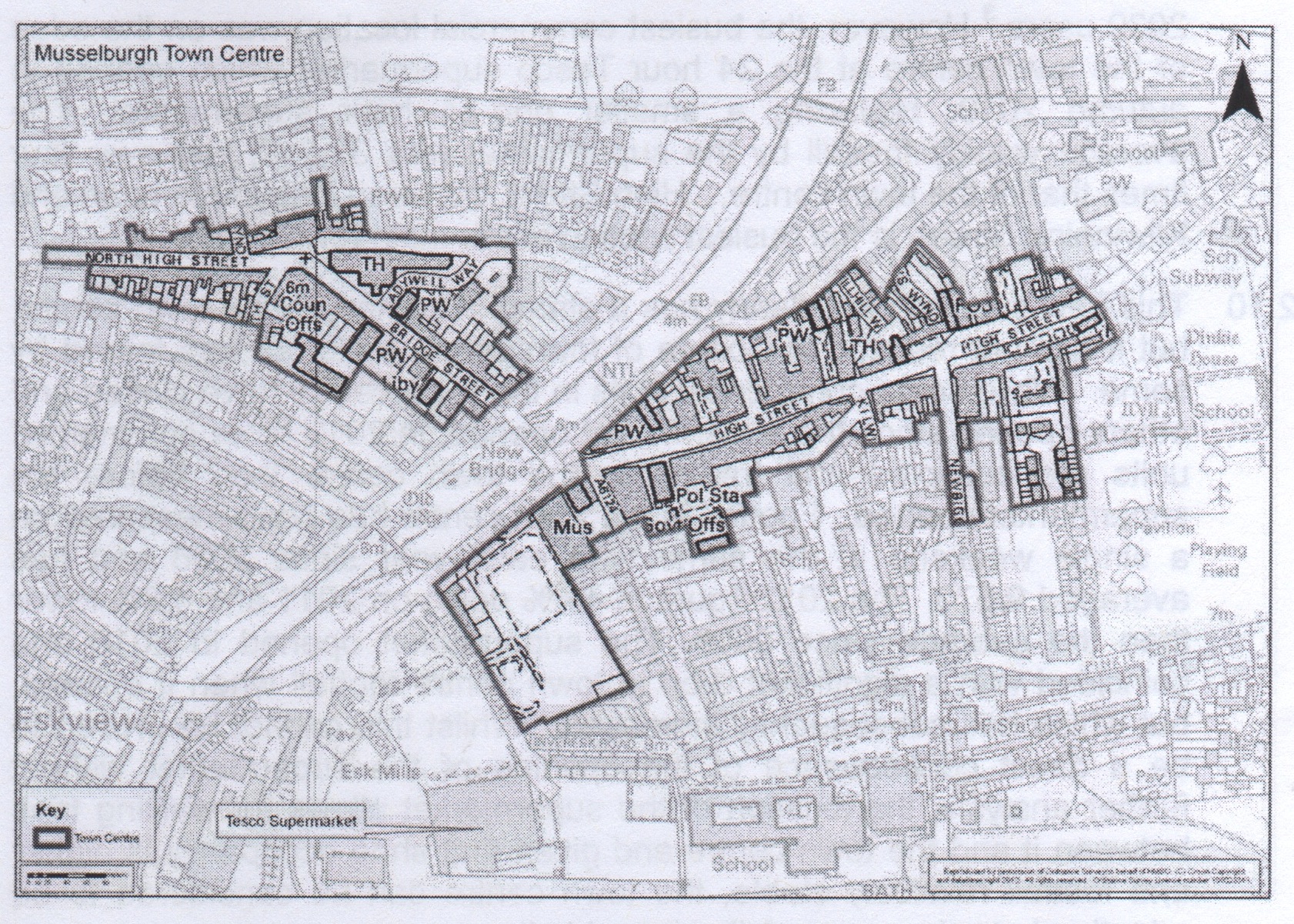
Areas Covered by the Town Centre Strategy

Areas Covered by the Town Centre Strategy

Conclusions drawn in the Strategy include:

  • The opening of a 24-hour Tesco had not had major impact and footfall numbers had been roughly static since 2008
  • The challenge was “to make the town centre more appealing to users”.
  • Planned interventions were required to do this although few redevelopment opportunities exist
  • A 24-point Action Plan, phased over short/medium/longer term

All of the above seems worthy and considered. But, digging deeper into the 24-point Action Plan leaves the reader with no clarity as to what strategy (i.e. the overarching plan, as opposed to operational/tactical detail) actually exists. This is compounded by the absence of any recognition—let alone action to address—a number of key factors identified in the document. This forms an unfortunate example of “Ready—Fire—Aim” which typifies a plan of action that has misplaced its strategic direction.

First of all, the map above illustrates the most glaring omission (despite being clearly stated in the third objective above) of the USP of the town centre is the Esk and its setting. Not only is this a most attractive aspect, perfectly sited to link the two components shown on the map, but the opportunity to do so is even more apparent than in the few Scottish towns that enjoy such an opportunity (principally Inverness, Ayr, Dumfries and Perth). The idea that the wide, green banks of this linear park could be woven in to the retail offerings with riverside cafes, restaurants, kiosks and recreational facilities is nowhere mentioned.

Secondly, the most unfavourable factor of heavy traffic all along the High Street and repetitive breaching of SEPA air pollution guidelines is nowhere addressed. Quite apart from the non-green waste of fuel that stagnant traffic symbolises, the constant noise and sight of traffic is unpleasant, quite apart from difficulties created in crossing the road. At present every single vehicle crossing between East and West must pass the single choke point outside the Caprice restaurant (25,000 vehicles each day). At no point has the possibility of re-opening Inveresk Road for access to/from Tesco/Eskmills or of the ‘Electricity’ bridge to link North High Street with Millhill—or any other traffic solution been mentioned, let alone considered.

Thirdly, the attraction of increased footfall is already embedded in the numbers provided but no conclusion drawn. The current footfall per week is barely 9,000, and that, spread over 178 commercial units is barely 10 customers each day. On the other hand, Tesco—not 300m from most of the area designated—enjoys over 37,000 per week. It seems obvious that attracting Tesco customers to spend time elsewhere would, if only 50% successful, result in a tripling of footfall and a revolution in business viability. The manner in which this could be done requires study but redevelopment of the underused council car park near Tesco beside the Roman Bridge into riverside business and the extension of this to the western end of the High Street that already backs on to the river would provide an attractive link to lead people to do just that.

Unfortunately, all three components appear to be outwith even co-ordination—let alone planning and financing—by East Lothian Council. There is a seven-figure provision in their capital budget, and that could provide a multiplicity of things: improved street furniture, spruce up shop-fronts, review heritage and its presentation and even revamp the Town House square to make it more pedestrian and event-friendly. But no concrete reasons are given why such things will alter the basic situation and no examples are cited illustrating where such measures have been effective elsewhere

While all these good intentions and supportive moves may indeed improve business in Musselburgh town centre, the mix so far echoes the effort made almost twenty years ago in Dunbar when several million were spent on a leisure pool and revamp of the High Street. That had no significant effect on improving business and, by altering the parking provision, caused some people to think it had actually damaged retail business. The present Musselburgh strategy (if it can be called that) pretty much fails the same test.

Posted in Commerce, Community | Tagged | 1 Comment

Winding Us All Up

After being trailed over the preceding weeks so much, there was little that was actually new to report when Osborne made his Autumn Statement last week. Most reporting was on the jousting of the Osborne/Balls protagonists in delivering/rubbishing it. (A more measured analysis was in the Financial Times.) But the sad death of “President of the World” Nelson Mandela following hard on it has only served to divert and so further restrict public debate.

Which is not good because the vagaries of this recession force Osborne out of an annual budget cycle into out-of-phase adjustments—this one apparently to proclaim the economy is ‘doing better’ at 1.4% growth. Not to be too much of a balloon-burster but ‘doing better’ and ‘not doing so badly’ are both positive signs that should not be confused with each other.

But the OBR are questioning whether growth is being driven by consumer spending; others question the absence of export-led growth following a period of effective currency devaluation. Some see this as Ed Balls’ focus on the “cost of living” is paying off. But only schadenfreude revellers could derive satisfaction from growth of 1.4% actually consists of 1.2% due to consumer spending and none due to business investment.

The ugly interpretation of this is another housing price bubble amid falling living standards across the UK. So, while Osborne claimed credit for putting his squeeze on welfare spend and the benefit cap centre stage, this also Labour into contortions of their own on state pensions and the so called ‘ triple lock’. Actually neither should be proud how the UK tax system appears to be targeted at the poorest 10%.

Amount of Wages Taken in Taxes by Decile 2011

Amount of Gross Earnings Taken in Taxes by Decile

But energy costs and support for renewables were the real zingers in this statement. Scottish Renewables have said: “the sharper than expected cut to onshore wind (strike price) will present a real challenge to developers, and could well mean that some projects don’t go ahead, slowing down progress towards our 2020 renewables and climate change targets.

Put another way, increasing uncertainty in the offshore sector will not be calmed by an increase of £5 /MWh from £135 to £140/MWh. This also puts any hopes for any renewables revolution out in the Islands at death’s door—already acknowledged by Energy Minister Ewing. They will need substantial financial support to survive.

The Scottish government has set challenging targets for Scottish Renewables and continue to strong-arm a rash of inefficient little turbines that contribute peanuts to self-sufficiency into sensitive rural areas. Onshore wind is still the most competitive source of renewable electricity but we are exhausting suitable sites for wind farms of economic scale and minimal intrusion.

The last of the six big shoes has dropped when E.On announced an average price rise of 3.7% for dual fuel customers, claiming this takes account of the changes to the green and social levies. This will still add £48 to the average bill in the new year, which is bad enough for individual households.

But, more ominously, this all puts the UK government on a collision course with the Scottish Government’s long-stated policy of becoming 100% green in energy generation. That strategy depends not just on existing wind but on massive offshore farms planned like Neart na Gaoithe which are essential to fill in generating segments still provided by nuclear and coal.

The alternative is for rapid development of both wave and tide technology but that, in turn, depends on massive development subsidies from either existing (thin) initiatives from Westminster or an equivalent amount from Holyrood which, given existing constraints under devolution they are simply not permitted to fund.

Is it Machiavellian or just realistic to wonder if Osborne is doing this on the threshold of the year of the Referendum just to wind the Scots up?

Renewable Capacity Built and Projected (source: Audit Scotland Sept 2013)

Renewable Capacity Built and Projected (source: Audit Scotland Sept 2013)

Posted in Environment, Politics | Tagged | Leave a comment

Oh, The Farmer and The Planner Should Be Friends ♫

This blog isn’t about to break out into Oklahoma-inspired song about how “one of ’em milks a cow with ease; the other steals his planning fees” but, as in the original musical, “that’s no reason why they can’t be friends”.

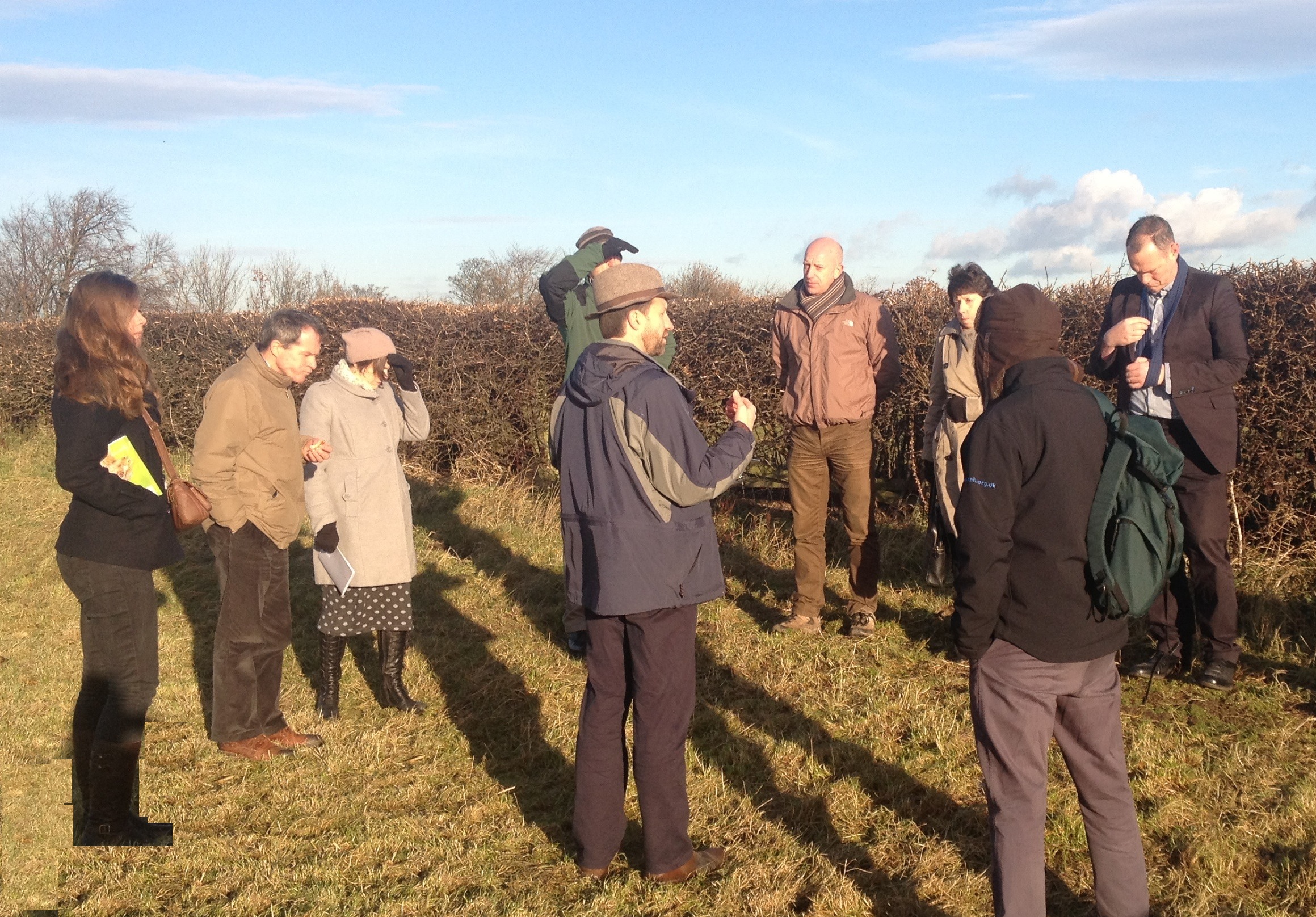
This insight came to me in the midst of a most instructive tour of the Winton Estate, kindly laid on by the estate owner, Francis Ogilvy, in an attempt to set up a dialogue with planning officials and relevant national bodies about the best way to develop business opportunities on the estate. He invited representatives of East Lothian Council, SNH, Scottish Enterprise, etc to spend a morning visiting the estate to see what had already been done and informally discuss what might be done.

In 14 years on ELC, I had never seen such a pro-active approach and it set me thinking. Most of ELC’s involvement with such large-scale, ‘blue sky’ thinking has been extremely limited. Leaving aside the myriad applications for window replacement or conservatory additions, their Planning department has been largely engaged with, on the one hand, receiving strategic allocations from the city region how many houses to provide and, on the other, fitting them into a local plan that wasn’t just a turkey shoot for developers.

A pivotal bulwark of their defence against the latter was a remains Policy DC1, which covers the bulk of the countryside and basically forbids any housing there that is not the conversion of existing buildings with minimal external alterations. In avoiding wholesale urbanisation and strip development, DC1 has been a success. But, as a tool of intelligent development of the countryside (as opposed to spreading houses all over it), it is blunt: “The answer is ‘NO’; now, what was the question?”

Francis was basically challenging the planning system to think more creatively than that about an estate with 1,000 years of history. Phillip de Sayton was granted the lands of Seton, Winton and Winchburgh around 1150 but were caught up in Henry VIII’s ‘rough wooing’ and Winton was burnt by the English Army in 1544. The 6th Lord Seton was made 1st Earl of Winton in 1600 and set about making a home out of the ruin.

Support for the Jacobite uprising of 1715 saw the capture of George 5th Earl of Winton whose land was confiscated by the crown and leased to the York Buildings Company. When they went bankrupt in 1779, the house was sold to Mrs Mary Hamilton Nisbet of Pencaitland. Mary was followed by Constance, her granddaughter who married Henry Ogilvy in 1888. Francis followed his father Sir David to become 14th Baronet. The whole estate was made over into a Trust a century later, with the house as its jewel.

Sir Francis Ogilvy and Family at Home in Winton House

Sir Francis Ogilvy and Family at Home in Winton House

The 1st Earl had engaged William Wallace, the King’s Master Mason as his architect who embodied his skills in the then-new Jacobean style in the restored house. His carved, pale stone twisted-chimney exterior in the style of the Scottish Renaissance still herald the palace within. His ornate plaster ceilings are the most elaborate in Scotland—so much so that casts were made to restore those in Edinburgh Castle to their proper magnificence.

So much for background.

The tour started in the house itself. As Winton House was designed for entertaining, it is a marvellous venue for bespoke dinners, conferences, meetings, activity days, team building events and special private events, such as weddings. Walls crammed with ancestral portraits and roaring log fires provide an atmosphere even 5-star hotels struggle to match. This activity started new business development on the estate, which has been augmented by self-catering and outdoor activities over the last couple of decades.

These have been financed so far by internal resources, which includes consolidating the three active and profitable farms and investing in key infrastructure such as a grain dryer and a district heating system, both run on local wood chips. While draft plans have been made for other activities, the whole purpose of the tour was to gain feedback and start dialogues that could help steer these without too much effort being expended on what would be dead-ends. Among the ideas floated were:

  • Conversion of Wintonhill  Steading into housing (fine views towards the Moorfoots)
  • Sand/Gravel extraction at Loanfoot, providing a large aquatic park and water sports
  • Addition of business (and perhaps some retail) space to New Winton village
  • Possible bakery/shop/restaurant social enterprise at Broomrigg Farm
The Tour at Winton Farm with Francis in Foreground

The Tour at Winton Farm with Francis in Foreground

Despite it being a chill day, there was a good bit of chat in the winter sunshine how business goals might be made compatible with both green and conservation objectives, especially as the economic driver of Edinburgh was so close. What was clear was that, because of a strong desire to resist rural over-development, no adequate forum was available to plan coherently for any development in the East Lothian countryside—desirable or not.

Virtually all agencies represented accepted that the present black/white approach which gave carte blanche to agricultural structures and banned virtually all else might be revisited, provided the defence against widespread tract housing was not weakened. Given that the City Region plan was close to completion and that the next Local Plan would then be formulated, the time seemed right for more in-depth discussion how a place like Winton could explore a profitable future while still preserving the highly valued unspoiled nature of rural East Lothian that makes it so attractive in the first place.

It would appear that a viable operation with deep local and historic roots like Winton offers the opportunity to explore how a such a multi-channel rural business could be sensibly developed in a sustainable manner for the 21st century. Rather than a blanket ban on all but (usually ugly and intrusive) agricultural buildings, this may be the opportunity for council planners to become more sophisticated in ‘enabling development’ so that the partial successes of Archerfield and Whitekirk can be improved on.

Large agricultural estates  were instrumental in leading the revolution in agriculture over 200 years ago. They bequeathed us gems we now treasure including planned villages like Athelstaneford and Tyninghame and the magnificent country houses that now decorate our countryside. Perhaps somewhere like Winton is already part-way down the road to making our countryside an attraction in its own right without despoiling it in the process.

Winton House Main Entrance

Winton House Main Entrance

Posted in Commerce | Tagged | Leave a comment

Fur Coat and Nae Knickers

Seldom can HM Government have been so embarrassed to spend so much and yet be so accurately pilloried for its inefficacy than in Angus Robertson MP, Defence Spokesman and SNP Group Leader at Westminster’s speech on December 3rd. The UK spends £40bn on ‘defence’. But, by trying to project strength globally, the UK Government’s delusional ego has left no credible defence of the UK itself.

The MoD focusses on being a ‘global player’. As a result, the current RN web site says “the core of the fleet” are their 13 frigates which “can typically be found east of Suez, safeguarding Britain’s vital maritime trade routes“. This rather avoids the practical substance of why the MoD even exists in the first place and underscored in detail in Angus’s forensic speech. It is a shame that so few people pay attention to what the government is doing in all our names:

“I think that Members from across the House agree that naval forces are there to protect and patrol, to secure freedom of movement, to enforce the boundaries of territorial waters, to control exclusive economic zones, and to secure the environment—a significant consideration—renewables and critical infrastructure. That is particularly important when one bears in mind what is likely to happen in the decades ahead with offshore wind, tidal and wave power and the development of super-grid systems, which are likely to connect Iceland, the Faroe islands, Scotland, Norway and the rest of Europe.

“There is no better place to start than with an incident that happened two years ago and has close connection to my part of the world. The 65,000-tonne Admiral Kuznetsov anchored on the edge of UK waters off my constituency. Other Russian ships that also sought shelter in the Moray Firth included the anti-submarine warfare ship Admiral Chabanenko, and the escort ship Yaroslav Mudryy.

Russian Carrier "Admiral Kuznetsov" with Escorts

Russian Carrier “Admiral Kuznetsov” with Escorts

“The vessels did not warn domestic authorities that they were going to come so close to the coast, and are believed to have blamed bad weather for making that approach. It was the first time the Kuznetsov, or a vessel of its size, had deployed near UK waters, and it was the closest in 20 years that a Russian naval task group had deployed to Scotland or anywhere else in the UK.

“In previous years, Nimrod maritime patrol aircraft would have been loitering and would have been aware of the presence of a Russian deployment of that size. Of course, by 2011, the UK had no such aircraft; it is the only northern European military without them. Nevertheless, the Russians were there without any UK escort. At that stage, the Ministry of Defence was relying on Scottish fishing vessels to report developments, including fly-tipping by the visitors.

“When the MOD became aware of the Russians’ presence, a 30-year-old Type 42 frigate, the HMS York, was scrambled from Portsmouth, around 1,000 miles away. That distance, at 20 to 24 knots, takes more than 24 hours to travel. The responsibility that the HMS York was fulfilling was that of fleet ready escort, which means being the deployable and capable vessel in UK waters ready to perform emergency response tasks.

“NATO has, as part of its immediate reaction force, standing NATO maritime group 1, which  operates in the eastern Atlantic. Similarly, standing NATO mine countermeasures group 1 operates in northern waters. They are relevant for future and current naval vessel provision, as they are standing operational commitments for allied nations, which provide destroyers, frigates and mine countermeasure vessels. It is notable that the UK has not provided vessels to either of the groups for several years.

“Similarly, on joint training, there is a real issue of properly committing current and, hopefully, future vessels. Last month saw the largest NATO training exercise in northern Europe in nearly a decade. Some 6,000 troops from 20 allied and partner nations took part in Steadfast Jazz, which involved land, air, and sea elements. Of the 6,000 participants in the exercise, the UK contributed precisely 52 personnel aboard a single mine hunter. It followed a large-scale exercise with maritime dimensions in Norway, where the UK provided just one aircraft, which is more than has ever been provided to the NATO air policing commitments in Iceland.

“When it comes to our immediate maritime backyard, the UK is sadly posted missing too often and is not taking its responsibilities seriously. The absence of any mention of the high north and Arctic in the most recent strategic defence and security review eloquently underlines my point.

“This is all especially relevant to Scotland when it comes to current and future conventional vessels. Scotland is a maritime nation with a sea area five times larger than its land area. Our coastline is over 11,000 km long—longer than that of the People’s Republic of China or India. It constitutes 61% of the entire UK coastline, and there are more than 800 islands. Remarkably, however, there is not a single major, ocean-going, UK conventional vessel based in Scotland to perform the key tasks that I have outlined”.

There are some amplifications needed in Angus’ speech, but only in detail, not in its general validity. These are:

  1. HMS York was actually a 5,200-tonne Type 42 destroyer (not 4,900 ton frigate). But, even so, had it been on-station in the Moray Firth, engagement with the Russian task force on its own would have been suicidal. It was paid off in 2012.
  2. Admiral Kuznetsov is only 55,000 tonnes fully loaded (yet still twice the size of any recent RN a/c carrier). Carrying 17 Sukhoi fighter and 24 Kamov helicopter aircraft, its task group was quite capable of also taking on remaining RAF strength in Scotland.
  3. Steadfast Jazz 2013 took place in November and was principally an exercise in ground deployment in Poland involving troops from Sweden and Ukraine. This highlights how the UK’s single-ship contribution was a trivial addition to a side-show.
Posted in Politics | Tagged | 2 Comments

I Was Proceeding in a Festive Direction

Today, I received the following e-mail from the Police Scotland commander of my local council’s patch. While undoubtedly sincere in wishing to help us locals enjoy a mishap-free festive season, in its dogged effort to cover all the bases, it does fail any test of a ‘festive message’—the mysterious “Operation Tinsel” notwithstanding: it fails to wish anybody anything, least of all “Merry Christmas”.

Quite apart from that, some personal element would not have gone astray—something reassuring like a local reference. That might dispel the impression that, under Stephen House’s direction, this same centralised message went out from Hamnavoe to Hawick.

_______________________________________________________

Festive Safety Message For East Lothian Public

“Police in East Lothian are issuing a safety message to ensure the public enjoy a safe and crime-free festive season. The Christmas and New Year period is a busy time for emergency services and local authorities with many people enjoying nights out across the county. During this time, a number of alcohol-related incidents are reported including disturbances, assaults and antisocial behaviour. Local officers will now begin engaging with their communities to promote responsible behaviour for those enjoying the festivities.

“To enhance our commitment to Keeping people safe, Police in East Lothian have progressed Operation Tinsel that will run between 4th December and 6th January.

“Licensing Officers will visit the various pubs and clubs within the region to speak with staff and remind them of their responsibilities when serving alcohol to patrons. Over the festive weekends, high-visibility patrols will be out during the evenings and will carry out inspections of licensed premises during this time. Any criminal activity witnessed will be appropriately dealt with.

“Police are also keen to ensure those enjoying the night-time economy are able to get to and from their destinations safely. Revellers are urged to plan their nights in advance and make sure they know where they are going; how they are getting there and back and whom they are going with. While within a pub, club or restaurant and when returning home, people are advised to always be aware of their surroundings and never leave items such as jackets and handbags unattended or unsupervised.

“Anyone wishing more advice on keeping themselves and their belongings safe can contact their local policing team or visit the Police Scotland website.

“With increased numbers of shoppers expected on the High Streets, the public are reminded to be vigilant for pickpockets and other criminals looking to obtain your money and possessions. Be wary of anyone acting suspiciously around you in crowded areas and always protect your pin number when withdrawing money or paying for gifts.

“The holiday season can also result in increased reports of housebreakings and thefts with criminals targeting the homes of those who have left to visit family and friends. When leaving your home unattended, ensure all windows and doors are locked securely and keys are not left in the keyhole. Where possible store items of value out of sight and report any suspicious activity around your property or neighbouring addresses to police immediately.

“Throughout December and January, increased police patrols will be deployed across East Lothian to identify potentially vulnerable properties and deter crime. Chief Inspector Colin Brown Local Commander for East Lothian said:

“The festive period is a time of celebration and relaxation for our communities, many of whom will head out and about enjoying a night out with family, friends or workmates. It is therefore essential that the public are equipped with all the necessary advice and guidance on staying safe. Simple steps such as drinking responsibly, planning evenings in advance and always being aware of your surroundings will help make sure your evening is an enjoyable and safe one.

“As part of our commitment to keeping people safe, we will be engaging with licensed premises across East Lothian and urging staff to use their best judgement and refrain from selling alcohol to anyone who appears to have consumed too much. Licensees will also be asked to report any criminal activity on their premises to police immediately.

“Higher levels of acquisitive crime are also reported during the holiday season and our communities should help safeguard themselves against thieves – both at home and while out.

“Keeping hold of your belongings when on a night out or when shopping will help deter would-be thieves, while appropriately securing your home when leaving it unoccupied make it far more difficult for criminals to strike.”

Ends

_________________________________________________

Posted in Community | Tagged | Leave a comment

Garbage In—Garbage Out

It’s not often that techies invent a buzzword but when ‘FIFO’ (the technical term for a serial data buffering device in a computer—first in, first out) was bent into GIGO, a new OED term was born to mean the quality of output for any system is entirely dependent on the quality of what you put into it. As with many cool phrases that come into public use, GIGO has so many varied uses that it has become everyday.

Unfortunately, this applies to some areas where we all wish it was not so, This includes hospital catering. The NHS across the UK has a sterling reputation for dedication by staff and their universal commitment to health for all. That does not, however, extend to hospital food, which has suffered an evil reputation for decades. And now that NHS needs to cut costs in areas other than clinical services, catering has been in the firing line. So parsimonious have some administrators become that patients are being fed for less than £3 per day. (Western Sussex Hospitals NHS Trust = £2.57; Harrow Primary Care Trust £2.75; North Somerset PCT £2.76), to name but three.

On the other hand, Kirklees PCT spends £19.81, University Hospitals Bristol NHS Foundation Trust (£17.46) and Cumbria Teaching PCT (£17.85) but that has done nothing to give hospital food a decent name because they don’t taste six time better. Palatability aside, there are serious questions as to the nutritional value of what is being served. Sandwell and West Birmingham catering output has no proper dietary control because the kitchens don’t operate with menus; dieticians involved therefore must guess whether sufficient nutrients in the right balance are being delivered to patients.

And that delivery itself ought to be under better scrutiny. In the current system, caterers load up trolleys with similar-sized portions to be taken into wards, regardless of whether patients are hungry. Many kitchens have been centralised: meals are delivered from a large facility either in urns (for medium-sized facilities) or ‘plated’ (stacked on trays) for distribution to smaller sites and within the main hospital supplying it.

Catering administrators are supposed to regularly monitor both consumption and quality. Many seem to regard and element of the meal touched (e.g. a spoonful from a pudding) is a meal consumed; outlying facilities simply empty their urns and provide no feedback.

The resulting statistics are meaningless: many trusts report food wastage below 20%, which is bad enough. But more accurate surveys that actually follow the food to the patient and record what they do not eat come up with figures between 40 and 50% wastage. It is not for want of funding. In England, the Department of Health claims:

“The amount of money hospitals spend on food has gone up over the past five years, with the average at £6.53 per patient per day in 2005-06, rising to £8.58 in 2010-11.”

But, looking closer at actual catering, very often, contracts for bulk food prepared outside have been let to industrial caterers like Brakes, Bunzl, 3663, etc attracted by huge amounts of money paid to outside caterers who win the contracts and who are tempted to inflate their costs and use cheaper ingredients to maximise profits. This results in little by way of creative planning by catering managers, a production line for industrial glop in the kitchens and little to motivate—let alone inspire—chefs and staff.

The Campaign for Better Hospital Food claims that between 1992 and 2013 there were 21 failed voluntary initiatives to improve hospital food, costing more than £54m. Journalist and broadcaster Loyd Grossman and celebrity chefs by the cauldronful—Albert Roux, John Benson-Smith, Mark Hix, Anton Edelmann and Heston Blumenthal—have all been drafted in to help improve standards. Things have yet to improve.

But, rather than a few TV shows of terrified toques with bleeped-out swearing, surely the hale clamjamfrie could be fixed by management with a grasp of both spreadsheets and people motivation who set up a catering system with restorative nutrition at its heart, viz:

  1. Set a clear budget per patient that is reasonable and consistent—something like £5
  2. Investigate local produce availability and develop draft menus with dieticians based on sourcing fresh, healthy supplies wherever possible.
  3. Supply menus to the patients who can then order ahead of time = minimise waste
  4. Properly track consumption of meals, using feedback to adjust menu = minimise waste
  5. Allow chefs and other kitchen staff to contribute to new recipes.
  6. Extend this to staff canteens & consider opening them to the public. “Pat’s” at Scarborough hospital not only runs at a profit but has brought food waste rates in the whole hospital down below 10%.
  7. Train staff to serve food properly; medical staff who have other priorities will sling it about like in an Army barracks
  8. Though this may be the bleeding obvious, inappropriate food should not be served to people who have specific medical and healthcare needs.
  9. Establish a “protected meal times” policy on wards so that people can enjoy food without interruption

A culture far too prevalent among ‘administrators’, hired in the nineties to make the NHS more ‘professional’, is knowing the price of everything and the value of nothing. They will argue suppliers down 1p on a box of sauce sachets but ignore when local soft fruit growers have strawberries coming out their ears. Rather than dictating top chefs, they should be following chefs’ directions, all within a clear budget per head.

It requires thinking. But anyone on their salary should be doing that as a matter of course and not foisting some formulaic glop onto patients whose recovery is not helped thereby—just because it’s easier to let the Bunzl rep handle everything. The real scandal is that many patients are prescribed diet supplements just because of the poor nutritional value of much NHS food—and they have a wastage rate (by not being taken) the same as any other prescriptions of around 40%.

Posted in Community | Tagged | Leave a comment

How would you build a nation?

The Burd is no stranger to nailing the Zeitgeist but anyone on the swither about whether Scots should run their own affairs reading this won’t get fiscal stats why we’ll be better off. But they will get lump-in-my-throat-pride at being Scots.
The only obvious omission from her uplifting list is a scribe whose passion lucidly articulates how a nation can better itself. But the Burd is too modest to list herself.

burdzeyeview's avatarA Burdz Eye View

If you had the chance, how would you build a nation? What qualities would you want your people and communities to have?

Courage, certainly. To decide in a split second that the right response, the human response to extreme adversity is to turn and face it, not run from it. Just as Jim Murphy MP did when he found himself passing the Clutha bar in Glasgow just as a terrible incident occurred. He could have stayed in his car, called 999 and waited for help to arrive. Instead, he and others, acted to save others, walking into an unknown situation, compelled to do so by some unbidden sense of duty and willing to set aside notions of risk in order to help people in need.

Also, prescience of mind. The ability to make a judgement call and make the right one. Thus, it was not enough for Edward Waltham to…

View original post 1,168 more words

Posted in Uncategorized | Leave a comment

Per Ardua Ad Asda

It may be flippant to paraphrase the RAF’s motto into a cynical equivalent for the Royal Navy but purchasing chickens now coming home to roost under Admiralty Arch are a product of a whole series of predecessors to the luckless Phillip Hammond as Minister of Defence. All of them have been faced with an impossible task: sustain global commitments on a shoestring budget. His particular crime? To be the mug holding the parcel when the music stopped.

For decades, Britain has deluded itself that it could achieve the twin goals of securing jobs by building huge defense contracts in the UK. Despite some catastrophic outcomes from this—from Blue Streak in the sixties to Nimrod replacement in the noughties—’big-ticket items’ like warships have been built in UK yards, most recently mostly those of BAE.

BAE is a prime illustration of how heavy industry in the West struggles to survive in a world where developing countries are increasingly assuming their own naval shipbuilding. Worse than that, it is now obvious that a private company’s primary focus on profitability cannot be reconciled with a government’s sovereign requirement to build warships in domestic shipyards.

It is now equally clear is that European governments eager to cash in on the post-Cold War peace dividend deluded themselves into believing that costly and unprofitable industrial activities, such as naval shipbuilding, would become sustainable and affordable simply by virtue of being handed over to private industry. This convenient fiction—that privatised shipyards can better compete for commercial ship orders—is now conclusively discredited.

Reality has now prevailed, starting with the RN building its next replenishment ships in South Korea because British shipyards couldn’t compete on price, & the Royal Navy budget balked at paying British prices. So much for Scottish yards being banned from bidding for RN contracts post-independence. Even Hammond has been forced to concede:

“We hear a great deal about how shipbuilding will be sustained through the commercial market and the third-nation market, including the market for warships, but I am afraid I have seen no evidence to suggest that we are able to compete in what is a very aggressive global market for commercial shipping.”

What is that ‘global market’? Well, the situation a century ago was Europe built 80% of the world’s ships and the Clyde was grandaddy of ’em all. That profile has changed massively with Europe down below 20%, South Korea boasting 8 of the 10 biggest yards and even Japan being beaten to those last two spots by an emerging China. As well as dominating the market, these three countries have effectively edged European yard out of most shipbuilding segments.

Share of SHipbuilding Segments by Major Producers

Share of Shipbuilding Segments by Major Producers (CESA = All Europe) (source: Study on Competitiveness of the European Shipbuilding Industry, ENTR/06/054, ECORYS SES Group)

Europeans had already been penned into the most expensive passenger segment (liners, ferries, large yachts, etc), as well as the similarly expensive military (not listed above because relatively small in tonnage). Meanwhile, low labour costs (not necessarily labour efficiency) have secured oriental yards the bulk of world tonnage construction, 99% of it for export.  Despite their technical skills, Europeans gave up competing in the bulk carrier market; even the Danish container giant Maersk couldn’t build its own ships economically.

However, because of jealous protection of home industries endemic in Europe, over 300 yards still exist—most of them hopelessly small and inefficient and just a few (like BAE) more hopefully big. But still inefficient.

Map of European Shipyards Coded by Size

Map of European Shipyards Coded by Size

Whereas European production per enterprise averages €4m, in South Korea it is €22m and €34m in China. Such efficiencies of scale are amplified building a 350,000-ton ULOC or 500,000-ton ULCC. The Portsmouths and Govans—let alone the St Nazaires and La Spezias—have been coddled from this cold reality so long they cannot compete on a level playing field of true competition, This is doubly true as recession still depresses shipping demands, operator incomes and shipping earnings, as measured by the Baltic Index.

So, even if the dozen-or-so Type 26 frigates as desired by the RN (plus proposed yesterday to form the blue water element of any Scottish Navy) are built by what remains of BAE shipbuilding, such has been the isolation of most yards from economic reality by their  governmental protection. Unless BAE makes a step change to its yards’ efficiency, these may be the last bespoke warships the RN has the luxury of commissioning.

Had the Admiralty been less bloody-minded and followed the RAF’s more pragmatic procurement, the acceptance of ‘foreign’ designs (c.f. American Apaches or Eurofighter Typhoons) might point to more positive options where they retained some control. But shipbuilding in the UK has become a shadow of itself even more than it has in Europe.

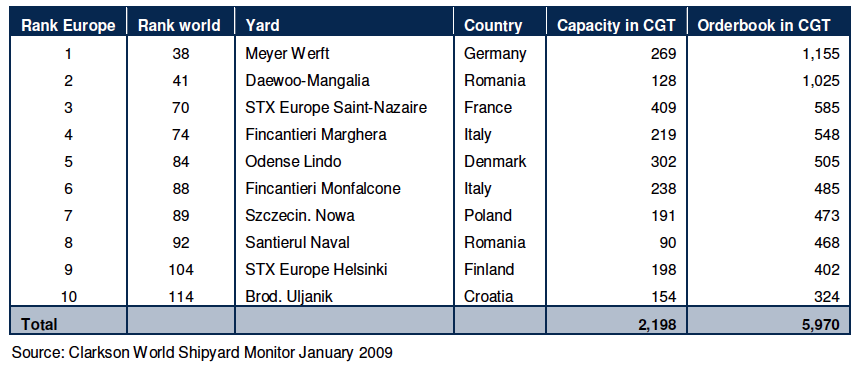
Top Ten Shipbuilders in Europe

Top Ten Shipbuilders in Europe (Note: STX indicates a subsidiary of STX in Korea)

Any further large warships for the UK are therefore likely to be limited to non-custom (and non-local) designs with broader appeal and built by yards that can spread costs across many multiple units and customers. That’s how orientals shrewdly came to dominate this business—as the shipyard equivalent of ASDA.

Posted in Commerce, Transport | Tagged | Leave a comment

Britain Is Broke

Making that statement does not fill me with great joy. There may be an entirely different social debate about wealth distribution that could equally have headlined “Britain is Broken” but this blog is about fiscal facts—that Brown’s smug ineptitude and Osborne’s bitter medicine have combined to bring one of the world’s great economies effectively to a level of stagnation that few (no?) analysts predicted seven years ago.

The statement is made with reluctance because this author is British, shares the islands’ culture with the other three nations and is downright proud of how much this medium archipelago influenced the development of civilisation. All great stuff. But all in the past and, rather than wear our stiff upper lips, hoping they’ll provide more than further demonstrations of fortitude, we all need things to change.

We Scots need our chance to find our own fortune. This deal with our English friends has been a good one for both sides. But, ever since the Masters of the Universe took over the asylum (sorry—Canary Wharf), England especially has lost the plot and there is little sign of it re-finding it, even after the most serious fiscal train wreck in living memory.

So the Scots are offski—and here’s why. Whereas, once, big countries were the answer to endless petty wars that plagued civilisation, now we’ve learned to coexist and desist from nuking each other, a similar extinction-level event to that which once wiped out the dinosaurs is underway: it’s the smaller, nimbler, more flexible creatures that will survive. Britainosaurus has gone the way of Monty Python’s parrot—it’s just too ponderous  a beast for news that it’s dead to have reached its tiny brain yet.

And, lest some flag-waver think I’m being flippant and/or biased and/or too lazy to put a substantive case, allow me to post as exhibit ‘A’ the table below, which draws together some salient figures, comparing the economy of Scotland with that of the UK.

Key Trade Balance Statistics for UK and Scotland

Key Trade Balance Statistics for UK and Scotland

The first thing to notice is how the situation has deteriorated for the UK as a whole. In the seven years to 2012, the trade imbalance worsened with that between UK and EU doubling. Also notice that the UK became a net oil importer, losing a once positive balance to spend 10% on importing what we once sold. The result is that the worrying £60bn trade deficit of 2005 has ballooned to almost double and new represents each person in the UK living £1,710 above their means each year.

Contrast all this with Scottish statistics, which Whitehall has doggedly obfuscated in their eagerness to undermine the idea that Scotland is economically viable without the steadying hand of its bigger brother down south. Note that in all three main categories, the Scottish account is positive, culminating in an estimated £21bn trade surplus, once the largest chunk—trade with England—is taken into account. Small wonder that anyone in Whitehall in the know is desperate for Scotland not to leave.

Even allowing for inaccuracy and the extensive negotiations that would precede any such step, these figures don’t just make a formidable basis for an independent Scotland; they flag a little caution to both our English cousins and to anglophiles in Scotland too (among whom I count myself). Because we all live in an interwoven world. If the fortunes of distant trade partners affect prosperity, how much more true for our close neighbours?

Even if the future were blindingly rosy for the Scots themselves, little would be achieved thereby if England were to continue on its present socially disruptive and fiscally dogmatic path. Look at the numbers above: trade with the rest of the UK (94% of which is England) dwarfs Scottish trade with elsewhere. Though Scots will make their own choices, ignoring what would be good for England (even if England seems oblivious to what that might be) will damage the Scots ability to achieve new aspirations. If the English economy sneezes, we will still risk catching flu.

So what might that entail? Keeping the pound for one. It’s in both our interests because: a) it will cause least disruption to Scots business and keep an economic flywheel working for us and; b) the English will benefit from it remaining an oil currency and Scots exports propping up its exchange rate and bank interest grade.

A second is steadying the English wobble on Europe being fomented by UKIP and benighted Tory backwoodsmen. Clearly the EU needs some straightening out but, in LBJ’s pithy phrase, it’s much better to have ’em in the tent pissing out than to have ’em outside the tent pissing in. Look at the trade both England and Scotland have with Europe; we both need to be at the table (with Eire?) making our case against Spanish fishermen, French farmers and all the other initiative-stifling lobbies.

We could even spare England a wheen of pain on defence. Without the Scots, their £40bn defence budget would be doubly unsustainable. This will force the MoD to take either the decision to axe England’s long-expired global role or to cancel Trident’s replacement for which there is no sane use—or both. Forming a team with Scotland and Eire, English defence could focus on heavy ground forces, long-range naval ASW/strike ability and a beefy air force to combine with Scots and Irish doughty infantry and specialist long-range maritime security into an interlocking North Atlantic component of NATO.

And, if the Scots succeed—as they are lining up to do—in becoming the literal powerhouse of Europe, leading to us breaking down centuries of British isolation by re-forming close ties we once had across the North Sea, this would finally drag the English closer to their natural allies—the Germans. And if they taught all of us a thing or two about supercharging economies, how much different would the EU look? Imagine a productive, socially advanced northern bloc leading the rest out of Mezzogiorno miasma to more enlightened prosperity, setting an example to BRICs, the 3rd world & even the USA itself.

It sounds very high-minded. But so did the Magna Carta, the Declaration of Arbroath and the Declaration of Independence. But in the turgid, post depression atmosphere of today are such inspirational concepts not urgently needed? For it is always some ordinary folk, moved by passion and belie—and never the smug establishment—who achieve mankind’s great advances, especially when confronted by a dim and uncertain future. If Britain is indeed broke, then at what point do we stop trying to fix it, lift our eyes and move on?

For when would be a time of greater need for advancement than now?

And who is in a better position to achieve it than the Scots?

Sources:

  • Scottish Tax Forecasts, March 2013, Office for Budget Responsibility, ISBN 978-1-909096-74-5
  • Scottish Draft Budget 2014-15, September 2013, ISBN: 978-1-78256-844-5
  • UK ENERGY IN BRIEF 2012, July 2012, DECC/1.3k/07/12/NP. URN 12D/220
  • Estimating Oil and Gas Flows for Scotland, November 2013, Scottish National Accounts Project (SNAP)
  • Scottish independence: the fiscal context, November 2012, Institute of Fiscal Studies, ISBN: 978-1-903274-96-5
  • Energy imports and exports, 30th August 2013, House of Commons Library SN/SG/4046
Posted in Commerce, Politics | Tagged | Leave a comment

Enough with Racket Science

Yesterday, my normally chatty barista went all quiet when one of my coffee buddies brought the chat around to independence by speculating on the White Paper due out this coming week. When prodded, she looked awkward, but blurted out “What with all these deadbeats on benefits and students not paying fees, we couldn’t afford it.”

But it set me to thinking: with all this barrage of misinformation across the media, why wouldn’t it look like a bad deal? Back in March, the Daily Record was wringing its hands at a “huge drop” in North Sea oil tax, quoting Michael Moore in furrowed-brow mode:

“There is a gulf between those independent OBR figures and the hugely optimistic numbers published by the Scottish Government last week.”

Last week, the Institute of Fiscal Studies published their Briefing Note 135 “Scottish Independence: the Fiscal Context” As with so many such papers, Better Together fell over themselves using it as evidence that more taxes or less services would be inevitable while Blair Jenkins declined to meet it head-on, saying only:

“Only a yes vote can put in place the economic levers to produce policies best suited to the needs and aspirations of our people.”

Enough with this racket science where one side tries to drown out the other. It’s the reason one in three Scots remain undecided on this vital matter. Most are clamouring for some information they can trust to help them decide under which choice they or their family will prosper better and life will be the rosier.

Let’s de-fang some of the numbers and maybe opposing arguments will make more sense. The Office of Budget Responsibility (OBR) is the UK’s attempt to provide independent commentary on government finance, especially its projections. The 40-year-old IFS is “Britain’s leading independent microeconomic research institute, and as authoritative commentators on the public finances, tax and welfare policy“. As both are London-based, expecting 100% objectivity may be asking a great deal. Nonetheless their analysis is by professionals and pivotal questions thrown up deserve reasoned answers and not just more boo-sucks racket.

OBR projections in March for tax revenues collected within Scotland to drop were described as “disastrous”. But examining the numbers and taking (as OBR does) UK Treasury projections as reliable, this means (for example) UK income tax take will dip below £144bn this year but then rise rapidly to £188bn in 2017-18. Income tax take in Scotland is proportionally far lower—around £4.46bn this year, rising to £5.54bn by 2017-18. This is lagging UK growth in tax take by over 5% and was seen as an example of how staying in the UK would benefit Scotland.

However, what was not said was the comparison with Scotland’s settlement, already projected over a similar period to drop from £30.6bn to £27.2bn—a 10.9% reduction. Put another way, Scotland staying in the Union means that the UK Government will get around £0.28bn less in income tax from Scotland than it might expect from a similar-sized chunk of England—but it will save £3.2bn in the basic devolution grant to the Scots. Sweet.

This newer IFS analysis is full of statistics, most of which seem correct. They (rightly) detail that money spent is £11,801 per head in Scotland but some £1,200 lower in England at £10,630 (2010-11 figures) and point to the following as main differences:

  • enterprise and economic development (£157 per person vs £80 per person);
  • agriculture, fisheries and forestry (£184 vs £84);
  • transport (£521 vs £345);
  • housing and community amenities (£340 vs £206);
  • recreation, culture and religion (£301 vs £209).

The second and third points are easily explained in that each Scot has 30 times as much geography (and most of it rugged) as compared to England. That takes care of 1/4 of the difference right there. But it is when we examine the contribution made that the balance is seen to be fully compensated for. Like the UK government, IFS are coy when it comes to allocating oil tax revenues—arguing they might be allocated on several bases, such per-head—and lump them into a third ‘region’ neither Scotland nor England but ‘offshore’.

But the only legally tenable solution (and that used globally for the allocation of maritime resources) is geographic, with Scotland owning 80.4% of the oil and gas resources in UK waters. On this basis, even the IFS accept that Scotland pays more than its share:

Revenue Income to UK Government

Income to UK Government from Scotland

So, even the IFS (when pushed) accepts that Scotland contributes more than it costs. But, while it may provide accurate figures and manipulate them accurately, the IFS paper makes several major assumptions that seem like suspicious attempts to undermine independence and echo unionist arguments of the fiscal dangers of not being in the UK.

  1. Oil Price. We are forever hearing how volatile the price of oil is. But not one oil economy is poorer than Scotland.  Norway has even managed to amass a £300bn oil fund in the past, so it could not have been all bad. Moreover, examine oil prices and we see spikes in the seventies and in 2007/8 but the other 90% of the time has seen a steady rise from $15 to $110 per barrel, which means what is still to be pumped will be worth a lot more than what has already been extracted. Recent private announcements of £4bn investments in exploration confirm a solid future for decades.
  2. Policy Inertia. Nothing in the IFS paper allows for any change of policy from that laid out by Cameron and Osborne for the UK. Leave aside whether they still call the shots post-2015. Their UK-based vision sidesteps much of the fiscal advantage independence offers. On defence alone, Scotland could save £1.5bn annually—£300 per head. Even policies already devolved offer relatively easy savings (free concessions, eye tests, prescriptions could re-inject £1bn into the coffers if repealed)
  3. Public Debt. From modest levels when Prudence was alive and well, Tories and Labour alike have saddled us with massive public debt—currently £1.2tn and growing at £8bn each month. The Scottish share of that will have grown to £120bn before we can achieve independence. It would take £2.5bn to service that and start paying it back. The good news is that’s achievable by oil revenues and defence savings alone (see above). The UK will not find it so easy repaying £30bn annual interest, especially if they don’t keep the Scots within sterling zone and the UK£ is no longer an oil currency.

So, neither the OBR nor the IFS should be seen as enemies just because they’re used by desperate unionists in their racket science. Once understood, their papers fuel the arguments that independence could provide an enlightened Scotland with fiscal wriggle room to re-think modern tax policies—drop Corporation Tax, get heavy with rich exiles, re-think land ownership and support growing industries for the future like renewables, food and drink (esp whisky), specialist engineering (esp marine and computer games), tourism and even bulk water export.

If a fraction of all that were to succeed, 10,000 jobs with a future are neither pipe-dreams nor insignificant in our much smaller workforce. Quite apart from a positive effect on tax take, this would have significant knock-on in service industries, retail turnover, property values and balance of payments. And if this seems to be fueled by optimism, it needs far less optimism than Osborne’s shaky recovery that seems too dependent on consumer debt and London property values than any significant boom in real industry or export.

Or are we so fixated on the UK’s own admittedly scary numbers that we’ve forgotten how gallus we could be in going out and creating ones that suit us and our ambitions better?

IFS: Scottish independence: the fiscal context (P. Johnson & D. Phillips) Nov 2012 BN135—ISBN: 978-1-903274-96-5
OBR: Economic and fiscal outlook—Scottish tax forecasts March 2013—ISBN 978-1-909096-74-5
Posted in Commerce, Community, Politics | Tagged | Leave a comment