C’mon get aff

Appalled as I was at Barrosa’s smug declarations on Sunday’s Andrew Marr Show (complete with sleekit protestations that he “did not wish to interfere”) it seems that I should have been even more appalled at his self-serving position and Marr’s docile acceptance of it.

weegingerdug's avatarWee Ginger Dug

Speaking on the Andrew Marr Show on Sunday, European Commission President José Manuel Barroso repeated the Glesga clippie objection to Scottish membership of the EU – c’mon get aff the bus and get tae the end o the queue.

Funny how it’s only the negative stuff that gets blanket coverage on the telly news isn’t it? Here we go again, a new day and a new scare story, or more precisely an old scare story reheated.  This one has been reheated so often that it’s little more than a toxic mass of bacteria which is unfit for human consumption, but that doesn’t stop the BBC presenting it as a tasty little delicacy.  They think if they coat lies in lard and deep fry them, Scottish people will consume them eagerly.

Barroso is a member of the European Popular Party  He belongs to the same centre-right cabal as the Spanish Partido…

View original post 738 more words

Posted in Politics | Leave a comment

Come Back, Canute: All Is Forgiven

A factor that is constantly overlooked in any debate comparing Scotland with England is the fact that, although the coastline of Scotland dwarfs that of England by a factor of three, it is nonetheless much more stable and not as vulnerable to global warming and to sea level rise that—surprisingly—conspire in Scotland’s favour. But—more importantly—they make the impact of the present flooding pale by comparison with what might come.

It is not just that Scotland has relatively few low-lying coastal areas and considerably more high moorland and mountain terrain. Measurements taken over decades reveal that, while Scotland and Northern England are still rising faster than sea levels, Southern England is sinking at a rate that effectively doubles the rate of sea rise. Many don’t see that as a problem, given sea levels rise by a millimeter or two a year. But that is changing.

There is a general consensus that global sea level rose by 20cm in the 20th century, But there is much speculation that it will be more this century, with many predicting around 40-50cm. Adding in the effect of sinking land would make that figure more like 55-65cm. The equivalent figure for Scotland is half—25-35cm. That alone would test sea defences on the relatively low-lying English coast but have minimal effect on the 10,000km of rocky, mostly mountainous coast in Scotland.

But then consider some less likely but nonetheless real scenarios. The science tells us that warming seas accelerate the process: glaciers don’t regenerate; ice sheets (which reflect much sunlight) melt to expose darker sea (which absorbs it); The Arctic ice sheet has halved in area, opening up the Northwest Passage past Canada in the last two summers. Current estimates are that melting polar ice sheets contributed 11cm to sea levels in just two decades and this is accelerating fastest of all. This is where it gets scary.

The melting of small glaciers and polar ice caps on the margins of Greenland and the Antarctic Peninsula melt, would increase sea level around 0.5 m. But collapse of the grounded interior reservoir of the West Antarctic Ice Sheet (WAIS) would raise sea levelsby 5–6 m. Melting of the Greenland ice sheet would produce 7.2 m and of the whole Antarctic ice sheet a whopping and catastrophic 61.1 m of sea-level rise.

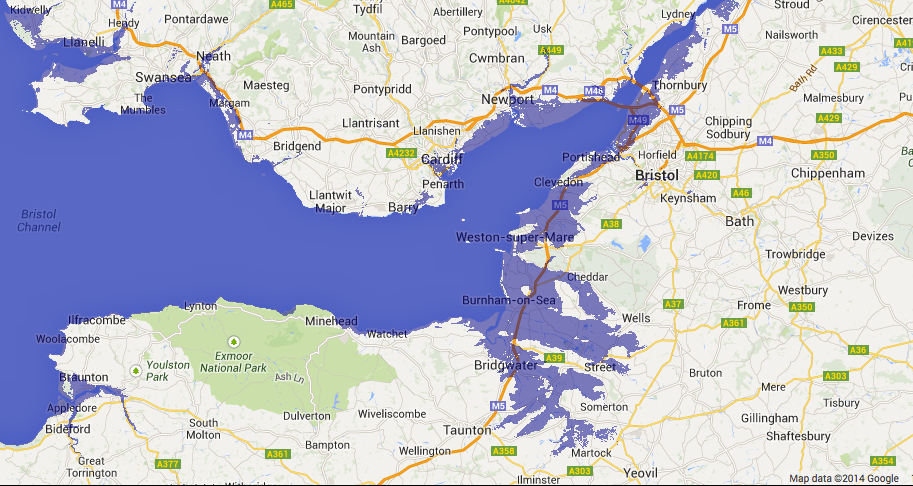
Anyone not living in Tibet or Bolivia ought to be concerned about this. Given recent fracturing of the smaller Weddell ice sheet, loss of the WAIS alone is a distinct possibility for this century and would drown several countries, including the Seychelles, Singapore and most of Holland. In this case, we are talking about an 8m (25ft) total rise in sea level in Southern England. Given the recent demonstration of the vulnerability of the Somerset levels, if the above occurs that part of England becomes shallow sea, much like the Wash.

Effect of 8m Rise in sea Level on Bristol Channel (purple indicates flooded land)

Effect of 8m Rise in sea Level on Bristol Channel (purple indicates flooded land)

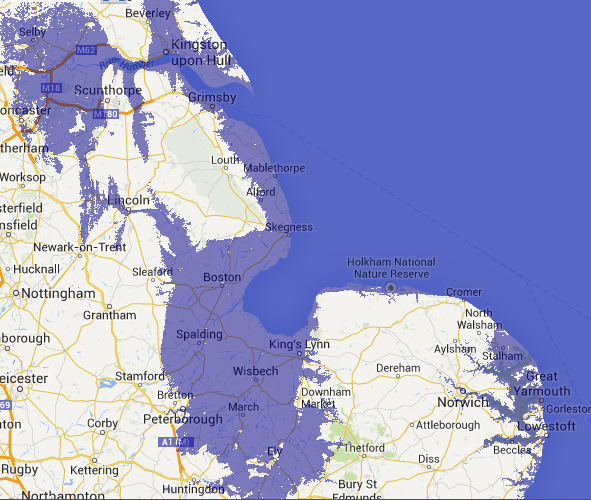
Bad though that is for the folks of Somerset, it is relatively benign compared with the equivalent 8m scenario in Eastern England. That area has not suffered the nearly as much recently as the brunt of recent storms hit elesewhere. But it was hard-hit by the Fen Flood of 1947 and the Great Flood of 1953 which devastated swathes of Essex. This area would actually be hardest hit of all by a steady sea level rise, as shown below.

Effect

Effect of 8m Rise in Sea Levels on Eastern England (purple indicates flooded land

Here the scale is ten times worse, with over a hundred square miles of fertile farmland, hundreds of towns, plus Cambridgeshire and much of Lincolnshire lost to the sea. Though civil engineers could get clever and build big enough to protect the Somerset levels from inundation, such is the sheer scale of vulnerability here that no coherent defence against flooding is feasible.

Though an 8m rise there would not tally up in terms of area like Eastern England, by far the worst flooding in terms of impact would be the Thames estuary. Greater London contributes £280bn to Britain’s economy—roughly one quarter in terms of gross value added and this would be substantially crippled by an 8m rise in sea levels—a situation in which the Thames Barrier would be so overwhelmed as to become little more than a navigation hazard.

Effect of 8m Rise in sea Level on Thames (purple indicates flooded land)

Effect of 8m Rise in sea Level on Thames (purple indicates flooded land)

The entire estuary and docks area, both financial districts, Southwark, Westminster and hundreds of metres either side upriver to Richmond would be flooded and/or tidal. Half the mainline train terminii would be gone, the Tube flooded and the only public transport working would be the Thames catamarans. Massive flooding along the South coast, with coastal towns from Portsmouth to Worthing all gone, Thanet an island again and Uckfield able to build a marina, would be serious but trivial in impact by comparison with London.

Were all this come to pass within the next century, even a large, leading economy such as England’s would be unable  either to absorb its impact, or finance the scale of engineering required to mitigate—let alone combat—biblical disaster on this scale. And though other countries may not be hit as badly in proportion, the global economy would be crippled.

England would need to look to its friends and, since swathes of Europe and the States would also suffer badly, one of the few countries least affected, probably disposed to help and close enough to do so would be Scotland—whether independent or not. Because of its rugged geography and rising landform, the equivalent maps for Scotland, while chilling, do not display anything like the catastrophe shown above for England.

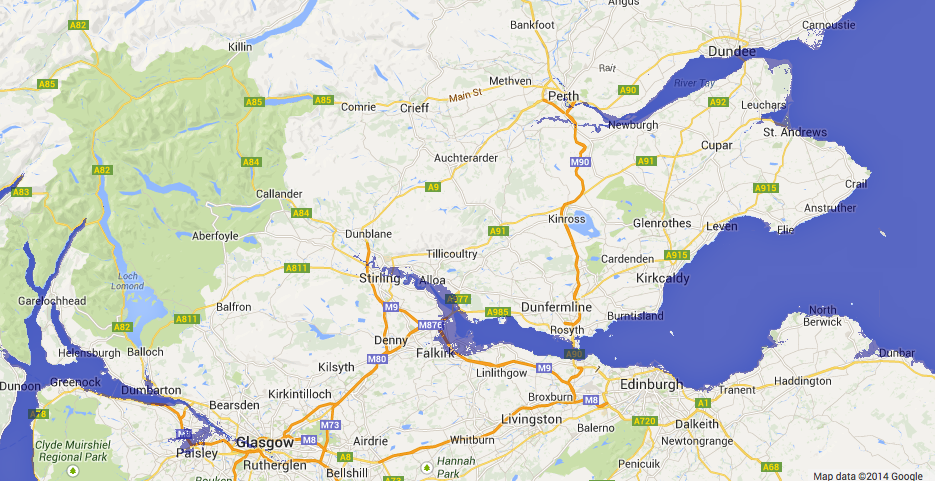
Effect of 8m Rise in sea Level in Central Scotland (purple indicates flooded land)

Effect of 8m Rise in sea Level in Central Scotland (purple indicates flooded land)

Though there will be major problems in Paisley and Falkirk/Grangemouth, some coastal farmland flooded and more robust bridging problems to be faced at Stirling and Perth, given flood defences for the Clyde, some 90% of the country’s economy could, with some adaptation, function normally. Indeed oil platforms are built to withstand waves larger than 8m, the associated storms that we’re seeing now would provide additional renewable power and that will come in handy with all England’s base-load nuclear power stations at Hinkley Point, Sizewell, Dungeness and Heysham knocked out by coastal flooding.

With plenty of space, Scotland would be able to house a significant number of the 8-10 million who would be rendered homeless by the sea. Many would enjoy a new quality of life close to the heart of things, revitalising areas of the Borders, Ayrshire, Fife and the Mearns. Others could find work further north in the booming offshore energy market around Cromarty, the Celtic Sea oil support industries growing up in Wester Ross or around the new Coronish gold mines around Tyndrum. All wild speculation? Perhaps: but a couple of thousand years ago you could walk from Holderness to Hamburg.

So, when (rather than if) Canute does come Cnock-cnock-cnocking on England’s door, there will be—then as formerly—no holding back the waters. But the Scots won’t let them down, provided that—before being struck by tragedy on such a titanic scale—our English cousins  bear such a scenario in mind and remember who their real friends are.

Posted in Environment | Tagged | Leave a comment

A Hard Pounding

Apologies to regular readers for the thinness of posts since the New Year. In part, after three years of steadily posting twice or more a week, it was to recharge the batteries in the pen/keyboard/quill. But equally, there was a seasonal outbreak of both good will—in the shape of positive noises from unionists—and glad tidings—in the shape of polls creeping upward for independence after months of rolling along with little change—so the outrage factor that normally drives new blogs was weakened.

For example, I was encouraged by a different poll last weekend (done by YouGov for Oxford University’s Migration Observatory) that demonstrated Scots culture did not mirror English, despite the much we have in common. Scots were shown to have a much more (if not totally) enlightened view on immigration, which pretty much settled a Twitter debate in which I was involved with Hugo Rifkind and others who feel strongly that Britain is culturally homogenous and therefore indivisible.

Positives had been coming from all the right people and merged into an outbreak of reasonableness after endless collective furrowing of brows that has been dubbed “Project Fear”. Alistair Darling himself, the chair of the No campaign, said that a sterling area between an independent Scotland and the rest of the UK was ‘desirable’ and ‘logical’. In an emotional personal plea during his “Sermon from Olympus”, David Cameron launched a charm offensive aimed at the large Scots diaspora in England to phone up their friends and relatives back home and persuade them not to go.

Those who should know were maintaining an even-handed approach on the tricky subject of sharing the pound, with Mark Carney making a major speech on which he stayed pretty much on the ‘mebbies aye; mebbies naw‘ fence and his predecessor Mervyn King saying: “(The Scots) problem is what the Treasury say now and what they say the day after a Yes vote in the referendum are two entirely different things”.

Clearly some bigwig in the Metropolitan Mafia decided all this was dangerous talk. Now the ‘Big Three’ UK parties are set to deliver a warning to the voters of Scotland that they will not be able to keep the pound if they opt for independence. Chancellor George Osborne is expected to rule out an independent Scotland joining a formal currency union with the UK when he publishes the latest Treasury analysis of the issue in Edinburgh.

It is expected to be followed by statements from shadow chancellor Ed Balls for Labour and Treasury Chief Secretary Danny Alexander for the Liberal Democrats, all making clear that their parties also would not allow Scots to retain the pound. Compared to the earlier sweetness and light, this is clearly a serious mood swing and—to those grateful for the quite affable tone the debate had achieved—rather throws us back into the debate’s dark ages.

While no-one should be expected to hold back in making the case for/against independence as they see it, consider the damage that in ill-tempered debate will have, irrespective of the outcome. Much of the unionist case rests on how much we have in common—from history through culture to interests. Sensible independistas all agree; but then make the case that the relationship would get even better without the ex cathedra arrogance of Westminster we still have to thole as part of the UK.

And here’s the rub: it’s the UK’s pound. The United Kingdom started in 1603 between equals under a common monarch. It was reinforced in 1707 with a grubby little Act that merged not just the parliaments but the finance system and, most relevant to our discussion, the currency. It became the British pound and, though de jure its name stayed unchanged as the Bank of England, de facto this became the British Central Bank, shared between the two, just as Westminster replaced the English parliament.

It is our pound as much as theirs.

If they want to play hardball, that is unfortunate—not just for the unnecessary ill-will it will cause among friends but also because the once great British state will wind up as a much-reduced English state with egg all over its face. Because without Scotland, the 1707 Treaty must be annulled and then there will BE no United Kingdom to be the remainder of. We are not talking about a sliver detaching from the main: this is a partnership and if it ends, it splits down the middle.

Now nobody is arguing it’s a 50-50 deal. The Scots are reasonable; they acknowledge that we now constitute roughly 8.6% of the population (back in the day it was much bigger) and are entitled, on balance, to that proportion of assets. We also acknowledge a responsibility for the fiscal mess Westminster helped get us all into and (so far) accept shouldering our proportion of the £1.5tn-and-growing debt as reasonable. And, if Yes win in September negotiations of the details of this will be long and intense—the billions in government property in London is little use to Scots except for an embassy; the presence of nuclear weapons at Faslane will be a bargaining chip; how the BBC, Network Rail, Met Office, DVLA, etc, etc function must be agreed.

But for the Metropoliticos to pick a fight on currency seems daft. Not only is it not theirs to withhold but the planet is strewn with examples of countries using other countries’ currencies with few problems (and indeed some advantages). The $US is the best example:

  • legal tender in Panama, Ecuador, El Salvador, East Timor
  • in common use in Zimbabwe, Peru, Uruguay, Cambodia, Afghanistan, Canada, Mexico
  • local currency in Bahamas, Bermuda, Barbados, Belize, Lebanon, Hong Kong, Macau all pegged to $US and so fluctuate with it on the currency markets

That’s a population bigger than Britain using someone else’s currency, NONE of whom have a currency agreement with the USA to do so. The US economy is a huge enough economic flywheel in itself for these others to have no appreciable effect on currency value. So, simply using the pound with no agreement is clearly an option, if less desirable.

And it is less desirable for two reasons. One is the fear that UK parties appear to have that the Euro sends a hard lesson about currency union. That may be but the huge difference is that the heart of the Euro economy—Germany—is swamped in size by the rest of the Eurozone, where as England would be 90% of any Sterling zone and, therefore, much more in charge.

The second is basic economics: Scotland is an oil economy; without it, England will see a fall in the value of sterling and, since imports massively outweigh exports there (not so much the case in Scotland) this could even lead to inflation, higher interest as BofE controls kick in and mortgages going to hell in a handcart.

And that’s not even considering what if Scotland gets equally stroppy with England and, for example, wants its nukes out of the Clyde within a year. Are the UK parties sure this is a road towards unhelpful belligerence they want to go down? Because, in international circles stuffy, stuck-up, anti-EU, UKIP-voting England has an image problem against which a high-profile, plucky, friendly, tartan-and-whisky exporting Scotland is golden.

Is it in England’s interest, Messrs Cameron, Darling, Carmichael et al, for you to pick a fight with us at all?

Posted in Commerce, Politics | Tagged | Leave a comment

Scotland Is Not Just Geography

It was Henry de Bohun who changed history catching, as he did, Robert de Brus out in front of his army at Bannockburn on a light palfrey. Despite de Brus’s glancing blow with his battle axe, de Bohun’s helmet held and the heavily armoured knight brought de Brus down, whethupon his schiltron retreated at the first English charge. Instead of their original plan to flank the Scots with cavalry alone, this allowed Gloucester & Hereford to follow up the centre with archers, which decimated Keith and Moray’s schiltrons in succession. Stirling Castle was relieved and, with that, went the last hope of independence.

Treated little different from the recently conquered Welsh, most of Lowland Scotland grew peaceable under great castles built across the Lowlands. Those at Perth, Dundee, Inverdee, The Broch and Inverness held sway over the fertile lands of Angus, Buchan and Moray, since, as at Harlech or Conwy they could be supplied and reinforced from the sea. But those at Dunstaffnage, Inverlochy and Dornie on the treacherous West coast proved not worth the effort for the barren hills of their hinterland.

And so the Albanach were hemmed back in their historic heartland—trackless wastes from Badenoch to the Hebrides while what came to be called the Scots were the english-speaking majority ruled from London, much as the Welsh.

In these new circumstances, Angus Óg MacDomhnaill, who had fought with de Brus, reneged on his father’s subserviance to Alexander III and declared Lords of the Isles to be kings in their own right and reasserted a title stretching back before Somerled to a time before Vikings came. This gaelic-speaking Alba remained a stump of a kingdom, confined the mountainous West. The North Isles and the fertile Caithness and Dornoch lowlands remained to the Earl of Orkney until traded into English control by Gustavus Adolphus.

The English, content with peace and the profitable parts of Scotland, could return their attention to their extensive Angevin empire across Western France, threatened from 1337 on by the Hundred Years War. Though thereby left in peace, the remainder of Alba (the English retained the name ‘Scotland’ for their conquests) remained culturally isolated, having neither ports nor larger ships nor many goods to trade with emerging riches in Europe in the shape of Hanseatic ports and the Low Countries.

With their backs secure and the riches parts of Britain providing the funds, the English were able not only to survive against the more numerous French but at the pivotal siege of Orleans in 1429, were able to break the French, despite all Joan of Arc had achieved and so remained a Continental power controlling effectively the western half of France. So while Constantinople and Granada both fell later that century, making both Spain and Turkey major European powers, the weak Henry VI was able to survive without civil war and prosper.

As a result, England was able to wrest the rich Catholic Netherlands from the Duke of Burgundy, whom the weakened French crown was unable to support. This, together with joint maritime interests shared with the Netherlands resulted in both a Protestant religion in both countries and the three-century-long tussle with the Spanish and Portuguese for overseas trade routes and the colonies to secure them. The Anglo-Dutch total defeat of the Armada off Beachy Head (there being no friendly port on either side of the Channel for their damaged ships to retreat to) secured North America for both powers, even as Spain and Portugal secured South America. But because of English preoccupation with Continental affairs from Gascony to Brabant, they never invested in global trading.

Meanwhile, the Lords of the Isles survived ruling over a backward rump Alba for centuries, meting out justice from their capital at Finlaggan, exercising power through a system of clan chiefs and a small standing navy of birlinns. Aside from fending off the occasional cattle raid, the English largely left them in peace, as they also left the handful of High Kings who ruled segments of Ireland at different times. Both Alba and Ireland lacked the riches of the valleys of the Loire, Meuse or Garonne to repay much attention. But, cut off by England, Alba had been active sending sons of leaders to France for cultivation and these wordly men saw opportunities and developed ocean-going ship types to trade with all the blossoming new colonies.

Having developed coastal ships beyond birlinns to ocean-going types, Alban caravels became the traveling traders of the world, first using ad hoc colonies on Central American islands as bases and then, when they developed into the piratical federation of Caribbea, preying on colonies all along the Atlantic coast, they developed longer-ranged routes with the East via South Africa. A long-term association with Portugal grew up with trade ports from both often established close by, such as Malacca/Penang, Zanzibar/Dar es Salaam Bombay/Goa and Macao/Hong Kong.

The trade profits and maritime skills revolutionised Alba. With plentiful harbours available at home as entrepôts, with a population used to hardship, the Albanach made indomitable sailors and shrewd traders. And whereas the Spanish and Portuguese saw natives as either slaves or competition, the Albanach made peace, learned local survival skills and intermarried so that the network of entrepots they established around the globe all had fruitful hinterlands and willing partners in the natives. So successful did they become that thousands of Irish were recruited to fill shortfalls and all over Islay—not just around Finlaggan became a melting pot of languages from all over the globe.

From a backward collection of islands and isolated glens, Alba passed England in riches per head by the mid-18th century to dominate world trade, becoming the first real internationalists and, effectively, the Phoenicians of the 21st century.


Posted in Education, Politics | Tagged | Leave a comment

My friends wonder why any intelligent Scot would vote Yes

Delighted to see a level of debate that rises above the doom-and-gloom gutter into which Better Together and its Westminster apologists keep trying to drag the debate on the most important decision of our lives.

Posted in Uncategorized | Leave a comment

Derek Bateman: Open Letter to MEPs on EU

I had intended giving readers of this blog a rest from ear-bashing over this season of good will. That has been scuppered (again) by articulate, pertinent points made by Derek Bateman in his incisive questioning of the loyalties of some of our MEPs, as they seem far keener on toeing the party line than reflecting the interests of their electorate—let alone the truth.

____________________________________________________

Open Letter to David Martin MEP and Catherine Stihler MEP (both Lab)

Dear David and Catherine:

Season’s greetings to you both and to your families. I do miss my trips to Europe paid for by the taxpayer. They may come round again for me when I’m appointed Scotland’s Ambassador to the EU in a couple of year’s time. (I have been told I’m ahead of both Alyn and Ian in the queue so it may be worth keeping in with me).

I see you have both been busy over the holiday period in keeping with your reputation as among the hardest working MEPs. In particular, your ringing public endorsement of Jose Manuel Barroso’s assertions about the position of our nation after a Yes vote have been striking and in tone at least leave you open to the charge of relishing the idea of your country being excluded from membership in its own right, an oddly masochistic reaction I put down to confusing two different things – your desire to remain part of the British state by winning the referendum on the one hand and your constituents’ national interests on the other. As we are about to vote this year on our independence and, since continued EU membership is very much the desired outcome for many of us, can you address a few questions for clarity. In this, I’m following the well-worn precedent of European Unionists in demanding answers of the Scottish government before we vote, not to mention the greater precedent of access to truthful information for all citizens in advance of a democratic vote. Here are my questions.

Can you point to the section in the treaties which can be applied to Scotland voting for independence and then subsequently, against its wishes, being expelled? If you are seeking legal clarity on Scotland’s position, will you formally ask the British government to request it from the Commission who have promised to clarify officially but only to the Member State (UK)?

Do you agree with the Foreign and Commonwealth Office that a “precise scenario” for clarification only applies after the referendum vote? (Letter to me from FCO 13/12/13. The ‘precise scenario’ referred to by the Commission can only be presented following negotiations on the terms of Scottish independence from the UK, which can themselves only follow a ‘yes’ vote in next year’s referendum as there is currently no democratic mandate for undertaking such negotiations.

Will you vote for Scotland’s membership of the EU irrespective of how it eventually comes about?

I appreciate it is in your political interest to have your constituents frightened into believing they will become stateless people – the Palestinians of Europe – stripped of their existing rights against their wishes after exercising their democratic right of freedom of expression but surely we are entering uncharted territory now in which the destiny of the Scots is at stake, not just another five years in or out of office. Therefore the ritual dance of claim and counter claim from our politicians – on all sides – should stop.

So, again, where in the treaties governing the European Union does it allow for existing EU citizens to have their country removed from membership, their citizenship revoked, their right to free movement withheld, their financial contribution retained, their subsidies stopped (retrospectively?), their visiting students repatriated before qualifying, their border re-introduced and closed to the single market, hundreds of EU-funded developments halted, and you as MEPs ejected from your elected position?

It seems that Barroso and Van Rompuy – and yourselves – are relying on Article 49 of the TEU which relates to new member states. Scotland won’t be a new state until the negotiations are completed and she will then be endorsed by London so are you saying Brussels will have no involvement of any kind in 18 months minimum of talks between London and Edinburgh and will immediately turn its back on the deal although it’s ratified by the rUK as a Member State?

Even if we adopt that viewpoint, although Article 49 manifestly envisages third countries applying to accede rather than existing ones splitting, my question is: How does Scotland get there? By what process based on which section of the treaties does Scotland cease to be a member? Who decides? Who votes? Is it your argument that the Commission members simply assert that Scotland is outside from a given date and do you as democrats – and as Scots – accept that without challenge? If so, what happened to your commitment to the rule of law and rights of the citizen and all those demands over the years for the institutions to be made more democratic and subject to the parliament? Or do we end up in the Court of Justice possibly under an Action for Annulment, thus:

If any EU country, the Council, the Commission or (under certain conditions) Parliament believes that a particular EU law is illegal, it may ask the Court to annul it. ‘Actions for annulment’ can also be used by private individuals who want the Court to cancel a particular law because it directly and adversely affects them as individuals. If the Court finds the law in question was not correctly adopted or is not correctly based on the Treaties, it may declare the law null and void.

I assure you, I will be the first individual raising such an action, should it ever be needed.

And, if it comes to this apparently unlawful exclusion, will you support it, even if the Scots, whom you both represent, have expressed their desire for independence and will you declare that your obligation is then to fall in behind the people who elect you and take up the fight for Scotland’s right to retain membership?

I would have thought that was self-evident but, David, I remember your enthusiasm for Scotland’s exclusion is quite boundless and you wanted to enshrine it in decisions of the parliament by producing an official report…. “Martin planned to write a report arguing that any new state would be automatically outside the European Union and would be forced to reapply for membership…” 

Why are you so keen to ensure your own country is made a pariah? The trouble I have with this is that it doesn’t sound like a patriotic Scot bringing to bear his vast experience by using the treaties and historic precedent to warn of the implications of a vote. Rather it has all the marks of a zealot hungry to find any means, lawful or otherwise, of creating difficulty for his own people…not to mention the democratic rights of our fellow European citizens in Catalonia. When did your fealty to the British state overtake your socialist instincts for peoples’ rights, subsidiarity and internationalism?

How is it that you can champion over many years the rights of Palestinians to their own homeland run by themselves even when it brings you into direct opposition with the Israelis, yet you campaign from other side when your own people aspire to the ultimate expression of nationhood – independence? In principle, I don’t think the two are so very different and at the very least, Scots and Palestinians are entitled to hear the truth about their position from those who represent them rather than find those same representatives are in effect running a campaign against them. (How else do explain your position of insisting – and working to demonstrate – that Scotland will be outside the EU? And why have the Labour MEPs done nothing to seek an alternative view, a more creative approach which is already being preached by voices in other member states and briefed by the EU’s own lawyers?)

I notice too that in working to get the institutions to oppose Scotland’s membership, it is your custom to refer to the nation of Scotland as a “region of the EU”. I suppose that is the reality of our place in the UK but I know of no Scot, Unionist or Nationalist, who talks on an international stage of his or her country as a region. Does this provide us with a clear insight into your own personal view of the Scottish nation as less than other countries and unworthy of statehood?

I fear the politicking in this debate is obscuring the reality which is the inclusive impulse of the EU since inception, a principle I know you subscribe to which makes your insistence that the Scots must be denied an odd one.

The risks for those of you promulgating this stance is two-fold. One, the anger at the embarrassment this obstructionism to Scotland – and Catalonia – is causing to the reputation of the EU as a democratic alliance spills over and other countries openly challenge the institutional orthodoxy or, even more likely, an insider leaks the outline legal viewpoint which contradicts it. Second, the Yes campaign wins and the truth is revealed in real time as negotiations begin. In neither case do the Barroso adherents win, or deserve, anything but the contempt of the international community and, more pertinently, the scorn of the Scots. Not much of a legacy, is it?

Happy New Year

Derek

Posted in Politics | Tagged | Leave a comment

The Real Britain

This is a reblog. I had been getting increasingly steamed up on the theme that this whole independence debate pivots around the wrong topic. At its root, it is NOT about what the Scots think of Scotland: it’s about what Scots and our English cousins think of Britain. On that topic there’s a wheen of difference and an edge to debate that threatens to turn ugly.

But before I could formulate this any more subtly, I came across Derek Bateman’s blog and found he’d already written a more incisive commentary than I could have managed anyway. As the man says himself:

“The British state, no matter which party is in power, (is) self-serving and contemptuous of the people it is supposed to serve.”

In deconstructing the British state and its culture, he asks if we really want this kind of government—an oligarchic monolith that knows every answer without ever having to pose questions—perpetuating a kind of Deus-ex-St-Trinians. This cultural nomenklatura has ruled us all uninterruptedly since “rebellious Scots” were brought to heel (if not crushed) and a Nelsonian blind eye turned to lucrative slave/opium/raw goods exploitation in which Glasgow became as sordidly complicit as Liverpool or Bristol.

And if you think that’s old-hat tobacco baron and/or Jardine-Matheson history, ask yourself what business British gunboats had in Brunei or Persia in the fifties, Oman in the seventies, Iraq in the nineties/noughties, right up to Libya last year. If your answer doesn’t include ‘oil’ then your understanding of what really drives Westminster appears flawed.

The real question: do Scots still want to be any part of a country like that?

Posted in Commerce, Politics | Tagged | Leave a comment

Politician: Heal Thyself

Just now, most people are preoccupied with enjoyed the feasts and bounty of the festive season; many of the rest are simply puzzling how to pay for their end of it. As a result, this may not be the best time of year for anyone to be banging the drum for in-depth reflection. On the other hand, when else does anyone have a whole series of days post-Xmas that can only be partly filled by film re-runs on Channel 5, bracing walks into the teeth of the wind and another turkey sandwich/casserole?

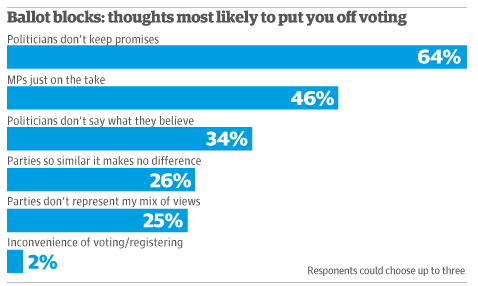
And if these hazy days are not a good time to take stock of the country and its management, when is? Clearly this was on the Grauniad‘s mind when it commissioned ICM Research to survey people’s attitude towards politics, using 2023 adults aged 18+ online on 20-22 December 2013. Although this was UK-wide, it has particular relevance to the referendum on Scottish independence to be held in September.

The results make unsettling reading for professional politicians, their hangers on and any idealists that are counted amidst their ranks. As the article reporting on the survey says:

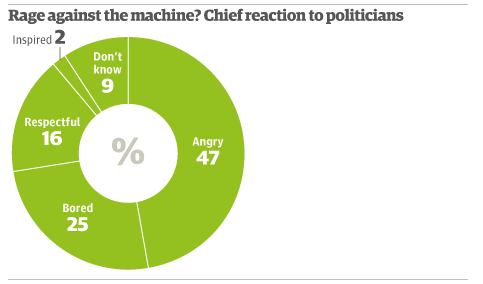
Asked for the single word best describing “how or what you instinctively feel” about politics and politicians in general, 47% of respondents answered “angry”, against 25% who said they were chiefly “bored”.

Negative sentiments vastly outnumber positive, with only 16% reporting feeling “respectful” towards people doing a difficult job, while a vanishingly small proportion of 2% claim to feel “inspired”.

Poll1PutOffsIn the years between elections, most elected representatives ride out unpopularity because the electorate has shown short memories in the past and starting any non-traditional pattern of voting to unseat specific incumbents is notoriously hard to do. What should be unsettling to the Scots is that, despite promises and good intentions to keep Holyrood pure of the braying partisanship on view at PMQ, we now have FMQs that have become indistinguishable in their braying partisanship. Most people are now put off by all of it.

Voter disconnect has become endemic among younger voters to the point where only 46% of sub-30s voted, vs 76% of over-65s did. Tory Chloe Smith has a ministerial brief that includes improving voter engagement. But she thinks:

“there is an existential problem coming for traditional forms of British democracy, which it is in everyone’s interests, all of us as democrats, to respond to. We have to demonstrate what politics is for, why a young person’s individual action in voting matters.”

This is equally true in Scotland, where the figures are even lower for deprived areas, swathes of which feel no incentive to vote because they feel their voice is ignored. Once upon a time, it would have been easy to blame that on Labour, who had represented such areas since Adam was a boy. But now the SNP represent as many such areas as Labour and have been just as monolithically party-loyal so that the voices of their constituents appear muzzled—even in those cases where they actually aren’t.

The result is a strong sense at grass roots that those who are elected ‘go native’ once there by kow-towing to party leaders and their politics and rarely take on the causes voiced by those who elected them: housing priorities in Arbroath or Ayr are driven by those in Airdrie. This sense then drives feelings that are not pretty. Gordon Brown’s former pollster Deborah Mattinson believes politicians have not begun to grasp the scale of the problem.

“Voter disengagement is getting worse and worse. Nobody is really taking it seriously enough.”

Poll2ReactionIf this were a poll on doctors or teachers, there would be politicians jostling to be in front of cameras to deplore such a result and speak emphatically how it should be tackled. But you’ll be hard pressed to find anyone on salary (with honorable exceptions like Margo or Caroline Lucas) between the Thames and the Water of Leith ready to take such appalling statistics on in public, largely because they know them to be true.

Because they are feart for their careers.

Now, it is fair do’s that you can’t represent everyone But you must do your best to judge the majority view among your constituents and either make it your own or explain to your electorate your reasons for not punting their position. Some 86% of people (whether they vote or not) think politicians take decisions that are Very of Fairly important to their lives so we are not dealing with ignorance and misunderstanding here.

Russell Brand expressed the disaffection of many in October when he told Jeremy Paxman on Newsnight that he had never voted because he “can’t be arsed“, adding later: “The only reason to vote is if the vote represents power or change. I don’t think it does.” Even those who dislike Brand and his style admit the accuracy of his comments.\

Which brings us to the Referendum. Though it has allowed itself to be distracted into trying parry the ‘All-Is-Lost-Brigade” clammy negatives emanating from the ‘No’ camp, the Yes campaign has also failed to inspire the 30-40% of Scots voters still sitting on the fence, desperate for understanding why one or the other choice will better the lives of their children, not to mention their own.

Plain though it may be to hardened nationalists that independence ripens fruits of all ilks, that message has yet to arrive among the switherers whose otherwise even-handed objectivity and openness to persuasion has been deformed—not to say poisoned—by the fact that the clearly political campaign being run to persuade them is obviously sired out of the same stable as the four parties of the Apocolypse whose collective gobshite has soured the air of debate for years before next year’s momentous choice was more than a gleam in His Eckness’ eye.

The Yes campaign therefore faces a major dilemma, highlighted by this timely ICM poll: continue with a well funded/focussed myriad-SPAD-driven (and therefore blatantly political) campaign that has run for a year now with no traction and an increasingly steep hill to climb…

…OR…

…dump everything successful politicians and their wolf packs of SPADs have learned in the last two decades—that dissent is poison; that policy is monolithically unquestionable; that, Rule 1, the Leader is always right, that, Rule 2, should he/she ever be wrong, Rule 1 comes into immediate effect. People want bonny fechters for their causes and not career-focussed lackeys. Because their is so much unknown, they want BOTH sides to be able to articulate a credible truth that lies somewhere in the middle between both camps.

The black-and-white-speak that fills each FMQ is now distinguishable from its English equivalent only by accent, not by content. November’s White Paper was beefy on many up-side arguments but piss-poor on facts/figures and dismissive of the (fair) case that there are risks involved taking a nation of 5.25m into uncharted waters. And what if it’s a 52% yes result on a 33% turnout? That’s a win—but how do you justify that morally to (let alone inspire with opportunity) the five in six Scots who didn’t vote for it?

If Fionn MacCumhail were to wake with his thousand Fianna so long asleep on our mountains awaiting our call and they were to scare the bejasus out of ALL our politicians so that they could speak only fairly and that from their hearts or if Wallace were to reappear and bang the modern equivalent of self-interested nobles heads together, would that ignite a real fierce, passionate debate on our futures that we all need?

If not, what would?: this is no rehearsal.

Forget the niceties of jousting within parliamentary rules and scoring political points that have zero value out in the real world. This is not just about next year’s referendum, major thought that is. It’s about the credibility of Holyrood itself. Was Bill Connolly right in this being “a wee pretendy pairliament”? And even if it does remain a devolved legislature of the United Kingdom, who will be inspired by it—let alone towards giving it full powers—if it is a jumped-up council, with council petty interests aping the tedious, self-importance of the Old Boys’ Club on the Thames because it knows no better ambition?

Posted in Politics | Tagged | Leave a comment

No Such Thing as a Free Lunch

As is its repeated wont, the massive EIS union has waded out into deep political waters well over its head by pressuring the Scottish Government to make all school meals free for pupils in the first three years of primary school (today’s Hootsmon). As a principle, it has merit—virtually all sources agree that ensuring all pupils are fed and nourished makes an impact on their ability to concentrate and learn and also removes one possible source of social discrimination among them. Most parties agree with the principle. But is it ipse facto that simple?

School meals have always had some social baggage—the kids whose parents both had to work, as well as those who were not good providers once made up the bulk of those in the school dining hall. Now that pupils typically don’t leave the campus at lunch time, there has been more of a leveling, especially now that swipe cards blur distinctions between those paying for their lunch and those using free meal entitlement.

The reason this policy has become a political football is a consensus that free school meal entitlement (FSME) acts as a measure of social deprivation in a school’s catchment area and (this point being more controversial) acts as an inverse indicator of academic performance. Such performance is itself a political football, with many (including the EIS and other teaching unions) scoffing that exam results are any measure of the quality of teaching received and more a measure of affluence, of engaged parents and their ability to hire tutors. The only scoff we make is that vocational qualifications should be equally venerated—but that’s for another blog another day.

As with any social science involving millions and complex demographics, single parameters are never able to tell the whole story. But the idea that free school meals are in the gift of government and have few opponents is appealing for politicians—including union officials—at a national level. There are few risks being seen advocating it. And it is not just Labour-leaning teaching unions trying to beat up on an SNP government. At their autumn conference in 2009, Jamie Hepburn MSP successfully moved and passed a motion for free school meals to ALL primary classes, not just to P1-P3. Despite  becoming party policy, this has yet to be scheduled as government business and passed into law.

But this leads to the fundamental question: who are the education authorities in Scotland? By law, it is the 32 local authorities, for whom there is very little point if their entire policy package is dictated by central government. That is already the case in class sizes, Curriculum for Education and Gaelic education. What’s the point of an Education Authority that does little more than set term times? Why can they not decide that their local circumstances require free school meals—or indeed a host of other choices like teaching Norwegian in Shetland, farming in the Borders or oil-related engineering in Aberdeen?

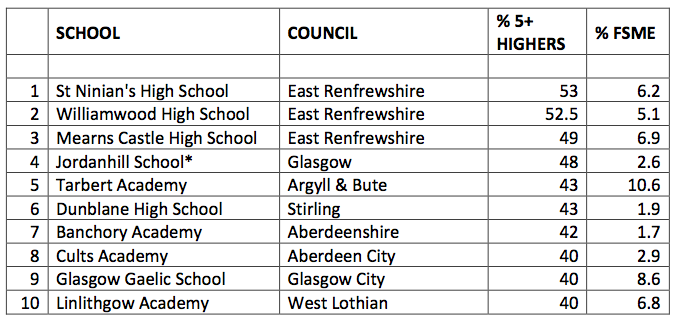
The whole premise that FSME runs inverse to exam results also does not bear much scrutiny. The table below is the top ten high schools by exam results with their FSME shown in percent of the enrollment.

'Top Ten' High Schools by Exam Results

‘Top Ten’ High Schools by Exam Results

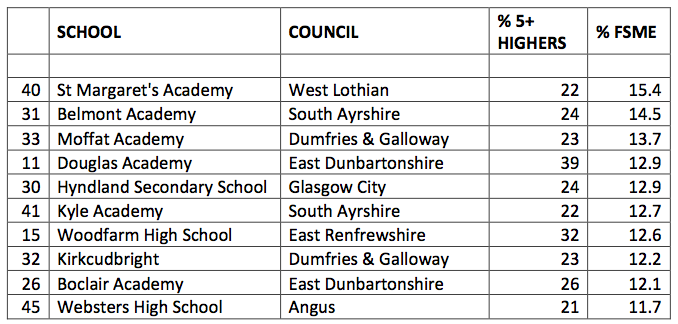
Only two have changed since last year. Impressive results as these are, there is a large variation in their associated FSME stats. If this were so decisive, why would Banchory not beat St Ninians as they have a quarter of their FSME? How do Tarbert or the Gaelic School do so well, despite 1 in 10 pupils entitled to FSM? Ansd what about those with substantial FSME? Take the highest 10 of these within the top 50 in exam achievement gives the following table:

Highest FSME High School within Top 50 in Exam Results

Highest FSME High School within Top 50 in Exam Results

What is striking among these is—despite high FSME stats—these are not all languishing near the bottom. Indeed Douglas and Woodfarm are not far off being in the Top Ten above. So, while a doubling of FSME over a broad range gives a rough halving of exam results, the variation between schools at both ends of the scales are huge.

At the bottom end of the table 14 of the lowest 20 are in one of the four cities; these range from 24% to 54% FSME. The half-dozen non-city schools range from 13% to 33%. Perhaps the most disturbing is the spread of schools within a given city: Glasgow has 2 in the top ten but 7 in the bottom twenty; Edinburgh has 0 and 3, respectively. While FSME provides some guide towards what exam results to expect, clearly there are other major factors at play, not least is that a general hierarchy of: suburban is-better-than rural better-than city applies right across Scotland and requires a less crude analysis than by FSME.

Educators, schools and unions all fall over themselves to dismiss exam tables as a measure of how good any school is. “There are very good schools in deprived areas which look like they are underperforming simply because their results are not so good.” (Dr Mark Priestley, School of Education, Stirling University). Interpreting such results through FSME may be too crude but, as it is based on deprivation, let’s look at its demographics through the Scottish Index of Multiple Deprivation (SIMD), published by the government.

Some 60% of best-performing East Renfrewshire lies in the least deprived quintile while barely 5% lies in the most. For Edinburgh, 45% lies in the least and 10% in the most-deprived quintiles. That again provides some explanation but does not answer why Douglas Academy can be just outside the top decile while Bo’ness Academy lies just above the tenth decile when both share FSME of 13%. What areas of East Dunbartonshire are not in the least deprived group around Kirkintilloch; few are in Douglas’ catchment. Most of the Bo’ness catchment is a mix of 2nd, 3rd & 4th quintiles.

So, SIMD might be one clearer measure. But after a study of such comparisons as the above, it quickly becomes clear that the real underlying factor (from which the more easily quantifiable SIMD and FSME derive) is the coherence of the community and its economic vitality. Visit Milngavie and Bo’ness and contrast the douce middle class suburb with the ex-mining/fishing/shipbreaking town that has yet to discover its 21st century purpose.

Scan down the list of ‘top’ schools above and every one is powered by motivated parents in a hinterland little different to Milngavie. Scan the bottom list and every one lies in areas blighted by economic decline—even Alness, where the smelter closed, rig construction has declined to nothing and tourists are hard to lure off the nearby A9. It is more than affluent areas sending their children to private schools; it is perfectly good state schools starved of motivated pupils because neither they nor their parents (some of whom are poor but many CAN spare lunch money for their children) see the point in bothering.

In an old Mad magazine cartoon, a character asked how many Elastoplasts it takes to cure a brain haemhorrage. Crusading union leaders and MSPs keen to board any passing bandwagon and boost their career might ruminate over Mad’s pallative ideas. Providing free lunches will cost significant money we don’t have to achieve nothing in academic terms and little in terms of nourishing the student body. Worse: it does nothing to address underlying causes—lack of community, of hope, of appreciation just how key education is to build futures, let alone how brutal the world can be, even armed with qualifications.

A more effective approach would be to examine the legion funded causes active in the Bo’ness, Wester Hailes, Castlebrae, Gallowgate, Shettleston, etc, give them targets and deadlines to succeed by putting themselves out of business and treat each area with a purposeful community plan so that residents have reasons to send their kids to school and interest enough to check the homework when they come back. Making excuses like “this school is excellent, given its catchment area” condemns another generation of our young to hopelessness, the buroo and, as the educationalists put it ‘non-positive destinations’.

A free or any other kind of lunch is useless—except as a platform for politicians.

Posted in Education | Tagged | Leave a comment

What’s Right with This Picture?

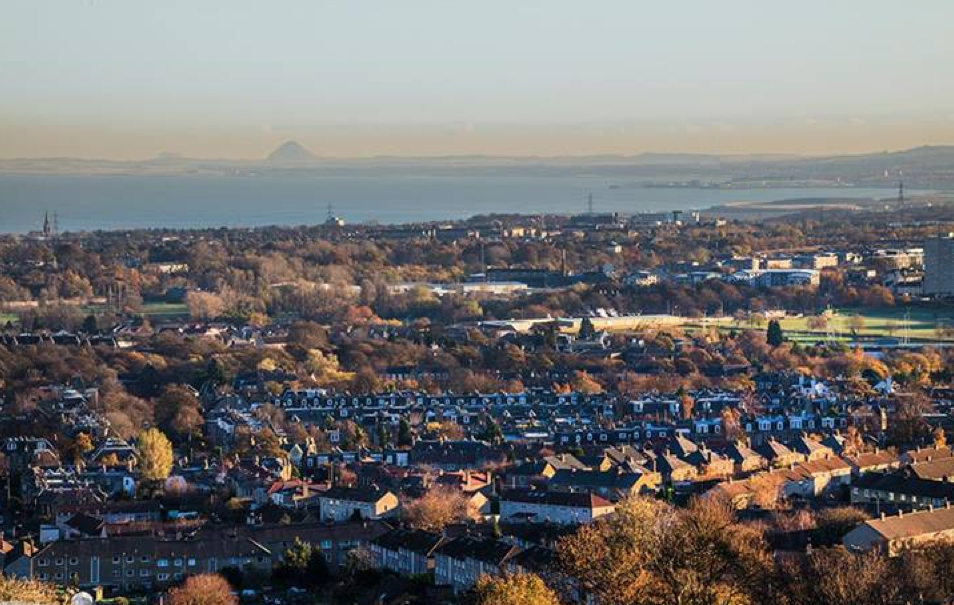
Cockenny

RealEdinburgh’s beautiful winter early morning shot of East Lothian from Blackford Hill is yet another demonstration why so many of us enjoy living in this part of the world.

But…

…this is not the exact original view: this shot has been doctored. Can you spot what is different from the actual shot? Comment if you think you know what the difference is.

Give up?

Check out https://www.facebook.com/photo.php?fbid=556080217811407&l=05d17aa437 for the answer (El poder español esta desaparecido). But if you had your druthers, would you not prefer the view above as so much better?

Posted in Community | Leave a comment