America’s Higher Education Brought Low

Rarely accused of being conservative (big or small ‘c’), reading George Will is not my natural territory. Being in agreement with him is even more of a stretch. But being in the Land of the FGree just now, I found his recent syndicated column in the Washington Post exposed a litany of assaults on reason that challenges the role of higher education across the USA.

Now, it is very much the role of academia to provide fertile ground for the germination and development of ideas. By definition, some of these must appear to be dislocating when first posited. They may even be outrageous by contemporary standards. Yet, from Galileo to Einstein, many have proved to be right, despite inertial wisdom from the rest of the planet.

But George brings so much provocatively ill-informed (not to mention ill-expressed) political correctness to light that it seems he is right to challenge the non-rigorous scale of it. Freedom of speech and academic questioning is one thing. But when so many seem to slide into a dangerous half-light of dogmatic intolerance and virulent criticism of those who question, American academia may have slipped from illuminating the dark corners of knowledge to fortifying certain belief mantras into them.

Certainly, Will has overstepped the mark before, as when he questioned “the supposed campus epidemic of rape” and was pilloried by Diane Feinstein, among others: “It takes a particular kind of ignorance to argue that people who come forward to report being raped in college are afforded benefits of any kind.”

But censorship in any form deserves rigorous questioning, no matter how laudable the intent. The copyright on Mein Kampf runs out this year and the 70-year ban by the State of Bavaria on its publishing will run out. Various Jewish organisations are arguing against this. Florian Sepp, a historian at the Bavarian State Library says “This book is too dangerous for the general public.” But is it? Why not (if they existed) ban Ghengis Khan’s memoirs? Both are ancient history, providing lessons we all should learn.

And so, George Will raises the absolutely legitimate question whether political correctness may have gone so far as to undermine the objective integrity of further education. When the University of Wisconsin at Milwaukee declares the phrase “politically correct” a microaggression or Mount Holyoke College cancels its annual production of “The Vagina Monologues” because it is insufficiently inclusive regarding women without vaginas and men who “self-identify” as women, then have things gone too far?

And, before we get too cosy mocking American campus naivety, there are debates and ill-tempered exchanges in Scotland when anyone questions the new received wisdom—already expressed by University of California sensitivity auditors who condemn as “hostile” and “derogatory” such perverse thoughts as “I believe the most qualified person should get the job” and “America is the land of opportunity.

Posted in Community | Tagged | Leave a comment

La Marseillaise

As the crowds streamed out of the Stade de France after the bloodthirsty events of Friday, they began singing the French national anthem; the crowds gathered to hear Hollande’s speech from Versailles did the same. Anyone who has witnessed even a handful of French singing it will appreciate the utter passion with which it is sung.

It was born in adversity and still works as a profoundly felt, inspirational rallying cry at times like these. It comes straight from the heart of the people in a way that the British equivalent’s adulation of the monarchy can never match. The only thing the two have in common is that few bother singing any verses beyond the first.

The European Union may well have adopted Beethoven’s Ode to Joy as its own anthem. But, in the tragic shadow of the Paris attentat, La Marseillaise is being sung with unifying passion by people across Europe—and indeed the globe—with no previous connection to France whatsoever.

Allons enfants de la Patrie,
Le jour de gloire est arrivé!
Contre nous de la tyrannie,
L’étendard sanglant est levé, (bis)
Entendez-vous dans les campagnes
Mugir ces féroces soldats?
Ils viennent jusque dans vos bras
Égorger vos fils, vos compagnes!

Aux armes, citoyens,
Formez vos bataillons,
Marchons, marchons!
Qu’un sang impur
Abreuve nos sillons!

Arise, children of the Fatherland,
The day of glory has arrived!
Against us tyranny
Raises its bloody banner
Do you hear, in the countryside,
The roar of those ferocious soldiers?
They’re coming right into your arms
To cut the throats of your sons and women!

To arms, citizens,
Form your battalions,
Let’s march, let’s march!
Let the impure blood
Water our furrows!

Posted in Community | Tagged | Leave a comment

You Know You’ve Been Quangoed

Last week, we outlined the largely unaccountable role of quangos in running Scotland and the unconscoinable salaries that their senior managers pull down. This week, we give the details. If they all took a 10% cut in salary, they would all still be well above the MSP’s £59,085 wages, let alone the £20,062 average wage in Scotland. And we’d have saved enough to pay for 260 teachers, nurses or police.

Total Quango spend in Scotland is £13,334,556,588 (i.e. over £13bn) or half of all public expenditure. Some £287m of that was spent by Scottish Enterprise alone. Older readers may recall former Scottish Secretary George Robertson’s promise to make a “bonfire of the quangos”. At the time of that promise, there were 186; there are still 115 today.

Quangos are alive and well and mostly living in pricey suites like Apex House (SFC), Atlantic Quay (SE) or Waverley Gate (NHS Lothian). Of course, their senior management teams need recompense commensurate with their fancy offices and status in society; six are paid more than the Prime Minister. Scottish Water’s chief executive Douglas Millican pulls in £263,000. Scottish Enterprise’s chief executive Lena Wilson (one of the very few females) is on £203,000 and VisitScotland’s Mike Cantley makes a mere £146,000. Don’t worry if you’ve never heard of any of ‘em; that’s how the system works and you’re in the same boat as 95% of Scots.

Leaving out the NHS and the SFC (universities and colleges), if all remaining quangos were to pull in their belts across their budgets (and not just senior management salaries) with a 10% reduction, we’d save £1,893m—or 63,100 teachers, nurses or police.

Here is a list of the 115 and how much of your money they spend each year:

EXECUTIVE BODIES

  • Scottish Funding Council                                           £1.7bn
  • Scottish Enterprise                                                      £287m
  • Skills Development                                                      £196m
  • Legal Aid Board                                                            £167m
  • Police Services Authority                                             £98m
  • Highlands and Islands Enterprise                             £81m
  • Scottish Natural Heritage                                            £64m
  • VisitScotland                                                                  £50m
  • Arts Council                                                                    £47m
  • Scottish Environment Protection Agency                £46m
  • SportScotland                                                                 £41m
  • National Museums                                                        £37m
  • National Galleries                                                          £26m
  • Children’s Reporter                                                        £25m
  • National Library                                                             £20m
  • Royal Botanic Garden                                                    £14m
  • Scottish Qualifications Authority                                £13m
  • Social Services Council                                                    £9m
  • Loch Lomond and The Trossachs National Park       £7m
  • Crofters’ Commission                                                       £6m
  • Bòrd na Gàidhlig na h-Alba                                             £6m
  • Royal Commission on Ancient & Hist. Monuments   £5m
  • Cairngorms National Park                                               £5m
  • Scottish Screen                                                                   £4m
  • Deer Commission                                                              £2m
  • Risk Management                                                              £2m

ADVISORY BODIES

  • Judicial Appointments Board                                      £309m
  • Law Commission                                                       £996,000
  • Architecture + Design Scotland                              £952,000
  • Local Government Boundary Commission          £340,000
  • Advisory Committee on Distinction Awards        £134,000
  • Local Authorities Remuneration Committee         £35,000
  • Public Transport Users Committee                           £15,000

TRIBUNALS

  • Mental health                                                                    £11m
  • Parole Board                                                                       £1m
  • Private rented housing                                         £   428,000

PUBLIC CORPORATIONS

  • Scottish Water                                                               £182m
  • Highlands & Islands Airports Ltd                               £26m
  • Caledonian Maritime Assets Ltd                                    £7m
  • Scottish Futures Trust                                            £440,000

HEALTH BODIES

  • Greater Glasgow                                                             £2bn
  • Lothian                                                                              £1bn
  • Lanarkshire                                                                  £889m
  • Grampian                                                                      £798m
  • Tayside                                                                          £689m
  • Ayrshire and Arran                                                      £649m
  • Fife                                                                                   £570m
  • Highland                                                                        £564m
  • Forth Valley                                                                   £434m
  • Dumfries and Galloway                                               £270m
  • Ambulance service                                                       £197m
  • Borders                                                                           £186m
  • Western Isles                                                                 £69m
  • National Waiting Times Centre Board                      £66m
  • NHS24                                                                              £54m
  • State Hospital Board                                                     £52m
  • Shetland                                                                           £49m
  • Orkney                                                                              £44m
Posted in Community | Tagged | Leave a comment

In Remembrance

There has been a flood of commentary on social media about Remembrance Day and poppies being worn to honour it. Not all are favourable and some, indeed, highly critical. These latter appear to come from a number of positions, including: guilt/resentment at Britain’s imperial past; an opposition to warmongering; anger at UK Armed Forces being used internally as armed police (especially in Ulster); opposition to foreign interventions (such as Iraq and Afghanistan); and even a refusal to embrace this aspect of the British state by hard-line nationalists.

At the risk of opprobrium, each of those groups does have a point. Those holding any of those views do so sincerely and, as they break no law and hold their views peaceably, are entitled to them—and even to express them. But in the context of Remembrance Day and of wearing poppies to mark it, their opposition is misguided.

As America has practiced since WW2, so Britain’s foreign policy in its imperial heyday (and, some would argue even today) was to protect commerce, exploit global resources and to resist those who would threaten that. Not a particularly noble motivation but it made Britain and most of its population rich, as it has America more recently. Whether Britain should still hold the Falklands/Malvinas or Gibraltar or other residual specks around the globe or not is a thorny problem with no obvious solution. Similarly, whether there is any mandate to be the World’s Policeman’s sidekick deserves considerable debate.

But the Remembrance poppy marks none of that. Despite egregious attempts by some establishment figures—especially in the Tory Party—to conflate defence, a global UK role and a Dunkirk Spirit that validates the Union, it is no such thing. People who have served in our Armed Forces have often done so with little choice. From dispossessed Highlanders who flooded kilted regiments from Torres Vedras to Waterloo, to their sons at Bombay or Balaklava, from the Pals Battalion enthusiasts of WWI to the more sober conscripts of WW2 to the National Service teenagers in Korea, millions fought and millions died.

There is a moral argument that WWI was caused by Britain’s paranoia about being top dog as much as Imperial German aggression—just as the Japanese might argue that the US stranglehold on its raw materials justified the aggressive risk they took at Pearl Harbor. But British Tommies of 1914 had no more option to argue such a case than their equivalent GIs had in 1941.

Not to disparage those who signed up from a spirit to engage the Hun or whatever the bête noir du jour was, the vast bulk went, trained, served—and sometimes died—because they saw it as their duty. Their motivation was neither politics, nor ambition, nor greed, nor even hatred. They did it because they felt they must, so they could hold their heads high because they—and the families they left behind—had risked all to secure what all believed to be a worthwhile, if not better, life.

We all make sacrifices to preserve our community, our culture, our civilisation. But none are as great as those we ask of our armed forces. It is to honour those millions and their selfless service which has allowed all of us to enjoy the comparatively comfy lives we do. My grandad lost a leg in Flanders; my dad drove a tank through the unbearable heat of Libya; the worst I have ever had to endure was scout camp.

That is why I wear a poppy every year for them—and for all their comrades—with humility and gratitude. Others may do what their conscience dictates but Remembrance should not be about politics.

Posted in Community | Tagged | Leave a comment

Angels or Vampires?

According to SCVO there are over 45,000 Third-Sector organisations (i.e. charities) in Scotland, employing a total of 138,000 people with a turnover totalling just under £5bn each year—getting on for 10% of our GDP. Many of them do sterling work and are bulwarks against the worst effects of modern society, market-driven economies and the increasing complexity of 21st century life.

Third Sector in Scotland (Source: SCVO)

Third Sector in Scotland (Source: SCVO)

In general, Scots are generous in their support for what is now a massive sector. But, just as the NHS—laudable though the great majority of its front-line staff are—suffers from pencil-neck jobsworths and third-rate administrators, not everyone in the third sector is a selfless hero(ine) working for the good of all, as opposed to themselves. High streets across Scotland are filled with charity shops, staffed by volunteers who receive nothing for their time. But running these large operations are salaried ‘professionals’ who are just the tip of the third-sector salary iceberg.

Across Scotland’s 100 biggest charities, 57 members of staff enjoyed wages of more than £60,000 in 2014 (in 2012, the number had been just 45), an average increase of 26% in the last three years when wage inflation had crawled up at 2.2%. Examples from the top of the heap include:

  • SSPCA‘s Stuart Early whose wage jumped from £160,000 to £185,000 (he who closed a £20,000-per annum Shetland shelter because the charity “couldn’t afford it“)
  • Laura Lee of Maggie’s Centre who’s on £120,000
  • Bosses at Quarriers, Capability Scotland, Scottish Autism and SAMH all around the £100,000 mark.

Even the SCVO itself is a charity with two members of staff on more than £60,000. There are more than 23,700 charities in Scotland but OSCR will stop short of revealing the pay packets of top staff. Charities Aid Foundation, which has carried out a study said “Many people remain concerned the money they donate may not be used to best effect“. Given they found poorer families were proportionately the most generous, with those earning less than £9,500 a year most likely to give away around 4% of their earnings, such coyness seems a travesty.

Not included in the above is the quangocracy that has spread across Scotland, with similar well paid jobs that are equally obscure where the public is concerned. A Quango (Quasi-non-governmental-organisations) is “an organisation that has responsibility for developing, managing and delivering public policy objectives at ‘arm’s length’ from government. Such bodies assist in the delivery of public services in Scotland including culture, healthcare, the environment and justice.” They have a long history of operation in the UK and have become an established part of public sector delivery. At least charities have a public profile through shops, adverts, street collection, volunteering, etc. Quangos are much more a mystery. Yet Reform Scotland has established:

  • 43 quango officials are paid more than the First Minister (£144,607)
  • 132—enough to fill the Scottish Parliament–are paid more than a Cabinet Secretary (£103,495)
  • Over 200 are paid more than a Government Minister (£86,405)
  • Nearly 700 are paid more than an MSP (£59,085)

That totals to over £78m or £25 each year for every man, woman and child in Scotland. And Scotland is a small place. Where once ‘The Establishment” (i.e. senior advocates, Heriots/Fettes FPs, the Honourable Company of Edinburgh Archers, etc) controlled many senior job placements, since devolution there a new kind of mafia grew up in the revived political firmament who also know one another and regularly show up in plum jobs.

The growth in quango numbers and budgets has meant significant expenditure streams are largely invisible to the public who pays for them. As Reform Scotland says:

“The current lack of openness and accountability is not conducive to good governance. Power exercised by government derives from consent of the people and should be exercised in their interests. It is difficult for people to judge whether that is the case when the current way blurs accountability.”

Research on quango spend on PR, overseas travel, external consultants and hospitality/entertainment comes to an annual total of £113m. This breaks down as:

  • £66.8 million per year on public relations
  • £3.7 million annually on overseas travel
  • £2.5 million on hospitality and entertainment
  • £40.2 million on external consultants

Buried within the above (and surely deserving of deeper investigation) are:

  • £300,000 on overseas travel by the Scottish Qualifications Authority (SQA)
  • £6.7 million by Scottish Water a year on consultants
  • £209,000 annually by Creative Scotland on public relations (somewhat explicable if not excusable by its squirmingly bad public profile)
  • £2.8 million for external consultants by Scottish National Heritage
  • £1.5 million on PR by Skills Development Scotland AND
  • £1 million on consultants by Skills Development Scotland
  • £1 million per year by Health Boards on hospitality and entertaining

This last item alone should set alarm bells ringing. When people are dying forgotten in our most modern hospital, when other budgets are pared to sustain the NHS’s, when Health Boards’ competence to oversee their multi-£m empires is under serious question, what are they doing squandering your money on ‘hospitality’? £1m buys a lot of custard creams.

There are, for example 24 board members of Lothian NHS Trust, headquartered in the prime office space of Waverley Gate (the old GPO building) at outrageous cost to the public purse and none of which assists a single patient. As an example of its ‘transparency’ its Annual Report and Financial Information doesn’t even mention ‘remuneration’ or anything as sordid as ‘pay’.

Both main parties seem content to sustain this irresponsibility. While the Scottish Parliament engages in an unedifying rammy over what to do with a putative £113m that may come their way from 50% of a devolved Air Passenger Duty, they might dig into the £200m listed above and many more such dark corners.

Our Labour opposition might think of waking up and combing through all the slumbering numpties they appointed 1999-2007 for efficacy and the SNP government do the same for their profligate appointments since. Because, from a country that once grew rich from building things for the whole world, we now specialise in featherbedding mediocre administrators into ever-more-expensive cushy numbers across our burgeoning charities and quangos. Because our riches are no longer self-generated, this is unsustainable.

Independence or no, unless we wake up, winnow our bloated quangocracy and knuckle under to steer people into jobs that emulate Switzerland (high-end services) Singapore (major trading entrepot) or Germany (precision manufacturing) our Byzantine third sector moguls will join those shoals of globetrotting/factfinding (but never doing anything) board members on the burroo with the rest of us.

Posted in Commerce | Tagged | Leave a comment

Millionaires Only

Anyone who has visited this blog more than cursorily will have twigged that I love where I live. North Berwick is not the perfect place. But having been round the world and lived abroad for a quarter-century in six different countries, I have yet to find one that is closer to perfect. And a huge part of its charm is its context—the bucolic and unspoiled county of East Lothian, together with easy access to Scotland’s vibrant capital. It has sea and sailing, golf and green space, beaches galore and an unspoiled historic heart around a High Street full of interest. What’s not to like?

Naturally, I am not alone in appreciating it. As well as the many locals, for years an influx of retirees and professionals working in Edinburgh have almost doubled the population of the county in the last half-century. That trend shows no sign of abating. Add the social profile of those new residents to a wide selection of Victorian/Edwardian quality homes and developers ever-eager to build and sell new statement homes, it comes as no surprise that a ranking of Scottish areas selling the most £1m+ homes puts East Lothian in second place, right after Edinburgh.

Which is, in many ways, good news. People buying them means engagement as well as investment in our communities is high; the council rakes in a higher council tax per skull than most of Scotland; local businesses are kept alive. But the down side is that such houses are either isolated upmarket ghettos like Archerfield or Craigielaw or middle-class tract homes all of the same design, such as Windygoul in Tranent or Lochend in Dunbar.

There is little at the affordable end. Prior to 2008, almost none were built, beyond a scattering from Homes for Life and ELHA (local housing associations). From its inception until then, ELC built a nice round number of new council houses = zero. In the same time, their stock of houses to rent dropped from almost 20,000 to under 9,000. No wonder the waiting list went through the roof to 4,000, homelessness soared and those leaving school could find little to rent in their own town that wasn’t at scalper rates (and quite often for former council houses that somehow found their way into private landlord hands).

Meantime, developers built 13,500 new private homes in the county—none affordable because ELC’s Local Plan had gagged including such a requirement. In theory, the 2008 Local Plan changed that. It demanded any development of four or more had to make 25% of the units affordable for rent. The parallel legislation that removed Right-to-Buy’s 60% top discount was intended to keep new council homes built affordable into the future.

That meant councils who had built little were no longer constrained to using sales to pay off debt, and would not lose houses they built almost immediately. East Lothian’s Labour administrations had put all their eggs in the Homes for Life basket but, instead of building 500 homes in three years, they managed 300 homes in five. So, if 25% was a reasonable proportion for affordable homes to keep communities balanced, 1995-2007 saw a piddly 3% built. The disparity across Scotland is shown in Chart 1.

Historical Housing Starts in Scotland by Tenure (source: Scottish Parliament)

Chart 1: Historical Housing Starts in Scotland by Tenure (source: Scottish Parliament)

In 2007, ELC’s new SNP/LibDem administration were fast off the blocks to address this. Despite a poor land bank available for build, in every town across the county, new council houses appeared—and quickly. In 2008-9, ELC built 29% and in 2009-10 27% of all new council houses in Scotland. Others caught up and the ratio dropped to 14% in 2011-12. But that still meant 107 new starts made both that year and the one prior.

Complementing this was a changed allocation policy. Labour had always given the vulnerable and homeless priority. This seems socially laudable but is short-sighted and poor community-building. Putting lots of vulnerable people in the one place means no social network and low ability of neighbours to start one. The policy was changed to increase allocations for those with a local connection and, more importantly, offer new homes to existing tenants with good records as a reward to them.

This still left the same number of houses available to vulnerable/homeless people. But it distributed them through existing communities where a social network already existed and there was a much better chance of support from neighbours and development into no longer being vulnerable but full members of the community. In that period, one in three new houses in East Lothian were council-owned for rent that (despite a premium) remained the second-lowest in Scotland. This started to redress the balance towards the goal of 25%.

Unfortunately, despite the major progress made 2007-12, a new Labour/Conservative administration has not seen fit to pursue this. Since they took office, new starts have declined each year as a proportion of what other councils are doing across Scotland to now stand at a risible 1.5%. The actual number of starts in both periods is shown below.

Housing Starts by East Lothian Council by Year (source: Scottish Parliament)

Chart 2:  East Lothian Council Housing Starts by Year (source: Scottish Parliament)

Is anyone else taking up the slack? No. Housing Association build is at a standstill and private developers (e.g. Cala’s Gilsland development in North Berwick) has been trying to weasel out of the 25% affordable (they sit poorly beside 5-bedroom statement homes available for £500,000).

When questioned why there is such a fall-off when private development (see Chart 1) is resurgent, the answer comes that ELC cannot afford to borrow. This seems smug and/or negligent, if not incompetent, for a number of reasons:

  1. Borrowing at current rates and rents is actually a competitive investment, given steady house price rises in East Lothian guarantees that, even on houses sold under Right-to-Buy, the council recovers its original investment and more.
  2. The previous administration showed great ingenuity in sourcing funding for new build, including grants from the Scottish Government, joint work with private developers and use of dormant property that officials had not suggested as appropriate.
  3. The local housing stock, already skewed to middle-class-upwards prices is beyond the reach of average wage earners who form the bulk of locally employed people, let alone the reach of those on minimum wage
  4. The resumption of growth in the waiting list implies growing social cost, as well as real cost in homeless accommodation and housing benefits to private landlords.
  5. ELC’s borrowing limit has not been reached and there are no penalties for exceeding it
  6. They banked £7m of public money into reserves last year, £1m of which they lifted from a profitable Housing Account

It is amusing, but deeply depressing, to watch ELC’s 3-member Tory group tail wag the 10-member Labour dog on this. But both are complicit in encouraging developers to build ever-more, ever-less-affordable houses across the county—and little else. The result may delight existing and would-be millionaires, but it forces more and more local people into the ‘vulnerable’ category, about whom they profess to care so much.

Cynical as I am about Labour’s motives, even I can’t believe they are doing it in their increasingly desperate quest for votes. But what other rational explanation is there?

Posted in Community | Tagged | 1 Comment

It’s the Unity, Stupid!

This blog was to be all about this weekend’s SNP Conference at the AECC. I had several key points (I thought) all lined up, ready to be expounded:

  • SNP Conferences have become bland as other major parties: little controversial is debated and many resolutions are symbolic grandstanding, passed by acclaim
  • Lively debates on major issues—such as the one on NATO membership three years ago that cost them three MSPs—are no longer allowed to sneak in (c.f. Labour & Trident)
  • As with other parties, the podium has become a choreographed showcase of prominent familiar figures, leavened with bright-eyed new recruits to encourage more.
  • The awkward squad (in which I would once have included myself) who act as collective conscience are reduced to the ever-vigilant but now ageing, Gerry Fisher.

The blog was to have highlighted the absence from the podium of many long-standing back-room/engine-room/backbone figures, most of whom carried the party through the wilderness of the 1980’s and 1990’s to build the grass-roots teams who delivered progress in the noughties. It would have bemoaned the absence of party support for the 425 SNP councillors (along with the related inertia at the head of ANC); the absence of a competent, arms-length national think tank; and the need for a social structure to retain the 85,000 new members who were hoping for more than leafleting in the rain and dire monthly meetings at which minutes are approved.

And then I read Andrew Wilson’s column in today’s Hootsmon. All of you reading this, whether fan, sworn enemy or observer of the SNP, should read it for its lucid clarity in laying bare this phenomenon that affects everyone living in Scotland today.

For Andrew sees this for what it truly is—a national phenomenon now hugely relevant outside the political village in an even larger way than FC Barcelona is Mas Que Un Club in the context of Catalan national identity. And he—rightly—lambasts the media for seeing what is going on in conventional political terms. In the simplistic world of the media (TV and tabloids especially), real-world news is fed through a dimension filter so that it all comes out as right/wrong or left/right or progress/relapse.

Add to that the fact that there has not been a radically new grass roots party since Labour came to prominence between the wars, and our fifth estate is no longer fit for purpose when it comes to encompassing, let alone analysing, what is going on. If more than one in ten of new SNP recruits watches Marr or Daily Politics I’d be surprised. The political village that MPs, journalists and their respective staffs inhabit in both Westminster and Holyrood (not to mention Brussels) has been so self-referential for so long that they can’t see their egregious limitations. As Andrew puts it:

“Commentators would love to find or invent splits or fights but there are none of material note. The new members are more representative of mainstream Scotland than the core of us who have been banging this drum for decades. They have joined an organisation that has a clear and consistent culture of behaviour that is grounded in positivism, self-belief and teamwork, hard work at that.”

And, what the overwhelmingly establishment-supporting media fail to realise is that, however more focused the current spurious and aimless complaints from Scottish Labour may become or however much the Scottish Tories break out of their current Milngavie-to-Morningside ghetto, they must broaden their debate to involve the real people who constitute 90% of the voters they claim to want.

Because the SNP has recruited a good chunk of them and are giving them the kind of bread-and-circuses that has usurped the stale TV-and-Daily-Mail fare. That has become ineffectual—and toxic for those mainstream parties still blindly peddling it.

Posted in Politics | Tagged | Leave a comment

Rewilding Highland Ecology

As a Scot descended in part from Appin Stuarts, I get emotional crossing the Highland Line, feeling the huge flanks of the mountains close around me like a herd of giant cattle and suffusing me with subtle feelings between awe and connection. It doesn’t have to be Appin, beautiful and sea-girt though it is: Mull or the Mamores; Trossachs or Torridon—all bring the same lump to my throat, echoing history, space and wildness that  feels like coming home. It is not cosy; it is more a brisk cold shower to awake the soul.

And yet its barrenness jars. Not only do the rickles of stones marking old clachans remind you of a time when people far outnumbered sheep but barren slopes on most mountains and equally unbroken vistas down as many glens stand mute reminders of what has been lost: diversity; a vibrant ecology; several key species.

Here is not the place to rehearse the destruction of Celtic culture and the clan system; read your Prebble for a much more lucid and pithy account than I could manage, But while the current domination of vast Highland estates entirely focussed on shooting grouse/deer and fishing beats does bring investment and employment to remote areas, the quasi-monoculture they require exaggerates bleakness to a level that is not natural.

It was certainly man who decimated the original Caledonian forest that once dominated  glens and slopes, even if it never covered the tops. But deer overgrazing  keeps decimating any hope of regrowth. In itself, that is a loss. But the resulting knock-on absence of species thirls the land in a semi-desert of heather, rock and bracken.

In the US, Yellowstone National Park was starting to go that way half a century ago, with growing numbers of deer and elk overgrazing woods and habitats for other species shrinking so predators were declining from lack of prey and the ecology in general was deteriorating. Then the wolves showed up.

A couple of packs drifted in from nearby Montana. They ate a few elk but, more importantly, they changed deer & elk behaviour, making them leery of valleys and draws where they could be trapped. Trees, bushes and shrubs regenerated there, so species who could hide in them returned, bringing foxes and eagles to prey on them and so on. The denser vegetation held slopes and riverbanks together, cutting erosion and even altering the rivers themselves. George Monbiot narrates a revealing 5-minute video about all this.

The idea of re-introducing wolves to Scotland (the last was shot in Moray in 1762) is not new. The whole argument about rewilding has gone on for years. In 2002 Paul van Vlissingen funded a 3-year study on his Letterewe holdings. Scientists found that the population of 4,000 deer on the 80,000-acre estate was controlled by winter weather and competition for food, rather than the annual cull by stalkers and so was not well managed. He proposed the return of the wolf and lynx to control actual deer numbers and also help to Scotland’s tourist industry. As he said at the time:

“I think wolves and lynx would fit very well into areas of land managed for deer, In this century there are no known cases of anybody being eaten by wolves in Europe, and there are thousands of people living among wolves in Canada and US.”

Two years ago Paul Lister the MFI magnate took up the idea for his 23,000 acre Allandale estate west of Ardgay. After a study, he hopes to bring 10-12 wolves and a few bears back into a 50,000-acre enclosed wilderness reserve in 2016, Alladale being half the area he thinks the wolves require, which means he would need co-operation of neighbouring landowners. Nonetheless, he claims:

“A reserve could attract 20,000 visitors and include overnight accommodation for 80. Wolves and bears will introduce a huge attraction for Scotland’s tourism, especially in a region where livestock farming and deer stalking offer little in the way of employment,”

Not everyone is happy with the idea. Gamekeepers and hill walkers oppose it. Rob Gibson,  SNP MSP for Caithness, Sutherland and Ross, said: “He treats his land as a private kingdom and that goes against Scottish access laws“. Dave Morris, director of Ramblers Scotland, accused Lister of trying to create a massive zoo. “The restrictions on people’s right to roam and the damage to the landscape caused by fences and tracks would be too great“. Well known, self-confessed ‘mountain bum’ Cameron McNeish has tweeted his concerns that the area wolves require is so huge the reserve proposed is just a zoo.

Lister’s position is that he does not want to release the animals into the wild as humans have long forgotten how to live with them. Rather, he is trying to emulate South African game reserves to create “a thriving industry based on nature and wildlife”. Research has found 36% of Scots support the wolf being released in the wild, with 20% undecided. However, that means 44% oppose, with the percentage higher in the Highlands.

It is true that Yellowstone’s 2 million acres gives the wolves there unbridled freedom and dwarfs the 2.5% of that Lister is proposing. But wolves exist all across continental Europe; Sweden’s 175,000 sq miles hosts a population of around 300. In the US, Minnesota’s 87,000 sq miles house 3,000 wolves. Scotland’s smaller 30,000 sq miles is 2/3rds rough ground suitable for wolves, implying at least 30-35 wolves could be accommodated.

Not to ignore the concerns for hiker safety and animal welfare, it does seem radical action against the artificial bleakness that has long marred the Highlands is overdue. With diverse fauna—not just deer—to predate on, reintroduced wolves would pose the occasional threat to sheep farmers but none to humans. Their scary reputation from folk memory belies that they are shy and would naturally avoid both man and settlements.

But, as with Yellowstone, the ecological positives could be huge; deer are currently running riot and would be best managed naturally. The return of natural forest regrowth (not regiments of forestry commission conifers) would bring back a variety of mammals and rodents which, in turn, would boost predators like kites, eagles and foxes. And, rather than dun-coloured hills everywhere, such diversity could only add to the magical spells that the Highlands already weave over those who know and love them.

Wolves

Posted in Environment | Tagged | 3 Comments

Misogyny? It Costs Us All

Gender equality has been a hot topic for a long time, especially in business. And, despite laws designed to ensure equal pay for equal work between men and women, the pay gap persists and hiring practices continue to discriminate, especially among those high-flown posts that pay the most. According to the Office of National Statistics in the UK:

“Median gross annual earnings for full-time employees on adult rates who had been in the same job for at least 12 months were £26,500. For men, median gross annual earnings were £28,700 while the comparable figure for women was £23,100.”

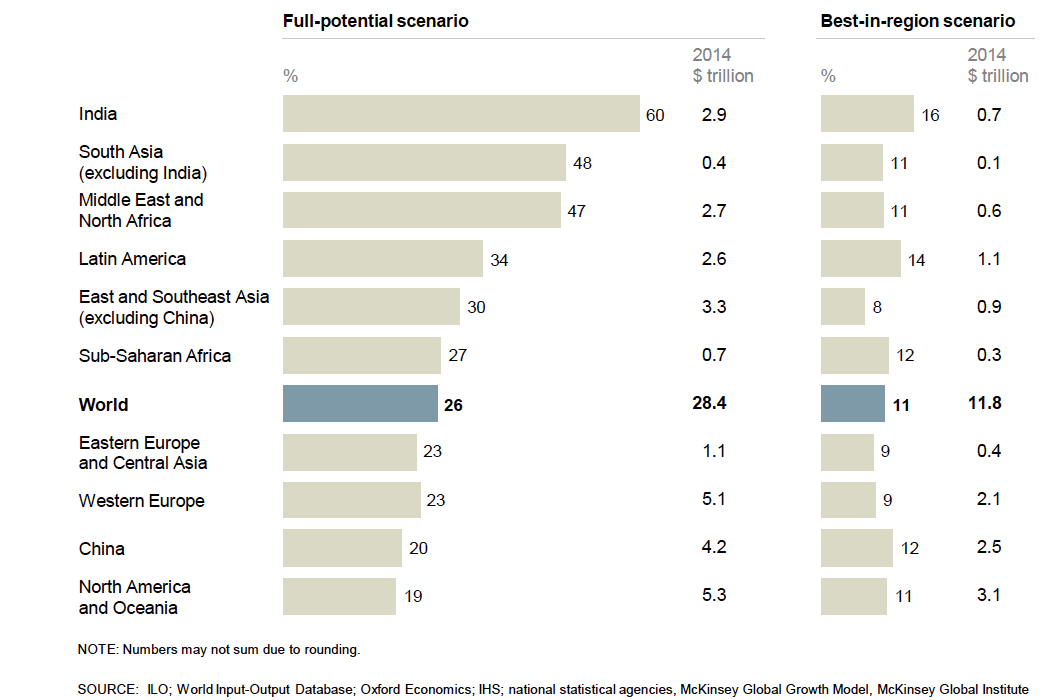
That’s a disparity of £5,600 or almost 20%. Seen another way, women have to work an extra day a week to earn the same as men. Now the McKinsey Global Institute (MGI) has brought out a seminal report How Advancing Women’s Equality Can Add $12 trillion to Global Growth that estimates the real cost to us all of such disparity. A breakdown of the shortfall by global region is shown below:

McKinseyGlobal

Clearly the more developed regions have made more progress to date and have less left to gain. But, to put it in context, even Western Europe could gain more than size of the entire UK economy, were true gender equality to be fulfilled there.

So there is a massive argument to be deployed against those Good Ol’ Boys who have held sway in boardrooms and as captains of industry to look long and hard at this in wholly pragmatic business terms: women are as bright and capable as men; not rewarding them is costing you money. As the reports says:

“The first dimension is gender equality in work, which includes the ability of women to engage in paid work and to share unpaid work more equitably with men, to have the skills and opportunity to perform higher-productivity jobs, and to occupy leading positions in the economy. This dimension is driven by the choices men and women make about the lives they lead and the work they do.

“The next three dimensions—essential services and enablers of economic opportunity, legal protection and political voice, and physical security and autonomy—relate to fundamentals of social equality. They are necessary to ensure that women (and men) have the opportunity to build human capital—and have the resources and ability to live a life of their own making.

“Despite progress in many parts of the world, gaps in both gender equality in society and gender equality in work remain significant and multidimensional. Our analysis finds that 40 of the 95 countries analyzed have high or extremely high levels of inequality on half or more of the 15 indicators for which data were available.”

Time us men got to worrying our pretty little heads about this.

Posted in Community | Tagged | Leave a comment

We Need To Talk About: Budget Underspends

About time ritual opposition hysteria over ‘underspends’ was exposed as such. The hypocrisy of Labour who ran such surpluses too—and even returned them to Westminster—is breathtaking.

Dr Craig Dalzell's avatarThe Common Green

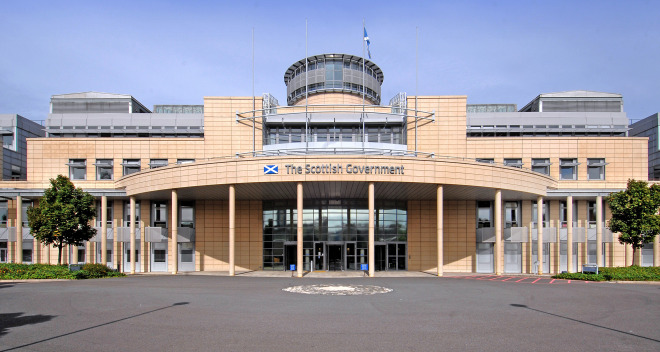
Victoria Quay

Q. When is a surplus not a surplus?
A. When someone is talking down the Scottish Government.

Today the Auditor General published its annual report detailing an independent opinion on how well the Scottish Government is managing its finances (or how badly it is failing to do so).

This year, as last, there have been howls of anguish from those opposed to the Scottish Government at the fact highlighted by the Auditor General that the Government spent £350 million less last year than it was given in the Block Grant.

As the opening question suggests in most normal countries when your government spends less than it has available to spend then it is running what is known as a budget surplus. This is, especially in today’s economic climate, generally considered to be a “good thing“. Not so in Scotland, apparently, where the phrase to be used instead is “budget…

View original post 980 more words

Posted in Uncategorized | Leave a comment