Building Something Worth Keeping

Edinburgh has a lot going for it as a city, not least its World Heritage architecture, its strong cultural reputation, its status as a capital city and its stunning setting beside the Firth and peppered with hills. Property professionals prize location above all factors when valuing a property, helping to explain Edinburgh’s pricey reputation—and not just on Anne Street. And these prices are post the 2008 fiscal meltdown (damaging the key financial services sector from RBOS on down) and with oil currently a basket case.

So imagine how much more insanely unaffordable housing might be if both financial services and oil were both to come roaring back. Is there, therefore, an upside to this down trend? Well, there is at least a model that might be used as an example what NOT to do. San Francisco shares many characteristics with Edinburgh. Its hills and views are even more spectacular; its culture and arts are more varied; its architecture is more modern but equally unique and valued; the Golden Gate must be the most stunning harbour entrance on the planet, through which passes much of the massive US trade with Asia.

But, unlike Edinburgh, San Francisco is in boom times. Its resulting travails may have some lessons for a Scottish Government so keen to build houses just now that now side with developers to steamroller local plans and over-rule local planning decisions.

A recent New York Times article (NY is no fan of SF, with city rivalries there are as fierce as between Edinburgh & Glasgow) highlighted the housing pressures SF faces from the boom in internet companies like Google, Facebook, AirBnB, etc. These companies are based outside the city in Silicon Valley on the SF Peninsula. But unlike their predecessors of Intel, AMD, Sun, Oracle, Cisco, etc, their relatively young employees have chosen to live in the culturally vivid and exciting City, as opposed to the staid suburbs of the Peninsula.

Their stratospheric salaries and lack of conventional burdens (e.g. kids) means they have serious disposable income and so have driven the housing market haywire. This is despite rent control ordinances passed thirty years ago. As the NY Times reports:

“Two years ago, radicals began delaying and harassing Google and other tech companies’ shuttles as they threaded San Francisco’s narrow streets. Now — after the city officially gave the shuttles free rein to use public bus stops; after the tech elite were accused of trying to buy a crucial local election; after the home-rental company Airbnb spent a fortune to defeat a proposition that would have restricted its business — the discontent is mainstream.”

We saw something like this with oil in Aberdeen in the eighties or the euro-boom in Dublin in the noughties. But this dwarfs either. People who do not make their living from technology are being squeezed out as San Francisco booms, adding 10,000 people a year to a record 852,000 in 2014. A one-bedroom apartment goes for a median $3,500 a month (£2,433), which means SF has passed NY to boast the highest rents in the US.

This is being fought by activists like Aaron Peskin who got himself elected to the Board of Supervisors (= City Council) by arguing:

“Let’s take a stand to make San Francisco more affordable and livable.These billion-dollar companies should help ameliorate the impact they’re having, They can afford to do a lot more. So far, it’s only window-dressing. They can volunteer to be decent.”

Peskin

But what might seem like a straightforward David-and-Goliath spar between evil property barons and landless peasants is a good deal more complex, as has been related to me by some long-time resident friends there who keep their fingers on the pulse.

They believe that those rent-controlled voters who had their rents frozen 30 years ago are actually exacerbating the problem as they hang on to their advantage. As a result, those few properties available rocket in price to make them largely unaffordable. As one said:

“The success-driven but otherwise quasi-autistic programmers which one used to see only in Silicon Valley now fill the cafés, but they’re not talking.  All of them are on computers, and typically with earbuds for the music from their iPhones.  This business about rents and the homeless is largely political rhetoric that grows from the fact that SF is a rent-controlled city with 80% of the voters being renters.

“I don’t think Peskin really believes a lot of the nonsense that he advocates.  That’s just how the game is played here by politicians.  That said, he’s better than his adversary, who was a total sell-out to the mayor, in turn a total sell-out to developers and Chinese power brokers.”

So, while the short-term solution for housing shortages in Edinburgh is under much less pressure and before concern for the vulnerable seizes on private rent control as a popular policy in any boom-to-come, it would help us evade SF’s current fate by:

  • Rethinking the present any-houses-anywhere-at-all-costs stampede
  • Getting much cleverer at linking jobs with housing to curb commuting
  • A proper share of affordable public housing (the only type that stays affordable)
  • Avoid letting good intentions build social wastelands, e.g. tower blocks; Easterhouse

Because, despite the gleeful chorus of unionists who appear to be celebrating the current economic hit Scotland has taken from the oil slump, I believe we have better days to come. And when they do, I don’t want clodhopping government fire-brigade policies capable of repeating our mistakes like Dumbiedykes and Saughtons and Wester Hailes and Piltons —and pleading homeless/substandard/deprivation as justification.

The spectacular and historic tenements of the High Street were once home to rich and poor alike. The servants once lived on the upper floors of all the genteel Georgian mansions of the New Town. The vast majority of residential San Francisco may be diverse but it is very livable. Time we started thinking of what this generation leaves for posterity that they will cherish similarly—and won’t want to knock down as unfortunate eyesores.


Posted in Community, Politics | Tagged | Leave a comment

Carlekemp: Architectural Gem

You can drive down Abbotsford Road in North Berwick and not even know it’s there. Carlekemp, a long, elegant pile of mellow Rattlebags stone, hides in its expansive four acres of grass and trees behind a high wall that retains the grandeur intended when it was first built. The name derives from the Celtic for the “crooked knoll” on which it stands, predating both the house and the 178-yard par 3 Hole 4 of the golf course it overlooks.

In the Victorian industrial boom, James Craig had amassed a fortune from his paper mills along the Esk around Penicuik. In the fashion of the time, a prosperous, high-profile family such as his needed a summer residence in a fashionable resort. In 1898, he commissioned Edinburgh architect John Kinross, RSA to provide him with a suitable 2-storey Cotswold Elizabethan style manor house on land between the recently completed Abbotsford Road and North Berwick’s West Links.

CarlekempLong

Kinross crafted an iconic Elizabethan Cotswold beauty but lost out to Lorimer to construct the almost-as-impressive mansions in similar style and stone for Craig’s brother Robert (Bunkershill in 1904) and with Peddie for Westerdunes (1910). Although its exterior and setting remain unspoilt the real gem of Carlekemp is the interior of the western third of the building—sometimes called Flat 1. This is actually the historic main portion of the original house. Superbly panelled in oriental teak and mahogany by Scott Morton and Company, Edinburgh, the galleried hall boasts Jacobean details and oriel over doorway, as well as strapwork and ornate plasterwork throughout.

Even a glance inside provides a flavour of how well those Edwardian magnates lived—especially considering this was merely their summer residence. Credit both to their taste for having built it but also to those who have preserved its graceful dignity down the years. In 1971, it was given Grade A Listed Building status. But, as elsewhere, large houses became progressively more difficult to keep and in 1945, Carlekemp was converted into a Priory Prep School under the supervision of the Friars from Fort Augustus Abbey. Father Oswald Eaves and his staff dressed in traditional brown habits taught well known pupils including the Duke of Hamilton, Earl of Haddington, George Hope of Luffness and Ludovic Broun-Lindsay (present Provost of East Lothian). The Priory School itself received unfavourable press last year about abuse of its pupils but its Prep School had closed in 1977 when the building was converted into apartments.

Three years ago, we visited and published a blog with a dozen photographs showing the magnificent interior of the building. These were removed nine months later at the request of residents as they felt the details shown compromised their security.

Posted in Community, Environment, Uncategorized | Tagged , | Leave a comment

Chocolate Steam Train

Ever since 2007 when the affable, ineffectual John Home Robertson (as unlikely a Labour MSP as you’ll ever meet) drifted into retirement, East Lothian has been represented at the Scottish Parliament by Iain Gray. Now Iain—like John—is not a bad lad. Trained as a teacher, he worked abroad and later in a charity. He is not your standard numpty. Unlike the unlamented, autocratic Anne Picking who was his MP colleague for a time, he doesn’t abuse punters with egotistical expenses. There’s not much legacy from his four years as Labour Leader in Scotland but ‘ineffectual’ seems a common trait in that job.

Though I am not standing again, I need to declare an interest in this: I stood against him in 2011 and ran him close. The worst I can say about him then is he was an opponent who pulled out all the stops he could to win. Nowt wrong with that, although he was clearly bricking it during the recount at the Corn Exchange. But I hold no deep animosity toward him, other than a frustration that he treads water in this magic corner of the country that deserves better—East Lothian.

Abelio’s ScotRail runs the North Berwick line that is the transport backbone of the county and the prime means whereby thousands of professionals who leave here shuttle into Edinburgh to earn a decent wage. So, when I heard Iain was stirring up a campaign against the inept way it is being run, my first thought was: “good on him; about time he showed some leadership; that’s a  local issue crying out for it”.

Except, as I dug deeper, my enthusiasm waned. The line has been in need of serious management intervention ever since the Class 380 4-car units were introduced in June four years ago. The trains themselves are now excellent and solve many earlier problems. But that, along with the booming ridership, has exposed shortcomings in management, not rolling stock. As he uses the train more than I do, why has it taken him four years to recognise that, for all that time passengers have had to put up with:

  1. Unreliable service. This is more than ECML trains with higher priority delaying our local service. ScotRail habitually abandons the 17:43 ex-Haymarket or turns trains at Drem to make up time, leaving dozens of passengers stranded.
  2. Overcrowded trains. Starting at Prestonpans inward in the mornings and that far outward at night has always been standing room only but now it’s so bad that people at Musselburgh can’t even squeeze on the train.
  3. Revenue loss. Partly due to overcrowding but mostly to inadequate staffing, hundreds of people from/to the last couple of stations never have their ticket checked and so freeloading has become endemic, much to the annoyance of passengers from further East who pay their fares.
  4. Antiquated ticketing. Not only no automatic barriers at Waverley but no sign of  reusable swipe cards like Oyster which has boosted ridership and cut delays in London for the last 13 years. As a tease, readers have been installed at stations two years before tickets that use them.
  5. Chaotic planning. It took almost ten years to get the Class 380 trains appropriate for the line and platforms were extended to cope. Now they are being extended again—but only to accommodate 5-car trains. There are no 5-car Class 380 sets.
  6. Poor maintenance. Ticket machines are regularly out of service, the Kiosk leaks like a sieve since it was built and it took over a month to fix the sliding door.

So, Iain has much to get his teeth into; since he rides the line, he ought to know all this. Yet, what does he make by way of suggestions to line up with RAGES, ELC, George Kerevan MP, Colin Beattie (MSP for Wallyford & Musselburgh, the worst affected stops) for a coherent campaign of lobbying? Well, nothing beyond a petition to ‘improve conditions’.

GrayRail

Iain has been out at stations handing these to commuters. He was at North Berwick on Feb 22nd and deserves credit for being there on a cold mornings. His reception was frostier than the weather. Even if everyone were to sign this petition, how does that advance a solution towards which others have been working for the last five years?

Unlike five years ago, ScotRail now runs trains to/from Dunbar and is in receipt of a follow-up paper outlining how a half-hourly service between Drem and Waverley can be run using one more train than they do now (4 instead of 3 sets in service). With an alternating hourly services to/from North Berwick AND Dunbar congestion would ease. Such a service is needed anyway to serve East Linton station when it is re-opened.

This solution seems clear, easy to implement and solves most problems listed above. If, for some reason, it doesn’t appeal to Iain, he should propose something equally effective. After four years to think up something, is one whiny petition the best he can do? What point is there trying to get up steam in a such chocolate engine?

My cynical side says this sudden interest in commuter welfare has more to do with a May election looming at which he’s threatened with his jotters. Like Home Robertson before him, the people of East Lothian have little benefit to show for his decade in post. His achievements? Unswerving loyalty to Labour and an affable presence kept afloat by SPAD-spawned press releases. But does he really believe people want their money spent on leaflets for symbolic campaigns like the above—more focused on keeping him off the burroo than improving the lot of his parishioners?

Posted in Community, Politics, Transport | Tagged | Leave a comment

Why Did It Take So Long?

Today’s Herald reports that Nicola is to use a visit to a school in Midlothian to announce major changes to how Council Tax is levied. The paper reports that the SNP had originally wanted to replace it with a progressive Income Tax, but didn’t have the powers to do so and abandoned the idea in 2009—two years after floating it.

Since then, Osbo’s Osterity has bit deep into council’s funding, their hands tied by having control over less than 20% of their income and even that option denied them by the continuation of the Council Tax Freeze for a decade. But, worst of all has been the Scottish Government’s disinterest in creating a better solution until stung into action by being outflanked by Kezia’s “Penny for Education” wheeze to exploit newly devolved tax powers.

It’s a shame it has taken seven years for the SNP to take its supposed local partners in government seriously enough to take action. What gars me greet is that they have taken this long to come back to a property-based tax when some relatively simple options were always available and that even this column was arguing that four years ago in the run-up to the last local elections in 2012. What follows is a reprint of what was published then.

The LabourHame web site has some good ideas worth stealing. John Ruddy has cooked up a more progressive system with the dual virtues of raising tax receipts without touching council tax rates that have been frozen over five years. Taking my own East Lothian Council as an example, some 55% of its 35,500 taxable properties are rated as Council Tax Bands A-C. Another 24% are in the ‘yardstick’ Band D, while 19% are in bands E-H. These last properties can reasonably be considered the more affluent, while bands A-C are typically occupied by those with modest incomes. Yardstick Band D properties pay 9/9ths of the tax rate set, with lower bands paying proportionately less and those above more. The current situation in East Lothian is shown in Table 1.

Table 1—Council Tax Bands in East Lothian with Approximate Revenues

This raises around £39m in Council Tax. John’s ploy to increase this is to split each upper band (E-H) in two so as to give bands E-L but to continue the proportionate ratcheting up of the ratio (3rd column) so that band L would be paying 36/9ths or 4 times as much as Band D. This does accrue appreciably more tax, with all of the increase coming from above Band D. But this hits the middle class (houses in the £58,000 to £212,000 valuation range) hard, compared to now. But it still doesn’t nail the many houses valued well over £212k.

A better compromise would be to adapt John’s scheme so that we have the additional bands and increments he suggests, but that we assign houses into upper bands with less steep gradations than his proposals and then add a proper ‘Mansion Tax’ on houses valued over £1/2m. This would give a scheme more like that in Table 2.

In the case of Table 2, no-one in Bands A-F pay any more. Those in old Band G would find themselves paying between £0 and £800 more each year, depending on which new band they fell into. Those in the old ‘over £212k’ Band H would pay at least £745 more. The middle-upper reaches of house prices would therefore be more fairly segmented; those approaching £1/2m in value would see their tax exactly double from £2,235 to £4,470. There would be no theoretical upper limit for properties valued over £500,000.

As a final element of this, second homes would be treated differently. Until recently, they actually received a tax break by paying at only a 50% rate. But most second homes are actually holiday homes, run as businesses and/or property speculation schemes. That, in itself, is not reprehensible but the cumulative effect on our remote and picturesque communities is a glut of empty houses and an abandoned feel off-season, with locals—especially young locals—being driven away by being priced out of the market.

Anyone with a second home cannot be poor. If they were rated at 200%, this would effectively be a tax on holiday homes that leave payment by locals unaffected. The definition of local would be registered voters resident, which would have the added bonus of catching the rich who maintain a home in Scotland yet claim reduced council tax as non-residents. Estimating the number of local second homes (mostly above band D) at 1,000 in East Lothian, such a scheme should add another £3m; urban councils would see less benefit.

Bottom line of this scheme is that it would boost Council Tax income in the East Lothian example 23% from £39m to £48m without any increment for people living in modest houses valued up to £100,000. The Mansion Tax sting would be concentrated on less than 10% of all houses but those are best placed to stomach such increments. Given increases in East Lothian house prices for decades now (average 5% per annum) property value accretion alone pays for any council tax five times over in the long term.

Would there be people unfairly hit (e.g. widows with little income still in a large family home)? Yes, it might and some thought needs given to such cases. And, lest you think that this would fall unfairly on certain parts of East Lothian, even the Fa’side ward has 16% of its houses in current Bands F-H.

Such a simple conversion of the council tax system would adjust its unfair burden from the less well to the better off and boost council income by the same as a 13% rise in council tax.

Posted in Uncategorized | Leave a comment

Council Crunch

Any regular reader will be know I have been a inveterate supporter of Scottish independence since I first became aware of politics as a teenager. For most of that time (38 years to be exact), I was a member of the SNP. Despite a parting of our ways three years ago, I still regard them as the main vehicle whereby the Scottish people will achieve that independence and do not foresee that changing.

But that does not make me see them as infallible, nor above criticism. Indeed, it was due to some serious disagreement on policies—handling of local government and justice briefs to be exact—that a minor spat triggered my resignation. While internal dissent is healthy, having a senior party member (I was Convener of ANC and an elected member of the National Executive) criticise ministers in public is clearly unacceptable.

But, with the exception of those two policy areas, this blog has been sparing in taking the present Scottish Government to task. Not only were they so much better than what had preceded them but our media wolf-pack that scents blood in the least peccadillo and holds politicians to standards that few humans can sustain is a distraction from recording real progress. Hence the selective criticism by this blog.

But the times they are a’changin’. Not only are a number of key areas of government displaying flaws that are more than just random chuntering from a dispirited opposition but a blinkered refusal to address valid criticism has become the norm. And now, a series of fiscal decisions have been taken that appear to have much more to do with symbolism and re-election than any long-term vision of securing happiness and prosperity for the Scottish people.

From some questionable moves in the Justice brief, things have started to look equally questionable in the two major areas of Health and Education which, between them, account for around 60% of the entire Scottish budget. In both cases, the ministers involved have (understandably) dismissed the weak criticisms made by Labour. But Robison & Watt have yet to take on board serious shortcomings appearing in health:

  • No attempt to curb execrable efficiency performance of NHS Trust administrations
  • Rampant abuse of ambulance and A&E calls which block real emergencies
  • Fixation on waiting times (to detriment of good management) and using them as political football
  • Ballooning over-prescription and hoarding of drugs at home from free provision

These are paralleled by equally urgent issues arising in education that are also being rather swept under the carpet by Constance & Allan and not being addressed:

  • Actual abilities of school-leavers declining while exam results ‘improve’
  • Fixation with university degrees when FE and vocational learning numbers drop
  • Fixation on policy—GIRFEC/CfE/inclusion—to the detriment of real outcomes
  • Massive over-centralisation so local circumstances ignored: Glasgow is not Orkney

In themselves, these are grave enough. But almost every area of government is now showing autocratic, out-of-touch traits not present when the SNP were first in power. And, rather than necessarily displaying ministerial hubris, it smacks of mandarins playing ministers like marionettes (c.f. Yes, Minister), as was the case with Kenny Macaskill at Justice before ‘going native’ caused his removal. These include:

  • Fergus Ewing being too long under the thrall of Scottish Enterprise & VisitScotland
  • Aileen McLeod weak on land access by bending consistently to the landowner lobby
  • Derek Mackay taking iffy advice from Transport Scotland on strategic projects
  • Margaret Burgess—far less effective at building affordable homes than Alex Neil

This should not be taken as personal criticism of anyone named. It’s always hard to push things through bureaucracy and their Labour predecessors (honourable exception being Malcolm ‘Jessie’ Chisholm) set such low standards they all look good by comparison. If the team moves forward as a whole, you can afford to have a few passengers.

But the last month has seen a watershed. The SNP Government moved from being an bolshie bunch who pushed the envelope with their ideals to become seasoned politicians keen on keeping their job & not rocking any boat. The litmus for that was John Swinney.

Even their opponents rightly credit both Alex Salmond and Nicola Sturgeon with being  effective leaders and formidable politicians. Their ‘front-of-house’ image sealed SNP’s rise to power; recent teflon performance in polls confirms that. But the sober voice backing them up, putting gravitas into statements and plausibility into budgets was John’s. But, after nine years of running budget numbers like a pro, he has fumbled the ball.

Read the previous blog for an analysis and interpretation of his December 16th Statement. His was the SNP analysis of the budget for an independent Scotland. That held water until the Referendum. Since then, projections of oil tax have plummeted from £7.1bn to £0.1bn. Pertinent (if barbed) questions on this from the likes of Kevin Hughes have gone unanswered except by the more distasteful troll end of nationalist supporters. Because he has provided no counter, John’s deservedly high reputation has taken a knock as a result.

Now, unlike plodding unionist rentaquotes like Alex Rowley whom the SNP runs rings round in Parliament on a daily basis, critics like Hughes have done their homework and deserve answers. Otherwise, thinking people out here in the real world (i.e. far from the puppet show of FMQs) will make up their minds on factual argument and not on the blind inertia that sustained Labour long past its sell-by date.

What the SNP has done—through John as its budget front man—is to take that leaf out of Labour’s book, always a dangerous tactic. Refusing to acknowledge (let alone address) the growing litany of criticism detailed above, the Government sustains an aura of rectitude of the Emperor’s Clothes variety. Compounding this are populist policies, barely justifiable in good times but fiscally irresponsible if non-means-tested in bad, such as:

  • Free prescription charges, eye tests and bridge tolls
  • Concession free bus travel outside of local area
  • Winter fuel allowance (not SG but falls under the same heading of unsustainable)

But the voice from the emperor-watching crowd—even if it does not happen before the May elections—is the confrontation with councils over their budget. Far from being the “Parity of Esteem” lauded by both sides back in 2008, the Scottish Government is foisting a 2% cut in council budgets against more than symbolic opposition. Sweetening it with a one-off £250m for health integration with social work is fooling nobody.

The real crux is the erosion of any council room for fiscal manoeuvre. The council tax system is antiquated; it is frozen; the eight years since 2008 have been wasted in terms of overhauling it. Councils must raise most of their own money and be left to make their own fiscal decisions. Given that Scotland is just about to have significant fiscal powers devolved, given a SNP landslide looming in May, it’s hard to see why John’s SNP colleagues could not find the cojones to bite this urgent bullet and avoid hypocrisy.

The net result will be several councils defying the government and raising council tax anyway. These are most likely to be four weighty councils who have already broken away from CoSLA out of frustration to form their own body: Glasgow, Renfrewshire, Aberdeen City and South Lanarkshire. This may seem like dilution but is more likely to lead to more variety of opinion and a headline-grabbing rammy in the run-up to May’s election.

But unlike the SNP’s short-term posturing, this is likely to lead to an ongoing dispute, a fragmentation between the SNP parliamentary group and their long-suffering (and far more numerous) council colleagues who have a much closer relation to the party rank-and-file. Combined with the flood of new members who owe little to the present long-serving party nomenklatura, expect the famously monolithic SNP party discipline to fragment once MSPs are back in power and SNP councillors are looking down the barrel of 2017 council elections, having been left holding the fiscal baby. Explaining to their voters swingeing cuts in schools and social work will not make them happy bunnies.

Posted in Community, Education, Politics | Tagged | Leave a comment

The Budget as Window Dressing

John Swinney may be Scotland’s best politician. He displays neither the presence nor the delivery of charismatic leadership but he is, for many, the embodiment of “a safe pair of hands”. He comes across as an old style bank manager, the one you rather balked at seeing because you knew he had the power and the authority to discover/solve whatever peccadilloes were lurking in your account.

And that steady hand on the tiller was apparent again when he made his budget statement to parliament on December 16th. But, though pitched as his “Scottish alternative to austerity”, it seemed nothing of the sort. He pitched a timid clutch of ‘steady-as-she-goes’ policies masquerading as something principled and radical. Given the present popularity of the SNP, the imminence of Holyrood elections and the weakness of any real opposition, taking an “if it ain’t broke, don’t fix it” approach had its merits.

SGbedget2016

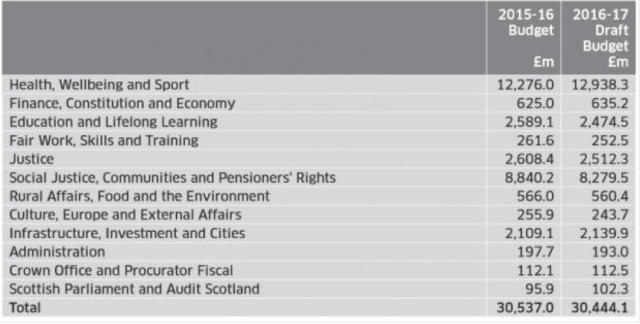
By the Numbers: Scottish Government Budget 2016/17

And so that was the pitch we got: no rise in income tax “because it would hit the poor harder“; same for council tax; the only rises to hit big business and second home owners. But, from the £400m increase overall, £500m more to NHS, £55m to police and parity to further education, to transport. Every part of the statement was positive, as if he had conjoured money and  stretched it further than you would think possible.

He made even some losers sound good—a £350m cut to councils being sweetened by £250m in NHS money to go towards better local social care that would ease pressure on NHS places. All in all, the whole was well received by his supporters for its coherent anti-Tory/Westminster theme. As John put it:

Scotland can accept these Tory cuts or we can rise to the challenge and choose a Scottish alternative to austerity. We choose to rise to the challenge. We choose the Scottish alternative.

The opposition did not share such enthusiasm. Jackie Baillie served up her ritual moanfest:

(This budget) doesn’t deliver fairer taxes, a long term plan for Scotland or an anti-austerity alternative. Local services like our schools, roads and care of the elderly will face massive cuts.

We’re in boy-crying-wolf territory here. Jackie never has a good word to say, even as she fails to offer credible alternatives. But now that she may actually have a point, it will be dismissed as her usual dog-in-a-manger act. Murdo Fraser made a better fist of it, pointing out that John had the option of reversing the cuts about which he complained through the new tax powers, but had refused.

Murdo’s point is hard to deny because John changed almost nothing in terms of income while robbing parts of his allocation to appear generous to others. Councils were hardest hit, losing £350m. Culture drops from £170.2m to £154.1m for 2016/17, with performing companies taking a huge hit of £27.6m (down to to £22.9m in 16/17) and spending on cultural collections dropping from £85.9m to £78.6m.

A 3.5% drop in Justice, a 4.4% drop in Education overall, a 6.3% drop in Social Justice (despite another boost to public pensions) are all serious reductions. None of these were mentioned in the speech, perhaps because these were more easily hidden from public view.

For eight years, this blog has praised John’s obvious competence. But, given the dire state of their opposition, was there any need for a softly-softly budget like this? Yet the ca’-canny cabal at the heart of the SNP has misjudged history and fallen into the same trap that felled Labour: that being in power trumps taking risks once you have it.

Had John displayed the cojones that he undoubtedly once had, he had a unique chance to take up cudgels on several (if not all of) these fronts:

  1. Used the income tax powers and ring-fenced it to defray any cuts in culture, justice or social programmes
  2. Released council tax freeze as local government has no room to maneuver and any change next year will be too late to retrieve fiscal balance before the 2017 local elections. Revision of CT has been urgent for years but nothing tangible has been done to fix it.
  3. Taken the economic quangos to task. The Scottish economy needs to boom for any ambitious spending programme to be plausible. But neither Scottish Enterprise nor Visit Scotland nor Skills Development Scotland have been effective, given what they cost.
  4. Sacrificed some shibboleths—free prescriptions, concession travel,  eye tests, personal care, etc are all very nice. But none are means tested and their soaring burden means they are abused
  5. Got tough with system abusers in general. Half of ambulance call-outs are alcohol related. Call-outs for ambulance, A&E, fire, police, coastguard, RNLI, mountain rescue, etc deemed spurious and/or culpable could carry automatic fines to cover costs (c.f. emergency cord on trains)
  6. Stop throwing money at things. Labour’s fault was that it always talked about how much more it was spending but never what had been achieved for that money. John started well with his ‘Parity of Esteem’ with councils and Strategic Outcome Agreements. The former has degenerated to a one-sided joke and the latter to box-ticking exercises that measure nothing.
  7. Face down the special interests. Scottish charities boast some high executive salaries; many quangos and council SMTs join them in a cosy oligarchy. The same names pop up repeatedly—fine IF they achieve something. But from Arts to Zoos people on six-figure salaries get scant more scrutiny than an annual report.
  8. Face down unions who claim to represent professionals but who fixate on money and resist quality of service evaluation. This is not just the usual suspects like EIS and BMA/GPC but also low profile ones like the Society of Local Authority Chief Executives (SOLACE) and the Association of Directors of Education in Scotland (ADES)

I know John’s Cabinet colleagues ordained circling the fiscal wagons to keep their jobs past May. But were any jobs under threat? This was a unique chance in dire fiscal circumstances for them to show real mettle and genuinely “rise to the challenge with a Scottish perspective“.

Had they done so, the gulf between their achievements and Labour would have been written into history. As it is, they fluffed it. And if they don’t move soon, the gloss will tarnish, risks proliferate and inertia will lock them into the same sad trajectory toward oblivion as Labour is now on.

Posted in Politics | Tagged | Leave a comment

Fleein’

Just back from a tour of sundry airports, it is hard not to be struck by the differences between airports in Britain and those countries who take air travel seriously, such as the USA. Scotland is particularly ill-served, having a clutch of under-developed sites scattered from Ayr to Aberdeen, none of which really fulfill the role of national airport.

Contrast American and even continental airport design with the utter chaos that is the heritage of the late-but-unlamented British Airports Authority. Compare, for example, Copenhagen with Edinburgh, both serving capitals of modest 5m countries at the periphery of Europe.

While Edinburgh (EDI) boasted of handling 4% more passengers to reach 10.2m, Copenhagen (Københavns Lufthavn CPH) grew by 6.5% to 25.6m passengers last year. Contrast the layout of its single terminal with that of EDI below

CopenhagenAirport

Map of CPH Gates (above) with EDI gates (below—Note the lack of piers).

EDImap

Not only does EDI lack the more flexible and efficient pier system to accommodate aircraft and ease access to them but many of EDI’s gates are not equipped with jetways, forcing arriving passengers either onto crowded airside buses or on a short walk. Both lead outside and expose passengers to our driech weather by way of welcome.

All this is despite a claimed £260m investment over the last decade and a similar amount promised over the next decade. Certainly there have been improvements. But almost all have been in airport operations (new control tower) and ways of parting punters from their money (multi-story car park and much expanded duty-free and shopping area). That’s what you get when you privatise your airports and don’t pay attention.

More importantly, EDI may boast New York as a transatlantic destination in its top ten (NWK) but CPH flies twice as many passengers to New York and almost as many to EDI’s main destination of London

Perhaps it is unfair to take smaller airports as examples of the best a country has to offer. What about the top two airports in the UK (Heathrow and Gatwick), as compared to the top two in the USA? In the same year as above (2014) Atlanta (ATL) grew 2% to 96m passengers and retained the top spot in the world (beating Beijing’s 86m) and Los Angeles retained its 6th world ranking by growing 6% to 70m.

Heathrow (LHR) did hold on to the 3rd spot with a 1.4% growth to 73m while Gatwick (LGW) was still way down in 36th place, despite a 7.6% growth to 36m passengers. Ten other US airports beat this, including San Francisco (up 4.8% to 47m). Interestingly, Singapore (SIN), a country not much bigger than Edinburgh, was in 16th place with 54m passengers.

But, just as with EDI and CPH, contrasting the structure of either UK airport with practice elsewhere shows both LHR and LGW is a poor light and underscores the lack of strategic thinking and investment in either.

LAXmap

Layout of Los Angeles Airport (LAX)

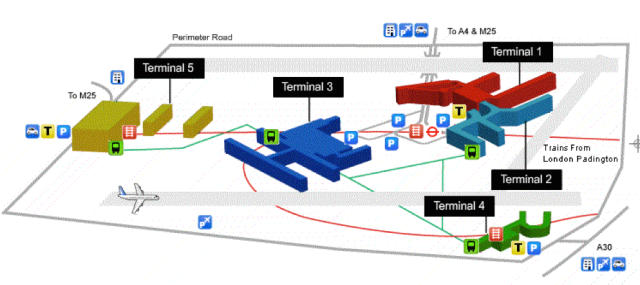
LHRmap

Layout of London Heathrow Airport (LHR)

Contrast the two maps above and what strikes you? That LAX is laid out to a plan. That plan has been in place since the 1970’s when there were only six terminals. It offers easy traffic flow around all eight terminals with through traffic unimpeded in the centre and shuttle buses connecting each terminal in a matter of minutes. It is well signed which airline leaves from which terminal; even if you miss it, it’s only five minutes round the circuit again.

By contrast, LHR looks like a Lego set that has been dropped on the floor. Though it should have a huge advantage in being connected to both the Tube and to mainline rail services to Paddington, connections are partial and illogical. Getting from one terminal to another is bewildering. It often involves a crowded bus ride, twisting through the air-side bowels of the place that no passenger at LAX would ever see.

Is this a fluke? Not at all. Look at JFK or ATL and you see the same logical pattern imposed, despite the US being an even more free-market place than the UK. Contrast the second airport in UK with the second airport in California and the disparity in long-range thinking repeats itself.

SFOmap

Map of San Francisco International airport (SFO)

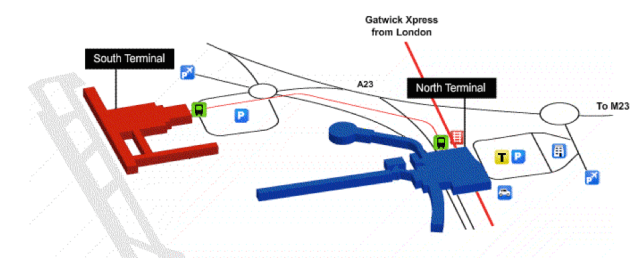
LGWmap

Map of London Gatwick airport (LGW)

Even allowing for the scale difference (47m vs 36m), SFO is laid out in a sensible and easily understood manner. Traffic flow is similar to LAX around all terminals and shuttles call at each in sequence. It even has a much used DLR-style shuttle to not just all terminals but to parking and car rental sites. There is even a BART station for connections to bothe the City and the rest of the Bay Area.

LGW does also boast a DLR-style shuttle but built such that expansion to any future third terminal is difficult, if not excluded. But LGW’s greatest sin is as illogical a set of gate numbers as you could dream up. Those sub-40 are in the South Terminal. The North Terminal has 40-56, 101-113 and 555-563. What happened to the rest is unclear. But then they really mess with your head by having 55A-55G, which happen to be at the opposite end of the airport from (and easily confused with) 555-559. The reasoning eludes me.

The recent political spat about Westminster not coming up with a decision on another runway for London rather misses the point. Why throw good money after bad with their execrably poor airport layouts? Whoever dreamed up London’s airport strategy must have been fleein’ not flying.

If the Scots had any sense, they’d build their answer to Copenhagen on a rail line near Larbert and close EDI, GLA and PIK. This could then act as our single hub, as CPH does for Scandinavia. It would steal transatlantic flights from hopelessly muddled LHR/LGW and provide Scotland with the kind of links that would mean far fewer of us would need to get lost in the present and future time-wasting tangle that is London in the first place.

Posted in Commerce | Tagged | 2 Comments

Time to Learn Mandarin

山雨欲来风满楼 (shān yǔ yù lái fēng mǎn lóu)

Coming events cast their shadows before them

Coming to the end of ten days in and around San Francisco, I am struck by how much the old place has changed. This 74th anniversary of Pearl Harbor may not be the most propitious occasion to make observations of incursions of the Orient into the Occident. But these major shifts merit comment.

I have loved San Francisco as a city since first introduced to it forty years ago. It has much in common with Edinburgh: its myriad views of hills and sea are photogenic and stunning; it acts as the cultural magnet for an extensive hinterland; it has become a major tourist destination. It also suffers from overshadowing by a larger, equally cosmopolitan rival better placed to take advantage of trade links on offer—New York in their case.

Unlike much of America, San Francisco has always looked to the Orient for its trade. Its cosmopolitan and oriental slant started early when many Chinese were brought in to help build the transcontinental railroads linking in with the rest of the country. But the City was built largely by Europeans, first brought here by the 1849 Gold Rush, boosted by the vast lumber and agricultural resources of California. And when a whole new set of industries from shipbuilding to aeronautics swept West in WW2, it formed the kernel of Silicon Valley and they have never looked back.

TransAm

Symbol of the Sixties: TransAm Skyscraper Does What it Says on the Tin

By the 1980s, the rising trade clout of Japan and Korea and the aftershocks of the Vietnam war poured new waves of oriental immigrants into the area, leavening the black and chicano elements and these have proved to be among the most successful immigrant groups America has seen, with many using family and hard work to propel first generation into professional careers through diligent ambition and education.

This was the state of play in the mid-1990s when I last lived here—a cosmopolitan City with its feet in the West and its eyes on the East. But in the last decade, a shift is discernible, linked with the inexorable growth of China as a global economic force. There has been no massive influx of people, as there was after Saigon fell or when the railroads were built. But the character of the place is changing rapidly.

Walk through San Francisco College at Balboa Park and there are almost no white faces. Ride BART or the Muni and almost all the faces are Asian or Latino. What was once a blue collar district like Noe Valley, with most working skilled manual jobs in places like Hunter’s Point shipyard, is now threaded with tasteful enterprises and a boatload of rich young whites who hop on the huge smoked-window buses to whisk them off to Google or Facebook in the 21st century’s incarnation of Silicon Valley.

SFireTruck

Classic SFFD American Ladder Unit Screams down Church St in Noe Valley

But the real change is in the Financial District downtown. The change in skyscraper construction is mirrored in those occupying them. Whereas once the faces were all white, except for serving staff in the watering holes and restaurants and Chinese faces were generally limited to nearby Chinatown, there is far more of a mix, with Chinatown now embracing what was once Irish and Beat-poet North Beach. Dim sum is now as popular as pastrami sandwiches for lunch.

PoetCityLights

The Poet Room in City Lights Bookstore: Still There, but for How Long?

The combination of affluence and racial mix is palpable, tasteful upmarket establishments spreading to the once-run-down Embarcadero waterfront (now a palm-tree boulevard of vintage trolley rides), infiltrating the once-sleazy, brothel-infested Tenderloin and spreading into SoMa (South of Market), replacing warehouses so artists can no longer afford studios.

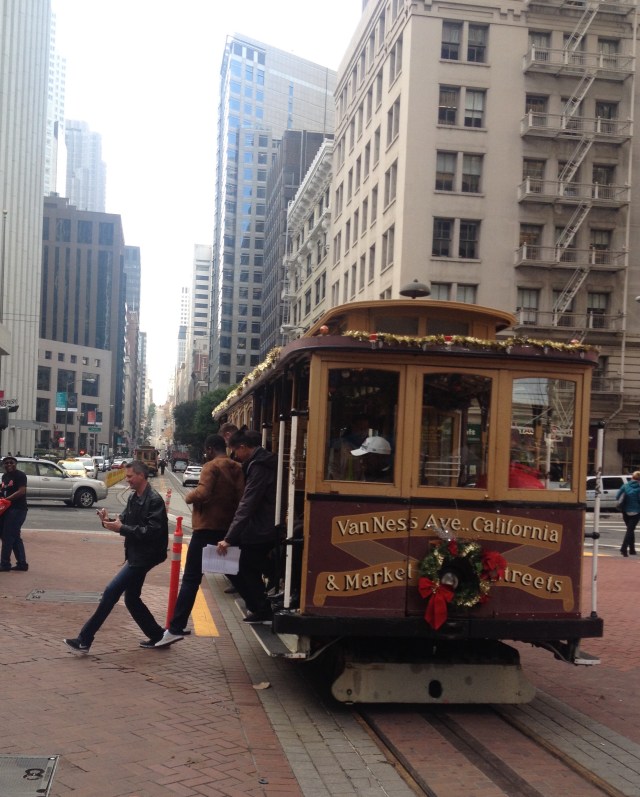
CalifCable

Heart of SF Financial District—California Cable Car Terminus on Market

But it’s the type of business in the skyscrapers that is driving all this. Always a financial centre with Bank of America headquartered here, the trend of the last few years is that here is where Chinese money made from booming trade is returning to America in the form of investments. Buying US T-bills is no longer sufficient. Entire US companies are finding their leases terminated as the Chinese enterprise that built/bought their offices wants the space for their own West coast operations within the US.

Although the US Immigration Service is still anally vigilant about people trying to sneak into the country, the State of California and the City and County of San Francisco are no slouches when it comes to seizing business opportunities. These days, San Francisco is giving Hong Kong and Singapore a run for their money as a financial hub and catalyst for trade development.

Lunch at the spectacular Cliff House out on Great Highway (overlooking the rolling Pacific as it sprays surf on the pelicans perched on Bird Rock) is a local treat. There are many ship movements to observe. At least once an hour, a massive container ship appears on the horizon and heads for the Golden Gate to discharge in Oakland’s humming port. Most of the containers are emblazoned “Han Jin“. Shipping traffic in general here makes our Firth of Forth look like a sleepy backwater.

CliffHouse

View from the Cliff House. That Dot on the Horizon Is the Future

But also listen to your fellow diners; many are Chinese but they are all speaking Mandarin, not Cantonese—the language of native San Francisco Chinese. Until recently. Most switched-on San Franciscans recognise this fundamental fact and are embracing it. But the impact of China’s development into a global economic power is still barely acknowledged in much of the West.

Even if you don’t live anywhere near San Francisco, but have ambition for your children, I would recommend they consider studying a second language: Mandarin.

Posted in Commerce | Tagged | Leave a comment

Patrician Politics

It would seem that, having led his party to multiple unpredicted victories before having the grace to fall on his sword when he failed to clear the final hurdle of the Independence Referendum, the political death of His Eckness has been greatly exaggerated. He was never likely to leave politics entirely. But, unlike Ted Heath, whose eminence grise may have haunted Thatcher but soon faded from public perception, Alex Salmond makes much too good copy to let him go gently into any such good night.

And so it was this week that, freed from the constraints of leadership (even of the third-largest MP group at Westminster) he flashed back into headlines both sides of the border with pithy commentary on the debate over adding bombing of Da’esh in Syria to that already underway in Iraq. That debate drew memorable speeches from a number of members, as well as the usual collection of toe-curlers. But the one that will sit best among Westminster’s hefty panoply of ‘history made eloquent’ came from Labour’s Shadow Foreign Secretary, Hilary Benn.

Had the speech been against the bombing, the story would end there. But, despite due deference being paid to his anti-war leader Jeremy Corbin, Hilary came down emphatically on the war side of the debate.

Having carved a political career for himself that owes little to his more famous father, it was perhaps inevitable that comparisons between the two would be drawn—especially as Tony made a typically blistering attack on the idea of bombing Saddam’s Iraq when things were leading up to Gulf War II in 1998. Describing Hilary’s speech on LBC Radio “Leading Britain’s Conversation”, Alex said;

(Hilary) “was batting a good wicket, with adoring Labour behind him and enthusiastic Tories in front. The buttons he pressed were appealing to Labour’s internationalism, the United Nations, the Spanish Civil War…but I’ll tell you this: his father, whose speech I heard in the Iraq debate all those years ago, would be birling in his grave hearing a speech supporting a Tory Prime Minister taking his country to war.”

Cue outrage among Labour chatterati that members of their Patrician elite could betray Labour principles, let alone each other. Prominent among them was the third generation—Emily Benn, Hilary’s niece and Tony’s granddaughter, demanded an apology from the former first minister, saying on Twitter: “Your comments are both deeply offensive and simply untrue. I hope you reflect and retract them.”

The Daily Record reported others leaping to Hilary’s defence. Labour’s lonely MP Ian Murray accused the SNP politicians of “dreadful behaviour”, claiming “This is too important an issue to play petty politics with“. But is this dreadful behaviour? Do the collective ladies protest too much? At what point does any politician—let alone a patrician dynasty—become such a revered shibboleth and immune from comment? This is democracy; it’s called debate.

No student of British politics can avoid Tony Benn. He gave up a peerage for a cabinet post in Wilson’s government and waxed lyrical over the ‘white heat of technology’ that was to power Britain out of its grey gas-fired black-and-white miasma that passed for post-war prosperity.”One of the few UK politicians to have become more left-wing after holding ministerial office“, he was a constant rallying point for the Left.

Benn stood against Denis Healey, the party’s incumbent deputy leader, triggering the 1981 Deputy Leadership election, disregarding an appeal from Michael Foot to either stand for the leadership or avoid inflaming party schisms. Fully supportive of Labour’s “Longest Suicide Note in History” that led to their 1983 GE nadir, he symbolically lost his seat. All this is not to denigrate Tony Benn, but to underscore that, eloquent, principled and passionate though he was, he (unlike his son) could in no way be called mainstream, even in the Labour Party.

Add in the fact that successive generations often establish their identity by reaction against what went before, and it’s mostly  whips and others tholed to blind party discipline who would finesse honest democratic differences and decry those who would discuss them. There is no evidence  Tony was ever other than proud of his son, a pride unshaken by their embracing differing threads within the Labour movement. But Salmond was simply articulating what anyone—whether in Labour or not—might have said when any media were out of earshot.

What this debate ought to have been about was Hilary’s speech itself. Memorable and well delivered as it was, it did signify a major shift from a anti-war stance that he had held and advocated as recently as two weeks earlier. It would appear the Paris bombings may have changed his mind. But there is much more than that deserving analysis.

Autonomy Scotland has done a thoughtful and provocative filleting of the speech: “Benn’s oratory was articulate and impassioned (but) the substance of what he conveyed was insubstantial. Although France is a great country and a great ally, the much trumpeted idea that we must bomb by their side is idiotic.” It then goes on to posit a sensible metaphor for the situation.

“There is more than one way to help a friend. For instance when my friend came round to my house one night agitated after having his car windows smashed in, I didn’t acquiesce to his request to join him in a bloody quest for vengeance. Instead, I sat him down, poured him a drink and talked some sense into him. He thanks me now as he appreciates not being in prison. This is the type of approach we need to adopt with our allies.”

Posted in Politics | Tagged | 1 Comment

Wha’s Like Us?

Being in a far-flung corners furth of Scotland for the last week (Glendale AZ; Sonoma CA) the marking and portent of St Andrew’s Day had slipped by me until somebody tweeted a link to Stephen Daisley’s OpEd column for STV News. In it, he rather dismisses what is perceived to be the perky patriotism of the average Scot, couching it largely in terms of the modern politics of nationalism and undermining the basis for such sentiment with emotionless pragmatism such as :

Scotland is a small country, not special or essential. If we vanished from the map tomorrow, warm eulogies would be given for our Enlightenment and inventors and the cute tartanry but the world would keep turning.

Technically, the man is right. But we are firmly in “knowing the price of everything but value of nothing” territory here; the man inhabits a reality that few Scots outside of 67 Northumberland Street N-W Lane, Edinburgh would recognise.

Were MORI to do an international poll of a statistically significant sample of the peoples of the world from Tierra del Fuego to Nova Zemlya and all points between as to the country with the highest positive profile, the USA would come out top. But, if the question were limited to small countries, Scotland would beat dull Switzerland, pricey Norway, peaceful Costa Rica. acerbic Singapore or any of the rest of them for high profile, let alone contributions to the world.

Because of an extensive, hardy, hard-working, shrewd, successful diaspora, Scotland’s profile in America and the dominions is sky-high—better even than the stratospheric level of the Irish who tended not to dissipate across the country. Once a poky little place on the edge of Europe, Scotland went out to meet the world as soldiers for Gustavus Adolphus, traders in the Low countries and admirals for the Czar. Little wonder they seized the opportunity in an empire-building partnership with England.

So much so that a century ago, half the world’s ships were being launched on the Clyde—an epic of achievement and a source of pride. From Bank of Scotland to Jardine-Matheson, Scots explored, built, pioneered, led, soldiered and founded with the best of them. Nobody suggests their achievements were unique but they stand as fine a testament to a people’s abilities as anywhere.

However, even if “Here’s tae us; whae’s like us? Damn few, an’ they’re a’ deid” is stretching things, are we as egalitarian and socially seamless as we like to think? Does Peter MacMahon have a point when he blogs to questionthis idea that Scotland is a country with social justice running through the national veins“? He cites three recent studies that imply otherwise:

  1. A survey for the Scottish government found doctors’ surgeries in the poorest areas of Scotland are getting less money per patient than those in wealthier areas.
  2. A report from Edinburgh University academics said there was no evidence the SNP’s policy of ‘free’ tuition fees has increased poorer students’ access to higher education.
  3. A report by the Social Mobility and Child Poverty Commission ‘Elitist Scotland‘ says the country’s leading professions are dominated by those from private schools and elite universities.

There is no reason to doubt any of the above. But neither do they imply  Czarist levels of inequality, nor do they preclude a cultural couthyness that goes well beyond cats looking at a king. There are devoted royalists across Scotland. But, without wishing to disparage anyone, they are in a serious minority, especially compared to widespread reverence across England, as amply voiced by Auntie Beeb.

Most Scots give elitism short shrift, seeing no reason accidents of birth accord anyone superiority in life. (It is no co-incidence that, from Carnegie in the States to MacQuarrie in Oz, Scots have flourished in the more can-do egalitarianism of the colonies.) Some of this derives from chippy resentment of English domination of Scottish life, as voiced by more ardent nationalists. But most seems to come from a genuine belief in the ‘Lad o’ Pairts’—the self-made man who pulled himself up by his bootstraps and earned any respect he was shown.

And—many though the rich subcultures in Scotland are—from Portree or Portobello, this derives from a plain-talking sensibility. Originally dinned into us by strict dominies and stern meenesters, it was carried on by grizzled grandads who’d been in the pit/yard/factory/field. They passed their lack of pretension and ready questioning of authority on to their 21st-century grandchildren. Anyone who lives here experienced this.

Nobody thinks we live in an egalitarian paradise. For example, Nicola Sturgeon wants to address the inequalities McMahon highlights, being “particularly concerned about the attainment gap between poorer and better off pupils in Scotland’s schools.” She has launched the Scottish Attainment Challenge, backed by £100 million, to try to close the gap.

Stephen Daisley may well be sincere when he fumes: “Scottish nationalism leaves me cold because there is no philosophy to it. It is about being Scottish — or more accurately Not British — and nothing else” but he entirely misses the point. Yes there are hardcore types who resent the helplessness of the 1980’s against Thatcher and see more Tory rule as alien and objectionable.

But the bulk of Scots embrace Winnie Ewing’s iconic “Stop the world—Scotland wants to get on“. They travel more, benefit from the biggest influx of immigrants since the Vikings and have found their cultural and political feet in the last two decades as much as independent Eire. Multi-faceted though it may be, a Scottish voice and cogent individuality exists—and it is far broader than individuals like our Andy Murray.

What Mr Daisley seems to have missed is that most Scots have ambition to be other than England’s poodle, to be more than a province of North Britain that speaks funny and where nasty stuff like nukes can be safely parked well away from the fount of all that is good in the Home Counties. We look at Norway or Singapore or Finland—ex-colonies all. We see they prosper. We see the global good they do. We see strong, friendly links with neighbours. We see nobody targets them because they give little reason to be targeted though they act as peacekeepers around the globe.

And, to correct Mr Daisley, we Scots are British, just as Norwegians are Scandinavian. But a geographic term and strong links based on history and mutual interests need not require political unity. And once that no longer applies, watch the chip that he perceives (probably rightly) to still sit on some Scots shoulders fall away.

Posted in Politics | Tagged | 1 Comment