Open Letter to Nicola

I hope you’ll forgive the presumption but I have already tried writing in confidence to all four of your party’s members of Holyrood’s previous Local Government Committee and even to the Minister at the time (Marco Biagi). Unfortunately none saw fit to send anything by way of reply—although Marco’s staff was good enough to acknowledge my missive.

First of all, sincere congratulations are due, both for a decisive win in the recent election and for a well merited return to the post of First Minister. But that now means the task of selecting a cabinet who will best assist you to, as you put it:

keep a laser like focus on the economy and the need to generate revenue to invest in our future…in a constantly evolving and challenging global environment, with the potential for renewed economic turbulence internationally, it is vital that we make sure Scotland is as well-equipped as possible to make a success of our considerable economic strengths.

While I would not presume to suggest its composition, I do ask that you consider that—from close observation of the SNP administration over the last nine years—local government should register more highly in cabinet consideration.

Significant number of your experienced members have considerable local government experience: Derek Mackay; Bruce Crawford; Richard Lyle; Kevin Stewart; Kenny Gibson; Keith Brown; Joe Fitzpatrick, to name just a few. Marco—bright and decent though he was—offered no such experience and displayed scant interest in pushing his brief, all of which sent a lamentable message to those who toil diligently as much as full time to get their chests prodded regularly for £16k.

After the positive start made by John Swinney with the Concordat and ‘parity of esteem’ in 2007, the hollowness of that and downplaying of councils’ roles became obvious (as well as embarrassing for your members). Council tax stayed frozen; no serious effort was made to reform local finance; last year’s budget hit councils particularly hard with ‘take-it-or-leave-it’ indifference. Your 400+ SNP councillors apparently were expected to stay well in the background and not rock the referendum boat.

But, now that your party soared over this month’s parliamentary hurdle and there is little likelihood of a second referendum soon, this would appear the opportunity to turn your and your closest colleagues (not to mention the Chief Executive’s) skeptical attitude to the usefulness of local government. As none of you have such experience, this is, perhaps, understandable—especially so where you own experience is against Glasgow Labour ‘machine politics’. But consider this before you continue to degrade councils into biddable extensions of the government.

  1. There are ten times more councillors than MSPs ; most come in daily contact with their public and are personally known by them.
  2. Though many councils are not SNP-run, only a few are Labour-run and even those are no longer a phalanx of old-guard opposition to an SNP government
  3. The public’s sour attitude to politicians is widespread. They don’t understand the system; they gravitate to single issues that matter to them; they prefer social-based civic organisations like WFI.
  4. Only councillors are numerous and widespread enough to reconnect public ambitions with a government that has the power to achieve them.
  5. A wider belief in something as momentous as independence can be led, but not generated from the top; rebuilding trust required involves reconnection of the public from the bottom up.
  6. Devolution good enough for Government is good enough for councils.
  7. Council finance reform is overdue; more like 50% should be raised locally
  8. Over-centralisation leads to arrogant government and to lazy government
  9. Council reorganisation is essential, perhaps into a few city regions and many much smaller burghs with minimal staff
  10. Local, visible control is the antidote to bureaucracy and disenfranchisement. It can generate civic participation

As SNP leader (with years in its leadership) you must understand more than most that speaking to the YES 45% is preaching to the choir. One in five of the other 55% must change their mind to make another referendum sensible, let alone winnable. Meantime, demonstrating competence and spreading affluence demands growing the economy and budgeting for the most good with the least expenditure.

For councils to spend their 1/3rd judiciously, they must be active partners and not passive executors—as dictated in this year’s SNP budget.But even the best-led 63 MSPs cannot speak to, let alone galvanise the wider public without those 1,200+ councillors working enthusiastically with your government and not dragging their heels in resentment.

It is not just in parliament that cross-party consensus is called for. If Tories and Labour are serious about forward thinking, then their councillors too, plus all the ALEOs, quangos, trusts, charities and sundry other civic initiatives in which they are involved could galvanise grass roots Scotland to also play their part in this awakening of Scots and their potential in which you rightly place so much faith.

Local government is not the enemy; it is actually the best ally available to you

Posted in Commerce, Community, Politics | Tagged | Leave a comment

Not Waving but Drowning

Over its five years and almost 1,000 posts, this blog has been critical of the Scottish Labour party. In part, this has been in lively debate with some of its members and its policies. The position taken here has always been that, like the Conservatives, the party reflects a substantial body of opinion in Scotland, deserves a voice to express that and has a serious role in holding to account whichever party has gleaned enough votes to form the Government of Scotland.

But much as the Conservatives marched themselves into electoral oblivion during the 1980s/90s and suffered catastrophic come-uppance in 1997, so Labour took the people’s enthusiastic endorsement in that year and spent the last two decades drinking pretty much the same Kool-aid of hubris. As journalist Molly Ivins observes about Texas men; ‘You can tell ’em; but you can’t tell ’em much”.

This came to mind after a minor falling out on Twitter with Duncan Hothersall, Duncan is one of the capable good guys still in Scottish Labour. As CLP Organiser in Edinburgh Southern, he pulls off political miracles even his opponents admire. Not only was his candidate the sole survivor among 41 MPs prior to last May but his was the only Labour candidate to win a seat from the otherwise triumphant SNP sweep of 59 constituency MSPs last week.

But when I had the temerity to suggest to Duncan that, as one of the few who clearly know what they were doing, thinking people like him might reconsider re-hashed socialist policies and ‘Labour values’ that defined his party through successive defeats, he took it that I was trying to silence him or, at the least, undermine his principles. However ineptly couched, my intent had been neither.

But if a stalwart of the party who clearly knows what they’re about is deaf to dialogue when the hale clamjamfrie teeters in the brink of oblivion, what chance does sincere-but-too-inexperienced Kezia, let alone the shattered remnants of her troops, stand in piecing together a viable future.

Though I oppose Labour for the manner in which it has taken Scotland for granted, plugged so many undeserving passengers into the ranks of those who should work to represent us and have put UK priorities ahead of Scottish ones, they do still matter. There is a constituency they could represent if they just stopped thinking they can tell the voters what to think and avoid righteous indignation when former fiefdoms are threatened. But their actions are starting to echo Sylvia Plath’s poem of hidden despair Not Waving But Drowning. If they obstinately refuse to hear the clarion call for change (as Duncan seems to) they will suffer the Tories’ two decades in the impotent wilderness. Or worse.

But some in the party ARE listening…and thinking. I came across this piece on Labour Uncut which should make eminent sense to loyal members It certainly made sense to me:

http://labour-uncut.co.uk/2016/05/10/why-arent-we-furious-with-the-scottish-party/#more-20781

It is a shrewd evaluation of where they are and what brought them there and deserves better consideration. But, as I’m not a member, they’ll just have to work it out for themselves or contemplate further SNP hegemony with Tory as the dominant opposition. They can’t want that.

Surely.

Posted in Politics | Tagged | Leave a comment

No’ Sae Green…but Cabbage-Lookin’

Despite predictions (including my own) of this election being a rather boring shoo-in, credit is due to those who peppered it with upsets of pundit apple carts. Iain Gray increased a wafer-thin majority in the teeth of the SNP hurricane that tore through former Labour heartlands. Virtuoso agent Duncan Hothersall repeated  last year’s Labour miracle in Edinburgh South by stealing a seat off the SNP. Credit also to Lib-Dems for reviving the Chris Rennard magic of focus where it matters and taking both NE Fife and Edinburgh West against heavy odds.

But the trail-blazing performance of the night was  Ruth Davidson’s 610 majority in Edinburgh Central, catapulting the Tories from 4th place there into their first city win since 2007 with a 10% swing. So, major and historic though the SNP’s third term may be, the one thing they clearly hoped for had eluded them. And, supporter though I am, I find this good, even as they avoided making it better.

Back in the heady days of 2007-11, they pulled off what no-one thought possible; a stable government with a minority of only 47 members. They eschewed coalition but found common ground with other parties so even budgets went through smoothly (with one exception). Scotland found itself governed more imaginatively than in the plodding days of Labour’s Executive and—because most parties traded some concession from the government in exchange for support, a wider swathe of the public than just SNP supporters felt they got something.

After the 2011 landslide, this sense of consensus disappeared as the SNP found no further need for it and stuffed every committee chair with their appointees and the membership with an SNP majority. Run with imagination and good judgement, this might have worked well. But absolute power and self-realisation seldom coincide. Though the SNP Government was scarcely ill-intentioned, a sense of autocratic insensitivity not seen since the dark days of Thatcher grew in the minds of their opponents.

See former blogs Making the Law an Ass, Must Justice Always be Blind? and Kenny Canny Ca’ Canny for examples from the Justice brief and the way it was handled.

Their sense of progress, apparently confirmed by the surge in support in the wake of the Independence Referendum, encouraged the government to press on. The brick wall hit by Labour in last year’s Westminster election lured them further into thinking they had discovered political mother lode and could do not wrong.

And, since their main Labour opposition looked especially vulnerable, the SNP carefully constructed a policy platform to revisit on Labour MSPs this year the same whirlwind that ravaged their MPs last year. So the social programme was strengthened, all the free perks like concession travel, prescriptions, eye tests, etc were safeguarded, the NHS and its budget were held sacrosanct and any tax talk was rigorously ‘progressive’ so that it would not hit the lower-paid.

As a strategy to deliver a body-blow to Labour, it was effective. But it also opened a flank on the business side. All sorts of people: those leery of independence; those concerned the UK economy had not recovered; those who saw Scotland’s economy under-performing vis-à-vis the UK; even those who were simply scunnered with the SNP appearing to have everything their own way—all saw little hope in Labour. This left them few choices.

For once, the Scottish Tories shook off their now-traditional cringe in Scotland and fought a feisty, unabashedly unionist, business oriented campaign. They pitched themselves as raring to take on this uppity SNP. It proved to be a shrewd move, especially as they had managed to bring in a broad spectrum of younger non-politicians who offered a fresher appeal than the series of former aides and SPADs who had characterised new faces in many parties.

But, taking nothing away from Ruth Davidson and her team whose 31 seats represent the best Tory performance in 25 years, the result reveals a trend that bodes ill for the SNP. Yes, the SNP swept the country, barring a handful of hold-outs. Yes, they pushed the limits of the voting system, bouncing into a third term when they should, by rights, have been toiling. Yes, they managed vote swings against Labour across the Central Belt in the teens . Yes, they are likely to provide a better government than any alternative on offer.

But there are straws in the wind.

Firstly, the delight at the debacle of their arch-enemy Labour and the taking of their citadels should not distract how the Tories exploited their exposed flank while they were busy doing so. In some non-Central Belt seats the SNP took some time ago—Inverness, Aberdeenshire/East, Moray, Angus/South, Perthshire/South, Angus/North/Mearns, Banffshire/Buchan the Tories now threaten in second place. If their 20% swings happen again, heads will roll. Even capable, weel-kent faces like John Swinney suffered a 25% swing to the ever-optimistic Murdo Fraser.

Secondly, in many of those non-Central Belt cases, even where they made little headway against SNP incumbents, they were snaffling up wandering Labour voters, rather then those going to the SNP. Aberdeen/Donside, Stirling, Carrick/Cumnock/DoonValley, Cunninghame/North, Clacks/Dunblane, Linlithgow, Clydesdale are all good examples. Even where there was no Labour vote to mop up and the incumbent held their own, there were still prodigious Tory advances, like the 19% in Aberdeen/South.

And that was just the constituencies. The Tories played an even cleverer game on the list and boosting their seven FPTP seats by doubling their list members to 24 with 524,222 votes that took them well past Labour for a very economical 21,842 votes per list member. Even in South of Scotland, despite winning four constituencies, their 100,753 votes were not wasted as they added two list seats.

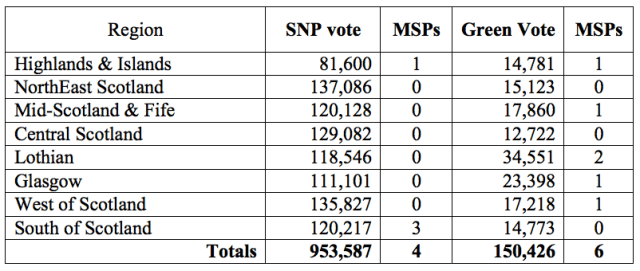
So, thirdly, Tory emphasis on receiving both votes was justified. Not so the SNP, who were adamant on the same point. This seems to have gifted their reviving Tory opponents an extra boost in doing so. The table below shows it took 288,397 list votes to elect one SNP list MSP but only 25,171 to elect a Green one (see above for what a deal the Tories got).

RegionVote

In six regions, 751,770 SNP votes were totally wasted. Worse, they could have been harnessed to the cause of independence. Rather than party discipline when there was no need, what if the SNP had publicly encouraged its supporters to vote Green on the list? Lets assume 25% were scunnered by this and didn’t vote, 50% ignored the request and voted SNP anyway, but 25% saw the logic and split their two votes.

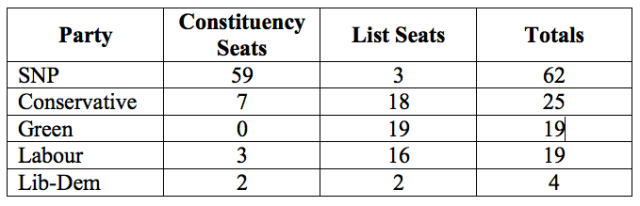
Even that 1-in-4 would (except in Glasgow) have tripled the Green vote for one or two more Green list MSPs per region for a total around 19. Those would have come most from the Tories and Labour, with SNP and Lib-Dems losing one each. This would result in the following makeup of Parliament:

GreenDawn

The SNP would still be in as strong a position to form a minority government. But if Nicola is serious about a working consensus, this scenario would make her job so much easier. Not only would she be facing Tories 2/3rds as resurgent but some hoary un-dead Labour opponents wouldn’t have slipped in through the back door.

She would face only 48 (instead of 60) hostile unionists in opposition. She would have a stronger similarly progressive ally committed to the same goal as she. That populist and similarly principled ally would soften the autocratic edges that cost the SNP votes and boosted the Tories for their promise to take that autocracy on.

That the SNP chose not to do this is regrettable by all who support their goal. It has boosted once-toxic Tories in a way they could scarce have dared hope. We’ll see just how green the SNP will become working with St Partick of the Harvie and his fewer untried troops. But so far, the waste of the greater opportunity—and of 751,770 of their supporters’ list votes—just makes them cabbage-looking.

Posted in Politics | Tagged | Leave a comment

The Election That Wasn’t

It’s a funny old world. Once Thatcherism so scunnered the Scottish electorate in the 1980’s they sent a phalanx of Labour MPs down to Westminster in protest. It was a vain effort to block the worst effect of Tory privatisation. But, though they were mocked by Alex Salmond as “the feeble fifty”, that phalanx was all we had to voice Scotland’s needs there for a quarter century. An objective assessment of their impact would be they were both invisible and ineffectual.

Labour’s watershed victory of 1997 changed nothing of this, nor did 1999 when the same stolid buggins-turn Labour stalwarts dominated the new Scottish Executive who behaved much like Strathclyde Region reborn—docile, partisan but rather less ambitious.

An observer of the subequent 2003 Scottish and 2005 UK elections could be forgiven for extrapolating such stasis into the far future. Loyal Labour activists were anointed (there is no other word for it) as councillors; if they voted right, they’d become committee chairs who, in turn, might be nodded into safe seats as MSPs and MPs. There were notable and capable exceptions like John Smith and Donnie Dewar. But the average member of either phalanx showed all the initiative of a spear-carrier in a 1950s Cecil B. de Mille sword-and-sandal epic.

And why should they kick against the traces? A conveyor belt to sinecure worked for the illuminati. It wasn’t broke, so why fix it? Though the Tories dwelt in the political wilderness north of the border, they still provided a convenient bogey man at Westminster; successive waves of effort by the SNP shattered on Labour’s monolithic West Central Scotland redoubt; all seemed well.

But the rot was evident to those paying attention. Labour’s Scottish vote was cultural more than political. As “the party of the working man“, as long as there were shipyards, steel mills, factories and mines to work in, all were instinctively Labour. Their workmates were all Labour. They lived in estates that were Labour. They socialised in Labour Clubs and Miners’ Welfares—or in pubs that might as well have been.

But the Proclaimers were singing about “Linwood no more” and significant numbers of such working men learned the words the hard way. And joined in. At first, it made little difference to voting. Dis-chuffed as they were, they weren’t going to betray former workmates, let alone drinking buddies and their own da’ and lodge a protest vote. After all, they counted Labour votes with a shovel, so what difference would one make?

But then Labour Clubs started to close. That loosened the social cohesion as such key melting pots disappeared. Then the SNP started winning council seats raising voices of effective opposition—even in monolithic Glasgow where irrepressible characters like Kenny Gibson and Billy Mcallister stood out against the norm of passive, faceless loyalty.

Scotland’s sprawling council estates once underpinned Labour’s base. But sale of those houses and floods of tract homes during the upwardly mobile 1990’s created residents with prospects and ambitions very different from the “aye-been” working class resignation on which much Labour support had been based. From Dunfermline East to Inshes/Milton of Leys in Inverness to Kirkintilloch/Lenzie to Tranent’s Windygoul, tracts of new homes were not cultivated and even the council houses sporting new doors drifted in loyalty with their new life.

So, while Labour heartlands started to wobble, the party stayed fixated on power at a UK level. Holyrood was regarded much like councils; a base of resources and patronage acting as a training ground for the real business of Westminster. So attention and venom was directed at Tories, even though they posed no threat in Scotland. As late as 2005, Blair swept them into power again; all was rosy.

But dwindling industry and clubs could not sustain working class consciousness. Gradually Labour in Scotland hollowed out. Its continued clout was sustained by still-plentiful MPs, MSPs, councillors. But the street-loads of loyal support were thinning out. Many regular voters stopped voting—a sure sign of anguish before changing their vote.

In parallel, the SNP’s relentless focus on Scottish matters, the obvious maturing of their front bench after eight years of Holyrood opposition and assiduous work by their 200+ councillors who didn’t see their office as a sinecure granted by the party, all paid off in 2007. It was a sea-change in results on a scale no-one predicted. Control of Holyrood and several councils passed to the SNP.

Because the SNP regard themselves as subservient to no-one, least of all London, they became adept at exercising control in a manner in which Labour had never dared. Labour in Scotland’s surly resentment at all this eased some in 2010. Even though they lost control at the Westminster heart of things, the Scottish phalanx continued intact; clearly little was wrong  with the party; it was just a question of tholing this awkward interregnum and they would come into their own again.

That restored complacency received a second sharp shock in the 2011 election when serious constituency losses to the SNP unexpectedly catapulted a slew of untried faces into ranks so diminished their leader of the time fell on his sword. A behind-the-scenes panic finally broke out that resources to recover from this were thin and the cupboard of experienced talent to lead that was bare.

The run-up to and even the result of the Independence Referendum almost two years ago further frayed nerves. The SNP emerged from that defeat not only united but a magnet galvanising involvement by a whole new segment of the public in a way  neither Tory nor Labour had managed in half a century.

Tories and Lib-Dems had already been humiliated. But going from 40 to 1 MPs was a body blow to what coherence Scottish Labour had left. As the transfer of the reins to Nicola Sturgeon was handled masterfully by an ever-more-professional SNP team, old hands disparaged the presidential rally style adopted as tacky and counter-productive. But SNP membership soared and a new sense of participation permeated the streets of Scotland that had not been seen since Labour had last galvanised the working class early in the 20th ©.

Since delivering that body blow to their one remaining opponent, the SNP have shown a steely focus on winning again. So dominant have they been that the media is reduced to whipping up flagging interest in what many now see as a done deal. Naturally, no party admits that in public. But when the only serious debate is on who’ll come second, this is not an election; it’s a foregone conclusion. It is entirely possible that voters will not bother to come out—but that usually hurts Labour more than any other party. That could even magnify the scale of defeat. Bookies have stopped taking bets against SNP candidates, never mind the party.

Which is a shame. Because in their urgency to seize full power for a second term, the SNP is actually doing damage to its main cause. It is true that a party must be in power to achieve its goals. But the goals set out in the SNP manifesto are shilpit things, full of reassurance, weak on facts, fluffy on the future. As a vehicle to discomfit Labour and stay in power, it is shrewd. But other commentators like Scott Macnab lambast its lack of vision and ambition. Even fairly even-handed political observers like  Gerry Hassan are scathing on this:

“There is a paucity of ideas, of imagination and serious policy, combined with a lack of candour. Worse, there is a fundamental lack of ambition for our country.”

So, while media and politicians collude to give the impression that this is a real election about which we’re locked in real debate, it is in fact a coronation. Discussion whether the emperor has any clothes never makes the front page.

And, while it may stretch a point to describe it as a coronation, this presidential personality cult imported from the USA contributes to that sense. We are enjoined to “choose Ruth for a strong opposition” or “re-elect Nicola“. Every Labour tweet or blog is about Kezia.The actual candidates become as faceless as the delegates stacked up in each US primary.
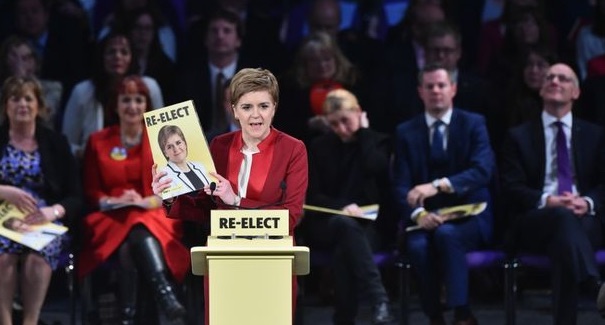
ReElectNicola

It’s not quite the three-ring circus going on with the primaries in America just now. But huge coverage, massive spends, ill-tempered debates still say little about policy or how the country and the welfare of its citizens will be improved. That we are heading down a similarly unedifying road is a shame.

Even now, the SNP is focussing entirely on re-election. At this stage, that is taking a 12-bore to a bumble bee. They have already won. They should stop posturing and make an early start on the hard work of improving the country so that its people want them to lead us all to independence. Rather than squabbling over oil price and numbers of police or NHS budget, they should be leveraging oil and whisky and renewables and tourism to turn us into an economic powerhouse.

Once you have made Scotland the Singapore-esque powerhouse of Europe where our skilled workforce out-crafts the Germans, our whizzkid software engineers out-program  the Indians, our tidal turbines in the St Lawrence and Straits of Johore and Straits of Gibraltar out-green the Danes, much becomes inevitable. Once the English are trailing sheepishly north across the Border to find the financial services and leading technology jobs they can’t find at home, then is the time to reward our retired hard workers with free bus passes and prescriptions. The more you dole out the seed corn, the less prosperous the future harvest.

That prosperous future harvest can only be reached by taking risks. So Nicola, be prepared to give half those cosy jobsworth bureaucrats dozing at Scottish Enterprise their jotters. You get there through world-class research, so hands off university budgets but hold on to every bright foreign postgrad we can. You get there by making best use of your money; ‘C’-class administrators blight the NHS—go through ’em like a dose of salts if they can’t show how blizzards of KPIs can lead to efficiency.

But, most of all, forget what campaign training has taught you, admit that you don’t have all the answers and that—whatever leadership you may show—you need to weld a far-flung team together to achieve ambitious goals for us all. That means

  • not treating local councils like subserviant executors of your policy—they may need a shake-up to be competent partners but that is a separate matter.
  • a bonfire of the quangos until they twig cosy remuneration for a few days a month needs to be earned by real experience, scrutiny and contributions.
  • serious capital investment in strategic development that includes bringing public transport up to European standards and roads up to US standards.
  • devolution of significant powers to at least city region level so that the major centres in Scotland can develop their own characteristic futures.
  • Be England’s best friend by showing all the advantages its faltering dog-eat-dog economy could have through a nimble entrepôt economy sharing the same island

Or the SNP can slide back into the comfortable shapes their bums have already pressed into ministerial chairs and ca’ the haun’le in much the same manner as your Labour opponents were always happy to do. You’ll have at least two more parliament sessions while others pull themselves off the floor and finally hold you to account. Do what you’re doing and your nemesis starts around 2025.

Which is a shame. Because, unless the Cult of Ruth can bring the Tories back from the dead this side of the next Ice Age, Scottish Labour will be the one to bring the SNP to earth. And, as they may simply revive the same walking political dead as they’ve mass-produced throughout the last half-century next time around, nobody outside their nomeklatura will see this as progress.

Given how the SNP is bludgeoning this already-dead campaign to death, the runes are not good. But, more than Labour, there are still good people in the SNP for whom the shape of our future matters more than the cushiness of their chairs.

Posted in Politics | Tagged | Leave a comment

If You Don’t Know By Now —

I’m thinking about taking the advice of Unionist friends and giving this up. They think I’m wasting my time because I’m not any good. But the real reason for stopping is altogether different…is there any point? What more do we have to do to show that, whatever your doubts about independence, sticking with the UK…

via If You Don’t Know By Now —

Posted in Uncategorized | Leave a comment

The First to Leave

While English politicians and media work themselves up with two more months of lather over Brexit, Scottish politicians and media are in a similar spiraling clinch over looming Scottish Parliament elections. Given the relatively isolated nature of the snug Tory shires driving the former and the combined inevitability and timidity of the SNP manifesto, the likely outcome to either is boring: no change.

So, er, where’s the news? Whatever scare stories of Transylvanians and terrorists storming the white cliffs by the zillion or of a second indy referendum being triggered by Brexit persist, the smart money is on the UK establishment realising even a flawed EU is better than the back of Obama’s trade deal queue. It is equally on Nicola’s troops storming to a third term of dominating every aspect of Scottish political life from FMQs, to all Holyrood committees, to micromanaging councils, to being one voice for Scotland in the Mother of all Parliaments.

But one story—likely to occur sooner than either of the above—is a departure of a country from the United Kingdom. This story is wholly unreported, partly because the seething mayhem that was once Northern Ireland and dominated front pages and news taglines for decades slipped into the un-newsworthy oblivion of Cricklewood or Crossmyloof or any other sleepy corner of the country.

And everyone involved seem to have sighed massive relief and were happy with that.

But almost a century on, the awkward imperial ego-fudge that split Ireland in 1922 still looks as cack-handed as an elastoplast applied to treat a  brain hemorrhage. Eire has, despite hot-head elements, long taken a philosophical view on re-unification. That has allowed a peace process and the awkward fact that there are four-and-a-half countries on these islands, run as two sovereign states has been rather glossed over.

FIFA recognises Northern Ireland right to a team; the formidable Irish presence in the Six Nations quietly ignores the border. Irish citizens have special access to the UK; Eire turns a blind eye to motorists nipping into Monaghan or Louth for a cheaper fill-up; cartons of duty-free cigarettes slip quietly into Fermanagh by back roads. Despite the Troubles and the fierce debate about immigrants stuck at Calais, this is Britain’s own little Schengen.

And so this cack-handed fix might endure indefinitely, were the world to stay unchanged. But events, dear boy, are conspiring to propel this backwater back into the news. Ulster unionists have a long history of fierce loyalty to the UK since Scottish Protestants were forcibly planted there in the 1680’s in an attempt to dilute recalcitrant Catholics at the height of religious wars and dynastic turbulence under the Stuarts. It was to placate them that the undignified ‘land grab’ of the six counties was made in 1922.

Ulster prospered from its industrialisation and remaining part of the Empire. Its 1.5m Protestants consistently outvoted its 1m Catholics and sent an unwavering phalanx of unionist MPs to Westminster. But the last two censuses have set demographic alarm bells ringing. It’s true that a significant chunk of Polish Catholics have moved in but they are still under 1% of the population.

But those identified as Catholic increased from 40% to 41% of the population while those as Protestant dropped from 46% to 42% in just the ten years to 2011. Even more telling for the future is the age profile, shown in this table,


Age Profile by Religion in Northern Ireland

Age Profile by Religion in Northern Ireland

Those aged under 40 show a significant majority of Catholics, as well as a growth in those identifying as having no religion. As and of itself, this is not a reason to change a peaceful status quo that took much effort and hardship to establish. Under the 1998 Belfast Agreement, unification can only happen through the consent principle, that is by a majority of people in the North voting for unity, as well as a majority in the Republic.

“Parties such as Fianna Fáil and Fine Gael are flexing their republican credentials; the SDLP also will assert their united Ireland aspirations.”  —Irish Times, 7th Nov 2015

However, the Irish Times is still skeptical of any such move soon. A survey of more than 2,000 people found 13% of Northern Irish favoured unity, with the figure at 36% in the South. Fifty years ago when Harland & Wolff was still building ships for the Empire and Eire was a relatively poor rural nation, there was little incentive. And, it could be argued, the ‘peace dividend’ has brought on the stagnant economy of the North while Eire is still recovering from last decade’s bank crash and property bubble.

But that is to ignore the huge advances that EU membership, EU investment and the Euro itself brought to Eire. Between 1970 and 2005 GDP per capita quadrupled from £7,465 to £30,924. Though it slid in recent years, it is now back up at £28,950. Despite the North’s economy growing at 1.4% (twice the UK’s) it still compares poorly with a £15,200 GDP per capita and with Eire’s lively 3.4% growth.

So, leaving aside the long and troubled colonial history and the rights and wrongs of the 1922 partition, not only is the demographic tide running towards re-unification but the economic argument—once an obvious hindrance—is now pulling strongly in the same direction. The fact that 54% of its trade is with the EU and another 33% with Eire means that Northern Ireland is even more discomfited by the Brexiters than Scotland and, like the Scots, will find itself increasingly at odds with the Little-Englanders who have taken over the Tory party.

In fact, hard-headed industrialist Belfast, teamed with the internet service and EU-foothold businesses of Dublin could be a duo with lessons for the Scots Edinburgh/Glasgow axis to learn from. Add in their idyllic rural West,  corresponding to our Highlands and the Scots and Irish could clean up on North American tourism because of the massive disaporas and high favourable profiles we both share there.

And maybe an all-Ireland soccer team would start to bust heads and lift trophies the way their rugby compatriots already do so well.

Posted in Politics | Tagged | Leave a comment

A Tale of Two Cities

I make no pretence at being an urbane city dweller but I know my way around much of the Western world and have seen many samples of the rest. Having grown up when there was still something of a British Empire, there is a residual assumption on my part that the UK, inventor and builder of planes, boats and trains with the best of ’em, still offers world-class transport. I didn’t need to go as far as Mumbai or Beijing to puncture that delusion.

An early vacation this year took me to Spain to meet up with a couple of friends and to the two principal cities of that country. We must remember Spain a hundred years ago was a shadow of the medieval superpower that once had encircled the world with golden galleons long before Britain painted a fifth of the globe a nice patriotic pink.

After losing Cuba and the Phillipines in the Spanish-American war, it was racked by political upheaval, culminating in three years of civil war and four decades of fascist rule. When Franco died in 1975, Spain looked like some third world dictatorship. Even with the great strides it made in the last four decades, during the recession it was still lumped in with other fiscal basket cases in the EU, lately under the derisory term of ‘PIGS’.

You land at BCN—Barcelona’s airport—and instantly forget the cheesy, cramped hodge-podge facilities of Edinburgh or the convoluted illogical spaghetti of connections among Heathrow terminals. As often happens on budget flights, we were delayed—in my case by two hours so the car hire desk was closed. No matter, the city centre bus was easy to find and the neat little hotel tucked behind Plaza Catalunya 200m from its terminus.

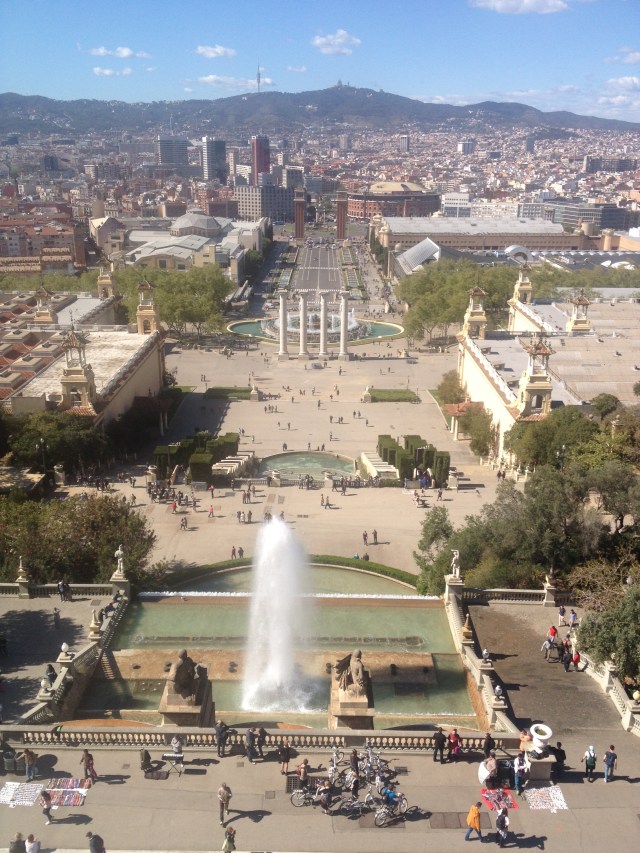
Spend time in Barcelona and you come to savour its diversity, all of which is easily accessible by Metro which costs under €10 for a ten-journey ticket. The quaint medieval lanes of the Barri Gotic is only a stroll from the broad Ramblas and ringed by wide boulevards where the bustle of the city flows by. The wide airy spaces of Montjuic overlook the  the processional avenue sweeping down from MNAC to the Plaza España and the surrounding busy commercial district around Sants. Shopa and cafes jostle along the tree-lined streets.

View over Plaza España from National Art Museum of Catalonia (MNAC) on Montjuic

View over Plaza España from National Art Museum of Catalonia (MNAC) on Montjuic

If there is a slum or a no-go district anywhere near the centre, I didn’t come across it. What you DO come across are a huge variety of districts, each with their own character. Head up the Ramblas away from the Port Vel through a pricey shopping district and cross the broad and busy Avenida Diagonal and get swept along the life flow that is the Gran de Gracia; here everything gets cosier and you find yourself lost in a maze of narrow one-way streets—some serenely quiet, others full of children playing and lively shops. It’s more fun to walk but it’s on three stops to Fontana on the Metro’s L3.

This is the Gracia district, still with the character of a town, although it was absorbed into the city in the 19th ©. Here are unexpected squares with fountains and cafe tables spilling round the edges where the locals hang out. There are superb fruterias with strawberries the size of hand grenades and xarxuterias with wafer-thin jamòn de serrano and even more serenely delicious jamòn iberico.

Plaza del Sol in Barcelona's Gracia district and 200m from the Apartment

Plaza del Sol in Barcelona’s Gracia district and 200m from the Apartment

Best of all are the local restaurants that don’t bother with Spanish—let alone English—on the menu where you dive into dishes like Pa Amb Tomaquet (bread rubbed with fresh tomatoes and drizzled with oil and salt), Escudella (stew made with meat, beans, potatoes and cabbage that can arrive as three courses) and Crema Catalana (their take on créme brulée that has also spawned delicious filo pastry custard tarts quite the equal of the divine Portuguese pastel de nata).

I had made the mistake of visiting Barcelona three times without ever entering Gaudi’s masterpiece of Sagrada Familia, having been put off by the queues and satisfying myself with the impressiveness of the exterior and crowds admiring it. This trip, I corrected that mistake and was shamed it took me so long. As an admirer of medieval cathedrals with gothic masterpieces in Norwich, Canterbury, Winchester, Notre Dame and even the floating mastery that is Chartres under my belt, I was still unprepared.

To say it is gothic on LSD trivialises it. The incompleteness outside is not reflected inside; it is a poem in three dimensions, suffused with subtle light. Whereas in other cathedrals gothic columns reach up to the roof in ranked arches, this is subtlety itself; each column branches with organic unpredictability of trees and the varied stained glass windows intersperse polychromatic highlights with shade so that the fantastic space within appears almost a living thing.

Interior of central apse of Sagrada Familia

Interior of central apse of Sagrada Familia

So, after the best part of a week in Spain’s second city, I climbed aboard an AVE (RENFE’s high-speed train) at Sants station, looking forward to its capital. As with the airport, the station embarrasses British standards for a main terminal. The whole thing has wide roads around it, bus and taxi areas, is served by three Metro lines and its modern passenger floor space (with shops, restaurants and facilities as well as ticket offices) is double the area of Waverley—tracks, platforms and all. Of equal area below this are fourteen through tracks to which access is controlled much as at airports but with much less fuss and walking.

The journey to Madrid is painless—the same distance as London-Edinburgh in half the time as a non-stop. Madrid’s Atocha main station is even bigger than Sants; it would make some airports look cramped. But, again, taxi, Metro and bus were easy to find and I was at my apartment not far from the Plaza Mayor within 30 minutes of arriving.

Perhaps it was because the weather broke and it was a week of spring weather much as you would expect in Scotland at this time of year (chilly, rain showers, a little windy) when I had left balmy 20 deg sunshine behind but Madrid gave the impression that it was chilly and dank even when the weather was good.

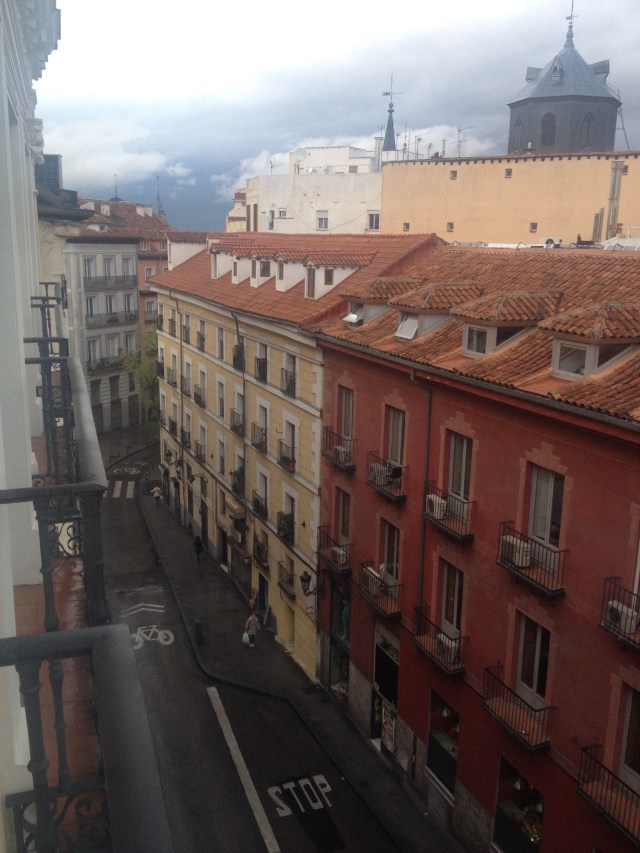
View from my Apartment in Calle AStocha, Madrid

View from my Apartment in Calle Atocha, Madrid

Madrid suffers from the problem of having been a major city in medieval times and so the centre is cramped by modern standards. Whereas Edinburgh (and Barcelona) solved this problem by building a brand new centre away from  the old one and Paris simply used Napoleonic authority to sweep the old away and build in a more grandiose style, Madrid still has the narrow streets and tall buildings of another era and feels provincial as a result.

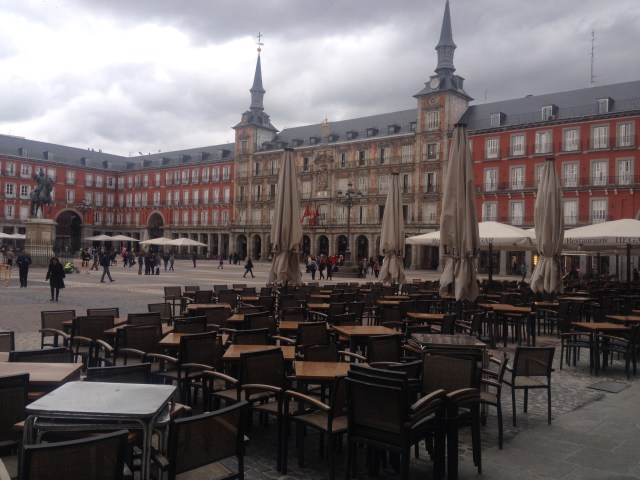
There are modern and lively parts to it—the Puerto del Sol is surrounded by fashionable shopping and yet has no cafes and restaurants sprawling along its edge making it more human and enjoyable, as would be the case in Barcelona. And when you penetrate to the supposed heart of the city, the Plaza Mayor, it has a faintly abandoned feel to it as the shops leading up to it are tackier than those in Edinburgh’s already touristy Lawnmarket.

Plaza Mayor—the Heart of Madrid.

Plaza Mayor—the Heart of Madrid.

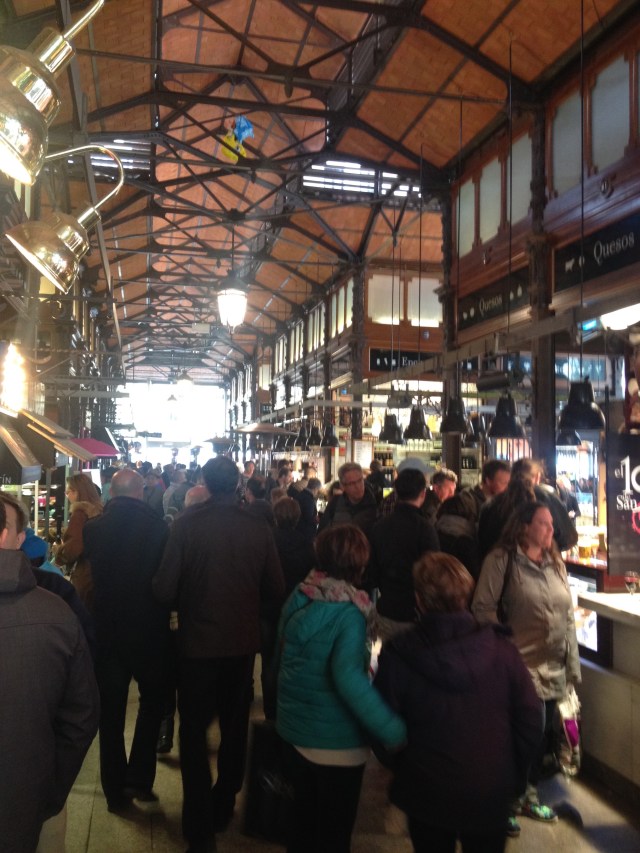
Certainly the weather didn’t make this supposedly main square seem cosy. But, even on a summer’s day, the sheer architectural relentlessness of the surrounding buildings is not conducive to the kind of informal, bustling cafe life I found in Barcelona. The most engaging and lively corner that I found in the city centre was the San Miguel market, which made a good fist of bringing together interesting food and drink stalls with boutiques and cafes to provide a real city-life experience to rival Boston’s Faneuil Hall or Philadelphia’s Reading Market.

Madrid's San Miguel Market, not far from Plaza Mayor.

Madrid’s San Miguel Market, not far from Plaza Mayor.

Moving out from the city core, it seemed to lose what character it had. The Prado is very accessible but, other than as an imposing building, came as a disappointment. They had chosen to glue an ultra-modern extension on the rear to accommodate shop, cafe and entrance…which rather demolished any feeling of antiquity or veneration for it. And, while the collection is vast and the Spanish school well represented, there are only so many Don this-an-that in lobstershell armour you can take before the eyes glaze.

Despite the wide selection of august paintings, I was most taken by a painter new to me. Joaquin Sorolla, a contemporary with the Impressionists, made astute use of their irreverent approach to light and colour. His monumental works on display carried social and historical themes that, for me, expressed more than all the formal Velasquez portraits.

Moving further out from the city centre brought little more than intensity, such as is common in a hundred faceless cities, viz: much traffic and phalanxes of pedestrians but little by way of soul or colour. Typical was Nuevos Ministerios, a transport nexus to the north, where many government departments are housed. Eight lanes N/S intersect with six lanes and a flyover E/W above a combined RENFE and Metro station beneath. There was scant joy and certainly none of the laid-back squares of the Gracia: everybody was much too busy wanting to be somewhere else.

And that included me.

Posted in Community, Transport | Tagged | Leave a comment

Trans-Arctic Convoys

Once upon a time, the British took the Phoenecian and Viking idea of building a maritime empire to its logical global conclusion. We spent the last two centuries congratulating ourselves on how clever we were to do so. Leave aside that a former colony has long put us in the shade as the heavyweight of global enterprise; leave aside that the masses of goods imported into the UK (we’re not so good at exporting any more) arrive in non-British ship bottoms,  registered under flags of convenience from Panama to Liberia, not the Red Duster; we still remain a maritime nation.

Which means that we still should pay attention to what goes on on those high seas we rely on. We should keep our wits about us to counter threats and exploit opportunities. But, unfortunately, media and government thinking both seem increasingly landlocked and focused on landlubber issues like Palmyra, Ukraine or Brussels.

Non-terrorist threats not requiring immediate action get short shrift. One such ho-hum is global warming and its effect on global ice sheets. This has drifted in the background of people’s awareness for years. Deniers do their best to keep it there. But since 3,250 sq km of the Larsen B ice shelf in Antarctica—a chunk of floating ice the size of Lothian— went walkabout in 2002, some people have sat up. Recent research doubles the prevailing estimate of rise in sea level by 2100AD from 1m to 2m .

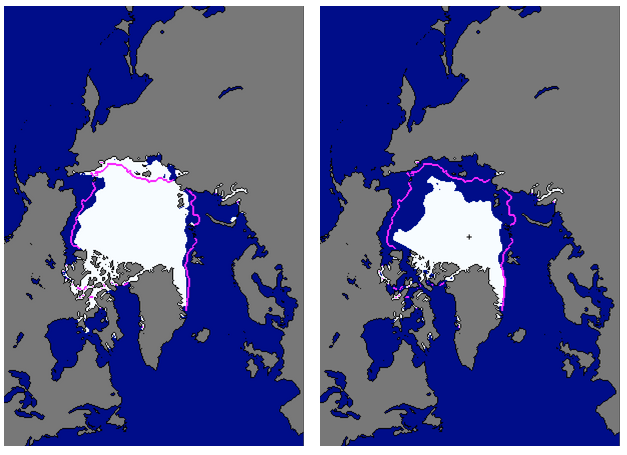
This is reinforced by mappings of the extent of Arctic ice at the end of each summer. The deterioration seems a cruel joke on intrepid explorers like Cabot, Frobisher and Davis who searched for the Northwest passage in vain; it now exists, albeit seasonally. Compare the two maps below for 1979 and 2011. The coloured line shows  average extent for the period.

ArcticIce

In recent seasons, ships have traversed round both sides of the remaining ice pack. And the way things are going, its extent will shrink further, possibly disappearing. Even though it would refreeze each winter, icebreakers could traverse it part of the time because it would be thin while forming.

This happening would not imply global inundation. The huge Greenland and West Antarctic ice sheets sit on land and their melting would indeed be catastrophic. If that happens, we need gills: Glasgow’s underwater and the Highlands become two islands. But Arctic ice already floats on water and displaces almost the same volume when melted. We might in fact find some good out of such an event. Look at the maps again and, this time, from a truly global perspective.

European trade with the Far East, especially China, has mushroomed in recent decades. Unless we find a better source of cheap electronics, appliances and manufactured goods, will grow more. At present, virtually all of this arrives in massive container ships. Where these were once so-called ‘Panamax’ size—cargo of around 80,000 tons (carrying 4,000 20ft containers) that could fit through the Panama canal—trade is moving to ‘Post-Panamax’ (6,000 containers) and ‘Post-Panamax Plus’ (10,000 containers). While the latter is more efficient for the $14m it costs to run (vs $9m for a Panamax), over half that cost is fuel.

The reason it costs so much is the distance. Glasgow may be just over 5,000 air miles from Shanghai but even ships using the Suez canal cover 10,800 miles and take over a month to get there. Larger ships must cover the Cape route’s 14,100 miles and that takes six weeks because ‘Slow Steaming’ at around 18 knots is the standard way to save expensive fuel. If that distance could be halved, then fuel worth $8m could be saved each voyage and twice as many voyages made. So let us really look at those maps again.

Even if the Arctic were not entirely clear of ice, 6,000 miles Glasgow to Shanghai becomes a possibility for perhaps half the year. What Europe really would need is a trans-shipment port. Huge vessels have great trouble accessing the shallow ports of Hamburg, Rotterdam, Felixstowe, Le Havre, etc. But they could be loaded up from and discharge to small ‘feeder’ cargo ships in some large, deep water anchorage on the edge of Europe for distribution..

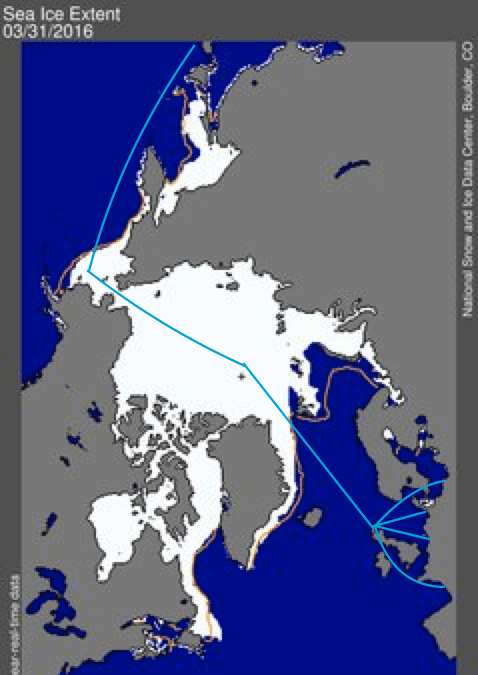
I give you the 324 sq km (same size as the lost Larsen B) of water that is Scotland’s Scapa Flow and a peaceful reincarnation of the Arctic Convoys of WW2.

Arctic

This map shows the sea ice at the beginning of this month—the greatest extent likely in the foreseeable future. Even assuming all of it does not melt, there will be open water and the advantage of this route as sea lanes is obvious. Once the home of the Royal Navy’s Grand Fleet of battleships, Scapa Flow, already a major oil terminal, could become what Patterson once dreamed of in his ill-fated Darien scheme of 1698—a major global entrepôt that would transform the economy of Scotland and place it at the heart of world trade.

Posted in Commerce, Environment | Tagged | 1 Comment

Nae Twae Kitchens

My grandad was a crusty old fart, given to rolling in from the pub the worse for wear and frightening the bejasus out of me when he took off his wooden leg to relax. His real one is still somewhere outside Ypres. That loss made his fisherman trade very difficult to ply so he was constantly broke. Which goes a long way to explain his crustiness. But, though he could be stern, he passed on some pithy phrases that stay with me. The one above was trotted out when my gran tried to sneak me a jeely piece with both butter AND jam; to him, sheer extravagance. Milk AND sugar on porage brought down similar condemnation. Though resisted at the time, such lessons in consuming within your means stay with you.

I was reminded of my modest and frugal grandparents when this week a rather damp squib of a starting gun was fired in the BBC Leaders’ Debate, almost simultaneous to Kevin Hague’s œvre The Price of Independence— An Objective Analysis. The former seemed scarcely able to address pragmatic political reality, while the latter contains an overdose.

Having ploughed through a serious amount of its 40 pages, the œvre contains what it says on the tin. Although claiming no party affiliation, Mr Hague bats steadily for the unionist team and has form as a vituperative critic of Yessers who dare question his numbers (including your humble scribe). Yet, to be fair, it is hard to poke holes in the extensive numbers he has gathered in this paper, based as they are on GERS and other government documents. He has set rigorous terms for any fiscal debate on Scottish independence.

To fellow believers in independence who rail against his relentless dismissal of any fiscal sanity behind that concept, I would qualify his conclusions as a beancounter. While his numbers stand scrutiny he seems oblivious that almost none of the 100+ countries who have gained independence over the last couple of hundred years did it by convincing their fellow citizens to believe in a spreadsheet. Business may well have been behind many a revolution but “we like the bottom line” has never been the mob’s cry as they storm the palace and line the bastards up against the wall.

In short, Mr Hague is one of those intelligent but unfortunate people who appear to know the price of everything but the value of nothing.

But, before we get too dewy-eyed and emotional, it must be acknowledged that running an independent country requires a pragmatic grasp of finances. So…convincing 2m+ Scots doubters who were unswayed by the dream but—more importantly—unconvinced by the numbers will take more than exuberant rallies by the faithful and dour dismissal of Westminster and all its works.

Between now and any successful second referendum in which significant numbers of those 2m+ doubters do join the believers, they must be swayed by plausible fiscal projections demonstrating how this country could prosper by itself. And, as Mr Hague’s paper points out, the rosy numbers  for both oil revenues and structural deficit cited as arguments by the Scottish Government a year before the referendum had not only lost their glow by September 2014 but have deteriorated even more since. See his pp 7-8.

The details of this, including looking over more than a decade and comparisons with other European countries do pose questions to be answered if significant amount of the doubters are to change their minds. Some will undoubtedly be immune to argument, being tholed to the Union as surely as some are to Independence. But the substance of the ‘NO’ campaign was using fear of fiscal damage as a club. And, for a significant slice of doubters with (understandable) concerns for jobs, business, commodity prices, property markets, etc, a convincing projection of a satisfactory fiscal future would indeed make the difference.

Which means, however much the SNP’s Scottish Government has fudged the matter over the last two years, a narrative that meets Mr Hague’s statistics and conclusions head-on is needed. Fudge has worked up to now and will probably carry the SNP back into power in May. But they will have to address this soon or lose credibility. The passing of significant devolved powers means blaming nasty Tories and raspberrying Westminster won’t do. Wur teenage Parly has to wean itself off pocket money and get itsel’ a joab.

Problem is that wur Parly has spent 17 years on mostly gesture politics. The McCrone settlement with teachers; the smoking ban; free tuition; free personal care; concession travel; nursery provision; minimum wage—all laudable initiatives. But they are populist; they were affordable ONLY because parliamentary budgets doubled before becoming constricted in the last couple of years.

That Mr Hague’s numbers show we Scots are running a structural deficit worse than the UK’s is not some unionist plot to undermine the SNP. It is reality. And waving saltires at rallies will not make it go away. Partly because of decades of Old Labour, together we Scots have grown cosy with a profligate society, as compared to our means. And, much though the SNP may have spruced up the competence of government since 2007, they have bottled hard fiscal choices to remain as populist as Labour ever was.

Just as many a Labour-run council cut its roads or cleansing or environment budgets so that libraries, community centres, all-weather pitches, etc could get built in true pork-barrel style, so the Scottish Government has ‘protected’ a high-profile NHS full of competent front-line staff let down by appallingly inefficient administrators of its £11bn. Or it has stood by while Scottish Enterprise shows very little enterprise with the £600m it swallows every year.

Meantime, some major fiscal beasts are devouring the landscape and creating Scotland’s structural deficit. It is true transport per head will be higher here than in densely-settled England. But concession travel costs have more than doubled with abuse: some people criss-cross the country on vacation while others would happily pay. Free personal care is a noble aspiration. But since its introduction, nobody has had the chutzpah to question whether we can afford it—at least until our finances look less of a basket case. There is a shopping list of a dozen such policies that need serious debate about their viability.

But perhaps the worst of all has been the extent to which our public institutions, quangocracies and charities have become stuffed with executives pulling down bloated salaries that often exceed those in the private sector—already bad enough when bonuses are included. Once upon a time, charity executives were there from noblesse oblige and not for compensation. Last year, this blog highlighted some of the outrageous charity salaries and expenses that now divert well intentioned giving by the public from the intended benefactors.

Similarly, once upon a time, council Heads of Service and Directors were modest bureaucrats grateful for rock-solid job security that compensated for their meagre salaries. Once upon a time there were far fewer public bodies whose heads were paid far less. There are now 52 Executive, Advisory and Tribunal Public Bodies, as well as Public Corporations like CalMac and Scottish Water. Chief Execs of such are routinely pulling down more than £100,000, plus some sweet benefits. Details of these were given last you in You Know You’ve Been Quangoed.

The journalist Iain MacWhirter recently came across this interesting chart published by the Parliament research organisation SPICe that sheds some light on the scale of the issue:

SPICeTax

Now, just why over 2,000 Health and Social Work executives should be pulling down more than £150,000 per annum here when the UK has proportionally far fewer and our (supposedly large and reputedly overpaid) financial sector should be so much less is a mystery both Iain and I would wish to see answered. Such sweet deals are symptomatic of the malaise and no-one has the cure but the government.

If Scotland is to make a go of it, the serious questions posed by Mr Hague’s analysis must be answered. That may be by judicious liposuction of the ‘flab’ highlighted above. Or by some equally trenchant wealth-creation policy so we can afford the profligacy identified —which, at present, we clearly can’t. The most effective answer would be both. We’re not quite as bad as my grandad—spending a night down the pub to obliterate the unpalatable truth that he can’t afford to spend a night down the pub—though we’re getting close.

In his blunt phrase, we cannae hae twae kitchens; we can’t go on overpaying people in non-wealth-creating jobs and piling more costly populist policies onto the public purse and think we’re running a viable country. Check out the EU Country Deficit Comparison on page 10 of the paper to see where we stand relative to our neighbours, as well as the UK.

More relevant, the history shown in the next chart on page 11 demonstrates that, while everyone suffered post-2008, the fiscal hard choices made in Greece and Ireland have allowed them to overtake us on their way back to viability. Meantime Scotland treads water in a fiscal funk that makes independence impractical as long as the SNP insists on spreading gesture jam on its fiscal piece.

Posted in Politics | Tagged | Leave a comment

A Terrible Beauty

For some years, I have made a point of wearing green on March 17th. That’s not because I have any Irish blood but because of a swathe of positive influences that Ireland and the Irish have made on my life. Starting with a colleen displaced to darkest Hampshire, I reckon I hitch-hiked a distance equivalent to global circumnavigation to see her over a three-year period. More recently, a riotous week a decade ago was ostensibly researching campaigns using STV voting, but actually savouring the fleshpots of Temple Bar and learning what criac really means.

Scots are fond of citing the far-reaching influence of their diaspora but—truth be told— the Irish probably have us licked as measured by global reach by a smallish country. Combined with the fact that they are stylised as sweet-talking hard drinkers while Scots are stylised as dour-faced hard drinkers, we could do worse that learn from our cousins.

St Paddy’s Day drifted by with very little fanfare in Scotland and any fraternal feeling evaporated in their decisive 35-25 6-Nations win over us in Dublin two days later. So there is little appetite to disinter a history forever wrapped with Easter 100 years ago. We like to call Culloden the “last battle on British soil”, but it wasn’t. Foolhardy bravery by barely 1,000 rebelsis was a pivotal historic event that is still debated in Eire, seminal as it was to that country, as it brought ‘physical force republicanism’ to the fore in Irish politics.

That the anniversary will be ignored in London and by the British establishment is perhaps understandable; it was not the Empire’s finest hour. The brutal lessons our Celtic cousins learned on their rocky road to independence should stand as indelible reminders of the cost to all involved of armed insurrection and decades of bitterness that follows.

The parallels between Scotland and Ireland cannot be taken far. Whereas the Scots (parcel of rogues notwithstanding) voluntarily joined to England and was a full partner in sending gunboats to the pink-painted fifth of the globe the Empire once covered, the Irish came by a different path. Since before Edward I subdued the Welsh in the late 13th century, England had colonial designs on Ireland. They had colonial designs on Scotland and France too but the latter both managed to fight them off.

But in the half millennium between then and the Irish being officially given partner status in 1801, there were a series of land grabs, skirmishes, pitched battles, resentment and religious standoffs that make John Knox look like a soft-spoken moderate. Present republican leaders descend from a romantic heritage stretching back to the High Kings and the legends around who we Scots would call Fingal. Hard-headed, hard-spoken unionists of the Ian Paisley mould descend from carpetbagging Scots who were shipped over by James VI to try to balance recalcitrant Catholics with dour Scots Protestants.

To this ancient powder keg, the otherwise triumphant government of the world’s most successful empire that had overcome warlike Zulu and wily Pathan, added gasoline. It seems they didn’t ‘get’ how they could be thwarted by a couple of million recalcitrant bog-dwellers. Since the destruction of the clan system and associated Clearances worked had so well in bringing a Tacitan peace to the Highlands—so much so that George IV could prance about in a kilt and Victoria visit the Cairngorms less than a century post-Culloden—well, the same medicine as pacified Jock jolly well ought to work on Paddy, what?

For the (largely English) colonists sent over to exploit the Pale and beyond treated the Irish pretty much the same as they did Bantu or Brahmin—local resources to be exploited in pursuit of profit. They practiced feudal overlordship long after bonded peasants had been freed into something more enlightened in England. Little wonder Irish resentment blossomed. Incidents were common as sullenness ran as undercurrents to daily life.

Catholics—80% of the population—lived in conditions of poverty and insecurity, despite emancipation in 1829. At the top of the social pyramid was the “ascendancy class”—English and Anglo-Irish families who owned most of the land, exercising unchecked power over their tenants. This land question became the root cause of disaffection, so the British Government established a Royal Commission in 1843 to review laws regarding the occupation of land. In predictable fashion, they formed it entirely of landlords. But even such a lopsided group could not:

forbear expressing our strong sense of the patient endurance which the labouring classes have exhibited under sufferings greater, we believe, than the people of any other country in Europe have to sustain.

Such was not always the case. Many Irish—like their Scots cousins—saw the opportunity that the burgeoning empire offered and created an early diaspora as they took up various callings from Saskatchewan to Singapore.

What undercut this co-operative, if not directly harmonious, element was an Gorta Mór—the Potato Famine. By the 1840s, Ireland was heavily dependent on potatoes for food. An outbreak of blight between 1845 and 1852 ravaged the crop. That in itself was bad enough. But the reaction of the British state was callous. Despite Prime Minister Peel making a start by importing American maize, he was replaced by a Whig administration that took a laissez-faire attitude: the market could rectify the famine situation. The result was 1m people died and another 1m emigrated in a desperate effort to survive.

From then on, Ireland was a rumbling volcano, the only question being when it would erupt, rather than whether. In post-famine Ireland, anti-English hostility was woven into the philosophy and foundation of the Irish nationalist movement. Parnell’s nationalists dominated the hundred Irish MPs returned to Westminster. Up to the turn of the 20th century, the Celtic Revival movement associated the search for a cultural and national identity with an increasing anti-colonial—and by extension anti-English—sentiment.

A feeling of anti-English sentiment intensified within Irish nationalism during the Boer War leading to real Anglophobia. To assuage this, bills were proposed in Parliament for Irish Home Rule but these were shelved at the outbreak of war in 1914. Though many Irish fought in that conflict (three divisions were formed—the 10th, 16th and 38th), the level of frustration and resentment after centuries of despair provide a background for a rising. Though organised across Ireland, effectively it happened only in Dublin. That it came to this was because the man in charge, Irish Secretary Birrell (hitherto seen as an enlightened chief secretary for Ireland) seems to have grown complacent.

A hundred years ago on April 24th, in a hopeless optimism that the British were so preoccupied in France they would let Ireland go its way, Pearse and Connolly led a few hundred in occupying several buildings. But they signally failed to take ports, railway stations or Dublin Castle, the seat of British rule, so reinforcement could be organised.

Despite being caught on the hop, the British response was devastating, including artillery being used on the streets. The 1,200 troops in the city were swiftly reinforced to 16,000 and all points seized by the rebels quelled in 5 days. 132 soldiers and 254 civilians were killed, along with 64 rebels. The 16 ringleaders were arrested, courts martial convened and all were executed within two weeks.

Which pretty much sealed the deal on Irish independence. Many former unionists were outraged at the peremptory and brutal treatment of their countrymen. Unrest flared up after conclusion of WWI. Churchill’s Irish Constabulary Reserve (better known as the Black and Tans and recruited largely from unsympathetic demobbed soldiers) employed a brutality that only made things worse.

So the British government threw in the towel and declared the Irish Free State in 1922. But not before they welshed on a deal struck with de Valera, unilaterally keeping the six counties of Ulster as part of Britain as a sop to the Protestant majority there, largely descended from those dour Scots shipped there three hundred years before. And we all know how well that turned out.

There are, as hinted above, lessons here for Scotland: for a start that armed resistance—even when apparently justified by heinous acts—costs both sides dear and leaves scars that heal only slowly, if ever. But the larger lesson is that even small, poor countries can make a go of it, increasing prosperity for their citizens. Fifty years ago, Eire was a backwater that sent its brightest elsewhere to find careers. Even with tough times, they rode out the 2008 crash. At no time did you hear no Irish voices raised asking to return to the Union fold. Better Together made no kind of sense to the Irish.

One of the more enlightened Tories Michael Portillo has now made a timely documentary about the Easter Rising called The Enemy Files. It is being broadcast on Monday. March 21st on both RTÉ One and BBC NI. But, perhaps significantly, it will not appear on any channel in either Scotland or England. So it remains a lesson our two countries still need to learn.

Now and in time to be,
Wherever green is worn,
Are changed, changed utterly:
A terrible beauty is born.

Easter 1916, W.B.Yeats

Posted in Politics | Tagged | Leave a comment