On the Cusp of Peace

This year sees the centenary of the outbreak of WWI and its terrible loss of life. A much smaller tragedy— but one poignant because it was avoidable— happened as the last warlike act of WW2 not ten miles off East Lothian.

In both world wars, Germany terrorised British merchant shipping with a variety of Unterseeboote. Early models in WW2 were still primitive—short-ranged, slow and forced to surface regularly. But German science developed “Walther” submarines, able to move fast and stay submerged. Luckily for our sailors, they came too late.

One of the few to see service was U-2336, commanded by Kapitänleutnant (Commodore) Emil Klusmeier, an officer intimately involved in their development. After a shakedown in April, U-2336 sailed from Kiel on war patrol on May 1st.

Hitler had committed suicide the day before, naming his successor as Großadmiral Dönitz, former U-boat supremo. He capitulated to the Allies three days later, issuing orders for a complete ceasefire of all Wehrmacht forces from midnight on May 7th. Being submerged, U-2336 was unaware.

Aboard five ships and three escort trawlers of convoy EN91, assembling off Methil bound for Belfast, this was great news. As the ships left port on the evening of May 7th, flares, rockets and impromptu parties ashore celebrated the return of peace.

Towards 11pm, dusk had fallen on the little convoy now two miles SE of the May where U-2336 was able to see them outlined against the faint light still in the north-western sky. Klusmeier had only two torpedoes but he was able to use the U-boats superior speed to reach an ideal firing position.

The first torpedo struck the 1,790-ton Sneland 1, an old Norwegian freighter originally built in Germany. She sank quickly, taking seven of her 28-man crew to the bottom, including her captain. Before the escorts could intervene, Klusmeier had lined up the year-old, 2,787-ton Avondale Park (Canadian but with a British crew) and hit her with his remaining torpedo. Though sinking within two minutes, most of her 32-man crew survived. Only two died: chief engineer George Anderson and donkeyman William Harvey, last casualties within an hour of peace.

Klusmeier easily eluded pursuit to return to Kiel and some intense questioning. The fifty survivors were picked up and returned to Methil, dampening celebrations there. The remains of both ships lie near each other on a silted bottom. Despite their 55m depth, they are popular sites for wreck divers.

First published in the East Lothian Courier, February 2014

Posted in Uncategorized | Leave a comment

Our Babel Tower of Place Names

Despite a popular destination now for those seeking quality of life, our corner of Scotland was not always the quiet rural backwater it appears. In fact, it has the richest cultural heritage, pulling together in one place the disparate threads from which our ‘mongrel nation’ was woven. East Lothian may be the most mongrel of all.

During Roman times, a Welsh-speaking Goddodin tribe dominated the area from their hill forts on Traprain Law, Berwick Law, Garletons, etc. whose King Loth gave his name to the whole region. By the seventh century, after heavy defeat at Catterick—as described in Y Goddodin the oldest medieval text in Welsh to survive—they fell prey to Northumbrians surging north from their capital at Bamburgh.

Despite becoming a Christianised province of Northumbria, sealed by a monastery founded by Baldred, their rule was weak, explaining survival of many Brythonic place names, such as Tranent (steading by the stream), Pencaitland (land at the head of the woods) and Traprain itself (the steading of the trees), together with its older name Dinpelder (the fort of staves). Others still dot the county: Aberlady (originally Aberlessic, sluggish rivermouth); Pressmennan (upland copse); Longniddry (long new farm).

During the next three hundred years, most of the county’s main settlements appeared with names of Anglian origin: Tyninghame (home of folk by the Tyne); Haddington (village of the Had folk), Preston (priest’s village); Whitberry (white cairn); Carberry (cairn fort); Kingston (laird’s village); Sydserff (henchman’s settlement); Linton (village by the waterfall) and Seaton (village by the sea).

Up to the turn of the millennium, Vikings raiding introduced their influence as they settled and created the origins of Dunbar (barley fort) leaving Norse local names—Fidra (feather island); Markle (small wood); Humbie (river meadow farm); Hedderwick (settlement by the heath); Begbie (small farm); Scoughall (the wood in the hollow). We also have many Laws (from Lög—hill where laws were read out).

Most puzzling are Gaelic names in this area with no Gaelic history. Yet Ballencrieff (village by the tree); Garvald (rocky stream); Macmerry (Mary’s plain); Cockenzie (Kenneth’s cove) and Inveresk (mouth of the water) are pure Gaelic, as are many features along the coast: Craigleith (grey rock) Leckanbane (small white rocks) Leckmoramness (point of big rocks); Maidens (middle rocks). Were there perhaps once gaelic-speaking fishermen who named our coast?

With Malcolm II’s victory at Carham in 1019, the area became part of Scotland and, though new names were created, they were coined in the Scots dialect still spoken, like Whitekirk; Auldhame, Saltoun, or Luggate. But a curious exception to all this is Gifford: it derives from 8th century Frankish (give hard) and probably came with a Norman knight of that name when Queen Margaret was civilising the Scots court in the 13th century.

First published in the East Lothian Couier, Febuary 2014


Posted in Uncategorized | Leave a comment

Carlekemp

You can drive down Abbotsford Road in North Berwick and not even know it’s there. Carlekemp, a magnificent pile of mellow Rattlebags stone, hides in its four acres behind a high wall that retains the grandeur intended when it was first built. The name derives from the Celtic for the “crooked knoll” on which it stands, predating both the house and the 178-yard par 3 Hole 4 of the golf course it overlooks.

In the Victorian industrial boom, James Craig had amassed a fortune from his paper mills along the Esk around Penicuik. In the fashion of the time, a prosperous, high-profile family such as his needed a summer residence in a fashionable resort. In 1898, he commissioned Edinburgh architect John Kinross, RSA to provide him with a suitable 2-storey Cotswold Elizabethan style manor house on land between the recently completed Abbotsford Road and North Berwick’s West Links.

Kinross crafted an iconic Elizabethan Cotswold beauty but lost out to Lorimer to construct the almost-as-impressive mansions in similar style and stone for Craig’s brother Robert (Bunkershill in 1904) and with Peddie for Westerdunes (1910). Although its exterior and setting remain unspoilt the real gem of Carlekemp is the interior of the western third of the building—sometimes called Flat 1. This is actually the historic main portion of the original house. Superbly panelled in oriental teak and mahogany by Scott Morton and Company, Edinburgh, the galleried hall boasts Jacobean details and oriel over doorway, as well as strapwork and ornate plasterwork throughout.

Even a glance inside provides a flavour of how well those Edwardian magnates lived—especially considering this was merely their summer residence. Credit both to their taste for having built it but also to those who have preserved its graceful dignity down the years. In 1971, it was given Grade A Listed Building status. But, as elsewhere, large houses became progressively more difficult to keep and in 1945, Carlekemp was converted into a Priory Prep School under the supervision of the Friars from Fort Augustus Abbey. Father Oswald Eaves and his staff dressed in traditional brown habits taught well known pupils including the Duke of Hamilton, Earl of Haddington, George Hope of Luffness and Ludovic Broun-Lindsay (present Provost of East Lothian). The Priory School itself received unfavourable press last year about abuse of its pupils but its Prep School had closed in 1977 when the building was converted into apartments.

First published in the East Lothian Courier, March 2014

Posted in Uncategorized | Leave a comment

Border Rail: Cheap as (Ballast) Chips?

For decades now, East Lothian’s economy has been driven by Edinburgh’s. While the council, electricity generation, tourism and agriculture all provide local jobs, these are dwarfed by the 25,000 people who choose to combine East Lothian’s high quality of life with jobs in the capital and its suburbs. Though most drive, one third of those coming from North Berwick do use the train—in part because car commute is slow on the congested Milton Road/A720. Despite rush-hour crowding and overflowing car parks, pressure to expand both residents and commuters remains strong.

On the other hand, rural Eastern Berwickshire has barely 2% who work in Edinburgh because neither car nor rail commuting is easy or fast. As a result, it has less growth and more poverty: Eyemouth is actually losing population. A 2011 study that showed a business case existed for trains through East Lothian to Berwick. As a start, ScotRail trains filled in gaps in Cross-Country/East Coast services to Dunbar to cobble together an hourly service that far.

Now, a second study published last month strengthens the case for a service all the way to Berwick as part of the next ScotRail franchise. A stopping service from Waverley, adding new stations to be built at East Linton and Reston, as well as Dunbar on the way to Berwick, is rated as having a Benefit/Cost Ratio (BCR) of 1.52 (if run jointly with the North Berwick service and up from 1.10 in the 2011 study).

It appears possible to run an hourly service, which would benefit East Lothian directly by doubling train frequency to 30 minutes between Drem and Waverley. But it would also provide a huge economic boost to Berwickshire, slashing travel times and making major house building viable, taking some pressure off East Lothian.

Operating details like timetable, how many trains of what type and service beyond Waverley are not yet defined. Costs are calculated around £57m, including two new stations and annual subsidy of £1.7m. Given that takings on the North Berwick line have doubled since modern rolling stock arrived in 2005 (Musselburgh is up 126% in four years, thanks to QMU)

The single-station Alloa service cost that much and is seen as a success, so the Scottish Transport Minister should see this option as a good deal. The basic service could be running as early as 2015, with new stations taking a couple of years more to complete.

First Published in the East Lothian Courier, January 2014

Posted in Uncategorized | 2 Comments

The Parallel with Parnell

(corrected Aprol 25th)

This last year has been a busy one for anyone in politics. One year ago the SNP retained its hold on the Scottish parliament. Last June, the David Cameron government committed harikari over Brexit and just when it seemed things were quietening down with a low profile election, Theresa May blind sided everyone by calling a snap election for June 8. This last year was already memorable but now it has become historic, if not seminal for the 60 million inhabitants of these islands.


More than Atlee’s 1945 victory or the 1979 and 1997 elections that led to Thatcher and Blair’s long reigns, this one won’t change the UK it will dismember it. In springing a snap election, May has made a shrewd if cynical move. Far from being in the country’s interest, this throws red meat to her ill disciplined back woodsman while blind siding her hapless opposition already hamstrung by an unelectable leader in Corbyn. The fact that it has stolen any thunder from May’s local elections is irrelevant.


The whole demographics of the selection are different to any previous. Queer, as once heartlands such as Tory Surrey or Labour Lancashire were taken as red and the election hung on a few dozen marginals. The fact that they started campaigning in Bolton North East shows that Tories believe that these former Labour heartlands that voted strongly to leave the EU are ripe for conquest. Not just Croydon but Sunderland and Hartlepool are likely to return Tory MP’s this time round. They may even succeed in places like Perth and Berwickshire from under the SNP’s noses. About the only downside for the Tories is likely to be a resurgence of Liberal Democrats in the South west. Condemn the Tories if you would like but they do understand aspiration. These days the average voter is aspirational.


My own dire prediction is 170 Labour, 30 LibDem, 55 SNP and a landslide of almost 400 Tories. Labour is already a rarity in South-east England. But watch for the blue erode islands of red in the Midlands and North as well.


It should surprise no one that the Tories are brutally pragmatic enough to exploit a 20 point poll lead by calling a snap election.. What is surprising is that their main opponents appear to have learned nothing from their 1983 debacle and are again sticking their heads in to the demographic sand.


Time was that the “party of the working man” could indeed rely on the votes of workers.

But with the exception of train crew, teachers and council workers, few are unionised and fewer vote Labour as a matter of course. Dockers, miners, footplate men or riveters, they are all history now. Though poverty still exists, the average British worker has a house, car, a 42 inch HD TV and suns himself in Lanzarote or the like. These “Labour values” which Corbynistas tout are only being kept alive by Fabians and the dispossessed in an ever shrinking minority. However unpalatable Blairism may seem to the faithful, he showed the Labour party a 21st century future. A future on which it seems hell bent on turning its back.


Exploitative and Cynical though May’s decision may seem, anyone else faced with a similar open goal would have handled the ball in to the back of the net. But why all but 13 Labour MP’s should have supported her, requires deeper analysis. If ever Jim Callaghan’s jibe about Turkeys voting for Christmas applied, then it is to this hale clamjafrie, about to get their collective jotters.


So this Summer, expect to go back to the future by about 30 years. May has already shown she can be as autocratic as Thatcher. And with a similar 100 plus majority, there will be nothing to restrain her. But the bad news is there will be no democratic counterweight like the miners to keep her honest, nor any new flood of North Sea oil money to boost living standards and keep people happy. As the economic drag of Brexit becomes more apparent and the NHS slides further out of control, white elephants like Trident or the carriers will be parred and belts tightened. It will be around then that the folly of ignoring the protracted crisis of the Northern Irish Assembly, the request by this Scottish Parliament for a further referendum and the comeback from ignoring friends like the Irish within the EU, will come home to roost.


Isolated outside and autocratic inside the UK, May’s government will become evermore Anglo centric and hanker for some form of Churchillian greatness that died a century ago. While this may play well in the home counties, those newly blue Brexiteer heartlands “oop North” suffer as investment continues to drain to London if not Frankfurt.


Worst of all will be the “Ultima Thule” of the cultural colonies of Ulster and Scotland which back woodsman Tories especially, have never understood, since “making the world England” is their only philosophy. Give both places 5 years of untrammelled Tories with May at the helm, then watch Ulster fold quietly into the Republic and Scotland finally go its own way in a velvet divorce. By then May will be too busy holding a fractious Tory party and a fractured England together to worry about losing them. Gung-ho Unionists would do well to avoid celebrating any repeat of 1983 and give sober consideration to a century prior to that. At its imperial height, the UK parliament included 103 seats in Ireland with over 80% of them held by Irish Nationalists. Within two decades, Ireland was independent. May’s myopic grab for irredeemably English power will launch Scotland on a similar path one century later.

Posted in Politics | Tagged | 3 Comments

Derek’s Deckchair Dispositions

Our Finance Minister Derek Mackay  may be new to his job but the boyish looks deceive; he is no rookie. Bred in the rough-and-tumble West Central politics of Renfrewshire Council, he built the SNP Group there into  formidable opponents of Labour;s hegemony. His reward was leading the fist-ever SNP administration there 2007-11. That was followed by election as an MSP, with ministerial posts soon after before taking over the hot potato of Finance from John Swinney’s legendary ‘safe pair of hands’.

So, How Did Our Boy Do?

In his first budget on December 15th, his hands did not fumble. Faced with predictable “no-taxes!” cries from the Tories and “more-taxes!” cries from Labour, he dominated the centre ground with a budget that should appeal to Scottish voters, most of whom are in the middle these days. But alienating both main opposition parties does not exclude either of the minor parties from supporting his budget after a little horse-trading.

Nicola should give him high marks for continuing John’s safe pair of hands. Going beyond ‘steady-as-she-goes’ Derek contrived a number of items that received little attention. Amonng these are:

  • £340m more for the NHS, which is a real £120m increase over inflation
  • £200m in capital to help provide more affordable homes
  • £140m in capital to extend the home insulation programme
  • £100m to speed up the rollout of fast broadband and communications
  • Extending to 100,000 the number of small businesses paying no rates
  • £60m for the police budget which at least keeps pace with inflation

He deserved more praise for these. But since even his opponents agree these are good ideas, the Scottish media ignores harmony to fixate on controversial or tabloidesque gossip as juicier reading. Even leaving tax thresholds alone earned scant coverage.

Does That Mean Our Boy Done Good?

Erm…not quite. As a stratagem to flatfoot the opposition, please his boss and stay popular among SNP MSPs, the answer is ‘yes’—a slicj fiscal elastoplast for the short term that raises little ire. But the UK struggling with a devalued currency on the brink of recession. Add in Scotland trailing England by over 1% in economic growth and that needs decisive action that wasn’t there.

Despite being given tax levers for the first time, scant use was made of them to re-stimulate Scotland’s economy. Indeed, by draining a third  of Scottish Enterprise’s £450m budget (richly though they deserved it), it could be argued he did more harm than good to growth.

Throwing more money at the NHS and schools and even rail passengers are popular with voters. But they do little to increase or distribute wealth. There was, however, one area where smoke and mirrors were deployed extensively: local government. His budget only got mealy-mouthed when it got to his. press release (published verbatim in the Hootsmon) said: “Councils to get £240m funding boost“.

Keeping Councils Quiet

Given council elections due next May, he had to boost the chances of  1,200 SNP candidates hoping to become councillors. After a decade of austerity and five years of real-term cuts of 9%, warm words don’t cut it in the teeth of cold number any more. Let’s look closer at that £240m ‘boost’.

Ever since John Swinney’s 2007 ‘Parity of Esteem’ turned out to be code for central control, the SNP government has treated local colleagues of all parties as subservient. Although Derek was local government minister for three years (2011-14) his main effort was to keep councillors docile before passing them on to the equally comatose  Marco Biagi. Derek is smart enough to know local government underpins party political strength. So May must offer good reasons why the SNP should run schools, refuse, etc. Derek offered|

  • £107m to further fund integration of local NHS with social work
  • £120m direct to head teachers for attainment in deprived areas
  • £100m stepped increases in council tax rates for bands E, F, G & H
  • Assumed £70m from 3% increase in council tax now freeze is lifted

Sounds more like £400m than the £240m he cites. But the money for NHS integration and school heads is ‘ring-fenced’ and can be spent only on those items, Inflation and pay rises alone would require £300m more to provide the same services as this year. That looks more like a £160m shortfall.

Bottom Line

Councils  will be forced to raise council tax by 3% AND levy the increased tax from high-end property owners—and get pelters for it while Derek smiles and claims he raised no taxes taxes.  Meanwhile, councils will have only half the increase they need. For all his warm words and council experience, this leaves Derek’s council colleagues rather in the lurch as they face budget setting this February.

It will take  special loyalty and bravery among would-be SNP councillors who face voters so poorly furnished with fiscal arguments without giving Derek a choice piece of their mind at the very next opportunity..

Posted in Politics | Tagged | Leave a comment

Phoenix: Rising Fast…but Then Ashes?

Jet-lagged and shocked by temperature differentials, this may not be cohesive. especially after a 3-month hiatus in writing this blog. A month in the capital of Arizona is a real experience of the American Dream writ large. At 4.3m people in its metropolitan area, it is the largest of all US state capitals in both people and area, at 2,969 sq km. That’s seven times the population of Edinburgh spread over twelve times its area.

And, unlike Edinburgh, Phoenix and its surrounding suburban cities of Tempe, Mesa, Glendale, Scottsdale, etc have virtually no historic centres or convoluted existing street layouts to preserve. Although founded in 1881, it was a small agriculture-based town until after WW2. Powered by the same aerospace and tech boom that stimulated Los Angeles and Silicon Valley, development of air conditioning and the flat desert landscape allowed the booming city to be laid out in a classic grid pattern impeded only by chapparal scrub, saguaro cactus and the need to pipe water in.

Whereas most booming US cities are hemmed in by mountains, sea or agriculture, Phoenix has no such restriction. It laid out numbered N/S avenues to the West and Streets to the East of Central and squared them off with named E/W roads at regular intervals, starting with Baseline in the very South. Even supposedly autonomous cities like Glendale fit into this pattern. All of them are laid out in a generous pattern of two lanes in each direction with protected turning lanes in the median and a forest of traffic lights at each main intersection.

PhoenixMap.png

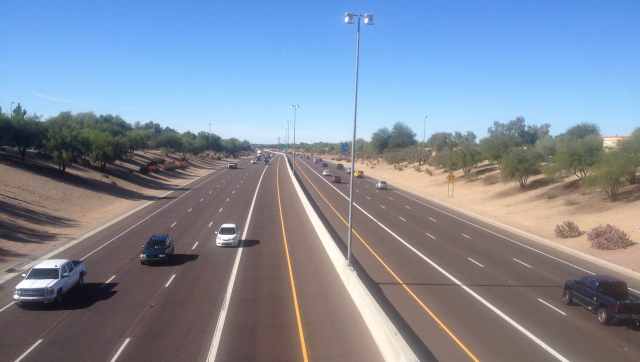
This grid is fed by the major E/W 8-lane freeway of Interstate 10 and similar N/S 8-lane freeway of Interstate 17, augmented by orbital 8-lane State freeways like 51, 101, and 220. At no point in this 50-mile-by-50-mile metropolis are you more than three miles from a freeway—built ahead of the streets and settlements they serve, not after.
azhiway101

Arizona State Hiway 101 at 59th Avenue Looking West (White lines delineate carpool lanes)

What this allows is an amazingly (and confusingly) regular mixture of tract homes and industrial sites with gas stations and retail malls at major intersections. It also allows a diffuse development that makes LA look dense by comparison. Large tracts of untouched desert still with tall cacti and palo verde trees intersperse settlements. especially near the periphery. Make no mistake: this is a thriving city, averaging 4% growth for the last 40 years and whose Sky Harbor airport is rated the best in the US.

Most of all, this is a car-based society. Not only are streets wide but distances are huge—as are parking lots and premises; Home Depot is typically 400m long and covers an area of over 50,000 sq m. And that’s without the 0.2 sq km parking lot in front. Pedestrians are, needless to say, a rarity. People think little of driving 30 miles to & from work or go to entertainment or even for a meal. There is a downtown that includes the usual office skyscrapers and cultural hubs like Symphony Hall and the Art Museum but it does not bustle with life and would not be recognised as a city centre by many Europeans.

downtown

Financial Office Buildings in Downtown Phoenix. (The Copper/Sand Colour is Typical)

Developments made recently are the sine qua non refinement of tract housing but are over 20 miles distant from downtown and. Here streets are curved, relatively short, child-friendly and dead-ended, with the pricier lots being laid out around a golf course or a lake. Four-bedroom and swimming pool is standard—with a 3-car garage (3rd slot for a golf cart). Though much of the planting is desert flora, Arizonans are profligate with water, tending lawns and decorating such developments with streams, waterfalls and fountains.

This high-income, affluent lifestyle with plenty menial labour around to support it is pretty much an embodiment of the American Dream. This has put Arizona politically in the Republican camp and the local tendency is not to think globally or about vague futures when there are businesses to be run, families to raise and bills—especially medical and school fees—to pay. As a result, with the exception of the latino population, Trump did well here in the recent election and took all 11 of the state’s delegates.

Phoenix may represent the apogee of Western consumer civilisation—at least for those with the money. But social segregation seems entirely related to salary. The golf-course-and-lake suburbs are pure ‘white bread’. By contrast, although over a quarter of the population, they are seen in such areas working in nearby retails shps, country clubs and restaurants—or driving in/out of those areas as gardeners, pool services, cat-sitters, cleaners, etc. Asians are not unusual but a black face is rare, other than around ASU, downtown or the older neighbourhood along 19th Avenue.

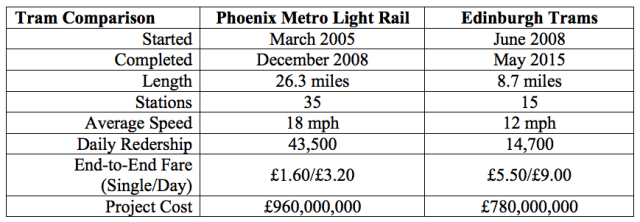
These latter are more apparent on public transport, which does exist. Indeed the Metro Valley Light Rail could teach Edinburgh trams a thing or two. Consider the contrast:
metrotram

Comparison of Metro Valley Light Rail with Edinburgh Trams

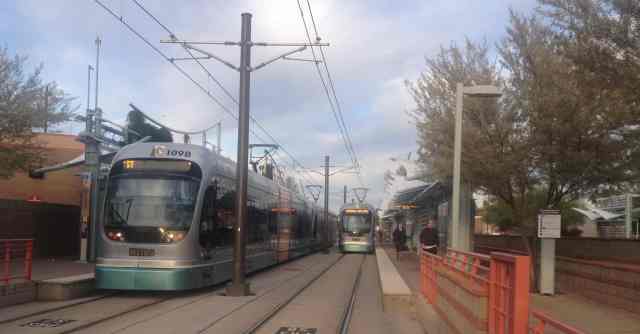
Generally, Edinbugh does not come out too well. MVLR uses more flexible 3-segment usnits that can be coupled into trains as long as three, which makes for flexible demand response.A typical station is show below.
camelback

Two MVLR Trams pass at Came;back & Central Station

Virtually all the lines run down centre dividers on main streets so the layout follows a zig-zag pattern through the street grid. This can cause trouble with drivers who are still unaware of just how much damage even a glancing blow from a speeding tram can cause.

truckcrash

Result of a Truck trying to Turn in Front of a MVLR Tram in Tempe AZ; No-one was Hurt

Large trucks such as the damaged Ford F350 shown above are hugely popular, despite their gas-guzzling nature. But, with gasoline at barely $2 a US gallon (40p a litre) there is little demand for fuel efficiencyimpressively better thought the MVLR system may be than what we have achieved so far in Scotland, it serves as small a fraction of the city population as Edinburgh Trams do.

Which means over 90% of all business, shopping and commuting is done entirely by car and over large distances. As long as gas hovers near 40p a litre, such a lifestyle is affordable. But what if there’s another ‘oil shock’ as happened in the 1970’s? Or if the entire American population of 330,000,000 want to have sprawling homes and drive everwhere, this utopia for the few would not be sustainable. Finding jobs near their homes—let alone ones that are walkable/bikeable is unrealistic. Property prices would fall, people strung out on debt would default and the main asset on most people’s ledger—their house—would become a liability.

Good thought their trams are, they counld not provide a network dense enough, let alone afford tp build such a huge extension, to sustain the city. Which would shrink and revert to the desert from which it sprang.

Posted in Commerce, Community, Politics, Transport, Uncategorized | Tagged | Leave a comment

Britain’s Dinosaur Defence

On a recent visit to the Royal Yacht Britannia, I was struck by two ‘birds-eye’ illustrations hanging in the corridor of the state rooms. One shows the Coronation Naval Review at Spithead in 1953 and the other the similar Silver Jubilee event in 1977. In the first, we had just fought the Korean War, had brush fire wars in Kenya, Aden and Cyprus and needed a serious navy to police the broad oceans that connected a still-intact Empire. The 300 ships there were impressive, including seven carriers and our last battleship Vanguard. By the second, the only remaining pink bits were pinpoints and the residual RN small, mustering just 58 ships—and about to be shown as too small for global operations as it was stretched to breaking over the Falklands.

It’s as well that the Lords of the Admiralty saw sense and scrapped any thoughts of a Golden or Diamond review because either would have been pitiful. Today our entire fleet musters just 22 combat ships. Even the normally gung-ho Torygraph was moved at the time of the former to write:

A serving commander in the Royal Navy, recently returned from operations, says the MoD has made it clear no comment is to be made in public on the subject. “It would have been just too embarrassing,” he says. “There aren’t many ships and those we do have are a long way away. It was just too difficult to mount a spectacle worth having.”

And yet we keep hearing from Westminster that “the UK is a global power” or that “the UK punches above its weight”. Well, I have news for Their Lordships: it ain’t true. Now that the UK deploys more Admirals than ships for them to command, even the Indian Navy is bigger, with a carrier-based naval strike capability the RN no longer owns.

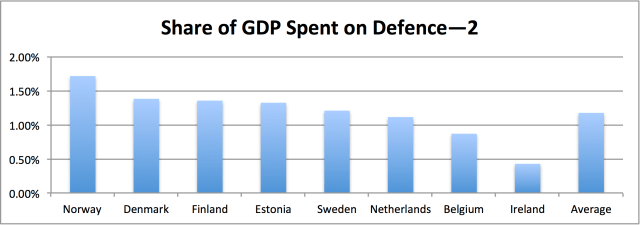
So why does the British public continue to pay through the nose for a defence posture that is clearly not fit for purpose? If we have no credible global clout why are we still pretending we do—and charging the public purse as if it were the case? Not only does the Emperor have no clothes but our Exchequer is paying Saville Row prices for them. Let’s compare the defence costs per head of the biggest European countries, taken as a fraction of per capita GDP (purchasing price parity) so we’re talking comparative financial impact.

DefenceSh1

Note that even the fearsome Russian bear charges its citizens less for its thousands of tanks, aircraft and a navy three times the size of ours. And Ukraine, with Russian troops and sundry militants roaming its territory, isn’t bleeding its citizens dry for defence.

What about the medium-small European countries, among which we would count Scotland, were it ever to assert its independence from the Admiral-heavy British state?

DefenceSh2

Even ‘worst offender’ Norway which shares a frontier with Russia and is the first stop on any foray by their Arctic Fleet makes do with 3/4 of the UK’s level of expenditure. And, given that Scotland has similar military exposure to Ireland, you have to wonder how they can hold their head up spending a quarter of our military cost per head. How come Ireland is the one doing long-range maritime patrols (LRMP) out over the Atlantic on our behalf because we can’t afford any LRMP aircraft ourselves?

Britain’s current defence posture is a joke; we claim global clout but can’t even meet our local NATO commitments. We get away with it because more frugal but better-balanced allies—especially the USA—cover for us. Even if our two aircraft carriers get built and the teething troubles of the F-35 jets to fly from them are ironed out, it will take all RN ships still left afloat to protect them properly at sea. “Do you know what we submariners call aircraft carriers?” the Russian Naval Attache is supposed to have asked at a Whitehall cocktail party. “Targets!

Is it rocket science to work out that Scotland’s current £3.8bn contribution to an overpriced, disjointed military stance, skewed by too many Admirals, unusable nuclear submarines, inadequate ships and ludicrous ambition could be halved? Look at the numbers above. Nobody considers The Netherlands undefended but were we to spend on a balanced military as they do, £1.9bn of Scotland’s supposed deficit would disappear.

Sources: SIPRI Military Expenditure Database 2014; International Monetary Fund World Economic Outlook (October-2014)
Posted in Politics | Tagged | Leave a comment

Blowing the Inheritance

Edinburgh deserves its status as a World Heritage Site. Its New Town is—along with Bath—the shining example of magnificent Georgian architecture. Its regular streets of coherent facades are interspersed with circles, squares and gardens and gifted with wide views of the city down to the broad Firth and the green hills of Fife beyond.

No wonder it is the second biggest tourist attraction in Britain, after London. With over 1.3m overseas visitors and ten times that in domestic visits, visitor spending pumped £1.2bn into the city economy last year; this figure has been growing at 10% each year and now employs 12% of the city’s workforce—not far off the city’s 15% in financial services. Throw in the various festivals scattered through the year and you have a world-class tourist magnet and a major asset in the Scottish economy.

Shame, then, that Edinburgh City Council (ECC) demonstrate little appreciation for this golden goose but rather demonstrate a perverse resolution to kill it off. Leave aside ECC’s corporate incompetence that led to the tram fiasco that tore up the city centre for a decade. Leave aside the natural incompetence of bureaucrats when it comes to the broader picture and not just securing their jobs. Leave aside myopic self-interest of major corporate bodies like Lothian NHS or the University of Edinburgh who have other priorities than wowing the tourists and the story remains a sorry one.

It was a fortuitous fluke that preserved the Old Town intact when the New was laid out elsewhere in the late 18th © and that riches flowing from the booming industrial revolution and British Empire were crafted by inspired architects into such magnificent townscapes. Even after the Georgian fashion passed, the Victorian heritage of the Caledonian, Scotsman, Carlton and Balmoral hotels, of Jenners, of spectaculat schools like Heriots, the Royal, Fettes or Stewarts Melville, of the leafy villas in Newington, Morningside, Ravelston and Trinity, of  solid ashlar tenements in Bruntsfield or Marchmont, all contributed definitive heritage elements to the city. Even alterations to the Old Town, like the bustling curves of Victoria Street or Cockburn Street with their turrets and  crow-step gables, added new interest to the warren of pends off the Royal Mile. Every building in Chambers Street is magnificent. The draining of the Nor’ Loch and ‘hiding’ Scotland’s main station out of sight was a stroke of Victorian engineering genius.

But, as the pragmatist says: “What have you done for me lately?”

For the story of the last half-century is a truly sorry one, with ECC—and especially its planning department—appearing to lose the World Heritage plot entirely. With partisan single-mindedness towards Edinburgh Corporation Transport buses that would have done Soviet planners proud, ECC shut down a tram network that dwarfed the current single line. They also successfully lobbied to have every suburban train service withdrawn so that Porty or St John’s Road or Clerk Street or Shandwick Place or Leith Street are permanently clogged with herds of double-deckers vying for access to a myriad of stops. Even if the locals know which stop and to have correct change, tourists stay away in droves.

But the real damage started in the 1950’s. The Midlothian County Council building’s intrusion into the Royal Mile, the University’s barbarism at George Square and Potterrow and the carbuncle that is the St James Centre came straight out of Mies van der Rohe’s minimalist playbook. Developers loved it because repetitive prefab units were cheap to make and could be sold off at high prices as ‘modern’.

And so the half-baked attempt to convert Princes Street to a two-level  modernist shopping precinct, started west of Hanover St but pursued lamely, resulted in a free-for-all that makes the view of the castle from Princes Street so much better than the reverse. It matters little that the schemes of Lochend or Pilton or Craigmiller suffered the same misguided ’60’s social engineering that failed and need pulling down; none of that was visible (although whoever dreamed up Dumbiedykes has a lot to answer for). Even though the recent apartment block wastelands of Macdonald Road or Gorgie or Western Harbour will soon fray in a way solid-built tenements never will, most tourists will never find them. But they will find the more visible ‘improvements’—and find them shameful.

Whether it is the ugly modernist jumble on the south side of the Grassmarket that looks across at the historic (much more attractive) jumble on the north or the newly bleak glass-and-concrete canyon of the Cowgate or simply the tatty state of South Bridge, none of this meets creative planning—let alone World Heritage—standards. Whereas some effort was made to make the modern Radisson blend into its Royal Mile context, we lost the horrendous Midlothian building only to find the modernist anachronism that is the G&V Hotel, right across from the 1613 Gladstone’s Land.

Two hundred years ago, impoverished though people were, they managed to produce Ramsay Gardens. Patrick Geddes’ contribution to the cityscape was no pastiche, nor did it pay much homage to the traditional Old Town tenement architecture. But few would argue that it did not improve, if not become the jewel in, the view from the gardens below.

Are the present city fathers so in the packet of developers, so impoverished by their ill-found forays into trams and EARL, so browbeaten by their bureaucrat jobsworths that they cannot rise—as their predecessors did—to improve and enhance their magnificent city, rather than simply do more damage by default than the Luftwaffe ever did?

Posted in Community, Environment, Transport | Tagged | Leave a comment

Dunkirk Spirit Doesn’t Age Well

During the last decade or so, arguments that Scotland’s future rest within the union have revolved around two key points: 1) economic advantages of being an integral part of a ‘large’ country; 2) the glorious history that nations of the British Isles have forged together down the centuries. This blog addresses the latter.

Scotland’s first difficulty with the Union started in the same century it was forged. Though some attempt was made to instigate a genuine balance within a ‘British’ context, in effect little changed in the English hegemony. Whereas some effort was made to re-badge Scotland as ‘North Britain’, ‘South Britain’ remained stillborn. A hundred years after the union, Nelson admonishes his sailors the “England expects every man to do his duty”.

In truth, whether it was subduing unruly Pathans, Boers, Zulus or Irish, it was to ensure that mills of Lancashire, the mines of Yorkshire, the shipowners of Bristol or the underwriters of the City had ready and profitable markets. That the Scots managed to dominate the tobacco and shipbuilding trade can be attributed to the wilier of us seeing the bandwagon of empire rolling and jumping aboard.

The Scottish Enlightenment of the late 18th © was quickly subsumed into a broader English culture where the public (i.e. private) school was adopted by the more ambitious of Edinburgh and Glasgow, reinforced by received pronunciation indistinguishable from Oxbridge graduates. This found its more garish aping in Morningside/Milngavie accents, whose ambition was conscious that precious few Writers of the Signet or Honourable Company of Edinburgh Archers spoke anything recognisably Scottish, let alone with any burr or accent.

It may be argued that all benefited from this; up to the heyday of empire in Edwardian times, few would argue the point. But such began to be seen as cultural colonialism once two world wars, Suez and the 1960’s put Britain firmly in its place as a second-rate country with a fraction of the political and economic clout it once exercised. People across Scotland started querying why even local BBC news readers all spoke ‘posh’, with an accent that was not theirs.

Such cultural resurgence was understandably delayed by two World Wars. Prior to 1914, Britain saw Europe as a source of war and invasion, while on the wide ocean, the Royal Navy wove the sinews that bound us closer to the other side of the world than the other side of the Channel. Both the Kaiser and Hitler reinforced this and there is no gainsaying that the spirit of plucky Britain defiant in the face of Nazi hegemony on the Continent could indeed be described as ‘Our Finest Hour’.

In that June of 1940, many threads came together: the obsolescent strategy of our French ally, the efficient modernity of the Wehrmacht; the solidarity of empire to the ‘mother country’ in her time of need; cultural cohesion in British society both sides of the border (upper class aplomb backed by middle class loyalty, all underpinned by working class phlegmatic humour in dealing with their lot). The idea of the modest Brit—slow to anger but resolute in adversity—found its most cogent symbol in the rescuing of 1/3rd of a million soldiers from the debacle that was Dunkirk, followed by repelling the until-then-all-conquering Luftwaffe.

Glorious days, all the more so because both were  essential to Britain’s survival and unexpected by most informed observers at the time.  All Britons have a right to be proud of such achievements. But they are no longer relevant, any more than similarly ancient historical facts: that we used to run slave plantations and a slave trade to support them; that we invented concentration camps to tame the Boers; that we started several wars with China so British merchants (including plenty Scots like Jardine Matheson) could continue selling them opium.

The point is: how relevant is any of it to the 21st © and the present needs of  peoples who inhabit these British Isles? Given that empire is now pink specks in distant oceans, that ‘our’ Dominions look to the USA far more than the UK for trade, defence and friendship these days, it is high time that we shelved historical distrust of our nearer neighbours and stopped kidding ourselves we still have a global role to play.

From the mutterings of various government ministers in London, it seems misplaced delusions of grandeur still clutter their thoughts. From the surprisingly large Brexit vote in former industrial areas, deeply-rooted mistrust of Johnny Foreigner in any guise dominates John Bull. That is England’s prerogative. But, claiming our three hundred years of a union demands it continues, irrespective of the clear wishes of one of the partners is not only short-sighted but arrogant. It rides rough-shod over the principle that any partnership must be to the mutual benefit of all partners in the first place.

That England cannot see any of this simply underscores the need for Scotland to seek a path more suited to its own needs than to England’s, to which it has subscribed for entirely too long.

Posted in Community, Politics | Tagged | 1 Comment