Brexit: Runners & Riders

Yes, this topic has reached tedium, and far as normal people (i.e. non-anoraks) are concerned. But the whole kerfuffle just reached its watershed, with a slippery slide to conclusion laid out before us like the proverbial patient etherised upon a table. The last week has seen a flurry from the main dramatis personae of this national drama of ours. Rehearsals are over; opening night’s behind us; and, though the ending remains murky, the whole thing is playing out as a tragedy.

Don’t just take my word for it—the most potent arguments pro and con have been deployed with 12 months to go. Compared to the draft legal document tabled by a united EU this week, the ones who started it are all over the place. With a 17 million vs 16 million outcome in the 2016 referendum, this is no surprise. Yet examining the various cases being made, what is striking is that Remain arguments our court hearing and consistent while Brexiteers deploy an emotional spectrum of chaos.

The latter do have form on this. Starting with wild pronouncements like £350 million per week extra for the NHS, they have indulged in implausible assertions: being able to stitch  a trade agreement together in an afternoon; that the Irish border could be dealt with like that between Westminster and Camden. Examine who is leading their charge, and you understand why this is. Theresa May is a steady (i.e. unimaginative) hand who makes heavy weather of leadership.

Squabbling behind her back is a reincarnation of Billy Bunter and his chums. Michael Gove and Jacob Rees-Mogg remain incarnations of the smug swot who wound up gettung scragged behind the bike shed—usually by people like Boris Johnson. Perhaps there determination not to get scragged in the Commons is why they exude political opportunism the way they used to swear. Eachexpounds Brexit like a mantra—but none seem to spend even five minutes in each other’s company to agree what it means. They each believe a 52-to-48 margin constitutes a landslide endorsement. But quite how rejection of European partnership can lead to better trade deals then we already have varies by whichever Brexiteer you listen to. Names, numbers, dates and other specifics are typically absent.

This is poor protection from the heavy guns recently pounding them, none of whom need fret about political ambition any more. Tony Blair, John Major and Michael Heseltine are heavyweights, none of whom have been slavish fans of the EU. Their recent interventions all cogently argued the same thing: that hard Brexit is unnecessary, damaging and rides roughshod over the wishes of half the country. They cite economic sources who all forecast declining affluence the further we push our European neighbours away. There are certainly flaws in how the EU operates. But to see the big picture, the table below pulls together six of the best arguments made recently on either side of the argument,

You don’t believe me? Compare and contrast for yourselves

LEAVERS   REMAINERS
Theresa Nay Speech at Mandion House Friday March 2nd   Tony Blair Speech at European Policy Centre on Thurs 1st March 2018
Boris Johnson Speech at Coffee House Weds February 14th   John Major Speech to Creative Industries Federation om Thur 1st March 2018
Michael Gove Essay in The Independent Tuesday 20th Feb   Michael Hesseltine “Voices” column in The Independent
Liam Fox “Road to Brexit” speech Tuesday 27th February   Jeremy Corbyn Spectaytor Coffee House, report Sunday Feb. 25th
Jacob Rees-Mogg Reburs John Major in The Expressm Thu March 1st   Phillip Hammond “UK Needs Trade Agreenebt: Tuesday 27th February
David Davis “Foundation of the Future” speech Tuesday 20th February   Carolyn Fairbairn (CBI) CBI Position Speech Sunday January 21st


Posted in Uncategorized | Leave a comment

Down to 25 in Old Money

It’s amazing what a little slow can do. Like paralyse civilisation. Here in Central Scotland we are on our second day of Red weather alerts after two prelude days of biting East winds and a whole prior week of dire warnings that’s Siberia was about to be visited upon us. Because they used it at every opportunity, the BBC was obviously chuffed with the epithet they had dreamed up for it: “The Beast from the East”. It’s certainly Baltic: last night down to 25°F (-4°C for any millennials may be reading this).

So you can’t say we didn’t get fear warning. And, as a write with the snow drifting to 30 cm in the street outside, the forecast is for worse to come. Granted, this combination of cold, wind and heavy snowfall has not been seen this decade anywhere south of the Highland Line. But I can’t resist the opportunity it gives a card-carrying bufti like me to Slide into grumpy old git mode.

Yesterday laid bare the fragility of our 21st century lifestyle. Despite ample warning and running empty trains overnight to keep track clear, all trains were halted by 6 PM on the first day. Bus services were also suspended and many people heeded the red warning and stayed at home. But articulated lorries, by which virtually all our goods and food move, thought they could tough it out. But they couldn’t make the hills, resulting in then swerving all over the road and turning the M80 into an overnight parking lot.

Because almost everyone drives in from afar, half the shops and businesses closed for lack of staff—and the other half closed for a lack of customers. Bufties like me Will recall 55 years ago when the storm of cold that hit at Christmas 1962 lasted until March 1963 and saw 6 foot snowdrifts, temperatures of-20 C (at Braemar) that froze streams, lakess and even small parts of the sea. But daily life did not freeze. Because most people Live close to their work, factories and shops carried on. Trains kept running because they were drawn by 100 tons en steam locomotive, which took a lot of stopping. The local postie and I both piled our bags on sledges, bundling his letters and my newspapers to minimise how much snow either had to slog through.

BassStorm

Winter Storm over Bass Rock from West Beach North Berwick  © Gordon Macdonald of Clanranald

This is not a plea for us to all return to 1963—nor even a claim that life was better then (though 1/6d = 7p for a Fruit & Nut bar would be a fine thing). But just 18 years after the huge trauma and many sacrifices of World War II, people were more social, more resilient and found happiness with much less. They had not yet discovered jet holidays, mobile phones, central heating, the property ladder or their legal rights. The respected neighbours, doctors, policemen and politicians alike. They typically stayed in the same house and job all of their adult life. Friends no longer live in the same neighbourhood, let alone Street; now hobbies are for the retired; we have remote services tend to garden, laundry, car, children, repairs, even nan.

This frigid blast may last hours, instead of months—and we may not get another one until 2073. In which case, grumpy old gits like me will be overplaying their hand like this as the watch the snow eddy down deserted streets. But if we did get a long, sustained, bitter winter like 1963, could we cope?

Or, by making 50-mile commutes common, by relying on distribution centres 200 miles from their outlets, by having all our food reach us by motorway in 22-wheelers, by relying on the Internet to carry essential but complex systems on which productivity (and therefore jobs) depend, are we not increasingly dependent on road, rail and power which—to judge from the last couple of days—are anything but fail-safe?

Or am I just being a grumpy old git?

Posted in Uncategorized | 1 Comment

Busted

Edinburgh takes pride in its buses. From its start as Edinburgh Corporation Transport, Lothian Buses has grown to transport over 100 million passengers each year, won accolades as the best bus company in Britain and seen off competition from FirstBus to provide 90% on journeys on public transport within the capital.

Last year, they invested £14.1m in 55 new Euro 6 (less polluting) vehicles while making £12 million profit on £146 million revenue. They have managed to make a decent fist of Edinburgh Trams, as well as growing the airport Express and sightseeing tour buses.

They have even shown First how to run rural services with their East Coast subsidiary that showed long– suffering East Lothian passengers that their buses could be clean, quiet, reliable, punctual AND profitable

All of which is highly laudable and speaks of an operation in the public sector from which others might draw lessons. Seen from the prospective of a bus anorak, Lothian would be hard to beat. Unfortunately, anoraks are not known for their strategic vision, nor for their close connection with the real world. If we were talking about Dundee for Aberdeen, this would not matter. But we are talking about Scotland’s capital—and a pretty sclerotic Capital when it comes to traffic. As they are the only option, all bus routes cross the city centre, where they become as much the traffic problem as the solution.

With its hills, it’s close-packed history and it’s Victorian street layout, Edinburgh was never an ideal design for 21st century traffic. A quarter century ago, David Begg convinced the City Council to invest in paint to prioritise buses over cars, leading to the latter being banned from Princes Street and forced into convoluted patterns as a result.

However appropriate that may have been as a solution in 1990, despite all their priority, buses mil about in Princes Street, taking 15 minutes to cover the mile between Waverly and Tollcross. Because of bus mayhem, there are commonly three separate shelters for our single stop which confuses locals and completely baffles the many tourists—who has to struggle with unfamiliar coins and holds the bus up even longer. This means that their fleet of 721 spend much time idling. (good job they bought those Euro 6 buses, eh?)

To a non-bus-anorak, the problem seems simple: too many buses. Because there is no alternative, passengers may not get upset taking an hour to rach the city centre from Penicuik (or Queensferry…Mayfield…Tranent…). No other European city of comparable size and standing would dream of trying to serve Half a million people with transport that averages under 10 m.p.h in urban areas—and half that in the city centre.

Edinburgh makes much of its expensive tram line.  But it duplicates the Fife rail linei and ts 30- minute Journey time is slower then the Airport Express—and glacial when compared to the 10 minutes ScotReal takes to reach Edinburgh Gateway. It has not made inroads on city centre congestion. In fact, it might have exacerbated the problem on crowded Princes Street

But, Lothian Buses ignores Edinburgh Gateway—and pretty much any other (faster) public transport. The idea of having buses from Ratho, Queensferry, etc feeding into there for our fast trip to town has not occurred to them. Even more reprehensible is there opposition to reopening the South Suburban rail line to passengers. Interchanges at Craigmillar, Cameron Toll, Newington, Morningside, Merchiston and Gorgie would remove the need for most buses to come any closer to the city centre. It would remove congestion(and the need for one third of their boss fleet) at a stroke.

So, why don’t they?

Well… remember that £12 million profit we discussed? Most of that goes to Edinburgh City Council (their owners), who are eternally strapped for cash. L heyack of vision over the last few decades (not to mention incompetence over trams, property, Princes Street retail, etc) is endemic. There has been no coherent transport plan for Lothian—let alone Edinburgh. It doesn’t want its political fingers burned on more trams, so it’s certainly not going too argue for what far-sighted cities from Munich to Manchester have done—build a fast, hi capacity Rail/Tram network backbone which buses feed locally and keep historic City centres both accessible and foot-friendly.

They would rather keep their £12 million bung and hope nobody notices that their city is choking on too many buses.

Posted in Uncategorized | Leave a comment

Enough Already

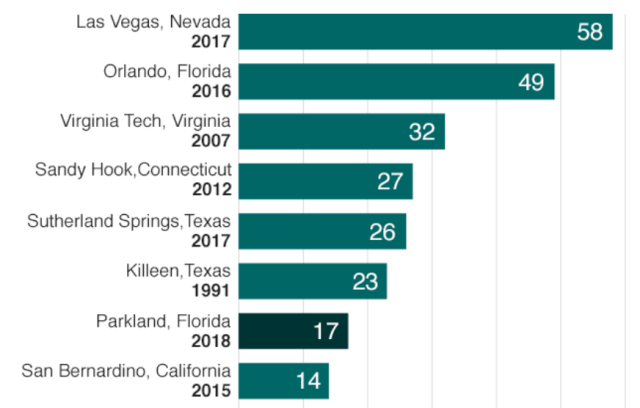
Within hours, the British media seem to have forgotten all about Parkland FL and the 17 staff and pupils shot and killed by a disturbed ex-pupil. As the 17th such shooting in this year alone, editors saw it as another unfortunate incident in the waves of such incidents that sweep America. Last year, 33,3,694 people (equivalent to the entire city all Stirling) were killed by firearms in the US, a ratio of 106 gun deaths per million population  Gun deaths stats per million in Britain? It’s 1.

President Trump, whose campaign received millions of dollars from the National Rifle Association and who address their confidence asserting “the NRA now has a friend in me White House, had overturned gun control legislation and reacted the Parkland shooting by praising First Responders and blaming it all on psychiatric shortcomings of the shooter. And that should be that. Nothing much happened after Columbine. Or Sandy Hook. Or Virginia Tech. Or the concept in Las Vegas. Why would Parkland not fade from Focus in a similar manner, despite gruesone statistics for mass shootings?

USmasShoot

Deaths from Recent Mass Shootings in the USA (Source BBC)

Annual gun deaths exceed even the carnage on America’s roads—death now touching 33,000 annually. Add the two statistics together and there are more Americans dying brutally in their own country each year them all American casualties in the Vietnam War. There may be out rage, what is there any action?

Well, it would seem that the other pupils in Parkland have not just been grieving about their loss but have  been getting pretty angry about there being more guns than people in America and the wonky laws that exist to control their use. So they went to Washington and held a demonstration so the President new how they fell. And they lobbied their senator Rubio (who, like many on Capitol Hill also received serious funding from the NRA). These young people are recruiting friends from across the country for an even bigger demonstration.

They have a huge task ahead to change anything. We Europeans may share Western civilisation with  Americans but any mutual empathy stops when it comes to guns. Wild West frontier necessity aside, guns were always integral to t American culture. Gun-lovers cite the Second Amendment to the US Constitution unendingly: ” …the right to bear arms shall not be infringed”. What those gun-lovers fail to cite is the bit peior, which says: “for the maintenance if a will trained militia,…”.

Given that the amendment was adopted in 1791, barely a decade after asserting their independence and before other fratricidal clashes with Imperial Britain like the War of 1812, the second amendment may well have been necessary. But in the i 227 years since, the world has moved on—and America more than most. Back in 1791, it was seen as necessary to extirpate Indians in the way of expansion of the new nation. Back in 1791, it was legal—even necessary—to own slaves to make cotton plantations viable. 227 years later,  an enlightened America now eschewa such one-time axioms as inappropriate for 21st-century civilisation.

Why are copious armories of guns any different?

Each nation holds conceits about itself: Brits are refined & reserved; Germans diligent & precise; Italians voluble & creative. The Americans see themselves as self-reliant entrepreneurial pioneers. They make heroes of the alpha male. And all pioneers carving a future from the wilderness must defend themselves. But crucially it is not just gun-lovers who oppose gun control. A wide swathe of suburban middle America keep guns at home against burglary or attack. Given  American crime statistics, this can be argued as reasonable behaviour.

The NRA play on this. Their mantra is “if you make guns illegal, only the criminals Will have guns”. Apologists appear even here on television with variants on this. Andrea Ockefeld (sp?), an articulate millennial, was on BBC News several times in the aftermath of Parkland making a case against any curb on guns because this would only make it harder for good citizens to acquire them. She cited the recent church massacre in Texas where the gunman was halted by someone with a rifle handy in the gun rack of his pickup truck.

But the times they are a’changin’. Despite the right wing and generally gun-supporting Republicans holding all the key posts in the White House, and Congress, the stubborn resistance to addressing this carnage may be starting to crack at last.  The young are marching. Prompted by a president they cannot abide, liberals are organising. And ordinarily, apolitical folk are asking why there should be twice as many guns her head in the USA as there are in war torn Yemen.

Major resistance Will come from a $13.5 billion gun Industry and the 4 million members of the NRA. But when 100 million suburban middle American parents start getting lobbied by the 16-year-old apple of their eye why they need something is dangerous as a loaded revolver in the bedside table, let alone an assault rifle locked in the garaged, then a majority for change will become overwhelming.

America is a great country, partly because it learned to respect its natives and  free its slaves. As it’s bountiful spaces become more crowded, its people will learn to be more neighbourly and less ruggedly independent—as Europeans once had to.  Those who dislike the prospect might consider Alaska.

Once significant portions of the 300+ million guns have been melted down into something more useful, this shameful homicide rate, this street warfare blighting Chicago, St Louis, Baltimore, etc., this unconscionable number of police officers killed on duty will drop to something other parts of the west have enjoyed for decades.

The resulting Bruce to the American economy will swamp any effect of job losses at Smith & Wesson more importantly, it will dwarf the bloated promises made by their current NRA-sponsored President. Perhaps it will even lead to something more enlightened.

Posted in Community, Politics | Tagged | Leave a comment

Republicans Want to Turn the Entire Country into Oklahoma

By Paul Waldman  February 8, 2018   © Washington Post

We have in this country an essentially unchanging disagreement about what model of governance will produce the best economic and social results. Democrats advocate what we might call weak social democracy: relatively high taxes (though lower than those of our peer countries), combined with a relatively strong safety net (though again, not as strong as other countries), spending on needs like education and health care, and economic regulation to protect workers, consumers and the environment. Read more…


Posted in Commerce, Environment, Politics | Tagged | Comments Off on Republicans Want to Turn the Entire Country into Oklahoma

To the Shores of Tripoli

One thing you have to give Film 4 is that it does ring the changes. Almost back to back, it ran the 1957 black & white classic “The Yangtze Incident” with 2016’s “13 Hours“. Other than being takes of derring-do in foreign climes, they seem worlds apart, certainly more than the half century that actually separates them. Yet, closer examination reveals them not only close to a remake but a study in how little the western world has learned from its domination of the last two centuries.

The Yangtze Incident“is pure post-war, stiff-upper-lip morality, complete with patriotic soundtrack and populated by unflappable officers leading phlegmatic salts-of-the-earth to glory against impossible odds. It dates from a time when a bankrupt British Empire was about to implode and the UK film industry saw itself as the cheerleaders trying to shore up the belief this was not the case. The plucky crew on HMS Amethyst save their ship from the clutches of uniformly fiendish Chinese Communists and their shore batteries. Why any British servicemen, let alone a Royal Navy frigate, two destroyers and a cruiser have any business in Chinese waters—let alone 100 miles up the Yangtze River in the middle of a civil war is never explained. At the time, the British had served 150 years as the world’s policeman, so the Admiralty having its fingers stuck in someone else’s pie would have needed no justification to British audiences. None of the British crew spoke Chinese. It was “Zulu” with ships.

Seen from a similar—if updated—perspective, “13 Hours” actually appears rich in parallels. The half dozen tough, bearded mercenaries protecting the secret CIA compound in Benghazi circa 2012 are as indistinguishable by their looks, cammies or terse special forces slang as the BBC English of the officers aboard HMS Amethyst. As far from a chick flick as it is possible to get, “13 Hours” doesn’t disappoint shoot-’em-up aficionados. Unfortunately, ever since The Governator hit Hollywood, they a kill ratio for the good guys over 100:1 is part of any such script. These heroes charge all over a blazing compound with no confusion, wasting “tangos” as they go. Ignoring basic infantry defensive tactics costs only one casualty. An early effort to distinguish friendly Libyans from hostile soon vanishes in the firefight to save the US ambassador, making any peaceful settlement impossible; none of the mercenaries or CIA staff speak Arabic. Despite interference from the CIA station chief, the delay before F– 18s can pave-bomb the baddies, and the delay before Chinook-fuls of US marines can descend from the nearest MAF, our plucky boyz have it under control.

Both films really tell the same story. What is tragic is the latter reflects current US public and political thinking: that there is nothing strange about having covert CIA compounds in war torn hellholes like post-Gaddafi Libya and then justify significant military presenve in the region and the right to use it in support. At no point does anyone see the need to justify the presence of any Americans in such a chaotic, dysfunctional country in the first place.

Which pretty much says we are now 50 years into the USA’s stint as self-appointed World Policeman and that the Imperial drive on Victorian Britain that led to the Indian Mutiny, Omdurman and Isandlwana has outgrown the hemispheric reach on the Monro Doctrine and is now globally alive and well in Washington.

If America’s military and intelligence diaspora spoke the local language and understood the local culture (as the Inca Empire or the French in 8th century Canada did), this might not be all bad. But when, in the late 1950s, a US embassy was established in the new Republic of South Vietnam, nobody there spoke Vietnamese.

And then look what happened.

One thing you have to give Film 4 is that it does ring the changes. Almost back to back, it ran the 1957 black & white classic “The Yangtze Incident” with 2016’s “13 Hours“. Other than being takes of derring-do in foreign climes, they seem worlds apart, certainly more than the half century that actually separates them. Yet, closer examination reveals them not only close to a remake but a study in how little the western world has learned from its domination of the last two centuries.

The Yangtze Incident“is pure post-war, stiff-upper-lip morality, complete with patriotic soundtrack and populated by unflappable officers leading phlegmatic salts-of-the-earth to glory against impossible odds. It dates from a time when a bankrupt British Empire was about to implode and the UK film industry saw itself as the cheerleaders trying to shore up the belief this was not the case. The plucky crew on HMS Amethyst save their shit from the clutches of uniformly fiendish Chinese Communists and their shore batteries. Why any British servicemen, let alone a Royal Navy frigate, two destroyers and a cruiser have any business in Chinese waters—let alone 100 miles up the Yangtze River in the middle of a civil war is never explained. At the time, the British had served 150 years as the world’s policeman, so the Admiralty having its fingers stuck in someone else’s pie would have needed no justification to British audiences. None of the British crew spoke Chinese. It was “Zulu” with ships.

Seen from a similar—if updated—perspective, “13 Hours” actually appears rich in parallels. The half dozen tough, bearded mercenaries protecting the secret CIA compound in Benghazi circa 2012 are as indistinguishable by their looks, cammies or terse special forces slang as the BBC English of the officers aboard HMS Amethyst. As far from a chick flick as it is possible to get, “13 Hours” doesn’t disappoint shoot-’em-up aficionados. Unfortunately, ever since The Governator hit Hollywood, they a kill ratio for the good guys over 100:1 is part of any such script. These heroes charge all over a blazing compound with no confusion, wasting “tangos” as they go. Ignoring basic infantry defensive tactics costs only one casualty. An early effort to distinguish friendly Libyans from hostile soon vanishes in the firefight to save the US ambassador, making any peaceful settlement impossible; none of the mercenaries or CIA staff speak Arabic. Despite interference from the CIA station chief, the delay before F– 18s can pave-bomb the baddies, and the delay before Chinook-fuls of US marines can descend from the nearest MAF, our plucky boyz have it under control.

Both films really tell the same story. What is tragic is the latter reflects current US public and political thinking: that there is nothing strange about having covert CIA compounds in war torn hellholes like post-Gaddafi Libya and then justify significant military presenve in the region and the right to use it in support. At no point does anyone see the need to justify the presence of any Americans in such a chaotic, dysfunctional country in the first place.

Which pretty much says we are now 50 years into the USA’s stint as self-appointed World Policeman and that the Imperial drive on Victorian Britain that led to the Indian Mutiny, Omdurman and Isandlwana has outgrown the hemispheric reach on the Monro Doctrine and is now globally alive and well in Washington.

If America’s military and intelligence diaspora spoke the local language and understood the local culture (as the Inca Empire or the French in 8th century Canada did), this might not be all bad. But when, in the late 1950s, a US embassy was established in the new Republic of South Vietnam, nobody there spoke Vietnamese.

And then look what happened.

domination of the last  c.

The Yangtze Incident” is pure post-war, stiff-upper-lip morality, complete with patriotic soundtrack and populated by unflappable officers leading phlegmatic salts-of-the-earth to glory against impossible odds. It dates from a time when a bankrupt British Empire was about to implode and the UK film industry saw itself as the cheerleaders trying to shore up the belief this was not the case. The plucky crew on HMS Amethyst save their shit from the clutches of uniformly fiendish Chinese Communists and their shore batteries. Why any British servicemen, let alone a Royal Navy frigate, two destroyers and a cruiser have any business in Chinese waters—let alone 100 miles up the Yangtze River in the middle of a civil war is never explained. At the time, the British had served 150 years as the world’s policeman, so the Admiralty having its fingers stuck in someone else’s pie would have needed no justification to British audiences. None of the British crew spoke Chinese. It was “Zulu” with ships.

Seen from a similar—if updated—perspective, “13 Hours” actually appears rich in parallels. The half dozen tough, bearded mercenaries protecting the secret CIA compound in Benghazi circa 2012 are as indistinguishable by their looks, cammies or terse special forces slang as the BBC English of the officers aboard HMS Amethyst. As far from a chick flick as it is possible to get, “13 Hours” doesn’t disappoint shoot-’em-up aficionados. Unfortunately, ever since The Governator hit Hollywood, they a kill ratio for the good guys over 100:1 is part of any such script. These heroes charge all over a blazing compound with no confusion, wasting “tangos” as they go. Ignoring basic infantry defensive tactics costs only one casualty. An early effort to distinguish friendly Libyans from hostile soon vanishes in the firefight to save the US ambassador, making any peaceful settlement impossible; none of the mercenaries or CIA staff speak Arabic. Despite interference from the CIA station chief, the delay before F– 18s can pave-bomb the baddies, and the delay before Chinook-fuls of US marines can descend from the nearest MAF, our plucky boyz have it under control.

Both films really tell the same story. What is tragic is the latter reflects current US public and political thinking: that there is nothing strange about having covert CIA compounds in war torn hellholes like post-Gaddafi Libya and then justify significant military presenve in the region and the right to use it in support. At no point does anyone see the need to justify the presence of any Americans in such a chaotic, dysfunctional country in the first place.

Which pretty much says we are now 50 years into the USA’s stint as self-appointed World Policeman and that the Imperial drive on Victorian Britain that led to the Indian Mutiny, Omdurman and Isandlwana has outgrown the hemispheric reach on the Monroe Doctrine and is now globally alive and well in Washington.

If America’s military and intelligence diaspora spoke the local language and understood the local culture (as the Inca Empire or the French in 8th century Canada did), this might not be all bad. But when, in the late 1950s, a US embassy was established in the new Republic of South Vietnam, nobody there spoke Vietnamese.

And then look what happened.
Posted in Politics | Tagged | 2 Comments

Ich Bin Ein Amerikaner

This week, Donald Trump’s first State of the Union Address was countered by a rebuttal from the Democrats in the form of  Rep. Joe Kennedy III of Massachusetts, who made an eloquent and passionate speech, made more symbolic coming from the scion of a family that is Democratic royalty. Its contents and underlying principles are those that most Americans I know would identify with and support. And that probably goals for half of the country, especially those on the coasts.

But I believe that, because it is so transparently partisan, that it compounds the political mess currently dominating America. I have no time for Trump, all the self-serving republicans who support him in Congress. But his”Base” is a significant chunk of the population from surging Arizona to rust-belt Michigan  like a rash. However shortsighted and mitigated we might consider them, they think Trump speaks for them and is the best thing since sliced bread; he is an iconoclast; he speaks his mind; he is a living example of the American dream; he is a celebrity, exuding a kind of charisma and is seen by rust belt America as a kind of saviour, especially as he claims to take on in the media and beltway establishments.

So, when he delivers a State of the Union Address that is uncharacteristically conciliatory, this is not the time doe his opponents to dig Democratic trenches deeper and lob more handwringing liberal grenades in his direction. In the 20th century, America’s great strength was too weld amazing diversity together into a common American dream in which all believed. In the 21st Century, the institutionalised two party system has fractured society into haves and have-nots. As the latter has grown, the temptation to seek out the kind of the simplistic (but delusional) that Trump peddles has grown. Adhererents to such delusions are deaf to those trying to burst their bubble, as Kennedy’s speech is trying to do.

With both camps so far apart, spitting invactive with a blinkered partisanship that makes the Hatfields and McCoys seem like reasonable people, there is scant hope of avoiding the Mexican stand-off, such as shut down the government or stymied most of Trump’s executive orders. The last time America was this divided was during the Civil War. I would have hoped someone of Kennedys standing and genealogies could realise this and start to find common ground to heall this deepening rift that is doing the country—and the world—no good whatsoever. Because this is no” faraway country, of which we know little”. America’s future affects us all so we must all engage an international awareness that Joe’s great uncle demonstrated so powerfully half a century ago.

To quote another German phrase: “Der Weg nach Hölle ist mit guten Vorsätze gepflastert” (The road to Hell is paved with good intentions).

Posted in Commerce, Politics | Tagged | Leave a comment

Third Degree Burns

It’s that time of year when function suites and community halls from Annan to Zetland are packed out with revellers tucking into their haggis and looking forward to a dram or three to accompany witty speakers. And why not? Late January can be a bleak time and having some convivual means of celebrating our common culture gives Scots something to look forward to in the dreich days that stretch out beyond Hogmanay. And, just as the Irish have exported St Paddy’s day to an international audience, so you may attend Burns suppers from Auckland to Zaparozhe (where?? 15 admlirals of the Russian Navy were Scottish; their patron saint is St Andrew). Even apart from all this guys for whiskey exports, such widespread homage to Burns’ humanity must be a good thing in this otherwise fractious World.

Yet it seems the greater the distance furth of Scotland or the higher these social rank of attendees, the more formal and the more rigid the proceedings of a Supper become. Each of us should be free to imbibe the arts as we see fit. Poetry in general and Burns\ work in particular should be no exception and taken many ways. But the manner in which both dress and proceedings have become formulaic runs almost counter to both the culture and character of the man and what he himself might have preferred.

Would Rabbie have got himself into a fankle—as some Caledonian societies do—over Montrose versus Prince Charlie jacket or the clan sett of tartan? Given that such things were the (very profitable) creation of tailors milking the fiction created by Sir Walter Scott’s obeisance to George IV two decades after Birns lay beneath the sod he once tilled, I rather doubt it. And, amusing though the ritual poems and speeches can be, I suspect he would rather be found “bousing at the nappy” wi’ Tam than listen to some Company of Archers QC mangling Lallans in his mildly risque Toast to the Lasses. Though he could move in high circles, Burns was a man of the people. And the people of Scotland do not generally stand on ceremony.

Were he with us today, Burns would have gravitated to the kind of celebration North Berwick drama club put on, mixing play acting with conviviality. Or the completely ad hoc one held in Tyninghame Village Hall with spontaneous speeches before a roaring fire, prior to tables being dragged aside to permit a hoolie to go on into the wee hours. I eightsomed and stripped the willow with many partners that night. None of them was Rabbie. But I know he was there in spirit.

Posted in Uncategorized | Leave a comment

A Year in Trumptopia

We call Scotland a “small” country. But it is diverse: a Borders farmer; a Buchan fisherman, a Bara crofter, a Glesca bauchle differ ;ile chalk and cheese, even as they are are Scots. No wonder, then, that the USA—at some 65 times our size—displays even wider diversity. And leading this amazing fusion of cultures and races for exactly one year has been Donald J. Trump.

Retirement last year let me spend four months of it in the country where I lived for 16 years. I found it no longer the country of the 80s and 90s I once knew. The many changes are not all due to the Trump presidency. Changes can be traced to Vietnam, the ending of the Cold War and the 2008 recession But the last year has seen change accelerate and Trump has been the catalyst for most.

During the 20th century, America was the rich leader of the rich Western world. In that period, a tenet of faith among Americans was, not only did they lead that world but they did so from the best, most democratic Government man could devise. Given a continent to exploit, millions of eager immigrants to exploit it and very few external threats to their system (barring nuclear annihilation) their economy roared, their people prospered and their system appeared ideal.

But it relied on a unique American ability to hammer diverse peoples into one nation sharing common culture and cause. The fact that two political parties were given and arm-lock on politics and both were right wing bothered few. Like the noblesse oblige that once drove Victorian Tory and Liberal parties in Britain, congressmen, senators and evn presidents found common ground on which all could prosper.

After World War 2, America bestrode he world economy like a Titan. It produced everything for its own huge internal market. But the rise of Asia as an economic force changed that. It started with Korean steel, then Japanese cars and electronics, then Australian coal, Taiwanese computers etc. But these were small countries. Nnow, in the 21st century, another Titan has come of age: China. It even threatens the USA as the world’s biggest economy.

Starting with oil shocks in the 1970s, America has been losing jobs and relative wealth. As creative and innovative people they have countered with inventive alternative: semiconductors, the Internet, mobile phones, social media. But this new wealth did not spread coast to coast, before, Smaller numbers of people got much richer; bigger numbers got poorer. For a while, the American dream survived. Because of the money required to be elected, politicians fell ever more into the former while your average “Joel Sixpack” blue-collar worker fell into the latter.

When he was elected in 2008, Barack Obama might have found an antidote to this. But the recession spurred the (more conservative) Republican party opposed his every move, preparing the ground for a Republican president to restoore economic nirvana. Had they selected one of their perfect-hair be-suited mannequins own, another Reagan or Bush might have resulted. But dark-horse Trump blind-sided, first the Republican establishment to get selected, then the Democrat establishment, who thought minority and women’s votes would torpedo a xenophobic, misogynistic braggart.

Neither party—and most media commentators—pickrd up that heartland America had fallen out of love with the once revered system, once foubt of “Life, Liberty and the Pursuit of Happiness”. Unlike the mealy mouthed mannequins, Trump boasted and blagged his way into their hearts, using language no Senator would use. He was the right man with the right message at the right moment. The fact that he never intended to win, having entered only as another ego trips may be regarded by history with some irony.

After a year, his core support is holding steady at 30%. That he has achieved little from his manifesto That he has upset a wide spectrum of groups, is ignored. That political pundits claim he tweets like a spoilted 8-year-old is ignored. But all get media coverage—on which he thrives. His immigrant ban is tied up in courts—but it gets media coverage. His cabinet is packed with unqualified sycophants—but it gets media coverage.

And here we come to the perfect storm of sound bite over substance. While many civic groups beside the Democrats wail and gnash teeth at his behaviour, his shattering of shibboleths remains popular. This is, in large part, due to American media entering the debate with both feet. While Auntie Beeb may still strive for objectivity, in the land of the free that barely exists. The once pure System has been bypassed. There is no national print media; the myriad local papers make Citizen Kane look objective. Television is worse. Fox News is indistinguishable from Tump’s own Press Office, while ABC and NBC networks follow his every move, driven by ratings, not principle. PBS, trying to balance this out, leans too much the anti-Trump way. Worst of all is Radio, the hundreds of stations are fragmented over six time zones. Most play music; the many evangelical stations are all pro-Trump; a few purport to be news stations but varying from mildly supportive to rabid “shock jocks” who use freedom of speech to court libel actions on a daily basis.

As a result, around 90% of all Americans are exposed to media supportive of Trump and his policies, however scatterbrained. On the anniversary on his inauguration, he attended are pro-life rally with his vice president Mike Pence; this was reported favourably. Whether his sole achievement— a tax break favouring corporations and the rich—will revive the economy and bring jobs home remains to be seen. Foreign Affairs get short shrift. Upsetting the North Koreans with insults or pulling out of the Paris climate accord or recognising Jerusalem as Israel’s capital rate little coverage. So far, such dangerously disjointed foreign policy has not started any wars. But this does not auger well for any future eyeball-to-eyeball.

If the economy does move into high near, if his daily pratfalls do not hinder America standkng tall again, he might even secure a second term, especially if the Democrats (the only choice the American system offers voters) continue to suck teeth while doing the headless chicken. Chance would be a fine thing. More likely is some international mishap drags America into recession and thenrest of the world with it. But the worst legacy may be unbridgeable divide in American Society that confounds all that two centuries of cultural integration had achieved.

Then an old witticism may prove to be true: that America is the only Great Nation to have gone from barbarism to decadence without any intervening civilisation.


Posted in Uncategorized | Leave a comment

Galloway’s Pier

A hundred years ago an era came to an end in the Forth when was forced the Admiralty to declare the Firth of Forth a Controlled Area and a highly successful 1914 steamer season was brought to an abrupt end.

Paddle steamer excursions had blossomed in the Clyde from the mid-19th century. Whole families grown richer from plentiful well paid work in the booming shipyards and workshops of Empire would take a tram to the Broomielaw for a cruise to a whole variety of Clyde pier destinations as far away as Millport.

Seeing a similar opportunity for Edinburgh families on the Forth, the Galloway Saloon Steam Packet Company of Leith augmented their existing ferry service to Aberdour by running summer excursions further down the Forth in the 1870s. Initially these only included Leven and Elie because East Lothian harbours are all restricted in size and dry out at low tide.

But, after the railway arrived in 1850, North Berwick developed rapidly; first as a fishing port and then as a fashionable Victorian summer resort. Galloway’s decided to capitalise on this in 1877 by building a wooden pier with a concrete base projecting north from Platcock Rocks into the Fairway and extending their excursions to there.

All ships used were paddle steamers, starting with the 130-ton Lord Aberdour and 200-ton Lord Elgin (which survived into the 1950s as an Isle of Wight ferry). These were augmented on the growing trade during the 1880’s by the Lord Morton, Stirling Castle, Edinburgh Castle, Tantallon Castle and Wemyss Castle.

So good was the trade that the North British Steam Packet Company made a successful takeover in 1891. Though Galloways continued to operate under its own name, it effectively became a subsidiary of the North British Railway. By this time, service criss-crossed the Forth and reached up-river as far as Stirling. Travel was highly flexible through NBR offering combination tickets with train services.

The heyday was the Edwardian era—the time when North Berwick was at its height as a fashionable resort The NBR transferred their 277-ton Redgauntlet from the Clyde to cope. So the Admiralty brought a brutally abrupt end to a stellar 1914 season and with many ships casualties in Admiralty service ‘Doon the Forth’ trips never resumed.

The wooden upper deck of the pier was demolished in 1940 but the base soldiered on as an unsatisfactory low-water landing place until 2012’s storm. The damage suffered triggered ELC to organise a proper rebuild—the first serious work since abandonedment 100 years ago—and completed on the centebary of the last Galloway’s sailing from the pier.

(First published in East Lothian Courier, September 2014)

Posted in Community, Transport | Leave a comment