Future Straits

Anyone accessing Edinburgh will be aware of difficulties in accessing the place—especially the city centre—and of moving around any part of it. It is not just a matter of traffic congestion and a maze of restricted streets. The buses are not much better, often stalled at stops and taking quarter of an hour to even cross the city centre.

Thise with long memories will blame David Begg, who emptied his paint pots all over arterial roads in the 1990s, before sloping off to a professorship. Subsequent ECC Transport Conveners have not improved matters. Lesley Hinds’ blocking off Waverley Bridge and removing taxis to a quarter mile from Waverley may not be the worst inanity, but it comes close.

The current convener, Scott Arthur, presented the latest wheeze to his committee on February 1stFuture Streets – a circulation plan for Edinburgh  sets out the latest wheeze how a 30% reduction in traffic by 2030 is to be achieved. The plan is hedged round by a blizzard of supporting plans, including a City Mobility Plan (CMP) and Street Allocation Framework (SAF)

Edinburgh is lagging behind other big cities and has a moral duty to meet its climate obligations.”

—Cllr. Scott Arthur, Transport & Environment Convener, ECC

Those familiar with local government will know that forests of trees are felled to feed council officials’ fetish for grand-sounding papers that feed their grandstanding councillors. Whether any good comes of it is another matter.

Pardon the cynicism but starting with a magnificent tram network being torn up (see Public Disservice) in the 1950s, through Begg’s paint pots and Hinds’ street closures to Arthur’s grandiloquence, Edinburgh has been ill-served in transport. Look at almost any other major city: Glasgow or Manchester; Munich or Barcelona. They have a transport network, usually integrated. (What we lost: Edinburgh Tram Map)

Edinburgh has no such thing because Edinburgh Corporation Transport begat Lothian Buses, who have a virtual monopoly on public transport since they won the 1990s bus war against First. With their 91% ownership, ECC pockets around £50 million a year in bus profits. Reducing traffic is just a front. What they really want is to push more people onto buses and thus fatten council coffers.

Like many historic cities, Edinburgh was not built for cars. Thankfully, the 1960s vandalism that would have put 4-lane motorways through the Meadows and down the Pleasance were shelved. Even the baleful presence of the “Blue Meanies” traffic wardens are not incentive enough to persuade people that a half-hour squeeze on a No.23 to get from Holy Corer to Canonmills is worth it.

The ”modern” Edinburgh tram is something of a white elephant. It may average 12 mph, but this is deceptive. The eight miles between Haymarket and the airport are fast, taking only a half hour (although the airport bus is faster). But the stretch to Newhaven averages barely 8 mph. You could bike it faster.

But the real tragedy is ttotal lack of integration. Frequent trains do Waverley to Edinburgh Gateway in 10 mins, but the ticket’s not valid on the tram for the last two stops to the airport.

To be fair to ECC, it’s not entirely their fault. Nine Transport Ministers since 2007 still haven’t devised a card like Oyster that has been a boon to public transport in London for two decades. Even low-hanging fruit is ignored; the South Suburban line and its half-dozen stations are all still there, but only used for freight. A spur off the Borders line through Gilmerton crosses the bypass and almost reaches Penicuik. There are track beds all over North Edinburgh that could find use by ram or train. But the idea of timetabling buses to meet trains a the few stations that do exist has not struck anyone as a useful way to lure people out of their cars.

The future “straits” will be dire. The only vision Cllr Arthur and ECC colleagues seem to have is of a massive new suburb beyond the airport. 

Though near two rail lines, it is to be served only by buses.

#1094—696 words
Posted in Community, Transport | Leave a comment

Robber Baroness I—Paula Vennells

Hard-line feminists may interpret what follows as critical of women achievers. This is not the intent, but should they consider it detrimental to the cause, I apologise in advance. This writer bows to no-one in conviction that equality is a cornerstone of civilised society.

That said, there is a small group of women who have reached prominent positions in business who, by questionable career performances, may have jeopardised progress made by their sisters, thereby handing ammunition to the ever-present forces of chauvinist reaction. This, and several subsequent posts, will lay out their careers in an effort to prove the threat they pose to equality. There are, of course, plenty men who deserve excoriation (Fred the Shred at RBS; Richard Howson at Carillion, to name but two) but they are not the ones bumping against any Glass Ceiling.

The most recent example of a women promoted beyond her competence was all over the media this month. Like other contemporaries we will highlight elsewhere, Paula Vennells walked away from a car-crash contribution as CEO of Post Office Counters, with little show of contrition or regret before the media belatedly fell on her like a ton of bricks.

Educated at a private girls’ school in Manchester and received a degree in languages from Bradford, her career started as a graduate trainee with Unilever, whence she moved through a variety of retail business experiences with L’Oréal, then directorships in sales and marketing with several of the UK’s largest retailers, including Dixons Stores Group and Argos. She then became Group Commercial Director for Whitbread Plc and held.

Her political influence developed when she was a member of the government’s Financial Inclusion Policy Forum. Having been ordained as a CofE priest in 2006, she also became a member of the Ethical Investment Advisory Group for the Church of England. A member of the Future High Street Forum, she joined P. O. Counters in 2007 as Group Network Director.

As Chief Executive from 2012 to 2019, she oversaw what may be the greatest mass miscarriage of British justice ever seen. While the details of how it happened are still unclear. What is clear is that, in 2009, P.O. Counters contracted with Fujitsu to supply sub postmasters with a software package, known as Horizon, which turned out to be less than secure. After a few years, discrepancies in returns from sub-postmasters, resulted in over 700 being accused of fraud, over 100 jailed and careers, if not lives, ruined.

Although senior management was aware of flaws in Horizon, Vennells maintained that neither software, nor P.O. Counters management could be at fault. Despite the scale of outrage, she continued rigorous interviewing of victims on presumption they were guilty.

This policy continued after she left her post in 2019. She then served as a Non-Executive Board Member at the Cabinet Office between 2019 and 2020. After that, Vennells received her CBE in the 2019 New Year Honours List “for services to the Post Office and to charity”.

In April 2021, thirty-nine of the convicted former postmasters had their convictions quashed, with a further twenty-two cases still being investigated. More cases are pending.

Ominously, her membership of the CofE Ethical Investment Advisory Group was terminated in 2021, followed by her resignation as chair of Imperial College Healthcare NHS Trust, directorships at Morrison’s and Dunelm and as governor of Bedford School. Just shows you how quietly lucrative such careers cam ne…if you’re not found out.

But it would take five years, an ITV dramatisation and widespread outrage for Vennells to apologise and return her CBE.

The Post Office’s conduct under Vennells’s leadership is an instance of appalling and shameful behaviour

—Criminal Cases Review Commission

#1093—611 words

Posted in Commerce, Community | Leave a comment

Can Kemi Count?

On Sky’s Sunday with Trevor Philips, Business Secretary Kemi Badenoch dismissed speculation about her becoming Tory leader and professed loyalty to Rishi Sunak for having “halved inflation and grown the economy”. Really? In which fiscal fantasy world is the UK government now living?

Right-wing Conservatives are scathing about anyone who dares to “talk the country down”. But what if that is deserved? At what point does their positive post-Brexit cheerleading become the economic equivalent of putting fingers in ears and loudly singing “Rule Britannia”? Over the New Year, several articles in the Torygraphcrowed how much better UK expected to be over that “engine of EU growth” Germany. This is indeed true, but paints a slanted picture.

“I just don’t agree with the narrative that Brexit has ‘severely damaged’ our economy. Every major country, especially in Europe, has faced significant economic challenges over the last few years. We should stop taking ourselves down, and instead talk ourselves up.”

Kemi Badenoch speech, November 7th 20323

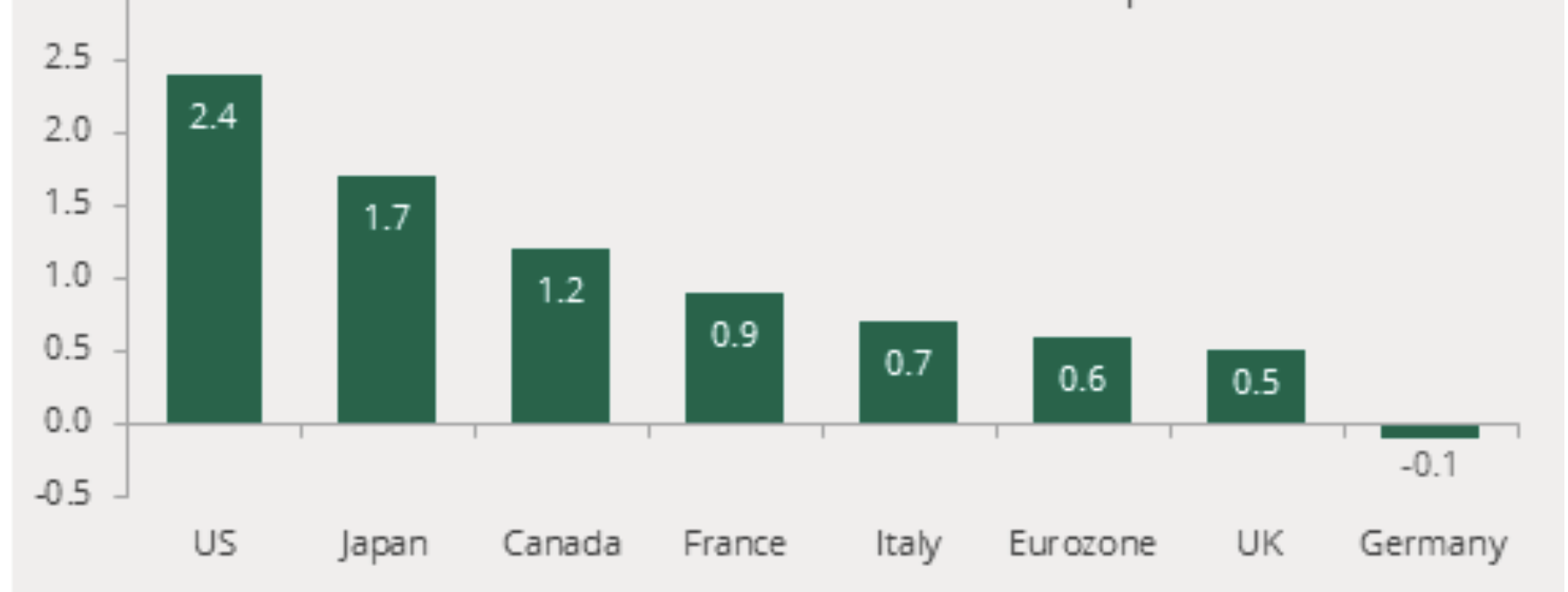
Indeed, the OECD has said global growth had been stronger than expected in 2023, but that growth will remain modest in 2024 and 2025. In contrast to Kemi’s upbeat assertions, the OECD calculates UK GDP grew by 0.5% in 2023 and by 0.7% in 2024. Its overview figures for the G7 in 2023 are shown in Chart 1 below. 

Chart 1—% GDP Growth during 2023 of G7 Countries (source: OECD)

While this chart confirms the UK doing better than Germany, this contest for last place should be an embarrassment, rather than something to crow about. Far more revealing would be to admit sluggishness and see what we could learn from the leaders.

A recent report from the US Bureau of Economic Analysis showed strong economic growth of 3.3% in the U.S. in the fourth quarter of 2023, setting growth for the year at 3.1%. This is greater than that shown above. But even at five, rather than six times the UK’s growth, it rates the UK economy as “sickly” as opposed to “strong”. It also shows Biden’s leadership in a strong light; in the first three years of Trump’s term, before the pandemic, growth was 2.5%). A year ago, economists projected that the U.S. would have a recession in 2023 and forecast growth of 0.2%.  US unemployment remains low, wages high, and inflation is receding (3.4% for the year, vs the UK’s 4.0%). 

The final three months of the year looked a lot like the soft landing Fed officials are seeking to achieve.”

—Gabriel T. Rubin, Wall Street Journal

 There is a major political story behind this impressive economic one. Since 1981, US lawmakers have insisted that cutting taxes, regulation, and the social safety net would create much faster and more efficient growth than was possible under the system in place between 1933 and 1981. This is echoed by prominent Tories like Jacob Rees-Mogg and John Redwood, who still preach the discredited lesson sof “Reaganomics”.

In the earlier era, lawmakers regulated business, imposed progressive taxes, and supported workers to make sure that ordinary Americans had the resources to fuel the economy through their desire for homes, consumer goods, and so on. But with the election of Republican president Ronald Reagan, lawmakers claimed that concentrating wealth on the “supply side” of the economy would enable wealthy investors and businessmen to manage the economy more efficiently than was possible when the government meddled, and the resulting economic growth would make the entire country more prosperous. 

The problem was that this system never produced the economic boom it promised. Instead, it moved money dramatically upward and hollowed out the American middle class while leaving poorer Americans significantly worse-off. 

When he took office, Biden rejected “supply side” economics and vowed to restore buying power to the demand side of the economy. His policies invested in manufacturing, infrastructure, small businesses, and workers’ rights. After years in which pundits said these policies would never work, the U.S. economy appears very strong.

With December’s UK government borrowing at “only” £7.8 billion, Chancellor Hunt is being pressured by supply-side Tories to use this unexpected “headroom” to cut taxes. This would be foolish and counterproductive. Another £7.8bn added to the existing £2,685 billion of public debt may not seem much.

But it represents another £409 million in annual interest, on top of the £14,100 million already being paid. Put another way, £14 more of taxes paid by each UK household will be diverted to service our massive debt.

Had Kemi Badenoch been right in parroting the party line that UK GDP is growing like the US’s, then debt would diminish as a fraction of GDP—and perhaps justify even more borrowing.

As it stands it is wilful denial on a national scale.

#1092—732 words

Posted in Commerce, Politics | Leave a comment

Culpably Clueless

Ever since the financial crash of 2008, many have been under the financial cosh, with councils in Scotland being among the worst affected. For over a decade, their ability to regulate their own finances was curtailed by the then-new SNP government’s freeze of Council Tax. 

While this was supposedly to be compensated for by additional grants to supplement the Revenue Support Grants that provided 80% of council funding, it effectively gave central government full control at local level, as well as national. Over the last seventeen years, the fiscal screw has tightened relentlessly.

Add in economic body blows from Brexit to Covid to Fuel Shock to Inflation, councils that had once balanced their budgets have recently resorted to including shortfalls as acceptable practice. Down at the Town House, the days of bankerly probity are apparently over.

East Lothian Council is no exception. On February 28th2023 they set a budget of £320.4m for 23/24. To cover services, this was an increase of £15m over 22/23, but included a funding shortfall of £18m. This means 5.6% of ELC’s budget was unfunded—equivalent to the entire budget of Children’s Services.

Alarm bells had been ringing for six months before the full council meeting at the end of August was told it faced some tough choices. Underused and understaffed public buildings, including libraries and public toilets, are expected to close while community funding grants are suspended and a recruitment freeze introduced across the local authority.

“The immediate measure proposed to tackle this year’s budget deficit were temporary warning they would not be sustainable over the long term. The current debt did not include major additional projects which had come into focus this year after the presence of unsafe concrete materials in Preston Lodge High School, Prestonpans, the Brunton Theatre in Musselburgh and Loch Centre, Tranent, had led to closures of parts of the buildings.”

—Sarah Fortune, Head of Finance, ELC

As if this were not salutary enough, subsequent report to successive council meetings up to December 12thhammered home the same stark need for economy, as the shortfall remained over £14m.

While focus was slowly being brought to bear on the revenue shortfall, capital expenditure is being funded by a “drunken sailor” approach to borrowing.  ELC has blown what reserves it had available to counter its revenue shortfall. 

The council’s capital expenditure (see: Treasury Management Strategy 2023-24 to 2027-28 report to the ELC, meeting of February 28th 2023) had been £95,5m last year (£64.7m on General Services and £30.8m on Housing). This is normal. But it is projected to rise to £524.6m over the next five years. This will be financed only partly by grants and capital receipts. The rest must come by borrowing from the Public Works Loan Board (PWLB), which offers favourable rates. Such borrowing is common enough in funding solvent councils. Although many present loans will be paid back, ELC plans to take on net new debt of £245.8m to plug their fiscal hole. This seems both irresponsible and unsustainable

“Solvent” is the key word in the previous paragraph. Coming on top of existing debt of £273.3m means ELC can expect to be £518,1m—over half a billion—in debt by 2029. That’s more than £5,000 for every man, woman, and child in the county. Were all loans from the PWLB made at a generous rate of 1% below the present bank rate of 5.25%, that would mean an annual interest repayment of ~£22m on council finances. That’s one third of the entire year’s take in council tax. Put another way, it would take a 43% rise in council tax just to pay the interest.

But that’s not all that needs to be paid. All this half-billion debt needs to be repaid at some point. The Treasury Strategy Report projects this over 70 years…and presumes no further borrowing between 2034 and 2094. This must surely be fiscal fantasy.

Such fairy tales have no place in a public body and should shame both the officials who generated them and an administration that approved them. Such behaviour drove Birmingham City into bankruptcy and saddled Woking residents with £18,756 debts per head. And these figures presume all the cuts, strictures and economies agreed by council have been applied.

“We do not believe this to be a meaningful data analysis…Our borrowing is linked to delivery of the capital programme, which is largely driven by the need for infrastructure to support a growing population.”

—ELC Spokesperson

The council claims that deliberate short-changing by the Scottish Government and a growing service demands from 10,000 new homes are responsible for this crisis. In the former, they have a point, but in the latter, they ignore that 3 out of 4 of these new homes are 3-or-more-bedroom family homes, often paying the top band of council tax.

They are also rubbish at making the best of what they have. Each of the six towns has up to a dozen facilities, each run by different central departments, with little work done on joint staffing, or building consolidation. Add to that their execrable commercial nous (sports centres lose money; no out-of-hours use of superb school facilities; not even licence charge for ice cream or burger stands.

It is possible ELC’s administration is using this as a political showdown with the Scottish Government. More likely, they are a dozy lot of timeservers who should get their jotters. They seem to have no idea they are saddling three generations of residents with paying off debts they were too innumerate to handle.

“Councils are ultimately responsible for their own finances, but we are very clear they should not put taxpayers’ money at risk by taking on excessive debt.”

Department for Levelling Up, Housing and Communities

#1091—938 words

Posted in Community, Politics | Tagged | Leave a comment

What Iowa Portends

Republican former President Donald Trump won the Iowa caucus by 30%, leaving his closest rival, Gov. Ron DeSantis of Florida in the dust…and setting a new record for victory margins in the Iowa Republican caucus.

Despite horrendous -28degC winter weather, Trump all but secured the Republican nomination. All other contenders will now drop out like flies, possibly as early as the New Hampshire primary next week. Either way, Trump will have it in the bag. As has been demonstrated over the past months, multiplex lawsuits and venomous tweets filled with disinformation have boosted, rather than broken, his ambition.

With few honorable exceptions, Republican Alice-in-Wonderland levitation from reality is meshing with Trump’s bumptious ego like Bentley clutch plates. He has a vision of America that even Hollywood at its Independence Day shoot-‘em-up best could not better. The Republican rich have no-one like Trump to reach the trailer trash, good ol’ boys and gun nuts, whose votes they need to preserve their power.

But the combination is dangerous stuff, at odds with the egalitarian principles of the Founding Fathers, whom the right wing are so fond of quoting. The danger of a second Trump president can be seen in the behaviour of the “Red States” already under Republican control.

Texas Governor Abbott is among MAGA Republicans are forcing the issue around immigration as a key line of attack on President Joe Biden in 2024, but while they are insisting immigration is so important, they will not agree to fund Ukraine’s resistance to Russia’s 2022 invasion.

Abbott has spent more than $100 million bussing migrants, who are legally in the US, having applied for asylum, to Democrat-controlled Northern cities. To make this worse, Texas has stopped coordinating with charities there that could prepare for migrant arrivals.

On January 12th a woman and two children drowned in the Rio Grande that marks the border between the U.S. and Mexico near Eagle Pass, Texas.  US Border Patrol agents were told that a group of six migrants were in distress in the river but could not try to save them, as they normally would, because troops from the Texas National Guard and the Texas Military Department prevented the Border Patrol agents from entering the area where they were struggling.

Effectively, Texas forces have prevented US Border Patrol officials from performing their duties, asserting that Texas officials have power over US officials. This sets a dangerous and unconstitutional precedent.

“Texas cannot run its own immigration system. Its efforts intrude on the federal government’s exclusive authority to regulate the entry and removal of noncitizens, frustrate the United States’ immigration operations and proceedings, and interfere with US foreign relations.”

US Dept of Justice, Jan. 13th 2024

Such grandstanding confrontational behaviour is typical of MAGA Republicans in positions of authority. However, Abbott is a lead proponent, and not one to let considerations of humanity toward non-voters interfere with his high-profile posturing. 

“Abbott is sending asylum seekers from Texas to the Upper Midwest in the middle of winter—many without coats to protect them from the snow—to a city whose shelters are already overfilled with migrants you have already sent here.”

—Illinois Governor J.B. Pritzker

Chicago’s temperatures regularly drop well below zero at this time of year. Pritzker supports bipartisan immigration reform, but not like this.

Republicans are doubling down on pushing the idea that migrants threaten American society and that an individual state—Texas, in this case—can override federal authority.

The only thing that we’re not doing is we’re not shooting people who come across the border, because of course the Biden administration would charge us with murder.”

—Gov. Abbott, speaking on the right-wing Dana Loesch Show 

But in this, as in so many issues, there is nothing new under the sun.

Was this to be permitted the government would lose the confidence of its citizens and it would induce disunion everywhere. No, the crisis must be now met with firmness, our citizens protected, and the modern doctrine of nullification and secession put down forever. Nothing must be permitted to weaken our government at home or abroad”.

—President Andrew Jackson, Jan. 13, 1833, on South Carolina’s assertion that sovereign states could overrule federal laws

Despite the emollient tones he used after his Iowa victory about “bringing us all together”, Trump’s pugnacious rhetoric echoes Abbott and his extremism, as when immediately prior to the poll, Trump boasted:

“As soon as I take the oath of office, I’ll begin the largest deportation operation in American history.”

—Donald Trump, campaigning in Iowa.

#1090—758 words

Posted in Politics, USA | Leave a comment

SOS Puffin Update, 2023

What follows is a précis of the newsletter sent out by the team at the Scottish Seabird Centre who monitor and protect the environment of local seabirds on unique offshore islands near North Berwick. It is reproduced here to widen appreciation for the excellent work all at the SSC do to raise our awareness of our precious marine environment.

#1089—1,141 words                                          

Introduction

SOS Puffin is a volunteer project led by the Scottish Seabird Centre (SSC) which started in 2007.  It aims to bring under control the invasive plant Tree Mallow (TM) which has taken over the islands of Craigleith, Fidra and the Lamb near North Berwick, and threatens the important populations of nesting Puffins and other seabirds.

A progress update is usually sent to all the volunteers every six months to summarise any volunteer activities that have been undertaken on the islands and to highlight any other relevant research that underpins the project. Any comments or queries are very welcome.

Island Visits

During the six-month period, one work party was sent to Craigleith and three to Fidra to cut TM. Members of the Lothian Sea Kayak Club also visited the Lamb during the autumn.

All the SOS Puffin work parties have been over-subscribed. We are sorry for any disappointment this may have caused for those of you who were hoping to join a work party. It is unfortunate that we cannot offer more places on these trips, but we are endeavouring to ration the allocation of places with priority given to those volunteers who had not been out before. New volunteers continue to come forward with 480 people now on the volunteer data base and we are very grateful for their continuing support.

Craigleith  

A visit in July showed a strong growth of vegetation during the summer, perhaps because of a wet March and despite a reasonably dry summer. However very little TM was to be seen apart from one area which could not be cut in March because of possible disturbance to nesting Cormorants. The grass Yorkshire Fog had a good year and now dominates large parts of the island, even replacing Stinging Nettles in some areas.

By August there was a lot of bare ground with indications that there was still a large Rabbit population. TM was restricted mainly to the south and south-east parts of the island and in the Cormorant colony at the east end. Elsewhere in the southern half of the island there were tiny seedlings evident on disturbed ground next to Puffin and Rabbit burrows. Sea Campion was still spreading out from the south-western corner. One work party in September cut most of the TM including part of the area around the Cormorant colony. A further visit was planned in October to finish cutting but it had to be cancelled because of the weather conditions.

The number of work parties each year has varied considerably over the life of the project. This is because huge amounts of TM needed to be cut in the early years while, more recently, fluctuations in the Rabbit population have influenced the amount of TM that needed to be cut. However, it is a sign of the project’s success that in the last four years the amount of TM has been very low.

Nettles were widespread as small plants with a few larger patches but there was no apparent increase on 2022, with some of the areas declining a little. No Nettle control was carried out this year, it having been agreed that further consideration of its value is needed.

Cormorants have extended their nesting areas in the south-east of the island with an increase in total numbers. No Puffin count was carried out this year but it was encouraging to see unusually large numbers of Puffins during a visit in July. No Puffin burrow count was undertaken because of concerns relating to avian flu.

Fidra

Three SOS Puffin work parties took place in late August and September and cut most of the considerable areas of TM which had developed in the usual places during the summer. The main areas still left to deal with were near the harbour and west of the lighthouse. As well as controlling TM, quite a lot of litter was removed. RSPB hoped to arrange one or more work parties in late October, but weather conditions did not allow this.

Nettles are widespread and are encroaching on some of the main Puffin nesting areas near the lighthouse and it is hoped that RSPB will carry out some control during 2024. Cormorants nested for the first time on Fidra with nine nests recorded on Castle Tarbet. If they spread much further in future, they could have an impact on the nearby nesting Puffins. No unusual mortality of Gulls or other species was seen.

The Lamb

Since 2016, parties of kayakers organised by David Simpson of the Lothian Sea Kayak Club have been visiting the Lamb to control TM. This year no work parties were arranged as they were not thought necessary. However, the three kayakers Tim Gibson, Chris Gordon and Neil Black, who helped so much to deal with the earlier rat incursion, have paid a small number of visits to the island to cut TM and check the monitoring boxes. No evidence of Rats has been seen and TM has been kept under control.

However, there is now sufficient TM to justify a work party and the Club hope to organise a trip to the Lamb in the next two months if weather allows.

As usual our priority for 2024 is to ensure that the islands are reasonably clear of TM by the time Puffins return to breed. Predicting the future is always risky, but it does seem that the project has reached the stage where the amount of TM control needed from now onwards will be relatively low. A schedule of trips for the coming spring will be circulated to all the volunteers during February, and RSPB will probably also organise some work parties to Fidra. However, the number of work parties will be determined by the amount of TM on Craigleith and Fidra and we expect that only a small number will be needed during 2024.

Looking Forward

As usual our priority for 2024 is to ensure that the islands are reasonably clear of TM by the time Puffins return to breed. Predicting the future is always risky, but it does seem that the project has reached the stage where the amount of TM control needed from now onwards will be relatively low. A schedule of trips for the coming spring will be circulated to all the volunteers during February, and RSPB will probably also organise some work parties to Fidra. However, the number of work parties will be determined by the amount of TM on Craigleith and Fidra and we expect that only a small number will be needed during 2024. 

We hope to carry out a Puffin burrow count on all three islands during the summer.

Many thanks to the members of the Craigleith Management Group and to all the volunteers who continue to support SOS Puffin.

With best wishes

Conservation Projects Officer conservationprojects@seabird.org

Scottish Seabird Centre, The Harbour, North Berwick, EH39 4SS

Posted in Community, Environment | 1 Comment

Fur Coats and No £nickers

This weekend the Telegraph rounded out a difficult year for the UK and its government with an upbeat article on economic prospects for the country in its Business section, entitled “Britain to outgrow Germany for years to come as eurozone growth engine stutters. Backed up by Deutsche Bank, UBS and the IMF, the article paints a rosy future when measured against the EU’s economic engine room, Germany.

“We anticipate growth in Germany of 0.5pc next year, followed by a modest acceleration of 0.8pc in 2025. By contrast, the UK will grow by 0.6pc in 2024 and by 1.5pc the year after.”

Reinhardt Cluse, Economist at UBS

Confidence in Britain’s revival is also reflected in a resilience in the pound sterling as traders see profits in the higher interest rates expected to persist in Britain and recent bets from traders, who believe UK interest rates will fall from 5.25% to 3.5% by the end of next year.

This seems just the shot in the arm that Sunak and Hunt so desperately need to offer wiggle room for tax cuts and some feelgood factor to pull their electoral chestnuts out of the fire as an election looms. But is this true optimism, tempered by hard-headed fiscal analyses, or just another piece of tribal boosterism from the Torygraph?

To hear the government tell it, success has already been achieved with the halving of interest rates. The UK inflation rate was 3.9% in November 2023, down from 4.6% in October, and well below its peak of 11.1% in October 2022, which led to seven months of double-digit inflation.

This looks good…until compared with our former partners in the EU. Inflation rates In the Euro Area decreased to 2.4% in November from 2.9% in October of 2023. Even the US shows the UK a clean pair of heels when we look at their rates: 2.6% over the previous November, down from 2.9% in October. Peaks for the EU and US were 10.5% and 9.1%, respectively. In comparison any welcome UK achievement of pulling itself out of a much deeper hole seems sluggish.

With central banks tasked with achieving a 2% rate, the UK is laggard in achieving this. So, if the much-trumpeted “halving inflation is a damp squib, what about actual economic performance, as praised in the article? It says:

The UK is expected to grow by 1.3% and the EU by 1.1%, while Germany is the laggard on 0.9%.”

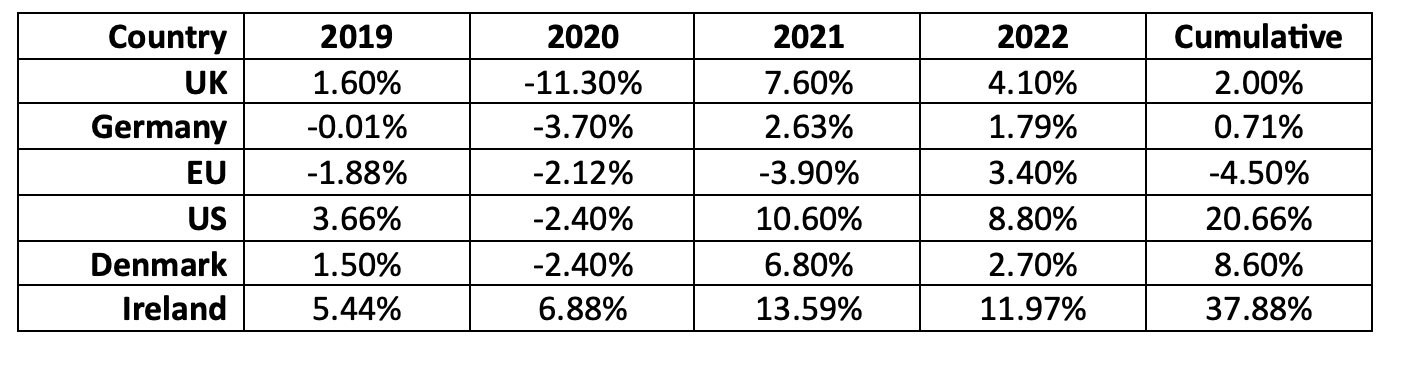
This may well be the case, but historic economic data has not indicated such a trend to be likely. UK performance over the Covid crisis has generally been poorer than either its EU neighbours or G7 partners. Although much has been made of the UK recovery being faster than others, the fall into recession was markedly steeper. This is shown by comparison with Germany and some other countries in Table 1.

Table 1: GDP Growth Since Pre-Covid (Source: World Bank)

From the table, it is clear that Germany has suffered economic difficulties and is not representative of the relatively shallow plunge and recovery achieved by others, A similar market economy like the US has achieved ten times the UK’s growth, as compared to pre-pandemic and Ireland managed to prosper throughout.

The German economy has indeed been adversely affected by a number of factors. The war in Ukraine found them particularly vulnerable to energy prices and the shut-off from Russian gas. Slowdown in Chinese demand has hit their strong manufacturing base hard. Berlin is already grappling with a budget crisis after Germany’s top court ruled that the government broke the law by using Covid cash to fund net zero spending.

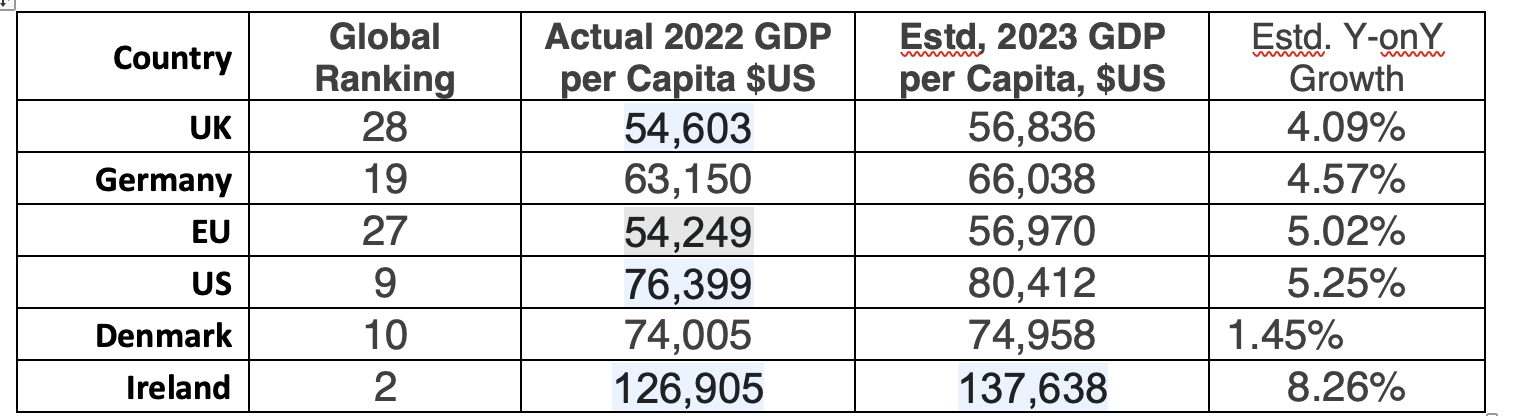
Indeed, figures given in the article seem to gloss over the weak position in which the UK economy finds itself, and from which the 0.2% differential in estimated growth vs Germany will be made, Looking at GDPs in the context of the global GDP “League Table” puts a very different complexion on this, as examining the same half-dozen countries sows in Table 2.

Table 2: GDP Country Global Ranking (Source: Wikipedia)

This tells a very different story. GDP growth rate comparisons over the short term between the UK and Germany are indeed close—within a fraction of a percent. But the bigger picture is alarming for the UK. Even if a 0.2% growth in the UK’s favour did apply, Germany’s GDP is already 15.7% ahead of the UK’s. At a 0.2% rate, it would take the UK until next century to catch up.

More interesting are the other figures on the tables above. Four years on from Brexit, the benefits of our market economy “punching above our weight” have yet to show up—in contrast to the US, whose citizens are already 40% better-off than Brits, and growing wealth at ten times the rate.

But the real zinger are Denmark and Ireland, two EU members that rather offset Germany. Both the size of Scotland, they offer their citizens a prosperous quality of life not far from Britain—but strangely never mentioned by government, BBC or other media as offering models for the future.

London-based economists at various banks have their own reasons for cheerleading Britain’s economy. Politicians  wedded to the overstretch of Brexit, nuke subs and aircraft carriers as placebos for vanished glories suffer similar motivation. But whether media “Pax Britannia” shills like the Telegraph article are genuine journalism, or tired propaganda can clearly be answered by the numbers above.

#1088—983 words

p.s. Jan. 4th; The Telegraph is nothing if not bullish in boosting Britain. Today, they print another article essentially rubbishing the economic prospects of our nearest neighbours and lauding the prospects for the UK. The figures they cite are correct, but misleading. German and French inflation at 3.7%is still better than the UK’s 3.9% and a bank rate of 4% looks far more favourable for growth than the UK’s 5.25%. As with the above, it’s the selective analysis that makes this reek of political propaganda.

See: https://www.telegraph.co.uk/business/2024/01/04/ftse-100-markets-news-latest-next-zero-inflation-space-x/

Posted in Commerce, Politics | Leave a comment

Another Tea Party?

Today marks the 250th anniversary of the Boston Tea Party, when 30 men boarded three East India Company vessels in Boston Harbour. They broke open 342 chests of tea and, carefully avoiding causing any other damage, dumped about 90,000 pounds of tea overboard.

The pointed destruction of a cargo worth over £1 million in today’s prices was no random vandalism. It was an escalation of an ongoing struggle over civic rights between a British government 3,000 miles away and thirteen of its North American colonies. 

Since war with France had ended in 1763, trouble had been brewing. Conquest had  dramatically expanded British possessions in North America, but at considerable cost. To raise revenue, George III’s ministers raised taxes on the colonists through a Stamp Act, arguing that their security had thereby been enhanced. 

This shocked the colonists. At issue was not just money, but the question whether the king’s power could be checked by the people, or were they unlimited, as Stuart kings had asserted a century earlier? Colonists were not directly represented in Parliament and believed they were losing their fundamental right to have a say in their government. They responded to the taxes with widespread protest. 

In 1766, Parliament repealed the Stamp Act but claimed for Parliament “full power and authority to make laws and statutes…to bind the colonies and people of America…in all cases whatsoever.” This act echoed the 1719 Irish Declaratory Act, which asserted that Ireland was subordinate to the British king and Parliament that also imposed new taxes.

Over the next few years resentment turned to unrest and British officials sent troops to Boston to restore order. They shot into a crowd, killing five.

Parliament relented and removed all but one of the new taxes—the tax on tea—but trouble continued to simmer. A threat to extradite colonists to England for trial seemed to the colonists to prove the British government intended to strip them of their civil rights. 

Then, in 1773, Parliament tried to bail out the failing East India Company by giving it a monopoly on tea sales in the colonies. To the colonists, it seemed the plan was to convince people to accept the tea, thereby establishing Parliament’s right to govern without colonists’ input.

Ships carrying the East India tea sailed for the colonies, but mass protests persuaded most captains to turn back for England. In Boston, however, the governor was determined to land the cargo. He refused to let ships loaded with tea leave the harbour until the tax was paid. 

So a group of colonists hid their faces as Indigenous Americans. They boarded three ships and dumped the tea to make their political statement.

Parliament responded by closing the port, moving the seat of government to Salem, stripping the colony of its charter, requiring colonists to pay for quartering redcoats in Boston, and demanding payment for the lost tea.  

“We must work together to advance a constitutional opposition to tyranny

—Boston leader Samuel Adams.

Americans would find an answer to the question of tyranny from a king’s omnipotence in a Declaration of Independence and eight years of war, culminating in British humiliation at Saratoga.

Unfortunately, the British government has “form” on this behaviour. Once a colonial power, it was understandably reluctant to see its empire diminished. But, while colonies dominated by other cultures have been granted independence with tolerably good grace, America is an example of fighting it tooth and nail when the culture is an attempt to “make the world England”. 

Another is Ireland. After centuries of imposition of English rule, that involved treating natives like disposable chattels, suppression of multiple revolts and indifference to a famine, in which a million died and another million emigrated, civil chaos forced Britain to grant independence in 1922.

But, at what was otherwise the height of Empire, the British government could not resist holding on to a fig-leaf shred of empire by retaining the Six Counties. The subsequent unrest and bloodshed there stands in stark contrast to the peace and prosperity of Eire. Do these examples of the USA and Eire form a pattern, where Britain holds on most fiercely to those that prosper more when they escape?

Because another example seems to be brewing. Over the last decade, the the British government has ignored Scottish requests from a duly elected government, backed by 50% of those polled for a referendum. This wilful deafness echoes earlier bouts of haughty hubris exemplified by the above.

What is particularly tragic about this case is that so far, unlike the American and Irish examples, no-one has even been hurt, let alone killed, in this cause. Such unrest as there has been in Scotland has been democratic and civilised. There have been no incidents of gallons of London gin being poured into the Forth, probably because it is distilled in Fife.

But 81% of Scottish MPs are rendered as powerless as Parnell’s Irish MPs were a century ago trying to sway the 84% of MPs who are English. As in the case of America and Ireland, non-English MPs have little chance to undermine self-interest among the English majority.

But such self-interest is foolish, and counter-productive. Even the most virulent Little-Englander praises the “special relationship” Britain now enjoys with the USA, and admires (albeit privately) that Eire’s Celtic Tiger economy puts the economic backwater of Northern Ireland in the shade. So Scotland’s case should be self-evident. It need not take dimming the power sent south, nor rendering Faslane inoperable—let alone violence—to see offering the Scottish people a democratic choices evades the animosity that poisoned relations with the USA and Ireland for decades.

#1087—940 words

Posted in Community, Politics, USA | Leave a comment

Council of Despair

Even during the heyday of empire a century ago, East Lothian was a sleepy country cousin of its dynamic Lothian sibling. Back then, despite the industrial might of Glasgow, Edinburgh buzzed with brewing, publishing and the law, West Lothian exploited shale oil and manufacturing and Midlothian boomed with coal mines. These latter only grazed East Lothian’s Western edge. Apart from a couple of coastal resorts, most of the county stayed bucolic.

While all suffered the stasis of the seventies, by the 1990s, Edinburgh’s focus on finance, tourism and the regenerative effect of the Scottish Parliament brought a booming economy to Lothian, from which all parts seemed to benefit.

At least, that’s how East Lothian Council (ELC) has been telling it. Immediately prior to the Covid pandemic, GDP per capita for Lothian was rated at a prosperous £32,600z-roughly the UK average. According to ELC, its residents shared in this relative affluence.

“There were 3,180 businesses in East Lothian in 2018, a growth of 665 (26%) from 2010. This already greatly exceeds the EDS target of an additional 350 businesses by 2020.”

East Lothian by Numbers

But how well does this represent East Lothian’s economy? When the ELC was formed as a Unitary authority the population was 86,000. This grew to90,000 by 2001 and to 109,580 by 2021. This growth is faster and steadier than any other of Scotland’s 31 council areas.

Given ELC’s high-minded statements of strategy and this influx of largely affluent, educated residents, might this compact county not transform into a dynamic hinterland for Edinburgh, much as Cambridgeshire has for Cambridge, or Silicon Valley for San Francisco? It is a picturesque, unspoiled recreational haven, blessed with excellent road and rail links to the nation’s capital. 

Unfortunately, research into more incisive figures do not appear to bear this rosy view out. For its first decade to 2006, ELC occupied itself with integrating departments like Education from the defunct Lothian Region. Increases in council tax were largely spent on mainstreaming Scottish Government social policies and wrestling a £156m PFI project for schools into place.

Despite a four-year quickening of pace by an SNP/Lib-Dem coalition during the financial crisis which still managed to implement Single Status for staff, slash limousines and other perks, and quash a dubious £149,000 payoff to a Chief Executive, Labour resumed sclerotic business-as-usual after 2012.

This meant not much business at all. Touting figures for business growth, as given above, was poor compensation for Cockenzie power station closing, along with several small hotels, Whitekirk Golf Club, Proquip, etc. And still the largest employers remain ELC itself and Torness power station.

ELC has not been entirely bereft of business initiative. This year, it is spending another £100,000 on a master plan for the huge Cockenzie brownfield site beside the Forth to replace the £150,000 one it commissioned seven years ago and has yet to start any implementation.

The last decade of ambitious ELC statements have proved as hollow as the first’s. Far from “providing high quality employment pathways for East Lothian’s workforce”, this has been done by Edinburgh. Local professionals living in East Lothian mostly seek jobs elsewhere.

Like the rest of Lothian, East Lothian’s economy was hit by the global economic downturn. But recovery struggled. In 2015, East Lothian GVA was £1,737 million, representing a 4% growth since 2006, lagging Edinburgh’s 13% and Scotland’s at 12%).

Jobs density is 0.62, compared to the Scottish average of 0.82. And, of those jobs, East Lothian provides only a third in well paid occupations, like finance, insurance and IT. The bulk of local jobs are low-pay, such as hospitality, social work and retail.

A larger proportion than nationally are self-employed sole traders, administrative workers, secretaries or carers, implying smaller incomes and contribution to the county’s GDP. Also significant is, of the 53,000 in employment, almost 20,000 commute out of the county for work, principally to Edinburgh. These are predominantly salaried, professionals. Barely  33,000 of the 53,000 are employed within the county. 

Despite ELC rhetoric, their patch is a dormitory with a third-world economy. The furious pace of over 17,000 new houses on ELC’s quarter-century watch has seen no matching growth in either opportunities or infrastructure.

What makes the story of ELC’s stewardship of this third-world economy all the more tragic is the opportunity missed to turn the county into a modest replica of Cambridgeshire. For all their lavish use of the word “strategic’, ELC wouldn’t know a strategy if they found one in their soup. They pants at capitalising on small opportunities (c.f. how The Loft turned their canteen into a money-spinner or the thousands they pass up not licencing ice cream stands) but there is a complete lack of vision for an area full of potential. If ELC had a clue, they might have:

  • Spent the >£1 million they wasted revamping parking around Musselburgh Town Hall on retail and hospitality development along the picturesque Rover Esk between the Roman and Electricity bridges.
  • Persuaded Transport Scotland to double frequency of ScotRail trains to Drem to provide hourly service to East Linton & Dunbar, continuing to Reston and Berwick.
  • Provided serviced office complexes in eastern towns to service many professionals working out of second bedrooms or forced to commute to Edinburgh/Midlothian to find space for their growing businesses. These are NOT the same as roller-door industrial units.
  • Tried to wake up sleepy Scottish Enterprise with clear plans for the Cockenzie brownfield site with a vision that might include a liner/ferry terminal, coastal promenade with retail, restaurants and a historic repro Tranent wagonway connecting to a Prestonpans Battlefield site, along the lines of Culloden’s.
  • Approached Ryanair/Easyjet/Jet2 to reopen East Fortune as a budget airport for Edinburgh, using the hospital site ad former station facilities.
  • Integrated public transport as a model for elsewhere: East Coast & Lothian Buses with ScotRail, using a single Oyster-style card and eliminate route duplication, using trains as a “backbone”. (c.f. any city in Europe).
  • Persuaded Transport Scotland that an interchange station at Joppa Junction, together with quadrupling of track between there and Waverley would be a lot cheaper than quadrupling to Drem but would offer comparable easing of ECML capacity.

Whether the above are feasible is not the point. Not only have none been tried, but nothing remotely ambitious has been contemplated. ELC administration has been content to ca’ the haun’le and draw their salaries.

Which is a shame. In its quarter century of life, ELC has pocketed over £90 million in “Section 75” charges from developers to provide the necessary education facilities for those >17,000 new houses. To do so, they chose a Private Finance Initiative (PFI) scheme that cost £158 million to provide £58 million worth of facilities. 

Instead of that, they could have built the schools themselves, and still had £30 million in hand to fund pivotal projects—such as those suggested above.

Shame, really; the future for Edinburgh’s coastal Garden of Eden could have been so different.

#1086—1,160 words

Posted in Commerce, Community, Politics | Leave a comment

This “Maga Saga” Is Nothing New

This month, tantrums by the Maga wing of the Republican control of the US House of Representatives got even worse. On November 15th, they shut down House business by refusing to pass a procedural vote to take up a spending bill. They had threatened to do this in retaliation for the passage of a resolution to fund the government into the new year. 

This is the fourth time the extremists have defeated special rules in the House this year. Their doing so is highly unusual. In the previous 20 years the House voted down no such measures at all. Although in the middle of a 17-vote series at the time, the Republicans then recessed the House until after Thanksgiving.

Such eccentric utterances and venal actions of Maga Republicans brinkmanship endangers both economy and government. But even those who follow such antics closely may be surprised to learn this did not start with Trump. Demonising political opponents as “Communists out to wreck America” started with Lincoln and the Civil War.

This Thanksgiving weekend, when our American cousins are celebrating with family by stuffing themselves with turkey and pumpkin pie, seems a good time to reflect on that time 160 years ago when that great country almost fell apart. Though the war ended in 1865, its legacy didn’t, as political differences were papered over, rather than resolved. The continued racial divisions in Southern states remained institutionalised and it was, strangely enough, Southern Democrats who kept the racial pot boiling. Southern “good ol’ boys” refused to vote Republican because that was Lincoln’s party—and he had freed the slaves.

Democrats were once the dominant political force from Texas to Virginia and—emancipation of the slaves or no. They spent the next century defending segregation and white supremacy. But after WW2 had removed segregation from US Armed Forces, Rosa Parks refused to give up her bus seat, the march on Selma went ahead and MLK had a dream, the status quo in Southern States was coming unglued.

In 1962, he U.S. Court of Appeals ruled that black army veteran James Meredith had the right to enrol at the University of Mississippi, known as ‘Ole Miss’. When the Department of Justice ordered officials at Ole Miss to register Meredith, Mississippi’s Democrat governor Ross Barnett physically barred Meredith from entering the building and vowed to defend segregation and states’ rights.

So, the Department of Justice detailed dozens of U.S. marshals to escort Meredith to the registrar. White supremacists rushed to meet them, things turned violent. The rioters destroyed property and, under cover of the darkness, fired at reporters and the federal marshals, killing two. That night, Barnett told a radio audience: “We will never surrender!”

At that point, Democrat President Kennedy, along with his brother Robert, as Attorney General, backed the Court of Appeals decision, saying James Meredith had the right to enrol at Ole Miss. Kennedy sent 20,000 troops to the campus, the riot was quelled, and Meredith enrolled.

By making it clear the federal government stood behind civil rights, Kennedy ran foul of white supremacists in his own party, who joined right-wing Republicans in insisting this proved the Kennedys were communists. Kennedy’s use of a strong federal government to protect civil rights was presumed to then take tax dollars from white Americans for the benefit of coloured people.

This conflation of black rights and communism stoked such anger in the southern right wing that Kennedy felt obliged to travel to Dallas to try to mend fences in the state Democratic Party.

And, as he prepared to ride in an open-top motorcade through the city, on November 22, 1963, the Dallas Morning News contained a flyer saying the president was: “wanted for treason for “betraying the Constitution and giving support and encouragement to Communist-inspired racial riots”.

What motives Lee Harvey Oswald may have had for assassinating Kennedy remain a mystery because he himself was assassinated before he could talk. But neither media, nor the myriad conspiracy theories around this terrible event say much about the fractious background to Kennedy’s visit, Few accounts of today’s fractiousness draw the clear parallels between the current Maga myopia and the entrenched bigotry surrounding events half a century ago. But those who do not learn from history are condemned to repeat it.

“We need to stop the false equivalency BS between Biden and Trump. Only one acts with the intention to do real harm.”

—Michael Steele, former Republican National Committee chair

NOTE: This article uses material from Heather Cox Richardson’s insightful and informative (if vaguely Democrat) blog “Letters from an American”.

#1085—748 words

Posted in Politics, USA | Leave a comment