Fur Coats and No £nickers

This weekend the Telegraph rounded out a difficult year for the UK and its government with an upbeat article on economic prospects for the country in its Business section, entitled “Britain to outgrow Germany for years to come as eurozone growth engine stutters. Backed up by Deutsche Bank, UBS and the IMF, the article paints a rosy future when measured against the EU’s economic engine room, Germany.

“We anticipate growth in Germany of 0.5pc next year, followed by a modest acceleration of 0.8pc in 2025. By contrast, the UK will grow by 0.6pc in 2024 and by 1.5pc the year after.”

Reinhardt Cluse, Economist at UBS

Confidence in Britain’s revival is also reflected in a resilience in the pound sterling as traders see profits in the higher interest rates expected to persist in Britain and recent bets from traders, who believe UK interest rates will fall from 5.25% to 3.5% by the end of next year.

This seems just the shot in the arm that Sunak and Hunt so desperately need to offer wiggle room for tax cuts and some feelgood factor to pull their electoral chestnuts out of the fire as an election looms. But is this true optimism, tempered by hard-headed fiscal analyses, or just another piece of tribal boosterism from the Torygraph?

To hear the government tell it, success has already been achieved with the halving of interest rates. The UK inflation rate was 3.9% in November 2023, down from 4.6% in October, and well below its peak of 11.1% in October 2022, which led to seven months of double-digit inflation.

This looks good…until compared with our former partners in the EU. Inflation rates In the Euro Area decreased to 2.4% in November from 2.9% in October of 2023. Even the US shows the UK a clean pair of heels when we look at their rates: 2.6% over the previous November, down from 2.9% in October. Peaks for the EU and US were 10.5% and 9.1%, respectively. In comparison any welcome UK achievement of pulling itself out of a much deeper hole seems sluggish.

With central banks tasked with achieving a 2% rate, the UK is laggard in achieving this. So, if the much-trumpeted “halving inflation is a damp squib, what about actual economic performance, as praised in the article? It says:

The UK is expected to grow by 1.3% and the EU by 1.1%, while Germany is the laggard on 0.9%.”

This may well be the case, but historic economic data has not indicated such a trend to be likely. UK performance over the Covid crisis has generally been poorer than either its EU neighbours or G7 partners. Although much has been made of the UK recovery being faster than others, the fall into recession was markedly steeper. This is shown by comparison with Germany and some other countries in Table 1.
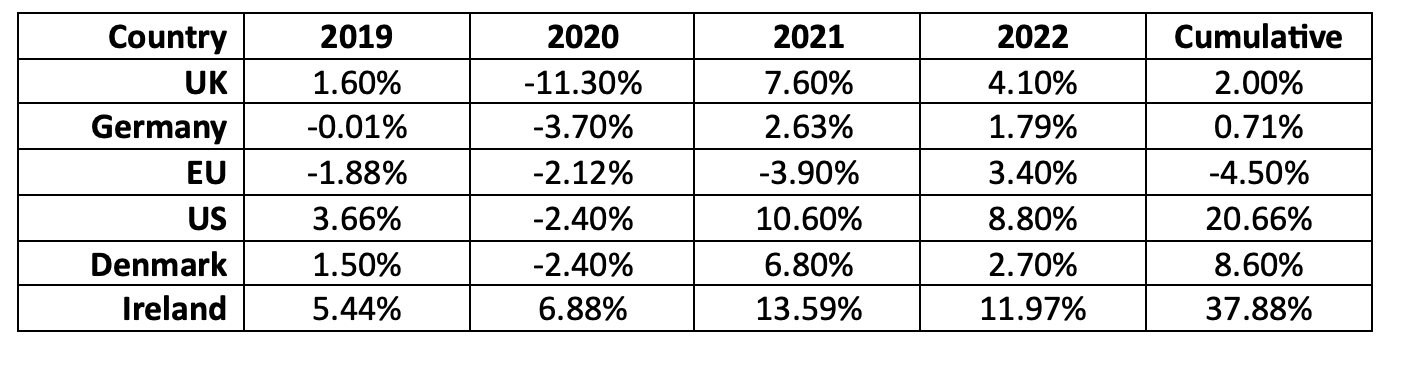
Table 1: GDP Growth Since Pre-Covid (Source: World Bank)

From the table, it is clear that Germany has suffered economic difficulties and is not representative of the relatively shallow plunge and recovery achieved by others, A similar market economy like the US has achieved ten times the UK’s growth, as compared to pre-pandemic and Ireland managed to prosper throughout.

The German economy has indeed been adversely affected by a number of factors. The war in Ukraine found them particularly vulnerable to energy prices and the shut-off from Russian gas. Slowdown in Chinese demand has hit their strong manufacturing base hard. Berlin is already grappling with a budget crisis after Germany’s top court ruled that the government broke the law by using Covid cash to fund net zero spending.

Indeed, figures given in the article seem to gloss over the weak position in which the UK economy finds itself, and from which the 0.2% differential in estimated growth vs Germany will be made, Looking at GDPs in the context of the global GDP “League Table” puts a very different complexion on this, as examining the same half-dozen countries sows in Table 2.
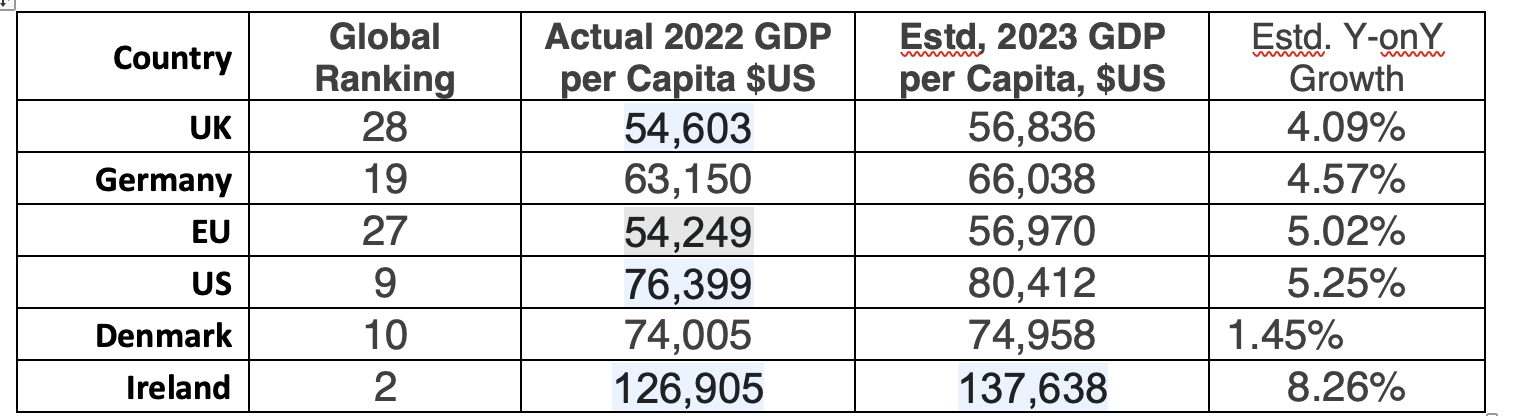
Table 2: GDP Country Global Ranking (Source: Wikipedia)

This tells a very different story. GDP growth rate comparisons over the short term between the UK and Germany are indeed close—within a fraction of a percent. But the bigger picture is alarming for the UK. Even if a 0.2% growth in the UK’s favour did apply, Germany’s GDP is already 15.7% ahead of the UK’s. At a 0.2% rate, it would take the UK until next century to catch up.

More interesting are the other figures on the tables above. Four years on from Brexit, the benefits of our market economy “punching above our weight” have yet to show up—in contrast to the US, whose citizens are already 40% better-off than Brits, and growing wealth at ten times the rate.

But the real zinger are Denmark and Ireland, two EU members that rather offset Germany. Both the size of Scotland, they offer their citizens a prosperous quality of life not far from Britain—but strangely never mentioned by government, BBC or other media as offering models for the future.

London-based economists at various banks have their own reasons for cheerleading Britain’s economy. Politicians  wedded to the overstretch of Brexit, nuke subs and aircraft carriers as placebos for vanished glories suffer similar motivation. But whether media “Pax Britannia” shills like the Telegraph article are genuine journalism, or tired propaganda can clearly be answered by the numbers above.

#1088—983 words

p.s. Jan. 4th; The Telegraph is nothing if not bullish in boosting Britain. Today, they print another article essentially rubbishing the economic prospects of our nearest neighbours and lauding the prospects for the UK. The figures they cite are correct, but misleading. German and French inflation at 3.7%is still better than the UK’s 3.9% and a bank rate of 4% looks far more favourable for growth than the UK’s 5.25%. As with the above, it’s the selective analysis that makes this reek of political propaganda.

See: https://www.telegraph.co.uk/business/2024/01/04/ftse-100-markets-news-latest-next-zero-inflation-space-x/

Posted in Commerce, Politics | Leave a comment

Another Tea Party?

Today marks the 250th anniversary of the Boston Tea Party, when 30 men boarded three East India Company vessels in Boston Harbour. They broke open 342 chests of tea and, carefully avoiding causing any other damage, dumped about 90,000 pounds of tea overboard.

The pointed destruction of a cargo worth over £1 million in today’s prices was no random vandalism. It was an escalation of an ongoing struggle over civic rights between a British government 3,000 miles away and thirteen of its North American colonies. 

Since war with France had ended in 1763, trouble had been brewing. Conquest had  dramatically expanded British possessions in North America, but at considerable cost. To raise revenue, George III’s ministers raised taxes on the colonists through a Stamp Act, arguing that their security had thereby been enhanced. 

This shocked the colonists. At issue was not just money, but the question whether the king’s power could be checked by the people, or were they unlimited, as Stuart kings had asserted a century earlier? Colonists were not directly represented in Parliament and believed they were losing their fundamental right to have a say in their government. They responded to the taxes with widespread protest. 

In 1766, Parliament repealed the Stamp Act but claimed for Parliament “full power and authority to make laws and statutes…to bind the colonies and people of America…in all cases whatsoever.” This act echoed the 1719 Irish Declaratory Act, which asserted that Ireland was subordinate to the British king and Parliament that also imposed new taxes.

Over the next few years resentment turned to unrest and British officials sent troops to Boston to restore order. They shot into a crowd, killing five.

Parliament relented and removed all but one of the new taxes—the tax on tea—but trouble continued to simmer. A threat to extradite colonists to England for trial seemed to the colonists to prove the British government intended to strip them of their civil rights. 

Then, in 1773, Parliament tried to bail out the failing East India Company by giving it a monopoly on tea sales in the colonies. To the colonists, it seemed the plan was to convince people to accept the tea, thereby establishing Parliament’s right to govern without colonists’ input.

Ships carrying the East India tea sailed for the colonies, but mass protests persuaded most captains to turn back for England. In Boston, however, the governor was determined to land the cargo. He refused to let ships loaded with tea leave the harbour until the tax was paid. 

So a group of colonists hid their faces as Indigenous Americans. They boarded three ships and dumped the tea to make their political statement.

Parliament responded by closing the port, moving the seat of government to Salem, stripping the colony of its charter, requiring colonists to pay for quartering redcoats in Boston, and demanding payment for the lost tea.  

“We must work together to advance a constitutional opposition to tyranny

—Boston leader Samuel Adams.

Americans would find an answer to the question of tyranny from a king’s omnipotence in a Declaration of Independence and eight years of war, culminating in British humiliation at Saratoga.

Unfortunately, the British government has “form” on this behaviour. Once a colonial power, it was understandably reluctant to see its empire diminished. But, while colonies dominated by other cultures have been granted independence with tolerably good grace, America is an example of fighting it tooth and nail when the culture is an attempt to “make the world England”. 

Another is Ireland. After centuries of imposition of English rule, that involved treating natives like disposable chattels, suppression of multiple revolts and indifference to a famine, in which a million died and another million emigrated, civil chaos forced Britain to grant independence in 1922.

But, at what was otherwise the height of Empire, the British government could not resist holding on to a fig-leaf shred of empire by retaining the Six Counties. The subsequent unrest and bloodshed there stands in stark contrast to the peace and prosperity of Eire. Do these examples of the USA and Eire form a pattern, where Britain holds on most fiercely to those that prosper more when they escape?

Because another example seems to be brewing. Over the last decade, the the British government has ignored Scottish requests from a duly elected government, backed by 50% of those polled for a referendum. This wilful deafness echoes earlier bouts of haughty hubris exemplified by the above.

What is particularly tragic about this case is that so far, unlike the American and Irish examples, no-one has even been hurt, let alone killed, in this cause. Such unrest as there has been in Scotland has been democratic and civilised. There have been no incidents of gallons of London gin being poured into the Forth, probably because it is distilled in Fife.

But 81% of Scottish MPs are rendered as powerless as Parnell’s Irish MPs were a century ago trying to sway the 84% of MPs who are English. As in the case of America and Ireland, non-English MPs have little chance to undermine self-interest among the English majority.

But such self-interest is foolish, and counter-productive. Even the most virulent Little-Englander praises the “special relationship” Britain now enjoys with the USA, and admires (albeit privately) that Eire’s Celtic Tiger economy puts the economic backwater of Northern Ireland in the shade. So Scotland’s case should be self-evident. It need not take dimming the power sent south, nor rendering Faslane inoperable—let alone violence—to see offering the Scottish people a democratic choices evades the animosity that poisoned relations with the USA and Ireland for decades.

#1087—940 words

Posted in Community, Politics, USA | Leave a comment

Council of Despair

Even during the heyday of empire a century ago, East Lothian was a sleepy country cousin of its dynamic Lothian sibling. Back then, despite the industrial might of Glasgow, Edinburgh buzzed with brewing, publishing and the law, West Lothian exploited shale oil and manufacturing and Midlothian boomed with coal mines. These latter only grazed East Lothian’s Western edge. Apart from a couple of coastal resorts, most of the county stayed bucolic.

While all suffered the stasis of the seventies, by the 1990s, Edinburgh’s focus on finance, tourism and the regenerative effect of the Scottish Parliament brought a booming economy to Lothian, from which all parts seemed to benefit.

At least, that’s how East Lothian Council (ELC) has been telling it. Immediately prior to the Covid pandemic, GDP per capita for Lothian was rated at a prosperous £32,600z-roughly the UK average. According to ELC, its residents shared in this relative affluence.

“There were 3,180 businesses in East Lothian in 2018, a growth of 665 (26%) from 2010. This already greatly exceeds the EDS target of an additional 350 businesses by 2020.”

East Lothian by Numbers

But how well does this represent East Lothian’s economy? When the ELC was formed as a Unitary authority the population was 86,000. This grew to90,000 by 2001 and to 109,580 by 2021. This growth is faster and steadier than any other of Scotland’s 31 council areas.

Given ELC’s high-minded statements of strategy and this influx of largely affluent, educated residents, might this compact county not transform into a dynamic hinterland for Edinburgh, much as Cambridgeshire has for Cambridge, or Silicon Valley for San Francisco? It is a picturesque, unspoiled recreational haven, blessed with excellent road and rail links to the nation’s capital. 

Unfortunately, research into more incisive figures do not appear to bear this rosy view out. For its first decade to 2006, ELC occupied itself with integrating departments like Education from the defunct Lothian Region. Increases in council tax were largely spent on mainstreaming Scottish Government social policies and wrestling a £156m PFI project for schools into place.

Despite a four-year quickening of pace by an SNP/Lib-Dem coalition during the financial crisis which still managed to implement Single Status for staff, slash limousines and other perks, and quash a dubious £149,000 payoff to a Chief Executive, Labour resumed sclerotic business-as-usual after 2012.

This meant not much business at all. Touting figures for business growth, as given above, was poor compensation for Cockenzie power station closing, along with several small hotels, Whitekirk Golf Club, Proquip, etc. And still the largest employers remain ELC itself and Torness power station.

ELC has not been entirely bereft of business initiative. This year, it is spending another £100,000 on a master plan for the huge Cockenzie brownfield site beside the Forth to replace the £150,000 one it commissioned seven years ago and has yet to start any implementation.

The last decade of ambitious ELC statements have proved as hollow as the first’s. Far from “providing high quality employment pathways for East Lothian’s workforce”, this has been done by Edinburgh. Local professionals living in East Lothian mostly seek jobs elsewhere.

Like the rest of Lothian, East Lothian’s economy was hit by the global economic downturn. But recovery struggled. In 2015, East Lothian GVA was £1,737 million, representing a 4% growth since 2006, lagging Edinburgh’s 13% and Scotland’s at 12%).

Jobs density is 0.62, compared to the Scottish average of 0.82. And, of those jobs, East Lothian provides only a third in well paid occupations, like finance, insurance and IT. The bulk of local jobs are low-pay, such as hospitality, social work and retail.

A larger proportion than nationally are self-employed sole traders, administrative workers, secretaries or carers, implying smaller incomes and contribution to the county’s GDP. Also significant is, of the 53,000 in employment, almost 20,000 commute out of the county for work, principally to Edinburgh. These are predominantly salaried, professionals. Barely  33,000 of the 53,000 are employed within the county. 

Despite ELC rhetoric, their patch is a dormitory with a third-world economy. The furious pace of over 17,000 new houses on ELC’s quarter-century watch has seen no matching growth in either opportunities or infrastructure.

What makes the story of ELC’s stewardship of this third-world economy all the more tragic is the opportunity missed to turn the county into a modest replica of Cambridgeshire. For all their lavish use of the word “strategic’, ELC wouldn’t know a strategy if they found one in their soup. They pants at capitalising on small opportunities (c.f. how The Loft turned their canteen into a money-spinner or the thousands they pass up not licencing ice cream stands) but there is a complete lack of vision for an area full of potential. If ELC had a clue, they might have:

  • Spent the >£1 million they wasted revamping parking around Musselburgh Town Hall on retail and hospitality development along the picturesque Rover Esk between the Roman and Electricity bridges.
  • Persuaded Transport Scotland to double frequency of ScotRail trains to Drem to provide hourly service to East Linton & Dunbar, continuing to Reston and Berwick.
  • Provided serviced office complexes in eastern towns to service many professionals working out of second bedrooms or forced to commute to Edinburgh/Midlothian to find space for their growing businesses. These are NOT the same as roller-door industrial units.
  • Tried to wake up sleepy Scottish Enterprise with clear plans for the Cockenzie brownfield site with a vision that might include a liner/ferry terminal, coastal promenade with retail, restaurants and a historic repro Tranent wagonway connecting to a Prestonpans Battlefield site, along the lines of Culloden’s.
  • Approached Ryanair/Easyjet/Jet2 to reopen East Fortune as a budget airport for Edinburgh, using the hospital site ad former station facilities.
  • Integrated public transport as a model for elsewhere: East Coast & Lothian Buses with ScotRail, using a single Oyster-style card and eliminate route duplication, using trains as a “backbone”. (c.f. any city in Europe).
  • Persuaded Transport Scotland that an interchange station at Joppa Junction, together with quadrupling of track between there and Waverley would be a lot cheaper than quadrupling to Drem but would offer comparable easing of ECML capacity.

Whether the above are feasible is not the point. Not only have none been tried, but nothing remotely ambitious has been contemplated. ELC administration has been content to ca’ the haun’le and draw their salaries.

Which is a shame. In its quarter century of life, ELC has pocketed over £90 million in “Section 75” charges from developers to provide the necessary education facilities for those >17,000 new houses. To do so, they chose a Private Finance Initiative (PFI) scheme that cost £158 million to provide £58 million worth of facilities. 

Instead of that, they could have built the schools themselves, and still had £30 million in hand to fund pivotal projects—such as those suggested above.

Shame, really; the future for Edinburgh’s coastal Garden of Eden could have been so different.

#1086—1,160 words

Posted in Commerce, Community, Politics | Leave a comment

This “Maga Saga” Is Nothing New

This month, tantrums by the Maga wing of the Republican control of the US House of Representatives got even worse. On November 15th, they shut down House business by refusing to pass a procedural vote to take up a spending bill. They had threatened to do this in retaliation for the passage of a resolution to fund the government into the new year. 

This is the fourth time the extremists have defeated special rules in the House this year. Their doing so is highly unusual. In the previous 20 years the House voted down no such measures at all. Although in the middle of a 17-vote series at the time, the Republicans then recessed the House until after Thanksgiving.

Such eccentric utterances and venal actions of Maga Republicans brinkmanship endangers both economy and government. But even those who follow such antics closely may be surprised to learn this did not start with Trump. Demonising political opponents as “Communists out to wreck America” started with Lincoln and the Civil War.

This Thanksgiving weekend, when our American cousins are celebrating with family by stuffing themselves with turkey and pumpkin pie, seems a good time to reflect on that time 160 years ago when that great country almost fell apart. Though the war ended in 1865, its legacy didn’t, as political differences were papered over, rather than resolved. The continued racial divisions in Southern states remained institutionalised and it was, strangely enough, Southern Democrats who kept the racial pot boiling. Southern “good ol’ boys” refused to vote Republican because that was Lincoln’s party—and he had freed the slaves.

Democrats were once the dominant political force from Texas to Virginia and—emancipation of the slaves or no. They spent the next century defending segregation and white supremacy. But after WW2 had removed segregation from US Armed Forces, Rosa Parks refused to give up her bus seat, the march on Selma went ahead and MLK had a dream, the status quo in Southern States was coming unglued.

In 1962, he U.S. Court of Appeals ruled that black army veteran James Meredith had the right to enrol at the University of Mississippi, known as ‘Ole Miss’. When the Department of Justice ordered officials at Ole Miss to register Meredith, Mississippi’s Democrat governor Ross Barnett physically barred Meredith from entering the building and vowed to defend segregation and states’ rights.

So, the Department of Justice detailed dozens of U.S. marshals to escort Meredith to the registrar. White supremacists rushed to meet them, things turned violent. The rioters destroyed property and, under cover of the darkness, fired at reporters and the federal marshals, killing two. That night, Barnett told a radio audience: “We will never surrender!”

At that point, Democrat President Kennedy, along with his brother Robert, as Attorney General, backed the Court of Appeals decision, saying James Meredith had the right to enrol at Ole Miss. Kennedy sent 20,000 troops to the campus, the riot was quelled, and Meredith enrolled.

By making it clear the federal government stood behind civil rights, Kennedy ran foul of white supremacists in his own party, who joined right-wing Republicans in insisting this proved the Kennedys were communists. Kennedy’s use of a strong federal government to protect civil rights was presumed to then take tax dollars from white Americans for the benefit of coloured people.

This conflation of black rights and communism stoked such anger in the southern right wing that Kennedy felt obliged to travel to Dallas to try to mend fences in the state Democratic Party.

And, as he prepared to ride in an open-top motorcade through the city, on November 22, 1963, the Dallas Morning News contained a flyer saying the president was: “wanted for treason for “betraying the Constitution and giving support and encouragement to Communist-inspired racial riots”.

What motives Lee Harvey Oswald may have had for assassinating Kennedy remain a mystery because he himself was assassinated before he could talk. But neither media, nor the myriad conspiracy theories around this terrible event say much about the fractious background to Kennedy’s visit, Few accounts of today’s fractiousness draw the clear parallels between the current Maga myopia and the entrenched bigotry surrounding events half a century ago. But those who do not learn from history are condemned to repeat it.

“We need to stop the false equivalency BS between Biden and Trump. Only one acts with the intention to do real harm.”

—Michael Steele, former Republican National Committee chair

NOTE: This article uses material from Heather Cox Richardson’s insightful and informative (if vaguely Democrat) blog “Letters from an American”.

#1085—748 words

Posted in Politics, USA | Leave a comment

Rather Grim Rutherglen

The person who calls an election before the day is either gallus or foolhardy—or both. In its efforts to catalyse conversation, this blog has sailed close to the controversial winds. But in over a thousand posts, it has never stuck its neck out quite so far as now.

This one is different.

Tomorrow, the voters of Rutherglen and Hamilton West go to the polls to elect a new MP. The seat—like every other former Labour seat in and around Glasgow—had been held by the SNP, although one of the most marginal. Created in 2005, it was first won for the SNP in 2015 by Margaret Ferrier. She lost it to Labour in 2017, but won it back in 2019with a ore comfortable majority. However, she was foolish enough in 2020 to travel back to Glasgow  from a vote at Westminster while she had tested positive for Covid and was stripped of the SNP whip when this was discovered.

All this led to a recall petition being initiated, which gathered the requisite signatures from 10% of the electorate by July of this year, with the seat being declared vacant on August 1st.  A by-election was duly called for the 5th of October—tomorrow.

This contest bears no resemblance to the three by-elections held in England this summer. As the Conservatives are irrelevant here. Though there are 14 candidates, Ferrier is not among them. The real contest is between the SNP’s Katy Loudin and Labour’s Michael Shanks. Whatever their personal qualities, they have been swamped by the political juggernauts of party campaign machines pouring resources into the area.

For this will be a showdown, a litmus of how well the SNP has survived increasing criticism from ferries to drug deaths and the degree to which Humza Yousaf has steadied the ship since the demise of Nicola Sturgeon and her Chief Executive husband. This will be measured against Anas Sarwar’s ability revive Labour’s fortunes in Scotland from its single-MP nadir. The result will be rightly judged as an indication how many seats Scotland might add to Starter’s tally across Britain. This may well decide the 2024 General Election.

Both main contestants will say this is a tight race, that there is everything to play for. But the result will be a Labour triumph and rather grim for the SNP.

This writer says this with a heavy heart. After four decades of SNP membership and several senior posts in the party, we parted our ways around the Independence Referendum as those running Holyrood succumbed to an inertia born of cosiness in their MP billets, [trbrlance of loyalty over initiative, and a predilection for voter bribes over inspirational vision from the leadership.

Sarwar is not setting the heather alight with inspirationsl visions of what Labour might do at Holyrood, any more than Starmer is at Westminster. Both are gambling that their opponents are making such a pig’s ear of things that power will simply fall into their laps.

Napoleon once said “Never interrupt your enemy when he is making a mistake:. Humza’s mistake is to keep Sturgeon’s pedestrian policies without displaying the steely competence with which she made them appear worthwhile.

Though it gars me greet to say it, Michael will walk it. This will undermine already shaky SNP confidence, such that, many of the other yellow dominies covering the Greater Glasgow area may well topple in similar fashion, as wayward sheep of ex-Labour voters come back into the fold.

It wouldn’t be the first time that Rutherglen has been a bellwether for change The Conservatives permanently  lost the seat to Labour in the 1964 by-election which presaged their decline in Scotland to the rump of MPs that are all  they have garnered here for years now.

#1084—626 words

Posted in Politics | Leave a comment

Mass Oysteria?

Time was when the denizens of the Edinburgh Enlightenment dined on woodcock and pigeon, while the poor had to make do with the humble Scottish oyster. So plentiful were they along the foreshore of the Forth.

Since medieval times, they were not considered a delicacy, and so were available in quantity for poorer households to augment their haggis, neeps and tatties. But people became ever more skilled at locating and harvesting their immobile, shallow-water beds, until—like the great herring shoals in the North Sea—they were fished out.

After initiating a programme of restoration of native sea grass to areas where it formerly flourished, Restoration Forth is now working with volunteers to re-introduce oysters to the Firth of Forth. They will also be working alongside local organisations, including the Scottish Seabird Centre at North Berwick. The native oyster has been missing from this location for some 100 years. Project partners and members of the local community will be deploying 20,000 oysters this autumn, with a further 10,000 next Spring. Together with restored seagrass meadows, the oysters will provide new habitats for marine life and improve water quality.

Supported by the World Wildlife Fund, the oysters will be collected from Little Loch Broom near Ullapool, where they have remained plentiful. The location of the restoration site is not being announced to ensure it remains undisturbed.

Both seagrass and oysters capture carbon and pollutants and stabilise the foreshore. Seagrasses also reduce wave energy, which helps prevent coastal erosion; native oysters reduce excess nutrients in the water and stabilise the seabed, improving water quality and clarity. 

The intention is to have complete 42 hectares of seagrass and 30,000 oysters by the end of 2024.

But, before seafood chefs start hunting them down to add to their menus, be aware Scottish oysters are smaller than the large Pacific oyster we are now used to. That said, they are sweeter and more succulent. And. if Scottish Enterprise and Marine Scotland were ever to pull themselves out of the passive, self-satisfied dwam they are in, there is great economic potential for development of shellfish husbandry. The wide, sheltered waters of the Forth are also suitable for the cultivation of mussels, cockles, and razor clams, as well as the currently modest shrimp, crab and lobster fisheries. Having such a seafood bonanza on its very doorstep could only add to Edinburgh’s stature as the second-most-popular tourist destination in Britain, as well as enhance Scotland’s reputation for and exports of, seafood.

#1083—418 words

Posted in Commerce, Community, Environment | Leave a comment

Our Nomenklatura *

“You must believe in something. I believe I’ll have another drink.”

The return of MPs to the hallowed halls of Westminster after their summer break has not gone well for the Government. P.M. Sunak came back empty-handed from the G20 summit in Delhi, to media seething with stories of schools riddled with crumbling RAAC; a bold breakout from Dickensian Wandsworth; water companies routinely dumping sewage with impunity and a stagnant economy.

Yet he and his party continue to tout Britain as the epitome of reason and democracy, setting an example to the world. Over the last decade or so, not only has this ceased to be the case. But, recent excesses of the self-sustaining nomenklatura from which both party and influential figures are drawn have, as times got tough, sacrificed noblesse oblige for more blatant self-interest. Sunak may claim he’s stopped the rot, but his post-Boris-and-Brexit shortcomings have done little to restorethe public faith in leadership of the country.,

Carnegie UK is a think-tank keen on tracking the health of our democracy. What they have found through YouGov polling is not good, viz:

  • 76% don’t trust MPs to take decisions that will improve their lives,
  • 73% don’t trust the UK Government on the same measure. 
  • 46% selected honesty and integrity as important values for the government to exemplify
  • 41% now say that democracy is not working. 
  • 32% see the biggest threat to our democracy as a loss of trust 
  • 16% see corruption as the second-biggest threat
  • 61% don’t believe the current UK Government reflects these values at all, 

The Government’s justification for behaviour that has led to this seems to be ‘the national interest’ – but the ‘Government’ and the ‘state’ here are not synonymous. When the two diverge to the extent that the Government starts acting in its own interest and to the detriment of the interests of the state, this no longer qualifies as democracy because it consists of a myriad documents and protocols which rely on any incumbent Government to act in good faith.

What seems to underly this is inequality—a growing disparity berween an elite who benefit from “the system” and the bulk of the population who do not. While the tide of prosperity was raising household financial boats from the 1980s to the 2008 financial crash, nobody much minded others getting rich while they were prospering themselves. A decade of austerity has sharpened the contrast and the cost of living crisis made the division stark.

With few exceptions, the elite is easy to define and a self-propagating nomenklatura, largely based in south-east England and educated at “public” (i,e. fee-paying private) schools. In the UK population, as a whole, 7% attend private schools, but:

  • 39% of the Cabinet went to private schools
  • 29% of the House of Commons went to private schools
  • 52% of the House of Lords went to private schools
  • 48% of the FTSE350 companiy CEOs went to private schools
  • 57% of the Sunday Times Rich List went to private schools
  • 44% of national newspaper columnists went to private schools
  • 43% of influential editors and broadcasters went to private schools

This may not be a complete definition of the elite who form Britain’s nomenklatura, but it is a pretty representative sample of who runs Britain. And they are increasingly running it for their own benefit, rather than any democratic principle that benefits all equally

But even the USA, a country with a much-vaunted Constitution, is not immune to similar, if not more severe, threats to democracy. The fallout from Trump’s behaviour in refusing to accept his 2020defeat and the mass of Republicans lining up behind him dwarfs any of his many peccadillos before and during his presidency. With four massive legal cases proceeding against him, he is doubling down and remains the front-runner as the Republican candidate for next year’s election. This has left more than just his Democrat opponents aghast.

This month, thirteen presidential institutes from Herbert Hoover to George Bush released a joint statement, expressing concern about the health of American democracy, saying:

 “While the diverse population of the United States means we have a range of backgrounds and beliefs, “democracy holds us together. We are a country rooted in the rule of law, where the protection of the rights of all people is paramount.” 

“We call on elected officials to restore trust in public service by governing effectively in ways that deliver for the American people, who must engage in civil dialogue,, respect democratic institutions and rights; uphold safe, secure, and accessible elections; and contribute to local, state, or national improvement.” 

Traditionally, ex-presidents do not comment on politics. Although no names were mentioned, it was clear the vitriol and disinformation coming from trump and his MAGA adherents were intended as targets.

The nomenklatura in the States are easier to spot. Instead of bank balance and accent, there it is a simple matter of bank balance alone. Also, instead of private schools, it is Ivy League universities that are the finishing schools for their elite. And because of complete lack of limits on how much money can be thrown at politics, the blatancy with which money talks far outstrips its more subtle interaction in the UK.

, As Trump and MAGA Republicans pump billions into disinformation, gerrymandering and obfuscation., it is small wonder presidential institutions of all stripes are raising the alarm in defence of democracy in such an unprecedented manner.

The UK may not suffer the same scale of open abuse of the system by those who can. But we have no political institutions of equivalent stature to the voices of past presidents to defend against to incremental erosion of democracy. The resulting  inequalities will be damaging to democratic engagement and any sense of common  galitarian future for our country.

*Nomenklatura;, In the former USSR, a list of individuals drawn up by the Communist Party from which candidates for vacant senior positions were selected

#1082—982 words

Posted in Politics, USA | Leave a comment

The Tangle O’ The Isles

Open Letter to Transport Minister Hyslop

Dear Fiona:

When we last met in the re-purposed Infirmary Street baths, you were Culture Minister, which shows the time since we last spoke.  This week’s news of further delay to delivery of the MV Glen Sannox (again) cannot sit well with you.

This political hot potato comes on top of a whole sack-full of then—from A9 dualling, to the white elephant of Prestwick Airport. The whole unwelcome accumulation was bequeathed by your eight predecessors flitting through brief tenures in the job en route to elevation, or ignominy. None had your experience: MSP for 24 years; government minister for 16 of them. Experienced authority must surely make its mark. Before even taking up post, you would be aware the Glen Sannox imbroglio was just the visible tip of a rat’s nest of problems with the ferry system. As ferry operator CalMac and owner CMAL fall directly under your jurisdiction, an opportunity presents itself to untangle the RoRo to the Isles.

Although Ferguson Marine bear some responsibility, they have been a reliable supplier of ferries in the past but, digging deeper, it soon appears that decisions on ferry procurement, made jointly by CalMac, CMAL and Transport Scotland appear deeply flawed. These flaws go much deeper than designers failing to anticipate MCA safety requirements of additional stairways on the Glen Sannox at this late stage.

It goes back to a decade ago when a steady investment pattern averaging a new ferry every year faltered. After MV Carvoria in 2017, few builds have entered service. This has resulted in flawed operating practice, robbing Peter to pay Paul, while an aging fleet means maintenance costs rocketing past £8m annually.

You need only look at CalMac practice of running a replacement freight ferry on the key Stornoway/Ullapool run with lorry capacity of just 6, when a capacity of 24 is required to cope—or CMAL’s late demand for dual-fuel engines in Glen Sannox—to doubt management competence at either firm.

More importantly, neither management understands either efficiency or profitability. You need not look far to find people who do. Western, Northlink and Pentland ferries (thid last able to build MV Alfred for £15m and lease it to CalMac for £9m) all make money. Even the tiny turntable ferry at Kyleakin turns a profit. After 172 years of monopoly operation, you’d think CalMac might have twigged how it’s done.

 Post-Brexit, is this contract/tender division that created CMAL still necessary? The £400,000 salary of its CEO and three directors represents immediate saving. The more useful staff would join CalMac, and an £11,000,000 annual loss avoided by closing their Port Glasgow ivory tower completely. It was Humza himself who ended the farce of contract bidding for ferry routes when he held the post you have now.

As you will appreciate, it can’t stop there. The three CalMac directors who took £300,000 in “performance” bonus during the time their company paid £10,500,000 in fines for failing on lifeline service implies they should get their jotters too. There seems no good reason why CalMac cannot turn a profitable, like other operators and cease to be a drain on your budget. Edinburgh City Council—not known for its dynamism—owns Lothian Bus, and siphons off £1,000,000 in profit annually to spend elsewhere.

Such an approach may sacrifice sacred cows, including those Sir Humphreys in Transport Scotland hold dear. But “aye been” is not a strategy. Asserting “£2bn has been spent on ferries” not only sounds directionless. Worse, it represents less investment than the one-ferry-per-year required to keep the fleet fit and modern. In the meantime, island businesses—especially tourism—are hurting badly, with knock-on effects on the economy and social demands.

A radical plan dumping CMAL entirely, restructuring CalMac under new management, tasked with a restructuring plan is essential to avoid total breakdown of  ferry services to the Hebrides. Otherwise, not only will islanders suffer increasing economic and social disadvantages, but the present wall-to-wall yellow of the political mac across the West is in danger of becoming just a memory.

Yours for Scotland

Dave Berry

Former NEC Elected Member; Former ANC Convener; Former Leader, East Lothian Council

cc: Paul McLennan MSP, East Lothian

#1081—711 words

See also the related blog of June this year Away with the Ferries

Posted in Commerce, Politics, Transport | Leave a comment

Boardroom Banditry

The last few years have not been kind to Joe Punter. After two decades of growing prosperity in the aftermath of the Thatcherite 1988 stock market “Big Bang”, Harry Enfield’s “Loadsamoney” satire came uncomfortably close to reality. Then “Prudence” Brown, deafened by the resulting din of shekels clinking into Treasury coffers was caught napping by Fred the Shred Goodwin taking his staid old RBS jalopy out on a fiscal Nuremberg ring, and all but writing it off—and any Scots’ reputation for fiscal probity with it.

So, the banks were bailed out with borrowed billions, VAT was jacked up to 20% “temporarily”, and everyone pulled on a hair shirt for a decade-long dose of austerity. This should have come naturally to the plucky Brits, who invented the “Dunkirk Spirit”, when everyone hunkers down in survival mode to see it through together. But it didn’t work out that way.

While workers’ wages and real incomes stagnated and savings made more interest in a sock under the mattress, one select segment did do well—so well that “austerity? What austerity?” might have been their leitmotif. Few would argue that valued skills and responsibility deserve higher remuneration. But at what point are we talking emperor’s clothes?

company the same as 50 workers on minimum wage. But that was not sweet enough.

This year, High Pay Centre researchers, trawling through annual reports and financial submissions. found that bosses at Britain’s biggest companies saw their pay rise by an average 16% year-on-year. In hard figures, the median pay of a FTSE 100 chief executive was £3.91m in 2022, up by £500,000 from £3.38m in 2021. In other words, boardroom bosses are now deemed worth £2,000 per hour. That’s 118 times the £33,000 a year earned by the average worker. So, while rank and file have been given a 37% increase over the decade, CEOs have enjoyed a 300% increase. The top of their “league table” currently looks like this:

  1. Sir Pascal Soriot (Astra-Zeneca) ££15,300,000
  2. Charles Woodburn ( BAE Systems) £10,700,000
  3. Bernard Looney (BP)  £10,000,000
  4. Ben van Beurden (Shell) £9,700,000
  5. Emma Walmsley (GlaxoSmithKline) £8,450,000

The rise was in part due to the economic recovery following lockdowns and through bosses having “strong incentive pay awards tied to profitability and share price.

—The High Pay Centre

Readers who faced eye-watering hikes in both energy and petrol billd should have little trouble explaining why profit incentives placed 3 and 4 so high.

“The report shows Britain is a land of grotesque extremes. We need an economy that delivers better living standards for all – not just those at the top.

“—Paul Nowak, TUC general secretary

Outside of the biggest firms, workers’ average wages have failed to keep up with rising prices, especially for fuel, electricity and food. Inflation, rise at, is currently at 6.8% in the year to July. However, the figure was much higher throughout the majority of 2022, peaking at 11.1% last October.

“While workers in sectors across the board were forced onto picket lines to make ends meet, these top brass were trousering fortunes.”

Gary Smith, GMB general secretary

“The pay of chief executives is all too often criticised without further thought. Company leaders provide value to customers with the products and services they sell”

Duncan Simpson, executive director at the Adam Smith Institute

 Latest figures from the Office for National Statistics (ONS) show regular pay growth, which excludes bonuses, reached 7.8% over the three months to June compared to a year earlier, but actually dropped by 0.6% once inflation was taken into account.

Workers should not ask for big pay rises to try to stop prices rising out of control,” 

Andrew Bailey, governor of the Bank of England

At a time when so many households are struggling with living costs, an economic model that prioritises a half-a-million-pound pay rise for executives who are already multi-millionaires is surely going wrong somewhere.

—Luke Hildyard, director at the High Pay Centre

#1080—694 words

Posted in Commerce, Community, Uncategorized | Leave a comment

Trump is Toast

Despite what US Civics and uber-patriots might have you believe, the USA is not the “perfect union” that the Founding Fathers conceived a quarter of a millennium ago, embodying their noble principles in the US Constitution. More than two dozen Amendments later, its imperfections astill being recognised.  Despite its undoubted virtues, this blog had argued it needs to be dragged out of the 18th century when 1 million people in 13 states exercised horse-drawn democracy and shaped for the 334 million using the email, jets, social media, etc. of the 21st century.(see Twelve Score and Seven Years Ago of July 2023, or Republicans Wrecking Their Own Republic of April 2023).

Until a decade ago, US politicians generally respected the rickety rules, even if the monies deployed dwarfed anything the Founding Fathers anticipated. Then along came Donad Trump, whose behaviour in business had shown he didn’t even understand the concept of “Rules” and applied the same bullhorn braggadocio to politics. Regular readers will know this blog holds his tactics and abilities in low regard (see Trump des Willens  of July 2023 or. Those Who Walk on Water II‑Donald J. Trump of October 2022). But, unlike McCarthy on the 1950s and Goldwater in the 1960s, Trump holds a large part of a morally malleable Republican party in his snake-like spell

In the 2 ½ years since he was bundled off to Mar Lago to ggrump constantly about the election, his ratings have proved Teflon/ The Republican minnows who might contest the republican nomination for 2024 have kept quiet or scuttled over to the MAGA camp, where Trump rules the roost. Indictment on four separate clutches of charges only seem to have consolidated his support.

Butp however loudly he blusters on Truth Social, however many walls of lawyers he hides behind, what will bring him down is the same flawed Constitution he swore to uphold in January 2017. The 14th Amendment, conceded in the aftermath of the Civil Was to prevent Confederate politicians to lapse into their pre-wa hellor ways, having taken up arms against the republic. It has no time limit, and so applies to both Trump tacit encouragement of the January 6th storming of Congress and his attempts to alter election results in Georgia and other states.

Section III of the 14th Amendment is wordy, but unambiguous.

No person shall be a Senator or Representative in Congress, or elector of President and Vice-President, or hold any office, civil or military, under the United States, or under any State, who, having previously taken an oath, as a member of Congress, or as an officer of the United States, or as a member of any State legislature, or as an executive or judicial officer of any State, to support the Constitution of the United States, shall have engaged in insurrection or rebellion against the same, or given aid or comfort to the enemies thereof. But Congress may by a vote of two-thirds of each House, remove such disability.”

A legal obstacle this massive will derail Trump’s freewheeling trolley—and the MAGA bandwagon brown-nosing close behind.

No.1079—513 words

Posted in Politics, USA | Leave a comment