
This weekend the Telegraph rounded out a difficult year for the UK and its government with an upbeat article on economic prospects for the country in its Business section, entitled “Britain to outgrow Germany for years to come as eurozone growth engine stutters”. Backed up by Deutsche Bank, UBS and the IMF, the article paints a rosy future when measured against the EU’s economic engine room, Germany.
“We anticipate growth in Germany of 0.5pc next year, followed by a modest acceleration of 0.8pc in 2025. By contrast, the UK will grow by 0.6pc in 2024 and by 1.5pc the year after.”
—Reinhardt Cluse, Economist at UBS
Confidence in Britain’s revival is also reflected in a resilience in the pound sterling as traders see profits in the higher interest rates expected to persist in Britain and recent bets from traders, who believe UK interest rates will fall from 5.25% to 3.5% by the end of next year.
This seems just the shot in the arm that Sunak and Hunt so desperately need to offer wiggle room for tax cuts and some feelgood factor to pull their electoral chestnuts out of the fire as an election looms. But is this true optimism, tempered by hard-headed fiscal analyses, or just another piece of tribal boosterism from the Torygraph?
To hear the government tell it, success has already been achieved with the halving of interest rates. The UK inflation rate was 3.9% in November 2023, down from 4.6% in October, and well below its peak of 11.1% in October 2022, which led to seven months of double-digit inflation.
This looks good…until compared with our former partners in the EU. Inflation rates In the Euro Area decreased to 2.4% in November from 2.9% in October of 2023. Even the US shows the UK a clean pair of heels when we look at their rates: 2.6% over the previous November, down from 2.9% in October. Peaks for the EU and US were 10.5% and 9.1%, respectively. In comparison any welcome UK achievement of pulling itself out of a much deeper hole seems sluggish.
With central banks tasked with achieving a 2% rate, the UK is laggard in achieving this. So, if the much-trumpeted “halving inflation is a damp squib, what about actual economic performance, as praised in the article? It says:
“The UK is expected to grow by 1.3% and the EU by 1.1%, while Germany is the laggard on 0.9%.”
This may well be the case, but historic economic data has not indicated such a trend to be likely. UK performance over the Covid crisis has generally been poorer than either its EU neighbours or G7 partners. Although much has been made of the UK recovery being faster than others, the fall into recession was markedly steeper. This is shown by comparison with Germany and some other countries in Table 1.
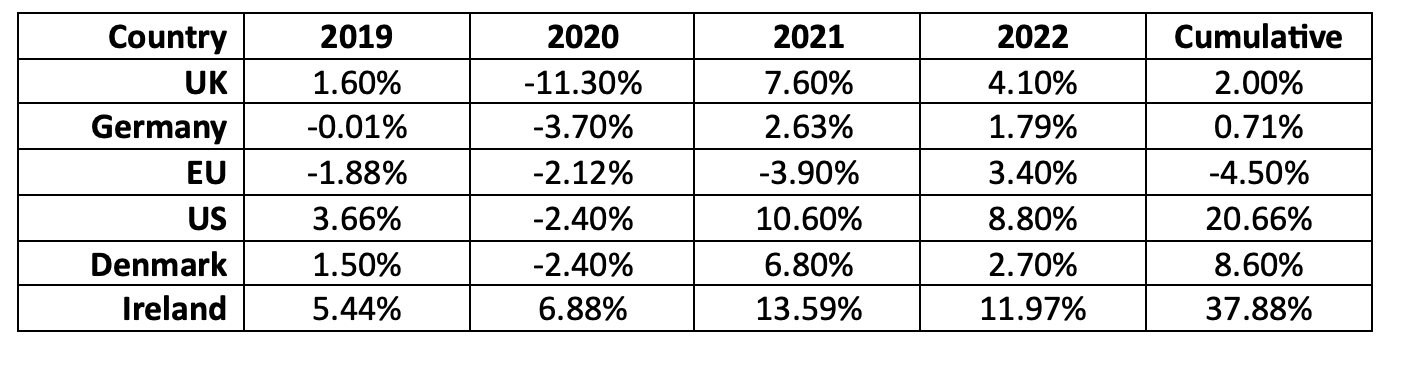
From the table, it is clear that Germany has suffered economic difficulties and is not representative of the relatively shallow plunge and recovery achieved by others, A similar market economy like the US has achieved ten times the UK’s growth, as compared to pre-pandemic and Ireland managed to prosper throughout.
The German economy has indeed been adversely affected by a number of factors. The war in Ukraine found them particularly vulnerable to energy prices and the shut-off from Russian gas. Slowdown in Chinese demand has hit their strong manufacturing base hard. Berlin is already grappling with a budget crisis after Germany’s top court ruled that the government broke the law by using Covid cash to fund net zero spending.
Indeed, figures given in the article seem to gloss over the weak position in which the UK economy finds itself, and from which the 0.2% differential in estimated growth vs Germany will be made, Looking at GDPs in the context of the global GDP “League Table” puts a very different complexion on this, as examining the same half-dozen countries sows in Table 2.
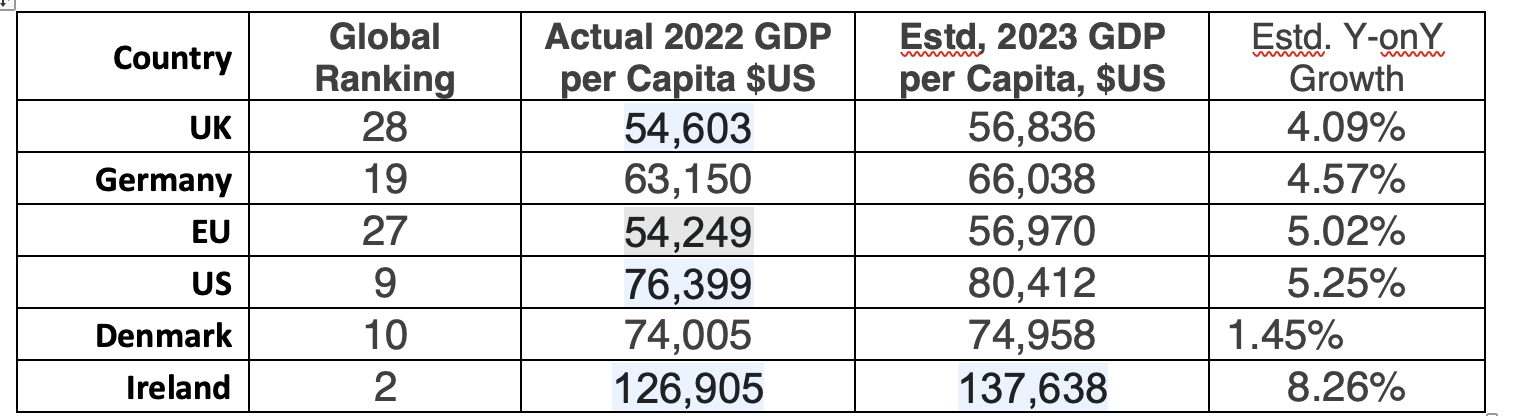
This tells a very different story. GDP growth rate comparisons over the short term between the UK and Germany are indeed close—within a fraction of a percent. But the bigger picture is alarming for the UK. Even if a 0.2% growth in the UK’s favour did apply, Germany’s GDP is already 15.7% ahead of the UK’s. At a 0.2% rate, it would take the UK until next century to catch up.
More interesting are the other figures on the tables above. Four years on from Brexit, the benefits of our market economy “punching above our weight” have yet to show up—in contrast to the US, whose citizens are already 40% better-off than Brits, and growing wealth at ten times the rate.
But the real zinger are Denmark and Ireland, two EU members that rather offset Germany. Both the size of Scotland, they offer their citizens a prosperous quality of life not far from Britain—but strangely never mentioned by government, BBC or other media as offering models for the future.
London-based economists at various banks have their own reasons for cheerleading Britain’s economy. Politicians wedded to the overstretch of Brexit, nuke subs and aircraft carriers as placebos for vanished glories suffer similar motivation. But whether media “Pax Britannia” shills like the Telegraph article are genuine journalism, or tired propaganda can clearly be answered by the numbers above.
#1088—983 words
p.s. Jan. 4th; The Telegraph is nothing if not bullish in boosting Britain. Today, they print another article essentially rubbishing the economic prospects of our nearest neighbours and lauding the prospects for the UK. The figures they cite are correct, but misleading. German and French inflation at 3.7%is still better than the UK’s 3.9% and a bank rate of 4% looks far more favourable for growth than the UK’s 5.25%. As with the above, it’s the selective analysis that makes this reek of political propaganda.


