The Entropy of England—IV

The Centre Cannot Hold

A haughty British indifference to the world outside the Empire applied as much to Lancashire mill workers as to victims of the Irish potato famine in Connemara. As long as mastery of global wealth and of a rigid social hierarchy applied, Britain could continue to be run by the same, small, English elite through their aura of permanent, unruffled sang froid.  The institutions that underpinned this—the Etons & Harrows; Oxbridge Bullingdon-esque and St James gentlemen’s clubs; the shooting estates—continue to the present day. One needed neither masonic handshake, nor membership for identification by fellow nomenklatura: your accent and your attitude were passport enough.

Though still extant, effortless superiority suffered erosion from financial earthquakes of both world wars and voter emancipation giving political powers to workers. Stripped of an accepted social certainty, they found themselves forced to operate out of the tabloid reach of the public eye, to whom they appeared a shadow of their former selves—much like Great Britain itself.

Formerly reserved careers were whittled away—RAF pilots were swamped by massed bomber crews in WW2; cavalry regiments degraded by rude mechanicals; pin-stripe management by business school upstarts. Even the douce “Something in the City” patrons of the Waterloo & City line found themselves jostled by loud Loadsamoneys in bright braces after 1987’s “Big Bang”. Post-Thatcher society in the South (meaning south of the Cambridge and East of the Cotswolds) modernised, finding affluence and social flexibility still exploited by the few, but now in a less obvious, if no less important, way.

But outside the South, elsewhere in England was drifting. Devon and Cornwall were growing ever more resentful of depopulation by holiday home. Eastern village farm worker cottages filled with retirees and commuters. The once-industrial Midlands and North drifted through denial that their great cities had lost their purpose and drive.

What areas of England did share was a wistfulness at their triple loss: empire; industry; influence. Since the 1970s, Britain had been chided as “The Sick Man of Europe”. So, it is unsurprising what came from UKIP—that greatness could be had if we only repelled an invasion of foreigners and threw off shackles forged by the bureaucrats of Brussels. This cheap slogan is as old as politics: garner support by creating a foreign enemy you will deal with. This ploy scared the bejasus out of the Conservatives, whose base in the South was especially vulnerable to such positioning.

So the Tories saw no choice but to out-xenophobe the UKIP xenophobes. It mattered not that the rest of Britain did not share the panic. Not only did Brexit become the obvious counter to outflank UKIP before being outflanked, but the money salted away behind front companies in various tax havens were about to be revealed through EU legislation against such convenient anonymity. An added bonus of northern job losses stirring up resentment to “blame the foreigners” carried Brexit over the line. In turn, this led to the 2019 crumbling of the Red Wall, with Boris Johnson trying to look like  John Bull glaring defiantly out over the beetling cliffs of Dover.

It might have looked like unity, but not as we know it. Outside a mile radius from London’s Pall Mall and a few outliers in places like Farnham, Cheltenham and Great Walsingham, it would be hard to gather significant numbers of English people who agreed on what their country wanted to do upon leaving the EU, much less a clear future ambition for itself, or what role in the world. Purposeful Victorian clarity of Kipling’s “White Man’s Burden” it is not.

Though many couch it in terms of “Britain”, it is, in fact, an English dilemma.  What’s more regional cultures that make up England don’t share the same dilemma, ever since ever since the Nazis disintegrated and the Empire went the same way.  Though far from achieving the relaxed sense of identity found in Denmark or Norway, the Scots, Welsh and (aside from a dying anachronism called unionism in Ulster) the Irish are all growing comfortable in their own skins. None of them have much interest in this on-going elite-driven Southern English throwback delusion of global greatness. Nor are they likely to hang around to see what happens when realpolitik presents the truth to their benighted English cousins who share these pleasant, but (let’s face it) geographically marginal islands.

Until the elite stop thinking it self-evident that they are and the South stops encouraging them, the decline of the last century will continue, the Celts will adopt the more modest, socially cohesive Scandinavian model. Outlying English regions may get lucky and—for once—London will leave them to forge their own future.

—END—
Posted in Community, Politics | 2 Comments

The Entropy of England—III

The English in British Clothing

The Georgian cultural package was British, not English. The gentry, lairds and clan chiefs of “North Britain” were no longer dragooned by Cromwellian English populism, but invited to partake in a multilingual, classically branded culture which, being natural to nobody, could be adopted without loss of pride by anybody. This found a common outlet in the growing British Empire. An aggressive stance and scant respect towards the rest of the globe had been established by Drake, Hawkins and the other English privateers. This led to growing affluence from trade and a leading role in the industrial revolution that drive it. Once parliaments were conjoined and rebellions in the Celtic fringe faded into history, even the lowliest strata of society across the British Isles derived a pride in its global dominance and could improve their lot in burgeoning cities and factories or seek far-flung adventure in the colonies, navy or army.

This artificial construct of “Great Britain” served brilliantly—so long as nobody asked the common peoples. At the general election of 1885, they were given their say, and promptly voted along lines established for centuries:  Southern England as a douce Conservative tribal fortress; Northern England with the bolshier Celts. As long as there was a world out there to conquer and plunder, nobody worried whether John Bull suffered schizophrenia, as long as he brought home the bacon. Matelots from Portsmouth to Portsoy, squaddies from Sligo to Slough happily shouldered the white man’s burden and shared pride in a pink-painted globe.

This appeared to simplify politics for the modern age. From 1885 until 2015, it was dominated by a polarised conflict: the Party of Southern England (aka the Conservative Party, with an outlier in unionist Ulster) versus a ever-changing federation of Outer England and Celtic Britain (embodied variously in the Liberal Party, Parnell’s IPP, the Labour Party and the SNP).

By the 21st century, this Tweedledum and Tweedledee arrangement, while suiting  politicians and the media reporting on them, had long lost its way. Wile there was a case for social and cultural cohesion in the Celtic fringe because of their modest populations, the 50 million English were fragmenting on even more complex dimensions than in the Middle Ages.  On top of existing cultural distance between north and south or town and country evolved blue-collar vs. white-collar; new-money industrialists vs. old-money aristocrats; music hall vs. opera; artisan vs. artiste.

Though all this caused social strain, throughout the Victorian and Edwardian eras, the multilingual, classically branded culture mentioned above dominated society through a self-regenerating elite, based on public schools, Oxbridge and shrewd exploitation of the many financial opportunities available to that inner circle. They were none too precious about how their power was maintained over the less docile fringes of the home islands. In 1886, Randolph Churchill first played what he called “the Orange card,” happily countenancing violence in Ireland. Conservative leader Bonar Law all but openly succoured armed sedition in Ireland in 1913-14. Not to be outdone by him or his own father, Winston Churchill growled back at him in March 1914 that “there are worse things than bloodshed, even on an extended scale.”

To that elite, “England” wasn’t any real nation but a vision of Imperial HQ. Yet, after 1885, their power depended on the loyalty of southern English voters and a nationalism that they had to keep safely contained. Hence the deliberate confusion between the flags of “England” and of “the UK/Empire.” The English—above all, the southern English—had to understand themselves, implicitly, as the most-favoured nation.

(to be continued)

Posted in Community, Politics | Leave a comment

The Entropy of England—II

Is it English to Be Nationalist?

 “Welsh, Irish and Scots nationalisms could all be catered for, but English nationalism, however, cannot”.

—Winston Churchill, Westminster Gazette 1912

           For the last millennium, English nationalism appears to have suffered from a kind of political Heisenberg Uncertainty Principle—the more you try to establish its geographic scope, the less in defined its policies and attributes become. In England, post Norman Conquest—and apparently uniquely in Western Europe—the grand process of High Medieval nation-building was run by a colonial elite with an entirely different language from the peasantry they ruled. They were also distracted from connecting with them by the need to keep half an eye on their swollen French possessions of the Angevin Empire.

They needed foot soldiers for each stage of their colonial ambitions in both France and the archipelago, so they created an English nationalism in its earliest form to make the conquered natives feel like the most-favoured subject people, having been over-run by the very best. As an example, the anti-Welsh and anti-Scots vituperation that opens the official record of Edward I’s 1294 campaign against them:

“May Wales be cursed by God and Saint Simon! For it has always been full of treason. May Scotland be cursed by the mother of God!”

Not the broadest, not most inclusive foundation upon which to build a union. However, the French-speaking elite were kept busy plastering over cracks in England itself, until their own cultural unity began to fray. In deposing Richard II in 1399, Henry IV secured populist covering fire for this act by becoming the first king since Harold to accept the crown by taking the coronation oath in English.

But almost immediately, English unity was again in question. In 1405, the Percys, mighty in the North, and the Mortimers, who considered themselves Richard II’s rightful heirs, agreed the “Tripartite Indenture” with Owain Glyndwr. This proposed splitting England into northern and southern realms, with Cheshire, Shropshire and Herefordshire being incorporated into a revived Wales. Fifty years later, the Percy and Mortimer families were at it again as pivotal powers in the Wars of the Roses—in practice, another series of north/south fights. English histories decorously avoid referring to these serial fracas as “civil wars” to avoid the impression that England was as partial to internecine brutality as their continental counterparts.

This fratricidal slaughter only ended when a part-Welsh dynasty, the Tudors, took charge. They brought a cultural, if not dynastic, stability. For the next 400 years, anybody who was anyone in England was expected to master Greek, Latin and French. So the former Medieval French-speaking elite culture was thus replaced by a classically-educated elite culture.

Key powerbases of this new Tudor elite—the courtiers, parliament, Oxbridge, the Inns of Court, the Church of England—were all in the South. The real driver of the Reformation was a determination of state-builders to brook no regional or supra-national loyalties. National unity was forced by external threats, especially from Catholic Spain. But for all the unity at home and exploration abroad under Elizabeth just a year after her death, the pronouncement was made::

“wherefore We have thought good to discontinue the divided names of England and Scotland… and do intend and resolve to take and assume unto Us… the Name and Style of King of Great Brittaine.”

—King James I and VI

This is what one of his courtiers, perhaps channelling the much later Sir Humphrey, might have called “a courageous decision”.  James may have seen the union as one happy arrangement between equals, but the English were having none of it. Their Parliament would have nothing to do with “Great Brittaine”. Arrogant monarchs, religious schisms and puritan intransigence destabilised society that, by 1688 one faction could think of no way to avoid further civil war, except asking the Dutch to invade and loan them a king.

Having stared into the abyss, the elite of the early 18th century tried to abolish England and replace it with Great Britain. Though technically becoming the Parliament of the United Kingdom, it was in all aspects continuation of the English Parliament, with only 45 of 558 members coming from Scotland. This was the birth of our modern politics. For the next 85 years, this parliament fought to impose itself on a peripheral cultural patchwork of northern English, Scots, Gaels, Cornish, Welsh and Irish.

This did not go smoothly.

(to be continued)

Posted in Community, Politics | Leave a comment

The Entropy of England—I

Fragmentary Foundations

 “What do they know of England who only England know?” Rudyard Kipling

Brexit and its aftermath have brought a renewed focus on what it means to be British. Cabinet Ministers giving endless Covid briefings in front of union flags; devolved governments being reminded of Westminster largess; the stubborn refusal re entertain work permits for foreigners to ease staffing crises in haulage and hospitality. But, unlike Victoria’s jubilee or post-Dunkirk, it is not being embraced to the same extent or with as much enthusiasm.

Certainly, there are those who unreservedly apply the description to themselves, among them ex-servicemen, Ulster Unionists; Gibraltarians; Lanarkshire Orangemen; Scottish and Welsh mainly-Conservative unionists. But there, it starts to thin. It is now no longer news that the majority of people in the United Kingdom outside England no longer regard themselves as primarily British. The surprising development is: neither do the English.

It’s true that the English are happy to be described as “British on their passports and other official documents. They do not rankle at this the way many Scots now do. But deeper investigation reveals a preponderance of using “English” to describe their culture, interest, etc. Ever since the Scots 300 years ago and the Irish 200 years ago were folded into a union with the more populous England, there has been a casual conflation in that country of the terms “British” and “English” as, effectively, equivalent. Foreign powers, having dealt with the more dominant England, seldom adjusted to the new arrangement and the terms “Angleterre”, “Inglaterra”, etc. continued in common use.

While the Empire was mighty and the Scots, Irish and Welsh happy to shelter un der and exploit that might, nothing worse than the occasional ruffling of provincial feathers occurred. Joining the EU hot on the heels of the dismantling of that empire gave smaller members of the UK union the sense that a newer, wider family of nations was showing them horizons beyond those dominated by England.

It was at this point that the construct that was England started to fragment. The clearly dominant element of the UK that interposed “English” and “British” as it pleased, found itself not even primus inter pares but just one of four big economies, often outvoted by a swarm of small economies. Understandably, this did not sit well with the pride of a “top dog” nation, even if its bark and bite had both become muted.

The English are not used to thinking of themselves as fragmented and troublesome. Such things were repressed while the minor nations of the UK were supine and holding sway over a quarter of humanity boosted the collective ego. But even partial subservience to the EU brought this to the fore.

(to be continued)

Posted in Community, Politics | 1 Comment

Can You Canute?

(Note: this is the column I would like to have written for my local paper, The East Lothian Courier, but was constrained to half the words and neither of the maps)

The new agreement between the SNP and Greens to govern Scotland in a loose coalition comes none too early for our environment. Both parties have displayed good environmental credentials. This makes the goal of carbon-neutrality by 2045 all the more plausible. However, even if this goal is reached, there is no guarantee that other, far more prolific greenhouse gas emitters will follow suit.

Look at any Admiralty chart or decent shoreline map and you find a line wriggling between land and sea marked “MHWS”. Those living along the coast know the tides don’t just come in and go out twice a day, but the amount varies between “Neap” (small) and “Spring” (large) tides. Along East Lothian’s coast, tides vary between a 2m and 6m difference between extremes. HWMS (High Water Mean Springs) shows how high up the beach the sea gets at high tide. Its position is changing—for the worse.

The problem of global warming is likely to continue and worsen. The 1.5 – 2.0 degree C temperature rise will almost inevitably lead to sea level rising over the next few decades. Research by Climate Central, made up of leading scientists and journalists who research climate change and its impact on the public, have predicted some serious coastal flooding in Scotland by 2050.

As the planet warms, seas expand, glaciers and (especially) massive, thick ice sheets high out of the water on Greenland and Antarctica melt, adding volume to raise sea level. It took the 19th and 20th centuries to add 20 cm to sea level. It took the last 20 years to add another 5 cm. The next three decades are expected to add 10 cm, 20 cm and 30 cm, respectively as warming accelerates. The total of less than 1m may not sound much, but other factors are involved.

NASA’s Sea Level Change Science Team at the University of Hawaii have highlighted a factor liable to make things worse before 2040. The Moon, which causes tides, has an 18.6-year cycle during which it “wobbles” This suppresses the height of high tides for half that cycle (which we are now entering) and amplifies them for the other. The next amplification, reaching perhaps an additional 10 cm, will be during the 2030s.

Timing is uncertain because several factors need to combine to boost unusually high tides so that they cause major flooding and damage. And “damage” need not mean going permanently under water. Fields, installations properties do not need to be flooded more than a few times for them to become useless and abandoned. Haughs and links will become salt marsh or mud flats; beach front properties will become derelict or protected by dykes that block views of the sea.

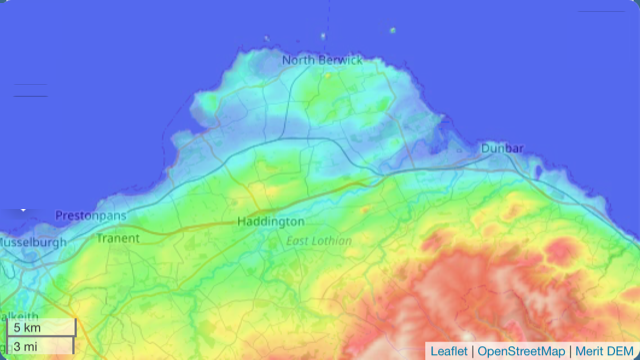
Relef Map of East Lothian

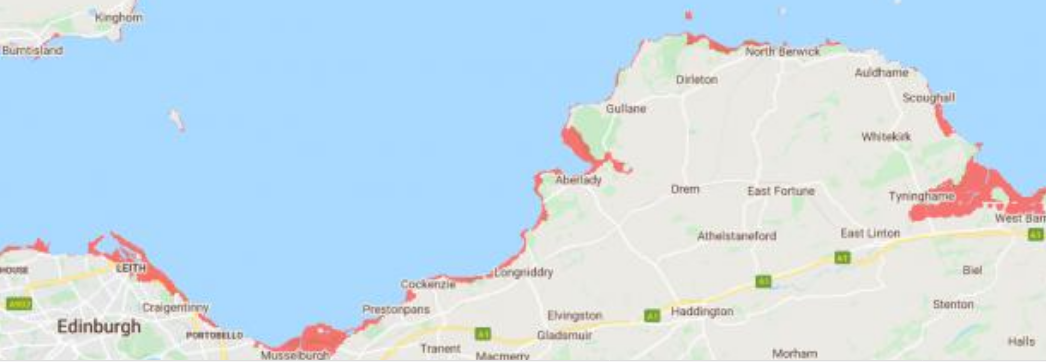
In the local area of East Lothian’s coast, very little will be permanent inundated. Even with a storm surge adding to unusually high spring tides, that extra metre will not reach places like Port Seton, Gullane, most of Dunbar or Prestonpans because they all sit at a slight elevation. But there are some vulnerable points.

It is clear from the map that Aberlady and Belhaven Bays will see the largest are permanently lost to the sea. This will mostly be farmland at Saltcoats, Luffness, Hedderwickhill, Tynemount, Kirklandhill and Knowes. What this does not make clear is that two key pieces of vital infrastructure—Torness power station and North Berwick sewage works will need special defences if they are not to be flooded and abandoned, probably well before 2050.

Coastal Areas of East Lothian Liable to Flooding by 2050

Low-lying parts of coastal towns like North Berwick’s Low Quay, Aberlady’s Gullane Road, Tyninghame’s South Row or the Belhaven and West Barns Inn areas will be threatened with no easy solution for defence. Worst hit will be the Fisherrow and Goose Green areas of Musselburgh on either bank of the Esk as it enters the Forth. Proportionally, recreation will ne hardest hit , with Musselburgh Ash Lagoons, Racetrack and Old Golf Course, East Links Country Park, Foxlake, plus links golf courses at Luffness, North Berwick West. There seems no obvious affordable way to defend any of these.

Of you think this is bad at one metre, the future could be much worse. There is enough ice piled on Greenland and Antarctica to add more than another 50 metres. Flooding at that level would leave Berwick Law an island and Tranent, the only town left in East Lothian, would be coastal.

Should sea levels continue to rise, Musselburgh—the largest town in East Lothian and the one already hardest hit—will lose a great swathe from Levenhall though the Wimpeys, the town centre and the rest of Fisherrow, causing massive property loss. Funds on a scale to prevent this may not be available, as elsewhere—Clydeside, Grangemouth, Leith, Ardrossan, Stirling, Inverness and others—will al be threatened even more. London, New York, Amsterdam, Singapore, Venice, etc. all face the same problem.

If that isn’t incentive enough to take global warming seriously and hope the SNP & Greens can get their (and, subsequently, our) act together, then what would be?

Posted in Community, Environment | 1 Comment

The Two Trillion Dollar Tragedy III

On the Laws of Engineering

A mere four days after the first part of this article was published, the tally of Afghan provincial capitals taken by the Taliban has tripled to nine—a full quarter of the total—and some 65% of the country admitted to be in their hands. Press releases about “special forces” and “B-52 strikes” and “dozens of Taliban dead” may all be true. But they are ineffectual. This is an end game, with only weeks to run.

The prime reason for this is relatively simple to grasp. There is a cod ‘First Law of Engineering’, much used by bodgers, rather than craftsmen: “When in doubt, use a bigger hammer”. Unfortunately, this also appears to have been the principle applied since WW2 to most overseas interventions by Western democracies—especially the USA. This is the nub of the second point made at the end of the first part: a belief that “shock and awe”, liberally applied, is the answer to perceived threats to Western democracy.

Ever since the Axis were overwhelmed by massive conventional armies deploying boundless materiel, massive military force has been applied to solve even diplomatic problems. Post-WW2 Western democracies, other than the USA, realise this was an expensive game they could no longer play. After the French lost Indochina in 1953 and the British were humiliated at Suez three years later, only the USA had both financial and military muscle to continue this tack.

In Korea, the weight of US materiel both drove back the North Korean invaders and managed to halt the Chinese PLA when  they crossed the Yalu River. The fact that the US 2nd Division came close of being wiped out was lost in the cease-fire.

As a result, escalation in Vietnam barely a decade later was predicated on over 500,000 troops, backed by profligate expenditure of munitions and copious use of air power. Applied with little subtlety and even less analysis of effectiveness, almost pure military engagement by troops with scant understanding of the people, their culture, or their language, triggered a resentment that spawned Mao’s “sea through which the guerrilla fish could swim”. The Americans repeated the same mistakes that had made Indochina untenable to the French two decades earlier, but with more firepower.

Whether it stemmed from hubris, or macho culture or the sales skills of Eisenhower’s “military-industrial complex”, both the Pentagon and successive administrations bought into engineering’s First Law. The one-dimensional aspect of raw military power applied to a different culture was lost on them. Minor successes against trivial opposition in Grenada and Panama reinforced the “night is right” school, such that setbacks in Lebanon and Somalia were discounted. Deployment of massive force in both Gulf Wars served to further reinforce the belief that cruise missiles, stealth bombers, advanced electronics etc., justified the bottomless budget required. They were the tools to solve international problems.

At first, this even seemed to work in Afghanistan. But once awesome forces, with their awesome equipment were sitting isolated on bases with PXs, ESPN on TV and regular rotation home, it became Vietnam-in-the-desert. An alien occupation force in the midst of a resentful population provides no long-term solution. The use of local interpreters and the training of local forces was undercut by imposing Western values seen as alien: emancipating and educating women; pouring in aid administered by contractors. Afghan women who embraced opportunities offered were outnumbered by men and women holding traditional beliefs. Billions of dollars in aid boosted corruption, as well as contractor profits. Imagine if Salt Lake City were taken over by muslims who built a Grand Mosque, encourages all to attend and converted all schools to Madrassas so the next generation would..

Like the Austro-Hungarian Empire in the Balkans, or the Soviets in Eastern Europe, military force won’t hold if the population resists. Even in Iraq, after one of the most swift and decisive military victories the world has seen, the low-level chaos there now derives from having removed the dictatorial glue that held that fractious country together. The West has provided nothing credible to replace it.

Two decades of costly Western effort in Afghanistan has achieved only a regime that is corrupt, ineffectual and likely to be short-lived. As the Americans pull their last forces out, the chance Ahmandzai will last any longer than Diem did in Saigon at the equivalent point seem slim.

(For a military view on this from the Royal United Services Institute, see🙂

https://rusi.org/explore-our-research/publications/commentary/why-did-afghan-army-evaporate

Posted in Community, Military, Politics | Leave a comment

The Two Trillion Dollar Tragedy II

On The Conquest of Quagmires

Two days on, and three more provincial capitals in Afghanistan have fallen to the Taliban. None of these is from  the strategic trio of Herat, Khandahar or Jalalabad in the news over the weekend, Instead, they have overrun the key northern city of Kunduz, as well as Sar-e-Pul and Taloqan.

What al this means is that those of us enjoying the benefits of Western democracy—and especially those in the USA—must get it through our heads that not everyone else can, or even wants to be, like us. Such ‘rebels’ are not persuaded by the attentions of AC-130H Spectre gunships. Learn this and the future for the highly diverse cultures across our planet becomes rosier.

Let’s discuss this Regional Quagmire issue first as vackground to this.

Mao Zedong said some crazy things, but one of his more profound utterances was “The guerrilla must move amongst the people as a fish swims in the sea”. There are few occupying forces that survive the hostility of the indigenous population for long. Where locals are few (e.g. Australian aborigines) or unused to hardship (e.g. post-Roman Britain) or culturally fragmented (e.g. colonial India), the period of dominance can be long. But where the natives are used to hardship, the terrain makes hiding easy and communication difficult, the problem becomes insuperable. Consider the pre-Culloden Highlands, or Soviet partisans in WW2, or the Viet Minh in French Indochina. Afghanistan may be one of the most virulent examples of this type. The locals were hardy warriors before the British Empire existed. Lord Elphinston’s disastrous expedition from India in 1842 was only the first of a series of setbacks suffered by the British whenever they ventured beyond the Khyber Pass.

Approaching from the North, the Russians fared no better, despite powerful forces equipped with armour, gunships and air strikes. After ten bloody years, their withdrawal in the face of fierce Mujahadeen resistance in 1989 was humiliating. There can be few countries in the world that combine as mountainous and inhospitable terrain with a resilient people, inured to hardship by long tradition of fighting and surviving by their own wits than Afghanistan. There is ample evidence that there may not be a harder for any outside force to crack.

(to be continued)

Posted in Community, Military, Politics | Leave a comment

The Two Trillion Dollar Tragedy I

On Lessons from Afvietmaliastan

Readers un search of an upbeat and inspirational read are advised not to read on. These few hundred words are an attempt to place the slow car crash that is Afghanistan in context. If you are a believer in western democracy, you are not likely to find any of it uplifting.

Yesterday (Friday Aug 6th) Zaranj, the first provincial capital fell to the Taliban. Today (Saturday Aug 7th) Sheberghan, capital of Jawzjan province, also fell. Neither is any of the more strategic trio of Herat, Khandahar or Jalalabad that news media had been reporting as under threat. With control of mot of the countryside and four of the six main border crossings, the situation has all of the attributes of dominoes falling.

The Afghan government is deploying “security forces” to counter this, but success has been lacking, not least because some units are fearful of what might happen to them in the event of a Taliban victory and fragile allegiance to a government widely seen as both corrupt and factional. Experienced observers in Kabul do not see this drift to disaster being deflected.

After 20 years, thousands of deaths and over $2 trillion expenditure, how can this all be coming apart at the seams so quickly? The short-tem answer is that the Americans, who had been propping up Afghan forces with air power are pulling out and will be gone by next month. The British, who withdrew from active engagement in 2014, are also pulling out advisers and recommending any British civilians to leave. It resembles nothing so much as South Vietnam half a century ago when the withdrawal of American firepower left the ARVN unable to cope with the NVA-backed Viet Cong  and the regime collapsed, leading to the unification of Vietnam.

In theory, President Biden, who inherited this mess, could have reversed Trump’s decision to leave. But, after Bush’s revenge invasion to go after the perpetrators of 9/11 in 2001, through Obama’s ‘surge’ when troops and equipment were poured in to resolve a stalemate, military experts both inside the Pentagon and elsewhere have declared the war to be ‘unwinnable’.

The truly sad thing about all this is that they should have known that two decades ago and not wasted pots of money and thousands of mostly Afghan lives to find out. The two glaring factors that should have been evident to any adviser in reaching those fundamental facts are:

  1. Places like Afghanistan are quagmires for external powers
  2. Military intervention alone never brings stability in the long term

Both facts require explanation. But the combination of the two, as happened in Afghanistan, is a poisoned chalice, a hiding to nothing, a recipe for disaster with knobs on.

(to be continued)

Posted in Community, Military, Politics | 1 Comment

The Other Sceptr’d Isle V

The Future? (Part 5 of 5)

t takes a brass neck and a boatload of optimism to predict what might occur in Ulster over the next decade. But one thing is clear: to continue the peace process and a prosperous future for the people of Ulster, sliding back into any of the historic phases outlined above would not achieve that. Republican resentment and Unionist siege mentality need to be dismantled to the point that a person’s religion or adherence to one of the many belligerent  organisations that have for too long populated and dominated Ulster become irrelevant. This won’t be easy.

A good start has been made by the Alliance party, which eschews traditional divisions and has proved this capable of electing councillors, MLAs and MPs. It is clear that unionists, having seen their economic edge erode need reassurance tat the inevitable loss of their political edge will not presage disaster. Though the present British government scarcely exhibits the interest or ability to play a decisive role, the Irish government, having moved from a sulkily intransigent position a century ago is well motivated to ensure prosperity and peace across all of Ireland and that the million unionists in Ulster must feel part of that.

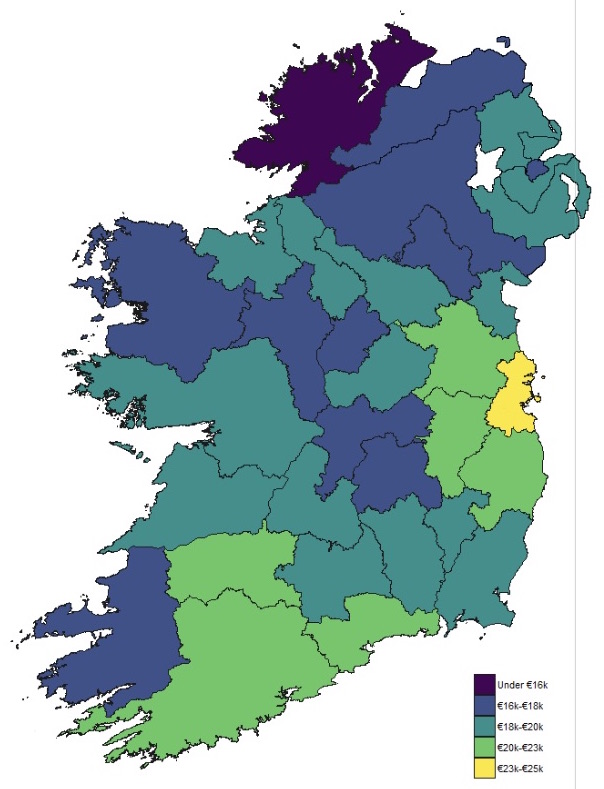
The factor most likely to engender a different approach is the change economic reality. Whereas a century ago, Protestant Ulster was a successful industrial component of the British Empire and Eire a comparative rural backwater, things have changed radically. In 2020, the per capita GDP in Ireland had grown to $78,600, almost 2 ½ times Ulster’s at $29,300, despite a $12.4 billion annual subsidy from a UK Treasury that would dearly like to have such fund available to stem some of there record borrowing. A reconciliation between North and South would also open Ulster up again to EU regional development funding. Just as economics once lay behind the division of Ireland, it may lie behind its reconciliation.

GDP per Capita in Ireland by County

Unionists make much of their “Britishness” through symbols like the Union Jack. But, just as the rest of Britain wrestles with the unanswered question of what it means to be British. Is it just a geographic term for the larger island? Is there a future for it as a political term if Scotland leaves the union? What would be left for “loyalists” to be loyal to? Given all that, together with much-weakened influence of the Catholic church and the much stronger, more enlightened positions taken by the Republic, what reasons are there left for unionists to feel threatened?

Sometime in the next decade, Catholic voters in Ulster will outnumber Protestant and guaranteed power will evaporate. With the Alliance sweeping up moderate opinion, more enlightened unionists will make their peace with reality.

And then, all the Irish will have a chance to do what even those stuffy empire-loving colonial British governments of a century ago are on record as having preferred as their option: let the people of Ireland come together to plan their own future. With Protestants able to over-contribute as they always have done, but without the fear that anyone will take it away from them.

  1. The Problem
  2. The History
  3. The Hiatus
  4. The Crunch
  5. The Future?
Posted in Uncategorized | 4 Comments

The Other Sceptr’d Isle IV

The Crunch (Part 4 of 5)

It takes a brass neck and a boatload of optimism to predict what might occur in Ulster over the next decade. But one thing is clear: to continue the peace process and a prosperous future for the people of Ulster, sliding back into any of the historic phases outlined above would not achieve that. Republican resentment and Unionist siege mentality need to be dismantled to the point that a person’s religion or adherence to one of the many belligerent  organisations that have for too long populated and dominated Ulster become irrelevant. This won’t be easy.

A good start has been made by the Alliance party, which eschews traditional divisions and has proved this capable of electing councillors, MLAs and MPs. It is clear that unionists, having seen their economic edge erode need reassurance tat the inevitable loss of their political edge will not presage disaster. Though the present British government scarcely exhibits the interest or ability to play a decisive role, the Irish government, having moved from a sulkily intransigent position a century ago is well motivated to ensure prosperity and peace across all of Ireland and that the million unionists in Ulster must feel part of that.

Unionists make much of their “Britishness” through symbols like the Union Jack. But, just as the rest of Britain wrestles with the unanswered question of what it means to be British. Is it just a geographic term for the larger island? Is there a future for it as a political term if Scotland leaves the union? What would be left for “loyalists” to be loyal to? Given all that, together with much-weakened influence of the Catholic church and the much stronger, more enlightened positions taken by the Republic, what reasons are there left for unionists to feel threatened?

Sometime in the next decade, Catholic voters in Ulster will outnumber Protestant and guaranteed power will evaporate. With the Alliance sweeping up moderate opinion, more enlightened unionists will make their peace with reality. And then, all the Irish will have a chance to do what even those stuffy empire-loving colonial British governments of a century ago are on record as having preferred as their preferred option: let the people of Ireland come together to plan their own future, with Protestants able to over-contribute as they always have done, but without the fear that.

  1. The Problem
  2. The History
  3. The Hiatus
  4. The Crunch
  5. The Future?
Posted in Community, Politics | 4 Comments