Two days on, and three more provincial capitals in Afghanistan have fallen to the Taliban. None of these is from the strategic trio of Herat, Khandahar or Jalalabad in the news over the weekend, Instead, they have overrun the key northern city of Kunduz, as well as Sar-e-Pul and Taloqan.
What al this means is that those of us enjoying the benefits of Western democracy—and especially those in the USA—must get it through our heads that not everyone else can, or even wants to be, like us. Such ‘rebels’ are not persuaded by the attentions of AC-130H Spectre gunships. Learn this and the future for the highly diverse cultures across our planet becomes rosier.
Let’s discuss this Regional Quagmire issue first as vackground to this.
Mao Zedong said some crazy things, but one of his more profound utterances was “The guerrilla must move amongst the people as a fish swims in the sea”. There are few occupying forces that survive the hostility of the indigenous population for long. Where locals are few (e.g. Australian aborigines) or unused to hardship (e.g. post-Roman Britain) or culturally fragmented (e.g. colonial India), the period of dominance can be long. But where the natives are used to hardship, the terrain makes hiding easy and communication difficult, the problem becomes insuperable. Consider the pre-Culloden Highlands, or Soviet partisans in WW2, or the Viet Minh in French Indochina. Afghanistan may be one of the most virulent examples of this type. The locals were hardy warriors before the British Empire existed. Lord Elphinston’s disastrous expedition from India in 1842 was only the first of a series of setbacks suffered by the British whenever they ventured beyond the Khyber Pass.
Approaching from the North, the Russians fared no better, despite powerful forces equipped with armour, gunships and air strikes. After ten bloody years, their withdrawal in the face of fierce Mujahadeen resistance in 1989 was humiliating. There can be few countries in the world that combine as mountainous and inhospitable terrain with a resilient people, inured to hardship by long tradition of fighting and surviving by their own wits than Afghanistan. There is ample evidence that there may not be a harder for any outside force to crack.
Readers un search of an upbeat and inspirational read are advised not to read on. These few hundred words are an attempt to place the slow car crash that is Afghanistan in context. If you are a believer in western democracy, you are not likely to find any of it uplifting.
Yesterday (Friday Aug 6th) Zaranj, the first provincial capital fell to the Taliban. Today (Saturday Aug 7th) Sheberghan, capital of Jawzjan province, also fell. Neither is any of the more strategic trio of Herat, Khandahar or Jalalabad that news media had been reporting as under threat. With control of mot of the countryside and four of the six main border crossings, the situation has all of the attributes of dominoes falling.
The Afghan government is deploying “security forces” to counter this, but success has been lacking, not least because some units are fearful of what might happen to them in the event of a Taliban victory and fragile allegiance to a government widely seen as both corrupt and factional. Experienced observers in Kabul do not see this drift to disaster being deflected.
After 20 years, thousands of deaths and over $2 trillion expenditure, how can this all be coming apart at the seams so quickly? The short-tem answer is that the Americans, who had been propping up Afghan forces with air power are pulling out and will be gone by next month. The British, who withdrew from active engagement in 2014, are also pulling out advisers and recommending any British civilians to leave. It resembles nothing so much as South Vietnam half a century ago when the withdrawal of American firepower left the ARVN unable to cope with the NVA-backed Viet Cong and the regime collapsed, leading to the unification of Vietnam.
In theory, President Biden, who inherited this mess, could have reversed Trump’s decision to leave. But, after Bush’s revenge invasion to go after the perpetrators of 9/11 in 2001, through Obama’s ‘surge’ when troops and equipment were poured in to resolve a stalemate, military experts both inside the Pentagon and elsewhere have declared the war to be ‘unwinnable’.
The truly sad thing about all this is that they should have known that two decades ago and not wasted pots of money and thousands of mostly Afghan lives to find out. The two glaring factors that should have been evident to any adviser in reaching those fundamental facts are:
Places like Afghanistan are quagmires for external powers
Military intervention alone never brings stability in the long term
Both facts require explanation. But the combination of the two, as happened in Afghanistan, is a poisoned chalice, a hiding to nothing, a recipe for disaster with knobs on.
t takes a brass neck and a boatload of optimism to predict what might occur in Ulster over the next decade. But one thing is clear: to continue the peace process and a prosperous future for the people of Ulster, sliding back into any of the historic phases outlined above would not achieve that. Republican resentment and Unionist siege mentality need to be dismantled to the point that a person’s religion or adherence to one of the many belligerent organisations that have for too long populated and dominated Ulster become irrelevant. This won’t be easy.
A good start has been made by the Alliance party, which eschews traditional divisions and has proved this capable of electing councillors, MLAs and MPs. It is clear that unionists, having seen their economic edge erode need reassurance tat the inevitable loss of their political edge will not presage disaster. Though the present British government scarcely exhibits the interest or ability to play a decisive role, the Irish government, having moved from a sulkily intransigent position a century ago is well motivated to ensure prosperity and peace across all of Ireland and that the million unionists in Ulster must feel part of that.
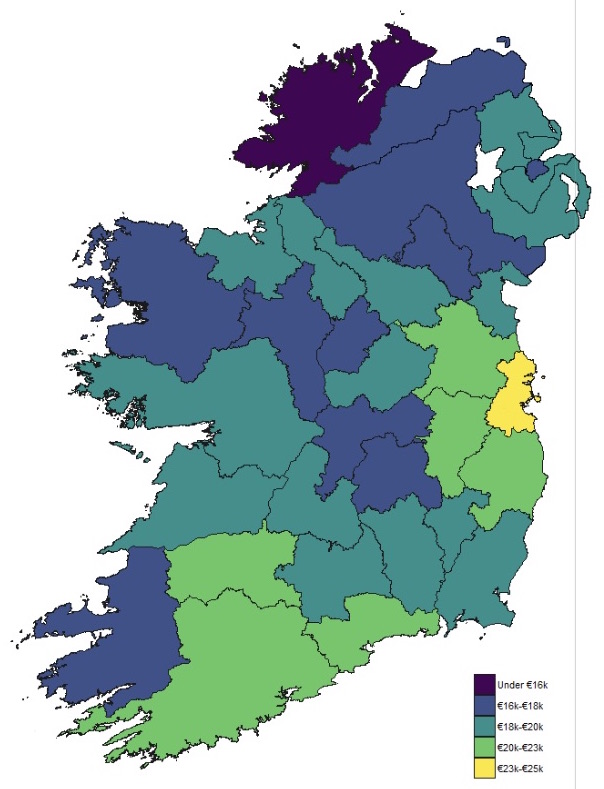
The factor most likely to engender a different approach is the change economic reality. Whereas a century ago, Protestant Ulster was a successful industrial component of the British Empire and Eire a comparative rural backwater, things have changed radically. In 2020, the per capita GDP in Ireland had grown to $78,600, almost 2 ½ times Ulster’s at $29,300, despite a $12.4 billion annual subsidy from a UK Treasury that would dearly like to have such fund available to stem some of there record borrowing. A reconciliation between North and South would also open Ulster up again to EU regional development funding. Just as economics once lay behind the division of Ireland, it may lie behind its reconciliation.
GDP per Capita in Ireland by County
Unionists make much of their “Britishness” through symbols like the Union Jack. But, just as the rest of Britain wrestles with the unanswered question of what it means to be British. Is it just a geographic term for the larger island? Is there a future for it as a political term if Scotland leaves the union? What would be left for “loyalists” to be loyal to? Given all that, together with much-weakened influence of the Catholic church and the much stronger, more enlightened positions taken by the Republic, what reasons are there left for unionists to feel threatened?
Sometime in the next decade, Catholic voters in Ulster will outnumber Protestant and guaranteed power will evaporate. With the Alliance sweeping up moderate opinion, more enlightened unionists will make their peace with reality.
And then, all the Irish will have a chance to do what even those stuffy empire-loving colonial British governments of a century ago are on record as having preferred as their option: let the people of Ireland come together to plan their own future. With Protestants able to over-contribute as they always have done, but without the fear that anyone will take it away from them.
It takes a brass neck and a boatload of optimism to predict what might occur in Ulster over the next decade. But one thing is clear: to continue the peace process and a prosperous future for the people of Ulster, sliding back into any of the historic phases outlined above would not achieve that. Republican resentment and Unionist siege mentality need to be dismantled to the point that a person’s religion or adherence to one of the many belligerent organisations that have for too long populated and dominated Ulster become irrelevant. This won’t be easy.
A good start has been made by the Alliance party, which eschews traditional divisions and has proved this capable of electing councillors, MLAs and MPs. It is clear that unionists, having seen their economic edge erode need reassurance tat the inevitable loss of their political edge will not presage disaster. Though the present British government scarcely exhibits the interest or ability to play a decisive role, the Irish government, having moved from a sulkily intransigent position a century ago is well motivated to ensure prosperity and peace across all of Ireland and that the million unionists in Ulster must feel part of that.
Unionists make much of their “Britishness” through symbols like the Union Jack. But, just as the rest of Britain wrestles with the unanswered question of what it means to be British. Is it just a geographic term for the larger island? Is there a future for it as a political term if Scotland leaves the union? What would be left for “loyalists” to be loyal to? Given all that, together with much-weakened influence of the Catholic church and the much stronger, more enlightened positions taken by the Republic, what reasons are there left for unionists to feel threatened?
Sometime in the next decade, Catholic voters in Ulster will outnumber Protestant and guaranteed power will evaporate. With the Alliance sweeping up moderate opinion, more enlightened unionists will make their peace with reality. And then, all the Irish will have a chance to do what even those stuffy empire-loving colonial British governments of a century ago are on record as having preferred as their preferred option: let the people of Ireland come together to plan their own future, with Protestants able to over-contribute as they always have done, but without the fear that.
The North established their own parliament at Stormont in June 1921 and any sense of this arrangement being temporary quickly faded. Over a million Protestants ruled over 400,000 Catholics, as they had intended. Thanks to a long industrial development of Belfast and the Laggan Valley, they were blessed with a balanced budget. As well as in Stormont, Protestants dominated the best jobs in the civil service, the professionals and industry, with active and open discrimination against Catholics. Many left, some to Britain and the USA; most to Eire.
Meantime, unrest continued—not in the North, but in Eire, where nationalist factions had fallen out over policies even before independence happened. There was effectively a civil war that did not die down until the summer of 1922. Left with mostly an agrarian economy, Eire did not prosper and balancing budgets, let aloe growing the economy, was difficult. Those in power resented both Britain and the more prosperous North. Those Protestants in the 26 counties tended to remain, as many had professional jobs or secure employment, so their exodus was much smaller than that on the North. However, little sympathy with the difficulties of those Republicans left in the North was weak, as was any aid provided to them. Understandably, they felt abandoned. In asserting its sense of identity Eire gave prominence to both the Catholic Church ad the Irish language. Though the latter made little headway outside its heartlands, the church dominated Irish life and gave further misgivings in the North about any sense f common culture or identity.
Goods from the more developed North flooded into the South triggering a tariff war, which further undermined relations and made control of the border an urgent issue to regulate trade. This led to smuggling of everything from cattle to cigarettes, further undermining the still-struggling Irish economy. Matters were not helped when Eire stayed neutral during the Second World War, despite Churchill pressuring for use of former naval bases at Cork and Queenstown. As a precaution, conscription was never introduced in Ulster and the 36th Division based there never left the province.
Post-war relations continued poor as Eire chose to leave the Commonwealth and become the Republic of Ireland in 1948, without consulting the British. And with the post-war decline of industrial Britain social pressures in places like Clydeside or Liverpool fractured the already divided society in Ulster even further. As Catholics became restless at their financial and social repression, Protestant reaction to contain this added fuel to what became the conflagration of The Troubles. The two communities went to war with each other and the British Army, sent in the pacify things, merely became a third and alien faction, a target for both sides, neither trained, nor equipped to deal with what was a guerrilla war. Atrocities were commonplace and neither side came out of it looking good. When it flickered out in the seventies, nothing much had been resolved.
Protestant settlers, frightened for their lives, celebrated this relief, which settled them in a dominant position, much as early colonists elsewhere ruled over conquered natives. After a century of sullen unrest, another rebellion in 1798 was quelled but fear of invasion by Napoleon by the ‘back door’ led to Ireland being fully incorporated as part of the Union in 1801. A hundred MPs were sent to Westminster and the cross of St Patrick added to the Union Jack flag.
A period of relative peace followed, with the West and South being run in an almost feudal fashion by large landowners, Dublin and its surrounds becoming ever more Anglicised and Ulster sullen in resentment at its Protestant overlords. This general peace frayed during the potato famine of 1845-49, when blight ruined the harvest such that a million died and a further million emigrated. This spread great resentment towards landowners and the apparently indifferent Peel government in London. Neither thought famine relief appropriate, as it would “weaken people’s resolve to look after themselves.”
Increasing prosperity in Ulster from Victorian industrialisation increased the grip of Protestant unionists on power there. The rest of Ireland remained rural and mostly poor. Increasingly resentful of their lot, electoral reform broadened suffrage and led to the swift rise of Parnell’s Irish Parliamentary Party (IPP) which soon held the balance of power at Westminster and pressured Prime Minister Gladstone into a Home Rule Bill in 1885 and again in 1893. Tory opposition, especially in the Lords, defeated both and led to the “Unionist” part of the Conservative and Unionist Party’s name in 1912.
Such development alarmed unionists in Ulster, catalysing the Ulster Unionist Party in 1905. The heated debates around a third Home Rule Bill in 1912 formed the Ulster Volunteers, the first paramilitary organisation. Asquith’s government, having succeeded in removing the Lords’ veto, but this Bill also failed, at the outbreak of the Great War.
Over 200,000 Irish of all faiths fought for the British; over 40,000 never seeing Ireland again. But enmity between the poorer Catholic majority and an increasingly nervous Protestant minority broke into the futile Easter Rising of 1916. This was put down so harshly by the British, it drove ever more Irish to resent what was increasingly seen as colonial misrule.
At the end of the Great War, this resentment break out in open hostility. To deal with this, the Royal Irish Constabulary were reinforced by a poorly trained British force nicknamed “Black and Tans”, whose methods sere crude and whose brutality drove resentment ever higher.
This constant unrest was an embarrassment to Britain and its Empire. At the zenith of its power to be unable to control some poor provinces of the home country was intolerable to the British government, now under Lloyd George who referred to Ireland “this little green cabbage patch”. The traditional template for dealing with colonies of “making the world England” having palpably failed in Ireland, he was keen to find an exit strategy that would save face. However, few of the ministers and diplomats involved had much experience of dealing with other cultures or being sensitive to their priorities in negotiation.
The Unionists in Ireland under Carson had, at first, argued for retaining all of Ireland as part of the UK. Gradually they saw that retaining an area with a built-in, indefinite Protestant/Unionist majority was a better way to retain their power for the future. Six of the nine counties of Ulster filled the bill..
Republicans under Redmond were, at first, adamant that Home Rule must apply across the whole island. They were brought round to thinking that a temporary solution bringing Home Rule to the other 26 counties first was more speedily achievable. The remaining six formed too small a unit to last long. Lloyd George pushed this compromise through in the Irish Free State (Agreement) Bill in March 1922. That December, partition of the island occurred: a new Dominion joined the empire; the six counties remained British.
With all the fuss over the Euro Final and the discussion of racism that ensued, nobody much noticed an item of non-news, a dog that did not bark in the night-time: celebrations of the Battle of the Boyne on July 12th was heralded by the usual massive bonfires. But there were no arrests or even unrest, much less rioting, as might have been expected, such as earlier in the summer. While this is to be welcomed, it does not mean the volcano rumbling under Ulster for centuries is dormant at last. It has not, any more than the recent replacement of Arlene Foster as leader of the DUP at the second attempt has made them into pliant political kittens. In fact, Northern Ireland stands at a crossroads just as pivotal as that in which it was formed a century ago. Its people are caught in an insoluble dilemma, brought to a head by Britain’s slipshod Brexit arrangements, supposed to resolve their unique status: Northern Ireland Protocol. This dilemma can be summed by:
The EU requires a customs border between members and any non-EU country
The 1998 Good Friday Agreement requires an open, invisible border between Northern Ireland and the Republic of Ireland (which remains an EU member)
The DUP insists there can be no form of border separating Northern Ireland from the rest of the UK; NI must be “an integral part of the UK”
Clearly, these three statements cannot all be fulfilled at the one time. This hard fact has been known since a “hard Brexit” was first mooted by Theresa May’s government. At that time, vague talk of “technical solutions” was made to gloss over this, none of which have since materialised. The Johnson government merely kicked the can down the road by taking no customs action to/from NI after Brexit became reality. The EU tolerated this as being temporary. But they are increasingly angry at being blamed for stirring up trouble by simply wanting the NI protocol to be followed.
Considering Ulster’s volatile history, Brexiteers pushing this line are playing with fire. The chance of all this going pear-shaped is made more likely by Johnson’s style. This situation calls for insightful patience and meticulous diplomacy. These traits appear entirely foreign to the PM. Delegation to N.I. Secretary Brandon Lewis solves nothing, as he has been given no leeway and shows no aptitude to dissemble creatively. There is no sign of good will and dedication that wrought the peace process miracle of 1998.
Indeed, a Machiavellian take on UK government actions would be to see this as an attempt to frame the EU in a bad light so as to blame them for inevitable difficulties stemming from this is months to come. Whatever its motivation, the UK government could soon find itself with a political forest fire of unrest reminiscent of the Troubles,. For any solution, the problem must be unwound back to roots running almost a millennia deep.
…the rich get richer, and the poor get poorer” runs the old song. Here are some stats to back up that equally old assertion.
This blog is a lift of the series of a half-dozen tweets by Tosten Bell (@TostenBell) of the Resolution Foundation, which provided a highly insightful synopsis of the impact the Covid pandemic has had on relative wealth in the UK.
The results are not quite what you might expect. The anatomy of the Covid wealth boom starts with:
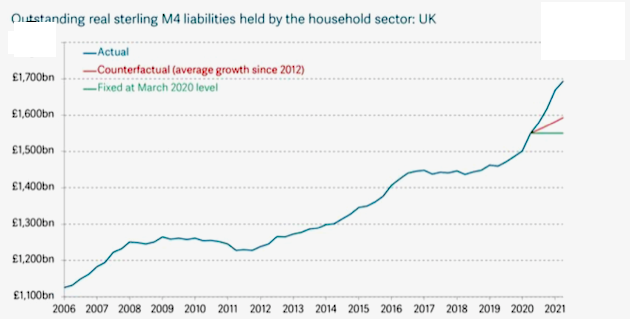
Savings up £200bn +
Debt down £10bn +
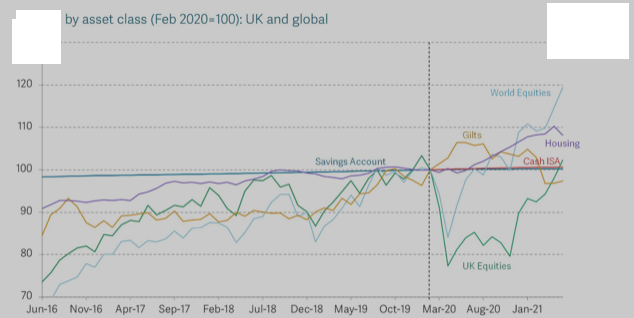
House prices up 8%
Total UK wealth up by £900 billion to £16.5 trillion.
What’s going on? Two unrelated effects. First the direct impact has seen the usual wealth falls for those losing their jobs outweighed by Covid restrictions. This means big spending falls for higher income households, lading to accumulating savings for them.
But the second effect is even bigger. Asset price rises have seen the wealth of those who already had some surge in value. For the UK that is mainly about housing but elsewhere (e.g US) shares have also boomed.
For the first time we’ve combined the effects of spending falls and asset prices surges to see who this wealth boom has benefited overall.
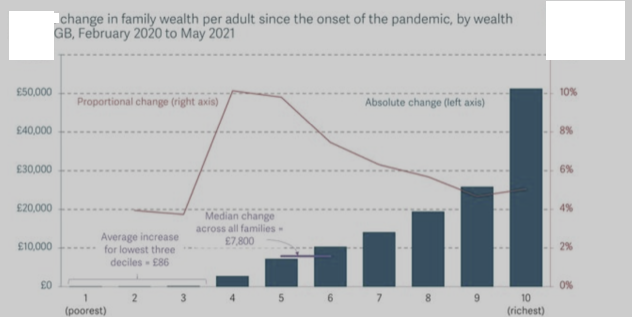
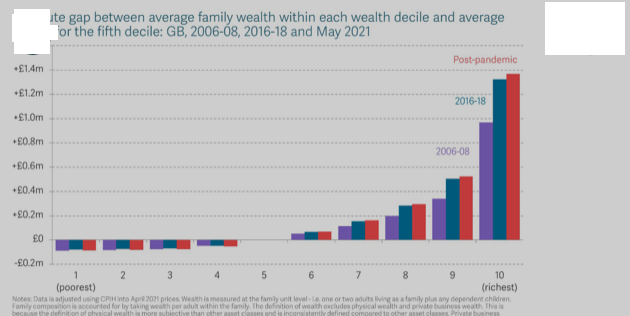
This wealth boom is a big—but very unequal—deal. The typical adult has seen a £7,800 windfall – but the average increase is just £86 for the poorest 30% vs over £50,000 for the top 10%. The middle have done best in terms of a percentage rise, because they are most reliant on property.
So wealth gaps have risen AGAIN – the gap between the middle and wealthiest 10 per cent has increased by £44,000 mid-crisis (on top of a £350,000 increase in the pre-crisis decade). It’s these wealth gaps that are redefining who does/doesn’t feel like the country works for them.
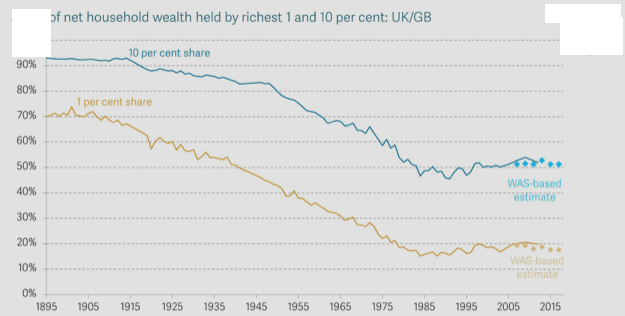
This is very much continuing the pre-crisis trend of wealth gaps rising because household wealth is rising so much faster than income (note it’s the growth in household wealth NOT rising wealth inequality that is doing the work here
)
For a lot more detail on this comprehensive take on what the pandemic has done to household wealth read our annual Wealth Audit, available via Rwitter from @jackhleslie @krishansays – with the kind support of @standardlifefdn. See also the Resolution Foundation at:
One hundred and sixty years ago was a seminal date in American history. There had always been tension between states in the South and those in the North. Resentment among southern slave-owning states grew with increasing pressure from the more populous and prosperous non-slave states of the North. In an attempt to redress this imbalance, southern politicians were keen for new states forming in the Mid-West to be incorporated in the Union as slave-owning states to stregthen their position.
Abraham Lincoln was elected President on an anti-slavery platform in November 1860 This was too much for South Carolina, which took the radical step of seceding from the Union in December. It was followed by six others. Together, they declared the Confederate States of America in February 1861. By the time Lincoln took office as President on March 4th, they had been joined by four others.
This unprecedented situation meant nobody on either side was sure what to do next, much less how to resolve it. The Confederates genuinely believed they were defending America and the freedoms for which it stood. Even before Lincoln took office, Confederate lawmakers wrote their own constitution, by copying the original United States Constitution verbatim, except for three “improvements”:
States each had rights to run their own affairs
Federal government were banned from interfering in states’ internal affairs
No law could deny or impair owner right of property in negro slaves.
The 4 million black people in those 11 states, almost all of them slaves, were not emancipated, and so had no voice in this momentous decision. Confederate leaders simply had to convince ordinary white men in their states that defending the expansion of human enslavement would, in effect, be defending the nation against “radicals” who misinterpreted “all men are created equal” in the Declaration of Independence. As women were neither mentioned, and therefore not meant to be covered by this, neither should blacks be. Arguing that this constituted true patriotism, secession happened while tempers over Lincoln’s anti-slavery stance were still hot.
However, after several weeks of standoff, with no move from either side, that heat was cooling. Sentiment for rapprochement was building in the South because the Confederacy found itself in a quandry how to official recognition from the North was to be achieved. They decided to make a bold move tat would signal their commitment and seriousness.
Charleston Harbor was the major port of South Carolina, which had seized all Union assets there, except Fort Sumter, which dominated the harbour entrance. After minor skirmishes in early 1861, bombardment was opened on April 12th and surrender received the next day. This triggered Civil War, brnging any Southern waverers firmly on-side for the Confederacy.
The relevance of this to modern times may not be obvious to those who have not studied the rhetoric building from Trump and supportive Republicans since the first accusatory political balloons of political skulduggery were flown by them over a year ago. Speculative claims of voter fraud grew in the run-up to the November election. Then—to the surprise of most neutral observers—it continued apace afterwards, the din rising as Republicans clung to Trump as political saviour.
Ironic as it may seem, given his prominent place among America’s rich & famous, Trump has successfully played to his followers as outsider, an anti-establishment figure who had demonised the Washington careerists and Democrats, accusing them holding back ordinary Americans with their rules and socialism. Such an anti-tax/big government is a Republicans mantra. But, under Trump, it became surreal, achieving a stridency that engaged the disillusioned, especially from the far right.
His desperate attempts to hold on to the Presidency after he had clearly lost—and recounts had conformed this—was behind the unprecedented event of his supporters storming the Capitol on January 6th this year. His plea was for supporters to defend America against bureaucrats and socialists trying to deny them “their” President.
This parallels the Confederate leaders claiming justification for slavery and defying the legitimacy of Lincoln. Trump’s rallies, his multiple law suits and sunsequent activity in Republican-controlled states to disenfranchise voters echo the argument behind founding the Confederacy in 1861: that the Founding Fathers would approve such actions. Like Christian fundamentalists with the bible, Republicans are keen on literal interpretation of the wjat the framers of the 1776 Constitution meant. The insurrectionists of January 6th, and those who continue to insist the election was stolen, do not think of themselves as domestic terrorists, but as patriots in the mould of Samuel Adams, one of those Founding Fathers.
A slew of Republican-controlled rural Southern and Mid-West states (approximating to the Confederacy) have questioned Biden’s victory and revised state voting laws in such a way as to disenfranchise minority communities and erode the value of their voting, all under the umbrella of “preventing voter fraud”. Such actions indirectly support the claim that the election was stolen from Trump. The clamour continues.
“Today is 1776!”:
—Tweet from Colorado Republican Representative Lauren Boebert, January 6th 2021
While all this has been disruptive to civic life, none has been truly effective. Biden’s Presidency has completed its first six months undeterred. However, with all efforts by Trump and supporters to question the result or derail Biden’s program come to nothing, their position parallels the Confederacy pre-Sumter. They have made their claim; that has not been accepted; there is no obvious road back; high expectations among followers are now drifting toward disillusion and dejection.
So Trump, like Jefferson Davis before him, must, in that colourful American phrase, “shit or get off the pot”. Davis seized the bull by the hors and triggered four years of civil war. Whatever Trump and his increasingly desperate supporters do, it is unlikely to lead to that. But they must do something radical to reverse increasing isolation and irrelevance. Even if they could find their symbolic equivalent of Fort Sumter, shelling it is probably not the best approach. But both Trump and his supporters are not the types to go away quietly.
On June 23rd, H.M.S. Defender of the Royal Navy, sailed from the Ukrainian port of Odessa on passage to the Georgian port of Batumi. This would take it across the Black Sea, covering 1,000 km from Northwest to Southeast. To do so requires navigating around Crimea, held by Russia and claimed by Ukraine, and therefore a sensitive area in politics and diplomacy. Russia claims territorial waters around Crimea up to the international standard of just under 20 km. By plotting its course to swing further West and South, Defender had plenty of sea room to avoid even approaching that distance from Crimea. But the ship chose not to and ‘cut the corner’, entering coastal waters near Cape Florient to a depth of some 3 km.
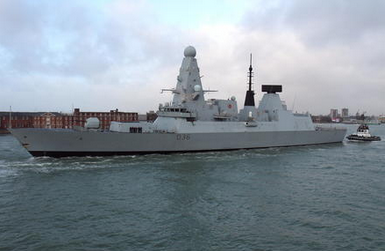
H.M.S. Defender (flag code: D36) is among the RN’s most capable ships in defending herself. At 8,500 tons and capable of over 30 knots, she is one of six modern Type 45 Daring class destroyers,whose primary role is to provide air defence, using the Sea Viper anti-air missile system.
H.M.S. Defender. Armament: Sea Vixen missilile system; 4.5-inch deck gun; 2 x 30mm cannon; 2 x 20mm Phalanx
The response from the Russians was swift and firm. A coastal patrol boat intercepted Defender, demanded several times that she left territorial waters, trying to force her further out before opening fire on the sea well ahead of their course. Several SU-24M Russian strike aircraft flew overhead, at least one dropping bombs, again well clear and another ‘buzzing’ the ship—passing low over it within a few hundred metres. Defender’s crew went to action stations but did not return fire. No-one was hurt; no damage was done before she was back out in international waters. But the real question is why she left them in the first place.
Crimea. Cape Florient is below Sevastopol
The RN is too professional for mistakes like this. The weather was clear; the coast was visible; the navigation aids were all functional. The captain, Commander Vince Owen has 20 years’ service and had been with the ship over a year. This wasn’t an error or misjudgement. Owen had orders to do this. The Amiralty would not have provoked such an incident without approval from Downing Street. The fact that a BBC reporter and camera team, plus other journalists were on board to witness this confirms this was a stunt, a deliberate poking of the Russian bear to see how he would react. It’s doubtful they let any Allies know—the same Allies trying to build bridges to Putin, including Biden’s recent meeting.
The rationale is not too hard to guess. After the Soviet Union collapsed 30 years ago, the residual Russian state realised that its Black Sea Fleet and main naval base at Sevastopol would be controlled by Ukraine, which had declared itself an independent state after centuries of Russian control. Clashes between the two in the Donbas region led to Russia seizing all Crimea in 2014. This was deplored internationally and Russia’s hold on it acknowledged by few.
Beyond unjustified military force, there are some arguments to support Tussia;s case. Not only is Sevastopol their second-biggest naval base and the only one with year-round warm water access, but almost 70% of the inhabitants are Russian, with only 17% Ukrainian and 10% Tartar Cossacks.
The West has, understandably, deplored such Russian high-handedness. But they have set about wooing Ukraine into their orbit, even discussing NATO membership, without showing how they could intervene effectively that far to the East. Such talk has upset the Russians, to whom they believe both Ukraine and Byelorussia rightly belong, as their inclusion in the Tsar’s domain had predated the United Kingdom. To even reasonable ussians, having Ukraine in NATO would be like the UK having to watch France join the Warsaw Pact at the height of the Cold War. If this seems exaggeration, read up on invasion by Karl Gustav’s Swedes, Napoleon’s Grande Armee, the Kaiser and Hitler’s Wehrmacht and the devastation they left. They have reasons to be touchy.
So, when Defender shows the flag in Odessa, in part to bolster sales of arms and corvettes to the Ukrainians for their defence against Russia, things are already growing tense. But, when she gets orders, as must have been the case, to bolster Ukraine’s claim to Crimea and its territorial waters by sailing through them, we have a demonstration of cold-war-era brinkmanship we have not seen in decades.
At home, this may been seen to boost Tory ambitions to present Britaon as a resurgent global power post-Brexit, it is playing with diplomatic firs and people’s lives. Because the Russians are no pushovers, have long been master chess players and in Chechnya and Syria, as well as Cromea and Donbas, don’t give much of a hoot whose toes they tread on.
Had this been 30 years ago, a fleet badly maintained and trained by a bankupt Soviet Union might not have posed such a threat. But, since the Rurrians again took over Cromea, there is a new sheriff in town. The fleet now includes six attack submarines, six Admiral Grigorovich class frigates and three flotillas of missile corvettes from the Steregushchiy, Karakurt and Buyan-M classes. All these support the cruiser Moskva and at least four amphibious landing ships.
Slava class Guided Missile Cruiser Moskva, 11,200 tons
Together with expensive land-based air and advanced missile batteries are capable of taking on the Royal Navy, let alone a single destroyer, however modern. Hat such a force dominates the Black Sea is confirmed by the US Navy, whose Sixth Fleet does not venture its mughty aircraft carriers anywhere near. They content themselves with a couple of detached destroyers (currently USS Roosevelt and USS Donald Cook) which are there more to reassure the Turks than anything else. American posture should it come to a shooting war in the region is to fly stand-off cruise missiles from B-52s and keep ships out of harm’s way.
Someone should tell the Tories: the days when the appearance of a British gunboat would cow the natives are long gone. Which makes you shudder at the insouciance with which this government beards the Russians. Whatever we may think of their claim to Crimea, they are convinced it’s theirs. As a result they are perfectly capable, both morally and militarily, of sinking any vessel that tries another such stunt, and of riding the subsequent diplomatic row with calm aplomb. Britain would also not win friends among NATO allies, plus the loss of £1bn it cost to build, plus its 191 crew, not to mention sundry reporters or film crews brought along for the scoop.
A type 45 destroyer costs us all £46ma each year to run. There must be better and more sensible things we could do with it.




 davidsberry