Videotracks of Our Lives

Given the myriad of channels through which it is now delivered, the very dame “film” has become a misnomer, verging on the archaic. But for a century, it has been the prime means of mass communication around the globe, surviving through each successive development of sound, radio, TV, videotape, DVD, YouTude, streaming, etc. In a world where someone known outside their home town can get called a “star”, remain the unquestioned peak of the star pyramid are film stars, recognisable around the world. Their work has formed a tapestry of my awareness of life, as it may have done for our culture—at least, until recently.

I fell in love with film early. Growing up in the pre-TV 1950’s in a small town where the only entertainment was the cinema, I took advantage of indulgent grandparents with whom I lived to toddle the 100 metres with another 6d (2.5p) puece in my hot little hand to watch what was showing. As the Playhouse’s programme changed three times a week, that meant most of my pocket money wound up there.

It was magic—a window on the world my grandparents never saw and hooked me on the immersive experience of being transported from the dark into the sounds and sights and emotional colour of living in the film. I have come to appreciate theatre, concerts and other live performance. But nothing moves me like a well crafted film.

It was only later in life, once I was well past the stage of missing half the film by paying too much attention to the date beside me, that I came to not only critique, as well as be entertained by a given film, but slowly realised what a wonderfully memorable videotrack (as opposed to soundtrack) of my life, and that of society in general, they had become.

This came to me during my 15 years in Silicon Valley when David Packard (of Hewlett-Packard fame) chose to spend some of his zillions restoring the Stanford Cinema to its pre-war glory and show a series of pristine black-and-white prints from the UCLA Film Archive, complete with cartoons, popcorn and usherettes in pill-box hats.

As well as revealing to me forgotten geniuses of the silent era like Buster Keaton and Fritz Lang, you started to see the living history of the pre-war era laid out in socially observant series like The Thin Man, witty observations on American life that moved into colour with authentic later representations like Chinatown.

All this threw many of the films I had seen as a primary school kid in shorts into new perspective. While I had my boyish thrills at British pluck in The Dam Busters, Cruel Sea or Ice Cold in Alex, I had not connected with more mannered British fare like Blythe Spirit or Genevieve. What I did connect with—but fully only much later—were American films that made eloquent (for the time) social comment, films like Giant, The Wild Ones, The Misfits, Look Who’s Coming to Dnner, In the Heat of the Night or On the Waterfront. It was only later that British cinema dared to come out with equivalents like Look Back in Anger; Georgie Girl; A Taste of Honey, To Sir With Love or Loneliness of the Long Distance Runner. All products of the “Kitchen Sink” school of writers determined to show life as it is.

There is so much to take in, so much insight into what drove or restricted people’s lives in any of those. Unfortunately, they were few and far between as Hollywood got side-tracked into “sword and sandal” epics or John Wayne westerns to try to compete with TV. Britain’s equivalent was endless Carry On films and bubble-gum like Summer Holiday. Had Bond not come along, Elstree/Pinewod would have shut up shop in the mid-1960’s.

Thankfully, the wave of rebellious innovation from that decade reached film makers. Lush and powerful dramas reset the standards high: Romeo and Juliet; Lawrence of Arabia; A Man for All Seasons; Women in Love; Doctor Zhivago brought history to life and posed modern questions. 2001; A Space Odyssey exploded the imagination in preparation for the moon landing; A Clockwork Orange frightened the bejasus out of you as a different take on the future.

There followed a couple of decades of film innovation interspersing blatantly commercial releases. Star Wars was popular, but comic book, while Alien seemed so chillingly plausible. The American agony of Vietnam was not assuaged by gung-ho releases like Green Berets, but the relentlessly surreal Apocalypse Now immersed you in the craziness, equalled (but not bettered) by the later Platoon. American politics came into film’s crosshairs in All the President’s Men and the wonderful Being There. The serious stuff was balanced by a series of wonderfully crafted period pieces so good, they could almost have been documentaries of these times, including Tess, A Room with a View and The French Lieutenant’s Woman. But, while the Americans came to grips with contemporary social issues in films like One Flew Over the Cuckoo’s Nest, Fried Green Tomatoes, Working Girl and Wall Street, the British stuck to historical clashes like Rob Roy or lightweight contemporary observations like Four Weddings or Notting Hill.

From the 1990s onward, the increasing number of media on which films could appear and the difficulty of securing income from them forced a wider volume of production, with a concomitant reduction in general quality. Pure entertainment series, such as Indiana Jones, James Bond, John Maclean (Die Hard), Lara Croft, Jack Ryan, Jason Bourne, etc., as well as Marvel Comics derivative brought in the money and art house releases gained scant distribution. Honourable exceptions are films of the Coen brothers. From Miller’s Crossing to Three Billboards, they are shrewd, very human and funny to boot.

The introduction of CGI opened up a world of possibility that earlier special effects could only dream of. These were put to excellent use in Titanic and the utterly stunning, unutterably beautiful Avatar. But mostly they have been used to enhance thin shoot-’em-up stories from Pearl Harbor through Independence Day to White House Down. It’s entertainment, but it’s not art.

Maybe that’s me being crabby because I’m old. Maybe I’m too much of a purist, steeped in the old school. But films documenting real life now seem rarities and fantasy is all the rage. I hope there will be more films blending directors craft with brilliant actors using eloquent scripts that make shrewd comment on society that we can all learn from, even as we are being entertained. But the last decade has not thrown up a film able to hold a candle to kitchen sink films cited above. But I live in hope.

And my own favourites? It’s a toss-up between Local Hero and Cinema Paradiso: both shrewdly observed, full of humanity and humour—and not a frame of CGI in sight!

#988—1,176 words
Posted in Uncategorized | Leave a comment

Is It a Fair COP?

“Humanity has long since run down the clock on climate change, It is one minute to midnight to prevent catastrophe.”

—Boris Johnson at COP26, November 2021

Intensifying media blanket coverage means most of us were fed up with “last-chance-saloon” mood music before COP26 even graced “The Dear Green Place”. It is now going well, a suspiciously politically motivated strike by GMB waste workers notwithstanding. While much has been made of Chinese and Russian leaders being no-shows and India making promises for 2070, not 2050, the fact that virtually everyone is there (192 countries sent delegates) means it may be the best we can do.

Talk in the run-up focussed on the goals of slowing, rather than halting, global warming, with a 2 deg C rise as a ceiling and a 1.5 rise an aspiration. A UN study predicting 2.7 rise under current commitments may be discouraging news, but, equally, it could act as a spur.

A short blog like this is no place to rehearse all the arguments. But a discussion of the concrete consequences might focus minds better than temperature generalities. It is clear that the world is already suffering weather instabilities from climate change but more permanent damage is in the offing and from which full recovery is unlikely. This the juggernaut of sea level rise.

“The global mean water level in the ocean rose by 0.14 inches (3.6 millimetres) per year from 2006–2015, which was 2.5 times the average rate of 0.06 inches (1.4 millimetres) per year throughout most of the twentieth century.”

—NASA Sea Level Research Laboratory, Hawaii

By the end of the century, they predict a global mean sea level rise of one foot (0.3 meters) above 2000 levels, provided greenhouse gas emissions fall to a low level in coming decades. This would be required to follow the 1.5 degree model, together with a linear extrapolation of the present rate of rise. This appears optimistic, because:

  1. The 2.7 degree rise is the most probable future temperature
  2. The likely disappearance of Arctic sea ice in summer will make the albedo of the Northern Hemisphere darker, causing more heat to be retained
  3. Such warming will start to melt the Greenland and Antarctic ice sheets, which have trapped 70% of the world’s fresh water

Neither the melting of glaciers, nor of sea ice causes appreciable rise in sea level; the former is relatively small and the latter already displaces the same amount of water as it floats. But the ice sheets are entirely another matter. Lying on land to a thickness up to 3 km, their melting would raise sea levels by a catastrophic 58 metres.

Long before that, the melting that is taking place and the thermal expansion of the seas through warming can cause trouble enough. Taking the more brutal 2.7 degree scenario and another factor of 2.5 for increase in sea level rise gives an increase of 1m over this century. In itself this could turn areas of low-lying farmland near the sea into salt marsh. But increasingly violent weather adds storm surges, caused by high winds and a drop in air pressure in the eye of such storms. This can add over 1m to the height of a tide. In 2005, Hurricane Katrina created a storm surge over 4m, which inundated much of New Orleans. In 2012, Hurricane Sandy flooded coastal New Jersey and parts of New York City.

The UK defines HMWS (High Mean Water Springs) as the highest a tide reaches. But, in reality, this could be overtopped by another 2 metres if all factors coincide. Such a “great flood” overwhelmed the Essex coast in 1953 and 53 people died.  Prepared sea defences, such as most of the Netherlands or the Thames Barrier protecting London, would probably withstand such an event. Most of the world enjoys no such protection.

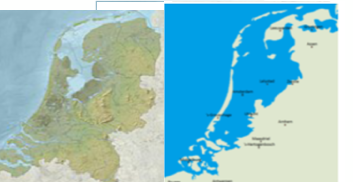
Netherlands—and Flooded at Current Sea Levels

In future, such events as the 1953 flood would rank minor among the world’s problems. Much of Bangladesh is already underwater for a time and inhabitants displaced. The American Gulf coast is vulnerable along much of its 1,600 mile length. Deltas, like Vietnam’s Mekong are vulnerable. Most Pacific atolls would soon become uninhabitable. Almost all coastal cities would suffer damage along their shores.

Were a combination of sea level rise, storm surge at high Spring tide add 3m to ‘normal’, entire cities would be lost. Though the waters might recede, damage and the likelihood of repetition would make re-occupying them to risky. Cities at risk of abandonment as a result of such occurrences include:

  • High Risk: Alexandria, Egypt; Algiers, Algeria; Brisbane, Australia; Darwin, Australia; New Orleans, LA USA; Quingdao, China; Beirut, Lebanon; Georgetown, Guyana; Venice, Italy, Wellington, New Zealand
  • Medium Risk: Adelaide, Australia; Bridgeport, CT USA; Colombo, Sri Lanka; Dohar, Qatar; Le Havre, Mobile, AL USA; France; Miami, FL USA; Perth, Australia; Rijeka, Croatia
  • Low Risk: Alicante, Spain; Atlantic City, NJ USA; Bangkok, Thailand; Belfast, Ireland; Benghazi, Libya; Hull, England; Galveston, TX USA; Hiroshima, Japan; Izmir, Turkey; Norfolk, VA USA; Panama City, Panama; St Petersburg, Russia; Trieste, Italy; Vancouver, Canada

These lists are neither exhaustive, nor definitive. But they do a sense of both the diversity and the importance of cities under immediate threat. Many others would suffer partial inundation and recover, as New Orleans did. Every metre rise in sea level would shift cities up one stage. Such lists could be extended to include hundreds of smaller cities, thousands of towns and, probably, millions of villages.

The key point is that, taken together with widespread loss of agricultural land and the millions of displaced people, few, if any, countries would have the resources to look after others so afflicted. Even advanced countries would be pre-occupied with  looking after their own damage and displaced citizens and to even maintain their economy.

This does not imply the collapse of civilisation, but it would mean severe drops in living standards and quality of life. Landlocked countries like Switzerland would be unable to compensate this scale of loss.

Bad though this may seem, even more catastrophic scenarios exist. Any serious melting of the Greenland and Antarctic ice sheets multiply the problem well before any 58 metre Armageddon. Well before that level, civilisation as we know it would disappear, along with entire countries. Londdon;s and Netherland’s sea defences may still be holding out but they would fall into one of the following lists of key cities likely to be abandoned with each metre rise in sea levels.

  • 4-Metre Rise: Bruges, Belgium; Cherbourg, France; Fort Lauderdale FL USA; Iskenderun, Turkey; Ravenna, Italy; Recife, Brasil; Shanghai, China; Southampton, England; Stockton, CA USA; Tunis, Tunisia
  • 5-Metre Rise: Basra, Iraq; Cagliari, Sardinia; Camden, NJ USA; Dunkirk, France; Kaliningrad, Russia; Tel Aviv, Israel, Sapporo, Japan
  • 6-Metre Rise: Bordeaux, France; Bremen, Germany; Charleston SC, USA; Channai, India; Luanda, Angola; Massawa, Eritrea; Riga, Latvia
  • 7-Metre Rise: Biloxi MS USA; Hamburg, Germany; Honolulu, HI USA; Tokyo, Japan; Ho Chi Minh City, Vietnam; Ostend, Belgium; San Sebastian, Spain
  • 8-Metre Rise: Exeter, England;Hue, Vietnam; Manila, Philippines; Monrovia, Liberia; Nice, France; Portsmouth, England; Vladivostok, Russia
  • 9-Metre Rise: Antwerp, Belgium; Corpus Christi, TX USA; Karachi, Pakistan; Reykjavik, Iceland; Salvador, Brasil, Tricomalee, Sri Lanka
  • 10-Metre Rise: Baltimore, MD USA; Bandar Abbas, Iran; Barcelona, Spain; Belem, Brasil; Calcutta, India; Cayenne, French Guyana; Hanoi, Vietnam, Kingston, Jamaica; Long Beach CA USA; Mogadishu, Somalia, Perth, Scotland; Philadelphia PA USA; Sacramento, CA USA; Taipei, Taiwan; Valparaiso, Chile

If global warming totally melted the ice sheets, even if the resulting weather permitted crops to grow and civilisation to hang on, the world would be literally unrecognisable. Half the capital cities of the world would be gone, including Washington and Beijing. Almost ALL European capitals would be gone—only Madrid, Zurich, Vienna, Prague, Sofia and Athens would remain. Budapest would be a coastal city. So would St Louis MO, Strasbourg, Chesterfield and Vitebsk, Russia. Wales would be an island and the Black Sea would flow across the Kalmyk steppe to fill the Caspian basin.

And the good news? Well, the Suez Canal would be superfluous and Antarctica would finally be available for colonisation.

Watch “Earth Under Water, a one-hour documentary on the Smithsonian Channel (Channel 56 on Freeview, UK)

An earlier post on the same topic, discussing impact on my local patch of East Lothian, was published here in August 2021. See: Can You Canute?

Antarctica—Covered with 2-3 km of Ice, Showing Sea Ice
Posted in Environment, Politics | Leave a comment

Those Who Walk on Water: III—Boris Johnson

“This Budget will deliver a stronger economy for the whole of the UK. We’re building back better from the pandemic with a more innovative, high skill and high wage economy that will level up across the country.”

—Tweet from Boris Johnson after Sunak’s Budget Speech, 27.10.21

And so we come to Boris Johnson, the latest in 21st century top dogs who see the rules are for mere mortals, but not for them. He does not have the vision and charisma of Blair or Obama; he does not have the planetary ego and unshakeable chutzpah of Trump. But he has earned his place in the Pantheon of Walkers on Water—of politicians whose personality comes to dominate the party that begat them, rather than the other way round.

Boris has long had form. Early on, he was fired as a journalist for making up a quote. As a reporter in Brussels, he cottoned on to English hostility to Europe and recognised a bandwagon to ride. A shrewd move was to be elected as Mayor of London brought him into the public eye. There his trademark tousled blonde mop, his boisterous manner and media baits like bendy buses and Boris bikes meant he received for more exposure than he could as an MP and his bloke-ish affability (c.f. Nigel Farage) took him into the consciousness of many outside his party and even outside politics. Throw in non-political appearances, such as on Have I Got News for You and the profile becomes that of famous actor or rock star, which few politicians ever achieve.

Once back in parliament, he was soon in the thick of the Leave campaign, once Cameron had released the jingoistic Tory genie out of tits bottle with the 2016 EU Referendum. It was here that Boris refined (though that may not be the correct term) as a political force in his own right. Gleefully attaching himself to slogans and assertions that owed more to posture than fact (£300m for the NHS if we leave), his rise stumbled when Michael Gove stabbed his leadership bid in the back.

It was, however, soon back on track when one of Theresa May’s many misjudgements was to appoint him Foreign Minister.. In his two years of tenure, he alienated more countries than any other in the post over that period of time. These were not gaffes, but tactics to keep him in the public eye. And when May’s faltering premiership ran out of road, Boris enjoyed the nearest thing to a coronation we’ve seem since 1953.

The next few months saw Boris at his presidential busiest, flitting from photo op to photo up, hair tousled, head down, as if about to butt someone, driving a fotk-lift though a polystyrene wall to “Get Brexit Done”. After May’s dither, Boris’ decisiveness carried not just the country, but many “Red Wall” seats ‘oop North’. By making Brexit the theme and leading the charge, he upstaged his own party. But, with a majority of 80 after a decade of weakness, nobody complained.

Boris was no Blair; he had no visionary agenda. But what he did have was Trump’s elastic and opportunistic relationship with facts, as well as much of his disdain for the niceties of tradition and procedure. As the shabby earnestness of Corbyn gave way to the dapper earnestness of Starmer, he came into his own, cheerfully ignoring substance at Prime Minster’s Question Time and taking gladiatorial joy in turning each into an attack on the Opposition. It was a home brew distillation of Trump’s “Fake News” handbook. Though few non-anoraks watch PMQs, the spirit of it leaked out and all his bumbling but can-do appearances have served to cut across party and even political barriers to give him a genuine, if undeserved, aura of “man of the people”, much as Trump achieved.

Especially given the bland and interchangeable facelessness of most of his Cabinet, it is his personal popularity that is carrying the Conservatives now. To date, the many gaffes (too slow to lock down; £40bn wasted on Test & Trace; no ‘over ready’ social care plan, even after two years), their accumulated effect has yet to cause damage, not least because Labour has been no more fleet of foot catching Boris than the Democrats were with Trump.

Whether the Conservatives can weather the fall when Boris goes is not clear. The First Republic did not survive Napoleon and the Labour party has yet to show it can survive Blair. But all three will live on in history books ling after the conventional Chamberlains and Coolidges are reduced to footnotes.

Final scene from Hal Ashby’s 1979 Film “Being There”

(End of 3-pert article, 2113 words)

Posted in Uncategorized | Leave a comment

Those Who Walk on Water: II—Donald J. Trump

“Well, if I ever ran for office, I’d do better as a Democrat than as a Republican – and that’s not because I’d be more liberal, because I’m conservative. But the working guy would elect me. He likes me. When I walk down the street, those cabbies start yelling out their windows.”

—Playboy, March 1990

Hot on the heels of the Obama personality phenomenon came one that redefined “cult of personality” on a scale  few could have anticipated. Whatever opinion you may hold of Trump, he played America and its political system like an old violin. Before the primaries, nobody would have bet on him gaining the nomination. But everyone was used to candidates playing by the rules. Delve into Trump’s business dealings over the previous three decades and you realise that, to him, there ARE no rules.

Trump has always been a law unto himself, moves through a world of his own creation that a stash of billions helped form and sustain. In business dealings, he found glitz and chutzpah opened many doors in New York and learned early that honesty and integrity were disadvantages that hindered progress and—more importantly—could be dispensed with by the application of money and good lawyers. His profitable exit from the Taj Mahal casino in New Jersey, leaving partners and contractors holding massive losses is the stuff of law school lectures.

The application of this approach to gaining the Presidency caught the stuffy patricians of the Republican party off-guard, and his appeal to normally Democrat blue-collar voters flat-footed the Clinton campaign with slogans like “Make America Great Again”.

Such ostentation of wealth and boastful hubris should have led to an ignominious prattall and humiliation. But the “Emperor’s Clothes” phenomenon seems to have kicked in. By sensing the need—always strong in middle ad working-class Americans—for their country, and by extension themselves, to stand tall, Trump was able to don the clothes of reviving American greatness that Reagan used to great effect to heal the scars and despair of Vietnam.

Though hardly credible to any objective observer, he presented himself as one of the people, a fellow campaigner against the remote bureaucrats of Washington, who were guilty of letting America slide in the world, be overrun by immigrants, have their pioneering technologies stolen by Asian upstarts. It came out of the playbook of right-wing demagogues from Attila to Zarathustra: create an internal enemy that threatens the way of life (Democrat = socialist) and create external enemies who threaten the country itself (Latino immigrants and upstart Asians). It was cheap and tawdry, but that had never bothered Trump and plugged right into the fears of the millions of Americans who had hardly left their state, let alone owned a passport to find out the truth.

By dismissing serious reporting as “fake news”, by seizing social media to bypass traditional media, by spreading rumours of electoral malfeasance well ahead of time and galvamising a tribe who stormed the Capital to overturn his defeat, Trump rode the tiger of his own creation. And, so overwhelmed were many Republicans by this, that they saw only the populism and its electoral power. Trump became a party in his own right, daring Republicans to ignore his wide support and flat-footing both Biden and the Democrats, who still think only in terms of legal procedure.

He may be out of the White House, but the final chapter of Trump’s political saga has yet to be written.

Posted in Politics | 1 Comment

Those Who Walk on Water: I—Blair & Obama

“We all have to believe in something. I believe I’ll have another drink.

—W.C. Fields

It was entertaining to watch Boris Johnson’s speech wind up the Conservative Conference in Manchester last month (the double-entendre is deliberate). Because this was unlike any other Tory leader’s speech in living memory—and probably ever. It was not just a pitch to the faithful in the hall, but to the many non-Tory voters across the country.

With all its flags, banners and rapt audience, the gathering more resembled its American equivalent; a rally, charged with excitement, focused on feel-good, not policy. All it lacked were cascades of red, white and blue balloons cascading from the ceiling at the climax.

But this was not Neil Kinnock’s misjudged “well all right!” chant at Sheffield in 1992, just before John Major and his man-of-the-people soapbox took the legs out from under him. What we are witnessing is further development of a relatively new phenomenon in politics: the cult of personality, as distinct from party.

Boris looked to be enjoying himself, firing jokes at Corbyn and Starmer, but not sparing Cameron or May either, Few politicians dare criticise party colleagues. Fewer still get away with it. But those who do have reached a state of grace, a bond with the wider public beyond party loyalists that apparatchiks in grey suits dare not challenge. So Boris peppered his speech with populist slogans to reach beyond the party—“Get Brexit done”… “Levelling-up”…“Build back better”. His catchy favourites were all there.

This was personality on parade, such as British politics has not seen in over a decade. It is largely a development of this century and, rather than being an American import to Britain, it appears to have developed in both countries around the same time.

Until the late 20th century, both presidents and prime ministers were creatures of their parties. The Coolidge and Callaghans, the Gladstones and Garfields did not stand out from their colleagues; they were still primus inter pares—and acted as such. True, Churchill and Roosevelt stood out, but that was as much from circumstance as anything else.

But a shift can be see with both Reagan and Thatcher, a shift where the government and its policies revolved around them more than their party, when increasing numbers voted for the leader, rather than the party they led..

The first to truly break the mould was Tony Blair. BBC’s excellent 5-part documentary ‘Blair and Brown” lays out the origins and development of New Labour and the revolution it effected on a party drifting after bing out of power for 18 years. Though Gordon Brown provided the engine room of ideas and the flywheel of long political experience, The front man, the Prince of Presentation was Blair. While Brown could persuade the party, it was Blair who made the party credible outside its core voters, by means of flagship chances, like scrapping Clause 4. His appeal to the newly affluent, aspirational working class fuelled the landslide of 1997.

By being so clearly in charge of a new agenda, whether it was Cool Britannia, or the Good Friday Agreement or the National Minimum Wage, he demonstrated vision and action nationally and clearly played a role on the international stage by patching up relations with Europe left damaged by the Tories and strengthened the “special relationship” with the USA in the aftermath of 9/11. This gave him a profile that reached well outside his party, or even his country, such that Labour’s shakiness in after his stepping down in 2007 continues to this day.

A similar development occurred in the US  with Barack Obama. Barely registering on the political radar in 2004, he trounced a series of lacklustre suits for the Democratic nomination in 2008 and proceeded to barnstorm the country with an antidote of hope and ambition in contrast to the lacklustre and war-studded term of “Dubya” Bush. He won by a 395-to-173 landslide against the plausible and popular John McCain. It wasn’t just that he galvanised black and hispanic voters who felt little engagement with mainstream America and its politics. He also moved the Democratic party out of its reliance on blue-collar workers in rust-belt states with declining industries and populations. And, as a fresh-faced, first term senator from Illinois, he was seen as far from the “Beltway Bandits” of Washington—politicos seen as remote and bound to the system. More than anything this latter factor was what lost Hilary Clinton the race in 2016.

The reason Obama did not achieve more with his fresh ideas and the momentum they gave was a combination of the intractability of Republicans who, since Newt Gingrich in the 1990s, dedicated themselves to curtail, if not destroy, policies like the Universal Health Care Act, plus a creaking US political system that allowed them to do that, an unbalanced Senate and over-precious assertion of States’ rights, filibuster threats, etc.

Posted in Politics | Leave a comment

Letter to the Editor

BACKGROUND: On Friday, October 15th, Member of the UK Parliament, Sir David Ames was holding his regular surgery (opportunity to bring cases to their MP by the public) in Leigh-on-Sea, within his Southend West constituency when he was stabbed and killed by Ali Harbi Ali, a 25-year-old of Somali heritage, who had made an appointment to see him and traveled 50 miles from London to commit the act. He is now in police custody. The MP Jo Cox was assaulted and killed in similar circumstances in 2016 and the weekend UK media is full of debate how to prevent further occurrences.

Surgeries in Public

Dear Sir,

I was outraged to hear of the murder of Sir David Ames MP as he held a public surgery in his constituency. Many across the political spectrum have been fulsome in praise of his assiduous availability to hear issues raised by his constituents.

Coming within five years of the murder of Jo Cox MP and of abusive trolling on social media, I hear a rising clamour to increase security, vet attendees and even suspend face-to-face meetings to avoide firther such tragedies. I believe any such actions to be misplaced, as they would damage the democracy upon which society depends.

As well as 59 MPs, Scotland elects 129 MSPs, and ten times that number of councillors, all of whom hold public surgeries. In my own eighteen years as councillor representing North Berwick, I held over 800 surgeries. To make sure people knew they were public, I held them on two chairs at the foot of steps leading to the Council Chambers in Quality Street, with a plaque on the wall saying “The Councillor is IN”, visible to all passing. Half the resulting chats were social, not ward issues. I found this delightful, as I believe the best representation comes through interaction. In this, I hope I was following Sir David’s superb example.

Retiring indoors, only to discuss private matters, I did experience heated exchanges that rose to abuse on two occasions. But only one required a half-nelson and bum’s rush to resolve. In my old-fashioned view, exposure to risk 0.1% of the time was part of doing the job properly.

I appreciate not all elected feel as safe, much less up for robust self-defence. But it would be a sad day when they could not mingle with local residents, or be isolated by security or pre-booking systems.

Yours sincerely

David S. Berry

Posted in Community, Politics | Leave a comment

Gas-umped!

Today (Sunday, October 10th) Business Secretary Kwarsi Kwarteng was doing the rounds of the politics talk shows, trying to pour renewables (rather than oil) on the troubled waters of the badly overheated natural gas market. Wholesale prices, which started at 60p a Therm in January recently rocketed as high as £4.00, before settling back at £2.40.

Households are, to some extent, protected from immediate rises in their bills by a “cap” that is adjusted each October and April, above which suppliers may not raise their prices to consumers. As the cap is set two months in advance, the true impact on consumers will only be revealed in February.

“I am convinced the UK will not suffer gas shortages in the coming months and that the price cap on consumers’ energy bills will not be moved this winter.”

—Business Secretary Kwarsi Kwarteng, Trevor Phillips On Sunday Show

Of more immediate concern is the fact that industrial users have no such protection. Ceramics, glass, fertiliser, brickworks and steel mills are only a few of the many industries that may be forced to stop production as uneconomic, or pass on price rises that will hit consumers other than in their energy bills. But even the “Big Six” gas retailers will be unable to absorb much of such rises as they will be tasked with supplying customers of a dozen smaller energy retailers who have collapsed.

Other than putting out soothing words that supply is not an issue and homes will continue to be heated, Secretary Kwarteng made it clear there would be neither adjustment of the consumer cap process, nor extension of it to business, nor any government bale-out of gas retailers who went to the wall. Unlike many other issues besetting the UK economy like trade impediments, shortages in key workers and erratic supply chains, it would be wrong to assign the blame for this to Brexit.

What it does, however, have in common with the repercussions of Brexit is that both can be ascribed to the lack of long-term thinking and strategic planning on the part of the government, especially the department of which Secretary Kwarteng is the minister.

  1. Reduced North Sea Production. While the gas once seemed plentiful, 40 years of relying on it has depleted stocks; but 2019 only 40% of UK gas consumption was coming from territorial waters, with another 33% coming from Norway. The rest arrived indirectly from Russia or LPG ships.
  2. Control of Production went out the window early with the sale of BNOC. But even British companies now account for barely one quarter (BP 12%; Shell 12%). The two largest are US-owner Harbour (23%) and French-owned Total (17%).But all are private international operations outside UK government control. But all these companies (and a half-dozen smaller competitors) are about to pocket a serious windfall in profits, made at our expense  in UK territorial waters.
  3. Overoptimistic Projections. For the last decades, Tory governments have consistently projected that fracking, nuclear and renewables would reduce UK dependency on the North Sea in general and gas in particular.
  4. Insufficient Storage. It is good practice not to live hand-to-mouth and have reservesto buffereither interruption in supply or price hikes, such as we are now experiencing. As examples, Germany stores 250 Terawatts; Italy 195 Tw and most other European countries have more than the UK’s 20 Tw. If this seems low, that’s because in 2017 the government chose not to replace  70 Tw in Centrica’s offshore storage, cutting the UK’s buffer down to less than a week’s of demand.
  5. The Wholesale Market. While the government largely blames this for the price paid in the UK, they are being disingenuous. What they are referring to is the spot market, where price fluctuations are a way of life. The way to avoid this is by “hedging”, which is negotiating a price for future delivery at an agreed fixed price. Most of the “Big Six” are hedged into 2023. Russian suppliers recommend this approach and countries like Germany use hedging as a matter of course. Which is why they are paying €137 per unit while Britain is averaging €245.
  6. Global Demand. Gas storage was emptied last winter due to strong demand, exacerbated by relatively weak renewables generation and strong underlying power demand. Power and gas demand has also been strong in Asia which pulls LNG away from Europe. This has combined with a global supply crunch and limited injections this summer, resulting in record-low stocks as we enter the heating season.
  7. The Impact of Covid. Dealing with lockdown caused delays to new projects and maintenance, notably to maintenance of the Forties Pipeline System in the UK central North Sea, which was postponed from 2020 This resulted in the shutdown of supply from all connected 67 offshore fields, while further work on other parts of the system throughout the year meant field clusters such as Elgin/Franklin, Shearwater, and ETAP were all offline for longer.
  8. Departmental Musical Chairs. The UK Department of Energy and Climate Change, created in 2008 to focus on this sector. It was the latest of five incarnations since 1964. It was replaced in 2016 by the Department for Business, Energy and Industrial Strategy has a much wider brief, and therefore less focus. There have been four different Secretaries since 2019. Secretary Kwarteng has clocked jut 9 months in the post.
Figure 1—Comparison of European Gas Storage Capacity (source: Reuters)

None of the above points lead directly to the present untenable situation. Even taken all together, they need not have led to this situation. But what is clear is that none of them were unknowns several months ago, and that a plan to anticipate rocketing demand should have been a priority. The idea of Secretary Kwarteng meekly following Boris Johnson’s wheeze of “letting industry tough it out” and hoping the cap will hold down consumer discontent until the Spring, when it will all have blown over seems optimistic at best and irresponsible at worst.

We have been gas-umped and there is little we can do about it. But that makes it all the more urgent that a coherent plan of transition to renewables for the long term and more sensible management of energy for the medium term to avoid getting gas-umped again.

Posted in Commerce, Politics | Leave a comment

We hold these truths…

“… to be self-evident, that all men are created equal, that they are endowed by their Creator with certain unalienable Rights, that among these are Life, Liberty and the pursuit of Happiness.–That to secure these rights, Governments are instituted among Men, deriving their just powers from the consent of the governed.”

—US Declaration of Independence


It is hard for anyone who believes in democracy to fault this fine statement of principle. Americans are justly proud of both the spirit and the letter of it, having had it dinned into them at school.

While I commend and support its sentiment, even as an outsider with many friends and 16 years of residence in the States, I am compelled to make comment on how far Americans have drifted from its core premise, while they still believe their democratic credentials remain the envy of the world.

The prime flaw is simply the document’s age and that of the Constitution founded upon it. Brilliant as both were, the context in which they were formulated was late 18th century colonial America, where 13 states with barely a million inhabitants, occupying a barely civilised strip of land between the forested Appalachians and the Atlantic Ocean communicated by horse and wagon. Other than that, they differed considerably—from the puritan North, the slave-owning South, with nascent metropolises of Philadelphia and New York in between.

This week, Republicans in the Senate blocked Biden’s $2 trillion infrastructure bill and vetoed a Democrat attempt to raise the debt ceiling. Together, this may shut down the US government by mid-November. This would not be the first time, as similar tactics blocked both Clinton and Obama and paralysed the federal government. This is just one, albeit massive, example of how the US political system, for all its meritorious origins and high regard in which many Americans hold it, is no longer fit for purpose. Trump’s antics have brought it to breaking point. And if it does break, it is not just the USA that will come down with a crash. Here are some thoughts on salient issues:

  1. “All men are created equal”. This sounds great and, in freeing them from the shackles of a class system, omce served its purpose. But it did not apply to non-whites or females, and certainly not to slaves. Women had to wait until 1919 and Native Americans until 1924 to become full citizens African Americans made progress in 1865 but it was a century later that those in Southern States gained equality. Though it tool two centuries, US society did catch up with its founding principles in the end.
  2. Office of the President Trump played fast and loose with this, showing how weak the “separation of powers” clause had become. The office was made powerful when the country was small. The powers available were little abused by 43 presidents who respected the office. Trump, with no such morals, showed how far they could be abused. Hamilton’s clause about impeachment is a bent reed, when the Senate colluded in running any such effort into the sane. A solution to this is too complex for a blog, but this imbalance and potential for abuse must be addressed.
  3. Congress has become a plutocracy and doesn’t even hide this fact. Whereas Congress was once a collection of landowners and farmers with a smattering of industrialist and intellectuals, nobody gets elected to the House or Senate without serious funding of a professional campaign. Current estimates are that it takes $19.4 million to win a Senate seat. A House seat comes in relatively cheap at $1.6 million. This means nobody but billionaires get elected without being obliged to people and organisations, some of whom want the favour returned. (see: https://www.opensecrets.org/news/2016/11/the-price-of-winning-just-got-higher-especially-in-the-senate/)
  4. The Senate is a gross anachronism and affront to democracy. Both House and Senate must agree to legislation. While the number of Representatives elected to the House is regularly revised to reflect the population in each state, only two Senators are elected per state. When there were only 13 roughly equal-sized states, this worked fine. However, these days, it takes the population of the 22 smallest states to equal the population of California. They get 44 Senators; California gets 2. In fact 51 Senators from the least populous states form a majority, having been elected by just 18% of the US population. The reason this outrage to democracy has not been corrected is that they are nearly all Republicans—turkeys reluctant to vote for Christmas.
  5. Procedure in both House and Senate are arcane and archaic. The Speaker is powerful but partisan  because they do not relinquish party loyalties when selected. Anyone can attach anything to any bill; it need not be relevant—even the threat of doing this is a bargaining chip. And the filibuster lives on as a nuclear option to block the passage of legislation. The place alienates and confuses those it should serve
  6. The two-party system is institutionalised. Although it is legally possible for a third party to emerge, even populist Ralph Nader in the 1970s and billionaire Ross Perot in the 1980s failed. Voters must register as one or the other and the massive funding is controlled by the parties, so inertia is huge. Since the 1990s, both parties have been locked in barren hostility that has gone as far as closing down the government.
  7. The Judiciary, the third leg of the “separation of powers” is political. All nine members of the Supreme Court are appointed by the President for life. Replacements are chosen for sympathies to those of the President and, by interpreting federal law, have impact long after the President who appointed them is long gone. Decisions momentous to ordinary lives, such as “Roe v. Wade” which legalised abortion, last for decades.
  8. Checks and balances outside are almost non-existent, especially when it comes to foreign policy. Because of shared conviction that American democracy cannot be improved on, its actions and influence in the world must ipso facto be benign. Quite apart from the subsuming of the plains indians, the Mexican War of 1848 that stole most of the West from them and the Spanish War of 1898 that garnered Puerto Rico, Guam & the Philippines and made Cuba a vassal state, there was the Monroe Doctrine that forbade any other power to interfere in the Americas and the convenient hiving off of Panama from Colombia to exercise sovereignty over the canal that was then built. There was no challenge to any of this.
  9. Anti-colonialism. Having sought freedom from colonial masters, American folklore is that it is a beacon for those seeking independence. For years, various presidents lectured the British and French on this. Yet their own record is poor, if not hypocritical. The US annexed Hawaii, ignoring a kingdom already there. They fought a brutal war against an independence movement in the Philippines. Puerto Rico is still a colony without democratic representation 123 years after being “liberated” from Spain. If given statehood, it would be bigger than 18 of the existing states, and entitled to at least five representatives in the House and two Senators.

This is not meant to disparage the United States. It is a fine, modern country—still offering the highest level of prosperity to its 330 million citizens. But its politics are neither modern, nor fit for purpose in an advanced society facing the 21st century. Any constitution, no matter how well conceived and crafted cannot still be 100% relevant 232 years later. The anachronistic 2nd Amendment about bearing arms is just the tip of the iceberg.

Influential Americans must start recognising just how far their country  has drifted from the ideals of the founding fathers. Commentators and politicians seem unable to acknowledge this fact. The otherwise disastrous Trump presidency may actually have done thoughtful Americans a favour by demonstrating how fragile a system devised for a million ex-colonists could be abused by an unprincipled egotist with money two centuries later.

(1,325 words)

Posted in Politics, USA | Leave a comment

Gullible Britain

For the five years since the EU referendum result, there has ben an ever-increasing drum-beat of good news emanating from Downing Street and its environs in the shape of interviews, press releases, statements to the House and articles in loyal publications from the Telegraph to the Spectator.  The invariable theme is how much better Britain is now doing—whether in trade opportunities, diplomatic standing, or generally “punching above our weight” as a country.

All this was achieved while fighting the Covid virus by rolling out a ‘world-beating” vaccine programme, at the same time the “levelling up” agenda blew great gaps in the “Red Wall” of Labour seats across Northern England. Such success was binding Scotland ever closer in the union, in contrast to Wales and Ulster, neither of whom were showing the least inclination towards leaving.

To Tory faithful—amd a goodly number who had never voted Tory before—this was soothing reassurance in difficult times. Brexit had bred much uncertainty, adding to the strain and constraints of life under lockdown. But Boris Johnson’s blonde mop top bounced with irrepressible vision of Churchillian sunlit uplands we would all inhabit.

Unfortunately, too many of these rosy projections—from “pandemic over by Christmas” to “oven-ready” solutions to social care turned out to be founded on groundless optimism. Only a weak parliamentary opposition allowed the UK government to posit a stream of spurious assertions to reassure business and punters alike through a pliant media.

This was exacerbated by a virtual blackout of any comparisons with abroad—either in dealing with Covid or sustaining the economy. The mantra was:

Brexit is finally letting Britain stand tall, without bureaucratic interference from Brussels. It would only be a matter of time before the UK regained its rightful leading place in the world, basking in the special relationship we always had with the USA.”

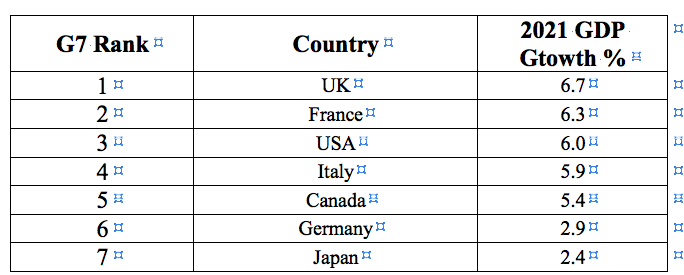
While visiting the UN in New York, Boris took credit for America easing 18 months of travel restrictions for Britons the country and asserted his government were clearly ahead in creating jobs and prosperity because “the OECD have projected that Britain now has the fastest GDP growth rate for this year in the G7”.

This correct but, like most Johnsonian pronouncements, misleading.

How so, if this is factually correct? Well, during the worst of the pandemic, government statements, via a pliant media, carried the story that the UK was dealing with Covid better than anyone. That Korea, Singapore, New Zealand and many other places suffered few cases and far fewer deaths, was under-reported. The UK did hear of Italy’s terrible outbreak at the start and how slow vaccine roll-out was in the EU. But when the EU performance overtook the UK, reporting went dark.

Now, in the run-up to COP-26, the focus has moved to economic recovery. To hear the UK government tell it, nobody is recovering better than Britain. Looking at OECD projections for this year only appears to validate this (Table 1).

Table 1—Relative ranking of G7 Countries by 2021 Growth

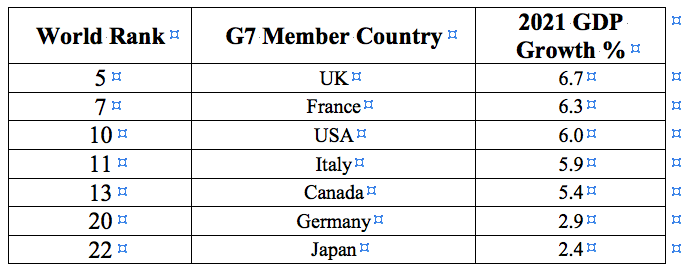
That might look conclusive. But haud oan jist a wee mnnit: isn’t this view rather narrow, taking in just one year? And where are China, Russia and India, not to mention a host of dynamic Asian tigers? Looking at full OECD stats might not change relative order, but it does put world ranking in perspective, as shown in Table 2.

Table 2—World Ranking of G7 Countries by 2021 Growth

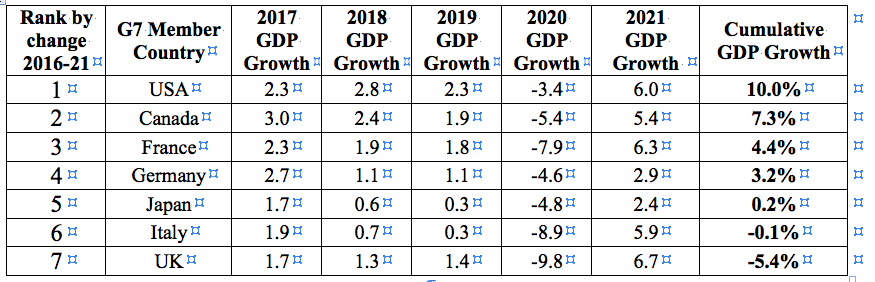
Britain is doing fairly well in fifth place. China and Spain both have higher projected growth than the UK. But neither are G7 members. More importantly, this is just a one year snapshot; taken out of context. Looking back to the Brexit decision, when Britain started to plan its unimpeded future should show the growth potential beginning, Even with recession in economies caused by Covid, if Britain truly achieved a better response than elsewhere, this should show up as less of a ‘hit’ to UK prosperity. Comparisons over the five years to date should show how well economies had been managed through these difficult times. OECD data, ranged by change over that time are shown in Table 3.

Table 3—Ranking of G7 Countries by GDP Growth 2016-21

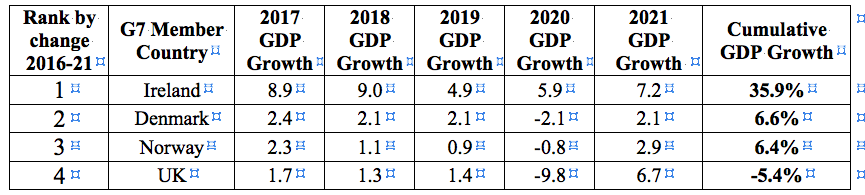
That paints a poorer picture of UK economic achievement by this present Conservative government. But it gets worse. Their insistence that Britain would prosper if freed from the shackles of the EU does not apply to parts of the UK. Indeed they are at pains to stress benefits to Scotland staying in a union with England and painted a picture of dire economic consequences, were it to leave. Scotland often compares itself to nearby countries of similar size enjoying close ties to Europe and comes to a much different conclusion. Who is right?.

Table 4 replaces other G7 members with such nearby countries, again ranking by GDP growth over the same five years as above in Table 3.

Table 4—Ranking of Nearby Small Countries with UK by GDP Growth 2016-21

Here, the UK clearly comes of worst of all, for three reasons:

  1. Sluggish growth for three years after the Brexit decision—UK economy was not at the races even before Covid hit.
  2. Larger-than-anyone-expected drop in UK GDP, due to poorer and more erratic manner of Covid lockdowns
  3. Rebound growth this year comparable to others, but due to having lost so much ground in the first place.

By making a more expansive discussion of OECD statistics, as illustrated above, it is clear to see why the present UK government would do all it can to suppress detailed comparisons with other countries—whether G7 members or even small neighbours. Gullible Britain is buying false goods from a government keener on offering obfuscation than serious progress reports

But the day of reckoning cannot be far off. Exports and imports are both down, due to much increased red tape. The only trade deals struck replace those we had as part of the EU. Far from being dynamic, UK post-Brexit performance has been sluggish, making us the worst in the developed world.

Which perhaps explains why Boris Johnson has been “economic with the veracity”.

Posted in Commerce, Politics | Tagged | Leave a comment

Droning On

Standing less than 2m tall, Boeing’s ScanEagle looks more like something you would find at the local model aero club than anything threatening. But this unmanned aerial vehicle (UAV)—also known as a drone—has become a front-line weapon in the War on Terror. And, increasingly, the weapon of choice for the US military. Originally developed in the early 21st century for reconnaissance purposes, its armed variant represents the bulk of those in existence.

George W. Bush first used them experimentally in 2004. Since then, US presidents and their military have placed increasing reliance on these unmanned weapons that spared lives in executing strikes on elusive and hidden targets, such as terrorists and their camps. 

When he took office, Barack Obama followed the trend toward drone strikes, dramatically increasing their use in the war on terror. Some 1,878 drone strikes in Yemen, Pakistan, and Somalia during Obama’s tenure included 154 strikes in Yemen alone.

That said, Obama did limit the use of drones. Strikes were to be permitted only:

  • Against terrorist targets that posed a “continuing, imminent threat to U.S. persons.”
  • Absent extraordinary circumstances, direct action against an identified high-value terrorist be taken only when there is near certainty that the individual being targeted is in fact the lawful target
  • If the lawful target is known to be located at the place where the action will occur
  • Absent extraordinary circumstances, direct action will be taken only if there is near certainty that the action can be taken without injuring or killing non-combatants.

When Trump took office, all such niceties went out the window. His administration wrote new rules to allow strikes where there was scant or no threat. These could be made against anyone regarded as a terrorist, even by a local military commander. The use of drones and reporting the number of civilians killed by drone strikes ceased. Trump launched 2,243 drone strikes in he first two years alone.

The most notorious Trump strike was in 2020 against Iranian general Qasem Soleimani, killing him and nine others. This violated international law because the U.S. had not provided evidence that Soleimani presented an imminent threat to justify the attack. Trump’s response? “That’s giving a pass to terrorists.

Biden suspended Trump’s rules immediately, and began to review how the policies of both Obama and Trump had worked. In its plan to end “forever wars,” the Biden administration brought drone use to an all-time low.  Unfortunately, an August 29 drone strike on a supposed Al Qaeda cell only killed 10 civilians. 

Even if Biden does curtail usage, this does not auger well. For the last century, America has shown an increasing tendency to act in its own interests globally. And ‘act’ has increasingly come to equate to military intervention. (See “The Two Trillion Dollar Tragedy”). Despite repeated setbacks, it is the US military that has repeatedly intervened in execution of foreign policy—and this is likely to continue into future

But because Americans are particularly squeamish about their “boys” coming home in body bags, the use of drones to attack terrorists and other awkward targets without risking any number of soldiers as “boots on the ground” that ground operations require. Despite the appeal to US politicians and military alike, there are significant disadvantages to this approach:

  1. Drones are not cheap. At $800,000 each, they are a bargain, as compared to an F-35, but they require significant technical support and carry expensive stand-off munitions
  2. They have a very limited payload—ideal for surgical strikes against human targets in a very small area, but trivial compared to artillery bombardment.
  3. They lower the bar for military engagement, enabling the US to insert itself into other countries at a much lower cost than in the past.
  4. Like other munitions, drones are indiscriminate who they kill. The ratio of military to civilian deaths is not known, but dozens of civilians at an Afghan wedding were killed by a drone strike in 2008.

This penchant for using force and reluctance to risk American lives to do so does not auger well for discontinuing the use of drones as (in von Clausewitz’s phrase) “diplomacy by other means”. As America continues to lose economic ground to the Chinese, it will be interesting to see whether, in global dominance, the ”Belt and Road” turns out to be mightier than the drone.

(Research material derived from Heather Cox Richardson’s Letter from America)

Posted in Military, Politics | Leave a comment