7: Small Country; Big Future

I owe my opponent an apology. At our final hustings in Haddington, he disputed my claim (in support of our potential for tidal and wave energy) that the coast of Scotland was 6,000 miles long. I was wrong; it’s 20% longer. To quote Wikipedia: “Measured along the mean high water mark the coastline of Scotland is 11,803km in length.” That’s longer than Brazil or Turkey. It is also over six times longer than England.

And it’s not just our coastline that’s big. Our exclusive economic zone extends out to 200 nautical miles and a UN Convention (Articles 77 to 81) define our rights over the continental shelf, including “control of all resources on or under its continental shelf, living or not”, which includes petroleum drilling and submarine cables or pipelines. Britain’s land area of 220,000 sq km is dwarfed by its 7,048,486 sq km of seabed. Even after the UK’s ‘land grab’ by the Scottish Adjacent Waters Boundary Act of 1999 that stole a triangular chunk of the North Sea apexed at Berwick, by this measure Scotland is four times the size of England.

So when last night’s BBC2 Coast programme focussed on Norway (with even longer coast and bigger seabed than us) exporting one fifth of the UK’s gas consumption to the UK, it was another wake-up call to Scotland’s renewables future. Their gas processing plant is powered by green hydro-electricity; most of the country runs on renewables already; they are even developing osmosis power generation from salt/fresh interfaces for use where rivers enter the sea.

How obvious does it have to be for us to get it? Scotland could be a giant in renewable energy from untapped potential in our seas. Tidal power floods our endless coast; our fresh water resources are far larger than our southern neighbour’s. We should stop being distracted by others’ self-interest and unleash our second industrial revolution by following Norway’s lead towards a hugely profitable green future.

Global Tidal Potential
Posted in Commerce, Environment | Tagged | 1 Comment

8: Calling All Conservatives

It’s all very well for David Cameron to come within an inch of suggesting that Conservatives should vote tactically, i.e. for the SNP. But, even with that endorsement and the glib, condescending tone of Ed Balls’ recent visit to goad you, I’m still not sure that many of the true blue would follow such guidance without further incentive.

Allow me to offer the circa 6,000 Conservatves in East Lothian a cast-iron case.

First of all, whatever misgivings you may have about independence, there would have to be a full referendum before any move in that direction, even if the SNP return as the Scottish Government. There is little else in our manifesto to disturb you. Second, the sole alternative to the SNP here is Labour. However loyal you may be to the Conservative cause, there is no more chance of winning here than of Annabelle entering Bute House this time round. Consider us the lesser of evils.

But finally, and most compelling, if you are genuinely enthused with the prospect of electing Derek Brownlee—a capable young man who has earned much respect—you don’t even have to vote for him. As well as standing in East Lothian, he is top of the Conservative list for South of Scotland. Unless the Conservative vote drops below 7% (something nobody expects) he will be elected as a list MSP automatically. Voting for him with your constituency vote would simply increases the chance that Labour will retain East Lothian, despite the strongest threat they have ever seen.

So don’t waste your vote on third place: vote for Dave Berry and the SNP. While Leader of ELC, Dave worked with the Conservative group there to the benefit of East Lothian. Voting for Dave gives you the best of three worlds, with no down side:

  1. Your man Derek Brownlee is elected anyway
  2. Dave Berry, a formidable local champion, is elected
  3. Labour (and their taking East Lothian for granted) comes to an end
Is this not something worth considering?
Posted in Politics | Tagged | Leave a comment

9: Nae Hidey-Hole

Our campaign has been from one end of East Lothian to the other. It has been an eye-opener for me as candidate because, having represented one area for 12 years (after half that time campaigning across the county as SNP organiser) I confess that I was not as up-to-date about some areas as I might have been. Many new streets have appeared at Windygoul (Tranent), Cuthill (Prestonpans) and Spott Road (Dunbar) as well as more minor developments, changing the demographics of the county.

But a more subtle shift has also been occurring in council estates dotted across the landscape. ELC has always looked after its houses and this Administration takes as much pride as the previous in maintaining their high quality. As a result, unlike estates elsewhere in Scotland, East Lothian’s council estates have improved in quality.

This is only in part from council house sales (Now up to 2 in 3) that provide both new doors and various improvements but also stronger pride in community, as evidenced by the growth in tenants & residents’ panels (TRP). What strikes any visitor, whether in the Trees (Dunbar), Nungate (Haddington) or the street maze of Ormiston is the trig sense of the place—tidy gardens, rafts of little improvements, minimal litter and folk being neighbourly. Where once things were run-down, little of that is in evidence as people respond with pride in their area.

These are the areas with the biggest change in political attitudes too. Whereas they might once have blindly supported Labour to secure more handouts, in these times when any money is tight, people are becoming more self-reliant and less wedded to obligations that come from being dependent. Once solid Labour bedrock, these areas are bcoming very mixed politically. It’s a sea-change; it’s major; no matter what the outcome of next week’s election, it has yet to run its full course. For Labour, there’s nae hidey-hole any more.

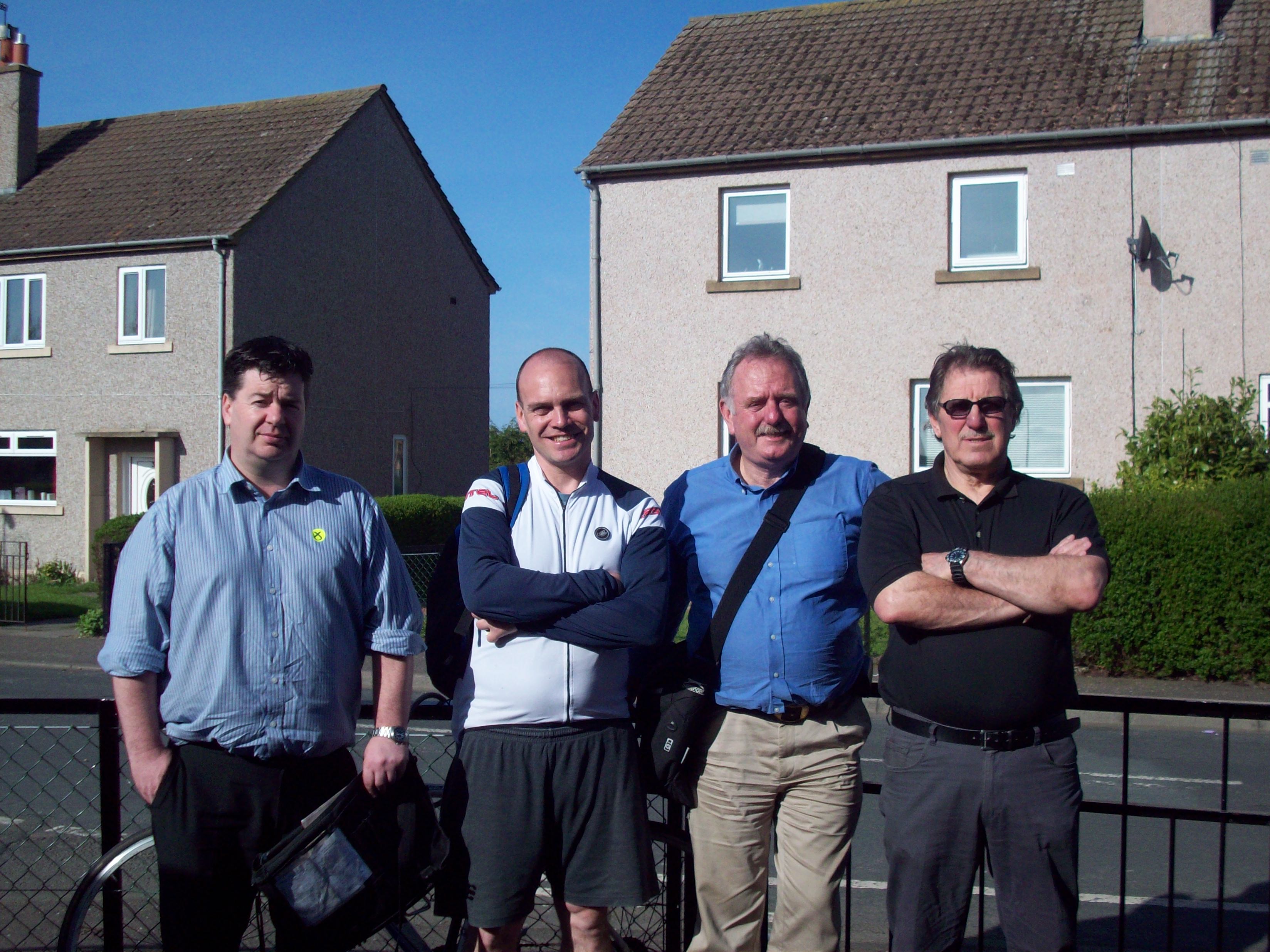
The Ormiston Squad: Ross, Jim, Dave, Mark

Posted in Community | Tagged | Leave a comment

10 Days to Decide

Reading the Sunday papers before setting off round the doorsteps again was really encouraging with another dynamite poll for the SNP that puts the  SNP 13% ahead of Labour and even MacWhirter’s always-measured blog can’t quite stifle a tone of wonderment. But today I was struck by a discrepancy. Whereas you can almost bet that most media issues (pensions; housing; even immigration) will crop up on whatever set of doorsteps you’re on, sectarianism does not and football itself only gets mentioned if you’re interrupting a match.

It’s not that sectarianism doesn’t exist in East Lothian but it is a shadow of its importance in West Central Scotland—a fact highlighted yet again by recent failed attempts to send parcel bombs to Celtic supporters. Anywhere else in the country, such events would meet incredulity but there, however unacceptable, it’s seen as a regrettable part of the culture and reason for another 1,000 police to deploy at the next Old Firm match with collective fingers crossed.

Pride in your culture is a force for good—but not at the expense of any other culture. Glasgow formed as our cultural melting pot and that rich diversity gifted us all an outpouring of art and humour, as well as industry and sport. When the Clyde rang to a billion rivets, Old Firm matches were already intense but the chants, the flags, the violence mostly date from a decline in work and of pride in other things. In post-industrial Glasgow, pride has grown rarer. Many found it in football but, in as lively and gregarious city as Glasgow, the intensity seems to have got out of hand.

It is all very well for clubs and police to promise tough action against sectarianism and for authorities to purge any remnant of discrimination but people will always want to belong to something larger than themselves, something in which to take pride, however vicariously, especially when life has dealt them a poor hand.

Until we in Scotland accept that all of us must create new purpose for Glasgow, where it rediscovers its rightful place as the engine of Scotland, a cultural and economic dynamo that drives the country, we will find our future fragile if its economy stumbles. Then its feisty people will put their energies into such causes as are available to them. Football’s a great game but Glasgow could again be famous for much more than just the Old Firm.

Posted in Community | Tagged | Leave a comment

11: Not Part of the Plan

As witnessed by the front page of the Courier a couple of weeks back, a local debate on 500 houses planned for Grange Road in North Berwick has resurfaced. This echoes headlines earlier this year about 750 houses at Letham in Haddington or 1,000+ at Blindwells in the West. While I do not wish to prejudge any planning application associated with these, the chances of approval are high because housing development on all three was clearly indicated in the adopted Local Plan of 2008. Protest might be more effective if it were to consider how new residents of any of these could earn a crust.

For that is the tragedy of the last fifty years across East Lothian: a boom in building; an influx of residents, then daily exodus to where the jobs are. Not all effects of this have been negative. Train services have improved, with civic infrastructure—schools, libraries, sports centres, etc—part funded by developers. But the net effect is imbalance. Our towns provide jobs for only a fraction of their residents. Good jobs are in Edinburgh or Livingston; East Lothian’s economic backwater has a per capita GDP below Turkey’s.

When challenged about this, council planners and EDU have shrugged, claiming there was no demand for business land; Spott Road has unwanted space, the Mitsubishi, Mid Road and Ben Sayers factories all stand empty, along with Macmerry offices and units. What an unimaginative counsel of despair from those in charge of our county’s future!

Edinburgh made (and still makes) a bundle on the Gyle. By buying and developing acres of land that would be serviced by the (then) new A720 and two new stations, they took Edinburgh business from RBS to two-man consultancies out of the West End and into the 21st century. We need nothing on that scale. But why aren’t the fields around both Musselburgh and Wallyford stations, with their instant A1/A720 access not part of our plans? Elvingston Science Park at Gladsmuir is another model; why aren’t similar schemes proposed adjacent to Longniddry or Drem (or for that matter, East Fortune and East Linton) stations?

If keeping industrial units at Macmerry filled is all the horizon our ambition can see, it’s time we shook up the smug complacency of our planners, who seem to think that by avoiding prosecution by house developers, they have fully discharged professional duty and earned one of the few professional salaries available within East Lothian.

Posted in Commerce, Environment | Tagged | Leave a comment

12: If I Were a Betting Man…

A Happy St George’s Day to all our English readers!

Confronted yesterday by one of my tireless volunteers who smirked “I’m going to make money off you”, I was unsure whether to be happy for them or wonder if my overdraft was under (more) threat. But it turned out that he’d put his money where my mouth is and got 7:1 odds from William Hill before they shortened to 5:1 yesterday. This is encouraging but throws me into a dilemma because, as a sceptical scientist an with understanding of statistics, I’ve never even bought a lottery ticket.

Odds Available on East Lothian Constituency Results April 22nd

I doubt that many local voters consider the betting odds before casting their vote but, unlike the pollsters and their predictions, these odds are life or death to betting companies and you can rest assured that such odds are not offered without solid reasons behind them. Hill’s spokesman Graham Sharpe said: “As the gamble on the SNP winning the Election has gathered pace so have the suggestions that even leader Iain Gray may not be secure in his own constituency – and thus far we haven’t taken a single bet of over £10 on him winning the seat”. 

Which is why when ELC Labour Group Leader Willie Innes is quoted as saying: “Quite honestly, this is just ridiculous. There is absolutely no chance of this happening. I think it is just bravado from the SNP” I get deeply encouraged. I have watched Willie’s plausible bluster get exercised across the council chamber for 12 years now. But, in fact, either he sees his Leader’s future as worth no more than a £10 punt or he hasn’t put any money where his mouth is. Either way, it seems to me he’s actually betting I will win.

‘Scuse me—I’m off down the bookies.

Posted in Politics | Tagged | 1 Comment

13: Unlucky for Some

Into the last but one lap and all four parties in East Lothian are pouring a blizzard of leaflets through letterboxes as the weather stays benign enough for them to get as many feet on the street as they can manage. Compared to so-called ‘target’ seats like Dundee West, there actually aren’t that many, as disillusionment and tight budgets are having an effect. In fact locally, the Lib-Dems are notable by their absence as those they can mobilise are drafted in to defend those seats they had in Edinburgh and the Borders. The Tories locally are playing their normal low-profile phone-oriented campaign of shoring up known supporters and ignoring half the county.

But Labour is scrambling. Not only is their candidate spending most of his time elsewhere—like the surprise appearance yesterday with Gordon Brown to try to win back Dunfermline—but voters are commenting on leaflets that are not only chaotic in both design and message but make bizarre assertions to the amusement of many even in Tranent and the Pans like “fighting for mining communities” when the last mine here closed half a century ago. But what really shows desperation is that candidate-signed “sorry you were out” cards are being put through doors not only when he wasn’t even around but without knocking the door in the first place.

All of which encourages the SNP greatly. Other than media appearances (East Coast FM this morning and Forth FM Tuesday morning) Dave and his team are now focussed following up with voters we had already spoken with, talking to the many we found who were fed up with the party they had once regularly supported but were not yet clear if they would vote SNP. There are so many of them, it’s a daunting task to get round all the doors but it’s most rewarding since half have made peace with whatever dilemma held them back.

Perhaps most telling is are the increasing isolation of solid Labour support. Chapping doors in Muirpark or the Bottom Pans ten years ago was a depressing experience: door after door was once “Nae chance; ah’ve aye been Labour” or even more galling “Ach, ah’d vote fur ye son, but yes’ve nae chance”. A week may be a long time in politics; ten years can make things totally unrecognisable.

"Yes, We Must All Learn to Think for Ourselves!"

Posted in Politics | Tagged | Leave a comment

14: Who Reports on the Reporters?

Anorak that I am, my idea of a time off last night was to head to the David Hume Institute to catch one of their excellent seminars, this time from Blair Jenkins, Fellow of the Carnegie Trust UK  to talk about Journalism in the Age of Disclosure. He was joined on the panel by Athol Duncan, his replacement as Head of News & Current Affairs at the BBC, Iain MacWhirter, the Herald’s political commentator whom I regard as the best in Scotland and Prof. Philip Schlesinger, Chair of Ofcom.

Blair’s argument was that disclosure may prevent a culture of abuse but that requires a higher level of journalism as the scrutiny applies there as well. Given the shrinking revenues for print media and that few have cracked how quality journalism can tap commercial opportunity in the internet, there is a direct conflict here between bigger demand but fewer resources.

This can lead to superficial relations with those being reported on, as when a cosy US media missed the financial crash of 2008. Over here, MacWhirter was alone in ringing the alarm. However the MP expenses story was one of exemplary investigative journalism by the Telegraph, which, despite is long support for the Tory party, treated all MPs to the same scrutiny and spotlit abuse, irrespective of party. In contrast, the sting on L-D ministers that caught Vince Cable fulminating about Murdoch broke many rules as entrapment journalism.

The most interesting part was where this all might lead and whether the relatively scarce media in Scotland could survive as a financially viable centre in its own right. The panel agreed that outsourcing the difficult investigative work to bodies like Pro Publica in the US, much as TV production is frequently done by outside companies may be the model. But until the Press Complaints Commission becomes independent of the business itself, they will always suffer suspicion.

Posted in Commerce, Politics | Tagged | Leave a comment

15: Down at the Roots

Our beautiful coast and endless vistas on the Lammermuirs are key parts of our identity but what makes East Lothian so photogenic is our rolling countryside, tended and cropped for centuries by our local farmers. And it’s a varied crop; although livestock has fallen out of favour, cereal and root crops remain strong and pockets of specialist output like Ballencreiff pigs and Belhaven soft fruit both fit well with ELC’s Food & Drink strategy in support of tourism.

The NFU released its own manifesto earlier in the month. In it were a series of broadly couched concerns that I found reasonable and measured. As a local candidate, I have no authority to sign my party up to all it contained. But, if elected as spokesman for East Lothian, I will be its champion and take its farmers’ concerns to the government. For several years I have been chatting informally with the NFU’s East Lothian President, Stuart McNicol of Castleton.

This week’s release of the SNP’s Farming Manifesto 2011 should be good news for our farmers. Its thrust is to ensure that agriculture continues to play a vital role in contributing to Scotland’s sustainable economic growth and that food production remains the primary aim of agriculture in Scotland. At the same time we want our landscapes, biodiversity and water quality protected. We want to support both the rural economy and its infrastructure. This latter is especially vital here, Whereas the Mearns or Buchan suffers little development pressure, we are so close to Edinburgh that the needs of farms and small villages are in danger of being swamped by town priorities and values.

But we will build for the future, supporting the role of tenant farmers and new entrants to the industry. We will also use our experience of the last 4 years to ensure that Scotland’s voice is heard in Brussels so that EU policy is shaped to meet our more particular Scottish needs. As a priority we need, for example, to simplify payments. The continuing administrative problems in England with the Rural Payments Agency means we should reject current proposals by the European Commission, which would see the current complex and bureaucratic system of direct payments replaced by one that could be even worse.

“I am backing the SNP for a second term in government as they have proved themselves to be a full partner in farming, rural issues  and especially Scotland at large.”

—John Kinnaird, livestock & cereal producer of Papple and past NFU Scotland President.

Posted in Commerce, Community, Environment | Tagged | Leave a comment

16: Double Dicker

East Lothian likes to see itself as a cut above many other places. But one area where locals think it comes nearer the bottom of the league is in bus services. To some extent, this isn’t fair. The two main bus corridors in the West: through Musselburgh to Wallyford and Tranent and through Musselburgh to Prestonpans and Port Seton are so well served there are complaints about the number of buses clogging the High Street and Newbigging. It’s also possible to go anywhere in Edinburgh for £1.20.

But outside this area the story’s very different. Why? It’s all down to deregulation, a Thatcher favourite that New Labour embraced as with so much else. Bus companies can run services and charge fares as they like. In big cities like Glasgow, competition might keep down fares and sharpen competition but in rural East Lothian, that’s a cruel joke. First runs the two main bus routes through the rural 80% of the county and, lacking competition, charge what they like: it’s over a fiver return from East Linton to Haddington. On vital routes they deem unprofitable, the council picks up the tab, which is where most of their £750,000 bus budget goes.

Recently First got outrageous, cutting the Dunbar service to hourly, pulling it from the Brodie Road estates it served and running a fleet of tired coaches with steps so high even elderly and buggies can’t board, let alone disabled. Even if you can get on, it won’t take you to Tranent because the service is now ‘express’. Pencaitland and Ormiston are already up in arms for what they get charged to reach Tranent and now Elphinstone is to lose its weekend service and Port Seton its expresses.

The result is that bus travel is getting a terrible name, which is unfair to Eve’s, Prentice and Perryman’s, small bus companies who all run excellent local services with council help. But should any of them try to compete with First, they would lose the ensuing bus war of cross-subsidised low fares and frequent service until they gave up. Then back to indifferent service with high fares.

The only viable solution is to re-regulate buses and put them under local control. Then sensible ideas like transfers and day tickets—maybe even London-style Oyster swipe cards would make using buses so much faster, easier, better and thereby popular. Labour dickered for ten years then brought a half-baked bill that the last government dickered with too. If elected, I commit to putting s bus re-regulation bill among my top priorites.

Firsts E. Lothian Route Map. Note how, as well as geography, they ignore all competition, including trains.

Posted in Transport | Tagged | 3 Comments