
Minnesota Ice Tea Party

"When fascism comes to America, it will be wrapped in a flag and carrying a cross” ~ Sinclair Lewis, 1836

While Scotland does not follow American politics closely, most will recall Sarah Palin as the ‘running mate’ of John McCain, Republican candidate defeated by Barack Obama in 2008. They may not recall the Alaska governor’s right-wing agenda and therefore won’t feel alarmed that she has been overtaken on the right by Minnesota Representative Michele Bachman, darling of the Republican right-wing shock troops referred to as the Tea Party movement, named for the infamous incident in Boston harbour (harbor?) that triggered the 1776 war of independence.

No sooner had Michele Bachmann hijacked the Republican presidential contenders’ debate on June 14th to declare she is indeed a candidate for the White House than her newly minted campaign website said she is on her way to “reclaim America”. Americans may also know less about the first Republican congresswoman from Minnesota than they do of that other Tea Party darling Sarah Palin. But we and they are about to learn. Fast.

During a 2008 interview she criticised Barack Obama for his association with Jeremiah Wright and Bill Ayers, saying “…usually we associate with people who have similar ideas to us, and it seems that it calls into question what Barack Obama’s true beliefs, values and thoughts are…I am very concerned that he may have anti-American views.”  Don’t be deceived that this sounds like laughable Soviet revisionism-speak; in the States, that’s as good as calling the President a traitor who consorts with terrorists. In the recent jockeying, front-runner Mitt Romney’s ability to speak French was framed by Bachmann as unpatriotic: “All we have to know is the president deferred leadership in Libya to France. That’s all we need to know.” Republicans do not like “cheese-eating surrender monkeys.” (originally Groundskeeper Willie in a 1995 Simpsons episode). This woman can’t be stupid: she has a BA and a law degree. Yet she believes global warming is a hoax because “carbon dioxide occurs naturally and therefore can’t be harmful to us”.

If she were some also-ran, she could be dismissed as the usual extremist Republican
who throws their hat into the presidential short-list ring. But this week’s news is that Bachmann now has a lead over former front-runner, governor Mitt Romney, that may be significantly wider than the 4% margin reflected in last weekend’s Iowa poll. Among voters described as the “most attentive,” Bachmann leads by a much-wider 14-point margin, 32% to 18%. Attentive voters are more likely to turn out to vote. The rest of the field, including Newt “You-Can’t-Trust-Anyone-with-Power” Gingrich, are in the single-digit dust. Palin has not declared and now is too late to. That means the odds are on a female Republican candidate more right-wing than Reagan or either Bush in 2012.

Why should we sweat it? Barack roared into power in 2008 and should ace 2012 after all his innovation like the health initiative, right? Well, yes, after the stasis and errors of Dubya, he was a breath of fresh air. But if the recession was blamed on Bush allowing Wall Street excesses, the economic bite, the 9.5% jobless rate and accelerated decline in American manufacturing (not to mention a whopping trade imbalance with the Chinese) means that Joe Sixpack is pointing at the White House as responsible.

Minnesota is normally Democrat and not radical country. It is known for dairy products and down-home small town America of the Coen Brothers’ Fargo or Garrison Keillor’s Prairie Home Companion (“where all the children are above average”). Bachmann claims to be the new broom from there to clean out the Augean stables. She has the cash backing and is gaining the momentum. America may be a big country but its politics are that simple.

Posted in Politics | Tagged | Leave a comment

Christie Eleison VI

What with Harry Potter’s latest wheeze or Kate wowing the Canadians or News of the Screws screwing itself, it’s been an packed week in the normally slack ‘silly season’. Long gone from anyone’s radar is the Christie report, about which we’ve been banging on.

This is a shame. Not always known for their decisiveness, CoSLA has come out so strongly in support of Christie that they didn’t even want to wait for official government adoption of the report before starting to implement it. In their words:

The Commission’s report concludes that nothing less than an urgent and sustained programme of reform embracing a new collaborative culture will allow Scotland to deal with a fiscal landscape where budgets will not return to 2010 levels for 16 years. In terms of a route map, this is a journey that local government is both willing and able to travel. We are pleased to see the link between circumstance and demand for services at last being recognised.  For this reason we are also pleased that the report recommends more spend on prevention and that there is a real focus towards integration, decentralisation and localism. We also welcome the fact that he is not proposing reform in the abstract, he is very clear that all reform must meet his criteria and we look forward to working with the Government to ensure that this is the case.”

Oh, really?

Little of Christie is new. It belongs to theories of local government predating the 1976 reorganisation that set up District Councils to be more locally responsive in matters like planning, culture or landscaping; dependent on local involvement to work properly. Sadly, what we got was Strathclyde—and what we have now is more like Strathclyde than any of the districts, let alone the now-defunct pre-1976 burghs.

It’s a shame there is little in CoSLA’s response to quibble with, especially as such harmony between them and a major government report is not the general rule. But what both seem to be blithely overlooking is whether an “integrated, decentralised and localised” system is achievable with the tools available. Most Scottish councils—especially those run by Labour pre-2007—are official-driven. That means all but the most general strategic policy decisions are taken by officers. Many pretend otherwise, but council meetings are boring, rubber-stamp affairs: actual debate as to what gets done how happens in non-public senior management team and departmental meetings. Almost all those attending those have been in local government all their careers.

We are supposed to believe that such people, used to cosy control for decades, are going to fling open their doors for amateur oiks to wage fragmented untidy causes all over their nice, tidy closed-shop budget decisions? I think not. Officials have spent the last thirty-five years bedding into the fabric of ‘big’ councils, where their writ now runs. Lip-service is paid to ‘control’ by councillors. But strategy, while cited, is barely understood, goal-setting and evaluation are unknown and council ‘spokespersons’ only vaguely aware of operational details, let alone where any bodies are buried.

People like Bill Jamieson can tub-thump about how the looming pensions squeeze in the public sector must be addressed properly. And they may be right: as a fiscal time-bomb, it could bankrupt the best-laid budget schemes o’ mice and men. But, even if such alligators were eliminated, we are still in a swamp. To expect the present management of councils to embrace and address Christie would not just be expecting turkeys to vote for Christmas; it would be expecting the medieval city states of Italy—cultured, stable and admired as they were—to undertake a space programme.

Posted in Politics | Tagged | Leave a comment

Crueller Even Than the Sea

I had been convinced that my second guide trip this season to the Isle of May would be cancelled today. The Met Office inshore forecast for Forth was Southeasterly force 5 or 6 wind, moderate to rough sea state, poor visibility and rain, with SEPA and EL Council backing that up with a flood warning because of so much rain. We were to land at Kirkhaven with broken sea running out of the Northeast at the bottom of a Spring tide.

But the day dawned and few of the predictions turned out as dire as forecast. The worst was heading into a broken sea on the passage across which meant plenty spray, slow progress and a lot of work for skipper Callum. But, once there, the rain held off and the biggest flocks of puffins I have ever seen stood about in amicable battalions like mini-penguins or clattered overhead in dense clouds. They seem to like it best when overcast and dull and were not the least deterred from fishing by the broken water nearby.

But my vivid memory of this trip will be of learning two more of the wrecks that pepper the outer Forth, their story being particularly tragic. It was May 7th 1945. The BBC had announced peace with Germany had finally been signed, to take effect at midnight, with two days of celebrations to follow. Among those cheering (and perhaps starting the celebrations early) were the crews manning the Fixed Defence Stations on the May and at Canty Bay who monitored the submarine detector loops laid across the mouth of the Forth.  Singularly displeased with this news were the sailors on the five ships of convoy EH51 that had just left Methil for Belfast, escorted by three trawlers.

They would have even been more displeased to know that U-2336 under Kapitanleutnant Klusemeier had slipped undetected inside the Forth. This was one of the revolutionary Type XXIII ‘Walther’ boats, capable of unheard-of submerged durations and speeds. Had they been introduced earlier, they could have starved Britain out of the war. Because they operated submerged, Klusemeier had not heard the OKM order of May 4th to desist from further attacks, nor that day’s one calling a midnight ceasefire.

At 11pm, the light was almost gone as the convoy steered 70deg in calm seas to clear the South Horn of the May. The Canadian (but British-crewed) Avondale Park (2,878 tons) was leading the starboard column when a torpedo hit her engine room, destroying the starboard lifeboat. As she settled by the stern, some of her crew got away on a raft on the poop deck. The next ship in the column, the Norwegian collier Sneland I (1,791 tons) had to swerve to port to avoid the sinking ship. As she drew level, she too was struck by a torpedo abaft her No.2 hold and sank within two minutes.

The escorting trawlers, though small, did have asdic and depth charges and attacked a submerged contact without effect. They picked up a number of survivors, finding them in the dark by the small light carried on new lifebelts. A total of 55 survivors were landed  back at Methil when the convoy turned back. But neither Chief Engineer George Anderson, nor Donkeyman William Harvey, who had gone into the flooding engine room  of Avondale Park, survived, nor did seven crew from the Sneland I, who had too little time to escape, including her Captain, Johannes Legland.

U-2336 returned to Kiel unharmed on May 14th and surrendered to the British. Being a coastal submarine, it had carried only two torpedoes—and could hardly have caused more carnage on its one and only voyage. But, cruellest of all, the nine deaths it caused were pointless, with peace less than an hour away. Both wrecks, the last casualties of the six-year-long sea war, stand as their monument 8 metres high in 45 metres of water little more than a mile off the South Horn of the May.

Posted in Community, Transport | Tagged | 1 Comment

We’re Number (Fifty-) One!

We are always being told how, being a part of Britain, Scotland derives major benefits from “being at the top table” or “punching far above our weight”. Let’s assume such logic isn’t mince. Well, why mess about with the has-beens and also-rans like Britain? Let’s go straight to superpower without waiting our turn to pass ‘GO’ or collect 200 squid.

As today is their Independence Day, let’s apply to the US for Scotland to be their 51st state. Just think about the advantages: Obama’s far cooler than Cameron; the US GDP ($14 trillion) is seven times bigger than the UK’s; we wouldn’t wait years to see their soaps; petrol would be under 50p a litre and you wouldn’t need a passport to shop New York or surf Malibu. And if you’re keen on really punching above your weight, how about being backed by a dozen carrier strike forces and three divisions of marines to tear the heads off anyone who looks sideways at Scotland?

Just think: a refrigerator the size of a car, a car the size of a house and a house the size of several Inner Hebrides stuck together. And they would love us: all our golf, whisky and tartan-laced history. 20,000,000 Americans (and 75% of their presidents) claim Scottish ancestry; how hard could it be to persuade a majority to let us meld with the colonies instead of being stuck with the colonisers? After all, where to you think McDonalds came from in the first place? Now’s the day and now’s the hour…altogether now:

Oh, say, can you see, by the dawn’s early light…

Posted in Uncategorized | Leave a comment

Christie Eleison V

From blog hits, it’s clear that dissection of the Christie Report makes less than riveting reading for our readers. But we make no apology for this instalment—nor for one more to come (anorak it may be, but it matters, guys). In the first four parts we’ve examined: the state we’re in (I); the recommendations (II); medicine for the NHS juggernaut (III); and public sector workers’ increasingly bolshy stance (IV). What we are considering today is, given ‘parity of esteem’ between government and councils, if “physician, heal thyself“ is a plausible, or even sensible, directive to councils.

Councils have a poor record of self-analysis and none on constructive reorganisation. They fought both 1976 and the 1996 UK-government-driven re-organisations tooth and nail. Since then, the net number of senior managers, which ballooned under the expanding budgets up to 2008, has failed to drop in the more stringent times since. And, while setting up Arm’s Length Executive Organisations (ALEOs) has shown some new thinking in places as diverse as Glasgow and East Lothian, the bulk of council business is still integral and by departments congruous with the council area.

After the 2007 change in most council administrations (and given a boost by the subsequent financial debacle) many councils formed local task forces to explore shared services (ELBF around Edinburgh and Clyde Valley Partnership around Glasgow). There were also efforts at national co-operation like Scotland Excel to combine purchasing and joint efforts for Stirling/Clacks and East/Midlothian to share back office and central control of Education and Children’s Services. All this was supported by CoSLA, the Improvement Service and the Scottish Government.

So, four years on, where are the victories, the better services, the streamlined delivery, let alone the savings? So far, bupkiss; zilch; nada. Stirling and Clacks have tied the knot and East/Midlothian may do so this year but any impact will be seen next year. Scotland Excel has a staff over 100 and is indeed driving down the cost of paper clips but councils still insist on buying big Tonka Toy trucks with their own special fixtures so worrying about the pennies while the pounds flood out the door makes SE’s £3.7m cost look like spend to spend more than to save.

But most telling has been the total failure of shared services—where one council provides all the service to another for a charge (ideally less than the original service cost). While Scottish Borders does get many roads contracts from elsewhere, nothing like a real shared service exists. Why 32 payroll departments or housing advice or welfare rights or a myriad back-office functions need be repeated in every city hall across Scotland is unclear. But ask a director and they will say “my department’s very efficient and we would not get that service from somewhere else”. Ask, if it’s that good then, why it cannot be sold as a service to another council and you get “they require a different specification and it would cost us money to run two systems”.

Despite three years of dire warnings from government and their administrations about budget cuts, it is not the staff—bolshy or no—who are the problem. It is the Heads of Service (on £80k+), backed up by their Directors (on £100k+) who, having enjoyed cushy 5% increments to budgets for a decade simply seem incapable of appropriate action. Across Scotland, we pay council senior management teams £100m; we are not getting our money’s worth. Drastic as wholesale government intervention may be, heads will need to roll pour encourager les autres. Public service management, never having seen calamitous times, badly needs a crash course in dealing with them.

Posted in Politics | Tagged , | 2 Comments

No’ Awa’ Tae Bide Awa’?

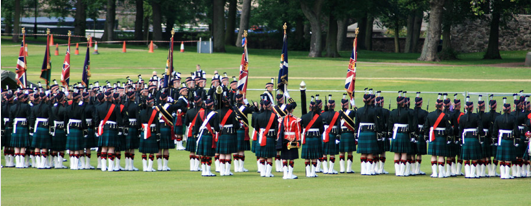
As part of her visit to open wur pairliament, this weekend, Queen Elizabeth presented new colours to six of the seven battalions of the Royal Regiment of Scotland (RRS: the 4th  Bn is absent, serving in Helmand). Those with little empathy for the military may not appreciate the symbolism and seriousness attached to poles with flags hanging off. But when you are asking young men to lay their lives on the line, military discipline is all the more effective if honed by ideals, self-belief and a little shared symbolism.

The former regiments each had their own pair of colours—a Queen’s colour, which held battle honours from two world wars and a Regimental colour, carrying battle honours from a myriad of campaigns from the 17th century to Iraq. Anyone visiting les Invalides in Paris will be struck by the serried rows of ragged regimental colours with similar battle honours, all gathered together in peace at last. Originally carried ahead into battle, colours would be defended to the death: losing them was disgrace.

But, being a single regiment now, all the honours accumulated by all the infantry regiments of what could be regarded as the Scottish Army had to be squeezed onto two flags—an impossible task. The Queen’s colour carries 32 honours (arbitrarily chosen as common to two or more of the battalions). The Regimental colour carries the maximum 46 of the 339 honours to which they were entitled. What horse trading decided which remains unknown. But the real tragedy is that five active ‘regiments’ that became component battalions were themselves the result of many amalgamations. Names of famous regiments, not to mention deeds, lie buried under re-organisation.

Those with little military interest may skip this paragraph but others interested in the scale of amalgamation, read on. The Argylls (5th Bn RRS) came from merging the 91st and 93rd Highlanders: the 71st (Fraser) and 74th (McLeod) Highlanders amalgamated to form the Highland Light Infantry which combined with 21st (Royal Scots Fusiliers) to form the Royal Highland Fusiliers (2nd Bn RRS); the 75th and 92nd became the Gordons and, together with 72nd and 78th, who formed the Seaforths, merged with the Queen’s Own Cameron Highlanders to form the Highlanders (4th Bn RRS); the Black Watch (in Gaelic Am Freiceadan Dubh, 3rd Bn RRS), started as guard companies along the Highland line and reformed from the 42nd and 73rd; these four remaining Highland regiments amalgamated with the merged lowland Royal Scots and Royal Scottish Borderers (1st Bn RRS) to form the Royal Regiment in 2006. The 51st Highland (7th Bn RRS) and 52nd Lowland (6th Bn RRS) are Territorial (i.e. reserve) battalions. Others were already history; the Cameronians started as Covenanters with muskets, became the 26th Foot, absorbed the 90th Perthshire Light Infantry to disband in 1967; eight yeomanry regiments were disbanded post-WW2.

A number of other Scottish units, such as the Scots Guards, do still exist. But the core of any pretence at a ‘Scottish Army’ is the infantry. Even though we no longer aspire to empire, the scale of reduction is massive and the extent to which dogged courage, occasional brilliance and fearsome reputations have drifted from common knowledge is deplorable. Even allowing for huge declines in Highland populations, Scottish infantry has suffered disproportionate disbandment. Over three hundred years, the British Army earned an enviable reputation for professional soldiering, among which the ‘Ladies from Hell’ figured prominently and enthusiastically. Whether the same fierce pride and tough resolution that built their reputation can be maintained as a single regiment in a declining UK defence force is a question still with no answer.

Royal Regiment of Scotland on Parade for Presentation of Colours in Holyrood Park

Posted in Uncategorized | Tagged | Leave a comment

Christie Eleison IV

In earlier segments of this huge topic I highlighted approaching problems in public services and suggested how the NHS half of expenditure might start addressing them. But pivotal across all public services are staff, whose engagement and motivation will be crucial. In section 3.10, the Christie Report states: “Our evidence demonstrates the need for public services to become outcome-focussed, integrated and collaborative. They must become transparent, community-driven and  designed around users’ needs. They should focus on prevention and early intervention.” Unfortunately, few staff think in such terms at present.

In fact, many are absorbed by issues like pension reform and typically see their final salary pension as a basic right. This view is shared across sectors and unions, so that an industrial showdown looks likely. What exacerbates this is the union principle of insisting that existing pay and conditions cannot worsen, even if this means colleagues losing jobs because shrinking money can stretch only to fewer numbers.

Heavyweight commentators are condemning this approach as short-sighted. The unions have chosen very weak ground. They scarcely have the support of their own members, let alone the rest of the public.” (Fraser Nelson, The Spectator, 30.6.11). “Just as Margaret Thatcher took on the miners on her own terrain, so Cameron and Osborne have chosen the ground on which they hope to defeat the likes of Bob Crow and Dave Prentis: pensions. The unions are striking in defence of incredibly expensive final salary pensions that are unavailable to the vast majority of Britain’s 28 million workers.” (Iain MacWhirter, The Herald, 30.6.11).

Unions cite that most public service pensions are only a few hundred a month (£7.800 p.a., according to Hutton) and that many public service workers are low-paid. This is true; such people have not been well served by the system. But the bulk of workers employed through the noughties public service boom have yet to retire, especially senior staff, where Chief Executives over £100,000 and Directors over £80,000 are the norm (over 250 such people in councils alone). Elsewhere, bank-scale bonuses compound the problem (five Scottish Water executives shared a one-off £450,000 bonus this week).

Marchers on Thursday argued for their pensions as their right. A decade ago when the private sector was booming, public sector pay certainly lagged. Job security and a modest pension were seen as compensation for that. However, average earnings in the public sector are now higher than in the private. Add in the devastating effect of the recent recession, add in that one million private sector workers have been forced to swap secure full-time jobs for part-time work with no tenure and no prospects, add in that half of them have no pension beyond the paltry state provision…and the idea that teachers or anyone can retire aged 60, and be paid for by people who have to work until they’re 66 starts to look foolish, if not outright selfish.

The days when nursing or any other public service was seen as a calling, rather than a career, are long gone. But Christie’s advocacy for more symbiotic working (public service organisations must engage with people and communities directly, acknowledging their ultimate authority in the interests of fairness and legitimacy”) is completely oot the windae, unless the hardship now facing most in the private sector is partly shared by the public. To say they’ll consider no cuts that will fund banker’s bonuses (vile though they are) is like throwing the crew out of lifeboats on the Titanic because they worked for the officers on the bridge who got everyone into this mess.

Posted in Commerce, Community, Politics | Tagged | Leave a comment

I Say! How Soup-ah!

With my iffy background as a prefab schemie, it never ceases to amaze me how the other half lives, still more that I seem to be on circulation lists that consider me one of them. The one that regularly has me falling about is Debrett’s missive, with its etiquette tips and gushing sales jobs for Fortnum & Masons, Justin le Blank, et al:

“From apricots and artichokes to watercress and wood pigeon, July is a gourmet month, and our list of seasonal foods will inspire you to indulge in some midsummer entertaining. July is also a great month for fish-lovers, with cod, crab, haddock, halibut, herring, John Dory, lemon sole, lobster, mackerel, plaice, salmon, sardines, sea bass, and sea trout all in season. So now is the ideal time to indulge in some chilled white wine. Remember to serve white wine in a narrow glass, which should always be held by the stem to avoid warming the wine. 

“Always try and eat a canapé in one mouthful, without overfilling your mouth or having to chew extensively mid-conversation. If a delicacy looks challenging or messy, politely decline and wait for something more manageable to come round. Watch your timing. Only tuck in when you aren’t about to be introduced to someone, or are mid-conversation and you’re going to have to speak.

“Never put something you’ve eaten off (spoon, skewer, etc)  back on a tray that is still circulating. Equally, never double dip a half-eaten canapé in a communal sauce dish.”

I don’t know how I managed to survive the twin threats of social ostracism and starvation before now. And, of course, ladies: never lick any spillage off a gentleman’s cravat, unless only footmen are about…and then only if they can be relied on to be discreet.

“And there are still so many summer highlights to come, from Henley Royal Regatta and Glorious Goodwood to Glyndbourne Opera Festival and open air theatre in Regent’s Park!”

Until then, toodle pip!

Posted in Uncategorized | Tagged | Leave a comment

Christie Eleison III

Given that the NHS forms half of the £20bn-plus public sector in Scotland, it is disappointing that the Christie report makes only tangential reference to it, and then mostly to plead for better integration with social services. But, however much of a political shibboleth it is, however well loved and groundbreaking, the NHS is a monster by anyone’s standards. Taken as a UK whole, if it were a country, it would come in at No.67 in the world—behind Hungary, but ahead of Morocco and Vietnam.

Dealing with even the Scottish 10% of it is daunting. Quite apart from powerful interests like the BMA, the NHS here is divided into a dozen or so Primary Health Trusts and a myriad of supporting orgainsations like the Scottish Ambulance Service, none of which have so much as a sniff of democratic control, other than by ministers.

NHS "Structure"—There Will Be a Quiz at the End of this Article

Leaving aside NHS24 and actual patient information, finding anything out is hard as you’re bamboozled by a myriad of websites, such as the so-called ‘information’ site:

http://www.ic.nhs.uk/statistics-and-data-collections/publications-calendar

This site is UK wide and might serve as a lesson in information overload all by itself. They have so many TLAs (three-letter acronyms) that they have an entire section of alphabet soup called ‘jargon-busting’. Of the 168,000 who work for the NHS in Scotland, a reassuring 67,000 (around 40%) are nurses and midwives. But a further 30,500 (18.2%) are in ‘administration’, plus a further 20,000 (11.8%) in ‘support’. So, for every worker directly involved with patients there is another who is not.

All modern organisations need some logistical ‘tail’ and cooks, cleaners and porters are obviously necessary in any hospital. But 30,500 administrators? What are they doing? In another life, I had some experience of NHS Trust backroom operations. They had all the trappings of modern management—KPIs (‘key performance indicators’ to those who don’t speak TLA) meetings, supervisors, budgets, the works.

But, lift any rock and some ugly beasties emerged. They counted meals as satisfactory if they had been touched (reminded me of a joke sign outside a hamburger stand: “17 billion served; 14 billion eaten; 9 billion digested”). They thought their porters were efficiently used because their logging system showed they were over 75% active—turned out they were only measuring 45 general porters, not those in X-ray or sorting mail or delivering pharmaceuticals, etc, etc (a total of almost 100 not being logged). Best of all was the utility bill for their main hospital paid from a single pot. No department had any incentive to save energy. When Ward 2 got too warm, they opened the windows while their electricity bill went through the roof.

Having a quarter century of management experience here and abroad, it was not rocket science to see where the NHS could make real savings and keep frontline services. But in their rush to hire administrators in the nineties, the NHS was naive and hired third-rate ones who could not hack it in the private sector boom at the time. Whether we have the political stomach to hack away such waste while the NHS is held as a shibboleth remains to be seen. But no tightening of public sector belts can be effective without starting with the half of public money that goes here.

Posted in Community, Politics | Tagged | Leave a comment

Christie Eleison II

Having had the chance to read and digest yesterday’s release of the Christie Commission report, it seems a useful contribution the scale of the future demand for public services but shies badly away from positing real solutions. Statistics quoted for the next 5 (& 15) years make for alarming reading:

  • additional demands on health, social care and justice of more than £9 bn (£27 bn) (National Endowment for Science, Technology & the Arts)
  • the care budget of approximately £4.5 billion will need to increase by £1.1 bn (£3.5 bn) (Scottish Government)
  • if local government services remain as currently configured, a gap of over £3 bn (£9 bn) will arise between demand and available resources Over half of this gap is driven by demand growth. (Strategic Funding Review Group)

Social, as well as financial statistics also make for uncomfortable reading. In the 12 years since devolution, the Scottish Budget has doubled from £16 bn to over £32 bn. Yet many shameful inequality gaps have widened:

  • income of the 30% of our population with the highest incomes, has increased while the 30% with the lowest has been static.
  • In education, the gap between the bottom 20% and the average in  learning outcomes has not changed at all
  • the gap in healthy life expectancy between the 20% most deprived and the 20% least deprived areas has increased from 8 to 13.5 years
  • percentage of life lived with poor health has increased from 12 to 15%.
  • link between deprivation and being a victim of crime is stronger.

The report sensibly states “Until now we have funded that ‘failure demand’ with annually increasing budgets. That is no longer an option.” However, it falls back into pious rectitude in seeking action: “So tackling fundamental inequalities has to be a key objective of public service reform.“

In the next two decades, the number of people aged 60 and over will increase by 50%; numbers aged 75 and over by 84%. These trends affect public expenditure demand, not least because many universal entitlements (e.g. public sector pensions and concessionary travel) are triggered by age criteria alone, irrespective of income or health status.

Their responses to these challenges show the familiar social concerns of the Scottish public sector, couched in language echoed in virtually any statement from Holyrood concerning social policy from any period over the last 12 years:

  • “taking demand out of the system through preventative actions and early intervention to tackle the root causes of inequality and negative outcomes
  • “working more closely with individuals and communities to understand their needs and mobilise a wider range of Scotland’s talents and assets in response to these needs, and to support self- reliance and community resilience
  • “tackling fragmentation and complexity in the design and delivery of public services by improving coherence and collaboration between agencies and sectors
  • “improving transparency, challenge and accountability to bring a stronger focus on value for money and achieving positive outcomes for individuals and communities”

Wow—more motherhood than Mother’s Day and apple pie with cream on top. Laudable though all that is, we didn’t need a commission to tell us that. What is actually needed are some concrete proposals how we reconfigure the smug £20+bn-guzzling monolith that is our public sector. It’s like the joke of the balloonist who lands in a tree and asks a passing walker where he is. “You’re in a tree” comes the answer. To which the balloonist observes “ you must be a public service analyst; the information your gave me is absolutely true, yet totally useless”.

Posted in Politics | Tagged | Leave a comment