Among the Belters

Having grown up in East Lothian and refreshed my knowledge of its newer corners while campaigning over the last year, you’d think I’d be pretty comfortable anywhere in the county. But today I’d been asked to speak to the Tranent Probus Club, who meet regularly at the Brig. They are an affable and dignified crowd and did make me very welcome. But they had asked me to speak on a topic that made me feel like an upstart Daniel in the lions’ den—Mining in East Lothian.

There’s nothing wrong with the topic—our westernmost parishes have been steeped in mining for eight centuries—and Lothian miners were as proud and as doughty about their heritage as any from Ayrshire or Fife. But, as a fisherman’s grandson, whose entire contact with mines has been a visit to the Lady Vic museum, it felt nothing short of cheeky for me to be telling Belters about their heritage. I expected some form of roasting for it.

But, not a bit of it. Half an hour of Death by Powerpoint had me tracing the story from the monks of Newbattle eking out surface coal in 1200, through the despicable slavery that entire mining families were held in, to the Cockenzie Wagonway and the steam pumps that allowed deep pits to keep working. It’s a story of tough, flinty people wrestling with the nasty business of digging coal in dirt, heat and dark. The few pictures I had of them are all posed and give little away about the story of each.
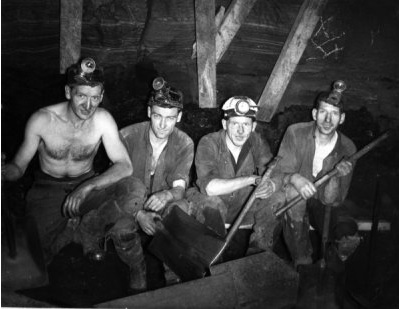
Miners Underground at Fleets Pit, prior to NCB Nationalisation

In the presentation, I tried to portray what a hard scrabble of a life it was—long shifts and long before the NCB installed either pit-head baths or canteens, full of danger from collapse and splintering pit props or fire damp and explosions. Many were killed, although there was no great loss of life in a single incident like the 207 who died in the 1877 explosion at Blantyre in Lanarkshire. Despite all, each man was expected to bring a ton or more of coal to the surface each day.

Although the last East Lothian deep pit closed in 1965, some of my audience did have mine experience still—an engineer who oversaw winding machinery, a pump engineer who transferred to Bilston Glen when that super-mine opened in 1963. Many, as lads, had carried their dad’s lunch pail to him or met him coming home still blackened with dust. It was touching to see how my minor research triggered so many memories, in men who had now half-forgotten a great heritage.

Because, however grimy, hard or tricky the work might be, it was just those things that bound miners together, gave them their feisty outlook—the same feeling of difficulties overcome that binds soldiers who have survived together. And, however much all the new houses in Tranent may be improvements, because most Belters who went down the deep mines of Limeylands, Fleets or Tynemount have long died of emphysema or other lung ailments, that close sense of community they held on to is almost lost.

But for half a hour in the Brig this morning, they let me rummage through their heritage, share with them what little I know of those tough men and their resilient wives who, in one year, once brought 25m tonnes of coal out of the bowels of Scotland in one year and whose predecessors had been doing it with the same gritty skill for over 750 years.

Being allowed to share that (and not get run out of town for my impertinence) was a real privilege for me.

Engineers at Tynemount, around 1937

Posted in Community | Tagged | Leave a comment

No Ferries from Westminster Pier

Good for the Hootsmon. Though too often it reveals Wizards of Oz furiously pulling unionist strings behind its editorial curtains, it gave a three-part, 6,000-word platform to ex-Lib-Dem Leader Tavish Scott to harangue us soothmoothers in stereo with the Lib-Dem jamboree in Birmingham. Shame he blew it.

Leaving aside his to-be-expected defence of the coalition, his warm words for Willie Rennie, and his saying-the-bleeding-obvious—that the SNP will define the next five years in Scotland by the decisions announced this Wednesday”, he used this golden opportunity to pour fire, scorn and assorted brimstone on the SNP and all its works.

Such ire might be politically expected and even personally understandable. And I take nothing away from his right to such a view and, indeed, the platform from which to declare it. Given that his chosen text was clearly to rubbish the nasty nats, for a basically decent fellah such as Tavish can’t help himself being, he made a fair fist of snarling derision at the devious heresies that Beelzebub Salmond and his Ministerial malcontents are plotting to visit on the defenceless damsel that is our nation.

Also, given what “Desperate” Dan Alexander was, in parallel, fulminating about from the podium in Birmingham, it’s obvious all this is part of the ‘orchestrated’ collusion among unionist parties that Joan MacAlpine warned us about a couple of weeks ago. But if this does represent a ‘big push’ by the forces of Unionism that is to decisively derail the SNP bandwagon and divert any thought of a successful independence referendum into oblivion, the approach shows serious misjudgment.

Because, it’s not like that, see. Tavish’s misreading of the SNP threat prior to May cost him his job, And any party leader who had recently had his head handed to him so comprehensively might think twice before rejoining the fray using weaponry that had proved so woefully inadequate less than six months prior. This shows not just poor judgment but a reluctance to learn from mistakes.

Perhaps Tavish spent too long cosying up to Labour over the Parliament’s first eight years. Because he makes the same fundamental mistake they made then—and are still apparently making—that stuffing more straw into the bogeyman of separation and waving it about as if it could come and devour everyone’s first-born child is a bankrupt strategy that barely had currency even before the SNP called the shots.

But his 6,000-word arguments reveal nothing new. All of them are variants on the old scaremongering that Labour was still peddling when they got hit by a train right around the time that Tavish got his jotters. What’s the point of claiming that Salmond has a master plan when everyone not only knows that but voted for it in droves?

Tavish misses the point entirely. What he, Desperate Danny, Willie Rennie and, indeed, every other unionist politician in Scotland don’t seem to get is that they have a handful of years left to get their act together—building a strategy on positive reasons why Scotland should stay in the union and finding a common, credible, charismatic leader that can, in the punters’ eyes, hold their own with the bold Eck.

For reasons given above, it ain’t Tavish—or any other Lib-Dem.

But, if they don’t twig soon, the hale clamjamfrie will need to follow Sir Malcolm Rifkind, MP for Kensington  Chelsea’s pragmatic lead: find a nice cosy corner that is forever Englandshire so their egregious contempt for Scotland’s capabilities will not lead them into the political wilderness. Again.

Posted in Politics | Tagged | Leave a comment

The Beginning of the End

Having been a longtime SNP member and activist, the rocky road I have come was made smoother by the stout hearts and selflessness of others. It is deference to those as much as to the cause of independence itself that kept me out and active in every local and national election for two decades.

Keeping the heid after disappointments like 1992 and 2003 was one thing; working steadily as if we were already living in the early days of a better country was harder. But being engaged in campaigning at the national level for the last decade and playing a role in candidate vetting has given me more insight into the national picture than any amount of work across my local patch alone could have done.

There was a time when potential candidates were heavily draw from either the stolid (and aging) loyalists who had never wavered though those dark days of the eighties and felt dedication alone had ‘earned’ them candidacy, or from ‘Young Turks’ overbrimming with enthusiasm but so short on pragmatism they wanted eternal confrontation. With so few councils under SNP control, vetting council candidates for 1999 and 2003 was a constant struggle to find competent candidates who would be a credit to us in running their council.

Thankfully, though many a staunch activist was disappointed, the vetting teams stuck to their guns. Their vindication came in 2007 when a dozen councils fell to the SNP and our councillor numbers doubled. Despite most being brand new and some being under severe financial or media pressure from the off, none wavered; none disgraced the party. 2007-11 was not just when the SNP came of age at Holyrood, it was when, from Aberdeen to Ayrshire, from Dumbarton to Dunbar, they showed others how to run councils—and in tough times too.

I am just back from a full weekend vetting council candidates where a team of two dozen senior party members—not those in the media spotlight but the stalwarts who make the unseen engine rooms function, the ones who actually make the party work. First of all, I was reminded why I got involved in the first place: because their good-natured, collegiate dedication is what makes the SNP the real force in Scottish politics today. This has all but disappeared from other parties.

Secondly, for all my experience on vetting teams, I was astonished by the quality of candidates—new people to most of us veteran vetters—that indicates a depth of talent and width of experience to make any jibe about ‘narrow nationalists’ seem hilariously misguided. These men and women would be a credit to any organisation. I had feared that, because so many of our stalwarts were swept into office in May we would now toil to find their replacements: anything but.

But, thirdly, and what I found most encouraging, there were among them a group who had, at one time, all been active in other parties. These people were not failures; they had been candidates and councillors but had left to find what one of them described as “something to believe in”. Their biggest beef? A lack of leadership or vision, of any sense of purpose beyond retaining what they had. If this is the quality of people now abandoning other parties in Scotland, the SNP’s dark days are behind it and the future full of promise.

Such evidence points to next May’s local elections being not, in Churchill’s description of Alamein, ‘The End of the Beginning’; if that wasn’t devolution in 1999, then it was this May’s SNP landslide at Holyrood. What next May will be even pathologically thrawn ‘Desperate Dan’ Alexander, fulminating from the Lib-Dem podium in Birmingham today, may come accept: it looks increasingly like ‘The Beginning of the End’.

Posted in Politics | Tagged | Leave a comment

So They Hit Us

Ian, my best friend at Uni, introduced me to Schultz’s Charlie Brown cartoons and their disarmingly insightful comments on life. Perhaps my favourite showed Charlie sharing his nervousness about approaching the little red-haired girl with Linus. When at last he stood in front of her. “I didn’t know what to do” Charlie confesses. “So, I hit her.”

I am reminded of such confusion as sundry unions clear the decks for action on St Andrew’s Day. Clearly the UK government has no intention of backing down and welcomes such foolish brinkmanship. The unions are quite right to doubt there’s any point in negotiating. But to lash out because they can’t find any other tool in the box is thrawn and counterproductive.

At least most public service unions have a clear bogey-man to rally opposition. Not only are many likely to lose their jobs but the generous final-salary pensions for the public sector are under threat. Why work longer for less? But in the front cohort of this rebellion are Scottish teachers. EIS General Secretary Ronnie Smith: “At the recent EIS Annual General Meeting, Scottish teachers sent a clear message that their patience with attacks on their standard of living is exhausted.”

That would be the standard of living that involves a 22-hour class time week, together with 12 weeks’ holiday for a salary double what most public sector workers get, would it, Ronnie? Because if there is one group of people whose withholding of their labour is likely to get right up the public’s nose just now, it is teachers, especially when egged on to strike by an EIS general secretary who pulls down a cool £120,000 a year.

Most people—even if they don’t have any kids at school—appreciate that a teacher’s job is not easy, that many still go the extra mile above the call of contract and that Scottish kids are much the better for it. But, once, teachers did even better, taking extra-curricular classes, coaching out of hours, driving minibuses to the theatre or rugby matches with not a penny of overtime. If standards have slipped it is the teachers’.

By the late 1990’s they’d had enough and a long overdue review of the professionalism of teachers and their compensation was launched which developed into the McCrone agreement. Unfortunately, having had the whole hot proposal dropped in his lap by hastily-departing First Minister McLeish, Jack McConnell, despite having been Education Minister, rather fluffed negotiations: he just signed the whole caboodle off without asking anything substantive from the teachers in return.

In the decade since 2002, in which the teachers suddenly received a more professional salary and worked clearly defined, reduced hours, progress in raising our education standards disappeared. The inflation in Highers results should fool no-one: children leaving school in 2011 are no better educated than those in 2001. By any objective measure, other countries, including England, have improved; Scotland has stagnated.

Doubtless there are social reasons contributing to this. But fundamental has been that, far from generous McCrone settlements consolidating the professionalism of teachers (as well as doubling council education spending), it has turned too many teachers into clock-watchers and made a mockery of McCrone-agreed non-contact hours that, in theory, are spent marking and preparing for lessons. This is not to say that heroic examples of teacher dedication do not exist. But they have become rare, atypical.

And, worst of all, the ‘profession’ is now steered by a particularly bolshie coterie who run the EIS as much for their own political reasons as for teachers’ (let alone children’s) betterment. After a decade of having very little to campaign on, union leadership has seized on the Cameron/Clegg coalition’s swingeing actions as a call to arms at just that time when youngsters need to complete their education to make their way through this chilly world… and their parents can ill afford the time off to cope with the disruption it will cause.

The EIS is threatened with no more than a decent re-evaluation of the teaching profession. But that seems to unnerve them because it appears they can’t think of anything clever to say.

So they hit us.

Posted in Education | Tagged | Leave a comment

Welcome to Gogledd Island

The rolling countryside to the East of Edinburgh gives East Lothian its rural idyll and fine quality of life. To those living in its small towns and villages, it seems eternal, as if its peaceful pattern of colourful fields, dotted with copses and pantiled cottages, had always been.

But its raised beaches are testament to a time when sea levels were once quite different and the chain of bronze age hill forts along the edge of Lammermuir imply a time when lower-lying land was uncultivated forest or swamp. Also, Scotland’s coastline is quirky: while our West coast boasts thousands of islands, the East has few and none capable of sustaining significant populations.

But this was not always the case. Raised beaches were formed after the weight of the last ice age vanished and land recovered its shape. Trace the 10m contour that probably corresponded to sea levels in bronze age times and the northern ‘neuk’ of East Lothian becomes an island separated by a shallow sea channel, now the valleys of the East and West Peffer Burns. Being at the intersection of the coastal and Central Belt trade routes, a more strategic bronze age location would be hard to find.

Unlike most Scottish islands (Islay, Tiree and the Orkneys being exceptions), Gogledd Island would boast over 30 sq. km. of rolling, fertile land stretching from Jovey’s Neuk to Gin Head and from Partan Craig to Brownrigg. Cut off by a natural moat but large enough to keep hundreds of people well fed, this would have given a potent defensive advantage to those living there over the contemporary Brythonic tribes who inhabited bronze-age Southern Scotland.

Gogledd Island = a Modern Map of East Lothian's 'North Neuk', Flooded to the 10m Contour

Dominated by a formidable hill fort on Berwick Law that provided a ‘last redoubt’, cists and implements found near Ferrygate and Eildbotle (OE = ‘old settlement’) Wood imply a density of settlement around the peninsula at its NorthWest end, perhaps associated with another, smaller fort on the hill on Yellowcraig hill or one offshore on those parts of Fidra above water. And that a village called ‘Kingston’ sits on the best vantage point in the middle of Gogledd must surely be more than just coincidence.

All of this is speculation. But that a fertile, defensible island much larger than the (then-flooded) Lindisfarne existed at this strategic cross-roads for thousands of years is a fact. This would have given the local tribe a huge advantage in both trading with neighbours and in surviving their predations.

It may even have triggered development into the powerful local people with whom the Romans made peace and called the Votadini. They called themselves Goddodin and survived as such well over 400 years, creating the earliest surviving document in the Welsh language and leaving us tantalising glimpses of a vanished, exotic Celtic culture that once boasted the largest city in Britain, crowning Traprain Law.

Local place names may now more Anglian, Norse and even Pictish than Brythonic. But a thousand years ago, this area was a no-man’s-land among all three for hundreds of years, so an overlay of newer names is understandable. But was Gogledd once a jewel of civilisation set in the sea of brawling mini-tribes that was once bronze age Scotland?

Posted in Community | Tagged | 1 Comment

Uprising Upstanding—Outstanding!

North Berwick can rightly claim many great things for itself, but a cool, cutting-edge place for the youth of today was never among them. Then came the demise of Proquip Sports, successor to Ben Sayers, and the end of over a hundred years of crafting golf equipment in the town. The 1970-era factory on Tantallon Road lay empty while developers scratched their collective heads over what to do with a building so near its sell-by date.

Local developer Zest Capital Management acquired the property and, deciding that the midst of financial uncertainty was not the time for its commercial development, was open to an approach from local third sector entrepreneur Adrian Girling who, having opened a pilot facility for young people at Phantassie in East Linton, was keen to find larger premises for a more ambitious project. A deal was struck and Uprising, the most ambitious youth project East Lothian—let alone North Berwick—has ever seen, was launched.

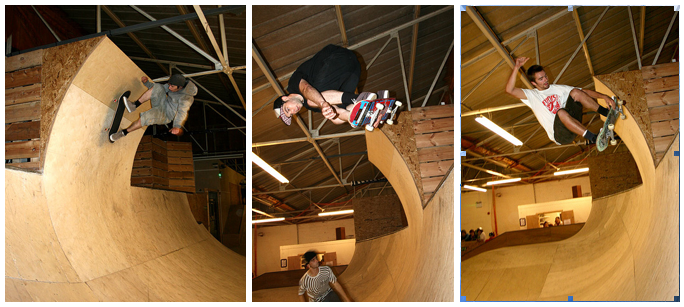
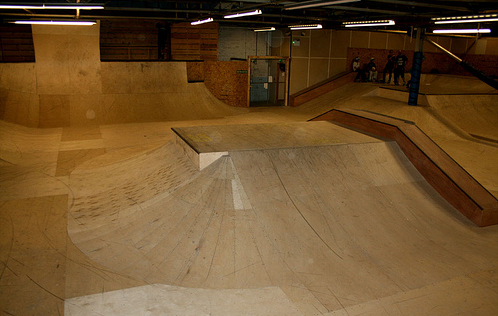
Despite a wheen of dedication and persistence, Adrian did not find it easy. From sourcing a ton of timber and an acre of plywood to cajoling the local Planning Dept and nervous neighbours into supporting the whole thing, all the problems of breaking fresh ground with fresh ideas could have derailed growing enthusiasm of local young people, musicians and skaters to make the thing work. Just building the skatepark itself took teams of volunteers months to design, build the frames and smooth all the interlocking curves and surfaces. Getting rehearsal studios equipped was a separate headache.

The Finished Skatepark—Complex and Challenging (Zeephoto)

After a year, the place opened on July 23rd, received the seal of approval from the skateboard fraternity within a month and held its first big event this last weekend. Now I would not know how to grind a rail, grab air or even wear a baseball cap backwards but I had a great time for the couple of hours I was up there. Not only were there a pile of young (and not so young) people enjoying themselves but the skill, balance and sheer audacity on display was a show in itself.

Most impressive for me was how they behaved with one another. There were ten-year-olds gaining respect and twenty-year-olds demonstrating it. Because everyone just piles in, collisions and interference may be rare but do happen. Yet everyone was taking it with good humour, snagging errant boards, applauding cool moves by tapping the front truck on the floor as they waited their turn. All that said, the air was electric because everyone seemed to be pushing their own personal envelope of what was possible.

Some Rad Dudes Doin' It Clean (Zeephoto)

Talking to Alex who runs Route One skate store on Cockburn Street and whose wildly tattooed arms contrast with his quiet voice and friendly manner, Uprising is a real asset to the whole county and not just to North Berwick. Even if it’s not the most accessible place, a facility like this is more than enough to bring skaters from all over, including Edinburgh. I hope he’s right because Uprising seems a godsend for our youth and not one that council or school or church, however well intentioned, could create—a cool place to hang, to get an adrenalin rush and not get grief from some vigilante grandad.

Posted in Community | Tagged | Leave a comment

Changing Course or Deckchairs?

It seems that my ex-opponent is as good as his word. Within 24 hours of standing tight-lipped across from me as the ERO confirmed his 151 majority and having heard the scale of the SNP victory elsewhere, he declared:

“There are many hard lessons we must take forward from this election, not least my own responsibility and role as the Scottish Labour Leader. After consulting with colleagues I have decided to stay on until the autumn as we conduct a fundamental and radical reappraisal of the structure and direction of Scottish Labour.”

This weekend saw the first step. Labour’s “biggest shake-up in 90 years” considers radical proposals for constitution and leader. These are to be debated at UK party conference in September. Then, at a special Scottish Labour Party conference on 29 October, the leadership process will begin. Highlights of the proposals are:

  • devolution for the party “on Scottish matters”
  • all party members (not just MSPs) eligible to stand as leader
  • leader to be for the whole Scottish Party, not just MSP group
  • redrawing CLP boundaries on Holyrood, not Westminster constituencies

Labour’s performance over the summer has not been impressive. Given the scale of their gubbing, their diminished ranks and loss of access to advice from Holyrood mandarins after 2007, this may be understandable. Iain Gray’s performance on his feet has actually got better. But the substance of Labour opposition, as when his response to Salmond failed to posit any alternative, or when Patricia Ferguson accused Fiona Hyslop of a ‘blunder’ in the EU debate is still substandard. 

But—so far—I congratulate them; no ancient organisation changes itself easily and one in the public spotlight is especially hard to shift off-course. It was not with malice that I suggested as much in April’s article in Newsnet Scotland. And, for all the sincerity about reform from Gray, Murphy, et al, what chance do they have of succeeding?

Ninety years ago, the party sang The Red Flag with authority, speaking up for the industrial workers of Britain against exploitation. They expanded into the party of aspiration for workers and protectors of the weak. Even under Wilson or Callaghan, this heritage was plain and worn on its sleeve. Unfortunately, Britain de-industrialised and, pre-Blair, Thatcher lured many aspirationals into the Tory camp.

After decades of class warfare in Scotland and entrenched municipalism in its cities and across its own ex-industrial belt, Scottish Labour lost sight of what it was for and exerted all its energy defending what it had. If Labour had a heyday in Scotland, it was embodied in Strathclyde Region. Although SRC begat SPT, the water referendum and anti-Thatcher actions, it also invented glacial self-interest common to Labour councils across Scotland. Three decades later, what structure props up Scottish Labour now?

  • CLPs now virtually non-existent outside of cities & ex-industrial areas
  • membership halved to 15,000 since the run-up to 1997 peak of 30,000
  • councillor numbers have halved from over 600 to barely 300
  • only 3 councils (out of 32) are under Labour’s full control now
  • any reputation for competence damaged by Holyrood performances
While the last of these five points has encouraged a drift of voters to other parties, it is the other four that are hampering Labour’s effectiveness in any fight-back. “For too long Labour has undervalued the vital work that councillors do in the party and in their local communities.” (David Martin MEP in Scotland on Sunday).And here’s the rub: the whole shebang was driven by local clubs (Labour or Miners’) and a career path from member to activist to councillor to convener to MP/MSP/MEP. In my own East Lothian, three of four Labour Clubs have closed and the couple of Miners’ Clubs still on their feet are wobbly. But they and the councillors were contact points that kept party and people in touch.

But post-Blair activists are now close to extinct. Members in the clubs like the criac and the cheap beer; they don’t even mind getting herded into vans to stuff leaflets through doors. But the clubs’ days of fervent debate and dedicated work are history. With STV in councils and Salmond’s Holyrood sweep, the career path has also been scuppered. And compensating effort that could once be called in from parliamentarian staffs has now been more than halved.

So the real question for Labour’s apparent good intentions is: Is it all too late? Apart from the high heid yins and the largely apolitical social membership, just who is there left to have their debate, let alone man the fight-back? Or is the whole process flawed and, in Brian Donohoe MP’s dismissive words “crass stupidity”?

Posted in Politics | Tagged | Leave a comment

Calling All Unionists

 “Unfortunately, it is true that only one side is even on the park playing in this match.” Lord McConnell of Glenscorrodale, Scotland’s first minister from 2001 to 2007, on the proposed Independence Referendum. The Scotsman, Sep. 7th 2011.

“We need someone people will listen to; this should not be restricted to the 36-or-so MSPs” former Chancellor Alastair Darling MP, speaking on Labour’s leadership contest, Good Morning Scotland BBC, Sep 7th 2011.

As has been said in the last blog, we live in strange times. After over 100 days for the political chatteratti and nomenklatura of all stripes who run Scotland to come to terms with the unprecedented result of May’s election, the silence from Unionists lambs verges on the deafening. The SNP called the event ‘historic’ and have busied themselves over the summer with building on the political momentum it generated. The only efforts to derail that momentum are a few apopleptic splutterings from the CBI and a border raid by Danny Alexander who galloped north to fling down his half-dozen questions before galloping off without waiting to see if anyone answered.

This was, according to Joan McAlpine, part of a co-ordinated plan to resist the SNP and all its works. The problem seems to be that nobody north of the border either knows about it or has the stomach to do more than stare at their feet when elbowed to get with this programme. Let’s be clear about this; the next five years will be as pivotal for Scotland’s future as the decade that followed Scotland’s near-bankruptcy in the odious Darien disaster and the scramble of self-interest that led to the 1707 union.

Love or loathe the SNP, they now have both the will and the means to take Scotland to independence. Whether they do requires some intense debate over many details, and not just a simple ‘yes’ or ‘no’. To hear the pro side of the argument, grab your local SNP member over a coffee a pint or lunch and get talking. Finding one isn’t hard these days—there are over 15,000 members and 902,915 people who voted for them. By all means ask hard questions but listen to the answers too—the SNP has been thinking about independence for decades and has its own proposals for which currency, whether the Queen should stay, what sort of armed forces, etc.

MORI Poll of Sep. 3rd 2011. Note the SNP Lead Has Grown since May's Election

But finding someone to make the opposing case is nigh-impossible. The papers are full of dinosaurs like Michael Forsyth mumbling the same unsubstantiated predictions of disaster they did decades ago. Where is the opposition? Well, the Lib-Dems—whether from entering UK coalition or not—have managed to machine-gun their feet so they’re barely standing. The Tories are locked in internecine rammies along “to be or not to be” lines. And Labour? Well, Jack’s observation of there not being another team on the park reflects more on his old colleagues than on anyone else.

Scotland deserves better.

For the main (only?) opposition party to faff about leaderless for months, doing little but spitting venom and looking surly when the country it claims to love stands on the brink, is reprehensible. There surely must be unionist arguments to make and Labour should lead in making them. I therefore offer articulate unionists (not an oxymoron but I sometimes wonder) this blog as a platform to make their case. This will not be a comment but a full blog with title. As long as it is not libellous, I will print it. And if the arguments are good, I will try to parry them.

Scotland needs this debate; let’s get it going.

Posted in Politics | Tagged | Leave a comment

“Murdo!” He Wrote

We live in strange times. Wind the clock back a quarter century and Scotland was an unsightly pimple on the alabaster edifice of Thatcherism and about to get handbagged by the Sermon on the Mound.  To suggest then that the Tory party would voluntarily disintegrate to placate the Scots would have got you certified. Yet that is exactly what Murdo Fraser, leading contender for the poisoned chalice of Tory leadership in Scotland, is advocating.

Now, Murdo is neither daft nor inexperienced—although he may be a little punchy, having, like most of his colleagues, been comprehensively gubbed in every constituency election since the early nineties. But he believes ‘Tory’ “has become a toxic brand” in Scotland, so his solution is “to wind up the Conservative party in Scotland and re-establish it as a new centre-right Scottish party.”

There are two major problems with this logical—and possibly even sensible—proposal:

  1. It is actually called “The Conservative and Unionist Party”. Ignoring for a moment that the ‘unionist’ bit refers to union with Ireland, there is a real cognitive dissonance about a unionist party splitting to preserve a union.
  2. Despite the obvious advantage to English Tories in offloading Scotland with its stubborn insistence on sending anyone but Tory MPs to Westminster, there is almost no support, either in Cameron’s cabinet or in the twinset-and-pearls party backbone for ditching us Scots, however intransigent.

This makes the job to which he aspires almost impossibly hard: he either fights his party, dominated as it still is by the harumphing backwoodsmen of the English shires; or he faces a Scotland resurgent with prickliness towards being told what to do or being treated as another region of England—both longstanding Tory habits. When elections were a straight fight between Tory & Labour, the battle was a familiar one to Tories—fought on the same left vs right lines, whether in Bishopbriggs or Bishop Stortford.

But Scottish politics has changed significantly. Voters of all stripes are now happily following Aladair Gray’s dictum: “work as if you live in the early days of a better nation”. For all Tories claim to be the party of business and progress, that mantle sits comfortably on a dominant SNP; Tories are scrambling to find relevance. Their clear ‘right-of centre’ rôle in England finds little relevance in Scotland any more.

It is not simply enough to trace the almost total extinction of Tory MPs in Scotland, from a majority in 1955 to a persistently risible 1 since devolution. The rot is also deep at local level. Trailing as the fifth party in councils (dropping 30 councillors to 143 in 2007—fewer even than independents), Tories verge on irrelevant, with partial control in only three administrations (out of 32). In my own East Lothian, their vote has slipped from a 15,500/28% second place to a 5,300/16% poor third. More telling is that their in-with-the-bricks local radar of councillors had dropped from seven to two.

And it is here, in growing, dynamic areas like East Lothian that Tory shortcomings hit home. Not only are they perceived as an alien party right across the county but they have lost ground in their ‘natural’ support—the 10,000 aspirational residents in new estates across the county; those have gone solidly for the SNP. More than anything, this explains why Murdo’s party keeps on flatlining.

This weekend’s Mori Poll puts the SNP on 49% and the Tories on 12%, which implies that, whatever the course taken, they must do something to escape electoral oblivion.

“I think that what Murdo Fraser is saying is very refreshing.  In broad terms, I welcome it.”—Sir Malcolm Rifkind MP, once of East Lothian, whose faith in a Scots Tory future might be deduced from his now representing Kensington & Chelsea.

After over a decade in this state, it takes a brave soul to predict a recovery and an even braver soul to prescribe the radical medicine that will pour life into as stiff a cadaver as the Scottish Tories have become. Murdo Fraser may be just that radical soul. But, while some may wait with bated breath for Murdo on the Ormiston Express, my (and, I suspect the smart) money will be going on And Then There Were None.

Posted in Politics | Tagged | Leave a comment

Hats Off to Pat

This blog has never been shy when it came to criticism. Given my SNP background, it may be expected that it would be particularly harsh with perceived faults in other parties. And, given decades of dominance of my beloved East Lothian by them, its criticism of Labour has been especially crisp.

But, last night, at the conference dinner of the Association of Nationalist Councillors (ANC) at Airth, a Labour man through and through won the hearts—if not the loyalty—of those present with an after-dinner speech that demonstrated in spades why the looming retirement of Cllr. Pat Watters as President of CoSLA will be a loss to local government in Scotland—and to politicians of all stripes.

It wasn’t just that Pat had walked cheerfully into our lions’ den or that he took and returned Derek Mackay’s barbed banter, or that he gave as flowing and amusing an after-dinner speech as I’ve heard. It was how he took the measure of his audience and seemed to speak to each, as only someone with years of skill at the top of their game could.

With almost thirty years of success in Lanarkshire politics and three terms as CoSLA President behind him, Pat certainly has experience in depth. Also, his CBE and last year’s Herald Local Politician of the Year Award are signs that I’m far from alone in seeing this rising above party politics. In my first two terms as a backbench councillor, CoSLA delegates were overwhelmingly Labour. I came to see the organisation as a tool of that party. But post-May 2007 opened my eyes.

Because in summer 2007, I began attending CoSLA Leaders’ Meetings and worked with  Pat for the first time. The huge changes in council composition, with no party dominant were reflected in CoSLA and Pat was faced with what must have been one of the toughest periods in his career, requiring resolute efforts to steer CoSLA through many choppy meetings so that it was respected—by all parties—as diligently following its core brief: to speak objectively for all Scotland’s 32 councils.

Achieving this did unlock major progress over the last four years, including Single Outcome Agreements including all public services (not just councils), council tax freeze, progress on Single Status with staff and a removal of ring-fencing of funds that allowed councils freedom to set their own priorities. “Parity of Esteem” became a reality. Many others were involved in all this but Pat steered CoSLA (and, by extension, councils) towards the possible and stood his ground when necessary to make it happen. But where he deserves huge kudos was in retaining his Labour credentials unsullied while championing the best interests of Scottish local government.

Even seasoned political observers like Brian Taylor have written pieces betraying their surprise that Pat handled things as astutely as he did. And this, I think, is the measure of the man—hard to find someone in the business who does not respect his ability and integrity, but harder to find someone who will be able to discern that quite unexpected direction that a sharp political mind will discern as the next step required.

Scottish local politics (and the good people of East Kilbride he has represented so well for so long) still have until next May to appreciate him. Working with him has been, for me, an education in how politics is indeed the art of the possible. I mean no disrespect to fellow councillors of any party in Scotland if I say Pat’s will be a tough act to follow.

Pat Watters in Typical Negotiating Mode

Posted in Politics | Tagged | Leave a comment