Another BRIC in the Wall

From Scotland’s fausse freends like Moore, Murphy and Mundell an unending drone of unsubstantiated guff about all that Scotland benefits from its union wafts north of the border. Its volume and stamp of officialdom beguiles many genuinely uncommitted people to believe them. After all, Britain is one of the world’s ‘big-hitter’ economies and so us wee Scots would be better off staying under its sheltering wing. Wouldn’t we?

Well, for most of the nineties & noughties, the UK and Brazil grew at comparable rates until the 2008 crisis hit. Since then, Brazil has resumed its 4% p.a. growth while we are struggling to achieve 1%. But much of the UK’s growth in wealth has been channelled towards the really wealthy—it saw a rapid rise in income inequality between the mid-1970s and the mid-1990s. Since then, the increase in the UK has broadly levelled off for most people but those at the very top of the income distribution—fat cat bankers, FTSE100 directors, etc—have continued to accelerate away from everybody else. Not all countries have suffered this socially debilitating effect.

According to the Economist, over the last two decades, the poverty rate in Brazil has halved. With this, the Gini coefficient measure of income inequality has also fallen sharply, declining 1.2% a year. Brazil’s economy is forecast to grow by 3.6% this year and Brazil is set to overtake Britain from ninth place to become the sixth largest economy in the world.

But it is not just scale, GDP per person, at around $11,000 (or 19,000 reais) has been growing at an average annual rate of 1.7% since 1990; closing the gap with high-income countries like Britain (currently $35, 165). But the key issue is that income growth is faster among the poorest—those in the favelas above São Paulo or scraping a living in the newly cleared forests of the Matto Grosso.

While much attention among the BRICs is focussed on China, Brazil is actually achieving comparable per person growth rates and could reach its poverty reduction goal in the next few years. So who should Scotland be taking economic lessons from? Stagnating Britain that has flirted with double-dip recession for the last three years yet allows obscene incomes by the Fred the Shreds? Or dynamic Brazil, not only samba-ing its way away from any recession but mixing up the economic classes the way it has already mixed up its multi-racial heritage to form a more dynamic, homogeneous confident country.
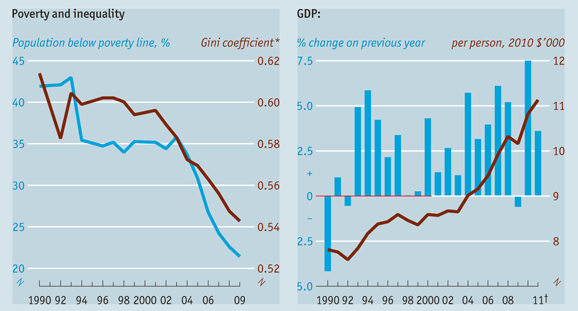
Source: IMF & OECD via The Economist
Posted in Uncategorized | Leave a comment

A Peter Rabbit Version (for Unionists & Other Beginners)

As I was about to say yesterday when Nick Clegg’s transatlantic ego pushed me off course, there are a number of people in Scotland to whom the motives—let alone the aims—of the SNP are suspect. There has been (as Mr Deltoid of Clockwork Orange fame might have framed it) “some extreme nastiness, yes?” across the blogosphere implying that no debate can be had while ravenous packs of cybernats roam the net looking for a Labour Red Riding Hood to molest. What say we cool our jets, squad?

My basic premise: there will be an independence referendum in the life of this parliament and, whoever wins, the other side better feel they made their best pitch (or they will torture themselves over it for the next decade). Playground abuse is not going to achieve that so let’s move on/grow up, eh? There are five basic steps to be taken:

  1. Outline of the country that would become independent. For avoidance of doubt this would be Scotland and its seabed out to agreed boundaries. It would include all civic institutions within Scotland and would require either the creation of those missing or an understanding with another country, probably the Rest of the UK (RoUK), to provide them. Some of the most important among those are: a) Treasury; b) Armed forces; c) Welfare system; d) Tax system; e) Embassy/foreign/diplomatic service
  2. Agree all-new relationships to be forged with neighbours in particular and the world in general. This will involve a series of bilateral talks starting with, but not confined to, RoUK. Among the most important will be our long-term links to: a) RoUK; b) pound/euro; c) EU; d) NATO; e) Nordic Union
  3. Once concrete proposals and provisional agreement on the key points above are available, that form of independence needs to be debated while the formulation and timing of the referendum on that basis are planned. This, more than anything, explains why several years are required to pose the question to an informed populace. The format of the question(s) must be agreed but I argue that a multiple-choice under STV should be the format.
  4. If any result other than status quo is chosen, the Scottish Government will form multiple task groups to negotiate the details and timing of dismantling civic structures of the British state and, where appropriate, allocating them between the two countries. Mutual, peaceful examples like Norway/Sweden (1905), Eire/UK (1922) and Czech/Slovakia (1993) should be studied for lessons and suggestions.
  5. Break out the bubbly (or the 18-year-old malt). Although independence will be more of a process than an event (c.f. how Eire relied on many aspects of the British state continuing while they worked to replace them with ‘local’ civic ability) we should pick a day and celebrate it. 24th June would be good (Bannockburn), 1st May almost as good (Workers’ Day and also Act of Union which would be hereby dissolved) but something in the summer so we can (unlike St Andrew’s or Burns’ Days) get the barbie out.

Now, that’s not too difficult to grasp, is it? Good—we have 60 months; get debating!

Posted in Politics | Leave a comment

Land of Hype and Glaury

Some lost souls milling around the Royal Concert Hall on Sunday seemed desperately in need of some direction. I had therefore intended to blog supposed ‘gaps’ in the SNP case for independence so they might see the error of their ways. But I was distracted by a quote from Clegg in the Observer:

“We stand tall in Washington because we stand tall in Brussels, Paris and Berlin”

It stopped me dead. A supposedly intelligent leader of a major UK party comes out with something barely appropriate to the playground. Now, I can understand the many people who are proud of Britain and its history. Together with the Welsh and Irish, we Scots and English created a major achievement of Western civilisation in the British Empire that was the envy of most of the planet a century ago.

Because my grandad lost a leg at Ypres (6th Bn Scots Guards) and my dad drove a tank across Africa and Europe (44th RTR) and I grew up with a pink-painted map hung on the classroom wall like other kids in the fifties, I share that pride. I’m also proud my Appin Stewarts were front and centre at Culloden and that 300 local Gododdin were gloriously gubbed by Angle hordes at Catterick in 600AD. But, though I connect with all three, all are now history. Done.

Since my dad parked his Sherman for the last time, Britain has been in trouble. The last country to recover from WWII, its innovations of jet airliner and mini, Beatles and Quant were undermined by industry, politics and empire in equally antiquated amounts that led to a ’70s nadir. Since then, ‘Britain’ has grown tenuous as its various components have diverged. This is not obvious to our English cousins because they (as well as many abroad) always conflate England with Britain.

We Scots developed a chip on our shoulders about that. After Thatcher depredations, the Labour party going native at Westminster, the Beeb retrenching from received pronunciation to ‘regional accents’ and growing hostility towards immigrants Scots don’t share, justification for that chip grew. And yet, today’s Scots, with their own Parliament, rejuvenated arts scene, resiliently cheerful Tartan Army & post-industrial economy, have dumped that chip. If you want to see a capital city of which anyone would be proud, try Edinburgh in August—abuzz with life and culture but relaxed and at peace with itself.

Not so our English cousins. Let’s leave aside this summer’s urban riots, all is not well even in the leafy shires. Tory backwoodsmen bicker about Europe, sabre-rattle about action in Kosovo, Iraq or Afghanistan when justification—let alone the goal—is unclear. It is from pandering to such thinking that Clegg’s appalling pompous comment derives. It highlights that England urgently needs to find a post-Empire identity. Whether it revisits hoary old traditions, like a catholic-free throne or a non-royal as head of its church, right down to wigs on its barristers, is for the English—not Scots—to decide.

And they would do well to travel abroad more before they come to any conclusion. Not only the Germans but the Portuguese and Singaporeans have overtaken England in building a modern society. The Brazilians and Poles are about to do the same. Only the Americans seem stuck in the same time warp of nostalgia for when their word was law and their writ ran around the globe. It’s not just Clegg who needs to drop the hype and get out more.

Scots have already discovered an identity for the 21st century. Their economy will be based on energy, specialised engineering, financial services, whisky and tourism. They will be part of the European Union, friendly and open with neighbours, modeling society on the enlightened Scandinavians. Small as Scotland might be, a positive profile will be welcomed, its sports teams spreading goodwill and its military adding its full share to peacekeeping around the globe.

What it will NOT be doing is talking glaury guff like “punching above our weight” or Clegg-esque gobshite. It will have no Trident, no £7bn ‘super-carriers and no interest in interfering in other sovereign states. But it will have a peace corps to bring aid and develop a future in less fortunate lands; its borders will be open to both its neighbours and immigrants who come to contribute. In the dark days of the late 20th ©, Scotland started a journey back towards enlightenment. Long may that remain so.

Whether our cousins ‘dahn saff’ want to emulate this is up to them. But we are done taking any lessons in identity, strategy or direction from their posturing politicians.

Posted in Politics | Leave a comment

Exclusive: Pot Calls Kettle Black

Having had him as my MSP for four years, been in many of the same meetings as local council leader and crossed swords with him on several occasions as we contested East Lothian closely in May, I feel I know the public Iain Gray. I make no comment about his private side but find his public face inconsistent, verging on the confusing.

As a constituency MSP, he is shrewd enough to be guided by his staff and so shows up at most events where he would be expected and gets regular mug shots, columns and press releases into the local papers as a result. When constituents write to him, he replies, takes up cases and often manages to resolve them. Many of the causes he espouses are laudable and, even where we differ—as we do on both Cockenzie and Torness power stations having a future—at least he deploys plausible arguments. In short, he appears a decent guy trying to do a difficult job.

But when we turn to his other job as Labour Leader a Jekyll & Hyde transformation occurs that is not only less flattering but stretches credulity that his utterances actually come from his own convictions. We take it as read that he is a devolutionist, believing his party delivered that. This is, again, a plausible position, especially when shored up by solid argument. But, rather than the “(Labour) needs to talk positively about what we are for and less about what we are against” from Ken Macintosh or the “By 2016, Scottish Labour will either have re-established itself as the party of aspiration, or it will be an irrelevance” from Tom Harris, at the leadership conference in Glasgow this weekend, Iain goes off the deep end.

“You will be attacked, you will be smeared, you will be lied about, you will be threatened,” he said. “The ‘cyber Nats’ and the bedsit bloggers will call you traitor, quisling, lapdog, liar and worse. They will question your appearance, your integrity and your sexuality. They will drag your family and your faith into the lies and the vitriol. If you are a woman it will be worse.

“It is no consolation to know that any journalist or commentator who gives you a fair hearing will suffer the same. This is the poison some have brought into our politics and it is vile. It is time we started talking openly about it and it is time the SNP did something about it. They know who some of these people are. This is not how you build a better Scotland and Scotland deserves better.”

Astonishing for the leader of any party to stoop to such levels and to regard this as what he wishes to be remembered by in his farewell speech. Let’s assume there is some substance to these accusations; how would the argument be advanced by venting his own spleen in this manner? Scotland indeed deserves better and any leader of Scottish Labour should help provide it, whether in power or opposition.

Independence is not the only plausible future for Scotland but it deserves serious consideration and debate. For Harris or Davidson to dismiss it out of hand ill serves Scotland but for Gray to do it ill serves anyone. The language of ‘separation’ of ‘tearing Scotland out of the UK’ is inflammatory, as is scaremongering about border posts at Berwick and trouble visiting granny in Carlisle. He claims devolution to be the ideal settlement but has never articulated why the Irish are not clamouring to return to the fold and why the most devastated part of Ireland should be the part that remained in the UK after 1922.

As leader during the ‘attack dog’ period of Scottish Labour when their MSPs sulked for four years after 2007 and then wondered why they had their heads handed to them last May, Gray symbolises how bankrupt of ideas the whole party became. To accuse the entire SNP as he does above means he learned nothing and ought to have stepped down sooner, rather then peddling the same poison for another six months. Scotland needs a mature and thoughtful Labour party to hold the SNP to democratic account. Even as an SNP member, I am not so foolish as to think we have all the answers. But this toys-out-the-pram spite from Glasgow makes me despair of that ever happening.

There are extremists in and on the periphery of all parties. Scotland is poorly served when their bias and unreasonableness becomes the lingua franca of any major party. When leadership contender Tom Harris claims that  “Labour has not had a vision for 12 years” he deserves to be taken seriously. Instead, the best their leader can do is insult the party that just wiped the floor with his own by inspiring a majority of Scots.

Posted in Politics | Leave a comment

Choice Means Understanding Options

Growing up in North Berwick, we felt sorry for the private school kids. Shipped off in the train to Heriots or Melvilles in Edinburgh, they came home in weird uniforms long after dark when local kids were long done playing and were snug at home having their tea. Parochial as that attitude might be, it didn’t stop one classmate becoming a leading forensic accountant at the Old Bailey or another Professor of Medical Statistics at the University of Hong Kong.

No doubt private school kids were given a good education, but at what cost? We never saw or socialised with them; they were never at Scouts or rugby, never went guising or sledging on Coo’s Green. Later, on holiday from university, they behaved like strangers in their own town. Now, few maintain any contact at all while, of the ‘local’ kids, many returned to live and even more keep in touch.

All this came to the fore when the BBC picked on Marilyne MacLaren’s efforts to dissuade Edinburgh parents from exercising their right to choose their child’s school, seeing in them a cynical ploy to deprive parents of their hard-won rights, while saving Edinburgh Council the inconvenience of having to deal with unplanned transfers.

Since Cllr MacLaren has yet to make any other argument, there may be some element of truth in this. But there is much more to in than that. At the very least, we have the situation described above, where children spend hours being freighted to and fro. Not only do they miss hanging with the kids from their own area but they don’t learn social or road skills—let alone get exercised and wakened up—strapped in the back of a Chelsea Tractor instead of walking the half-mile to school with friends.

What such kids do learn is to be a gypsy, feeling at home neither in school nor where they live. Add in a couple of career moves and, as a young adult, they have trouble settling from minimal experience of what ‘settled’ means. No doubt, parents have good intentions, wanting “only the best education” for their child when sending them across the city to a school with ‘better results’.

But how can they judge? A parent with their first child entering P1 has only their own schooling of twenty or more years before as experience. They may chat to the head or even some teachers but what will they be told? That the school is any less than excellent and the staff any less than dedicated and brilliant? Unlikely. So their child will become ping-pong baggage for up to 13 years on what basis?

Even if the school chosen is unquestionably better at achieving exam results, what does that matter if the child has few friends there, feels alien social pressures there, does not meet the local understanding that many good teachers master and practice. Kickabouts in the park after school and crowding round a new Xbox game in a friend’s bedroom round the corner may not lead direct to Nobel prizes but they create support networks, round out personalities and provide a rootedness that leads to involvement like visiting local old people. Kids coming home from across town with a bagful of homework are notably absent from such activities.

Now, most kids are resilient. Given some of the backgrounds they have survived, it’s a miracle many kids grew up to be the contributing human beings they have. Commuting to a distant school is one of the lesser evils. But parental choice should be exercised as a right no more than access to the NHS. Ideally, each school, while being different and perhaps offering some specialties, should be of a comparable standard.

The concept of sink and magnet schools sits poorly with Scotland. Given our society is becoming more widely heterogeneous at the community level, there is no reason for any school not to become a good school. Allowing ambitious parents to pull their promising offspring away shows little confidence in that community—let alone the school—and in the rich variety of people inhabiting Scots towns and reflected in the social cross-section of kids at their school. That, in itself, is part of our education.

Before they make their choice, parents should think what they’re actually asking their child to forego for the sake of their own ambition, however well intentioned.

Posted in Education | Leave a comment

They Shall Not Pass

Today the Royal Society of Edinburgh (RSE) weighed into the political debate with a plea for the SNP government to re-think its generous policies towards the people of Scotland. In the firing line were a number of planks that constructed the popular policy platform that, among other things, did so well for the SNP in May, including:

  • Council tax freeze
  • Free university tuition for Scots residents
  • Low prescription charges
  • Free personal care for the elderly
  • Free eye testing
  • Free bus travel for over-60s

Such policies, according to the RSE should receive “far more independent and rigorous assessment”. In submitting its opinion to Holyrood’s Finance Committee, they have brought a more neutral voice to the political clamour that normally surrounds this. With the Spending Review imminent and another round of cuts coming from the UK Treasury next year—and the one after—perhaps this is a time to examine these options.

Pretty much all of those listed above are popular and most agree that we should do well by our elderly. But, of those listed above, the one that comes under most questioning is the free bus travel. Originally conceived to allow the elderly and infirm who most likely also did not have a car to have easier access to shopping and socialising, this will have grown into a £1bn monster by 2015. Tales abound of older people travelling all round Scotland on a regular basis, simply because it’s free. Bus companies love it because it boosts their income for no outlay or effort on their part.

But, rather than scrapping it wholesale, are there ways of retaining the original intent while reducing the degree of abuse that appears to be happening now? There certainly are, especially when you consider the degree to which it favours those who live in towns (where buses are frequent and the network dense) over those who live rural lives, sometimes without any buses at all.

  • Firstly, this was introduced from age 60 simply because women had retired at 60 and equality demanded that men could not be made to wait until 65. Simply raising the age at which it becomes valid to 65 for either would, at a stroke, save £279m or 1/4 of the policy’s cost and still allow the original intent of more elderly and infirm benefitting.
  • Secondly, it seems unreasonable that no off-peak restriction applies because those using their bus pass compound the problems of rush-hour. Banning its use between 9am and 4pm or after 6pm on work days, as most discount fares do, would not only ease congestion but save another £23m.
  • Thirdly, those still in full-time jobs could be reasonably expected to still pay their bus fares while the perk could be restricted to those already retired and generally not capable of bringing in a wage any more. Excluding full-time workers, irrespective of age would save another £42m.

Taken together, these three limitations should not disadvantage the great bulk of people for whom the original policy was conceived. And yet they would cut the actual cost of the policy by 38%, freeing up £344m for use in these tough times and perhaps retaining other policies that most people would generally agree have a higher priority.

Posted in Uncategorized | Leave a comment

By the Numbers

The UK unionists in the shape of Michael Moore MP, last(?) Sec. of State for (a.k.a. Viceroy of) Scotland, has wheeled out UK Treasury stats like a good boy to prove that, taken over the 30 years North Sea oil has flowed, Scotland has a accumulated a debt of £41bn (see today’s Hootsmon). He appears to have included all elements of income and outlay, including oil (normally conveniently excluded by Whitehall in financial stats).

As a number, £41bn is hard to grasp. More easily conceived is to calculate indebtedness per person = £8,167. Compared to the actual average personal debts in Scotland of £20,000 per head, this amount seems serious but manageable.

But, what of the UK as a whole? The Treasury’s equivalent figure for accumulated debt for all the UK over the same 30 years is £715bn. That’s £11,910 per head, or almost 50% higher than if Scotland had been a country in its own right. The “dividend” for being in this union is that Scots each now have an additional £3,472 of debt. Since Mr Moore thinks that £41bn of debt would scupper Scotland as a country, then how can he think that the UK is viable carrying a burden 50% greater?

Last March, his government set out a budget to spend £711bn with revenues of only £589bn, a deficit of £121bn or a whopping 20.5% shortfall. This is the economics of the madhouse. Anyone in the cabinet responsible for this should not lecture anyone else on economic viability. So, let’s see how Scotland could do better away from such nonsense.

Oil revenues to the UK Treasury this year will total at least £13bn, with $2bn of that new, coming from Osborne’s ‘escalator’ introduced just last March and not in the above figures (for 2009/10). Between higher oil prices and new proven reserves (e.g. BP’s Celtic Sea announcement this week), this scale of revenue is not going away for at least four decades yet.

Scotland’s proportionate (i.e. 7%) share of the UK defence budget is £2.8bn and of debt interest payments is £3.5bn. The Irish defence budget of £0.9bn is small. If Scotland doubled it, that still leaves a total of £3bn per annum (£2bn from the escalator; £1bn off defence) that could be used to repay Scotland’s share of UK debt (7% 0f £900bn = £63bn). Using mortgage payback of £6.5bn per annum, all would be paid off in 15 years.

If we then chose to add the £6.5bn thus freed up to an oil fund annually, in a further 15 years, Scotland would accumulate £100bn, with a decade of oil revenues still to come. Scotland could then enjoy the luxury of an extra £12bn in revenues to spend, without touching the fund itself.

So, in three years’ time, when the referendum question is posed, simply ask yourself this: which would you rather do:

  1. Stay mired in the deeply indebted world of Osborne, Moore et al where the UK deficit will stay above £1 trillion indefinitely, with some £60bn (equivalent to Scotlands’ total budget) being wasted on interest payments each year, or…
  2. Follow the path above, be free of debt by 2030 and be sitting on a £100bn nest egg by 2045, dispensing 50% more money on public services and investment per head than our poor English cousins can afford?

By the numbers, it’s a no-brainer.

Comparison of Potential Spend per Capita

Posted in Politics | Leave a comment

Down Our Street

Regular readers of this blog may already be thoroughly fed up with the way I bang on about ‘community’ and its importance to people’s sense of wellbeing and belonging, which in turn gives a far better tone to society as a whole. I think Thatcher was entirely wrong to claim that there’s no such thing as society. People of all stripes like to belong, to feel comfortable in their surroundings, however opulent, however humble. Perhaps our greatest piece of social vandalism was flattening the Gorbals for wholesale transfer to the tower blocks of Castlemilk. More recently, the middle class wildernesses of Dalgety Bay and Penicuik exhibit the same problem.

So, when my own council did an in-depth resident satisfaction survey through Research Resource, I was deeply curious to see how the administration of which I am a part and whose direction I helped set performed. It is both a relief and a delight to say that we seem to be on the right track.

First of all, a trend analysis of what most needs improving shows concern for affordable housing—our top priority—halving (24% to 12%) and big improvements on clean streets (15% to 6%), public transport (13% to 10%) and health services (11% to 5%) showing clear progress. Worst were jobs (30% to 32%) and cost of living (10% to 14%), both items I’ve been banging on about for the twelve years I’ve been a councillor. These rankings were constant across the county, although Dunbar was especially dissatisfied with affordable housing and Tranent with activities for teenagers.

Perceived problems were also similar across the county, with Dunbar seeing drugs and alcohol abuse far worse than elsewhere. Crime and homelessness were both seen as low (0-4%) and the trend since 2009 was clearly improving on all measures. In terms of managing financially, over 85% of households in all areas were doing tolerably well, again with the exception of Dunbar, where the number was 70%. None were reporting deep financial trouble.

Most encouraging were attitudes towards East Lothian Council, especially as compared with earlier surveys. “Value for Money” rose from 48% to 71%; “Designing services around people’s needs” from 47% to 73%; “Does a good job caring for local people” from 53% to 78%. This trend was consistent across a dozen measures. Each of those measures here is now double results for the Scottish Household Survey of Scotland as a whole. Perceived safety was up (Very/fairly safe 70% to 78%) while fear of crime (and actual crime) was down (Great Deal/Fair Amount 11% to 2%).

In terms of what makes for a high Quality of Life and how well their area performs, the old difference between the East and West of the county seem to be disappearing as they develop more similarities. Whereas the mining vs rural background once stood these two main elements in stark contrast, the steep decline of deep mining half a century ago and the similarities among new residents of the new estates in all seven wards is both smoothing out inequalities and bonding the main towns with issues in common.

The proportion who are very satisfied with the county and the way it is being run has increased from 15% to 57% in the last two years, with Musselburgh West showing the lowest level who are very satisfied (11%) and Preston/Seton/Gosford the highest (75%). But adding in those fairly satisfied brings the county-wide figure to 90% which, while no cause for either smugness or complacency, does make you think that, not only is East Lothian blessed with a fortunate quality of life but that ELC seems to be on the right track to preserve and improve it.

Posted in Community | Leave a comment

It’s Not the When—It’s the How

Unionist blogspots are having conniption fits about the lack of a date for an independence referendum. Like surgeons worrying about an unexplained lump, they have refused to be part of any constructive solution until someone has diagnosed the issue in minute detail. As they have failed miserably to shake the Scottish people’s open willingness to consider a form of government different from the teeth-sucking grey nonentities who dominated until lately, spreading uncertainty seems to be the doubt du jour. It will be in three years. Why should the exact date matter when we’ve never had more than a month’s notice for a full UK election?

Now, some of the more far-sighted doubters, like the quiet but steadily thoughtful Malcolm Chisholm (the only Labour MSP left with long experience that includes Westminster) has urged his party to consider ‘Devo Max’ (aka ‘Independence Lite’), rather than keeping its head stuck firmly in the ‘no change’ sand of London’s Victoria Street. Some of his more astute colleagues see the wisdom of this. But Labour HQ—as well as the ConDems—seem thirled to the idea that a straight yes/no referendum has the best chance of derailing any change at all. Dangerous thinking.

Because the SNP is likely to paint them into a corner as unreasonable and inflexible and, by implication, anti-democratic and anti-Scottish. Again. And the SNP, buoyed by the result in May and a high-profile, harmonious conference in Inverness, have the chutzpah to outflank them with an offer the people of Scotland can’t refuse. Though you might think the SNP would want a straight head-to-head, their nous will lead them into the option that pleases the Scots best and divides their opponents who already won’t share platforms together.

A multi-option referendum, held under STV would scupper the unionists by dividing them further. Since polls indicate the Scottish people clearly want some kind of change and there are several opinions what that change should be, then we offer a selection. The ballot paper is not yes/no but is an STV vote that simply says: rank the following from 1 to 4, in your order of preference:

  • the status quo: a devolved parliament as at present
  • Calman proposals: extended devolution as proposed in the new Scotland Bill
  • ‘Devo Max’: all fiscal and domestic powers devolved, possibly in federal form
  • Independence: Scotland returns to being a sovereign state but may choose to retain some current links with London, such as sharing embassies.

The risk the SNP would run is that people would prefer compromise to full independence. But is that really a risk? The SNP believe firmly in the sovereignty of the people and so would, perforce, listen to the result. They seized on the part-way compromise offered in 1997/99 to skillfully manipulate it (the late Dr. Alan MacCartney’s words “using a shoogly stane tae cross a wide burn”). Do the unionists really think they’d miss seizing such tactical advantage to wrong-foot them all again?

Posted in Uncategorized | Leave a comment

You Want Reasons? Ask Anyone…

Having pressed the flesh around Eden Court in Inverness, I realise there are still those in the party who either don’t know of me or have not witnessed my work in the cause. So, for any SNP delegate reader yet to fill in their ballot papers (available from HQ desk at the entrance and to be cast there by 10am on Sunday 23rd), here are six reasons I offer (and you should cross-check by asking those who do know me) to justify your voting for me in said cause:

Dave has an activist’s background:

  • Reformed N. Berwick branch ‘93
  • ELCA Organiser 1995–98
  • National Organising Ctte 2000-05
  • Active in every by-election to date

Dave knows what it takes to win:

  • First SNP councillor in E. Lothian (N. Berwick East, 1999)
  • Led first by-election win (Musselburgh East, 2000)
  • Led first SNP Administration 2007
  • Destroyed Labour Leader in 2011

Dave knows his way around the party:

  • Member, National Council 2000–present
  • Member, NEC 2006–present
  • Member, national vetting team 2007—present

Dave knows what councillors need:

  • Revived ANC from dead 2005
  • ANC Convener 2006–10
  • Introduced Local & Vocal newsletter
  • Introduced Councillor Conferences
  • Presented to most council groups

Dave’s not afraid to break fresh ground:

  • Campaigned for a modern party database
  • Founder member cross-party Scottish Independence Convention 2004

Dave knows how strategic this post is:

  • Training new council candidates
  • Supporting councillors old & new
  • Targeting opponents’ weaknesses
  • Maximising voter confidence
  • Selecting best tools of persuasion
  • Seizing a chance of Administration

Dave Berry for Local Government Convener 

Posted in Uncategorized | Leave a comment