…Then Wait Five Minutes

I’ve always enjoyed the way Scots tell jokes against themselves. One that sprang to mind recently during an intense Twitter slugfest on the topic of independence referenda was the one about “if you don’t like the weather in Scotland, just wait five minutes”.

I have just had my evening political fix, having watched Anas Sanwar MP pitch for his party against an unperturbed Nicola Sturgeon on two separate channels. Can’t take anything away from Mr Sarwar’s intense, almost crusading pursuit of why a referendum could not be held yesterday. But something didn’t sit right with me. It was only when I visited the Wings Over Scotland blog site that I realised why his delivery rang so false.

They have researched Labour’s position on this and it is little wonder that I (and many other people) stand confused. If I may steal the core of WoS’s blog it is that Labour has taken no fewer than eight positions on this over the last four years:

4th May 2007 to 3rd May 2008:
There should be no referendum.

4th May 2008 to 6th May 2008:
We should have a referendum immediately.

7th May 2008:
There should definitely be no referendum now – we must wait for the Calman Commission to deliver its report on devolution in a year’s time.

8th May 2008 to 14th May 2008:
We must have a referendum immediately, in order to end uncertainty.

13th May 2008 to 30th August 2009:
There should definitely be no referendum.

31st August 2009 to 30th April 2011:
There can be a referendum, but definitely not now, and not until the economy has recovered and is in sustained and steady growth.

1st May 2011 to 6th May 2011:
Definitely no referendum, not even if it’s held very early in the new Parliament to end uncertainty and help the economy recover*.

7th May 2011 to present day:
There must be an early referendum, even though the economy is stagnant and heading back into recession.

It was John Maynard Keynes who, when confronted with an accusation of inconsistency retorted “When the facts change, I change my mind. What do you do sir?” But, as the SNP has been consistent in wanting an independence referendum, facts have not changed. They were thwarted in bringing a bill to Parliament in their first term: whether Labour is entitled to this excuse looks in some doubt.

I would (seriously) welcome plausible justification for the above. To most objective eyes it is aimless dithering. To even sympathetic eyes, it smacks of tactical maneuvering with scant reference to any principle. In no case does it flatter Labour’s political integrity.

Posted in Politics | Leave a comment

How Green Is My Valley?

Much of what a councillor does, while necessary, does not, in general, hold enough interest for me to blog about it. But, having spent today entirely bound up by an appeal over planning consent for a couple of wind turbines, I realise that we may be at the cusp of major conflict of desires between being green and protecting our precious landscape.

Scotland is often described as a small country but, seen in terms of population per square km, it’s actually big for the number of people. At 85 people per sq km, we’re comparable to much-larger Spain or Malaysia (England is four times as dense at 395). Nonetheless, that doesn’t mean we have land to waste, which is especially true when we talk of our highly attractive fertile farmland, of which we have less than even England.

East Lothian is one of the few places to be productive like the wide fields of Lincolnshire but also retain photogenic qualities of rolling hills, cosy steadings and lush copses, framed by a blue line of hills or vistas of the Forth. Its council has fought vigorously against overdevelopment, especially in the countryside, which is largely unsullied, even by pylons and prominent microwave masts.

Despite this, East Lothian has, through its two power stations, been shouldering more than its share of generating electricity. You would think that providing over 50% already would make the county slow in taking up renewables but not a bit of it. With Aikengall and Crystal Rig, we are approaching a half a power station in wind renewables and are keen on Scottish & Southern’s proposal for a major wind farm 50 km offshore.

But, the well intentioned feed-in tariffs have meant that a number of landowners in the more sensitive parts of the county have hit on a few local turbines as a means to augment their farming and/or business income. This seems an entirely different matter.

Part of the beauty of East Lothian comes from being able to see prominent landmarks like Berwick Law, Traprain Law, Bass Rock, Hopeton Monument or the Balfour Monument from much of the county. That also means that other large structures would be equally visible. When small-scale generators (such as the one at Gullane Primary) were just that, there was little by way of a problem if numbers were kept modest.

But now pressure is rising to build 35 or 45-m-tall turbines in places like the Luggate valley and that is a different scale of things altogether. While Aikengall and Crystal Rig are visible if you really look for them, they are most visible from Fife (at over 20 km range) or close up below them around Oldhamstocks. Their impact on the “visual amenity” of 99% of East Lothian is minimal.

But now that large-ish turbines have appeared North of Alderston and East of Stenton, both are very visible from the roads around Garvald, let alone those more central. Today, there seemed a shared clarity among councillors who considered the appeal against refusal of two 34m turbines within 300m of the Balfour Monument that they would be altogether too intrusive and upheld the original decision to refuse.

This may get painted as hostility towards renewables by ELC but that is patently untrue. What it seems to be is a recognition that, important as wind renewables are in our energy future, they do not have any automatic right and priority, especially when it comes to preserving the superbly unspoiled countryside between Morham and Luggate for both our and posterity’s amenity.

East Lothian is already doing more than its share; if we need more wind turbines, why not put them where there’s plenty of wind—down by the Scottish Government building in Leith?—or along the dockside there, as they do in Zeebrugge and other ports?

Posted in Community | Leave a comment

Floating White Elephants

These are testing times for commentators like me who try, despite my own beliefs, to keep an open mind and (somewhat harder) make commentary that includes others’ points of view. And just to prove how wide I have been casting my nets, I was brought up short by a piece on the Scottish Labour website that went far in testing my resolve.

Thomas Docherty, MP for the corner of the Kingdom that includes Rosyth, has a piece claiming to have written to SNP Defence Spokesman Angus Robertson MSP challenging the party to state whether they will retain one of the two aircraft carriers to be assembled there in an independent Scotland. He states:

“”The commitment to carriers will be warmly welcomed at Rosyth Dockyard, as it secures the jobs of 1500 skilled workers, including 200 apprentices, and guarantees work at this site for more than five decades. There is no doubt that the loss of the carriers would have a devastating impact on the Fife and indeed the Scottish economy and the SNP has a responsibility to make people aware of the full consequences of separation.”

Some will see this as simply a conscientious MP arguing the case for their local constituents, as can be seen daily in Westminster. I see this as exactly the kind of grandstanding self-serving piffle that makes MPs like Mr Docherty the target of anger by the great bulk of Scottish voters who aren’t riding the Labour gravy train (currently stalled in a siding outside Crewe). Allow me to explain.

Labour has a long and evil history in Scotland of throwing money at industrial projects for short-term reasons that seldom account for the the wider world and economic reality. Their Willie Ross is regarded as a ‘great’ Scottish Secretary of State. Though I can’t gainsay him some achievements, it was he who blessed us with Linwood, Monktonhall, Ravenscraig and other ‘make-work’ fag-ends of the Wilson/Benn “white heat of technology” guff. Those same white elephants caused no end of grief to workers and their families when global economic reality pulled the wool from their eyes.

And here we are, forty years on. Another Labour government has hatched another series of white elephants for their own short-sighted purpose. Worst among them were two aircraft carriers. Nothing wrong with carriers if you are running a blue water navy and require global military reach. But even worse than its conversion to nuclear weapons has been Labour being infected by the Tory delusion that Britain is a global power and can afford such things. If the mighty US has just announced £290bn in CUTS to its defence budget and that is seven times the total UK defence budget, what more proof do you need that we can’t afford to play this silly global game any more?

And just look at the story so far of HMS Prince of Wales and HMS Queen Elizabeth. These are not propitious names, even for Royalists: the previous owners were both sunk in 1941 (respectively) off Malaya by the Japanese 22nd Squadron and in Alexandria Harbour by some brave Italian frogmen. From a budget of under £4bn, these two huge ships have escalated to over £7bn—so much, in fact, that one is to be mothballed upon completion and neither will have a suitable aircraft deployed on their decks until five years after completion (sometime in the 2020s).

Far from Scotland being able to afford one of the carriers, Britain can’t afford to run even one of the carriers. The sooner this registers in Whitehall, the better for all. Docherty is typical of yer bog-standard MP who only sees jobs for his boys and apparently would not know a strategy or a global trend if one bit him in the arse. He thinks he’s clever, arguing that, with him, Labour and the Union, his “jobs of 1500 skilled workers, including 200 apprentices” are secure and taunts the SNP to put all that in jeopardy by going indy and scrapping any carriers. He is playing politics with the jobs of his voters.

Reality is that, after another year when Osborne misjudges things by £111bn, the carriers may be toast anyway, just like the Nimrod replacements. But if they’re not, and Britain really does want these things, an independent Scotland would happily build them (and by staying competitive, stand little risk of losing the contract).

But more likely—and where Mr Docherty and his ilk entirely misses the point—an independent Scotland would require an appropriate Navy. Carriers would be stupid in such a context. A balanced Scottish Navy would include not just a few ex-RN frigates but a series of fast patrol boats that would need to be built to protect North Sea infrastructure. This is a role in which the Royal Navy has been hopelessly inept for some years now and which the scrapping of Lossiemouth’s Nimrods has thrown into stark relief. See my earlier blog for details.

An independent Scotland would have plenty of work for both the Clyde and Rosyth yards. Since its defence budget would not include Trident or Challenger tanks or strategic lift/global deployment, it could afford the real workhorses of local defence that the Scandinavians have specialised in for years. Going after terrorists trying to smoke an oil platform from a RIB with an aircraft carrier (even if it was where it was needed) is like going after a wasp with a 12-gauge.

But a fast patrol craft like the Finnish Hamina—capable of 40 knots, stealth profile, water-jet-powered (for shallow waters) and armed to the teeth—would make short work of any naval El Quaeda. Does the RN have any? Well, er, actually, no. All the money’s gone to Trident, Afghanistan and a couple of carriers. But, building a squadron of, say, six for an independent Scotland would keep Mr Docherty’s constituents very busy for a number of years.

And—most important of all—there would be a use for them.

Posted in Politics | 2 Comments

The Whole Ruth & Nothing But?

Along with a number of others (including, I suspect, Murdo Fraser), I found yesterday’s “Let’s Get Started” speech from new Tory leader Ruth Davidson something of a disappointment. Nothing wrong with the delivery, made with youthful energy and, indeed, there were parts of it I would commend, such as:

“We must not only state what we want to achieve, but why we want to achieve it.”

“Our policy soundings will involve wider consultation and input than we’ve had in years.”

Laudable stuff and, if acted upon sincerely, may pull them back from the kind of obliteration that has long been forecast and that the Lib-Dems are currently facing. And, in theory, firm policy statements were made.

But the speech included “Conservatives are wedded to the cause of a smaller state, sound public finances, enterprise, opportunity, endeavour, and – yes – to the success and growth of a private sector which offers opportunity to individuals and benefit to the whole country.” Most people with an interest in politics could have written this for her—it’s straight Tory cant and brings debate (and her party’s fortunes) no further on.

While, by definition, we could not have expected anything as radical as the defeated Murdo had proposed, this was business as usual; this was what a 32-year-old Annabelle might have said. Have they simply jumped down a generation in leader and the Torytanic steams on? A 55%/45% victory, while clear, is hardly a ringing endorsement and little by way of a sop, other than a promise to listen, has been thrown to that 45% who were so alarmed that they would consider ditching the whole party name and starting over.

Perhaps alone among nationalists, I see a point to Tories in Scotland. Behind the Hooray Henries, residual peers and proto-colonists who give the Scottish Tories its English patina, there is a genuine body of decent bourgeois types (not, despite appearances, an oxymoron) who need a party to represent them, especially when Cameron eventually cuts them loose in an independent Scotland. Can the present party do that?

I always thought the now-defunct Progressives, who used to have numerous council seats, especially in Scottish cities, struck the right pose. Shopkeepers, office managers, the generally underrepresented, modestly ambitious white-collar workers, together with  joiners, plumbers, etc who ran their own business provided a fairly rich recruiting ground. Most of them experimented with New Labour but many now vote SNP.

Ms Davidson’s speech, I recognise, was the start of a consultation and so was never going to provide enough answers at this point. But the problem is that I don’t see that it provided any, certainly not anything new/radical/appealing enough so that any consultation will sustain enough profile to be relevant and therefore helpful. Parties in power are able to do that. At this point and with this material, the Scottish Tories can’t.

Allow me to encapsulate Ms Davidson’s problem in two dates and four numbers

1955:  1,273,942    12,112

2011:   276,652  902,915

Unless she can seriously appeal to the 1m (4 in 5) voters the Tories have lost in Scotland over the last half-century, she and any other leader is on a hiding to nothing. That there are now 85 SNP voters for every one back then won’t help. But she needs to face this.

Because, if yesterday was the Ruth, the whole Ruth and nothing but the Ruth, she can’t.

Posted in Uncategorized | 1 Comment

Triple Eh?

Just about inhaled my muesli this morning when I glanced at today’s Hootsmon front page to see that prophet-of-doom-who-should-know-better Bill Jamieson was querying whether Scotland could retain the present AAA credit rating the UK (and very few other countries) enjoy. Why do I say he should know better? Well, firstly, his speaker’s bio runs eloquently over his financial experience and astuteness:

“Bill Jamieson’s areas of expertise include corporate finance, mergers and acquisitions, capital markets, funds and structured finance. He has considerable experience in cross-border corporate and finance transactions, and has advised multi-national, public and private companies, financial institutions, governments and multi-lateral institutions during 8 years in the City of London and 14 years in Asia.”

Secondly, his track record of doom and gloom outbursts is both depressing and inaccurate. Over a year ago, he was prophesying that Ireland was in such dire straits they would run out of cash by last summer. As of writing, Eire’s still afloat. Its BBB rating isn’t the best but it’s a sight better than most countries, especially as they have little beyond a young, dynamic workforce as resources. His most recent analysis is based on a ‘bond vigilante’ at M&G Group observing that most small economies do not merit a AAA rating. But it stands up badly under deconstruction.

First of all, the ratings themselves are hardly standards of objective science. They are an amalgam of what pointy-heads at a handful of key rating agencies think. Standard & Poor, Fitch, Moody’s and Dagong set the standard between them, even if they don’t all agree on the scale to use, let alone the rating to assign. Secondly, the ratings given to Lehman Bros and similar financial Icaruses were sky-high when the junk bond/mortgage boom that brought the financial world low was at it height. Hardly a resounding endorsement of their objectivity, their analysis or their foresight.

Thirdly, the article presumes that the UK will continue to merit its rare AAA rating as it is. With two tranches of ‘quantitive easing’ (used to be calling printing money with nothing to back it—but that sounds bad) behind us and the Chancellor admitting in his autumn statement that he needs to borrow an extra £111bn over the next five years, the UK is courting the same situation as the once-mighty US, which has recently seen its rating fall to AA+ for the first time ever.

Fourthly, he cites Iceland and Ireland that Bill and Jim Murphy have both enjoyed kicking around since both fell from AAA fiscal grace to BBB- and BBB+ respectively. Yet those ratings still qualify as “investment grade” for bonds. Neither country is as large as Scotland, nor boasts a fraction of our resources. He cites that agencies “would look at Scotland’s poor relative growth”. But Scotland is the only area of the UK outside London to have growth between 2007 and 2010.

In fact, if we look at Scotland as if it were an independent, the countries closest to it in terms of size, economy and geography are our Scandinavian neighbours: Norway (AAA); Denmark (AAA); Sweden (AAA); Finland (AAA). Not bad company to keep, especially if Scotland were to join the Nordic Union and become an active member of their prosperous little club.

And, looking at Scotland—even taking our share of the unprecedented defecit that Brown and Osborne have run up for us—the defecit-to-GDP ratio of 9% for the UK almost halves to 5%—if Scotland were on its own. We are one of the few non-Third-World major oil producers. If the agencies can rate repressed Saudi Arabia at AA- and tinder-box Abu Dhabi or Kuwait at AA, then boringly stable, energy-rich Scotland ought to be rated along with resource-poor but also boringly stable Austria and Switzerland at AAA.

And, if small countries have little hope, how come Edinburgh-sized Singapore (of which Mr Jamieson knows much) and Argyll-sized Luxembourg both deserve AAA rating?

Only towards the end does the article admit that several factors favour independence, including budget defecit and the positive effects of controlling 90% of North Sea oil revenues. While I am delighted that the debate on the pros and cons of independence is growing, badly researched articles framed as scare stories to suit the policies that Mr Jamieson favours does little to advance the debate and, frankly, undermines the otherwise important contributions that someone of his stature ought to be articulating for the unionist side.

When his source says “if I’m rating Scotland as a standalone country, I worry what will happen going forwards”, it may sound reasonable. But it is partisan. In the last four years, Scots have become over 10% poorer by remaining part of Britain and there is every indication that the worst is not over. Why are such articles not asking the real question: whether things might not be even worse if Scotland stays part of basket-case Britain?

Posted in Commerce | Leave a comment

Lab Phlostigen Research

Of all the trends apparent in politics over the last couple of decades, the one that appears pivotal is not any revolution in political thought on policy or the invention of a whole new category like socialism but the rout of the amateur. Whereas even Westminster was once the province of the gifted amateur—Scotland contributed people like Nicky Fairbairn, Tam Dalyell or Hugh Gaitskell, all able to lead the troops, spice up debate or snipe thoughfully from the sidelines without having had a day’s training in their puff.

Though Thatcher’s discipline started the trend, it was Blair’s New Labour that brought in a professionalism never before seen. Armed with pagers and computers, databases and the internet, a swarm of bright young things, ably lampooned by In the Thick of It, took a political rabble and taught it to march in step.

From a Whip’s perspective, this was bliss indeed. From  new inductions of MPs who had scarcely held a job down, this was salvation: to know what to say by consulting an oracle, however prepubescent or halitosis-blessed, steered a safe course toward a career as Under-Secretary for Important Stuff if you just kept your nose clean.

If Labour was the first to embrace the new religion, the Tories and SNP were not long in following. Pagers may have gone but modern politics is held together by bright young things with perfect hair and suits standing in odd corners near centres of power talking urgently into mobiles. Lib-Dems and Greens both appear too quirky and/or shambolic for this approach to have entirely taken them over.

But that last explains why they are in the political doldrums. Because parties who have not used these ‘scientific’ methods over the last decade have been taking on the US Marines with bows and arrows. Politics has become as much about positioning, PR and surfing evanescent trends as any substantive policy. Voters have proved this time and again, with the apogee of this being Labour’s 1997 victory on a five-point pledge card. Manifestos have been obsolete as frock coats and top hats ever since.

But it was at that point that Labour especially got stated digging itself the hole it is now staring out of the bottom of in Scotland. Science is wonderful and professional has more chance than amateur but ‘ a little learning is a dangerous thing’ is a phrase that should have resonated but didn’t. For the Labour Party in Scotland never embraced New Labour and, as a result, never quite grasped (indeed wholly resented) the bright young things running amuck in Millbank Tower around the Millennium.

Science is littered with blind alleys, however hopeful they once seemed. There was no aether to transport light across space; Newton’s beautiful mechanics fails totally to explain how atoms work; phlostigen—once seen as the essence of fire—has been proved a fallacy. Like the Sorcerer’s Apprentice, Scottish Labour saw what Millbank was doing and wanted the same devastating effect on voting patterns in Scotland. But, though having access to the tools, they were untutored in how they should be applied.

Being Old Labour worked initially in their favour. Their long-term supporters and large cadre of councillors, MSPs, and staff payroll could pretend that little had changed, that they still were “the party of the working man”; dominoes and beer down the miners’ welfare was the glue that held it all together. But the MPs had seen Paree and were now convinced that the more ‘professional’ appeal to the new middle class that dominated most of what Blair did was the future.

And, since they had run Scotland before these upstart second-rate MSPs came along, they were keen for everyone else to get religion. The Essex focus groups had said that Mondeo Man was the typical floating voter, the lynch-pin of electoral victory, as demonstrated so ably in 1997, 2001, etc. So John Smith House signed up to this. Intense young men looking like David Torrance and armed with Blackberries became the shock troops, the elite Janissaries who would cluster around elections like flies.

Quite often, they looked successful, whether the 2000 Anniesland or the 2008 Glenrothes by-elections. They could even be credited with 2010’s 3% rise in Labour share of vote. But their science, though possibly valid in Essex, was flawed in Scotland. They were arguing that, just like the medieval concept of Phlostigen flowing out of a burning substance as flames, so political influence of voters flowed out of media events that they could manipulate.

Now, Phlostigen is a compelling theory. Look at any fire: the flames appear out of the material and dissolve in the cooler air; sparks fly up and away; the ashes remaining are always lighter than whatever burned. Similarly, the appearance of disciplined politics with everyone on-message and every interview question parried by answering a different question was resulting in hammering victories. The political science was equally obvious.

But if burning is subjected to exact measurement in enclosed apparatus, a very different picture appears—oxygen from the atmosphere combines with, say, carbon from wood to form carbon dioxide which, together with the residual ash, weighs more than the original. To exist, Phlostigen would have to exhibit negative weight.

Examining the classic Labour voter in Scotland would have dispelled the equivalent to the Phlostigen myth being peddled by the bright young things—even if their message was reaching some of the (smaller) middle class in Scotland. The footsoldiers standing on doorsteps and street stalls were almost all Old Labour, who didn’t like hoity-toity areas and only leafletted them. The bulk stayed close to Labour support in the estates—where people paid no attention to what suits with Blackberries said and, for years,  just kept voting as their faithers had done.

Given the success Labour had for a decade from 1997, it is fairly easy to see how the campaign bright young things could be deluded into thinking they were succeeding in Scotland, just as they had done in England. But, deluded they were. The huge cracks in their theories that showed up in 2007 were dismissed as experimental error; this seemed confirmed by the 2010 partial recovery.

But if political phlostigen existed, Labour should have been on fire by 2011—four years after an SNP minority government who had almost immediately been thrown into the worst recession in decades, a ConDem coalition in Westminster to blame it on and with a new leader blameless of any error by an earlier Administration. But it was a huge damp squib for them, the 2007 result with knobs on.

Phlostigen is dead: long live political reality.

Posted in Politics, Uncategorized | Leave a comment

Rip-off Railways

Something of a rammy has broken out over the scale of increases in rail fares. In fact, this year’s (average ~5.9%) are no worse than previous. But now that many are feeling the fiscal pinch, sensitivity on such inflation-busting rates has reached a fever pitch.

Tempers have been frayed by this UK ConDem government continuing Labour’s policy of shifting the cost of rail funding onto passengers. In 2006, Labour funded £6.5bn; this year Cameron will provide just £4bn. What customers pay rises from £4bn to £6bn in the same period—as much by growth in ridership as increase in fares. If increases were applied sensibly, people might accept them. But some fares—including season tickets costing several thousand pounds—will increase by 11%. And this when train travel in parts of Europe costs 10% of what it does in the UK. Too many private companies got their snouts into the trough under the Tories and their profits speak for themselves.

Examining my local (East Lothian) part of the network an opportunist and downright underhand fare structure has been perpetuated for another year. Our fares (calculated on off-peak day returns) have risen by 6.3% on average, with the worst being an 8% increase on the Dunbar-Edinburgh fare (where ScotRail doesn’t even run a regular service) to £10.80. What is especially galling for Dunbar travellers is that the NB-Edinburgh fare for a similar half-hour journey only went up by 6.56% to £6.50. What justifies the good people of Dunbar getting stonked for an extra £4.30 is a puzzle.

But the sneakiest part of all is for tickets beyond Edinburgh. This matter was raised with ScotRail over a year ago—and ignored. It is uniformly cheaper to buy tickets in two parts—to Edinburgh and then beyond Edinburgh than as one through ticket. But through tickets are all that the unstaffed station machines will sell you and on-board staff refuse to sell anything but a full single fare (if you haven’t got your ticket before boarding).

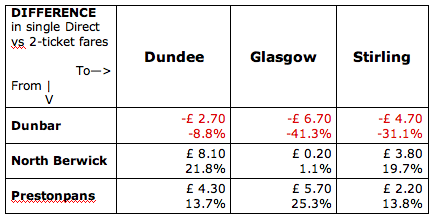
As shown in the table below, the penalty incurred by NOT buying two tickets averages 14.2% from North Berwick and a whopping 17.6% from Prestonpans. It is wholly bizarre that it is cheaper to travel from North Berwick than from Prestonpans, despite it being 16 miles closer to Edinburgh (2/3rds the distance). Both John Yellowlees (ScotRail Customer Service Manager) and Steve Montgomery (Managing Director) are aware of this issue but, to date, have simply waffled in answer to requests for corrective action.

East Lothian 2012 ScotRail Fares to Edinburgh & Selected Destinations (Source: TheTrainLine)

The calculate the two-ticket price, add the appropriate fare in the ‘Edinburgh’ column to the destination fare on the Edinburgh line. Tabulating the results gives as big a pig’s breakfast of irrational pricing as you could find in any railway buff’s nightmare.

Differences in Using Direct and 2-Ticket Fares

It is hard to believe that everyone at ScotRail is so innumerate as not to see the public relations disaster of such an illogical structure so the only logical conclusion is that it is a wheeze to milk extra money from their customers without their realising that they are paying up to 25% over the odds. And, before you celebrate that Dunbar’s getting a deal on direct tickets, see above where they are already getting fleeced 40% more than other ScotRail customers. Only their best deal (Dunbar-Glasgow) saves them that 40%.

Suffice to say, the table highlights a whole series of anomalies. If any other vital commodity were sold with such arbitrary price structure, there would be a riot. It’s only because rail fares—like the myriad energy tariffs—are so complex that people simply give up trying to unravel it all and pay up.

Which was probably the plan all along.

Posted in Commerce | Leave a comment

The Road Less Travelled

More than a little surprised at the intensity of debate on loyalty that erupted on Twitter as we approached the bells last night. It seems that I was being controversial when I argued that Unionists were more confused in their loyalties than people like me, for whom the welfare of the Scottish people is my top priority.

Before I am to post a blizzard of comments amplifying their position, let me try to paraphrase what was being said from contributing unionists across the party spectrum:

  1. You can be loyal to more than one cause
  2. Being loyal to Britain does not prevent loyalty to Scotland
  3. EU supporters were, by definition, loyal to the EU
  4. As London is the capital and seat of the monarchy, loyalty to it is normal
  5. Some Unionists do prefer Westminster to Edinburgh. Both camps have wide view

All but #3 are agreed. Naturally, we each hold a spectrum of loyalties over all our myriad endeavours (family; school; club; friends; business; etc) and this extends to the political sphere, where voters (rightly?) can hold multiple loyalties to parties, policies, individuals and even traditions. I have made no value judgement nor queried the validity of any of these, although some, like the BNP, are sailing close to the wind in my view.

However, when it comes to the matter of independence for Scotland, there are some tenets of my own that I don’t mind putting down in black and white. All are free to query them but the only thing likely to disqualify opinions you may hold yourself is if you question my right to hold my own. These truths, as our American cousins say, I hold to be self-evident:

  1. The people of Scotland are sovereign, as stated in the Declaration of Arbroath. I don’t care what English custom says: I’m a Scot.
  2. My definition of ‘Scot’ is all those who were born here or who chose to make their home here. Race, colour, religion, etc are irrelevant in defining the people of Scotland—we’ve always been a mongrel nation; long may it remain so.
  3. My loyalty is to the people of Scotland. Insofar as we bind with our friends, as we did with our English friends these 300 years, I have loyalty to that bond, appreciation for the friendship it brings, pride in what we have achieved and respect for their distinctiveness within it.
  4. I am also a committed European. Despite William/Philip/Napoleon/Hitler and whatever local miscreant the next centuries dredge up, I remember our Viking forebears who settled and enriched us, our merchants in Flanders and the Hanseatic Ports, Scots Russian admirals, regiments of Scots with Gustavus Adolphus and Louis and the whole history of international outlook. Scotland is, was and can be European in a way Apopleptic of Tunbridge Wells may never manage.
  5. Where loyalties come into direct conflict, as when wars break family loyalties or when London dumps unwanted nukes on the Clyde, everyone has a choice to make. What I am very clear about is that Scotland—or more exactly what I honestly believe to be in the best interests of the Scottish people—is my primary loyalty. All others I will seek to maintain but where a conflict arises, Scotland has clear priority.

I do not issue any challenge for anyone to make similar declarative statements. But I though it might clear the air and speed the debate along in 2012 if we got these ground rules straight. But, given the above, any unionist has to choose their own priority: is it to the Union in London or to their own version of what I write above? To date, most have managed to fudge and pretend both are valid. The road less travelled is to come clean and say which has priority.

For, when push comes to shove and a clear conflict between Scottish and British interests exists (e.g. feed-in tarriffs or North Sea oil revenues) it can’t, in my opinion, be both.

Posted in Uncategorized | 1 Comment

We Don’t Need No Altercation

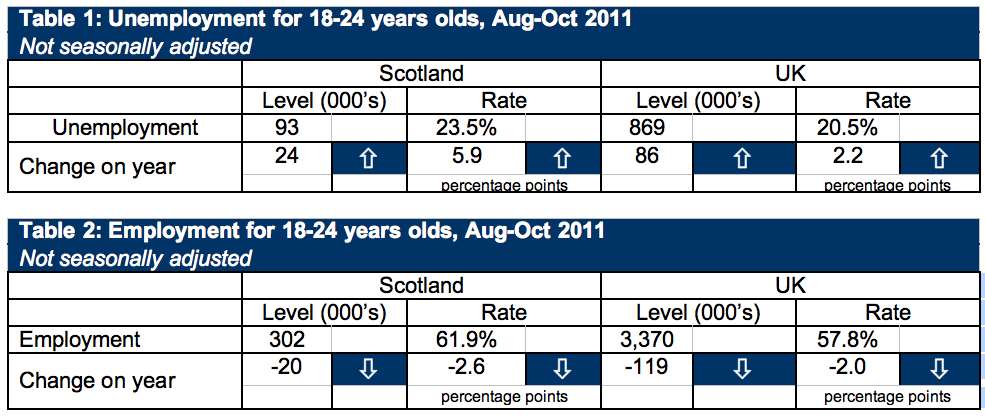
Since 2007, the total proportion of 18- to 24-year-olds claiming jobseekers’ allowance has almost doubled in Scotland – from 4.3 per cent to 8.3 per cent. While everyone has felt the chill wind of the ongoing fiscal crisis, at the bottom of the pecking order, young people seeking their first job have been hit hardest. The usual suspects snuffling about for bad news have hoovered this into their moan machines but, as usual, have been distinctly quiet as to an effective solution.

Source: Scottish Government, December 2011

Yesterday’s man Iain Gray has led this particular charge and, to be fair, did propose a solution: unlimited apprenticeships. While definitely part of a solution, as with so many Labour postures, it is partial and even damaging, as well as rather ignoring Swinney’s existing ambitious plan, with increases confirmed in September. The danger is that, after years of education fixating on access to university, to swing the opposite way and focus on vocational would be even less helpful.

The future of Scotland rests on three key commercial advantages, all with a worldwide reputation and potential market. One is our history and environment. on which tourism is being developed; one is our richness in resources so that our continuing oil will become outstripped by renewables; the third is our knack for quality specialist products, be it whisky or Irn Bru, Weir Pumps or Wolfson Semiconductors, salmon or chutney, market or mutual funds. And we’ll find new opportunities in an ever-changing world: when drought becomes endemic in England, who’ll have loch-fulls of water to sell them?

Pivotal in exploiting all of this will be our young people and how we prepare them. It’s not just about education. It’s about tapping into their ideas and firing their imagination; it’s about seeing youthful enthusiasm as a solution and not a problem. We restrict—or worse yet waste—it at our future’s peril. A current lager ad set a century ago touches on this, when a young Tennant’s magnate glows with his vision of brewing a reward for the people, only to find that someone’s stolen his cartwheels.

Scots need no lesson in drive, energy and enthusiasm. The trouble has been that it was always seen necessary to travel elsewhere to fulfill it. If our businesses were to focus along the lines above and education were to adjust so that, as well as brilliant academic research, we were to turn out scientists and engineers to staff such industries, craftsmen to build and maintain their infrastructure, administrators to both preserve and develop our peerless quality of life, then not only would jobs for non-specialists be more plentiful but better funds to help less fortunate participate, if not contribute, would be available.

Most of all, there would be a sense that there was some link between contribution and reward, that taxes paid were not being drained off to build tube lines in London, intrude in other countries’ affairs or fund a third generation of nuclear armageddon-makers to sit as a useless threat on our own doorstep. That would give a more engaged context.

But young people are idealistic, passionate, impatient. The blatant irrelevance to them of media fixated on Westminster or Afghanistan or the latest eurocrisis and especially of the endless, conclusionless altercations that pass for politics means any sane, effective approach to engage them would not just provide sensible (and equally valued) career paths for academics, engineers, artisans, artists, administrators, etc., but would support this through engaging teachers and parents in more than just extracurricular sports but in wider extracurricular activities that would hold their interest.

Youth cafes, Scouts, etc. are a start but the blight that nitpicking H&S has put on outdoor activities needs to be lifted, the mindless bureaucracy of Disclosure Scotland trimmed and the paranoia about child abuse mollified so that a broad spectrum of adults can interact with kids not their own without thinking the polis are watching every move. This is how kids used to get a real education—by hanging out at the farmyard or shop or smiddy, getting keen and starting on the skills that would make them a good apprentice journeyman. And they start this around age 6, not 16.

Will this require some undoing of well meaning legislation? Yes. Not everything made into law is, in retrospect, sensible. Just ask the Americans about Prohibibition. Even today, any Welshman caught within Chester city limits after sunset can still be legally shot with a longbow.

If we’re to make real inroads into the sad youth NEET stats, let’s give our young people (and stray Welshmen) a real chance by changing the rules; you can’t eat political postures.

Posted in Commerce | Leave a comment

Education is no Football

Today’s Hootsmon features Alan Massie gaunin’ his dinger that the “SNP’s failure on schools is a dereliction of duty”. The seems a pretty ringing condemnation, yet reading the article, it is hedged around with caveats and conditions—“the SNP inherited Curriculum for Excellence”; “there are many good schools and good teachers in Scotland, and some at least of our universities maintain very high standards” and the like.

However much I struggle with his patrician Tory views, Alan Massie is a respected, articulate member of the media in Scotland and roams far beyond politics in his many writings. As those views have been solid since Adam was a boy, his articulation of them demands respectful hearing, even when a whiff of fire and brimstone in any critique to do with the SNP are part of the package.

I would normally pick holes or attempt to outflank his thesis, but here I take exception to his whole premise—that Scottish education is in a parlous state and that the SNP has sat on its hands in the face of such catastrophe. Despite his long tenure as a pundit, his own education of Drumtochty, on to Glenalmond, then topped off by Oxbridge is hardly mainstream anywhere—most certainly not in Scotland. Nonetheless, I do grant that he pays close attention to educational matters and generally writes on them well, as in:

“Too many leave school barely literate, barely numerate, and ill-equipped for adult life. Too many are, as it were, programmed for failure, doomed to unemployment or, at best, to low-skill employment. Many are, in the view of employers, unemployable. They are the casualties of an education system mired in complacency.”

Up to that last sentence, I was with him. But such blanket declarations make education into an endless game of political football: they are not helpful. Domination of Scottish school philosophy for decades by Fabian principles of equality and inclusion blunted much of the edge our schools once had. By 2002, the McCrone agreement sought to restore prestige and initiative to a demotivated cadre of teachers.

But McConnell’s approach of throwing money at a problem did not succeed. Decades of defensive thinking by teachers’ unions has kept a ‘work-to-rule’ principle going. Many teachers declined to take an interest in their charges out-with the hours for which they were contracted. School trips, out-of-hours activities, even sports suffered as a result. Mr Massie says little about these circumstances and how we got where we are.

A secondary effect has been the gratuitous drive by successive governments to drive up the number of graduates, with scant thought for either the disciplines involved or what such highly educated people would actually do for a living. Like apprenticeships for all, a degree for all is simply bodyswerving the problem for a year or so. And, anyway, student life is hardly the best training for successful business.

The corollary was that vocation education was viewed as second-rate, a consolation prize for thickies. Maybe Mr Massie is handy with jig-saw or welding torch but I doubt it. And ask any householder and they will tell you that there is a dearth of good plumbers or mechanics or roofers, etc. The country has become fixated on the idea that people with five highers are better than those with one. A brief census of your friends tells you this is mince. But parents and teachers have been jointly driving this agenda since the sixties.

This unhappy joint conspiracy among governments, teachers and parents has done the country no good, with, as Mr Massie rightly points out, “Too many programmed for failure, doomed to unemployment or low-skill employment.” Right on, brother; it’s a shameful waste of young energy and talent. But the fix is not in the make-work post-school wheezes emanating from Tories and Labour alike. That’s like treating rickets with elastoplasts: not just wrong but counterproductive in raising false hope.

The SNP started off in 2007 saying that class sizes were important, especially in early years. They are. Unfortunately, Labour has griped monotonically about teacher numbers, promised apprenticeships to everyone and pretty much ignored everything else. They have also used control of the few (large) councils they have to fire many teachers and thereby save budgets, while supplying their MSP colleagues with more gripewater.

Look at what the SNP HAS done, Mr Massie. Take my own council of East Lothian. Teacher numbers are down slightly, but then so are pupil numbers, the recession having cut down numbers moving to the county. Bottom line is that most P1-P3 children are in smaller classes. In addition to that, schools in the low-performing areas have been given extra teachers to work with the infants in those classes. Also, Place2Be has been brought in to smooth social stresses and much effort is made to ensure joined-up thinking with the rest of the council, most especially children’s services. Results can only be evaluated in a decade when those children move from school into the world.

For there are two dicta that I and my colleagues believe apply here: 1) “Give me a child until he is seven and I will show you the man” and; 2) “A school may teach a child but it takes a village to raise one”. Just as the family is an essential background and vehicle for the successful education of most children, so surrounding neighbours, through their guidance, actions and culture complete the development. To approach the complex process of education as if it were Roads Services or Planning, where minimal context within the community is the norm, is to fall for a wrong assumption.

Mr Massie calls for a wholesale reform of the education system without so much as a hint at how this might be done, nor the extent to which this could be done without a parallel reform of society. Blair’s academies and Gove’s free schools are faction-based and only ever going to be partial solutions, even if successful. Let’s drop the party-partisan rah-rah, shall we? Rather than beat up his old enemy the SNP—apparently just for the sake of it—I hope serious contributors like Mr Massie would consider joining in the debate to achieve real long-term improvements.

He (and Labour and Uncle Tom Cobley) are right to highlight the problems. But in this era of declining incomes and budgets, what would he suggest beyond what is being done? A societal approach to education seems the only sensible one. This is not to shirk that more must be done by both councils and government to lower class sizes, engage teachers and apply strict standards. Those emerging from school must be smart, keen and useful and not just using pieces of SQA paper as camouflage for a lack of purpose.

SO, get off the sidelines and onto the field, Mr Massie. Our kids deserve better: you, of all people, know they do.

Posted in Education | Leave a comment