Subsea Robbery

One fact that is almost wholly unappreciated outside of the oil business is the obligingly shallow nature of places like the Gulf of Mexico and the North Sea. To landlubbers, the sea looks pretty much the same anywhere and, since it gets dark and eerie much below 40m depth, what does it matter? In some cases, the shallowness can have useful effects, such as enabling causeways to be built between islands in places like Orkney and Eilean nan Siar, but mostly, it’s just sea, isn’t it?

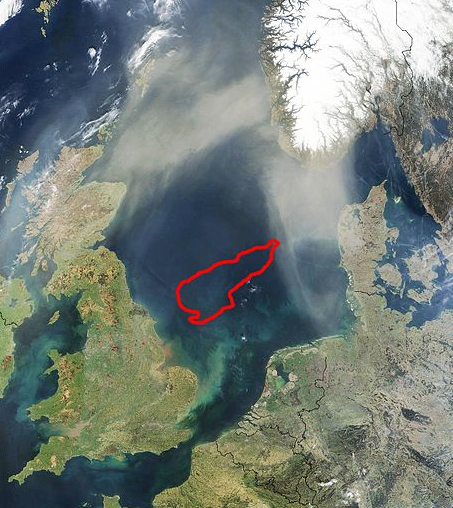
Students of paleogeography have unearthed (unsead?) some interesting history in that the North Sea was once much smaller and some 10,000 years ago, it was possible to walk from Yorkshire to Jutland, provided you splashed across the combined Humber and Rhine at some point. En route you would have passed a chain of highlands that are now being called the Dogger Hills.

Location of the Dogger Hills

As ice age snows melted, sea levels rose and the lower-lying parts flooded. Evidence that the area was inhabited are dredged up by fishermen on a daily basis. The last to submerge were the high Dogger Hills, which now lie submerged 18m-60m below the surface. The Geology of the Dogger Bank notes “a buried relief at an average level of 3 m below the sea floor was discovered. Most likely this relief represents a former glacial landscape covered with soft sediments.” So a drowned world exists out in the North Sea.

Curious as this is, you may be wondering what all this has to do with the price of cheese. Let’s imagine that the UK Govt felt threatened by Scottish independence. How could they secure a better share of the North Sea oil billions that would otherwise fall to Scotland? Well they already did that once in 2000 when the Blair government shifted the agreed maritime boundary where Scots jurisdiction ran to put 6,000 sq. km into England. If you head due East from the Forth, you actually run into England.

An evil-minded Westminster might consider a little land reclamation. With the sea bed barely a building height below the water, it is not inconceivable that an island of several sq km could be reclaimed by a ring of rock ‘seerapp’ armouring, within which sundry landfill materials could be dumped to create dry land. Its official purpose, being 100 miles closer, would be to provide close support for North Sea installations and act as a base for the many offshore wind farms being contemplated for the area. With supply bases, helicopter and rescue facilities and even a tanker and pipe terminal, it could be a business in itself.

But its covert purpose would be less obvious. At that latitude, it should be under English jurisdiction, which makes it part of England. In turn, that would cause a redrawing of the equidistant boundary that caused so much fuss when first drawn in 1999. Because it would actually steal considerably more North Sea bed than the original grab. In fact, it would place England as the dominant benefactor from North Sea oil and gas, even if Scotland would still dominate the Norwegian and Celtic Sea.

The "Dogger Effect" What if the English Reclaimed Dogger Bank?

If all this sounds implausible, then consider what similar investment has done to turn three rocky islands called Macau into one of the fastest growing (literally) places in the world as it passes 28 sq km in size by filling in large sections of the Pearl River estuary.

Posted in Commerce | 4 Comments

Along the Highland Line

Scotland’s Chambers of Commerce have gone public with their criticisms of the rail network North of Perth which they describe as “not fit for purpose”. Given that the last major investment made there was the Inverness & Aviemore Direct Railway over Culloden moor (completed 1898), they may have a point. The timing is no coincidence as the Scottish Government’s Rail 2014 Public Consultation completes this month.

ScotRail Network as at February 2012 (Colours indicate routes run)

Those who travel by rail North of the Central Belt will know what SCC is on about. Though ScotRail use (mostly) Class 170 Turbostar 3-car trains to Aberdeen and Inverness, they are crowded and uncomfortable for a 3+ hour journey and services beyond are slow 2-car Class 154s. The North lines from Inverness to Perth, Kyle, Aberdeen and Thurso are each about 100 miles long or 2 hours’ driving. The respective trains take 2 hrs, 2.5 hrs, 2.5 hrs and 3.5 hrs. Hardly competitive.

Given the difficult landscape and absence of any investment, not much could be done on these four lines without significant investment in infrastructure. The remaining Glasgow-Edinburgh-Aberdeen triangle is another matter. While the Edinburgh-Glasgow Improvement Programme (EGIP) is welcomed, as well as long overdue, it will only provide catenary electric power on the main Glasgow-Edinburgh link and as far North as Dunblane. This will do little to address the SCC’s complaint, nor, in my opinion, start to exploit longer-distance travel within Scotland. At the moment, travelers to Aberdeen are in rather poky 3-car Class 170 Turbostars—adequate for short-haul but not the 150-odd miles to Aberdeen on which they are eternally overcrowded and poor in facilities. They can barely seat 140 standard, plus a dozen First Class passengers.

While I support projects like the recently completed Alloa line and think both Borders and St Andrew are long overdue to be reconnected to the network, what is missing is some ‘big’ thinking to ratchet rail travel in Scotland up closer to continental standards. That would take new thinking by both ScotRail and the Minister and involve new trains and some track improvement.

A ‘feature’ (I’m being kind here) of the Tory rail privatisation was to split track, rolling stock and operators from one another: Network Rail does the track Rolling Stock Operating Companies lease the trains and (in Scotland) ScotRail runs them. The length of leases entered into between ROSCOs and TOCs are generally equivalent to the length of the franchise agreements for the provision of rail passenger services.

At the end of the current ScotRail franchise all leases for trains operating in Scotland will terminate, except for the new Class 380s where we have given a commitment for longer leases as it was more commercially advantageous to do so. Electric rolling stock has lower lease costs than equivalent diesel units, and they are also more reliable and cheaper to maintain and run. Long-term, the Aberdeen triangle must be electrified but what would revolutionise it in the meantime (and justify such investment) is new trains.

Currently there is no such thing as an Aberdeen express but there should be. Currently it takes three hours because each train stops at every lamp post. If you want to be in Glasgow/Edinburgh for a 9 am meeting, you must catch the 05:33/05:56—and even then it’s tight. This is short-haul, Central Belt thinking. It provides 15 trains a day to each of Glasgow and Edinburgh. EGIP will release many Class 170s for use elsewhere, so these could lengthen the trains—but not improve them. What we need is a fresh thinking.

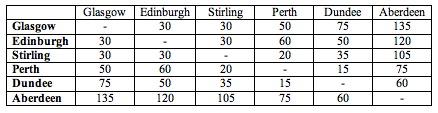
What we need is an express service between Aberdeen and Glasgow, stopping only at Dundee, Perth and Stirling. Using tilting Class 222 Super Voyager (like Cross-Country use), journey times could be cut to barely 2 hours. A fleet of 12 5-car units could provide an hourly service, each with 250 standard and 100 1st class seats. Add in another five units to provide non-stop Dundee/Edinburgh and Stirling/Edinburgh express service that connect with the Glasgow service and you have yourself a railway.

Projected Travel Times for a Class 222 Express (in Minutes)

Naturally, the first question must be: can we afford this? Well the Class 170s we have each cost around £750k per annum to lease. Even if they’re full, their revenue per trip can’t be more than £3k. Assume 3 trips each 5 days per week with a couple of weeks in the sheds and each train will gross £2.25m each year. Even half-full, a Class 222 will gross £7m. Given a lease cost for a used 5-car set of around £3m, that still earns more than the Turbostar. And those Turbostars would still have a job—forming a twice-hourly service from intermediate stations (including the Dunblane-Stirling-Edinburgh service) and feeding passengers into the express stops.

But, more importantly, this ratchets the backbone of Scotland’s rail network up into a 21st century class and means (with EGIP) four of Scotland’s cities and two of its main towns have superb interconnections. ScotRail has gone from 58m to 78m passengers each year but this is the way to keep it climbing. Somewhere in the £738m we are paying to have rail services (plus the £800k we pay in fares) there must be the latitude for the £40m investment that will pay for itself after the first year.

This step would focus future investment on signalling and doubling of the single-track line still in use South of Montrose. It would also trigger us getting serious about rail investment in the more expensive Inverness connection so that all our cities enjoy a decent level of communication. But best of all, car travel would drop, rail travel multiply and business would embrace catering, WiFi and opportunity to work in first class conditions.

Posted in Transport | 2 Comments

J’Accuse

Regular readers know my politics but what may not be so obvious is that I am a fan of the Labour party—not today’s Labour party but the one that John Maclean founded, that spread through the streets and slums where underpaid workers supported the imperial state of 100 years ago.

My admiration stretches easily on to Atlee and Bevan and their visions. But, since my first political memory is of John P Macintosh giving Tory toff Anstruther-Grey a local fright in 1966, the former has recently been a rarity—a Labour politician of vision and humanity who reached out across party boundaries, espousing a rooted inclusiveness that originally lay at Labour’s heart.

How the likes of Derry Irvine and Peter Mandelson ever got into the party remains a mystery to me but what is more relevant is a) the total absence of a politician of real stature in the Scottish Labour of today and b) an embalmed echo of the in-with-the-bricks community strength of the original party. This, more than anything, explains its recent demise. But there is a third, overarching factor, which is that the UK party has lost its soul. Blair may have started that process but others continue it.

Much though I may oppose Labour these days, I still accept the need in Scotland for a party along the lines that Maclean would recognise and embrace. But, since there seems to be little hope of that happening locally, I am encouraged that several blogs and writers dare to put their heads above the parapet in discussion on such things. Local Labour man Neil Foy was on LabourHame decrying cyberbullying from all sides. And today was one of the most insightful and honest letters diagnosing what is at the heart of Labour’s problem and published, with no small amount of courage on both sides, on LabourList.

LOSING FAITH

FEBRUARY 17, 2012

Dear Ed,

I do wonder how often you receive letters from party members and whether they all start by saying how long they have been party members. In my case it is 21 years. As a 15-year-old I was going to be part of a tidal wave sweeping Neil Kinnock to power. I was optimistic in those days.

Since then I have been a parliamentary candidate twice, a school governor and a councillor – generally what you would call an activist. I grew up in the party; my parents were councillors, my mother was a parliamentary candidate three times, my grandfather was a party agent and my great grandfather was the chair of Poplar Labour Party. I’m saying that this party is in my DNA.

All of this makes my current concerns very hard to resolve; mainly that I no longer have any faith that the Labour Party will make a better society – or even wants to do so. This is a feeling that I have been trying to ignore for some time, but I think it is time to raise it with you.

Firstly, the party’s attitude to democracy is pitiful. Internally, it’s a joke and the people and factions competing for power seem to despise party members. I had hoped your review led by Peter Hain would tackle this problem but what came out of that was not a meaningful change from the current state.

It might be forgivable if this rejection of democracy were just an internal thing, but the party’s approach to democracy for the public is just as qualified. After the expenses scandal, Gordon Brown let a lot of basically dirty MPs off the hook and then offered the weakest possible reform to parliamentary accountability (AV) as a sop to the electoral reform movement.

After the election, all it would have taken to have shown some vision and understanding would be for one of the putative leaders to say how ridiculous AV is and have proposed an amendment to the Bill to allow for a third option of STV. But no candidate was willing to upset one third of the electoral college – the MPs – by suggesting there was anything wrong in principle with safe seats.

Your election as Leader also upset me because the party was so desperate to elect someone who would recant the sins of New Labour that they refused to consider whether you actually meant it or whether you would be any good at the job of leading. It shocked me that anyone believed your proclaimed principles when at no time in your career had you espoused them before standing for the leadership. It shocked me that party members, unions and MPs would back you regardless of the fact that you were so clearly not up to the job, have no vision for Britain and can’t communicate very well. That said, I hoped I would be proved wrong once you had won.

Your leadership has shown me how lacking in vision you and Ed Balls are in particular but your team is in general. You talk nonsense about good companies and bad companies as though companies can have ethics. It’s not about companies, it’s the people who make decisions who are, or are not, ethically driven. And your confusing position on austerity is simply small minded.

Austerity may be a necessity but our party, with our values, ought to be standing up for people. And if that means “embracing” austerity, that should be conditional on an outright mission to attack the cost of living for the people who will have to pay for austerity. You know that the major cost of living is housing and that’s driven by a perverse, ever-inflating housing market. But you won’t push for real, meaningful policies that would reduce this overweight cost because any such policy would take the heat out of the housing market and lead to house price deflation. You won’t countenance policies to help the many if the few who will pay are Daily Mail reading swing voters in marginal seats.

This is the core of your problem. Because you believe in power over principle, you can’t tell the difference between vision and triangulation. You think you can keep the left just enough on side through pointless attacks on individual bankers’ bonuses or honours and that you can win the centre ground by attacking the unions and embracing austerity. This ridiculous lack of vision means that I have to wait to see what your latest quote is to know whether – this week – the party’s left wing or right.

While I don’t believe you are any more left wing than Blair or Brown, I don’t particularly care if you’re left or right wing. Leaders have to take a direction and it’s reasonable to ask party members to support the vision – the destination – even if the course isn’t the one those members would prefer.

My problem is that you are not a leader. You are not articulating a vision or a destination, you’re not clearly identifying a course and no-one’s following you. You’re simply coming out with unintelligible guff in response to the latest headlines and seemingly hoping that we’ll think its impenetrability is down to our lack of understanding rather than your lack of coherence. The nonsense you say isn’t even well crafted and your “something for something” speech at conference was simply embarrassing.

I have come to fear that you might actually win the next general election. Your absolute lack of a vision for Britain or any leadership qualities, and in particular your willingness to dissemble about your beliefs to win the Labour leadership makes me fear what you would do if you had any actual power. I don’t believe you know what you would do with power and I fear what you would do to keep it. It’s a formula that would lead to a government with a similar inertia to that of Gordon Brown. Except that you don’t have Gordon Brown’s talents.

People try to tell me that it would be a problem replacing you, but if we excluded the outright mad or bad MPs there’s at least a hundred Labour MPs who couldn’t do a worse job than you.

It is all about talent. I’d love us to have a leader with the articulacy of Emily Thornberry, the intelligence of Stella Creasy, the easy charm of John Woodcock or the tangible decency of Hilary Benn. But somehow the Labour Party seems to drain the talent from its people.

Our shared history and values imply that we will stand for the people who need us most. Right now that’s more than half of the population of this country. But it’s disproportionately people who don’t vote and it’s not swing voters in marginal seats. So we don’t stand for them. Nearly any Labour MP you speak to wants to stand for them but collectively we are incapable of doing so.

The Labour party stands for its leader and his interests first. Then it stands for its MPs and securing their jobs as best as possible. It stands for the union general secretaries (but not their members) just enough to keep them affiliated. After that it stands for swing voters in marginal seats and the media proprietors who can influence them. After that, if we’re lucky, we get to do something for the people for whom the party was created.

And it’s not that we’re any worse than the other parties, who operate just the same. We’re just supposed to be better than them and so our failure is more disappointing. Whether you think we’re a democratic socialist party or a social democrat party, you’re wrong. We’re an illiberal elitist capitalist party with no taste for democracy and a misplaced belief that the masses are better off in our care than that of other parties.

I’m not sure whether your departure would really make a difference to this. Would the next leadership election deliver us a leader or just another functionary fearful of his or her vulnerability and incapable of inspiring?

For all his faults, Blair had a real vision of a Britain that was better and fairer than the nation he inherited. And he had the leadership skills to keep the party together even when we didn’t like the details.

So what am I asking you to do? To prove me wrong maybe? To resign? To be honest I don’t particularly care anymore. I’d like it if you were honest and told us who the Labour Party’s going to help, and how, and set your policy direction consistently with that declaration. And then if we didn’t agree with you, we could just leave rather than persisting with vain optimism.

Alex Hilton

Posted in Politics | 2 Comments

Ye’ll Ken It’s Summer When the Rain’s No’ Sae Cauld

With snowdrops out and the first crocuses showing colour, we may not yet be in Spring but the assiduous visitors are already planning their holidays. So, rather than banging on about politics (again), I thought we might provide a little guidance when it comes to that key variable in vacations: weather.

Given that we are talking about weather in Scotland, we are (despite ‘Sunny Dunny’s protests about being the driest place in Scotland) talking about rain. And, like the eskimos have fifty words for snow, so the nuances that the Scots can make regarding precipitation takes some translating.

Punch once ran one of its many hilarious cartoon digs at the Scots in which a tourist passes a grizzled gamekeeper in the middle of a downpour who, when greeted with “nasty weather” replied “aye, ah doot it’s threatenin’ tae dry up”. Here follows a rough guide for furriner and sassanach alike so that they may better understand local meteorology:

“braw” = a bright day that threatens no rain
“dootful” = although fair now, no clarity whether it might rain later or not
“lowerin” = no rain but low clouds make the day seem dull
“nae drouth” = no rain but with high humidity
“nae washin the day’ = no rain but rain expected
“threatenin'” = no rain but dark clouds imply rain soon
“lyin’ fir mair” = wet ground from recent rain with more expected soon
“haar” = a mist you get wet in as you walk through it (actually a cloud at ground level)
“scotch mist” = a haar so dense you don’t have to move to get wet
“showery” = if it’s not raining, it soon will be and vice versa
“drouthy” = intermittent rain (like showery but with more rain than none)
“cloudburst” = sudden, intense rain shower that seldom lasts more than a few minutes
“thunderplump” = worse than a cloudburst and normally accompanied by thunder and lightning
“dreich” = steady but not particularly heavy rain with low clouds and little sign of relief
“squally” = a dreich day but with wind to blow the rain around
“pelters” = rain and wind together that make umbrellas unmanageable
“stoatin’ doon” = a dreich day but with large drops of rain
“drookit” = a dreich day but with dense drops of rain
“stair rods” = intense and persistent rain with large and/or dense drops of rain
“richt sou-wester” = intense and persistent rain with gusting winds from varying directions
“whitecaps”  = intense and persistent rain with winds strong enough to whip drops from puddles
Posted in Environment | 2 Comments

SAC Race

Always good to see the Scottish press lead off debate on things that matter to us all. Today, The Record features the deliberations of Westminster’s Scottish Affairs Committee who have put their heads together and come up with an inquiry that is based on a list of…well, let’s see…it seems to be a list of questions most of which The Record seems to have forwarded from its readership.

The Scottish Affairs Committee, representing such hot-beds of debate on matters Scottish as Congleton, Dewsbury, Finchley and Warrington, has decided to seize the initiative and clarify all this confusion over what independence means. By posing the questions raised the committee apparently feels it is driving the agenda and racing to a conclusion by “asking and answering these questions about how it will affect every aspect of every life”. No modest ambition here.

Committee chairman Ian Davidson said: “We are extremely grateful for all the responses from Daily Record readers, who told us the sort of things they needed to know.” Then, demonstrating his unique take on impartiality, Mr Davidson went on to say: “The big question is the terms of the ‘divorce settlement’—how resources, rights and responsibilities would be broken up.”

Anyone truly committed to calming fears and spreading the truth would do well to consider less loaded and inflammatory language. But his woeful contributions mirror any in his party. From Shadow Scottish Secretary Curran, on through Lords Foulkes and Robertson, right down to Lab leader La Lamont, all sing off the same dismal hymn sheet. The rather obvious collusion among SAC, Labour and The Record means that giving any of them the benefit of the doubt may seem foolish. Or fruitless. Or both.

But Scotland deserves better—this debate is too important. However much a sham the ‘objective’ cover of a Westminster select committee may be, it must be faced and dealt with or we’ll start off with a free Scotland tainted by the same self-serving bigotries. Just about any Scot who has been paying attention—to the better media and not just the SNP—could answer SAC’s daft questions in their sleep. But to anyone having trouble, there are thousands out here happy to help.

Posted in Politics | 1 Comment

Carte d’Amitié

L’UNION LIBRE

Ma femme à la chevelure de feu de bois
Aux pensées d’éclairs de chaleur
À la taille de sablier
Ma femme à la taille de loutre entre les dents du tigre
Ma femme à la bouche de cocarde et de bouquet d’étoiles
de dernière grandeur
Aux dents d’empreintes de souris blanche sur la terre blanche
À la langue d’ambre et de verre frottés
Ma femme à la langue d’hostie poignardée
À la langue de poupée qui ouvre et ferme les yeux
A la langue de pierre incroyable
Ma femme aux cils de bâtons d’écriture d’enfant
Aux sourcils de bord de nid d’hirondelle
Ma femme aux tempes d’ardoise de toit de serre
Et de buée aux vitres
Ma femme aux épaules de champagne
Et de fontaine à têtes de dauphins sous la glace
Ma femme aux poignets d’allumettes
Ma femme aux doigts de hasard et d’as de cœur
Aux doigts de foin coupé
Ma femme aux aisselles de martre et de fênes
De nuit de la Saint-Jean
De troène et de nid de scalares
Aux bras d’écume de mer et d’écluse
Et de mélange du blé et du moulin
Ma femme aux jambes de fusée
Aux mouvements d’horlogerie et de désespoir
Ma femme aux mollets de moelle de sureau
Ma femme aux pieds d’initiales
Aux pieds de trousseaux de clés aux pieds de calfats qui boivent
Ma femme au cou d’orge imperlé
Ma femme à la gorge de Val d’or
De rendez-vous dans le lit même du torrent
Aux seins de nuit
Ma femme aux seins de taupinière marine
Ma femme aux seins de creuset du rubis
Aux seins de spectre de la rose sous la rosée
Ma femme au ventre de dépliement d’éventail des jours
Au ventre de griffe géante
Ma femme au dos d’oiseau qui fuit vertical
Au dos de vif-argent
Au dos de lumière
À la nuque de pierre roulée et de craie mouillée
Et de chute d’un verre dans lequel on vient de boire
Ma femme aux hanches de nacelle
Aux hanches de lustre et de pennes de flèche
Et de tiges de plumes de paon blanc
De balance insensible
Ma femme aux fesses de grès et d’amiante
Ma femme aux fesses de dos de cygne
Ma femme aux fesses de printemps
Au sexe de glaïeul
Ma femme au sexe de placer et d’ornithorynque
Ma femme au sexe d’algue et de bonbons anciens
Ma femme au sexe de miroir
Ma femme aux yeux pleins de larmes
Aux yeux de panoplie violette et d’aiguille aimantée
Ma femme aux yeux de savane
Ma femme aux yeux d’eau pour boire en prison
Ma femme aux yeux de bois toujours sous la hache
Aux yeux de niveau d’eau de niveau d’air de terre et de f’eu.

André Breton

Posted in Uncategorized | Leave a comment

Big Yellow Taxi

Fond as I am of Joni and her subtle creations, this blog has nothing to do with her soaring flexible voice or her poetic lyrics but is about the visit by a Sea King HAR3 to North Berwick this weekend.

Sea King HAR3 up close

With its endless coastline, growing shipping and recreational boating, as well as huge range of outdoor activities, Scotland has become something of a hotbed for emergency rescues. To their credit, the RAF and Royal Navy who both operate rescue helicopters in Scotland work closely with the Coastguard and RNLI to provide a superbly integrated team that, together with NHS A&Es, have saved more lives from the jaws of death than you could shake a stick at.

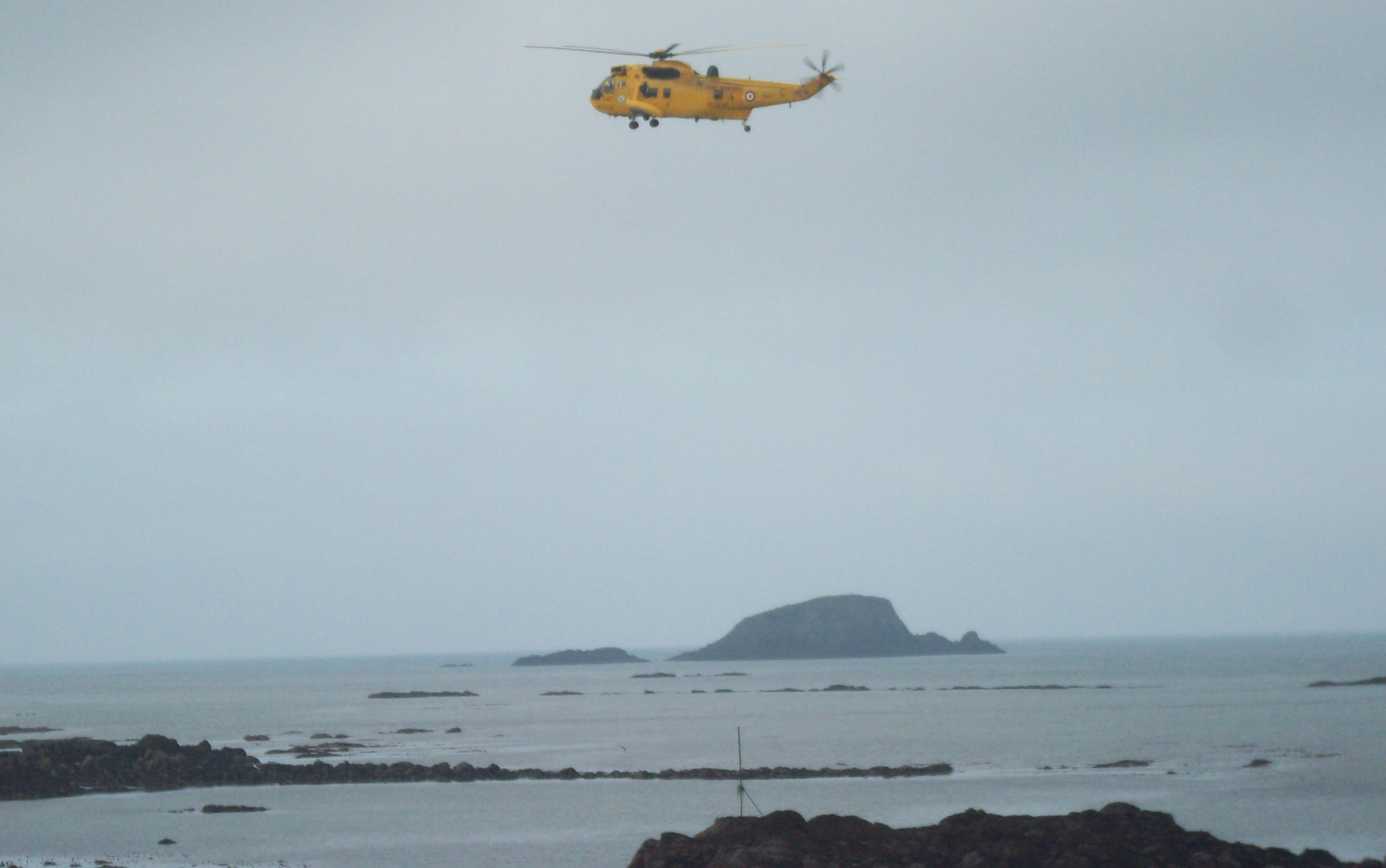
Such professional competence does not come easy and exercises that bring all elements together are a regular feature along our coast. This Sunday was the turn of North Berwick’s inshore Blue Peter III and its crews to get the shakedown. Instead of their standard Sunday exercise, three separate crews were out in the waters between the Craig and the Lamb practising winching patients from RIB to chopper and back while underway. Normally the local RNLI works with the choppers of ‘A’ Flight, 202 Squadron because their base is half an hour’s flight away.

202 Squadron’s origins started with the formation of No. 2 Squadron Royal Naval Air Service (RNAS) at Eastchurch on 17 October 1914. After operating various flying boats through two wars by 1976 it was operating Whirlwind helicopters and, with HQ 22 Squadron, formed the RAF’s Search & Rescue (SAR) Wing. The Whirlwind aircraft were replaced by Sea King HAR3s in 1978/9 and these aircraft then equipped both Squadrons. Since then, 202 Squadron has operated detached Flights, with ‘A’ at Boulmer (near Alnwick) and ‘D’ at Lossiemouth.

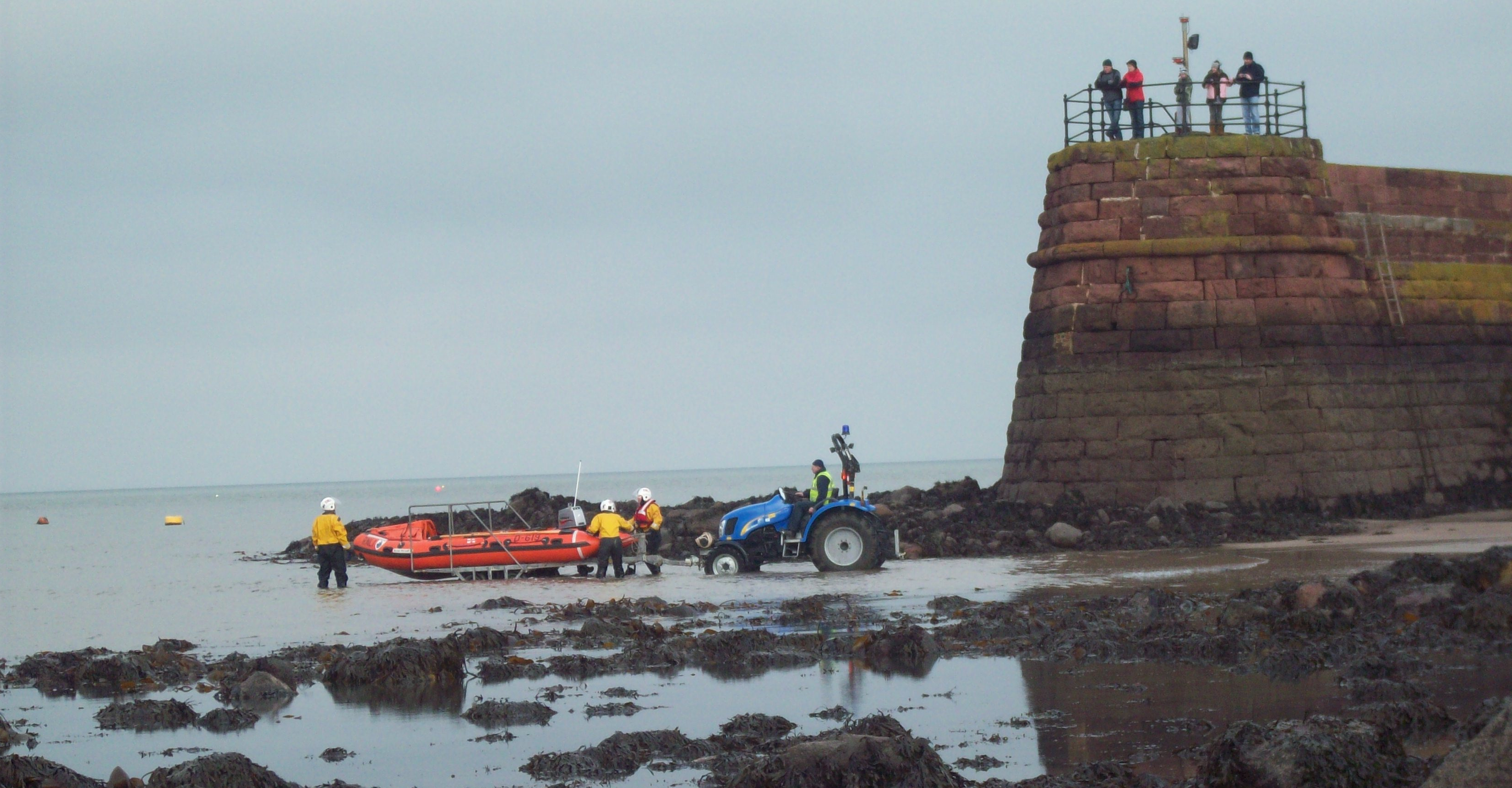
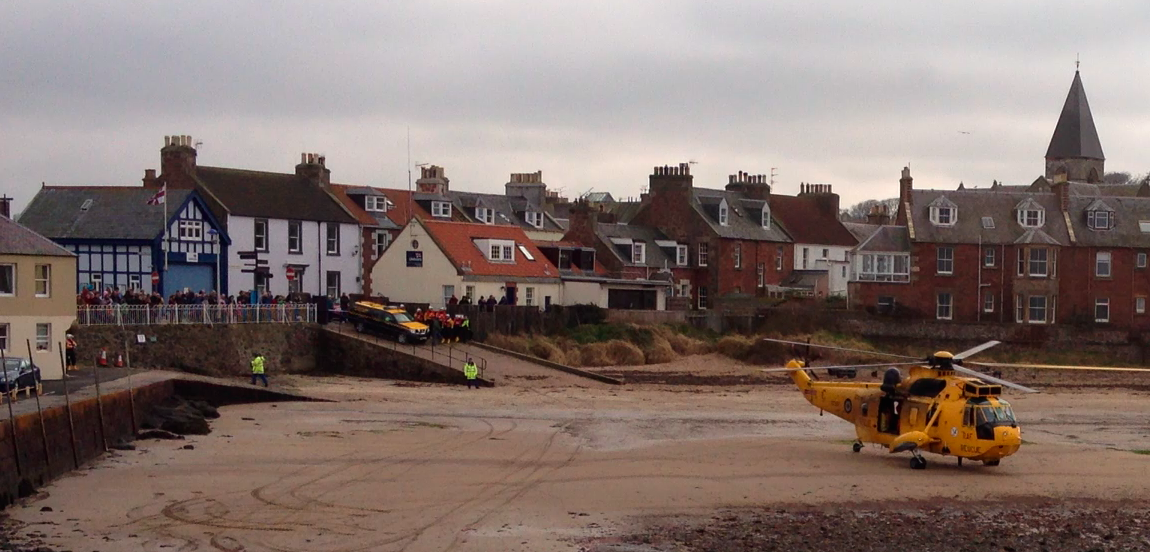
Each exercise is different so that crews can prepare for the unexpected. Yesterday’s called for an initial landing on the beach for a planning conference and am RNLI crew member to be lifted out and act as the ‘patient’ being transferred. As well as the RNLI RIB, a second RIB (EL Yacht Club’s rescue boat Valiant and skippered by Ted Hill) was used as a tender to ferry two more RNLI crews out to be rotated onto so that as many crew members as possible gained experience.

Launching Blue Peter III—at the Bottom of a Spring Tide

Blue Peter III (l) and Valiant (r) Waiting for the Off

Sea King Rescue-123 Safely Landed on W Beach in front of RNLI Station

Sea King in Mid-Lift (Photo taken by NBRNLI Crew)

As you’ll have gathered from our Staycationer’s Shore Guide blog from just a few days back, we want everyone who visits our magnificent coast to enjoy themselves and stay out of trouble. But for those whose luck does not hold—and I say this for myself who has gone out on the sea umpteen times feeling all the better for this fact—there is a team of highly motivated (if not highly paid) professionals who are trained to pluck you to safety under the most dire conditions.

And should you come visit us here in North Berwick, stop in at the RNLI’s newly refurbished (courtesy of Kitty Wilkie and her team of volunteers) shop right opposite the shed in Victoria Road. Drop in to say ‘hi’ and buy a souvenir. If you saw them in action, you’d do both and reach deep as you did so.

Re-opening of North Berwick RNLI Shop, Feb 11th 2012

Posted in Community, Environment | Leave a comment

Those Who Don’t Learn…

…from history are doomed to repeat it. George Santayana’s aphorism seems universal in its applicability and therefore the BBC presenter Neil Oliver (of Coast and History of Scotland fame) is entirely justified in sounding a similar warning on Radio Five Live. Neil sees the decision regarding Scotland’s independence as the biggest since the two parliaments were merged 300 years ago:

“It would be the biggest constitutional decision facing Britain certainly in the last 300 years, since the parliaments were brought together as one. I think everyone should be absolutely aware of how big a deal it is. Heaven forbid that anyone, or any part of the nation, should sleepwalk into a decision.”

Peppery as they can be about their national identity, Neil may be on to something when he implies that we Scots don’t really understand and appreciate our own heritage and history. And, bound up as it has been with our southern neighbour as we embarked on the most successful piece of empire-building since the Romans, it is understandable that both partners have become a little hazy as to what distinctiveness each brought to it.

I have some understanding for staunch unionists who feel the two countries have been together so long, have come through so much together that it isn’t even feasible, let alone desirable, to disentangle the two. Were we 100 years ago, still in the throes of empire, I might even give serious weight to that argument. And the messy separation of Ireland at that time haunts us to this day because unionists then would not accept change.

No-one quibbles that the Scots and English share much. I would include both Welsh and Irish in the cultural entity that is the British Isles, much as Scandinavians share culture, language and interwoven histories. But dig deeper and any simplistic model comes apart.

There is no way to fully analyse the English/Scots relationship in a few hundred words but the sheer fact that both countries remain so distinct after so long says there is something other than the single country of Britain. The last couple of centuries has seen an empire built and lost and two world wars fought through major sacrifices to victorious conclusions, all unforseeable when first launched.

But just as affinity for and from Canadians or Aussies has not evaporated since independence (over 100 years ago in both cases), so the Commonwealth is and will continue as a matter of pride, links with it remain strong and  the leading role that England played in it all won’t come under question. We may fall out more over shared institutions like the Imperial War or British Museums that about the niceties of politics and economics if we do go our own way.

Reverting to two individual countries will actually ease much of the present strain that both suffer. The English and many ‘British’ institutions in London like the Beeb will stop conflating ‘British’ with ‘English’ and the Scots can take the chip off their shoulder that appears each time that happens.

I am no fan of either soap operas or costume dramas but while the Beeb’s output of the latter is a monotonically ‘English’ BBC Scotland has managed to sell River City furth of Scotland, where it is categorised as a ‘foreign soap’ like Home and Away or Desperate Housewives.

It is unfortunate that, while many Scots spend time or live in England—most especially London—and have some appreciation for the cultural distinctions, not enough English make the reverse journey and bring that understanding back to inform their countrymen.

To move the debate along (and meaning no value judgement either way) there are at least a half-dozen reasons why the English & Scots share a similar set of misunderstandings as the English and Americans that Mark Twain so succinctly described as “two peoples, separated by a common language”:

  1. The ‘In Bed with an Elephant’ effect. Scots can find the English insufferably overbearing and yet their resentment at the US being insufferably overbearing to them does not seem to have brought them enlightenment through the parallels.
  2. The most profound message from ‘Braveheart’ was neither independence nor freedom but the ease with which Scots nobles sold their country down the river for their own ends. In turn, this goes a long way to explain egalitarianism and anti-establishment feelings among Scots, which have little resonance among the English.
  3. Bleaker, tree-poor, colder, windier Scotland breeds a different mind-set than cosier, greener, milder England. Is it any wonder that English are considered the more civilised/less prickly while Scots are the phlegmatic, dour, resilient types?
  4. While both countries were welded together around the same time (AD1000), the English were more outward-looking, fighting formative wars on French, Welsh and Scots soil. The Scots took a more inward path, fighting superior Viking and English forces and coping with major cultural divisions (Gaelic Highlands; Norse islands)
  5. While the English reformation was as minimal and genteel as you could get (unless you were trying to get between Henry VIII of his pillage) Scots were torn by religion for centuries and still exhibit harsher differences and disagreements than the English.
  6. Adam Smith notwithstanding, the English embraced commerce and a flexible set of morals in support of it from Drake, the colonies and the Bank of England at an early date. In this, Scots were willing accomplices but seldom the drivers. The more social democratic posture of the Scots is something the English have never understood.
  7. With a hostile England between them and their friends, the Scots have a folk memory of Europe as the good guys. Whether it was as mercenaries in Gustavus Adolphus’ armies, traders to the Hanseatic ports and the Low countries, guards to French kings or admirals to the Tsars, the Scots don’t share England’s understandable touchiness about the next dictator to gaze across the Channel from Cap Griz Nez with evil intent. That the English dictate our foreign policy on that basis is an irritation to Scots.
  8. While the Scots were joint partners in building an empire, most did so for business or self-advancement of adventure reasons. The hubris of thinking we are still a global power lives on in London but not Edinburgh. The English may still consider they carry the white man’s burden and tweak foreign policy to match the US’s but whatever ‘top dog’ ego the Scots may once have had was eroded by cynicism long ago.
  9. While we share a common interest in dry humour, the English version is distinctly reserved and understated. The Scots variant is far more hard-core, pushing the edges of taste. Just compare Billy Connolly with Morcambe & Wise through to Michael McDonald (or for that matter get into conversation in any Glasgow pub) to hear the mordant, uncompromisingly harsh humour that is everyday.

In summary, there seems to be a predeliction among unionists that what we have done together over 300 years has subsumed the Scottish into a British (which is fairly close to an English) identity. My thesis is that Scots are not only still distinct but are also far more aware of why they are distinct than most unionists—and certainly the British media—seem able to comprehend. 

Posted in Community, Politics | Leave a comment

Staycationer’s Shore Guide

A small article in today’s Hootsmon praises the 47 RNLI stations around Scotland’s long coast for dealing with over 200 call-outs (a.k.a. “shouts”) over the last year. This is apparently a record and is being explained by the growing number of people who chose to spend their holidays in the British Isles and not on some sun-soaked foreign shore.

Any regular reader of this blog will know that I’m a big fan of the RNLI and especially of all the hardy, brave volunteers that man their lifeboats. No matter that the weather is currently freezing or that, a month ago, they were out in Force 10 gales; if there are people in peril on the sea they are out there on the edge, saving lives and getting little for it beyond thanks and the reward of knowing a tough job was well done.

Which brings us to the nub of this blog. Of the 200+ shouts, barely half were unavoidable incidents like weather, disabled boats/engines or floating wreckage damage. The rest were people putting to sea badly prepared or not understanding how the sea behaves or what it is capable of at short notice. This blog is intended as an easy guide for townies and not for seasoned mariners, so the latter must forgive me stating what might seem the bleeding obvious.

On The Shore Most people access the seashore over a beach. These may be sand or shingle, with the former offering the easiest walking on the wet or hard sand. Wear stout shoes with waterproof soles. The boundary between dry and wet sand is the high tide mark. After storms this can be strewn with seaweeds that are both slippery and stinky as they rot.

Note that tides in Scotland are much bigger than in the Mediterranean and most tourist destinations. A 5m difference is common, with 7m during ‘spring’ tides (nothing to do with the season: they happen 2-4 days after a full or a new moon—basically every two weeks. In between springs are ‘neap’ or lesser tides when the difference can be a small as 3m.

The key thing to remember is that, unless you go regularly, your favourite beach will always appear different, depending on the tide and what seas are running. Seas (i.e. waves) are created by wind and storms far out to sea. Most of Scotland’s West coast is sheltered or inlets and it is only in the outer Clyde and exposed shores like Tiree and the Uists that you will witness stormy waves. The East and North coasts are different, especially when the wind is steady in the East or a storm is raging out towards Norway. 2m waves are not unusual and they will reach 10-15m up the beach. They also create powerful undertows that can suck a swimmer into deeper waters.

Walking the sands, especially a distance from the water, is harmless. But most Scottish beaches also have rocks—both flat & sloping areas and (less common) jumbles of boulders. Both tend to be covered with the small varieties of seaweed (big 2m kelp grows below the low tide mark). Whether green or brown, all seaweeds are slippy so, if you must go rockpooling, walk on them at your peril. Also, the closer to the water, the wetter and slipperier they are, so take a companion: it’s not unknown for people to slip, bang their head and wind up unconscious in chilly water.

Some of the rocks are large and tempting to explore. But keep an eye on the tide. Black Rocks in Burntisland Road, Eyebroughy (pron “Eebris”) West of Fidra and Cramond Island all get cut off at high tide, with the first actually submerging in spring tides. Avoid getting caught: 36 of the RNLI rescues were of people who had ignored this advice.

Similar care applies when you walk along beaches under cliffs. If there is no high tide mark, chances are the whole beach submerges at high tide so either know you have your timing right or avoid here altogether. The cliffs between Tantallon Castle and Seacliff beach have caught many, as has Kinghorn tricky beach between the Vows and Hummel Rock; thankfully all were rescued.

In the Water Paddling along the shore holds few perils beyond stubbing a toe or a cut from a sharp rock or (rarely) broken glass, unless the waves are large. But all waters around Scotland are cold. A calm summer’s day can be deceptive because water can be warmed over 20degC as it creeps up the beach. But 50m or less offshore, its usual chill 14degC can come as a shock.

For this reason, swimming out to rocks or islands can get you in trouble, especially if you get chilled by staying in too long. Hypothermia starts with shivering and losing strength so don’t push your luck or succumb to bravado in front of friends. Modern wetsuits are not restrictive and will allow you far longer in the water if that’s your desire. They also make sensible wear for kayaks, sea canoes and any form of small boat where you are likely to end up in the water. Life vests are a smart addition to any outfit you wear on board

If you are more adventurous and want to body or board surf, wetsuits are essential. The same applies to surfing in sea kayaks. And If you are doing it anywhere near rocks, a helmet is also a sensible accessory because once yo get rolled in a breaking wave, just finding the surface is a major task, let alone knowing what you’re getting swept towards.

In all cases, you should consider wind and tide before you enter the water. An offshore wind will take you further offshore. Unless you know what you’re doing take to the water only where the wind is blowing on-shore. And, while the tide usually moves slowly, it can reach 5knots at mid-tide over places like the Brigs of Fidra as the Forth fills or empties. That’s much faster than you can swim—and probably faster then you can paddle over a long stretch.

On the Water Messing about in boats can be huge fun, even when the weather isn’t perfect. Especially on the West coast, Scotland offers many boating opportunities that do not require you to risk open sea. But boat operation is a huge topic and one that would take several blogs to do justice. Therefore I’ll leave you with a few on-line contact points for exploring these options:

If you only visit one of those on the list, make it the last one and consider giving a donation when you do. When you’re lying winded at the bottom of a sea cliff and the tide’s on the flood, it might be too late.

Posted in Community, Environment | 1 Comment

Nemo Me Impune Lacessit

As the debate on independence heats up, Clive Fairweather, a retired SAS colonel and a man who knows a thing or two about such things, wrote a chippy little article in the Hootsmon last month in which he bemoaned the lack of specifics coming from the SNP as regards the proposed shape of Scottish armed forces. He was particularly concerned about the provision of special forces and their role in defending vulnerable oil and gas installations, especially from terrorist attacks. Not only is Clive not a man to be trifled with but he has a perfectly valid point.

Similarly, today’s Hootsmon prints an Op Ed piece from Lord Robertson of Port Ellen in which he derides the SNP for woolliness on a whole list of important items, including a “Scottish Defence Force”. But, while he argues strongly for the social unity of the UK, he is clearly paying no attention to what the SNP are actually saying and habituates a use of words that show little understanding for any view but his own. (Elsewhere in the paper, Ewan Crawford takes the loaded vocabulary of unionists to task: The US—and many other countries—ALL celebrate Independence Day, not ‘Separation’ Day.)

We are in muddy waters when senior politicians like George work from a model that is at odds with reality. The United Kingdom came about in 1603 as a union between two equal partners. The SNP is not arguing to end it but we are arguing to reverse the 1707 union of our two parliaments. The treaty that created that latter is a sorry pastiche of self-interests and religious bigotry of which both partners ought to feel ashamed. In this supposedly more enlightened 21st century, England & Scotland are overdue to revisit this travesty.

George and Clive and their like would do well to consider just what would be a sensible relationship between England and Scotland if we were to assume there WAS no UK. George in particular needs to get out more. He talks of “picking apart a successful commercial union”; he talks of people “moving throughout the UK without loss of identity” as if this would change.

Is this not the vitriol he ascribes to others? Has he never been to Canada that shares the longest undefended border in the world with the US? As he ran NATO from its Brussels HQ, did he never travel to France, Holland, Germany and other Schengen countries with no barriers at any of their borders?

Because that’s what the Scottish border would be like. Cars, planes and trains whizzing across unimpeded as now. Commercial relations would continue unaltered because EU would insist on the same level playing field we have already. What gars me greet about the likes of George is that they demand answers now but won’t engage in debate to discuss them. If they are, as they claim, Scots, then they need to engage or girn from the sidelines. This is big. Be part of it.

So, let me give both George and Clive something they can get their teeth into. I challenge either or both to critique ideas about how Scotland could provide a non-nuclear partnership with NATO on a budget of £2bn (about half what our current share of the UK defence is). Writers like Stuart Crawford posit this as feasible, provided we consider what we want those forces to do. If we Scots wanted a more modest role, we could eschew many expensive things the UK currently pretends it can afford:

  • No nuclear strike ability = no Trident, nor “Son of” Trident
  • No global projection = no aircraft carriers, assault ships, heavy lift aircraft or long-range bombers
  • No land war by ourself with a major opponent = no heavy tanks, heavy artillery or major logistics.

This would imply a very different ‘posture’ from the present UK armed forces. Good models for appropriate armed forces for such a posture can be found in Norway and Denmark. (Interesting that the penultimate episode of BBC4’s Borgen revolved around Denmark forking out over £13bn on modern fighters). Both have long been solid NATO members with peacekeeping and other UN commitments fulfilled. Neither are military pushovers and yet their per capita defence budget is just 1/3rd of the UK’s. Each deploys 35,000 permanent personnel, expanding to around 6 brigades with reserve call-up.

(Readers disinterested in military details, skip to the end: George & Clive, read on)

Scotland stands in a comparable position to our Nordic neighbours. Taking the existing Scottish elements of the British Army as a core, land maneuver commands of Scottish Armed Forces would probably consist of five brigades:

  • 2 x Active Field Brigade Headquarters (51st Highland/Light; 52nd Lowland/Mech?)
  • 2 x Reserve Brigade Headquarters (9th Highland; 15th Lowland?)
  • 1 x Special Operations Headquarters

These would control manuever and support battalions that would probably consist of:

  • Existing 5 active battalions of the Royal Regiment of Scotland, reconstituted as individual infantry regiments—Fusiliers (Light), Argylls (Air Assault), Black Watch (Light), Highlanders (Mech), Borderers (Light)
  • Scots Guards, although a moot point whether they transfer or stay at Windsor
  • 42 R.M. Commando, reconstituted as a special forces regiment (the SAS Clive wants and specially equipped/trained to deal with terrorists in North Sea conditions)
  • Royal Scots Dragoon Guards, reconstituted as a light armoured recon regiment
  • Existing 2 reserve battalions of the Royal Regiment of Scotland, reconstituted as individual training/reserve/volunteer regiments (revive regimental IDs?)
  • 3 new reserve battalions, possibly reviving regimental identities such as the Gordons, Seaforths and Cameronians (together w/ above re-establish links with recruit areas)
  • 4 x Mixed Artillery regiments, (1 active,  3 reserve) based on 40th Regiment Royal Artillery consisting of medium field, light field, AT and AA batteries
  • 4 Support regiments (1 active,  3 reserve) consisting of engineer, logistics, signal and medical squadrons (this is Scandinavian practice)

Infrastructure to support this is available, with principal bases at Fort George and Glencorse, additional technical/support bases in the major cities and training facilities in Angus, Galloway and the Western Highlands. In addition, rotating ceremonial garrisons (c.f. Brigade of Guards in London) could man Edinburgh and Stirling castles as tourist draws. A similar seasonal presence at other strategically prominent tourist locations, such as Eilean Donan, Blair Atholl, Culzean, Glamis, Floors, etc.

Deployment would be up to the government of the time but would typically consist of at least one active battalion deployed in a UN peacekeeping role, one on active service training with the RUK/English army and one on NATO co-operation training. The balance would be garrisoned around Scotland, as above, with one brigade group capable of short-order deployment (3 battalions, with artillery and support battalions) and at least one troop of 42 Commando on standby defence of the North Sea at all times.

Further support elements of fast patrol boats air strike, heavy transport and helicopter support would be furnished by the air and naval elements of the Scottish Defence Force.

Because of their reputation within and furth of the British Army as some of the toughest infantry in the world, deployment of Scottish regiments would continue on a global scale, working with the English Army, NATO and the UN. And, given that deployments like Ulster and Helmand would no longer be the order of the day, recruitment should not pose any significant problem.

Posted in Uncategorized | 6 Comments