The Other Auld Alliance

Down our way, Labour candidates for Thursday are banging on about jobs and buses, as if their political lives dependent on it. Which they do. That is unfortunate for them; the SNP has already sorted the local problem with buses, but they keep banging on about them because they have no idea how to replace that ploy with anything relevant.

But their point about jobs has some validity in the present UK recession. Trouble is that their proposals how to provide any jobs are seriously light on detail. They promise to end youth unemployment by creating a place for every school leaver. This echoes Irn Broon’s wheezes of camouflaging dole queues by giving them pretendy work. But they’re rather more coy to identify either useful jobs to employ them or public money to fund those jobs. Hardly the clear forward thinking of a party expecting to deliver on their promises.

But, with England wallowing even deeper in recession than Scotland, the initiatives that might provide those well paid, business-boosting, economy-booming jobs are unlikely to come from ‘dahn saff’. So, if not there, where?

Today’s Hootsmon carries an intriguing op ed piece by Wolfgang Michalski entitled Hamburg is a Model Worth Emulating. This probably comes as a surprise to most Scots. For all that modern life has made travel abroad commonplace, it’s unlikely that 1 in 100 Scots have ever been there—despite the fact that, of major European cities, only those in the Low Countries are actually closer to us. More than anything, this underscores the historical down side of our 300-year union with England, after which our attention went global as our new partnership engaged in empire-building.

Seven hundred years ago, the world was very different—and not just because so much of the world remained unknown, not to mention unexploited. Because overland trade was made nigh impossible by poor roads, the Scots were very active in seaborne trade and travel: it was easier and faster to get to Danzig than to Doncaster, especially with a load of hides. Lads o’ pairts like own John Maior of Gleghornie (just outside North Berwick) studied in Paris and became a high official at the Vatican. Highland chieftains would send their sons to France for schooling. From our East coast ports, major trade with the Baltic and Low Countries in hides, wool, cattle, etc, met finished goods coming the other way.

Originally, most of the trade was with the Hanseatic Ports. The long east coastline of Scotland gave Scottish merchants a much shorter sea crossing to Scandinavia and the Baltic ports.  Until 1296 Berwick was the leading Scottish port when it was then taken by Edward I. By the late 1300s there were in excess of 70 ports, harbours and havens in Scotland. Leith had the greatest trade, followed by Aberdeen, Dundee, Perth and the many harbours around the Firth of Forth.

It was from this trade that so many Scots made major contributions across Northern Europe: ‘Scottish’ towns in Poland; generals and entire regiments in the Swedish armies of Gustavus Adolphus; fifteen admirals in the Russian Navy. It was a heritage that once helped Scotland blossom into a place in the world but one we have long forgotten. Though never formulated as such, it was an ‘Auld Alliance’ that actually brought us far more good than the better-known one with France that only ever took us to war.

Decline began with the virtually terminal decline of the Hanseatic League in the late 15th century and remaining focus lost with the Union as trade turned towards the New World and colonies. But what once made trade easy—close proximity, a common egalitarian culture, Protestant ethics and doughty determination in adversity—is still there.

So when Herr Michaelski refers to the Scottish Government’s 2006 paper  “Business Growth – the next 10 years“, it seems puzzling that more has not been made of such dormant links to provide that growth, especially in light of the subsequent recession. Because, of all developed countries, it is exactly those old friends from half a millennium ago who are weathering these present economic difficulties best. Scandinavia, Germany and Benelux have seen none of the GIPS (Greece, Italy, Portugal, Spain) financial stress; none of their banks needed bailing out; none of them have seen recession, let alone a double-dip one.

So, rather than waiting for a further turn of Osbo’s quantitive easing and financial screws an analysis of the Hamburg district and its (booming) local economy, as Herr Michaelski suggests, might offer a more productive approach. Key to this is the fact that Hamburg is neither the capital (Berlin), nor the industrial focus of its country (Ruhr). But what it has is a flexible economy that has reinvented itself down the years, adapting its focus to what provided prosperity to its citizens at any given time.

Other places have risen and fallen on the success of one industry. Glasgow is such an example. From little more than a village at the time of Culloden, it grew into the ‘Second City of the Empire’ on the back of shipbuilding and the heavy industry derived from it. But the shipyards were late in adopting welded hulls; the North British Locomotive Co was still building steam engines in 1960. Glasgow is still recovering from the resulting decline.
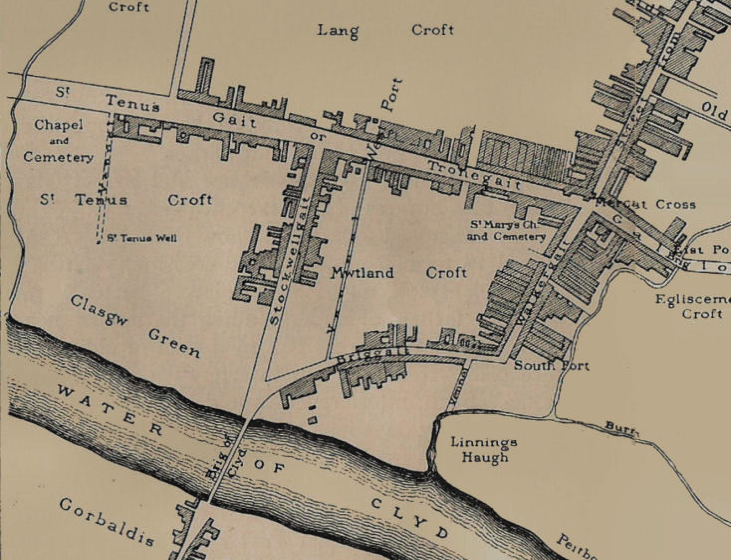
Map of Glasgow in the Early 1700's

But Hamburg has reinvented itself several times since its Hanseatic heyday. To quote Michaelski’s article:

Today, Hamburg is, in terms of both population and GDP, the most important non-capital city in the European Union. And although shipbuilding and the oil industry, two of the growth sectors of the city’s economy during the 20th century are no longer there, it is still the number one industrial city and trading centre in Northern Europe. It is now the world’s third most important location for the civil aircraft industry, operates one of the two leading European container ports, is home to Europe’s biggest copper smelter and a leader in new energy technologies. And despite all this industrial activity, the city remains a pleasant place to live, winning high scores in lifestyle rankings.”

It is all very well for us Scots to wax lyrical about how much more prosperous we would be with independence—and I, for one, believe that to be true. However, that does not mean that we should sit around waiting for that to be our salvation. If Hamburg (and other places) can prosper and offer a high quality of life to their citizens, while still being treated as a distant province their own country, the dismissive way that Scotland is treated by London is no excuse for us to sulk about it.

Our own Scottish Government’s Culture Committee laid the groundwork in a paper six years ago; that was when Labour ruled the roost, so instead of partisan obstruction that sometimes clogs up our national strategy, this ought to be the chance for cross-party consensus to dig Scotland out of this fiscal mire and leave our English cousins wondering how a country they see as “too poor and too wee” managed it.

Posted in Commerce, Politics | Tagged | Leave a comment

Target Practice

In cutting my teeth on active politics twenty years ago, my unwitting mentor was John Macnair, a crusty, iconic businessman-cum-farmer, whom I had known for a long time because I had gone to school with his two sons. John stepped down as a Tory district councillor but kept an eye on his many local interests by remaining active on the community council, environment trust, etc, etc.

Having survived a stint on destroyers in WW2 and endless insults from Labour council administration over decades, he could be tough when he needed to. But he was neither narrow in nor stingy with the wisdom it had brought him. I was lucky enough to benefit from its depth. “If they’re shooting at you, you know you’re doing something right” was one of John’s sage phrases that has stuck with me.

It sprang to mind again when I was handed the latest leaflet from my Labour opponent in Thursday’s election. Devoting the entire side of the leaflet to one of my blogs from last year, they pay me the great compliment of attacking what I wrote.

The Welsh Labour Administration had dared to break an unspoken political pact among parties not to discuss local government reorganisation. On the back of that, I had posited how that might be approached in Scotland. Labour here clearly doesn’t talk to its Welsh cousins but the leaflet ploughs ahead with: “This is typical of the crazy ideas that David Berry puts forward without thinking through the implications for local communities.

Horseshit. My ideas are both thought-through and based on 13 years serving on single-tier councils. The Tories introduced them over vehement Labour protest in 1996. But Labour now seems to treasure them. Why? Beats me: no-one else does.

I won’t rehearse the arguments from last year’s blog but ask yourself: if you’re abroad in some exotic location far from home and are asked where you’re from, what do you say? If even one in twenty say “East Lothian” or whatever council area they live in, I would be stunned. A Belter will say “Tranent” or maybe “just outside Edinburgh”; most people will cite either their town/village or the nearest city.

No matter how well run and efficient, councils are unloved. This is because they are all too big for people to identify with. And, because they are run from faceless offices and depots miles away, they are foreign to whatever town/village each of us identifies with.

On the other hand, councils are too small for efficiency of scale. With 32 different roads depots or payroll departments and chief executives, jobsworths jealously guard their own patch/job/pension. Each new development in equipment or policy requires that wheel to be reinvented 32 times. After four years of effort, Scotland Excel (common purchasing agency) still handles only a fraction of council buying. You’d think the council umbrella organisation CoSLA might co-ordinate such things, but they are too passive for that.

Dividing Scotland into six city regions to manage the big public services would still allow for regional distinctiveness but with major economies of scale. A city region would have 50 or so councillors, each paid professional salary, and perhaps a provost comparable to the London Mayor. That’s 1/4 the number of salaried councillors we have now. Each would represent a quarter as many people as present MSPs do (around 16,000, vs 70,000) at a saving of around £20m.

Those six ‘big’ city-region councils would administer around half the current Scottish Government budget and would therefore be more readily seen as SG partners, having under their management:

  • Health—all present NHS facilities, replacing inefficient/unaccountable health boards
  • Police and Fire—a reasonable compromise rather than single national forces
  • Water—Scottish Water has far too little public accountability as a public body
  • Education—schools would remain devolved and unaffected but services centralised
  • Social Work—would be refocussed on working with Health, private and third sector
  • Transportation—not only economy of scale for roads but integrated public transport
  • Environmental, Building, Cleansing, Recreation, Parks & Wildlife services, as required

The final ‘as required’ is important and the key balancing element in my argument that Labour’s leaflet ignored. If main public services were managed at city region level, a local element is essential. That element is the level of council universally missed since their abolition in 1976—burghs. They were at a scale people identified with (and still do); their councillors got nabbed in the street; the burgh surveyor got things done to avoid being nabbed himself.

But the structure of a 21st century burgh would be a different. Beyond a burgh manager, there would be few staff; some professionals and an office staff. Most services (e.g. bin collection) would be contracted with the city region (but free to be contracted elsewhere). Main burgh functions would be planning, housing and economic development.

The burgh council would be small (e.g five councillors) and unpaid. Apart from acting as a board for the burgh manager, their role would be to steer the future direction of their community. Where the burgh was large (as in a city) it could be divided into burghs, like London. Where the burgh is small, as in villages, they may wish to coalesce or be managed by a neighbouring burgh.

So, in this instance when the aim is so bad and the attack misses out the half of my thesis how people can best identify with their local government, being shot at by Labour is a compliment. They draw attention to the democratic deficit; they remind us that vibrant community spirit reduces demand on the ‘big’ services, making them less necessary.

But, rather than calling me crazy, I challenge East Lothian Labour to stop mumphing and contribute some real vision for our area: the poor one on their leaflet is either ‘me too’ or pretty lame. I quote:

  1. Safeguard local health facilities—high-priority but not a council function = no control
  2. Maintain local bus services—already done by the SNP but we’ll also integrate them
  3. Fairer local housing applications—Labour started the non-local policy; SNP fixed it
  4. More local job opportunities—SNP’s doing this with apprentices & tourism promos
  5. Devolved funds for local schools—Already done and funding maintained in recession

For decades Labour have recycled ideas from others but don’t seem to read them all the way through, let alone give proper credit. But, I have faith: they should keep shooting; someday they’ll eventually hit something other than their foot.

Posted in Politics | Tagged | 3 Comments

Gathering Nuts in May

So, it’s the final stretch. I have avoided blogging about the upcoming local election partly because I have an interest in it and partly because the great majority of normal people don’t. It doesn’t matter that they should; it doesn’t matter that over £2,000 per head is spent locally of behalf of each and every one of you, nor that holes in the street, dog fouling and scaffy service are on far more minds than nuclear submarines, refining laws or endless enquiries in London about who tweeted whom when about what.

The result in my own East Lothian will not be spectacular; Labour took its unexpected thrashing five years ago but, other than local Lib-Dems following a nationally expected trend of doing a snaw-aff-a-dyke act, the dust will settle on the local SNP running the council in some form. If there is any focus, it will be on the contest in Glasgow where, through their own silly internal wrangling, Labour have lost overall control and don’t look likely to get it back. But smart money—including the SNP’s—is that nobody will be able to secure an overall majority there.

And that is likely to be the main outcome—Labour losing its remaining strangle-/strong-holds in Midlothian, Glasgow and the two Lanarkshires. Rather than anything radical, this is simply a kind of political hysteresis—a natural delay of cause and effect in any monolithic organisation, as when a brontosaurus has a heart attack, everything functions normally for a while before the scattered physiology realises that it’s dead.

Though it will not be a good outcome for Labour, it will be no wipeout. Despite the fact that La Lamont and others on the bridge have proved themselves incapable of adjusting to reality and have logged five years of ill-tempered reactionary opposition with hardly two ideas to rub together, that’s not true everywhere. West Central Scotland may still see many tear-stained red rosettes because they still don’t ‘get it’.

But read Edinburgh Labour’s manifesto and here is a group who have taken recent electoral drubbings to heart and have a set of policies as close to visionary as anyone has managed in their party since Blair. The only question is, if all these shiny ideas are so good, why they had done nothing about them pre-2007 when they ran the place? But the voter is a fickle creature and such history counts for little. Labour won’t surge back into control of the capital but nor will they suffer much further loss.

And that is more likely to be the story where the local party has been dragged into the 21st century and no longer quote Thatcher and the miners’ strike as their main rationale. They will wallow directionless in Dundee, Fife, Ayrshire and the like for a while longer but they may start to come back elsewhere—non-traditional areas where they have good local candidates, instead of the traditional party-loyal-numpty-with-red-rosette.

Wee Ruthie Davidson has made a weak fist so far of here tenure as Tory leader. National appearances have simply echoed the miseryguts attacks on the Scottish government but locally, they claim to want devolution from the centre. Not a bad idea, except that the SNP was already parading that idea. In stark contrast to the pre-2007 bickering within Labour, Swinney and the councils have been a revelation in co-operation and those who claim this is from supine passivity of SNP councils awed by His Eckness have clearly never met many SNP Council Leaders.

So the Tories might be talking sense but then—to one section of the population—they always did. However, their appeal elsewhere remains risible and, as long as they make the mistake of conflating the independence debate with the SNP’s competence in running councils and country, there will remain marking time in the wilderness. As for the Lib-Dems, this will be their worst election to date, comparable to the great collapse of the Liberals in Scotland almost a century ago. They won’t disappear but they’ll be decimated, with Tories overtaking them in votes and councillor numbers.

And, while there are plucky Green, UKIP, BNP and Independent candidates all over the country, those elected are likely to be sitting councillors or in the cities where they had colleagues. That means UKIP/BNP get none, the Greens a handful in Edinburgh and Glasgow and the independents will retain their Borders/DG/Highlands-and-Islands dominance, albeit with a few losses.

Which leaves the SNP. They are considered to be riding high, have firm control of the government and varied levels of control in a dozen councils. This could be the time when they sweep all before it, much, as they did last May. That is possible, and, speaking as a party member of 35 years, desirable. But it’s not going to happen.

First of all, apart from well oiled machines like Perth & Kinross that never make the news, the SNP has been thrust into power in a swathe of places new to them. That meant relative inexperience, not least because Labour was venal in its refusal to share power with anyone unless forced. This has resulted in some understandable mistakes; Edinburgh’s clumsy handling of the trams hot potato is perhaps the best known.

Secondly, the mess that Brown’s administration left in Whitehall (“all the money’s gone” read the note on the Treasury desk) had its parallel in Scottish councils. Aberdeen was left with a financial bombshell; Renfrewshire was little better; my own East Lothian had to deal with a £149,000 payoff to its Chief Executive that the Accounts Commission and CiPFA reversed in embarrassment. Many SNP councils have struggled to right the ship.

Thirdly, although the now-double-dip recession has been well advertised, people still were used to the decade of Labour control when council spending almost doubled from £6bn in 1999 to £11bn last year. Although expectations, children, social care and elderly are all rising in demand, the money to do it is now going the other way. Objective understanding is one thing but when the local school closes or bins get lifted only every other week, people focus on that and forget why.

So, the reality of being in the line of fire at a difficult time will bring disadvantages that have not been experienced before. But the fourth and final thing that will hold the SNP back in this election will be the insistence of a Scottish Government with its tail up of getting started on the independence debate when the decision is still two years off. While a long and decisive debate is in everyone’s interest, for every voter out there who already supports a ‘yes’ vote, there is one still undecided and one dead against.

Since elections are mainly fought (and won) in the media, unless strong local candidates make their mark, the debate as seen by the public has been about the referendum and not about the frequency of bin collection. Because people are not yet ready for the referendum, this will deflate a fair bit of the momentum the party built last year. That does not mean there will be unexpected losses but nor does it mean there will be sweeping gains (i.e. Glasgow) to parallel last May.

As Angus McLead of the Times put it “Many tabloid readers don’t read the politics but goes straight to the back pages.” The level of political debate may seem complex to the press offices and SpAds. But out in the real world, this local election is not causing much of a stir; the low (circa 37%?) turnout will favour the Tories and, despite being decoupled for the very purpose of not being overshadowed, won’t attain the prominence in history that the ‘overshadowed’ 2007 local result did.

Posted in Uncategorized | Leave a comment

The sheer hypocrisy of opposition leaders falling over themselves to find some mud to sling at Salmond when their own party High Heid Yins schmoozed Murdoch for years verges on the breathtaking. #cheekan’impitence!

auldacquaintance's avatarAuld Acquaintance

I commented yesterday about the lack of any evidence of Alex Salmond behaving inappropriately or corresponding improperly with Murdoch.
Assumption and allegation of impropriety based on nothing but speculation are worthless, particularly when there is concrete evidence of endeavors to promote Scotland and Scottish jobs in hte form of the letter written by Alex Salmond to James Murdoch on the 25th of January 2011, two weeks prior to the internal emails of News International advisor revealed yesterday.

Today, for anyone who cared to watch, Johann Lamont made a total mess of her accusations against the First Minister, and she was seen off accordingly. Ruth Davidson chose Trump rather than Murdoch for her subject, and we are still trying to work out what was the purpose of her question?

BBC News tonight, again went completely over the top in reporting events in a manner which bore no semblance of truth to…

View original post 1,090 more words

Posted in Uncategorized | Leave a comment

Lions Led by Donkeys

Now that the Scotland Bill has passed its final hurdle today and will become law within a matter of weeks, we Scots can expect to be enjoined by a kaleidoscope of unionists to appreciate the multifarious benefits of that union. These will revolve around our common history and in that there are indeed things to celebrate. But let’s not kid ourselves that being integral to all that was British and its Empire was pure beneficial glory.

For today is also ANZAC day. For you non-Antipodeans, this is a special kind of Remembrance for Australians and New Zealanders for what became the first action of their recently-independent armed forces in the Allied cause during WWI. It was an example of unequalled bravery on the part of the soldiers and an example of appalling stupidity on the part of the British, who dreamed up and executed one of the least celebrated disasters that pock-mark the story of the ‘Great War’.

WWI was launched on waves of patriotic fervour on both sides. But by 1915, trench warfare had stultified progress on the Western Front. As First Sea Lord, the congenitally impatient Winston Churchill was in charge of the Royal Navy. Turkey had entered the war, blocking access to our Russian allies. Churchill glimpsed glory in forcing the Dardanelles, capturing Istanbul and knocking Turkey out of the war. Re-opening supply routes to support a hard-pressed Russia were an added bonus.

Starting on February 19th, Admiral Carden expected the breakthrough to capture Istanbul to take no more than two weeks. But the first attempt to suppress Turkish forts protecting the Dardanelles was a disaster: a combined French and British fleet of second-rate battleships traded shells with shore batteries, while dodging torpedoes and minefields. 100 years before, Nelson had said  “any captain who engages a fort worthy of the name deserves to be shot” but that lesson had been forgotten.

Instead, the French Bouvet was sunk, with Suffren and Gaulois heavily damaged. The RN lost Irresistible, Inflexible and Ocean, all in the first five miles. Sent homeward to think again, Kitchener appointed Sir Ian Hamilton to lead a Mediterranean Expeditionary Force. It was to land on the Gallipoli peninsula, clear it of Turks and their artillery, so allowing the fleet to proceed. Turkish soldiers were discounted as obstacles.

As the British Army was stretched to fill the ranks in France, Hamilton augmented his 29th Division with the Australia and New Zealand Corps (ANZAC). These had answered the empire’s call for men and were completing their training in Egypt. Aside from lacking experience, these were superb troops—fit, young, healthy, built like brick shithouses and—what is key in war—organised in cohesive units and raring to make their mark.

Being new to amphibious assault, the British Army was short on both equipment and experience. Luckily, the Turks had not expected the makeshift landing by the 29th division near Hellas at the tip of Gallipoli, while the ANZACs came ashore at Gaba Tepe, in what became known as Anzac Cove. While elements of the 29th took hundreds of casualties on defended beaches, others landed without opposition and then, against orders, drifted back and re-embarked. Although the ANZACs got ashore, they ran into stiff opposition. Within hours, all landings had been sealed off and movement reduced to the equivalent of the trench warfare then ongoing the length of France.

The Turks, far from being pushovers, had been taken in hand by a German General von Sanders and reinforced by two divisions, the one facing the ANZACs being commanded by  a Col. Mustapha Kemel, later Kemel Attaturk, regarded as saviour of his country from disintegration in the aftermath of WWI. Able to land as planned on April 25th, the ANZACs were immediately counter-attacked by Kemel’s 57th Regiment and experienced days of tough fighting where the outcome hung in the balance. Almost out of ammunition, Kemel issued a brutal order “I do not order you to fight; I order you to die. In the time which passes until we die, other troops and commanders can come forward and take our places.” Of the 3,000-man regiment, none survived. As a mark of respect, there has been no 57th regiment in the Turkish Army since.

Despite desperate fighting and heroic deeds, the ANZACs bled for no good reason. All of the beachheads into which the troops had been led blind with no reconnaissance and no artillery bombardment were going nowhere. Yet General Hamilton persisted. By the summer, the heat was atrocious. Corpses in the open were bloated and putrid and, with bad sanitation, led to so many flies that eating was misery. Dysentery spread through the beachheads.

Hamilton’s solution  to the stalemate was another landing further at Suvla Bay where 22,000 men of IX Corps (British 53rd and 54th divisions) would sweep ashore against 1,500 militia holding the area and—this was key—move swiftly inland to capture a commanding chain of hills. The ANZACs were to provide a diversion by capturing Chunuk Bair. This was assigned to the New Zealand Brigade and the Australian 3rd Light Horse Brigade (dismounted at this point). The exploits of the latter became the subject of Peter Weir’s fine 1981 film, the eponymous Gallipoli.

So fierce was the fighting around Chunuk Bair that, of the 760 men of NZ’s Wellington Battalion, 711 of became casualties. Meantime under General Stopford, the IX Corps landed and proceeded to just dig in. For over two days, the wide open Turkish flank was left untroubled by soldiers milling about on the beaches of Suvla “like an enormous anthill”. Stopford stayed aboard ship, satisfied to have got his command ashore safely.

When he eventually moved forward nine days later, the chain of hills were full of dug-in Turks under the formidable Kemel and 8,000 of his men died in futile attempts to secure them.

While there is no gainsaying the utter bravery and self-sacrifice of ANZACs from half a world away fighting for a country that was no longer theirs in a war that was not theirs, the sheer professional incompetence of the British commanders from Churchill down through Kitchener, Hamilton and Stopford was shameful. It was, if anything, worse at Gallipoli than in the unimaginative charnel house that Haig created in France.

A bon mot usually attributed to the very capable German General Ludendorff, famous for bamboozling the 1914 Russian offensive in Masuria, was that British soldiers were “Lions led by Donkeys”. But how much more difficult for Australians and New Zealanders—both fighting in the forces and anxiously awaiting news from half a world away—to thole that their lives, sold dearly with such bravery, should be wasted by incompetence rife in the mother country’s supposed professionals who’d yet to learn their butcher’s trade of war.

Posted in Uncategorized | 4 Comments

Camlachie Lassie

As a politician of 13 years experience in both parliaments and having demonstrated in that time that she is no numpty, the current Shadow Secretary of State for Scotland Margaret Curran MP should be able to hold her own. That she can mix it with the best of them was demonstrated in the feisty campaign she ran in the Glasgow East by-election in 2008—losing narrowly to John Mason before digging in and achieving a thumping turnaround in the subsequent 2010 general election.

A disappointment, then, when interviewed in London today along with Stewart Hosie MP on the matter of the now-double-dip recession that, instead of finding common cause with the SNP to declaim Osbo’s flawed economics that have led us into a £1 trillion deficit and no recovery in sight, Ms Curran chose tangential-attack-dog mode instead. Far from finding common cause, she fixated on an irrelevant question whether MSPs can insist on the First Minister being specially carpeted prior to FMQs due tomorrow (Thursday) to explain any discussions with Rupert Murdoch.

It was an unwitting re-enactment of the hilarious Monty Python snippet: “and here is a recording of Alastair Cooke being attacked by a duck—(cue nasal Ivy League accent) ‘I can never visit Philadelphia without’...” the rest of the monologue is drowned out in quacks. Poor Stewart; despite a sincere attempt to support Labour’s thesis that the present ConDem fiscal strategy is bankrupt, he was dragged into pained silence by Curran’s puerile repetition of exactly the same question.

To some extent, repeating the question and not being stonewalled by non-answers is a legitimate political tactic. Paxo has used it to devastating effect in his time and any question of substance does deserve an answer. But in a proper context.

To be legitimate and effective requires that the question pass two key tests: 1) the question must have direct bearing on the discussion; 2) the one questioned must be competent to answer it. On the first, the FM’s relationship with Murdoch is irrelevant to our recovery from recession and, on the second, querying an MP for procedure in the Scottish Parliament (where he has never served) reeks of seizing any opportunity to justify a pre-judged position.

It wasn’t a pretty sight. Ms Curran did her credibility no good in quacking as raucously as she did. This is especially so when her own and her party’s performance is considered when the questioning boot is on the other foot.

Just as Labour’s recent pious demands for education budgets to be preserved, whatever Westminster cuts may come (conveniently ignoring an 8%-and-rising drain on that budget funding 30 fat years of profit for PFI companies set up by Ms Curran & her former MSP colleagues), so this pious insistence on utter, instant openness sits awkwardly with Labour’s own FOI record.

In the period 1999 to 2007, the three Labour-led Administrations declined to answer 547 questions put to it, mostly under the FOI Act requests. Of these 18 were questions made directly to FM Jack McConnell, which included:

  • discussions with the Catholic Church (Refused: deemed exempt under Section 12—excessive cost of compliance)
  • the Section 28/2A furore of 2000 (Refused: deemed exempt under section 29—Formulation of Scottish Administration policy)
  • the Beattie Media furore of 2001 (Refused: deemed exempt under s12—excessive cost of compliance and s33(1)(b)—Commercial interests and the economy)

Some of the reasons given are pretty odious, as when “Request for copies of the advice given from Dundas & Wilson, Ernst & Young, Scottish Airports Ltd., Thomas  & Adamson, SO, HM Treasury and its PFI Unit on the PFI project.”is met with: “Refusal: exempt under sections 29 (Formulation of Scottish Administration policy), 30 (Prejudice to effective conduct of public affairs), 36 (Confidentiality)

Baron McConnell of Glenscorrodale needed no lessons in evading questions he preferred not to answer; Ms Curran had a front bench role throughout his tenure and learned well from the master, steeped, as she was, in his ritual obfuscation for at least the last decade. It may not be her fault that her facial expression falls naturally into a body language that radiates distrust and displeasure. But it seems a fair expression of what’s going on inside.

Nonetheless, it’s a shame she focusses her energy into trying to trip up opponents so deeply that she’s convinced others deploy the same obfuscation. Because there is a dwindling pool of people who can pull Scottish Labour back from the brink of oblivion into which it seems hell-bent on driving itself. The combination of thrawn sullenness at not being in charge and addiction to decrying the works of others as flawed by definition will be its downfall unless someone of the stature of Curran or Darling calls ‘enough’.

Credibility is a precious commodity in politics; parties or people play with it at their peril. If people believe you’re as two-faced as Camlachie clock (and that’s got four), it might be time for someone with ambition for office to consider whether incessant quacking has any place in a strategy towards such a future.

Posted in Politics | 2 Comments

Recycled Rubbish

Sad case that I am, while on-line yesterday entering canvass results, the TV that shares my desk was tuned—like a junkie who can’t get enough—to Scottish Questions on BBC Parliament. This one was from April 18th, but I had to keep checking the date on the strapline because I kept getting a strong feeling of déja vu, that I had seen all this before.

And then it struck me: I had. Not literally, but here was a cast of characters rehearsing their roles with all the plot predictability of Tom and Jerry. Don’t get me wrong: I’m a big Tom & Jerry fan (even tho’ I sometimes feel I’m in one of their plots at the Council). But in one of their cartoons, it’s never in doubt who’s going to win. Last Wednesday, SQT ran with the same predictability, as if it were on rails.

The Mother of All Parliaments, the inner sanctum of our democracy spent the best part of an hour doing a fair impersonation of a bunch of macho rednecks discussing “women’s problems”. For once, it made little odds from which side of the House the questions were coming. Laced with ritual snipes across the chamber about which side was purloining the larger sum from granny’s purse was an almost orchestrated sense of agreement that came straight out of the straight man/funny mad music hall tradition.

At the centre of it all was the Moore and Mundell double-act. While the one can’t help himself in looking over-serious, the other struggles to be taken seriously at all. Yet they were in fine form, knowing—as in all the SQT sessions for months now—that well over 90% of members present were entirely on their side and willing participants in a theatre of gesture politics that ill-suited so historic a chamber. On the topic of funding, they started off sounding reasonable:

  • Mr David Evennett (Bexleyheath and Crayford) (Con): Does my hon. Friend agree that it is vital to maintain the Union in the interests of both England and Scotland, but that the funding formula should be fair to both countries?
  • David Mundell: I agree absolutely with my hon. Friend’s sentiments, but as he and many other Members are aware, this Government inherited the worst deficit in peacetime history from the Labour Government, and stabilising our nation’s finances must be the focus of their efforts.
  • Gordon Banks (Ochil and South Perthshire) (Lab): Does the Minister agree that the Scotland Bill will increase the amount of revenue gathered in Scotland to about a third of its spend, and will thus decrease dependency on a block grant?
  • David Mundell: I agree that the Scotland Bill represents a radical, historic and significant change to Scotland’s financing. More than a third of spending by the Scottish Parliament will result from funding from taxes that it determines and raises. That is a major step forward in terms of devolution and accountability, and should be welcomed by all Members.

Punting the Scotland Bill then moves up a gear with a fair degree of relish being displayed on each side. At least they retain enough dignity not to indulge in a ‘nudge-nudge, wink-wink’ but you can tell it’s a struggle:

  • Mrs Anne McGuire (Stirling) (Lab): The new Scotland Bill will pass significant powers to the Scottish Parliament, including those relating to tax. Among the representations that he has received, has there been a request from the First Minister to work jointly with him to highlight and promote those new powers, to show that we can maximise devolution while maintaining the integrity and strength of the partnership of the United Kingdom?
  • Michael Moore: The right hon. Lady will not be surprised to hear that I have not received a representation on that particular subject. I agree with her that the Scotland Bill is a significant piece of legislation; it represents the most significant transfer of financial powers from London to Edinburgh since 1707.

We then segue neatly into indirect condemnation of what the Scottish Government has been clear in organising with the mandate it received mast May:

  • Amber Rudd (Hastings and Rye) (Con): What assessment his Department has made of the responses to its consultation on the proposed referendum on independence for Scotland.
  • Michael Moore: The Government published their response on 4 April. The responses to the consultation gave strong endorsement to a referendum involving a single, clear question on independence, overseen by the Electoral Commission, using the same franchise as that used to elect the Members of the Scottish Parliament, and held sooner rather than later.
  • Alun Cairns (Vale of Glamorgan) (Con): Does my right hon. Friend agree with the consensus of established by the responses, which is that people do not want to wait 1,000 days to exercise their votes in a referendum?
  • Michael Moore: This is a fundamentally important decision, the most important that we as Scots will make in our lifetimes, and the longer it is delayed, the greater the uncertainty will be. The sooner we can get on with resolving the process and the question, the better.
  • Amber Rudd: Do the responses of the consultation reflect my view that there should be a simple “yes or no” question in any referendum if we are to secure a decisive outcome for Scotland?
  • Michael Moore: My hon. Friend is entirely right. We must not muddle the issue of independence with a separate debate on the future of devolution. Today we mark another important milestone in the development of the Scotland Bill. What we want after its enactment—assuming that we receive their lordships’ support—is a clear decision on the future of our country, and for it to stay in the United Kingdom.

A clearer example of a stitched-up artificial debate is hard to imagine. Had the arcane rules of the House permitted it, a pantomime to-and-fro-ing between 600 unionists (Oh, no it isn’t!) and 6 SNP MPs (Oh, yes it is!) would have been appropriate. And, lest it seem that the opposition were not complicit in this great game, the above was followed by:

  • Pamela Nash (Airdrie and Shotts) (Lab): Some 70% of respondents to the UK consultation felt that 2014 was too long to wait to decide Scotland’s constitutional future. Businesses and financial institutions in my constituency have made it clear that this state of limbo is damaging the economy in Scotland. Has the Secretary of State received similar representations from businesses elsewhere in Scotland?
  • Michael Moore: The hon. Lady is entirely right to draw this issue to the attention of the House and to highlight that across Scotland and the UK, businesses, like individuals, want answers. We need to resolve this hugely important issue sooner rather than later, so we do not lose out on investment in jobs and we understand our future within the UK.

The debate finally moved into business as usual, whereby government stags were chased by baying opposition hounds. Michael Connarty, Lindsay Roy, Sandra Osborne and Greg McClymont all went baying after Mundell on the matter of 367,000 pensioners being affected by changes in age-related personal allowances. Nonetheless, the bulk of the SMQ session was an exchange that repetitively echoed so many other SMQ sessions this year.

It’s not that Moore isn’t capable of more complex and enlightening debate, nor that Mundell is quite as green as he is habitually cabbage-looking. But it does appear that, when it comes to presenting the unionist case in as sympathetic an environment as Westminster’s hallowed halls, any old recycled rubbish will do to scupper the Scots.

Posted in Politics | Tagged | Leave a comment

I’m All Right, Jock

Peter Sellers fans—and readers already carrying a bus pass—may recall his merciless portrayal of “bruvvah” Fred Kite and his heroic antics at preventing upper-class twit Ian Carmichael from inadvertently causing efficiency among the work force of a munitions factory in Boulting’s under-rated but brilliant 1959 “I’m All Right Jack”. This all flashed before my eyes when The Big Picture arrived on my doormat today. Unstapled and amateurish, I was about to recycle another tree-wasting circular when I realised that it was the EIS manifesto. How fortunate that I did: only Peter Sellers himself could have made it more entertaining.

The Educational Institute of Scotland likes to think that it speaks for all teachers but it couches everything as if its interests were indistinguishable from those of children and the future welfare of this country. That, in fact, it speaks for a fairly large number of primary school teachers and not much else is not made clear. Nonetheless, it does so in a way of which Fred Kite would be immensely proud.

Before proceeding farther, let me say that I have much sympathy for teachers and the way in which their profession was rather marginalised as part of the Tory colonial (mis-?)rule of Scotland in the eighties and nineties. By the millennium, teachers’ pay had fallen well behind other professionals with whom it had once been comparable and many teachers felt, rightly, that their extracurricular work (like after-school clubs, sports & theatre outings, etc.) was neither properly compensated nor acknowledged.

In May 2000, the report of the McCrone Inquiry into professional conditions of service for teachers was published. Authored by Prof Gavin McCrone this took a broad view of how to recover a sense of professional dedication among teachers that many felt had been lost. As education had been devolved to the new Scottish Parliament, this milestone document was seized upon by the then-Labour/Lib-Dem administration as a balm to soothe understandable unrest among teachers. Unfortunately, few in that administration seem either to have read or to have understood its wider scope. An agreement A Teaching Profession for the 21st Century was hatched by an Implementation Group that reads like a Scottish Labour Who’s Who (Jack McConnell, Sam Galbraith, Norman Murray, etc)

What had been a broad discussion on the profession of teaching was rather narrowed, with new pay and conditions featuring heavily in both political grandstanding by the politicians and teachers, most especially their unions with EIS foremost among them. While a number of innovations such as Chartered Teachers and more flexibility in work remained from the original report, details like that were lost in the general backslapping about what a good deal this was. Teachers’ pay would rise by over 30% within two years; their unions trumpeted a victory; the politicians rushed to congratulate themselves.

In those halcyon days when the Scottish budget jumped in dizzy increments from £16bn in 1999 to £32bn in 2009, no-one noticed that the new teaching emperor had no clothes for chillier times. As a result, extra teachers were hired to cover the new lesson preparation times, pupil support was extended so teachers could teach and council education budgets doubled in a decade (East Lothian’s £50m in 2000 was £104m by 2010). But once the current budget strictures hit, big cracks showed in the edifice.

Because nobody had actually required any outcomes for all this doubling largesse, any closing of stable doors now is futile. Anyone analysing the Agreement of which the Implementation Group were so proud in 2001 will be struck by how proud Fred Kite would have been of it. It is full of gradings and pay scales and the language of union jobsworths but says bugger all about how well our kids are to be taught and how we are ever going to know whether they are or not. It is a shop steward’s wet dream.

So, fast forward to today and examine the EIS website. Is it full of admonitions to its members of how best to inspire their charges? Does it outline how well its motivated professional members achieve that inspiration? Not a bit of it. Fred Kite haunts every line. Their response to the recent McCormac Report: “Advancing Professionalism in Teaching – Report of the Review of Teacher Employment”?

  1. “a list of duties for teachers and associated professionals, as set out in Part 2 of the SNCT Handbook, should be retained;
  2. Appendix 2.6 of the Handbook should be retained;
  3. a contractual working week of 35 hours should be retained;
  4. a weekly class contact maximum of 22.5 hours should be retained;
  5. the existing clearly defined time allocated to personal time and time allocated to the collective work of schools should be retained;
  6. mechanisms to ensure that school based decisions on the use of time remaining are subject to agreement should be retained.”

blah…blah…blah. Not all unions have as soul-destroying a mindset as the EIS—but surely one is too many, especially when it is involved in teaching our children. But decades of Ronnie Smith as its belligerent General Secretary has made it legendary in the yes-what-we-have-is-OK-but-more-is-always-better approach. Although Ronnie retired this year, and Alan Munro publishes their manifesto, his voice echoes spectral-like throughout:

  • “why must children pay?” as if the fiscal wealth of teachers were any measure of children’s learning
  • “education must be defended against any budget cuts” as if the elderly, the vulnerable or the homeless are, by definition, less important than teachers
  • “teacher numbers may start to decline and pupil numbers to rise” as if this were fact (not in East Lothian) and as if teachers were exempt from any effects of the downturn
  • “establish national staffing standards” as if schools on Canna and in Craigmiller can be standardised so that union negotiators have an easier time of it
  • “protecting teacher professional development” yet Chartered Teachers, trumpeted in the 2001 Agreement, have been discarded by teachers as a career path
  • “improving levels of support staff working” when most schools have a half-dozen each of administrative and support staff; both far exceed numbers of even 10 years ago
  • “class sizes must be reduced to 20” as if school buildings could magically be rebuilt with, say, 15 classrooms for 20, instead of 10 for 30—& no hint where this s/b priority

It may be axiomatic that unions exist to serve the interests of their members. But, in discussions with teachers over the first year of Westminster cuts that came in 2010/11, the EIS had one year to run on a 2.5% annual pay increase. All other council employees—including councillors—had their pay frozen. When EIS were asked to forego their rise, else it might mean reducing teacher numbers to make the budget stretch, they declined. It seems that even their members’ jobs come second to keeping up pay levels.

What is perhaps most revealing is that, in all the acres of small print and among pictures of thirteen children, ‘teachers’ are mentioned almost 200 times but ‘teaching’ only 20. ‘Pupil’ gets only 56 mentions and ‘children’ a measly 11—half as often as ‘government’. The 41 mentions of ‘development’ all apply to teachers: none to pupils. For the biggest union involved with teaching our children, such a manifesto comes across as an unedifying, egregious piece of self -serving claptrap. If I were one of the many professional teachers that I know, I would reconsider my membership in such a selfish, narrow-minded outfit.

But, at least the recycling will benefit.

Posted in Education | Leave a comment

The Innumerati

This week, it appears that Ed Milliband has finally succeeded in doing what he has clearly been desperate to do for months—seize the political agenda. He did this by proposing something daring and radical and which must therefore run against all his training as a pure product of the UK political hothouse: that political parties have their funding capped at £5,000 per donor.

Initially, I was deeply skeptical, assuming this would not apply to trade unions (whence most Labour funding comes). But having been swiftly rapped over the knuckles by several Labour MPs for such cynicism, it appears that it does apply to them too. At first glance, a limit to anyone’s ability to buy political influence is desirable. Yet, every political system from Babylon to the Kremlin has suffered from this problem. While cutting back on political money may seem ipse facto a positive move, what about the old saying that when you pay nuts, you get monkeys?

Do we really want 3rd-rate people in charge of £1,000,000,000,000+ of our money?

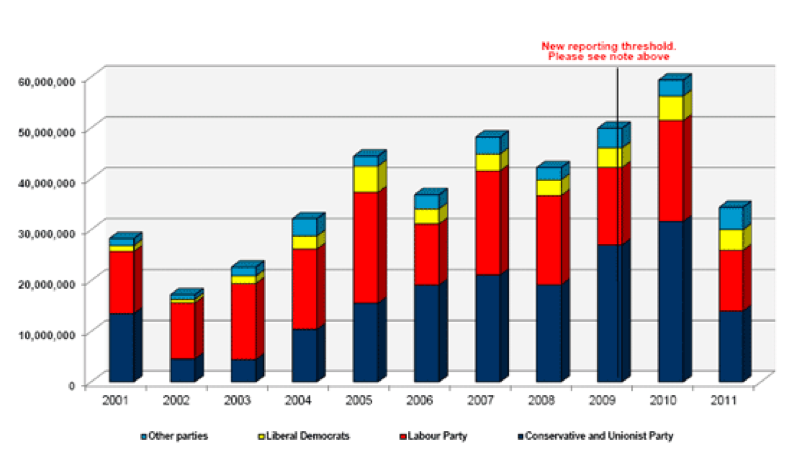
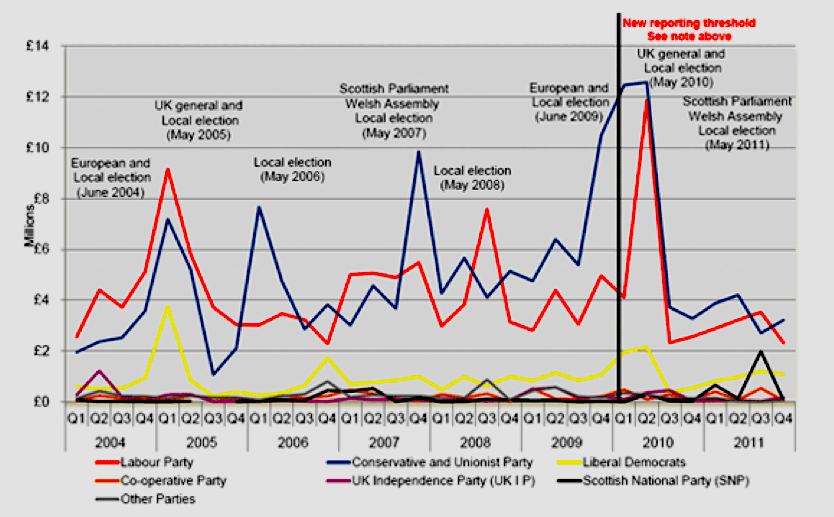
Current party funding is something of a minefield and other countries offer much in the way of moral lessons from which we could learn. Quarterly donations to the two main UK parties have zigged between £2m and £12m each quarter for the last decade, as shown in chart 1 below. Note that the first (and only) time the SNP registers is in Q3 of last year.

Chart 1: Quarterly donations (in £millions) to UK Parties (source: Electoral Commission)

The scale of disparity between the main UK parties and those either trying to break through to UK level (e.g. Lib-Dems of UKIP) or those with limited geographic aims (e.g. Plaid or SNP) is particularly pronounced when this is looked at on an annualised basis, as shown in Chart 2.

Chart 2: Annual Donations to UK Parties (source: Electoral Commission)

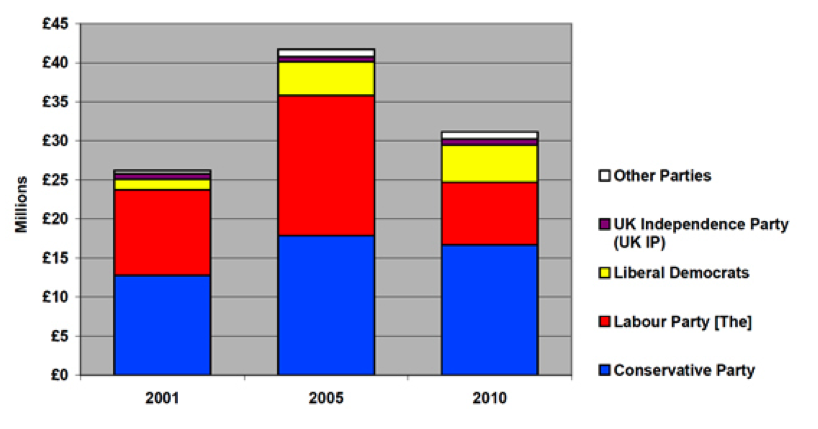
What this effectively means is that two parties can outspend all other parties put together by several factors, which results in the kind of expenditure on general elections looking as shown in Chart 3.

Chart 3: Expenditure (in £millions) by UK Party on General Election Campaigns (source: Electoral Commission)

Note the disparity between the white sliver which represents mostly SNP and Plaid and roughly £1m between them, versus the £25m spent by Tories + Labour in 2010 (down from the £35m in 2005, largely because Labour was going broke). Even allowing for the under 10% of UK population that Scotland represents, they outspent the SNP by a factor of five AND had ‘national’ BBC coverage going for them.

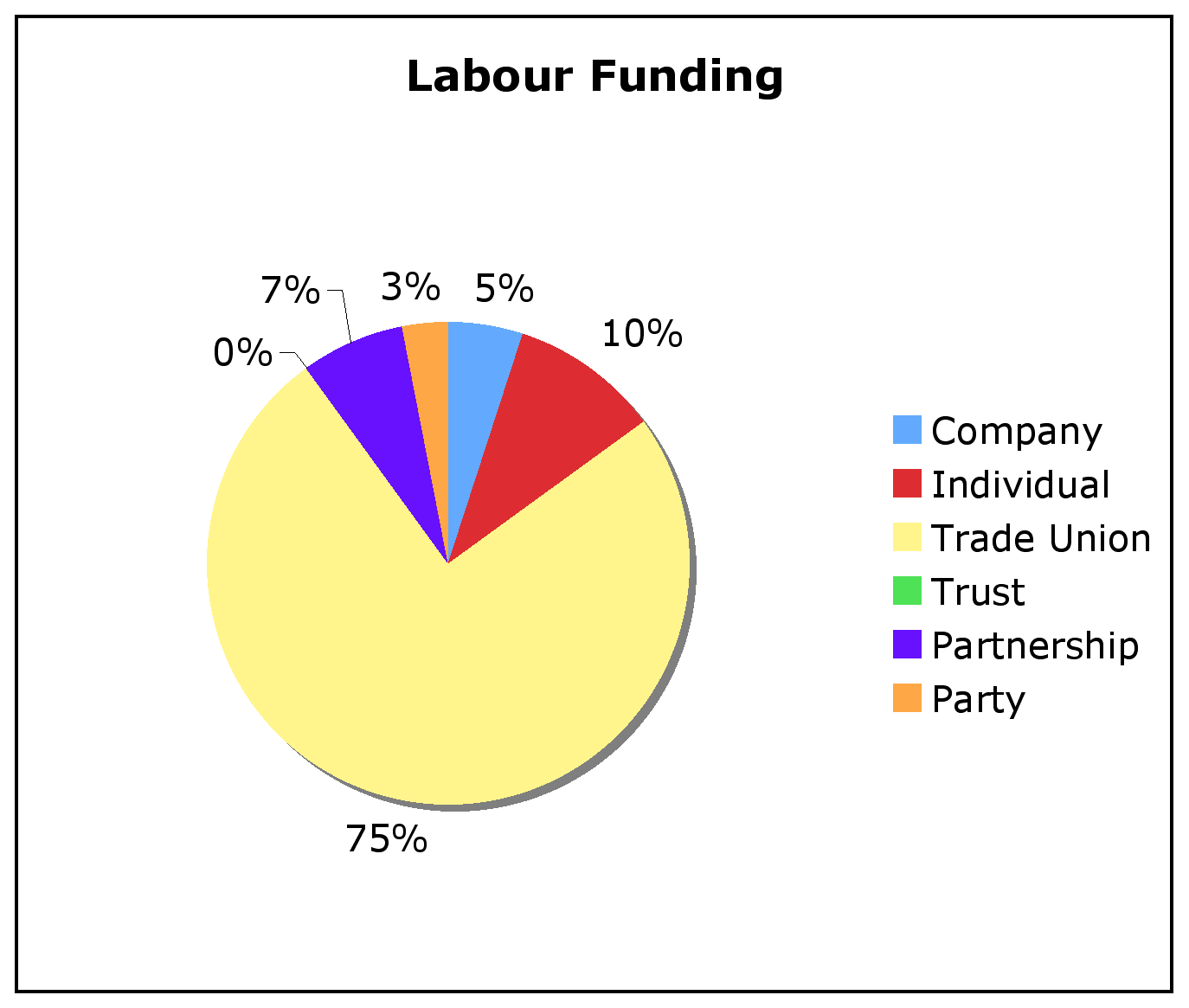
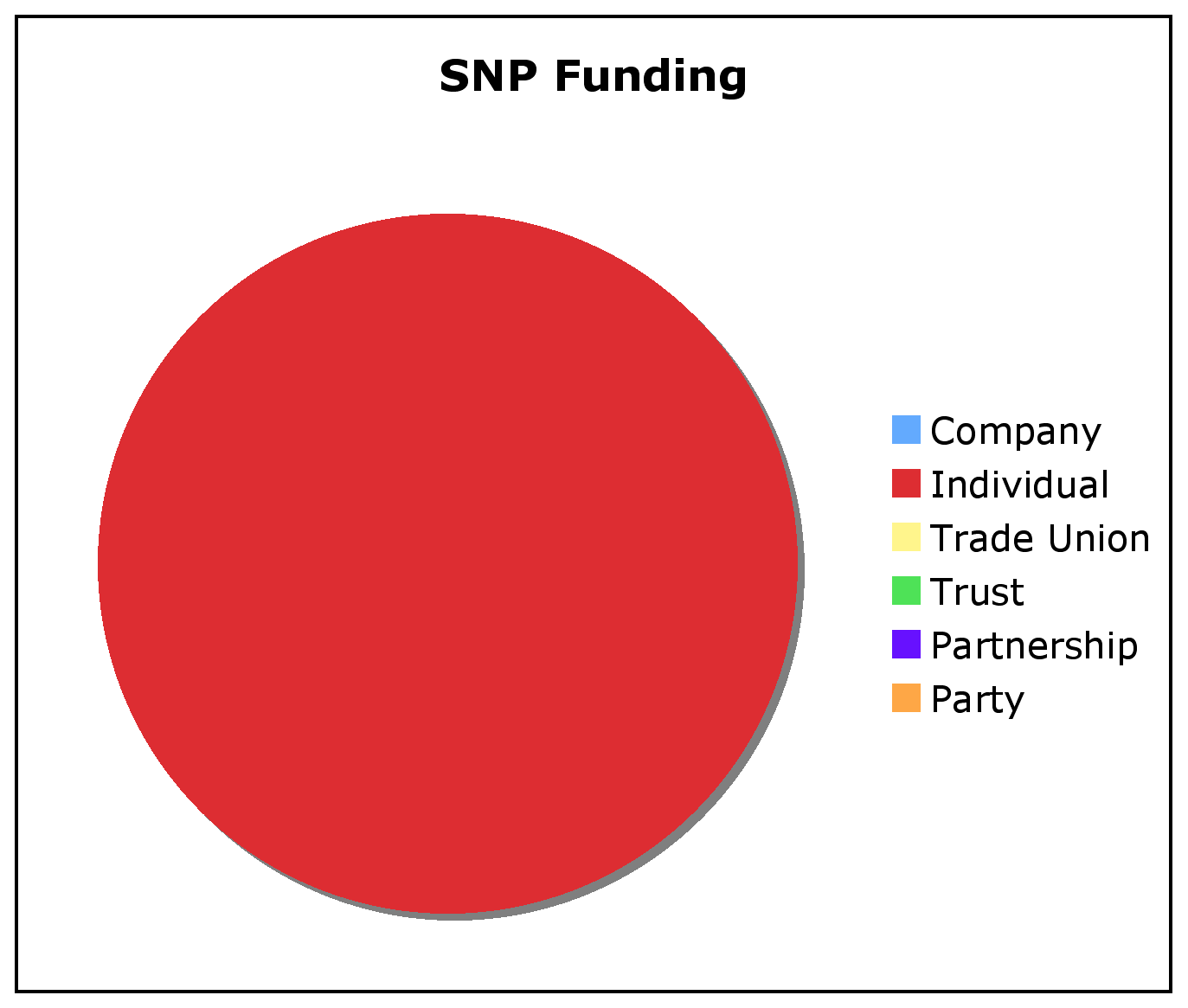
But more interesting is to bore down deeper into the sources of funding, as the Hootsmon, to its credit, did yesterday. They looked at the four main parties in Scotland—and quite a contrast their funding sources made too. These are shown in Charts 4a to 4d.

Figure 4a Distribution of Labour Funding Sources (source The Scotsman April 16th)

Figure 4b Distribution of Tory Funding Sources (source The Scotsman April 16th)

Figure 4c Distribution of SNP Funding Sources (source The Scotsman April 16th)

Figure 4d Distribution of Lib-Dem Funding Sources (source The Scotsman April 16th)

The differences among the above four charts are quite striking. As long as the SNP was broke and receiving very little funding, the big UK parties seemed quite happy to hoover up funds from whatever source suited them. In the last quarter of 2011, the Tory Party received:

  • £600,000 from the National Conservative Draws Society
  • £150,500 from Mark J.C. Bamford
  • £136,180 from Lycamobile UK Ltd
  • £125,452 from Peter (I-can-get-you-dinner-with-the-PM-for £125k) Cruddas

Meantime, the Labour party was doing very nicely in the same period with its biggest donations being:

  • £649,092 from the GMB union
  • £427,774 from the Unison union
  • £304,588 from the Union of Shop, Distributive & Allied Workers
  • £194,210 from the Communications Workers union

And, lest we think the Lib-Dems were missed from all this ‘civic giving’, they received £329,352 from the Methuen Liberal Trust Fund and a cool £153,267 from the Ministry of Sound (NOT, we should add, a Whitehall department. Yet).

The SNP has come under considerable criticism from its opponents that it received money from Shir Shean and that Brian Souter’s recent £500k in matching funds and ~£1m each from the estate of the great makkar Edwin Morgan and lottery-winner members who shared their windfall with the party. With the exception of Soutar, it is clear that no self-serving influence could be attached to the ‘generosity’. But with hefty union and business donations sustaining both Labour and Tory and Cruddas recent ‘access-for-sale’ exposure coming on top of expense scandals, cash-for-honours and egotistical nonsense like Derry Irvine’s wallpaper, that distinction is palpably naive.

How Ed and his boys would survive had they only received 4 x £5k = £20k instead of the over £1.5m the unions slipped them is unclear. Noble though the principle of his initiative may seem, with his party deep in debt and elections getting no cheaper, Miliband needs to explain how he can square that particular circle without dipping into public funds. With the mood the people are in just now, advocating more public money for politicians would be political suicide.

Is Ed that daft?

Posted in Commerce, Politics | 2 Comments

Operation SOS Puffin

Even in as delightful a place to live as East Lothian, people get into the usual habits of life. As we zip from home to work to shop and then off to evening class or golf course or pub, we are not always aware of changes happening along our regular commute paths, let alone in the wider environment.

One such example happened over the last decade on the islands of the Forth near North Berwick. These provide a scenic backdrop to our picture postcard beaches and, until the Scottish Seabird Centre started frequent trips and studies of the wildlife on them, most locals were pretty ignorant of how well of badly things were doing. From the gradual spread of white all over the crown of Bass Rock, it was pretty clear that the gannets were doing well and, when Prof Brian Nelson spent his year-long soujourn on the rock studying them, he confirmed that was the case.

From a few thousand nesting on the cliffs when they became protected a century ago, their population has boomed to over 150,000 now. However, the other seabirds, being smaller and less obvious, were something of a mystery. What was know was that the highly photogenic puffins liked Craigleith because the myriad of rabbit burrows from the days when it was the town warren provided them with ready-made nests. By the turn of the millennium, their numbers had reached around 40,000—not as many as on the larger Isle of May but still impressive numbers.

But then numbers started to decline. At first, no-one but a few keen birdwatchers noticed. But then the regular boat trips by Sula and observers using the remote cameras in the SSC remarked that the rafts of puffins on the water and the ranks of them socialising along the skyline of the island seemed to be fewer each season. A cursory examination of the island six years ago identified the problem almost immediately.

Although looking equally green as the grass that normally covered it, Craigleith had become infested with tree mallow, a plant not native to the area. Originally from the Mediterranean and related to the geranium, tree mallow grows large soft, circular leaves. The theory is that lighthouse keepers grew some as reserve toilet paper for the times weather delayed their supply boat. Once the keepers were taken off in 1996, it grew wild and some of its seeds were carried to Craigleith.

There it found a cosy home. Puffins are good housekeepers and clean out their burrows each season. This means the mouths of the burrows always have plenty of soft soil—which makes an ideal seed bed. Initially small, the mallow plant stem becomes woody after the first season. By the second season, it can be 2m high and produce thousands of seeds. Not only are the burrows blocked by ‘cell bars’ of mallow at their entrance but small puffins can’t land or take off in the middle of a mallow jungle. Even people disappeared in the denser stretches.

Your humble scribe mallow-bashing on Craigleith. The tall plants are mallow

Supported by the SSC who provided boats to take the volunteers out, naturalist John Hunt has been organising regular ‘mallow bashing’ trips, together with wildlife expert Maggie Sheddan for the last five years. Initially focussing on the worst areas with the tallest plants, followed by seasonal strimming of the seedlings springing back up from the millions of seeds dropped, Craigleith is almost back to normal and most of Fidra has been cleared too, Because the puffins nest between April and July, work has to be done in the other eight months to avoid disturbing them.

That means we have now come to the end of another successful season—this winter being particularly light on storms and so a lot of work could be done. Even if you can never manage to visit and/or volunteer, watch the video trailer to get a sense of what a magic and unusual place these islands are and how worthwhile the efforts of hundreds of volunteers have been in restoring such a precious wildlife resource that is so close and accessible it provides a splendid learning opportunity for our visitors and locals alike.

This blog reported on the project last year and also published an update last month. But now a French-Canadian team has filmed the raw material for a documentary that gives a sense of what the volunteers have been doing all these years. Have a look at the trailer here which gives a glimpse of what it is like to visit the other-wordliness of being among the wildlife on islands that are within swimming distance from the shore but seem so rare, exotic and far from civilisation once you’re there.

Although there will be no more trips this season, volunteers will be needed, starting in August and there may be some places on a puffin count of the islands to be done before then. The bottom line is that numbers are recovering and the rafts of puffins bobbing off Craigleith on Easter Sunday morning bode well for that continuing. Gordan Buchanan did a brilliant short film for BBC2 Wild about puffins on Lunga which you can watch here.

If you need more information about SoS Puffin:

  • Scottish Seabird Centre: 01620 890202 http://www.seabird.org/sospuffin.asp
  • John Hunt (SoS Puffin co-ordinator) johnf_hunt@yahoo.co.uk
  • Maggie Sheddan (Seafari Guide at SSC) m.sheddan@virgin.net
  • Maude Rivard-Haustrate (Documentary maker) maude.rivard@gmail.com
Posted in Environment | 2 Comments