Fun Isn’t Weather-Dependent

After a record cold/wet April, May is bidding fair to make this the worst Spring in decades. Farmers are staring morosely at crops that, after a good start from a mild winter, have barely grown any in seven weeks. Blossoming trees seem at sixes and sevens about what to do and several chestnuts have been shedding damaged leaves that had only just unfurled.

The weather has been driven here from the Arctic by persistent northeasterlies, which, in turn, means a livelier sea running into the Forth. This does not seem to have deterred our local yachtsmen whose racing lasers have been out capsizing regularly in the unpredictable surf of the last few days.

Perhaps more surprising has been the stream of people keen to go out on the Seafari boats from the SSC around Craigleith and Bass Rock. Yesterday, though the May trip was cancelled (hard to get in & out of Kirkhaven on a northeasterly) I was called in for guiding on three trips on the RIB.

It was, as the locals describe it, “lumpy”. A long, heavy swell from the East was being ruffled by a ragged chop out of the North East, making passage uneven and the sea state qualify as ‘rough’. And, as we were going at 20-25 knots into it, the Force 3 wind was shredding a fair bit of spray from the bow and thrashing it over the passengers and me. My kind of weather.

Luckily, everybody else loved it too (with the possible exception of skipper Brian who had to steer us safely through it). From a quintet of Italian twitchers, big enough to have been from the scrum of the Azzuris to a well spoken wedding party whose high heels looked incongruous poking out the end of the waterproofs, all treated it as a fairground ride bonus on top of seeing the wildlife.

And wildlife there was: several young harbour seals hauled out below the vale in the Craig, with a big raft of puffins offshore opposite; plenty of mini-penguin-like guillemots and razorbills clumped on the cliffs or whirring overhead; cormorants and shags; kittiwakes and fulmars; and everywhere the scavenging gulls looking for an easy meal.

Down at the Bass, the “gannet flying school” had hundreds aloft, gliding effortlessly in the updraft above the cliffs as we pitched and yawed in the unpredictable jabble below. Most impressive was when several hundred adolescent birds lifted off the helicopter landing area to fill the sky above us with these magnificent birds.

Lighthouse and Castle on Bass Rock

It’s always fun for me to ‘visit the estate’ as I do at every opportunity. But it’s twice the fun to be sharing it with people seeing it for the first time and watch them still beaming from the experience as we unload they all safe back on dry land.

Posted in Education, Environment | 1 Comment

Creative Skintland

And while we, as we were yesterday, are on the topic of the arts and creativity in Scotland, today’s Herald carries a piece on how Creative Scotland is shaking up the way it disburses the £50-or-so-million of their largesse to various artists and organisations. Precipitated by a cut in government funding, to be offset in part by an increase in lottery funding (now that the endelss drain of London Olympics is being plugged), this nonetheless racks up a level of uncertainty that is unprecedented in the hand-to-mouth world of the arts.

Creative Scotland is a new quango, created in July 2010 by rolling Scottish Screen in with the Arts Council. Although a new quango, it is pretty standard-issue in terms of its structure. It has an (unremunerated) board of worthies of whom Ruth Wishart is probably the best known and chaired by the usual business heavyweight in the form of Sir Sandy Crombie who was previously Chief Exec of Standard Life Investments.

Under the board, the senior management team of six pulls down £440k between them and a group of 13 ‘portfolio holders‘ heads up the rest of the 137 staff. Through them a variety of arts projects across Scotland was being given financial support through a mechanism called ‘flexible funding’. This was not as solid as ‘foundation funding’ but did allow organisations to plan shows, pay bills, hire staff and breathe easily.

But lottery funding cannot be used for anything that looks like stable and permanent support. To be moved on to a project-by-project funding basis will be onerous to funded organisations because they will have to apply for project funds before flexible funding expires each year. In effect, it puts CS even more in the driving seat than it was because everyone from the Edinburgh Festival to Mull Little Theatre will be coming, cap in hand, on an annual basis.

Creative Scotland disburses the arts support money across Scotland, so it is reasonable to secure professional management of that money. But, with most of the arts ‘industry’ up in arms about developments (and individual artists being especially derisory about ‘nomeklatura’ and/or a ‘Glasgow Mafia’ making key grant decisions) just who is watching whether public money is being directed and used wisely. Attending a recent CS event in Dovecote Studios (I remember them as the Infirmary Street Baths) in Edinburgh, I was impressed with the canapes, glitz and flummery, but little else.

It reminded me very much of fundraisers I once attended for the San Jose Symphony at which Silicon Valley names like Intel’s Moore or AMD’s Sanders would be entertained and fleeced for fat cheques in exchange for founder’s status plaques being nailed up in their box. But—penguin suit or no—that was private money and theirs to disburse. Every penny of CS’s largesse started off in the public purse.

The whole shebang started off poorly, with Morag Hay being pulled in as a ‘bridging’ Chief Exec and getting a brisk £15k for 60 days’ work. All in all, just rolling the two quangos into one cost Joe Public £838,475 in severances last year. In all, CS received £52m of public money from Holyrood last year and disbursed £45m of it, leaving a nice little cushion of £9.5m in the bank. And, in doing that, its 137 staff pulled down £5.821m in total.

Far be it from me to question in detail which of the 40+ arts organisations got how much CS money last year. But to have 13% of funding monies drained off by the very organisation that dispenses their funding seems excessive—especially when its events would put some private sector shindigs to shame. It has moved up to the split new and prestigious Waverley Gate office complex (the old GPO) where it joins Amazon, Balfour Beatty, Microsoft and NHS Lothian (whereby hangs another tail). What was wrong with their more modest quarters in Moray Place is unclear.

Canada has a population of 34.8m (roughly seven times as many people as Scotland) Their Canada Council for the Arts disbursed CAN$205m for a total administration overhead of CAN$14m, which translates to a much more reasonable 6.8%—or about half of what the CS prestige machine skims off the top.

How do they do it? Well, for a start, they don’t have an SMT that costs £1/2m, nor 13 ‘portfolio holders’ each keeping a serious mortgage going. The Canadians recruit a dozen practicing artists for a year on a board, chaired by a civil servant. Decisions are made by those who’ve lived the life and, although they get little in the year they serve, they play fair because next year it will be someone else’s turn to vet their application.

When Lord Robertson of Port Ellen promised a ‘bonfire of the quangos’ over a decade ago, who would have thought that by now and in the midst of a recession it would be the quangos turning up their own heat while the public purse shivers out in the cold?

Posted in Community | Leave a comment

Hollywood Comes to Town

Not often our corner of the county gets the attention of the rich & famous but for the last ten days, we’ve had the production crew for Johnathan Teplitzky’s film of The Railwayman (from the book by Eric Lomax) camped out on Milsey Bay. The story is of a WW2 veteran of the infamous ‘death railway’ in Burma coming to terms later in life with the torture meted out to him during his years as a prisoner of war.

Shot in Thailand, Edinburgh and North Berwick, it stars Colin Firth as Lomax himself and Nicole Kidman as a nurse who first becomes involved with his tortuous personal journey and then becomes his wife. Names like that are quite a draw so the whole thing has become a highly entertaining hoot for locals. Since the production is at one end of the town, few are inconvenienced but curious crowds have been thronging the place and neighbours report an unusual number of locals walking their dog frequently in the area.

On Tuesday, a mass invasion of some 300 kids from the local high school almost brought production to a halt but good-natured intervention by the local polis kept everyone happy and lucky ones went away grinning with autographs and photos of them with Colin Firth. Managing to wangle me a set visit was the brilliant Film Focus team in Edinburgh (who have brought a raft of lucrative film productions to our area).

Thanks to Ros and Rosie’s faultless Film Focus PR, I was able to traipse around the set with Oliver Veysey the associate producer and Miglet Crichton the Location Manager, seeing how they’d crammed several sets into the terraced house they were using and marveling at the filmless, fully digital production systems now being used. Both director Johnathan Teplitzky and Cinematographer Garry Phillips seems very pleased with the reception they had received. Garry commented:

“When we arrive on set, there can sometimes be resentment at the intrusion to local life. Everyone here in North Berwick has been helpful, if rather curious. But we’re especially grateful that they have not insisted on spoiling shots by walking or driving past when we ask them not to. We rely on people’s co-operation; the locals here—even the swarm of kids who just showed up—have been great.”

Just seeing the amount of work that went into scene 47 was an eye-opener. Shot through the upstairs window into a front garden cluttered with tea chests and removal bric-a-brac  this scene depicts Mr Firth’s Eric confronting Ms Kidman’s Patricia moving in with him. It was fascinating to see several takes as the arriving Eric struggles with the mixed male emotions so many men must have experienced at equivalent watersheds in their life as his future wife’s presence sits ill with the bachelor chaos that characterises his home.

Film Location on Tantallon Terrace; Castle Hill in Background

Exciting though the visit was, more exciting to me was that the Anglo-Australian production was using mostly Scottish crews (which will help sustain our film industry and encourage further location business) and that such a film will showcase our area. Exquisite shots of Colin Firth strolling along Milsey Bay framed by Partan Craig, the Bass and Craigleith in cinemas round the world is an ad we could never afford to pay for.

After the film is released (around September 2013), look for strangers wandering along Tantallon Terrace, arguing about which house The Railwayman was actually shot it.

Posted in Uncategorized | Leave a comment

The Early Days of a Better Council?

Yesterday was the first day of term—the first meeting of the new East Lothian Council after the election of May 3rd. It would have been easy for me and my eight SNP colleagues to have grumped about the place but I was rather proud of the calm dignity with which handled ourselves under the political oxymoron of ten Labour and three Tory councillors forming an Administration.

We were put in this galling position by the Lib-Dem ‘snaw-aff-a-dyke’ act of losing all six seats they won in 2007 and thereby removing any option of working with them again. But it was not all bad. Whereas Labour administrations I had had to thole 1999-2003 and 2003-2007 would take every post for themselves then scoff at opposition impotence, the allocation of posts was equitable and approved nem con.

Having a Tory provost is a first, as is one who promises to be above party; he even resigned the group leadership to add weight to that assertion. But, as one of the two members with a quarter century of council service under his belt and a minuted record of strong moral dimensions, he certainly has the experience to make a decent fist of the job.

Indications of a more enlightened, even fair, approach to business was an allocation of one CoSLA delegate to each of the three parties, the allocation of chairs of the two Scrutiny Panels to the opposition members who the SNP group had nominated for them and a balanced spread of political balance among the committees allocated so far. Given we were the opposition (and in contrast to 1999 or 2003), there was no more to complain about than there had been when we proposed equivalent divisions in 2007.

So are the runes favourable for a quiet life in opposition over the next five years? Not quite. Of the 13 items on the agenda, the one that triggered most debate was Item 10 Manifesto. Unlike 5 years ago when the SNP & Lib-Dems took a month to hammer out a joint manifesto to bring to council for approval, this paper consisted of the two campaign manifestos stapled together.

Let’s leave aside that the Labour half still contained text decrying the SNP as a promise-breaking, baby-eating bunch of political barbarians that made our voting for it an exercise in self-immolation, there was such a gulf of philosophy that I’m not sure we need do much more than bring popcorn to meetings so that we can watch them go picnicking on each other.

Better yet, we had already had a chance to dissect both manifestos and, of the two, the Labour one, while showing a vast improvement in terms to having a few ideas to balance the flurry of brickbats aimed at their opponents, had some howler contraditions that may cause them some grief in implementation.

We are—as all but inhabitants of Rockall must know—in recession and money is getting tighter for all, including councils. Prominent on Page 3 of Labour’s manifesto was a promise “Every Council policy will be subject to an assessment of its impact on jobs and the economy in East Lothian, policies that threaten jobs will be rejected”. Laudable—and not far from our own policy of avoiding compulsory redundancies. But the manifesto is then peppered with unfunded promises, the logical conclusion of which is job losses, e.g.:

  • “Introduce a £100,000 budget for each secondary school cluster for the schools to determine their joint priorities”. Cost each year? £600,000 = 21.4 jobs
  • “Halt the outsourcing of home care services”. Cost each year? 280,000 = 10 jobs
  • “Improve the quality and accessibility of public transport across East Lothian, including restoring rural bus services cut by the SNP administration”. Cost per year? £180,000 = 6.4 jobs
  • “Restore “free special uplifts”, take action to reduce fly-tipping and introduce tougher penalties to deter dog fouling”. Cost per year? £300,000 = 10.7 jobs
  • Keep our school buildings open and available for community use outwith school time and review opening hours of community facilities with a view to increasing activities and use by young people”. Cost per year (because of Labour-approved PFI)? £96,000 = 3.4 jobs
  • Not mentioned in the manifesto was a motion to take June 5th as a holiday at a cost of just shy of £500,000 = 17.8 jobs

There were plenty of other laudable promises in their manifesto but it would be difficult to give serious estimates of what delivery might cost. What is clear from the above is that, given a 3% shrinkage in money coming to ELC next year, the promises listed above  would require almost 80 staff to lose their jobs in order that these promises could be funded.

We strongly opposed such contradictory irresponsibility. That their Tory colleagues voted for this classic Labour exercise in overcommitment speaks either for their innocence or for their ambition for power. I suspect in won’t take the next five years to find out which.

Posted in Politics | 1 Comment

Physician: Heal Thyself

One of the few things upon which political parties the length and breadth of the country agree these days is the sanctity of the NHS. So Macca’s musical question of 1967: “—will you still need me, will you still feed me when I’m 64?” can be answered with a resounding ‘yes’ now that our national health service has reached—and passed—that age.

People consider it so popular and essential that the Scottish Government promised to keep raising its funding, even through this time of fiscal shrinkage: no opposition party has dared quibble. Scottish Health Boards will receive £8.645bn this financial year, rising to £9.390bn in 2014/15—an 8.6% rise.

After Greater Glasgow, Lothian Health Board receives the second-biggest chunk of that—some £1.122bn—which includes five ‘off-the-books’ PFI projects, plus a huge one on the books: the Edinburgh Royal Infirmary. It’s also been on the receiving end of unfavourable press and awkward questions both in terms of how well it is run and exactly what it does with all that public dosh.

Earlier this year, Health Secretary Nicola Sturgeon ordered an investigation into the management culture at NHS Lothian after the board was accused of manipulating waiting-times figures to meet targets.

An independent review into the management culture of NHS Lothian said interviews with staff had depicted a “wholly inappropriate style of management” that exists in parts of the health board at the centre of a waiting times controversy. Two members of staff were suspended as part of the probe. Royal College of Nursing Scotland director Theresa Fyffe said:

“The unhealthy culture that is currently being investigated at NHS Lothian has resulted in unacceptable pressure on staff. It depicts an organisation where being bullied, whilst not representing the daily experiences of the majority of staff, is common at certain levels.”

The management styles described by staff were “creating an undermining, intimidating, demeaning, threatening and hostile working environment. A number of instances of bullying, intimidation and inappropriate behaviours were alleged, both first and second-hand“. Staff anecdotes of bullying behaviour are common, with the Lothian Way often being referred to as ‘the bullying way’.

At the same time, investigating how well public money is spent in NHS Lothian is far from easy. Its Annual Reports are long on fudge that seems to satisfy a supine Audit Scotland but short on detail that then begs many questions—for example explanations for large expenditures like:

  • £30.1 million relating to clinical and medical negligence claims
  • £49.5 million revenue costs for the ERI PFI contract
  • £93.0 million on administrative costs (rising £13m in a single year)

In fact, it took parliamentary questions just to establish the scale of that last item—almost 10% of their total budget and growing by 15%.

No-one questions the dedication of the medical staff. But over the last couple of decades, the NHS has become bloated with administrators who perform as ‘B’ team operatives—business graduates who could not hack it in the private sector and landed cosy jobs here.

Facilities and infrastructure, especially at large teaching hospitals, attract administrators like flies. Where they do their job well, both staff and patients benefit. But where they baffle with bullshit and create the illusion of management without much corresponding substance, money gets wasted. Some examples:

  • Catering management thinking they were doing a grand job preparing meals: “92% of plated meals are being consumed” they reported. But all meals being delivered to other facilities were automatically counted as consumed and if a patient took one spoonful, that also counted as ‘consumed’. In fact tonnes of food were being binned.
  • Electricity bills were centralised “to keep them under close scrutiny”. So hospitals are heated centrally. As none of the wards or departments face any heating bill when it got too hot, staff simply open windows.
  • Management of hospital porters were very proud to measure efficient porter usage to their management. However, investigation found they only measured dispatching porters from a central pool to move patients around the hospital—fewer than 40% of all porters employed. The other 60% were delivering pharmaceuticals or mail or dedicated to other locations

If there is one thing worse than management unaware what is going on, it is management that thinks it knows what’s going on but has little actual clue. Administrators paid £60k to push paper around appears endemic across the NHS and not confined to NHS Lothian. However, that’s whose ineptitude resulted in two active operating theatres there being plunged into darkness last month because electricians “cut the wrong cable”.

Professor James Barbour, 59, who spent 35 years in the NHS, ten of them running NHS Lothian as Chief Executive, retired just weeks after Health Secretary Nicola Sturgeon ordered the investigation into manipulation of waiting-times figures to meet NHS Lothian targets. His abrasive dominance of meetings, including his Board, his ambition for a knighthood, and his reticence to work with any agency outside of his direct control were all legendary. In a decade, such a CEO sets the tone of the place.

Prof. Barbour and NHS Lothian may not be typical. But it is time for both the priority of patient welfare and the efficiency with which over £1bn in public money is spent (quite apart for personal ambitions) to come under proper public scrutiny. Had NHS Lothian been democratically accountable and Audit Scotland not such a limp wuss in what it regards as adequate detail in annual reports from such bodies, much of the litany above might not have survived the vigorously antiseptic effect of strong daylight.

Posted in Community | 2 Comments

An Army Fit for a Better Nation

Twitterati with political agendas (especially Jim Murphy and staff of sundry opposition politicians) have been deprecating military careers in any Scottish Defence Force. Their argument is twofold: 1) more grievous losses to units and their identities would happen under independence than now; 2) no-one with real military ambition would join such an insignificant force.

In contrast to the US Army, soldiers enlist in geographically-based regiments of the British Army and remain there for their career. This builds loyalty and unit cohesion: soldiers live, fight and come to trust their comrades. Morale and cohesion being prime military virtues this is a major reason why the British Army has a formidable reputation, with Scots units (the “Ladies from Hell” as some unfortunates on the receiving end dubbed them) second to none.

But, consider what has happened to Scottish units of the British Army since its empire-spanning full extent. Whereas Scots regiments once made the doughty backbone of any foreign campaign and eighteen Scots foot and five horse regiments fought in the Napoleonic Wars, under the Union, the Scottish fighting units are now reduced to:

  • Royal Scots Dragoon Guards (formed 1971: to disband by 2013)
  • 3rd Regiment of Guards (Scots Guards; formed 1681)
  • Royal Regiment of Scotland (2008: 5th Bn Argylls to disband by 2013)

Add in some support units and these remnants of once-proud military tradition cannot be said to have prospered. At the end of this blog is a brief catalogue of cuts the UK Government has visited on famous Scottish regiments over the two centuries since Waterloo. There are now more Scots regiments in the Canadian Army than in the British.

Seventeen proud histories crammed into one regiment of five battalions, one of which will face the axe next year is an appalling record of MoD indifference to what made those units famous in the first place. The most ludicrous of fig-leaves conceal what has been lost: the superbly unconventional Lovat Scouts now exist as a cap badge for the Orkney Cadet Force. Phillip Hammond has recently promised to ‘protect cap badges’.

Does it matter that we have lost such names as Seaforths, Cameronians, Gordons, HLI, Scots Greys, Fife & Forfar, KOSB, and, soon, the Argylls? Not to Whitehall, obviously. But what if a Scottish Army believed in and restored pride in such glorious names? What if it revived the fierce courage that once made bagpipes strike more fear into the bad guys than artillery barrages?

What if a Scottish Army, built around a half-dozen regiments of tough infantry, determined to uphold centuries of proud tradition, were trained for deployment in the world’s trouble spots as light infantry, special forces, anti-terrorist and other 21st century military tasks? Would such top troops not be in demand? And, given the frequency of skirmishes (as opposed to conventional wars) would that not be how soldiers could see the world and officers make their mark?

Declan Power, a journalist and veteran of the Irish Defence Force wrote this weekWe (Irish) have become specialists in low intensity conflicts, peacekeeping and peace enforcement and Irish and Scottish military tradition is very similar.” He was responding to a Scotsman newspaper article written by MoD advisor Hugh Strachan, who seems to think that mass armies and massive defence budgets were the only options.

Freed from ludicrously expensive items like nuclear submarines, aircraft carriers, main battle tanks and global deployment, Scotland would be a far more useful partner in the world than the British manage at present. They would also be far better placed to defend crucial North Sea infrastructure than the ludicrously overstretched UK forces are now.

All of that—including revitalising Scottish regiments and their personnel—could be done on a defense budget under £2bn. That’s half per capita what we pay now. Time we restored our soldiers’ pride.

Appendix: Scottish Line Units of the British Army

Original Formations (does not include units disbanded in the period)

  • The Royal Scots (The Royal Regiment) (1633-2006; merged with KOSB; formed 1/RRS)
  • The Scots Guards (raised as Argyll’s Regt; 1642-present)
  • The Scots Greys (1678-1971; inc. into Royal Scots Dragoon Guards)
  • 21st Royal North British Fusiliers (Earl of Mar’s Regiment; Royal Scots Fusiliers; 1678-1959 inc. into Royal Highland Fusiliers)
  • 25th Foot; Edinburgh Regt; King’s Own Scottish Borderers (1689-2006; merged with Royal Scots; formed 1/RRS)
  • 26th Earl of Angus’s Regt (The Cameronians 1689-1881; inc. into Cameronians Scottish Rifles)
  • 42nd Foot; Royal Highland Regiment); Black Watch (1725 – 2006; formed 3/RRS)
  • 70th Glasgow Lowland Rgt (1758-1825; inc. into non-Scots E. Surrey Rgt)
  • 71st Foot (Lord Macleod’s Highlanders; Highland Light Infantry; 1777-1959 inc. into Royal Highland Fusiliers)
  • 72nd Foot (Earl of Seaforth’s Highlanders 1778-1881 inc. into Seaforth Highlanders)
  • 73rd  Foot (Perthshire Highlanders 1787-1881; inc into Black Watch)
  • 74th Highlanders (Glasgow 1789-1881; inc. into Highland Light Infantry)
  • 75th Foot (Abercrombie’s Highlanders; Stirlingshire Regt 1787-1881; inc. into Gordon Highlanders)
  • 78th Highlanders (Ross-shire Buffs) 1793-1881; inc. into Seaforth Highlanders
  • 79th Cameron Highlanders; Queens Own Cameron Highlanders (1793-1961 inc into Queens Own Highlanders)
  • Fife & Forfarshire Yeomanry (1793-1956; inc. into Queens Own Yeomanry)
  • Ayrshire (Earl of Carrick’s Own) Yeomanry (1794-1956 inc. into Queens Own Yeomanry)
  • 90th Perthshire Volunteers (1794-1881; inc. into Cameronians Scottish Rifles)
  • 91st Argyllshire Highlanders (1794-1881; inc. into Argyll & Sutherland Highlanders)
  • 92nd Gordon Highlanders (1794-1994; inc. into Queens Own Highlanders)
  • 93rd Sutherland Highlanders (1795–1881; inc. into Argyll & Sutherland Highlanders)
  • 94th Highlanders (1796-1809 discontinued as Scots)
  • Lothian and Border Horse (1797-1999; disbanded)
  • Queen’s Own Royal Glasgow Yeomanry (Glasgow Light Horse; 1798-1956; inc. into Queens Own Yeomanry)
  • Lanarkshire Yeomanry (1819-1956; inc. into Queens Own Yeomanry)

Cardwell Reforms (generally forming one active + one reserve Bn in each Regiment)

  • The Cameronians (Scottish Rifles) (1881-1968; disbanded)
  • The Highland Light Infantry (City of Glasgow Regiment) (1881-1959; inc. into Royal Highland Fusiliers)
  • The Seaforth Highlanders (Ross-shire Buffs, The Duke of Albany’s Own) (1881-1961; inc. into Queens Own Cameron Highlanders)
  • The Gordon Highlanders (1881-1994; inc. into Queens Own Highlanders)
  • The Queen’s Own Cameron Highlanders (1881-1961)
  • The Argyll & Sutherland Highlanders (Princess Louise’s) (1881-2006; formed 5/RRS)
  • Lovat Scouts (1900-1981; inc. into 51st Highland Volunteers)
  • The Scottish Horse (1900-1956; inc. into Queen’s Own Yeomanry)

Post-WWII Reforms

  • Royal Highland Fusiliers (1959-2006; Princess Margaret’s Own Glasgow & Ayrshire Regt; formed 2/RRS)
  • Queens Own Highlanders (1961-1994; inc. into Highlanders)
  • 51st Highland Volunteers (1967-2006; formed 7/RRS)
  • 52nd Lowland Volunteers (1967-2006; formed 6/RRS)
  • The Highlanders (Seaforth, Gordons and Camerons) (1994-2006; formed 4/RRS)
  • Queen’s Own Lowland Yeomanry (1956-1999; disbanded)
Posted in Community, Politics | 3 Comments

Savaged by a Wolf in Dead Sheep’s Clothing

Amidst the settling dust from last week’s local elections, a number of things are becoming clear. YouGov have conducted their usual regional poll around the UK and, while it shows little that is surprising, it does continue to show some trends.

First, the popularity of the UK Government continues to decline and the rot seems to be spreading South. Whereas Scotland had consistently shown the worst disapproval rating (generally hovering around -50) that dubious honour now goes to the North of England where 70% of voters now disapprove of the UK Government.

Secondly, the disintegration of the Lib-Dem vote continues apace, with only 25% of those who voted Lib-Dem in 2010 still intending to vote that way at this point and the rate in Scotland half of that in the rest of the UK. But, thirdly, the most interesting statistic appears to be that, of the 75% of lost Lib-Dem votes, 44% have drifted to Labour—almost twice those remaining loyal to the Lib-Dems.

That certainly seems to bear out what appears to have happened in the Scottish local elections. Whereas, in last year’s Holyrood election, the disintegrating Lib-Dem vote went largely to benefit the SNP, this year those same voters appear to have voted Labour instead.

While it is probably foolish to speak of any group of voters as if they were solid and homogeneous, there appears to have been a historic development of floating voters since the 1970’s. Prior to that, the UK had an almost US-style two-party polarity. Governments were formed and lost on the pendulum left-right swing between Labour and Tories; third parties were rare and frequently crushed between the two giants.

Labour’s industrial nightmare of the seventies laid the foundations for Thatcher and the muscular Toryism in the 1980’s that cleared the centre for the rise of the Lib-Dems and SNP. Voters deserted Foot’s principled but unelectable Labour in droves. But as the Tories ran out of ideas, they were seen as more extreme and Blair’s obvious reforms beguiled millions of newly propertied consumerist Tories into supporting his social democratic spin.

But not in Scotland. Scots had never given up on Old Labour. So, when the great Blairite phase came down around Irn Broon’s ears, the main beneficiaries of these floating voters were the SNP. Thousands of them—accompanied by many Labour voters fed up with little sign of life in moribund Labour heartlands—overturned decades of voting-for-donkeys-with-rosettes Labour across Scotland.

The clear beneficiary was the SNP, who swept into majority power in Holyrood against all statistical likelihood and—truth be told—their own forecasts. They became the current roost of this growing flock of floating voters, whose numbers have been growing for four decades.

But these voters, impressed as most were by the SNP’s deft underdog performance in its first term, did not thereby become nationalists, nor were they solidly behind independence. In fact, the whole idea of independence made a third of them at least nervous and another third residually hostile to the very thought. Most savvy SNP activists realised this. Whereas their original core vote was solid, this rapid rise of support over the last couple of years came from a different stock altogether.

In 2011, Labour was caught with its political pants down by believing polls three months out that said they were in the lead. That all changed in the last eight weeks so that the now-marginal Tory and Lib-Dem votes highlighted the shape of the election as purely a Labour-vs-SNP contest. Given that Scottish Labour had avoided much of the modernisation that Blair’s reforms had wrought elsewhere (and actually prided itself in this fact) their business-as-usual grump that passed for opposition played poorly against an SNP with its tail up and a dynamic message to convey. They were duly gubbed.

Spending longer than either of the other opposition parties to sort out a new leader, Labour seemed to have been stuffed. External observers seemed agreed on that—few campaign initiatives, problems with heartland councils, especially Glasgow, ill-tempered handling of those tools available like the Scottish Affairs Committee, right up to and including Johann Lamont’s doughty but hardly virtuoso handling of FMQs.

Whether it was deliberate or not, it wasn’t a bad impersonation of a predator who feigns injury to lure their prey closer. Because people in Labour like Douglas Alexander, Margaret Curran and her son Stephen were not only alive to the danger but quite prepared to step on toes to do something about it. For once, London Labour and their dour Scots colleagues appear to have agreed on joint action, staff were sent North and something approaching a real plan was hatched.

That did not include much by way of new ideas, change of direction or even of tactics. This suited Scottish Labour’s somewhat creaky structure. But there was both a readiness to start listening to punters and much more of a backbone organisation that put candidates back on doorsteps talking to people and harnessed new and enthusiastic activists to support that by leafleting, etc. It was no rocket science but it was work that Labour had become careless about doing.

Other than the walking-dead Lib-Dems, this campaign saw more active candidates, including Tories where they thought they had a chance, following this old-time religion than ever before.

Granted, it was a pure local election so national media coverage was dimmed in comparison with either 2010 or 2011 because they saw little outside of Glasgow that was at stake. Savvy local organisers knew that, as well as not turning people off with saturated coverage, this was an opportunity to fly under the media radar.

Buoyed up with momentum from the 2011 result enhancing the 2007 sense of solid progress, the SNP saw no reason to alter its tactical campaign. Indeed, being confident that positive advance would be maintained so soon after last year they effectively launched the referendum campaign in the form of public consultation, heightened discord with Westminster and an internal roadshow to prep the troops.

Had Labour stayed moribund, this might have worked. As it was, the SNP, despite now being a national party, with coast-to-coast representation at all levels, is still a bunch of enthusiastic amateurs. And those amateurs have had many of the best and brightest either creamed off to serve as MPs/MSPs and their staff. It takes time for the flood of new members to turn into activists, especially experienced ones.

With a small (as compared to UK parties) staff, SNP HQ has little ability to reach out into the field with support. Professional organisers out there who could take local charge (which the Tories have always had and Labour woke up to this time) stayed off the priority list. Theoretically key posts like Local Government Convener, National Organiser and Association of Nationalist Councillors officials were all unpaid and each of them engaged in being re-elected as a councillor themselves.

What seems to have remained unappreciated in the SNP was the continued disparity between their formidable heartland campaign organisations all across the North East and well intentioned ad hoc ones staffed with newbies that characterises the Central Belt. This latter have still to learn much about effective campaigning.

In 2007 and 2011 they worked hard and won. But the win was as much due to a national tide raising all boats; that tide did not run in 2010 and no-one seems to have asked why. The reason seems to have been that the former two elections were purely about Scotland and the SNP have made huge strides in convincing people that they, more than any other party, stand up for Scotland.

In 2010, it was not about Scotland—it was about recession, international affairs and how badly both would affect people’s pockets. While no disaster, it was a disappointment for the SNP. And, while it is foolish to read too much into comparing elections at different levels, it appears that this 2012 election had something of the same disappointment for the SNP. Why? What happened seems to have been:

  1. Expectations were poorly managed. Talking up the chance of Labour losing Glasgow made the actual solid advance made there seem a disappointment.
  2. Focus was diffuse. While the local troops were out doing their best, the phalanx of former activists now in and associated with Parliament were preoccupied, understandably, with other things
  3. Media was not managed. Whereas parliamentary members have media support, local campaigners and councillors have none; when exposed to TV especially they came across as a series of shots from the hip
  4. Intelligence was used poorly. Early canvass results indicated voters getting markedly nervous about independence now that the prospect had come closer. Nothing was done to counter a ‘this is a stepping stone to indy’ perception.
  5. SNP is now the Establishment. Whereas even parliamentarians have played the underdog and evoked support for taking on an uncaring colossus, that ploy has less traction when SNP can and do make laws with no cross-party support.
  6. Unreasonable expectations from the public. All parties in power run into this as the media hunts for the least flaws. Disagreement with The Donald or association with the discredited Murdoch affair do unavoidable damage. For the SNP, this is new.
  7. Labour got its act together. After several elections of poor campaigning, they made the breakthrough of stopping sulking, admitting to people that they needed to listen and translated this into the first campaign with real traction on the doorsteps.

Since the next—and biggest—political step is the referendum, how that is launched from this point will be crucial. A smashing and decisive romp in 2012 that carried on the momentum of 2011 would have been perfect. But to grimly hang on to this result as if it were that would be a mistake by looking like numbers mattered more than people.

Yes, by all measures, it was a win. But politics is three parts perception; go to the 80% of voters who are not wedded to any party and they are unlikely to agree it was a win. They may see a referendum in 2014 as given. But most have misgivings what independence might mean and are staring sullenly at the ground just now. As usual, they are looking for a voice they can trust in uncertain times.

Labour pulled off this sleight of hand simply by telling people it had changed and was listening; they still had no message of substance beyond “mea culpa” and “don’t listen to the nasty nats”. Until they concoct their own vision for Scotland, they’re ambitious political wolves, whether they wear sheep’s clothing drag or not.

The SNP’s success to date has been built on positive vision, a prosperous, egalitarian Scotland that takes it place in the world among the exemplarly small countries that have led the way. Appearing to cling to statistical victories, historic irrelevances or scoring tactical points in politics is what led all three opposition parties to the sorry pass in which they find themselves. Honesty, courage and selflessness are not what Scottish voters are used to in their politicians.

To win, all the SNP has to do is prove them wrong.

Posted in Uncategorized | 1 Comment

All In It Together?

You don’t hear that phrase much these days (especially from ConDem spokespersons). Perhaps it’s because the stats for this last year—the year that Osbo forecast we’d start to see the positive effect of a paper money mountain for his banker chums to sit on—don’t look good for the peasants who aren’t among the twenty Cabinet millionaires.

While those of us whose closest approach to Eton was a walking tour of Windsor, wages last year rose by 1%. And, while FTSE100 companies (& your pension pot) lost over 7% in value, compensation for their Chief Execs for climbing in and out of limos went up 11% to £3.65m. At the same time, the Second Baron Lord Strathclyde was protesting that the Conservatives “are not the rich and posh party“.

Aye, right.

But as a Belgravia mafia supplants the Islington mafia in fleecing the rest of us, a much more subtle, widespread and damaging fragmentation of our society is occurring at the other end of the social spectrum. Whereas the UK Government has always been the playground of the establishment, augmented by a small waves of arrivistes (c.f. Derry Irvine), a disconnect with the poor & excluded is no post-2010 phenomenon but something for which Blair and Brown carry as much blame as any Lord Snooty & chums.

Because of frozen wages, social strains are starting to show in union belligerence and consumer spending. But that is, in turn, concealing some serious fractures between society and those who no longer feel a part of it at all. Once this was a phenomenon of American cities which the social justice agenda over here did much to prevent. But, after 13 years of Labour social programmes, the disenfranchised are now a significant chunk of society—mainly, but not exclusively, in our cities.

Consider the news today that 495 properties across Scotland are now blacklisted by the Scottish Ambulance Service because paramedics and ambulance crews have been assaulted or otherwise abused when attending incidents there. Greater Glasgow and Clyde hold the dubious record of most “red-flagged” addresses in Scotland (125) but Lothian is close at 86; Forth Valley and Fife both have 53.

It’s not just ambulances; over the last five years, almost 1,300 firefighters—an average of five each week—have been attacked when attending 999 calls and the trend is upwards. Add in incidents like the trainee social worker attacked by three teenagers while doing a home visit or that the number of deliberate wheelie bin fires has become close to an epidemic and alarm bells of social disintegration become deafening.

Evening Times (Glasgow) Front Page Weds May 9th 2012

Society is not rigid, nor should it be. There are misbehaviours that can be discounted, such as when students get uppity with eggs around Halloween. But at what point does the unthinking, gratuitous, menacing behaviour of a growing number become critical?

A councillor for 13 years, it takes quite a bit to shock me. But recently, a couple with a young child came to see me to complain. They claimed to have been homeless and impoverished and our council’s homeless team managed not just to house them but to do it in the town centre of the place they most wanted to stay as the child’s nan was there. Their complaint? Not about the flat, nor the time taken to house them. It was that they didn’t have a parking space for their car and would I please fix that?

Whereas my mother would have to have been at death’s door before asking for a doctor’s appointment, much less a home visit, we have a local who phones an ambulance to take him home when he gets too drunk to walk because he gets so abusive regular taxis decline to handle him. It’s not about teenage skaters who wreck wooden benches by using them as grind bars—they’re just daft and will learn, possibly even under their own steam. It’s about society’s switch to fixation on entitlement and dissociation with even some ownership—let alone responsibility—of using public services with care and consideration.

No enlightened society neglects its elderly or its vulnerable. But in their attempt to outbid one another, major UK parties have trumpeted their social programmes without paying much attention to their effectiveness. In times of plenty, this may have been foolish but was still feasible. In times of indefinite fiscal constriction, such as we are now facing, that no longer applies.

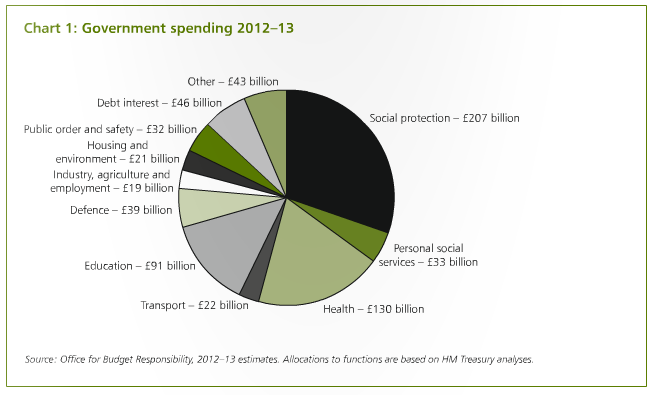
Whereas the number of social workers and those pulling down a decent professional salary while running charities or ‘third-sector’ operations has rocketed from virtually nil half a century ago, social funding now dwarfs every other area of government expenditure. The UK numbers (taken from the Treasury’s 2012 Budget Report in March 2012) are shown in the chart below.

The £207bn on Social Services (which includes all benefits, pensions, etc) represents 30% of all UK government expenditure but, because we’re running a whopping £91bn budget overspend, it’s a rather larger 36% of income. That represents £3,460 each year for every man, woman and child in the UK. Adding in the £2.7bn that Scottish councils pay out for Social Care, which is another £540 per skull and you’re talking a cool £4k per person.

Now, given that three-quarters of the population are net donors—not (in theory) vulnerable, nor too old/infirm, not to mention in jail or on drug recovery programmes, you’re talking about over 1m people in Scotland each receiving an average £12,000 in state help. Leave aside whether such help is adequate or that thousands of carers deserve financial help and/or respite, with the economy on a steady downward track and the UK government paying some £600,000,000 each DAY in interest on what it has borrowed already, this is all careening towards a very big fiscal brick wall.

So, while it is perfectly fair to demand that Chief Execs get their collective snouts out of the trough, it is equally fair to ask why people who attack ambulances or firemen or cause £130m in damage to wheelie bins are still entitled to any benefits. Of Scotland’s 49,618 criminal offenders last year, 27,813 (over 57%) were re-offending and this after decades of ‘enlightened’ attitudes among police, social work, municipal organisations and sundry charities.

When careers advisors say “There are thousands of charities in the UK, employing well over half a million people full-time” this is not to say that they may not be a cost-effective way of providing essential services, often to those most in need. But they also become a self-interested party. While the ideal of such charities and, indeed, of social work in general, ought to be to put themselves out of business by succeeding, so far, this has not happened.

And, while it would be unjust to blindly equate benefits recipients with wanton damage and unnecessary cost to society, it is not fat bankers who are setting fire to wheelie bins and stoning the firemen who show up to put them out. Both extremes of society need to make themselves included and respected within the whole; both must take responsibility to do that. There are plenty of third-world communities working miracles with the paucity of aid that actually reaches them that could teach us what can be done.

But, if the middle keeps getting squeezed between greedy rich and ma-giro’ll-do-me-jist-fine types, then the present fiscal squeeze will fragment society further, undermining any sense that “we’re all in it together“. After a further couple of years, look for something very like revolts that will, by comparison, make community charge riots seem like bliss.

Posted in Commerce, Community | 1 Comment

If our democracy is so exemplary, how come Malawi puts it to shame?

burdzeyeview's avatarA Burdz Eye View

This week, the blog will be focusing on some of the wider issues raised by last week’s local elections – the voting system, the impact of apparent Alphabetis, the low representation of women (and others).  To kick us off, a fantastic guest post on low turnout and compulsory voting from Susan Dalgety.  

Susan is an independent communications adviser, focusing on public policy campaigns, gender and international development. She was a Labour councillor in Edinburgh (1992 – 99) and Jack McConnell’s chief press officer during much of his time as First Minister. 

I was following the 2012 council election results on Twitter last Friday as I simultaneously proofed a project proposal for training women candidates for Malawi’s 2014 local elections.

I don’t need my crystal ball to predict that the turnout in Malawi in two years time will be much higher than Scotland’s was on 3 May, with less…

View original post 677 more words

Posted in Uncategorized | 1 Comment

Local & Party Politics: Symbiotic or Strangers?

Three days after the first standalone local elections for over a decade and while most of Scotland still does not know who is going to be running their schools and libraries, the two biggest parties in Scotland are lobbing claim and counter-claim at each other to prove who won.

Call me naïve but, unless the people themselves feel that they won, the whole exercise has been a huge waste of time and likely to push party politics ever further into posturing irrelevance. Outside of the political and media hot house, few conversations in pubs or aerobics class hinge on who runs Glasgow or council group sizes. Plenty revolve around local services from bins to buses—but if politicians get mentioned, it is likely accompanied by expletives.

Leave aside whether parties get their national policies and pitches right. Is part of the reason why the turnout for last Thursday’s election was so embarrassingly low because none of the parties in Scotland ‘gets’ council-level politics? In cahoots with all manner of media, parties all seem to make the same mistakes, finding themselves still distant at the level of politics closest to the people. This is for several reasons:

1)    Inability to handle diversity Because national politics is eternally in the media’s eye, diversity is anathema to party handlers. They are convinced (with some justification) that the voters punish internal rifts which diversity resembles. So, despite huge disparities in appropriate local service priority in Stenhousemuir is locked with Stornoway and national party manifestos for local government become the song sheet from which all local candidates must sing—whether in their language or not.

2)    Inflexible Internal Communication. National leaders are invariably found in parliament because that is the seat of power and vice-versa. As a result, this ‘parity of esteem’ touted over the last four years is a convenient fig-leaf concealing an inner coterie around each party leader. It is actually a one-way-street: that coterie posits, formulates and embeds policy with scant consultation of those in local government tasked with implementing such policy. It is only party discipline that keeps the illusion of co-operation functional.

3)    Organisational Incompatability Whereas national campaigns, based on constituencies as units, are organised uniformly, managed centrally and look coherent to an outsider, local council campaigns can be untidy, eccentric and amateur to the point of embarrassment—even as they are effective. Often that effectiveness relies on understanding nuances of individuals, 95% of whom do not fit the neat database boxes into which national canvass would fit them. Despite parties’ best efforts to harmonise, some 400+ wards are beyond enforced uniformity: canvass is sporadic; records are parital/mislaid; analysis of or research into opposition activities is rare. A political equivalent of ill-disciplined militia to the military, local campaigns present an insoluble headache to national organisers in the on-message world of SPADs

4)    Fuzziness in Election Focus Although lip service is paid to local elections and HQ staff sometimes deployed to support it, true national effort, such as happens in general elections, is rare. The ineffectiveness of party internal local government organisations stems from their being staffed by unpaid councillor volunteers too pre-occupied with their own election to provide strategy, overview or support to others. And, steered by parliament priorities, national staff provides little proper scrutiny.

5)    Confusion of National Message Whereas a government minister controls the officials of the department and need only worry about the media and connecting with the Leader and Cabinet, by contrast, few council cabinet members know who their opposite numbers are, still less what their policy direction might be. Due to paranoia at the centre about policy leakage, there is seldom consultation with those tasked with implementation prior to commitment to a policy. The result is either a local policy initiative vacuum or, at best, a fragmented, contradictory set of messages—again anathema to the bright young suits at headquarters.

6)    Interference by National Image The highest profile in each party is held by their leaders, upon whose public image so much political success depends. That requires constant public confidence and aura of infallibility. But to be seen either as soulless power addicts or be classed with the current damaging ‘in-it-for-themselves’ public image of politicians in general is especially damaging for councillors who depend far more on personal contact and trust. The best councillors are those who neither behave like, nor are seen as ‘politicians’ in any recognisable sense.

7)    No Room for the Radical One of the reasons for the continued popularity of Independents in many parts of Scotland is their reputation of speaking their mind and damn the consequences distinguishes them in the public eye. National politics demands that parties close to power march their members in lock-step unity. ‘Awkward squad’ types like Malcolm Chisholm, Nicky Fairbairn, Tam Dalyell or Dennis Canavan are the bane of whips. Yet the best councillors are such individuals. Without them, public disillusionment with politics would be even worse than it is.

In this age of the professional, it is understandable that voters make ever more unreasonable demands of their elected representatives. The resulting inevitable falls from grace tend to be at a national level simply because that’s where the media focuses. By not allowing a much more generous latitude in both behaviour and support to their councillors and insisting on parliamentary levels of discipline and conformity, not only are parties choking off a prolific source of ideas and energy but they are constricting the fruitful source of public trust and credibility that they so desperately seek.

Posted in Politics | Leave a comment