Danny Dare: Bigot of the Future

The launch of the “Better Together” campaign last week (no, not this one, nor even this one, but this one) generated reasonable and measured statements from heavyweights like ex-Chancellor Alistair Darling and positive signs that unionists are finally getting their act together to articulate proper reasons why the UK should continue to exist.

Despite already being enthusiastic about the benefits of Independence themselves, nationalists of the Scottish persuasion are neither narrow in their outlook nor blind to cogent arguments deployed against them by such campaigns. There are many debates to be had and questions to answer. Few of us think that the great apolitical majority will embrace a different future, no matter how enticing, unless those advocating change deploy credible reassurances and plausible reasons for taking such a step.

At the same time, any arguments why staying in the Union would be beneficial also need to be made with depth and cogency. Glorious joint histories, shared civic cultures and even geographic closeness are all important. But they are not, by themselves, decisive: why would 50-odd members of the Commonwealth abandon empire; why would Slovakia and Czech Republic, Sweden and Norway, Malaysia and Singapore not have each stayed together as one country if “better together” were a universal truth?

Many unionist protagonists are starting to build their case and should be commended for that, especially as years of frankly bratty behaviour, of pouring scorn on the concept or simply declaring this to be “the strongest union the world has ever seen” has clearly not worked. On June 25th, constructive joint statements from Darling, Rennie, Lamont and Davidson demonstrated considerable cross-party strength and encouraging signs that thrawn naysaying would no longer form the major part of a unionist campaign. “We make a positive case for staying together. A positive case that celebrates not just what makes us distinctive but also celebrates what we share” Darling claimed.

Fair enough—’bout bloody time.

Except that one of the team seems yet to have ‘got’ this religion. As Chief Secretary to the Treasury, Danny Alexander plays a pivotal role in running the Union, as well as representing a large slice of Scotland’s photogenic scenery. But he does not diplay this new enlightenment. Since the campaign launch, he has been singing the same wrist-slitting dirge as before. Yet, any of his pronouncements must be seen in a context that throws his judgement—both political and financial—into some question. He has:

  • told a London City audience that the oil tax increase the UK government imposed on the North Sea, and which threatened developments and jobs in the North Sea was “my idea, which I proposed a few months ago.” Entirely unhelpful to the British economy, let alone the Scottish.
  • argued that the UK Government’s £10 billion tax raid on the offshore industry “would be good for people in the north and north-east.” Again entirely unhelpful to the British economy, let alone the Scottish.
  • claimed “mortgage rates will be linked to government bond issues in an independent Scotland“. This claim was debunked by Dan Macdonald, Chairman of the Scottish Property Federation 2007/8
  • said “cutting the top rate of tax would be cloud cuckoo land”. Now, he supports a budget that is doing precisely that.
  • claimed “regional public sector pay was a distant and unlikely prospect.” He had previously written to the Welsh First Minister saying he was “keen” to see it introduced.
  • been author of the current budget’s ‘omnishambles’—successive U-turns on 3p rise in fuel duty, tax relief on charitable donations, and VAT on pasties and caravans.
  • entered the 2010 election pledging not to increase tuition fees, to oppose an increase in VAT and on a platform that would not back Tory austerity cuts. Upon entering government with the Tories he has reneged on each of these.

This is no track record to write home about. So his baleful pronouncements on the fiscal evils of independence must be seen as not just running counter to his unionist colleagues attempts to make a positive case for the Union, but also deriving from a kind of innumeracy that sits badly with his day job. Some examples:

  • July 5th 2012: “Scotland will have a large budget deficit, be overly reliant on oil revenues and would see financial services flee south of the Border.” That deficit would be 2/3rds the size of the UK’s per head and, while most oil economies are dependent on oil prices, Scotland has a more diversified economy than most (whisky, tourism, engineering, renewables, financial services). The latter go where most profits are to be made and Edinburgh competes nicely with Manhattan or Canary Wharf on costs, quality of life and skilled people.
  • June 23rd 2012“low interest rates for family mortgages will be hit in an independent Scotland because of higher borrowing costs”. He doesn’t seem to know the difference between mortgage availability in the private sector and government bond issues. Banks base their mortgages on the interest rate set independently by the Bank of England, which would be exactly the same for Scotland as for England in the proposed sterling zone.
  • December 29th 2011: “plans for an independence referendum are a ‘self-inflicted wound’ on the Scottish economy“. Meanwhile, in the real world: North Tyneside Council’s Tory mayor warned Scotland was at a competitive advantage over the north in England in attracting inward investment; Aker Solutions announced another 500 jobs to its current 2,700 strong operation in Aberdeen; £4.5 billion investment announcement by BP West of Shetland – an extension of the existing Clair oil field, including investment by oil firms Shell, ConocoPhillips and Chevron; Hewlett-Packard will provide more than 700 jobs by setting up an IT services hub at Erskine.
  • September 2nd 2011: “Scotland would have struggled to deal with the fallout from the financial crisis if it had not been part of UK.” As we are now discovering, the FSA missed many key issues creating the fiscal crisis, including loose LIBOR control and following Brown’s ‘soft touch’ regulation. Had Scotland been independent, a tighter regulation would have kept RBS & HBOS sensible enough to avoid fiscal meltdown— as banks in Denmark, Norway and other countries did.

In short, our Danny peddles mince—and not just mince but bigoted mince at that. Scots needs a proper debate about their future. He isn’t providing one. Whatever drives him, it would be in his own future interests, as much as anyone’s, if he toned it down some and embraced Better Together or (the equally unionist but nonetheless articulate) Scotland Institute for ideas how to make the running. Properly.

Because, unless he sees the light, we will.

Posted in Commerce, Community, Politics | Leave a comment

The Right of the People

Two hundred and forty-six years ago today, fifty-six representatives of thirteen colonies who had been gathered in Philadelphia for a month to decide their future signed a document drafted by Thomas Jefferson that was then printed up and distributed to what thereby became the state legislatures. The Declaration of Independence—like the one made at Arbroath in 1320 and owing much to its ringing nobility—founded the most powerful country history has yet seen on principles to which most enightened people would seek to aspire.

Since Scotland has no Independence Day, as yet, why not celebrate such a magnificent one until we do? To readers keen to draft a Scottish Declaration of Independence and return the compliment from Arbroath; the text follows. To Unionists who wish to avoid repeating the follies of Lord North and his monarch; consider its dignity, force of argument and, ultimately, effectiveness.

When in the Course of human events it becomes necessary for one people to dissolve the political bands which have connected them with another and to assume among the powers of the earth, the separate and equal station to which the Laws of Nature and of Nature’s God entitle them, a decent respect to the opinions of mankind requires that they should declare the causes which impel them to the separation.

“We hold these truths to be self-evident, that all men are created equal, that they are endowed by their Creator with certain unalienable Rights, that among these are Life, Liberty and the pursuit of Happiness. — That to secure these rights, Governments are instituted among Men, deriving their just powers from the consent of the governed, — That whenever any Form of Government becomes destructive of these ends, it is the Right of the People to alter or to abolish it, and to institute new Government, laying its foundation on such principles and organizing its powers in such form, as to them shall seem most likely to effect their Safety and Happiness. Prudence, indeed, will dictate that Governments long established should not be changed for light and transient causes; and accordingly all experience hath shewn that mankind are more disposed to suffer, while evils are sufferable than to right themselves by abolishing the forms to which they are accustomed. But when a long train of abuses and usurpations, pursuing invariably the same Object evinces a design to reduce them under absolute Despotism, it is their right, it is their duty, to throw off such Government, and to provide new Guards for their future security. — Such has been the patient sufferance of these Colonies; and such is now the necessity which constrains them to alter their former Systems of Government. The history of the present King of Great Britain is a history of repeated injuries and usurpations, all having in direct object the establishment of an absolute Tyranny over these States. To prove this, let Facts be submitted to a candid world.”

(There follow 25 separate detailed accusations against King George III and his government.)

“In every stage of these Oppressions We have Petitioned for Redress in the most humble terms: Our repeated Petitions have been answered only by repeated injury. A Prince, whose character is thus marked by every act which may define a Tyrant, is unfit to be the ruler of a free people.

“Nor have We been wanting in attentions to our British brethren. We have warned them from time to time of attempts by their legislature to extend an unwarrantable jurisdiction over us. We have reminded them of the circumstances of our emigration and settlement here. We have appealed to their native justice and magnanimity, and we have conjured them by the ties of our common kindred to disavow these usurpations, which would inevitably interrupt our connections and correspondence. They too have been deaf to the voice of justice and of consanguinity. We must, therefore, acquiesce in the necessity, which denounces our Separation, and hold them, as we hold the rest of mankind, Enemies in War, in Peace Friends.

“We, therefore, the Representatives of the united States of America, in General Congress, Assembled, appealing to the Supreme Judge of the world for the rectitude of our intentions, do, in the Name, and by Authority of the good People of these Colonies, solemnly publish and declare, That these united Colonies are, and of Right ought to be Free and Independent States, that they are Absolved from all Allegiance to the British Crown, and that all political connection between them and the State of Great Britain, is and ought to be totally dissolved; and that as Free and Independent States, they have full Power to levy War, conclude Peace, contract Alliances, establish Commerce, and to do all other Acts and Things which Independent States may of right do. — And for the support of this Declaration, with a firm reliance on the protection of Divine Providence, we mutually pledge to each other our Lives, our Fortunes, and our sacred Honor.”

(There follow the 56 signatures, organised by the 13 new states that they represent. Among them are two future Presidents, not counting New Hampshire’s Josiah Bartlett, the name taken for the President in the West Wing. Over one third of the 56 were Scots, including the president of New Jersey College, John Witherspoon from Gifford, East Lothian)

“Liberty cannot be preserved without a general knowledge among the people, who have a right…and a desire to know; but besides this, they have a right, an indisputable, unalienable, indefeasible, divine right to that most dreaded and envied kind of knowledge, I mean of the characters and conduct of their rulers”

John Adams (1725-1826), Signator for Massachusetts

Posted in Politics | Tagged | Leave a comment

The Whole Wunch of ‘Em

It is rare to find civic figures taking more flak than the government—especially a Tory government, as seen from Scotland—but, this week, the bankers managed it. And it wasn’t just the one in the limelight, Barclays. It was the whole wunch of ’em. Labour is quite right to insist  (today’s Hootsmon) that a parliamentary inquiry is inadequate to deal with the scale of what’s been going on: only a Levenson-style examination under all stones—no matter how sacrosanct or odious—can clear the air.

In truth, they have been living dangerously ever since the house of cards loosely described as junk mortgages collapsed in 2007, blowing great holes in what were deemed as assets, triggering a reflex slamming-on of brakes in liquidity. Such a major spanner thrown into the global banking works tripped Northern Rock, Lehman Bros, Landisbanki and other overexposed international operations into insolvency, brought the two major ‘Scottish’ banks RBS & HBOS within hours of the same and cast huge doubt over the wisdom of recent inflated deals—such as RBS’s takeover of the Dutch ABN-AMRO.

Many sensible commentators, such as the Hootsmon’s redoubtable Bill Jamieson, had been saying the emperor had no clothes for some time. Ever since 1988’s ‘big bang’ of deregulation in the City, normally staid commercial high street banks had been in thrall to their investment arms that created and invested in “financial derivatives”. In the long stock market run prior to 2007, banks as well as developers, investors and outright speculators had not been content with simply investing in shares or bricks and mortar.

Starting with stock options, various ‘instruments’ were then marketed as ‘products’, each more speculative than the other. Any associated element of risk, as with most things in life, carried with it a premium. But that meant that Icelandic bonds or say, packaged junk mortgages, paid better interest. The trick was to keep the whole merry-go-round of faith going, even though this broke almost every principle of staid commercial banking being used as the stuffy ‘front’ for the bunch of financial cowboys running the investment arms.

And because those investment arms made the money, their managers were the ones promoted to run the whole operation, hence why Bob Diamond now runs Barclays, Fred the Shred got the top job at RBS. Such people were pilloried in the aftermath of 2007 as they retained their bloated bonuses even as their shares (supposedly ‘safe’ investments) lost 90% of their value.

Worse than that, small businesses, equally hammered by the sudden business chill found their bankers preferred to sit on the public cash they had been given to stay liquid and snub opportunities to make loans they once would have peddled tirelessly. Banks moved from being a pillar of local business to the pariah, especially when few heads rolled over the debacle they helped create and money appeared to still flow freely only in top salaries and bonuses (although explanations what exactly the latter were for became hazy).

This week’s ‘Libor’ scandal comes on top of all this. It appears that the same ‘masters of the universe’ in financial centres like Canary Wharf were also manipulating the rates at which banks loan money to one another, mostly overnight. Such arcane matters have no direct effect and hold little interest to those outside the business itself. But the manipulation meant that key investment bankers could make that bit more for their firm and, by extension, for their own bonuses. Barclay’s is the first to be caught with its hands in the till but they won’t be the last.

The shocking part though is two-fold: first, this was discovered by the banks themselves as far back as the 2007 debacle and is only now being revealed; second that the same FSA  asleep at the wheel then but who should have prevented speculation in worthless ‘instruments’ (but was ordered to move with ‘a light touch’ by Chancellor Irn Broon) was informed fairly promptly and still has not brought any of its own investigations to a conclusion. Talk about toothless, of not complicit!

Bob Diamond may have settled a £260m deal to get regulators off Barclay’s back and thrown his Chairman Marcus Agius to the wolves but nobody thinks Barclay’s is alone in guilt for such actions. Coming on top of Diamond now falling on his own sword today, after pulling down a cool £100m since the debacle, ordinary punters have had enough. They’ve suffered serious financial squeeze; major banks like RBS pared IT staff and moving operations to India for ‘efficiency’ to find collapsing ‘legacy’ computer systems unable to reliably make customer transactions; their pitchforks and burning torches are now well and truly out for banks.

It all makes for sordid and distasteful stuff, especially since the greed, avarice and self-centred behaviour repeatedly evidenced sits poorly with any ‘all in this together’ spirit that Cameron’s Coalition has tried (and failed) to foster. They are not quite getting the spirit of it themselves: last night Tories down Labour’s amendment to stop 14,000 millionaires getting a £40,000 tax cut by 315 votes to 233. And with impeccable timing the Department of Health appoints a Warclays banker to run the National Health Service.

So, what’s to be done? How do we clean Augean Stables on this massive scale, especially restoring the faith in dour-but-competent banks that the present set of spivs have so cheerfully gambled away for their own ends? Campaigner Andy Wightman has some constructive things to say in his recent blog. He quotes a recent speech from Swinney:

“If we are to learn the lessons of the boom years, the banking collapse of 2008 and scandals like this one at Barclays must become an opportunity to build a better banking system.”

Well, duh! And just what would that look like, John? Well, as Andy rightly argues, monetary reform is a prerequisite. And if Scotland is to use Sterling after independence, that means, quite apart from anything else, reform of the Bank of England. Biggest problem with this is that big bankers, their buddies in the English Establishment and its subset the Bank of England itself have a slew of long sharp talons dug into Lord Snooty and his chums on the Tory front bench, so don’t hold your breath.

Positive Money has written a useful article on how power has shifted from parliament to the banking sector and given some thought how to shift it back. To help this along, they have even drafted a Bill for reforming the Bank of England. Whatever Scotland does in the next few years, it should take the ideas in both to heart if it is to establish a reputation for its own financial culture that echoes the probity for which we were once famous.

Visible on the same page as the article on the on-line Hootsmon site, the results of the reader survey on whether Jimmy Carr was morally wrong for getting creative with his taxes was much closer than you would expect from a public with its moral dander up: 56% thought him wrong while 44% disagreed—a mere +12% moral edge. Perhaps we get the bankers we deserve?

Posted in Commerce, Politics | Tagged | 1 Comment

Europe or Euyo-Euyo?

If there is one element of British life that the Yes campaign has working for it tirelessly, it must be the xenophobia of a wide section of the English public. Even assuming they can persuade Scots to embrace the concept that we might be “better together”, then a deep-seated virulence against the rest of our neighbours defeats their own rationale.

On the back of Cameron’s speech raising the possibility of another UK referendum on Europe, today’s Daily Express returns to its virulent anti-EU stance with a leader that struggles to revive the bulldog defiance of Napoleon and Hitler, viz:

“What is the point of Britain trudging on with this euro-albatross round its neck, dragging the dead weight of a failing currency and a ruthless Brussels-based regime that seeks to destroy our sovereignty, override our laws and drain money from British taxpayers like a vampire gorging on blood?”

Not analytical journalism’s finest hour, but at least UKIP now has plenty material for their next rant. Meantime, over at the equally xenophobic Daily Mail, former minister Liam Fox has invented a radical path to restart his career by advocating Britain’s withdrawal from the EU altogether. He wants a referendum now and bluntly warns Cameron:

“not to wait for EU leaders to recognise the failure of the ill-conceived euro before we set out what we want for the British people.”

Why should this ‘most successful union in history’ that Scotland is blessed to be part of—one proud of its imperial legacy, its globe-spanning trade, its powerful alliances, its seat on the UN Security Council—behave in this way? Such a petty and short-sighted attitude must call current unionist arguments over Scotland into serious question.

For. which of “better together”‘s more plausible arguments do not apply as much to the UK relations with the EU as to Scotland’s relations with England? Europe accounts for 57% of our trade and over 80% of our foreign holidays. Exports to the newer members is growing at 10% and helping to address a scary £180 bn import level that overwhelms our £139 bn in exports to the EU—a balance of trade deficit of almost 30%. In other words, they’re our best trading partner but they’re much better at selling to us than we to them.

The Little-Englanders, much exercised about the dire state of the Euro and the ongoing saga of which of its weaker members might default, imply that this should not be our concern. Well, first of all, the fiscal emergency that created the saga was as much a product of Canary Wharf and the dubious banking practices like Libor manipulation there that only now are being dragged into the light of day. Secondly, the UK financial nomenklatura are still struggling to find some exit from this ongoing recession while, thirdly, the stronger Euro members have not only restored growth but are again showing the struggling Brits a clean pair of heels in business.

That Europe has its flaws, no-one disputes. Any organisation of 300m+ people crossing many languages and cultures is cumbersome in a way that the USA with its unifying language and federal organs is not. But to clamber onto a xenophobic bandwagon—as the Tabloids and Fox seem keen to do—smacks of a politics of fear, of blaming foreigners for our own troubles and of being seen as a weak partner, short-sighted and selfish.

Were Scotland to become a normal country, they should not assume that Europe will be generous and selfless in its negotiations with us for membership. But nor should we take the habitual English-dominated approach to date of reluctant participation, of hand-bagging ultimata, of habitual low-level discord.

Scotland offers Europe a robust trading partner and tourist destination. With our vast and varied energy resources, our strategic location on its northern wing and a positive, recognised international profile that comparably-sized countries can only envy, we could use such bargaining chips for a place at the top table among our neighbours that our Channel-invasion-fixated cousins will at last be able to understand that a great future for all can be had from a union that looks to the future and not to the past.


Posted in Commerce, Politics | Tagged , , | 1 Comment

The Giftie Gie Us

Listening to the last act of ORF’s live broadcast of Donizetti’s Lucia di Lammermoor on top of today’s EFF premiere of Brave and Cummings in Macbeth earlier in the week, I am struck by the contrasting views that various “furriners” appear to have of Scotland. Seen through such a prism—as opposed to a flurry of petty tweeting about who’s more Scots than whom—the place Scotland holds in the world looks pretty secure.

What does it matter that Lucia flits among the standard amorous travails of Italian opera and that neither Lammermoor nor Ravenswood Castle exists, let alone the feckless Enrico? Brenda Rae’s soaring aria as Lucia has the Wiener Staatsoper audience applauding out of their seats at the romantic aura woven about what we locals know to be  as bleak a haar-whipped treeless waste of heather and bracken as you could wish for.

For decades, we Scots have been touchy about Macbeth, claiming he wasn’t as bad a lad as made out. Possibly not, but Shakespeare gave us a more mordant, rounded picture of the human frailties of those who rule than private secretaries (or the BBC) will ever dare reveal. What really happened 1040-1057AD we’ll never know—but civilised and pretty, it wasn’t. But if Macbeth’s sole legacy is one of the finest scripts to grace the English language, what more would anyone want to be remembered by?

And so to the latest portrayal of medieval Scots, this time by Californians. Some had expected a Brigadoonish worst but they needn’t have worried. Not only has Pixar done this one with their usual panache, visual style and attention to detail but McToyStory it is not: they went to the trouble of researching the culture and hiring authentic voices. With Kelly MacDonald and The Big Yin, backed up by a host of weel-kent voices, it avoids the cod-Scots weak spots of Braveheart and Rob Roy to make you think we might have made it ourselves—if only we’d had the time/equipment/money/skill/gumption.

But no matter. Just as Donizetti’s Lucia can make something heart-renderingly beautiful out of the glaur of Spartleton Edge so Macbeth can mix feminism with power politics to make a heady brew that carries a kick even today:

“Yet do I fear thy nature; It is too full o’ the milk of human kindness. To catch the nearest way: thou wouldst be great; Art not without ambition; but without the illness should attend it.”

But what is delightful about Brave is that it isn’t Braveheart. That was a film of its time, when Scotland was still politically asleep and barnstorming patriotic fire was finally lit under those who had seen too many feeble fifties and rusting Ravenscraigs. What we have is humorous entertainment that grandads can take kids to see or vice versa. But, better than that, non-Scots (yes, I mean our English cousins) won’t be offended by either the towering ruthlessness Patrick McGooghan brought to Edward I or the foppish guile with which Tim Roth infused his Archibald Cunningham.

I expect the main difficulty non-Scots will have will be with the accents—everything, including a broad Doric, is uncompromisingly to the fore. But I hope everyone can get beyond that because, despite being animation, this comes across as a real film about real Scots—with all our flaws, quirks and idiosyncrasies. You will swear you know half of these people, even though they’re a cartoon. If there’s a cringe or hidden apology in there, I missed it—it strikes me very much as a major milestone in our cultural coming-of-age.

The only complaint I have is that we should have had the gumption and foresight to make the film ourselves.  But, much more than the other renditions of Scotland described above, this may be the best way to date tae see oorsels as ithers see us.

Posted in Community | Leave a comment

Not Our Finest Hour

Before there were such clinically business-like names as “nuclear strike capability” and “mutually assured destruction”, there was the Strategic Bomber Offensive which, unlike our present military madness, was actually prosecuted to as full an extent as we could.

Based on the theories of Douhet, the thirties and forties saw a build-up of air forces capable of striking at other countries. The RAF was to the fore, developing Bomber Command for that specific purpose. This differed from the parallel Nazi development of the Luftwaffe in that their bombers were designed for close co-operation with the rest of the Wehrmacht in an integrated all-arms operation dubbed “blitzkrieg”.

Today, in London’s Green Park, a monument will be unveiled to the 55,573 airmen of Bomber Command who died in the course of the war—the highest proportion of any arm of any service, higher than similarly dangerous efforts that saw huge hardship and sacrifice. The airmen fully deserve this belated recognition for repeated bravery in the cruel circumstances in which most died—on their umpteenth mission in an unheated Lancaster or Halifax in the dark at 20,000 feet over a burning German city amidst exploding 88mm or 105mm flak shells.

But to ask what they were doing there is not to doubt courage, sacrifice or recognition of it.

When war broke out in 1939, people all over Britain rolled into makeshift shelters clutching gas masks, believing Douhet’s predictions of air war would be fulfilled; they were wrong. There were pinprick raids on naval targets at Scapa Flow and choke points like the Forth Bridge but the Luftwaffe was too busy helping sweep the Polish, then Norwegian, Dutch, French and Belgian armies aside to venture over the North Sea.

Bomber Command confined itself to military targets and leaflet-dropping, hoping that their older 2-engined mainstay bombers making it to the Ruhr to drop leaflets would be deterrent enough. Early RAF efforts to attack Kriegsmarine ships in their North Sea home ports damaged nothing and half the planes dispatched were lost: it was a shock to Douhet disciples how wrong he was—the bomber didn’t always get through.

Up to 1940’s Battle of Britain, both sides avoided civilian targets. But in September, a German geschwader’s flawed navigation dropped bombs on London by mistake. An incensed Churchill dispatched a couple of RAF squadrons  to bomb Berlin in ineffectual retaliation. Although targeted at Templehof Airport, accuracy was so abysmal it was seen as indescriminate. So, in the military vacuum following the Germans shelving invasion, bombing cities was the only either side could strike at one other.

So, for a year, the ‘Blitz’ rained down on London (especially the East End) and industrial cities like Coventry and Glasgow. Because of the demonstrated weaknesses of bombers to fighter attack in daytime, this took place at night, which removed any hope of accuracy. Even though military targets were invariably given, raids were lucky to find the right city in a blacked-out landscape. Do17s and He111s, with barely a ton in each plane, targeted industry, with raids of more than 100 considered large. Nonetheless, 100 tons of high explosives were hell to endure for anyone living even near the ‘target’.

Bomber Command was tasked with retaliatory raids, even after the Luftwaffe was pulled away to support the invasion of the Soviet Union in June 1941. When a study found that not even half the bombs dropped fell within five miles of ‘target’, the effort to develop newer and heavier bombers and dispatch them at the foe did not slacken a bit.

In February 1942, RAF Bomber Command explicitly began to focus its attacks on the enemy civilian population, when it shifted from target bombing to night-time area bombing of cities, designed to break enemy morale. Arthur ‘Bomber’ Harris, the new head of Bomber Command, saw German civilian deaths (or the ‘dehousing’ of their workforce) as entirely necessary.

He embraced the theories of a Prof Lindemann, who posited attacking major industrial centres to deliberately destroy as many homes and houses as possible. Working class homes were to be targeted because they had a higher density and fire storms were more likely. This would displace the German workforce and reduce their ability to work.

The new RAF 4-engined Lancaster and Halifax bombers coming on-stream could each deliver 7 tons of bombs to any city in the Ruhr. The RAF’s first 1,000-bomber raid (on Cologne at the end of May 1942) devastated large parts of the city with 5,000 tons of bombs—fifty times what a ‘big’ German raid had once delivered.

As other fronts were opened in Italy and D-Day landed Allied armies in France, the ‘bomber offensive’ continued, with the RAF’s night raids now partnered in daylight by the US Eighth Air Force (who did adhere to precision bombing). Harris received top-level backing for his ‘bomber offensive’ even to the point of starving Coastal Command of long-range aircraft.

One of the most gruesomely ‘effective’ raids were against Hamburg in July 1943. The unusually warm, clear weather meant the bombing was highly concentrated around the intended targets. This created a vortex and whirling updraft of super-heated air which built into a 1,500-foot-high tornado of fire. Over a week of raids, 9,000 tons of bombs killed 42,600 civilians, wounded 37,000 more and wrecked 250,000 homes, practically destroying the entire city. Yet the war continued for two more years. (For comparison, fewer than 1,000 died in Coventry or on Clydeside.)

Harris’ argument that, even if they were not destroying military targets, his massive raids were splintering German infrastructure and sapping their will to resist was not borne out. Not only had German efforts 1940-41 not weakened British will to resist, German sources maintain their response was no different.

“In the burning and devastated cities, we daily experienced the direct impact of war. It spurred us to do our utmost . . . the bombing and the hardships that resulted from them (did not) weaken the morale of the populace.” —Albert Speer

Perhaps the most callous and unnecessary RAF raid was made on Dresden in February 1945. The Germans were beaten on both fronts and this “Florence on the Elbe“, a cultural landmark of little or no military significance, was full of refugees fleeing a vengeful Soviet Army. In four raids, 1,300 bombers dropped 4,000 tons of bombs that devastated 40 sq. miles of the city in a firestorm; the 25,000 casualties were never properly counted.

There is no question that the thousands of airmen who climbed into lumbering aircraft night after night, knowing their chance of survival over furiously hostile territory was under 50%, deserve recognition for bravery few of us could muster. But the reasons behind orders they followed so resolutely, the justification for a million tons of bombs killing 305,000 civilians, wounding 780,000 more and rendering 7.5m (the equivalent population to London’s) homeless, lie open to questioning even today.

  • Is there any such thing as ‘civilised warfare’?
  • If so, did Britain comply with its precepts 1939-45, as it claims to have done?
  • If ‘yes’, how can Bomber Command’s indiscriminate strategy be justified?
Posted in Community | Tagged | Leave a comment

Nation for Sale

THE assertion by Scottish Labour that Scots willingly chose to join the UK is wrong on every level.

Again, like yesterday, not technically a reblog, this informative article from Paul Scott was printed in today’s Hootsmon. It gives a scholarly backdrop to how this Union we are now in made its start in rather unsavoury circumstances.

On 1 June The Scotsman quoted verbatim a passage from a speech in the Scottish Parliament by the Scottish Labour leader, Johann Lamont. She said: “We, as a nation, were never conquered. The United Kingdom has not been imposed upon us. It is the choice of Scots”. She made the same point again in the BBC Question Time programme on a week later.

This distorts the facts so drastically that Johann Lamont is either completely ignorant of the history of the Union or she is trying to deceive us. It is an event which I have studied for years and which is the subject of two of my books, Andrew Fletcher and the Treaty of Union (1992 and 1994) and The Union of 1707, Why and How (2006). There is in fact no mystery about the way in which England achieved the Union against the clear wishes of the great majority of Scots. It is clearly recorded in the documents of the period.

The English opportunity arose over the failure of the Scottish attempt to establish a trading post at Darien on the Isthmus of Panama. The Act of the Scottish Parliament which established the Company offered 50 per cent of the shares to English investors. There were over subscribed within few days but they were withdrawn when King William made know his disapproval. The necessary funds were raised in Scotland alone in a surge of patriotic fervour. They amounted to half of the total money in circulation. The venture failed for many reasons including the English encouraging a Spanish attack.

In consequence of this, the Scottish Parliament passed an Act in 1703 which called for the appointment of a different successor to the Scottish throne on the death of Queen Anne. Royal approval of the Act was withheld and the Scottish Parliament passed it again in 1704. The English Government reacted by first threatening invasion and then proposing negotiations in London.

Because it was put to the vote after most members had left for the night the Scottish Parliament passed an Act to leave the appointment of the Scottish delegation to the Queen. When they arrived in London the English Government declined to discuss any Scottish proposal their own was eventually adopted.

This provided for the abolition of the Scottish Parliament but the continuation of both Houses of the English Parliament with the addition of a few Scottish members to both Houses, 45 in the Commons (one more than Cornwall) and 16 in the Lords (fewer than the English bishops). The Treaty provided for the payment of a sum of money to be paid to Scotland which among other purposes was intended to compensate the shareholder in the Darien scheme. On the other hand it imposed on Scotland a share of the English National Debt and the payment of English rates of import duties on alcohol.

To secure the passage of this proposed Treaty the English began a programme of bribery of the members of the Scottish Parliament. The debate there lasted from 30 October 1706 to 16 January 1707 when it was approved. At that time the Parliament was not representative of the people. It consisted of three types of members sitting together, the Lords, the Burghs (which were then unrepresentative of the people) and the Counties. It was only this last element which was elected, but only the Lairds had votes. The population of Scotland at large made its outraged opposition to the Union very clear. Letters against it flooded into the Parliament and not one in favour.

The great economist Adam Smith in a letter of 14th April 1760 said of the Union: “The immediate effect of it was to hurt the interest of every single order of men in the country. Even the merchants seemed to suffer at first. The trade to the Plantations was, indeed, opened to them. But that was a trade which they knew nothing about; the trade they were acquainted with, that to France, Holland and the Baltic, was laid under new embarrassments which almost totally annihilated the first two and most important branches of it. No wonder if at that time all orders of men conspired in cursing a measure so hurtful to their immediate interest”.

For some years after 1707 the English Parliament intervened in Scottish affairs, including the Patronage Act of 1712 which enabled lairds to intervene in the appointment of Church ministers in Scotland. This led in 1843 to the Disruption, a major split in the Church of Scotland. But, as Walter Scott remarked in his Letters of Malachi Malagrowther of 1826: “Scotland was left from the year 1750 under the guardianship of her own institutions, to win her silent way to national wealth. Scotland increased her prosperity in a ratio more than five times greater than that of her more fortunate sister”.

These Letters (which have been called the first manifesto of modern Scottish nationalism) were a passionate protest against the way in which Westminster again started to interfere in Scottish affairs when France ceased to be a threat after their defeat at Waterloo. In fact (although Walter Scott died too soon to see it) Scottish opinion began to approve of the Union in the 19th Century. This was because of the effects of the British Empire, while it lasted. It provided a good source of raw materials and a market for Scottish exports and provided valuable jobs for many Scots in its administration.

That is now the distant past. The modern world is the age of independent, and contented small nations. They have increased the membership of the United Nations from 51 member states in 1945 to 193 today. The rapid surge in their prosperity and sheer happiness as independent countries has been unmistakable and impressive. Scotland should follow their example.

Posted in Commerce, Politics | Leave a comment

SOS Puffin—2012 Report

Technically this can’t be a reblog since the original wasn’t a blog at all. But as a great example of a dedicated wildlife fan who has put major amounts of effort over five years into a project to secure the habitat for Scotland’s most popular seabird, it deserves wide coverage. For all that time, the driving force has been John Hunt, a genial, craggy and dedicated ‘twitcher’. Thanks to John, a huge conservation programme for threatened puffin habitats of the Forth is now almost complete. John’s report follows below.

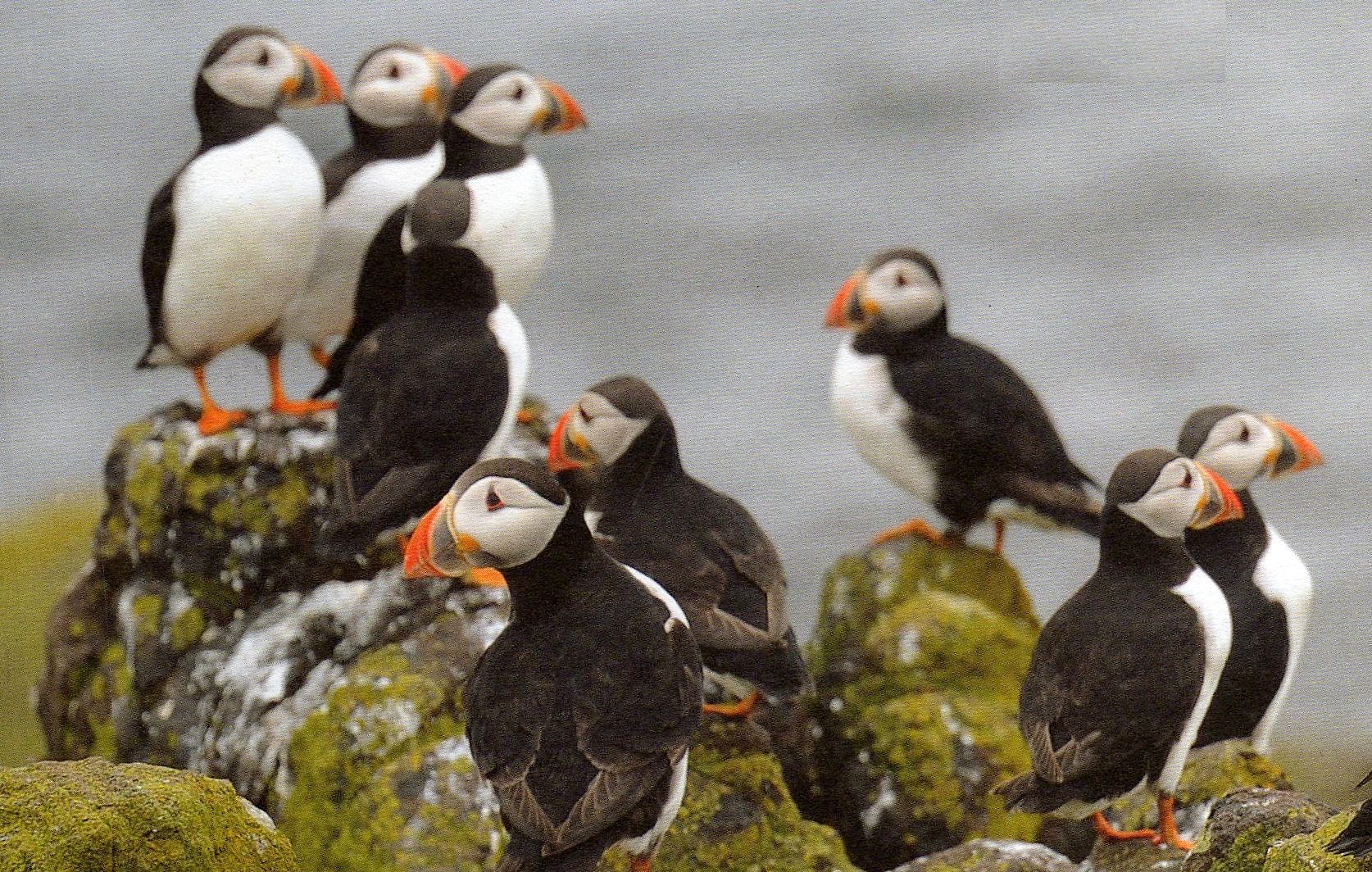
Typically Sociable Group of Puffins—Known also as ‘Tammy Norrie’ or ‘Clowns of the Sea’

Introduction: SOS Puffin is a volunteer project sponsored by the Scottish Seabird Centre which started in 2007.  It aims to bring under control the invasive plant tree mallow which has taken over the islands of Craigleith and Fidra near North Berwick and threatens the important populations of nesting puffins and other seabirds.

Islands Visits and Volunteers:  To avoid disturbing breeding birds, no visits to cut tree mallow were made to the islands from mid-April 2011 until August 2011 when work parties recommenced.  From August until October, attempts were made to organise work parties on most weekends and once during the week whenever the limitations of boats and tides permitted.  Last winter our usual boatman was reluctant to take us out so few work parties took place.  In March 2012 the Seabird Seafari inflatable returned and work parties resumed until April when we stopped once again for the breeding season.

Craigleith:  The weather was distinctly unhelpful last autumn and we managed only nine trips to Craigleith before the large inflatable came out of the water for the winter.  However thanks to the winter weather and the impact of rabbits only four more trips were needed in the Spring to thoroughly clear the island of tree mallow.  The number of work parties to Craigleith each month (with the number of volunteers shown in brackets) since the project started is shown in the table:

Trips (and volunteers) to Craigleith

The drop in the number of work parties over the last three years is largely a reflection of  steadily getting on top of the problem.

‘Mallow-basher’ Squad at the Pond on Craigleith—John Hunt Second from Right (‘Nests’ on Ground are Cut Mallow)

Last summer the tree mallow was slow to make an appearance and we were lulled into a fall sense of security.  However from July onwards it made its usual impressive comeback so that by the autumn large areas were once again covered by seedlings from 1 to 2 metres in height.  However there were areas where the density of seedlings was less than the year before.  Only limited progress was made with cutting this before we lost our boat transport in late autumn but the rabbits helped during the winter, attacking most plants and killing small seedlings.

This meant that by this Spring our task was significantly less and four more work parties were all that was needed to clear the island completely apart from small areas at the east end which we had to avoid because of the nesting cormorants.

Rene van der Wal (Aberdeen University) continued his programme of ecological monitoring based on a number of plots across the island. He is looking at the response of tree mallow and other vegetation to the control work including the recovery of native plants.  His findings confirm a gradual recovery of perennial plants with the island vegetation mostly in good condition during the puffin breeding season.  The effect of rabbits is mixed in that, while they are hitting the mallow hard during the winter, they are also creating ideal conditions for tree mallow to germinate during the summer when the rabbits eat other vegetation.

Due to bad weather we were not able to land on the date planned for the puffin burrow count so unfortunately this count will have to wait until next year. However a count of other nesting seabirds was carried out on 26th May, organised by Bill Bruce, and the totals for the main species counted are given in the table below.

 Seabird Census (Other than Common Gulls) on Craigleith

Fidra:  Only three SOS Puffin work parties have been out to Fidra during the last year.  The number of visits each month to Fidra since 2007 (with number of volunteers) was:

Trips (and volunteers) to Fidra

In addition to the above, Allison Leonard of the RSPB (Fidra’s owners) organised three work parties to the island during February.  We were able to supplement their volunteers with some of ours so that an additional  22 volunteers were on these three visits.  By April the island was largely cleared of tree mallow. RSPB even managed to organise some climbers to cut tree mallow growing in inaccessible places on the cliffs.

As with Craigleith, fewer visits to Fidra have been necessary in the last two years to keep the mallow under control even though here there are no rabbits to help.  This is again a reflection that the mallow is returning less vigorously with each year.

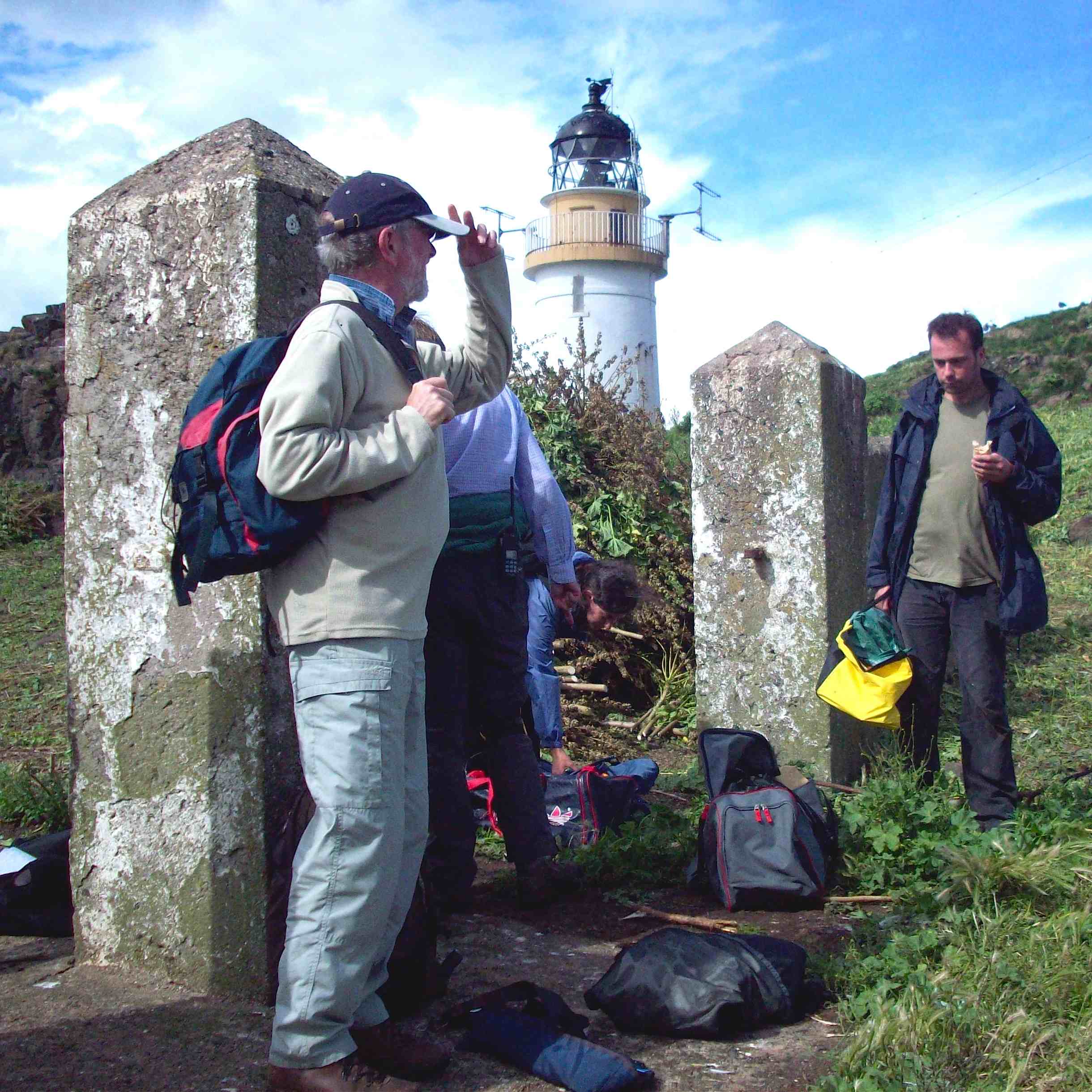
Strimmer Squad at the Railway Path below Fidra Lighthouse

Tree mallow also recovered strongly on Fidra last summer and autumn, returning to most of the former areas but generally at a lower density than previously.  With the help of the RSPB visits, most of the island was cleared by the end of March though the weather prevented us from completing the task as thoroughly as we would have liked.  The RSPB involvement made all the difference and it was particularly good to have the tree mallow cut on the cliffs.

A puffin burrow count was carried out on 3rd May by the Forth Seabird Group and came up with a corrected count of 750 apparently occupied burrows (aob).  This is similar to the count of 799 in 2009 but disappointingly less than the 1,149 in 2010.  It is not known what the breeding numbers are like on the Isle of May this year but at present there is no obvious explanation for this drop in numbers.

The Lamb: No visits were possible to the Lamb during the last year.  There is only a small amount of tree mallow on this island but it still needs to be cut each year to stop it spreading further or retirning to the other islands.

Overall Effort:  during last year, 21 planned work parties had to be cancelled—mainly because of the weather or weather forecast.  The number of volunteers coming on each visit has varied from 5 to 13 with a mean of nearly 11.  It was very frustrating to have to cancel so many trips but we are grateful for the good nature and patience shown by the volunteers.

Since the project began in 2007, nearly 900 people have been out helping on the island visits, with many coming more than once.  The number on the volunteer data base continues to grow and is now at almost 600—of whom well over 400 have been out at least once.

But work parties continue to be heavily dependent on a small group of enthusiasts who come regularly, a number of whom have now helped on the remarkable tally of work parties notched up to date by:

  • David Ross 92
  • Margaret Wight 83
  • James Leyden 81
  • Howard Andrew 65
  • Bill Bruce 48
  • EJ Shields 48

Organised groups that have been out during the last year include Scouts and corporate groups from John Lewis, Royal Bank of Scotland and the George Hotel, Edinburgh.

Looking Ahead:  As a result of all this hard work, we have been able to bring tree mallow sufficiently under control so that, since 2009, puffins and other birds have been able to nest on Craigleith and Fidra without being impeded in any way.  The extent and density of tree mallow is slowly reducing and the effort required each year is also declining. However, it is not yet clear how long it is going to take before the tree mallow is reduced to the extent that it only requires occasional visits to keep it at bay.  Until then we shall continue to organise regular work parties. Work parties will start again in August and details of proposed dates/times will be sent out to volunteers in July.

Our ecologist Rene van der Wal will continue his ecological monitoring on Craigleith and a masters student from Aberdeen University, Tiana Rakotondratrimo, will be looking at what is happening with the tree mallow seed in the soil.  We hope her project will give us valuable information about the all-important seed bank which has so far proved remarkably resilient.

What It’s All About—A Puffin (20cm high) Next to Flowering Tree Mallow (Grows over 2m)

A huge thank you to all those who have helped as volunteers and in other ways.   From all the feedback we receive, the work parties are still much enjoyed by those who take part and more volunteers keep coming forward. Our thanks also go to Viridor Credits, Scottish Natural Heritage and others for their generous funding of the project.

  • John Hunt
  • Craigleith Management Group
  • June 2012
  • info@seabird.org


Posted in Community, Environment | 1 Comment

Day of the Naysayers

So, today is the launch of “Better Together” aka “The ‘NO’ Campaign”. Can’t say that I wish them well. That’s not because they oppose my personal belief that the Scots would do better running their own country in their own interests. It’s because unionists have yet to explain what advantage Scots would gain by remaining in their union. Their utterings to date are dire warnings but all vulnerable to question, if not disproof.

What really undercuts their statements’ credibility is their uncanny echoes of flat-earth prophets who went before—supposed giants of their day whose lofty status in the firmament of the time rendered them blind to seeing the real world, let alone a better future. Some classic examples:

“Heavier-than-air flying machines are impossible” —Lord Kelvin, President of the Royal Society, 1895

“I  think there is a world market for maybe five computers.” —Thomas Watson, chairman of IBM, 1943

“We don’t like their sound, and guitar music is on the way out” —Decca Recording Co. rejecting the Beatles, 1962

“There is no reason anyone would want a computer in their  home.” —Ken Olson, president and founder of DEC, 1977

Apparently no era has been free from such hilarious humbug: there’s no reason why the early 21st century should be any different. Indeed, today may become their finest hour as unionists from near and far pontificate how no sane, rational person could want Scotland to become a normal country.

First up to the plate: the egregiously negative D. Alexander MP, aka Maestro of the Mint who has rather jumped the gun by flinging his supposed thunderbolt the day before. He asks: “What would be the arrangements for borrowing and finance under an independent Scotland? If interest rates went up by 1% that would cost families in Scotland about £1bn in extra mortgage costs.

Well, yes, if you do the sums. But what basis does he have for postulating this as a likely outcome? Or are we here among habitual naysayers whose hefty salary is on the line if the UK ceases to be? Let’s take a look at some global and fiscal mechanisms that indicate what might drive or prevent Scotland getting a poor fiscal rating.

The UK currently enjoys a healthy AAA rating on its government debt. That means some gnomes at Moody’s, Standard & Poor, Fitch’s, etc credit rating agencies agree the UK is able to repay anything they borrow. Many Northern European countries enjoy the same high rating, as does the US. But Italy, Spain and Portugal have ratings of A, BBB and BB+, all of which imply increased risk (and therefore interest rates) while eye-of-the-storm Greece is down at CCC and paying well over the odds to borrow.

The implication of Maestro Alexander’s questions is that Scotland would not have the same high credit rating as the UK currently enjoys. It’s a fair question to ask if there is any basis for this.

First of all, the “better together” slogan and many other unionist litanies forever harp on about how Scotland gets to punch above its weight by being part of a BIG country of 60m, rather than ‘go it alone’ with 5m. Is there a basis to this? Well India, Russia and Brazil are all huge countries with economies that would dwarf Scotland’s; yet they’re all rated BBB—in other words on the world’s fiscal shit list, with ratings exactly the same as wobbly Spain. Meantime Denmark, Norway and Finland—all smaller than Scotland—rate AAA. Hell, so do Luxembourg, Singapore and Liechtenstein and the SUM of their populations is less than Scotland’s. So it ain’t size.

Second, let’s look at economic health. Both UK and Scotland specialise in financial services and, as a result of Irn Broon’s ‘prudence’ being a joke, those services are in intensive care and we now owe something close to 100% of GDP in either case. The UK’s budget deficit has cratered over the last four years, rising to £97.8bn or 6.6% of GDP. At first glance the GERS figures for Scotland show a comparable deficit of £14.3bn or 12% of GDP. But when North Sea oil revenues, based on a 90% share of the fields, is added in, this shrinks to £6.4bn or 4.4% of Scottish GDP. In other words, anyone arguing that the UK can sustain an AAA rating when it is doing 50% WORSE on the world stage has to argue the same for Scotland.

But thirdly, and most conclusively, we really should be talking about comparing the future UK with a future Scotland. With Osbo’s economic strategy in tatters, continued massive borrowing and quantitative easing  are inevitable, so UK debt is set to grow, not shrink. And what economic miracle or business breakthrough lies just over the horizon to snatch Britain’s fiscal chestnuts from the fire? None that springs to mind.

On the other hand, consider Scotland. Already energy-rich, oil exploration proceeds apace as oil prices bob along above £90 and the 5-year average, onshore wind approaches half our existing capacity. Meanwhile, offshore, tidal and wave in development will fully exploit our position as inheritors of half of Europe’s renewable energy. Add in that, per capita, we export more engineering, that the whisky export market is going through the roof (up 22% last year to over £4bn) and that tourism is up 16%, now spending over £4.4bn, then you have the basis for as robust an economy as any other country.

In the dismantling of shared institutions, there will be some premium to pay for Scots running their own DWP, Pensions and other government departments currently housed in and around Whitehall. But that will be more than offset by most of those jobs landing in Scotland, with dispensing with the scale of things like embassies that a self-styled ‘world power’ requires, a cut of at least 50% in our defence costs and the possibility of a solid lease sum for England to continue to use Faslane until it works out where to stick its nuclear deterrent.

Put all this together and, no longer burdened by global delusions,  a pretty vibrant economy would result, one that would pay back Scotland’s £65bn-or-so debt this union has recently cost us far faster than England will be able to manage. Don’t tell Danny, but once his moth-eaten union ballast is detached from the more dynamic, less service-burdened, more future-oriented Scottish economy, the threat of losing AAA rating and mortgage rate chickens are more likely to be coming home to roost in our English cousins’ homes. A resulting rate rise of 1% would sting unhappy English punters for well over £10bn.

Posted in Commerce, Politics | Leave a comment

Public Disservice

Lothian Buses has a history stretching back to the formation of Edinburgh Corporation Tramways in 1919 and a slew of recent commendations, including Best UK Bus Company (2002), Bus Operator of the Year (2007) and Top City Operator of the Year (2011). It runs the youngest bus fleet in the UK and they are generally held to be modern, clean and reliable to those who use them. And, since their main competitor, FirstBus, has thrown in the towel on many of its more rural routes a decade after it had given up competing head-to-head with Lothian on principal city routes, it could fairly be said that Lothian now rules the roost in the Capital.

So why am I about to excoriate them? Especially when, as that rare beast—a successful public company—they return a tidy profit to their ‘owners’? (Edinburgh City owns 91% and the three Lothian councils own 3% each).

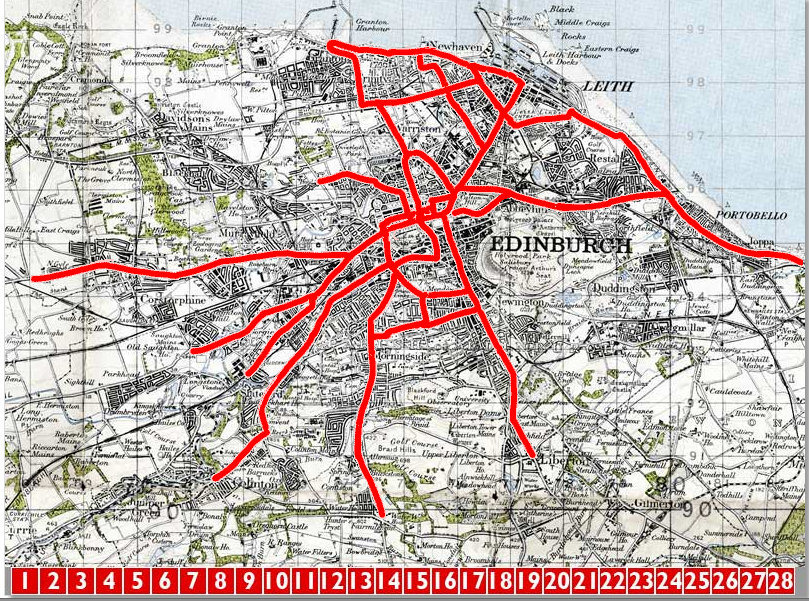
Well, first of all, in their original incarnation during the fifties, they dismantled the once comprehensive tram system that ran from Granton to Braids and Musselburgh to Corstorphine. Leave aside what San Francisco has done to transform its Embarcadero waterfront by running vintage trams along it, if Edinburgh had simply preserved and maintained half the routes it once had at, say, £2m each year, that would still not have cost 10% of what we are spending today to resurrect their ghost.

In the same era, ECT was bullish about what its new Atlantean streamlined double-deckers could do: they were instrumental in persuading British Rail to abandon: Inner/Outer circle services through Newington and Morningside; a Corstorphine branch serving the zoo at Pinkie; Craigleith and Granton service; loop through Easter Road to Leith; all the little stations like Abbeyhill & Piershill on the way to Musselburgh. The wholesale butchering  of local stations left Edinburgh as the biggest city in the UK with no suburban rail service.

But, for ‘efficiency’ the new streamlined Atlantean buses were driver-only; without clippies, they spent inordinate amounts of time loading at each stop as grannies fished for change. Nonetheless, ECT forged ahead with more such buses until the back-platform Routemaster that you could hop on or off at the lights became a thing of the past. Increased traffic in the city brought even more sluggish routes until, in the nineties, the City Council’s transport maestro David Begg (now an academic) got his big paint set out and turned half the city streets into garish bus lanes.

It was just a few years prior that Maggie Thatcher had decreed a market free-for-all in buses and had abolished the regulation that had restricted ECT buses to services within the city and all others to services in and out of the city. For ten years, there was chaos as newly formed bus companies like Stagecoach and First cut each others’ throats for dominance in a given city market. FirstBus and the repackaged Lothian Regional Transport duked it out with flooding certain routes, scheduling their own buses to run a few minutes ahead of the competition. It was a mess. The only advantage the punter saw was a £1 flat fare all across the city where the two competed.

In 2000, LRT became Lothian Buses and, as the whole furore died down, they scooped a number of awards, as related above. But these were essentially for running ever more modern and environmentally friendly buses. The fleet had grown to over 600 vehicles and side businesses like the Airport Link and City Tours had been added. But there were still only 50-ish bus routes and it took at least as long on any of them in 2010 as it had in 1960. Passengers were riding cheaply in clean, comfortable buses. But speed was poor.

Even before the tram works and after a ‘no-change’ policy on fares, convoys of LRT buses would jam Princes Street or Nicholson Street as five tried to get to one stop at one time. The counter-move of creating more stops and spreading bus routes among them helped move things along for natives but still confuses the hell out of visitors. Anyone not knowing the City who arrives at Waverley by train has no chance of finding an onward bus anywhere (let alone the bus station): the stop for the 10/11/16 services to Bruntsfield is 1/2 mile away at the Mound.

And then there’s the profit Lothian makes—quite apart from what gets syphoned off for perfectly legal reasons—over £38m in 2010, despite recession and tram works. And that was after an relentless regime of bus replacements, of paying their MD a £208k salary (which includes a £48,100 bonus) and three other directors pulling in a nifty £145k each with a £49k sweetener on top (see today’s Evening News). They alone account for 1p on every one of the 107,000,000 fares Lothian collects in a year.

In less than ten years, fares have increased by 40% and while red diesel might have increased by that in the same time, other costs, wages and inflation haven’t. Paying the big cheeses a cool £200k each might be justified if this company had broken fresh ground, revolutionised public transport or otherwise transformed Edinburgh into a Mecca for pilgrims to good bus practice. But it isn’t.

Given that Edinburgh has; no rail services; mobile, affluent bus-riders; a booming tourism industry; a decrepit competitor in FirstBus and a parking regime that makes Devil’s Island look like a holiday camp, Lothian ought to be profitable. But what does it do with that profitability? New buses and environmental conscience are both laudable but hardly inspired: real competition would expose their major flaws:

  • their service, while reliable, has not improved in half a century
  • average speed of service along a route one of the worst in the UK
  • a given bus is hard to find if you don’t know both stop and city geography
  • no literature or timetables to be had other than at a stop
  • no single-ticket to use train or other buses on one fare
  • no free transfers from one Lothian route to another
  • day tickets that have risen 75% in the decade
  • almost all routes radial—you can’t easily get to ERI from Muselburgh
  • almost all routes double deckers & empty for most of the way
  • no small ‘nippy’ buses and no ‘feeder’ local routes

They raked in a £38.6m profit in 2010. That means 35p of every fare taken (or 25%) was profit. That didn’t go to pay the high heid yins their £1m—that was already part of the costs. But 91% of profit (about £35.1m) went to Edinburgh City Council. That’s equivalent to each household in the city paying another £140 for that year in council tax. Nice trick! And this is how to ‘encourage’ public transport?

Where is the investment in Oyster-style cards where people slip on and off the bus like they do in London? Where are the clippies on routes to Leith who can help out baffled tourists trying to find Britannia? Where are the short, fast linking services using cheap, small buses through the sprawling suburbs that every European city has?

Lothian has taken a 1960’s model for a city bus service and done no more than spruce it up with new buses. A five-year-old with a stout abacus could make such an unambitious company profitable in such a cosseted environment. But 21st © integrated transport, such as you find in any European city, is a mystery to them—and will remain so as long as a suspicious cosiness between the City and its ‘arms-length bus company remains as thick as it is.

What They Threw Away 60 years ago—Edinburgh’s Tram Map, 1950 (source: see below)

Map copyright © David King and originally used without his permission, for which I apologise. Originally drawn by cartographer J.C. Gillham and published by Edinburgh Corporation. Permission has now been graciously given—see:

http://www.grantonhistory.org/transport/edinburgh_tram_maps.htm

Posted in Transport | 4 Comments