Disease in Common

Those keen on Scotland becoming a normal country often cite other countries as examples for such a situation. Many serve well in this role—including affluent Norway who “separated” peacefully from Sweden just over a century ago and has been a shining example of neighbourly democratic success ever since.

But one equally cited because it is almost the same size and latitude is Denmark. Problem is that few Scots know much about Denmark, with even fewer ever having been there. However, some distance was made up recently by the Beeb screening two hugely popular and excellent Danish TV series: Borgen and The Bridge. Not only did they engage and thrill but they gave us insight into Danish life and a rare chance to hear their language.

Danish belongs to a Scandinavian common family of teutonic languages that are mutually intelligible, similar to the latin-based Iberian group (Spanish, Portuguese and Catalan)—they are distinct languages but with a great deal in common. It’s a bit like Scots and English. Just as the English will gripe about the unintelligibility of a broad Scots accent, so the Swedes have a phrase that claims “Danish is not a language: it’s a throat disease“.

This week’s Economist, amongst its usual eclectic mix, has dug up an amusing video trying to help visitors to Copenhagen even manage to pronounce street names with any hope of locals knowing what they mean. As the author of the article says:

“Two non-Danes living in Copenhagen bang together some electronics to create talking street signs, telling confused foreigners how to pronounce things like Kvæsthusgade and Rådhusstræde. If you don’t know Danish, your best guess will probably not even be close.

“Strøget is the most famous street in Copenhagen—the pedestrian shopping street right through the heart of town. It may also be the hardest to say in the city. It combines:

  • a strongly uvular r—not that hard if you know French or German, but still not easy for non-natives
  • the ø—which is not so different from German ö, but still difficult for those who don’t know it
  • a g that is not pronounced at all, and worst:
  • the definite article -et (“the”), which in Danish always comes at the end of words.

“The combination, “Strøget” as Danes say it in running conversation, is one long, slightly strangled-sounding syllable.”

Scots may laugh at this difficulty. But before we do, think whether we appreciate the confusion we cause to our English visitors—let alone foreign ones—when we talk about “Mulgai” “The Broch” “Hoik” or my own local home of the saltire, “Ailshenfur”. And this is without even starting on any of our islands.

So, the problem seems to be that we and the Danes have similar troubles communicating even with our nearest neighbours. Is it a wonder that, example or no, we have so little contact between each other?

Posted in Education | Tagged | Leave a comment

Don’t Get MoD, Get Even

Fibre-optic broadband is humming with the opening salvos of debate on the announcement from the SNP’s highheidyins that they have placed Scotland’s defence strategy—including NATO membership—as a keynote topic for discussion at the party’s upcoming Autumn Conference.

Defence Spokesperson Angus Robertson MP has set the tone. It is a posture that I, for one, have long argued as a way to win friends both in- and out-side the country and to secure an independent Scotland’s rightful and responsible place among its neighbours—but without the obscenity of nuclear weapons.

However, there is a long a honourable tradition among veteran SNP members (especially core activists) to distance themselves from all things nuclear, including any nuclear equipped alliance, which includes NATO. Their perspective is perhaps better expressed over at Burdzeyeview, a source I respect so much I was considering simply reblogging it.

It’s shaping up to be a real debate—like other democratic parties used to have. I hope others are relishing the prospect as I am.

Posted in Politics | Tagged | 1 Comment

Go Get ‘Em, Gramps

The following letter was sent by an 86-year-old to their bank manager, who, displaying far more chutpah and humanity than most modern bank managers display, had it published in the New York Times:

“Dear Sir:

I am writing to thank you for bouncing my check with which I endeavored to pay my plumber last month. By my calculations, three nanoseconds must have elapsed between his presenting the check and the arrival in my account of the funds needed to honor it.

I refer, of course, to the automatic monthly deposit of my entire pension, an arrangement which, I admit, has been in place for only eight years. You are to be commended for seizing that brief window of opportunity, and also for debiting my account $30 by way of penalty for the inconvenience caused. My thankfulness springs from the manner in which this incident has caused me to rethink my errant financial ways.

I noticed that whereas I personally answer your telephone calls and letters, when I try to contact you, I am confronted by the impersonal, overcharging, pre-recorded, faceless entity which your bank has become. From now on, I, like you, choose only to deal with a flesh-and-blood person.

My mortgage and loan repayments will therefore and hereafter no longer be automatic, but will arrive at your bank, by check, addressed personally and confidentially to an employee at your bank whom you must nominate.

Be aware that it is an offense under the Postal Act for any other person to open such an envelope. Please find attached an Application Contact which I require your chosen employee to complete. I am sorry it runs to eight pages, but in order that I know as much about him or her as your bank knows about me, there is no alternative.

Please note that all copies of his or her medical history must be
countersigned by a Notary Public, and the mandatory details of his/her financial situation (income, debts, assets and liabilities) must be accompanied by documented proof.

In due course, at MY convenience, I will issue your employee with a PIN number which he/she must quote in dealings with me. I regret that it cannot be shorter than 28 digits but, again, I have modeled it on the number of button presses required of me to access my account balance on your phone bank service. As they say, imitation is the sincerest form of flattery.

Let me level the playing field even further. When you call me, press buttons as follows.

IMMEDIATELY AFTER DIALING, PRESS THE STAR (*) BUTTON FOR ENGLISH

  • #1. To make an appointment to see me
  • #2. To query a missing payment.
  • #3. To transfer the call to my living room in case I am there.
  • # 4. To transfer the call to my bedroom in c ase I am sleeping.
  • # 5. To transfer the call to my toilet in case I am attending to nature.
  • # 6. To transfer the call to my mobile phone if I am not at home
  • #7. To leave a message on my computer, a password to access my computer is required. Password will be communicated to
  • you at a later date to that Authorized Contact mentioned earlier.
  • # 8. To return to the main menu and to listen to options 1 through 7.
  • # 9. To make a general complaint or inquiry. The contact will then be put on hold, pending the attention of my automated answering service.
  • # 10 . This is a second reminder to press* for English. While this may, on occasion, involve a lengthy wait, uplifting music will play for the duration of the call.

Regrettably, but again following your example, I must also levy an establishment fee to cover the setting up of this new arrangement.

May I wish you a happy, if ever so slightly less prosperous, New Year?

Your Humble Client”

Posted in Commerce | Tagged | Leave a comment

Dishonesty as a Cash Cow

For more than the last decade, a selection of informed voices have warned about PFI/PPP. But they have done so from the wilderness because every stripe of government bar the SNP at Scottish or UK level has regarded ‘Public/Private Partnerships’—whether rebranded as  ‘Private Finance Initiatives’ or not—much the same way as gluttons regard their lunch.

None of the 85 PFI projects in Scotland have been pretty sights. None have gleaned awards or even positive comment, other than in local council or NHS patsy sheets and internal bumfodder. Because almost all were done behind closed doors due to ‘commercial confidentiality’; because punters did not have their pockets felt directly, because your average politician falls over themselves to get another swimming pool or health centre for their patch—whether needed or not—the juggernaut, once started, was effectively unstoppable. It was credit-card-junkydom, shopaholism on a national scale.

It’s hard to blame the huge shoal of businesses that swam towards the smell of major money to capitalise on the many PPP opportunities created by the Thatcher and then Major governments—or even the pod of business sharks who swam in with them. And, fair’s fair, the Tories have always had a penchant for privatisation by hook or by crook whether or not—like the railways—it winds up being an expensive pig’s breakfast for which the public are still over-paying a quarter century later.

And you can almost forgive politicians (whether at the Treasury or the Town Hall) for pushing this wheeze. The former got to provide capital ‘off the books’ so that Irn Broon could claim the UK met debt criteria; the latter got to announce shiny new pork-barrel babies, knowing that poor shmoes running that council decades later would pay for it. Who cared that, in the long run, it cost £3 or £5 or £8 for every £1 of investment. None of the beneficiaries would need to pay for it. Sweet.

For Old Guard Labour, the fact that their party embraced it with such enthusiasm came as a bit of a shock. But Labour members are nothing if not loyal. If rebranding PPP into PFI and peddling the same snake oil to the masses under a different label was going to keep them in power in both Westminster and Holyrood, well…Sweet again. This was, after all Blair’s Third Way; some shibboleths were going to get hurt.

Because the Lib-Dems were complicit under Dewar/McLeish/McConnell in pushing a total of some £5.7bn in PFI in Scotland and, since 2010, have been similarly complicit in Westminster, we have the unedifying prospect of 95+% of our MPs being held shtum about the worst financial deal ever foisted on the public for political expediency.

Wasting public money is usually a headline-grabber, with the MoD leading the field in this particular parade of shame (remember the £4bn write-off of Nimrod replacement aircraft?). But PFI takes the biscuit in both scale and in silence. When’s the last time you saw it mentioned on TV/in the press/by anyone?

Yet, every man, woman & child in Scotland will wind up paying £4,400 each. For nothing.

Let’s discuss the scale of this in Scotland alone. There are 85 live or completed PFI projects across the country. The sum of their capital investment in public infrastructure is £5,692.8 million. By the time all projects are complete, the public purse will have paid £30,755.5 million in so-called ‘unitary charges’ to the private consortia who run the various PFIs. In some cases, the public won’t even own the buildings they paid for.

Now, every investment comes at a cost. The normal public process would be for councils or NHS Trusts to go to the Public Works Loans Board (PWLB) to borrow the money and be charged interest on it. Current rates for a 20-year load are around 2.75%. If all projects had been financed this way, the total interest would be around £2,372 million. Call me innumerate but that looks like more than a £22,000 million over-charge—or a sucker rate of 400%. Not so sweet: even pay day loan companies are a better deal.

And the real horror is that we’re stuck with this bum deal. Several attempts have been made to ‘buy out’ the PFI by offering a lump sum payoff, financed through the PWLB. None have gone any further the falling-down laughing-before-dragging-another-sack-of-dosh-to-the-bank phase. Why would they?

But who’s being dishonest here? It’s not the consortia who are running the PFIs, however greedily and/or ineptly. It wasn’t their fault that McConnell’s executive pitted naive bureaucrats against their slick negotiators, who reamed the public big-style. You make the best deal you can: it’s business—always has been run like that. And it’s not the fault of officials losing an ever-larger slice of their budget, armour-plated against any savings in the unitary charge, who were given much choice in the first place. They got telt.

But those Labour, Tory and Lib-Dem politicians who seized this blinkered opportunity for short-term advantage and—like Brown, Major, McConnell, Kerr, Howe and Lawson—mostly buggered off before the ricketiness of this fiscal house of cards became apparent are the real cuplrits. Some are even directors in companies now raking it in. None are apologetic for mis-selling this fiscal lemon.

But even among those few whose conscience is now uneasy, nobody who’s anyone wants to talk about it at a UK level and, as a result, UK media are largely silent. It is similar to the media approach to disasters: a plane crash in which 100 people die is front-page news for days; the fact that just as many die on Britain’s roads every fortnight gets no coverage. Bias by a thousand omissions.

Only the SNP Scottish Government speaks out and used what limited fiscal wiggle room it had to form the Scottish Futures Trust to provide more sensible financing. Yet even this is caught up in the general unionist tirade of misery about independence and dismissed as posturing. Stewart Hosie MP poses insightful questions in the Treasury Select Committee but he’d be as well going up Soho for a good time for all the coverage.

There are another thirty years to go before the last PFI signed (Dumfries & Galloway Council’s £109m schools project) will be paid off in 2041. Everyone hopes this recession won’t last until then. But it’s lasted four years so far, with no sign of reprieve. How long can councils/NHS Trusts/SEPA/etc afford to keep giving fat lump sums to overpay for public projects as Westminster, the source of this wheeze-gone-wrong keeps paring their income and the equally-squeezed punter simply can’t be charged more to make up the shortfall?

Posted in Commerce, Politics | Tagged | 1 Comment

Worthwhile Yet Untaxing Read

James Aitken’s measured thoughts in his Legal Knowledge Scotland blog are always worth a read but Friday’s is particular value in information provided vs time spent to absorb it. Regular readers of this blog will have noted my trouble getting what I need to say out in less than 1,000 words; James, on the other hand, is a model of succinctness.

Posted in Uncategorized | Tagged | Leave a comment

South Suburban Salvation

Edinburgh’s train services suck. As a result, its public transport sucks.

Even if the trams are completed—including the abandoned original loop to Leith, Granton and Craigleith—it will still have a third-world transport system. In the absence of any underground at all, the ‘fast’ rail services that normally provide the backbone of any transport net are practically non-existent. Waverley may handle 20m passengers a year but only 5% of them are within Edinburgh. The only ‘suburban’ stations it has are South Gyle (0.5m) and Edinburgh Park (o.4m). After those two you’re in the dross, with Slateford seeing a risible 21,000 people (to AND from) per year.

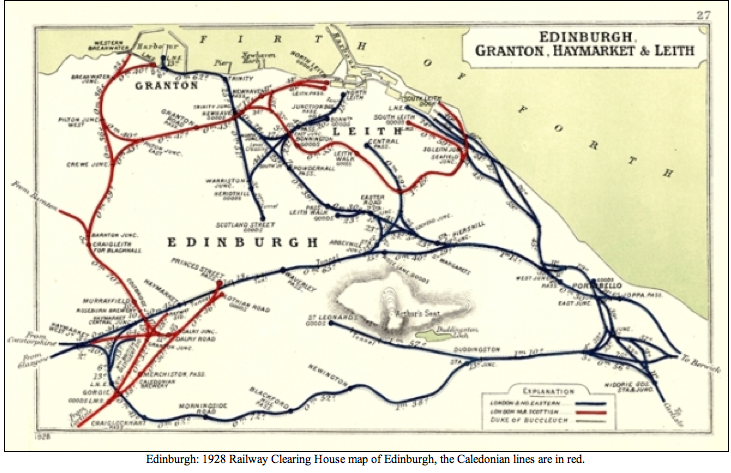
Given the pigs’ breakfast of unco-ordinated 19th century rail developments that gifted the city with hopelessly inefficient rail spaghetti, it’s perhaps not surprising rail did not do well here against 20th century competition. A 1928 map says it all at a glance

So the bulk of intra-Edinburgh trips are carried on Lothian Buses—109m last year. They are a well run bus company but their speeds are glacial. Edinburgh City used to run them and in the 1960’s encouraged British Rail to close its suburban stations because ECT buses were faster and better. At the time, it took 12 minutes by train from Morningside or Corstorphine into Waverley. The numbers 16 and 26 buses now take 24 minutes for the same journeys. As the Americans say: go figure.

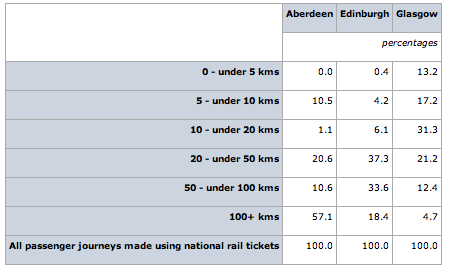
But what is more concerning is the number of unnecessary road journeys being made around Edinburgh because there’s no easy way to get to Waverley with luggage without dropping serious dosh on parking. The result is an interesting transport statistic on the three main city-centre stations in Scotland, shown in Table 1.

Table 1—Passenger Distance Travelled to Scottish Main Train Stations

Note how few Edinburgh people bother with rail—most (a huge 89.3%) of Waverley’s passengers) originate well outside the city. Glasgow, with its comprehensive and fast electric rail network gets 61.7% of its main line travel from within the city; Edinburgh achieves one sixth of that, despite a whopping £48m invested in Waverley over the last decade.

Given that £500m-and-counting and we still have no tram working, public transport is a touchy topic in the capital. But why are we blinded to all else, leaving the sluggish Lothian bus as the only game in town? Is there no ‘low-hanging fruit’ that could address the problem without breaking the bank and digging up more streets? Well, yes. And, co-incidentally, it would provide fast public transport to the very area of the city that trams will ignore, even when they do run.

Allow me to introduce Edinburgh’s South Suburban Railway (ESSR). It already exists. Many residents will know it and some older ones may even have ridden on it before Mr Beeching’s blade came down exactly 50 years ago. Built in 1880 it is still in use, carrying some 60 freight trains a day so that they don’t need to pass through Waverley and the congested tunnels through to Haymarket.

Transform Scotland has been campaigning to re-open the line for years and a consultant report provided several options for restoring what used to be a circular service by making this part of a “Crossrail 2” scheme, up to electrifying the line to fit in with the EGIP service plan already on the stocks. The key thing is that NONE of the options requires the kind of silly amounts of public money that have been thrown at railways for marginal improvement.

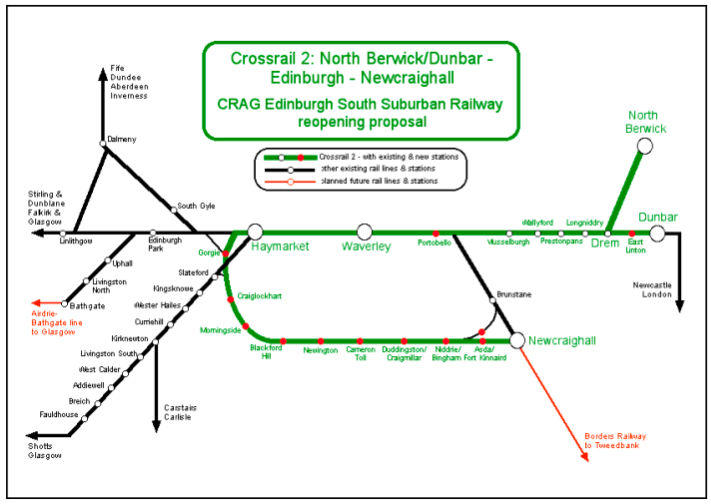
In terms of the ‘best bang’ for our buck, the Crossrail 2 is the most useful. The options were considered by the City of Edinburgh Council in 2004, and the council indicated a preference for a North Berwick-Niddrie service (Crossrail 2 option). Not only does it link up seven former and three new stations in the South of Edinburgh but it could integrate with the existing East Lothian services and complement Crossrail 1 by sharing a common terminus at Newcraighall, ready for this to be extended as Borders Rail. The proposal is shown below.

Figure 2—Edinburgh South Suburban Railway (ESSR) As a Crossrail 2 Project

New stations would serve shopping destinations at Cameron Toll and Fort Kinnaird. Morningside would be under ten minutes from Waverley by train, instead of 25 minutes by bus and, more importantly, a slew of professionals living along the line would find it a very easy way to Waverley and on to a long distance train, drastically cutting car travel.

Campaigners submitted an online petition to the Scottish Parliament, who noted that the re-opening would not require parliamentary consent as the line itself is still operational, and minimal infrastructural work was required (other than stations) so re-opening costs would be unusually low.

The new Airdrie line (3 stations) cost £300m; the one to Alloa (one station) cost £57m; the Borders Railway (6 stations) is to cost £235m. Hell, even a facelift for Waverley has cost us all £48m. Reopening the ESSR line with ten stations is estimated at a paltry £15m, with electrification at £18m. Forget the trams—compared to any other railway project in Scotland, this is a deal like no other.

Running half-hourly trains from Newcraighall (timed with existing half-hourly trains leaving there via Brunstane) gives a 15-minute service to Waverley. Half of them would follow the ESSR via Newington, Morningside and Gorgie to pass through Haymarket and Waverley roughly 30 minutes later and then provide an improved half-hourly service to Drem, where alternate services to North Berwick and Dunbar each hour would complete the service: Duddingston to Dunbar direct in under an hour; Newington to North Berwick the same; or vice versa.

It is calculated that 7,725 passengers per day would use the ESSR stations—or around 2.8m passengers a year. That compares with ridership on the popular North Berwick line already or 15% of Waverley’s total. And not all of those would be a loss to Lothian buses. Many would be new customers, attracted by the line’s speed and convenience and adding to the users of Lothian buses on the Southside to reach reopened stations. With a Benefit-Cost Ratio of 1.42, it would be a profitable asset and addition to ScotRail’s allure as a mode of transport around Edinburgh the way it already is in Glasgow.

We are already part-way there. In February 2007, the private consortium E-Rail announced that £8.5m had been pledged by land owners along the route, in recognition of the forecast that properties and land close to the stations on the line are expected to increase in value by around 10% if the line re-opens. It is understood the finance would come from The University of Edinburgh, and the Cameron Toll and Fort Kinnaird shopping centres.

So, what are we waiting for?

Posted in Transport | Tagged | 4 Comments

It’s Democracy, Stupid

It’s a curious world we live in. Yesterday, unionists presented a panel of “election experts” to frame a single referendum question for consideration by the Electoral Commission. The launch of the panel came as Scotland Office Minister David “Nae Scottish Mates” Mundell said backing a second question would be an “upfront admission of defeat” for Mr Salmond.

Let’s leave aside that two of the three unionist parties’ policies (Labour & Lib-Dem) support strengthening devolution—and they’ve previously held these views for an honourable length of time. Obviously, the “Better Together” movement must be Tory-dominated. In their unionist extremism, they have opposed any power being devolved anywhere at any point in history; they at least get credit for consistency. Yet their panel of three to formulate is distinguished and qualified, even if some do have unionist ‘form’.

But whatever conclusion on formulation they come to, why have opposition parties swung lemming-like behind the single-question position? Could it be a tactical ploy, a confusing red herring? A choreographed wailing-and-gnashing-of-teeth portrayal of an independent Scotland frames a stark choice between the familiar warmth of Ma Britannia’s hearth and the unknown maelstrom of financial turmoil outside. Their formulation of a question may not be as blunt—but look for it in the subtext.

It is unusual for all three opposition parties to be obtuse at once, even for political short-term advantage. It’s not difficult to determine what sort of referendum the Scottish people prefer; it’s an almost eerie three-way split among three clear choices. This was underscored again this week by a TNS BMRB poll conducted for The Herald that posed both a two- and a three-option referendum and compared results.

In the two-option version, they were asked one question—basically a ‘yes’ or ‘no’ to independence. Their formulation was, with results shown in Table 1 below:

  • I AGREE that the Scottish Government should negotiate a settlement with the Government of the United Kingdom so that Scotland becomes an independent state.
  • I DO NOT AGREE that the Scottish Government should negotiate a settlement with the Government of the United Kingdom so that Scotland becomes an independent state

Table 1—Two-Option Referendum Results. Source: TNS BMRB

Though the demographic variants are interesting, all groups roughly corresponded to the overall conclusion of 5 people disagreeing for every 3 people agreeing. Even died-in-the-wool independistas would have to admit this portends no rousing victory for their cause. But, note that the ‘undecideds’ sit around 20%—one in five don’t like either option.

However, TNS BMRB went on to survey the results if three options were available (adding what is generally referred to as “Devo-Plus”/”Devo-Max” to the two above), as outlined below, with results in Table 2:

  • Keep the current arrangement of a Scottish Parliament with its existing powers.
  • Transfer more powers from Westminster to the Scottish Parliament, including tax and welfare but excluding defence and foreign affairs
  • Full independence for Scotland

Table 2—Three-Option Referendum Results. Source: TNS BMRB

In this case, the number of ‘don’t knows’ halved, with nine in ten ready to choose an option. The largest proportion of respondents (37%) chose the one option unavailable in the single-question/yes-no/two option survey in Table 1 (more powers without full independence). The proportion supporting the status quo dropped by 3 in 5 to 20%, while those for full independence maintained second place at 27%—barely down from Table 1. Again the demographic variances are interesting but not decisive.

Unionists can bleat all they like about ‘straight choices’ and play their brinkmanship game. But when given several options, eight in ten of the Scottish people are dissatisfied with what they have, with four of them wanting all but external affairs transferred and a solid three of them resolute for full independence. That latter number will grow, the more those four-in-ten voters ‘in the middle’ feel democratically ignored and dissatisfied.

It is entirely up to the unionist ‘no’ campaign to pursue their arguments any way they see fit. But choosing to dismiss 37% of the voters when that option has been publicly part of their long-held policies and beliefs strikes me as carrying tactical political ‘advantage’ to the point of self-immolation. It seems unprincipled, undemocratic and, frankly, stupid.

Roll on 2014.

Posted in Politics | Tagged | 2 Comments

Like Wolves at Lambing

With the blog a week ago titled The Whole Wunch of ‘Em, I hoped to have cleared the air about the scale of malaise gripping the country’s morals and proposed some ideas from others how things could be actively improved. But, having picked up what various other commentators are saying, it seems this is more than a hiccup of our financial systems; it is a crisis of faith among the general public as to what society is for in the first place.

The right-leaning-but-thoughtfully-articulate Economist has a piece on the LIBOR scandal in which alarm bells are ringing: “What may still seem to many to be a parochial affair involving Barclays, a 300-year-old British bank, rigging an obscure number, is beginning to assume global significance.Joyce MacMillan—who seldom agrees with anything the Economist has to say—blames “a global elite who seem to have convinced themselves, long since, that whatever rules are in force simply do not apply to them.”

In fact, Joyce is on a crusade of ideals, shared by many, that UK society has fallen in thrall of what she describes as “Junk Thatcherism”—that everything and everyone has a price, and that all human interactions can finally be reduced to the model of some kind of market transaction, or “investment”.

An alternative perspective came in the Reith Lecture at the Royal Society of Edinburgh, Professor Niall Ferguson points the finger at “welfare as the culprit, corroding our moral fibre, and bankrupting our institutions.” Yet even American stalwart supporters of their beefy brand of capitalism like the Washington Post are crying foul and accusing major banks of cowardly, if not criminal, behaviour: “It takes little effort or intelligence to make a profit when you’re setting a rate and betting on that rate at the same time.

Whatever your perspective, the whole thing is appalling. But what makes it worse is the crass inequality with which the financial crisis is striking people. Channel 4’s Dispatches will have Jon Snow leading one of their typically mordant reports on July 23rd on the effects of mis-selling on ordinary people that puts a human face on this tragedy. Without revisiting what I blogged about a week ago, it seems this whole thing goes deeper than any other event since the miners’ strike.

No matter who does or doesn’t get prosecuted over LIBOR, people’s faith in bankers—once up there with doctors and ministers—has fallen into the mud. After the amateurish Commons interview of Barclay’s Bob Diamond and the yah-boo-sucks tone of the spat between Balls and Osborne coming on top of exposure of grubby attitudes to expenses at Westminster, the politicians at the helm are seen as little better.

Fundamental questions are being asked, rightly, about what drives the UK. But they are not being asked by leaders in politics, banking or most other business endeavours, where it appears to be business as usual. The sixties and seventies were a car crash for British socialism that cleared the way for Thatcher’s capitalism. Whatever your misgivings about it, that brought growing prosperity to most for the next three decades.

But, like the USA (and unlike most of Europe) Britain never set much by way of limits to problems for which capitalism might be the solution. Most of our problems stem from those limits of capitalism. The railways are cod capitalism that remain state dependent and not efficient. The same applies to most of transport system, those bits of the NHS hived off—and the banks. This last is not because Lloyds and RBS are now state owned but because they were in the “too big to fail” box and not really subject to the market.

People often portray markets as being all about self-interest. But self-interest is as essential part of the human character and it has been argued that markets harness and control self-interest to the benefit of all. So long as customers can shop around, businesses must continually reduce prices and improve quality. It is this dual tension, where self-interest is held in check by the free choices of others, that drove our prosperity.

What torpedoes this virtuous cycle is monopoly control, which is why the state-owned model works poorly. And this is our tragedy, as played out by our banks. They were deregulated and so swallowed up competition until they achieved artificial competition like our rail companies. Nobody said much when the government took over GNER and kept the trains running as East Coast. But what kind of ‘market’ is that?

A market where you don’t need literal corruption for it to infect the banking system. You just need banks big enough so that the jobsworths keeping an eye on them have nightmares about what happens if banks fail. At that point the jobsworths will dedicate themselves to keeping the megabanks afloat at all costs, even it requires methods that aren’t on the up and up.

It’s a heady mixture: untrammeled cowboy operations by so-called ‘investment’ arms of banks, sustained by high street monopolies that drain bank fees, savings and what should be business investment money and cascade it all into the hands of people who get huge bonuses to take risks on derivatives with other people’s money, all underwritten by the state. No wonder they got in trouble; the wonder is it took so long.

But how to unmake the omelette and all these broken eggs? With government and senior bankers behaving as if business as usual were an option, this ludicrously broken system is being preserved. And the once-solid trust of the punter to work hard, pay taxes and retirement rewards will surely come is paper-thin. Tom Meirs offers positive suggestions in today’s Hootsmon but it would take years (and independence?) for them to take effect.

Meantime, why should anyone believe “we’re in this together” when Diamond walks away laughing from his Commons “grilling” en route to plopping a cool £17m severance into his piggy bank? …when the Government front bench is stuffed with millionaires who largely made all that dosh from the system described above? …when the opposition bench were not only tholed but embraced Tory policies (PFI; bus deregulation; arms sales; MoD outsourcing; foreign wars; Trident, etc, etc) throughout their 13-year tenure.

The line from the film Rob Roy about the elite running his country seems apposite: “They are like wolves at lambing” he growled. Once people get angry en masse about not just the recession and how badly it has hit them but that the ones who did it to them are still prospering, still running the show, how long will British sang froid and patience hold? The carnage of riots last summer was visited on a swathe of towns by a few thousand disenfranchised youths.

What happens when Middle England joins in?

Posted in Commerce | Tagged | 2 Comments

Butcher’s Choice

Many column inches have been expended in pursuit of ‘nasty nats’—those Scots impatient to live in a normal, independent Scotland but whose impatience provokes them into rash statements and personal attacks on those who stand in their way. I have found few of the nasty kind. Most are quiet, dedicated and, if passionate or articulate, neither hostile in expression nor personal in attack.

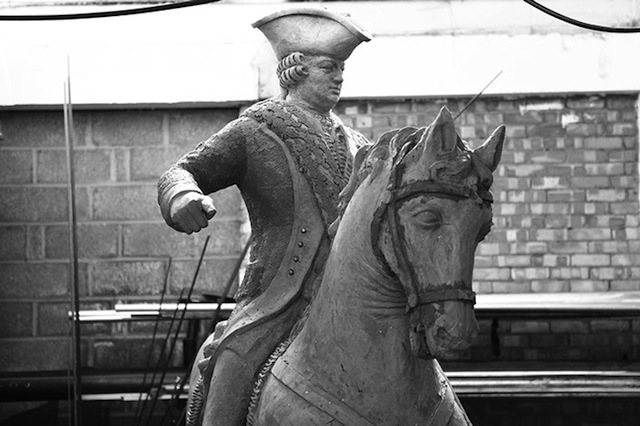
Most of us are also on record as fans of the English, admirers of their culture and champions of what our two countries achieved together. But, sometimes, a blithe England-as-centre-of-the-universe insouciance exasperates even its fans to the point of anger. This happened again just this morning when I sprayed coffee all across an article in SoS that a statue of the Duke of Cumberland was again to be placed on the empty plinth in Cavendish Square in London.

Westminster Council (second only to the CofE as “The Tory Party at Prayer”) has commissioned Korean artist Meekyoung Shin to sculpt another life-size likeness of William, the Marquess of Berkhamstead in the County of Hertford, Earl of Kennington in the County of Surrey, Viscount of Trematon in the County of Cornwall, and Baron of the Isle of Alderney—better known as the Duke of Cumberland, second surviving son of George II—to replace one removed in 1868 in deference to Scottish sensibilities.

Replacing it now may not be a unionist ploy to piss off the Scots—but it’s hard to imagine a more tasteless one that would tread on our sensibilities in any more clodhopping fashion.

Displaying physical courage at an early age, William became his parents’ favourite and rose quickly in the Army to command the Foot Guards and then England’s eternal tussle with the French. He was victorious, if wounded, at Dettingen (1743) but fluffed his chance at Fontenoy (1745). By this time, Charlie’s wild Highlanders were on the march towards Derby and, in the ensuing panic, he was recalled from Flanders as a popular general who would deal with this worst of these recurring Jacobite rebellions.

Credited with pulling together and training a badly rattled British army to face the apparently unstoppable energy of a Highlander charge, William chose his ground well at Culloden Moor. His men scythed down the clans where they stood with grapeshot from artillery, flanked them with musket fire as they charged in frustration and defended with a new, simple close quarter tactic—bayoneting the enemy to their right beneath his targe.

Thus far, history shows him a capable, if unremarkable, general who got done the key job of clearing the threat of invasion from the rear. But, such was the fear the Highlanders had induced that he went much further, ordering his men to advance after the wild charge had been broken to bayonet enemy wounded found on the field. For his 52 casualties, he left 1,200 Jacobite dead on and beyond the moor, taking only 550 prisoners (mostly French, the only ones he recognised as legitimate combatants).

With the tacit support of the King, government and much of Lowland Scotland (Glasgow even awarded him an honorary degree), he then set about systematically dismantling the gaelic-speaking Highlanders’ way of life. Although ‘government’ clans like the Campbells were spared, Jacobite clans (almost all Catholics) had suspected rebels murdered complicit settlements burned and rapacious soldiers billeted on them. But, most ruinous of all, the herds of cattle by which clans measured their wealth were driven off and auctioned to part-pay for the campaign (and end up in some officers’ purses).

It was systematic destruction of a way of life, a genocide before that word had been coined. Quite apart from the hundreds killed or died of starvation, proud clan chiefs were ruined along with their clansmen. And many, defying Highland custom of holding land in trust for the whole clan, became English-style landlords, turning clan lands into businesses, replacing subsistence farming with sheep, thereby throwing thousands into homelessness and starting the Clearances. Though only there a year, Cumberland’s harsh influence still echoes through empty glens or lies mute under rickles of stones that were once homes.

Ironically, to survive many clansmen joined the very army destroying their heritage. The famous Highland regiments were formed from them. Each earned praise from officers up to Wellington for resolute toughness, courage in adversity and a fearsome effect upon Britain’s enemies around the globe. It was only when the Clearances had long done their baneful work that the British Army found any regret—that it could no longer raise fierce Highland battalions for the Crimean War as it had done for the Napoleonic.

Cumberland returned to Flanders where his undistinguished generalship lost the Battle of Lauffeld and ended the war for a while. The relieved British establishment had meanwhile lauded him as ‘Sweet William’ after the common ragwort dianthus barbatus. But his epithet among Scots is they call this plant ‘Stinking Billy’.

As his post-Culloden predations became better known, his political ambitions were frustrated. Even a return to military action in the Seven Years War did him little good. While Britain was generally victorious, Cumberland lost Hanover to the French. On his return, George II’s dry comment was: “Here is my son who has ruined me and disgraced himself”. He failed even to secure the regency over his nephew, George III, when his elder brother died.

Cumberland spent his last days advising his nephew. It is not known if he was complicit in forming George III’s intransigence that lost Britain its American colonies. He died in 1765 and an equestrian statue in lead was cast in 1770 for a plinth, originally intended for a statue of Queen Anne. That it stayed almost 100 years before being removed speaks volumes for English chauvinism and insensitivity. That another is being erected does little to dispel the feeling that either has moderated in the meantime.

The only good news is that it is being sculpted in aromatic soap so that Stinking Billy can slip away from us, albeit more slowly this second time.

Hanoverian Hygiene—Soap on a Dope

Posted in Community | Tagged | Leave a comment

Time to Play Chemin de Fer

Today the Torygraph reports that MPs have announced that over-optimistic forecasts for passenger demand have left taxpayers “saddled with £4.8 billion of debt” over the 68-mile HS1 London-Folkestone Channel Tunnel rail link.

Total taxpayer support over the period to 2070 is likely to be £10.2 billion. Apparently, international passenger numbers on HS1 are only a third of the original 1995 forecast and two-thirds of the ‘corrected’ Department for Transport forecast in 1998.

Oh aye, bluidy typical!” comes the standard Scots gripe. “Thae English tak’ wur siller tae pay fur mair whigmaleeries doon in Lunnon”. The original plan for Regional Eurostar services to destinations north of London was abandoned after connecting services from places like Edinburgh saw little traffic.

But the problem with those services is that they took much longer then bog-standard GNER trains at the time. Now significantly improved journey times are available with HS1. It is physically linked into both the East and West Coast Main Lines (ECML & WCML) through Stratford International and the North London Line to Willesden, Watford and points north.

Recently increased maximum speeds on the WCML should make Regional Eurostar services to/from the Midlands and Scotland commercially viable. However, Simon Montague, Eurostar’s Director of Communications has said” “International services to the regions are only likely once High Speed 2 is built.”

By Eurostar’s own estimates, following the December 2009 opening of the Benelux HSL Zuid, a London–Amsterdam journey is estimated to take 4¼ hrs. In 2010, international rail travel was liberalised by new European Union directives, designed to break up monopolies in order to encourage competition for services between countries.

Germany’s Deutsche Bahn, now intends to run services between London and Germany and the Netherlands. The sale of HS1 by the UK Government (having effectively nationalised the original ‘London & Continental Railway’ in June 2009) is also likely to stimulate competition on the line.

But all these new ideas refer to London-to-Continent traffic. The ‘regions’ remain ignored—partly due to English xenophobia about foreigners (all Chunnel trains run as if they ran only on UK soil) but mostly due to London-centric thinking that is the bane of the rest of us. In a 21st century of international trade, Schengen agreements and foreign travel by everyone and their granny, isn’t it time that the massive public investment of £21bn that is the Chunnel and HS1 were utilised by the 80% of the UK that isn’t London to recoup their £16bn subsidy of the capital?

The Labour government of 2010 didn’t think much of the potential for a link from the Midlands to HS1, let alone from further North. They claimed:

“Running direct services to Paris or Brussels would bring Birmingham within three hours and attract a significant market share, but the market would not be big enough to fill a 400 metre train a day in 2033.” (HS1/HS2 Connection by C. Stokes)

Oh, really? There is no real need to wait for any HS2 for this ‘other 80%’ to start exploiting fast rail to Europe. Booming Continental air traffic from everywhere North of London is a clear sign of the demand. An overview is shown in Chart 1.
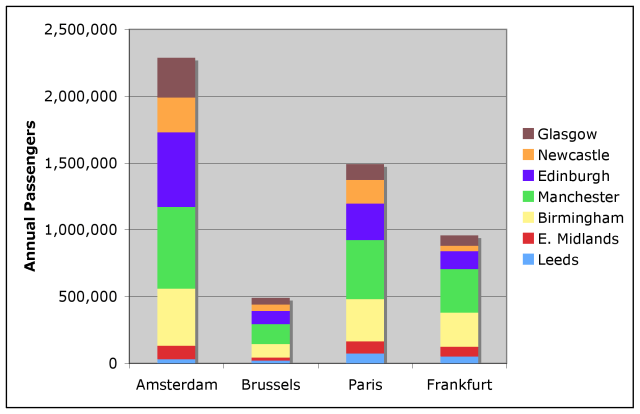
Annual Air Passengers North Britain to Near Continent

Some 5 1/4 m people fly between the areas in question. Even assuming only 50% of those as the potential market, 20 trains a day, each carrying 360 passengers could not transport them all. This represents a considerable untapped market that neither Eurostar or the UK Government seem keen to exploit, quite apart from the ‘green’ element of not piling even more people into fuel-inefficient short-haul jets.

Both HS1 and the Chunnel are underused. To date, only the Eurostar’s monopoly makes use of its 100 mph (160 kph) capability and even they stop running between 10pm and 6am. That’s 33% of capacity underused. Rather than just running more trains, there are three distinct businesses untapped, each of which appears viable in the circumstances:

  1. Evening services between the Midlands and the Near Continent (targeted at businessmen who want to return home in comfort that same day)
  2. Sleepers between the Midlands and the Central Continent  (targeted at those who wish to save travel time in comfort getting to/from Berlin/Munich/Geneva)
  3. Sleepers between Scotland/The North and the Near Continent (targeted at those who wish to save travel time in comfort getting to/from Amsterdam/Paris/Frankfurt)

If such services ran at Eurostar/ICE/InterCity225 speeds, all of the above could be encompassed through using the currently unused 33% capacity of HS1/Chunnel. Draft timetables are shown below.
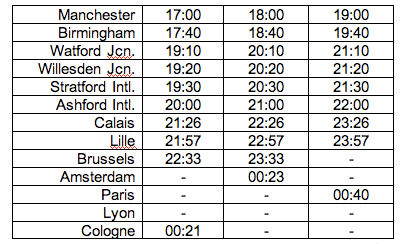
Table 1—Draft Chunnel Timetable for Midland/Near Continent Evening Services
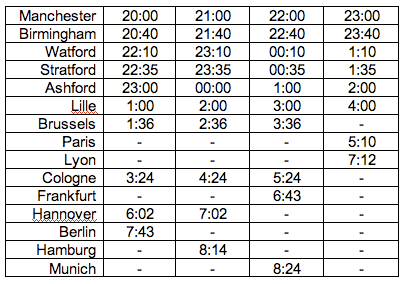
Table 2—Draft Chunnel Timetable for Midland/Central Continent Sleeper Services
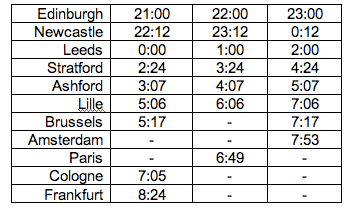
Table 3—Draft Chunnel Timetable for Scotland & North/Near Continent Sleeper Services

Now that Network Rail has adjusted much of the British network to accommodate European dimension trains, the main problem would be differences in power standards for overhead lines in some countries. The concept of a fast service that could shift over 2m passengers onto rail each year is surely a driving incentive for future travel.

As to the business side, that seems conclusive. Compare the air fares available between the destinations cited above and, despite low-cost airlines flying to some, examples of the cheapest return fare bookable at 10 days’ notice (below) show very adequate margins:
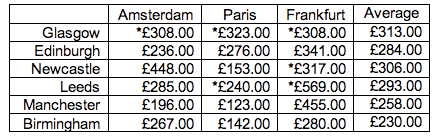
Table 4—Current Cheapest Air Fares to Near Continent (*no direct flights)
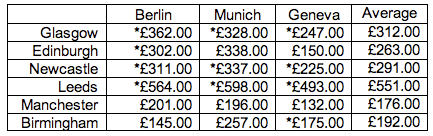
Table 5—Current Cheapest Air Fares to Central Continent (*no direct flights)

In a third of the cases, no direct flights are available, which puts fast rail at a speed advantage too. For the rest, standard return fares of around £200 from the Midlands and £250 from Scotland/North would make them competitive with the air alternative, while the option for luxurious facilities that would justify a true 1st Class service at less than the £750 typically charged by major air carriers.

Assuming an eight carriage sleeper train (two of which are 1st class) gives a potential revenue of some £40,000 in revenue per train. Extrapolating a year’s revenue for the ten trains described above at average 50% loading gives a rough turnover of £45m each year, even allowing one night per week (Saturday) with no trains for track maintenance.

Given Eurostar’s revenues of around £675m, an enhancement of 7% in payments for use of HS1/Chunnel would change its finances and point the way for a far easier integration of UK business outside of London with its Continental partners. And all that would be based on switching only 25% of those using airlines to travel from the Midlands/Scotland.

Once a UK government realises the short-sightedness of zero VAT and duty on aviation fuel, the gamble on air traffic as sole mainstay of UK Continental interactions outside of London will become even more obvious. Once ‘regional’ service is proved with the above, the folly of assuming everyone changes in London will be exposed and interchange points like Willesden and Stratford (as connected as St Pancras but much less crowded) will become popular with Londoners too.

Posted in Commerce, Transport | Tagged | Leave a comment