Union ‘Dividend’: No’ Like the Co’

Posted in Commerce, Politics | Tagged | Leave a comment

Independent School; Private Politics

Earlier this week there was a flurry of press around a Lloyds/TSB research detailing how fees for private schools had risen by a whopping 63% over the last decade. While I respect the motivation of parents who choose to shell out £10k or more each year as part of their effort to give their offspring the best chance in life, it is not a force for social good. Would the demise of the hale jingbang be such a bad thing?

Scotland has a long and honourable tradition of universal education, dating back to Knox and his disciples, who, as part of simplifying worship by removing intermediaries, saw the ability of each worshiper to read their own bible as freeing them from a priest’s impenetrable mumbo-jumbo during mass. The parish school and its dominie sent many a Scot out into the world to make their mark, creating the diaspora, an enviable reputation and the highest GDP in the world by 1910.

But we’ve since rather lost our way. Scotland has not topped any global league, either in education or in GDP, for some time. There are many reasons for this but high among them is our propensity for sending some children to private schools. It is not that the schools are bad in themselves—recent exam results published by SCIS are superb and those who attend the schools and those who paid are both generally well satisfied.

Although it comparing apples with oranges, the following two table list what are regarded as the top schools in the private and state sectors.

“League Table” of Private Schools by Advanced Highers

“League Table” of State Schools by Exam Results

But boosters of private schools open-minded enough to have read this far should consider the socially divisive impact of all this. To live in a free country, some degree of choice is necessary but so is some compulsion. We do not choose which laws to follow any more than which side of the road to drive on. While choosing a school for your child clearly has merits, siphoning off certain children amplifies inequality and, where money is involved, leads to the kind of self-perpetuating elitism that characterises ‘old money’ in the US to a disturbing, if not disruptive degree. Education in the USA is grossly unequal.

Those remaining in schools from which pupils with engaged parents have been wheeched away have that much less example of good ethos and ambition for themselves that is characteristic of the best schools—and especially fee-paying private ones. For pupils whose parents are poor, it becomes doubly hard to achieve whatever potential they may have. And while many schools in deprived areas combat—and often overcome—this with a tough ingenuity that is a credit to staff pupils and parents, why should they have to?

We need not have to follow the great leveling gulag of the comprehensive, as conceived by Labour in the sixties. Educationally, we are still recovering from the concept that every class must proceed at the speed of the slowest pupil. But the state schools of Scotland, boosted by much capital investment and the reinvigourating effect of the McCrone Settlement have never been in better shape. nor better funded.

I grew up in a small, affluent town, and, as someone whose dad bashed metal for a living, went to its state school, although a number of contemporaries hopped on the train for a private education. My school was one of those listed above and so I went on to enjoy an education limited only by my failings and not by opportunity. Others were not so lucky but both of us relished grinding some private school victim into the mud at rugby.

Now, although socialists believe in equality of education, you don’t have to be a socialist to see its advantages. In this competitive, global age, we no longer need an elite few, plus a mass of workers. The 21st century is skills-based and, whether its distilling whisky, engineering Class 26 frigates, relating Stirling’s colourful history or developing cool apps for the iPhone, we need all our oars in the educational water to avoid becoming a post-industrial backwater.

For secondary pupils, Edinburgh has the highest level of privately educated pupils in the UK, accounting for 24%. In Aberdeen it is 16%, in Glasgow 12%. This goes some way to explain why only Boroughmuir just squeezes into the last place on the state league table. In our capital city, where 1 in 4 pupils are creamed off to go to private schools, the state schools struggle to provide comparable education results. While league tables are not everything, the exam results on which they are based do determine who enters which university. Increasingly, well paying jobs are demanding that applicants have degrees.

Now, if Edinburgh were a social basket case, a vast wasteland of sink estates where society was failing and the vulnerable abandoned by the uncaring rich, that might be some explanation—however deplorable or inexcusable—for poor league results. But, since Edinburgh’s 26,000 primary and 20,000 secondary pupils are funded by some £300m, that spend of £6,500 per head is generous (especially given they need only teach 3 in 4 children) and actually approaches the £9,800 for private schools reported recently in the Hootsmon. Clearly the issue is not one of money.

What the issue appears to be is that—in Edinburgh especially—pupils with either ambition or potential (and some with neither), who have parents with both ambition and money, are sent to private school as a matter of course. Despite teachers’ best efforts, this skews the culture of state schools to disadvantage pupils there and inculcates the kind of elitist old-school-tie clique fumbling the job of governing Britain so badly just now.

While I am prepared to accept that Eton/Harrow/Windsor/Winchester, then on to read the Greats at Oxbridge is so quintessentially English that to meddle with it is a heresy to rank with ploughing up the cricket field, changing the guard in cammies and kevlar or chilling the bitter down at the Dog and Duck, I see no such dispensation in egalitarian Scotland. From Arbroath, down through the socially mixed tenements of the Old Town, through the broad reach of the dominie’s teaching from Whithorn to Wick, this has been the homeland of the Lad o’ Pairts, a humble citizen given a chance and who seized it.

Were there no compelling reason to curtail private education in Scotland, it would still rankle many, as it does not sit well within our culture. But the compelling reason is that, whatever private schools can achieve, they are depriving the majority of a social balance in their education and perpetuating a class system originating in English sensibility and which causes a mixture of impatience and derision among most Scots.

However desirable, abolishing private schools could be seen as undemocratic. However, removing their dubious charity status would seem a reasonable, if not desirable step. Most would close as a result. Those who insisted on setting themselves apart from us mortals could still do so—but would pay through the nose far more than the 63% increase bemoaned by the Hootsmon. But all children from a given catchment would then not just be educated together but socialise far easier because they would know each other and not use different uniforms to build social divisions.

Those journeying in to work in cities would no longer have to thole tribes of 13-year-olds with their feet on the seats and those 13-year-olds would suddenly have an extra couple of hours in the day to swot under the cosh of their ambitious parents—or simply get to know the other kids in their neighbourhood for once. Best of all, some £300m of middle class money would be released as discretionary spending each year—enough to drag Scotland out of recession all by itself.


Posted in Education | Tagged | Leave a comment

Going South North by Northwest

Time was centuries ago that brave explorers in fragile wooden ships probed the bewildering series of ice-bound passages separating the islands of Northern Canada. Unlike the later Antarctic explorers, these were not quests for knowledge but hard-nosed attempts to find a sea passage through to the Pacific. They never succeeded—until now.

Satellite Image of Arctic Ice, August 2012 (at Record Low of 4.1m sq.km.)

You may have noticed we’ve had a poor summer; this is not a local phenomenon. Arctic sea ice follows an annual cycle of melting through the warm summer months and refreezing in the winter. It has shown a dramatic overall decline over the past 30 years and this year ships could have made the longer Northeast Passage around Siberia as well as the elusive Northwest one that many died failing to find. Clive Tesar of WWF’s global Arctic programme says:

“Record-breaking ice minimums are becoming the new normal. We’re breaking records on a regular basis as the sea ice continues its decline.”

According to many scientists, the sea ice plays a critical role in regulating climate, acting as a giant mirror that reflects much of the sun’s energy, helping to cool the Earth. The formation of the sea ice produces dense saltwater, which sinks, helping drive the deep ocean currents. Without the ice, many scientists fear this balance could be upset, potentially causing major climatic changes and our whole world will go south.

Before you next jump in your Chelsea Tractor, think about this.

Posted in Environment | Tagged | Leave a comment

A Trip to Avalon

Hanging about the local harbour has its charms, especially on a sunny day, such as Sunday was. Sometimes you get to crew one of the fishing boats hauling creels and snag a nice lobster for your troubles. Sometimes it’s more recreational—last weekend my mate Cam wanted to shake down and rig his new lugger and we spent a very pleasant couple of hours ploutering about off the Lattie Doocot working out how best to set her three sails.

But this time one of the rare un-cancelled trips out to the Isle of May still had a couple of empty places, so I pulled a favours to take up one of them. The bad forecast slipped to the next day and, despite lumpy seas making something of a juddering passage out, the day improved hugely as it went on.

The Isle of May from the North East

Much though I love the four islands closer to the East Lothian shore, to me The May is Queen of the Forth. Not only is it larger and flatter than the rest but you get to land and wander and, even with nesting seabirds almost all gone, it remains a magical place. With waves surging only on the lower NE shore, the rest of the island is a haven of peace now—the only birds now obvious are some oystercatchers, shags down by Kirkhaven and a flock of pigeons.

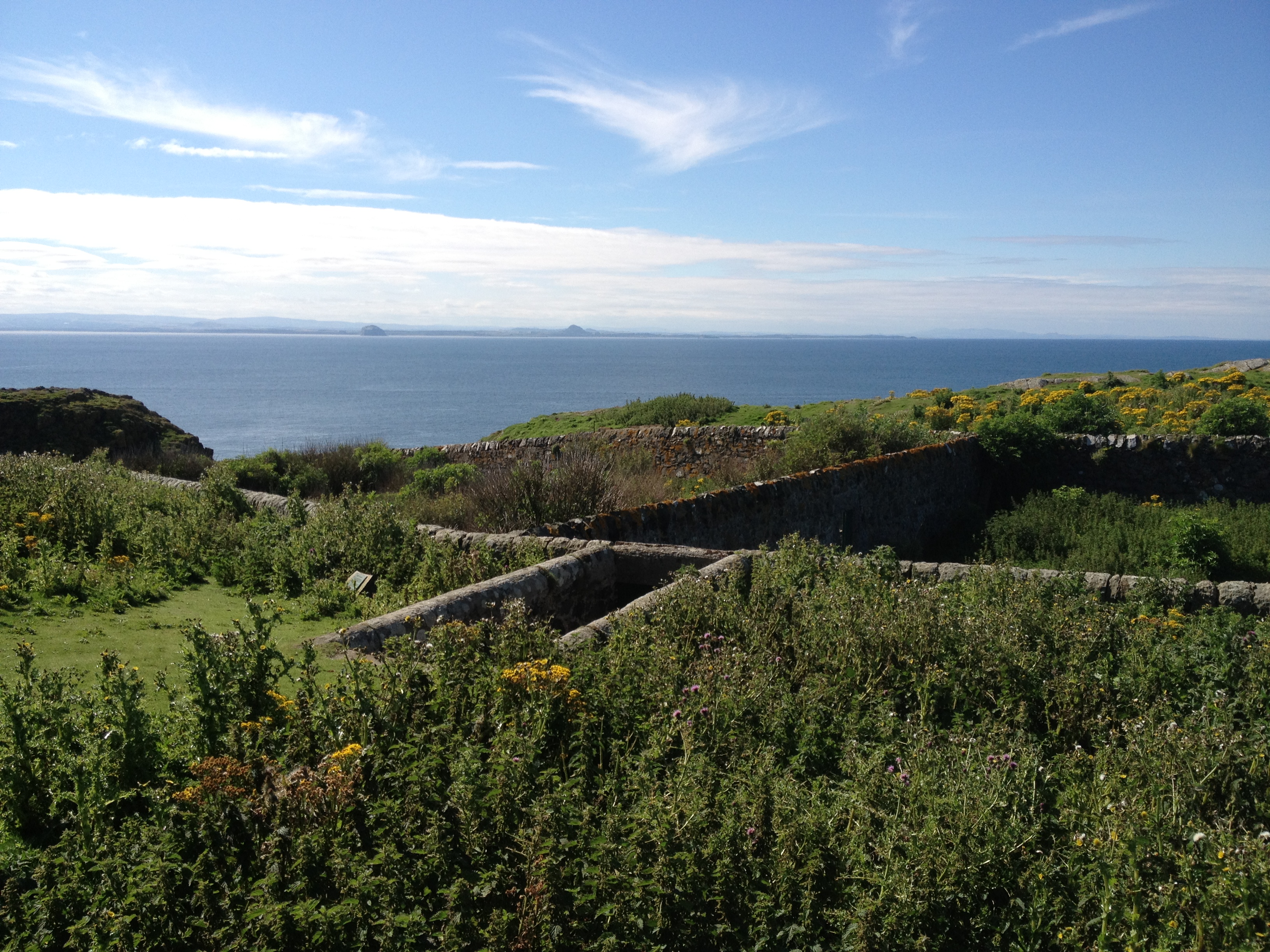
View SW over walled gardens (once used for vegetables by lighthousekeepers) towards Bass Rock & Berwick Law

After a brutal spring and early summer that left much of the island’s vegetation brown and withered until recently, the place looks green and lush, with the rabbits hopping about in acres of space, now that the crush of 10,000+ puffins are off out to sea. The peace along Holyman’s Road and the SW cliffs at Three Tarn Overlook was particularly noticeable.

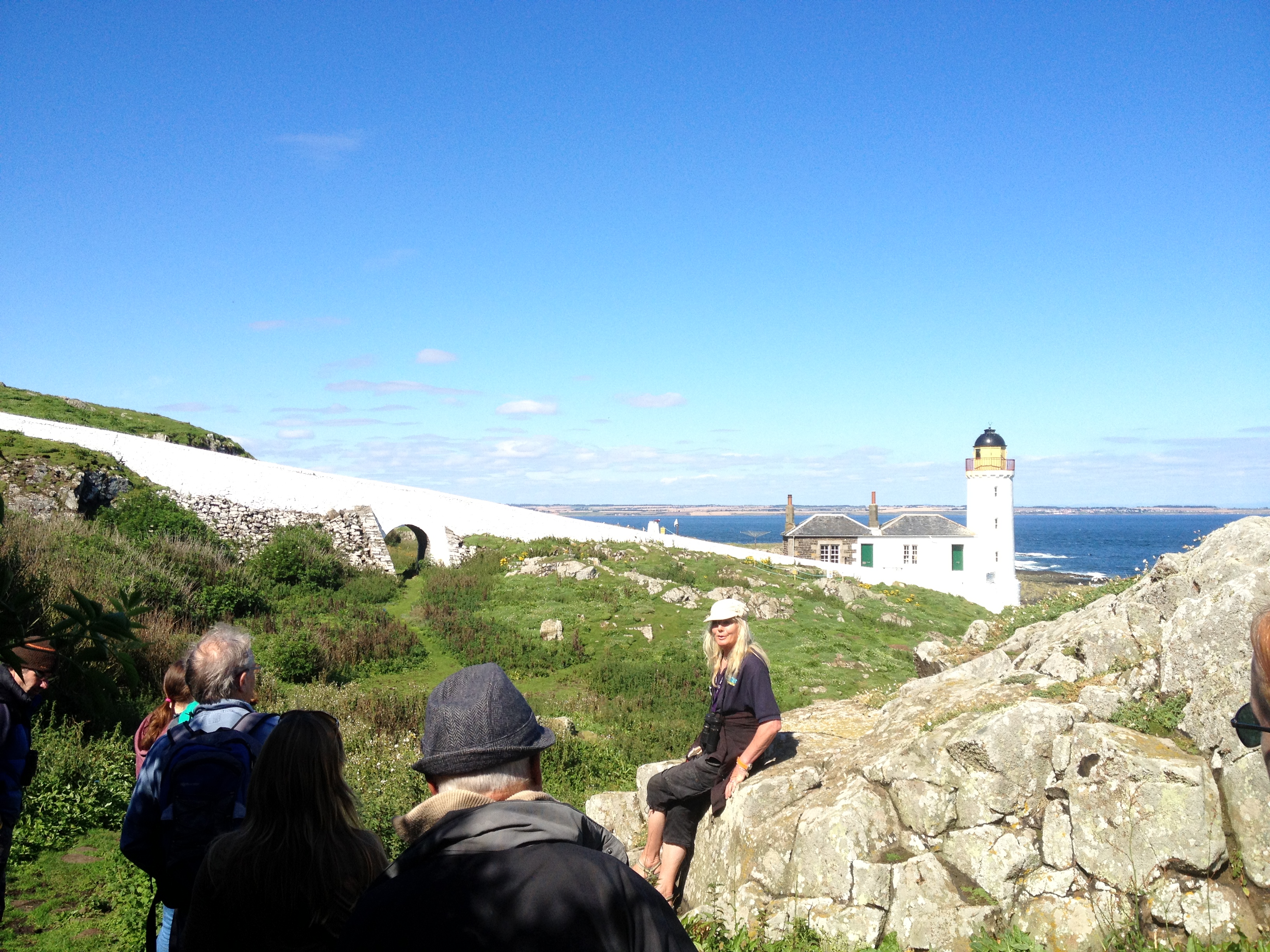
Approaching the Low Light on Holyman’s Road

The island’s owners (Scottish Natural Heritage) are understandably touchy about people straying off paths, especially during the breeding season. But there are still so many paths taking you to odd corners to explore, such as the flat rocks next to the landing stage at Kirkhaven.

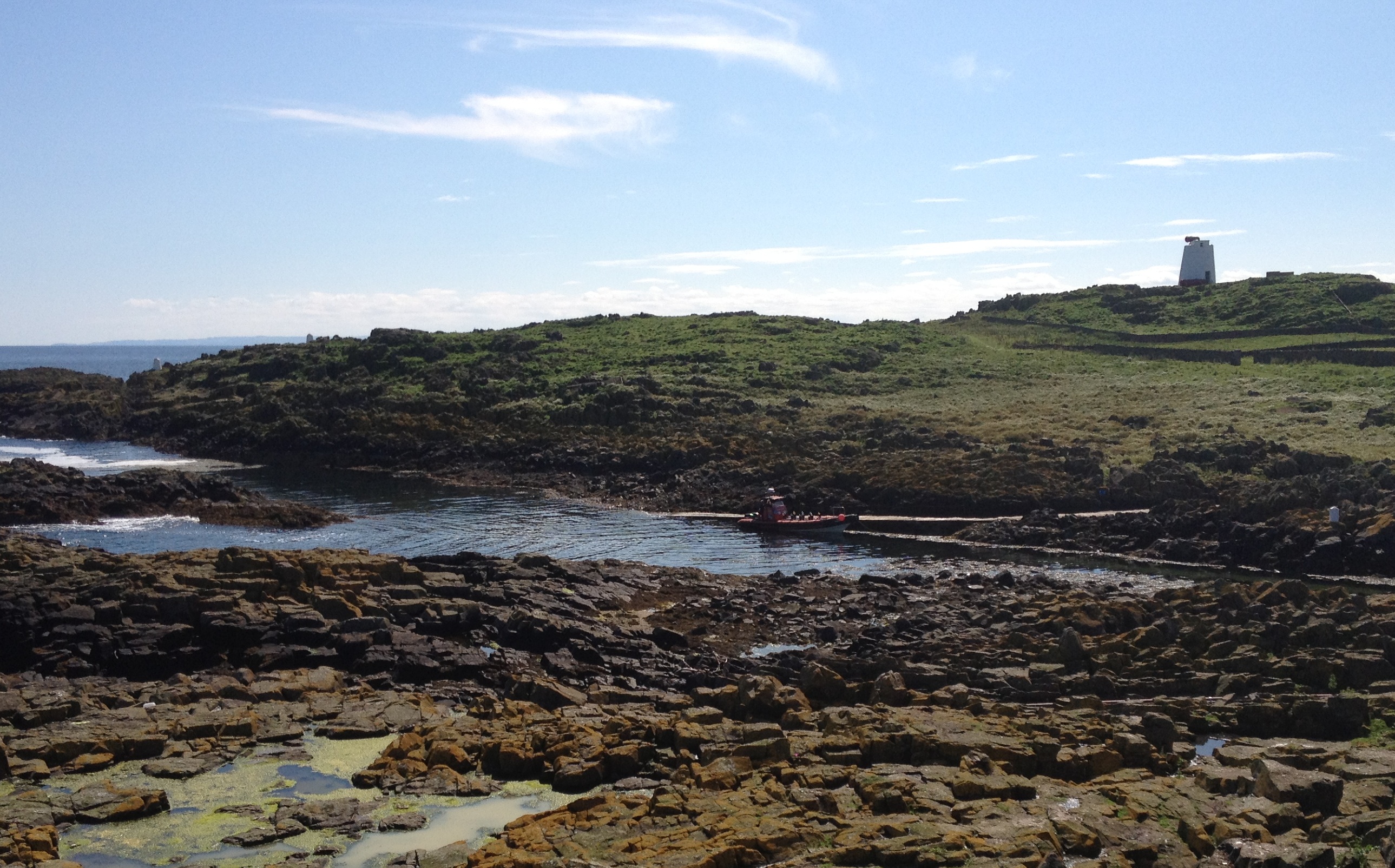
Kirkhaven with the SSC RIB tied up at the Landing and the South Foghorn in the Background

Because of its size (over a mile long) and undulating landscape, the May seems like a much bigger island. Even discounting Rona at the north end because it is inhabited year-round by a hundred or more grey seals that should not be disturbed, it is still hard to get to know the island, even in several two-hour landings. Especially in the brilliant weather that we had, it’s hard to accept that it’s already time to kit up and head home.

Gathered again & kitted out at the Visitor Centre ready for the return

Full of history, including a ruined monastery and many WW1&2 buildings, the isle even has associations with King Arthur from the time when Arthur’s Seat was named. That this was the fabled isle of Avalon is not too hard to believe.

The Crowning Glory—the magnificent, castle-like Main Light, built by the Stevensons in 1816 (original 1637 light on the left)


Posted in Environment | Tagged , | 1 Comment

Wake Up and Smell MR BO

Much though it may appear an incomprehensible circus of brassy showmanship taking place far away from our lives, the outcome of this year’s US Presidential elections matters. Since post WW2, when the US became a superpower, their political postures—from the Cuba missile crisis to post-9/11 pursuit of the Taleban in Afghanistan—have defined the world in which the UK/Scotland operates, like it or not.

Because of its dominance of the the world economy, the outcome of their election will have a major impact on our economy, as well as their own. Aberdeen can flourish all it likes; if Houston doesn’t, any growth will be limited. VisitScotland can trumpet next year’s Open at Muirfield but if the Americans don’t come over in force, its impact on our revival will be trivial. Which will triumph on November 6th—Obama’s pragmatic inclusiveness or Romney’s tax-cutting de’il tak the hindmost?

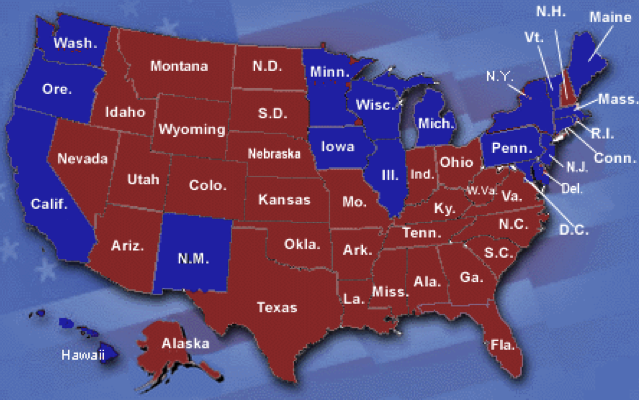
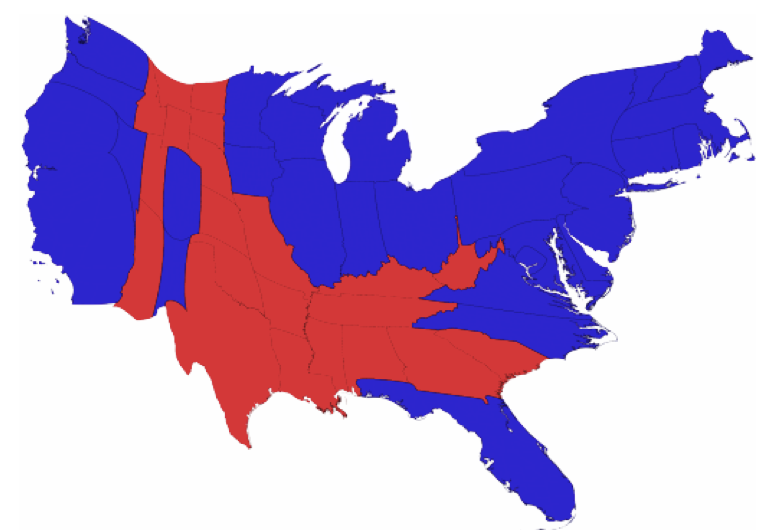
American politics can appear naive and simplistic on policy (only two parties and those sharing a child-like jingoism) but they are geographically complex. A convenient shorthand of “blue coasts—red centre” gives you a layout of the (relatively speaking) left-leaning Democrats winning states like California and New York and (definitely) right-leaning Republicans dominating places like Texas and Tenessee.

For Presidential purposes, each state elects a number of delegates (to the Electoral College) proportional to its population and most give all to the winner in that state. The candidate with majority (over roughly 245 delegates) wins. After a cliff-hanger in 2004 when Bush unexpectedly won Ohio and the contest, in 2008 Barack Obama sailed home, leaving the Republican McCain/Palin ticket in the dust. This is shown in Figure 1 below:

Figure 1—Map of 2008 US Presidential Result (Red = Rep; Blue = Dem)

At first glance on this map, it would appear that the Republicans won from the sheer size of their red area. But much of the US population is concentrated on the coasts and so a more accurate, demographically based map is one such as shown in Figure 2.

Figure 2—Demographic Map of the 2008 Presidential Result

In either case, several unusual occurrences stand out. Florida, famous for being an unending cliffhanger in 2000 and run by Bush’s brother, chose Obama and in New England only New Hampshire (state motto: a rather uncompromising “Live Free or Die”) voted for McCain. After four years of buffeting by recession, almost everyone expects 2012 to be a much tighter race, with polls confirming Obama is only a few points ahead.

The on-line retailer Amazon has come up with a creative new measure of what is in the voters’ minds by compiling political books they are buying into a heat map (Figure 3).

Figure 3—Political Book Purchase Heat Map (Source: amazon.com)

At first glance this appears alarming for Obama, with Republican readership 16 points ahead of Democrat. But, simplistic as it is, American politics cannot be so glibly divided into two camps, any more than its literature can. There is also the argument that many Democrats are boning up on Republican thinking as the right has made far more policy twists in recent years. The New York Times has a handy 2-minute lesson on this.

As the Republicans gather for their conference in Tampa, Florida next week under the inauspicious shadow of Hurricane Isaac, they are reasonably united in policy: no gay marriage; no abortion; lower taxes; undoing ‘Obamacare’ medical coverage; less government. But, Mitt Romney gaffes aside, by picking Paul Ryan as his ‘running mate’ (i.e. Vice-Presidential candidate) has painted himself into a pretty extremist corner. It may be no more extreme than Reagan chose in the eighties. But that ballooned the country’s debt, laying the spending-beyond-means foundations of the present fiscal mess.

The Democrats convene the following weekend in Charlotte, North Carolina and will have some unwanted distractions: a rally on same-sex marriage is in town at the same time. Despite their reputation as pace-setters in innovation of material things like cars and computers, Americans are notoriously conservative politically. There is also continued links between big donors and their influence on party policy on a scale we would find embarrassing (the Boston Globe recently covered the issue of “Late-Night Charlotte” and who’s schmoozing whom).

At this point (10 weeks out), there is still little coverage here—not least because there tends to be a series of unseemly squabbles as both sides lob expensive ‘attack ads’ at each other on major TV channels. These are invariably unedifying and usually about some obscure item of US politics/constitution/personal history about which we know/care little. That Obama made a mark in his four years is beyond doubt, unifying a fragmented country by motivating whole blocks of previously disenfranchised citizens to vote. But you can also argue that he has been divisive, as National Public Radio (NPR) has found.

But we really should care. Whoever is inaugurated into the White House in January will lead the world out of recession. While Republicans claim to be the party of business, their track record of cutting taxes with no real cut in expenditure means their strategy is bankrupt. Add to that Romney’s Bush-esque lack of awareness of the world outside and foot-in-mouth ability to hack off friends and you may find yourself with the bulk of Europeans—rooting for Obama.

It now looks like I may be in-country for the fortnight run-up to the poll (Philadelphia and San Francisco), so expect Uncle Sam to dominate this blog from around October 24th until the brouh-ha-ha dies down in the early hours of November 7th. It’s important enough to make a stink about it.

Posted in Commerce, Politics | Tagged | Leave a comment

There’s Nothing Surer…

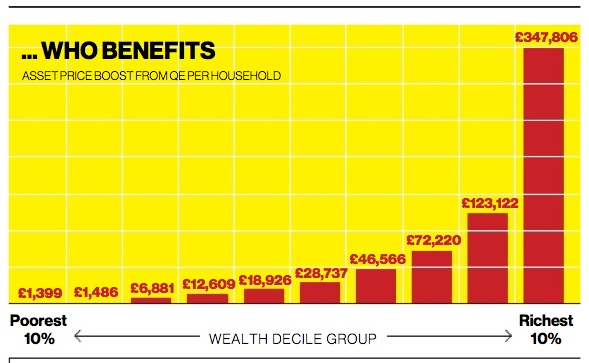
…the rich get richer and the poor get poorer” was a line from a twenties song popular through most of the last century—probably as much for its social commentary as for its musical appeal. It should be coming back into fashion again, given the current statistics on exactly who is benefitting from the quantative easing (QE) being sprayed about just now. Today’s Independent contends that it is almost exclusively the rich.

Now, Osbo and Mervyn are not the first to dream up the financial strategy of stuffing money into the pockets of the already-rich in order for there to be a ‘trickle-down’ effect that benefits the less wealthy as the rich spread their good fortune around. Ronald Reagan excused a massive series of tax breaks to wealthy Americans in the early eighties as a means to get a sluggish economy whirring.

The economy did revive but only because he also spent trillions he didn’t have on the military. That bankrupted the ‘evil empire’ Soviet Union—but also saddled the US with a public debt that stands at $15 trillion (or $50,000 for every American still breathing after hearing that shock news).

Many of us more mature citizens grew up in the last century being taught not to spend what we didn’t have. The national equivalent of that was for the country’s Treasury to simply print money without the economy to support it. Such an approach had done for the Weimar economy in the 1920’s (and paved the way for Hitler); the same strategy has once-prosperous Zimbabwe on its economic knees under Mugabe.

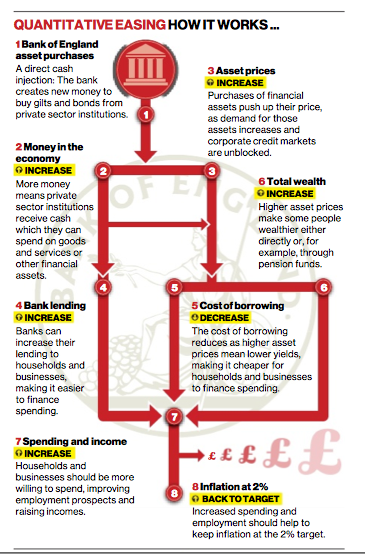
Undeterred by either such prospect, the UK Treasury and Bank of England have boldly seized upon QE as a major tool to revive the economy. In theory, it works like this:

Source: The Independent, August 24th 2012

Simple though this may appear, there are serious flaws in this argument:

  1. Step 4 has a uniform effect only if the banks lend across the affluence spectrum. Over the last four years of pause in growth and outright recession, a more rapacious and self-serving pile of bastards than the banks have been hard to find. Money has been provided to them but, after having their collective fingers burned by over-speculative commercial brethren, the retail end have made outrageous demands for small loans and sit on the money with the fierceness of terns protecting their breeding colony.
  2. Benefits only accrue if the value of the currency holds up. The only things holding Sterling up above the deep fiscal hole we are digging is the even-more-profligate approach by the US and the fiscal irresponsibility of the PIGS (Portugal-Italy-Greece-Spain) so that all three of Sterling Dollar and Euro are suspect in global eyes. If Greece defaults and the Euro stabilises, we’re in trouble as our main trading partners do so in Euros, which will become expensive.
  3. We can only afford the massive public debt that all this is causing (£600m more in July when it should have dropped £2-3bn) because interest rates are low AND we still enjoy an AAA credit rating on world markets. Should either—or, heaven forfend, both—go south, we will be in deep puckey. Public sector net debt was £1,032.4 billion  at the end of July 2012 (equivalent to 65.7% of GDP). Currently around 2%, if bond yield rates rose to just 3% (Spain’s are over 6%), we would pay an extra £10bn in interest—or one third of the entire Scottish Government budget.

Scary though this all is, much could be forgiven if it were working. But not only is there little sign that the UK economy is reviving but the whole mechanism is skewed to reward those who started out with money in the first place. It would probably be crediting Osbo and pals with too much Machiavellian foresight to claim that the programme was set up to benefit the millionaires in the Cabinet and sod the non-Tory-voting plebs who have to work in the rain for a living. But consider the following chart:

Source: The Independent, August 24th 2012

A more egregious poster for the Communist Party is hard to imagine. While it is a fact of life that money begets money and that bankers fall over themselves to lend money only to those who don’t need it, for any democratic government that purports to represent the people as a whole (and not some nepotistic subset) to have created this almost beggars belief. That they blithely continue it is morally bankrupt.

We haven’t heard much about “we are all in this together” from Cameron recently. I wonder why.

Posted in Commerce, Community | Tagged | Leave a comment

Interesting to consider how different we are (and probably always have been) which was understandably downplayed in the centuries of joint empire-building and standing firm against sundry baddies across the Channel.

burdzeyeview's avatarA Burdz Eye View

There has been much seizing upon by the Better Together campaign of the Mail on Sunday’s poll results, published yesterday.

Not only do the survey findings suggest that support for independence is slipping, but also that opinion on the issue of the referendum question or questions is hardening.  Only 27% support independence, with 13% undecided and 60% now opposed.  At the same time, the poll suggests a slight majority now favours a single question referendum (53%) with 41% wanting a devo plus or max option on the ballot paper.

But a different poll conducted by Com Res for the Independent on Sunday, albeit with a much smaller sample size for Scotland*, shows a slightly different position.  That poll conducted over roughly the same time period shows 31% in favour of independence with 20% undecided and 49% against.  Whichever poll you prefer, they both do confirm the trend of…

View original post 793 more words

Posted in Uncategorized | Leave a comment

Senior Service Needs a Junior Partner

The Royal Navy has prided itself—and not without reason—in having a proud and distinguished tradition, longer even than the British Army. To that end, it continues to have and develop state-of-the-art equipment that will allow it to do its job and sustain that tradition.

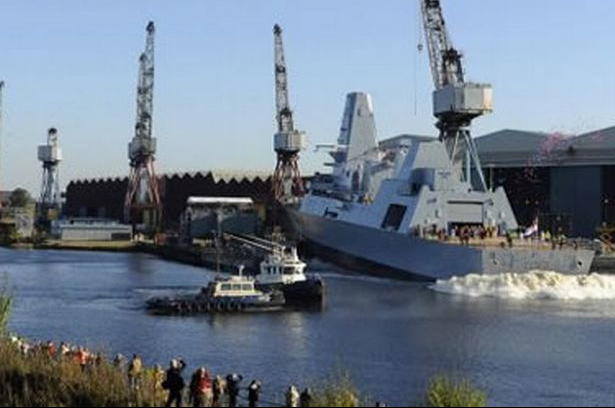
The most recent step along that road has been the £127m programme initiated in 2010 by the MoD with BAE Systems to develop the Type 26 frigate Global Combat Ship (GCS), previously known as the Future Surface Combatant. These ships are to be completed from 2021 onward, replacing Type 22 (‘Broadsword’ Class) and Type23 (‘Duke’ Class) frigates, currently in RN service.

Far from their humble WWII origins as cheap, sluggish 1,300 ton convoy escorts, frigates have become the backbone of ‘blue-water’ navies capable of deployment far from friendly bases. To do this, they have developed into 5,400-ton weapons platforms that can touch 30 knots and cruise over 10,000 miles. The Type 26 will use stealth technology and can be configured for several roles, such as Anti-submarine warfare (ASW), each ship costing from £250m to £350m, depending on equipment configuration.

Unionist politicians, led by Shadow Defence Secretary Jim Murphy, have flapped their lips about how imperiled the BAE’s Type 26 programme will be if Scotland threatens to become independent. Conveniently glossing over the fact that four RN support vessels are now being built in Korea and every nuclear system deployed (as well as the F-35s slated for the two aircraft carriers) is of US origin, the bold Jim sees only thousands of lost jobs:

“It’s crystal clear that if we leave Britain then we leave the Royal Navy.  If we lose the Navy we lose the work in the yards.  That would cost thousands of skilled jobs and many more in small companies in the supply chain.” —Jim Murphy, 14th February 2012

But, more practically than that, the decision about where such ships would be built lies as much with BAE as with the MoD. And, anyway, what do they have as alternatives? The BBC’s Scottish Business & Economy editor, Douglas Fraser, has written a sensible piece on this topic, pointing out that the only capable site outside Scotland is BAE Systems other shipyard in Portsmouth.

Whatever differences Scotland and England may feel they have now or in the future, it will be in the interests of both to be close friends—closer even that Eire currently is to the UK because neither would benefit from loss of the currently close levels of co-operation. Unlike Portsmouth, BAE’s Yarrow and Fairfield yards on the Clyde and at Rosyth have been building modern warships for decades.

In any case, a study by Howard Wheedon, senior strategist with City firm BGC Partners, told the Daily Record newspaper that the Clyde yards would continue to operate after Scottish independence:

“If BAE decide to close a shipyard because of uncertainty about future work levels, I think it would be Portsmouth.  It would be natural because Portsmouth is smaller than the Clydeside operations. It’s true that if Portsmouth closed and Scotland went independent, all the yards would be in Scotland.  But that’s not BAE’s concern.  That’s the UK Government’s concern.”

In fact, shipbuilding—especially of warships—has grown on the Clyde, with the workforce doubling to almost 4,000 over the last decade and key companies like engine manufacturers Rolls-Royce and SELEX Galileo, one of Europe’s leading avionics companies based in Edinburgh benefitting from the growth.

It is true that, in an independent Scotland, the MoD would be under no obligation to feed contracts out in a steady stream to allow optimal use of the skilled workforce. But, on the other hand, Turkey, Australia, India, Malaysia, New Zealand and Brazil have all expressed interest in the design and are potential customers. Portsmouth learning all the skills and expanding the capacity to handle all RN and/or export markets makes no economic sense—such overhead can’t be justified in this era of tight budgets.

Perhaps the most ironic element of all this is that Scotland would be unlikely to build any spiffy new frigates for the Scottish Defence Force. Not only do we not need global deployment (their 10,000-mile range is overkill) but the very RN ships that Type 26s are to replace actually fill the role we require far more economically, especially if refurbished with transom flap, Intersleek anti-fouling paint and Type 2087 sonar.

Better yet: the Scottish ‘share’ of the 19 Type 22/23 frigates active with the RN would be two, roughly the naval defence element we would need, especially if operated with the RN. The advantage to Scotland from that would be that both ships would be based and deployed in our waters—unlike at present where the nearest active RN frigate is actually at Gibraltar and poorly placed to intervene in any terrorist attack on, say, North Sea oil.

To sensible minds (that includes those in the MoD and Admiralty), building the Type 26 in Scotland is the best/cheapest solution for England: for the price of two ships they’d pay off anyway, they get England’s Northern flank protected by a stronger force, reliable and friendly as if it were the RN itself (because most personnel would BE ex-RN). They would also get much cheaper unit costs if we were to build Type 26’s for allies as well as RN. Only the Clyde has such capacity. Meantime, Scotland gets the core of its Navy for free.

The best deals are those where both parties win. That should be the independence debate theme—not singing Jim Murphy’s dolorous dirge that matches his long face.

Posted in Commerce | Tagged | Leave a comment

Glorious and Free

Before unionist readers have conniption fits about this being another diatribe about Scottish independence, allow me to point out that the title is the English translation of the Province of Manitoba’s motto: GLORIOSUS ET LIBER. And why should I be citing such obscure mottos? Because yesterday was the 70th anniversary of a little-remembered (outside Canada) piece of British military mishap/incompetence in which large numbers of brave men lost their lives—arguably unnecessarily.

Recently, we Scots are being forever told that we are part of “the most successful union the world has known”, with the subtext of having come through two world wars together. While demonstrably true, let’s not kid ourselves that we were the only country to answer the call when the British interpretation of ‘civilisation’ was threatened.

Despite already being nominally independent as ‘Dominions’, Canada, South Africa, Australia and New Zealand were quick to side with Britain on both world wars and to send their young men to fight alongside. This blog has already covered the pointless sacrifice of young Australian lives on the altar of British military incompetence at Gallipoli in Lions Led by Donkeys.

Although Canadians lost 67,000 killed and 173,000 wounded, out of an expeditionary force of 620,000 in WWI (a tragic 39% casualty rate), this was attributable to the general stupidity of Hague and his generals from which all troops suffered there, not just Canadians. In WW2, Canada was equally quick to offer support supplying a huge naval effort in the Battle of the Atlantic and thousands of flying personnel in Bomber Command.

But the 1st Canadian Division arrived in the UK too late, luckily, to be sent to France prior to Germany’s crushing defeat of France and the Dunkirk débacle (let no one call it a triumph—we were lucky; our men and the little ships were brave; the Germans, for once, were stupid). Which left the Canadians as the only competent and equipped military unit of any size to defend Britain in the dark days when the Sealion invasion seemed a real possibility.

Once Hitler’s deranged strategy threw the Wehrmacht’s 180-odd divisions at the USSR in June 1941, Churchill (under heavy pressure from his new ally Stalin) was urging his military to open a second front. Sanity prevailed and a compromise invasion of North Africa was agreed for late 1942. But, since invasion of France would be a prerequisite of any defeat of Germany, some kind of major raid to test theories and equipment would be necessary. This was scheduled for the port of Dieppe in August 1942.

As the most coherent units available (such British units as could be spared had been sent to the Middle East and Singapore) Canadians—mostly their 2nd Division—made up the bulk of the troops involved. The plan was conceived by South-eastern Command’s Montgomery, a competent enough general if given enough force but not an innovator. It involved an amphibious landing under and direct assault on the cliffs on either side of Dieppe harbour.

Support for the operation was weakened from the plan: a massed bomber raid was reduced to avoid French casualties, destroyers replaced battleships for providing support bombardment (52lb shells instead of 2,000lb shells) and a parachute landing to capture major shore batteries dominating the beaches was replaced by commandos landing on the same beaches.

The Plan for Dieppe: Note the Number of Canadian Regiments with Scottish Associations

Dieppe was defended by the German 302nd Infantry. Mobilised only two years before and by no means a ‘crack’ unit, this was still a fully-equipped regular division of 14,000 men under a competent Major-General von Bogen, strengthened by flak and coastal artillery units and well dug in behind barbed wire obstacles all along the beaches. While obstacles were not as comprehensive as two years later at Normandy, the defences had been alerted by French spies and good intelligence.

Photo-recon Spitfires only had to cross the Channel to report back on all this but the plan went ahead anyway. 237 ships deposited the assault force on the morning of August 19th. Only No 4 Commando had any success, destroying the shore battery at Varengeville. Those at Pourville, Puys and Berneval, along with field artillery, dug-in machine-guns and mortars on the heights, shredded the Canadians on the shingle beaches below, including 27 of the new Churchill tanks, none of which made it past the sea wall. By 11am, the whole operation was abandoned and survivors taken off as best they could under heavy fire.

Casualties from the raid included 3,367 Canadians killed, wounded or taken prisoner, plus 275 British commandos. The Royal Navy lost one destroyer and 33 landing craft, suffering 550 dead and wounded. The RAF lost 106 aircraft to the Luftwaffe’s 48. German casualties? 591. The German Fifteenth Army (responsible for the sector) conducted an investigation into lessons to be learned from the operation, as well as from two dozen samples of Britain’s latest tank with which they were presented. They thought little of either British planning or their latest tank. It triggered the building of the Atlantic Wall and eventually having no less a figure than Rommel put in charge of it.

Much has been said since about the fact that the Dieppe raid was a necessary precursor to the great amphibious operations that were to follow, in terms of the lessons learned and experience gained. However, it needed no debacle like Dieppe to learn those lessons. Unsupported frontal assaults on a competent, dug-in enemy are never part of sane tactics. General Sir Leslie Hollis (deputy head of the Military Wing of the War Cabinet with direct access to Churchill) judged the operation a complete failure, and the many lives sacrificed in attempting it were lost with no tangible result.

But the whole sordid episode bids fair as another glaring example of ineptitude that tarnishes any glory deriving from the British Army’s exploits through history as part of this union—and raises considerable questions about a relative indifference from their staff officers to casualties, proportional to the distance from the Home Counties that soldiers involved in any given operation originated. It’s a wonder Canadians are as fond of the British as they are. But they’ve had their own country since 1867—glorious & free.

“So proud of the way the (Queen’s Own) Camerons (Highlanders of Canada) went to their deaths. So sad that they seemed to have been wasted. So angry that I was even a part of something so unrewarding, without even knowing what I was doing or where I had been.” —Dieppe survivor Albert Kirby

Posted in Politics | Tagged | Leave a comment

School’s Gone Back: Time for Summer

It has become a cruel tradition in recent years that the weather down our way waits until the schools go back before it rolls out its most summery offerings. This year seems no exception —but at least it had the grace to schedule it on a Saturday so that youngsters were able to join in.

Yesterday started out with two-edged promise: A dark belt of rain to the South of the Firth of Forth and a wide swathe of sunshine to the North. At first, it wasn’t clear which would prevail over our part of the border between.

West Beach at Morning Low Tide—Dark Clouds to the Southwest (The Lamb is just Above the End of the Pier)

But after a nominal drenching, things picked up. Out in a lugger for a short sail to check on Uri Geller’s Lamb, we sneaked up on rafts of guillemots, mostly paired up as parent teaching chick to dive on what must have been a rich shoal of sand eels. There were even some razorbills and less-colourful puffins (now their beaks have lost their display plates).

As we were quietly under slow sail we could get within feet of them. All of these auks have disappeared from their nesting sites, making islands like the Lamb and nearby Craigleith seem bare, so it was good to find so many of them still local because of plentiful food for them. Not long ago we were losing pufflings because all their parents could find were pipefish and the youngsters were choking on their bony bodies.

Almost-grown Puffling—not yet Quite as Cute as its Parents

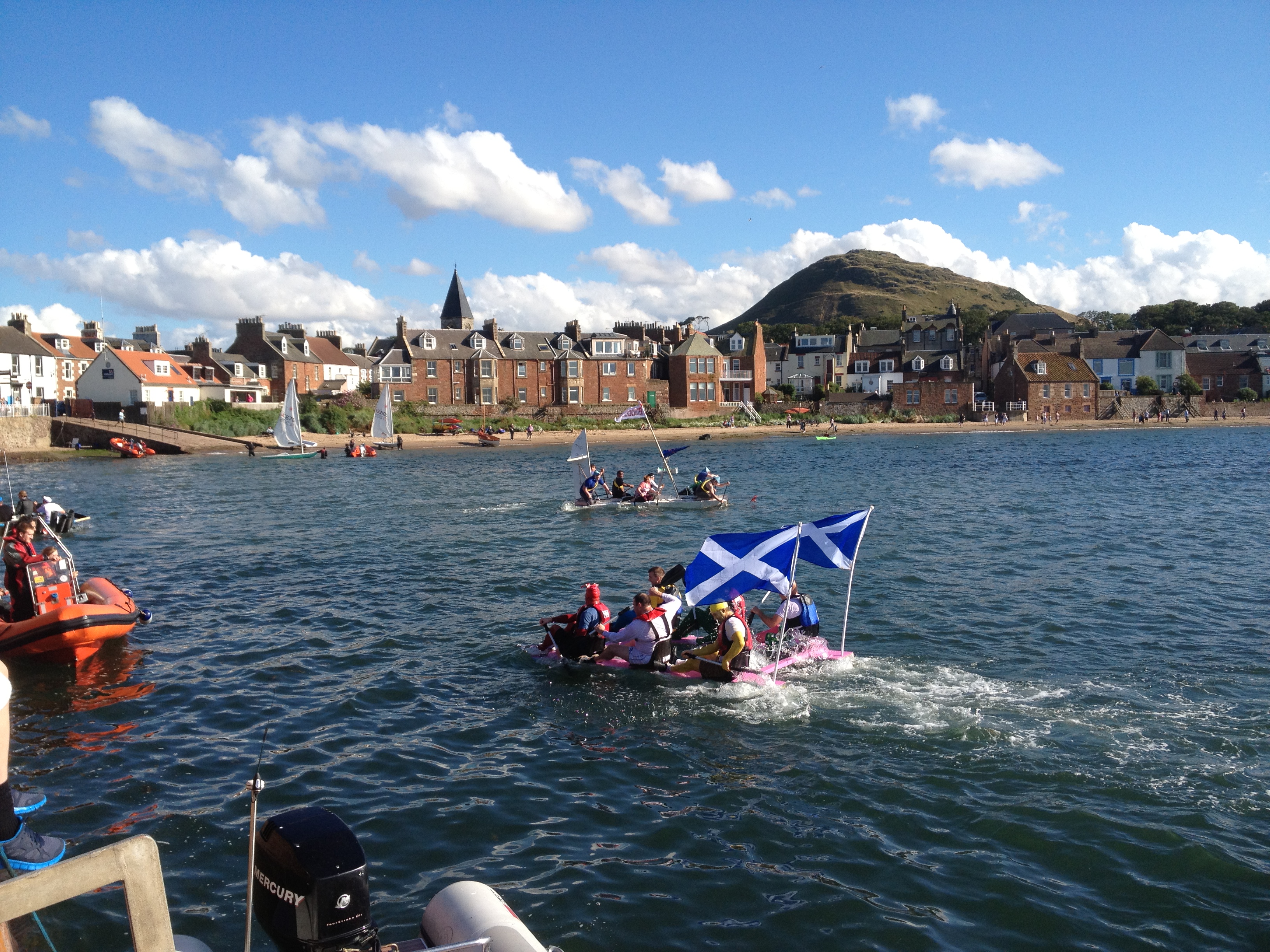
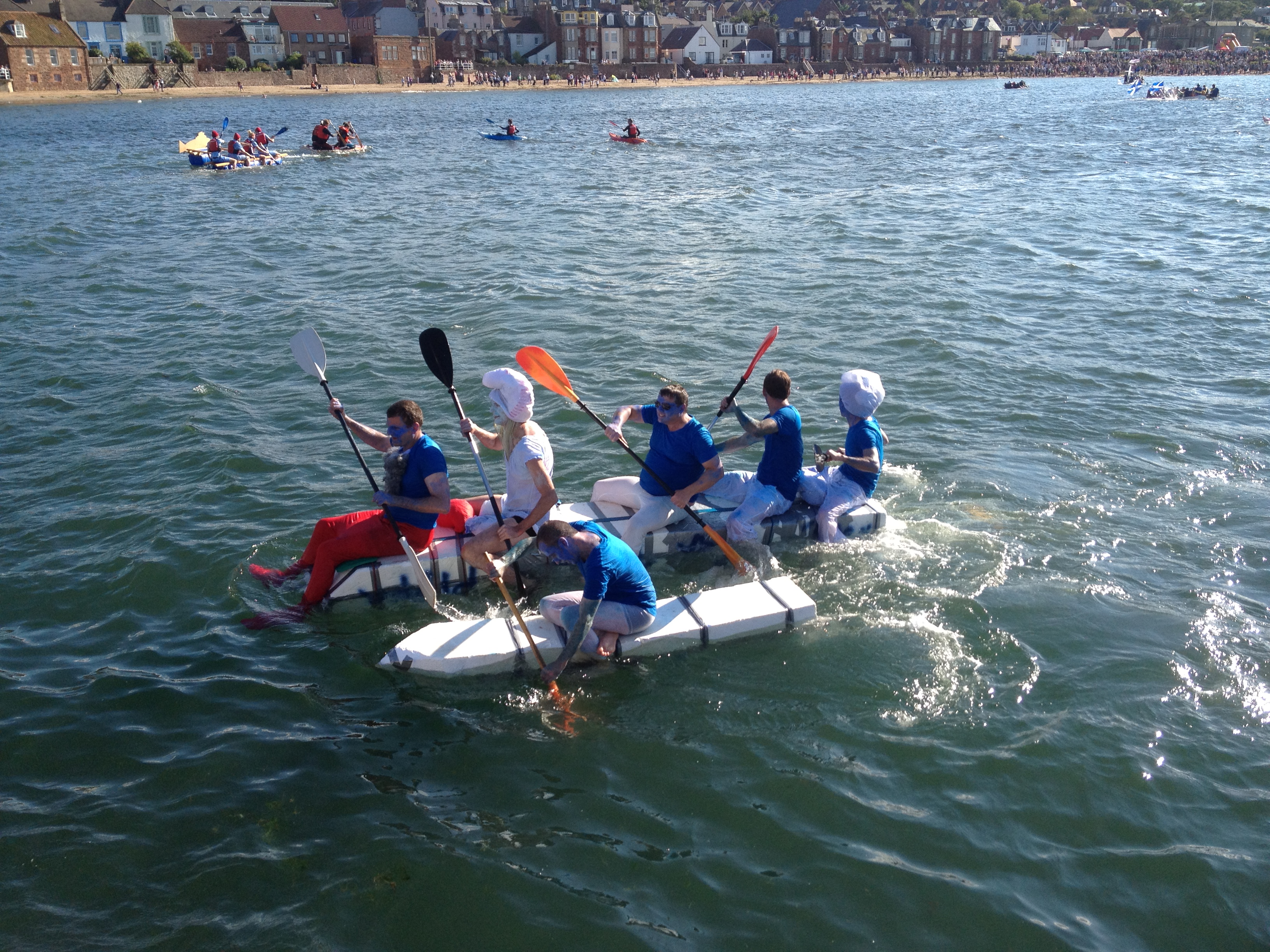
Back to harbour in time for the Raft Race highlight of the day, the weather had turned from threatening all the way to brilliant. It became the warmest, sunniest afternoon so far, with just enough cloud to make the views interesting. With a grandstand view from the South Pier (which contestants had to touch as the second marker in a three-leg course), I still couldn’t work out which film/TV themes each raft represented.

First and Second (with the Saltires) Places at the Turn

Though the finishing times varied wildly—some taking three times the winner’s 8 minutes back to the beach—even the stragglers didn’t give up, paddling furiously against a stiff headwind on the final leg back to the beach Elcho Slip start line.

Lying in Fifth Place—Unsure What They Represent but it’s not Top Gear

The Batmoboat Won no Award for Speed but, Judging from Female Spectators, Came 1st in the Beefcake Stakes

Crowds at Elcho Slip Watch our ILB Shepherd Last Place Along. (How the Yachtie Got involved, No-one Knows)

No idea yet how much the event raised for the RNLI and NB’s Music Therapy Project but I hope it was a lot: hundreds went home happy with the sunburn they’ve been hoping to get all summer. Many thanks to Peter Hammond and the RNLI for providing a brilliant focal point for a memorably splendid day.

Posted in Community | Tagged | Leave a comment