Why No Searchlights On Titanic?

Easily the greatest maritime tragedy that can be regarded as avoidable was the 1912 sinking of the brand new White Star liner RMS Titanic on its maiden voyage. Fitted to the most opulent standards of the time, no cost was spared to make her the safest and most luxurious ship afloat.

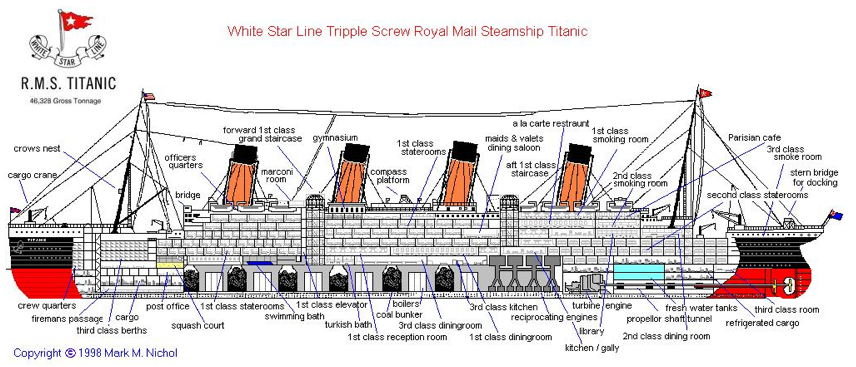
So, apart from the unheard-of luxury of the first class accommodation (it was a rather different affair in steerage), the whole structure of the ship was divided into 16 watertight compartments that could be sealed of by electrically actuated doors. Anyone who has seen the film or read the story needs no reminding of the somewhat insouciant attitude of Captain Miller, senior captain of the White Star Line and, as such, privileged to always take a new liner out on it first cruise.

He was provided with ice warnings, although in insufficient detail for him to appreciate that meteorological circumstances had combined to push a number of icebergs further south of the Grand Banks than they typically managed before melting into harmless slush. As with any such voyage, subtle pressure was exerted on him to not just make but better the scheduled crossing time.

With that to the fore in his mind, all 29 boilers were lit and Titanic’s three massive screws were churning its 46,000 tons through a glass calm, icy sea at her 23 knot best speed under clear and starry skies of a night with no moon.

Much has been made of how difficult it is to spot icebergs in a calm sea when there is so little light and no wave-break at their waterline. It has also been noted that Lookouts Frederick Fleet and Reginald Lee had only their eyes to watch for hazards as the officer with the key to the binocular locker had gone ashore at Southampton. Given the speed of the ship, both these factors undoubtedly contributed to the best reaction the crew could achieve not being enough to avoid the iceberg when it was spotted at 23:39 on April 14th.

But, given the speed and relative blindness, why had the crew not used searchlights to illuminate the sea ahead? The easy answer is that they had none. Hard to believe, given that all navies had seen the advantage of developing strong, directed lights for night fighting and Norris, A. “Alternating Current on Shipboard.” in the Journal of the American Society of Naval Engineers. Vol. 24, (1912) detailed a practical 7.5Kw searchlight and observed “All searchlights of the (US) Navy are operated on a power circuit requiring about 125 ampères at 60 volts.”

Given that no expense was spared on the Titanic, why were no searchlights shipped? Captain E.J. Smith and White Star Line’s Vice President Sanderson in charge of ship’s equipment would both have agreed that such new-fangled ideas interfered with the night vision of lookouts. Such skepticism had its basis. Human eyes have an ability to see peripherally in very low light but this requires up to 30 minutes to adjust and is ruined instantly by any bright light.

This meant that use of searchlights to navigate would have rendered not only all lookouts blind at night, except where the light was shining but also any lookout on a passing ship. It was considered essential to keep a 360 degree watch and, although naval units could be trusted to administer searchlight assistance only when required and under strict regulations, civilian mariners could not be so trusted and so the idea of any ship navigating by searchlight was considered hazardous to all.

Second Officer Charles Herbert Lightoller told the Senate subcommittee, “I think [a searchlight] would have assisted us, under those peculiar conditions, very probably. The light would have been reflected off the berg, probably.” Third Officer Herbert John Pitman added that, though he had seen them used by naval vessels, he had never seen a merchantman vessel with a searchlight. An experienced seaman, he believed that a light might have revealed the iceberg.

A prominent British scientist blamed the Royal Navy for the disaster. Henry Wilde, an English electrical engineer and Fellow of the British Royal Society, charged that the ultimate responsibility “rests upon the naval authorities at Whitehall through their blind policy of excluding searchlights from the mercantile marine.”

The Admiralty objected to widespread use of searchlights, arguing that they interfered with the navigation of other ships. While it is true that bright lights can complicate navigation, and an unshielded light at night in the pilothouse can ruin a watchkeeper’s night vision, this is a short term effect. In reality, the Admiralty’s position was more complex and based more on military than on navigational considerations.

The Admiralty’s effort was doomed to failure in the end. Applying the prohibition to British shipping did nothing to slow other nations use of arc lights. Worse, as Titanic showed, denying passenger ships the tools they needed for safe navigation put innocent civilians at risk, and today every ship that goes to sea carries several strong lights to illuminate the hazards of the deep.

If two searchlights had been fitted either to the for’ard mast where the lookout crow’s nest was located or an some other superstructure immediately above the bridge, the technology of the time would have allowed a path ahead and some 30° to either side to be illuminated, with a good chance of identifying icebergs of the scale that did for the Titanic around 5 miles away on a night like April 14th 1912.

Granted, the lookout’s night vision would have been impaired, as would any other ship in the vicinity. But there was no other ships in the vicinity, other than the Carpathia which took four hours to cover the sixty miles and the nearby California which was hove to because of the ice field and therefore not in need of lookouts (or, unfortunately radio telegraph operator who had gone to bed 15 minutes before Titanic hit).

But imagine the headlines that might have been: April 17, 1912, edition of the New York Herald:

(New York) “We learned today from passengers on her maiden voyage that the White Star liner, Titanic, nearly collided with an iceberg in the early morning of April 15th. Titanic, pinnacle of the modern shipbuilder’s art, was saved from damage by an electrical arc searchlight. The guardian beacon of light alerted the officers of Titanic in time to steer away from danger. The captain noted that a collision, though unlikely to have been serious, might have inconvenienced the great ship.”
Posted in Commerce, Transport | Tagged , , | 2 Comments

The Burd may be injured—but she still knows how to fly straight when it matters.

burdzeyeview's avatarA Burdz Eye View

But first, a word about my own.  Blogging silence has been enforced by a mystery shoulder affliction, which might be connected.  Or not.  Suffice to say, it is agony, I am a whimpering wreck when the painkillers threaten to wear off.  And cannae do normal things which require the use of two hands.  This post marks an occasional return which took two hours to type one-handed.

Bad as my week was, it could have been worse.  I could have been the Education Secretary, Michael Russell.  Suffice to say that he will have been dispatched by the Boss to his constituency this weekend to reflect on just how shoogly the peg on which his coat rests, is. Fortunately for the Education Secretary, there has just been a re-shuffle and the FM, as ever, is not one who acts under an admission of adversity.  People come and go at his behest, not…

View original post 966 more words

Posted in Education | Tagged , , | Leave a comment

Why Arkansas Is Not Argyll

Despite whatever peccadillos my have transpired during his White House tenure, Bill Clinton survived the worst that his Republican opponents could throw at him (and pretty odious some of it was too) to preside for two terms over a steady boom in US affluence, lasting accommodation for the fragments of the Soviet empire and a period of relative international peace.

So when he appeared on-stage at the Democratic Convention on September 5th to nominate the Obama/Biden ticket for a second term in the White House, the thousands of delegates thundered their welcome for him, as well as their approval of his message. And his speech did not disappoint. Much more than a paean of praise for Obama, it was a lucid and well laid out policy document that presented the complexity of the tasks ahead without the usual rabble-rousing shorthand that comes so easy when the popular talk to the faithful.

It was another reminder of Clinton’s skills and capabilities and why he rightly commands eye-watering speaker fees at events around the globe. One other such event at which he featured was Entrepreneurs 2012 in London this weekend at which he asserted:

“The issue of independence is a “classic case” of identity politics which, would dominate 21st century...Can you be Scottish and British? How are the Egyptians going to deal with their various identities and still be Egyptian? Can we find a way to appreciate what is separate and unique about us and still think that what we have in common with others still matters more?”

These are fair questions. What is disappointing is that, unlike in his rousing speech in Charlotte, he appears to have made little effort to answer them, other than by implication that what we have in common should dominate. From an American perspective, they believe that they have the balance right. Their great country is built of 50 distinct federated states, each with its own constitution, laws and other forms of identity in which the citizens set great store.

But, from a European perspective, these identities appear almost artificial and more on the scale of English counties or French départments. Certainly travel from New Jersey to Massachusetts gives little indication you’ve passed through five states any more than a journey from Atlanta to Bill’s own Little Rock another five—although the contrast between the two trips are Yankee urban night vs Confederate rural day.

When Clinton made his Charlotte speech, he was not just among friends, he was on sure ground. His explanation of how Obama filled the $716 bn ‘donut hole’ in Medicare or how the Recovery Act provided 450,000 more jobs was lucidity itself, the mark of a speaker on top of his game. And after eight years in the White House and a dozen more making high-powered speeches to high-powered people, it is little wonder. So why would his London foray not carry the same weight and authority?

He need look no further that Article 1 of the Constitution of the State of Arkansas 1874, which declares:

“All political power is inherent in the people and government is instituted for their protection, security and benefit; and they have the right to alter, reform or abolish the same, in such manner as they may think proper.”

Sound familiar? It should, because it derives, as most states’ constitutions do, from the 1776 Declaration of Independence which, in its turn, derives from the 1314 Declaration of Arbroath that said more or less the same thing. And, if you should examine Bill’s no doubt random reference to the Egyptians, you would realise that they have a history longer than almost any other country of being unified as Egyptians; during those many millennia they have never sought to be anything else.

Scotland (or Ireland, Denmark, Finland, etc, etc) is different. Not only has there been a Scottish border about ten times longer than there has been a Constitution of the State of Arkansas, it has kept unique laws, religion, culture  and identity that only the State of Texas seeks to approach in its distinctiveness. Steeped as he is in US state civics, their minor differences don’t begin to approach the distinctiveness that most Scots feel from the other peoples of Britain.

So when Bill makes his sincere pleas to bury differences and work towards a common goal, he is presuming that we, like a US state, are already comfortable with the status quo. As Bill phrased it:

“Political debate framed about identity issues hampers efforts to forge stronger bonds. “You can’t have 51/49, 52/48 debate about that every single year. This is the triumph of identity politics that is zero sum and its negative reference instead of a common vision.”

But what when that identity needs its proper expression in order to make the full participation in a common vision? The Scots are British and Europeans, just as their English and Welsh cousins are. But they need the latitude to be Scots without forever having a London-based set of presumptions hung around our neck—whether it be that nukes based on the Clyde, beating up total strangers in Afghanistan or giving away our fishing rights are all justified by a Westminster majority and a non-existent constitution.

Would Bill argue the Canadians ought to house America’s nuclear sub fleet? What if that situation were reversed and there were Canadian nukes on the Mississippi? Before any such unlikely scenario, you would swiftly see another draft “We the People of the United States, in Order to form a more perfect Union, establish Justice, insure domestic Tranquility…”

Because it’s the people, stupid (I mean, Bill). Just as your forebears worked out that British imperial peasantship was not what they were about, so have we. Once the English get it through their miasmic heads that the Empire has gone and the last colony is about to jump ship, that’s when we Scots will “find a way to appreciate what is separate and unique about us and still think that what we have in common with others“.

Including Arkansas.

Posted in Politics | Tagged | Leave a comment

Protecting Our Nation’s Interests

The title of this blog is lifted from the header of Royal Navy’s website and before we get our sleeves rolled up and into the subject, I wish to make clear that there is no stronger admirer of the Senior Service and its achievements down the centuries than your humble blogger. But, being as we are in the 21st century, the principles upon which Britain’s exercise of sea power and the political masters that determine its strategy ought to be the topic of a more serious review than the penny-pinching exercises that Messrs Hoon, Hammond et al have indulged in over the last decade.

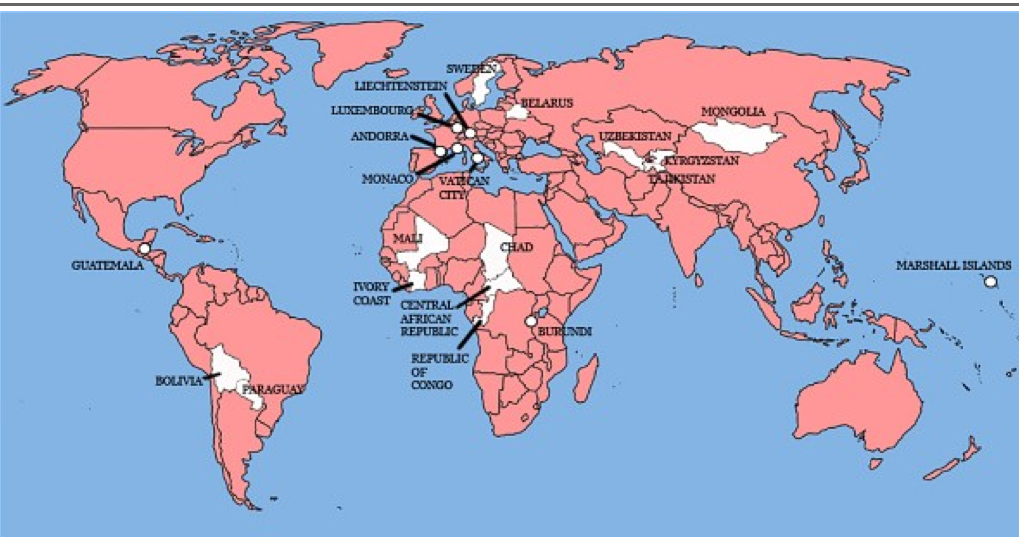
The British like to think of themselves as peaceloving—slow to anger but fierce in their retribution. Unfortunately, such a self-image sits ill with reality. Let’s leave aside who was at fault in the major conflagrations that were WW1 and WW2, few of the countries of the world can boast as aggressive a history as Imperial Britain. Consider a world map in terms of that history:

Countries Shown in White Have NOT Been Invaded by Britain; All Others (Shown in Pink) Have

Fewer than thirty of the world’s two hundred countries have never stared down the barrel of a figurative British gunboat. And before you start pointing out that neither Mongolia nor Mali have a coastline and are therefore inaccessible, note that Upper Volta and Uzbekistan both have; also, as recently as 1998, the Royal Navy paid a visit to Switzerland by sailing a patrol boat up the Rhine to Basel. There is however no truth to the rumour that Russia drained the Aral Sea just in case perfidious Albion found some way of wangling a gunboat onto it.

Admittedly the world map is a simplistic rendition of four hundred years of complex history and geopolitics. But the point of it all is that attitudes toward Britain have been formed at least in part by such a perspective. And, given incursions into both Iraq and Afghanistan in the last decade, it could be argued that we are still playing the gunboat diplomacy role of a world power and that terrible events like 7/7 or the Glasgow airport car bomb are direct, if unjustifiable, consequences of that.

Given the scale of British interests, it has always fallen to the RN to police those interests across the globe. A century ago, we dominated both trade and naval power and that effort was both sensible and feasible. However, British share of both has now shrunk to risible levels compared to global competitors. Yet the RN continues to be tasked with its old role. Thirty years ago, the fallacy that this could be done was almost exposed in the waters off the Falklands. Although a brave victory against steep odds, a few more Exocets and/or fewer dud Argentinian bombs could have made it a disaster.

A quarter century later, the Royal Navy still had its global tasking but Geoff Hoon’s Strategic Defence Review of 2005 pared all three small carriers and 3 of the 35 ‘blue water’ escorts (frigates and destroyers). By comparison, the USN operates 11 major carrier task groups (each with almost 100 aircraft and a half dozen escorts, including Aegis cruisers), plus 9 similar-sized amphibious assault groups, each capable of landing a brigade of 2,200 US Marines against opposition.

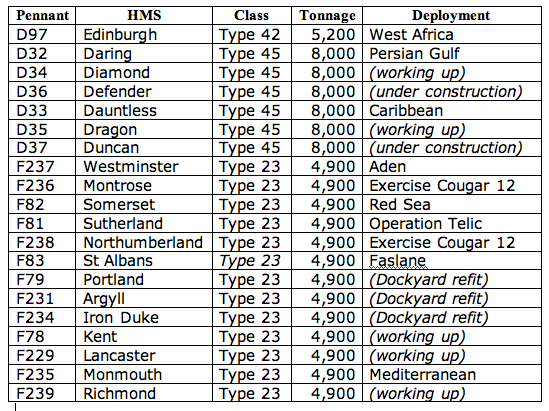
Not only is Britain incapable of deploying even one such task group (at least until 2018) but the existing main units are stretched halfway round the globe and, despite their web site slogan, no longer capable of discharging all that is asked of them. But, worse than that, the beancounting firm of Hoon, Fox & Hammond have all but gutted what capability is left. From the SDR’s 32 FF/DD fleet of only seven years ago, the RN is effectively down to 5 DDs and 13 FFs—and not all of those operational

Royal Navy Fleet Escort Deployment, November 2012

For anyone with a naval background, this does not make comforting reading. The RN still deploys four amphibious warfare and helicopter assault ships plus six survey ships, but those are not naval combat units in the usual sense. They also have a couple of dozen patrol ships and minesweepers but none of those are really ocean-going, nor armed, nor capable of the 30+ knot speeds of the destroyers and frigates.

So the table above scatters nine of the ten operational units halfway round the globe (including two supporting HMS Bulwark on Exercise Cougar 12 with the French and Albanians in the Mediterranean). The only ship in home waters not either undergoing refit or working up (in theory operational but crew is still training on new equipment) is the Type 23 Frigate HMS St Albans, based at Faslane.

Now the defence of the nuclear sub base at Faslane is obviously a priority which is why the St Albans is there (along with two 50-ton Archer class patrol boats). And chasing drug-runners in the Caribbean or Somali pirates could be justified if they caught more of them. But if I were the Taliban looking to smack Britain in the chops for daring to invade my country, a couple of fast cigarette boats packed with amatol could do damage to North Sea rigs that would dwarf Piper Alpha.

Even if the Admiralty were to get wind of such a strike, attack submarines would be useless to counter it, minesweepers and patrol boats would be too slow, even sailing from the Forth or Hull, and HMS St Albans would take a day to get there, even if immediately ready to put to sea from Faslane. And the RAF would be hard put to hit such small, fast targets, even if they were not clever enough to hide out next to the rigs that ASMs or cannon would be as likely to damage as their intended target.

Or what about an LNG tanker with 200,000 cubic metres of liquid gas aboard is similarly attacked as it come in to tie up at South Hook? The resulting fire and explosion would not only wreck Britain’s main LNG import facility but take out much of the Milford Haven oil facility with it, causing an environmental as well as economic disaster.

That the RN is ludicrously overstretched cannot be blamed on the sailors. Both Labour and Tory governments have insisted on a global role for Britain, whether it be a global military reach the whole UK can no longer afford or the nuclear deterrent that it can’t afford either. As a result, the RN is kidding itself that it is capable of protecting Britain’s conventional maritime interests any more.

But what is worse, seen from a purely Scottish perspective, the key oilfields, most especially the newer ones out in the deeper waters of the Celtic Sea, are wide open. With no long-range maritime patrol capability, we no longer even know what’s out there, whether some rusty Liberia freighter off the Faroes is even now removing its deck hatches and using its derricks to launch fast attack boats amidst the rigs.

To protect our nation (that is Scotland’s) interests, we need 2-3 FF’s deployed around our coast, backed up by a half-dozen fast attack boats (c.f. Finland’s Hamina class), a squadron of long-range maritime patrol aircraft and an SBS squadron specially trained to deal with terrorists, especially aboard oil rigs. The UK has none of that.

No disrespect to the RN personnel doing their best in impossible circumstance but the only way we Scots can protect our nation’s interests is to have our own nation and then choose defence forces that don’t involve poking 90% of the world in the eye with a gunboat at some point in our history.

Posted in Politics | Tagged | Leave a comment

The Economics of BASE Jumping

With the dust settling on a US election result that just about everyone who is not Republican (and a good few who are) is relieved by, it is back to financial business as usual—and not before time. Europe has just moved back into recession with French unemployment at 10% and one Spanish youth in four out of work.

Even though the Greeks approved (another) sweeping set of €17bn in austerity measures cutting pensions, salaries and social services, their €31bn in credit remains firmly locked and most workers remain convinced that strikes can magic good times out of thin air. The UK is in the throes of a double-dip recession and a reinvigorated Obama is immediately faced with what is being touted as a ‘fiscal cliff’ for the US economy.

The origin of all this is the series of tax cuts and unemployment benefits linked to reductions in military and domestic programmes, agreed six years ago under Dubya and designed to stimulate a faltering economy. But that had caveats of time limits attached. That flight of chickens is already in the landing path and set to come home to roost on January 1st 2013. Both sides of the House are agreed that this sudden $700m change could scupper recovery. But whether Obama can break the Washington gridlock of DEM initiatives being stalled by resolute REP opposition remains to be seen.

Much of the current energy around establishing sound fiscal conditions is focused on plans that theoretically would both contribute revenue to deficit reduction and significantly reduce individual income tax rates. But two things combine to make that desirable outcome unlikely:

  1. Some politicians see the scape-goat-free enforcement of tax increases and spending cuts that would result if no action is taken prior to Jan 1st as one way of increasing tax revenue in the teeth of Republican opposition and for which they cannot personally be blamed
  2. Despite the supposed unity within parties, some politicians from both sides (but especially Democrats) see such logjams as pork barrel opportunities, where they can insist on irrelevant attachments to bills that nonetheless suit some narrow interest for theit own local constituents (especially generous campaign donors)

While it may sound strange to European ears, where party discipline is a given, such horse trading is common in Washington. Plans to reduce many tax deductions, exclusions, etc (i.e. tax expenditures) to pay for both lower personal income tax rates and deficit reduction may seem like a politically attractive alternative to raising tax rates or cutting entitlements or other spending.

But huge swathes of people now rely on tax expenditures, such as the deductibility of mortgage interest, charitable contributions and the exclusion from income of employer-provided health insurance. Even when the substantive effects and political realities of large-scale reductions are examined, it’s obviously not possible to both reduce tax rates and also cut the deficit on this basis.

Raising tax rates for those with the highest incomes challenges the proposition that even moderately higher rates hurt growth. Clinton’s 1993 deficit reduction plan increased income tax rates for the top 1%. Republicans fell over themselves to claim this would lead to recession. Instead, the job creation powered over a decade of economic expansion that fell over only once Dubya had brought in his tax reliefs for the rich that are among those about to roll over the cliff.

Perhaps because we don’t face the same urgency of an approaching cliff, none of this seems to have percolated into the economic thinking of either Osborne or Balls. It certainly has elicited no contrition from their predecessor Alastair Darling, on whose watch the wild excesses of junk ‘financial instruments’ imploded, taking most of our economic growth with them. His new book Back from the Brink implies that politics is merely a competition in managerial competence: his stance is unchanged in a defiant macho chest-butting austerity that gets short shrift from colleagues:

“I will admit from the outset that I am not a big fan of the former Chancellor. In particular his, our cuts will be “tougher and bigger” than Thatcher’s, almost led me to giving up on the 2010 election campaign. That one stupid phrase illustrated just how managerial Labour had become in government”. —Dave Watson, Head of Bargaining and Campaigns, UNISON Scotland.

Now that Britain is four years into Osborne’s eye-watering austerity, made liquid only by extravagantly irresponsible amounts of ‘quantitive easing’ (i.e. printing money you don’t have), you wonder if the US’ dilemma of an impending fiscal cliff might not be just the thing to focus our own minds for fresh, decisive action, rather than simply applying more leeches to an already debilitated economy à la Osborne.

BASE jumpers know how to deal with a cliff: indeed they welcome such opportunity to launch themselves into the unknown. But (and this is a big ‘but’), in order to survive, they have trained, equipped and psychologically prepared themselves for something so radical as a leap into the unknown, with every intention of landing hale and hearty. It will take much hard work, good will and inspired insight for Obama and both sides of the House to design, pack and agree a fiscal chute in the short time available. But it’s still feasible.

Assuming Clean Slate in 1997, Cumulative UK Debt from Brown + Darling + Osborne

Despite Labour having raised debt per head fourteen-fold on their watch (£432 to £6,237) and he has taken it to forty-fold (£17,523), Osborne sees no cliff—indeed maintains that the ground recently covered that has perversely sloped down and down each year, despite all his best reassurances, will soon lift us back towards the sunlit uplands that lie just ahead. The chart above shows scant evidence for this.

Right about now, you may wish to consider strapping on a parachute.

Posted in Commerce, Politics | Tagged | Leave a comment

Making the World England

So far, most of the arguments coming from unionist mouthpieces in the independence like Better Together have revolved around perceived advantages that accrue to Scotland from being a part of the Union. In terms of economies of scale—such as running embassies around the globe or having critical mass enough to retain our own global currency—they may have a point. But a many more points deriving from the UK’s scale and historical ambition actually work in the opposite direction.

Despite early obstacles, like Jacobites and Americans, the Union thrived from inception. Its modern proponents claim it will do so in the future too. But let’s take a closer look at that thriving. While the Scots became willing partners in the enterprise, they were never equal. It was rather like a boys gang where the bigger of two brothers dominates and the smaller/younger goes along part in awe and part in the knowledge that he could achieve none of this by himself.

That Britain was a leading nation in Western civilisation for a quarter millennium is a given. That it contributed to exploration, technology, humanities and a host of other key developments for mankind is unquestioned. But it was not all sunlit uplands. From the early slave trade, through imperial excesses like Amritsar, to axiomatic racist attitudes in non-white colonies, imperial enlightenment came at a price of hard menial work and the insult of being a second-class citizen in your own land.

There is no intent to demean what was achieved but, given that 50m Brits dominated ten times that number of citizens of empire, it was always going to be a con job.Perceived superiority was essential if the young agent-sahib, outnumbered 1,000 to 1 at some Assam hill station was not going to have his throat slit. This was especially true when the natives realised that the prime British motive to come among them with rituals that sat awkwardly in the local culture like afternoon tea was not to enlighten but to exploit.

Unprofitable British colonies got short shrift. Other than coaling stations, no-one ever worked out what Belize or St Helena was for. But Canadian fur or South African gold or Malayan rubber got the ships or the redcoats or new laws they needed before you could blink. As a trading nation, there was none nimbler; as a manufacturing power, there was none more innovative. Scotland played at least its share in achieving this.

Much though the story of empire has been couched as heroism and altruism, that does not bear close examination. To say the British Empire was the most efficient pillaging machine ever invented until our US cousins came up with the multinational corporation is equally superficial. What is true is that British troops and gunboats were used shamelessly to break open closed countries (e.g. China), subvert exotic empires (e.g. India) or simply strongarm ancient civilisations out of resources (e..g. Iran/Iraq).

Once the raw materials were identified, secured and exploited, they were shipped home to fuel Britain’s burgeoning factories and population’s needs and out again into the world as finished goods. In our Victorian heyday, this worked like a dream. No other country had the combination of global reach and factory muscle to compete or the combination of gritty infantry and jolly tars strategically positioned around the globe.

It was a sweet deal. Not only did the City ensure the establishment grew rich but clacking mills and roaring furnaces from Clydebank to Chatham put everyone in work, although not yet either secure or well paid. The only British people not swept along were the Irish, whose resentment grew with  indifference to the potato famine, mass emigration and being seen as cheap labour and/or cannon fodder.

It was a plausible system, not least because it was successful and almost everyone felt they had a stake in it. Closer examination reveals that virtually all of the sacrosanct pillars that held up the whole edifice—whether Monarchy, Parliament, City commerce, naval tradition, unflappable sang froid, home-as-castle, roast-beef-n-yorkshire-pud—were English. Welsh cakes and choirs went with other regional idiosyncracies like Morris dancing or scrumpy as colourful descants to the main theme.

As a result, it is little wonder that the names of Britain and England become conflated to the point that few foreign languages bother—Inglaterra; Angleterre; etc. While we’re all signed up to a global programme that’s still achieving, why quibble? But, since the British Empire ignored the close-to-bankruptcy shot across its bows from WWI and was caught embarrassingly short in the aftermath of WWII, when the US had money and everyone else was broke or devastated or both, Britain has been struggling for a new role in the world.

And what is it exactly? Seen from a European perspective, we are just another mid-sized country but with an ego problem and stroppier than most. Seen from a US perspective, we are one of many developed markets and a sidekick that’s good to have along when a swift global action needs to look consensual and not too unilateral. From an Asian perspective, we are Turkey or France—a once global empire reduced to modest means but a decent market for finished goods.

The point is that all our joint culture of judicious exploitation of the world’s resources with a minimal amount of slapping anyone around does not play in the 21st century the way it did in the 19th. Ninety years ago, the Irish decided they didn’t want to be a part of it any more and left. There are few studies of this but most would accept that to have been a good choice. There is certainly no voice raised in Dublin to rejoin the UK because it offers a better deal than what they have.

Which leaves the Welsh, the English (still happily pretending the whole culture theirs) and us. Were the Scots in some doubt about themselves— as in the great self-examination of the 1970’s, when industry went to hell in a handcart and the cultural revival consisted to the Cheviot the Stag and the Black Black Oil, there’s an issue. But 40 years ago was the last time that happened. Building momentum since the early nineties, Scotland’s awareness of itself, its culture and—most importantly—its potential, has changed the debate. Rather than why we should go, the argument Better Together is scrambling to make now is why we should stay.

The argument that Scotland is economically viable takes five seconds to make: the arc of whatever (the countries that are our neighbours) all seem to do fine. But they don’t have our oil, our renewables, our tourism or £4bn annual exports of whisky. The fatuous argument about splitting up social bonds are nonsense—the Irish are closer friends than they have ever been and we even have a law defining them as ‘not foreign’. And, as the bulk of Scots want nothing to do with Trident on the Clyde, the fastest way to get rid of it is to become independent and tell the English to put it closer to the Home Counties.

There are strong economic as well as emotional arguments why England would want to stay in a union with Scotland. And, if they want to be nostalgic for the days of Empire, then that is their privilege. But more and more Scots are wondering why everyone is so keen to keep this union intact when every opportunity open to Scotland for a more vibrant and culturally coherent future lies outside with the Nordic Union, exploiting the Celtic Sea with Ireland and the Faroes, managing our fish as cleverly as the Icelanders, developing a new non-nuclear relationship in NATO, developing a less stroppy approach to the EU if we get something for it.

England does a superb job of making England England. But the world isn’t buying it any more and it’s time for this first and last colony to stop the world and get on.

Posted in Community, Politics | Tagged | Leave a comment

‘Big’ and ‘Stupid’ Mean the Same

Recent revelations of the latest fiscal shell-game being played by major multinationals is causing excruciating embarrassment to HM Revenue because it appears they have been taken for a ride by not just one but a whole gamut of major American companies—especially those in the service and retail sectors, who have broken into the UK over the last few decades.

The Scots are being forever told how much easier and better the world is when we have the size, resources and capacity of the UK to help us. This seems like a good example of where that not only does not apply but seems to apply in reverse. A list of major US companies conducting significant business in the UK, their UK turnover and corporate tax paid is shown in the table below.

Comparison of Some Multinational Business UK Revenue & Tax Figures

Action Aid, the development charity which campaigns for multinationals to pay fair taxes in the developing countries they operate in, said government action was key to stop companies “hiding” wealth by moving it to tax havens. Companies could voluntarily improve their practices, but to compel them, the rules need to change. Companies must publish a basic set of accounts for every country they operate in to make it easier for tax authorities to work out how much tax is owed. The UK government has the chance to take the lead in tackling tax dodging next year when it chairs the G8.

House of Commons Public Accounts Committee (PAC) has been investigating this, starting with Andrew Cecil, public policy director at Amazon. He was unable to explain the corporate structure of the internet shopping firm, saying he ‘did not know’ who owned the Luxembourg holding company that Amazon uses to reduce its UK tax rate.

Starbucks chief Troy Alstead appeared before a UK PAC on Monday and was accused of lying to shareholders after he told the committee that the coffee giant made a loss in its British business dealing. He was rightly pressured by Margaret Hodge MP: “You have run the business for 15 years and are losing money and you are carrying on investing here. It just doesn’t ring true!

Matt Brittin, vice president of Google’s northern and central European Sales and Operations, got off slightly lighter at the hearing because he appeared to have the information at his fingertips. He defended Google’s decision to operate in Ireland—and therefore pay its taxes there—as it employs 3,000 in the country compared to 1,300 in Britain. ‘Like any company you play by the rules,’ he said.

‘Playing by the rules’ means the European laws that allow competition across the EU; you only have to comply with the tax laws in one country to do business in all 29. Given the relatively generous tax laws in places like Eire, that means a large number of multinational companies conduct their business from there and this whole argument from Better Together that bigger countries have an advantage holds no water.

If that were true, why would Apple—the world’s biggest computer company—conduct its EU production, shipping, repair and support from Eire; why would Google—whose ad revenue at £27bn recently exceeded ALL print media ad revenues—conduct its EU development, administration and support from Eire? All these major new business monoliths play the same game. It is not always Ireland that benefits. But what is certain is it’s NOT the UK, which is treated as a dumb cash cow as slick corporate tax creations shelter profits.

HMRC is not up to this: the number of serious tax evasion cases—with more than £50,000 of suspected tax evasion—has fallen by a quarter in the past year as the government prepares to hand HMRC a general anti-abuse rule from April 2013. In 2011-12 there were 3,346 suspected tax avoidance cases, down from the 4,506 in 2010-11, according to data compiled by a law firm.

HMRC now seems prepared to use its strongest anti-evasion measures in cases that would previously have been regarded as quite modest in size. But, the fall in the number of cases doesn’t really gel with the idea that there is a substantial and growing threat to public spending because of tax evasion. In other words, while they crack down on the individual shoveling dosh through the Caymans, big company legerdemain passes as legit and no-one at corporate level gets their collar felt if, as Matt Brevin says, you ‘play by the rules’.

And. lest you despair that such nasty tricks were dreamt up by feckless foreigners, who do you think led the companies to cook their books this way? The UK Tax Tigers of Canary Wharf and Caymans by way of Jersey and Isle of Man. All three Train Operating Companies used their considerable wiles to play this highly profitable game while syphoning £2bn in public money out of the public transport system, largely through increased fares.

But the most egregiously gallus of the lot has to be Starbucks, who have prompted a scathing Special Report from Reuters for the effortless way they have screwed HMRC—and by extension every taxpayer in the UK—out of every red cent. A precis does not do it justice but try to bear with us just for the fun of the ride.

Seattle-based Starbucks is a $40bn operation has operated in the UK in 1998 but, despite growing to 738 outlets, has yet to show a profit here. Yet in those 12 years, Starbucks officials regularly talked about their UK business as “profitable” and even cited it as an example to follow for operations back home in the United States, where, Starbucks paid an average tax rate of 13 percent on overseas income—one of the lowest in the consumer goods sector. Both HMRC and the U.S. Internal Revenue Service (IRS) say confidentiality rules prevent them from commenting.

Over the last four years, Starbucks UK made a loss of £26m, £52m, £34m and £33m respectively. No wonder they paid no tax, despite being liable to our standard 24% rate. But there are two very good reasons why the business is not the basket case it looks. Firstly, Starbucks (like other consumer goods businesses) has taken a leaf out of the book of tech companies such as Google and Microsoft by housing intellectual property units in tax havens, and then charging their subsidiaries fat royalties for using it.

By paying a 6% of revenues fee to Starbucks Coffee EMEA BV any tax to pay is sheltered there. That firm had revenues of 73 million euros in 2011 but declared a profit of only 507,000 euros. Secondly, there is a sweet deal where all coffee is supplied via a subsidiary. Starbucks buys coffee beans for the UK through a Lausanne, Switzerland-based firm, Starbucks Coffee Trading Co. This charges handsomely because profits tied to international trade in commodities like coffee are taxed at rates as low as 5 percent in Switzerland. Swiss companies do not publish their books.

Nothing Up My Sleeve—NOT Starbuck’s Chief Financial Officer Troy Alstead (as erroneously captioned earlier) but Andrew Cecil, Public Policy Director at Amazon. (Thanks to Angus McLellan for the correction)

A third wheeze is to fund all UK operations from the Starbucks group and charge them handsomely for the privilege. Whereas Macdonalds will operate in a similar manner, its double the number of branches cost less than £1m last year and paid Libor + 1. As a contrast, Starbucks charges its UK unit interest at Libor plus 4 percentage points, costing the UK operation well over £2m (that would otherwise have been profit).

Clever, huh?

But the bottom line is not that Starbucks—or any of the rest of ’em—are so smart. It’s that the supposedly big and competent UK government, with its PC Plod taxmen are so sluggishly stupid—especially dealing with the boys in the bright-coloured braces. Scotland should consider Eire’s nimbler opportunism and a rationale that independence would make sense if just to capitalise on the billions being lost on this intra-EU shell game alone.

Posted in Commerce | Tagged , | 3 Comments

The Pitch for the Soul of America

The weekend’s ‘dead tree media’ the length of the States is replete with analysis on the unexpectedly complete victory for Obama and his party. The totality offers cold comfort to either Mitt Romney or the Republicans he led for an interlocking variety of reasons. But, rather than list them, more interesting is to gawp at the scale of denial that has settled over most right-wing centres from RedState website to unwavering media like Fox News  and all shades of support in between.

For, in the run-up and on the night, Republican sources were loud, adamant and consistent that the election was theirs. The announcements, ads and tones of their commentators had evangelical fire and undoubted sense that this was America’s last chance at salvation. Now, claiming you’re in the running is no bad tactic to tip any election on a knife edge. But this one drifted into a kind of dual reality that did neither democracy, nor its local exponents, much good.

Most people accept that both Obama and his campaign lacked the fire they showed 2008, the sense of mission to bring about change in the way American is run. They lost the first debate and were not getting across why a second term would not be stymied in action by the same malicious forces marshalled against him the first time. But it soldiered on targeting swing states, amassing funds through millions of small donations and rightly getting brickbats for not raising the game in either policy or presentation.

The Republicans appeared to be making much of the running. Not only did they outspend their opponents but they had several high-profile advocates like the ‘shock-jock’ Rush Limbaugh and the ever-accommodating Fox Network who would provide a platform for whichever spokesperson the Romney camp wanted in front of the public. Notable this time was the fact that MSNBC established itself as a credible channel, despite heavy  ‘liberal’ taunts from Republicans, CNN managed a balanced coverage (even if staccato and glitzy by UK standards) and that, in the end, the professionalism of even Fox’s news team outweighed the loyalties of station owners (Fox anchor Megyn Kelly boosted their credibility by directly asking REP heavyweight Carl Rove: “Is this just math that you do as a Republican to make yourself feel better, or is this real?”)

And, while both parties are prone to ‘going off the reservation’—i.e. having candidates say idiosyncratic things because the idea of a manifesto here is flexible at best—both Romney and his Republican troops were as unified as any US campaign has seen. The hit list of acceptable policies: pro-church, pro-life, pro-guns, pro-rights, anti-abortion, anti-gay, anti-welfare, anti-immigration, etc was long agreed. Their common song sheet was one they knew well and had sung from in harmony before:

  • America is the greatest nation of the planet and its citizens the most blessed
  • The Constitution is sacrosanct and basically unimprovable
  • Its Christian ethics of hard work, independence and self-reliance show how to live
  • Traditional white patriarchal societies are prosperity’s backbone and future
  • Government interference in medical and social programmes undercut motivation
  • Taxing for redistribution is socialism and objectionable—people must keep earnings
  • Abroad has nothing to teach—Europe invented communism and is sick with socialism

For European ears, it is all rather simplistic and verging on the naive. But the power with which messages were sent and the enthusiasm across sections of the public with which they were received was more pronounced than any previous election. The result was an unprecedented polarisation of the vote. The manifested itself in three emphatic ways:

  1. Policy: Several questions comparing 4 years ago posed (by the NY Times) to those who voted DEM or REP came back with huge differences. “Do you think things in the country are better today?” DEM” 94% Yes/REP 84% No; “Who’s to blame for the current situation?” DEM 85% Bush/REP 94% Obama; “Should we expand or repeal the 2010 Health Care Law (a.k.a. ‘Obamacare’)? DEM 92% Expand/REP 93% Repeal.
  2. Race: While everyone was careful to avoid playing the race card, the REP appeal to traditional white middle-class was monotonic and, many feel counterproductive. Despite winning a 20% lead in the white vote, they lost. This was because the non-white vote went solidly DEM—93% of black, 69% of latino and 74% of Asians went for Obama. And, given that the latino segment had grown from 8 to 10% and the Asian from 2 to 3% of all voters, this is an electoral flood the Republicans ignored at their peril.
  3. Women. While Republicans make passionate claims to be the champions of family values, they lost traction among women voters—or, as some feisty activists were calling themselves, “The Maginity”. There were more women than men voters and Obama won easily among them with 53% of the vote. Many Republicans admitted that remarks made about rape by their candidates damaged their chances, Tina Fey commenting “If I have to listen to one more grey-faced man with a $2 haircut explain to me what rape is I’m going to lose my mind!

There is currently little sign that the Republicans have yet gathered rather basic lessons from all this—that they need to be less extreme and paternalistic, more inclusive, socially less conservative and more flexible on policy. Unfortunately, responses from the more extreme wing, such as the Tea Party have proclaimed no new taxes, no more Obamacare and tough immigration as the basis for even starting talks. Jenny Beth Martin, National Co-ordinator of the Tea Party Patriots has already declared:

“What we got was a weak, moderate candidate hand-picked by the beltway elite/country-club establishment. The presidential loss is unequivocally theirs; the Tea Party is the last best hope America has to restore her founding principles.”

It is difficult to see a joint way forward to deal with the fiscal cliff that looms over the US budget at the end of the year when one party is so intransigent. But the stand-off is as real and urgent as the need to knuckle down and negotiate a solution.

On top of all this, it was amusing to read UK analyses from various Tory bloggers and mouthpieces, dismissing any possible lesson to be learned from either the US campaign or from its fairly decisive result. While it may be true that some right-wing extremism displayed is quintessentially American and much else has been diverted into either UKIP or the BNP, a fundamental mistrust of foreign experience, a cavalier clinging to past glories well beyond their “bury-by” date and a Pavlovian circling of mental wagons when local natives are actually making friendly overtures rather than seeking scalps, all seem to fall into the what-could-be-learned box.

Europe is blessed looking forward to four years with an outward-looking, pragmatic and determined regime across the pond. In that time, a resurgent US economy could pull us all out of a fiscal hole, a realistic attitude to terror could wind up Afghanistan and put the West on a better footing to be the engine to spread prosperity not just to the BRICs but to the long-suffering Middle East and Africa.

But somewhere between Salt Lake City and the Mississippi heartlands of the Bible Belt, they need to really re-examine the basis on which their country was built, to recognise: that separation of church & state is a good idea; that all people benefit when everyone in the country feels they have a stake in its success; that a country enabling anyone to make good is the one likely to do well for everyone. It’s what their Founding Fathers believed. Get all 300m to believe it and there will be no stopping them.

Posted in Politics | Tagged | 1 Comment

Alastair’s My Darling

There are few more prestigious lectures in Scotland than the John P. Mackintosh Memorial Lecture, usually hosted annually alternating between the University of Edinburgh’ magnificent Playfair Library and Haddington’s equally splendid St Mary’s Church, It is prestigious not because John being a professor and member of parliament for East Lothian, nor because he set such store by himself but because others recognised his achievements in academia and politics.

Scottish politics can be tribal, vicious and unforgivingly partisan. Though solid Labour, John rose above that, articulating his belief in devolution for the Scottish people so well that not only were colleagues persuaded but many with differing party loyalties and none. His stock has, rightly, always been high in his own party; what is less well known is that it rides equally high among others and certainly among the local SNP.

The lectures given to date are not just a who’s who of senior Labour figures; names like John Kenneth Galbraith and Neal Ascherson lend it a national if not international stature. In this year of arrangements to hold the independence referendum in 2014, the choice of Alastair Darling, Chair of the Better Together movement, experienced ex-cabinet minister and long-serving MP for Scotland’s capital could not have been bettered—especially as the subtle distinctions of Mackintosh’s politics (he was no advocate for independence) for further devolution are not slated to appear as an alternative on the 2014 ballot.

This was the perfect opportunity for an articulate launch of the multifarious case from Scotland to continue in its union with England. While reference to history and social ties would be appropriate, what was needed was a vision of ambitions to be seized across the 21st century, but only if Scotland and England did it as the partners they had been to date. To date, the ‘nats’ had been making the emotional running with visions of booming renewables, rising exports, new friends in the Nordic Union, a new profile in the world.

It was, to say the least, a disappointment—on the scale of a steeplechaser balking at the first fence. So disappointing was it that the consistently unionist Hootsmon wheeled out an editorial leader soapbox to pound the life out of it. The lecture itself was no bad text, nor was it delivered poorly. Indeed, given Mr Darling’s (for him) impassioned delivery of it, it appeared to correspond closely with what he himself believes,

As with many other people, he is sincere in seeing threats to the easy and close social ties that cross the border; he believes in the UK as a world power and sees it diminished by the loss of Scotland; he may even sincerely believe that an improved devolution settlement will be on the table if the Scottish people choose to vote ‘no’. All these were part of the lecture and delivered with conviction. But what was also part of the lecture was a promise of substantive arguments:

“And our side too shouldn’t be afraid to deal with difficult questions.  We need to explain why we are better and stronger together.”

The trouble is, in what must have been the thick end of 6,000 words, he didn’t. Not to get too personal about Alastair, there is a major element of the unionist camp that seems to have lost touch with what 21st century Scotland is about. Proud though we are of all that we achieved as the UK in the second millennium, we are that happily diverse, chippy, slightly socialist, passionate, overgenerous, under-travelled people no-one who’s been here confuses with the English these days. Begbie rode the same bus as JK Rowling; smack between Murrayfield and Tynecastle we build key components for iPhones. We are, and shall remain, a complex lot

And here the fundamental flaw in Alastair’s (sincere, well intentioned) pitch: he’s still talking about the sullen, unemployment-futured Scotland of the eighties in which he and his colleagues cut their political teeth. Because it still gets applause down at the miners’ welfare, some dog-eared spectre of Thatcherism still gets dragged out and kicked about.

But the rest of us have moved on. Not only do we not like having nuclear weapons still simmering on the Clyde, we don’t want new ones. And, now that the last identities of Scottish Regiments have been squeezed into a cap badge, there’s no taste for cod-empire-building and see-we-can-play-big-league ploys of recent UK governments in the teeth of fiscal reality. Not only do Scots not see the justification for Afghanistan but they would have given Iraq a more serious scrutiny before getting involved there too.

Alastair—and the entire Unionist/Better Together movement really need to nail down what 21st century Scotland is about in their own minds. It’s not keen for a role in some macabre faded-glory ex-empire strut that stuffs nukes down its shorts just to prove it’s still got cojones. Because that’s what present MoD posture of nukes+carriers+overseas strike is signalling. And, unless England comes up with its share of the future kitty that the Scots are in the process of paying their bit (with renewables, £4bn whisky receipts, £12bn in oil revenues), the case still needs to be made why we should let our English friends keep their hands in our wallet.

We Scots know the English are big on tradition and get emotional over Dunkirk spirit and Vera Lynne. They believed their Kiplingesque destiny to bring culture to some be-jungled spot and sip G&Ts on the verandah while the natives sweated to get the rubber/cotton/gold/etc back to Blighty to make it all worthwhile. We were a part of that—most likely building/running/repairing the ships/railways that held it together. But that is history.

Alasdair: Britain is a second-rate power still pretending not to be. Get over it.

And, until you and your colleagues start lecturing us on what a second-rate power that is just one among several peers (and regarded as the stroppiest, least helpful peer at that) in Europe is going to able to lead any union out of that poor situation to better things, you are going to be hard-pressed to make any case in Scotland on the flimsy scaremongering that was the substance of your lecture.

Scotland and England once had a union with Ireland that ended in 1922 after many tragic deaths and much hard feeling. Despite that, are the Irish foreigners? Do we see them as such? Are there barriers to visiting or security concerns? There are? Oh, you must mean that source of trouble for 90 years Ulster—the same part the UK government, in its imperial wisdom, declined to let go, much to the outrage of the new Republic of Eire. Eire, with whom since then, relations have never been better.

Posted in Politics | Tagged | Leave a comment

Senate Moves Toward Balance

For all the ups an downs of the US elections, the money spent, the people alienated and the egos brusied, the overall feeling in the US seems to be one of progress. That may be because national media is based in the ‘blue’ (i.e. DEM) coasts and the Cheyenne Picayune‘s apoplectic editor still hasn’t worked out what headline can get past the lawyers. But the result is more healing that it first appeared.

One area that pleases me is the outcome for the Senate. The Senate is the equivalent of the House of Lords but far more powerful. And curiously, as the Lords was once stuffed with cantankerous backwoodsmen with unenlightened views, but has diversified in members and mellowed in attitude, virtually the reverse is true of the Senate.

Originally a broad representation of the people by each state electing two of its senior representatives, it had become a boys club fit for any building in St James. Until recently not only were all of them multi-millionaire lawyers but they all seemed to stem from the same Holywood factory that churned out the older actors for Dallas or Dynasty. All have well coiffed silver hair, flawless teeth they deploy effortlessly to smile, impeccable suits with understated ties and deliver their lines like the seasoned professionals they are.

Watch any episode of The West Wing and note that the truly palm-sweating operation, requiring extensive prep, teamwork and impeccable timing wasn’t facing up to the Russians or negotiating with the Iranians but “going up to the hill” to meet Senate leadership. And that was when they were both nominally controlled by the same party.

Before anyone criticises this apparently adversarial relation, remember the executive (President), legislature (Congress) and judiciary (Supreme Court) were deliberately set up to counterbalance each other. The US Founding Fathers had seen enough unbalanced Brit power wielded entirely by the PM in parliament. Their system of checks and balances, whether flawed or no, have served them well: decades of Thatcher or Blair or any other messianic leader are simply not possible.

That said, there has been a tendency for the Senate to become a set of immensely presentable (and therefore re-electable) but faceless (and therefore re-electable) sea-lawyer gnomes who kiss ass, do lunch, cut deals and generally make top M&A business negotiators look like amateurs. While the House of Representatives does much of the work and gets its oars into negotiations whenever it can, the deal-makers and -breakers are in the Senate.

Hence the ‘old boys club’ accolade. And since a Senate campaign can cost you $100m, it’s not a game for the poor or even the arriviste. Now women had been storming this last citadel for some time. Until 1922 there had been no women Senators. In the next 90 years there would be 39 but 13 of those served by replacing their deceased husband. It got more serious 20 years ago: former mayor of San Francisco, Dianne Feinstein was one of five women Senators in the “Year if the Women” (kinda says it all, doesn’t it?).

Although 2010 was a better milestone when 17 women posed for the cameras, 2012 has proved to be especially enlightening not just because of the number of women but their sheer abilities and the manner in which they won. Bear in mind that the Democrats were defending three times the number of seats Republicans were and half-conceded that losing several seats and their 51-47 control was a possibility. Some results in detail:

Elizabeth Warren, Massachusetts. This seat, held by Ted Kennedy for half a century, is as close as it gets to hallowed ground if you’re Democrat. When Ted died in 2010, a good campaign from Scott Brown won it for the Republicans. But Harvard Professor Warren had done sterling work in consumer financial protection (anathema to Republicans) and ran a scrappy campaign pushing women’s rights, equal pay and demolishing the generally reactionary Republican message for women.

Elizabeth Warren Takes the Tape in Massachusetts US Senate Contest

Claire McCaskill, Missouri. A first-term Senator and the first female one from Misouri had benefitted by her first contest being in 2006, during ‘Dubya’s’ dying days. She faced a strong challenge here in a ‘red’ state and was regarded as the most likely to lose a seat on the night. Even though the National Journal ranked McCaskill in the middle between liberal and conservative Senators, many Missourians saw her on the far left.  She cited “stubborn determination, tenacity and a refusal to give up” as helping her prevail in the election. And if that recalls Harry Truman, that might be because Truman used to hold exactly the same seat.

Not content with the odds being in their favour, the Republicans selected the most right-wing of their candidates to stand against her—Todd Akin, already a member of the US House of Representatives for Missouri and already well known. The whole contest went out of his control during an interview he gave on August 19, and aired on St. Louis television station KTVI-TV, in which he was asked was asked his views on whether women who became pregnant due to rape should have the option of abortion

“First of all, from what I understand from doctors, that’s really rare. If it’s a legitimate rape, the female body has ways to try to shut that whole thing down. But let’s assume that maybe that didn’t work or something. I think there should be some punishment, but the punishment ought to be on the rapist and not attacking the child.”

It’s the sort of clumsy statement some people might make even if they were not so-called “pro-life” but this thing went viral and he lost by an 8% margin.

Tammy Baldwin,Wisconsin. Given this was Paul Ryan’s home state, it was regarded s being ‘in play’ and so when a seat was vacated by retiring Herb Kohl, she put her hat in the ring. By winning the election Baldwin became not only the first woman elected to the Senate from Wisconsin, she also became the nation’s first openly gay politician to win a Senate seat. And, in case you think her 100% down-home WI credentials were what tipped it for her, the man she beat—Tommy Thompson—was the state’s governor.

Making history is not exactly new to her. When she won Wisconsin’s 78th Assembly District back in 1992, she was the first openly gay member of the Wisconsin Assembly and one of only six openly gay political candidates to win a general election nationwide. She held the seat for three terms from 1993 to 1999.

None of these three examples of a new generation female Senators fit the mould. Even with the retiral of Maine’s formidable Olympia Snowe and Hilary Clinton’s calling to serve elsewhere, they join 17 others, some formidably experienced as Feinstein or Boxer, some bringing the fresh air and perspective that they themselves bring. But at one in five, they are no longer a faction to be accommodated but a force to be reckoned with and less likely to be fobbed off with the same trinkets.

Let’s see how the boys do—and if other countries like the UK don’t now pick up that gender tokenism at the top has had its day. What must be puzzling the right wing nursing some ugly bruises from Tuesday was how a bunch of girls coulda done it to ’em.

Posted in Politics | Tagged | Leave a comment