More Isaiah 9:19 Than Proverbs 22:9

It’s the Sabbath and in bright sunshine beside an unbelievably calm sea (given what transpired on Friday night over into Saturday) I’m assessing the damage to North Berwick’s infrastructure from 24 hours of fury that did more damage than the storm of March 31st 2010. Disbelievers in any Wrath of God who witnessed it might well have had their scepticism shaken, if not stirred.

It was, as then, a Hell’s Kitchen combination of unfortunate circumstances that drove major waves ashore on the crest of an unusually high water level. Spring tides were forecast for Saturday 16th—a 5.9m peak at 3:30am and a similar peak at 3:45pm. This was well known to all involved at the harbour, along with the forecast of SE winds out in the Dogger area of the North Sea, building large waves out of the South East. These are always a threat on top of big tides but the wind was forecast to back to the West late on Thursday, which was expected to calm waves down.

Three yachties were distrustful of this reassurance and pulled their dinghies out of the Esplanade dinghy park late on Friday. Long-time civic figure in NB, Norman Hall, shared their misgivings. He contacted ELC’s emergency planning (01620 827779;  emergencyplanning@eastlothian.gov.uk) to request sandbags and precautionary stationing of JCBs and lorries. ELC checked with SEPA, whose job it is to predict and prevent flooding. They reassured ELC that their model of the event showed Fife and further North bearing the brunt of it and East Lothian need not worry.

Three things combined to make a bad situation worse. Firstly, the winds in the North Sea produced bigger waves than expected; secondly, the centre of the low causing the storm parked itself right over NB, dropping the barometer by 50mbars and adding another half-metre to the tide height; thirdly, the wind did back to the West but blew gently, which was not strong enough to dissipate the waves, in fact it steepened them.

Although fishermen, lifeboat and yachtsmen all spent a sleepless night with one eye and one ear out for the weather, no-one could have done much to prevent the major damage, even had everyone been on full alert. Around 3am the worst of the storm came ashore at the peak of the tide. For more than an hour beforehand, the sea defences of the Esplanade wall had been overtopped and the Esplanade itself filling with seawater to a depth over 2m.

All of the 50+ dinghies tied down on the Esplanade were flooded and buffeted by large waves  sweeping over the top of the sea wall without much hindrance. In the previous storm, most had broken loose and piled on top of each other in the west corner where a barred gate acted as a drain. This time they held firm, although some were damaged at their tie-downs by the force of the waves.

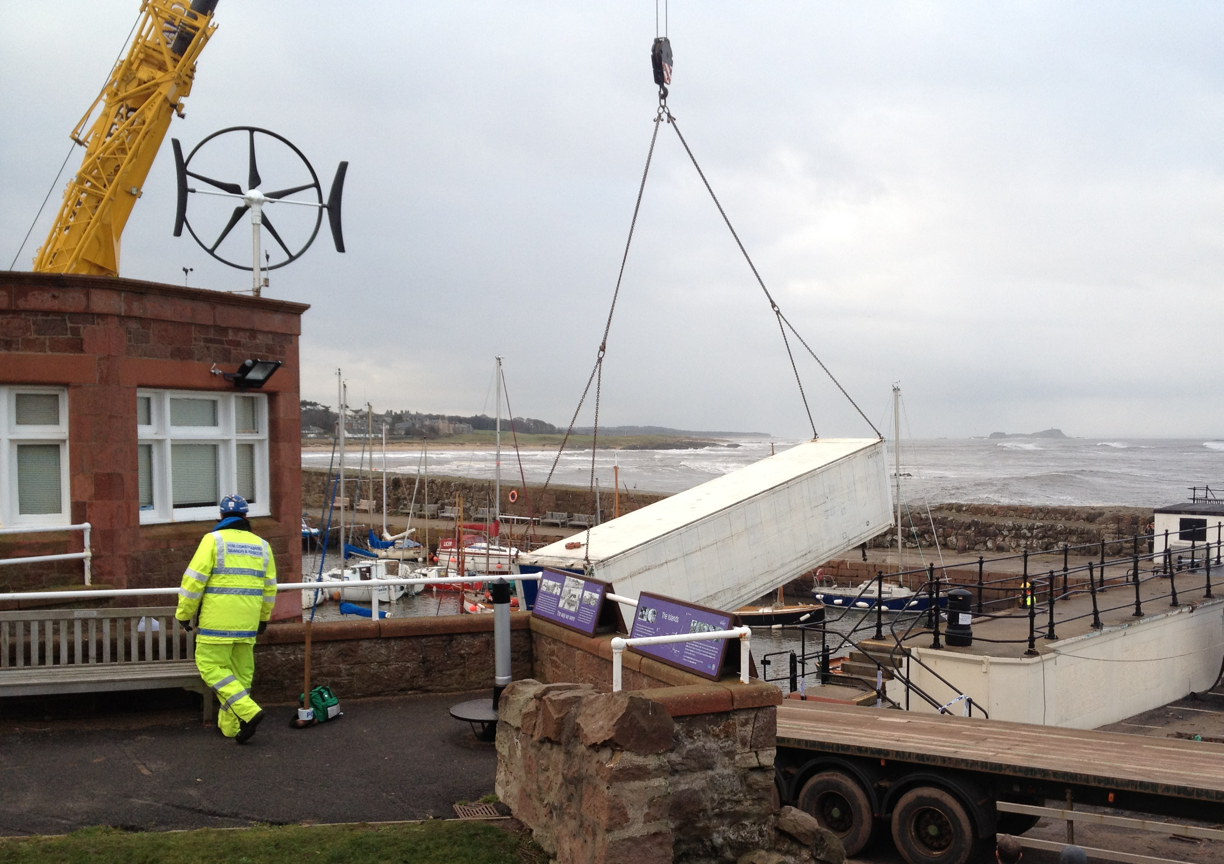
Those waves broke loose a 40ft container that had arrived only that day and was tied down adjacent to the Lobstery Hatchery at the east end. One of the fishermen intended using it as a keep tank storage of his catch. Once free, because its doors let in water only slowly, the container floated. Pushed by waves, it acted as a battering ram against the moored dinghies until it was swept along to the harbour quay underneath the Seabird Centre offices.

Here it fetched up against the yacht Borecay, standing on its cradle on the quayside. The metre-deep water pushed Borecay off its cradle and against the harbour railings so hard that they gave way and everything piled into the harbour on top of the boats moored in the SE corner. Meanwhile, the Girl Pat, sitting at the west end had been floated off its blocks and was driven against the old pool cubicle block so high and so hard that it bent the railings along the top, which stove in much of her starboard side. Local people have taken this particularly hard: this was Chris Marr’s boat.

Before dawn, as the tide dropped and the waves relented, the harbour was a hive of activity as ELYC members rescued as many dinghies as possible from the esplanade, fishermen were winching the harbour booms into place, Harbour Trust Association were trying to assess the damage and police, fire and ELC Transportation all showed up in strength to sort things out before the next, equally-high tide made it worse.
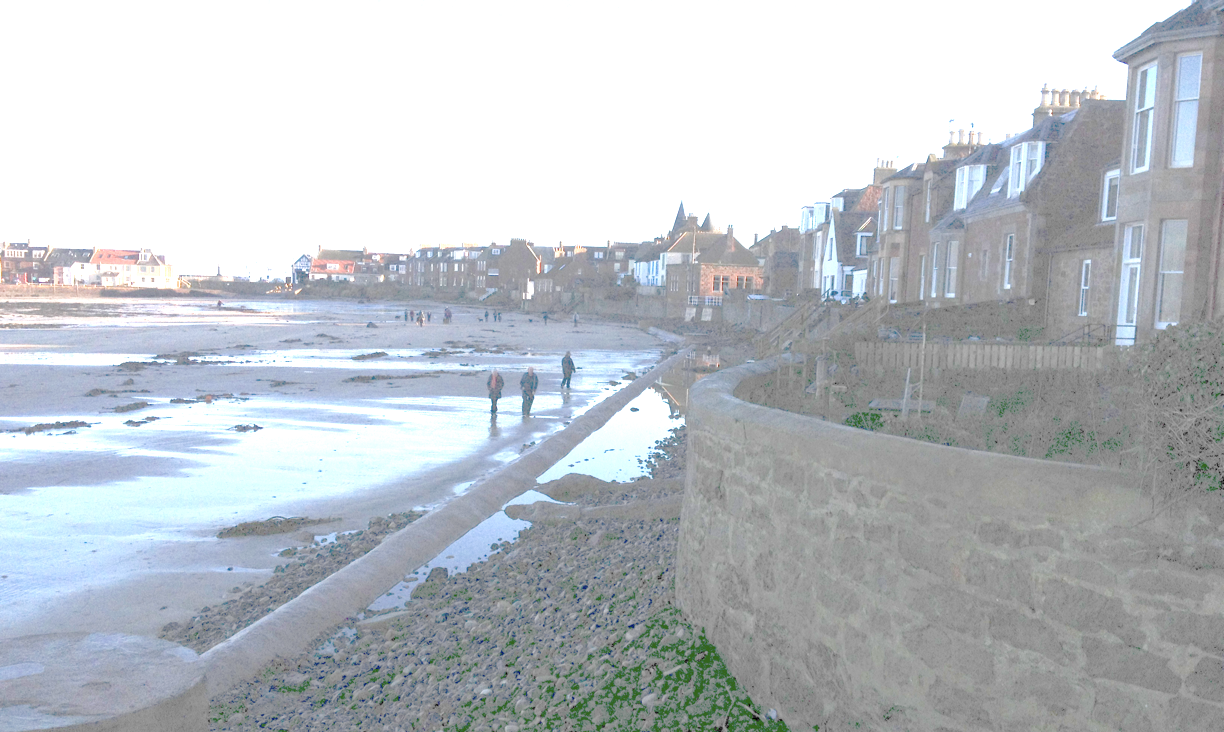
West Beach: This Is the Same View as Shown in the Header of This Page

West Beach: Low Tide and the Same View as Shown in the Header of This Page. A 2m Sand Cover Has Disappeared
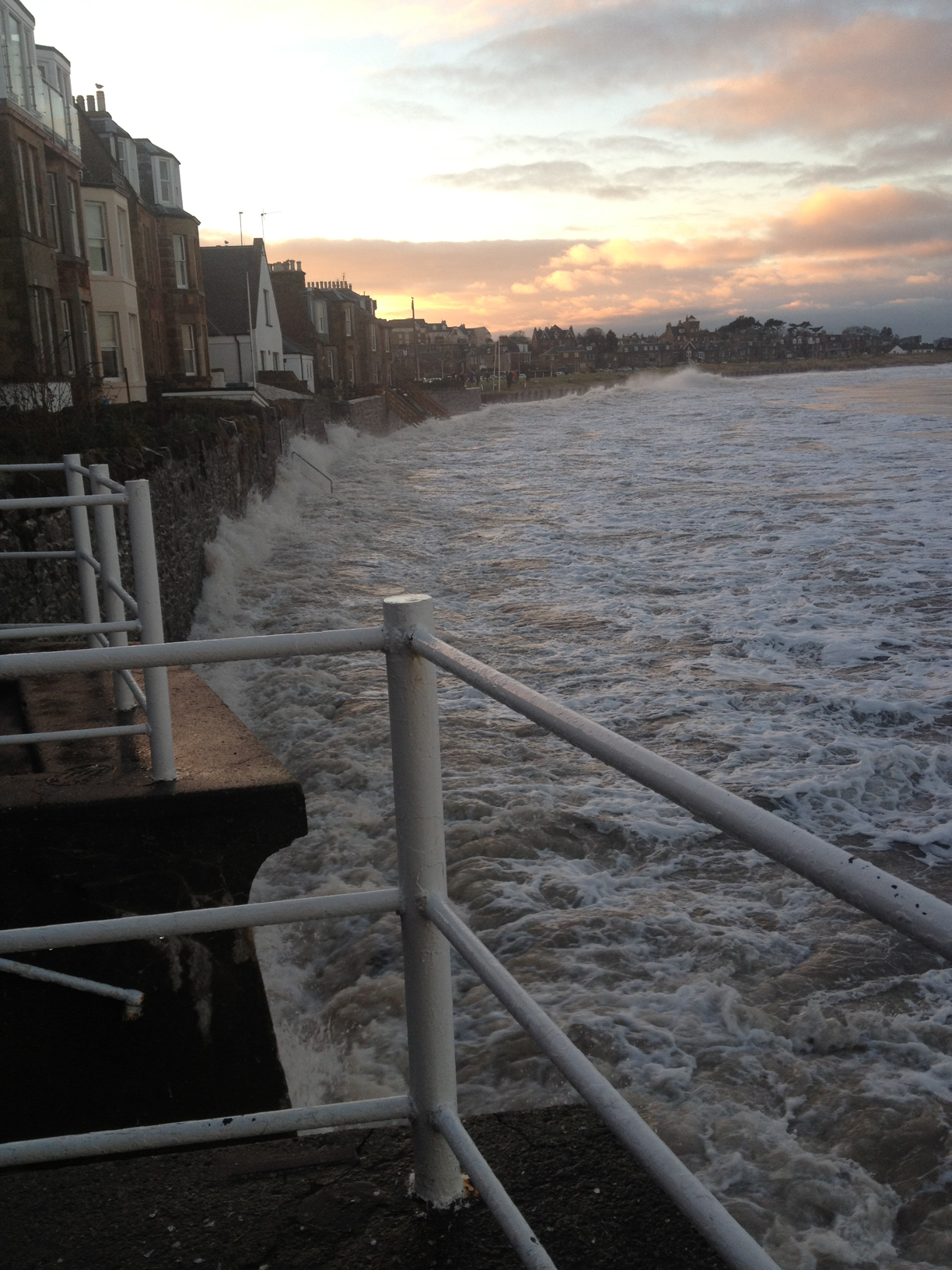
West Beach at 2pm—2 hours Before High Tide

West Beach at 2pm—2 hours Before High Tide. This View is in the Opposite Direction to the Above
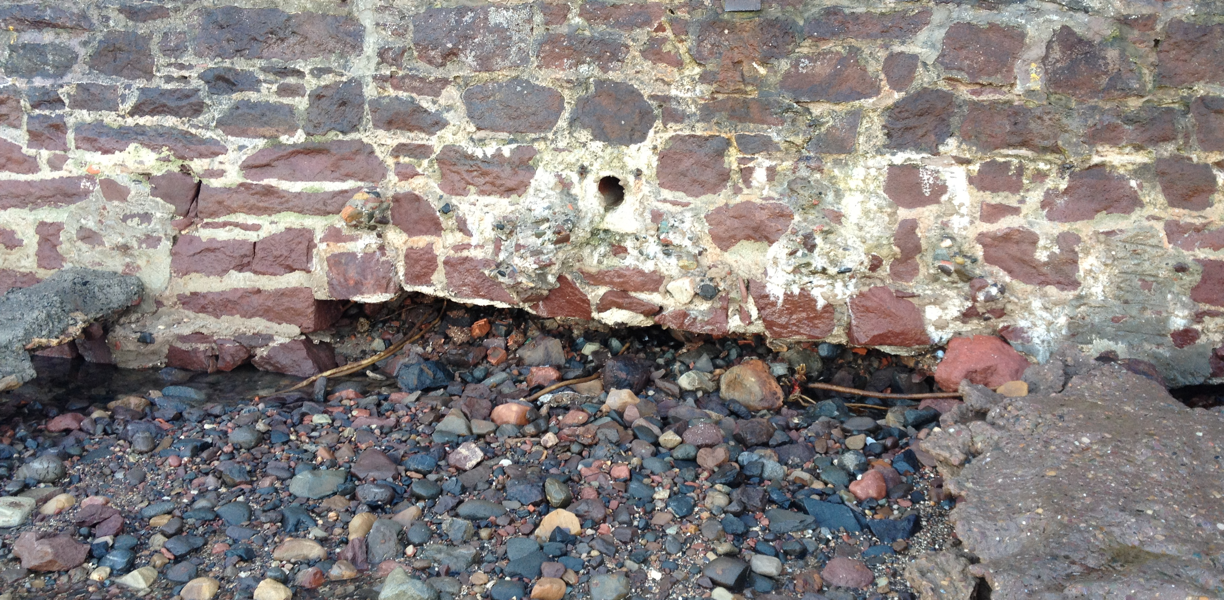
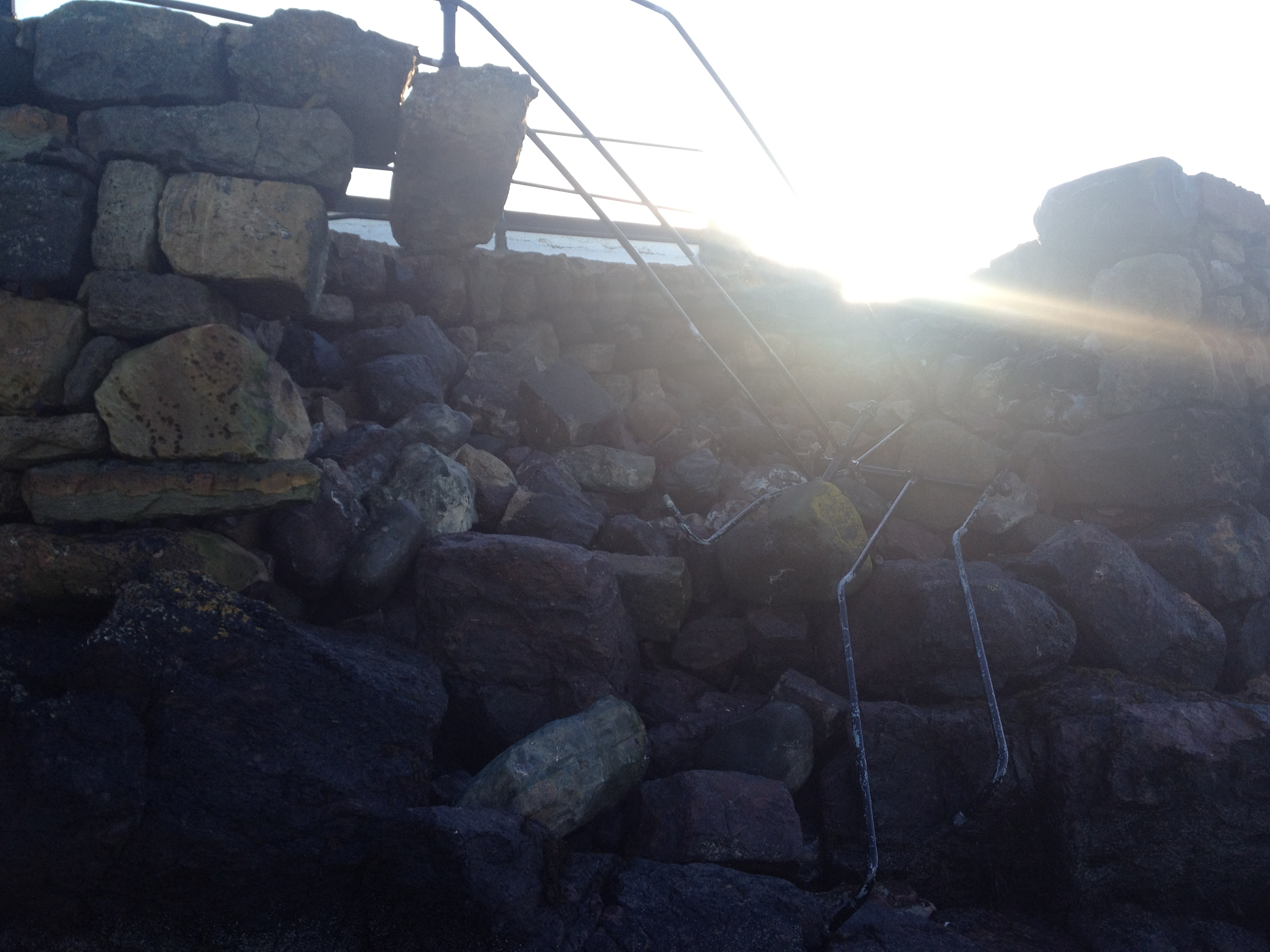
Detail to Show Undermining of Sea Wall, Forth St., NB

Detail to Show Undermining of Sea Wall, Forth St., NB

Although no significant damage occurred on either of the main  beaches, huge amounts of sand were eroded and marram grass areas all along the East Beach were halved in extent as the sea clawed 4-6m towards the road. Back at the Seabird Centre, the sea had entered by an emergency exit and partly flooded the exhibit area and cinema. But the main loss there appears to have been water damage to the shop store which is located under the cafe deck. Nonetheless, they were open for business again on Sunday.

Before the afternoon tide could return, all of the dinghies, most of the debris and all of the damaged boats had been recovered and removed. But nothing could be done to prevent more damage to the oldest part of the harbour wall at its NE corner. Here the rough stones had been held in place for half a millennium by wooden chocks through all kinds of weather. This time, it gave and a 5m section of the outer wall collapsed into the gully below. This exposed the rubble core which the afternoon tide washed out. By evening, only the pump hut on the N pier was holding up the inner wall and stopping the waves from gushing straight into the harbour.

The waves were observed to be an unusual format. The sea would be rough with normal waves for 2-4 minutes. Then a set of a half-dozen monster waves, most estimated to be over 4m would appear and, as quickly, disappear. More than anything, those super sets caused the bulk of the damage, coming as they did on top of a record sea levels around 6.4m above chart datum.
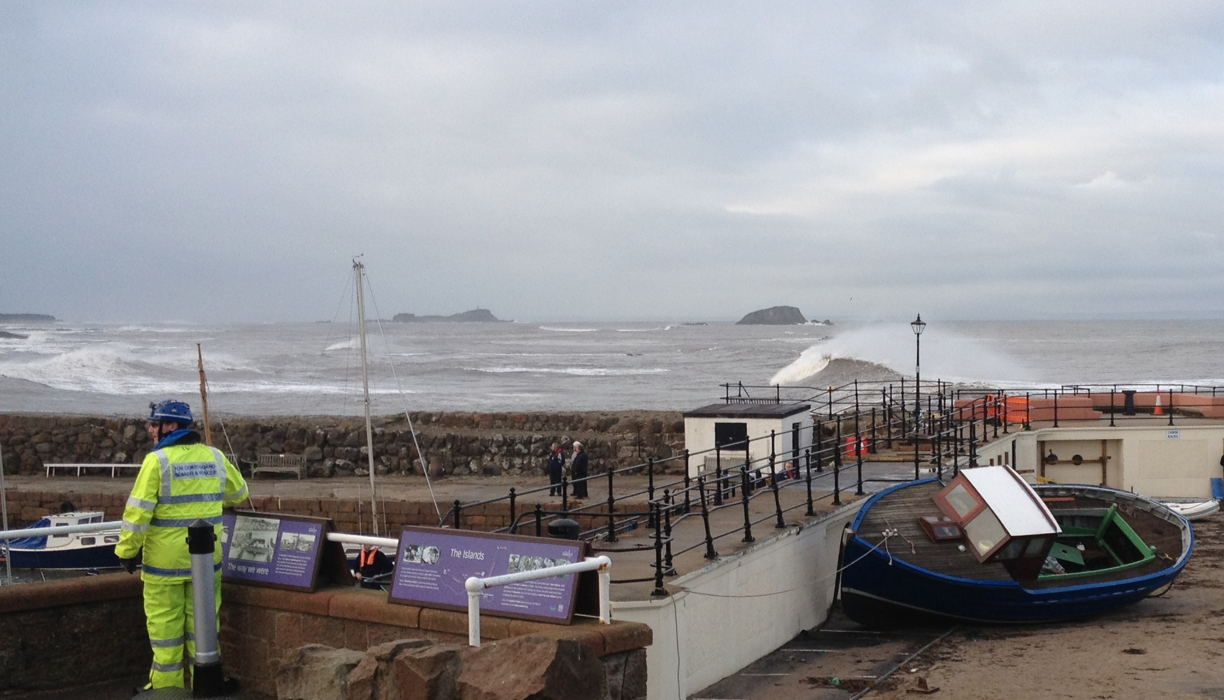
Girl Pat Against Cubicle Block Damaged Harbour Wall Between Breaking Wave and Pump House
Girl Pat Against Cubicle Block—Damaged Harbour Wall Between Breaking Wave and Pump House

Recovery of the Container from the Harbour
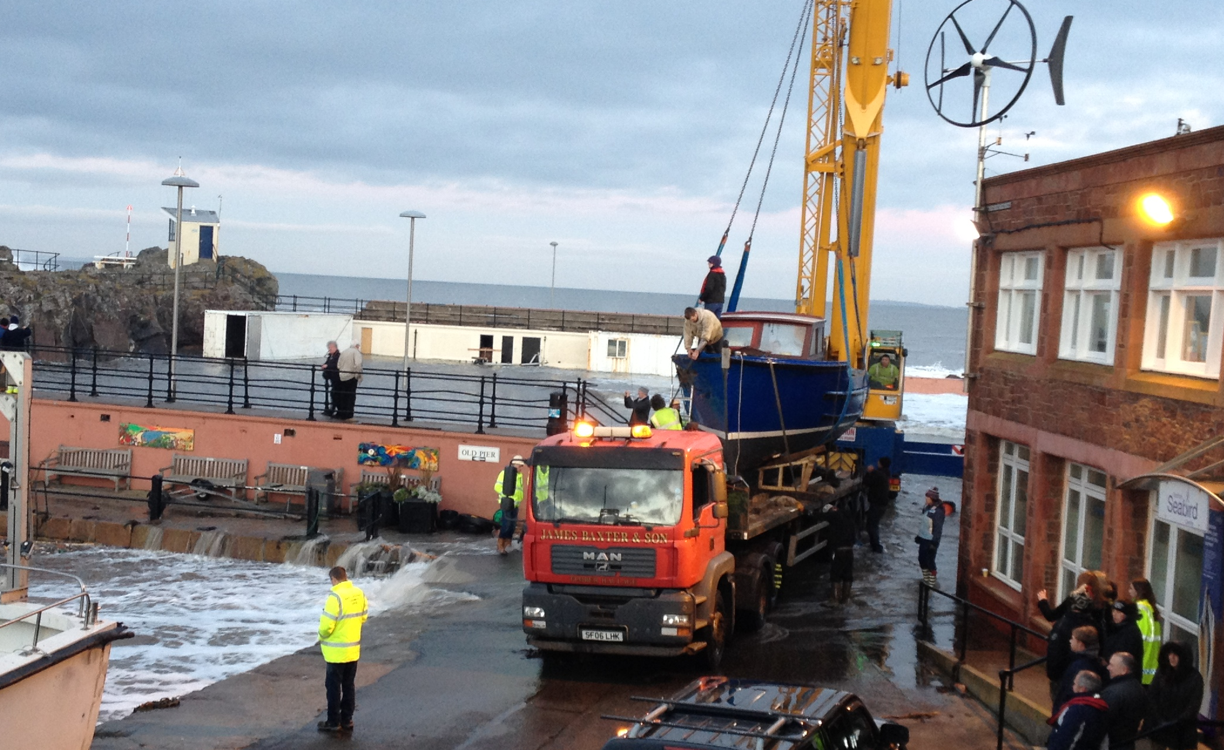
Recovery of the Container from the Harbour

Girl Pat Is Strapped Down for Removal—Note Water from Afternoon Tide on Esplanade & Flowing into Harbour

Removing Girl Pat—Note Water from Afternoon Tide already on Esplanade & Flowing into Harbour

Wreck of Steps to Galloway's Pier

Wreck of Steps to Galloway’s Pier

Hole in the Harbour Wall

Hole in the Harbour Wall East View Point—’Pipes” Are Wreck of Railings; Bench Was Found in Harbour

As fast as it had come up, the sea state dropped. Another 5.7m tide at 5am Sunday caused no damage and by daybreak, the sea was almost flat calm. The sun made it look glassy and it was hard to remember its stormy nature just one day earlier. It will take a few days to catalogue all the damage and a couple of weeks to come up with a plan for restoration. A figure of £500,000 was quoted in the press but that must be a guess at this stage

The hardest to solve but most urgent issue is how to deal with the harbour wall. It will need to be restored so that it does not look out of place, which will take both time and craft. Meantime, some temporary patch must be found because leaving it in its vulnerable, torn open state only invites another storm to break through to the harbour and wreak even more damage than we’ve had already. Adding the loss to boat owners to the major infrastructure problems, this is already a more costly storm than 2010.

While North Berwick usually likes publicity, the last three weeks have brought it too much of the kind it prefers not to have.It makes locals wonder what they have done to provoke something verging on the Wrath of God. Following our Fire Station burning down, we lost an iconic figure in Chris Marr within a week and, within a second week. have had the focus of the town wrecked in a night. Not the sort of run-up anyone wants to have towards Christmas.

Posted in Community, Environment | Tagged | Leave a comment

Responsibility Must Trump Rights

It may be 16 years ago but the inexplicable barbarity with which Thomas Hamilton shot 16 innocent primary school children in Dunblane sprang first to mind when the news broke of the equally horrific shooting of 20 innocent small children at Sandy Hook Elementary School in suburban Newtown, Connecticut.

Newtown is not one of the US’s many social disaster areas. It is a postcard-perfect New England town where everyone seems to know everyone else. In many ways it resembles Dunblane—an affluent outlying green belt town with many commuters, in this case using Metro North to travel the 70 miles into Grand Central Station in Manhattan. Its tree-lined streets are home to 27,000 and lie near Danbury CT in Fairfield County, just over the border from New York state.

The gunman was Adam Lanza, the 20-year-old son of a teacher at the school. It all apparently started when he killed his mother Nancy at her home nearby before taking guns she kept there and using her car to drive to the school with them. All US schools have security access but Dawn Hochsprung, the school Principal, recognised Adam as the son of a colleague when he rang for access and buzzed him in. She was one of the six adults who died when she went to investigate the sound of shots.

This early on, there is only speculation what the motive could have been. But whatever gripe Lanza may have had against his mother or the school management, how this translated onto 6-year-old children is difficult to fathom. He is reported by former classmates to have been a quiet, self-effacing, intelligent and nervous type. Because it is so typical, little can be read into the fact that his father Peter had divorced Nancy or that his 24-year-old elder brother Ryan had moved away and was living in New Jersey. Since Adam showed up wearing all-black combat gear and a bulletproof vest, this can hardly have been a spontaneous event. He made no attempt to escape and shot himself as police responded.

As we Scots have learned ourselves, even one such tragedy is too many. Though the United States is not as dangerous a place as those who have never visited might believe, this scale of willful carnage is entirely too commonplace there. This year alone, 12 people had already died at a Batman movie opening, six at a Sikh temple and, just this week, two more at a shopping mall. And the horrific scale of this rampage at Newton still does not top the 32 casualties Virginia Tech in 2007. It is a tragedy that the world even needs to have such a league table of carnage.

While some blame violent films, TV, games and other hostility-inducing elements of our culture, that does not explain why—Dunblane and Utoya being glaring exceptions—the bulk of such events occur in the States. Even the Canadians, who share a long open border and a very similar culture, do not indulge themselves in inhumanity on anything like the scale.

Some insight can be gleaned from more thoughtful films like Peter Bogdanovitch’s Targets (1968) or Michael Moore’s Bowling for Columbine (2002). The former explores what motivates a slightly unhinged young man to drag his gun collection out on a shooting spree, while the latter is a tongue-in-cheek documentary about American gun culture, the title deriving from the 1999 rampage in Colorado when 12 died.

The common denominator appears to be the US’s prevalent gun culture. While it was still a frontier country, carrying weapons there was an understandable way of life. But justification this Western mentality has long been history. A secondary reason is the also-understandable perception that Americans live in a violent society and each should be capable of defending themselves and their homes. This accounts for the bulk of the 250,000,000 guns in the States. Many people own two. The only other country to come close to the raw 0.88 guns per head statistic is terrorist-infested Yemen at 0.5 per head.

Whether because of the foregoing or the simple macho power it confers, supporters of gun ownership have always been a significant political force, spearheaded by the National Rifle Association (NRA), whose uncompromising slogan was coined by Charlton Heston while he was their president; “You can have my gun only when you pry it from my cold, dead hand.” Not the most flexible stance and made all the more resolute by support for gun ownership outvoting those who would curtail it over the last few years—recent massacres notwithstanding. “Guns don’t kill people; criminals kill people” is one of their more sensible mantras.

The defence pivots around the Second Amendment to the US Constitution—a hallowed document that is revered to an extent a constitution-less Brit has trouble comprehending. The NRA and its supporters often quote this in their arguments:

“the right of the people to keep and bear arms shall not be infringed”

Which sounds pretty definitive; like it or loathe it, this seems to make a conclusive case that guns can be owned and carried by those who wish to do so. But the above is only a partial quote. The full text of the Second Amendment reads:

“A well regulated militia being necessary to the security of a free state, the right of the people to keep and bear arms shall not be infringed”

When this was adopted (in 1791), it made perfect sense. America had just emerged as the first colony to set itself free after a long and bloody war. It would soon be plunged into the war of 1812 and so the idea that its citizens could transform into well armed militia volunteers was a vital one and deserved enshrining. But that was 200 years ago. Europeans have far more recent arguments why they should go about armed to the teeth. But they don’t.

Whether Obama can take this anachronism and its powerful lobby on remains to be seen. But, in the meantime, it is providing cover for an arsenal to be available in almost all US homes. And, despite statistics showing that the great majority of the times they are used it is on members of the same household, opinion in support of that ‘right’ has remained firm.

Which means that the naturally occurring tiny psychotic minority (especially among teens and young men struggling with identity, hormones and drugs) have access to the personal equivalent of nuclear armageddon. That some use it is hardly surprising: to a 20-year-old (to quote Spike Milligan) ‘patience’ is a word invented by old farts who couldn’t think fast enough. Such behaviour is also hardly surprising in a culture where community generally tends to be thin as people move often and wall themselves off from each other in ranch-style homes.

But that last point does not appear to apply to idyllic Newtown, which could be the model for every fresh-faced, uplifting film about cosy community from “It’s a Wonderful Life” to “Home Alone”. So, even though all of the facts are not yet in, we are left with guns plentifully available to pyschotic youngsters as the only coherent explanation for what just happened there. Their ‘right’ to bear arms was not balanced by any functioning sense of responsibility towards the community of fellow humans.

And the only way for government to make a direct contribution to avoid more of this is for it to face down the NRA for once and knock away its main justification by a long-overdue repeal of the Second Amendment. Otherwise, Obama’s legacy is toast and America will fully earn Oscar Wilde’s scathing observation of being: “the only country to have gone from barbarism to decadence without any intervening civilisation“.

Newtown's Grace Christian Fellowship Holds a Candlelit Vigil

Newtown’s Grace Christian Fellowship Holds a Candlelight Vigil

Posted in Community | Tagged | Leave a comment

Part of the Job

At this week’s meeting of East Lothian Council’s Cabinet, a draft paper on the Council’s Health & Safety policy was discussed. Not, you would think, the most exciting of topics, especially as H&S has become something of a joke these days, requiring behaviour that some would regard as excessively cautious: kids are banned from playing conkers or riding to high on swings.

But, as it is nonetheless necessary to set rules for worker safety, I posed a couple of questions, chief among which was how we would ensure that staff would not use this policy as an opt-out from doing their job. I cited the 2008 case of Allison Hume who fell down a disused mine shaft in Galston, Ayrshire. Strathclyde F&R crews were soon on-site with the necessary ropes and harnesses. But managers deemed the rescue too dangerous and it was seven hours until a mountain rescue team arrived, by which time, Allison had died of her injuries.

ELC staff encounter equivalent cases—whether it’s the bin men who pirouette wheelie bins safely through traffic or social workers who trudged through snow storms two years ago to ensure all their clients were warm and safe or the grit lorry drivers who, by definition, are out on empty roads in the worst weather we get. To date all have been both dedicated and heroic. But, what if they got precious and ‘did a Galston’, declining to take any risks and citing H&S policy?

I was reassured that such would not be the case and that, while risk analysis has been done for all ELC jobs, appreciation was always shown staff who went that extra mile. What I found much more reassuring was a reality check on Lothian’s Number 26 bus related in the Tim’s Tales column in this weeks East Lothian Courier. I thoroughly recommend buying the issue just for this tale but, since the Courier’s scant website only publishes a fraction of the print, I paraphrase it here for those too far from civilisation to get “dead-tree media” yourself.

A Tranent woman was returning home on the lower deck of a Lothian 26 bus on a dark, cold evening witnessed an example of someone doing more than just their job. As the bus approached Musselburgh, a group of five young lads got on, all of whom went upstairs.

At the police station,  a young couple around 16 got on with a babe in arms and sat opposite the woman in the pushchair space. When two more lads got on at Newbigging, one recognised the young father and made a threatening gesture to him before both climbed to the top deck to meet the other lads already there. Both he and the mother turned pale and looked distressed.

A tense situation got worse when the two lads returned with three of the others who had boarded earlier and crowded into the seats around the couple, who said nothing. Then the father touched his partner’s hand and stood up as if to get off at the next stop and, presumably, run for it.

As the bus slowed to the next stop, all five lads stood up and waited behind him near the door. Meanwhile, the mother had been frantically trying to phone someone and, because she could raise no answer, had started to cry. It was an ominous situation and the woman witnessing it had no doubt that trouble was about to erupt.

But, just as the bus halted, a clear voice rang out “You lot stay there—you’re no’ leavin’ the bus here.” It was the bus driver, a woman. She looked back up the bus at the mother and asked “You want to get of here too, hen?” Through the tears, the mother shook her head, sobbing “It’s no’ oor stop.”

“Fine” said the driver, turning to the five lads “youse can get off now” and, turning to the father, “and you go sit wi’ yer bairn”. The father slipped unmolested past the five to sit back down beside his young partner. The five lads remained standing by the now-open doors. “Well, go on” the driver said.

“This isnae oor stop either” said one of the lads. “It is now”  the driver shot back, with such authority that the lads called the remaining two down from the top deck who remonstrated why they were being ‘pit aff’ into the cold and dark.

” We’re gettin’ a row fae the driver: we’ve tae get aff the bus; she’s telt us tae.” explained one of the five. The driver backed that up “Come on lads, hurry up—there’s another Tranent 26 in five minutes. I’ll let the driver know.” And all seven exited quietly.

The doors closed after them and, as the bus pulled away from the group, the young father gave a triumphal laugh. But the driver snapped at him “That’s enough. You hae a bairn and yer a dad, so act like one.” He nodded in silence, hugged his partner and, for the first time, looked directly at his baby and smiled.

As they got off a few stops later, he said “thanks” to the driver. “Nae bother” she replied “just mind ye hae a bairn now”. As the woman witness got off a few stops after that, she stopped at the driver’s cab and said “Well done for that”. The driver just smiled.

The incident wasn’t major—it might even be commonplace. But you can bet your life that this brave and shrewd intervention by the driver appears in no Lothian training manual, let alone any Health & Safety policy. What the woman witnessed is exactly the kind of thing that makes community more than a random collection of houses populated by individual selfishness.

The driver didn’t need to do what she did and, if identified, would probably get a row from her boss or Lothian’s legal department. But both the young couple and the seven lads shivering five minutes for the next 26 learned something about respect and boundaries and strangers who aren’t really strangers that made them better citizens.

We need people like that driver on our buses, on our grit lorries, in our social work—regular folk who can handle themselves, who would modestly say they’re only doing their jobs but are, in fact, the sensible glue that holds all of us together. Long may we have such people quietly doing their job with such engagement and understanding: we are all the better for it.

Posted in Community | Tagged | Leave a comment

Chris Marr: Obituary

Early in the morning of Sunday December 9th, Chris Marr was found with serious head injuries in Bank Street, North Berwick. Though rushed to Edinburgh’s Royal Infirmary, he died soon after. The police, so far, are treating the death as ‘unexplained’ and have no firm evidence to substantiate any of the rumours of foul play now buzzing round the town. An explanation will be established, probably soon. But that doesn’t help those of us who knew him come to terms with our loss.

My first contact with Chris was literal—at NB Primary when it was still in what is now the Community Centre. It was a robust contact, he was two years older and we were playing football on the tarmac at the back of the school when he shoulder-charged me out of the way. He was a robust, crusty character even then—quiet-spoken, direct but a hair-trigger temper that suffered no fools. But when there were apples to be scrumped or snowfall offered sledging down the Greenheads, Chris was to the fore.

Which is as it should have been. Coming from a long line of North Berwick fisher folk, the Marrs had provided their share of local harbourmasters and seasoned sailors for the Royal Navy when the colours called. His family lived first at 34 then 43 Melbourne Place, within spitting distance of the sea. In the fifties father Fred brought a modern boat in among the small zulus and one seine netter in the harbour—a trig wooden motor boat with a high fo’cstle and wheelhouse for’ard and work space aft he called the Girl Pat after his only daughter and younger sister to Chris.

Though bright enough, Chris was no academic. By the time he was fifteen, he was already helping Fred at the creels over his summer holidays. Soon after, he left school to make it permanent. But, like Chris, Fred wasn’t content with just lifting crabs and lobsters for its seasonal living. He secured the NLB contract to ferry lighthouse keeprs and their supplies out to Fidra and Bass Rock. In this role, the two of them featured in a scene from a promotional colour film made in the 1960’s by the town council, called “A View from the Bass“.

Still this wasn’t enough for them, so in 1970, remembering David Tweedie’s success with pleasure launches in the 1950’s, they invested in the original Sula to take people on summer cruises round Bass Rock. This was soon replaced by Sula II in 1972, a clinker-built open 76-seater brought all the way up from Norfolk for the purpose. Soon this became the highlight of any summer visit to the town, with Fred and Chris growing their carrot blonde hair and beards in the flowing fashion of the time, they looked like a crew more appropriate to a longship of the Viking era.

Gannets over the Castle & Lighthouse on Bass Rock

Gannets over the Castle & Lighthouse on Bass Rock

Business grew so that they could both afford impressive neighbouring houses at the harbour end of Victoria Road. Chris married Meg and three daughters followed in the six years to 1982. As well as ferrying visitors and lighthouse loads, academic interest in seabirds was growing and so boatloads of ornithologists and artists were added to the summer traffic. At the time, the gannet population on Bass Rock only covered the cliffs and a fraction of its top and Fidra had not been overrun by gulls so landing trips with time on either island were commonplace.

Taking over from Fred’s short, gruff trip commentary, Chris added more extensive data on the fauna and, developing his interest in local history and scuba diving, peppered each trip with more historical snippets and details of wrecks. The more he learned and explored, the more his enthusiasm grew until he was spending days in the winter off-season researching details in the local History Centre in Haddington and becoming something of an expert in 100+year-old back issues of the Courier.

Business during the summer months became so intense that sister Pat and even her husband Ken Macaulay were recruited as crew. And, though none of his own daughters took to the sea like their dad and grandad, his nephew would get hauled in on occasion. By the millennium, Fred, along with ‘Craw’ Pearson, was regarded as the the last of real characters, the fisher folk ‘old guard’ who had dominated the local harbour for so long until yachts and dinghies displaced the few working boats.

Fred’s career high point may have been piloting Prince Charles round the Bass as part of the Scottish Seabird Centre opening in 2000. But, as Fred aged and participated less, Chris became the more recognisable figure with local and visitor alike. His greying red hair, erect military bearing and purposeful stride were unmistakable from a mile off. To say he was loved (other than by family) might stretch a point. His bearing was stiff—a body language some found off-putting; if you were incompetent or forgetful around him, his impatient anger could be merciless.

But, catch him in the corner of the Auld Hoose bar of an evening and ply him with a pint and informed questions about the wreck of the Fusilier or the U-Boat off Dunbar and, if your knowledge could keep your end of the conversation up, you’d learn more detailed local history in an hour than any other way. The man had passion, a great love for his home town and a mind broad enough to absorb and integrate its myriad stories.

After the daughters had left home, he and Meg split up, eventually selling the home, with Chris landing back in Melbourne Place a stone’s throw from the sea and literally across the road from where he’d grown up. But he still ran Sula II with a level of boatmanship that 40+ years of guiding some three million people out to the amazing sight of Bass Rock had made exemplary. To see him pirouette the 12m boat with 70 people aboard inside the crowded confines of NB Harbour was to see a master at work. A quiet man who kept things personal, few guessed he was losing his enthusiasm after doing that same trip over and over again over all that time.

And so, in agreement with Pat, 2010 was the last season of trips on Sula II with Chris at the helm. The business and boat were sold and another operator, who has struggled to approach the 8,000+ passengers each season that Chris had attracted. For the last two years, he had more time for his local history and wreck charts, keeping himself to himself, as he had always done.

Sula II with Chris at the Wheel and Pat Preparing Fenders Approaches the East Landing of Bass Rock

Chris Takes Sula II Astern to Clear the East Landing at Bass Rock, © John Richardson

Quite apart from the shock for those who knew him, for those who could recognise his erect stride a mile off, he is a loss to the whole community. With Chris, the family name of Marr, so prominent in and around North Berwick harbour for eleven generations, dies out. And we’ve lost an individual who navigated life by his own compass, melding a family tradition with his own talents to be different, unique, a man of deeds, more at home beside/on/in/under the fickle waters of the Forth than in any desk-bound office or elegant dinner party.

Chris will be mourned by his family. My deep sympathy goes out to them for their great and untimely loss. But I expect that so many more—even those who crossed swords with him—will, like me, also mourn him, remembering him as his own man, a man of unique character who both loved and enriched this place he had always called home so that we came to a deeper appreciation of it ourselves.

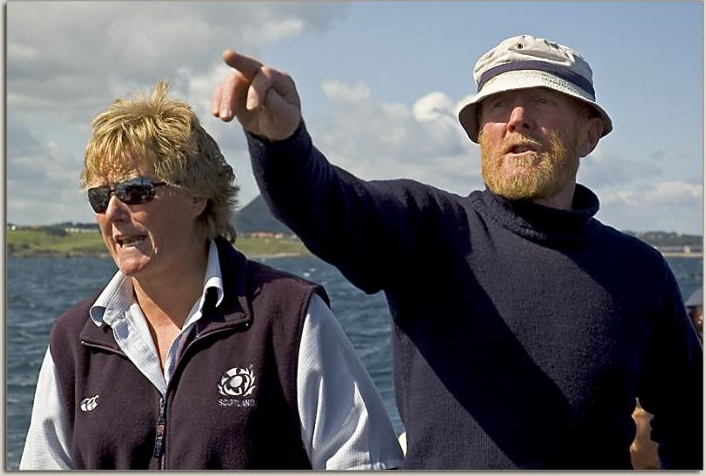
Chris Marr (1946-2012) Last of a Long Line of North Berwick Boatmen R.I.P.

Chris Marr (1946-2012) Last of a Long Line of North Berwick Boatmen R.I.P. © John Richardson

Posted in Community | Tagged | 22 Comments

On the First Dodge of Crimbo…


12DodgersFound this on Facebook and thought it too good not to rip off from:

http://www.facebook.com/peoplepowerchange

Posted in Commerce | Tagged , | Leave a comment

‘Tory Evolution’: an Oxymoron?

There appears to be a concerted programme of disinformation being followed by unionist parties. The latest is how Scotland would need to reapply to be an EU member in its own right, complete with letter to the House of Lords stating this. At least, that’s what the Hootsmon claimed this week.

Except, there wasn’t any letter and the Hootsmon was forced to print an apology to that effect. Yet that didn’t stop the Tories fulminating that the SNP had changed its mind on EU membership by shifting from a position that membership would be automatic. For the objective third of Scots yet to jump into one trench or the other on this, allow me to recap the story so far:

  1. Originally, the SNP opposed EU membership as it would mean some loss of sovereignty and, having none at the time, they were impatient for all 100%.
  2. As the party matured in the 1980’s wilderness, it realised how Scotland might benefit from good friends outside the British Isles too and became pro-EU.
  3. The EU has no official process for ejecting a member or for dealing with an existing member wishing to become two. Barossa’s comments this week reflect the closest thing to that: anyone not a member must follow the accession process to become one. This is the answer he gave David Martin MEP in 2004.
  4. The SNP’s position is Scots are already members, complying with membership requirements, so there should be no obstacles to Scotland remaining a member.
  5. Furthermore, in the event that the Commission decided that any renegotiation were necessary, the two years or so between 2014 and 2016 could resolve that while Scotland was still a UK component. We could slide seamlessly from membership as a part of the UK to membership in its own right.
  6. Scotland is NOT comparable to ‘new’ members seeking accession: it does not have Turkey’s human rights issues, Serbia’s racist history. Iceland’s belligerent fisheries or Croatia’s dubious finances. It is the only oil-rich state the EU, would make positive net contributions; therefore most members don’t want to lose us.
  7. Those few states who have an issue are restricted to Spain (not wanting to encourage the Catalans) or Belgium (not wanting to encourage the Flamands). But the idea of Flemish provinces that border Brussels being thrown out of the EU is so ludicrously self-evidently stupid that it’s hard to see the Commission ruling that way for Scotland in case it would set a precedence for Belgium.
  8. Before and after 1707, Scotland was and is a country, with its own laws, church, culture and identity. It STILL ranks 15th among recognised states in the world. The United Kingdom is just that—a union of two countries and, like a marriage, the creation of a joint identity does not erase either original identity.

Though some are undoubtedly playing the daft laddie on the above, the worst is the Scottish Conservative & Unionist Party. Though there are honourable exceptions—members who are genuine Scots and shred their lip staying loyal to what their southern cousins get up to—the bulk behave much like an English National Party. From the leafy shires of the Home Counties come a phalanx of Tory MPs for whom culture ceases beyond Watford; they just don’t ‘get’ the diversity of Britain. Whether backbench Jeremy Hunt & Spock (John Redwood) or front-bench Michael Gove & Philip Hammond, the Surrey mafia rools (ya bass).

A measure of Tory lack of modernity is that the ‘unionist’ part of their title has nothing to do with Scotland; it refers to Ireland. Hundreds died in the last century for that supposedly unifying sentiment. If it made any sense today, why would Eire not reject any ‘Arc of Insolvency’ and be clamouring to get back into the UK? This week’s riots over flying the flag over Belfast City Hall underscores how unresolved feelings remain there ninety years on from sneaky retention of the six counties as part of the UK. This was done to give fig-leaf cover to the ‘union’ part of their title.

As they dig their heels in about Scotland too, despite their having been reduced to a rump here for doing so, you wonder if they’re secretly plotting to hold on to Shetland or Faslane à la Ulster. While appalling personal attacks on the First Minister may well be all that Scottish Labour in their reduced straits are capable of, our Tories had at least once shown both guts and ideas—until Murdo Fraser’s radicalism lost out to Babe Ruth’s pitch to the blue-rinses.

Since then, Ruth has shown herself every bit as dire as Johann, dabbling any mud handy and flinging it across the chamber. This is a pity. With the virtual annihilation of the Lib-Dems as a force at Holyrood, the Tories are our one hope to keep pace with the SNP and hold them to account: ‘Bella’ Goldie achieved quite a lot doing just that 2007-11—but her matronly low-key lessons seem to have been ditched.

This week, things deteriorated further with Jackson Carlaw carping about perceived SNP inconsistencies about Europe. Granted, the UK Tory record of dire hostility to Europe from Thatcher to May is forced on them by a significant Eurosceptic wing of the party who behave as if the next Napoleon were about to muster another invasion force on the Pas de Calais. But the more reasonably balanced Scottish Tories have no room to talk, bound as they are to xenophobic English colleagues who run the show.

Perhaps its because the English have such influence with them but Scottish Tories seem oblivious to the Scots’ relative warmth towards Europe and immigration and their total rejection of UKIP and BNP. They are not embarrassed as the rest of us are by a grumpy UK approach to our best market and nearest friends. They are not annoyed as the rest of us are that they sell our major fisheries and spirits duty interests down the river, that they keep air passenger duty high so we have few direct links into those markets, that the real advantage of HS2 is over the long distance to Scotland and that is kicked into the long grass.

But, most of all, they betray their own principles of self-sufficiency by pooh-poohing that Scotland has enough oil left worth exporting, that we could become THE leading source of renewable energy, that we could make things business-friendly so that BAE would keep building ships and we might stretch our existing lead in quality research and manufacturing over our English cousins as they struggle to overcome the Osbo/Irn Broon debt mountain while we pay off our share in short order.

Which is a shame. We need a decent opposition, especially when we get independence. If our Tories were to climb out of the swamp they’re wallowing in with Labour, we could see Keith Brown being challenged on transport ideas, Swinney’s mettle tested with alternatives for business growth and Lochhead not monopolising farming’s enthusiasm—an area Tories once called their own.

If they want to get a clue, they could start by shutting up and watching one of their own. Liz Smith sets no heather alight. But she knows her education brief, has carried it with distinction for years and is pragmatic enough to work with others to achieve her goals. She is one of the few reasons I do not look forward to more Tory wipeouts in Scotland. And, dire as any other opposition is, that’s their future if their collective heads stay stuck in history’s sand while their country moves far beyond them.


Posted in Politics | Tagged | Leave a comment

How Many Does It Take?

Scotland has a proud history of making things. Our industrial revolution was built on a robust base of a very manly heavy industry that once supplied steel and locomotives and ships to a significant portion of the globe. The eighties boom of ‘Silicon Glen’ may now also be history but, even today, we are proportionally more engaged in making and exporting things than our English cousins, whether it be oil & gas equipment, whisky, Irn Bru or Tunnock’s Caramel Wafers.

But, like most Western economies, we have developed into a service economy, with more people earning a crust by hairdressing, sales or Macdonald’s. The extent to which this is true has been underscored by The American Lawyer. performing what it calls the Valuation Calculation, in which it estimates the market value of top law firms, as if they were regular companies.

Bearing in mind that two of the top Scottish manufacturing companies are the Wood Group (market value $4.6bn) and Weir Group (market value $6.2bn), then the ‘top ten’ law firms shown in the table below give food for thought:

LawFirms

And that’s just the top ten. There are 100 global law firms with valuations over $250m. It’s not just on TV that law firms have been taking over the world. The famous US tendency to sue first and be reasonable later has led to a litigiousness spreading around the globe. According to Reuters, legal fees in the Gulf of Mexico oil spill are expected to run into nine figures—i.e. over $100,000,000.

If it were only such major actions that incurred such fees, then the costs would be buried in financial statements for large companies. But every time your bank writes to you about some change in conditions on your account or credit card; every time your insurance company adjusts your claim conditions, the letter always comes with a booklet of dozens of pages of tightly printed 6-point text that is not only illegible and incomprehensible but is invariably never read.

Such boilerplate, cover-your-ass sophistry was all created by lawyers, none of whom work for free or for you, even though you pay their (high) wages through bank charges, premiums, etc. And, because they spend a career knowing the rules and the exact square micron count each angel requires to dance on a 1 oz dressmaker sewing pin (not to mention where the bodies are buried in each deal), they have the inside track on promotion.

As a result, almost the entire 535 members of the US Congress are lawyers; according to Businessweek, 11% of the S&P 500 companies have CEOs who are lawyers—more than from any other background. Which goes a long way to explain why Western businesses have become so cautious and unimaginative and generally having rings run around them by Asian companies these days. Innovative Western companies are still led by mavericks—whether it’s Richard Branson at Virgin or Micheal O’Leary at Ryanair.

But, more importantly, their substantive-and-growing salaries (not to mention tomes that no-one reads) are all paid out of company funds, which leaves that much less for dividends or, more importantly, for investment. Coupled with bloated CEO salaries, lawyers’ fees are the biggest fiscal drag on business here in Scotland.

And, in case you think that’s their only source of income, Joe Public paid £153m to them in Legal Aid last year, with ex-MSP Gordon Jackson QC taking £407,000 of that personally. The 150 QC’s in Scotland receive fees of £500 per hour for their time, though they do nothing so vulgar as charge by the hour.

Picking on Scots lawyers is unfair because they’re no worse than elsewhere. But you have to ask what they are all for—other than their own self-serving preservation. When law firms vie with our largest companies in market valuation, do we not have our priorities about what matters seriously wrong?

No wonder the jokes continue (“What do you call 500 lawyers at the bottom of the sea? A start.“). My favourite is a variant on the ‘lightbulb’ joke: How many lawyers does it take to change a lightbulb?

Whereas the party of the first part, also known as “Lawyer”, and the party of the second part, also known as “Light Bulb”, do hereby and forthwith agree to a transaction wherein the party of the second part (Light Bulb) shall be removed from the current position as a result of failure to perform previously agreed upon duties, i.e., the lighting, elucidation, and otherwise illumination of the area ranging from the front (north) door, through the entryway, terminating at an area just inside the primary living area, demarcated by the beginning of the carpet, any spillover illumination being at the option of the party of the second part (Light Bulb) and not required by the aforementioned agreement between the parties.   The aforementioned removal transaction shall include, but not be limited to, the following steps:

  1. The party of the first part (Lawyer) shall, with or without elevation at his option, by means of a chair, stepstool, ladder or any other means of elevation, grasp the party of the second part (Light Bulb) and rotate the party of the second part (Light Bulb) in a counter-clockwise direction, this point being non-negotiable.

  2. Upon reaching a point where the party of the second part (Light Bulb) becomes separated from the party of the third part (“Receptacle”), the party of the first part (Lawyer) shall have the option of disposing of the party of the second part (Light Bulb) in a manner consistent with all applicable state, local and federal statutes.

  3. Once separation and disposal have been achieved, the party of the first part (Lawyer) shall have the option of beginning installation of the party of the fourth part (“New Light Bulb”). This installation shall occur in a manner consistent with the reverse of the procedures described in step one of this self-same document, being careful to note that the rotation should occur in a clockwise direction, this point also being non-negotiable.

Posted in Commerce | Tagged | Leave a comment

Pretzel Logic

Sebastian Junger Is  Freelance Journalist in Afghanistan & Author of "The Perfect Storm"

Sebastian Junger Is a Freelance Journalist in Afghanistan & Author of “The Perfect Storm”

Posted in Uncategorized | Leave a comment

Osbo’s Tunnel of Osterity

We are, it must be said, lucky. Not only do we live in Scotland but, unlike the dark days of the 1980’s, we are sheltered from the worst excesses of a Tory government in London by the existence of one in Edinburgh that has scotland as its one and only priority.

Now, given that belts have been tightened for the last three years and today the Reichskanzler had little joy to spread around other than some sheepish news that—oops—he had got his sums wrong and his bitter austerity that would end in two more years would actually have another five to run, fiscal hair shirts will be the fashion for the rest of the decade.

No Consensus—Half Percent Correction Still Not Enough?

No Consensus on Future—Half Percent Growth Correction Still Not Enough?

Those with a sense of history or really long memories might recall that it took us less time to recover from WW2 than it will take us to recover from investment banking out-of-control rave in 2007 that left many Western economies dead in the water—or should we say “dead in the sand” because liquidity, thanks to banker greed and Irn Broon complicity, is the one thing that went AWOL.

Wherever you stand on Osbo’s “Osterity”, today’s Autumn Statement announced—between sounds of humble pie being chomped—that £5bn was to be freed up for application to capital projects that will help restart the economy. This is good news. John Swinney has been arguing this for two years but no matter: a sinner has come to his understanding. Pushed through the Barnett mincer, that amounts to £394m in extra capital funding for Scotland, along with a basic revenue rise of £90m. However, because of departmental cuts of £160m, it boils down to about £330m.

As well as knock-on effects of road improvements in England, such as upgrading the A1 below Newcastle, Scotland will therefore see, for example, £34m of shovel-ready roads projects come on-stream over the next few years, including the A9 upgrade. This is in addition to Perth and Aberdeen being lined up for ultra-fast broadband. But the problem is that all this only restores part of the £1.3 bn shaved off Scotland’s capital allocation in the years up to now. Still, it’s a gift horse; let’s not quibble.

Because, as Oscar Wilde might observe, it’s what’s not being talked about that’s worse. Extending the hair shirt season to almost 2018 means that public services, far from seeing light at the end of the tunnel in 2014, will have anther three years of cuts to contend with. This is seriously bad news: both the NHS and councils—which together consume 2/3rds of the Scottish budget—have already seen three years of belt-tightening. Any low-hanging fruit for savings has long been picked.

We are just about to come into council budget-setting season. John Swinney distributed the proposed settlement to councils last week. Today’s largesse will have little or no effect on it. While it is nominally an increase on last year’s totals, all of that will be swallowed up by ‘scale progression’ (= grade promotions) and a 1% pay deal. With demand for services such as Adult Social Care increasing around 8% each year and people poorly disposed to cost cutting measures, be it charging for school buses or fortnightly bin collection, councils were already heading for a vicious squeeze.

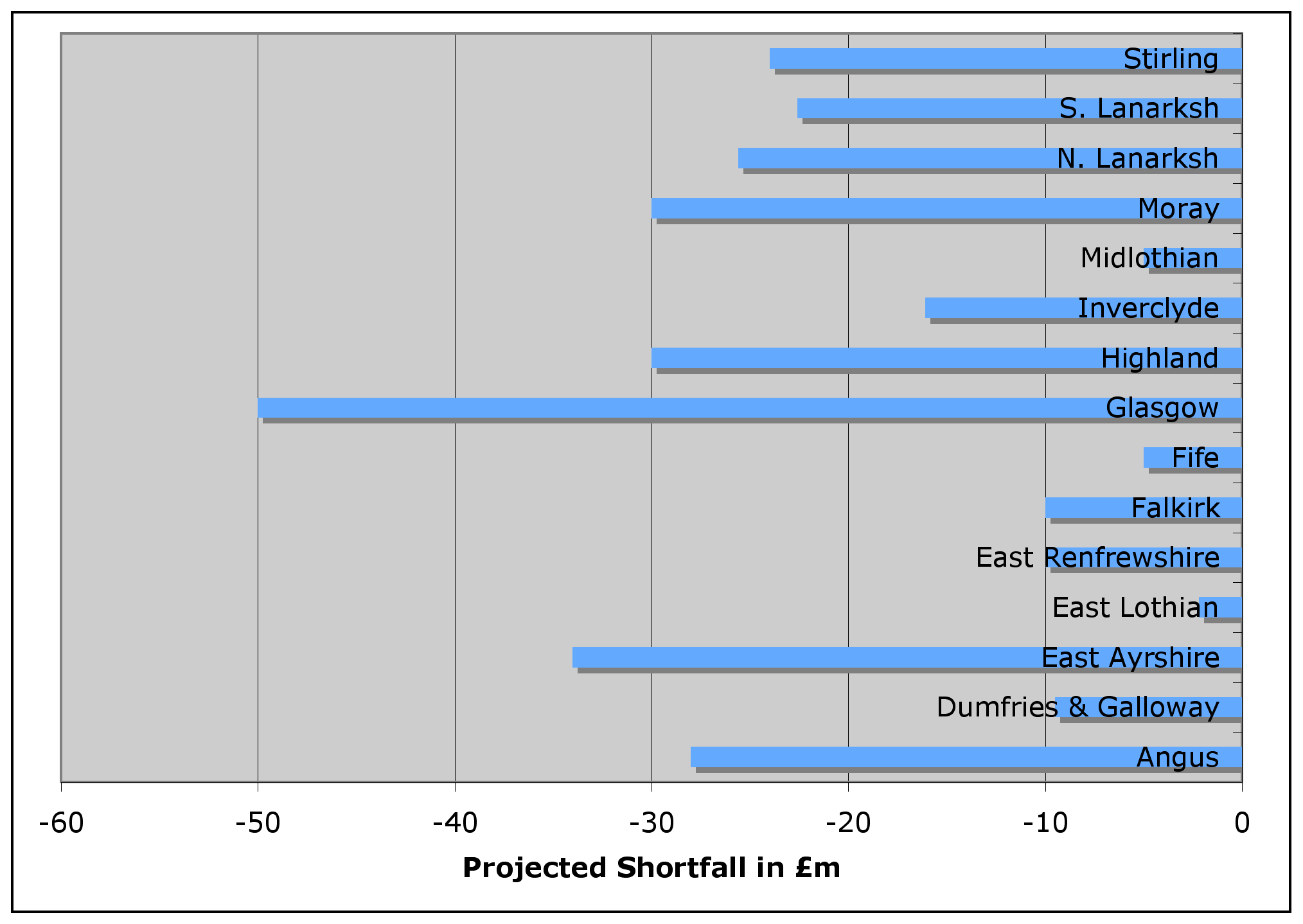
A quick survey around the country shows that most councils are looking at serious funding shortfalls in the coming year, varying between £5m in Fife and £50m in Glasgow, with some small councils like Moray staring at £30m—a proportionately huge gap for them. This means that what reserves they have will be eaten into this year (2013/14) and some drastic action will be necessary no later than the following fiscal year of 2014/15. Now we have three more years of even worse to come.

If, as some Administrations tried to argue, council senior management teams had taken the original scale and depth of the projected trough seriously and had set up far-reaching shared services, joint working (e.g. with police/fire/NHS) and real community planning (i.e. involving the serious commitment of pooled budgets), then  the idea of even leaner operation might be feasible.

But they didn’t. Although complacency and lack of firmness or imagination did afflict some council leadership, the root of the problem lies with chief executives and their directors who, despite now pulling down respectable salaries in the £100k range and therefore every bit as well compensated as the private sector, have grown smug with the fat years of the noughties when Scottish council budgets doubled in a decade.

Consider, despite more than three years of warnings, shortcomings in their preparations for the extra lean years now upon us will become glaring, especially as few key parameters can be turned around in short order:

  • Inter-council shared services: NONE
  • Intra-council restructuring, especially management: some but many inefficiencies (e.g. full Head Teacher in village schools; small departments that have ‘aye been’)
  • Capital equipment replacement: still by schedule rather than need (IT every 3 years; vehicles almost as frequent)
  • Inefficient field working (ad hoc scheduling of social workers, transport or house repair/refit; lack of GPS tracking with dynamic routing in the field)
  • Reluctance to consider business opportunities (e.g. ground care bidding for estate maintenance; cafes/entertainment in parks/libraries; sports facilities to compete with private gyms)
  • Joint facilities with other bodies (e.g. care homes run with NHS; police/fire in smaller towns sharing joint premises with council; shared recycling/landfill)
  • Bureaucratic/inefficient shared operations (e.g. Scotland Excel; ESEC; CoSLA)

Since little progress has been made in any of these, the extensive drop in the 80% of council income that comes from Revenue Support Grant over for the next five years will be far too extensive to fund from reserves and would require something like a cumulative 50% increase in Council Tax to cover. Apart from being hugely unpopular, this tax is regressive and would hit the poorer far harder than those in mansions. (An earlier blog Ma Faither’s Howff proposes a method of increasing Council Tax take by 20% without hitting the poor at all).

So, tough though councils claim things to have been to date—and will again this year, you ain’t seen nothing yet, baby. Senior management has failed to think out of the box. On record to date, each Townhousetanic will continue at full speed into the fiscal iceberg ahead. And, though panic cuts in services will be tried, staff will still need to be shed in larger numbers to balance the books. The question isn’t if, but when—and who among the £100k salary squad who dithered us into this impasse will have the grace to join them.

Projected Budget Shortfalls for 2013-14 for a Selection of Scottish Councils

Projected Budget Shortfalls for 2013-14 for a Selection of Scottish Councils

Posted in Commerce, Politics | Tagged | Leave a comment

If You Lived Here, You’d Be Home by Now

Much is made these days of green living, whether it be using low-energy light bulbs or recycling the newspapers. And, while these and similar efforts do make contributions to minimise the impact we humans have on the ecological balance of the only planet we have, it seems we may not be doing enough.

Now, given that the Chinese plan to spend $720 bn building 363 coal-fired power stations over the next two decades (effectively a power station per fortnight) and that 300,000,000 Americans own a car each that burn an average of 2,500 litres of fuel every year, we’re talking over 1/2 bn tons of CO2 being pumped into our atmosphere each and every year from both sources. Makes taking the train to work once to save 250g of CO2 seem small beer.

But you’d be wrong. Because the reason Americans burn so much ‘gas’ is that their sprawling cities make no provision for work and home to be sited anywhere close to one another—often not even in the same city. And, even if they were, aspirations at work and home means that each family moves on (promotion, new job, etc) so often that any proximity would be a temporary fluke.

Europeans are often cited as being far more sensible about this. But, while the Germans and Scandinavians do make a decent pass at strategic planning of cities, infrastructures and the homes that inhabit them, Spain is a Heath-Robinson nightmare and we British manage to combine the worst of most worlds—lack of strategy, abysmal repetition that passes for architecture and little clue about integrating work, home and facilities beyond a crude zoning.

The English may be worse than the Scots in this regard, but any distinction seems small, at best. Consider the great swathes of Penicuik or Dalgety Bay that are little more than suburbs without a centre but few wonder why they have teenage problems because there’s nowhere to ‘hang’.

But tastelessness and bloated scale are not the worse planning crimes perpetrated across Scotland. The worst is that housing development is wholly developer-driven, while commercial falls between Scottish Enterprising clodhopping ineptitude (due to its ‘big name’ fixation) and a rabble of economic development departments without two shekels or two ideas to rub together. The result is successful business is constantly scrambling to find decent, affordable premises that aren’t ‘prestige’ glass palaces of Ocean Terminals/Edinburgh Park or some bleak and blasted industrial park in Cardenden.

The soullessness of such places are bad enough but they are always remote from where anyone lives and seldom well served by public transport. The two stations that ‘serve’ Edinburgh Park are half a mile from the nearest office block; Ocean Terminal is in the most inaccessible part of Edinburgh. Developers made a bundle from both and beaucoup bonuses were reaped by high-heid-yins responsible. But by any green measure they are nightmares—design dinosaurs we will need to live with until rising sea levels make Ocean Terminal untenable (roughly AD 2150).

All this is not just venting spleen. With modern technology, over half of present office workers could work from home—at least part-time. But, more than that, the need for graphic designers to be located cheek by jowl with their ad agency customers or the need for bank back office operations to be anywhere near HQ went out with the steam fax machine and the introduction of universal fast broadband and WiFi. So why do people waste 2 hours and £25 daily getting to/from the office? Because, to paraphrase bank robber Willie Sutton “that’s where the jobs are”.

But why?

Why, in the case of East Lothian, do over 25,000 people indulge in this daily time-waste? Is the county proud to boast a miserable per capita GDP worse than bankrupt Greece because other than a council and two power stations, its job market is a joke? Probably not. Angus and the Mearns or Dumbartonshire are not much better; almost all their resident professionals don’t work there.

But why not?

If the still-under-formulation City Region Plans were to be worth the paper they’re to be printed on, why don’t they become more than just a blueprint for developers to make another mint and SE to squander another £500m of UK & EU funds on favoured white elephants? Why don’t they focus on locating as many jobs as possible near to where people already live—in towns scattered across the country?

Imagine, if people walked or biked to work—like your grandad in all probability did. Imagine having lunch in your local cafe or pub with friends. Imagine popping out mid-afternoon to pick up your kids from school. Imagine buying your Christmas prezzies in a shop where the owner knows your taste and that are not angry zoos full of strangers. Think what all that would do to revitalise High Streets and pour money back into the community and not into Starbucks at the Gyle.

It would require planners to take off the “but the book says” blinkers and—for once—get creative, including putting dynamite under their sleepy EDU colleagues to find places for low-impact/office business in or near town centres or in attractive small enclaves near enough to bike/walk to. They need to grab developers by the lapels (or somewhere more sensitive) and say “I know you want to build nothing but acres of 5-bedroom mansions for top dollar but what our towns need are mixed housing. as far as possible integrated with jobs, retail and other infrastructure like medical centres, schools and sports facilities. Do it creatively or you get no consent.”

People will use good facilities if they are convenient; they will enjoy it all the more if it is frequented by friends and neighbours so that local shops/gyms/parks effectively become social centres at the end of the road. Then everyone will be amazed how much time they now have with their family and friends because they don’t spend their life 35 miles distant from them. They will also be surprised how much more money they have not filling the tank twice a week at £85 a pop and the corner bakery or deli does a better lunch for half the price of Ritz Bar & Grill.

But, most of all, they will have discovered pretty much the only practical formula for green living in the 21st century that doesn’t involve stone age poverty. Not only will we all enjoy a much better quality of life but those who still wish to be there in the thick of it won’t find themselves (and half of Leith) flooded out of Ocean Terminal in about 138 years time.

Posted in Community | Tagged | Leave a comment