Dear politicians and political types

Dear politicians and political types.

I find myself pretty much in sympathy with the sentiments expressed in this blog and, since I have a public affiliation to the SNP, acknowledge ALL parties have suffered some erosion of moral anchors afflicting them since the rise of the SPADs.

As this can be read as a call to arms, it is a challenge that I accept: within a few days I intend to formulate my own ideals in 1,000 words or less and publish them on this blogsite.

Readers are welcome to critique it within the bounds that Mute Swan proposes. Anyone without a platform to do the same, I offer this one—again provided it does not breach the principles embodied in the original blog.

Posted in Politics | Leave a comment

Two Peoples, Separated by a Common Language

Although a phrase coined by the ever-observant Mark Twain to describe why the Americans and British were forever misunderstanding each other, despite both, in theory, sharing the same English, the phrase jumped to mind as I watched Simon Heffer’s New Year’s Day documentary on BBC1 Fifties British War Films: Days of Glory.

Born in the late forties in the shadow of WW2, In the fifties, I was in awe of a dad who had managed to drive various inferior tank designs against all that the Afrika Korps could throw at him. Living in sleepy North Berwick, where no-one much remarked on a seven-year-old, I spent my pocket money catching many of the three-films-a-week programme at the Playhouse cinema 100 yards down the road.

I was game for most anything and Mrs Scott who sold the tickets none too picky whether someone barely able to see over the counter should be watching Kiss Me Kate, let alone the Hound of the Baskervilles. But, though I didn’t realise it at the time, I was witness to many films from a classic phase of British cinema—the black-and-white semi-documentary war film.

All I knew was they were my favourites. When the Dam Busters finally reached our corner of the world, I saw all five showings, most of which were a sellout. I much preferred the British war films to American. Whereas Audie Murphy seemed all posture in To Hell and Back, the underplayed anguish on Jack Hawkins’ face in Cruel Sea when he depth-charged a U-boat in the middle of swimming sailors had me horrified that such choices were made.

This was before TV stole the cinema audience and closed most small-town cinemas like the Playhouse and many of the films appeared as filler on TV channels in the sixties and seventies, which rather debased their value. The film experience was lost on a 19″ screen with tinny sound and an ad break every 15 minutes.

But, in the fifties, in a ‘proper’ cinema, these films were epic, draining experiences: We Dive at Dawn; Cockleshell Heroes; Sink the Bismarck; A Hill in Korea; Bridge on the River Kwai; Battle of the River Plate. While other films impressed me, few haunted me like these, scenes staying in my memory so firmly that I still have trouble watching the DVD half a century later.

It troubled me for some time that later war films seldom had the same appeal for me. Even Cross of Iron or Das Boot, although streets ahead in budget, realism and sophistication, did not hold the some attraction for me, did not offer the pitiless tension of, say, Ice Cold in Alex. It’s only recently that all this has more to do with identity and psychology than entertainment or even adrenalin rushes.

Because the element of all those films that I schizophrenically both admired and simultaneously thought foreign were all the heroic leads were officers speaking Oxbridge English. I only ever heard such an accent on the BBC and when people brought their pranged cars in to my dad to have the dings hammered out. They represented a culture embedded in a class war—at once familiar and yet not mine.

While John Mills could make a decent fist of playing a regular Joe (e.g. Dunkirk), the rest of the Ealing stable could only do the stiff-upper-lip English officer. When they strayed outside of that (e.g. David Niven hopelessly miscast as dynamite specialist Miller in Guns of Navarone), it was painful to behold. I even disliked Michael Caine when I first saw him in Zulu because he made a very convincing fist of an Eton-then-Sandhurst accent.

And so, although I did not realise it at the time, my political awakenings lay in that very genre of films that taught me culture and history, even as it entertained me. Even as I admired the manly heroics with which these films are replete, I was put off by the type that always seemed to play them.

In his programme, Simon Heffer states  these films “are part of my DNA, displaying what it meant to be British and values such as courage, heroism, patriotism and decency.” While I understand just what he means, there is a quibble that has been with me for the last half-century: the films displayed the culture of the upper class in England. Other than token appearances by John Laurie, the first Scot I saw with any equivalent derring-do was when Shir Shean played Urquhart in Bridge Too Far. But that was two decades later.

Now, given the dominance of England in our little union, plus Ealing Studios being located in, well, Ealing, plus the fact that received pronunciation was the lingua franca of radio and then-nascent TV, the lead’s accent was likely to sound that way. But it was the conflation in the films (and repeated by Simon Heffer) of ‘English’ with ‘British’ that stoked my awareness then and has been with me since.

Because the stoic repression of feelings, the use of stock phrases, the deference to authority, the references to cricket or Piccadilly or pints of bitter that lace all of these films make them far more English than British. For a contemporary film with Scots culture juxtaposed with the English for comparison (and with a bit of American thrown in for good measure), try The Maggie. Or for a film that embodies Scots cultural thinking in a myriad of ways, try Caton-Jones’ Rob Roy.

I take nothing away from the excellent, articulate and historically accurate genre that is the 1950’s era British-made war film: Simon Heffer is quite right to highlight it as part of our heritage. In the 1950’s the shared horrors and relief that it was over released emotions all across Britain in these shared experiences. But this far on, they belong more to the English than to us Scots because it is English cultural icons, behaviours and social mores that inform and populate scripts, directing and acting.

English people having difficulty following this might consider how they feel about American productions. Forget U-556, which was a straight rip-off of one of the Royal Navy’s most audacious operations. But consider Last of the Mohicans—a lyrical, pretty accurate, beautifully shot 1759 slice of the war with the French. The setting is technically ‘British’ (the colonies still had two decades to go before revolution) but neither the English Major Heyward nor the Scots Colonel Munro, though brave, come out of it well because the sensibility of the film is very much American.

One of these days we may have black-and-white films made of Lord Lovat non-standard training of the first commandos up in Glen Roy or of the hazards overcome by the volunteers who manned the Shetland Bus. Either would need to display a Scottish cultural sensibility to be decent portrayals. But, until then, it is no great hardship to get by with the English-dominated (but really none the worse for that) portfolio of 1950s war films that articulated the mood of Scots and English unused after two world wars and a depression to allowing themselves self-expression.

Thankfully, the Scots seem to have made progress overcoming any such inhibitions since. Punk music and reality TV notwithstanding, it must be time for the English to get there too.

Posted in Community | Tagged | Leave a comment

Ten of the Best

For all our readers, whether regular or no, thanks for your interest in this blog over the last twelve months. The hope is that it entertained and stimulated your thinking.

In truly democratic fashion, a ranked list of the top ten blogs from among the 240-odd posted throughout the year, ordered by frequency of hits by which you, the reader, accessed and read them, is given below.

  1. Chris Marr: Obituary (December 11th) For locals in N. Berwick, there may be no surprise in this topping the list. What might stun them—as it did me—was the size of its lead: swamping the next in line over five times and logging more than 2,000 hits in a very short period. As I said in response to a comment, I only hope I did his complex character, unsung abilities and wide popularity justice.
  2. You Can’t Get There from Here (March 14th) A critique of Lothian Buses. Although a well-run operation, they do it in a world seemingly unable to understand public transport as a key part of Edinburgh’s offering.
  3. Along the Highland Line (February 21st) Another transport critique, this time of ScotRail’s apparent inability to see Scotland’s long-haul train journeys as opportunities their minimalist short trains more suited to the Greenock run can’t handle. Class 222 trains like Virgin runs could make them more profit and revolutionise travel to Dundee & Aberdeen especially.
  4. J’Accuse! (February 18th) Often I despair of any voice of reason coming out of a now habitually venomous Scottish Labour party. But this brave letter, reprinted in full, was replete with true party loyalty, mixed with sincere concerns about where that party was going.
  5. An Army Fit for a Better Nation (May 14th) One of several blogs imagining the structure of any Scottish Defence Force and what its roles might be. This blog focussed on a very different deployment posture from the UK, more on the Irish model.
  6. Furth of Forth (July 15th) Bemoaning the UK Government/MCA decision to close Forth Coastguard station on the flawed rationale that fewer stations and reduced intimate knowledge of the ‘patch’ can handle the moody complexity of Scotland’s 6,000-mile coastline.
  7. South Suburban Salvation (July 13th) Another public transport diatribe bemoaning the glaring absence of any real suburban rail in Edinburgh and the lack of will for a very cost-effective way to provide it via an existing South Suburban Rail Loop.
  8. Labour for Independence (July 30th) A brave set of Labour activists who think there’s a debate to be had on independence engage with the rest of the country by putting their head above the parapet and launching a website.
  9. Nemo Me Impune Lacessit (February 7th) The next most popular of several blogs on  a Scottish Defence Force, this one written to rebut a dismissive Op Ed piece from Lord Robertson of Port Ellen. A year later I’m still waiting for his plea to his party to “cut the vitriol; we need a debate” to be heeded.
  10. Britannia Waives the Rules (November 12th) Almost as a complement to No 9 above, this deconstructs the illusion of sensible defence of Scotland, its rigs and other strategic targets from unconventional attack under UK MoD policy.

It’s interesting to take stock. Why half the top ten should come from only two months is not obvious. The above list is far more ‘heavy’ and political than the general run of blogs and are also notable for their almost total lack of humour. While life can be a serious business, it’s too short not to lighten up on a regular basis. This blog may need to consider whether its humorous attempts need to smarten up—or whether it simply attracts an overly serious readership.

Wishing all readers a Guid and Prosperous New Year (unless you belong to the be-bonused wunch of bankers); may you read wide and debate long. And, remember, all comments are free & welcome: all will be accepted, right up to (but not including) the personal and/or insulting. As my dad once put it: “I refuse nothing but blows.

Posted in Uncategorized | Tagged | 1 Comment

Darling is My Charlie

I had every good intention of sitting out the balance of 2012 full of pud and good will and sticking my oar back in the political water once the Hogmanay bubbly was undrinkably flat and more than a few well intentioned resolutions had paved the road to hell for another year. But, thanks to Alastair Darling’s New Year Message for Better Together, my gast is flabbered that someone as senior and with his depth of experience should associate himself with material like that.

Allow me to be clear: I neither discount his right to formulate a case for the unionist campaign—in fact, I welcome that someone is trying to—nor do I expect any case he puts not to outrage me in some form or another, so differing are our viewpoints. But within his 3 1/2 minutes are so many venomous misrepresentations that I question whether he was the author, so far from the integrity I would expect from him do many formulations stray.

The language of “breaking apart”, “splitting up”, “turning against our closest ally” seems prejudiced. But open debate is not genuine if either side dictates how the other must express itself. And it would be unfair not to acknowledge areas of agreement—that the debate demands respect on both sides; that it needs to start now with serious questions that demand considered answers; that it is too important for anyone not to stand up and be counted as part of it.

It would be tedious to contradict each part in turn so two examples should suffice.

  • Several alternatives given between which he believes we must choose includes: “getting our economy back on track or facing years of instability”. Now, not only is his party and their union colleagues relentless in their condemnation of the present UK government’s financial policy but they believe it to be ruinous to our economic prospects. With the UK’s debt passing £1 trillion with no recovery in sight and Scotland in a better position to pay off its £65 billion share, the first half of his alternative seems shaky at best. And what instability is there beyond the UK’s plight? Scots would keep the pound, stay in Europe, minimise any disruption and continue trading under close relations with England (much as Ireland has done for 90 years) because it’s in nobody’s interest to rock the boat any more than necessary.
  • In making what he describes as a ‘positive case’ he leads off with: “On our small island, we have more in common than divides us; more to gain from working together than turning against each other.” Let’s leave aside that our end of the island’s actually quite big in proportion to our population (it’s the English who are crowded) and that we’ve tholed 300 years of English priorities (not least because we got rich on empire-building too). Yet in this—and every other ‘positive statement’ from anyone in Better Together—no pragmatic case is made for Scots remaining in the union. Why would we be richer/happier/safer? Because if you look at Norway/Denmark or even pressures exerted on Catalonia/Flanders, the case for staying is anything but obvious and we’ve yet to see much sign of it being articulated.

Where he does pose a series of questions, most are indeed deserving of an answer. And while this blog cannot claim to speak for the Scottish Government or, indeed, anyone else signed up for the Yes campaign, the degree to which unionists pose a flurry of questions and then proceed to ignore cogent answers is doing their pose of positive messages serious damage. So, allow me to recap the more serious ones.

  1. What would the currency be? The UK Pound until/if the Scottish people chose an alternative, such as joining the Euro. There are plenty of examples already and the argument about not controlling bank rates is facile—we don’t now.
  2.  How do we keep jobs dependent on trade with the UK? The same way we got them in the first place—by being competitive and by trading on a world-wide reputation for reliability, engineering savvy and financial canniness
  3. How would we be represented?  As every other normal country is: our own embassies (share with England?); our own MEPs (14?) & EU commissioner; our own UN seat; our membership of NATO; membership of the Nordic Union? Our most important embassy would be in London.
  4. Would we keep the BBC as is? At first, why not. And if it proves able to break its SE England bias, that could be extended indefinitely as a joint facility, much as the RNLI currently happily includes Eire as well as the UK. The same could apply  to the Post Office, MCA, etc.
  5. (Alasdair never mentioned but should have) How would we divvy up the various UK-level institutions and government departments? Actually many are already split (e.g. Law, Church, SNH, water, NTS, all SG departments). Tax, Benefits, Defence, Foreign Office, etc would need to be set up or negotiate continued use of English facilities for a price.
  6. (Alasdair also never mentioned but should have) How will we restructure the armed forces? Subject of a separate blog, this should not prove insurmountable. The RRS, RSDG and proportionate support units could be expected to transfer to the Scots but with the proviso that no serving soldiers/sailors/airmen be forced either to become part of the SDF nor to be left behind. The more modest SDF would not require nuclear weapons, tanks, global deployment ability nor aircraft carriers—but it would need new long-range maritime patrol craft and fast missile boats to defend the rigs (both neglected by the UK). In this context, “A’the Blue Bonnets: Defending an Independent Scotland”, by Stuart Crawford and Richard Marsh, claims a Scottish Defence Force would be necessary, feasible and affordable.

It would please me no end if Alasdair or (being realistic) someone else at Better Together would put their head above the parapet with details of how post-2014 Scotland would clearly be better staying in the Union. Comparison to the rather bright future for small, developed European countries with a world-class reputation would be a plus.

Actually, that description of Scotland probably puts us ahead of England in the eyes of the world, especially now that troglodyte Tory backwoodsmen drive much of the UK’s foreign policy. With independence, Scotland is likely to find it has a lot more friends in the world—especially in Europe—than the nostalgia-prone, monolingual, cold-fish, endlessly stroppy English seem to manage.

So—while they’re at it—Better Together might explain how Iceland has dragged itself out of a bigger fiscal hole than us and is now powering past our recession-ridden UK economy; or why Scottish membership of the Nordic Union might not transform both our international relations as well as our economy?

Because, unless they start putting their arguments up for debate, it’s not just Darling who is going to look like a right Charlie when the ‘undecideds’ give up on them.

All True: Now Tell Me Why Independence In Incompatible—an amicable divorce is better than a one-sided marriage

BT Poster is All True: But Why Is Independence Incompatible with Any of the Above—we HAVE conflict: is amicable divorce not better than a loveless, one-sided marriage?

Posted in Politics | Tagged | Leave a comment

The Auld Adversary

Much ink has been spilled in the dead tree media over how difficult it would be for Scotland to operate economically as an independent country with England no longer bound to support it. Certainly any hostility on England’s part would make life more difficult for the Scots. Exactly why they would do so, given how well we have worked and traded together so far is unclear. But can we draw on any examples that might give us some guidance?

Although bound by the same ruler, Scotland operated on its own as an economic unit between 1603 and 1707. Not remembered as a time of great prosperity and blossoming, might that period not actually be power to the unionist argument of better together?

Certainly there were some serious low points. The massive failure of the Darien venture, coming on the heels of famines in the 1690s certainly tee’d the country up for union in 1707. But, in the rest of the century, the Scots actually prospered. Not least among the factors were the evaporation of the need to spend so much wealth on defence. The last tower house was built in 1660 and more opulent country houses funded by improved agriculture became the order of the day. Rural markets, longer leases, crop rotation and the use of lime all presaged the systematic improvements that would be made widespread by Cockburn.

Highland lairds were soon exploiting the English market for their timber and black cattle and the great Border landlords did the same with cattle and sheep. Between them and Lowland enterprisers, over 100 burghs of barony were created that century, harbours and ports were created at places like Saltcoats and Bo’ness. These assisted trade in linen, coal and salt, as well as cattle and sheep to ready English markets and accounted for 40% of Scotland’s trade by 1700. Traditional monopoly rights were removed from Royal burghs in 1672; the 18th © fashion for ‘improvements’ actually got its start a hundred years before.

But, primarily because of the constant focus on Anglo-Scots relations in any British history with a subtext of hostility to whichever continental power was currently out of English favour, Scotland’s strong international links and their positive economic influence are often overlooked. But, whereas strong links with Poland, the Hanseatic Ports and Scandinavia fell into disuse and those with France were gradually blocked by the constant wars England waged with France, others were built to replace them.

Experienced Scots traders simply shifted their emphasis West. The 100,000 new Scots emigrants in Ulster needed supplied with goods from home and this provided a stepping stone to exploitation of the booming trade with English colonies along the American seaboard, especially tobacco. East Jersey and Pennsylvania both attracted a share of some 100 investors and several thousand colonists. The Carolinas were planted with Highlanders in the earliest and most willing of the Clearances.

These investors were ploughing new fields of opportunity and not simply following where their English cousins led. Glasgow merchants were fast to exploit larger and faster ships. together with agents in the colonies buying up and gathering harvests at ports ready for loading. As a result, whereas most English ships only managed a single annual trip of around 100 tons of cargo, the Scots would manage two with up to 500 tons on board, resulting in lower costs and great competitive advantage.

It was a combination of misfortune with the famines of the 1690’s and the steeply rising English tariffs to fight off the entrepreneurial Scots that damaged an otherwise healthy economy that laid the Scots low in the early years of the 18th ©. The provisions of the Act of Union, compensating many for their losses, gave the impression of the magnanimous English taking their impoverished  neighbour into the embrace of its trading empire so that it might prosper. History does not bear this out.

Post-1707, prosper the Scots surely did as equal partners in the first country to exploit the heady combination of an industrial revolution at home supplied by a global empire of raw materials and almost limitless markets for their goods in a rapidly industrialising world.

But, true though that might be, let’s not forget the 104 years when the supposedly poor and backward Scots turned a barely self-sufficient rural nation that could barely feed itself into such a feisty competitor for English markets that thier merchants went crying to Westminster for tariffs and duties to deal with the shrewdly competitive Scots.

There’s no law that says the English would not be so thrawn post-independence for them to try to keep the Scots outside of the EU’s single market and then impose punitive tariffs on them, as they did in the 1600’s. But, given their need for our power oil, gas and water and a liking for our whisky, game, fish and tourist offerings, why would they damage their own interests?

And if we build better warships at competitive prices, do you not think an MoD now further cash-strapped by loss of North Sea Oil revenues would keep ordering from the best friend England’s likely to have as they get even more xenophobic from loss of the outward-looking Scots from Westminster? Say what you like about the English—they are practical people; they are not daft.

And if you add in a deal that we might let them base their nukes on the Clyde for a few years to avoid international humiliation—quite apart from military dislocation—do you not think they’d recognise this as a serious bargaining chip for which they’ll need to come up with a pretty nifty quid pro quo?

The post-independence period would see the Scots adjusting to a new relationship with the English, much as we did post-1603. And, if we take that as an example of how ‘wee’ Scotland might cope, a pretty solid case can be made that the English may again be constrained to dance to a Scottish tune, rather than the Anglocentric dirge that most Unionist commentators appear to be singing.

Those commentators should study our joint history closer. Chapter 3 of Tom Devine’s The Scottish Nation would make a fine start.

Posted in Commerce, Politics | Tagged | Leave a comment

‘Tis the Season

If the Three Wise Men had been abroad in England on their mission to follow the star in 2012, they would have a tough time of it. Not only have the skies here been uniformly obscured by rain clouds (except for a welcome break on Sunday) but I hope they brought their wellies and were warned that gold, frankincense and myrrh won”t be welcomed nearly so much as a re-stock of sandbags.

From Helford to Stonehaven and beyond, this has been a terrible time for people with houses near rivers and includes a huge number who—until the present drenching—had thought themselves safe enough. This is a horrible time for families & firms affected by floods—but huge thanks to emergency services and council workers for doing all they can to help. Flooding is devastating at anytime, but especially at Christmas.

For those newly affected seeking to register for Floodline Scotland, call 0845 988 1188 for the latest information or visit SEPA’s Floodline website. If you’re on Twitter, follow @metofficeScot to get Met Offfice (sic) alerts sent automatically.

But for the great majority of you of all political stripes and none who are not so affected, other than being forced to take your working-off-the-calories constitutional walks in wellies; may you enjoy a very Merry Christmas among the people you love.

Over the last year, I have much enjoyed contributions from supporters and opponents of my beliefs and am equally grateful to both for their contributions. I only hope that I was able to consider and develop my views as a result. The New Year will hopefully improve on that.

There will be a festive hiatus in this blog for the next few days but I sincerely hope that regular readers will find they have much more engaging, memorable and enjoyable things to do before service here is resumed shortly.

Peace and good will to all.

Among Friends—My Ersatz Family at Christmas

Among Friends—My Ersatz Family at Christmas

Posted in Uncategorized | Leave a comment

The Gross Is Greener

As it has been doing for a number of years, BOS has published its “Quality of Life” List just before Christmas. This rates council areas in Scotland by seventeen parameters, grouped in a half-dozen classes that they believe relate to measuring the quality of life in a given area. We’ll consider the validity of that later but first let’s examine what they came up with. As BoS themselves put it:

“The Quality of Life index aims to quantify where living standards are highest in Scotland by ranking local performance across a range of indicators, including the labour market, the housing market, the environment, education and health.”

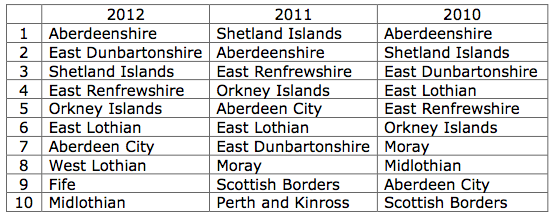
There are minor changes in position in those in the ‘top ten’ but no major surprises, as compared to last year; indeed the bulk of the councils in the top ten are pretty much the same over the last few years, with Scottish Borders and Moray drifting out (the latter hit by RAF base closures) to be replaced  by West Lothian and Fife. The top ten for the last three years are shown in Table 1 below.

Table 1—Top Ten in Scotland for Quality of Life (source: Lloyds Banking Group)

Table 1—Top Ten in Scotland for Quality of Life (source: Lloyds Banking Group)

But those wishing to use this as an guide where to live should consider both major omissions and unstated selfish interest that cast some doubt on both BoS’s arithmetic and its quantisation.

A similar study done over the UK by Lloyds (BoS now being part of Lloyds Banking Group) ranks ‘desirable areas’ across the UK by pretty much the same criteria. In this case, Hart (near Fleet in Hampshire) tops the poll—indeed the only areas outside the Home Counties were Wychavon, Worcestershire; Rushcliffe, Nottinghamshire; Rutland; and North Kesteven in Lincolnshire. Nowhere in the north of England, NI, Scotland or Wales managed to make this exclusive top-50 list.

Hold on—does that mean SE England enjoys a higher quality of life than anywhere else? I’ve been there. Pretty and cultured as parts are, it’s something of a zoo from which many people have escaped to places like Scotland. It might pay to examine this story and its conclusions in more detail.

Because we’re not comparing apples to apples. Hampshire is the biggest English non-metropolitan county, boasting a population around 1.7m in an area of 3,700 sq. km. But it is barely half the size of Aberdeenshire’s 6,313 sq. km. whose 232,000 people are clearly not nearly as crowded  (by a factor of ten). This also means that the larger area clearly will contain a broader mix, with Hart’s 213 sq. km. holding just one strata of society and a station car park “that looks like a BMW dealership“.

Indeed, all of the top-rated English districts are small, comparable in size to Hart, and home to under 100,000 people. The BoS evaluation ignores the density and hectic associated with even supposedly rural areas of England’s Home Counties. Most of the demographic maps of traffic congestion are based on journeys per resident and so Perth comes out as bad as Petersfield because it has the A9 running through. But sheer traffic volumes and associated congestion are the bane of England’s South-East. Why were these not considered in the study? The top ten places in England are components of traffic statistics given in Table 2.

Table 2—Traffic Statistics for English Counties Covering QoL Top-Rated Places

Table 2—Traffic Statistics for English Counties Home to QoL Top-Rated Places (Source: Dept for Transport)

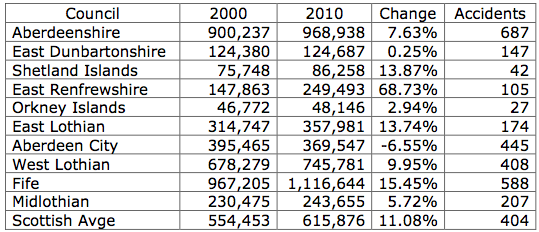
The figures (in thousand vehicle-miles) show pretty consistent heavy traffic, still  growing at over 6% in ten years and accidents that, while improving, add up to some pretty serious carnage. The equivalent statistics for the top ten for Scotland are shown in Table 3 below.

Table 3—Traffic and Accident Statistics for Scotland's Top QoL Places

Table 3—Traffic and Accident Statistics for Scotland’s Top QoL Places

While geographic areas covered differ some between Tables 2 & 3, it’s not a major factor. And though Scotland’s traffic may be growing at almost twice the rate of England, it is from such a small base that it’s still barely a tenth the size, with comparable differences in accidents. You are left with stark statistics implying that the ‘top’ quality of life locations in England are far more congested and dangerous, a key issue that shows up nowhere in BoS’s ratings.

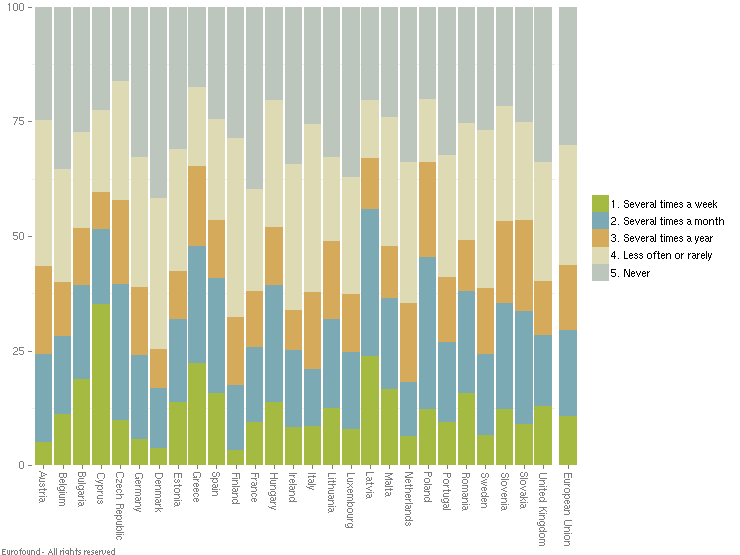
Things get worse when we broaden our view beyond the UK into Europe (I know this brings on a barf reflex in most Tory readers, but bear with me). The EU makes a point on surveying its own take on quality of life across the continent and comparing results among member countries. This again makes for interesting reading. It is not possible to reproduce all 125 questions but the trend where the UK did poorly in comparison to other members—especially Denmark and Finland—was stark.

Chart 1—Frequency That Family Responsibilities Intrude to the Detriment of Career

Chart 1—Frequency That Family Responsibilities Intrude to the Detriment of Career

While UK residents are not as torn as others, they still come in over 40% with this problem, while Danes and Finns are more tranquil—closer to 25%.

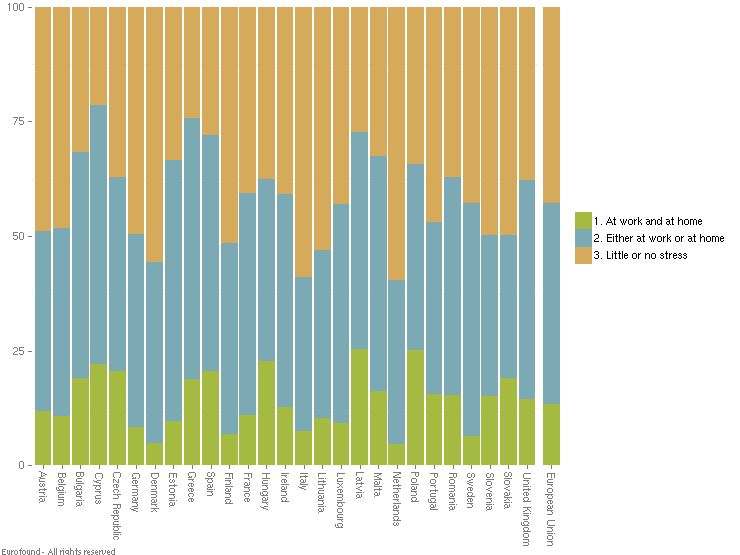
Chart 2—Number of Times Respondents Felt Stress from Conflicting Priorities

Chart 2—Number of Times Respondents Felt Stress from Conflicting Priorities

Again Danes and Finns come out well with over 50% feeling no stress, while the Brits can’t manage a 40% level. There is clearly a pinch of salt to be taken with any conclusion drawn over multiple cultures like this. But the qualitative feel: that the British are over-worked, suffer more stress and have a poorer overall quality of life compared to their neighbours is inescapable.

Which brings us back to the questionable nature of BoS’s results. Rather than measure genuine quality of life, the parameters they measure have an agenda. While some of them (weather, crime, health, life expectancy) are entirely valid, the rest (weekly earnings, house prices, number of rooms in house) are a yuppy wet dream. They expose BoS’s real motivation—shifting expensive houses to the highest bidder, which is rather shabby. It is, effectively, ammunition for an estate agent’s pitch.

While this is neither illegal nor unexpected, it rather undercuts their high-minded statement printed at the top of this blog. Had they titled this “How the already Rich and Lucky can get even Richer and Luckier”, it would at least have been honest. They want you to trade up: to see the gross is always greener elsewhere.

Because you will indeed make more money buying a house in Hart or Elmbridge (only if you’re already rich enough to afford it). But, as you struggle with traffic on the B3016, inching your Beemer towards Winchfield station or the M3, think about tranquil Turriff or laid-back Lerwick in a Zen attempt to bring its genuine quality of life into the hectic of your own.

Posted in Commerce, Community, Environment | Tagged | Leave a comment

Grey Sea of Grey Seals

Half of the world’s population of the grey seal is found on or around the British coast and it has doubled in number since 1960. Grey seals mainly feed on fish, but will also rarely take squid, octopus and crustaceans. While they are found in colonies all round Britain, they are predominately in Scotland, with the one on the Marr Rocks at the North end of the Isle of May the one with which I am familiar.

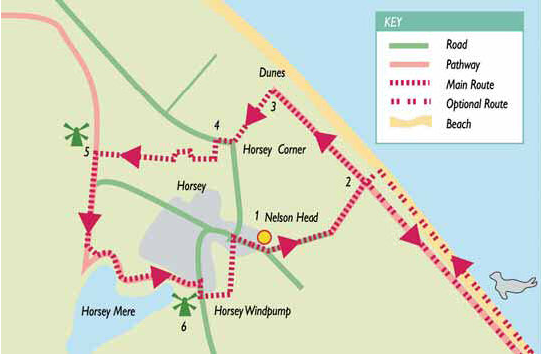
Suggested Walk Round Horsey Taking in Seals, Windmill & Pub

Suggested Walk Round Horsey Taking in Seals, Windmill & Pub

A rare southern Grey Seal colony has been growing at Horsey (on the Norfolk coast between Waxham and Winterton) for the past 10 years. It started with only a handful of seals (a break away group from Blakeney Point?) and now there’s believed to be more than 1,000. The seals come onto the beach to breed between early December and early February. Access to the seals has been causing issues over visitors going too close to the seals, worries about the sea defences being eroded and the car havoc at Horsey Gap. With most cameras having good zoom options, you really don’t need to get too close.

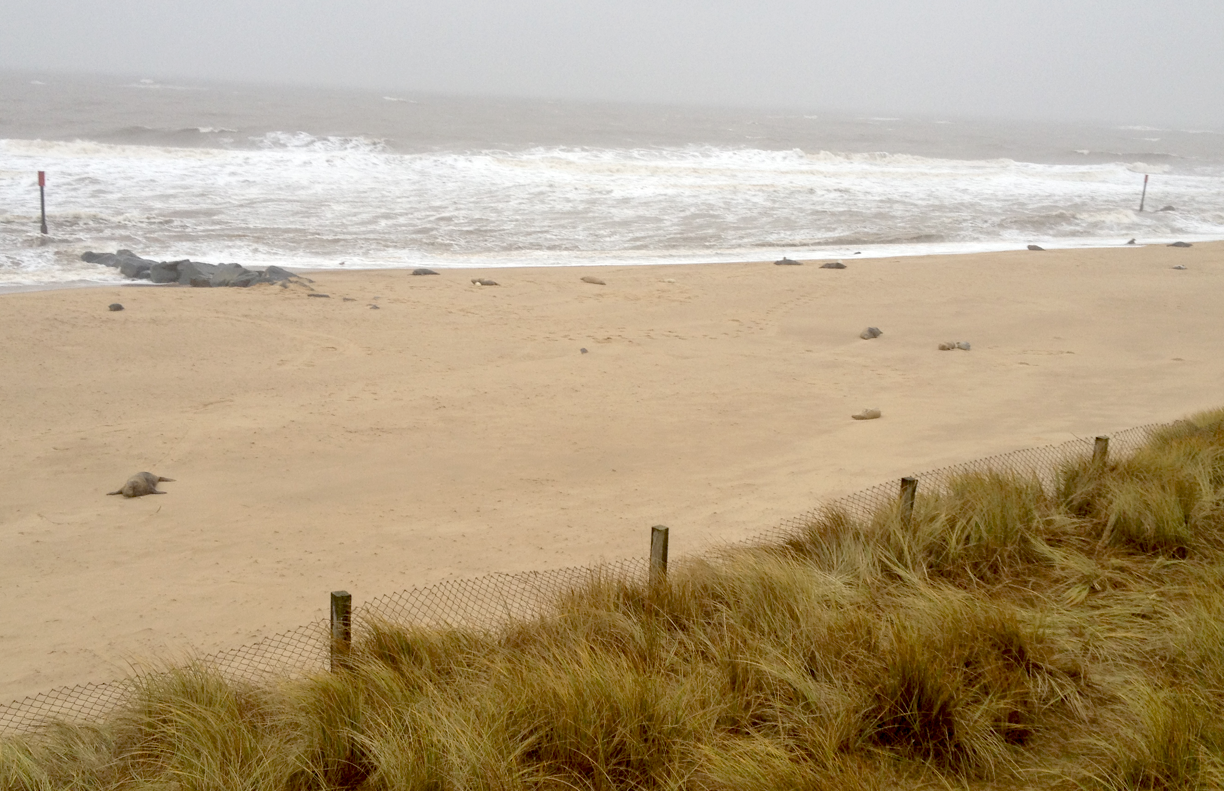
Our visit was on one of the worst days of the year with rain slashing in from the Southeast—directly into your face as you stumble down the rutted mile or so from the car park. The beach itself is off-limits, for obvious reasons. Use the first access to the left near the WW2 bunker to get a glimpse without walking too far. But at this time (Dec 2012) the roped off path along the top of the dunes where people can observe the seals without disturbing them was closed from that point South.

The Beach at Horsey Gap: the 'Boulders' ARe Grey Seals

The Beach at Horsey Gap: the ‘Boulders’ between the Groynes Are Grey Seals

Continue along the track behind the dunes, ignoring the concrete gap in the dunes and sea defences which was closed up with Herris fencing and finally you come to an area where you’re allowed on top of the dunes overlooking the main colony. Although visitors were once allowed on to the beach among the seals, this caused so many pups to become detached from their mothers and lost that everyone should stay off the beach and on the dunes behind the blue rope.

Grey seals seem so awkward on land, lolloping forward with waves of blubber showing along their bodies. But, underwater, they are immensely graceful and streamlined, capable of lithe, effortless turns and speed to catch most fish. Those here at Horsey probably broke off from the older colony at Blakeney Point or Donne Nook in Lincolnshire. All three are unusual, being beach colonies; most of the others are on remote rocky points far less accessible for us to appreciate them.

Bull Seal Well Up the Beach at Horsey

Bull Seal Hauled Well up the Beach among Dunes at Horsey

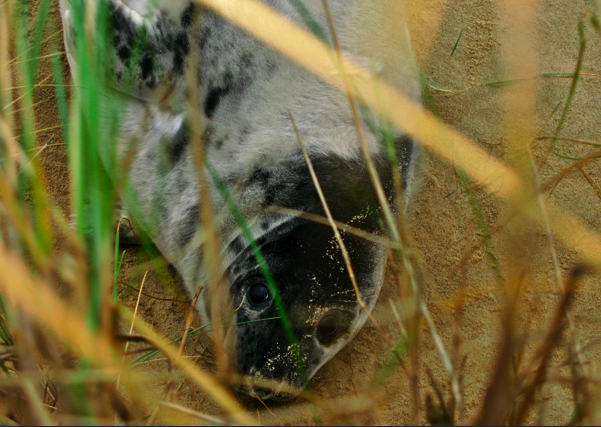
After commercial hunting in our history, it’s good to see these fascinating sea mammals making a recovery—although inshore fishermen complain they lose too much of their catch to their ravages. This colony is an excellent opportunity for much of East Anglia to catch a glimpse of them, especially in winter when larger numbers are ashore to pup and it’s not hard to find a white-coloured one suckling from its mother.

Gey Seal Pup Trying to Stay Hidden in the Marram

Gey Seal Pup Trying to Stay Hidden in the Marram

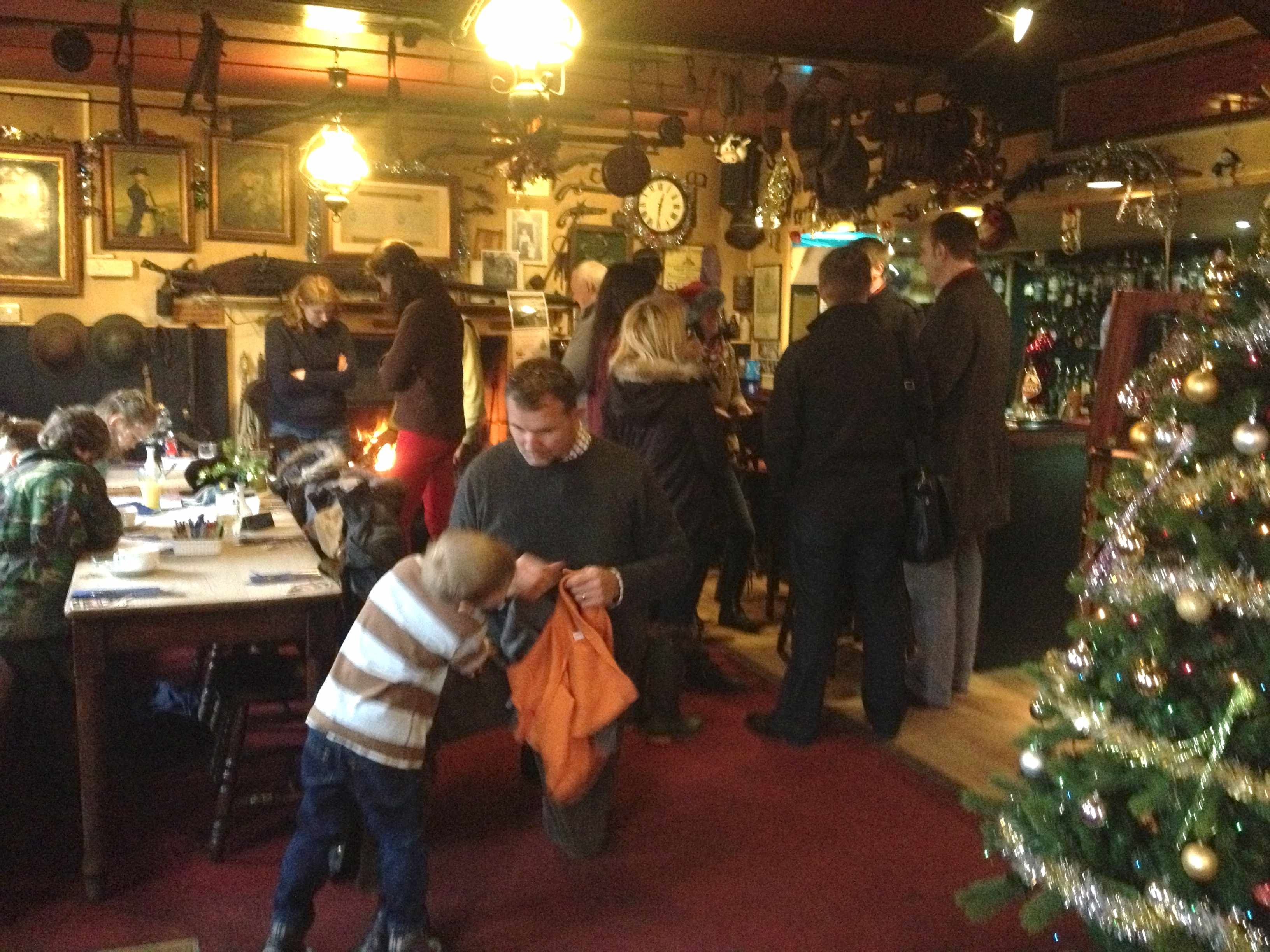
After braving the elements for the best part of an hour (the seals appeared supremely indifferent to what the weather was throwing at them) we retreated to Horsey’s conveniently located only pub, the Nelson Head, where some fine parsnip soup did much to restore circulation and restore us to a more human state of mind.

Snug Interior of the Lord Nelson at Horsey

Snug Interior of the Nelson Head at Horsey


Posted in Environment | Tagged | Leave a comment

All Struggling Together

One of the joys of spending Christmas with good friends in England is to be immersed in a generous hospitality and a flair for celebrating Christmas that the Scots could well learn from. But it is also an opportunity to experience a rather different culture than I’m used to. It’s not just differences with things Scots but it’s a rural culture (1.6 people/hectare) of huntin’/fishin’/shootin’, despite the presence of the Fine City of Norwich (pop: 190,000). And it forms something we see little of in Scotland these days: Conservative heartland.

In some ways, it does resemble other Tory heartlands like Surrey, where only the odd Lib-Dem orange blob disturbs a tranquil sea of blue and upstarts like Greens or Labour may occur on town councils, but never at MP level. However, where Norfolk seems to part company with its Home County Tory chums is that it’s a bit more turbulent than the seamlessly douce quiet of Haselmere or Farnham.

First of all, they seem quite open to change. Breckland District’s former Chief Executive is returning to take on the job of joint Chief Executive with Holland District Council—the kind of radical innovation that Scots have shied away from. The voters also seem capable of discounting party loyalties and voting for the person. In yesterday’s by-election for two seats on Norwich City Council, Labour’s Marion Maxwell romped home in the Crome ward while Andrew Boswell retained the Green’s numbers at 15 by holding Nelson ward. Though the city’s two MPs are split between Tory and Lib-Dem, they elected only 5 and 6 councillors (out of 39) and both received a good drubbing at this poll.

Although the half-dozen surrounding district councils are solidly Tory, they are not the sleepy shires normally associated with that party. Jon Herbert, a Conservative member of South Norfolk District Council has resigned from the party to stand as an independent against Derrick Murphy, the Tory Leader of Norfolk County Council. The spat appears to stem from a combination of approval for 180 houses near his home in Mulbarton and an ongoing QC investigation into taxpayer-funded catfight internal to Norfolk Tories in which Mr Murphy seems implicated.

More disturbing to comprehend than that was the death of Keith Johnson, Leader of Tory-controlled North Norfolk Council. The police investigation into this is still ongoing but it appears Mr Johnson shot his wife of 18 years dead with one of her four shotguns in a neighbour’s garden in Cromer, returned home then shot himself in his own garden.

He had become Leader only in May with the “shock resignation” of Helen Eales who had led the Tories to victory in ousting the Lib-Dems from control of the council for the first time in its history. A new civic leader (= Provost) was chosen at the same time. Tom Fitzpatrick took over as Leader at this week’s council meeting at which a new civic leader Peter Moore was elected to replace John Perry-Warnes who resigned unexpectedly.

In case you think they might run out of councillors at this rate, there are 43 on North Norfolk Council serving a population of barely 80,000—smaller than East Lothian. And, in case you think this month is an unusual flurry of activity, on Nov 17th of this year, Dr Jenny Harries, joint director of public health at NHS Norfolk and Norfolk County Council resigned, saying she “could no longer sustain the toll being placed on her by living away from her family, who are based in Wales”.

Back on the County Council, Cllr Paul Rice defected from the Lib Dems to the Conservatives in July 2011, to be followed in November of that year by Cllr David Callaby, of Fakenham Ward. Cllr Phil Hardy who had been leader of the Green Party group on NCC defected to the Conservatives and one of the by-elections mentioned above was caused by Green Cllr David Rogers resigning, claiming the Green Party “attracts the gullible and the authoritarian”.

This scale of kerfuffle is not limited to the County. Having 47 Conservative, 3 Labour and 3 independents, Breckland District Council is almost the political mirror image of the old Glasgow City (74 Labour out of 77 total). But, like Glasgow, that did not lead to serenity. They have seen no fewer than five resignations since the last local election—one where a Labour member left to form a group with the independents, three Conservative resignations gave by-elections that they easily won back and the most recent was by Cllr Pauline Quadling who resigned as a Tory so that she can fight the current Tory leader (of Breckland, not Norfolk—don’t get confused with the above).

Given that the population of Norfolk is barely 0.75m (a fifth our 5.25m, even though it has almost half the number of councillors as Scotland), this level of political ‘churn’ seems amazing, most especially in a heartland of douce—and supposedly stable—Conservatism. Yet so frequent and incessant are such political spats that they seldom rate more than a side column in the Eastern Daily Press.

If this happened in Scotland, such council bun fights would never be off the front page.

Posted in Politics | Tagged | Leave a comment

Native Arts; International Direction

I had been hoping to back off on the politics for the festive season, get out the mulled wine, wish everyone whether nationalist or unionist, flat-earther or chelsea tractor pilot alike good cheer for the festive season, and revel in the warmth and humanity of the season. I had even decamped to England where they ‘do’ Christmas rather better than we Scots in terms of both public and private festive warmth. But ’twas not to be.

Because, the Torygraph has a piece from Jenny Hjul that rubbed me up the wrong way because it rolls out some hoary old chestnuts around the discussion triggered by Alasdair Gray. Now Jenny—or anyone else—is entitled to their opinions. And, as someone who lives in the capital and earlier used to contribute regularly to the Hootsmon, hers is an articulate voice worth considering, despite the fact that most of what she wrote had me spluttering cornflakes before para 3.

Alasdair Gray is, as Jenny observes, a member of “the cantankerous old guard” and, in my opinion, long may he remain so. He has earned his place in that Scottish firmament just as Ken Clarke, Dennis Skinner, Margaret Thatcher and Alf Garnet qualif for the English equivalent. Actually, what he is saying, IS pretty cantankerous—but also drags points into the limelight that deserve debate.

To categorise English people who take up senior arts posts in Scotland as either ‘settlers’ or ‘colonials’ does approach the boundary of racism. Professor Tom Devine, a cultural heavyweight with whom I do not lightly cross swords, thunders in the Herald“I think Mr Gray shows a disgraceful attitude. We have got to remember that the current Scottish population is so vibrant because of the English factor.” Ian Dean Burns and Hannah McGill both appeared on Scotland Tonight ill at ease taking an icon like Gray to task but nonetheless agreeing he’d gone too far.

But what is his reprehensible act? Gray, making the comments in an essay in a book called Unstated: Writers on Scottish Independence, has said this row leaves him mystified. He distinguishes the settler from the colonial by describing the former as those who come here, absorb Scottish culture and go on to make a life here, whereas the latter simply use whatever stint they serve as a stepping stone on their career and soon move back to England.

Unfortunately for Alasdair, that latter pattern is common among more than just senior art administrators and futile to avoid, except at job interview stage. He singles out Vicky Featherstone as being guilty of that after eight years here—a judgement I find severe, given what she did with Black Watch, a seminal Scottish play. In international terms, the Traverse carries more creative cachet than Dublin’s Abbey, so we are not in agreement on that either.

But the furore about provincialism and racism thus created has obscured some significant points, most especially the ‘nasty nat’ overtone so rampant in Jenny Hjul’s piece. There are estimated to be over 400,000 first-generation English ‘settlers’ now domiciled in Scotland and I have yet to meet someone who doesn’t regard them as generally welcome.

As with most people who move seeking the prospect of a better life, ‘settlers’ tend to exhibit gumption, which does not always go down well with all locals. I witnessed this with Gastarbeiter in Germany and immigrants in the States; a small section of the population—usually the less successful—resents outsiders ‘taking their jobs’. But most people in Scotland are simply curious about outsiders and open to new ideas that they bring. I certainly believe that to have been the case in the arts.

What I think Gray was raising as a question was twofold: how many ‘colonials’ are simply job-bagging for their CV and to what extent are such people excluding local talent from jobs they could have filled. The number of senior posts in the arts filled by non-Scots in Scotland certainly validates such a question being asked, even if it in no way justifies any kind of witch-hunt of non-natives.

Gray’s ‘colonial’ phenomenon is palpable in many aspects of Scottish life outside of the arts. Whereas the relatively canny banking culture displayed formerly by RBS and BoS brought an almost Swiss reputation for reliability to Scottish bankers, the piratical irresponsibility of Fred the Shred and fellow Halifax colonials who exploited and then trashed that hard-won reputation has caused immense damage.

Look at any up-market housing development across our Central Belt. For the many families making friends to share the excellent quality of life here in Scotland and whose children will be indistinguishable from any old guard’s sprogs, there are always a few up here promoted to some corporate stepping stone who shield their children in private school, rail against the weather and the distance to London and are relieved to move back south on a further promotion within a matter of months.

We must see past the poorly phrased argument that Gray made to understand any terms of debate how we develop our own arts management talent to compete on the world stage for posts anywhere—not just in Scotland. We must also examine the extent to which we tolerate the kind of carpetbagger to whom a posting to Scotland is seen as exile—to be tolerated and in no way a positive cultural opportunity.

So when Jenny Hjul and Tom Devine—both, I am sure, convinced of their objectivity in this debate—see “disgraceful anti-Englishness” or echoes of repressive apartheid in this, hauling out the old chestnuts of ‘nasty nats’ and quoting racist incidents against the English, it cannot go unchallenged. Though much was made of supposed statistics showing increased racism this flies in the face of recent experience and was debunked by the Scottish Government.

More important is to deflate this straw man of an entire phalanx of ‘nasty nats’ out there. Eejits exist in all camps; few are under control. In my challenge to the many negative and simplistic arguments put forward by unionists, I may qualify as a ‘nasty nat’ myself—I have been blocked on Twitter by Tom Harris MP, whom I hold in high regard. But, along with the great bulk of fellow nationalists on social media, I have been as courteous as I have been robust, swallowed a couple of deserved portions of humble pie and treated arguments with which I had little sympathy as much with good humour as with scorn.

Many of us grow tired of NOT being racist—of presenting what we believe to be solid arguments why Scotland as an independent country is both a normal and a desirable state of affairs—and being pilloried as one anyway. But we want an open discussion—with all scots, regardless of origin. The sole qualification is residence here. And, though there is clearly no way to enforce such a thing, a committed permanence to that residency would seem a stronger endorsement of right to participate. For the avoidance of doubt, all those mentioned above qualify.

But Alasdair Gray’s key point—that there are career carpetbaggers among us and we might wish to consider what effect that is having on the development of native talent—is worthy of discussion without descending into anglophobia or scaremongering about any renewed Settler Watch. The Scottish culture scene is indeed robust, in a manner not seen in centuries; the English among us are making key contributions to that.

But one thing is clear to me: if London’s arts establishment were as dominated by Americans as ours is by the English, questions very like that raised by Gray would have long since raised heated debate. It is not racist to query people’s commitment to this country’s arts. And, since no Poles, Pakistanis or Italians head our arts establishments, it would be disingenuous not to couch the question in terms of the English, who do.

But if, instead of presuming divisive intention, we could now move on to discussing just how different our arts management is here (c.f. the Abbey in Eire), then we might bring something both useful and positive to this debate.


Posted in Community, Politics | Tagged | Leave a comment