We Don’t Teach No Calculation

A major plank of the argument made in the previous blog (The Other End of Empire) for an upside for Scotland’ independence, using Singapore as an example was its education system. A central priority virtually since their independence, some 20% of the country’s entire budget is spent on education and with result that are statistically impressive. The structured system though which children progress for almost twenty years is credited with part of the success. But even more important is the status that the entire population accord it and the esteem in which its professionals are held.

Schooling in Singapore begins at the age of 4 in nursery, then 5-6 in kindergarten, before proceeding into the more structured primary school system at age 7. Upon clearing the Primary School Leaving Examination after six years, pupils proceed to secondary school, going into more advanced schoolwork and preparing for the GCE (General Certificate of Education) O-Levels. From there, the path branches, one of which leads to a Polytechnic, where they can specialise in  areas of study with more relevance to industry. Doing well in O-levels will net a student a place in a Junior College, preparing for the next and final phase of schooling, university.

All this need not result in better education. But some respected international studies indicate that it does. The Learning Curve has brought  together an extensive set of internationally comparable data on education inputs and outputs covering over 50 countries. This, in turn, has enabled a wide-ranging correlation analysis, conducted to test the strength of relationships between inputs, outputs and various socio-economic outcomes. It also underpins an initiative to create a comparative index of educational performance which, as might be imagined, is anything but straightforward. They have established some axiomatic factors in good education:

  • Strong relationships between education inputs and outputs are few
  • Income matters, but culture matters more
  • There is no substitute for good teachers
  • When it comes to school choice, good information is crucial
  • There is no single path to better labour market outcomes
  • A global index can help highlight educational strengths and weaknesses

In formulating these axioms, they have developed five lessons for education policy-makers:

  • There are no magic bullets The small number of correlations found in the study shows the poverty of simplistic solutions. Throwing money at education by itself rarely produces results, and individual changes to education systems, however sensible, rarely do much on their own. Education requires long-term, coherent and focussed system-wide attention to achieve improvement.
  • Respect teachers: Good teachers are essential to high-quality education. Finding and retaining them is not necessarily a question of high pay. Instead, teachers need to be treated as the valuable professionals they are, not as technicians in a huge, educational machine.
  • Culture can be changed: The cultural assumptions and values surrounding an education system do more to support or undermine it than the system can do on its own. Using the positive elements of this culture and, where necessary, seeking to change the negative ones, are important to promoting successful outcomes.
  • Parents are neither impediments to nor saviours of education: Parents want their children to have a good education; pressure from them for change should not be seen as a sign of hostility but as an indication of something possibly amiss in provision. On the other hand, parental input and choice do not constitute a panacea. Education systems should strive to keep parents informed and work with them.
  • Educate for the future, not just the present: Many of today’s job titles, and the skills needed to fill them, simply did not exist 20 years ago. Education systems need to consider what skills today’s students will need in future and teach accordingly.

So, bearing the two lists above in mind, what—if anything—can be drawn from a comparison of Scottish with Singaporean education? Given that countries are now competing in global markets with a fluidity that makes mockery of sovereign borders, there is no merit in an argument that we should be looking closer to home. Let’s not delude ourselves: both English and Scottish education, for all its abilities and dedicated teachers, is churning out substandard graduates, be they from primary, secondary or tertiary level. Take five crucial parameters:

  1. Early Years. Despite Scotland having introduced nursery places for 3- and 4-year-olds, they are little more than creches that enable parents to work. Singaporean pre-schools have broad, balanced and purposeful curriculum, delivered through planned play activities. Children  develop skills such as speaking, listening, persistence, as well as early reading, writing and numeracy. While the highly-rated Scandinavians do not introduce such structured learning until 6, they do utilise the earlier years for learning social interaction, especially outdoors with nature.
  2. Primary. Whereas in Scotland, children supposedly progress together as classes with a single teacher each year, the pressure on funds and composite classes, as well as the introduction of specialist teachers (e.g. music; languages) rather undermines that. In Singapore, this consists of a 4-year foundation stage from Primary 1 to 4 and a 2-year orientation stage from Primary 5 to 6. The overall aim of primary education is to give students a good grasp of English language, Mother Tongue (e.g. Malay) and Mathematics. Unlike Scotland, pupils do not progress either illiterate or innumerate.
  3. Secondary. Whereas in Scotland (and even more so in England) there is a narrowing focus on fewer subjects as pupils progress towards sixth year, in Singapore Schools in Singapore boast a holistic education, which is another word for having a well rounded education. In this, it is more like the European Baccalaureat. Although specialist schools exist, the emphasis is to bring all pupils to competence in a wide range of subjects.
  4. Tertiary. Comparable in stature and ability to colleges and universities elsewhere, the biggest difference in Singapore lies in the status of vocational institutions. As Singapore acts as an entrepôt for half the world (and the dynamic half at that) there is immense demand for well educated hands-on professionals, craftsmen and artisans. There is no stigma attached to such careers and certainly no perception that they are inferior to ‘white collar’ doctors of lawyers.
  5. Teachers. As in other countries where the standard of education is exceptionally high, the social status of teachers as professionals is also exceptionally high. This is a product of the teachers themselves and willing respect and encouragement from parents. What EIS and other teaching unions fail to grasp is that the more they ignore the educational welfare of pupils and focus entirely on teachers’ pay and conditions as if they were hard done by, the less this positive perception of teachers is achievable here in Scotland.
  6. Society. In part deriving from the large ethnic Chinese grouping, who have always placed high importance on education as a vehicle for success and happiness, the status and importance of education is higher in Singapore (both among parents and pupils) than it is in Scotland. In Scotland, this priority exists, but mainly among the middle class and those sending their children to private school.

These are clearly only an overview of differences and there are certainly many whose opinion is that the Singapore system is too rigid, churning out too many generalists and stifling creativity. Such thinking led to Burgess Hill and the like in the 1960s and major changes in curriculum in both Scotland & England through the eighties. The net result was barely any improvement for the better pupils and the beginnings of illiteracy and innumeracy among the worse.

All people are different and will succeed in their own different ways. But, unless they are equipped with a minimum (and standard) set of skills during their education, they will struggle to recognise—let alone achieve—that success. It is NOT a question of money. Many politicians and educators point to poor school results from poor areas but draw the wrong conclusion and throw money at the problem. But instead, if the society in those sink areas adopted the attitude of the Singaporeans (or US immigrant poor in the Bowery or impoverished 18th-century Scots who soaked up the teachings of their parish school dominie to create the Enlightenment) then Scotland would finally be back on the road to leading the world in education.

Again.

Posted in Education | Tagged | 1 Comment

The Other End of Empire

Back when the British Raj was at its greatest and one fifth of any self-respecting globe was painted pink, the entire “empire on which the sun never set” was held together by a series of bases from which redcoats and gunboats could be dispatched to quell whatever local insurrection dared question the Great White Queen. Prime among these because it held the key to the lucrative sea trade with Southeast Asia—whether silk, spices or opium—was the modest-sized island of Singapore.

At barely 760 sq. km. (not even twice the size of the Isle of Wight) it was recognised early on in European sea trade with the Far East to be a key holding. Though the Dutch and Portuguese fought for control they lost to the British who in 1819 established an entrepôt there which, by WW2, had become the largest and most important British base overseas, made all the more important by its Malay hinterland that was a huge and very lucrative rubber producer. However, un-awed by the might of Empire and its superior numbers, Lt. General Yamashita and his 25th Japanese Army brought two centuries of Empire  crashing down in a little over two months in the most humiliating surrender suffered by the British Army. Ever.

British prestige in the area never recovered and in 1963 the country of Malaysia which included Malaya proper, Singapore, plus Sabah and Sarawak (both parts of Borneo) was given its independence—not least to counter communist guerillas who had lurked in the jungles as part of the early Cold War. With massive resources of rubber, tin and hardwoods, with a mixed ethnic populations that included significant amounts of industrious chinese and sitting at the commercial crossroads of Southeast Asia, great things were expected of Malaysia.

For two years, the 1.6m largely Chinese and entrepreneurial Singaporeans tried to get along with the more passive 9m largely Malays who made up the bulk of the population, sharing a GDP of around $3bn per annum. But there were frictions. In an unexpected development rather stunning in its broadmindedness and foresight, they agreed their ways should diverge and in 1965 the small island state of Singapore left Malaysia to be recognised as an independent country.

While this example at the other end of empire of a large country separating into two unequal but much more culturally coherent parts may not translate exactly into the present question of whether the UK should be put out of its misery, there is certainly a tale of positive benefits to all concerned that is at serious odds of the Better Together scare stories of evaporating pensions and warts on all their first-born if the Scots dare to think that there is a better world than that which issues from the pens of Whitehall mandarins.

Such mandarins (or any unionists) never mention examples like Singapore/Malaysia. And, though there is no automatic correlation between that and the UK, I defy all the supposedly sincere unionists to deconstruct why Scots, if they were to recover the venturesome spirit of Adam Smith, James Watt, Mungo Park, Charles Rennie Mackintosh, Keir Hardie and their ilk, would not create a situation in Britain similar to Malaya, where the smaller partner provides the commercial hub for the varied industries of the larger. London once did that for Victorian Britain but the docks are now yuppie playgrounds. Look at Malaya and ask why this can’t happen here…

…in 1965, their joint GDP was $3 bn per annum for 10.5m people—a modest $285 per capita. Regularly achieving 6% growth, Malaysia alone went on to achieve $21.8 bn by 1980 and $287bn for its 24.3m people by 2012. That’s a respectable $11,757 per capita, which places it around 50th ranking in the countries of the world. Not bad.

Meanwhile, Singapore, starting with little but the leavings of British bureaucracy and a fortunate location, embraced the world and the opportunities the late 20th century afforded it. Whether corporate HQ’s, offshore semiconductor production or becoming the regional hub for wealth management, they took their population to 4.3m in fifty years and—more impressively—their GDP from less than $1 bn through a growth that spurted to 8% on occasion to land at $245 bn in 2012—not far short that achieved by all the rest of Malaysia and landing them (along with Qatar, Luxembourg and Norway) among the richest countries in the world, boasting a $57,000 per capita GDP.

Often cited as a city of the future (and sometimes criticised for the resulting Orwellian feel), Singapore has spotless streets, modern buildings, an amazingly efficient public transport system and well paid employment for its citizens. Singapore now has a highly developed trade-oriented market economy that has been ranked as the most open in the world, the least corrupt, the most pro-business and offering low tax rates (14.2% of GDP). It is recognised as the world’s fourth leading financial centre, after New York, London and Hong Kong.

Singapore has the highest trade to GDP ratio in the world, averaging around 400% during 2008-11. The Port of Singapore is the second-busiest in the world by cargo tonnage with a modern port infrastructure. Its skilled workforce is attributed to the success of the country’s education policy in producing skilled workers and is fundamental in providing easier access to markets for both importing and exporting, and also provide the skill(s) needed to transform imports into exports.

There are no guarantees for any future but the unleashing of Singapore was an event that lies firmly on the plus side of the argument for Scottish independence. A country the size of Glasgow traded independence into making its people 200 times richer in half a century. If that’s too fanciful for your taste, pardon these imaginative proposals:

  • What if North America turns fracking into major oil exports? Already European energy capital exactly on the approach to Europe, Scotland could be Europe’s energy entrepôt, capitalising on both North Sea oil pipelines and those to the East, plus the international electricity grid being proposed.
  • What if the trend to Cape-size (~200,000 tons) and VLBC (~400,000 tons) continues? The Channel is already crowded and only 40m deep; much of the North Sea is shallow. Scotland has deep water access and is spoilt for choice in anchorages.
  • What if we invested in a major international airport hub near Falkirk? More than any other country, we lie on the great circle routes to North America. We would attract major US traffic from Schipol, Copenhagen and Heathrow with a web of feeder links all across Europe and cutting flight times by at least an hour.

The equivalent of Singapore’s story is for a swampy, tropical Isle of Wight with no oil, no minerals, indeed nothing but its people as an asset to  become both the hub of Western Europe’s trade and finance and fourth-richest country on the planet. If that is possible, what opportunities might hundred-times-bigger, more advanced, globally famous Scotland achieve? If England took a leaf out of Malaysia’s book—help its feisty go-getter  brother move from being a surly lodger to discover his métier in the world—the whole family of countries on the British Isles would benefit.

Posted in Commerce, Politics | Tagged | 1 Comment

Elvis Has Left the Fairway

With the Open now closed, it’s meet to take stock of the net effect of such a huge circus rolling into as small a town as Gullane. From almost any perspective, it must be considered a huge success and the R&A, supported by a myriad of organisations, deserve praise for the way it knitted together and showcased top-notch golf at a top-notch venue with minimal distractions.

The weather was especially kind—to the onlookers, if not to the players themselves. A run-up of glorious summer weather had left greens “like glass” and fairways almost as fast as the greens. Together with fearsome rough that lurks close on either side, this was the downfall of many a fine contender on the first sun-drenched day as balls rolled further than they should have. Unlike many such top-rank golf contests, a below-par score was a rarity and highly-ranked golfers like Rory McIlroy stumbled into plus territory.

A second day of blazing weather fooled many who thought they had the measure of the course now as the wind swung from West to East and balls rolled in entirely different patterns. As a result, the cut winnowed out many worthy and famous names from Faldo to McIlroy and the spread of scores was unusually narrow, making it anyone’s contest and setting up a couple of cliffhanger days of fine links golf over the weekend. The top of the stand at the 13th was judged to be the prime seat as, not only could you see several other holes but the views of Gullane Hill’s fine houses and the panorama of the Forth were made as the more stunning in the summer sun.

Meantime, the impact of the Open on the surrounding communities  became clear. With  local roads closed, there was minor disruption to residents who had coded passes for vehicles to give them access. The provision of both park-and-ride and thrice-hourly trains to Drem worked very well and ScotRail/Stagecoach/Scottish Police are to be commended for whisking 7,000 fans daily in and out of the tiny station with even larger numbers using the Ballencrieff or Muirton P&R. The only transport black mark goes to FirstBus who insisted on running a bog-standard 124/X24 half-hourly service through Gullane, resulting in frequent overcrowding between Musselburgh & Gullane.

And it was at those park-and-rides that the first mumbles were heard regarding prices. Not only was a day ticket a hefty £75 (with no concessions) but the £15 P&R charge was regarded as steep. Add in the fact that anything being sold inside the event itself was at a steep premium (bottle of water: £2.50) and it is little wonder that the numbers attending slumped from previous years—some 10% down at around 30,000 each day. Whether the R&A takes this on board in the present ever-tightening economic stagnation remains to be seen.

Certainly, there was little indication of parsimony at the heart of the contest. All the usual sponsors were there; a fleet of grey Mercedes courtesy cars whisked insiders where they wished to go; the big BBC studio overlooking the 18th was dwarfed by ESPN’s double studio and 200 staff in attendance. The Bollinger tent was going like a fair and people (well, men) were snapping up expensive golfing wear of questionable colour schemes.

Although some had benefitted during the weeks of run-up, local businesses who offered daytime services did suffer serious falls in takings over the four days: few of the shops, cafes and restaurants in Gullane saw much business until the day’s golf was done and Fenton Barns, even though technically accessible, suffered hugely from having the through road to Drem closed. North Berwick reported significant drops in daytime activity as people from Edinburgh perceived the area to be choked with traffic and gave the place a miss.

But the story was better in the evenings. All the restaurants, while having minimal lunch business went like a fair each evening, with available tables like hen’s teeth as famous names block-booked for eight or more. Most popular of all was Zito’s where Bert gave his usual virtuoso front-of-house performance in presenting excellent food. Over the week it developed into the players’ favourite haunt—so much so that a group of golfers left their stunned waitress a £250 tip and staunchly rebuffed her refusal.

There was also, unlike in 2002, a timely recognition of when opportunity might present itself along the High Street. As a result, a handful of shops stayed open late into the evening, including Blues & Greens, Etc, Tippecanoe and Locketts who found good business in the hundreds of players and spectators when wandered the High Street throughout each evening.

So, if there are lessons to be learned (apart for the R&A shifting a thrawn Muirfield out of its neanderthal attitude on gender) for next time, it would be for a more proactive role by the Council’s Economic Development to formulate a plan that better spreads the wealth to local business more. As a start, a much more comprehensive explanation of the traffic plan that didn’t fall between an over-simplified diagram from the police and fifteen pages of legal TRO gibberish from the Roads department would help.

Oh—and more fabulous weather would help.

Not Yet Sunset: West Beach, North Berwick, July 19th 2013

Not Yet Sunset: West Beach, North Berwick, 9pm July 19th 2013

Posted in Commerce, Community | Tagged | Leave a comment

In The Bunker

North Berwick High Street was a-buzz into the late evening yesterday. Although the Fringe-by-the-Sea beach hut had closed, the pavement tables were jammed and even Rory McIlroy was forced to the subterfuge of getting Bert’s personal number off the ESPN crew camped in Castle Inn before he could get himself a table at Zito’s. The crush was not helped by word texting around local ladies that Gerard Butler was already dining there.

Despite NB having been mobbed by crowds during this, the best summer we’ve had since 2005, there is a Brigadoonish boost when The Open is here. Arguably golf’s greatest contest this side of the pond, the influx of Mercedes with tinted glass and cloak-and-dagger codes taped inside their windscreens and tall, lost-looking bronzed men in white baseball caps and ill-considered tartan shorts gifts us a cosmopolitan sophistication that we just can’t match in the decade between the event happening here.

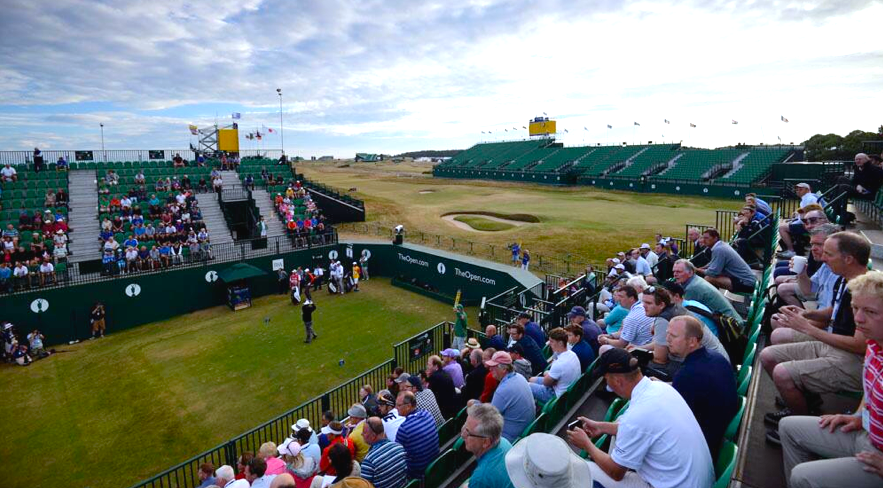
Muirfield Ready for the Open (copyright The Open)

Muirfield Ready for the Open (copyright The Open)

Everything seems in place for the big day today; half the back roads in the North Neuk are sealed off, three trains an hour are whisking spectators direct to Drem where a fleet of two dozen Stagecoach buses drawn from all over Scotland take them to the course. It is never easy to access Muirfield, even if you’re just a local trying to walk your dog but Eliot Ness & The Untouchables would be 6 to 4 against being able to make it onto the course without credentials, let alone into the hallowed clubhouse itself.

Which is the nub of this blog. Now, I am as one with Mark Twain who regarded golf as a good walk spoiled; I am also as one with Groucho Marx who opined that he would not wish to belong to a club that would have him as a member. Whether the Honourable Company of Edinburgh Golfers would ever permit me to darken their clubhouse door at Muirfield is moot: the point is that, whatever reason they might advance to refusal, it would not be based on gender.

But the First Minister himself has already highlighted the antediluvian rule that, not only are females not permitted as members but the dastardly distaff are not even permitted in the clubhouse. Which is strange, not to say hypocritical, given that they (albeit grumblingly) have permitted female journalists in to perform an interview and they seem to have no problem paying waitresses minimum wage to serve them drinks.

The R&A is under some pressure to persuade the three remaining bastions of male supremacy that hold The Open to drag themselves out of a Middle Ages mindset and draw the logical conclusion of the 1928 Emancipation Act viz: that women have rights equal to men and it is not for some smug cabal of a membership committee to ignore progress on the rest of the planet simply because it is not technically illegal. Since half the membership is drawn from Edinburgh’s legal elite, you’d fancy they knew better and would want to be seen to get out of the bunker.

But the R&A’s form on this is poor. In April, they stated that they “would not bully clubs into accepting female members“. Yesterday R&A chief executive Peter Dawson said “it would take a hard push to change policy on all-male golf clubs. There’s a huge difference between men-only and whites-only club membership and we see no reason to act on Muirfield”. Whether he would be comfortable with men being banned from his local library or from joining a local tennis club, he did not say. But the bottom line is that the R&A is complicit in, if not actually supporting, the kind of discrimination that is illegal in all but private clubs.

Were this entirely a private matter, such a position might be legally, if not morally, tenable. But, having been involved in the massive public services effort that allows both Muirfield and the R&A to coin money like it was going out of style from such a high profile and public event where admission starts at £75 and drinks at a fiver, this travesty of the Equalities Act cannot be left to stand. Public money must not support any form of discrimination. In principle, ‘men-only’ or ‘whites-only’ are no different.

That the Open is a great event and welcome in East Lothian is not the issue. If a bunch of old farts want to live anachronistically, we should let them. But they don’t get to host any event that involves public money. And until the R&A stops turning a blind eye to such thrawn cantankerousness, their jaiket’s on a shoogly peg too.

My Response to the Continued Ban of Femals by Muirfield

My Response to the Continued Ban on Females by Muirfield

Posted in Community | Tagged | 1 Comment

Ye Olde Schizophrenia

Tuesday was a busy one for news regarding the UK’s defence posture. A Liberal Democrat-led review of alternatives to a like-for-like replacement of the UK’s nuclear arsenal has been deflected and will, according to PM Cameron, not affect government policy: the UK remains committed to replacing its continuous deterrent. And yet Danny Alexander  asserting that the review could still lead to a change of course before a final investment decision is reached in 2016.

On the same day, a freshly minted Minister for International Security issued a stern warning that “Scottish independence will severely damage Britain’s defences” and that he believes “defence is one of the SNP weaknesses“. As a man with thirty years’ service with HM Forces, Dr Andrew Morrison certainly can claim some qualification to so opine. Even if his service was as a Surgeon Commander, the way the Navy works, pretty much everyone out on the briny is in the front line and as likely to get shot at as the next guy.

A number of thinking people—and not just rabid ScotNats—will have difficulties with both positions (Cameron and Alexander are not disagreeing on the fundamental question of nuclear deterrent; merely on how best to extend it). But the real debate (whether, dare I say, Scotland remains in the UK or dismantles it) must surely be:

“What manner of threats face Britain from elsewhere and how best can we deploy resources to counter them cost-effectively?”

Both Cameron/Alexander and Morrison not only fail to answer such a basic question; they singularly fail to acknowledge that it even requires to be asked. This is self-referential idiocy of the highest order. Cuts or no, if we are to continue spending £40bn each year on defence (the thick end of £700 for each person in the UK) some serious reflection is in order.

Now, if us Brits were Americans: gun-toting, frontier-nostalgic, “Live-Free-Or-Die” types whose international relations seem scripted by Hollywood, then deploying 11 carrier strike groups and 5,113 nuclear warheads and throwing your weight around makes some kind of sense. After all, guns outnumber the  300 million people in the country and their self-reliant, anyone-can-make-it philosophy was made to support Harry Truman’s engagingly simple foreign policy: “walk softly and carry a big stick“.

But, much as we love parts of their culture and think of them as friends, whether English, Irish, Welsh or Scots, we are not Americans but have much  in common with each other. We are less brash; we are more polite; we are proud of the NHS; we favour “Dixon of Dock Green” unarmed, friendly cops, not some gum-chewing, holster-on-hip Rod Steiger from “In the Heat of the Night”. So why we should retain ambition to be a Steigeresque global cop now that our overseas interests are mostly fly-blown specks marooned in endless oceans is a question all 60 million Brits ought to be asking—especially how better to spend our £700 each. A dozen cogent points relating to this must be addressed:

  1. Might the security of the British Isles not be improved if we stopped poking Iraqis or Afghans in the eye. 7/7 and the like could well be the price you pay for acting as the world’s policeman. Since one fifth of the globe is no longer painted pink, why are we still reaching for a status we neither have nor can afford?
  2. The Cold War is over; why do we still have Trident subs and heavy armoured Chieftains and global strategic lift capacity even after we’ve dismantled BAOR and admitted that the Soviet 20th Guards Division is not about to storm through the Fulda gap? If Russia is a threat, it’s not to us—and if it does become one, most of Europe has already gone under.
  3. Who, in God’s name, would we ever launch a nuclear strike against? In fifty years of having the capability, we have never, ever even come close to nuking anyone. If Iranian/Moldovan/Ruritanian terrorists detonated a dirty bomb that poisoned thousands and laid waste to a square mile of a major UK city, would we launch against their (possibly blameless) homeland? And if big boys like the Soviets did it we would be just one big radioactive slag heap so why bother contributing to nuclear winter?
  4. What are we trying to defend and what are the best ways to defend it/them? Seems that North Sea rigs are pretty vulnerable when we have ditched all maritime recon capability and have failed to provide either fast patrol boats or seaborne anti-terrorist forces. Why? And if we insist on doing anti-drugs patrols in the Caribbean, why do it with ASW frigates that can’t catch cigarette boats when the fast patrol boats (that we don’t have) could?
  5. Germany is a prosperous nation that leads the EU while the Brits are seen as stroppy ingrates squabbling on its periphery. Why don’t we take a lesson from the Germans, tailoring their armed forces to a local role as the core of European defence and an international peacekeeping role, costing 81m people only 31m Euros (or £330 per head)?
  6. What business do we have in Diego Garcia (or anywhere much east of Skegness)?
  7. Why the hell would we still need a major base at Limassol (Cyprus)?
  8. How can we argue against giving the Malvinas back to Argentina (they were snagged from them by force majeur in 1833 when the UK needed global bases and coaling stations) when we groveled our way into lucrative trade deals with the Chinese by giving them Hong Kong back?
  9. Why do we have 41 Admirals when we no longer even have that many warships?
  10. Why do we have 250 generals in the Army when we have fewer than 200 tanks?
  11. How can the MoD be short of money when it had £4bn to waste on Nimrod replacements (scrapped), £4.2bn to purchase non-explosive stock (that has seen no use since 2009) and The National Audit Office found at least £6.6 billion of stock was either unused or over-ordered?
  12. Is it not a fact that the most recent time the any part of mainland Britain came under direct attack was when de Witt led the Dutch Fleet’s daring raid on the Medway in 1666?

For all the lip-flapping coming out of Whitehall/Admiralty/MoD about how well defended we are, none of the above questions that undermine such guff have been provided with an answer. It is not just a matter of any independent Scotland being able to better defend itself—and its European friends, including England—on a per capita budget half of the UK’s (c.f. Germany). Just look at Denmark to see how it’s done. And the idea that the UK can even afford anything more than such peaceable, secondary roles is surely demolished by endless rounds of defence budget cuts.

More relevant is why a supposedly peace-loving nation like England, renowned for its genteel understatements, magnificent art and architecture, bucolic countryside and the subtlety of its argument would want—with or without Scotland—to crash around the planet waving its nuclear big stick just because English politicians envy Uncle Sam’s chest-butting bravado and swagger?

Posted in Politics | Tagged | Leave a comment

Paving Paradise

Coming as she does from Southern California, Joni knows a thing or two about untrammeled development in a culture that believes endless space to build is its rightful inheritance. Here in Scotland, despite the echoing emptiness of glen after glen and with the exception of enthusiastic Victorian paving-over of Lanarkshire, there has been a consciousness of limited arable land and the rather tight confines in which most population centres operate. But not any more.

Scots planning law has always been a bit of a cowboy’s charter, presuming development should be permitted unless substantive reasons under said planning law could be found to prevent it. This lies at the heart of a thousand local lost causes since the eighties boom.  From C.R.Smith conservatories to 1,000-home Miller estates, local protesters who see their view, local custom, building aesthetics and social cohesion as reasons to protest have often been left hurt and bewildered that their arguments were ignored.

Unfortunately, development always was one-sided, with slick QCs backing up extensive experience on the part of the developer and inexperienced locals bamboozled by re-submissions, alterations and minor chicanery, even where they managed to put up a fight. All through the building boom that skidded to an awkward halt in 2008, house builders in particular had a field day, shoehorning estate after estate into peripheral fields and providing minimum in infrastructure beyond the odd play park in exchange.

Councils were rather complicit in this. Having been fragmented in 1996 so that none had much of a strategic view, they were happy to receive £thousands per house for adoption of the roads pavements and lighting in an estate; those shrewd enough manipulating their school rolls could extract rather more to provide required education facilities. But nobody had either vision or capital to build the bypasses or hospitals or context of jobs and/or retail that knitted the tract homes into their local community.

The good news was that lots of people moved into new homes and, with growing affluence, could afford the cars that made commuting from them possible. Despite some howlers in town planning and backsliding on green principles, everyone affluent enough to participate was happy. The real problem was that, because of right-to-buy legislation, no-one saw much point in building affordable homes to rent; councils typically had sold half of their rental stock by the time 2008 rolled around but had built virtually no replacements for those losses.

Unbalanced as this was, nobody is happy with the balance achieved post-2008 when the banks took all the public money they could and sat on it. Few could get a mortgage, councils were strapped for capital and house builders could find no finance. The next five years saw the fewest houses built in Scotland since council house building went out of style in the early eighties. Rightly concerned with this, the Scottish Government rattled their sabres and declared that house must be built—and that they would ensure the more traditional considerations of local plans/protest/circumstances would not stand in the way.

In places like Fife and or Renfrew—let alone around Glasgow—developers with healthy land banks could be coaxed out of their shells to build new, usually 2/3-bedroom family homes to replace the stock of industrial age housing that had outlived its usefulness and often been condemned as sub-standard. But this developers free-for-all did not restrict options to such community priorities. In North Berwick, this has led to some of the most egregious money-spinning violation of community welfare and common sense yet to find its way to a planning department.

North Berwick is a blimp-shaped community, rather less than 1 km from sea to southern fringe but already stretching 3km from East to West. All the land between that western edge, where the A198 carries 90% of car traffic into town, and the pretty village of Dirleton is farmed by the Millers of Ferrygate. Wherever new houses have gone, residents of both communities have been adamant that they should not start to join them up as a strip development further west along the A198 (i.e. in this area). For at least a quarter century, it has been obvious that the Millers are intent on doing just that.

In the early nineties, a strange belt of saplings was planted, sweeping from road to horizon to the South, enclosing over 50 acres next to the edge of town. These have no earthly agricultural use but are now becoming tall enough to obscure any development east of them. Such foresight effectively removes any objection that might by lodged about a development behond them changing the ‘gateway’ to NB.

Then in 2004, as part of the consultation for East Lothian’s 2008 Local Plan, a submission was made for 150 houses in this enclosed area—but with a sweetener that an entirely new road would be provided that would link with Gilsland on the south side of the railway and thus provide the beginnings of a NB bypass that might drain much of the 90% of road traffic mentioned above. Along with proposals for 1000-house ‘villages’ at Drem and Fenton Barns, it was given short shrift by both  local communities and  planners; none were included in the final 2008 Local Plan.

What was allocated were 100 houses at Gilsland and a further 400 on land between there and the High School, a remnant of the old Mains Farm and owned by the North Berwick Trust. Formed in the dying days of the old NBTC in 1976, the Trust’s ~100 acres are its only asset and this was the first chance it would have to fulfill its charter of benefiting the residents of NB. But there was a snag. The Agricultural Holdings (Scotland) Act 2003 had given tenant farmers the right to buy at rural prices. And who had farmed those 100 acres under a ‘gentlemens’ handshake’ agreement for the last three decades? Why—small world—Millers of Ferrygate.

The Trust would have to remove their tenant in order to exploit their asset. Since the tenant had already pulled the wool over their eyes (by a change of partners to the agreement of which they failed to inform the Trust until it was too late), this was not likely to happen through good will, a smile and a tap dance. Actually this would lead to years of negotiation at much cost. Indeed, the tying-up of the Trust’s potential 400 house played right into the Millers’ hands: even though the Ferrygate land was not in the Local Plan, if only 100 houses were left to be built, this was in sufficient to meet demand in North Berwick. It would be imperative to provide alternatives…say, at Ferrygate.

Clever stuff.

So a proposal for 140 houses was duly submitted, properly processed by East Lothian Council—and unanimously refused by their Planning Committee in late April. Having no doubt anticipated this setback, within a month an appeal was lodged with the Scottish Government that this decision must be overturned in order to deliver on the SG’s urgent requirements to build housing. This is also clever because the type of housing is not yet specified. When Cala submitted their outline plans for Gilsland, they talked of ‘family homes’ of the sort that NB really does need—2/3-bedroom starters for young families. Their final plans contained no such thing but 5-bedroom mansions, starting at over £1m.

To raise the profile of this looming land-grab, NB Community Council called a public meeting last night, which 80 or so locals attended, most of whom were not aware of the detailed story set out above. But they were unanimous in not wanting this development to stretch the town out towards Dirleton where 3-car garages would carry their residents away from using town facilities and create another isolated clump of statement homes like Archerfield or Craigielaw. In their view, the allocations at Gilsland and the NB Trust property more than supplies NB’s share of homes required, especially when the 1,000+ already built in the last twenty years are considered.

As a reporter has yet to be allocated to this case (a decision is expected by 10th September), those wishing to make comments have until Friday 19th and should be submit them to:

  • Ref: PPA-210-2036
  • Directorate for Planning and Environmental Appeals
  •  4 The Courtyard
  •   Callendar Business Park
  •   Callendar Road
  •   Falkirk
  •   FK1 1XR
  • E-mail:  dpea@scotland.gsi.gov.uk
Posted in Commerce, Community, Environment | Tagged | Leave a comment

No Future in the Past

This weekend has seen a couple of unionists stick their head above the parapet with more style and conviction than seems to have been the case heretofore. In today’s Hootsmon, Brian Monteith makes the fair point that asking valid questions cannot be simply dismissed as scaremongering. He argues:

“Unionists should explain to the peoples of all nations within the United Kingdom that there are positive benefits from us living and working together and how there remains great potential for us going into an ever more challenging world supporting each other.”

Abso-bloody-lutely! But what Brian et al seem to sidestep is the question as to why this can only be achieved locked into the same state and why really important decisions need be taken 400 miles away by another country. Sensible and mature countries such as the Scandinavian group achieved their present enviable status, prosperity and reputation by doing just as Brian suggests but eschewing any political union, even after a millennium of tearing lumps off one another in the cause of imperial ambition.

He might also take a stab at explaining why the basket case of the Irish element of Britain should be the part that stayed in the union (as if current petrol-bomb riots were not reminder enough), in contrast to the blossoming and supportive relations that the UK enjoys with independent Eire.

Earlier on in the weekend, Alf Young had caught my attention in his opinion piece in Saturday’s edition of the same paper by citing a local hero of mine—John Major of Gleghornie, a noted Scots thinker of the 16th century who made it all the way to a top job at the Vatican at a time when there was no higher calling nor qualification as an internationalist. Alf poses a number of issues, beginning with:

“Mair asked what another St Andrews professor, Roger Mason, has called – pace Tam Dalyell – the East Lothian question. What, Mair wondered, was the practical value of independence for southern Scotland in particular in the early 16th century if the result was ongoing sporadic warfare, poverty and lawlessness? In 1521, in his Maioris Britanniae Historia (History of Greater Britain), Mair set out his answer.

“Kidd describes Mair’s answer thus: “An Anglo-Scottish union would achieve the same political benefits for Scotland as independence, as well as a range of social and economicgoods, which embattled independence on a small island shared with a much greater power had conspicuously not delivered.”

Apart from the rather slick pun that ‘Maioris Britanniae Historia’ can also be translated as ‘Major’s History of Britain’, Alf fails to outline the rather important context in which it was written. Seen thus, the oeuvre becomes more a shrewd diplomatic proposal to deflect resurgent English aggression after a peaceful and prosperous 15th century in both countries. Henry VIII opened old wounds by claiming to be overlord of Scotland, which led first to Flodden, then to his Rough Wooing. Major’s far-sighted but pragmatic proposal to avert this must be seen in this light.

Fast-forwarding 200 years to the Union of 1707, Alf disparages the negative mien in which independistas habitually describe it.

“For all the talk of rogues and traitors, there is another narrative. One about how Scotland flourished, in so many ways, from its 1707 political union with its southern neighbour. Our two big banks, one formed 12 years before, the other two decades after that union, certainly prospered over the next three centuries, until they crashed and burned, thanks to their own commercial excesses, in the banking debacle of 2008.

“Scots embraced the free trade area created by union and the access afforded to a burgeoning British empire. Glasgow became a great industrial powerhouse. Edinburgh, what the novelist Tobias Smollett called a “hotbed of genius”, the core of enlightenment thinking. As Alistair Darling reminded us, in his Glasgow University lecture on Thursday, one of the greatest luminaries in that world, Adam Smith, wrote in 1760 to his publisher suggesting that the union was a measure from which infinite good has been derived in this country.”

Accurate though this description may be, it again rather omits the context, as if the turbulent century of regal union that led to 1707 was not the unmitigated disaster for  once-proud and supposedly equal Scots that the carpetbagging of their monarchy for richer climes turned out to be.

What Alf fails to mention is a brutal choking-off of any Scots entrepreneurial spirit prior to 1707, as Scots ships were forbidden to trade with English colonies. This culminated in the shameful hostility of the English colonies—especially Jamaica (with full support from London)—towards the Scots’ 1698 attempt at a visionary, if foolhardy, investment of a quarter of the nation’s capital in Darien, from which little of value was recovered.

As if such a parcel were not rogues enough, in the resulting national bankruptcy of almost all the 600,000 Scots of the day, an influential few—Queensbury and Seafield to the fore—made good their losses by selling out their influence in a doomed Scottish Parliament. Negotiations had far more to do with ensuring Hanoverian succession to both thrones and the exclusion of any Papists from such office than either the welfare of Scotland or the rights of its people. Parcel indeed.

Henry VIII launched England on 400 years of stroppy, bombastic imperial aggression that those nations who share these British Isles have since accommodated as best they can. Scotland adopted the “if-you-can’t-beat-‘em-join-‘em” approach. Both Brian and Alf have broken fresh ground (for unionists) by citing examples in our history that they see strengthening their case—rather than scaremongering. Fair comment. And for this breaking of rather over-ripe moulds, they are to be congratulated.

But what we Scots really need are cogent arguments for the future—how spending billions on Son-of-Trident or HSR2 or the next Afghan War (we’ve had four) would benefit Scotland. And, since England’s resources are now demonstrably insufficient to match such continued overweening ambition, they might also construct a plausible argument why 2014 is not a sensible time to revisit Scotland’s 1707 Hobson’s Choice.

Posted in Politics | Tagged | Leave a comment

Notes from the Imperial Capital

The month’s hiatus in posting is not explained by a week’s trip to London to meet up with some very good friends from the States—but there was little chance to ruminate in the hectic that passes for life dahn inna smoke. (The hiatus was  from having temporarily run out of things to say: it’s hard to enjoy  summer and feel like a good girn at the same time). Given the place was splitting at the seams with tourists, I must say that the old girl is looking good.

Never having spent a week living in Soho before, I don’t have the chance to compare apples with apples but I found the place to be jumping. Whereas in the sixties, it was seedy and even by the eighties it had a run-down feel, this time between Soho Square and Covent Garden there was a cosmopolitan, a selection of shops and eateries, a fashionably  youthful va-et-vient that puts anywhere comparable I’ve seen—Greenwich Village, the Sixiéme’s Cherche-Midi or San Francisco’s Marina—on notice about being THE place to live. It seemed an anachronism to find two-century-old Rule’s still there on Maiden Lane.

And, rather than me-too malls of sameness that drain even historic town centres of their soul (Winchester was such a disappointment on July 5th, despite that launching its city festival) Soho has found the wit and diversity of a genuine lively city centre. And, unlike the weekend mausoleum that is The City, despite its shitload of shekels, this is a 24/7 operation that bowls on through the weekend. From Pain Quotidien on Wardour down to Polpo on Maiden Lane, everything was quirky, busy and good. Dim Sum at the Golden Dragon on Gerrard St was awarded top marks by my fussy, oriental chef American buddy.

Everything else seems to have ratcheted its game up a notch. From the fast cat ferries that now ply the river to the slickness of the Churchill War Rooms displays and even the relative ease that Congestion Charging has made of driving about (not to mention the slick east/west passage of Upper/Lower Thames Street) London may not have solved its traffic problems. But much pedestrianisation, Barclay Bikes, hundreds of rickshaws and a clear secondary priority for cars in many areas means what was once traffic-snarled hectic has become more lively and even livable.

Though Islington remains a yuppie epicentre; though both Harrods and Fortnum & Mason still rule their ordained roosts; though the King’s Road is as pricey & fashionable as ever, the part that took my heart was the rather funky corner called Borough where, aside from the cosmopolitanism from students at the Kings College campus, yer actual Cockney locals seem to have a thriving and stable community. And—if the waiter at Terry’s breakfast place on Great Suffolk St and the Rastafarian mechanic at Carpoint car hire on Borough Road are anything to go by—their mordant humour is thriving too.

Though I did get out of the city and, having evaded the worst that the M2/M25/M3 could throw at me, I do throughly recommend The George Hotel’s seafood plate in Odiham (followed by plum-sized cherries from the stall across the road), the sheer joy of driving the Sussex weald along the A 272, the quirky charm of Canterbury and all that it has preserved over a millennium (c.f. lost-the-plot Winchester mentioned above), the ebullient joy of London will be what I remember best from this week.

That and the terribly isolated look that Westminster now has with its anti-ram barriers in place and Portcullis House looking for all the world like a prison from the future. Which, in many ways, it is.

Posted in Community | Tagged | Leave a comment

A bridge named after a woman? Yes!

Forget the gender: this has been Margaret’s Crossing for the last eight centuries and such acknowledgement is long overdue.

burdzeyeview's avatarA Burdz Eye View

There are only 18 hours of voting left in the public consultation to “name the bridge”.

To show its inclusive credentials – or at least, so it doesn’t have to shoulder the blame for giving it a daft name, which is good politics – the Scottish Government through Transport Scotland decided to ask the public what the new forth crossing should be called.

Let’s not rehash the arguments over whether it should be being built at all.  Like many, I had my doubts and if I’d had the choice, might have opted for a ferry or even a tunnel.  But a bridge is what we are getting.  So let’s use it to make a statement.

In recent weeks, there has been much documenting, particularly as part of the great campaign to have Mary Barbour honoured publicly in her home city of Glasgow, of the lack of public acknowledgement…

View original post 704 more words

Posted in Uncategorized | Leave a comment

Phew! Water Scorcha!

After waiting for weeks for some weather we could fool ourselves was summer, East Lothian finally had two days of splendid stuff delivered with perfect timing over the Whitsun bank holiday weekend. In North Berwick, it was clear blue skies, trainloads of visitors, barely a breeze so the azure water was covered in boats and Luca’s ice-cream man was rescued from overwork by scraping empty every tub he had with him. The only people looking dejected were five Finnish ladies who had budgeted only a hour to visit us and had to climb back on the train to make their flight back to Helsinki.

From Falko’s Konditorei to the sun-soaked patio of Tyninghame Old Post Office, there were no tables to be had, the Community Centre was a zoo with a packed car boot sale mixed with a most elegant wedding at Our Lady Star of the Sea right across the road and the trip boats were running extra trips into the evening to cope with demand. Great stuff—and long overdue.

Which makes SEPA’s timing of water quality announcements all the more apposite. Coming, as they do, at the opening of our bathing season (which down our way embraces; surfing, scuba, kite-sailing canoeing, yachting, dory racing, wake-boarding seasons and lots of people getting wet besides swimmers and paddlers),  the timing could hardly be better and, best of all, the details make terrific reading.

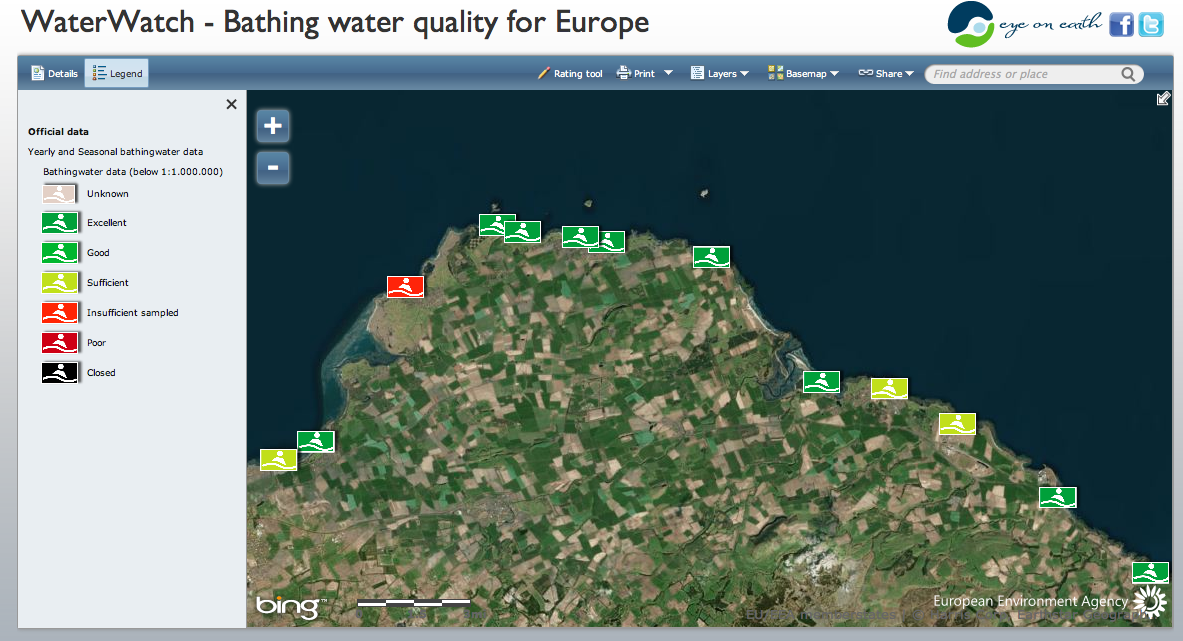
Official European Water Quality Ratings for East Lothian Beaches 2013

Official European Water Quality Ratings for East Lothian Beaches 2013

The Forth Coast shows Seton Sands to have passed but not reached the top rating, while Gullane Bents did not collect enough data to be rated. On the North Sea coast, Dunbar and Skateraw passed but not enough to get top grade. But here on the coast of the North Neuk, our entire stretch—from Yellowcraig to Seacliff—received top rating, which is all the more encouraging as the middle two are right in town: North Berwick Bay and Milsey Bay. But don’t just believe the bureaucrats at SEPA; come and sample for yourself.

Quarrel Sands—One of Our Pristine Secluded Beaches

Quarrel Sands—One of Our Pristine Secluded Beaches

Posted in Environment | Tagged | Leave a comment