Heart of Scotland

There has been a lot of media flannel about St John’s Town in the wake of their peppy team bringing home the Scottish Cup. But some is overdue praise for a little-recognised Scottish success story and one both the Central Belt and civic planners would do well to learn from. Perth and Perthshire may be considered the “Heart of Scotland”, as their local tourist industry would have it. But it links in to other parts of Scotland in a whole series of ways such that there are few other representative touchstones that could mirror the complex country we live in.

The bulk of the county is Highlands, reaching far into the glens towards Dalwhinnie, Glen Lyon and Killin. Acres of tartan are shifted out of the House of Bruar on a daily basis; far fewer pounds of salmon are lifted from nonetheless fiercely delineated beats along the Tay; Glenshee is still celebrating a bumper ski season; on the Atholl and Chesthill and Glenfernate estates they are gearing up to cater for well heeled shooting parties.

But another swathe across the South is as fertile a swathe of beautiful rolling countryside as you find anywhere in Berwickshire or Fife or the Mearns. It turns gold and green in the summer and slides into russet, offering some of the most scenic bike or open-top car runs down its sleepy lanes. Yet come into Perth itself and you find a bustling place that wholly merits the title of ‘city’.

Not only does a tastefully pedestrianised area around the High Street provide a pleasant outdoor shopping environment but the hypermarkets along the nearby Dunblane Road offers a selection of bulk buy opportunities where it’s easy to load up the car. The retail offering has a huge catchment from Crianlarich to Cupar: people even travel from Dundee, it’s that attractive.

And its economy holds its own with any similar-sized town, having survived a local decline in the whisky industry for more romantic settings deeper in the Highlands and the merger of General Accident (headquartered in Perth) with Norwich Union, it is still the home to leading UK firms like Scottish & Southern and Stagecoach. Heavy engineering has declined here, as in much of Scotland. What remains survives around the little-known port where ships can still navigate the Firth of Tay.

As a result, the city has a richer political mix than its hinterland, with Labour & Lib-Dem councillors representing many city wards while the rural ones tend to be SNP where they have replaced (but not entirely displaced) the Tories as the locally dominant force. In fact, the SNP has quietly run Perth & Kinross (P&KC) for the last two decades with little fuss and quiet efficiency, overseeing major local investment like Perth Concert Hall and the Tay Flood Defences. Some city centre housing does compare poorly with douce villas off the Glasgow Road but the difference is less than in Scotland’s larger cities.

People who are partisan about their own home town may disagree but many objective observers acknowledge Perth as Scotland’s most successful and liveable city, with outliers like Dunkeld, Crieff and Blairgowrie. Not suburbs but towns in their own right they offer, if anything, even better quality of life. So it is perhaps long overdue that their local football team should plant the ‘Fair City’ solidly on the map at last. At 45,000 people, it is urban enough to offer cinema, theatre, restaurant and other cultural offerings people now demand, while not losing a green ambience that the river and the two massive Inches lend it. It even rates No.10 as tourist destination with Insider Scotland.

With Scotland’s future demographics no longer tied to where coal can be mined or ships can be launched, we need not be thirled to the 19th/20th century dictum that the big city is the place to be: modern communications and a higher value put on quality of life demand a more flexible and livable approach. Far too much time is wasted on the M8 than is good for people of the economy.

Perth actually offers an excellent model for the future: a modest city serving its citizens better than sprawling monoliths spawned by the industrial age. Just as small countries like Denmark or Singapore have shown how modest size can offer nimble economic advantages to prosper in the 21st century, is it not logical that places like Perth—and by extension, Stirling, Dumfries or Inverness (No 2 in Rightmove’s Happy At Home Index for 2014)—will be the places to invest and that those places will become a magnet for quiet affluence that all can enjoy?

Posted in Commerce, Community | Leave a comment

Thinking Big

Jimmy Reid was not a man to think small. A product of the tough Clyde shipyards in its heyday, he saw a future for shipbuilding when the yard bosses and their clumsy attitudes had alienated a proud workforce into union nitpickery as a defence. When the Heath government pulled all support from Upper Clyde Shipbuilders, instead of a strike, Jimmy organised a work-in to complete orders. After two years, the government capitulated. Jimmy’s speech that galvanised workers to take this visionary step is legendary:

“We are not going to strike. We are not even having a sit-in strike. Nobody and nothing will come in and nothing will go out without our permission. And there will be no hooliganism, there will be no vandalism, there will be no bevvying because the world is watching us, and it is our responsibility to conduct ourselves with responsibility, and with dignity, and with maturity.”

Jimmy died four years ago but a Foundation set up in his name has kept his gallus visionary spirit alive, never more so than with their publication of “Atlas of Productivity” which seeks nothing less than to literally change people’s perception of Scotland’s place in the world. The authors describe it as:

“The first dedicated atlas of Scotland since the 19th century and perhaps the first ‘atlas of productivity’ anywhere in the world. The atlas maps not just Scotland’s landscape and towns and cities but seeks to map as many of the aspects of national productivity as possible.”

This, in itself, would make it groundbreaking. But what it also seeks to do is see Scotland’s—as opposed to Britain’s—potential place in the world. The aim of the atlas is to get Scots to look afresh at the potential of their nation based on its position and its natural resources. It considers issues like:

  • 83.1% of land in Scotland is owned by private landowners – and of the private land 50% is owned by 432 people
  • Scotland has 25% of Europe’s offshore wind resources
  • Scotland has 25% of Europe’s tidal potential and 10% of its wave potential
  • Scotland’s peak energy requirement is 10.5GW. The full wind energy capacity of Scotland is 159GW.
  • In 2013 Orkney generated 103% of its renewable capacity, but a lack of connection with the mainland meant a £3m loss in energy
  • There are 7,000 possible 5MW hydro schemes available in Scotland
  • Scotland lacks ferry connections with the Nordic countries, despite European ferries already passing between Orkney and Shetland
  • How Scotland would and should contribute to the Arctic region
  • How Scotland could become the “gateway to northern Europe”

Perhaps most intriguing of all are these last two points. For the last 300 years, all strategic UK thinking has been, understandably, been done for Britain as a whole. For most of that time, Empire meant that two major axes of thought dominated: across the Channel to Europe and; towards global trade via the Western Approaches. Even though Britain’s role in the world has diminished, these two axes still dominate London’s thinking and consign Scotland to the resulting fate of a province on the periphery.

But, apart from political upheavals and an overdue modernisation of Scottish thinking towards near neighbours in Scandinavia and the North, geography is colluding to open up whole new possibilities for that orientation. The steady reduction in summer ice in the Arctic means that, instead of being on the periphery of Europe, Scotland can be re-thought as Europe’s launch pad for the Arctic.

Projected extent of Arctic Sea Ice over the Next Century

Projected Extent of Arctic Sea Ice over the Next Century

Initially, the season of open water connecting the Barents Sea with the Bering Strait will be too short for commercial exploitation. But demands for raw materials for China and the rest of developing Asia will mean coal, minerals and timber, currently locked in the Russian and Canadian Arctic will drive a commerically viable shipping option. But the secondary effect, more crucial for Scotland is that our rail links to the South mean that we could develop the new Rotterdam—transhipment point where huge, efficient ocean-going carriers have their goods transferred to smaller lighters for local distribution and exports from all over Europe are combined for shipment to Asia.

Currently, Rotterdam to Shanghai is 12,000 nautical miles (even using the Suez Canal, which ‘cape size’ ships can’t) and the voyage involves 50 days at sea. A Cape-Size ship would face 13,800 nautical miles and a 59-day voyage. It is not far off that distance and time if a Westward course via the Panama Canal were used instead.

But, given the option of the marine equivalent of a polar route, already flown by airlines heading for the Far East, distances suddenly shrink. From the Firth of Clyde’s deep water, massive anchorage and excellent transport links, a Cape-Size ship with an ice-free passage across the Arctic would mean after only 7,200 nm and 32 days it could reach Shanghai, (6,250nm/29 days, Yokohama)—at savings of over 40% in shipping costs. Norwegian and Russian ports may be closer yet but they don’t have our links to the South; US & Canadian East Coast ports would also benefit but would navigate West of Greenland. The resulting passage of the Canadian Arctic archipelago of 37,000 islands would be a nightmare and probably be ice-free for less time each summer.

Jimmy Reid’s questing spirit is well remembered in such provocatively forward thinking. Whether or not you want to plunk £40 for this quality book, it underscores that, if Scotland is already capable of making its own way in the world—as balanced, objective financials indicate—how much better would the Scots do if new futures such as this were seized by a people freshly invigorated to plant their country firmly on the 21st century map?

Posted in Commerce, Transport | Tagged | Leave a comment

Ten Wakeup Calls for Scottish Labour

In an attempt to bolster the Labour vote for the European Elections, the Labour List web site attempts a morale-boosting list of

10 reasons for Labour activists to be cheerful

And so they might be—in Englandshire. But seen from a Scots perspective, even dyed-in-the-wool, aye-been Glasgow Labour hardliners may have to scramble a bit to find much succour in the chippy young researcher’s (for who else but an apparatchik-zealot who’s not been out much could conjour up such blinding optimism?) ten upbeat points.

Yes, Labour may do well in England; they could hardly do worse than 2009 when UKIP swept up seats the Labour thought were destined for them. Below are the his points with some more realistic observations about how the point is likely to play in Scotland. Like we’ve been saying all along; it’s a different country.

  1. You can win round UKIP voters. Yes, we’re having a judder. But I’ve not talked to a single Labour voter considering UKIP who knew about their views on the NHS and the flat tax. As soon as they learn that Nigel Farage wants a cleaner to pay the same percentage of tax as a banker, the dalliance with UKIP ends. UKIP is a non-starter in Scotland where there are few Tory votes for them to pillage and therefore even fewer to be won back: Farage in Scotland is a fish out of water.
  2. To repeat: every single wavering Labour- to-UKIP switcher I have talked to comes back to the fold when they know UKIP’s policy on the NHS. When faced with policy facts, their appeal as the anti-establishment party fades. In Scotland, Labour is still seen as the Establishment and their credibility as guardian of the NHS is weakened as the SNP are seen as doing a better job of protecting it.
  3. Labour’s on-the-ground operation is the best of all the political parties. This will only improve over the next year. The Arnie Graf and Movement for Change model of community organising is making a difference. Our members and organisers are working flat out in the run up to Thursday 22nd. He clearly hasn’t been to Scotland where the demise of Labour clubs and colliery brass bands has decimated the number of footsoldiers; those that are left are mostly aging rapidly or inexperienced students.
  4. Lib Dem activists – the bedrock of their campaign base – will erode yet further next Thursday. How can I predict this? Well, remarkably for a so-called national party of government, a third of the wards being contested next week do not have Lib Dem candidates standing. This speaks to a continuing long-term decline. At least we can agree on this one—but it’s already happened; Lib-Dems are endangered species in all but the North Isles.
  5. Hate it or love it, the Labour Party Political Broadcast that makes the point about Nick Clegg being a small and insignificant figure has at least got people talking. And a third of 2010 Lib Dem voters are still in the ‘undecided’ column on your canvass sheets. Nick who? Even Cameron’s visit to Scotland this week highlighted not the power but the rarity of Westminster ‘big guns’ registering up here. And because of this, the ‘B’ team currently running Scottish Labour are exposed weekly to not being up to the job.
  6. Sion Simon will be an MEP next week. Why is this good? Because when he wins, Labour in the West Midlands will have doubled our representation in the European Parliament. And we’re making progress in every region, not just the West Midlands. Nice spin—doubling from 1 in Birmingham shows how rocky Labour ‘heartlands’ have become for them—like Coatbridge & half of Glasgow falling to the SNP in 2011. They will still have a single MEP in Scotland after May 22nd.
  7. At last we’re taking the independence referendum seriously. Douglas Alexander, Jim Murphy and Frank Roy all are committing their time and political reputations to work for Alistair Darling in the Better Together campaign. And even better, they’re bringing back Gordon to provide substantial weight to the final push. Oh, puh-lease! That may fly ‘dahn saff’ but they have no votes. Only Alexander seems to have any traction with switherers in his own backyard and Labour inner circles need to wake up to Irn ‘Pension Raider’ Broon being a liability.
  8. The polls show that 65% of people under 25 support Labour. The future is ours to win. Even if that were true in Scotland, 58% of under-25’s support independence and some (large?) percentage may decline to support Labour any more.
  9. We have 2218 new councillors since Ed became leader. That’s a battalion of Miliband’s marchers. In Scotland, the number is 62, still much lower than their 2003 heyday. And, with rare exceptions, Labour has not dealt well with losing power across Central Belt councils and with loss of patronage has comes erosion of activists.
  10. The weather forecast says it’s sunny for the weekend – perfect for that last minute push on the doorsteps. Good luck to all Labour candidates next Thursday. Win or lose, your personal commitment to a greater cause will make a difference. That may apply in Hull or Halifax but even in Hamilton, Labour is outgunned. If they get round half the doors the SNP can (10% outside the Central Belt), they’ll be doing well.
Posted in Politics | Tagged | Leave a comment

How Not to Run a Railway

Anoraks are dusting off their bobble hats and sharpening their tram-spotting pencils in anticipation of Embra trams soon making a reappearance after an absence of half a century. I’m not sure who deserves more opprobrium—the city fathers who first junked the comprehensive network of the 1950s or the ones who managed to bastardise a reasonable concept for revival into the worst transport white elephant that Scotland has seen. Yet.

Had they gone with original circle/Line 1 concept, linking city centre with rail-starved waterfront and junked the ‘prestige’ (aka ego-driven) addition of an airport/Line 2 element (that wound up being the ONLY element), they might have been on a winner and shifted the revival of Granton/Newhaven/Leith into top gear. As it is, it’s faster to get to Fife or Dunbar from the city centre than to Ocean Terminal. But I digress: they didn’t.

What they did was something that serious transport experts across Europe are stunned into incredulity over—breaking what ought to be a cardinal rule stapled to the forehead of every TIE executive who waltzed into (and out of) their £1/4m post:

Never build a tram line that duplicates an existing serviceable heavy rail line because capital investment alone—quite apart from competition—make it impossible to be cost-effective.

As soon as line 1 was ditched in favour of line 2, this rule was broken and Edinburgh trams transmogrified into the white elephant before you next month, The scale of this FUBAR will only become evident when the Airlink bus comes under threat because it will easily out-compete the insanely indirect line the tram takes to the airport.

But, you say, that’s a bus. I thought we were talking about the trains competing. True: we are. Because the other half of the ill-fated (and very expensive) TIE disaster was a white elephant that was thankfully assassinated in the womb in summer of 2007 by the then-new SNP government: the Edinburgh Air Rail Link (EARL).

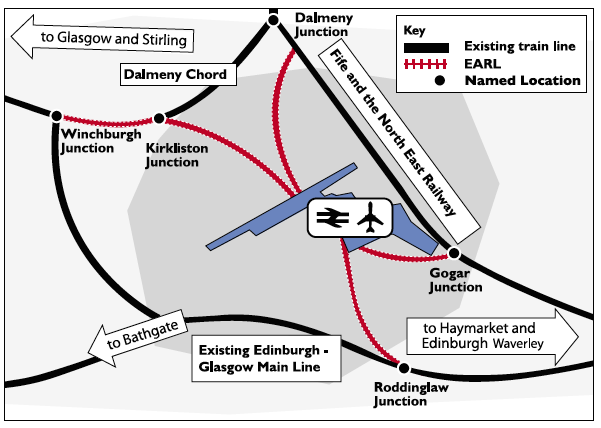
Providing Edinburgh Airport with a station with direct links to Scottish cities is no bad idea. Scotland has among the worst public transport service to/from its airports in Europe. EARL would have dragged Edinburgh’s out of oblivion and into the 21st century. But, given a budget of £650m, had TIE managed EARL the way it managed the trams, they could have muddled that up to £2 billion, no sweat.  And, like the trams, the implementation concept was flawed from the start. Check out this map & spot the error.

Edinburgh Airport Rail Link (original TIE plan)

Edinburgh Airport Rail Link (original TIE plan)

Did you spot it? The four tracks coming west from Haymarket split before reaching the area of the map. Therefore there is NO NEED for duplicate tunnels from both Gogar and Roddinglaw junctions to meet again under the airport: i.e. at least 20% of the cost was unnecessary idiocy.

But even more relevant is this concept was hugely and unnecessarily pricey in the first place. It is well for all concerned that Swinney recognised a turkey when he saw one. But, unfortunately, because every other party ganged up to force him to fund the trams, any reasonable alternative for EARL was never considered. This is unfortunate because a far cheaper alternative that Orcadians might call PEARL (Peedie EARL) was available.

The EARL layout was intended to allow services on both Edinburgh-Linlithgow (to Glasgow & Stirling) and Edinburgh-Forth Bridge (to Fife, Perth, Dundee and the North) to call en route to/from Edinburgh. The same could be achieved by combining four relatively cheap components:

  1. Re-open Turnhouse station with road access to/from Gogar roundabout (& tram stop)
  2. Provide a frequent shuttle bus between the station & airport terminal
  3. Build a chord (above ground) to connect the station directly to Kirkliston Junction.
  4. Re-route all Linlithgow & beyond trains via the airport & this chord

This achieves all the aims of EARL without a single (expensive) tunnel. It would work better if the revived station could be provided with four tracks to ease congestion. In terms of capital required, £10m for the station, £5m for related infrastructure, £15m for the Kirkliston chord and £10m for quad tracks at the station comes in at £40m. Call it £50m total, with contingencies.

This is 8% of the original EARL budget—or a mere 2.5% of what TIE,  from past form, would have run up as a bill. All services posited for EARL would be equally possible with PEARL. The trams could even be used to transfer passengers to the station, getting them into town faster than suffering the 11 stops (and 200m walk) into Waverley by tram.

Better yet: the entire Almond Valley viaduct and Winchburgh tunnel—both high cost-per-mile structures to maintain—with no passenger trains would be surplus to requirement and be abandoned. The only disadvantage (which applied equally to EARL) is that Stirling/Glasgow trains could no longer serve Edinburgh Park; on the current ScotRail timetable, most don’t anyway.

Almond Valley Rail Viaduct.: Symbol of West Lothian

Almond Valley Rail Viaduct.: Symbol of West Lothian

Interior of Winchburgh Tunnel or Brightness of TIE Executives—whichever makes sense.

Interior of Winchburgh Tunnel…or Brightness of TIE Executives…whichever

The principle on which TIE was founded–a unifying single transport authority for Scotland’s capital that could co-ordinate large, expensive projects such that they worked together—was not flawed. Indeed, since its demise, the absence of a TIE, or an equivalent that is any good, is glaring.

From a country seriously under-investing in the eighties to a modest programme of new stations in the nineties, Scotland naively let the pork-barrel numpties loose in the noughties with pots of money. As a result Airdrie, Alloa and Galashiels services all sucked in burgeoning sums with scant real network improvement to show for it. Major projects to improve Waverley and realign the ECML at Prestonpans did little for passengers but cost £60m each. Throughout it all, private companies did only what short franchises required but took several £billion in profits each year while doubling rail fares.

To whale on TIE’s shortcoming when our whole transport philosophy was torn between a private-no-matter-what diktat from London (which continued under Labour 1997-2010), combined with an endemic civic jobs-for-the-boys mantra across Scotland’s Central Belt is probably unfair. But fresh-faced MSPs fell over themselves post-1999 to justify their own existence and what better than a sparkly new train/tram for their punters? TIE actually suffered by having its SMT’s rank incompetence shielded by new ministers and self-interested city fathers (& now mothers) who didn’t know enough to challenge it.

When the real history of early 21st-century civic Scotland is written, it will point the finger firmly at the absence of adequate scrutiny to combat the professional incompetence of those who have all now taken their comfortable £1m severances, shrugged and moved on.

Posted in Transport | Tagged , | Leave a comment

Capital Offence

At the end of last week, the Grauniad shored up a decades-old reputation for clod-hopping sub-editing by crediting Glasgow with being the capital of Scotland. Given that 115% of weegies might agree with such an assertion, this is not all bad, even if such Southern ignorance/laziness did nudge a few hundred more switherers into the ‘Yes’ camp.

But the unfortunate thing is that the article itself (Don’t call Glasgow’s Contemporary Art Scene a Miracle from Maureen Jaffrey) did have merit, pointing out that three of this year’s four nominees for the Turner Prize are graduates of some form from the Glasgow School of Art and seeking to explain why that might be. Indeed, the article implies that this is no longer surprising; indeed it is now considered the norm:

“In recent years the city has come to dominate Turner prize lists. Glasgow winners include Douglas Gordon (1996), Simon Starling (2005), Richard Wright (2009) and Martin Boyce (2011). Martin Creed (2001) and Susan Philipsz (2010) both studied and made their careers elsewhere, but grew up in the city. I could go on: nominees Christine Borland, Jim Lambie, Nathan Coley, Cathy Wilkes, Lucy Skaer, Karla Black, Luke Fowler and David Shrigley have all lived and worked in Glasgow.”

While the original article made no attempt to politicise such eminence, I found it stood in sharp contrast to a Simon Shama’s piece in the FT on May 9th, which is being seized upon by unionists as a shining rationale to retain the status quo. Whereas Shama waxes lyrical about all the quirky contributions the Scots have made to the union, he cannot seem to grasp that the present argument is not about the splendidness or otherwise of what the nations on this island (what he calls “a splendid mess of a union (that) should not be torn asunder“) have achieved but what each perceive as a best option for their future going forward from this point.

For his sole forward-looking argument, Shama cites Adam Smith “the capacity to enter into the experience of someone not necessarily like you was the fundamental principle around which just societies, as well as rich ones, evolved.” On this basis, he argues that both Smith and Hume would have been ‘No’ voters, which rather presumes impervious national boundaries of that era still apply, rather than the present actuality of global mobility and economy dominating our lives today. Smith and Hume would worry little about borders today.

In contrast, Jaffrey’s article is suffused with the gallus, mobile creativity that was always part of Glasgow but now manifests itself in multiple channels well beyond any Clydeside garret, making nonsense of geographic or political barriers. As she says:

The novelist Nicola White cites “the collective, egalitarian feel of Glasgow, the multitude of practices and groupings, the respect for hard work, the ‘now’“.  All of them agree that the do-it-yourself culture of the city’s artists, who built their own institutions rather than rely on established ones, has been crucial.”

Even Edinburgh would concede Glasgow as the Art Capital of the country, just as Aberdeen is the Oil and Dundee the Game Capital. All of this is indicative of a new Scottish cultural vibrancy radiating from Glasgow, despite (as many artists would avow) the clammy hand of Creative Scotland slowing things down. These artists are interacting with a market outside the UK via the mobile telephone, cheap air travel and the internet. And since they are working a deep cultural source that has been opened recently, their art will be no more impeded by borders than French impressionists were over a century ago.

Glasgow has always been outward looking: a mighty river runs through it. Its built fabric is Victorian and very grand. Rents are considerably cheaper than in many major UK cities and the city council, which once appeared wrong-footed by the riches on its own doorstep, has now invested hugely in studio complexes. Glasgow is home to impressive architecture (the Glasgow tenement is crucial, offering large rooms, high ceilings and huge windows), a strong cultural sector (music & film as well as art) and reasonable rents. It is also a smallish city—the M8 cutting right through it means most people live 20 minutes from the airport; cheap flights do the rest.

There is a critical mass of  creativity that no earnest bureaucrats can create. Artists are gregarious, routinely alerting each other to their colleagues’ progress: one studio visit leads to another. Artists learn from, share with, and are challenged by their peers.

Given such circumstances, it’s little wonder that Glasgow has become such a force in contemporary art. That, in turn, is a springboard that will showcase Scottish culture far beyond the limits of a small country—whether that country is Scotland or the UK. Small wonder then the little-Englander mentality that drives most of the unionist campaign has little traction in Glasgow in general and its artists in particular. The corollary is that the vibrant Glasgow art scene is one of the many forward-looking drivers that point towards independence being the better choice for a Scotland with a future other than as an appendage.

Ben Luke of the London Evening Standard said: “The shortlist confirms the supremacy of Glasgow as the UK centre for new art”. Now, if we could only get the weegies to recover engineering skills that made miracles a century ago, it could reassert itself as the finance capital too and re-establish itself as what it once was in 1910—the richest city in the world.

Posted in Commerce, Community, Politics | Leave a comment

Home Thoughts from Abroad

Jake Briggs and I have been friends since I showed up in his P1 class and we ‘chummed’ one another to school. In our late teens, he went off to a financial career in credit cards, retired to Catalonia and has recently been driven back to the UK by repercussions of the 2007 downturn. We clash amicably on Facebook, so his opinions and mine do differ. But, since he recently took the trouble to lay out his position on Indy as both expat Scot and expat Brit, his opinions seem representative of many and merit wider coverage.

_________________________________________________________

First, let me state that I am a floating non voter.

This is my first grizzle, I am Scottish and although I have not lived in Scotland for 40 years, this does not make me any less Scottish. Our local Tesco manager is a genuine bites-yer-bum Glaswegian, promoted to “dahn saff”. No vote for him either. There must be hundreds of thousands of us throughout the world, and we care. By contrast, some eligible voters will not be Scottish, merely working/resident there, possibly with no long term commitment to the country. This cannot be right. When you lived and worked in California, did you consider yourself American ? Unlikely.

Local/General elections come and go. If you don’t like the result, you have the chance to change it in a few years . Not so here—this is a one-off. And how do 16-year-olds get the opportunity to vote, how did this happen? This looks like an equation for a “my game, times my rules, equals my result”. Also there are issues that are not just Scottish matters, but affect the whole of the UK. In fact, the whole Independence issue relates not only to Scotland, but to all of the UK. A ‘Yes’ vote would see 50-odd fewer Labour MP’s in Westminster—a major long term change to the political landscape. As someone said “If the Scots vote to stay, can we have a vote on whether we want to keep them?”

On to the campaigns, starting with the No/Better Together.

This has really been a non-campaign, but in how many different ways can you say ‘No’? Change, keep things as they are, straight ahead. What has worked (or not worked) in the past will work (or not work) in the future. Living standards have generally improved, our health care, education, law and order are fine (this is arguable), so why change? Issues such as currency or EU Membership will be resolved. But, at the moment, the threatening statements from the No campaigners has only served to fuel the perverse ‘see-you-Jimmy’ attitude in the Scottish character, and has possibly worked against its objectives, rather than in favour of them.

Now the Yes/#Indy.

Where to start? I can understand the desire of a country to have control of its destiny and much is made of decisions being taken in London. However, London and Edinburgh are only 400 miles apart, and Scotland sends 59 MP’s to Westminster. Will these MP’s vote differently if they are based in Edinburgh? Even Alex Salmond agrees the first Scottish government could be a Labour Government.

My impression is that some people see this not so much as a pro-Scotland move, but an anti-England move (don’t deny those people exist) and that Independence is an end in itself, the Holy Grail has been achieved, game over. They will find that, after any euphoria, a reality check may well kick in. However, I think there are more pro-Scotland voters with good intentions. There does seem to be a bit of cherry-picking over which bits of the existing situation will not be affected by Independence, topics such as currency, retention of the B of E as lender of last resort. Had Independence happened 10 years ago, could the Scottish economy, on it’s own, have bailed out RBS/BoS?

The yes argument seems to be primarily based round two principal agendas: Norway and Oil. If Norway can do it so can we, possibly, maybe even probably, but not definitely. I can see the similarities, but a lot depends on the political direction the country takes.

As you’ve said, oil prices have stabilised around $110, but this is no indication of future trends, and it is a diminishing resource. Future forecasting is something best avoided, and perhaps not dependent on.

As always, the prime concern will be the economy. Can an Independent Scotland maintain the same spending that it currently enjoys? I have reservations on health (free prescriptions) and education, (free university education). Bearing in mind that the first Independent Scotland government is likely to be Labour-led, and that these governments tend to be tax/borrow/spend, there may be a few gaps somewhere which will need to be plugged.

So, if the magic wand could be waved, and I could be allowed to vote, where would I put my X? I think that, if there is a ‘Yes’ vote, then those not in favour will accept it and get on with it. If there is a ‘No’ vote, then the pro-Indy lobby will still be there, and won’t go away. The preferred option of “let’s give it twenty years and see how we get on” is not available. This may surprise you, but I think I might (and it’s a big might) vote Yes, backed up by my “what if” theory. This states that if you don’t do it, you will always wonder “what if”.

So, go for it, remembering, there are lots of ifs, it’s a big cliff, there’s no parachute, and no-one else to blame if the land of milk and honey fails to materialise.

Posted in Politics | Leave a comment

Never Too Old to Learn

I stopped celebrating birthdays decades ago and have just passed an age milestone that America named both a Route and a sixties rock ‘n’ roll song after. Yet each day still brings something new and long may it remain so. Easily the most substantial chunk of learning  experienced recently happened last Friday.

Those who have followed me for any time will know that I have a mouth on me and that mouth has got me into trouble more than once. I like to think that I use both experience and judgement on a regular basis and, on the good old Scots Honi Soit Qui Mal Y Pense principle, don’t pillory folk without justification or proof they have ‘form’. Apologies have been forthcoming only three times in the busy four years this blog and a parallel Twitter account have been running. This constitutes the fourth.

Back in February of this year, I clashed on Twitter with Steve McCabe, Labour Leader of Inverclyde Council. The topic was prosperity and economic development in general. I had used Inverclyde as an example of decay, with major losses over decades having resulted in loss of population and economic difficulties. Although positioned vis-a-vis Glasgow in roughly the same relationship as my own East Lothian is to Edinburgh, I had posited political leadership as a major factor in their decline vs our prosperity, quite apart from the relative differences between us driven by the two cities’ differing fortunes.

Steve was having none of this. An escalating series of tweets resulted in Steve deflecting the growing acrimony by throwing down the gauntlet and challenging me to come see for myself. Having experienced Labour leadership under Norman Murray in my own ELC and Jim McCabe’s in South Lanarkshire via CoSLA, I had a picture that was a mix of inertia, Buggin’s Turn, reactive cabinet spokespeople and a surly hostility to anyone outside their group. I suspected a bluff, or possibly even a wheeze to waste an unbeliever’s time.

In my first attempt to visit, I tried to seal arrangements over Twitter because ELC had seen fit to cut off all remote access for councillors in the name of UK-driven database security. That was a mistake and resulted in the first attempted visit being cancelled at short notice, which did little to allay my suspicions. However, Steve was quite civil about it and doggedly rescheduled for May 2nd, this time ensuring respective PAs were on top of it.

Getting to Greenock from North Berwick is quite a coast-to-coast adventure; three trains and a hike through central Glasgow, totaling three hours each way. Was I being had? I expected a brief meeting for form’s sake and then an hour or two with colleagues or officials being shown how Inverclyde works as a council. Although all structured differently, all councils provide roughly the same services.

I was more interested in what role it played in economic regeneration, especially its £60m per annum ALEO called Riverside which had taken stick for failing to either get the private investment or provide more than a few percent of the jobs promised. A Reform Scotland report was especially critical and the Parliaments Local Govt committee has been rummaging in this area, looking for bodies. My own experience of Inverclyde was limited: some passing visits en route to Cowal and Bute and several days door-knocking in the by-election caused by the death of David Cairns in 2011.

Met off the train by Steve himself, the balance of the afternoon was entirely not what I had anticipated. No flunkies, no tour of council buildings (although we did pass his salt barn), this was a personal tour by Steve himself, keen to correct any impression I had that the area was an economic basket case from which people were fleeing. And, given that all I knew was that Inverclyde had lost all but one of its shipyards and 10% of its population in a decade, that was a fair accusation to make of me.

Port Glasgow town centre does look worse for wear—a wobbly retail mix heavy on betting shops, carpet stores and charities, reminiscent of Tranent. But the town centre buildings of Port Glasgow were better than Tranent—solid Victorian red sandstone tenements found all over Glasgow and solid enough to merit refurbishment at some future date.

That was a theme that repeated itself throughout the trip: a Victorian heritage of such civic pride that whether it was the swimming pool in Port Glasgow or the ex-Tate & Lyle dockside Sugar Sheds in Greenock or the Marine Centre, Gourock, it was clear that substantial investments a century ago were worth further investment now as there was both heritage and architecture that had a place in the future.

Sugar Sheds and James Watt Dock, Greenock

Sugar Sheds and James Watt Dock, Greenock

One reason you soon became confident of that is the peculiar geography of the place. Unlike post-industrial Blantyre or Airdrie where some new alternative to heavy industry is not obvious, here you are dealing with a strip of land less than 10km long and barely 1/2km wide. And what is beyond that is both unspoiled and spectacular. Housing estates do run up the steep hills that lead to Loch Thorn and rolling, pretty countryside. But the glory of the place is the Clyde.

Still a river until it turns south at Tail o’ the Bank, the 2km wide sweep of calm water is gloriously visible wherever you are. And, unlike views from North Berwick across the Forth—fine as they are—they don’t have the detail of Helensburgh or Kilcreggan going about their business across the water, nor the height of hills reaching up to Ben Lomond on the horizon, with Dunoon and the green Cowal Hills beckoning you further on.

View over Gourock and the Tail O' The Bank to Cowal.

View over Gourock and the Tail O’ The Bank to Cowal. Memorial is to the French Navy (close ties since WW2)

As property barons have always maintained, there are three vital elements to prospering with property: location, location and location. Seeing how many visitors come to our coast and the praise they give it, it’s easy to see the potential in Inverclyde. While some heavy engineering remains (Ferguson’s, the last shipyard in Port Glasgow still builds ferries) and the James Watt dock in Greenock has been converted to a marina, there are miles of unused waterfront now obvious contenders for redevelopment, all within a few hundred metres of 4-each-hour modern electric trains to the centre of Glasgow and the A8 to Glasgow airport.

Steve and his colleagues seem to have clocked all this potential but have started at the pragmatic end, bringing the likes of a Mega-Tesco and B&Q to boost retail and retain shoppers in the area. These have not been sited subtly, being highly visible off the A8 but not close enough to town centres to boost surviving High Street retail. But Inverclyde have also moved with the commercial times, hiding a large Amazon distribution warehouse in woods above the Western Ferries terminal and evolving the IBM presence at Inverkip into a commercial park.

And, rather than bulldoze a rich architectural heritage, many solid stone-built edifices live on in new roles. Particularly impressive is the Custom House area of Greenock which leads on the container port and cruise line terminal. Tastefully landscaped and cobbled, it includes a Premier Inn, The Waterfront Complex and Cinema and the Western College campus. This leads onto a fine wide promenade west (to Battery Park and Gourock) that outshines Portobello and has massive recreational potential. Here, with green banks to develop and, calm, wave-less water, the potential for watersports—kayaking, skiff rowing, paddle-boarding, as well as sailing of all shapes—seems huge.

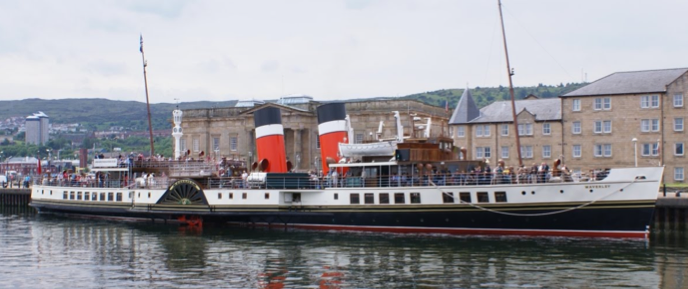
SS Waverley at Custom House Quay, Greenock

SS Waverley Docked at Custom House Quay, Greenock

Even end-of-the-line Gourock where the ferries leave for Dunoon (Cowal) has retained a functional High Street with a wide selection of douce villas offering stunning views. They lend the place such class they could be key in attracting people back into the area. Past the urban section, Inverkip offers a marina and Wemyss Bay ferries to Rothesay (Bute). Their green, unspoiled environment stretches all the way up and over the hills to Kilmacolm in a wide hinterland back to Port Glasgow. This latter was ideal cycling country: gentle hills, varying rural views, roads with little traffic.

Steve was quiet-spoken—not at all brash or boastful. But, as a local whose dad spent his working days slapping red lead paint over the bottom of ships in the local yards, he spoke with assurance and passion. As with anyone so rooted in the place, he clearly knows and loves his patch. But what Steve also brings to the party is a vision, determination and the backing of a strong local Labour party who—in contrast to my own experience—seem to have moved on from wishing good old days to return and are looking to a future through ideas and with gumption to back them up.

Having gone to Inverclyde as a unbeliever, as no fan of this post-industrial backwater, one afternoon with Steve turned me firmly around. Now I wonder if, despite all our advantages, East Lothian might not come second to Inverclyde in seizing a rich quality of life for the future of its citizens, if Steve McCabe has his way.

All power to him: property prices there went up 24% last year.

Posted in Education, Politics | Tagged | 1 Comment

Волк в ове́чьей шку́ре

WolfSheep

After a couple of decades dimly perceived media limelight, the Russian wolf has suddenly loomed large in the headlines in a way that it has not since the bad old days of the Cold War. After the fall of both the Soviet Union and the Berlin Wall, a collective amnesia among western countries—especially in America and its UK deputy sheriff where global politics is habitually defined in terms of white and black hats—that the wolf wearing a new capitalist waistcoat and riding a spiffy new non-Lada-made bicycle was fit to invite to tea.

This impression was reinforced by western media having unprecedented access across the country, newly rich Russian oligarchs buying up half Chelsea and Baltic cruise ships calling at renamed St Petersburg to witness the cultural magnificence of the Hermitage. Despite the fact that not one in a thousand Brits understand the Cyrillic alphabet, let alone speak Russian, the inclusion of Russia in the G8 signaled the bear was tame and all was well.

Granted, to those of us grown up under the shadow of WW3, it is a relief not to care where the next fallout shelter is and how many loved ones you might reach if given the five-minutes-to-Armageddon warning. That philosophy was simplistic and bleak. What we have now is simplistic and dangerous. Back then, the rarity of insight ‘over the hill’ was underscored by Sting’s “If the Russians Love their Children too” being one of the few messages of hope in a desolate flurry of Fleming/Le Carre eyeball-to-eyeball cultural icons.

And, just as it was simplistic then to malign the Russians as the Cold War baddies, so was it even more so to imagine that 200m people were suddenly going to embrace western identity wholesale. The present series of Mexican standoffs along the Ukraine/Russia border is entirely understandable to those who have made a study of the history, culture and mentality of a people who have much to offer the world besides nuclear annihilation.

Russia, like most countries, was born in turmoil. But most western countries didn’t have brutal raiders like Vikings, Mongols and Turks invading them from all sides over centuries. And just as a long-overdue unification of Germany led to it feeling its oats and to a couple of world wars before it calmed down, so the great unification and expansion of Russia under Peter the Great led to wars and iconic victories at Poltava and Borodino that shaped the Russian mind that the Western neighbours were enemies and invaders, not friends. Pilsudski’s Poles in 1921 and Hitler’s Germans in 1941 did little to dissuade them.

So, despite international achievement from Tcaikhovsky through the Bolshoi to Faberge, Russian paranoia on this account found its deepest expression in Stalin, who used WW2 to build the biggest buffer zone Russia ever achieved on the back of the greatest victory ever achieved unflinching from 28 million sacrifices (27% of the population, compared to UK’s 0.94%).

What the Russian people went through 1941-45 was unimaginable to our cosy Western lifestyle. The Wehrmacht surrounded Leningrad and, through two bitter Baltic winters, tried to starve out the 3m inhabitants. Over 1m died—of cold, disease, malnutrition more than bombs or shells. But the trams ran; the factories turned out munitions; the workers ate bread that was mainly sawdust.

Inured by a hard 19th © lifestyle that makes our Highlanders’ sparse pre-Culloden life seem luxurious by comparison, by WW2 they had built a modern country in the teeth of Western opposition. They pride in the Bratsk power station or the Dniepr dam and the fact that they out-designed, out-produced and out-fought the much-vaunted Wehrmacht while the Allies were taking three years to chase an Italo-German sideshow out of North Africa.

No matter what country you come from in Western Europe, you are ill-equipped to project yourself into the Russian psyche. It is 40 times the size of Spain; Moscow is regularly above 25degC in summer and below -10degC in winter; the train from Moscow takes 6 days to reach Vladivostok; Russia’s forests cover 7.7m sq km—14 times the size of Spain. Russians are more dour and inexpressive than the Scots but, like the Scots, once they warm to you are embarrassingly generous and make solid friendships. They love music and dancing but are especially passionate about poetry, most being able to recite Pushkin or Soviet-era writers like Yevtushenko.

Even today, they are stoic, phlegmatic in surviving on little, proud rather than ambitious yet curious as children about the world. Survival of individuals has always been a crap shoot. Mother Russia has survived every invasion even if whole swathes of the people didn’t. As a result, their whole history revolves around a strong leader holding their vast country together—even if it’s by means that squeamish Westerners would disown.

Among family and friends they are very human, but geared to accept strictures that life and or the government imposes. They expect strict and clear principles on what is or is not acceptable—in many ways the emotional reverse of the American ‘land of the free’ ideal. This alone goes far to explain why they so often misunderstand one another. It also helps explain the rise of the Russian oligarch since Glasnost—those who apply bald capitalism can exploit their own people’s relative passivity quite easily.

Since the fall of Communism in Russia, there has been too swift a readiness to see Russia as an extension of the West. It has released its satellites, pulled its troops back home, joined in economic summits, joined in world trade and exported billionaires as well as raw materials and wheat. But it is no more relaxed about sovereignty and prestige than France is about the inviolability of the French language. Losing its military buffer states against a repeat of 1941 was traumatic enough. It wore sheep’s clothing as a pragmatic way to feed its people and trade its way back into the world.

But when the Ukraine starts talking with the West, alarm bells ring in Russia; traditional loyalties seem turned on their head. Why Krushchev decided to award the Crimea to Ukraine is a mystery. Russia had fought the Turks over it for over a century—that’s where our Crimean War came from. And, now that Russia is come down in the world from superpower status, that their principal arm protecting their southern borders—the Black Sea Fleet—was suddenly based in a foreign country was too much to swallow long-term.

Though the Ukrainians may protest (partly because the West naively encouraged them to) over ‘loss’ of Crimea, the Ukraine was never a state before now and therefore has scant right ‘historic’ to provinces. This is not to condone Russian actions but they are a very practical lot; if they want something and think they have the power to grab it, they will, or expect to be considered weak.

The most sensible suggestion about the whole crisis came from Kissinger, who argued that, rather than being tugged hither and yon by both the EU/US and its Russian opponent to join one side or the other, Ukraine could make the best contribution as a bridge. (see earlier blog Kissinger on Ukraine), something the Russians might tolerate. Membership of NATO or EU is not.

The Donets industrial basin in Eastern Ukraine is less clear-cut but, populated as it is largely by ethnic Russians and included in the country thanks to some questionable boundary-drawing by Stalin’s Kremlin, there is a genuine problem about Russian minorities who, in that particular case, aren’t a minority. Given that Putin’s standing within Russia (a matter far more important to him than international niceties) it is not rocket science to predict that a relatively easy victory snatching Crimea makes it tempting to try for Donets too.

Because what can the West do? The Russians have overwhelming military superiority in the area. Even America at its most gung-ho would not stick its hand into this wasps nest because the Russians could obliterate anything they could deploy that far from home right on Russia’s doorstep. This is why the US let Russia have its way in Chechnya, Georgia and other tinder-box flare-ups along its southern border. The best the West can bring is a non-player here.

So, when Alex Salmond, while qualifying any admiration, declares that Putin’s actions have been a good thing insofar as it has restored Russian pride, he is demonstrating a firm grasp of realpolitik that seems to have eluded most English party leaders. Instead of making the best of a bad job like Alex, the UK government and its opposition have struck a pose both unrealistic and pathetic. They seem to think  they command a deployable force that the Russians won’t fall over laughing at. Just because the Russians have recently donned sheep’s clothing internationally to avoid frightening trade delegations away, doesn’t mean they don’t still have sharp teeth and remain brutal as ever about using them.

In Putin, Russia has a leader they like, not least because he understands them. Resisting their ambitions has long been a part of the global ‘Great Game’ that imperial Britain once played on the North-West Frontier. But, while Russia may not be what it once was, Britain is a weak shadow of its 19th © self and should stop sabre-rattling before someone gets hurt.

Posted in Politics | Tagged | Leave a comment

A Sprinkle of Stardust

For over three years and 630 blogs, I have been happy in this far vineyard, toiling to bring such readers as I have gathered insight into life in my beloved East Lothian and pragmatic perspective on independence for my country to help ensure that does come to pass. But in all that time, grateful as I have been for the interest of my readers/followers, I have never felt the flutter of flattery—until today.

Many of said followers lead informed and questing lives; I know this by the amount of shrewd and informed feedback—if not actual shots across my bow—that I receive, for which I am most grateful. Never having had the truth presented to me on a plate, I am appreciative of other perspectives, learn from them and, hopefully, blog the better for it.

But this weekend, an unusually exotic creature flew in among my followers; colourful, beautiful and graceful as an ikran from Avatar. For this blog is now being followed by Elena Levon, aka ‘Lena’ who is, if my regular readers will forgive the sheer ingratitude of such a bald statement, a real breath of fresh air.

Absinthe Makes the Heart Grow Fonder—Lena at La Coupole, Paris

Absinthe Makes the Heart Grow Fonder—Lena at La Coupole, Paris

Let me admit right away that any interest from such a hot momma has a viagresque effect on a man who has had a concession card longer than he cares to admit, so that my world suddenly appeared brighter and newly stimulating. But Lena brought much more than a stimulating portfolio. She brought obvious intelligence, creativity and bold ambition which she is parlaying into celebrity status with a deft, natural skill that leaves lifetime plodders like me somewhere between awestruck and gobsmacked.

For she has parlayed a Russian academic background, dark good looks and a strong jawline that would serve leading males well onto an international-circuit lifestyle before she was thirty. Now with her own entry in the IMDB database and a portfolio including snaps of hardy partying with a suite of ‘names’, it would seem easy for her to relax into the role of arm candy for selected sugar daddies in the good ol’ “poo-poop-ee-doop” tradition.

But here’s where she impresses me most. Not only has she used her considerable range of talents to carve out a ‘celebrity’ status for herself with precious little external assistance but she also puts it all on the line by challenging herself in various adventures on random continents and seizes emerging opportunities from social media to live a rather public life over the internet via a multifaceted blog site that puts her creativity on-line to be mocked and/or praised as the readers see fit.

That takes either boundless ego or guts and my money is on the latter. Why? Because there have been other ‘celebrities’ who search for some kind of grounding in the world by sharing their poems/art/music/etc so that they have more bearings to go by than the sycophancy of fans and agents. But Lena displays real substance. Whereas someone else in her place might be a natural clothes horse—and she seems to have select, if racy, taste herself—there is substance and a real person here:

“Social status has never been a goal or a priority of mine. I can’t tell the difference between jimmy choos and prada. To me it’s just a shiny wrapper with no substance or real value. Our world today has more important issues to deal with, than a decision making of what brand of shoes to buy this afternoon or what color the highlights should be.”

Once you get used to centre-line fixations of her blog, there is material worth mining in there—musings of a woman of the world who has a nice turn of phrase expressing them.:

“I was and I will always, find myself walking on fire and I’ll be convincing my heart that it’s only cool water. I believe that if your passion is greater than your fear, you can have anything you want!”

To be 19 and on a bench at LAX in 2003 with no idea what came next, to experience and achieve all she has in the intervening decade and to articulate it in 21st © style so that others can critique, ignore or learn from it takes a kind of courage and clarity that few of us have. And to be clear about a childless and unmarried future so early in life shows a gutsy pragmatism that isn’t always a celebrity strong suit. But there is room for a really human side too: she actively supports ten charities, including the Nelson Mandela Foundation.

So, cheerfully confessing to (and relishing) being somewhat bewitched, I still haven’t fallen into ‘if I were half my age’ speculation because I am from another era and definitely not into living out my thoughts through social media—although I have allowed myself to speculate that she would be a dynamite salsa partner. But I do remember being on that bench at LAX myself in 1977, aged 29 and making a fair—but not as good a—fist of  opportunity as Lena even in twice the time she’s had.

I think this lady is both fun and a force of nature; so I am flattered that she should find interest enough in my musings to bother following them. But it’s a sprinkle of unexpected stardust that I hope to savour.

Posted in Community | Tagged | Leave a comment

Making the Law an Ass

This blog has been critical of recent ‘developments’ in Scotland’s justice system in general and the role played in such changes by the Justice Minister, Kenny Macaskill MSP. And this criticism is not personal, having nothing to do with wur Kenny finding no time to hang out with veteran activists in the SNP Club since his elevation.

Much more important is the degree to which he—using the unexpected SNP majority in Holyrood—has taken a meat cleaver to the finely balanced combination of body of law, legal profession, enforcement and justiciary that had been Scotland’s distinctly independent glory for the last 300 years (see earlier blogs Must Justice Be Blind from last May and Kenny Cannae Ca’ Canny from the year before). To put it mildly: he has form.

Not content with one major reform he has blundered about like a bull in a china shop fixing a succession of things that senior observers of such matters still don’t consider were broke. These include:

  • folding eight forces into one and removing the democratic scrutiny of police boards
  • giving the resulting Police Scotland monolith carte blanche to ‘reorganise’ (aka slash) services (e.g. traffic wardens) without consultation with ‘partners’
  • restructuring the Procurators Fiscal offices, much to the consternation of judges
  • closing a significant number of Sheriff Courts after a sham ‘consultation’
  • deleting Corroboration as a major pillar of fairness in Scots Law

A blog is too short to rehearse all of the arguments why wur Kenny might have much of this wrong. But this week saw a particularly ugly and indigestible chicken come home to roost when the Chief Inspector Brown presented the full East Lothian Council with a first Police Report for the third of the new Police Scotland “J” Division that it covers.

Some six months ago, his predecessor’s only appearance was marked by her getting it tight for having dropped wardens, re-tasked community officers and re-allocated council-funded officers, all with no consultation with the civic authorities thereby affected. Why she then moved on with less than a year in the job has not been made clear.

Ch.Insp. Brown’s 26 pages of report starts off well enough, with reassuring introductory comments that include:

“I remain strongly committed to the principle that community-based policing, which responds to local need and demand, is crucial to delivering services that keep people safe and maintain public confidence.” —Chief Constable Sir Stephen House QPM

Few would quibble with that. Indeed, those involved at the sharp end of policing have found that genuine community bobbies who know their beat (and therefore the kids, secrets and malcontents therein), combined with civic wardens, tenants & residents, community councils, ASBO teams and various civic pillars have been doing a bang-up job dealing with minor disturbances so well that few ever reach crime statistics. And those have been falling steadily for several years as a result.

Reading the report, you would never know it. Described as a ‘strategic document’, this makes it flawed right out of the gate because what is needed is an operational report. The five priorities given as the backbone of the report are pure motherhood and apple pie. In itself this is not risible but the fact that they are so generic as to apply equally to Whitecraigs, Giffnock as Whitecraig, East Lothian makes the reader wonder what understanding there is for real local issues among police middle management.

But, worse that that, one of the objectives given is: “Increasing the proportion of positive stop and searches“. Such actions are common currency in city estates where weapons and drugs are commonplace. But to introduce such abrasive behaviour into docile East Lothian is akin to having police walk the beat in Warrior armoured personnel carriers. Such crass application of inappropriate tactics is more likely to scare citizens than reassure them. Worse, it will give the impression that police are losing the fight against crime when the opposite has been true.

And when senior officers start talking about ‘flexibility’ and ‘cross-training on local issues’ you know that the bean-counters are in charge and that officers are regarded as so many interchangeable pegs to fill a variety of policing holes. This ‘efficiency’ was tried in the nineties and ‘community officers’ cycled through the post so fast most of them never even found the local toilets, let alone our petty criminals.

They also fixate on serious crime and think the minor stuff is seen as just that by the public. As a ‘goodwill’ gesture, two officers were assigned to North Berwick High Street on Easter Saturday to compensate for the absence of traffic wardens. While they were busy timing which cars were overstatying the 90 minute limit, Marine Parade (seafront) jammed up with double-parked cars (incident #215) and the Dirleton Avenue entry into town backed up a mile while a lorry offloaded (incident #428). Both incidents were reported on ‘101’ by 12:30. #215 never received a response and two (other) officers attended #428 at 15:25 to report no lorry.

Such examples are legend and serve to dissuade the public from reporting anything to the police who then delude themselves into thinking they’re well on top of things. Neither incident above, nor any like them will ever find their way into this Police Report because, unlike any competent report in business, it includes neither goals, nor measures, nor even scrutiny as to whether anything—let alone competent policing—was achieved. Another problem in the nineties was that crimes went unreported because of the paperwork involved and the need to occupy two officers to apprehend suspects and take them to police stations. Look for that practice to re-appear as statistics are cooked to polish up ‘solve rates’ and thus careers.

None of the above should be taken as criticism of beat officers. Having chaired a Community Action Police Partnership for the last four years, I am full of admiration, gratitude and respect for the hard work done by officers attending there and the pro-active communication of their local inspectors who have invariably provided the best support available for those officers in the front line. Middle management is another matter—interfering with officer availability locally, rigidly enforcing shift patterns so they can’t attend to local duties when it suits, being more in thrall of internal objectives and career paths whether they bear relevance to citizens’ real policing needs or not.

The thing made most clear by the wholly unsatisfactory report is that, from House down to division level, the police—always fond of their own jargon and generally dismissive of civic insight, let alone control of how they operate—have gone native. This report is not just a bureaucrat’s charter but an insult to anyone genuinely trying to exercise their democratic right to scrutinise those who apply the law.

However, that probably applies to the 32 clone reports with which councils are being fobbed off across Scotland. What makes matters worse is that the report reeks of policing that may be appropriate to Glasgow but certainly not to Gifford; the subtlety of policing that once made it so effective in East Lothian is at risk of being thrown out the window of pseudo-managers who clearly don’t know their patch and don’t seem minded to learn.

Worst of all, having handed Mr House this one-size-fits-all cleaver, Macaskill seems not to care how that will reverse crime figure improvement, especially as his abolition of Haddington Sheriff Court means local miscreants will get trucked up to Edinburgh where they can learn their criminal trade properly from graduates of Saughton and Bar-L with whom they will soon be rubbing shoulders.

Posted in Community | Tagged | 1 Comment