Girl Talk

Last night’s TV included 2003’s Mona Lisa Smile, a film I had not seen. As a period piece of cloying post-war American consumerist culture, the location, set design and wardrobe depts get full marks but the screenplay—written by two men—seemed both predictable and superficial. Most reviewers see it comparing poorly as a female version of the late (and greatly lamented) Robin Williams vehicle from 1989—Dead Poets Society. That did make a better fist of awakening young minds locked too early on an upmarket career path.

But, all that said, it did make a decent fist of examining the roots of modern woman and the still-ongoing conflict with traditional roles that brings her. The business world has been wrestling with this since at least the film’s setting in the early 1950s (c.f. Mad Men where the jobs are segregated but the power certainly isn’t) and is still found wanting, despite equalities acts and a genuine commitment to avoid wasting talent. But from California to Canary Wharf, the ground-breakers/high-earners remain driven by testosterone and sports metaphors.

Fortunately, the fact that aroma of stale cigar smoke predominates still in boardrooms does not hinder too many women; the real battle is on the career ladder leading there. Once women amass the requisite heft to their CV, they find climbing the final boardroom peak easier—dinosaurs like Fred Goodwin notwithstanding. Once there, they usually find allies in undermining a macho culture that butts chests over how long it’s been since you took a vacation and habitually uses vocabulary based on warfare to describe business.

Where business deserves brownie points is that it, in general, it recognises it still has a major problem in making proper use of talents in the female half of the population. Earlier efforts failed for lack of flexibility:  California positive discrimination legislation from the 1970’s fast-tracked many latinas faster than their abilities could develop so that no-one benefited when many cratered.

Unfortunately, politics has not followed so pragmatic an approach. On the surface, there has been enthusiasm in UK parties and abroad for gender balance. The Scottish Parliament was set up as a ‘family friendly’ operation and even the gentlemen’s club that is Westminster has made concessions. But from St James to St Andrews, bias against women remains rife and the role of the presentable, support wife as career adjunct—basic to the story in Mona Lisa Smile—remains sacrosanct.

Take ‘enlightened’ Labour in Edinburgh as an example. It describes selections as fair and transparent, considering both all-women shortlists and a twinning procedure as progressive measures. In Edinburgh Western, two (minority ethnic) males, one other male and one white female all sought selection for the twinned constituencies of Edinburgh Western and Edinburgh Pentlands. She automatically received sole nomination while three male PPCs had to compete for the remaining constituency.

Similarly, even though identified as a ‘key seat’, Edinburgh Western eschewed an all women short list to select Cllr Cameron Day. In this, he was supported by major local figures like Traminatrix Cllr Lesley Hinds who chaired the selection, even though insiders complained the selection timetable was rushed through, objections ignored and she advocates all-woman shortlists. Soon after, the MSP for Edinburgh Northern and Leith (twinned with Western) announced retirement and an all-woman short list was promptly declared. When nominations closed, there was only one candidate: Cllr Lesley Hinds.

It would be easy to claim ‘stitch-up’ were other parties not equally guilty of besmirching equality with grubby ambition. But the net result parallels the over-promoted California latinas, as evidenced by the sweetie-swapping Karens who graced the early days of wur Pairlimunt but who could barely read a scripted speech, let alone contribute to debate. Did they show that ‘real people’ could be elected. Or did they turn off professional women who saw them—and their televised tribal yah-boo-sucks debates—as unedifying, a kind of Sex and the City without the glamour.

As well as the whole political process itself, poll after poll shows Scottish women are also considerably less keen on independence than men. Despite wur Eck reaching out to women voters since the campaign kicked off two years ago, fewer women seem engaged in what will be the biggest decision they are likely to make this century. Or it may be they just want more evidence: that doesn’t necessarily make you more disengaged or cautious, it just makes you more analytical. Jo Armstrong, Professor of Public Policy at the University of Glasgow says:

“If the hypothesis is that women analyse things differently, it’s unlikely that they would want to see policies promoted only for them. It’s about having policies where they can understand the implications for them and their families, which is perhaps not being communicated well in the political messaging.

“I suspect that the issues that interest women are exactly the same as the ones that interest men. I can’t believe that women think that childcare is more important than the economy, jobs, or more important than better services in general.

“The idea that you’ll be able to make women change their minds with women-only issues is misguided. It suggests that the political parties still have a poor idea of what equality is really all about.”

Traditionally women are more conservative than men in how they vote. Perhaps that’s because men were in the factories or the office, negotiating careers but finding common ground on which to do it and so forming networks whether in trade unions or golf clubs. But women are more about pragmatism. Old-fashioned as it sounds, in many cases women are the ones running the household budget and so they actually see what’s happening to the price of food, clothes, etc—the ‘sharp end’ of the economy.

Women want reassurance that independence is going to be better. They are the ones who ask: “What if something happens to my husband’s wage? What if something happens to childcare? “What if something happens to university fees?” They are far more engaged than the arm-candy-for-life girls of Mona Lisa Smile. Trevor Salmon, Emeritus Professor of Politics and International Relations at the University of Aberdeen says:

“The trouble with making pledges about what will happen after the referendum is that there’s such a distrust of politicians nowadays. The only promises that either side can make to attract more women are ones where they can make them real.”

The old Scottish tradition of women not being heard is influencing what women are prepared to say or on how they are going to vote; women are more naturally cautious because of this culture of exclusion. No wonder we have low participation level by women in politics. Where are the female role models, women in leadership roles or on senior management teams? All this saps women’s confidence levels.

And this was my major gripe with Mona Lisa Smile—the Miss Watson (Julia Roberts) character went through obvious iconoclastic motions towards Wellesley and its broom-up-the-bum conventionalism but never resolved her own human frailties into life lessons; development; progress. That’s one characteristic where women typically surpass men.

I’m with Karly Kehoe, Senior Lecturer in History at Glasgow Caledonian University on this one when she says:

“There’s no easy fix here, but the first step is to recognise that we have a problem. We need to start for example by normalising equality in society. This can start with children by reinforcing understandings of equality through childhood and young adulthood. If you show a child how their mum and dad are equal in both home and employment, that child is going to grow up with a balanced picture of what society is and should be.”

But with one month to go before the referendum, we no longer have the luxury of time that needs.
Posted in Commerce, Politics | Tagged | Leave a comment

It Cannae Be Canny—Can It?

Last week’s FM Questions did not much advance the sum of human knowledge as JoLa insisted on asking the same question (“What is “plan B” if currency union is not an option?”) four times in an obviously scripted attempt to finally score a point off His Eckness as Alastair Darling managed to do in their televised debate. His reply was equally consistent (if a touch more humorous than the expression-free zone of the Labour leader): there were a number of options laid out on Page 110 of Chapter 3 of the White Paper but only one was both desirable and right: “It’s Scotland’s pound and we’re keeping it”.

This question loop was clearly part of a cross-party drumbeat caterwauling at the prospect of independence because JoLa followed up with a press release early this week asserting that Scottish families would see their mortgages rise by £1,600 a year in the case of independence. How she could be so certain of numbers when she and her party can’t even outline what actions they would take to ‘improve’ the devolution settlement, should Scots not vote for independence, was not made clear.

What is even less clear is what fiscal planet nay-sayers like JoLa are living on when, virtually on the same day that £1,600-worth of doom & gloom was being peddled, the Daily Excess (no friend to those who don’t think that SE England is the source of all wealth and the font of all goodness) splashed with a very interesting piece that Scottish house prices had risen by £800 a month for the last year.

This rise was most pronounced in the capital where average single home price is up 4.2% in a month to reach £239,369 while oil-booming Aberdeen is not far behind at £228,802. And contrary to what Bitter Together would appear to assert, the rest of the UK is not sharing in this. Gordon Fowlis, regional managing director of Your Move, commented:

“While the majority of regions in England and Wales are witnessing price falls, the Scottish market is moving the other way.”

Even more inexplicable if you believe in impending independence fiscal disaster is seaside towns offering superb quality of life and accessible from those markets are doing even better. My own North Berwick comes in at £327,518 average, St Andrews at £261,446; Stonehaven at £211,413 and Inverbervie at £202,144.

None of this compares, of course, to London, where, as the Independent burbles:

“At £1.5m, a home in London remains a highly lucrative investment, as those who bought a property in ‘prime London’ this time last year would have made a profit of £166,216.”

For more realistic comparisons, let’s look to that lair of global capitalism, the USA. Not only have Americans been avidly practising career moves linked to property speculation decades before Londoners woke up to this nice little earner but the bitter recession of 2008 is now behind them and property prices rising across the States.

To what? Well, the top four markets there are all in California which is still being driven by waves of technology that gave us Silicon Valley, the PC, the internet and the iPhone. The four most expensive housing markets are San Jose, $899,500 (£535,416); San Francisco, $769,600 (£458,095); Anaheim-Santa Ana, $691,900 (£411,845) and San Diego, $504,200 (£300,119).

That my seaside town of 7,000 can compete in house price with top US markets and that our capital has a 13% edge over Washington DC’s $356,500 (£212,200) is no guarantee that such affluence is any less transient than other property bubbles that have come and gone.

But, if we were standing on the brink of fiscal disaster, why would canny investors lose their heads to buy up properties in the path of Hurricane Independence if they thought it threatened their wealth? What do they know that JoLa and her eye-of-newt forecasting cauldron don’t?

Posted in Commerce, Politics | Leave a comment

Douglas Alexander: Politician, Thinker, Great Briton

While I don’t entirely share Jamie’s degree of criticism, I admit Douglas’ SoS piece seriously undermined my previous level of regard for him as a unionist who avoided falling into closed-minded, hate-filled clichés typical of Brian Wilson, Ian Davidson et al.

Posted in Uncategorized | Leave a comment

The Poond in Yer Pocket

The British Pound (£UK) has a long history as a currency. Prior to the 1707 Union of the Parliaments it was known as the English pound as the ‘Pund Scots’ was of rather less value—not least because of the country losing a quarter of its wealth in the Darien disaster. The exchange rate dropped from an initial parity under David I (12th ©) to 4:1 under the unpopular and ineffective James III (15th ©) and down to 12:1 when reformed under James I & VI (17th ©). It was at this rate it was phased out in the 18th ©.

Since then, the British pound has led a chequered life. Britain’s two centuries of industrial and colonial growth up to WWI saw its value and usage grow to dominate a global trade in which the Scots shared and benefited as much as anyone; around 1910 the highest per capita GDP was in Scotland.

The crippling debt accrued and the damaged trade that followed that global catastrophe was largely kept from the British public during the inter-war years but economic body blows to world trade like the 1929 Wall Street crash and the subsequent Depression cost Britain as the world’s leading trading nation dear.

Further outlays for another World War put such severe pressure on the £UK that Britain entered into an agreement with the USA known as the Bretton Woods system of fixed exchange rates, pegging the £UK at the $4 rate held through WW2 and $35 being the fixed value of an ounce of gold held as security in Fort Knox. (This led to slang of the time: 5s (a then-rare ‘crown’ = 25p) was called ‘a dollar’ and the much more common 2/6d (half a crown) as ‘half a dollar’.

Despite deep devaluations to $2.80 in 1949 and $2.40 in 1967, the global recovery of the 1950’s and ’60’s when people (in MacMillan’s phrase) “never had it so good” let this arrangement bring stability as it was effectively a formal currency union and tied UK fortunes to the now-much-stronger USA. Every chancellor of the time from Labour’s Stafford Cripps to Tories’ Anthony Barber saw this as a good thing, eschewing all control over exchange rate policy and taking credit for economic growth.

On August 15, 1971, President Nixon announced his New Economic Policy “to create a new prosperity without war.” Known colloquially as the “Nixon shock,” the initiative marked the beginning of the end for Bretton Woods; so many dollars were in global circulation that the even the US was having trouble holding enough gold to cover them all and there were speculative runs on the dollar.

After several failed attempts to realign currencies, in March 1973, the G–10 approved an arrangement wherein six members of the European Community tied their currencies together and jointly floated against the U.S. dollar, a decision that effectively signaled the abandonment of the Bretton Woods fixed exchange rate system in favor of the current system of floating exchange rates. The UK made a separate attempt to link the £UK to the $ but with similar ability to float and absorb vagaries of the market.

In the Louvre Accord of 1986, Thatcher agreed to switch the standard from the $ to the Deutschemark, followed up four years later by Major entering the Exchange Rate Mechanism or ERM. Membership lasted two years before currency speculators, led by George Soros realised that a killing could be made if major currency speculators ganged up by selling a particularly weak currency so that it was forced out of the system and effectively devalued.

This happened on ‘Black Wednesday’ in 1992 when all the Bank of England’s efforts to shore up the £UK failed and cost the British taxpayer over £3bn, a third of which would up in Soros’ piggybank. Despite this, attempts were made to keep the £UK linked to both other currencies and the value of gold but this was finally abandoned and the currency allowed to float freely on world markets under Gordon Brown in 1999.

Not such a bad idea in itself, Brown went further and sold off much of Britain’s carefully hoarded gold reserves as now superfluous—an evaluation that is highly questionable in view of later events. But, worse than that, he announced the sale and eventually sold about 395 tons of gold over 17 auctions from July 1999 to March 2002, at an average price of about US$275 per ounce, raising approximately US$3.5 bn

Had he held on and used it in 2008’s recession, prices were passing $1,000 (and are now nearer $1,500), it could have fetched an additional £10bn—or £400 off everyone’s tax bill. ‘Prudence’ did you say?

And if that’s not bottom line enough for any blog, consider that the above story of currency exchange rates demonstrates the UK has, in the last half-century, tried just about every option available. And George Osborne, latest author of and heir to the UK’s sorry fiscal decline in all that time, dictates unilaterally that Scotland, were it to become independent, cannot choose among those options?

Is this attitude by a partner in any union worth the name one that offers any value to us?

Posted in Commerce, Politics | Tagged | Leave a comment

Anorak of the Year

Health warning: this blog is one only anoraks are likely to love.

Ten years ago, Lothian Buses made great play of receiving the ‘Bus Company of the Year’ award for 2002 and emblazoned the fact on their buses. In the intervening time, having lost much goodwill from punctuality torpedoed by tram works, insult has been added to their injury by having the whole tram operation hung round their necks.

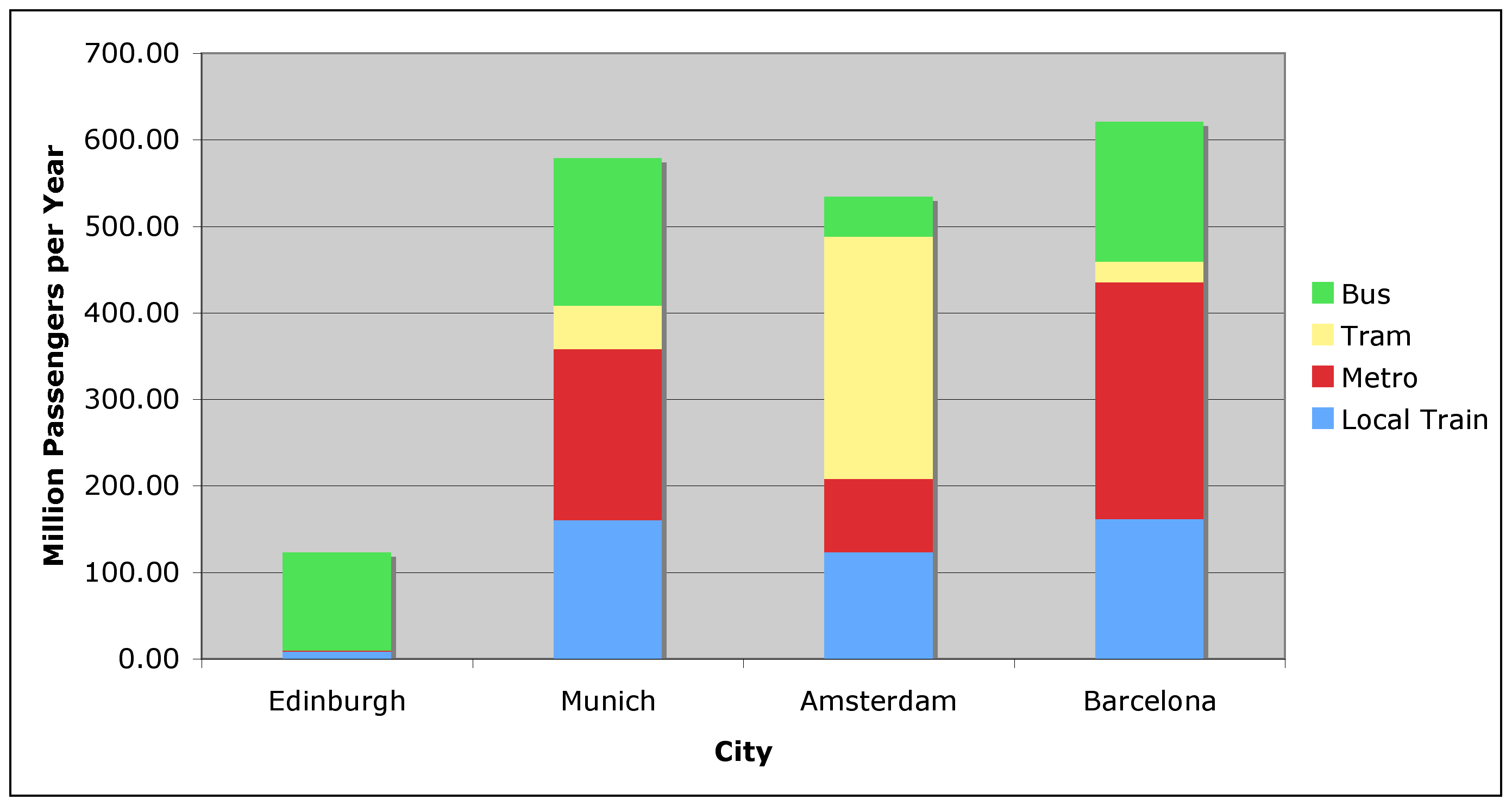
In fairness, they do run a tight ship with a fleet of clean, new, buses that run a relatively punctual schedule around Edinburgh and its near environs and therefore receive few complaints from the locals who use it regularly. But anyone with enough buses, drivers,  mechanics and an IQ in double-digits could make buses pay in Edinburgh, a major city with horrendous traffic problems and no other public transport to speak of: it is the biggest city in Europe with the transport strategy of a village—check the comparisons.

Embra-rassing: Public Transport Stats for Comparable European Cities

Embra-rassing: Public Transport Stats for Comparable European Cities

Most important, the other transport nets cited are integrated: one ticket gets you from A to B, no matter what means you use. Check out Lothian’s website. It has a tab for “Integrated Transport” but all it consists of is a 3-minute cartoon aimed at 5-year-olds that skips the fact that trams take longer than the Airport link and cost lots more (although the website’s ‘fares’ page tells you none of this).

All through the site, the assumption is that you are a resident. Want multiple tickets? Well the CityTicket for 20 journeys costs £30—exactly the same as you’d pay for 30 single journeys and you have to find a Travelshop to achieve this stunning 0% bargain discount. Or the Day Ticket: “Perfect if you are making 3 or more journeys in a day.” chirps the website. But how many times is that likely?

But what of the 3.7 million visitors Edinburgh, the No.2 tourist destination in the UK, receives each year? Well, they’re stuffed, whether they arrive by train or get turfed out of the Airport link at Waverley Bridge. Good luck finding the TIC dragging their cases or working out which of the 18 Waverley bus stops they need and then finding it or even the two nearby-but-well-hidden Travelshops. Try asking about trains in a Travelshop or buses at the train counter if you want an earful of pithy anglo-saxon in a broad Scots accent.

In short, Lothian is on another planet. The reason is: it’s run by bus anoraks largely for bus anoraks—the present CEO Ian Craig replaced Neil Renilson—both with bus CVs the length of your arm. No-one would mind his total pay package of £269,388 last year (up from £264,196 in 2012) if he was delivering a 21st century integrated system.

They do get 96% customer satisfaction and services they provide are clean and modern.  Recent PR oozed over 10 new Volvo 7900H diesel-electric hybrids, gushing over their green credentials and soon to be running on Route 30 Clovenstone/Musselburgh. But nobody polls the millions (including almost all of the 3.7m visitors) who don’t use Lothian as to why.

Leaving aside the total lack of integration with ScotRail (or tourist buses or FirstBus or anyone else), the most glaring flaw is their network structure that is pure 19th century. Compare Lothian’s route map with the 1950’s Edinburgh Corporation Transport trams map and see how little progress has been made. Then compare it with, say, Munich’s transport map. Note how the radial routes on which Lothian fixates are all provided there by fast S-Bahn or U-Bahn lines in Munich; any gaps are provided with higher-capacity trams. Buses are only used to feed this fast, high capacity backbone. And—this is why Edinburgh is now saddled with a white elephant—no tram line duplicates heavy rail.

Consider this when you are stuck in a chain of No 26’s crawling their way through Roseburn or a shoal of No.3’s stuck in South Clerk St behind a delivery van.

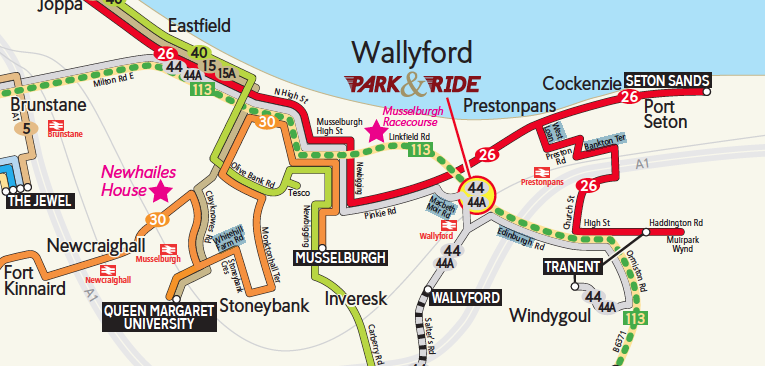
It’s just as well that efficient buses are to be used on the No.30 route. It might qualify as the least efficient route of all, especially at its eastern end where it takes 1/2hour to cover 1.4 miles crossing Musselburgh between Newhailes House and Musselburgh Grammar. That’s 2.8 mph in old money.

Lothian Route Map in Musselburgh: Route 30 in Orange

Lothian Route Map in Musselburgh: Route 30 in Orange

Despite serving QMU, this bus takes 1 1/2 hours end-to-end, a voyage no sane passenger undertakes. After Fort Kinnard, it duplicates other routes, so you might think demand would exist for a faster service that didn’t duplicate the train to Waverley (10 mins vs Route 30’s 40 minutes). It could profitably be rerouted through the swathe of South Edinburgh that has no QMU/Musselburgh service, even if it does need to wind up at Clovenstone. (Wild guess that’s for another anorak reason: the depot’s nearby)

But that would be a non-radial service, which Lothian abhors. Every good anorak knows that is no way to parade your spiffy buses before an adoring public—even if it does cause self-induced traffic jams blighting Musselburgh High Street, Shandwick Place, St John’s Road, Great Junction Street, Elm Row, Tollcross…and two dozen more bottlenecks.

Therefore, this blog’s clear winner for Anorak of the Year, in acknowledgement for setting  goals furthest from public need (through endemic bus fetishism, executive-over-passenger priorities and showboating for their 91%-share ECC political masters) is Lothian Buses.

In modern cities with real transport systems, buses don’t cause traffic jams; they fix ’em.

Posted in Transport | Leave a comment

Делать хорошую мину при плохой игре*

“It is the servant who takes the money” —Lawrence of Arabia

As a young man, I was proud to be British. But the more I became familiar with its Establishment and could compare it with other cultures, the more that pride has been (to put it mildly) eroded. The last tenuous memories of such pride are of Lord Carrington resigning as foreign secretary some 32 years ago.

Watch any British film from the 1950’s and you are struck by a time warp of modesty, selflessness and dogged resilience that verges on the fetish. Contrast the self-deprecation with the rugged individual heroics of US films of the same era and you have a rough model of cultural differences that still existed.

But roll forward to the 1980’s, the era of ‘Big Bang’, brazenly loud braces and the Masters of the Universe emerging amidst the new cityscape of Canary Wharf. Those cultural differences (e.g. Carrington vs Rumsfeld) might still exist out in the shires but they were already gone from the Square Mile of the financial district and, courtesy of Blair and New Labour, soon to be expunged from the political village of Westminster just up-river.

Such purging was not all bad. The long boom from early nineties to late noughties made most people much richer, creating a quality of life unknown 50 years before. Even the avalanche of outsiders into the City blew fresh air through stuffy management in Morgan Grenfell, Hambros and Warburg; the huge NatWest was gobbled up by newly aggressive (if much smaller) RBS and creative investment banking invented PPP, PFI, privatisations, 100% mortgages and derivatives of ever-increasing complexity to mine what seemed like an inexhaustible and profitable supply of ‘financial instruments’.

The fact that ‘canny’ Scottish bankers like RBS and HBOS were to the fore in all this only served to soothe any disquiet felt by the fuddy-duddies who still hankered after the much more staid days of  ‘my word is my bond’.

The comeuppance of 2008 was a shock to everyone. Twenty years of salary and bonus inflation had addicted an army of bankers, accountants, traders and fund managers to  seven-figure salaries and the mortgages they paid. Despite constriction everywhere else in the economy—and particularly in Joe Public’s salary—denizens of the Square Mile (which now includes Canary Wharf and the Qatari-owned Shard) successfully defended their bonus culture, convincing the UK Government that it was essential in any recovery.

Spending over £100bn each year that they did not have, the UK Government bought that story, betting on a recovery in lucrative financial services to drive borrowing down before the whole country (and AAA rating) sank under a £1,500,000,000,000 mountain of debt. As the result, the City’s bluff was not called and this residual distinction of British (vs American) culture—that there was a moral as well as a profit obligation—disappeared.

Foreign money has poured into the City for centuries. And, like the Swiss, there have not always been searching questions asked as to its origin. But weak UK sabre-rattling in response to the disappearance of Crimea back into Russia and appearance of Russian tanks in Eastern Ukraine demonstrates that the UK establishment understands that, in the 21st century, what matters are banks, not tanks and global competition to house the dosh concentrated in 58 Russian billionaires and their poorer brethren (there ARE no sisters) is fierce because of its very lucrativeness.

Thus has London become the centre for Russian corruption, deftly directing their loot into Britain’s continuing empire of tax havens—Gibraltar, Jersey, Cayman Islands, British Virgin Islands (BVI)—on which the sun never sets but where the taxman’s baleful glare seldom shines. To give some concept of scale, the entire UK received £53.2bn in foreign inward investment last year. That’s a respectable £1,000 per head. But the BVI saw almost £54bn in inward investment—roughly £1.5m per head—in the same period. “We are all in this together”? I think not. As the blurb for the place (pop: 28,000) itself says:

  • “The British Virgin Islands represent the world’s principal centre for International Business Companies (IBCs) of which there are in excess of 500,000 currently registered
  • The BVI is among the top four domiciles for offshore mutual funds in terms of the number of offshore funds incorporated (over 2,500) and domiciled
  • There is no tax on offshore income and capital, no tax on mutual funds, no inheritance tax, no capital gains tax, no VAT/sales tax, no currency controls, and no double taxation agreements in BVI.
  • BVI are home to leading international accountancy and attorney firms, and its Know Your Client legislation has been approved by the US Treasury”

In other words, an offshore tax scam on a colossal scale in which both the City and HM Government are complicit. Yet the average UK citizen neither has access to nor benefits from dog-eat-dog global finance in whose waters some very shady sharks swim—not all of them with thick Russian accents.

But this is not all. For tbose who can afford it and despite this pious guff about slowing immigration, British residency is up for sale. “Investor visas” can be purchased, starting at £1 million; Russian clients now provide 60% of the work for lawyers in London’s Commercial Court; 50 Russia-based companies swell the trade at London’s Stock Exchange; planning regulations become malleable for Shard-like aspirations of London’s hedge-funding class.

London’s bright young things have become consultants, art dealers, private bankers and hedge-fund-runners. In effect, they have become the oligarchs’ valets. Such is the trade that Rootin’-Tootin’ Putin knew he could play serious sabre-rattler to bolster his ratings with the krest’yanin, as well as the nomenklatura, by talking tough, grabbing Crimea by coup de main and stirring things endlessly with Ukraine’s Russian minority.

Because when you pay them, you own them. Putin calmly assumed that Britain’s senior management, shuttling through the revolving door that now exists between cabinet posts and high-flown corporate boards, won’t/can’t give up their fees and commissions from the oligarchs’ billions. He has been proved right

In the austerity years following 2008’s financial crash, such a source of wealth could not be resisted. Tony Blair has come to embody a latter-day Raleigh’s pirate ways; he advises Kazakh’s Nursultan Nazarbayev on his image in the West, tutoring his patron on evasion of awkward questions about crackdowns and mine shootings that are everyday life there.

As Scots stand within six weeks of being able to choose an alternate future, they should consider that ‘No’ means remaining party to the UK’s latest growth industry that taints its history as much as earlier greed-driven wheezes like the slave trade or opium wars: laundering oligarchs’ dirty billions and laundering their squalid reputations.

* “To put a brave face on a sorry business” (Russian proverb)

Posted in Commerce | Tagged | Leave a comment

Quis Custodiet Legis Latori?

If another smug unionist argument repeats the claim that bigger is automatically better and that we can all relax in the arms of Big British Brother, I may have to reach for the boke bag. Let’s leave aside unanswered questions why inhabitants of Switzerland or Singapore can be so much better off than ‘global power UK’ or why Eire shows no desire to re-enfold itself in Britannia’s protective skirts and focus on just one item that is an insult to Scottish autonomy on even the devolved scale.

Pardon me if this gets anorak and esoteric in its detail. Scottish Ministers are responsible for policing and justice. A Regulation of Investigatory Powers Act was signed into law by Westminster in 2000. It was already the case that Scottish Ministers signed off any request for intercept on serious crime grounds but being in its infancy, the Scottish Parliament accepted the legislation in full. It permits five types of surveillance:

  • Interception of Communications—this involves listening to the calls made on a telephone or opening and reading the contents of a target’s letters or e-mails. This is only allowed under the authority of a warrant signed by a Secretary of State
  • Intrusive Surveillance – covert surveillance in residential premises or in private vehicles – so covertly filming a person’s house, bugging a house or car.
  • Directed Surveillance – covert surveillance mainly in a public place – so covertly monitoring the movements and actions of specific targets, following them around, listening in or filming in mainly public spaces.
  • Covert Human Intelligence Sources A CHIS is a person who, under direction from a public authority, establishes a personal or other relationship in order to (covertly) use the relationship to obtain information or disclose information gained from the relationship.
  • Communications Data – this contains the record of a communication, such as a telephone call, email or website visited – it does not contain the content of the communication.

It appears that the European Court of Justice deemed the original Bill contradicted the rights of its citizens, so there was an indecent rush at Westminster to patch the legislation so it did not. Some haste is understandable but it seems Theresa May sat on the revision since April and left minimal time for public debate—always a bad sign when Tories are dealing with security.

Many opposition MPs, including Pete Wishart (Perth and North Perthshire, SNP) objected to the resulting wholly unnecessary ‘bum’s rush’:

“I have massive concerns about this Bill. I do not like the way in which it has been brought to the House. I do not like the way in which we have to rush through this process at breakneck speed, even though this is an issue that was flagged up to the Government some three months ago. I am suspicious about the reasons why we are doing all of this now. I do not like the fact that it seems little more than a half-hearted attempt to get around a European Court of Justice ruling that declared the European directive invalid and thereafter practically everything that the Government are doing on data retention probably illegal.”

In the background, all UK parties and leaders were brought into line around “unspecified threats”, reminiscent of the dark days of the creation of New Labour’s anti-libertarian state. Despite having responsibility for the judiciary, policing and even delivering parts of RIPA in Scotland, the Scottish Government were never consulted. Theresa May’s department pretend this legislation is business as usual. But it is clearly an extension of what the Government can do in the collection and retention of an individual’s personal data.

The Prime Minister said that the Government were not introducing “new powers or capabilities”, but clauses 3 to 5 make significant amendments to the range of powers included in RIPA. The Bill extends the Government’s surveillance powers in two very important ways. Clause 4 clearly extends the territorial scope of RIPA, and the Government can now issue interception warrants for communications data to companies outside the UK. It also extends the definition of what “telecommunications services” means within RIPA to include webmail services such as Gmail—the most fundamental change in the relationship between ISPs and the state.

The Government have had three months to address the Court’s findings. It is not the threat of terrorism or of criminal activity that has forced the Government’s hand in bringing this forward today. It is the threat of legal action by organisations such as the Open Rights Group and others that has prompted this emergency legislation. The Government should not mislead us about the urgency of the Bill. Given its significance and the issues it raises about our civil liberties, it should not have been passed without proper parliamentary scrutiny.

In the interests of legality—not to mention people’s rights against unwarranted surveillance, the Government must come clean that this is not business as usual. These are significant and substantial new powers. What the European Court of Justice said was that we have a very low threshold for the retention of data, and it made it clear that the retention of data of every single person strikes the wrong balance between the need to tackle serious crime and our right to privacy and a private family life.

The Bill is more than the sum of its parts. It is a statement of intent. The Home Secretary’s real intention is, of course, to reintroduce her much-coveted snoopers’ charter in this Bill. The way in which the Bill brings on board the overseas ISPs is little more than a paving Bill for the reintroduction of that most unwanted anti-civil libertarian measure.

Posted in Politics | Tagged | Leave a comment

Marking-Time Season

Never having been one to body-swerve touchy issues, it is nonetheless with some trepidation that this blog is dedicated to questioning the usefulness to anyone of high-profile public display of whatever your religious beliefs happens to be. While they are hardly a model of enlightened restraint when it comes to religion, I have always believed that the clear separation of church and state that the Americans wrote into their Constitution is something the Old World would do well to consider emulating.

Let me be clear that I single out no religion for criticism and certainly in no way question anyone’s religious beliefs insofar as they do not dictate how others who don’t share those beliefs must live. And while there are many examples in the past of religions causing wars and havoc, I also believe that those who follow almost any religion believe in peace, co-existence, the sanctity of life and the rights of their fellows.

Religion requires much faith and cannot be judged on scientific substantiation. Whether the wine becomes the blood of Christ or the Queen is the supreme spiritual head of a church because of Henry VIII’s combination of human frailties, greed and ego is not for outsiders like myself to quibble with, not least because there is no perceptible harm to others from either.

But in today’s news (July 12th), both Israeli strikes on Gaza and the limits imposed on an Orange Order march in North Belfast are items that I, for one, am thoroughly sick of hearing. I have watched such depressingly repetitive items all my adult life with no sign of humanity—let alone sheepish acceptance of how daft it appears to those outside—breaking out. I have now come to regard those and similar such entrenched bigotry (Sunni/Shia, Serb/Moslem, Dinka/Nuer, India/Pakistan, etc) as net detractors from human progress.

Such distinctiveness not all bad;  personal identity, community spirit and national awareness derive from similar distinctions and, indeed, sometimes from those traits against which this blog is otherwise railing. As with individuals, we should celebrate our differences but that does not mean absence of spirited differences. This year’s World Cup in Brazil was perhaps the most splendid example to date of the world having a go at one another in an atmosphere of frantic but friendly competition, just as Brazil itself provides a vibrant example of how races and origins can get so mixed up that their international reputation beyond football is of a place to party and make friends.

Not to imply that the Irish are unique in unproductive self-harm, nor am I without sympathy for both the sash and the shamrock, given they’ve been living with dissent ever since Richard II overreached himself beyond the pale and brought the War of the Roses down on himself as a result. Half a millennium of undeclared civil war cannot but leave scars and Britain’s imperial/colonial approach to what it tried to pretend was part of the homeland 1801 to 1922 will take more than a royal visit and apology (however sincere) to consign to history.

But, just as Lt Hiroo Onoda finally accepted WW2 was over and emerged from the Phillipine jungle, so at some point one of the factions involved in Ireland will win and the other will need to get used to that fact. Now, while it is possible that Ulster unionists and their supporters may broaden their appeal and convince the rest of humanity that sashes, bowler hats and fife bands are somehow symbolic of the future, they will also have to deal with the statistical fact that catholics generally have more children and that some day within the next century, that will mean a unionist voting minority.

However distasteful and however much that flies in the face of tradition and victories won three hundred years in the past, there is scant hope for the world’s other trouble spots, some on their second millennia of strife if an island with so much culture in common and a racially indistinguishable 5m inhabitants can’t find some way of burying the memories of Black & Tans and IRA hit squads equally deep to find an emotional, as well as political accommodation of one another’s existence on the same piece of real estate.

Israel’s unilateral decisions as to where boundaries lie and then delineating them with community-fragmenting walls are operations worthy of Canute. A much mightier empire than theirs once divided what is now Germany’s capital with a similar idea; it is now dust and souvenir fragments. Just as the 12th and 13th © Crusades ended in failure when the Turks took Constantinople in 1453, so the Turkish-Greek animosity that erupted in war in 1920 is cooling to quasi-normal relations.

Forbidding Ulster unionists their provocative-in-all-but-name marches is no more sensible then the old Ulster Constabulary’s foot-on-the-neck approach to policing catholic communities. But with the passage of time and some easing of tensions already, both communities now include a majority of pragmatic and reasonable people who, in their heart, want the best for their community. When pressed, they accept such will require an accommodation with the ‘other side’.

Every marching season pushes actualisation of that accommodation into the future and adds a little more despair and frustration to fans of the Irish people in general like this writer with no axe to grind for either faction. Because, ready though Britain may be to have royal visits and make apologies for errors in the past, that will cut little ice as long as two factions of Irish stand like petulant children, glaring and poking each other in the ribs to elicit any response but with the tacit understanding that anger will do.

Posted in Community, Politics | Tagged | Leave a comment

Century-Old Lesson Still Unlearned

Since posting The Bitter Legacy of Sykes-Picot a couple of weeks back, I have run across a couple of points substantiating the thesis therein, namely that two untraveled mandarins were ill-qualified to carve up one of the world’s great powder kegs along lines that suited their respective empires. Quite apart from leading the Arab Revolt of that time against the Turks, T.E. Lawrence used his experience to argue a different approach.

Apart from listening to men from across the Middle East who were serving in the army of Britain’s Arab allies against Turkey, he was also in contact with other British experts on the region, such as DG Hogarth and Gilbert Clayton. Lawrence’s suggestions however fell foul of the British administration in Mesopotamia.

Jeremy Wilson, Lawrence biographer recently discovered a map that was particularly interesting because “it suggests that Lawrence’s proposals were taken fairly seriously, at least in London and would have provided the region with a far better starting point than the crude imperial carve-up agreed by Sykes and Georges-Picot”. Hania Farhan, regional director of the Middle East and North Africa, Economist Intelligence Unit, said: “The map shows that the opinions of those who knew the region well were often ignored, as the colonial powers in London and Paris had their own agendas and did not appear to care about the facts on the ground or the people of those areas.

Lawrence's 'Peace Map' for the Middle East

Lawrence’s ‘Peace Map’ for the Middle East

Note how provision for a Kurdish homeland (still unrealised) and an Arab unity outside of Palestine. Had such a proposal for sovereign countries (not just protectorates to be subsumed into existing empires) been followed, much of the mayhem that has plagued the region in the century since might have been avoided.

Fears are growing of a widening war across the Middle East, fed by reports that the Islamic State of Iraq and Syria (ISIS) envisions a region-wide, all controlling theocracy. At the same time the centenary of  The Great War and its 37 million casualties is focusing on the battlefields and trenches of the Western Front to the exclusion of the Ottoman Empire of the Turks that dominated the Middle East. T.E. Lawrence became a hero in the Arab world when he led nomadic Bedouin tribes in battle against Turkish rule. Peter O’Toole immortalized him in the epic movie, “Lawrence of Arabia.”

In that film, after dynamiting the Hijaz railway and looting a Turkish supply train, Lawrence is asked by an American reporter, “What, in your opinion, do these people hope to gain from this war?” “They hope to gain their freedom,” Lawrence replies, and when the journalist scoffs, insists, “They’re going to get it. I’m going to give it to them.”

At war’s end, Lawrence’s vision of Arab independence was shattered when the Versailles peace conference confirmed the carving of Iraq, Syria, Lebanon and Palestine into British and French spheres of influence; arbitrary boundaries drawn in the sand to satisfy the appetites of empire. The F.O. even called the former Ottoman lands “The Great Loot.”

Using Lawrence’s map could have provided us “with a far better starting point than the crude imperial carve up.” Lawrence wrote to a British major in Cairo: “I’m afraid you will be delayed a long time, cleaning up all the messes and oddments we have left behind us.

After the invasion of Iraq in 2003, demand for Lawrence’s book, “Seven Pillars of Wisdom” increased eightfold. It was taught at the Pentagon and Sandhurst  for its insights into fighting war in the Middle East. In 2010, Major Niel Smith, who had served as operations officer for the US Army and Marine Corps Counterinsurgency Center, told The Christian Science Monitor, “T.E. Lawrence has in some ways become the patron saint of the US Army advisory effort in Afghanistan and Iraq.”

Lawrence’s understanding of the ancient and potent jealousies of the people among whom he had lived and fought generally was ignored. In 1920, he wrote for the Times an a prophetic article about Iraq. He decried the money spent, the number of troops and loss of life, and warned that his countrymen had been led “into a trap from which it will be hard to escape with dignity and honor. They have been tricked into it by a steady withholding of information…. Things have been far worse than we have been told, our administration more bloody and inefficient than the public knows. It… may soon be too inflamed for any ordinary cure. We are today not far from a disaster.

Not for the last time in the Middle East would disaster come from the blundering ignorance and blinding arrogance of foreign intruders convinced by magical thinking of their own omnipotence and righteousness. If ever George Santayana’s pithy aphorism applies it must surely be here:

Those who do not learn from history are condemned to repeat it.”

Posted in Politics | Tagged | Leave a comment

Why Yes is the Answer III: It’s the Economy, Stupid

There is a clear case for an independent Scotland to prosper more than it has to date within the UK. I confess that I have not examined all the contrary evidence put out by HM Gubmint on its website at public expense but any open-minded Martian would find it a) turgid; b) light on facts and c) questionable in its conclusions. You need only hold your nose and point your browser at:

https://www.gov.uk/government/publications/scottish-independence-referendum-money-and-the-economy/scottish-independence-referendum-money-and-the-economy

for the sheer self-serving vacuousness of the arguments to assault your senses. For example:

  • Scotland is a successful, growing economy, as part of the UK Scotland has the highest economic output per person behind London and the South East.
  • The UK’s economy grew by 1.7% in 2013 – and the recovery is forecast to continue – with growth of 2.7% in 2014.
  • There are more people in work across the UK – more than 30 million – than ever before. The UK’s overall employment rate is higher than the USA for the first time since 1978 and, as part of the UK, Scotland’s employment rate is greater still.
  • Nations within the UK have strong, important and beneficial trade links – In 2013, Scotland sold £50 billion worth of goods and services to the rest of the UK and bought £63 billion worth of goods from the rest of the UK.

All of which is fascinating. But it makes no case whatsoever why Scotland needs to remain part of the UK. Indeed, the reverse could be argued, since Scotland appears to be doing so well within the UK and all of us are part of the EU open market. The Westminster beancounters then go on to say that Scots already control 60% of expenditure and receive 10% per capita more than England (conveniently ignoring oil revenues). So??

The entire 2000-word document is in the same vein, verging on the naff. There are four such ‘Factsheets’, plus a dozen ‘Scotland Analysis’ papers totally well over 1,000 pages in all. The one on Currency and Monetary Policy is typical of them all, seeking to rubbish all options for use of sterling by both countries, as if it were not in England’s interest to see an independent Scotland succeed. This self-destructive myopia is a leitmotif of the entire UK government approach to Scotland. Given the strength that Scotland brings to the UK economy, such self-interest is understandable. But to present the debate as if Scotland were a basket case while citing umpteen positive parameters as if they could only ever be realised under Westminster’s sage tuition takes rare cheek.

But let’s leave aside those Tories who have made themselves foreign to Scotland and their city chums whose wizard wheezes need the biggest fiscal stage on which to play. Let’s also leave aside a ‘feeble fifty’ Labour MPs—in 35 years after scuppering our ’79 referendum they have grown fat from the imperial trough but done diddly-squat on behalf of their Scottish constituents (honourable exceptions: Donny Dewar and John Smith who had both ideas and principles, working themselves into early graves trying to stick to them).

Let’s look at this ‘recovery’ of which Lord Snooty & Chums are so proud. “The economy” says the Treasury “grew by 1.3% in 2013“. Let’s see what the Evening Standard—as big a booster for London as you can get—says about that:

The UK’s economic recovery is dangerously unbalanced, with almost 10 times more jobs being created in London than in the next best city, according to a new report. Research by the Centre for Cities think tank revealed that London accounted for 80% of private sector employment growth between 2010 and 2012.

The kind of jobs created were mostly service sector jobs—little surprise given London’s relative paucity of manufacturing. So, comparing Scotland’s recovery with England’s can we distinguish differences? Since 1996, in Scotland, manufacturing has dropped from 19% to 12% of GVA while finance and insurance has risen from 12% to 16%, despite financial crashes. England still retains a significant manufacturing element (e.g. Rolls Royce and foreign car plants) but Scotland’s is larger per capita, specialising in oilfield engineering, whisky and renewables.

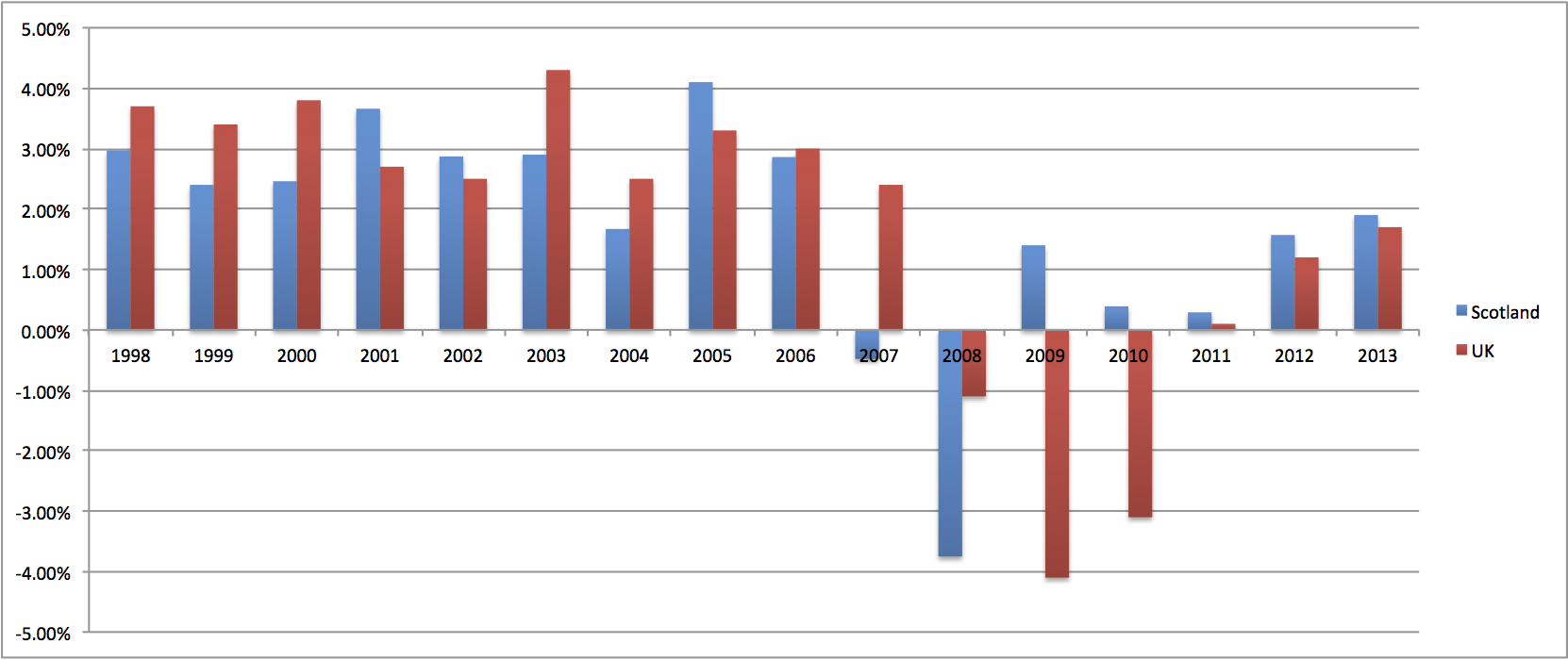
In fact, throwing in the financial and tourism sectors, plus growing food and drink exports, Scotland can be said to have a robust economy, closer to London’s than to still-to-recover northern and Midland areas of England. This is borne out by comparing GVA statistics since before the recession, shown in Figure 1.

Figure 1—GVA Change Comparisons (Sourgce ONS & SG)

Figure 1—GVA Change Comparisons (Sourgce ONS & SG)

Clearly, Scotland grew at a rate comparable to the UK until the recession in 2007. At that point, we were initially hit far harder but recovered faster and continue to do so. Indeed, Scotland’s economy appears more robust than the UK (i.e. England’s) and a strong case can be made that they need Scotland to keep them afloat.

It’s about this point when unionists wade in with their hoary warnings how RBS would have gone bust, had Big Bruvver Britain not been there to grease the skids. As they put it:

“The UK Government supported the injection of over £45 billion into the Royal Bank of Scotland in 2008 and offered the bank a further £275 billion of guarantees and state support to protect our financial systems. The total level of this support would have been more than double the total size of Scotland’s economy in that year.”

All factually correct—except that subsidiaries NatWest and Ulsterbank operate solely elsewhere in the UK and are worth £380bn and £48bn respectively—out of total group assets of £1,470bn, 30% of which (£421bn) are held overseas (including £70bn in the  disastrous Dutch foray of ABN-Amro). Ignoring other English RBS subsidiaries, at least 60% of RBS operations were furth of Scotland and—unlike Icelandic banks who had no ‘Big Bruvver’ to rescue them—the Bank of England would have been foolish not to intervene, even had the bloated RBS been based in an independent Scotland at that time.

The alternative would have been to see NatWest and Ulsterbank close their doors and freeze depositors out, as Northern Rock had just done. Hard fiscal realities dictate that banks with heavy presences in other countries can rely on adopted countries to help in times of fiscal trouble. That’s why Icelandic banks went to the wall (because they had none) but the heavy presence RBS/HBOS furth of Scotland gave the Bank of England no choice. (The whole question might not even have arisen, had Scotland been independent, with a real Financial Services Authority—not a toothless gaggle of City chums asleep at the wheel in London. Scandinavia—with robust FSAs—survived without a banking blemish).

Which brings us to the use of the £UK. High-placed unionist payroll members like the Alexander brothers (Danny and Douglas) are falling over themselves to explain why this is an impossibility. Let’s leave aside that the Aberdeen agreement was supposed to lead to constructive dialogue to achieve the best for both countries in the event of a ‘No’ vote and consider several pragmatic points:

  • It’s not England’s £. Shared jointly since 1707, so Scots have a solid claim it’s theirs too
  • Sterling with Scotland outside would stop being a petrocurrency and drop in value
  • Although not independent, sharing the £UK officially means having a Scots member of the BofE board to argue our particular needs—more influence than Scots have now.
  • Any barrier to the 80% of Scots trade that is with England hurts them as much as us.
  • In 1922, independent Eire used the punt—pegged to the £UK—for 80 years before adopting the Euro in 2002. It was done with an amicable agreement which worked well
  • If Scots chose to use the £UK unofficially, there’s nothing England could do about it.
  • Having Scots use £UK unofficially as England gets ever more Euro-hostile could give Scotland a huge boost as Europe used it as a bridgehead in the sterling zone

There’s a strong case that the UK is being petulantly thrawn over this. But let’s assume that Scotland chose not to use sterling, thereby creating a barrier to trade to that £2tn market. When life gives you lemons, you make lemonade; huge markets exist to our East:

  • Germany—£2.500bn economy
  • Low Countries—£830bn total economies
  • Scandinavia—£1,050bn total economies

It would be naive to pretend that this market—twice the size of the present UK—would be immediately accessible. But centuries of London fixation by those who have steered our economy have lost us historic links with our other neighbours obvious from one glance at a map. Aberdeen is closer to Oslo, Copenhagen, Hamburg and Amsterdam than to London.

It’s high time Scotland stood up for ourselves in Europe and not thole this self-serving guff from Westminster and (especially) the new herd of myopic UKIP MEPs. Europe has faults that need fixed but Scotland has many friends (Iceland today became the latest to go public) who will delight at Scots distancing themselves from English xenophobia and wistful hankerings for a lost empire. Scots were England’s hard-headed partner in building, policing and administering that empire; but 21st century trade opportunities are global and not just in pink-painted bits.

Seen objectively, the idea that the EU would not fall over themselves to admit a dynamic, viable, energy-rich, export-rich Scotland as soon as they detach from England is really laughable. And that’s in the event that the Commission were not to interpret an existing member splitting into two would not entitle both to automatic membership. The EU is as creative at political fudge as any organisation. Scotland would, like Sweden, have to sign up to eventual adoption of the Euro. But, like Sweden, it only need finesse its finances to that they fail convergence criteria indefinitely and the kroner/£Scots could last forever.

Look at it the other way. If Scotland were already independent, with a stronger economy than England, better trade balance, more friends, no fiscal drag of Trident & ‘global police’ delusion, no europhobic faction, less haves/have-not inequality and a reputation for good education, resourceful engineers and generous hospitality, why on God’s green earth would they choose to partner up with a greedy, inward-looking, nostalgia-fixated has-been like London-dominated England?


Posted in Commerce, Education | Tagged | Leave a comment