Operation Puffin Update

I have reported on the terrific work that 100+ volunteers have done on the Forth Islands to protect the indigenous puffin population from being crowded out of house and home by an invasive plant. What follows is the latest report from John Hunt, redoubtable organiser of expeditions in all seasons and all weathers to deal with the threat.

SOS Puffin is a volunteer project sponsored by the Scottish Seabird Centre which started in 2007. It aims to bring under control the invasive plant tree mallow which has taken over the islands of Craigleith and Fidra near North Berwick and threatens the important populations of nesting puffins and other seabirds.

The last summary report was sent to volunteers in May 2014 and this report summarises what has happened since then. Any comments or queries are very welcome.
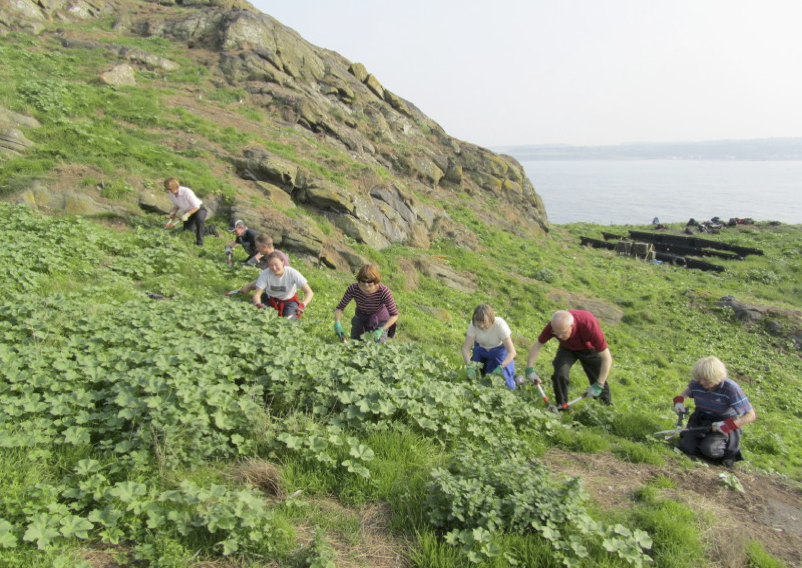
Precision mallow cutting on Craigleith in September

Precision mallow cutting on Craigleith in September

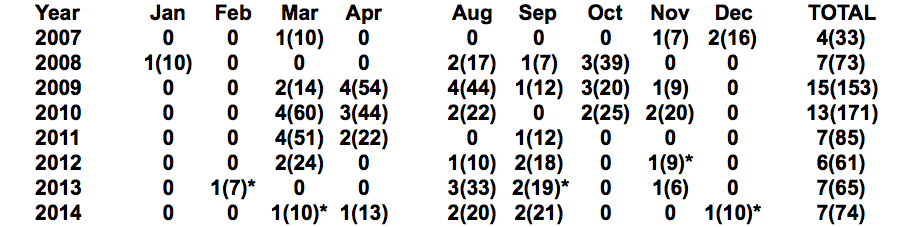
The following tables show the number of work parties to Craigleith and Fidra each month (with the number of man/woman days shown in brackets) since the project started. Note that the gaps between April and August are because this is the nesting season.
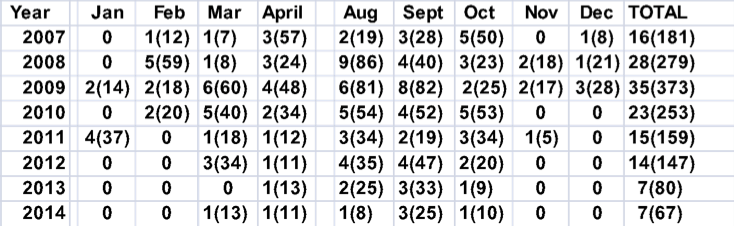
Operation Puffin Expeditions to Craigleith
Operation Puffin Expeditions to Craigleith

Operation Puffin Expeditions to Fidra

Operation Puffin Expeditions to Fidra

Note: The trips during the months starred above were organised by the RSPB but most of these also involved volunteers from SOS Puffin. In addition to the above, the RSPB organised three other work parties during the autumn of 2014. During one of these some of the tree mallow on the cliffs (hazardous to access) was cut.

As can be seen, significantly fewer work parties have taken place in the last 3-4 years. This is mainly because the task has got less but also because a high proportion of planned work parties have been cancelled because of the weather and other factors.

We hoped to fit in a trip to the Lamb where there is a small amount of tree mallow but in the event suitably calm conditions for landing did not arise at times when a boat was available.

It is pleasing that new volunteers continue to come forward and there are now over 650 people on the volunteer data base. However work parties are heavily dependent on a small group of enthusiasts who come regularly – six of whom have now helped on more than 50 occasions. David Ross reached the remarkable number of 100 work parties in September. It would have been a close-run thing between David and Margaret Wight as to who reached this milestone first if Margaret (who has done 90 work parties) had not been unwell during the autumn. I am glad to say that Margaret is now recovered and was back in action again on Fidra in December.

Howard Andrew, Bill Bruce and David Ross relaxing on Fidra after a hearty lunch of tree mallow.

Howard Andrew, Bill Bruce and David Ross relaxing on Fidra after a hearty lunch of tree mallow.

From August until October we were able to use the Seabird Centre’s large inflatable and our thanks to Colin Aston and his skippers for taking us out. This boat came out of the water at the end of October and will not be available again until March.


Local boatman Dougie Ferguson conveyed the RSPB work parties to Fidra in his launch Braveheart. He is not willing to land on Craigleith because of the risk of damage to his boat.

What has happened on Craigleith?

Throughout the summer there was very little tree mallow to be seen and puffins and other seabirds will not have been troubled at all during what appeared to be a successful breeding season. Tree mallow was later than ever making an appearance and it was not until August that small seedlings became apparent; by September there were extensive seedlings on the south side of the island and locally elsewhere.

This meant that seedlings being cut during the autumn were quite small with none more than one metre high. Only five work parties were possible during the autumn and considerable areas of seedlings still remained after the last visit in early October—most on the south side of the island. It will be interesting to see if the rabbits deal with these during the winter and there are signs at the time of writing that they are already making an impact.

On the Summit of Craigleith, October 2014

On the Summit of Craigleith, October 2014

During a dry summer the rabbit grazing created extensive bare areas of soil in those areas with a high rabbit density such as the Glen on the south side while their digging led to some localised erosion and soil collapse.
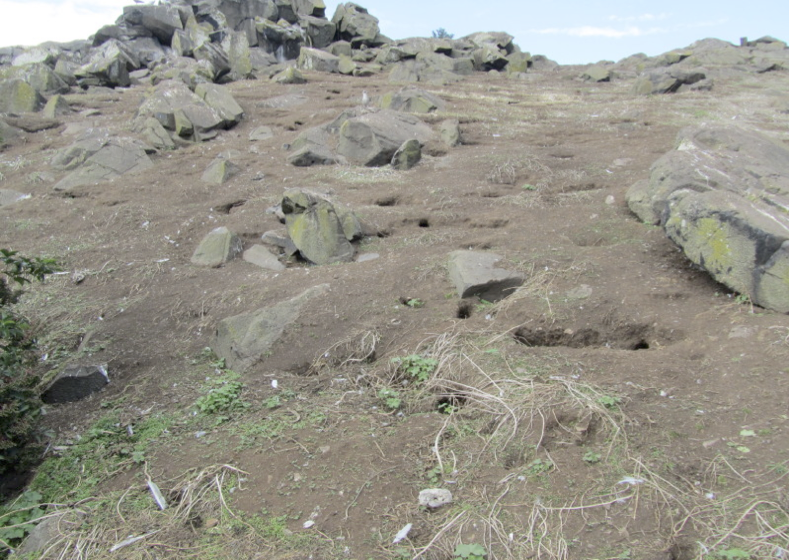
An Area of the Glen Laid Bare by a Dry Summer & Hungry Rabbits

An Area of the Glen Laid Bare by a Dry Summer & Hungry Rabbits

Nettles of both species continue to increase into areas previously covered by tree mallow – this helped by the rabbits which do not normally eat nettles. The Annual (or Small) Nettle was very noticeable over large areas during the summer but being an annual plant may not become a problem. However there are a number of large permanent patches of the perennial Stinging Nettle which are clearly spreading and can pose a problem for young eiders and puffins trying to reach the sea. These patches of nettles contain almost no other plants or puffin burrows. In total they extend to 0.4 ha which is significant on an island only 7 ha in extent.
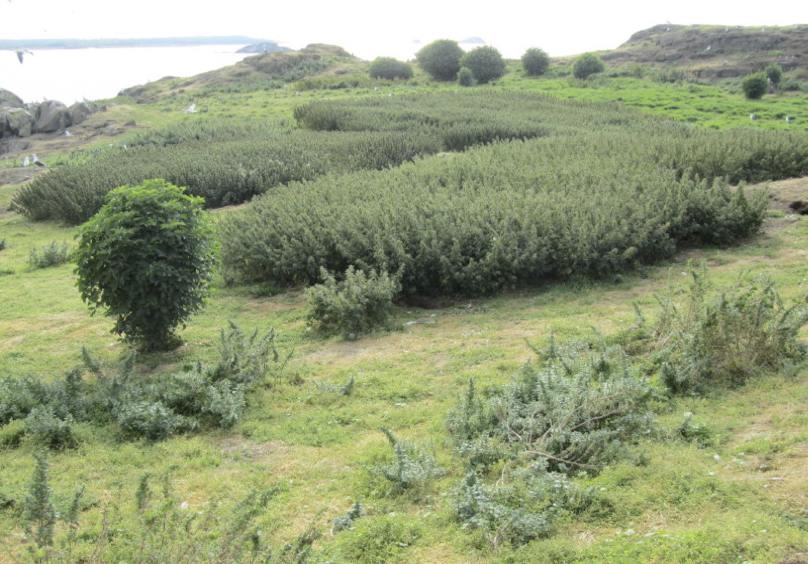
Stinging Nettles on Craigleith.  Elder Bushes in the Foreground and Background.

Stinging Nettles on Craigleith. Elder Bushes in the Foreground and Background.

What has happened on Fidra?

When the first work party visited on 9th August, it was noted that tree mallow had returned to the usual places with some seedlings up to two metres in height (though most were smaller than this) but seedling densities were again a little lower in most locations than in the previous year. Two areas which we did not manage to cut last Spring flowered and seeded which was unfortunate though these were not areas used by puffins.


The four work parties in August and September plus those organised by the RSPB ensured a reasonably thorough cut of the whole island including some of the cliffs. However there were plenty of mallow seedlings evident for the final work party to tackle in December and it is expected there will be no shortage of plants needing to be cut in the Spring.

Extreme Mallow Bashing by an RSPB Volunteer on Fidra

Extreme Mallow Bashing by an RSPB Volunteer on Fidra

The annual meeting of the Craigleith (and Fidra) Management Group was held in October. Rene van der Wal from Aberdeen University who carries out the ecological monitoring on Craigleith reported on his work as follows:

  • Conditions for nesting puffins were again excellent in 2014 with tree mallow cover in the summer the lowest yet recorded.
  • In the Glen on the south side of the island, grasses are not able to cope with the high level of rabbit grazing and it is hard to imagine what perennial species could colonise this heavily disturbed area.
  • Rabbits are helpful in eating tree mallow but have a negative impact in preventing the desired restoration of native maritime vegetation – other than nettles.
  • Investigation of the bare areas showed that tree mallow seedlings mainly colonised the transition between vegetated and bare ground where moisture conditions are most favourable.
  • The experiment set up to assess the value of sowing Fescue grass seed has been of limited value, the plots being too small and proving to be a magnet for rabbits with some also being smothered by Chickweed. A larger scale seed sowing experiment using Yorkshire Fog and Fescue grasses combined should be considered.
  • Vegetation mapping showed that the island is moving in the right direction in terms of less tree mallow cover and increasing target vegetation (ie perennial grasses).

It was agreed that further spread of the perennial Common Nettle was likely and undesirable and that a trial control programme should be devised which might incorporate sowing of grass seeds.

It was agreed that a volunteer engagement project looking at SOS Puffin should be carried out by a PhD student Marie Pages. Marie would like to understand why people decide to take part, what sustains their involvement and how to enhance their experience. A Questionnaire was sent out to all volunteers in late 2014 and the findings will be made available to everyone in due course. Over 70 responses have been received to date and thanks to those who took the trouble to do this.

The management plan for Craigleith has been updated and anyone is welcome to have a copy by email.

Looking Ahead

A programme of work parties for March and April will be circulated to all volunteers in February. It is likely that less work parties will be planned than previously since it is anticipated that there will be comparatively little to do on Craigleith. The aim will as usual be to ensure that both islands are effectively clear of tree mallow by the time the puffins return in April.

We expect to carry out a trial control of Stinging Nettles on Craigleith during the summer subject to the details being agreed by the Craigleith Management Group. This would be a small operation and it is not intended that the project should switch from controlling tree mallow to nettles!

We are not planning to do a puffin burrow count on the islands this year but may do so in 2016.

Fidra in November from Castle Tarbet— largely empty of seabirds and tree mallow

Fidra in November from Castle Tarbet— largely empty of seabirds and tree mallow

Conclusion

It does seem that a turning point has been reached in the project. Less work parties are now required to keep the tree mallow under control on Craigleith thanks to our efforts over the last eight years combined with the more recent impact of rabbits. On Fidra a considerable control effort is still needed but the extent and density of tree mallow is slowly reducing. With the RSPB increasing its own contribution to the project, less SOS Puffin work parties may be needed on Fidra in future.   We shall continue to monitor what is happening and react accordingly.

SOS Puffin has been running now for eight years with almost a thousand volunteers helping on 213 work parties to date – 145 to Craigleith, 66 to Fidra and two to the Lamb.

Very many thanks to everyone who has helped – as volunteers and in other ways. Our thanks also go to Viridor Credits, SNH and others for their generous funding of the project. I look forward to seeing many of you during 2015.

John Hunt, Craigleith Management Group, January 2015
Posted in Community, Environment | Tagged | 1 Comment

Senate Intelligence Committee “Torture Report” Findings

This is not for the squeamish. But if you want details just how egregiously cavalier the CIA was in pursuit of ‘terrorism’, this is a digestible synopsis. Fan though I am of the American people this is enough to question why any country would wish for a ‘special relationship’ with such self-justifying barbarians.

Posted in Uncategorized | Leave a comment

Getting Your Feet Wet

Just recently, I was asked to give a presentation to a civic group so lively it refused to accept defeat after a decade of bureaucratic foot-dragging by the local council: the Friends of the CC Museum. Founded in a century-old school in the 1950’s by the formidable Dr James Richardson LLD FSSA, Inspector of Ancient Monuments, “bespectacled, 6 feet tall, big-boned but very slim, and slightly stooped in conversation with those of lesser height” North Berwick museum was long a popular seasonal attraction to locals and visitors alike.

That is, until ELC pencilnecks got around to inspecting the building and decided that it had been neglected too long, heating wasn’t up to code, didn’t meet prevailing fire regulations, blah, blah, blah and locked the building two weeks before its Easter 2002 opening with the exhibits already installed and ready.

What was then the Friends of N. Berwick Museum (FNBM) had organised regular talks raised funds and generally lobbied against a council museum service in Haddington who seemed more keen on nationally touring exhibits than anything celebrating the town and its culture. The also seemed singularly indifferent to the museum’s closure, declined to slim down staff so that a budget for re-opening might be accumulated, focusing instead on the Mining Museum and their new plaything in the John Gray Centre.

Not so the Friends, who closed ranks, kept up their lecture series and fundraising against the day when something substantial might be done to re-open. The first glimmer was when a new ELC administration slotted capital into a budget year to start the process so that actual work began in 2011 and the building re-opened in Spring of 2013. Chalk one up to the community for having both vision and perseverance.

Perhaps best of all, both remit and name were changed into the Coastal Communities Museum (CCM) so that the whole catchment area of NB High School from Whitekirk to Gosford was included. The Friends changed accordingly into FCCM but kept up their excellent work of spreading the word among local residents and helping recruit volunteers to provide staff to keep it open.

So, when asked to make a presentation, it seemed only fair to examine the much wider territory the CCM represents. Searching for a way that was not simply a compendium of packet histories of the town and various villages that comprise the council’s “North Berwick Coastal ward” (or, as I prefer to describe it with a nod to our maritime neighbours across in Fife, “the North Neuk”), it seemed that maritime theme might give a new slant on some very old stories.

And so it was. Cramming what should have been at least an hour’s material into less than 45 minutes, we swam our way from Kilspindie to Belhaven, looking at this 20km of spectacular and varied coastline from the sea—as people living here when it first became a part of Scotland 1,000 years ago must have done. The joy of such an expedition is novelty and feeling of exploration. While there are books about the land, very little describes the shore or the sea itself.

So we visited the once-magnificent but now gone castles of Kilspindie and Luffness, splashed across a much more extensive Aberlady Bay to find the X-craft submarines half-buried in the sand, explored Jovie’s Neuk and its long-gone iron workings as Nigel Tranter once did and imagined the disaster that covered the original Gullane with sand so that the parish church moved to Dirleton.

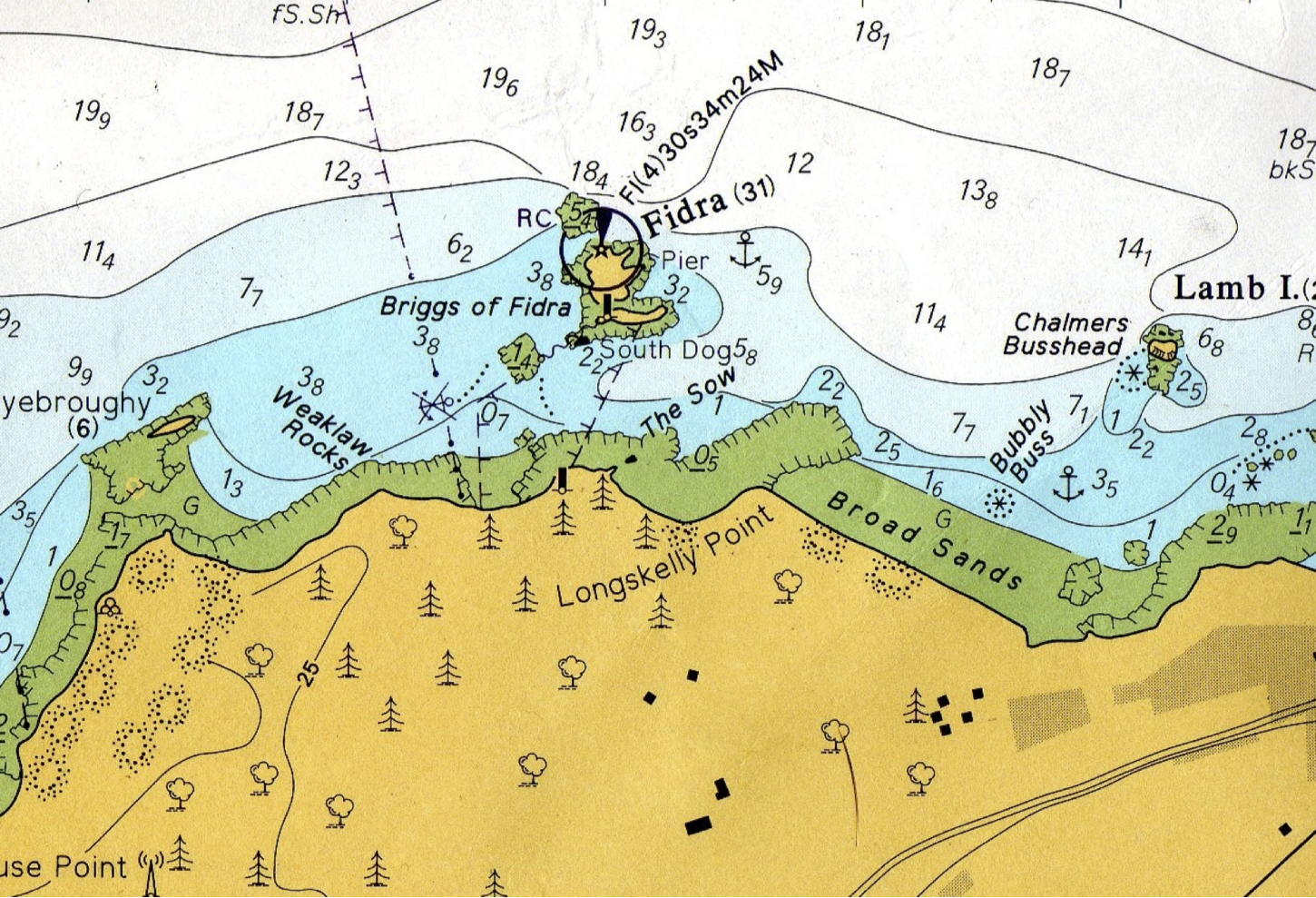
Were the Brigs of Fidra once an actual wooden bridge from the shore? Was there a stave fort atop Castle Tarbet? What other ancient buildings beside the solitary wall remaining of St Nicholas chapel did Fidra have? Then, detouring to the 3,000-ton wreck of Sein Majestäts Kreuzer München just a few miles north, we then visit thousands of guillemots crowded on the Lamb and ponder if there might indeed be treasure that Uri Geller sought when he bought the island and spent the night there in search three years ago.

Admiralty Chart of Eyebroughy tpo Broadsands

Admiralty Chart of Eyebroughy tpo Broadsands

Past the piece of Philadelphia on Broadsands (USS Stockton a.k.a. HMS Ludlow) expended there as a target for shipping strike training Beaufighters out of RAF East Fortune and on to the Bull—closest wreck to NB, lying in 25m of water only 200m to the north of Craiganteuch. Inland of that is the beautiful red/green/ochre seaweed garden off Swinie Craig that leads over boulders to the swaying kelp forests of the Maiden’s Foot and The Sisters where our fishermen are forever finding lobsters.

Out at Craigleith, the seals have finished pupping and there are few other residents besides gulls, shags and cormorants. This is the time of year John Hunt and his ‘mallow bashing’ squads are out there hacking down the Bass Mallow invaders so that puffins can easily get to their burrows to bring up their young next season. As a result, their numbers are up—as are the rabbits who also help by snacking on the seedlings.

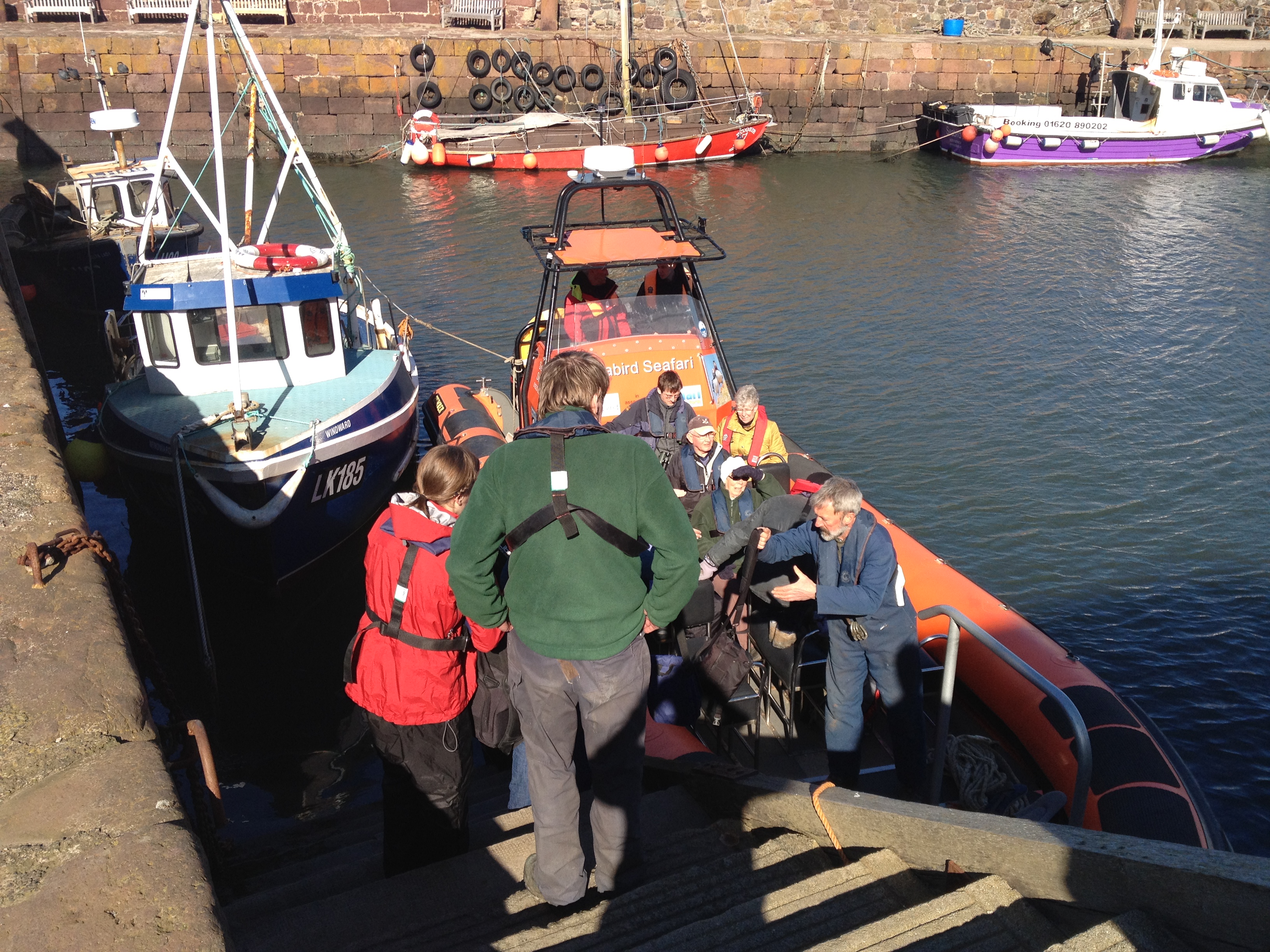
Loading the RIB at the Fish Stairs. The Two Colins at the helm and John Hunt (nearest camera) Main Organiser

Loading Mallow Bashers at the Fish Stairs. John Hunt (nearest camera) Main Organiser

East past the Red Leck, once quarried because its thermal properties make it the perfect over lining there is a wilderness of skerries and kelp to bring you to the long jagged lava flow of the Leithies and the fractured coast beyond where sandy bottoms favour crabs and more kelp makes it another target area for fishermen.

Past the hidden and almost forgotten village of Canty Bay, round Gin Head are the remains of a bustling port beneath the beetling battlements of Tantallon and the smallest harbour in Scotland carved out of the massive red lump of the Gegan. We are now at our favourite secret beach of Seacliff with its acres of curved sand, fine views, caves, ruined 15th and 18th centry mansions andgrey seals hauled out on St Baldred’s Boat.

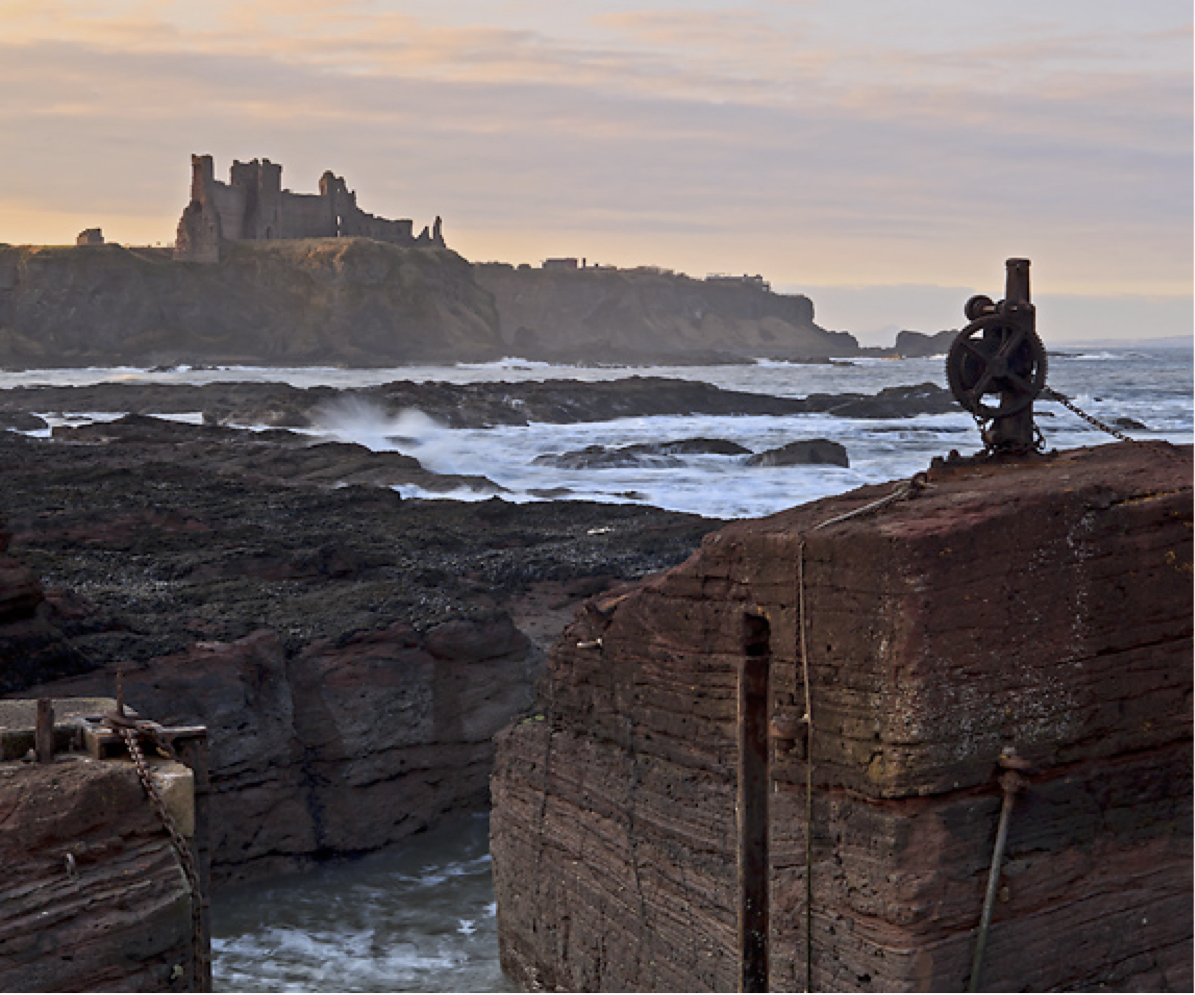
Tantallon Castle from Seacliff Harbour at the Gegan

Tantallon Castle from Seacliff Harbour at the Gegan

Then round into the wreckers’ paradise of Scoughall Rocks—many wrecks from ships turning into the Forth too early or caught against a lee shore by a raw Nor’easterly. Most famous among them is our own Whisky Galore—the Louise, out of Bordeaux bound for Leith with 110 tons of brandy aboard. Driven ashore by a storm in October 1864, would-be rescuers found the shore littered with casks and apparently:

…”were not slow in being acquainted with the fine taste of Cognac. Scores of them sat beside the barrels in a state of helpless toxication. The scene witnessed on the Sunday afternoon on the wreck-strewn beach was utterly disgraceful to the character of the people.”

—Haddingtonshire Courier

After the long and usually deserted beach of Peffer Sands, you round Whitberry Point into the calm of Belhaven Bay, separated from the wide expanse of the beach by the huge sweep of the Tyne entering the sea. Although Aberlady is rightly favoured by birdwatchers, those who find Sandy Hirst and its long empty stretch of shoreline are seldom disappointed.

Posted in Environment | Leave a comment

Beyond the Beach

And, just in time for your last-minute Christmas scramble—a shopping experience much more pleasant than crowded malls lost amidst acres of tarmac…

Posted in Uncategorized | Leave a comment

Home from School

I may need to sit down, take a powder or do something radical: it seems I agree with Jim Murphy—something that has real rarity value. Now, unlike many Labour timeservers, Jim is not someone I dismiss. He packs an impressive array of awareness, shrewd evaluation, populist understanding, machiavellian diplomacy, nuanced articulation and sinewy ambition into an above-average political brain. My problem is I can’t get over an intense personal dislike of the Deus-ex-machina that results.

Nonetheless, the piece in today’s Sunday Hootsmon (aka SoS) announcing his taking on the SNP over education underscores how necessary a leader of his calibre is for Scottish Labour if they are ever to slough off the seven-year sleepwalk-to-oblivion in which they appear doggedly engaged.

Jim is clear, far-reaching and ambitious in his proposals for Scottish schools in particular. He wants to:

  • target the 20% of pupils who achieve the least—wherever they study
  • transform the 20 poorest performing schools into community learning centres
  • encourage parents with literacy issues of their own to learn alongside their children
  • ensure the Chartered Teachers scheme makes a comeback.

And, for me, perhaps the most laudable ambition I have heard from him to date:

“One of the things I am going to make an enormous effort on is the fact that too many kids from working class communities get locked out and it has happened for far too long.”

So far, so positive—gaun yersel’, Jim. But this is not the first time that a shrewd politician on the cusp of an election has thrown out some vibrant ideas as window dressing—without have thought through the feasibility and what it would take to achieve lofty goals.

Now I confess to being one of many who have scorned such lofty Labour pronouncements in the past because, having had 50 years dominating Scottish politics, how come they still preside over kids from Glasgow to Gorgie who underperform worst of all mostly in traditionally Labour-voting areas.

But, seven years of the SNP running the Scottish Government and many councils, we are no further on and Jim is quite right to argue something more radical is needed. And this is the first flaw in his ambition. Although theoretically part of the Labour movement, Scottish teaching unions from EIS on down will object: they are overworked; Curriculum for Excellence is not yet bedded in; teacher numbers are down; etc. It is a Pavlovian reaction they deploy—but it has worked like a charm for decades—especially on Labour. (See “Mining the Chalk Face“)

Take Chartered Teachers. A laudable idea to promote and reward those better suited to the classroom than layers of management, they could have been magnet teachers inspiring the best pupils. Instead it decayed through strict interpretation of McCrone-based clock-watching into a fiscal salary top-up scheme. It was abolished by the SNP two years ago.

A second element that Jim skips lightly over with his inclusion of parents’ role in the social context of failing pupils. Jim is likely to resort to Labour’s eternal solution: more money to alleviate poverty so kids don’t grow up poor and deprived. Problem is that Scots already enjoy £18bn in welfare (£3,600 per head per year) and that’s likely to drop—not rise—with the Smith Commission settlement and/or a Labour government for the UK.

The third—and probably most decisive element entirely absent from Jim’s ideas are what can be learned from elsewhere. The Scots a century ago boasted an egalitarian and effective education system whose superiority has, unfortunately, continued in the minds of pedagogues and union spokespeople into this century.

Over-protectiveness and fears of child abuse tend to make Scots overlook how Swedish toddlers get wrapped up and thrown out into the snow to learn social skills before they ever touch a pencil. Teachers balk at the lower salaries, huge autonomy but sky-high social status that Finnish teachers enjoy (See Long Way to the Finnish Line). Parents, teachers and officials conspire to revere academic exams as the sole measure of education while Germans accord the skilled artisan as much respect as the bookish kid headed towards teaching Greek. Their manufacturing prowess speaks for itself.

But perhaps the worst aspect is that parents—especially middle-class parents—send kids to school as if they were putting the Lexus in for a tune-up. They expect results, yet seldom grasp the active role that they—and all parents—have to play. Unlike any other public facility, the local school is an extension of the home; it is where children will make friends, form their character, learn most and coalesce the journey they will make the reast of their lives.

Any parent who sees it as cheap childcare needs an attitude adjustment before they damage the child they profess to love. They should care about the ethos of the school, take time to know teachers so they will better know their own children and become part of the team that is preparing the next generation to take over the world and shape it once the rest of us are past caring.

Although modern car-based society makes it difficult, the Yoruba saying “It takes a whole village to educate a child” is prescient. Neighbours, shopkeepers, clubs, local police, sports all add to experience, social balance and perspective—which is why private schools should be abolished (or at least taxed) because of the rarified atmosphere the pupils breathe—not just because of their socially divisive nature. They are like the big brother who scorns his sibling’s ineptitude, rather than taking him under his wing.

So, in that sense, school should be an extension of the home—a place where kids feel they are wanted, are acknowledged, feel comfortable. That takes both parent participation and teacher engagement; just marching into a classroom and delivering lectures is what happens at university but has no place in schools. And if the pupil shines only at sports or at wood shop or art or music but can’t ‘get’ logarithms to save his/her life, it is time for the graduate factory to shift gear and hone those gifts they have been given, rather than censure them for not grasping what is (let’s face it) marginal as a life skill.

So, if Jim gets round to thinking that raising the bar for all is great (provided it isn’t always the same ‘identikit’ bar), if he takes on the smug self-referential greed merchants of EIS and most other unions, if he modifies Labour’s narrow, pork-barrel priorities in communities and instead cracks how to inspire deprived kids so they never have deprived kids of their own, who knows what might happen?

I might even get to like the guy. I’d certainly like the kind of Scotland the brave, radical thinking extending these initial steps of his could create.

See also:

Posted in Community, Education | Tagged | Leave a comment

Market, not Manure

The most beautiful, if not the most romantic village in Scotland” is how Sir Walter Scott described the town of Kelso. Indeed, a visit there is always a pleasure; the town is a friendly streetscape of historic building gathered around a spacious square and full of the kind of unique shops that makes Peebles or North Berwick such a popular destination.

Like those towns and many others, it suffers from the inexorable pull of Edinburgh for well paying jobs and counts many commuters in its population. But, unlike other councils around Edinburgh, Scottish Borders is fighting back with an imaginative business complex near the Square, right in the heart of Kelso. Having heard about this initiative, I arranged a visit with East Lothian’s EDU manager and its Economic Development spokesman

Location is in Central Kelso within 100m of the Square

Location is in Central Kelso within 100m of the Square

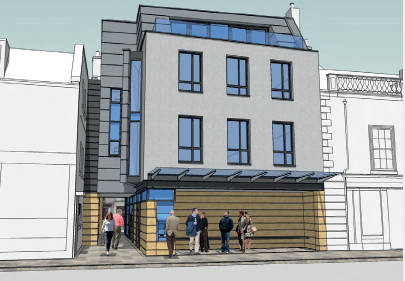
All felt the visit well worthwhile. SBC’s new £800,000 Horsemarket Business Centre incorporates five business units between 44 and 63 sq.m. It was built on the site of decrepit public toilets and the innovative design provides new public toilets and two bus shelters on the ground floor with bright offices offering views of Kelso’s streetscape on three floors above. The centre was funded by SBC, Heritage Lottery Fund and European Regional Development Fund.

All offices have mains electricity, water and drainage and superb heat/noise insulation. Heating is provided by a highly efficient system of solar panels on the roof and an electric air-source heat pump—even in an empty office where heating has never been on it was cosy, despite it being 2deg outside. The arrival of super-fast broadband is expected year. And, despite being so central, parking appears easy because of the number of hidden medium-stay lots near the town centre.

South Aspect from Woodmarket: Bus Shelter below and Unit 5 Balcony above

South Aspect from Woodmarket: Bus Shelter below and Unit 5 Balcony above

We spoke with the first tenant to move in: Border Marketing Company. They had moved from considerably older premises in Galasheils and were delighted with the move. They found the new premises delighted their creative staff and management were now proud to show clients their offices, many of whom found Kelso a more convenient location to meet, with its wide variety of restaurants for lunchtime meetings.

Quite apart from its quality finish and its convenient location, it seems that most small towns who have significant professional commuters would benefit from such a development. Start-up businesses are often launched from second bedrooms and before they grow into medium enterprises able to invest in their own premises, such quality premises allow the entrepreneur to stay local, enjoy the local quality of life 24/7 and especially the shorter commute.

East Lothian Council is now in the process of refurbishing one of its buildings in Brewery Park along similar lines. But it would appear that each of East Lothian’s six towns would each benefit from such a development, especially as the transport links with Edinburgh are easier and the attractions by way of quality food and restaurants at least as good. Providing local SMEs with such facilities would lure many professionals to stay closer to home. This, in turn would cut commuting and provide extra business for local retail and town centre regeneration so vital to keeping communities vibrant.

Posted in Commerce, Community | Tagged | Leave a comment

Changin Scotland

It’s the end of a packed weekend in and around the ever-quirky Ceilidh Place in Ullapool. Therehave been over a dozen previous Changin Scotland get-togethers but this was my first—and, unfortunately, reputed to be the last. There were so many newbies like me that they had to shift the main venue to the nearby Village Hall to accommodate the 80-100 at each session.

Starting Friday evening and running to Sunday lunchtime a series of a nine discources of over an hour each with 2-4 ‘names’ on-stage covered an eclectic range of topics from feminism through the Smith Commission to possibilities in the Arctic. Not all gave speeches and not all who did seemed comfortable doing so. But there was a clear sense (rare, if not unheard-of in political discourse) that all were sincere and none were here purely as a career move.

In the opening session Politics; Cultures; Imaginations, Kathleen Jamie, one of Scotland’s finest poets who deftly exudes a couthy and an international outlook simultaneously and Guardian journalist Madeleine Bunting exchanged views on how Scotland was perceived and how it perceived itself under the astute chairing of BBC Business Correspondent Douglas Fraser.

Intense audience participation over whether Scotland was comfortable in its skin (it was) was relieved by Douglas’ chocolate Labrador—impatient at the back of the room—broke free to join him onstage and spent the rest of the session flat on his back contentedly having his belly rubbed. It was that kind of gathering—intense yet disarmingly informal.

My own response to sessions was mixed: I found the Gender Power Radicals and Leadership xession to be both hectoring and old hat. A lecture about how young men were trapped in male aggression seemed the same antique one-sided feminism that was espoused by Andrea Dworkin 25 years ago and not in tune with the more complex interactions behind modern thinking.

Probably my favourite session was with Lateral North’s obviously nervous Tom Smith, somewhat calmed by able chairing from Andy Wightman. But despite himself, Tom’s articulation and enthusiasm shone through talking about seeing Scotland from a radical geographic perspective—as the threshold of Europe for trade with Asia via the Barents Sea and Orkney becoming an entrepôt, capable of handling 300.000-ton ‘cape size’ container ships too large to access Rotterdam or Hamburg directly.

The liveliest, most audience-interactive session was chaired by Gerry Hassan What Do We Do about Scotland, England and the UK? The main contributor was Adam Tomkins, a Professor of Public Law at Glasgow since 2003 and advisor to the Conservatives on the Smith Commission. Not only did he give insights into why it reported as it did (e.g. why 15% of Welfare was included and Pensions weren’t) but he made a strong case—through reference to other countries—why this was about as powerful a settlement as could be hoped for.

This led to what was, for me, the least enjoyable passage where the audience turned clearly hostile and accused him of a “party political broadcast” as his views clashed with the bulk of those there. I found this unfortunate; I had hoped for a more open and flexible debate, hearing many views but this reminded me of when Labour’s Pat Watters addressed the SNP Councillor Conference and the atmosphere was very much one of Daniel in the lion’s den.

And there lie the limitations of the gathering. While genuinely attempting open and varied debate, Changin Scotland seems to attract almost entirely independence supporters in the older age groups. I was reminded of SNP conferences of the 1990s when numbers were small and many grey hairs present had seen the false dawn of the 1970s and suffered the depredations of the 1980s wilderness.

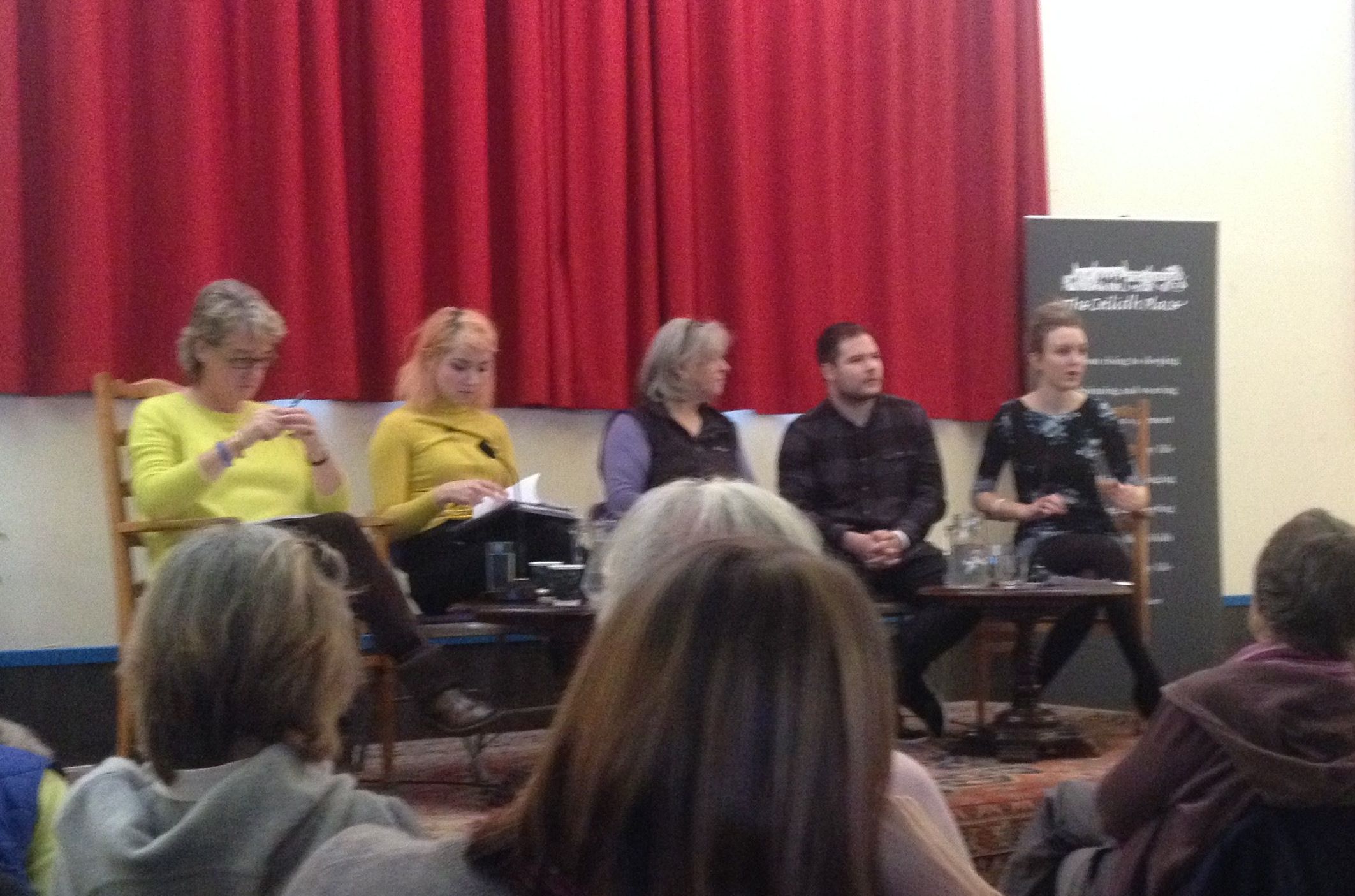
Susan Stewart: Cat Boyd; Kathy Galloway (chair); Ross Colquhoun; Miriam Brett in final session of Changin Scotland

Susan Stewart: Cat Boyd; Kathy Galloway (chair); Ross Colquhoun; Miriam Brett at Changin Scotland

Although the bulk of attendees would probably have been glad for that, in no way did this resemble the razzmatazz of Nicola’s rally in the Hydro last week. It had more content but significantly less buzz and enthusiasm. It also contrasted poorly with last month’s SNP conference in Perth—shot through as that was with young people and wide-eyed enthusiasm of new members; neither element was present here.

But perhaps I expected too much. Under Jean Urquhart’s kindly and embracing stewardship. the Ceilidh Place has always been a quirky corner of unexpected homey comfort—one that old hands rather than firebrands are likely to appreciate. The fact that attending requires both travel and accommodation expense also mitigates against the younger audience readily available in Glasgow or Edinburgh should not permit too much criticism or sombre analysis.

The bottom line is that, for three days and £60, I got to rub shoulders with a panoply of names I have read and admired and was able to discuss my country and its future in a variety of cosy environments scattered around a picturesque Highland village. As memorable weekends go, this one will be hard to beat.

Posted in Politics | Leave a comment

Politics in a New Dimension

For as long anyone could remember, politics in Scotland was an extension of Westminster and British politics; same parties, same policies, same debates. ‘Putting a kilt’ on a story simply meant having a Scottish slant on a miners’ strike or industry investment. Some may have believed things changed in the seventies but Thatcher soon dispelled any such notion.

Then came the 1997 Tory comeuppance that was especially brutal for them in Scotland. Donnie Dewar’s provision of a Scottish Executive shifted the ground under any latent Tory aspiration to preserve a politically seamless union but the party has struggled to recover from the perception of an English-dominated pseudo-colonial attitude. They have yet to adjust to that first seminal shift in Scottish social attitudes.

From a northern poor relative in constant need of fiscal infusion for its ailing industries, the riches of the North Sea took two decades to infuse the Scottish psyche with a cultural renaissance that stretched from cinema (Trainspotting) through theatre (Black Watch), music (Franz Ferdinand), architecture (parliament) industry (renewables) media (BBC Alba) and a varied slew of creative writing from Kelman to MacCall Smith.

That could be considered the first phase. No longer was the ‘cringe’ a topic worth discussing; we had rediscovered our cultural identity—and it was secure enough to embrace the full-tilt self-mocking of Rab C. Nesbitt, Still Game or Billy Connolly. But, although the day the parliament was (in Winnie’s historic words) “reconvened” was full of colour and hope, it struggled for a while to find either its feet or its voice.

That came when the SNP grabbed power by a whisker in 2007 and swept away the many moribund council administrations to whom ‘aye been’ was justification for inertia. The minority administration was bold in its attempt to break fresh ground and were unabashed to do it in a populist manner. Many ‘freebies’, including free personal care, prescriptions, concessionary travel and eye checks were either preserved or implemented and council tax frozen acrtoss the country.

Although habitually criticised by all opposition parties, the SNP stuck to their guns and spent a solid four years proving competent in administration and adept at working with even the Tories to get their budget passed. That proof of competence paid off hadsomely in 2011 when they were swept back into power with an orverall majority and a stunned Labour party found itself with half its experienced team out on their ear while relative unknowns from list places were elected.

It cost Labour leader Iain Gray his job but his replacement Johann Lamont failed to ignite any stirring from what appeared to be a moribund party. It was clear they had lost track of Scots and wandering the political wilderness but this only became highlighted to the aoplitical majority when the SNP and oits allies made all the running in the leadup to the Referendum and that any Better Together initiative that rose above dire threats and warnings came from the Conservatives.

What didn’t help was a spillover from the English parties who are famously reluctant to sit in the same room as one another. Better Together campaigns were run jointly but only so far as what few street activists there were delivered pretty much the same literature. It was obvious to most that they made uneasy bedfellows, with Labout clearly the least comfortable.

A major party of the Better Together campaign was a serious distaste among its supporters—especially those with a Tory bent—tht they were having to deal with this issue at all. Many gave the impression of citizens confronted by a predicted tsunami or earthquake: deep concern lixed with varying levels of terror at their helplessness. Whereas the ‘Yes’ side seemed ebullient and keen to chat with anyone and everyone, there was no such sense from the ‘No’ side beyond a hope this would all just go away.

Decisive though the referendum was and clearly though the ‘Yes’ camp has said they accept the result, the tone of debate in the two months since has taken of in a direction few had forecast. Instead of the ‘losers’ dispersing dejectedly and the ‘winners’ being bouyed into carrying their idead further, the roles appear to have been almost diametrically reversed.

Despite some organised nastiness from ‘No’ extremists in George Square the day after, the debate has not faded but continued in more or less the same good humour that had characterised the run-up. Organisations like Radical Independence, Women for Independence and similar ad-hoc groups—as well as the parties involved—have seen a huge rise in interest and membership and the debate has taken on an even more elevated tone which the former Better Together colleagues seem to have gone back to their old interests on the assumption that the issue was settled and they could just walk away.

But, more than that and without the ‘No’ camp even seeming to recognise it, political debate has changed into something Scotland (and probably the UK and most of Europe) has never really seen before—a kind of evangelical, show-biz approach that would not be out of place in America. Somebody in the SNP—and it’s hard to believe that it’s self-effecing Peter Murrell, their long-standing Chief Executive—has realised the powerful alchemy that showbiz can bring to a campaign on a roll.

The SNP has always been good at staging enlivening conferences. Not only were debates held in public but showcasing good speeches and punctuating with PPBs or inspirational music interludes meant each SNP gathering had a ‘buzz’ that other parties never could replicate. That has been taken several stages further.

To attend Radical Scotland or Women for Independence meetings was to be struck by the amount of ‘fresh blood’ and dearth of ambitious politicos on had. Not only were postures heartfelt but most avoided the standard cliches expected from a conference rostrum as if the gathered faithful were the only ones who mattered.

This was brought to its apogee so far in the Roadshow that filled the new Glasgow Hydro with thousands of people, many of whom were members of no party. It was a night such as Scotland has only ever seen at T in the Park or similar mega-concerts—lots of music, amusement and atmosphere all stoked by a competent compere. While the politics were present, this was more entertainment and positive experience than anything else.

In fact, it may be that the former ‘No’ cumpadres are too deep in relief that they won to register how totally the political grounf is shifting under them. Because, unlike party conferences of old, dominated by a nomenklatura or old hands and officials, this was a born-again rally of mostly young people who had found interest in current affairs and were basking in the opportunity to participate, even as an audience member.

But what an audience. Political parties have been rightly criticised for being worlds unto themselves. What post-referendum Scotland seems to have done is galvanise huge formerly cynical and disengaged segments of the population into participating in a movement. It may not be subtle, there may not be the usual attention to policy details. But it is real, huge and seems to have been capitalised on by the ‘Yes’ camp to the exclusion of the ‘No’.

All three main unionist parties can be accused of sloping off after the deed was done on Sept 18th and regarding the job as done. But with the Tories still speaking largely to their own 15-20% with no traction on the rest and the Lib-Dems hurtling towards sub-5% oblivion, it falls to the Labour party to take up cudgels against the phenomenon. And if they can’t beat ‘em, join ‘em.

Because Labour has relied on inertial loyalty at least one election too often. Once they come out of this debilitating hiatus of a leadership contest, they will have five months to understand how Scotland is now a civic hotbed that long-serving CLP officials are ill-equipped to understand, let alone harness. Not only have they held no rallies like the Hydro but no-one is trying to develop either their version or even their antidote.

And the 55% who voted ‘No’ will approach the May 2015 General Election faced with a choice between parties who have engaged the spirit and soul of Scotland—especially its young people—and those that think plodding inertia and absence of apple-cart-upsetting ideas is their road back to political health.

To deal with this politics in a new dimension, they need to ask themselves how many elastoplasts they think they need to cure a brain hemorrhage.

Posted in Politics | Leave a comment

Silicon Valley’s Culture of Amorality

Unashamedly lifted verbatim from his Nov 23 article in LinkedIn by Tom Foremski, former Financial Times journalist, publisher of Silicon Valley Watcher, and adviser on corporate affairs. For those few readers who may not know, Silicon Valley is shorthand for the fifty miles of world-leading high-tech companies between San Francisco and San Jose in northern California.

Ten years ago in mid 2004 I left the Financial Times and started publishing Silicon Valley Watcher. Silicon Valley was starting to wake from a long downturn from the dotcom deflation and Google’s August IPO was a good sign after several years of bad news.

The culture of Silicon Valley was different then. The software engineering community was more radical than today, and far more socially conscious. The open source software movement was very strong among engineers and there was overall an anti-commercial attitude and a respect for protecting an open commons.

It shared much in spirit with the radical English groups from the mid-seventeeth century such as The Diggers, and also with the The Diggers of the 1960s in San Francisco, who ran free stores and served free food from their kitchens.

The business bible of 2004 was The Cluetrain Manifesto and it came directly from that culture. Here’s an excerpt:

…People of Earth

The sky is open to the stars. Clouds roll over us night and day. Oceans rise and fall. Whatever you may have heard, this is our world, our place to be. Whatever you’ve been told, our flags fly free. Our heart goes on forever. People of Earth, remember.

Google took on Wall Street

Google was very much a part of this radical culture. Its IPO was shocking at the time because it tried to stop the Wall Street bankers and their insiders from profiting from the one-day flips on opening day. Its “Dutch” auction was designed to give small investors the same access to shares as anyone else.

Its passion towards social responsibility was front and center, its “Letter from the Founders” was the first thing you saw in its IPO filing.

A mystery black box…

I was working at the Financial Times when the much anticipated IPO documents were filed with the SEC. Until then, Google was a black box — no one knew how much money it was making. We raced back from lunch to comb through the hundreds of pages of financial statements.

The numbers were fascinating and told an amazing story of how immensely profitable “search” had become. But it was the “Letter from the Founders” that stood out. It was extraordinary, I had never seen anything like it in any IPO filings.

Here was Larry Page and Sergey Brin telling future shareholders that making money was not the prime goal, that building a business that improved the world was their motivation. The founders explained how a dual-share structure, that gave them ten-times the voting rights, was essential to its mission.

Here’s an extract:

Don’t be evil. We believe strongly that in the long term, we will be better served-as shareholders and in all other ways-by a company that does good things for the world even if we forgo some short term gains….

We aspire to make Google an institution that makes the world a better place. . . We are in the process of establishing the Google Foundation. We intend to contribute significant resources to the foundation, including employee time and approximately 1% of Google’s equity and profits in some form.

We hope someday this institution may eclipse Google itself in terms of overall world impact by ambitiously applying innovation and significant resources to the largest of the world’s problems.

Corporate social responsibility

Google became an important thought leader in the burgeoning social corporate responsibility movement, which was kick-started earlier by Salesforce.com founder Marc Benioff.

Corporate Social Responsibility was important because it was important to the software engineering community. It was essential in recruiting the best engineers. A company bus and a company lunch didn’t cut it with that generation of coders.

Today’s Silicon Valley culture is dominated by a peculiar amorality, a narcissism that claims Ayn Rand for its aspirations, even though few have read her books or even their dust jackets.

It’s as if everyone has forgotten, “What the right thing to do is.” And Google has worked hard to play down its “Don’t be evil” rule.

Water is a disruptor

The culture of Silicon Valley today sits somewhere on the autistic spectrum and exhibits the elemental qualities of water. Water will always find its way, it will find the unseen cracks, and find ways through obstacles and even tear them down, as a tiny leak can bring down a mighty dam.

Water is an amazing disruptor in nature — materializing from thin air, it can torrent and push aside mountains, or it can patiently work at opening up tiny cracks in solid stone, freezing and expanding, thawing and flowing.

Water doesn’t need ethics or morality it is a force of nature. It will always find its right level. It’s an appropriate metaphor for Silicon Valley’s culture of amorality. For example, the “Double Irish Dutch sandwich” tax accounting scheme used by (Bermuda based) Google, Apple, and others, to reduce corporate taxes in Europe and the US.

These loopholes in tax laws require extraordinary measures by large teams of accountants and lawyers to exploit, but like water finding its way through obstacles, if the holes are there water will flow through. Or as Eric Schmidt, Google’s Chairman told angry British politicians last year: plug the holes if you want more tax revenues.

This culture of amorality extends to lobbying in Washington where Silicon Valley companies don’t see a problem in giving money to re-elect politicians working against measures to control climate change, or restrict marriage to heterosexual couples.

No win-win…

And the amorality of winning at all costs even when you are winning.

Look at the secret conspiracy by Silicon Valley’s most successful and richest companies, Apple, Google, Intel, Intuit, Adobe, against their own workers, to hold down their salaries and restrict their career moves; Zynga’s admission of nasty revenue scams; Uber’s uber-sleazy growth strategy; Twitter’s demands for tax relief simply for locating its HQ in San Francisco’s poorest neighborhood — an economic burden for the city.

Silicon Valley companies have discovered the simple fact you can have your cake and eat it because there’s always more cake. You can be shitty and behave despicably and never have to eat humble pie because there will always be more cake.

And like water, this culture of amorality doesn’t set out to be evil, but it also doesn’t set out to do good — it sets out to see what it can get away with, what holes it can find to win and keep winning.

Ten years ago Silicon Valley aspired to be more than this

Posted in Commerce | Tagged | Leave a comment

Ten reasons why reducing automobile dependency makes sense

Usually right up there with the Americans as addicted to cars and laying out their cities to accommodate them more than people, the Australians seem to be considering a change of heart. With less space and more problems, why are Scots not ahead of them in integrated transport thinking?

vanndemon's avatarreviewanew

Like many places throughout the world, Australian cities’ transport systems are dominated by the private car. The car has offered unprecedented flexibility and reach in our personal mobility and dominated the form and lifestyles in cities since the mid 20th century. They can be convenient and versatile and fast, and now account for about 90 per cent of the total urban passenger movements (up from around 40 per cent in the late 1940s). In Australia there are about 17m cars. Worldwide, we are up there in terms of cars per capita at around 7 cars for every 10 people.

But over the last two decades or so, we have heard increasing calls for reducing automobile dependency. Like here, and here!

I’m on board with this – it seems to me that a more balanced transport system is the key to the future livability, economic success and social inclusiveness…

View original post 1,133 more words

Posted in Transport | Tagged | Leave a comment