The Price of Everything and The Value of Nothing

“The follies of our youth are, in retrospect, glorious compared to the follies of our old age.” (G.K.Chesterton)

The real question for the Scottish Labout party is: which of these follies is it presently engaged in? Forget the barking mad purge currently going on across the UK in a ludicrous attempt to derail the Corbyn bandwagon.As UK Democratic Audit puts it:

“Ed Milliband’s leadership was characterised by a series of catastrophic mistakes, and the registered supporter model may prove to be the one with the most lasting consequences.”

By contrast, in a well mannered and decisive contest, Kezia Dugdale won the Scottish leadership. She was quick out of the gates with her ‘Front Bench Team’, promising change and that “her front bench would be charged with communicating Labour values, rather than shadowing SNP ministers so their portfolios do not necessarily match opposite numbers in government“.

Not necessarily a bad idea, provided those values connect with the voting public. But Euan McColm had a recent column in the Hootsmon that questions whether people might identify with ‘Equality’ and ‘Opportunity’ as political briefs. McColm was also less than kind in his evaluation of the options she faced, concluding:

“There is a dearth of talent in Labour’s Holyrood ranks. Dugdale had to make do with what she had.”

A second issue that will surely bewilder punters is that she seems to have fallen into the same trap as the UK Tories of appointing a myriad of colleagues to front bench positions—resulting in scrambles for air time and precious little chance of the disinterested public remembering any of them. Whereas the SNP Government’s tally of ministers has swollen to 23, Labour has gone two better and appointed 25 to their front bench.
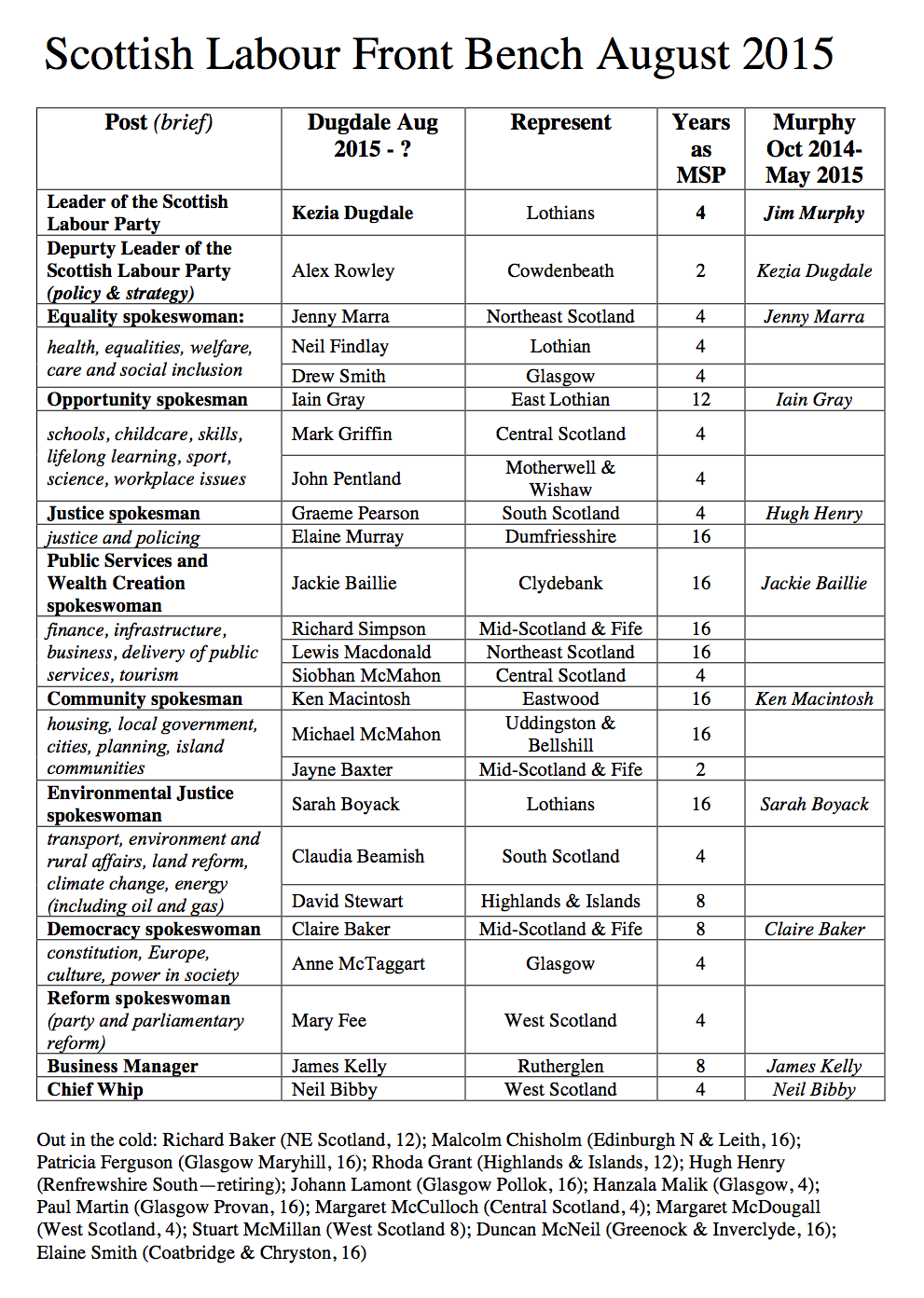
LabShadPicHow that makes the remaining 13 backbenchers feel can only be guessed at. But if that number appears cumbersome, consider the potential for turf wars over the myriad briefs, especially given relative lack of ‘bottom’ or experience in those who are exalted. In her quest to move younger/newer blood into the limelight, Ms Dugdale has built an unwieldy structure that also seems dangerously unbalanced. Several of her key spokespeople have only 4 years experience in parliament— and the whole shooting match barely averages 8. Why Mary Fee’s 4 years as a councillor and twenty-plus as a shop steward qualifies her to steer both party and parliament reform is entirely unclear.

On the other hand, those left out average 12 years experience and include many former ministers, never mind shadow frontbenchers. The absence of the well liked, experienced and capable Malcolm ‘Jessie’ Chisholm is a puzzle all by itself. Certainly, half of them can be seen as ‘The Old Guard’ and excluded from any bid for a fresh start. But we may be in ‘Ready—Shoot—Aim’ territory here. The whole shebang smacks of symbolism.

Building on McColm’c criticism of fuzziness in the briefs, it is hard to see where the ideas and new policies that will restore Labour as a credible government in Scotland. Even the long-experienced members of her shadow cabinet have weak track records of making much of their briefs to date and appear to be in post for the sake of continuity. As an example, Iain Gray had the Education/Opportunity brief under Lamond. Yet he never laid a finger on the urbane Mike Russell, has failed to land any blow—far less unsettle—the less sophisticated Angela Constance and yet this summer had not two ideas to rub together in a speech supposedly lauding the opportunities of new powers being given to Scotland.

And it may be unfair to pick on Iain; his colleagues have been equally duff in coming up with anything new, besides moans about what the SNP has or has not done in eight years of office. Jackie Baillie managed to criticise Vale of Leven hospital in her own constituency for something she inaugurated while she was Health Minister. Sarah Boyack has had Transport since Adam was a boy but, while the SNP moved from EGIP to Borders Rail to A9 improvements to the Forth Crossing, never made a mark of her own and indeed came close to losing a vote of confidence in her work.

All in all, it seems a rum do when Kezia’s promised team of fresh horses turn out to be the same old nags who were still finishing the course when everyone had gone home. It’s a variant on the old seventies TV comedy Never Mind the Quality, Feel the Width. If she thinks by flooding the media with ministers comments she can hoodwink the punters into thinking something new and exciting is happening, her own 4 years of experience outside the student/party bubble have yet to teach her how the >95% non-politicians out there think—and vote.
Posted in Politics | Tagged | 1 Comment

Kan Kezia Kope?

Despite party rules that forbid badmouthing other candidates, the UK Labour leadership contest is descending into mud wrestling. Although it’s hard for outsiders to distinguish many differences among these clone children of New Labour, they themselves insist that distinction exists, if only as negatives. According to the New Statesman, Yvette Cooper’s camp recently spattered their rival for second place with:

“Andy needs to show some leadership and be clear whether he opposes Jeremy or not. Our figures show he will drop out in the second round because his campaign is failing to provide an effective alternative to Jeremy.”

“Old-style bullying by the boys”

To which the Burnham camp accused Cooper of:

“A desperate, panicked stunt since it was completely untrue that she was in second place.”

“Yvette has no chance of winning and is continuing only because of her pride; she should stand down”

Contrast such unedifying rammies with the relative dignity of the Labour leadership contest in Scotland. Congratulations are due Kezia Dugdale, the clear favourite who romped home handsomely with a 72% share on a 60% turnout. Other than promising change and wider internal democracy, she did not offer much new on the policy front. Nonetheless, recognition is due for chutzpah and courage to stand for the leadership of a party that just suffered a worse drubbing on its supposed home turf than even its more fanatical opponents had projected.

Though Scottish Labour is more resilient than recent voting results might indicate, it still takes guts to take the helm when even sympathetic observers see only rough waters ahead.

Although young by any party leadership standards, she has already demonstrated nous in awareness of the scale of the task the job entails and surprised many who had not seen her in action by handling the stand-in-leader position at FMQs with a competence that ranked well, especially when compared with her predecessors: none made any lasting impact. Kezia may be different.

It may seem strange for an unabashedly independence-supporting commentary such as this to speak in positive terms of the one person in any position to rally the somewhat disorganised forces of unionism, but these are strange times. The supposed defeat of the cause of independence a year ago has had exactly the opposite effect. It appears to have opened up the ranks of the SNP to a flood of new recruits, politicised a whole slew of people previously deaf to politics and damaged, possibly irreparably, the hegemony that Labour once enjoyed in most Scottish cities and large towns.

But—referendum aside—this wave of support and positive results for the SNP brings with its power a minefield of dangers; disconnection from its roots; beginnings of hubris; over-tight restriction on policy speculation and debate. Should any of these come to pass, Kezia may find a fair wind with which her predecessors were not blessed.

So far, she has conducted herself well—having a good campaign, being magnanimous in victory and making credible noises about bringing change to an ossified party—a party still full of jobsworths, policy stuck in ‘aye been’ dogma and ranks depleted as those with vision or talent or principle who moved on. For all the media slurs about unelectability, Jeremy Corbin has galvanised the UK party talking tough on clear ideas. Can Kezia do the same?

She has some tough alligators to whack on the snout if she is to clear this particular swamp. Her team reckon up to half of the party’s 39 MSPs are of poor quality and need to be culled at a time when every one of 14 remaining first-past-the-post seats is under threat. One proposal is to re-interview potential List candidates, including incumbents, with a view to weeding out the deadwood. Kezia is quoted as saying:

“I’ve been very clear I want to bring in new talent, new people to the Scottish party, and I’ll be encouraging them to stand next year. I will say more about that in the weeks ahead.”

All very laudable. But in the Miners’ Welfare and CLP rooms of darkest Lanarkshire they have a way of doing things that has changed little down the aeons that involves closed door debate, blind loyalty and Buggins’ Turn. It will take serious political dynamite, together with acceptance that things need to change, to make real progress.

And for someone who wants change, she is not off to a flying start with her cabinet reshuffle. Hugh Henry has been singularly ineffectual in neutralising the Kenny MacAskill bulldozer taken to Procurator Fiscals, the Scottish Court Service, the Scottish Fire Service and local policing, and is stepping down. But the Old Guard of Baillie, Boyack, Gray, Macintosh, Marra etc all stay in post after years marked by endless anti-SNP moaning and little by way of either innovation or inspiration.

It is significant that her ‘biggest’ change has been to appoint Marra as spokesperson for Equalities—something symbolically significant to politicians and their SPADs but without much traction in Carntyne or Lochee. Nothing against Marra who, like Dugdale, carries no baggage from the do-nothing days of 1999-2007 and also shows promise.

But though she may not be able to squeeze ideas—the lifeblood of politics—from these stones with which she has burdened herself, perhaps her promise to infuse the party with new, younger candidates to be elected next May will allow her to cobble together a more dynamic crew further down the line. Meantime, this stinks of don’t-rock-the-boat ossification that has characterised CLPs right across the Central Belt since Tories became irrelevant in the seventies and Labour lapsed into their cosy fantasy that they alone had a right to represent Scotland, especially working-class Scotland.

So, if Kezia is to gee it all up, she must do better then this. Brutal as it may be, she faces the same dilemma that faced the much shrewder, more experienced Jim Murphy: a party grown smug and losing touch with once-loyal base voters. Even if next May is not the gubbing of last May, there is still a long, hard road back to challenge the SNP, let alone Westminster and ‘real’ power. Once turned, voters are not inclined to admit they were wrong and meekly return to the fold; defeat costs leaders their jobs.

Because it would be a shame to lose her. Indeed, Scottish Labour needs more like her as it is not (yet?) blessed with a wealth of upcoming talent. Indeed Scotland needs more like her because the SNP running rings round the opposition (as they are doing) does not make for healthy politics in the long term. And it would be unfortunate if someone showing her signs of future leadership should be thrown into this unforgiving maelstrom of politics a decade early—before she could develop the nous to survive, and maybe even harness, it.

Posted in Politics | Tagged | Leave a comment

Yes, We Must All Think for Ourselves

Monty Python’s Life of Brian is over thirty years old now and therefore probably unknown to younger generations. Pilloried in its day as sacrilegious, its humour has aged far better than its Carry On… predecessors, especially its shrewd observations on political movements and the tides driving them.

Because, like humour, politics is seldom about being sensible. Indeed irrational emotion and gut feelings continue—despite Iain Macwhirter’s best efforts to introduce logic and the ever-present lure of personal gain—to drive the bulk of political activity in Scotland. Seems to apply elsewhere too.

I was reminded of the sheer irrational gusto of the epinonimous Brian’s unwitting elevation to cult messiah when I caught Derek Bateman’s latest piece encouraging robust debate in the wake of the SNP government’s teflon poll performance, despite some recent wobbles. Derek recently sold his soul to become a columnist at the odious Daily Mail, yet his pithy blogs are required reading for us independistas who don’t swallow every ray of sunshine issued by the SNP Jackson’s Close press eyrie.

Derek’s piece makes the case that open debate is healthy, ergo, it’s time we had some around the SNP government. He also—in my opinion wisely—cautions against the prospects of any premature “Indyref2” and predicts that the influx of new members to the SNP will inject an even more radical, more progressive, tone into internal party debates that may not chime so well with the wider public.

He argues, rightly, that the Scottish public has made unprecedented strides in altering its basic political posture within a handful of years and is in no mood to move much further before this new status quo is better digested. As he puts it: “Gie’s a brekk should be the (SNP) conference slogan for Aberdeen.” Be that as it may, that is not what the SNP nomenklatura need to be considering, even if not yet in public.

As a political force, the SNP has had a wild ride. After a false dawn in the 1970’s, the political purgatory they suffered for two dark decades tested every loyalty and shred of thrawn determination among those members who stayed. Joining the SNP pre-1999 was the choice of the idealist. No-one with either nous or political ambition thought the party offered any route towards success, let alone to the top.

There then followed a rise that was both unpredicted and historic. A prostate out-of-touch Tory party and a smug, ossified Labour Party were both bypassed as if they were standing still. Latterly May’s utter rout of the remnants of both continued this unpredicted, stratospheric pattern of SNP progress.

But, while it may be argued that the unionist parties gifted them the opportunity, the SNP did also earn it. Not only did they have the backbone of indefatigable veterans from the dark years but their constant note of hope and progress inspired younger, imaginative, more ambitious phalanxes, culminating in the party growing from 15,000 to over 100,000 members within a year.

To say this was all planned would say too much. But a tight Praetorian group around Salmond held their nerve and, as far as resources would allow, used technology and marketing to exploit an emotional appeal to Scots that we weren’t too wee, too poor, too incompetent to look after ourselves. Even those to whom the SNP and independence were anathema mostly agreed with such tenets, even if they preferred devolution as the answer.

Once the supposed-impossible happened and the SNP ran the country from 2007, many such skeptics were impressed how the new government displayed a vigour that made previous Labour administrations seem listless and cautious. The apolitical majority found the barbarians ran Rome better than the ossified Senate had. In opposing only by criticism with no coherent set of alternative policies, both Labour and Tories set themselves up for succesive trouncings, culminating in this year’s wipeout.

The key to all of this was SNP internal discipline. Unlike other parties where personal ambition jousted with party loyalty, SNP members and ministers alike had come through  hard times together. Like Mao’s colleagues at the end of the Long March, their unity had overcome hardship; they saw cohesion was vital to sustain success.

This was reinforced by budding politicos seeing the SNP for the first time as a plausible vehicle for a successful career. Dozens of new MSPs hired young staff which included many such; this phenomenon grew with the recent equally-large batch of MPs. Few staff, researchers, SPADs, etc have yet made the transition to election (c.f. Ed Balls and his like in Labour) but that’s only a matter of time. Unlike some stroppy old guard, such people are fully aware dissent is not career-enhancing. They shrewdly eschew following either the Dennis Skinners or Dennis Canavans of this world and keep their heads down.

Since the electorate is notoriously brutal about punishing apparently disunited parties, the now legendary discipline of the SNP remains an understandable prority. Former rebels like MacAskill, Blackford and even Salmond himself (albeit long ago) are firmly back in the fold. But the SNP’s problem has evolved. The self-discipline that got them into power is now wavering as they transition from being the rebels to being the Establishment. Personal ambition and natural strains from collective responsibility put pressure on old loyalties. But most still think it better to conform and thus survive, not to innovate.

What has saved the SNP so far has been an effective small cabal who run the show, plus the self-interest of many now in paid positions under their tutelage. This balance has been at the expense of having other power centres; in contrast, Lanarkshire Labour was a law unto itself in its neanderthal attitudes and buggins-turn hierarchies,. The SNP has left their 400+ councillors largely ignored and still without a serious power base.

Such a balance of focussed core vs relatively docile hinterland works well so far. A number of centrist initiatives (MacAskill in the Justice brief, for example) have gone badly off the rails in execution, in part because of clogged or even non-existent feedback channels from the real world. But, because of  obvious electoral success and ever-higher rating in the polls, such peace-through-hegemony looks likely to work at least past next May’s elections to the Scottish Parliament. Most observers expect a result then as decisive for the SNP and humiliating for Labour as that in May.

But rigid passivity for the sake of peace and power is not the SNP’s natural home. The original party was full of iconoclasts and the 80% of the membership that is new in the past year are heavily laced with idealists who saw Tories are right-wing colonials and Labour as Blairite betrayers of the party’s founding principles. They will respect the 20% old guard who preceded them as long as the future appears to lead upwards.

Despite being a broad church from its inception, the bigger variety of opinions about to bubble out of rejuvenated branches is unlikely to reach the agenda at SNP conference. Unionist parties have always stage-managed theirs into harmlessness. as the establishment, the SNP will join them. This may even work for a year or two.

Then, either the SNP leadership must relax discipline and find a way to allow, yet contain, genuine debate or they will confront internal rammies between the People’s Front of Scotland and the Scottish People’s Front as newbies, still full of piss, principle and vinegar, start to make their mark as a fractious idealist majority, if only to dislodge the old guard who will try hanging on to all the decent jobs.

Posted in Uncategorized | Leave a comment

Who’s Kidding Whom?

The fiscal train wreck that is Kids Company has been explained away in the English media as one of a kind, much as its founder and leading light—the larger-than-life Camila Batmanghelidgh—belies any standard concept of a CEO. When the Cabinet Office convened in Downing Street to consider the wreckage, The Guardian reported:

“She appeared out of nowhere, said a few words that no one could hear and then slowly made her way through the photographers to a cab and vanished: a great, big, fruitily dressed fairy godmother who, when you come to think of it, bears not the slightest resemblance to any of the other seven million people on the planet.”

This sense of unreality pervades much of the story. Many people have come forward to praise what Kids Company has done and the Chairman—BBC’s Alan Yentob—is not running for cover. But, whatever good the charity did in fact do, wholesale abandonment of traditional public sector duties to the untried/unexplored world of social enterprise as is now policy both sides of the border has yet to come under adequate scrutiny.

In the case of Kids Company, despite receiving millions of pounds in government funding, it lived hand to mouth, spending almost all its income each year, meaning to never built  any reserves. HM government knew they didn’t have any reserves and so bailed them out when there was grass in the undercarriage. As a result, the trustees got complacent, knowing they would always get bailed out. It received constant injections of funding, including government grants running into millions.

Between 2009 and 2013, its income increased by 77% from £13m to £23m, but in the same period, its outgoings increased by 72%. Meantime, senior management were awarding themselves pay increases. In 2009 the highest salary was under £70,000. By 2013, the top-paid was nudging £100,000, and the next close to £80,000.

This echoes arguments over appropriate executive pay in the public sector where the old saw that “you pay nuts, you get monkeys” has been used repeatedy to ratchet directors and CEOs toward what they might earn in the private sector. This whole area is murkily seedy. High streets are full of charity shops manned by volunteers that compete—often with new goods—with small retailers who have a tough enough time as it is. People are making good careers on the back of it.

No-one objects to paying for a result they value. But last year, 32 charity executives topped £200,000 in earnings. Most people think this outrageous. And who scrutinises such things? Well, in England, it’s the Cabinet Office, who seem overwhelmed by the complexity of this task, dispensing myriad grants in complexities they barely appear to comprehend. There may be a case for combining the Office for Civil Society with the universities and science functions of the business department (DBIS)—and even the Department of Culture, Media and Sport (DCMS) to form a critical mass with a dedicated Secretary of State.

Though the problem may be smaller in Scotland, because of our more ‘progressive’ politics, there is even more enthusiasm both for social conscience and social enterprise as a way to execute it. The Scottish Government supports several umbrella organisations and provides some £8m in direct funding through their Scottish Investment, Enterprise Growth and Social Entrepreneurs Funds. But that’s the tip of the iceberg. Another £200m+ is dispensed over seven years by the European ERDF and ESF. These funds are ostensibly overseen by a committee of fifteen sundry worthies. But they meet only four times a year and that to rubberstamp what Sir Humphrey places before them. Chip in lottery funding and elements of SE, Sports Scotland, HS, NTS, etc and numbers are big and growing, despite recession/recovery.

All this is not to imply that Scottish social enterprise is rife with snouts in the public trough. But, given the wide public’s good natured support here for good causes—whether it be the homeless, the vulnerable, the poor, children, pets, wildlife, nature—the social enterprise sector providing more and more of such services does demand a scrutiny beyond benight neglect that assumes everyone is doing their best and demanding least in each of the undoubtedly good causes.

But the road to hell is paved with good intentions. As much as the private or public sectors, so the social sector needs hard-nosed management if funds are to be used effectively. In 2009 Kids Company cared for 14,000 children but this rose to 36,000 in four years, which required weekly full-time employees to increase from 231 to 495. But, since costs for youth workers, therapists, practice teachers and special project workers only increased 26% over the same period. Ergo, most of the 77% increase in income did not reach where the work was done.

This is not a prediction that Scotland (or another 36,000 kids) will experience such disruption to vital services. But, unless someone with clout wakes up and gets a handle on this sector, a combination of gravy train greed and well meaning incompetence, a similar derailment may not be avoidable. OSCR now oversees (but does not scrutinise) something like £20bn in third sector business across Scotland. That’s 2/3rds of Scottish Government’s entire budget.

Who’s watching how well it is spent?

Posted in Commerce | Leave a comment

Eastern Promise

The character of many small fishing ports around the Forth is stopped from falling into the soporific boredom of marinas like Port Edgar by the remaining fishing boats that still ply their trade. Though oysters may be a thing of the past and deep sea fishing goes on only from Pittenweem and Eyemouth, the backbone of the remaining ports—especially those in East Lothian, is landing lobsters.

But, unlike other major producers like Maine in the States, the business here is pretty ramshackle. Until recently, virtually all East Lothian lobsters were sold wholesale to Eyemouth dealers who would ship them to Spain for consumption by the tourists—many of them Scottish. Prices were low, crabs had no market and, with weather unpredictable and overheads  growing, it was becoming a marginal way of making a living. Several old hands passed away, some younger ones found better money on a steady wage and few school leavers saw the fishing as any kind of future.

All this may have the sound of fatalistic finality for the lifeblood of small ports around the Forth but it need not be so. Maine lobstermen had already shown how a good business can be made by controlling both who can fish where and the distribution channel. Their Homarus americanus is very similar to our Homarus gammarus, but with larger claws. But their real secret is to make them available: a half kilo live lobster in carry-on container is available at Boston’s Logan airport for $60 (£40).

So, though the life may be equally hardy, lobstermen make a far better living in Maine than they do around the Forth, where most are hostile to their fellow fishermen and much ill-will comes from fleets of creels being shot indiscriminately in waters other think are theirs. It’s a little like a farmer driving a combine down a country road and harvesting whichever field takes his fancy.

The people who have improved the local lobstermen’s lot have not been fishermen themselves. From a small start with the Lobster Shack on the harbour-side in North Berwick, this has expanded to include the nearby Rocketeer and a branch on George Street, as well as other restaurants starting to offer lobster on their menu. Moving their fresh catch this way means they effectively earn double for the same amount of work.

The other boost is a long-term one where the Lobster Hatchery takes berried hens (female lobsters with fertilised eggs serried under their tail) which normally must be thrown back, removes the eggs for hatching and returns the now salable lobster to the fisherman. The eggs are hatched, developed as larvae and then released onto local lobster grounds as 1″-size mini-lobsters which have 1,000%+ greater chance of surviving to maturity than an egg. In 6-8 years they will mature to boost yield from the areas where they were released.

But all of this still doesn’t keep pace with what the Maine lobstermen are up to now. Back in 2009, they tried exporting to the growing Chinese middle class, to whom a steamed, whole crustacean — flown in live from the United States — is not just a festive delicacy and a good-luck symbol but also a mark of prosperity. They managed to add $2m to their business. While that is impressive, last year they had boosted it to $90m and their lobsters were retailing for $50-$100, still expensive, but more affordable than the previously dominant Australian rock lobster (Panulirus cygnus), which can cost hundreds of dollars and doesn’t have the big meaty claws of the American variety.

China took about 12% of U.S. lobster exports in 2014, up from 0.6 percent in 2009. Lobsters and other foods seen as luxuries are popular at Lunar New Year and other festive occasions. The bright red of a cooked lobster is considered lucky, as is its resemblance to a dragon. The boom has put more money in the pockets of lobstermen and kept shippers and processors busy during the usually slack midwinter months. China also imports lobsters from Canada, Australia, South Africa, the Caribbean and elsewhere, but the market for the U.S. variety is exploding, with the demand strong year-round, not just at New Year’s. There are now 144 boats operating in Maine. Why are we Scots not in on this booming business?

There are a variety of reasons. First of all, the Scottish Government’s so-called business arm Scottish Enterprise are a chocolate teapot when it comes to sticking their neck out to exploit opportunity with their £400m annual budget. Despite Scotland £1.1bn food and drink export business, lobsters get no mention on their website. Secondly, the Scottish Fishermen’s Federation spends most of its time fighting for the deep-sea fishermen that dominate it and their Inshore Committee seems happy just to haud the jaikets in the occasional dispute. Thirdly, smaller organisations like the Forth Estuary Forum could be called ineffectual toothless talking shops—if that were not an insult to ineffectual toothless talking shops around the world.

But, mostly, the reason lies with the absence of any organisation prepared to define what is needed and then campaign to assemble the coherent lobby and marketing support that Maine lobstermen enjoy. Individual ports and even councils are too small and preoccupied with other things. The most experienced fishermen are comfortable in their ways and not enough newbies are coming in with an eye on a more profitable future.

But, if someone were to pull together effective local fishermens’ associations, allocate them so-called ‘Several Orders’ to take certain species from certain areas and cobble together a marketing channel to compete with Maine (coastline = 3,478 miles) in the still-booming Chinese market, Scotland (coastline 10,250 miles) could become a world-class player in lobsters and our young people would flood back into a lucrative business (tough though it is) that might pay well over £250 a day for hauling a fleet of 50 creels.

Posted in Uncategorized | Leave a comment

Local Tax Overhaul Overdue

After some serious consideration almost eight years ago, the Scottish Government has swept the whole concept of handing democratic control to localities through local taxation (as opposed to the regressive Council Tax) onto the back burner indefinitely. While a minority government has the plausible excuse that it has to pick its fights carefully and not court controversy, that has not applied since May 2012 and is unlikely to alter come May 2016 (any more than the flavour of government).

So, presuming the probability of SNP rule until at least 2020, the next five years offer a real opportunity to revamp the effectiveness of local government from the halfway-house carved up by the Tories in a failed gerrymander 20 years ago to try to prop up some Tory councils somewhere. But before the huge task of rethinking councils appropriate for the democracy of the 21st century, much could be done to fix the clumsy unfair regressive manner in which Council Tax is levied, especially as the Scottish Government has increased its leverage and control over this area by freezing it for the last eight years.

As a first step, the Scottish Government has collaborated with CoSLA to create the Commission on Local Tax Reform (CLTR), although one main party has chosen to absent itself from the debate. A submission to this has been made on behalf of the Centre for Scottish Public Policy (CSPP) by Professor Richard Kerley, Chair of the Centre. We think it makes eminent sense and reproduce it below in full, encouraging readers to both consider it and any amendments they might make as their own submissions.

(CSPP Submission follows)

We are covering a range of matters here, and have not confined our comments to just a consideration of the approximately 18-20% of council income that is covered by the council tax, i.e. in gross terms only a little under £2bn last year compared to a total local government revenue spend much greater than that.

A major theme of the work of the CSPP, and a statement we often use, is to stress the importance of ‘people and place ‘. There are clearly many ways of interpreting this phrase, but central to this theme is that for us great emphasis should be given to people determining what is, in their views, appropriate for their place—whether that place is the UK, Scotland, a given council area, or a community within that council area. Of course all of that has to be set in the context of shared rights, and the responsibilities we believe we all share to ensure equitable treatment of all peoples regardless of where they live.

  • For us, this is an argument for a default assumption that specific competences and decisions – e.g. on local tax levels, should be made as locally as possible. Local government data already shows that assessment of Scotland-wide per capita spend [excluding the Islands] ranges between a little over £2000 to a little over £3000. Such a variation on spend should logically be matched by a variation on local tax raising.This is why we consider the current system of council tax, particularly with the current ‘freeze’ that will have been in place for 8 years by the next election, to be a flawed system.
    The standstill on council tax levels is regressive, not providing material advantage to the lowest income households, and also infantilises local authorities and those who elect them by denying them options of specifically increasing local taxes to support proposed initiatives and expenditure.
  • It seems very limiting for the review to confine itself only to Council Tax, particularly when the Chancellor in England has initiated a review of Non Domestic Rates (NDR). Previous Scottish governments have followed NDR policies from England closely, and there are clear reference points here for the many multi-site businesses that operate across the UK; if this is not reviewed in Scotland there is a clear risk of the government being caught on the hop by an announcement in England.We would urge the government to review NDR reach by, for example, ending agricultural and rural estate de-rating along with the de-rating for various other subjects that are category exempt from NDR.

    We would also urge the government to re-localise NDR and enable councils to make choices on NDR that they consider appropriate to their areas, with a legislative requirement to consult with all representative business of organisations on proposed budget changes that impact on NDR.
    If this were to happen then both CT and NDR, along with local fees and charges would approximate to some 60 % of local council spend and eco the kind of revenue raising financial balance likely to emerge  from the current Scotland Bill .

  • Aspects of the Council Tax itself are flawed: this partly arises from the artificially created multipliers built into the original scheme; the failure to revalue since 1991, and the constrained banding. It also arises from the hybrid nature of the tax: it is partially a charge for services (hence the discount for 2nd homes and the reduction for solo occupancy); partially a property tax; and partially income contingent (the rebate scheme).We do favour a form of tax that relates to property. Property is the most substantial real asset most people own or enjoy and it would seem odd to have tax on it at all.
    In the longer term we think there is a lot to be said for discussion about land value taxation, or a form of domestic property taxation based on capital values and annual percentage levies (a la Burt Report).

    That may be too ambitious for agreement now, so  in the meantime various changes could  be made to the CT. For instance:

  • Revaluation in the near future – and the creation of a formalised mandatory quinquennial review of domestic subject values to prevent future governments avoiding this sensible necessity.
  • The extension of bands above H, and the precise number of bands, would depend upon the nature of the revaluation.  One more band is not enough; while there may be little sympathy or people owning properties valued in excess of, say £1M, it would be equally as inequitable to lump them in with £5M + properties.
  • The removal of the single person discount.
  • The removal of discount for 2nd homes.

Revaluation and therefore possible re-banding of improved or extended properties should be triggered on the issue of a completion certificate for building works, not – as at present – on future resale. Particularly in the period since 2008—according to press reports and trade reports—there is a large backlog of extended properties that may not yet have been re-sold and hence revalued.

4] We also recommend a programme of public education and reference to experience in, say Wales, in relation to any suggested changes in banding and valuation. There appears to be a broadly held view that both equate to a massive increase in local taxation and the Welsh experience has shown that this is not the case.

Posted in Community | Tagged | 2 Comments

Open Letter to Fergus Ewing

Dear Fergus:

my congratulations for having held the Tourism portfolio for the last four years. That is quite a record in terms of stability in the slippery world of politics. However, I have to ask what you believe you have actually achieved in that time that would not have happened entirely by itself.

This week’s choice of meeting venue for the annual Scottish Tourism Alliance (STA) midsummer conference of Cumbernauld—the ‘Carbuncle of Scotland’ and symbol of how wrong town planning can get—might be seen as a metaphor for the ill-conceived nature of current tourism planning in Scotland. I recognise that the STA is not under your control but such cack-handed thinking is representative of the parts that are.

It starts with VisitScotland, your main quango and executive arm. VS appears more keen on behaving like a corporate cash cow than a promotion and support operation. From a symbolically remote eyrie down in the docks, it presides over a wheen of meetings, strategies and bumf production but seems to have scant understanding of the experience of the average tourist and, more especially, their needs. They have distanced themselves further from their ‘customers’ by closing many TICs because of ‘falling footfall’.

It is obvious that VS never stopped to analyse why that footfall declined when visitor numbers were rising. Apart from selling kitsch like Loch Ness Monster soft toys from Kirkcudbight to Kirkwall and plugging only those B&B signed up to pay VS fees, they became staffed with warm bodies with scant knowledge of the areas served. Their usage fell because of an obvious programme to kill them off, ostensibly because “everyone uses the internet nowadays”. Simplistic and flat wrong—as wrong as last decade’s push to have all B&B’s en suite, which has ruined many a quaint cottage bedroom to satisfy VS’ box-ticking fetish.

The second problem is that VS has body-swerved local tourism to make it a council problem. Even if councils had the necessary business attitudes, VS has abdicated all responsibility in co-ordinating key tools and templates so that each of the 32 councils reinvents their own tourism wheel with mixed results (CoSLA being no more than a talking shop). But they do so on declining budgets as their secure education and social budgets that are 3/4 of their outlay. But no councillor gets elected on his/her vision of tourism.

As a result, council Economic Development budgets are often under £1m and so struggle to print local leaflets, let alone co-ordinate/exploit and distribute benefits from major tourism markets such as Edinburgh. A Golf Officer here and a User Group there result in small-scale projects but nothing lasting, still less strategic.

More importantly, councils have yet to understand ‘customers’ or break out of departmental ‘silo’ mentality. For example, Planning treats all applications with the same ‘objectivity’. This means running scared of developers and indifference to future tourism needs. Hotels and B&Bs are lost as profitable housing—even if it is never the affordable housing that the country needs. Per-day spend by tourists plummets as a result.

Transportation in councils is another case. They remain in the dark ages when it comes to through-ticketing and organise supported bus networks as if it were still the 1980s when ploughmen’s wives had to get into town to do the shopping. Not only are there no tourist-oriented services linking with trains (even seasonal) but any information provided is patchy. If there are any timetables at a stop, they are by different companies and show timing points that are seldom tourist destinations like castles or museums. Local buses often run school services through school holidays when they could run a tourist service. The concept of a day ticket for use on all transport (as most of our European visitors expect) is still alien.

At the STA meeting, tourism chiefs complained of “problems with tax levied on tourism experiences, air passenger duty, high fuel prices, poor digital connectivity and difficulties recruiting skilled workers.” I’m sure all that is true. But, at a more basic level, nobody is addressing the need for a professionalism in hospitality as a cultural issue. The number of cafes, restaurants, bars, etc staffed by young girls with no training, yet who provide a major interaction experience with visitors is appalling. Even in the States, service is rewarded and waiters/bartenders/etc have an enlightened attitude to pleasing the customer. We still suffer from the clock-watching teen who’d rather yak with her friend in public view. Some of the worst examples vampire on key destinations, living by inertia: try getting a decent lunch in the three hotels at Dunvegan, Skye. Yet the (un-signposted) Three Chimneys is just down the road.

Marc Crothall, STA Chief Executive said “Scotland faces barriers to ensure that visitors  see it as first choice for a high-quality, value for money and memorable customer experience”. We have had eight years of such high-minded guff and it has largely been down to innovative chefs and pioneering hosts to provide progress to overcome those barriers. My own North Berwick now has a flourishing local restaurant market for locally-landed lobster and crab. It was generated by local businesses prepared to take risks; both VS and the local council were useless in either developing or supporting the idea. Indeed, Planning did their best to obstruct using a derelict historic building as a site.

We are all still living on the fact that Scotland has a global profile that any other nation (not just a small one) would give its eye teeth to have. The experience that will bring visitors back is not what draws people to Lanzarote or Phuket. We are not about sun-drenched packages where geography is almost immaterial. Scotland must be as modern and welcoming in its hospitality as anywhere else—global standards now demand it. But charging cruise ship visitors who’ve just been schlepped to the shoddy Hawes Pier $1,000 for a day tour of Edinburgh is not the way to demonstrate that.

Our appeal is based on evocative scenery and ancient stonework but this must be presented with style and warmth. The real attraction of our golf courses—shabby by comparison with Atlanta or Dubai—is the gritty challenge of authentic links courses that you can’t fabricate elsewhere. Access to the character of the Scots, the sense that we welcome them, talk to them in a language most understand, make personal contact is something Lanzarote or Phuket can’t offer. Providing a modern service against a backdrop of historic beauty will bring them and their cousins back again and again.

VS is a chocolate teapot. If you think that’s overly harsh, consider some facts:

  1. VS gross spend has gone from £58.1m to £63.6m in the last two years. That’s a 10% boost when everyone else’s budget is being cut.
  2. Last year Grant in Aid (i.e. SG funding from public money) to VS increased from £45.3m to £47.7m, an increase of over 5% in just a year.
  3. The £4.7bn increase in tourist spend in 2014 celebrated by VS and STA was entirely driven by one-off events such as the Commonwealth Games and the Ryder Cup.
  4. On VS’s (and your own ministerial) watch, overnight tourism stays in Scotland—a clear measure of serious tourism expenditure—have declined steadily from 17m to under 15m. That is a drop on 13% on VS’s own figures.
  5. VS paid over £1m in ‘severance packages’ last year, half of which went to 6 senior staff.

This is YOUR baby, Fergus; the buck has stopped at your door for 50 months now—and counting. Is your VS really fit for purpose? Do you expect Scotland to coast past  another decade of opportunity with a money-grubbing VS and councils’ internecine pen-pushers as our tourism ‘spearhead’ when they are as sharp as stale porage?

Or is it not high time this costly, ossified, self-serving quangocracy got its jotters and you earned your £86,300 paycheck in sorting this out?

Posted in Commerce | Tagged | Leave a comment

Dominorum

Schools don’t teach much Latin these days. Despite The Iris Project – Literacy Through Latin, launched two years ago its teaching is pretty much confined to independent (i.e. private, or in England, public) schools. This makes them appear archaic. State schools meanwhile are launching our kids into the future by teaching ‘modern’ subjects, right?

Not quite. Although proportionally significant only in Edinburgh, private schools in Scotland are pretty smug about their ability to educate ‘leaders of the future’. And basic SQA exam statistics would appear to bear them out. Of the 660,000 pupils in Scottish schools, only 31,000 (under 5%) attend private schools. Yet, according to Ms Dorothy MacGinty, Headmistress of Kilgraston School:

“Students in independent schools are three times more likely to gain A and A* grades at A-level than their state-educated peers. In girls’ education, the figures are even more stark: only one in 20 girls taking A-levels study at independent schools; yet one in four of the A* grades awarded in STEM subjects goes to them.”

Ms McGinty is fulsome in her praise of the advantages of independent schools; the Friends of the Scotsman have given her a half-page platform in today’s Scotsman to expand on the above, which she does with great enthusiasm. Recently returned from England where the ‘public’ school is alive and well, she attributes a recent 4.3% rise in pupil numbers to Michael Gove’s policies. as he puts it: “With Academy Schools and Free Schools springing up to blaze a trail in uncharted territory, parents are not willing to leave their child’s education to chance.

Though many may share her antipathy towards Gove, she just said a mouthful. The implication is that, unless you can fork out double minimum wage per sprog, your children’s education is likely to suffer. That’s bad enough in England but, in Scotland which has long had pride in its education, that cannot go unchallenged.

Certainly, regular readers of this blog will know that it has little time for the EIS and the manner in which all education unions constantly harps on teacher pay and conditions but appears to care little for the fate of children that should be their focus. As a result, state schools remain afflicted by a minority of clock watchers, sea lawyers, time servers and dead wood whose days might be more fruitfully spent on their vegetable patch and not in the classroom. Private schools tolerate few such passengers.

But that ignores the bulk of motivated professional teachers who seek to inspire their charges and are constantly finding ways to engage with young minds to inspire them with worlds they can inhabit beyond Hollyoaks, Farmville or Game of Thrones. Private schools ensure they don’t always get to teach the best pupils. The flaw in McGinty’s thinking is to think that, by throwing money at education, you can guarantee a good one. There are many reasons she—and those parents who think they can buy their kid a successful career—are wrong. Here are six of the best

  1. It’s been tried before. The USA is rife with a class system in a culture that claims to be classless. ‘Prep Schools’ are no longer confined to the East Coast. Attendance at them and the odd endowment from parents guarantees places at Ivy League universities, which in turn pretty much guarantee good jobs in law firms and large corporations. But the massive waste of talent for 9 in 10 families unable to afford horrendous fees involved means the US still relies on trained immigrants for much of its science and engineering prowess. Silicon Valley is half-staffed by Asians.
  2. Almost all private schools in Scotland ape public schools in England in training for the professions. By that, they mean lawyers, doctors, diplomats, financiers, high-ranking civil servants. They do NOT mean engineers, scientists, craftsmen, creatives and certainly not anything smacking of sweaty toil like joiners or masons. Although once the privately educated might have dedicated their lives to selfless work in the colonies, today, it’s about getting into a highest-paying professions.
  3. This, in turn, skews the whole attitude in Scottish education to think that the academic is the only field that really matters in education. There is no such thing as a private school for mechanics. Yet Germans value skilled workers on a par with professionals and there is no implied social inferiority. As a result, British engineering has retreated to a few specialties while Germans export their handiwork throughout the world.
  4. Private schools believe the Curriculum for Excellence is catching up with what has always been ‘their’ philosophy: “commitment to developing successful learners, confident individuals, responsible citizens and effective contributors.” But there is much more to it than that. Even if Scotland does not fly the Old School Tie quite as blatantly as England, the small size of the Scottish ‘village’ means it is no co-incidence that a similar proportion of QCs, board members, CEOs, mandarins, etc here went to private schools as happens in darkest Home Counties.
  5. The sheer inequality of levying fees and the paucity of bursaries means a rich elite have an inside track to semi-exclusive training grounds for ‘movers and shakers’ and all that state education has tried, private schools’ small classes, incentivised teachers, ambitious parents and brutally competitive culture continue to make them a bastion of privilege. Bursaries are rarely given at primary school level so the privileged few have all the advantages before the less well off have a chance of attending.
  6. For that reason, how private schools have charitable status under OSCR is a mystery. Their fees verge on the outrageous. Starting with Fettes at £30k, the rest of the ‘top ten’ are all over £20k and even day pupils save barely £6k on such sums. Were that all, most families would be struggling. But add in uniform, sports kit, activities, trips, clubs, etc and the bills are more than most earn, let alone can afford.

It is clear that the Scottish elite look after their own. Private education is so integral to their identity that all threats have been quietly seen off. But the average state school pupil suffers as a result. If the best and brightest are constantly creamed off into the 21st century answer to a Spartan Military College, they are not there to inspire and compete with their peers. Instead, they become inculcated in the same culture that did so much to ossify and damage Scottish manufacturing after the war, leading to rust-belt disasters from which we are still recovering like UCS or Linwood or Kinlochleven or Ravenscraig.

It’s time Scots bit the bullet and treated private schools like the businesses they are and exposed the sham of their perceived advantage by taking education in a direction in which most advanced North European nations have already gone: treating academia as just one of many career paths, not all of which are defined by exams and league tables. Engaging parents in their share of bringing up their own kids as assiduously as private school parents treat their own ‘investments’ would give most—not 5% of—pupils the ‘private boost’.

Posted in Education | Leave a comment

More Than a Dormitory

Life is good in East Lothian. It rightly prides itself on its attractive towns, pristine countryside, glorious coast and golf galore, Together with good schools and easy access to Edinburgh, that makes it a magnet for commuters and retirees. Unfortunately, that does little for the local economy and jobs. To date, the county has been smart enough to avoid spoiling its splendour with factory development but has so far failed to exploit an opportunity to prosper that relies on keeping things pristine and presentable: tourism

It already boasts a national name in golf and in day trips from across Central Scotland. And, as home to the award-winning Scottish Seabird Centre world-famous Bass Rock and Scottish Ornithologists’ Club, has a growing profile as a wildlife destination, especially for ‘twitchers’. But the bulk of high earners still do their earnings elsewhere—county GDP per head is no better than Turkey. Add in a myopic VisitScotland closing all three of our Tourist Information Centres and tourism growth is sluggish.

The most obvious next step would be for East Lothian to work closer with Edinburgh—the biggest tourist destination in Britain outside London—by broadening Edinburgh’s portfolio of appeal. But there is one barnstorming opportunity to put the county on the global tourist map they simply won’t support because they already make a killing from it; cruise liners.

In the last decade, despite recession, the global cruise business has gone through the roof. Forget your experience on the cross-Channel ferry, these ships represent the future. Kirkwall in Orkney was one of the first Scottish towns to exploit this business. A recent survey there showed, of the two dozen ships calling, 94% of passengers went ashore, each spending an average of £100 while there.

A typical modern liner (Royal Princess which moored off Queensferry on May 18th) has 3,500 passengers on board. That gives a one-day boost of more than £1/3m to the local economy. These ships are now so big Leith cannot accommodate them. Yet there will be no fewer than 36 such behemoths calling this summer. This represents a £12m boost to local revenues from passengers alone.

So far, Forth Ports has been adept at making money but not in sticking its fiscal neck out to invest in the future. Landing in the rain from bouncy little boats at Hawes Pier is not the five-star experience to which cruise passengers are accustomed. The only serious marine study was the £3/4m project in 2008 for ferry services across to Fife and that came to nothing.

But Napier University has put its thinking cap on and has an unpublished proposal for the already derelict Cockenzie pwer station site. where a deepwater pier out into the Forth could transform the only ugly part of the East Lothian coast using the existing rail branch that served the coal yards. Add a proper passenger terminal able to handle ferry as well as cruise passengers and you would have a dynamic business core to which Ocean Terminal style facilities, yacht marina, boardwalk and restaurants could be added.

With a weather-secure rail link into Waverley, cruise passengers could be whisked into town in 15 minutes (and ferry passengers out)—rather than endure the inadequate 90-minute-long lighter-plus-bus solution via Queensferry.

The knock-on boost to the local economy could be massive, with chandlery, catering, engineering, and other high-value facilities required. And with stylish redevelopment of not just the Cockenzie industrial dinosaur but both Prestonpans and Cockenzie waterfronts, all could prosper with copious jobs and revenues by bodily shifting the start of East Lothian’s attractive recreational coast seven miles closer to Edinburgh to start at Musselburgh Racetrack instead of Seton Sands.

It is exactly the engine needed to restore pride, purpose and prosperity to the county’s ex-mining region and contribute its proportionate share of the dynamic economy of Edinburgh’s city region without spoiling what makes it unique in the first place. But is anyone thinking big enough to realise it?

Posted in Commerce | Tagged | 5 Comments

Jockalypse Now

Two weeks ago a tsunami of revolt against London unionist parties felled the two remaining in Scotland bringing them down to the same risible level of 1 solitary MP at which the Tories have been languishing since devolution was introduced 16 years ago. The phalanx of 56 SNP MPs have been making waves by not meekly following ancient Westminster conventions like where to sit in the chamber or in the Commons dining room. The Establishment is quite put out about it.

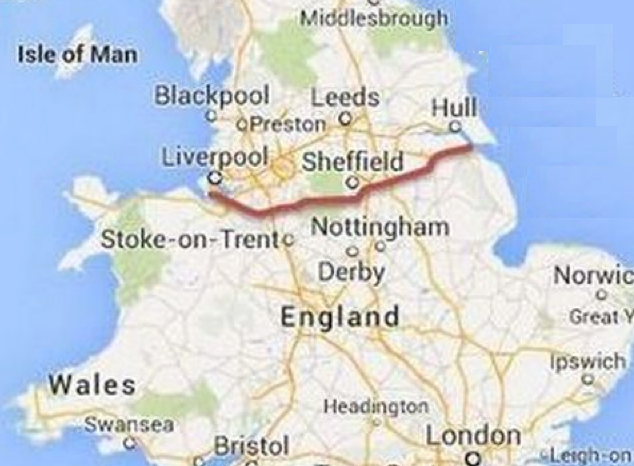
But, as if that weren’t enough, last week the Manchester Evening News revealed that a petition was going the rounds to take the North out of England and attach it to Scotland, with which it appears to have much more in common, socially and culturally than the London-dominated Home Counties. The scheme proposed is shown below.

Proposed New England/Scotland Border

Proposed New England/Scotland Border

Far more radical than a return of Berwick to Scotland—or even a restoration of Malcolm’s border on the Eden and Tyne—if this happened it would bifurcate Britain; England would no longer dominate. It would involve all the big cities of the North and the counties of Cumbria, Northumberland, Tyne & Wear, Durham, Cleveland, all four Yorkshires, Manchester, Lancashire, Merseyside and Chester—half the ten biggest English counties, even giving Scotland a border with Wales.

Using the hashtag #TakeUsWithYouScotland, the call appears to have originated in Sheffield. The petition says:

“The deliberations in Westminster are becoming increasingly irrelevant to the north of England. The northern cities feel far greater affinity with their Scottish counterparts such as Glasgow and Edinburgh than with the ideologies of the London-centric south. The needs and challenges of the north cannot be understood by the endless parade of old Etonions lining the frontbenches of the House of Commons.”

If this ever happened, it would shift over 12m people into another country. Scotland would then cover half the island with a population of 17.5m, putting it eighth in size in the EU—behind Romania but ahead of the Netherlands. It would have around 30 MEPs and  command a whopping 200 seats at Westminster, very few of whom would be Tory. The entire dynamic how British governments are currently formed would be overthrown.

Either the Tory party would have to accommodate Northern thinking or this such a bloc would soon seek independence, as spurious arguments about size deployed against Scotland during their Independence Referendum clearly no longer apply. Then a rump English economy would be left with London’s finance and residual industry in Derby, Bristol and Birmingham.

Apoplectic retired colonels in Tunbridge Wells may splutter cornflakes all over their Times at the very idea. But those same colonels’ fathers spent a career in India only to witness it slip from the fingers of the colonial office as local democracy asserted itself in the teeth of colonial efforts. Traditionalists may scoff at the concept but Manchester is already well down the road to forming a city-region alliance of surrounding councils to take not just education and social work under their wing but the gamut of transport, strategic planning and health too. It’s even physically closer to Edinburgh than to London.

The cultural bonds of industrial heritage and post-industrial recovery bind the North with Scotland more strongly than either politicians or journalists of the South’s self-referential culture appreciate. But those who scoff at such a revolutionary concept should consider the pressures within Belgium as Flemish of the North increasingly resent cultural differences with the Walloons of the South or similar centrifugal pressure in Lombardy vs the Mezzagiorno.

And the more the unionist right dominates the British political agenda with Europhobe if not xenophobe sentiments and seek to continue the illusion of  Britain as a ‘global power capable of punching above its weight‘ the more progressive sentiments of Scots will find resonance and common cause with the similarly minded Northern English. Then the concept of an enlarged Scotland not be so far-fetched is it might now appear.

Posted in Politics | Tagged | Leave a comment