Selective Centenary Silence

Last week it would have been difficult to avoid high-profile commemoration of D-Day’s 75th anniversary last Thursday. But it is interesting what the British State chooses to commemorate and those it studiously ignores. Ordinarily, a centenary is an even-higher profile event, as the marking of various milestones of the First Wold War permeated 2014-18.
Actually, 2019 is strewn with centenaries for a whole series of events that shaped the world in which we live even more than the bloodbath of the Western Front. But you will not find them commemorated, largely because we British got it horribly wrong and the world has been coping with ramifications ever since. But none of them will feature on the nightly news.
Firstly, there is the Treaty of Versailles, signed on 28 June 1919. In it, the British and French humiliated the Germans, carving large chunks of territory out of the country, stripping her of all colonies and imposing reparations that led to hyperinflation, economic collapse and a political vacuum filled by a democratically elected Hitler on a promise to restore pride to 80 million Germans, albeit for evil reasons. The Second World War can be seen as the second half of a conflict that the Allies singularly failed to truncate after what turned out to be an inconclusive “first half”.
Second came the dismemberment of the Austro-Hungarian Empire and the gluing together of Croat, Slovene, Serbian, Bosnian and Kosovar provinces into the Kingdom of the South Slavs o Yugoslavia. We all know how well that went in the 1990s, creating a series of humanitarian outrages about which Europe remains embarrassed.
Third came the parallel dismemberment of the Ottoman Empire into Turkey and a blizzard of states in the Middle East. This carve-up was codified by the Sykes-Picot Treaty, named after two senior bureaucrats who had never been near the place, much less understand its ethnic demographics. and With its eye on oil, Britain created a flock of dependent fledgling Gulf states: Kuwait, Oman, Qatar, Emirates. As the Royal Navy was switching to oil from coal, this ensured BP (then state-owned) got its fingers deep into important oily pies. The less important parts, they divvied up with the French, taking Palestine as a “Protectorate”, which became a global flash point even before they pulled out three decades late. The French took The Levant, know known as Lebanon and Syria. These have taken it in turn to be global flash points, like some macabre tag-team.
A humiliated Turkey (see first point above) took it out on its minorities, creating a genocide against Armenians and Kurds in their remaining Eastern provinces and starting a war against the Greeks living in their Aegean provinces. Although that element has since subsided into mere venal hostility, Cyprus, already stolen by the British from the Ottomans in 1878 has become a proxy for Greek/Turkish enmity and remains divided to this day. Meantime, the Sykes/Picot carve-up of the ancient “fertile crescent has produced more full-scale local wars than the rest of the planet put together.
And, fourthly, anyone puzzled why Putin’s Russia should take such a cynical and hostile stance against Britain objecting to intervention in border states like Chechnya and Ukraine cannot be aware of this centenary of British intervention in Russian Civil War on the side of the Whites. Royal Navy bombardment from the Baltic, a division landed at Archangelsk and another with RAF support in the Kuban, followed by two decades of ostracism of “Socialism in One Country”, then the Cold War have left a bad taste in Russian mouths.
So, while it may be entirely right to commemorate those sacrifices made by many in the cause of Peace and Freedom, it would behoove Britain to also look at the complete pig’s ear that its hubris as “The Empire Upon Which the Sun Never Sets” made of the post-WWI world. Bad enough, had it simply snaffled ex-German colonies to paint pink and retreated into splendid isolation a la USA.
But, bankrupt as it was, it took upon itself the role of the World’s Policeman, under the pretext of protecting its extensive trade. But those many pivotal decisions then taken in 1919 were uniformly misguided and many consigned large parts of the planet to a century of global unrest the blame for which can be laid at Britain’s door. It is perhaps understandable that none of these slow-burning disasters receive any acknowledgement a century on.
But those who do not lean from history are condemned to repeat it. And, as the present Tory government cuts bonds with Europe, builds aircraft carriers and Trident subs and talks big about “punching above our weight in the world”, they might consider the track record a century ago when the Royal Navy was a force in the world and consider whether Germany or Japan’s peaceful, non-hectoring stance might be more appropriate stance for a second-rate power in the 21st century.

Posted in Politics | Tagged | Leave a comment

Charity Chiefs—Paragons or Parasites?

Ten years of austerity have put the squeeze on public spending, especially among councils. With any increments being soaked up by the NHS and ballooning demands on Social Work, much of the social burden had fallen on the so-called ‘Third Sector”, the bulk of which are registered charities. These organisations cover a huge range of types, from church organisations, through food banks and specific advocacy like Shelter or Matie Curie to full-blown businesses like council ALEOs. Almost all depend on unpaid volunteers to survive and do go work, constituting a major asset in our social fabric.

But as the demand on their services has grown, the standard of professional management required to run them has also grown. This has meant compering in the commercial marketplace for paid staff. And, similar to ballooning compensation to senior management in both the commercial and public sectors, the Third Sector has followed suit. This generally does not apply to the bulk of Scotland’s 45,000 voluntary organisations, including 27,300 charities, over 90% of which employ no staff and are run by volunteers.  But some 130,000 are employed in the Third Sector. Some larger charities seek to be fugal with their money, but others employ staff—especially at executive level—at what they euphemistically call “competitive rates of pay”.

Chief executives at FTSE 100 companies average salaries top £4.9 million per year – 28 times the average charity chief’s salary, while NHS bosses at top hospitals can expect to earn at least £400,000.

Top earning Scots earn substantially less than their English equivalents, however, the highest paid in Scotland is Stuart Earley, SSPCA chief executive on a salary of £185,000. Laura Lee, executive in charge of cancer charity Maggie’s Centre, earns over £110,000 Bosses at Quarriers, Capability Scotland, Scottish Autism and SAMH are all on wages around  £100,000. Given that average Scottish wage is £26,000, rising at barely 1% each year, and that the poor give proportionally more to charity than the rich, charity bosses receiving generous raises to their already adequate remuneration is unfair, if not an insult. The number of staff at Scotland’s biggest voluntary organisations on a basic salary of more than £60,000 rose by 26% in three years.

The body that represents the charity industry in Scotland, the Scottish Council of Voluntary Organisations (SCVO, itself a charity) believes the level of pay afforded to key charity staff and chief executives “should reflect the requirements of the job”. It has over 60 paid staff, two of whom are on more than £60,000 each.

England’s Charity Commission censured a Hereditary Beast Cancer Helpline for spending only 3% of its £900,000 income on its professed aim. Overall, it is estimated that less than 70% of funds raised were spent on charities’ aims, with the largest (>£100m) charities falling to just 60%.

In case you think Scotland is leading the way on this, consider in England there are more than 168,000, whose collective income is above £75bn. The top five earners there are:

  1. David Mobbs, Nuffield Health. Salary over: £780,000
  2. Paul Holdom, London Clinic Trustees. Salary over: £390,000
  3. Jeremy Farrar, Wellcome Trust. Salary: £394,00
  4. Simon Cooke, Marie Stopes. Salary over: £370,000
  5. Michael Anderson, CIFF (UK). Salary over: £360,000

Oh, and as for the Office of the Scottish Charities Regulator itself (OSCR), it cost us all £1.7m last year, including £80,000 for the Chief Executive, Lindsay Montgomery CBE. So, even if you give nothing to charity, 25p of your money goes there each year.


Posted in Community | Tagged | 1 Comment

A Perspective on D-Day

June 5th saw extensive ceremonies around Portsmouth, followed by further ceremonies in Normandy on June 6th itself to mark the 75th anniversary of the Normandy landings when Western Allies stormed ashore at the beginning of a year-long drive to defeat Nazi Germany. Amazingly, some 300 veterans of Operation Overlord—all in their nineties— attended, many crossing in a specially  chartered ship to recreate their epic voyage and even two ex-paras who jumped with modern comrades from a fleet of C-47 Dakotas assembled for the purpose.

These veterans were rightly given pride of place and the memories of the 2,499 Americans, 1,564 British and 359 who died that day were accorded all honours, along with them. My dad drove his Sherman ashoe with 4th Armoued Brigade on D+1 and I am eternally grateful that he lived to tell about it. The reasons for and the success of the largest air/sea/land combined ams opeation the world has ever seen need to be remembered. Those who gave and those who risked their lives that we all might live in a better, more peaceful, more prosperous world deserve our thanks and to be remembered for what it cost them.

All that said, I have a couple of bones to pick with those who organised and scripted the event. Though the armada of ships and planes carrying 157,000 left from ports and airfields all over southern England, it was not a British affair. If the five divisions that stormed the beaches, two were Ameican and one Canadian. Of the three airborne divisions dropped inland to delay German response, two ere American. It was an international North Atlantic operation, but the ceremonies focused entirely on British armed forces and there seemed to be no sign of our American or Canadian partners. This seems a shame.

But more disturbing was the total absence of any mention of our Russian allies. That they were not present seems fair enough; they were not involved in the D-Day landings. But they most certainly were involved in the defeat of Nazi Gemany and deserve at least a passing mention. To put things in perspective, the eight Allied divisions of 157.000 men who assaulted Normandy in 1944 were opposed by four German divisions of 42,000. Well dug in as they were, the 91st, 352nd 711th and 718th Infantry Divisions were weaker second-rate formations, with only the 352nd having three regiments. Although formidable first-rate formations like 21st & 116th Panzer, Panzer Lehr and 2nd & 12th SS Panzer divisions would be thrown into the fray, they arrived piecemeal and devastated by relentless Allied air strikes.

Just two weeks after D-Day the Soviet Amy unleashed Operation Bagration on the Eastern Front against the German Army Group Centre’s four armies of 42 divisions of 840,000 men, 116 tanks and 3,450 field guns holding the key sector barring the direct road to Germany. Against this force of troops seasoned by three years of fighting, the Soviets launched 1,670,300 men, 3,841 tanks, 1,977 assault guns and 32,718 guns, rocket launchers and mortars in the four Belorussian ‘Fronts’ (Army Groups). The German position was not helped by Hitler ignoring the threat here and moving mobile reserves south to cover Rumanian oilfields.

Using rapid thrusts of Blitzkrrieg learned from their German opponents, the Russians sliced open the German lines, encircling and destroying 4th Army around Vitebsk and the 3rd Panzer Army in the marshes to the North and driving the dregs of  2nd and 9th Armies across the Vistula to Warsaw and over the borders of East Prussia.

DestrnAGC

Operation Bagration—The Destruction of Army Group Centre, June 1944

The German army never recovered from the materiel and manpower losses sustained during this time, having lost about a quarter of its Eastern Front manpower, exceeding even the percentage of loss at Stalingrad—about 17 full divisions or four times what the Allies dealt with on D-Day.

Since D-Day would have been either impossible or  a disaster without three-quarters of German strength and most of their best formations being tied down in Russia, it would have been nice to have given our other key Alliy a mention.

Posted in Uncategorized | Tagged | Leave a comment

The Poem Is Mightier Than the Gun

My California friend Jeanne Watson has penned many fine, eloquent poems over the forty years I have known her. But none touched me as this one did, capturing as it does the anguished despair of most Americans at the excessive power of the NRA-led gun lobby there who distort the 200-year old Second Amendment  to the Constitution to justify the proliferation of assault rifles. The result is an apparently endless series of abuse of such weapons on people as innocent as children.


THE FELLED AND THE FALLING

In my dreams children are running,

rivers of children slipping by boulders,

falling into canyons, not like lemmings

for their strange survival, they are

running from death. From a wall of

death, from holes in walls fixed

with neat circles holding guns of every

type. They are running from

their parents’ souls that their parents

might forget. Because they are children

they imagine this as a possibility.

Where did we leave the notion

of defending one’s country, to

adopt aggression towards our offspring?


Genocide is an ugly word.

But it is our word now.

We have turned on our own

laying open each shooter’s wound of emptiness.

To have power over life is the force

that keeps them alive, children in

heaps at their feet.


Sixteen bullets

in a young man is beyond what it

takes to bring him down––naked

hatred. At least let us speak the truth.

Who, really is the perpetrator?

When did our children become objects

for venting our insanities, our rage?


If Sandy Hook could not stop us, as

did Lot’s wife becoming salt, if that crack

in the earth could not have ended

the NRA’s holding aloft the fate of our

children, what might we hope for?


JCWatson

Posted in Community | Tagged | Leave a comment

Bowling for Brexit

Neither the most inventive writer, nor the most learned historian could ever have come up with the script for an opéra bouffe, such as has played out at Westminster over the last few years. In good Pantomime tradition, the lead was played out by a woman, more manly than any in her fractious household—yet thru were her undoing.

Over the 24 hours following Theresa May’s announcement that she would step down as Prime Minister, the flood of unctious praise for he character and resolution came in from a gamut of politicians, many of whom had spent the last three yeas trying to trip her up. But these soon dried up as the media circus went into overdrive to second guess who would be he replacement. They had plenty from whom to choose.

While this may do wonders for nightly news viewer numbers and newspaper circulation, it appears to be a futile  distraction from reality. For, much though the British chatteratti like to busy themselves interpreting various bird entrails abound the Westminster bubble, they have so far excluded four factors that will determine the outcome, not just of Tory kingmaker process, but also the future of the United Kingdom. These are:

  1. European Election 2019 results
  2. The Conservative Party members who will select a new PM
  3. European Union reaction to the results.
  4. Post-Brexit economic future

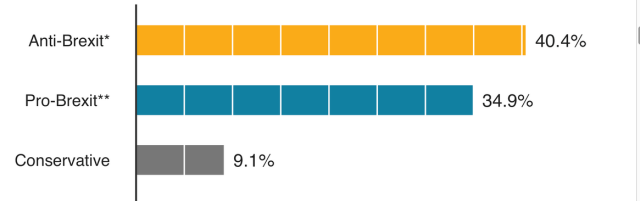
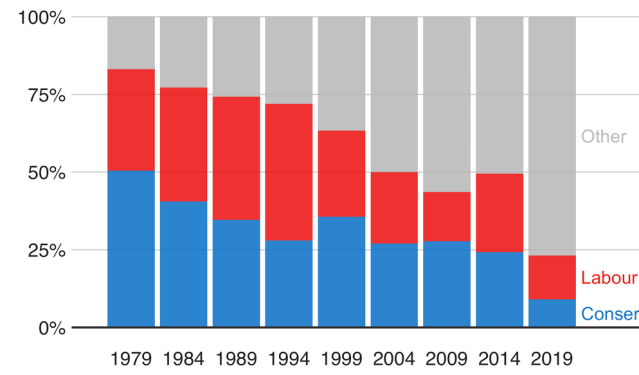
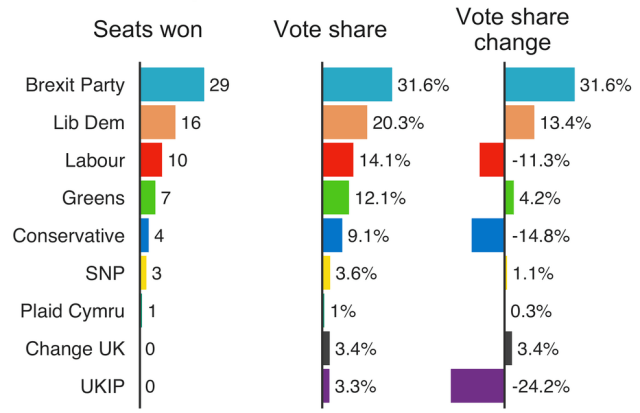
On the first factor,  results of the European Election shocked many. In the other 27 members states the centre alliance lost ground to a mix of smaller parties. Both Merkel and Macron have their work cut out to deal with domestic fragmentation. Nobody will have much time to keep focusing on Brexit. In Britain, Tories and Labour alike suffered catastrophe, losing 13 of 17 and 8 of 18 MEPs, respectively., The Brexit party climbing over the corpse of UKIP to elect 29 on 32% of the vote. Pro-EU Lib-Dems, Greens and SNP all did well, tallying almost 40% of the vote among them and arguably winning for Remain. Conservatives are already declaiming that this shows an urgent signal to deliver on Brexit and assuage anger shown. That seems too simplistic as avid Leavers and Remainers are much less common than parties claim. Most voters seem disgusted by the indecisive cacophony coming out of Westminster for months and were looking for a way to take their overly self-important representatives down a peg or two.

S

The problem posed by the second factor is that these results mean most MPs—especially Tories— are running scared. Whoever winds up being the final pair of candidates to lead the Tories must be avid Brexiteers. To get shortlisted by MPs, they will have to out-boast Farage in virulent euroscepticism AND distance themselves from May’s ‘deal’, seen as a weak-willed compromise that caused all the trouble in the first place. BoJo ad Gove are the most likely winners of the 3-week first stage. Then July will be taken up by membership voting. And since the 1670,000 members are mostly older white males keen on a no-deal Brexit, the resulting winner will be geared up to take on Farage where he lives.

Problems are compounded by the third factor. By the time the UK has a new PM, not only is Parliament in recess but the whole structure of the EU is on flux while they also take their vacation and haggle over the composition of a new Commission. Even though Westminster reconvenes in September, it is short-lived as recess for party conferences lasts into October. Even if the new PM were serious about negotiating a deal, it will not jappen because:

  • thee is no time left before October 31st
  • the EU has been consistently clear the May ‘deal’ is NOT re-negotiable
  • the selection process will ensure any new PM prefers a ‘No Deal’ anyway

There will, of course, be some window dressing of wanting a deal, or even holding out the possibility of a “people’s vote” referendum to appear statesmanlike and discomfit Corbyn. Remain parties and even a late-conversion Labour may posture in Parliament for debates and motions but a Brexit-minded PM can parry all such attempts—at least until it is too late. The default is still leaving with no deal.  the reality is that the Europeans, while preferring a proper deal, will be too preoccupied with their own internal affairs, too reluctant to risk fragmenting unanimity by re-opening negotiations and tired of British inability to put their house in order to even contemplate any extension. The idea that they will follow our wishes because no deal hurts them as much as us is delusional: they have too many other things at stake.

Which, altogether,  means a >90% chance of a No Deal Brexit on October 31st.

Which means Nigel and BoJo (or whoever is in the Tory hot seat) will be happy. But not for long. Because just about anyone in Britain numerate enough to understand its economy (which does not include the two gentlemen mentioned) will tell you of the negative impact such a Brexit will have. From the Bank of England to the Institute for Fiscal Studies, this fourth factor has been studiously ignored or dismissed by Brexit supporters. But the truth is that the 60% of UK trade that is with the EU will be disrupted in the short term. As for other countries, WTO terms are not automatic, so there will be various delays while even these terms are settled. And, as for lucrative FTAs Liam Fox has come up with Faroe Islands and five others so far. The idea that China, America, Brazil or Indonesia will go out of their way to cut UK (65m people) a better deal than the EU (240m people) is delusional.

Because they will be terrified of an outcome similar to these elections, whatever luckless Tory leader caries us into a no deal Brexit like a bowling ball down a gutter, will avoid all talk of any General Election. Buy, eventually, June 2022 will roll around and we may see the demise of the once-powerful Tory party as it circles a few remaining wagons around Cheltenham, Guildford and Tunbridge Wells to reminisce of past glories and empires lost.

EUelecShare

Change in Tory and Labou Share of Vote in European Elections—Source:BBC at https://www.bbc.co.uk/news/uk-politics-48403131

Posted in Politics | Tagged | Leave a comment

It’s The Economy, Stupid!

Bill Clinton knew a thing o two when he coined this phrase a quarter century ago to bolstwe his (successful) campaign to be US President.  Times may have changed bit the appropriateness of the phrase has not.

Today’s Sunday papers are full of the shrill cries of various Brexotees smelling blood at next week’s European election of the back of polls indicating that 62% of people would support a ‘No-Deal’ Brexit, just to put everyone out of this never-ending misery. Given the complete and apparently endless hash both those in charge and those opposing them have made of the three-years-and-counting process, this should not be surprising.

But, meanwhile, outside of the media and politics hothouse, the other 99% of people have been trying to run their lives and make ends meet. Instrumental in making ends meet are th nusinesses that provide jobs and—especially—manufacturers who make things to export so we can afford the fruit and fridges we import. The media mayhem has said little about them, but they are distinctly not happy. “The Manufacturer” magazine reports:

  • 71% of UK manufacturers say Brexit is damaging strategic-planning and business prospects
  • 64% say Brexit will cause chaos for the manufacturing sector
  • 55% say the government could do more to promote exports

While many job- and export creating companies are rooted in their communities and not even contemplating leaving, warning signs from some without such commitment are growing ominously. Bombardier in Belfast, Honda in Swindon, Nissan in Sunderland are all pulling out. British manufacturing made Dyson’s £12bn personal fortune but he’s moving to SIngapore to make it bigger. Meanwhile, CrossRail is £3.4bn over budget and major infrastructure like Hinkley Point, HS2 and Heathrow expansion are all on hold. Job growth is in Amazon warehouses or on a moped for Deliveroo.

But if that’s what firms deeply invested in machinery, bricks and mortar are doing, how much easier for financial Young Turks of Canary Wharf to move whee the lucre leads. Major foreign financial institutions like JP Morgan, Goldman Sachs and Morgan Stanley, Mitsubishi and Sumitomo have already spent over £1bn of what some consider wasted money preparing for a No Deal Brexit. But many such institution chose Britain as an English-speaking foothold in the EU. Dublin, Frankfurt and Paris are already booming as smaller institutions move to stay within the EU.

Most flexible of all are the currency markets. Like bookies, they are famously cold-blooded about profit above all else, Here the runes are not good. After the UK£ plunged from $1,50 to $1.30 after the 2016 referendum decision to leave, in the two weeks of May alone it dropped further form $1.31687 to $1.27045 and from EU1.17553 to EU1.13777. That’s a 4% hike in costs for foreign holidays and imports alike. At that rate, the £UK would become worthless before Christmas.

The 62% of people polled by the Sunday Times as wanting a No Deal Brexit asap must have heard some of the clamour from CEOs, professors, economists, right up to the Govenor of the Bank of England that it would damage Brtain’s GDP by as much as 10%.  And, far from countries queuing up to sign trade deals, as promised by Leave, Liam Fox has been able to sign off only six, none of them with major economies.

Media and party fixation with bills at Westminster is now veering into angels-on-pinheads territory.  Who is doing the day job of looking after the economy? Brexiteers keep stressing Britain has the world’s fifth-largest economy. It soon won’t have.

Posted in Commerce, Politics | Tagged | Leave a comment

Makes Me Cross Rail

Even the casual visitor to London must be aware of its sprawling public transport network. The world-famous backbone to this is the London Underground, universally known as ‘The Tube”. Latest in its many extensions is the Elizabeth Line, also known by its working title of “Crossrail”. Scheduled to be a £14bn project, due to open to the public late last year, it has quietly transmogrified into a £17.6bn project, now due for completion “between October 2020 and April 2021”. The reasons given are software and safety.

The economic benefits of all this money are listed as

  • £42bn benefit to the UK economy
  • Better links between the capital’s major commercial and business districts – Heathrow, the West End, the City and Canary Wharf
  • 55,000 full time jobs and 75,000 business opportunities during the construction of the new railway.

What they don’t say is that 95% of such benefits accrue to the London metropolitan area—their 10.4m people already the richest region in the UK (average salary £35,303) leaving 5% of diddly squat for the other 56m Britons (average salary £27.875).

CrossrailMap

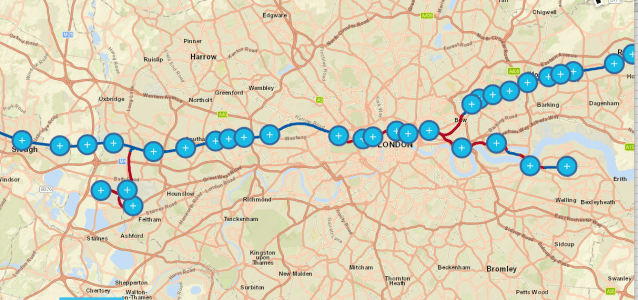
Overview of Ctossrail. Note that major non-London stations like Manchester Picadilly, Cardiff Central or Edinburgh Waverley are nowhere on this map.

It’s not that Crossrail is a bad idea,  linking the atrociously served Heathrow airport with  Paddington, Bond Street, Centre Point, Smithfield, The City and out past Stratford is a visionary link that fills a transport gap. But its execution is another example of UK Tory Government fixation with farming out huge public projects to the private sector. Though the collapse of the £5.4bn Carillion giant in January of 2018 was not the sole cause of Crossrail delay but its contribution of the Paddngton Integration component further muddied already murky waters.

Carillion’s collapse two weeks into the year, and then just two week’s ago Crossrail’s latest admission that the line will need £2bn more to be completed”. (New Civil Engineer, Jan. 2019)

Rather than trains at 5-minute  intervals planned to run from December 2018, trains at 10-minute intervals are planned for Spring 2021, with the Bond Street station not due to open until later. While major projects of such complexity can be expected to run into problems, the reason for the delay is given as safety, especially the software control of signalling. Given that Crossrail over its central portion consists of two opposite tracks in tunnels with no branches and that even the DLR has been running for decades without even dives, this must count as the flimsiest of excuses. The tunnels are finished; the track is laid; most stations are complete, despite having to be show-horned into some of the most expensive real estate in the world.

Perhaps most galling for the rest of us is the scale of the cost increase. £3.6bn is seven Scottish Parliament buildings, four Edinburgh tam systems or three Queen Margaret Crossings. Add that in to other eye-watering London projects since the millennium alone, such as:

  • Portcullis House—£235m (includes £1/2m for rented decorative fig trees!)
  • Heathrow airport expansion—£18.6bn
  • Extra runway at Gatwick airport—£7.4bn
  • HST line to the Chunnel—£1.9bn
  • St Pancras refurb for Eurostar—£800m
  • Houses of Parliament refurb—£3.5bn

Even leaving aside major pre-2000 projects like the Jubilee Line, the Millennium Dome, renovation of  most London train terminals, etc., that’s a round £50bn spent on London infrastructure alone, or about £5,000 for every Londoner. That’s five times the entire budget of all 32 local authorities in Scotland, who can’t even afford to build a mile of road, let alone an airport.

It is natural for investment in a capital city may be higher than elsewhere. But when the only significant infrastructure investment elsewhere is in essential schools and hospitals and little that will boost local economies and address some of this chronic imbalance, it is time to ask whether the Imperial Capital is siphoning off a lion’s share of the Imperial Budget and further skewing the income imbalance at the root of the provincial unrest behind Brexit Fever, Scottish independence, the mythical Northern Powerhouse and much else in the ex-industrial former heart of Britain.

Posted in Commerce, Politics, Transport | Tagged | 1 Comment

The Other Island

In 834 blogs, a similar number of newspaper columns and over 25 years engaged in politics you will find little mention of Ireland. This is not because of indifference to that beautiful island or to its fellow Celtic people and the culture with which they have enriched the world, especially the USA. The reason is that, since becoming an adult in the sixties with an active interest in current affairs, the venomous thread of The Troubles saddened me on a regular basis until influential people finally managed to see out of their respective bunkers and, encouraged by supportive neighbours, signed the Good Friday Accord twenty years ago.

In speaking of ‘Ireland’ as a whole, I mean no disrespect to the Republic of Ireland and the responsible and constructive way it did its best to diffuse The Troubles, nor to those caught up in them. But my personal position had always been that there are three nations on the island of Britain bit only one on the island of Ireland. That said, it is none of my business—solely that of the people living on said island. So, for fear of simply stirring it to no purpose, I have shut my face, and kept it shut.

Until now.

Having seen the open border, the growing prosperity and self-confidence of the North coming more in line with the outward-looking, cosmopolitan ebullience of the South, despite DNA-deep intransigence from Assembly members I felt, as many did, real progress was being made. Then came the Derry riots around the 103rd anniversary of the Rising, at which journalist Lyra McKee was shot dead by ‘The New IRA’. They have issued an apology.But any organisation venal enough to use guns in furthering their political ends should learn to shoot straight or disband.

I knew nothing of Lyra beforre April 18th but fully believe and would associate myself with the fulsome praise she received as a journalist and open-minded human being from those who shared her work and young life. Her death was clearly a loss. But in such a loss, I found hope in the way in which all six parties united in clear condemnation of the act as unacceptable in any part of Ireland in the 21st century. Politicians whose utterances normally jar in me like fingernails on a windowpane made heartfelt, diplomatic statements, with which I found myself agreeing. Several hundred residents of the normally recalcitrant Crreggan district where the riot occurred, cam forward with information. The PSNI have desisted from the boots-and-truncheons of yore and tried to work with the community to solve this.

So on this, the day of her funeral, I mourn, along with so many others, the loss of a woman who had already made a difference in her young life but whose brutal death highlights the progress made by two decades of the peace process.

It is not for outsiders like me to say but, perhaps this sharp contrast with such progress and all the many such incidents stretching into history may be the incentive for political leaders, gathered in common grief round Lyra’s grave, may forge a future of peaceful and prosperous sharing of their beautiful island as a fitting legacy for Lyra.

Today may be more hopeful than it appears.


Posted in Politics | Tagged | Leave a comment

Continental Car-Rail

This week saw the launch of the Caledonian Sleeper’s new fleet of carriages for use on their five overnight Scotland-London routes. After the pleasant but antiquated stock Serco tool over from First ScotRail four years ago. This fleet represents the 2017   £150m investment Serco made to revamp the Caledonian Sleeper, with en-suite cabins and double beds, They wee originally due to come into service a year ago. With airports increasingly crowded and inconvenient, traveling overnight saves a day each way, compared to daytime services, as well as the cost of a hotel.

Good though this improvement might be, thee is further opportunity they might consider that will exist even after Brexit—continental services. When the Channel Tunnel fist opened in 2007, there wee airy promises made to justify the £5.8 billion spent that it would benefit all of Britain. Indeed, there was one train a day that would its way from Waverley to the original Waterloo Chunnel terminal. Bit this took seven hours and was soon cancelled. Since then, all further investment has gone into the St Pancras terminal and the HS1 line through Kent.

While it would be an undoubted economic boost for Scotland to have a direct TGV link to the Continent that London enjoys, even the HS2 link to the Midlands stands in doubt. Buy Scotland should not despair. Half of family holidays from Scotland taken on the Continent involve taking a car and the subsequent two-days-driving-plus-ferry to each your destination, whether it be Bilbao or Barcelona, Florence or Venice. Each of these destinations is about 1,300 miles away—or over 24 hours of driving, quite apart from time spent on rests, sleep and ferry.

What if you could do it all in a day, enjoy the journey and arrive rested?

The terms of the franchise under which Serco operates the Caledonian Sleeper are entirely up to the Scottish Government. Were they to show some far-sighted initiative, Scotland could have its own link with the Continent that would not only ease  travel abroad for Scottish families and turn a profit but would provide a conduit to lure Continental families to holiday in Scotland with their car. It would require the co-operation of the English Network Rail, the Chunnel and SNCF but they would each be interested in revenues from under-used resources. Apart from access contracts with them, we would need:

  • Expansion of the existing Caledonian Sleeper franchise to include this
  • Car-rail terminal facilities in both Central Scotland and Southern France
  • Three additional fast sleeper trains with vehicle flatcars.

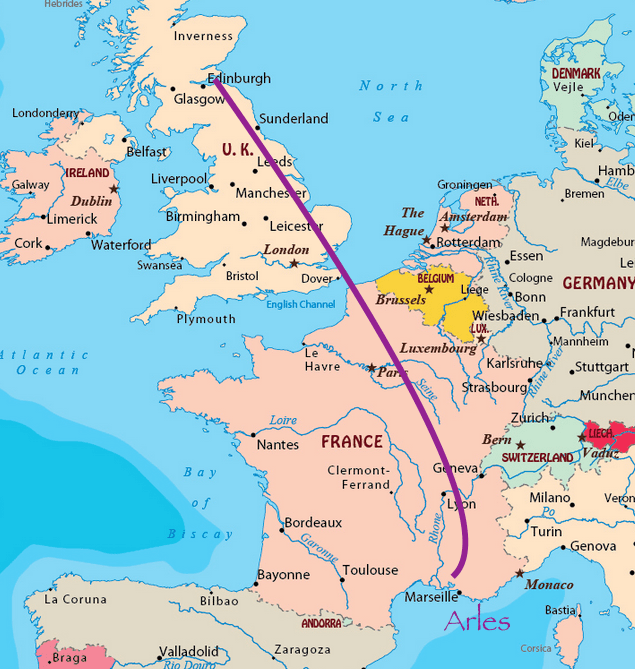
Together, these would provide a daily car-rail service between a Central Scotland terminal somewhere easily road-accessible, like Ratho or Mossend and a Southen France terminal somewhere like Arles or Nimes. The outbound train would depart early evening to allow time to drive there and avoid evening rush hour and travel fast non-stop to just north of London, taking about five hours. It would avoid London terminals and join the NS1 line north of the Thames crossing at Ebbfleet, reaching the Chunnel before 2am and so run through it when thee is little traffic. Skirting Paris about four hours later—again before rush hour—it would take the Lyons line, then the Rhone valley to arrive at Arles after  1,000 miles before noon the next day. There would then be a half day for drivers to reach Bilbao, Barcelona, Florence, Venice etc. by evening in the 5-6 hours it would take to cove the remaining 200-300 miles left.

CarRailMap

The reverse inbound trip would operate to similar timings in reverse, arriving with a 6-hour turnaround time before repeating the journey. This means just two trains could operate the service at a pinch. Clearly Spanish, Italian and Southern French families, daunted by present awkward logistics would then find it easy to bring their car to tour Scotland and provide a secondary market. A train would consist of five sleeping cars, eight enclosed vehicle flat cars, plus a lounge and a dining car. All this is within the 775m length requirement. This would transport up to 30 families in 4-bed suites, saving the £300 each way for petrol and ferries, quite apart from accommodation costs. Assuming this charge would be competitive as a ticket price 50% above this ($450 per family one-way), given the time and stress saved, a 75% loaded train should gross revenues of £25,000 per round tip.

Were the initial service to prove successful, a further terminal at Perth to serve North-East and Highland markets. A second Continental terminal around Munich would not just open up Central European destinations in an arc from Prague through Vienna to the Dalmatian coast but open access to a further market of visitors wanting a driving tour of Scotland. In all cases, the concept of a fast overnight arrival that allows time for driving at both ends would be the USP. While family car holidays would be the main target customer, other small groups and even foot passengers would find such a service.

Key also is that this must be a fast, if not express, service that does not stop between terminals. Unlike the present London sleeper, which dawdles deliberately so as not to arrive too early, the Continental Carr-Rail would match East Coast 225 service to London and fit with TGV slots beyond. This might require electric motive power—especially in light of the emissions that each trip would be saving.

Of course, this requires a full business case to be made before it could become more than a pipe dream. But, along with many other good things, Brexit is likely to foul this up.


CalSleeper


Posted in Commerce, Transport | Tagged | Leave a comment

Haven on Earth

Throughout its history, Britain has been driven by global commerce. Even the socialism of the Atlee years were a sensible antidote to private railway, coal, steel, shipyard and health industries on their last legs. Commercialism really got a modern shot in the arm under Thatcher. The two decades of boom that followed could be justified by the broad reach of the prosperity thus generated.

For all its image of dusty reserve, Britain has been an enthusiastic member, if not actual leader, of the charge towards commercial exploitation ever since Europe broke out of the Middle Ages with the Renaissance. Elizabethan privateers led to exploration and colonisation, which led to trade, industry and empire. None of those would have succeeded on the scale they did without complete disdain for the human rights and equality given prominence these days. ‘Progress’ appeared to benefit everyone, even if those benefits were spread unevenly.

After dabbling with socialism post-WW2, post-imperial Britain hit its capitalist stride in the two decades following the City’s ‘Big Bang’. Although never egalitarian, wealth spread as broadly across the country as it ever had. Modern homes, new cars and foreign holidays became the norm; North Sea oil repaid the National Debt, kept taxes low and lubricated the world’s fifth-largest economy. Senior public servants secured hefty pay hikes that were dwarfed by inflated salaries and bonuses of boards and CEOs but neither triggered recriminations.  Even lefties embraced the change in the shape of Blair’s New Labour.

Then came the financial storm of 2008. Though many global companies were humbled, none of the executives involved suffered more than opprobrium and ineffectual cross-examination from politicians with insufficient experience to outmaneuver them and find where the bodies were buried. There was a tacit understanding that large institutions were “too big to fail” and that minor players like stockholders, SMEs and employees would survive. To a large extent, this turned out to be true. But the senior executives, already schooled in high salaries from piratical practice did not adjust to the austerity being visited on the less fortunate.

Creative tax avoidance did not begin in 2008. In fact, tax havens like Jersey, Isle of Man Bermuda and Cayman Islands became that with the blessing of pot-WW2 UK governments for their own purposes. But public exposure of Fed Goodwin’s £8m bonus from a baled-out BS or Philip Green’s retention of half the £750m he siphoned off the BHS pension fund before it went bankrupt are just the tip of a very lucrative iceberg. Not only has inequality of income between the better and worse off widened appreciably in the last decade but some very rich have become past masters at not even paying the resulting whack due to the Treasury on their hefty earnings.

Prime among techniques deployed is non-residency. Those citizens not domiciled in the UK need only spend more than 183 days each year abroad to be considered a foreign resident and tax-exempt. HMRC will also consider ‘ties’ like family and home ownership in the UK. But they do not consider company ownership as a tie. The March 17th  of The Times ran a 4-page article exposing that, of Britain’s 98 billionaires, 28 are no linger resident and half of those left since the financial crash. Such people  may own UK companies—joining 6,700 citizens who, among them, control over 12,000 UK companies from offshore havens. Almost 2,000 of those are registered in one modest office block in the Cayman Islands. Non-resident owners avoid paying the 38.1% income tax on dividends, as well as the 20% capital gains tax on the sale of shares. Since the financial crash, the total number of tax exiles has risen 16% to 210,000.

Even HMRC has no idea how much revenue it loses from this and must therefore be made up from punters not rich enough to elude the taxman in such style. Estimates for Monaco, the top non-British tax haven after Switzerland, are £1bn in lost HMRC income. That alone adds £43 to every UK resident taxpayer’s bill. To give you some idea of scale, the top half-dozen Monaco ‘residents’ are worth more than the entire £45 million annual UK defence budget:

  • Jim Ratcliffe (~£21 billion, founder of Ineos)
  • David and Simon Rueben (~£15 billion)
  • Andy Currie (~£7 billion)
  • John Reece (~£7 billion)
  • Eddie and Sol Zakay (~£3 billion)

If that’s not enough to get readers all steamed up, many of these people have been knighted—including Stelios Hajl-Ioannou who founded EasyJet but was resident in Britain for only four years and John Whittaker, a construction boss worth £2.2 billion who runs 230 UK companies from the Isle of Man.

But, most egregious of all, as UK citizens our tax exiles are free to fund political parties and movements in a country where they do not live, A 2009 bill that would have banned large offshore donations received royal assent but has never been enacted by the Tories who have been in government ever since. There is more than a whiff of turkeys and Christmas here. On that decade, £4.4 million have been donated to parties by our 28 ‘non-residents’. £1m of that went to the Tories just before the 2017 General Election, half of it from Lord Ashcroft in Belize. £798,900 has gone to the Tories from the Monaco-based Reubens listed above, along with £487,000 from Virgin-Islands-based Richard Branson. No wonder, when asked, the Tory Government deemed the Political Parties and Elections Act 2009 to be “unworkable because tax status is confidential” Aye, right.

It is obscene that some of the super-wealthy think it us fine to avoid paying UK tax. It is even more obscene for people living in tax havens overseas to be funding politics”. —Dame Margaret Hodge MP, Public Accounts Committee Chair

“It’s a very common thing nowadays. British people who have a tax problem because they have a high income are setting up their residency in different counties.” —Kensington wealth manager Mariam Schroeder


Posted in Commerce, Politics | Tagged | 1 Comment