The Faslane Conundrum

Guest column by Lt. Col. S. W. Crawford (retd.), late 4th Royal Tank Regiment

With support for Scottish independence at a seemingly all time high and next year’s Holyrood elections – Covid 19 permitting – in the offing, it’s little surprise that the debate on Scotland’s future constitutional status is once again in the news. There are a number of major issues here, membership of the EU, currency, and the economy to name but three. But the topic of how an independent Scotland might organise its own defence forces always seems to crop up, this despite the fact that defence is a Westminster retained competency and really nothing to do with the Scottish Parliamentary elections.

Be that as it may, I have been writing about this particular topic for at least that last 20 years or so – until I’m blue in the face, if you’ll excuse the rather obvious pun, me being an independenista and all that. For anyone who has the time and inclination, the main thrust of my thinking is in a 2012 RUSI publication entitled A’ the Blue Bonnets: Defending an Independent Scotland[1], and the Scottish Centre on European Relations published Defending an Independent Scotland Post-Brexit[2]. These should be read consecutively to get a real sense of how thinking has developed.

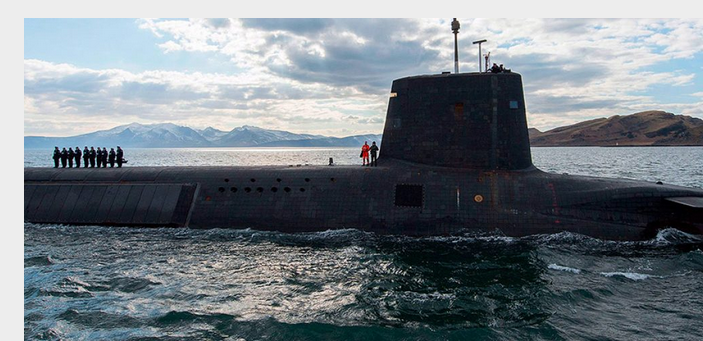
Whilst many observers are happy to examine in detail how many ships, aircraft, and battalions a Scottish Defence Force (SDF) might field and what the budget might be, all of which has its place, the elephant always in the room is the UK’s Trident-carrying SSBNs (submarine/submersible, ballistic missile armed, nuclear powered) based at Her Majesty’s Naval Base, Clyde, commonly referred to as Faslane (although it encompasses the weapons storage facility at Coulport as well). When it comes to talking about iScotland defence all roads lead eventually to Faslane.
Perhaps I should outline my personal position on the UK’s nuclear weapons before going further. Firstly, I believe that from a moral and ethical standpoint it is so indiscriminate as a weapon – sophisticated targeting systems notwithstanding, it is so powerful that huge collateral damage to people and property is unavoidable – that no civilised country would ever use it.

Next, I don’t believe it is truly independent in that I cannot imagine the UK ever employing it without at least the tacit approval of the US (although I also understand that technically it can be used independently), nor do I think it is a universal deterrent – it didn’t deter the Argentinians in 1982, nor the Iraqis in 1990, nor the Taliban and/or Al Qua’eda. Nor do I truly believe there exists a credible nuclear threat to UK interests from so-called rogue states like Iran or North Korea. (It may stop the UK being bullied by Russia in the final analysis but I’m not convinced of this).

What I do firmly believe is that Trident is essentially a political weapon, not a military weapon, whose main function is to maintain the UK in the front rank of global powers and guarantee continuing national membership of the UN Security Council, NATO etc etc, a posture supported by successive Westminster governments over the past 50 years plus.  Furthermore, its maintenance, and eventual replacement, places an enormous burden on the MoD’s budget and soaks up vast funds which would be far better spent on the UK’s conventional forces – more ships for the RN, better equipment for the army, better pay and conditions, and better provision for ex-service personnel when they leave the armed forces. Or, indeed, on other things like education and the NHS.

In summary, I think Trident is in fact a weapons system which has no conceivable use and which is far too costly when other priorities should prevail.  Therefore I do not think it should be replaced when it comes to the end of its lifespan by anything similar.  The best thing that could happen here is that the Vanguard class SSBNs should soldier (sailor?) on until they are obsolete and then not be replaced by the Dreadnought class, which should be cancelled forthwith.

Against that personal background, let’s look at the options for the UK’s nuclear deterrent post Scottish independence. The prevailing orthodoxy in the broader independence movement seems still to be that Trident would be removed from the Clyde almost immediately after Scotland seceded from the UK. This is the stuff of fantasy for a number of reasons. First and foremost of these is the fact that there is nowhere else for it to go, not in the short to medium term anyway. For example, Barrow on Furness is tidal, Milford Haven is already home to a major oil terminal and therefore doubly vulnerable, the traditional ports on the south coast of England don’t offer the required immediate access to deep water, and nowhere has the close proximity of weapons and submarines that Faslane/Coulport offers.

Nationalists are wont to say that “this is no’ our problem”, an easy get out, but actually it is. Because a newly independent Scotland and its anti-nuclear weapons campaigners are only two of the players in this particular debate, and two of the smaller ones at that. The rest of the UK (rUK) will have something to say, as will NATO, and perhaps most influential of all, the USA will want its penny’s worth. I have been advised on pretty good authority that if an iScotland demands early removal of Trident then its accession to NATO would be blocked by the US. And iScotland would want to be part of NATO, believe me.

It is unlikely to come to this, however, for wiser heads must surely prevail. As an academic chum asked the other day, why would an iScotland make the process more difficult than it need be? Why would any government let its policies be driven by, let alone be in thrall to, small, but well-intentioned, vocal pressure groups which are only one or two of the players in a multi-participant debate?

There is a danger of prioritising process over purpose here. The purpose is to remove nuclear weapons from the Clyde; the process by which that is done should be a matter of negotiation. It seems to me that the best way of approaching this is to acknowledge that there are difficulties in relocating the SSBNs and their missiles and accept that a measured withdrawal of them from the Clyde is most likely, perhaps whilst other arrangements are made in the rUK. Most observers seem to agree on a timeframe for this of between 10-20 years.

I think even the SNP is coming round to this. The party has never put a firm timeframe on de-nuclearisation, and has tried to keep all the footsoldiers on board with the weasel-worded (and I paraphrase) “as soon as safe and practicable”, which can mean all things to all men. What is certain is that the removal of the Trident submarines, along with presumably the rest of the UK’s submarine fleet and at least some of the mine counter measures and offshore patrol vessels – ie those not inherited by the independent state – will leave a huge economic hole in the west of Scotland that the SNP’s plan to put the Joint HQ of the SDF there in its place cannot hope to fill.

In the interim period between Scottish independence and the withdrawal of the Trident fleet, however, there might be a little good news. The SSBNs presence at Faslane is, as I have said oftentimes before, the biggest bargaining chip an iScotland is likely to have. Allowing them to remain temporarily can be traded for either payment of an annual lease, which I have suggested (conservatively) might be in the order of £200 million per annum, or to defray part of iScotland’s share on the UK National Debt, another emotive topic, or indeed for anything else that the government of the day might decide. The chip should be spent wisely.

© Stuart Crawford 2020

Stuart Crawford is a former British army officer and regular commentator on military affairs in the print and broadcast media. He has a special interest in how an independent Scotland might design its defence policy and armed forces.


[1] A’ the Blue Bonnets: Defending an Independent Scotland | RUSI

[2] Defending an Independent Scotland Post-Brexit – Scottish Centre on European Relations (scer.scot)

Posted in Politics | Leave a comment

The Whopper That Got Away

Fish in another man’s pond and you will catch crabs.”

—Yiddish proverb

St Andrew’s Day seems an appropriate time to consider the plight of thousands who once were the backbone of one of Scotland’s historic main industries—fishing. It is timely because Bojo’s Band of Brexiteers are within an ace of achieving glorious isolation from our neighbours. To that end, they may be on the verge of selling Scotland down the ocean (given the scale of it, ‘river’ is too small) once more. Traded away in 1973’s EEC negotiations, our fishing history seems about to repeat itself .

Bargaining Chips and Fish

Fishing is one of the last three stumbling blocks to Brexit peace with the EU. Britain is playing hardball up to the last minute, a fudge might be found on the other two points: Level Playing Field and resolution of disputes mechanism. But the emotional element with fishing makes it the hardest to resolve.

Backed by Boris, David Frost has been playing up the totemic nature of sovereignty, of which fishing is a special case. It constitutes 0.01% of British GDP and the EU is desperate to assuage their fishermen grown used to taking 80% of the catches in British waters, as if it were their own back yard. As a bargaining chip Frost will be tempted to throw this in at the last minute as the only strong card I his hand.

Though England once boasted a serious fleet, operating out of Lowestoft, Hull, Grimsby, etc., losing the “Yom Kipper War” with tiny Iceland in the 1970s decimated their deep sea fleet.  Day fishermen from Amble to Penzance would be hurt by capitulation on fish. But they will be seen as expendable, as will the Scots.

—Readers who already know their fishing history may skip the next section—

Why Fishing Matters in Scotland

At the peak of the Herring Boom in 1907, 227,000 tonnes were cured and exported, the main markets being Germany, Eastern Europe and Russia. Trawling was introduced into Scotland from England in the late 19th century and, from the 1920s, seine-netting was introduced from Denmark. After the interruptions of two world wars, whitefish and shellfish became the main catch. Technical developments put fewer fishermen operating more efficient vessels. Though the annual value of catches rose, the number of people working in the industry fell.

In January 1977, the UK extended its Exclusive Economic Zone out to 200 miles or the median line with other countries. The zone around Scotland became the largest fishery in Europe, by including North Rona, St Kilda and all of the Minch As the CFP gave all EEC members equal access, this has always been shared, as the CFP was made into British law and remains reserved to Westminster.

Fishing retains much greater social, economic and cultural importance to Scotland. Despite having just 8.4% of the UK population, its fleet lands two-thirds of the total catch in the UK. A large portion of EU boats fishing in UK waters land their catch at Scottish ports.

The marine economy, of which fishing is the main component,  represents 3% of Scotland’s GDP and employs over 74,000 people, mainly in smaller and more remote communities where alternate employment is generally scarce.

The Scots As By-catch Discards

UK fishing catches have been stable for the last decade, with around 6,000 vessels employing around 5,000 fishermen who land 700,000 tons of fish each year. The value of that catch has risen from £0.6 bn to almost £1 bn in the last decade.

Scotland provides 65% of the above-mentioned vessels, crew and catch noted above, which creates a major export earner for Scotland as 75% of this is exported, mostly to the EU. England accounted for just 28% of these totals. Unlike in England, fishing is a major component of the thriving Scottish food and drink export market, along with whisky, salmon and farm produce.

Of the 445,000 tons landed in Scotland, 50,000 tons are shellfish caught by smaller boats, mostly on the West coast, with the rest pelagic (284,000) and demersal (107,000), caught by larger deep-sea boats.

Most EU countries have modest fleets of 200-600 boats. These are mostly small, inshore vessels, engaged in day fishing or shellfish and so compete mostly with English boats in the Channel and southern North Sea. Not so the Spanish who operate the largest fleet in Europe. While there are many inshore craft fishing their coastal waters, many of them are deep-sea boats that range as far as Newfoundland, Guinea-Bissau and even Madagascar.  Their total of almost 10,000 boats land a million tons annually and are manned by over 33,000 crew. These numbers have grown over the last 40 years as they have taken advantage of the CFP, buying up licences from Scottish skippers keen to profit from decommissioning. At the same time, the Spanish were building new deep-sea boats to make maximum use of these licenses.

Although the French and Dutch are supposedly making over retaining access to UK waters, their fishing interest is small beer. Of the existing EU 80% share of fish in UK waters, it is the Spanish who take most advantage of it with their far-flung, deep-sea fleet. Therefore, it is they who are leaning hardest on EU Commissioner Barnier to negotiate retention of the status quo. Banking on EU horror of “no deal”, Boris & Frost will be tempted to cave in on fisheries, in exchange for agreement on the Level Playing Field and arbitration of future disputes. Both points are of more importance to the UK Government in the sovereignty stakes.

Though such a compromise will affect English fishermen too, it will be more a zero-sum game to them. At worst, there may be standoffs in the Channel. Similarly, Scottish West Coast fishermen will also operate much as before. Few EU boats intrude into their dangerous waters. Their problem world be tariff barriers. However, shellfish are barely 10% of total Scottish catch. The shadow of our once-numerous deep sea fleet may still operate out of Lerwich, Peterhead, Fraserburgh, St Monans and Eyemouth. But if they are betrayed again, they will find Spanish boats overfishing, ignoring quotas and manipulating discards. That would be bad enough. But if our fleet declines further, some of our most tight-knit, hard-working, self-reliant communities will take further knocks so their youth drift elsewhere, like the 1980s drift toward the oil industry. And those who can’t thole that as a life at sea again drift towards drugs..

Posted in Commerce | Leave a comment

East Fortune Need Not Cost One

The announcement at this week’s Spending Review of £40 bn for infrastructure investment in England means a Barnet consequential amount of £2.8 bn coming to Scotland for the same purpose. This could be swallowed up by existing ambitious projects like dualing the A9 to Inverness. But, as a ‘bluebird windfall’, it might be better used to fund innovative investments that bring disproportionate benefits. One is in East Lothian.

As a pleasant dormitory, close to Edinburgh, it benefits economically from its financial service jobs and tourism. But it is home to no key facility from which either it or Edinburgh benefits such as Waverley station, or Edinburgh airport. The potential to rectify that with a cruise and ferry terminal at Cockenzie is covered in an earlier blog.

Anyone who flies out of Edinburgh (EDI) will notice that major investments by private owners Global Investment Partners are to maximise revenue from passengers through costly parking, extended duty free and a myriad of shops in an already crowded departure lounge . It is a poky place, hardly worthy of a capital, lacking the logical layout and modern spaces of Dublin, Amsterdam or Copenhagen. is. Its increased congestion starts at the city bypass and continues o two-lane access roads, crowded check=in hall and security maze before you even get to the departure lounge..

Shifting the entire airport elsewhere would cost far more than the £2.8 bn mentioned. However, converting an unused airfield to host low-cost airlines and relieve much of Edinburgh’s congestion would be well within such a budget.  Just as Stanstead relieves Heathrow (LHR) and Prestwick relieves Glasgow (GLA) with cheaper, no-frills facilities.

The most obvious choice is East Fortune. Not only does it already house the National Museum of Flight and an Ultralight strip, but its main runway was extended in 1962 to serve as temporary replacement for EDI for a year while the second runway there was being built. Terminal buildings there in 1962 were primitive and have become a part of the NMoF, so most investment would be to build new ones.

Fortunately on the other side of East Fortune’s runway lies the 50-acre site of the derelict East Fortune hospital. Planning consent for 50 houses here was turned down by East Lothian Council in 2010 for want of a strategic vision for the site. Terminal facilities for a minor airport would surely fit that bill.

Road access would be from the A1 at the Haddington/Abbots View exit, some 11 miles east of the A720 Edinburgh bypass. From there two miles following the A199 (former A1) and one mile on the B1347 brings you to the present airfield. Both are quiet. Only the last is likely to need any improvement. Not only would this be hugely more convenient to East Lothian and most of eastern Edinburgh but Berwickshire and Northumberland are close enough to find it convenient too.

East Fortune offers a key bonus, in that it could provide rail access by re-opening its station on the East Coast Main Line, where LNER , Virgin and Transpennine offer services all over the country. ScotRail already have as a local service between Waverley and Dunbar, A stop by long-distance trains would provide environmentally friendly services to Central Scotland, Northeast England and beyond.

So, who might be persuaded to transfer their service to such an airport? Major airlines such as BA, KLM and SAS all prefer operating from major airports. But secondary airports have grown more than the majors through an explosion in low-cost flights, likely to resume their volume once Covid is defeated. Bratislava is a popular alternative for Vienna; Gerona for Barcelona; Charleroi for Brussels). That is where the low-cost airlines—Ryanair, Easyjet— fly. To offer such low fares, hey avoid high costs of major airports, such as EDI.

East Fortune has what they’re looking for. No other site has intact runways, space for a modern terminal and excellent transport links. Without paving over any of its rural idyll, an airport could transform the county economy and relieve congestion at EDI and its access at minimal cost. This seems worth a feasibility study, at least.

Posted in Transport | Leave a comment

Political Pedagogy

For good or ill, children’s education in Scotland is in the hands of 32 local authorities, who run nurseries, primary and secondary schools under guidance of the Scottish Government, who set out the vision and priorities though vehicles like the National Improvement Framework and Plan. Each council has an Education Committee, that, in theory, oversees execution on schools. On occasion, this becomes enmeshed in the ambitions of senior administrators or—worse—used as a political tool by the ruling administration.

This latter has unfortunately become the case in my own council area of East Lothian, where I served for 18 years in increasing frustration at this on its Education Committee. What follows is an article on this, published in the East Lothian Courier on November 19th 2020 trying to address the problem of under-performance consistently swept under the carpet under the chair’s leaderrship by anodyne reports she directs officials to present that conceal shortcomings.

___________________________________________________________

In a former life, I served18 years on East Lothian’s Education Committee. Of all council responsibilities, none is more important than educating our children. Awkward questions therefore need to be asked. But the present administration avoids any unpleasantness by anodyne reports to the committee, recommending:

“East Lothian results represent a continuing good profile in comparison to the national and comparator grouping averages.”

Such smugness is disturbing and typical. In 2014, I pointed out we were barely keeping pace with Scottish averages. Three improving schools were masking decline in three oghers. Individual statistics were merhed “to avoid victimisation”. Rather than support teachers and staff to raise attainment, support focussed on inclusion, anti-bullying and other social priorities. The table shows SQA statistics on ‘progress’ over the last decade. While exam results don’t tell the whole story, careers depend on them. Fee-paying schools know this, and ensure they excel.

Musselburgh and Ross show good recent progress. However, the upper three have fallen, relative to their peers. PL is underperforming, despite an effective head teacher and serving a demographic now similar to other catchments.

The Scottish average for 5+ highers has moved from 20% to 26% over the decade. So East Lothian claims to be keeping pace, with 23% rising to 34%. Official comparison council figures flatter us. They are middling performers, like Stirling and Angus.. Let’s examine REAL comparators

True ’comparators’ would be like us—pleasant commuter areas.  Over the decade, East Dunbartonshire upped its score from 36% to 50%; East Renfrewshire from 42% to 51%. They boast five high schools in Scotland’s top ten’; we have none, Yet both have areas of deprivation, comparable to ours.

The explanation may lie in primary school attainment. Despite intervention a decade ago, with additional P1-P3 teachers, Place 2B, etc., East Lothian barely tracks national average, while both those councils track 5-10% above throughout primary. Now that Lesley Brown has had three months to get her feet under the desk as Head of Education, perhaps change will replace decades of complacency.

Posted in Education | 2 Comments

This Disenchanted Isle

America has just completed its most contentious election by having a record number of citizens come out and vote, despite being in the throes of the Covid pandemic. Aside from Trump gracelessly mumping that he should have won and refusing to congratulate President-designate Biden with a concession speech, the streets are full of celebration, especially among the young, blacks, latinos and suburban women, whose increased participation contributed to the result.

Biden has already stated that this is an end to polarisation , that “we are not enemies; we are all Americans and this is a time to heal”. Statesmanlike words that may indicate the US regaining its self-imposed role as the ‘Leader of the Free World’; an example to all; a bastion of democracy. There will be much celebrating how the Constitution again delivered a government of the people, to which other countries can only aspire.

Let’s leave aside the fact that objective observers consider much of the Constitution overtaken by events, starting with the much misquoted Second Amendment that states “A well regulated Militia, being necessary to the security of a free State, the right of the people to keep and bear Arms, shall not be infringed”. But, perhaps more importantly to maintain American integrity, as perceived by the rest of the world, their attitude towards colonies and their democratic representation is , at best, flawed and, at worst, downright hypocritical.

America has done much huffing and puffing over colonisation down the years. Given their origins, this can seem justified. The Monroe Doctrine warned European powers off from making a play for control anywhere in the Americas. Noble as this may sound, it had more to do with the United Fruit Company having unrestricted (and therefore very profitable)  access to what would come to be described as “Banana Republics”.

Had it stopped there, the case for the US being protector of an entire hemisphere might reasonably have been made. But in 1898, the newest major power was keen to flex its global muscles and Hearst was keen to sell papers. So he stoked anti-colonial feelings against the remnants of the once-mighty Spanish empire. In short order, Cuba, the Philippines, Puerto Rico and Guam were ‘liberated’ from the colonial yoke, with the independent state of Hawaii seized as a necessary staging post to achieve this. Repression of a genuine independence movement in the Philippines meant it was effectively a colony until 1946, with Subic Bay being retained as a major US base, similar to Guantanamo in Cuba. Though Cuba was technically independent, it was tied to the US economy, with the odious dictatorship of Batista and the successful 1959 revolt under Castro being the result.

This left Hawaii, Guam and Puerto Rico being run effectively as colonies. Guam could reasonably be seen as America’s Gibraltar in the Pacific—an ideal base and staging point for any action in East Asia, as happened in Korea. With a population of under 170,000, Guam does not really make a viable country. But the other two are different. Following their standard pattern of turning territories under its control into states, America created Alaska and Hawaii as the 49th and 50th states of the union in 1959, thereby breaking 173 years of tradition that new states be contiguous with the rest of the Union.

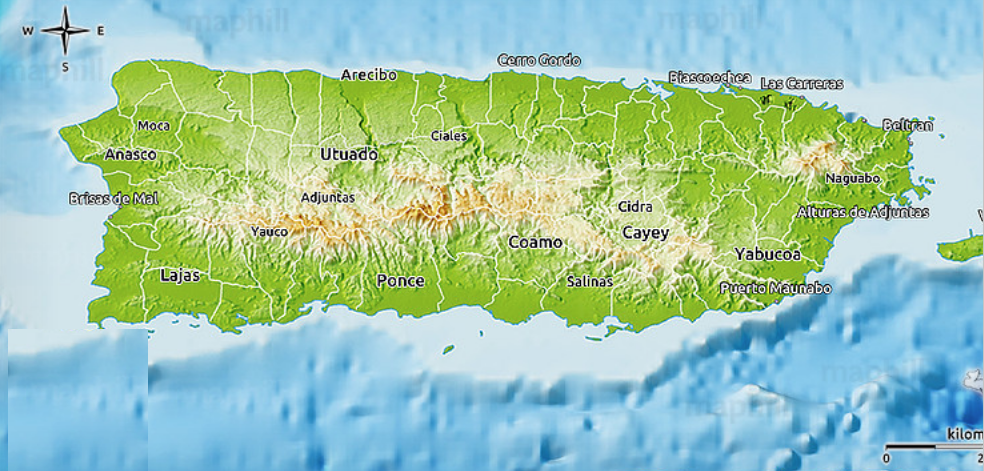
We are now 61 years further on and Puerto Rico remains a colony in all but name. It is a tropical paradise, with a richness of terrain and biospheres that put Florida and other states in the South to shame. Yet it lost over 100,000 of its people escaping poverty each year—much worse pro rata than rust belt states like Ohio or Michigan. It is still recovering from the devastation caused by Hurricane Maria in 2017. Yet, thee are no moves to welcome it into the Union as the 51st state, despite 122 years to prepare for it. Were it the size of Guam, such a status might make sense. But it’s not.

Puerto Rico has a bigger population than 20 of the 50 states. It has a larger area than Rhode Island or Delaware. Were it a state, it would elect 4 Representatives to Congress, along with two Senators. At present, it gets 1 non-voting delegate and has no voice in US elections, like the one we just witnessed.

If Britain were to run Northern Ireland on a similar basis, American politicians—especially Joe Biden, who has strong Irish roots—would pillory the iniquity of such a democratic deficit, foisted on people for over a century.

It is over 2,000 miles from either Honolulu, Hawaii or Anchorage, Alaska to the continental US. It is barely 1,000 miles from San Juan, Puerto Rico, so distance can’t be an issue. There are 710,000 people in  Alaska and 1,415,000 in Hawaii, while there are 3,411,000 I Puerto Rico. With barely half the population, these two states send three Representatives and four Senators to speak for them. Puerto Rico sends none.

There have been a half-dozen non-binding plebiscites on Puerto Rico’s future: 1967; 1991; 1993; 1999; 2012; 2017—all inolclusive as they were confusing. Nost offered three alternatives (statehood; dependency; independence) and required one option to gain ove 50% of the vote. Even when that did happen, with 54% fo statehood in 2012, over 100,000 blnk papers submitted were deemed to represent “none of the above”, bringing the percentage for statehood below 44%. Even had one of these votes been decisive, the US Congress would choose not to implement the result.

At last, a Congressionally mandated plebiscite was put on the ballot during this year’s General Election on November 3rd. There were two options: statehood or status quo. 623,051 people (52.34%) voyed for statehood, while 567,346 (47.66%) voted against. with the 2020 Election’s ongoing fracas around the presidency taking up most of the media’s bandwith, nobody seems to have picked up on this historic acknowledement that it is high time the US cleaned up democraric deficits like this on its before they resume lecturing other countries on the path to political righteousness?

I think Puerto Rico becoming a state would fulfill the destiny of 3.5 million American citizens that live in Puerto Rico. Ricardo ” Ricky ” Antonio Rosselló Nevares, Governor 2017 to 2019.

Posted in Community, Politics | Leave a comment

Biden-Harris or Hide Embarrassed?

So, the media have called it for Joe. The US 2020 Election is all over, bar the shouting. Unfortunately, there may be considerable amounts of shouting. Although Trump is clearly trumped at the ballot box,  decades of being able to bully his will onto those around him means that Donald J. will not “go gently into that good night”.

Despite accusations of unpredictability, it is not hard to anticipate Trump’s actions in a adversity. He is always right. If advisers dare to contradict him, they get the “my way or the highway” treatment. If his message is not adopted as if the word of God, it can only be because it has not been said loudly/often enough. Even though born into billions, he has known hardship and frustration—but only in business, that was always the other man’s fault and an army of lawyers could prove it. His first divorce was Ivanka’s fault; the billion-dollar bust of the Taj Mahal casino was the bankers’ fault.

Why circle the wagons when you can buy off the Indians?

Given the posse of ossified grandees and Beltway Bandits who have controlled Washington since Eisenhower’s military-industrial complex got their fingers in the federal till, it has not been hard to look like a political outsider. However, without support from the institutionalised two-party-plus-electoral-college, consigned even well known aspirants like Ralph Nader or Ross Perot to oblivion before a vote was cast. But none combined all three of the profile, the funds and planetary ego that Donald alone offered.

For once, Republicans, bruised by this week’s result, and finally embarrassed after a quarter-century obstructing anything Democrats proposed, have received an almighty shove to change their  direction. Since Newt Gingrich started a pathological opposition to Clinton in the 1990’s, there has been little evidence of what the American political nerds call “bi-partisanship”. So venal and entrenched did this become that shibboleths like tax cuts took priority over balancing budgets, simply because the Democrats wanted to raise taxes to pay for social programs like ‘Obamacare’ (universal medical coverage).

Only when Trump barnstormed to the nomination, leaving political corpses of standard-issue ‘haircut-and-suit’ hopefuls like Ted Cruz or Marco Rubio in the dirt did the Grand Old Party ditch what principles it had left and hitch its future to Trump’s erratic star. And, for four years, they swallowed the consequences of his jumping jack policies, despite a drubbing in the 2018 mid-terms, because he brought in tax cuts for the rich, ditched business regulation, talked tough abroad and brought on board a swathe of blue-collar white folk, disillusioned with Democrat dithering.

Now that Trump today became yesterday’s man, what’s a good Republican to do? The gun-toters, the evangelists, the pinko-haters, the anti-abortionists, the right-wing conspiracy junkies that make up a good slice of Trump’s ‘base’ some may stay with him, swallow his story the election was ‘stolen’, and hope for his comeback in 2024. But listen to moderate Republicans like ex-Senator Jeff Flake or Georgia Governor Brian Kemp. You hear the sound of footsteps distancing themselves. Indeed, if the bulk of Republican politicians don’t want to find their jailit on a shoogly nail, they  should follow their lead and disinter GOP integrity from where they buried it in 2016 and go public with their disquiet at the mess Trump has made of government credibility and eroding America’s status on the world stage. They will be joined by a ‘payroll’ who survive by understanding their bread and who is doing the buttering. This will include people like black TV evangelists like Pastor Mark Burns, Fox News and an army of shock jocks who were fed flammable material in many of Trump’s antics.

But Trump’s hard-core support will not desert him. This includes not just his family and blinkered hired-gun believers like Rudy Giuliani, but a number of now-docile White House staff, and most of the Trump Organisation management because they have had years of knowing what is good for their collective careers. This coterie will provide more than enough of a cushion against reality to support Trump’s on-going conviction that hi actions in office were genius, that he made America great, that the media is fake, that he really did win the election, etc.

And that’s where the trouble begins. Despite four days of delay after a super-intense campaign, street demonstrations have been lively but non-violent. Despite media love of unrest as a story line, Americans have again proved to be reasonable people, with a belief in the goodness of their country that would shame most Europeans. That does not include Tump, nor his coterie. They may not get violent, but they will fight.

This fight will involve his usual tactics of obstruction, disinformation and copious legal actions. The four actions already brought in the swing states this week are just the start. Though two were thrown out unceremoniously, others will follow—many others. There are recounts in Wisconsin and Georgia. Witnesses will be dragged out of obscurity to testify that Joe Frazier voted in Philadelphia, although he’s been dead five years. Every effort will be made to question the result in any state where Biden is barely ahead. They will attempt to draw the process out beyond the December date by which all 50 states must certify results for the Electoral College. He will make no concession speech, There will be an inertia about vacating the White House up to (but not including) forcible eviction.

Most Americans are simply relieved to hear a result. Any smooth transition of power, as conducted by all retiring presidents, is unlikely. Any gracious congratulatory speech to the winner by the losing candidate is a convention that will be absent. Trump never follows convention because the unexpected gives him the edge over hidebound opponents. He could teach Sun Tzu or Machiavelli a thing or two. He won’t meekly this most humiliating defeat that is font-page news around the world. Neither ‘big-hearted’, nor ‘forgiving’ are found in his vocabulary.

His tactics of revenge? Well, he has two more months of full presidential powers. He may not cancel Thanksgiving, nor re-introduce Prohibition, nor unleash the Sixth Fleet on some unsuspecting island (c.f. Grenada, 1983). It won’t be that scatter-gun. It will be targeted and venomous because Donald is a man who bears precise grudges. That means he will try to make someone pay.

But, once the two months are up and he has found some high-profile way to vacate te White House, what then? The smart money thinks he will negotiate a deal whereby he vacates the WHote House peaceably, on condition tat the immunity gainst prosecution for his questionable business practices will be extended indefinitely when he is a private citizen.

Significant numbers of the 70m who voted for him believe in Trumpism, which should not be confused with Republicanism. He is too smart to think he can form a third political party. But there is money to be made from his fans. A Trump TV channel that out-Foxed Fox would be a gold mine. And he would need the money to derail litigation against his murkier dealings, like not placing the Trump Organisation in any trust fund while he was in office.

Celebrate as people might at the end of hs presidency, Donald Trump is not disappearing from the public eye any time soon.

Posted in Politics | Leave a comment

Betting On the ‘B’ Team

By now, we are all fed up with our lives being dominated by wall-to-wall coverage of Covid-19 and the indefinite nature of plans to contain it. Even those still able to work need a distraction, since holidays, socialising, nights out, and even a quiet drink with a good friend, are all off-limits. We need an entertaining distraction to take our minds off the resulting drabs. Thankfully, our considerate American cousins have supplied it.Normally, US Presidential Elections are of tangential interest to us. They are ritual affairs, involving perfectly coiffed grand-dads in suits, with a lot of red, white & blue razzmatazz thrown in. But not this year. We have an extraordinary vaudeville show that is entertaining half the planet. Say what you like about Donald Trump, but he has transformed the 2020 contest into a riiveting reality-TV show that makes Big Brother or Jerry Springer look bland.

Amidst all the tut-tutting and sucking in of breath from ‘serious’ commentators like the NY Times and the Washington Post about the damage Trump is doing to the US political establishment at home and the image of America abroad, The Donald is actually doing the world—not just 334,000,000 Americans—a big favour.

Because it was time for the boisterous teenager that was America to grow up.

That may seem a disparaging, if not insulting, comment to make about the country that has been ‘the leader of the free world’ and by far the richest economy for half a century. Indeed, it has shed benefits beyond its borders:

  • the New Deal that ended the Depression
  • the Arsenal of Democracy that out-produced the Fascists
  • the Marshall Plan that rebuilt shattered countries
  • the United Nations
  • the space program
  • the electronics second industrial revolution.

No other country—including China and the Soviet Union—had the resources, the can-do chutzpah and diverse talent, drawn from around the world to achieve all that. But the resulting hegemony had to end sometime.

In the aftermath of WW2, no country but the Soviet Union could have challenged America’s economic dominance. And forty years of trying left it in the dust, giving a end-of-Cold-War windfall to spread prosperity much wider than America itself. Because their main idealogical foe had crumbled, American enduring faith in the superiority of their culture over all others was reinforced.

Few Americans alive can recall the Depression. What older citizens remember are halcyon days of the fifties and sixties when gas, white goods, cars and even houses were cheap, land seemed infinite, resources were plentiful and even blue collar work paid handsomely. Thousands of factories, created to re-arm the country, turned out consumer goods and everyone had the money to snap them up.

There was a dark side to all this. The growth of what Eisenhower decried as the “military-industrial complex” and covert operations by the CIA, both justified by the perceived Communist threat, led to America assuming the role of ‘The World’s Policeman”. Despite public protestation of “protecting our ftrrdoms” this led to a series of misjudgements. Those driving these decisions lacked experience of other cultures and justified actions with the simplistic morality of Hollywood war films since John Wayne stormed the Sands of Iwo Jima. This led to major miscalculations like the Vietnam War and minor ones like Bay of Pigs, Nicaragua, Lebanon and Somalia. Given the present state of both countries, the ‘victories’ in Iraq and Afghanistan now seem no such thing.

The resentment this caused across the globe has had little effect in chaning America’s geopolitical stance. The primary reason why the USA has not is that both President and Congress pander to a public disinterested in foreign affairs. Political focus is internal, sometimes even local and parochial. No country is entirely free of this. But small countries like Singapore and Switzerland are so dependent on foreign relations that it looms large in their politics. Even important economies like Germany and Japan rely heavily on exports for their prosperity, and act accordingly. The USA has neverr operated under any such constraint.

So, while all politicians play to a domestic gallery, no country does it on the scale of the USA, nor with such international impact. In 1930, the Smoot-Hawley Act was signed into law by President Hoover, slapping tariffs on thousands of goods entering the country ‘to protect American business’. The result was the Great Depression.

It is not hard to find the spirit of Smoot-Hawley alive and well in most of Trump’s actions, especially those affecting international relations. His success in 2016 and his resilient popularity even today is grounded in shameless pandering to that large section of the American public (mostly, but not entirely, Republican) who have never been abroad and regard the Constitution as holier than the Bible. They don’t just see America as the greatest country in the world, but that benighted foeignes all aspire to be American. To them, there is no reason why halcyon days of the sixties cannot return.

This attitude derives from the country being so huge, with abroad being seen as irrelevant; it is because education focuses on teaching America’s greatness and unconditional loyalty to it. It is not brainwashing They simply have no other countrry with which to compare themselves, as the Dutch must deal with Germans or the Dames with Sweden. Without that, a fertile field of jingoism can be harvested by simplistic sound bites, in which Tump has shown himself to be fluent.

So far, the case being made is negative: that another Trump term will further blind American ambition with platitudes rooted in the past. Such inertia will permit Asia to eat their economic lunch. But why should Americans vote for the ‘B’ team of Biden? The man is old, uninspiring, slurs his words, has no more dynamic policies than Trump does. Is he the best they could find to challenge Trump’s planetary ego?

Because Biden will not be running the show the way Trump does. Reagan is fondly remembered as President. His tenure 1980-1988 was a time of prosperity, of recovery of global profile after Vietnam and of telling Gorbachev where to get off. How was this achieved, when Reagan was just an affable ‘B’ movie actor who was the same age as Biden? Indeed, Reagan wasn’t smart enough to do the job. But he was smart enough to know he wasn’t smart enough—so he gathered a Cabinet around him who were.

Quite apart from it running counter to his nature, Tump wasn’t smart enough to do that. But Biden will. He will staff the wreckage left by Tump among the departments of state with something other than a revolving door of yes-men. And, given the deep resentment among thousands of civil servants trying to be professional amidst chaos, he will be given a fair wind to do so.

Sadly—and perhaps more importantly—Biden may not last his term. POTUS is a tough job. If he wins, Biden would be 81 at the end of his term. Given his somewhat shaky performances to date, he may not last the term. And if he didn’t…

…Kamala Harris would become America’s 47th and first female President, sill in her fifties. She does not carry the ‘Washington insider’ baggage that scuppered Hilary Clinton’s bid. Harris gives every indication that she is smart enough to know not just who to include in her Cabinet, but also how to mend fences abroad that Trump has taken delight in wrecking to achieve political advantage at home.

Biden is Old School and so unlikely to even try to nudge America into a more collegiate role in the world . But Harris would revive the more thoughtful, statesmanlike approach followed by Obama.  Harris may be the one to de-fang gun-toting retrogrades among Trump’s followers and chart a less overbearingly macho course for the 21st century.

The big question is: can Biden secure a wide enough margin of victory, such that Trump’s blatant plan to cast doubt on results beforehand, so he can challenge them if they are close, will come to nothing? But, if the result is clear by Wednesday November 4th, America may finally outgrow the teenage tantrums of the last four years.

Posted in Politics | Leave a comment

Let’s Level Up, not Dumb Down

The previous blog “Our Private Fount of Inequality argues that a major contributor to inequality of opportunity to become a leader in Scotland stems from a self-reinforcing establishment, based on attendance at private (i.e. ‘fee-paying’ or ‘independent’) schools. The case was made to remove to counter this by removing charitable status from such schools as a first step to rectify ‘systemic inequality’. While accepting this step as one possible move, a reader of this blog, long committed to improvement in education, took the trouble to comment at length. The key point made was that improvement to standards in the state sector must precede any meaningful adjustment to the private sector for educational improvement (and related social equality) to be achieved. What follows below is an interpretation of his contribution:

Private schools are a major contributor to educational standards across Scotland. Their pupils consistently perform well in national examinations, university entrance ad subsequent careers. What can be said to distinguish private from state schools is their mantra that ‘the world is your oyster’ rather than ‘the oyster is your world’. They offer smaller class sizes, many extra-curricular activities (especially sport) and a more robust governance. The ‘establishment’ networking effect referred to is actually diminishing over time.

Scotland publishes annual ‘league tables’, ranking exam results achieved. If you took out the top twenty state schools: Boroughmuir, Jordanhill, James Gillespie, North Berwick, etc. (all with affluent catchments), those state schools remaining would provide only a small proportion of the country’s leaders.

The question is: why is the overall education provided by state schools generally not comparable to that in the private sector. The quality of teaching staff and the personal commitment of each teacher may be comparable. Facilities vary, but in many state schools they are comparable. It is quality of leadership, in school administration and in guidance provided by education authorities, where the problem seems to lie.

As an example, response to the Covid pandemic was more effective in the private school sector than in most state schools, which is not explicable by differing financial resources. Council-controlled education authorities seem hamstrung by a culture of ‘not getting it wrong’, rather than ‘getting it right’. The resulting weak leadership, a dither when faced with the unfamiliar, puts state school pupils at a disadvantage. 

The case to continue charitable status may be weak, as unequal pupil opportunity undoubtedly contributes to social inequality. But, before any change to their charitable status is made, the financial and other implications need to be researched and evaluated.  Below are questions that require answers before any removal of charitable status from private schools should be considered: 

  • Are there adverse economic and social consequences, locally or nationally? 
  • To what extent are fee paying schools dependent on their charitable status?
  • How do fee-paying schools contribute to their wider communities?
  • How could this contribution be beneficially expanded? 
  • Which schools and where may close as a result
  • What facilities lost as a result? 
  • What would be the likely effects on local employment?
  • Would a smaller, more expensive fee-paying sector be perceived as more ‘fair’
  • How many more pupils will the state have to cater for if closures take place? 
  • How can specialist pupils (e.g. those with a particular talent) be developed as well in the state sector as well as at present in a private? 
  • Which social groups will benefit most and which will suffer most? 
  • What is the likely net impact on state tax revenues?
  • What are the ramifications for the tax status of other educational institutions, such as the Russell group of universities, whose intake from fee paying schools is disproportionately large

Removing charitable status in Scotland alone appears more of a flag-waving exercise than offering real economic and/or social benefits. If such a change were confined to Scotland, private school there would be put at a serious disadvantage to much more numerous private schools in England. The removal of charitable status would be easier to support if it were implemented uniformly across the UK.

Many private schools, already impacted badly by Covid, and especially boarding schools in rural areas, would no longer be viable and have to close. This would adversely affect local employment.  Parents who could afford it would send their children south of the border.

Other measures beside removing charitable status should be considered in parallel. For example, ‘school empowerment’, to reduce the Council’s role could replicate the initiative common in private schools and equalising opportunities. Fee-paying schools are often selective in their intake and more ruthless in dealing with pupils displaying behavioural problems. Extending this to include expulsions is likely to meet opposition from the present Scottish Government and from teaching unions for two reasons, at least:

  1. The principle of inclusion, irrespective of pupil behaviour
  2. Ingrained attitude of teacher salary based on length of service, not on performance

Teaching unions have been contributor to private/state differences, but it has been local authorities who have been complicit in not requiring more engagement and initiative from union members since well before the McCrone Agreement.

So, do we need private schools? Having fewer private schools, or even none at all, might level educational standards, but downward. On the other hand, it would also introduce a more vociferous lobby to raise standards; private sector parents tend to be vocal, engaged and less tolerant of poor school leadership. 

Fewer private schools would require a corresponding increase state education provision. Would this constitute educational improvement? Were private schools to lose their chartable status, the increased tax revenue would not necessarily accrue to education. The net result may result in a ‘dumbing down’ rather than a ‘building up’.  

Posted in Education | Leave a comment

Our Private Fount of Inequality

In 2015 the David Hume Institute (DHI) published Elitist Scotland? in partnership with the Social Mobility Commission, examining the education diversity of the top decision makers in Scotland. Five years on, they increased the scope of analysis to include gender and ethnicity of people in key leadership positions. This new analysis showed:

There has been progress in some sectors but others are still lagging behind. Across the 708 individuals identified as part of this study,(a) double disadvantages unmistakable.

  • 32% of top leaders are female
  • 1% of top leaders are people of colour.
  • 0.9% of top leaders are British Asians

There is undoubtedly a civic challenge in these figures. Clearly, women comprise around half the population. largest BAME minority group in Scotland is British Asian, who

2.7% of the population and Black/Caribbean at 0.9%. From these figures alone, the disparity in gender/racial mix among Scotland’s top leaders seems clear.

However, in the present climate of political uber-correctness, there may be some danger of the equality baby being thrown out with the orthodoxy bathwater. History relates a number of attempts to rectify disparities with the best of intentions. Forty years ago, the state of California introduced Spanish-language high schools into predominately latino neighbourhoods. Although latino pupils did well at school, they found it doubly difficult to find jobs and further education in a society that spoke English.

It is true that, a century on from universal suffrage and half a century on from racial diversification, letting nature take its course has failed to produce a representative balance among Scotland’s leaders. But, rather than a Pavlovian jumping on the BAME/feminist bandwagon, it may be better to dig deeper to identify institutional causes, against which enlightened attitudes have yet failed to make much progress. For fairness, of 708 leaders should include 113 more women and 18 more people of colour (perhaps overlapping) to achieve the balance desired. If similar-sized countries as far apart as New Zealand and Norway can do it, why can’t Scotland?

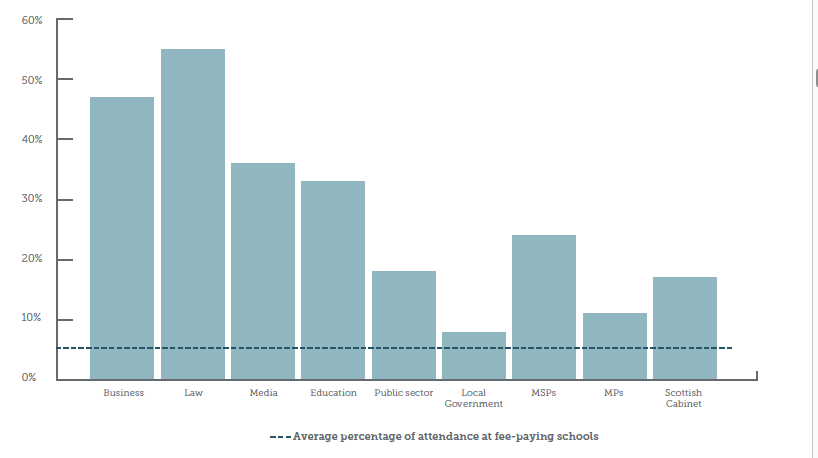
The answer may lie on the DHI’s original 2015 study, focusing solely on education. While, in their 2020 study, the educational disparity is more severe than either the gender and racial parameters on which they place such emphasis. Consider Figure 1 below:

Figure 1: Percentage of Leaders with Private Education by Segment

According to the Scottish Council of Independent Schools (SCIS),  in 2016, some 29.647 pupils attended private schools, meaning 4.1%t of children in Scotland attend one of its 102 private schools (73 are members of the SCIS. Pupil numbers have been declining as fees have risen by more than 23%, with the average annual cost climbing from £11,410 to £14,127.

Is there a reason why families shell out 2/3rds of a median wage when council-run schools are generally good and totally free? Well, yes. The data in Figure 1 shows why. Even Council Chief Executives pull down a salary of over £100,000, with job security and a 50% pension. Investment in six years of private high school is repaid within a year.

The smooth passage of private school alumni to leadership roles is eased by the fact that they represent 26% of the student body at Scotland’s four ancient universities of in 2014/15, with 71% in total receiving an offer of admission at one of the four, compared to only 29% of state-school entrants. Becoming a leader without a degree is becoming progressively unlikely. Scottish private schools are perceived by many to be heavily influenced by the culture, practices and ethos of English independent, or “public”, schools. The perceived English influence in many of these schools was such that in 1887 one author referred to them as “English schools.

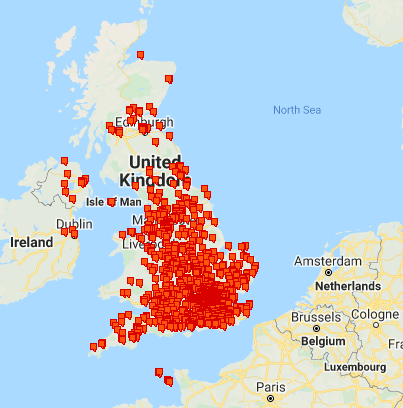
The comparison with Eton, Harrow, Winchester, etc. bears out. The number of leaders in England who attended public (i.e. private) school there is compares well with Figure 1, with the Eton + Christchurch Oxford route proving particularly successful for those heading into politics or the Civil Service. The distribution of private schools in the UK is shown in Figure 2:

Figure 2: UK Distribution of Private Schools

The disparities n Scotland mirror those prevalent in England for centuries. It is therefore hardly surprising that the private school remains instrumental in shaping the leaders of tomorrow. Given that attendance of BAME and female pupils at Scotland’s private schools would appear to be far more relevant than racial or gender bias in the organisations themselves.

To combat the appearance of being unattainably elitist, an average 24.5% of private school pupils receive some financial help and 3.1% are fully funded. Given that, of the 102 private schools across Scotland (only 73 in the SCIS), 3 are for girls and 17 are co-ed. This implies under 15% of places are available for girls. This makes the 32% of Scottish leaders who are female a magnificent achievement, given this starting disadvantage. There are few stats on racial mix in private schools. Our minorities are not well represented among the wealthy, implies under 3.9% of private pupils are BAME.

The Scottish establishment remains just as adept at maintaining its own as that in England, and this is done, as in England, by a system of advancement grounded in private schooling. As long as this prevails, the old Scottish tradition of hard work and lad o’ pairts advancement will remain a cultural myth and advancement will be held in thrall to a venerable English system of appointing nomenklatura that has also existed in Scotland since the Union. To see what happens when wealth is the key in educational success, you need only look at the USA and its gross inequality in life opportunities.

Perhaps it is time for Scotland to remove this risible ‘charity’ status for private schools. They would still function, but without taxpayers subsidising their elitist access to power.  Advancement toward the egalitarian balance the DHI paper seeks requires a more level educational playing field, so all our children might achieve their leadership potential—as already happens in New Zealand and Norway.

Posted in Community, Education | Leave a comment

New Verse for Ane Auld Sang

Many Indy supporters are whooping for joy and loudly quoting a Survation poll in the Sunday Herald (October 11th) that documents eroding unionist conviction. One third of those voted NO six years ago have changed their minds.

“…the No vote has effectively collapsed. The Survation poll of 2,093 respondents found that almost one third of 2014 NO voters would now vote YES. Nearly twice as many NO voters have moved to YES than have in the opposite direction…” —Bella Caldona blog

 However, before those joyful independistas break out the bubbly and speculate who is best suited to become the first ambassador to Bermuda, first consider four bucketfuls of rain dampening your parade:

  1. While winning two NO voters over to YES for each one going the other way, that shows a softness in support for either side. Not only does this raise an alarm because  voters have a record of turning feart in the polling booth. Even if the stats were true, this still does not provide a support at the “well over 60%” that pundits regard as necessary for a decisive win.
  2. Even if the SNP win big in May on an Indy manifesto, Boris will say ‘NO’. This may be called unjust, undemocratic, etc., but examine quasi-dictatorial moves Trump has got away with for four years—against a written constitution. Boris will enjoy support in this from Labour & Lib-Dems, as well as his own normally stroppy backwoodsmen Tories.
  3. An earlier blog, revealing despair among arch-unionists from Scotland at The Spectator, is encouraging, but not conclusive. The thrust of that blog was that informed commentators like that have never despaired to that extent before. Douglas Ross may be out of a similar mould to Jackson Carlaw, one of Young Farmers & County Balls, rather than douce suburbs & golf clubs, but Ruth is their best street fighter. If they have any sense, they’ll put her in charge.
  4. Much of this new support comes from people appalled by inept Westminster handling of the pandemic.  Nicola, on the other hand, has shown more effective leadership. She’s front and centre daily and even admits to mistakes. Why this should have more than compensated for repeated dithering by her Cabinet and the absence of palpable progress in Education, Health, Social Care, Economy, etc., mystifies most observers—including this one.

In other words, Indy has an appreciable way to go. This journey does not just involve overcoming Westminster intransigence, much less baffled incomprehension across the Establishment how anyone could be so foolish as to abandon the heaven that is England. This last is important, because it does not occur to the pukka people of Tunbridge Wells, Chiping Norton et al that ‘England’ and ‘Britain’ are not synonymous, except when humouring the Celtic fringe.

In fact, this conflation is the Achilles heel of the Union. No matter the strength of  economic argument that Scotland is “too poor; too weak; too wee” to go it alone; No matter emotional, historic ties that “we faced down Fascism together”; No matter the North of England suffers even more than the Scots from neglect—the imperial capital, the source of all power, all wealth, all culture suffers cultural myopia. And this is the petard by which Unionism will be hoist. Centralised self-belief by which Westminster lives will be the downfall of Unionism. Even the Scottish Tory leader realises this:

“The case for separation is now being made more effectively in London than it ever could in Edinburgh.” Douglas Ross MP, speech to Conservative conference, October 3rd 2020

For an example of why this is so, roll time back 140 years and settle into the politics of 1880. Britain was at its peak of influence and prosperity, yet the hubris shown by Disraeli and his Tories resulted in Gladstone’s Liberals sweeping to power, helped by a massive batch of 80 Irish MPs under Parnell. Anglo-Irish landlords, endemic poverty and decimating potato famine made Ireland a sullen embarrassment to imperial pride. But, try as he might, Gladstone made no progress to assuage Irish feelings in the teeth of unionism, English jingoism and a House of Lords stuffed with land-owning Tory peers, intolerant of upstart nonsense like Irish Home Rule. Even George V’s acceptance that it would be better to let Ireland go peaceably could not move them.

This festered inconclusively on until it exploded into the Easter Rising of 1916, merciless executions, making martyrs of its leaders, three years of post-war repression by the Black and Tans, followed by Lloyd-George’s sleight of hand in retaining the Six Counties while grudgingly granting Eire its independence.

Did the English National Party (a.k.a. the Conservative & Unionist Party) learn nothing from its history of colonial arrogance? Even post-WW2, Mau-Mau in Kenya; Eoka in Cyprus; Communists in Malaya, all dared question London’s right to rule—and paid with many lives.

It is a matter of proud record that no-one has been killed, or even seriously hurt, in the cause of Scottish independence. There is no sense of a Scots rising occupying the old Post Office building at Waverley—not least because it’s now HQ for Lothian NHS. But there is no need for such rough-housing, not least because the Scots have a much more positive attitude to the English now than the Irish had a century ago. what goes around comes around; a century after, polls in another ‘home’ country of the Union point to this history repeating itself, if more peaceably.

It is this uber-English assurance, posing as unionism, that will do for the likes of Johnson, Gove, Rees-Mogg et al. While yeoman backwoodsmen of the Tory party recognise them as standard bearers of joint ambition, Scots will be equally convinced they could do better. Why be ruled for another 300 years by attitudes gleaned from public school and grouse moor when Ireland or Norway show how much better your future can become if you let go of nurse and find the courage to believe in yourself

Posted in Politics | Leave a comment