Betting On the ‘B’ Team

By now, we are all fed up with our lives being dominated by wall-to-wall coverage of Covid-19 and the indefinite nature of plans to contain it. Even those still able to work need a distraction, since holidays, socialising, nights out, and even a quiet drink with a good friend, are all off-limits. We need an entertaining distraction to take our minds off the resulting drabs. Thankfully, our considerate American cousins have supplied it.Normally, US Presidential Elections are of tangential interest to us. They are ritual affairs, involving perfectly coiffed grand-dads in suits, with a lot of red, white & blue razzmatazz thrown in. But not this year. We have an extraordinary vaudeville show that is entertaining half the planet. Say what you like about Donald Trump, but he has transformed the 2020 contest into a riiveting reality-TV show that makes Big Brother or Jerry Springer look bland.

Amidst all the tut-tutting and sucking in of breath from ‘serious’ commentators like the NY Times and the Washington Post about the damage Trump is doing to the US political establishment at home and the image of America abroad, The Donald is actually doing the world—not just 334,000,000 Americans—a big favour.

Because it was time for the boisterous teenager that was America to grow up.

That may seem a disparaging, if not insulting, comment to make about the country that has been ‘the leader of the free world’ and by far the richest economy for half a century. Indeed, it has shed benefits beyond its borders:

  • the New Deal that ended the Depression
  • the Arsenal of Democracy that out-produced the Fascists
  • the Marshall Plan that rebuilt shattered countries
  • the United Nations
  • the space program
  • the electronics second industrial revolution.

No other country—including China and the Soviet Union—had the resources, the can-do chutzpah and diverse talent, drawn from around the world to achieve all that. But the resulting hegemony had to end sometime.

In the aftermath of WW2, no country but the Soviet Union could have challenged America’s economic dominance. And forty years of trying left it in the dust, giving a end-of-Cold-War windfall to spread prosperity much wider than America itself. Because their main idealogical foe had crumbled, American enduring faith in the superiority of their culture over all others was reinforced.

Few Americans alive can recall the Depression. What older citizens remember are halcyon days of the fifties and sixties when gas, white goods, cars and even houses were cheap, land seemed infinite, resources were plentiful and even blue collar work paid handsomely. Thousands of factories, created to re-arm the country, turned out consumer goods and everyone had the money to snap them up.

There was a dark side to all this. The growth of what Eisenhower decried as the “military-industrial complex” and covert operations by the CIA, both justified by the perceived Communist threat, led to America assuming the role of ‘The World’s Policeman”. Despite public protestation of “protecting our ftrrdoms” this led to a series of misjudgements. Those driving these decisions lacked experience of other cultures and justified actions with the simplistic morality of Hollywood war films since John Wayne stormed the Sands of Iwo Jima. This led to major miscalculations like the Vietnam War and minor ones like Bay of Pigs, Nicaragua, Lebanon and Somalia. Given the present state of both countries, the ‘victories’ in Iraq and Afghanistan now seem no such thing.

The resentment this caused across the globe has had little effect in chaning America’s geopolitical stance. The primary reason why the USA has not is that both President and Congress pander to a public disinterested in foreign affairs. Political focus is internal, sometimes even local and parochial. No country is entirely free of this. But small countries like Singapore and Switzerland are so dependent on foreign relations that it looms large in their politics. Even important economies like Germany and Japan rely heavily on exports for their prosperity, and act accordingly. The USA has neverr operated under any such constraint.

So, while all politicians play to a domestic gallery, no country does it on the scale of the USA, nor with such international impact. In 1930, the Smoot-Hawley Act was signed into law by President Hoover, slapping tariffs on thousands of goods entering the country ‘to protect American business’. The result was the Great Depression.

It is not hard to find the spirit of Smoot-Hawley alive and well in most of Trump’s actions, especially those affecting international relations. His success in 2016 and his resilient popularity even today is grounded in shameless pandering to that large section of the American public (mostly, but not entirely, Republican) who have never been abroad and regard the Constitution as holier than the Bible. They don’t just see America as the greatest country in the world, but that benighted foeignes all aspire to be American. To them, there is no reason why halcyon days of the sixties cannot return.

This attitude derives from the country being so huge, with abroad being seen as irrelevant; it is because education focuses on teaching America’s greatness and unconditional loyalty to it. It is not brainwashing They simply have no other countrry with which to compare themselves, as the Dutch must deal with Germans or the Dames with Sweden. Without that, a fertile field of jingoism can be harvested by simplistic sound bites, in which Tump has shown himself to be fluent.

So far, the case being made is negative: that another Trump term will further blind American ambition with platitudes rooted in the past. Such inertia will permit Asia to eat their economic lunch. But why should Americans vote for the ‘B’ team of Biden? The man is old, uninspiring, slurs his words, has no more dynamic policies than Trump does. Is he the best they could find to challenge Trump’s planetary ego?

Because Biden will not be running the show the way Trump does. Reagan is fondly remembered as President. His tenure 1980-1988 was a time of prosperity, of recovery of global profile after Vietnam and of telling Gorbachev where to get off. How was this achieved, when Reagan was just an affable ‘B’ movie actor who was the same age as Biden? Indeed, Reagan wasn’t smart enough to do the job. But he was smart enough to know he wasn’t smart enough—so he gathered a Cabinet around him who were.

Quite apart from it running counter to his nature, Tump wasn’t smart enough to do that. But Biden will. He will staff the wreckage left by Tump among the departments of state with something other than a revolving door of yes-men. And, given the deep resentment among thousands of civil servants trying to be professional amidst chaos, he will be given a fair wind to do so.

Sadly—and perhaps more importantly—Biden may not last his term. POTUS is a tough job. If he wins, Biden would be 81 at the end of his term. Given his somewhat shaky performances to date, he may not last the term. And if he didn’t…

…Kamala Harris would become America’s 47th and first female President, sill in her fifties. She does not carry the ‘Washington insider’ baggage that scuppered Hilary Clinton’s bid. Harris gives every indication that she is smart enough to know not just who to include in her Cabinet, but also how to mend fences abroad that Trump has taken delight in wrecking to achieve political advantage at home.

Biden is Old School and so unlikely to even try to nudge America into a more collegiate role in the world . But Harris would revive the more thoughtful, statesmanlike approach followed by Obama.  Harris may be the one to de-fang gun-toting retrogrades among Trump’s followers and chart a less overbearingly macho course for the 21st century.

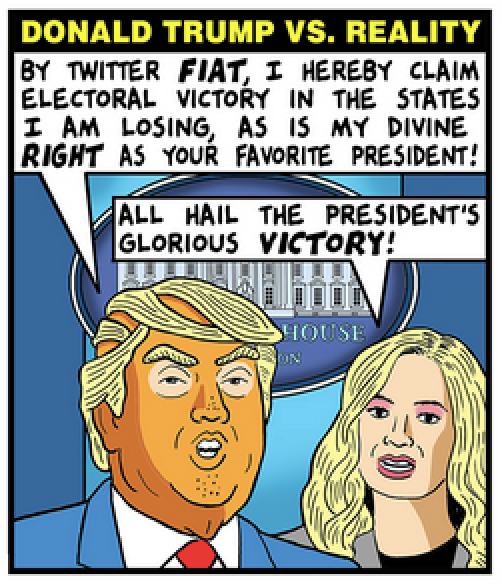
The big question is: can Biden secure a wide enough margin of victory, such that Trump’s blatant plan to cast doubt on results beforehand, so he can challenge them if they are close, will come to nothing? But, if the result is clear by Wednesday November 4th, America may finally outgrow the teenage tantrums of the last four years.
Posted in Politics | Leave a comment

Let’s Level Up, not Dumb Down

The previous blog “Our Private Fount of Inequality argues that a major contributor to inequality of opportunity to become a leader in Scotland stems from a self-reinforcing establishment, based on attendance at private (i.e. ‘fee-paying’ or ‘independent’) schools. The case was made to remove to counter this by removing charitable status from such schools as a first step to rectify ‘systemic inequality’. While accepting this step as one possible move, a reader of this blog, long committed to improvement in education, took the trouble to comment at length. The key point made was that improvement to standards in the state sector must precede any meaningful adjustment to the private sector for educational improvement (and related social equality) to be achieved. What follows below is an interpretation of his contribution:

Private schools are a major contributor to educational standards across Scotland. Their pupils consistently perform well in national examinations, university entrance ad subsequent careers. What can be said to distinguish private from state schools is their mantra that ‘the world is your oyster’ rather than ‘the oyster is your world’. They offer smaller class sizes, many extra-curricular activities (especially sport) and a more robust governance. The ‘establishment’ networking effect referred to is actually diminishing over time.

Scotland publishes annual ‘league tables’, ranking exam results achieved. If you took out the top twenty state schools: Boroughmuir, Jordanhill, James Gillespie, North Berwick, etc. (all with affluent catchments), those state schools remaining would provide only a small proportion of the country’s leaders.

The question is: why is the overall education provided by state schools generally not comparable to that in the private sector. The quality of teaching staff and the personal commitment of each teacher may be comparable. Facilities vary, but in many state schools they are comparable. It is quality of leadership, in school administration and in guidance provided by education authorities, where the problem seems to lie.

As an example, response to the Covid pandemic was more effective in the private school sector than in most state schools, which is not explicable by differing financial resources. Council-controlled education authorities seem hamstrung by a culture of ‘not getting it wrong’, rather than ‘getting it right’. The resulting weak leadership, a dither when faced with the unfamiliar, puts state school pupils at a disadvantage. 

The case to continue charitable status may be weak, as unequal pupil opportunity undoubtedly contributes to social inequality. But, before any change to their charitable status is made, the financial and other implications need to be researched and evaluated.  Below are questions that require answers before any removal of charitable status from private schools should be considered: 

  • Are there adverse economic and social consequences, locally or nationally? 
  • To what extent are fee paying schools dependent on their charitable status?
  • How do fee-paying schools contribute to their wider communities?
  • How could this contribution be beneficially expanded? 
  • Which schools and where may close as a result
  • What facilities lost as a result? 
  • What would be the likely effects on local employment?
  • Would a smaller, more expensive fee-paying sector be perceived as more ‘fair’
  • How many more pupils will the state have to cater for if closures take place? 
  • How can specialist pupils (e.g. those with a particular talent) be developed as well in the state sector as well as at present in a private? 
  • Which social groups will benefit most and which will suffer most? 
  • What is the likely net impact on state tax revenues?
  • What are the ramifications for the tax status of other educational institutions, such as the Russell group of universities, whose intake from fee paying schools is disproportionately large

Removing charitable status in Scotland alone appears more of a flag-waving exercise than offering real economic and/or social benefits. If such a change were confined to Scotland, private school there would be put at a serious disadvantage to much more numerous private schools in England. The removal of charitable status would be easier to support if it were implemented uniformly across the UK.

Many private schools, already impacted badly by Covid, and especially boarding schools in rural areas, would no longer be viable and have to close. This would adversely affect local employment.  Parents who could afford it would send their children south of the border.

Other measures beside removing charitable status should be considered in parallel. For example, ‘school empowerment’, to reduce the Council’s role could replicate the initiative common in private schools and equalising opportunities. Fee-paying schools are often selective in their intake and more ruthless in dealing with pupils displaying behavioural problems. Extending this to include expulsions is likely to meet opposition from the present Scottish Government and from teaching unions for two reasons, at least:

  1. The principle of inclusion, irrespective of pupil behaviour
  2. Ingrained attitude of teacher salary based on length of service, not on performance

Teaching unions have been contributor to private/state differences, but it has been local authorities who have been complicit in not requiring more engagement and initiative from union members since well before the McCrone Agreement.

So, do we need private schools? Having fewer private schools, or even none at all, might level educational standards, but downward. On the other hand, it would also introduce a more vociferous lobby to raise standards; private sector parents tend to be vocal, engaged and less tolerant of poor school leadership. 

Fewer private schools would require a corresponding increase state education provision. Would this constitute educational improvement? Were private schools to lose their chartable status, the increased tax revenue would not necessarily accrue to education. The net result may result in a ‘dumbing down’ rather than a ‘building up’.  

Posted in Education | Leave a comment

Our Private Fount of Inequality

In 2015 the David Hume Institute (DHI) published Elitist Scotland? in partnership with the Social Mobility Commission, examining the education diversity of the top decision makers in Scotland. Five years on, they increased the scope of analysis to include gender and ethnicity of people in key leadership positions. This new analysis showed:

There has been progress in some sectors but others are still lagging behind. Across the 708 individuals identified as part of this study,(a) double disadvantages unmistakable.

  • 32% of top leaders are female
  • 1% of top leaders are people of colour.
  • 0.9% of top leaders are British Asians

There is undoubtedly a civic challenge in these figures. Clearly, women comprise around half the population. largest BAME minority group in Scotland is British Asian, who

2.7% of the population and Black/Caribbean at 0.9%. From these figures alone, the disparity in gender/racial mix among Scotland’s top leaders seems clear.

However, in the present climate of political uber-correctness, there may be some danger of the equality baby being thrown out with the orthodoxy bathwater. History relates a number of attempts to rectify disparities with the best of intentions. Forty years ago, the state of California introduced Spanish-language high schools into predominately latino neighbourhoods. Although latino pupils did well at school, they found it doubly difficult to find jobs and further education in a society that spoke English.

It is true that, a century on from universal suffrage and half a century on from racial diversification, letting nature take its course has failed to produce a representative balance among Scotland’s leaders. But, rather than a Pavlovian jumping on the BAME/feminist bandwagon, it may be better to dig deeper to identify institutional causes, against which enlightened attitudes have yet failed to make much progress. For fairness, of 708 leaders should include 113 more women and 18 more people of colour (perhaps overlapping) to achieve the balance desired. If similar-sized countries as far apart as New Zealand and Norway can do it, why can’t Scotland?

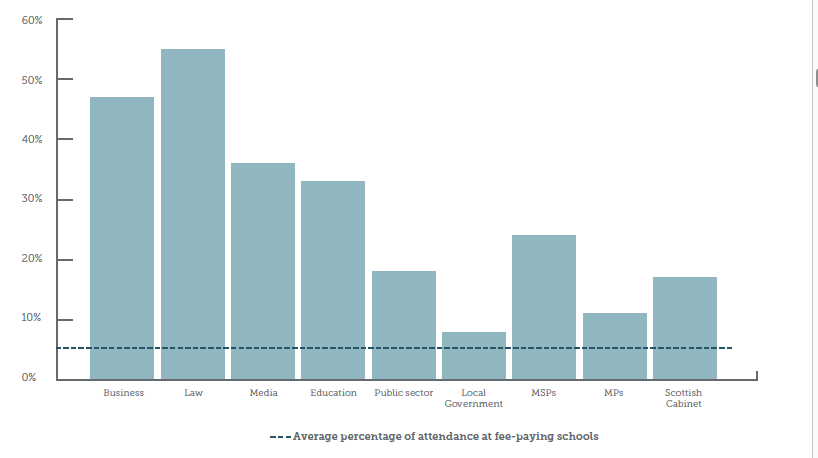
The answer may lie on the DHI’s original 2015 study, focusing solely on education. While, in their 2020 study, the educational disparity is more severe than either the gender and racial parameters on which they place such emphasis. Consider Figure 1 below:

Figure 1: Percentage of Leaders with Private Education by Segment

According to the Scottish Council of Independent Schools (SCIS),  in 2016, some 29.647 pupils attended private schools, meaning 4.1%t of children in Scotland attend one of its 102 private schools (73 are members of the SCIS. Pupil numbers have been declining as fees have risen by more than 23%, with the average annual cost climbing from £11,410 to £14,127.

Is there a reason why families shell out 2/3rds of a median wage when council-run schools are generally good and totally free? Well, yes. The data in Figure 1 shows why. Even Council Chief Executives pull down a salary of over £100,000, with job security and a 50% pension. Investment in six years of private high school is repaid within a year.

The smooth passage of private school alumni to leadership roles is eased by the fact that they represent 26% of the student body at Scotland’s four ancient universities of in 2014/15, with 71% in total receiving an offer of admission at one of the four, compared to only 29% of state-school entrants. Becoming a leader without a degree is becoming progressively unlikely. Scottish private schools are perceived by many to be heavily influenced by the culture, practices and ethos of English independent, or “public”, schools. The perceived English influence in many of these schools was such that in 1887 one author referred to them as “English schools.

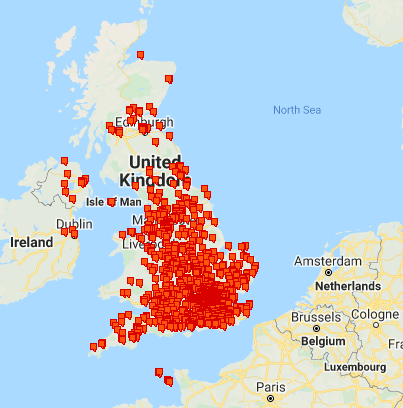
The comparison with Eton, Harrow, Winchester, etc. bears out. The number of leaders in England who attended public (i.e. private) school there is compares well with Figure 1, with the Eton + Christchurch Oxford route proving particularly successful for those heading into politics or the Civil Service. The distribution of private schools in the UK is shown in Figure 2:

Figure 2: UK Distribution of Private Schools

The disparities n Scotland mirror those prevalent in England for centuries. It is therefore hardly surprising that the private school remains instrumental in shaping the leaders of tomorrow. Given that attendance of BAME and female pupils at Scotland’s private schools would appear to be far more relevant than racial or gender bias in the organisations themselves.

To combat the appearance of being unattainably elitist, an average 24.5% of private school pupils receive some financial help and 3.1% are fully funded. Given that, of the 102 private schools across Scotland (only 73 in the SCIS), 3 are for girls and 17 are co-ed. This implies under 15% of places are available for girls. This makes the 32% of Scottish leaders who are female a magnificent achievement, given this starting disadvantage. There are few stats on racial mix in private schools. Our minorities are not well represented among the wealthy, implies under 3.9% of private pupils are BAME.

The Scottish establishment remains just as adept at maintaining its own as that in England, and this is done, as in England, by a system of advancement grounded in private schooling. As long as this prevails, the old Scottish tradition of hard work and lad o’ pairts advancement will remain a cultural myth and advancement will be held in thrall to a venerable English system of appointing nomenklatura that has also existed in Scotland since the Union. To see what happens when wealth is the key in educational success, you need only look at the USA and its gross inequality in life opportunities.

Perhaps it is time for Scotland to remove this risible ‘charity’ status for private schools. They would still function, but without taxpayers subsidising their elitist access to power.  Advancement toward the egalitarian balance the DHI paper seeks requires a more level educational playing field, so all our children might achieve their leadership potential—as already happens in New Zealand and Norway.

Posted in Community, Education | Leave a comment

New Verse for Ane Auld Sang

Many Indy supporters are whooping for joy and loudly quoting a Survation poll in the Sunday Herald (October 11th) that documents eroding unionist conviction. One third of those voted NO six years ago have changed their minds.

“…the No vote has effectively collapsed. The Survation poll of 2,093 respondents found that almost one third of 2014 NO voters would now vote YES. Nearly twice as many NO voters have moved to YES than have in the opposite direction…” —Bella Caldona blog

 However, before those joyful independistas break out the bubbly and speculate who is best suited to become the first ambassador to Bermuda, first consider four bucketfuls of rain dampening your parade:

  1. While winning two NO voters over to YES for each one going the other way, that shows a softness in support for either side. Not only does this raise an alarm because  voters have a record of turning feart in the polling booth. Even if the stats were true, this still does not provide a support at the “well over 60%” that pundits regard as necessary for a decisive win.
  2. Even if the SNP win big in May on an Indy manifesto, Boris will say ‘NO’. This may be called unjust, undemocratic, etc., but examine quasi-dictatorial moves Trump has got away with for four years—against a written constitution. Boris will enjoy support in this from Labour & Lib-Dems, as well as his own normally stroppy backwoodsmen Tories.
  3. An earlier blog, revealing despair among arch-unionists from Scotland at The Spectator, is encouraging, but not conclusive. The thrust of that blog was that informed commentators like that have never despaired to that extent before. Douglas Ross may be out of a similar mould to Jackson Carlaw, one of Young Farmers & County Balls, rather than douce suburbs & golf clubs, but Ruth is their best street fighter. If they have any sense, they’ll put her in charge.
  4. Much of this new support comes from people appalled by inept Westminster handling of the pandemic.  Nicola, on the other hand, has shown more effective leadership. She’s front and centre daily and even admits to mistakes. Why this should have more than compensated for repeated dithering by her Cabinet and the absence of palpable progress in Education, Health, Social Care, Economy, etc., mystifies most observers—including this one.

In other words, Indy has an appreciable way to go. This journey does not just involve overcoming Westminster intransigence, much less baffled incomprehension across the Establishment how anyone could be so foolish as to abandon the heaven that is England. This last is important, because it does not occur to the pukka people of Tunbridge Wells, Chiping Norton et al that ‘England’ and ‘Britain’ are not synonymous, except when humouring the Celtic fringe.

In fact, this conflation is the Achilles heel of the Union. No matter the strength of  economic argument that Scotland is “too poor; too weak; too wee” to go it alone; No matter emotional, historic ties that “we faced down Fascism together”; No matter the North of England suffers even more than the Scots from neglect—the imperial capital, the source of all power, all wealth, all culture suffers cultural myopia. And this is the petard by which Unionism will be hoist. Centralised self-belief by which Westminster lives will be the downfall of Unionism. Even the Scottish Tory leader realises this:

“The case for separation is now being made more effectively in London than it ever could in Edinburgh.” Douglas Ross MP, speech to Conservative conference, October 3rd 2020

For an example of why this is so, roll time back 140 years and settle into the politics of 1880. Britain was at its peak of influence and prosperity, yet the hubris shown by Disraeli and his Tories resulted in Gladstone’s Liberals sweeping to power, helped by a massive batch of 80 Irish MPs under Parnell. Anglo-Irish landlords, endemic poverty and decimating potato famine made Ireland a sullen embarrassment to imperial pride. But, try as he might, Gladstone made no progress to assuage Irish feelings in the teeth of unionism, English jingoism and a House of Lords stuffed with land-owning Tory peers, intolerant of upstart nonsense like Irish Home Rule. Even George V’s acceptance that it would be better to let Ireland go peaceably could not move them.

This festered inconclusively on until it exploded into the Easter Rising of 1916, merciless executions, making martyrs of its leaders, three years of post-war repression by the Black and Tans, followed by Lloyd-George’s sleight of hand in retaining the Six Counties while grudgingly granting Eire its independence.

Did the English National Party (a.k.a. the Conservative & Unionist Party) learn nothing from its history of colonial arrogance? Even post-WW2, Mau-Mau in Kenya; Eoka in Cyprus; Communists in Malaya, all dared question London’s right to rule—and paid with many lives.

It is a matter of proud record that no-one has been killed, or even seriously hurt, in the cause of Scottish independence. There is no sense of a Scots rising occupying the old Post Office building at Waverley—not least because it’s now HQ for Lothian NHS. But there is no need for such rough-housing, not least because the Scots have a much more positive attitude to the English now than the Irish had a century ago. what goes around comes around; a century after, polls in another ‘home’ country of the Union point to this history repeating itself, if more peaceably.

It is this uber-English assurance, posing as unionism, that will do for the likes of Johnson, Gove, Rees-Mogg et al. While yeoman backwoodsmen of the Tory party recognise them as standard bearers of joint ambition, Scots will be equally convinced they could do better. Why be ruled for another 300 years by attitudes gleaned from public school and grouse moor when Ireland or Norway show how much better your future can become if you let go of nurse and find the courage to believe in yourself

Posted in Politics | Leave a comment

Black History? What Black History?

This will be a controversial blog. I say this because, this ha been designated “Black History Month” and, no matter how much I protest colour-blindness when it comes to people and, having worked with and for black people during 16 years in the USA, modern social attitudes may equate disinterest in black history with racism. Having traveled the world, living and working in three countries furth of Scotland, embracing their culture (rather than seeking out British pubs), my cosmopolitan credentials ought to dispel any taint of racism. Nonetheless, It’s best to get my rebuttal in first.

The reason the concept of black history seems alien to me has nothing to do with its validity. Communities with black heritage have much celebrate and I hope this month succeeds in bringing that heritage to wider attention. As with other cultures, there are aspects of black culture I appreciate (jazz; blues; athletics) I admire, and others (reggae; rap; West African art) that I don’t. This is a matter of taste, as with most people. That I am left cold by Kabuki or Hinterglasmalerei does not imply racial hatred of either Japanese or Germans.

What I fail to understand is a sudden featuring of black culture across Scottish media when there are few black people here to appreciate it. When an American friend visiting Scotland for the first time was asked what she thought of it, she said: “it’s very nice—picturesque and full of character. But it’s so white bread”.

And she was right. There is much les racial mix here when 92% of 5,404,700 residents here identify as “white”. A further 3% identify as “Asian” and almost 4% declined to supply racial identity. The African/Caribbean/Black pooportian had increased by 28,000 since 2001, bringing it to 1%. Like most Scots, I welcome this increase in diversoty and would not object to jerk chicken replacing curry as Scotland’s national dish, even as I remain partisanly partial to McSween’s haggis.

So, by all means, let those with heritage and/or interest celebrate Black History month. Where this seems unbalanced is proper celebration by the over 90% white, 80% of whom (and 34% of ethnic minorities) declare their national identity a “Scottish” seems comparatively absent. This goes much deeper than St Andrew’s Day or Burns celebrations being scuppered by Covid-19. It goes well beyond “we wiz rubbish” 90-minute patriots decried by Jim Sillars, who think Mel Gubson got it right in Braveheart.

It’s also not about bookish study of links with the Irish, Norwegians, Netherlanders, French or Russians, once more important than those the English unionists harp on. Over 400 years, England has, understandably, imposed culture on ours, being 10 times our size, holding the seat of power all that time, devolution included. Go to titled homes or the Honourable Company f Edinburgh Archers and ‘received pronunciation’ English accents predominate. Many a lad o’ pairts make good by taking the London road.

This is not a swipe at the English, any more than it is at blacks. But ask anyone on Princes Street or Buchanan Street or Union Street and ask: Who was the Earl of Stair? or; what language did Lothian once speak? or; who was Somerled? What is New Lanark? or; who was John McLean? and you are likely to get blank stares.The Swiss know a lot more about themselves than William Tell. The Japanese could teach us much about honourr and community. People who know and celebrate their culture seem to hav less need to resent or blame someone else’s. There is a nationalism that is neither right-wong, nor belligerent, but rooted in pride and self-knowledge.

While Scots—largely Glasgow tobacco barons—were involved in slavery, the 3 million transported to the Americas from Africa were in English, Portuguese and Dutch ships. The tragedy affecting Scotland far more at the same time was the brutality of the Highland Clearances. The millions of the Scots diaspora now settled in Nova Scotia, Ontario, the Carolinas, the Appalachians, Australia, fragments of Poland and Russia, even Patagonia hold Highland Games and attend clan gatherings—but know little more than their cousins where of the story behind eyeless black houses open to the sky in abandoned clachans scattered from Kintyre to Caithness. They should.

It is the story of Scotland’s greatest tragedy—far more tragic than the loss of Berwick or Flodden or the finale that was Culloden. Ever snce George’s IV’s showy visit to Scotland in 1822, tailors and tat-sellers have made a good living out of “Scottish” culture. But, historically, minutely specified clan tartans, pleated kilts and louping sword dances are a myth, if not a cynical travesty.

Because Scotland used to be schizoid, a country divided between the more affluent, English-speaking Lowlands, where the power and money lay, and the wilder Gaelic-speaking and much-hated Highlands. “Mi-run mor nan Gall” (the Lowlanders’ great hatred) was how the clans described the schism. The hatred was largely earned, given the clans’ inclination to form “The Gallows Herd” and raid the fatter lowlands three ways from Sunday.

But those who died during cattle raids were as nothing, compared to forces deployed from Edinburgh (and, after 1603, London), to quell Scotland’s obstreperous untamed half. It began with the dismantling of the Lordship of the Isles,gathered pace with the Glencoe Massacre and Jacobite risings, to culminate in a concerted effort by government and clan-chiefs-become-landed-gentry to replace unprofitable clansmen with sheep and herd the population into productive ‘industry’ like fishing, kelp collecting and crofting.

Few enterprises so set up prospered. How many starved when the market for kelp disappeared or the potato blight decimated the crop is unknown, but a quarter million were displaced were displaced and their culture destroyed. Some 75,000 of them escaped their homeland altogether—more than double the present number of black people in Scotland, almost all of whom arrived—by choice—in the last 50 years. They are all welcome—Scotland is not full up and needs their talents.

While recent academics have played down the brutality and pitilessness of the landowners and their factors, books like John Prebble’s The Highland Clearances (Penguin, nut o.o.p) provides copious insight into the destruction of a culture that was not a genocide any more than slavery was a genocide: because the brutality and resulting deaths were not intentional, for all the dearth of humanity involved.

Which is why Scots should first learn about outrages perpetrated within their own country by brutal people reaching progress and enlightenment so that we may better understand the history of black people—and therefore black people themselves.

Encourage Sellar (her factor, subsequently tried for brutality) in trouncing these people who wish to destroy our system … I do hope the aggressors will be scourged” —Duchess of Sutherland (Her estate evicted 15,000 people)

Posted in Community, Politics | Leave a comment

Boris: The Union’s Last PM

Regular readers of this blog will know that it has long been sceptical about the prospects of Scotland remaining in the United Kingdom and has presented arguments why this should be the case. Arguments elsewhere have been made to the contrary, many based on rational argument (as opposed to jingoistic tub-thumping) deserving of both respect and an audience. One thing of which both sides of the argument deserve to be proud is that no-one has even been seriously injured—let alone lost their life—in this serious argument between friends.

But this argument seems to have crossed the Rubicon of inevitability in the least expected of places. The Spectator is a sober, analytical magazine covering UK current affairs that was recommended to me by a politically-savvy friend. I have since described it to an equally-savvy American friend as “mildly left-wing to you, but mildly right-wing to me.” It is, like most London-based publications, pro-Union, but not venally so. Its contributors make cogent arguments that deserve consideration. It is augmented by a daily podcast, during which a staffer hosts a half-hour discussion of the topic of the day—again worth listening to.

The Chicken Little moment came during today’s podcast (Is There Still a Case for the Union, Saturday October 3rd), when host Katie Balls interviewed Fraser Nelson and Stephen Daisley (all of them Scots), who were joined by regular James Forsyth. The Saturday podcast passed quickly over the inexplicably buoyant popularity of Nicola Sturgeon and Alex Salmond to dwell on the prospect of the Union. All it needed was a cameo from Dad’s Army Private Fraser to declare “we’re all doomed“. I would have hoped Katie Balls might have ‘got it’. She’s from my home town of North Berwick, full of Tories and English accents—that I represented for 18 years as am SNP councillor.

What did run through my mind was their inability to channel the Bard and “see oorsel’ as ithers see us“, in that they anguished over threats to the Union without seeming to have formed an understanding whence they came. Were they typical denizens of the Home Counties, whose cultural radar barely reached no further than Watford, their puzzlement could be dismissed out of hand (c.f. Maggie’s Sermon on the Mound or Peter Mandelson’s bafflement over mushy peas)

Although James Forsyth can be excused by his classic Westminster-bubble nomenklatura credentials of education at Winchester & Cambridge, plus marriage to a director of communications in Boris’ government the rest have Caledonian roots. With Indy now leading Scottish polls, shouldn’t they know why? Are normally astute, incisive commentators letting emotion cloud judgement?

In the spirit of furthering debate without animosity, perhaps we can help.

Fraser Nelson’s despair that arguments of a dire fiscal future has had scant traction against independistas is deep and genuine. He wonders why unionists are so inept:

  • – talking about what the union means to us
  • demonstration the advantage of being part of the union family
  • arguing against making foreigners of friends and family by leaving the union

What if we couched all this in Brexit terms? Substitute “EU” for “union” and present it to the Brexiteers of your choice and you would get short shrift. The vast bulk of unionists are also Brexiteers. But few see similar arguments applied to England (which is what most of them mean when they say “Britain”) within the EU, also apply to Scotland within the union.

Although she was the presenter, Katie Balls was dragged into the discussion and opined that the middle of the Covid pandemic was no time to be considering splitting up the union. There is an argument for that, but it ignores opinion in Scotland. One hundred years ago, the carnage of WW1 and indifference to their cause due to preoccupation with it drive Irish nationalists to stage the Easter Rising, which led to brutal suppression, followed by a futile Black and Tan reign of terror that led to independence for Eire in 1922. The pressure of that dire situation intensified the Irish desire to make their own mistakes, rather than have paternalistic London foist mistakes like WW1 on them.

The parallels with Scotland are weak, especially with regard to violence. The Irish people were not persuaded to stay with the world’s most extensive and richest empire but chose relative poverty. They did not cherish continuing eight hundred years of close linkage with the English ‘family’ but used the subsequent linkage to remain close friends. And, finding new friends in Europe and a GDP better than Britain’s you would not get 10% of the population to vote for re-unification into the UK, if there were a plebiscite.

Had the Scots been independent already, there’s a fair chance they would be coping with it much better than now and following better examples like Denmark or Ireland, who do not have to track the daily distracting bluster emanating from Downing Street.

Stephen Daisley seems to see himself as the “shock jock” of Spectator columnists when it comes to reporting on the state of the independence argument in Scotland. His main difficulty seems to be that he swallows the Southern mantra that the SNP are xenophobic nationalists when he lives among them and should know better. His recent column comparing them to the John Birch Society. These are nasty, right-wingers, based in Orange County, California. During two years living there, I had first-hand experience of their extremism and found nothing in common with people I met during my 39 years in the SNP.

Yet Stephen bemoans that the SNP has “stolen the cultural identity” that “no politician identifies as Britain” that “nationalism is an alluring dream” that “points within Scottish cultural identity that nationalists have annexed to themselves”, as if this were not cricket, not playing by the rules. While the Scottish Office bombards him with press releases about how much the Westminster Government is spending in Scotland, he seems oblivious to the fact that this is not where the vortex of debate lies..

He does not seem to grasp that, with the Lib-Dems in limbo and Labour wandering leaderless in the wilderness, Scottish Tories, supposed to be the Opposition, sound like someone dug up the corpse of the Colonial Office, peddling a version of the British Raj. As a result, the SNP, for all their faults, are 33% ahead in the polls only seven months out from an election.

Perhaps the podcast participants are justified in being downcast, if only to stay loyal to their unionist credentials. But if they want to stay relevant as reporters, they should look at the Arab Spring, at Portugal in April 1973 or, yes, the 13 colonies  in the run-up to 1776. It wasn’t about investment or security or nostalgia. It was about a critical mass of people resenting being run by those with other agendas—and that it was high time something should be done about it.

The case for Scottish independence is being made in London more than in Edinburgh.

—Douglas Ross, Scottish Conservative and Unionist Party Leader, October 3rd 2020

Posted in Uncategorized | Leave a comment

Hoc Etiam Transibit (This Too Shall Pass)

The latest revelation who really runs the world comes from BuzzFeed News, who have shared a series of suspicious activity reports (SARs) filed by financial institutions with the US Treasury Department’s Financial Crimes Enforcement Agency, (FinCEN), You may think this is dry stuff and of interest only to fiscal anoraks. The 2,000+  SARs do indeed make dry reading, but their implications are serious, because:

  • They show money-laundering to be commonplace
  • Many major banks are involved in such activity
  • Crime syndicates, terrorist organisations and Russian oligarchs are all involved
  • Offshore holding companies under British jurisdiction are a major compinent
  • Virtually all the laundering activity passes through Britain at some point.
  • Governments, financial regulators and serious crime units are failing to prevent this

In itself, this is appalling. But this is just the latest in a series of revelations about how rich people get richer, no matter how dire life gets for the rest of us. You may have missed or forgotten earlier chinks in the armour of secrecy that protects the very rich, such as:

  • Paradise Papers (2017) were leaked documents, including corporate registries in 19 tax jurisdictions, revealing financial dealings of politicians, celebrities and business leaders.
  • Panama Papers (2016) The German Süddeutsche Zeitung obtained encrypted documents from the Panamanian law firm Mossack Fonseca, selling anonymous offshore companies that help the owners hide their business dealings. There was so much data it took a year, until April 2016, to be published, with the database of documents going online a month later.
  • Swiss leaks (2015) Investigation of HSBC Private Bank (Suisse) lifted the lid on dealings in a country where banking secrecy is taken for granted. More than 100,000 individuals and legal entities from more than 200 countries had used its services, including “those close to discredited regimes” and “clients unfavourably named by the United Nations”.
  • Luxembourg leaks (2014) These centred on how professional services company PricewaterhouseCoopers helped multinational companies gain hundreds of favourable tax rulings in Luxembourg between 2002 and 2010.
  • The Offshore Leaks (2012) Only a tenth the size of the Panama Papers but at the time,  the biggest exposé of international tax fraud. 2.5 million files revealed the names of more than 120,000 companies and trusts in hideaways such as the British Virgin Islands.

With that kind of record, we should not be surprised that the brash “Loadsamoney”  culture of Canary Wharf mught include operators to whom the hard task of  turning a profit need not become even harder by  becoming ensnared in morals. Those who have watched Leonardo diCaprio chew up the scenery in 2014’s Wolf of Wall Street or Michael Douglas define the ice-cold wheeler–dealer in 1987’s Wall Street should have little trouble imagining the people behind all this.

Those who pay their taxes, give way to other drivers and support deserving causes may have trouble grasping this mentality, let alone live it. But the fear is that such people are a dying breed and that Gordon Gekko is becoming the pin-up boy for those wanting to make their way in the world. Amnition is not, in itself, evil. But any sophisticated society relies on the huge majoroity of people to live by its standards, including morals, especially those of its leaders. Owen Jones’ 2015 book “The Establishment” gives a comorehesive, if left-wing, expose of how all this is perpetuated.

A century ago, society was hopelessly unequal but Edwardian Britain was a surprisingly cohesive society, because the vast majority believed in it, even those it disadvantaged. A similar attitude pervaded those caught up in the hardships and rationing of WW2. All that is now very much history. The more recent emergence of self has created a concomitant mistrust of those in charge which goes beyond the healthy questioning at the heart of democracy. The money-laundering ‘finocracy’ behind the most recent Buzzfeed News revelations are only one of the many examples of self-perpetuating oligarchies that undermine people’s belief in society and that it can be fair to them. Currently, Britain’s richest 1,000 are sitting on £512,000,000,000. Nice.

There is a dangerous assumption that Western Democracy, and the fiscal systems that are its life blood, is stable and can tolerate the abuses listed above. That it has survived and prospered through two world wars, one cold war and sundry financial panics shows it has strength and the ability to adapt. But how far?

Britain and America have led that society for two centuries. The Romans ruled an even more integrated society for twice that amount of time. A citizen could travel from the Tyne to the Tigris with no need of passport or currency exchange. An army of twenty legions and auxiliaries numbering 300,000 kept peace and held the frontiers. They could have done so indefinitely, had an internal decay of ambition and greed not turned it to fight internecine wars, letting  floodgates that had held back Caledonii, Vandals and Visigoths creak and collapse.

We may be at that point. Despite worthy international efforts, Africa and South America, Central America and the Middle East remain a pig’s breakfast of despotism, corruption and inefficiencies. Where there was once Western unity, frmer leaders Britain and the US are in the hands of inward-looking administrations led by blustering egotists in search of lost glories.

While Russia and China are like wolves circling two stags, wounded by their own hubris, America claims tax cuts, tariffs and tough talk will make them great again and Britain deludes itself it can be a global powerhouse when it lets its supposed “world class” finance centre make its money through laundering dirty money through offshore tax havens under a government that declines to prevent it. Why should they? They set up those tax havens in the first place.

Like Caligula and his kind, Trump’s family businesses, the Fred Goodwins, the Phillip Greens, the Aaron Abramovitches, will all be too busy exploiting fuzzy morals to  accumule and protect ever more proceeds to worry whether the ordinary punters who make Western democracy—and therefore their wealth— possible will put up with theur abuse, or turn into the Visigoths of the 21st centrury.

Posted in Uncategorized | Leave a comment

Do You Know Who I Used to Be?

As sundry wheels come off Boris Johnson’s Tory wagon as it careens from one U-turn to another, they seem to believe blindly incanting Zero Mostel’s mantra from Mel Brooks’ classic film, The Producers, will restore power and prestige to once-great Britain that he and his backwoodsmen supporters crave.

To be fair to him and acolytes like The Honourable Member for the 16th Century, he may actually believe he inhabits a Churchillian role: St Bojo of Wryslip rescuing an eyelash-fluttering Britannia from the clutches of Trotskyites at home and Juhnny Foreigners beyond the white cliffs. He will then escort her toward those sunlit uplands where green sward echoes to the ‘thwack’ of leather on willow, the shrieks of rosy-cheeked children and there is honey still for tea. Cue a swelling soundtrack segueing from Vera Lynn to Rule Britannia, with lyrics now gloriously restored.

Unless it stokes hostility towards others, there is nothing wrong with shared national pride and identity. But to be effective and unifying, it must also be relevant to the vast majority involved. Unfortunately, this resurgent brand of English jingoism comes unstuck on all three counts.

Firstly, it is largely not relevant because it is rooted in another era, when the world was a very different place. It is no wonder those tunes that stir Tory blood were composed when Britain did indeed rule the waves. Having overcome Louis XIV and Bonaparte, plus once-great Moghul and Chinese empires, who could stop us making mightier yet?. And a very nice profit we made from it too, without being too choosy about what goods were traded and how degraded the labour was to achieve it. The sop of Kipling;s ‘White Man’s Burden” served to salve the conscience. The disgrace of white superiority from that festers behind present Tory indignation over immigrants. Tory belief that Britain can again be an independent trade titan rests on naive nostalgia for when we possessed all the factories and could force the world to ship us raw material cheap and sell finished goods to them at high prices.

Secondly, it is not unifying because the present Tory government may talk about ‘the nation’ and ‘The Union’, but don’t seem to realise that they are an oligarchy of Home County types, those nabobs of South-East England who look increasingly like an alien occupation to people in Birmingham, Manchester and Newcastle, quite apart from Wales, Ireland or Scotland.

Their vision of Britain is actually that of a subset of England whose social mores and ambitions Thackery was already lampooning a century ago. Tories gloating over their breaching of the ‘Red Wall’ in December’s election should examine the Trojan horses now flooding their benches. For most of them are genuinely local and not from the genteel confines of Tunbridge Wells. For example, Katherine Fletcher, pragmatic new MP for Ribble South, a qualified scientist channrling Victoria Wood on form, will be just one that reactionary traditionalists like Bill Cash, still celebrating Brexit triumph, must adjust to.

Tory assumption that the rest of England outside the 100-mile radius of Westminster, in which they feel most at home, share their culture and ‘Britannia Redux’ vision of the future are not only flawed, but threaten the joint prosperity of everyone else on these islands.  A hundred years ago, this culture drove the Empire. Its easy arrogance as tholed by all its beneficiaries, including a Times obituary for a Scot could get away with saying “he brought renown to England and all its dominions”.

Finally, this does not effective in binding the peoples of Britain. A result of the backwards-looking English Nationalism espoused by BoJo and masquerading as British patriotism, will have a shelf life no longer than his government’s. That is likely to end in the 2024 general election. At that point, the poor performance of his blundering: the worst handling of Covid in Europe; the sluggish economic recovery; a recovery exacerbated by declining exports and swingeing tariffs from a No Deal Brexit upon which he is clearly hell-bent. Four years from now, all will be dragon-sized chickens come home to roost on a re-built Red Wall.

But the resentment of the North at being sold a Brexit pup will be as nowt, compared to the wrath of the Scots. Having voted in another SNP government in May 2021, who put independence front and centre and a Scottish Tory loss of a quarter of their MSPs for following instructions to defend the union. With the attitude described above, things will get hot. BoJo may spend the balance of his tenure denying the Scots a referendum but even non-SNP voters in Scotland will lose all patience with authority exercised without moral justification.

That’s what lost England America and Ireland. The last colony will take the chance it gets, once a more enlightened government drops the Cummings autocracy, covered up by Bullingdon-club bullshit.

Posted in Uncategorized | 1 Comment

The Missing GOP Manifesto

This year’s party conventions in America had to follow a non-traditional format. Instead of a blizzard of red/white/blue rah-rah and copious balloons, both were zoom meetings n steroids. But, whereas the Democrats presented a variety of contributors and some policy, the GOP (Grand Old Party = Republicans) seemed like a Trump family reunion by remote access and, beyond dissing ‘Slow’ Joe Biden as a slavering commie about to dine on your first-born, was a policy-free zone.

As it is hard to debate when you don’t have policies to debate, as a public service to its American readers, Atlantic published a list by David Frun—with heavy irony but poignant accuracy—of policies that all Republicans would agree on. See: The Platform the GOP Is Too Scared to Publish.

Unfortunately, it was rather long-winded and, for a European audience unused to American political shorthand, not immediately accessible, not least because of the irony mentioned. What follows is a ten-point synopsis for us aliens (as we are classified by the US State Dept). This may be considered the GOP manifesto AWOL from their convention.

  1. The coronavirus pandemic is over-hyped. It will soon burn itself out, so the economy should be restarted as rapidly as possible. Casualties will be worth paying to rescue prosperity.
  2. Trump’s 2017 genius cut in taxes to the richest citizens positioned the US for swift, strong recovery from 2020’s temporary setback.
  3. Exploit global dominance (c.f. British Empire circa 1890). Presume everyone wants to become American. Play hardball with equals (i.e. China); milk smaller developed economies through trade (EU, UK, Australia, Canada); leave small fry to corporations (c.f. United Fruit); hamstring international talking shops (WTO, UN) into impotence.
  4. Climate change is overhyped, not worth worrying about and certainly not worth paying trillions to ‘fix’, as regulations impede economic growth.
  5. Health care is a commodity to be purchased, like a car, house or vacation. Such markets require minimal government supervision. Those who pay get; others go without.
  6. Voting is a privilege. Voting fraud is rife among minorities. The U.S. Postal Service enables fraud by postal voting.
  7. Police departments are all that stand between upstanding citizens with property and the mob. Democrat-controlled cities are full of minorities and where unrest happens, leading to the mob. Priority to stop crime should be by empowering police.
  8. The constitutional separation of church and state has gone too far. The USA is a Christian country; Christians believe in the sanctity of life; abortion is an abomination and should be outlawed, overturning the 1965 Roe v Wade court decision.
  9. Overly strict rules against campaign donations bar wealthy and successful businesspeople from public service. The Trump family have met ethical standards in this regard.
  10. A southern border wall will slow illegal immigration; enforcement should not fall on businesses who hire them. full citizenship, voting rights, and health-care benefits for illegal immigrants should be delayed as long as possible as a deterrent.
Posted in Politics | Tagged | Leave a comment

The American Delusion

The global superpower that is the United States was built on the common concept of the American Dream. Starting with a handful of colonists, it was eventually shared by over 300 million people in the country—and an even larger number outside of it.  By having the spirit and resolution to expand across a vast continent, together with the wit and skill to exploit its vast resources, Americans built a society that became the bedrock of Western prosperity. At its most basic, the dream was that anyone, no matter how humble, could be part of that richer society and “pull themselves up but their bootstraps”.

With the original colonists escaping the constrictions and persecutions of Europe and subsequent waves hoping to make a better life, the American Dream was born of a blend of aspiration and desperation. It needed little justification, given its palpable success for several centuries. But it was a delusion.

It was a delusion, based on something approaching a Ponzi scheme—that the frontier was infinite, that resources were infinite and that environmental and social consequences were negligible. The Founding Fathers declared:

“We hold these truths to be self-evident, that all men are created equal, that they are endowed by their creator with certain unalienable rights, that among these are life, liberty and the pursuit of happiness. That to secure these rights, Governments are instituted among men, deriving their just powers from the consent of the governed”

These are inspiring and noble words by which to live, especially as the were formulated in the era when Europe was a firestorm of warring states, Pavel Petrovich was Tsar of all the Russians and Louis XVI lived high on the hog in Versailles, sustained by his impoverished peasants.

But America built its noble Constitution on false premises. Leave aside the “all men” did not include black slaves or even native Americans, the idea that the revolution was a fight against tyranny is stretching a point rather far. Up until the mid-18th century, the American colonies had suffered no more than benign neglect. Although each was nominally run by a Governor appointed by the Crown in London, the real power lay in the colonial assemblies, who raised finance and printed (illegal) money to fight natives, and make local laws, etc. Each colony pretty much ignored the others until 1754 to organise defence for what they called the French and Indian was but the British refer to as “The Seven Years War”.

With the fall of Quebec in 1759, the threats from Canada in the north and Florida in the south cleared away any lingering threat from France or Spain and the British government, saddled with a national debt twice its original size, made moves for the colonists to contribute to their own defence, as it was now on a minor scale. The colonists railed against, and the Navigation Acts and evaded duty by smuggling, even going so far as to smuggle supplies to French islands in the Caribbean while the war was still on. They also resented a demarcation line for their western boundary down the spine of the Appalachians to minimise further costly wars with natives. These infringements of their rights, as the colonists saw it, were further exacerbated when, in 1765 a congress to oppose the Stamp Act harmonised opposition to being taxed at all.

King “Farmer” George III was active in ruling, so he and his Prime Minister Lord North, having no direct experience of the colonies, decided laws must be enforced. The colonists were well off as things stood. Apart from enjoying wider freedoms, they had bigger, richer farms than in Britain, they paid an average of 1 shilling a year in tax, as against the British average of 26 shillings.

Communication involving two-month voyages across 3,000 miles of ocean were badly placed to defuse the cultural drift apart. What the British saw as firm and fair government, the colonists saw as oppressive, The colonists saw the British in terms of the repressive catholic Stuarts, from whom many had fled, and so regarded British rule as “tyranny”. Despite provocation like Rhode Island’s burning of a revenue cutter, the British tried conciliation. But  the Boston Tea Party’s destruction of a fortune made hostilities inevitable. inevitable.

In the interests of trade, the new American republic was nothing, if not pragmatic. Despite the war if 1812, trade with Britain actually increased. Much of the industrial wealth of Glasgow and Manchester rested on American tobacco and cotton trade. The prospect of enhancing those riches were the wellspring of the American Dream. With the Louisiana Purchase, the idea of a firm frontier was history. With only the natives as resistance, pioneers flooded west in search of it. New territories that became new states unrolled west like a carpet, with neither Mexico nor Russia able to stand in the way.

Huge industries and massive wealth were created out of nothing: the industries of Pennsylvania; the cornfields of Iowa; the oilfields of Texas and Oklahoma; the wheat fields of Kansas; the orchards of California; the automobiles of Michigan created widespread wealth.

But, as the states filled the space between oceans, a change came. With eyes on the yet-un-built Panama canal, the Monroe doctrine looked beyond the borders to declare the Americas a zone of exclusive interest. As a former colony made good, the USA portrayed itself as an anti-colonial power that, thanks to excessive testosterone from W.R. Hearst and Teddy Roosevelt fabricated a war with Spain  and wound up with colonies of its own. This was the era of United Fruit and the banana republics, modelled on the corporate colonisation of Hawaii by the Dole corporation.

It was due to such local domination and the vastness of their own country that Americans understandably became convinced of the superiority of both their political and their commercial systems. Two world wars that decimated Europe and brought down any global competitor also spawned their lead in aerospace and electronics that hatched new highly profitable businesses that continue to this day in the shape of Amazon, Facebook, Google, Tesla, etc.. Little wonder that many middle-class Americans still believe the Dream is alive and well.

But the belief that each generation can earn ever-expanding riches, that the poorest child of the poorest immigrant can build a corporation or become president has, unfortunately, become delusion. For the ides of unbridled liberty, born of the revolution and unlimited riches from the scale of the continent has had its day. there is no more frontier to exploits—space is much too expensive and Alaska much too cold to offer another California Gold Rush.

The real problem is that nobody is prepared to admit this. The politicians don’t want to because their whole pitch is based on America’s greatness, with Trump being the worst offender. The rich have no interest in undermining their wealth and so shelter behind Republican efforts to preserve this in law. The middle class have a share in the still-immense wealth of a great country and believe hard work, dedication and a little luck will bring them further riches. Even a large chunk of the white working class believe that a $20/hour job on a Detroit assembly line giving them a garage full of quad bikes and a motor home in the drive like their dad had is still possible. Even some of the urban poor, whether a chicano sub-class in LA or a black sub-class on the south side of Chicago cling to such hopes.

All of them are cocooned in a society that has taught that America is the nirvana, to which the rest of the world aspires. Very few travel outside of their country to find out the truth. Most of those who do travel see the world from their room in a Sheraton or their balcony on a cruise ship, or even the cockpit of an Apache gunship. Getting under the skin of another country is largely left to young backpackers.

Now that the physical boundaries of the country and the limits of its resources  have been reached, the American Dream will have to adapt to limits imposed by the rest of the planet. It’s hard to see how it can do that. Large houses, cheap fuel, disposable goods and air travel cannot be made available to 8 billion people. It’s not even available to all 335 million Americans. In fact, many millions of mostly non-white Americans don’t enjoy such riches anyway—and their number is growing.

Demographic dinosaurs like Trump may appeal to increasingly disgruntled whites that America can be great again, but it is not based on the realities of a dominant and more efficient China and similar lower-wage/less demanding producers among the other BRICs. So far, the growing disenfranchised masses in America have been kept quiet by their own hope of achieving The Dream. But, as generation upon generation fails to move closer to achieving it and those who have build homogeneous suburbs and gated communities and send their kids to the schools/universities that repeat their own high salaries, the belief in any common dream will die.

It will not lead to another 1776. But the combination of a wholly irascible president  who embodies the worst traits of materialism with the demographically dispossessed flexing their civic muscles through Black Lives Matter will lead to stresses in American civic like that make Roe v Wade and the Selma march seem mild until a realistic dream—one again shared by all—can be conceived and believed in.

Until then, the dream is delusion.


Posted in Community, Politics | Tagged | Leave a comment