All Men Are Created Equal?

Because of a need to forge millions of disparate peoples into a coherent country, history was simplified: the North won that war and subsequently freed and emancipated former slaves, before readmitting states of the conquered Confederacy back into the Union. This is all the post-bellum history that gets talked about. But echoes of the ante-bellum South still dog US politics today.

But recently, a Maine-based journalist, Heather Cox Richardson, has chosen the opening of the trial as a cue to revisit some little-known, shoddy US history in her daily Letter from an American who are black feel American society still does not offer them a level playing field and equal rights. What follows below is a verbatim and unedited transcript from her writings. It’s long (over 2000 words) and seen entirely from a US perspective. But the read, and the $5 monthly sub, are both worth it for those who track the huge influence exercised on politics elsewhere.

_____________________\

Letter from an American, March 26th-28th 2021 by Heather Cox Richardson

On March 25th, Governor Brian Kemp of Georgia signed a 95-page law designed to suppress the vote in the state where voters chose two Democratic senators in 2020, making it possible for Democrats to enact their agenda. Among other things, the new law strips power from the Republican secretary of state who stood up to Trump’s demand that he change the 2020 voting results. The law also makes it a crime to give water or food to people waiting in line to vote.

The Georgia law is eye-popping, but it is only one of more than 250 measures in 43 states designed to keep Republicans in power no matter what voters want.

This is the only story from today because it is the only story historians will note from this era: Did Americans defend their democracy or did they fall to oligarchy?

The answer to this question right now depends on the Senate filibuster. Democrats are trying to fight state laws suppressing the vote with a federal law called the For the People Act, which protects voting, ends partisan gerrymandering, and keeps dark money out of elections.

The For the People Act, passed by the House of Representatives, is now going to the Senate. There, Republicans will try to kill it with the filibuster, which enables an entrenched minority to stop popular legislation by threatening to hold the floor talking so that the Senate cannot vote. If Republicans block this measure, the extraordinary state laws designed to guarantee that Democrats can never win another election will stay in effect, and America as a whole will look much like the Jim Crow South, with democracy replaced by a one-party state.

Democrats are talking about reforming the filibuster to keep Republicans from blocking the For the People Act.

They have been reluctant to get rid of the filibuster, but today President Joe Biden suggested he would be open to changing the rule that permits Republicans to stop legislation by simply indicating opposition. Republicans are abusing the filibuster, he says, and he indicated he would be open to its reform.

The story today is not about coronavirus vaccines, or border solutions, or economic recovery, because all of those things depended on the election of Joe Biden. If the Republicans get their way, no matter how popular Democrats are, they will never again get to direct the government.

Georgia Governor Brian Kemp signed his state’s new voter suppression law last night in a carefully staged photo op. As journalist Will Bunch of the Philadelphia Inquirer pointed out, Kemp sat at a polished table, with six white men around him, under a painting of the Callaway Plantation on which more than 100 Black people had been enslaved. As the men bore witness to the signing, Representative Park Cannon, a Black female lawmaker, was arrested and dragged away from the governor’s office.
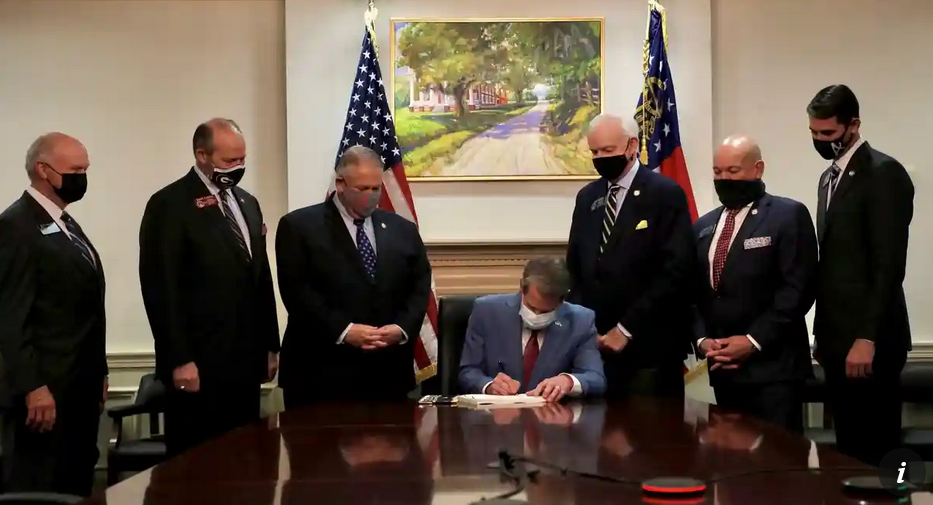
A scene that conjures up a lot of history.

Voting was on the table in March 1858, too. Then, the U.S. Senate fought over how the new territory of Kansas would be admitted to the Union. The majority of voters in the territory wanted it to be free, but a minority of proslavery Democrats had taken control of the territory’s government and written a constitution that would make human enslavement the fundamental law in the state. The fight over whether this minority, or the majority that wanted the territory free, would control Kansas burned back east, to Congress.

In the Senate, South Carolina Senator James Henry Hammond, who rejected “as ridiculously absurd” the idea that “all men are born equal,” rose to speak on the subject. He defended the rule of the proslavery minority in Kansas, and told anti-slavery northerners how the world really worked. Hammond laid out a new vision for the United States of America.

He explained to his Senate colleagues just how wealthy the South’s system of human enslavement had made the region, then explained that the “harmonious… and prosperous” system worked precisely because a few wealthy men ruled over a larger class with “a low order of intellect and but little skill.” Hammond explained that in the South, those workers were Black slaves, but the North had such a class, too: they were “your whole hireling class of manual laborers.”

These distinctions had crucial political importance, he explained, “Our slaves do not vote. We give them no political power. Yours do vote, and, being the majority, they are the depositaries of all your political power. If they knew the tremendous secret, that the ballot-box is stronger than ‘an army with banners,’ and could combine, where would you be? Your society would be reconstructed, your government overthrown, your property divided… by the quiet process of the ballot-box.”

Hammond believed the South’s system must spread to Kansas and the West regardless of what settlers there wanted because it was the only acceptable way to organize society. Two years later, Hammond would be one of those working to establish the Confederate States of America, “founded,” in the words of their vice president, Alexander Stephens, upon the “great physical, philosophical, and moral truth… that the negro is not equal to the white man.”

Illinois lawyer Abraham Lincoln recognized that if Americans accepted the principle that some men were better than others, and permitted southern Democrats to spread that principle by dominating the government, they had lost democracy. “I should like to know, if taking this old Declaration of Independence, which declares … are equal upon principle, and making exceptions to it, where will it stop?” he asked.

Led by Abraham Lincoln, Republicans rejected the slaveholders’ unequal view of the world as a radical reworking of the nation’s founding principles. They stood firm on the Declaration of Independence.

When southerners fought to destroy the government rather than accept the idea of human equality, Lincoln reminded Americans just how fragile our democracy is. At Gettysburg in November 1863, he rededicated the nation to the principles of the Declaration and called upon his audience “to be dedicated… to the great task remaining before us… that this nation, under God, shall have a new birth of freedom — and that government of the people, by the people, for the people, shall not perish from the earth.”

The United States defeated the Confederacy, outlawed human enslavement except as punishment for crime, declared Black Americans citizens, and in 1867, with the Military Reconstruction Act, began to establish impartial suffrage. The Military Reconstruction Act, wrote Maine politician James G. Blaine in 1893, “changed the political history of the United States.”

Today, as I looked at the photograph of Governor Kemp signing that bill, I wondered just how much. Since the Civil War, voter suppression in America has had a unique cast.

The Civil War brought two great innovations to the United States that would mix together to shape our politics from 1865 onward:

First, the Republicans under Abraham Lincoln created our first national system of taxation, including the income tax. For the first time in our history, having a say in society meant having a say in how other people’s money was spent. Second, the Republicans gave Black Americans a say in society.

They added the Thirteenth Amendment to the Constitution, outlawing human enslavement except as punishment for crime and, when white southerners refused to rebuild the southern states with their free Black neighbors, in March 1867 passed the Military Reconstruction Act. This landmark law permitted Black men in the South to vote for delegates to write new state constitutions. The new constitutions confirmed the right of Black men to vote.

Most former Confederates wanted no part of this new system. They tried to stop voters from ratifying the new constitutions by dressing up in white sheets as the ghosts of dead southern soldiers, terrorizing Black voters and the white men who were willing to rebuild the South on these new terms to keep them from the polls. They organized as the Ku Klux Klan, saying they were “an institution of chivalry, humanity, mercy, and patriotism” intended “to protect and defend the Constitution of the United States… [and] to aid and assist in the execution of all constitutional laws.” But by this they meant the Constitution before the war and the Thirteenth Amendment: candidates for admission to the Ku Klux Klan had to oppose “Negro equality both social and political” and favor “a white man’s government.”

The bloody attempts of the Ku Klux Klan to suppress voting didn’t work. The new constitutions went into effect, and in 1868 the former Confederate states were readmitted to the Union with Black male suffrage. In that year’s election, Georgia voters put 33 Black Georgians into the state’s general assembly, only to have the white legislators expel them on the grounds that the Georgia state constitution did not explicitly permit Black men to hold office.

The Republican Congress refused to seat Georgia’s representatives that year—that’s the “remanded to military occupation” you sometimes hear about– and wrote the Fifteenth Amendment to the Constitution protecting the right of formerly enslaved people to vote and, by extension, to hold office. The amendment prohibits a state from denying the right of citizens to vote “on account of race, color, or previous condition of servitude.”

So white southerners determined to prevent Black participation in society turned to a new tactic. Rather than opposing Black voting on racial grounds—although they certainly did oppose Black rights on these grounds—they complained that the new Black voters, fresh from their impoverished lives as slaves, were using their votes to redistribute wealth.

To illustrate their point, they turned to South Carolina, where between 1867 and 1876, a majority of South Carolina’s elected officials were African American. To rebuild the shattered state, the legislature levied new taxes on land, although before the war taxes had mostly fallen on the personal property owned by professionals, bankers, and merchants. The legislature then used state funds to build schools, hospitals, and other public services, and bought land for resale to settlers—usually freedpeople—at low prices.

White South Carolinians complained that members of the legislature, most of whom were professionals with property who had usually been free before the war, were lazy, ignorant field hands using public services to redistribute wealth.  

Fears of workers destroying society grew potent in early 1871, when American newspaper headlines blasted the story of the Paris Commune. From March through May, in the wake of the Franco-Prussian War, French Communards took control of Paris. Americans read stories of a workers’ government that seemed to attack civilization itself: burning buildings, killing politicians, corrupting women, and confiscating property. Americans worried that workers at home might have similar ideas: in italics, Scribner’s Monthly warned readers that “the interference of ignorant labor with politics is dangerous to society.

Building on this fear, in May 1871, a so-called taxpayers’ convention met in Columbia, South Carolina. A reporter claimed that South Carolina was “a typical Southern state” victimized by lazy “semi-barbarian” Black voters who were electing leaders to redistribute wealth. “Upon these people not only political rights have been conferred, but they have absolute political supremacy,” he said. The New York Daily Tribune, which had previously championed Black rights, wrote “the most intelligent, the influential, the educated, the really useful men of the South, deprived of all political power,… [are] taxed and swindled… by the ignorant class, which only yesterday hoed the fields and served in the kitchen.”

The South Carolina Taxpayers’ Convention uncovered no misuse of state funds and disbanded with only a call for frugality in government, but it had embedded into politics the idea that Black voters were using the government to redistribute wealth. The South was “prostrate” under “Black rule,” reporters claimed. In the election of 1876, southern Democrats set out to “redeem” the South from this economic misrule by keeping Black Americans from the polls.

Over the next decades, white southerners worked to silence the voices of Black Americans in politics, and in 1890, fourteen southern congressmen wrote a book to explain to their northern colleagues why Democrats had to control the South. Why the Solid South? or Reconstruction and its Results insisted that Black voters who had supported the Republicans after the Civil War had used their votes to pervert the government by using it to give themselves services paid for with white tax dollars.

Later that year, a new constitution in Mississippi started the process of making sure Black people could not vote by requiring educational tests, poll taxes, or a grandfather who had voted, effectively getting rid of Black voting.

Eight years later, there was still enough Black voting in North Carolina and enough class solidarity with poor whites that voters in Wilmington elected a coalition government of Black Republicans and white Populists. White Democrats agreed that the coalition had won fairly, but about 2000 of them nonetheless armed themselves to “reform” the city government. They issued a “White Declaration of Independence” and said they would “never again be ruled, by men of African origin.” It was time, they said, “for the intelligent citizens of this community owning 95% of the property and paying taxes in proportion, to end the rule by Negroes.”

As they forced the elected officials out of office and took their places, the new Democratic mayor claimed “there was no intimidation used,” but as many as 300 African Americans died in the Wilmington coup.

The Civil War began the process of linking the political power of people of color to a redistribution of wealth, and this rhetoric has haunted us ever since. When Ronald Reagan talked about the “Welfare Queen (a Black woman who stole tax dollars through social services fraud), when tea partiers called our first Black president a “socialist,” when Trump voters claimed to be reacting to “economic anxiety,” they were calling on a long history. Today, Republicans talk about “election integrity,” but their end game is the same as that of the former Confederates after the war: to keep Black and Brown Americans away from the polls to make sure the government does not spend tax dollars on public services.

Posted in Community, Politics | Leave a comment

No Life on Mars

On Tuesday, BBC4 broadcast two excellent Horizon documentaries from a few years back. An hour of “Mars: A Traveller’s Guide” from 2017 at 9pm followed by an hour of “Mission to Mars” from 2012/13at 10pm. Given that, fifty years ago, all we could see of the planet was a fuzzy reddish dot through a wobbly telescope, the scale and depth of visuals, quite apart from understanding in geology, geography, chemistry, atmospherics, etc. etc. was astonishing. It lifted the viewer literally into another world.

The opening commentary spoke enthusiastically about the first to land on Mars was alive today, and the programme would tell them “where to land and how to live”, with all the engaging conviction of the Disneyland tour guide. This was triggered by last month’s successful landing of NASA’s Perseverance rover, already adding to the billions of images we now have of the planet. Coming on top of the entertaining and scientifically plausible film The Martian and all our varied fixations with the Red Planet since Schiaparelli’s ‘canals’ triggered H.G. Wells “War of the Worlds” space amateur and scientific enthusiasts have seen colonisation as simply a matter of ingenuity and time.

In the cause of advancing science, expeditions to Mars make sense. But they are a dead-end. Mars is a dead world, closer to our Moon in its bleak inhospitability, with an atmosphere  0.6% as dense as our own, with polar ice caps that are not water but dry ice (CO2) because it gets as cold as -125degF there. As the planet has only 1/10th the mass of Earth, it has lost almost all the atmosphere and water it once had. This makes the idea of “terraforming” into a habitable world a futile prospect, even if the necessary technology were developed.

If mankind were serious about colonising other worlds, we should ignore Mars and concentrate on Venus. The reason we don’t is, being shrouded in dense, acidic clouds, it provides few visuals and therefore doesn’t make good copy. But we ignore it at our peril. For, should another asteroid, such as the one that wiped out the dinosaurs, strike Earth, we will need a habitable alternative. We need our world to offer open air greenery to survive long-term. Given the cabin fever we are all suffering necause of Covid, livinf in cramped pressure domes and walking in space suits, Mars isn’t it.

Because of planetary alignment, a round trip to Mars will take three years, not least because it is 50 million miles further out from the sum. Venus, on the other hand,  orbits three times faster than Mars, giving many more alignments to work with. It is also only 25 million miles closer to the sun, halving the theoretical distance to travel.

But, quite apart from planetary logistics, we need to focus our best science on terraforming Venus into somewhere we could inhabit.

The basis and urgency for this longer-term and less media-savvy-approach lies in what we are doing to the planet we already inhabit: Earth. While Greta and a growing swathe of concerned people are urging everyone to ‘go green’ and some progress is being made by more enlightened governments, global warming has not been stopped, let alone reversed. Venus holds a lesson for us I n this, which we are yet to take seriously.

Ever since the Soviet Venyera probes started exploration in the 1960s, Venus may seem an even less hospitable world than Mars. Being Earth-sized, it has retained a substantial atmosphere. However, pressure on the surface is over 90 atmospheres (equivalent to 1,000-metre depth in the ocean) and a scorching 450 degC, whipped by gale force winds of 90% CO2. Lead would melt and life would seem impossible.

But, it was not always so. Some believe Venus had oceans and (possibly) life, as ‘recently’ as a billion years ago. But, as the sun grew warner, the oceans boiled away, water vapour creating a greenhouse effect, which released carbon from rocks . The resulting CO2 amplified the greenhouse effect, which ran away, giving the approximation to hell we find today.

Dealing with this may sound a daunting prospect, but the technology required to reverse developments on Venus towards making it habitable are close to those we need to develop a technical antidote for global warming on Earth: massive carbon capture on a planetary scale, releasing oxygen into the atmosphere as a by-product.

There will be no planting of trees or other living carbon sinks on Venus until the temperature is brought below 50 degC. There are organisms on Earth that tolerate massive pressure, such as the works that inhabit the Black Smoker hydrothermal vents on the ocean floor. Whether they could be bioengineered to withstand 450 degC to produce oxygen from CO2 seems a long shot. But if Venus’ clouds could be engineered to reflect much of the sunlight, if terraforming machines that  bound atmospheric carbon back into the rocks were built on the Moon and dropped onto the surface to work over centuries, Venus’ decline might be reversed.

This sounds—and is—fantastical, but so was powered flight to Julius Caesar, or space travel to Napoleon, or the iPhone to Alexander Graham Bell. The point is, the way we are going, we will need to pioneer such technology to deal with our self-made problems o Earth. And if we fail here, Mars will be no lifeboat for us. It will be several billion years before the Sun expands as a red giant and warms moons of the gas gieants, like Titan or Europa, into habitable worlds. Meantime, where else is there, but Venus?

Posted in Community, Environment | 3 Comments

Fire-arm-ageddon?

A huge swathe of Americans have a love affair with guns. Despite having spent two decades enjoying their wonderful country, I met few such people, nor Republicans, KKK, Proud Boys or anyone with NRA membership. They exist in some number. They enjoy the same rights and freedoms as any American citizen. Whether that should include owning guns is a matter of debate.

But I dispute their insistence that guns are a necessary part of American life and they cite the Second Amendment—the one that says “…the right to bear arms shall not be infringed” as justification.  What they don’t cite, in the bit before that, written in a time when redcoats threatened and actually burned Washington, “for the maintenance of a well trained militia, the right to bear…etc.” despair at their attitude distresses me, not because I aspire to tell other countries how to shape their culture. Britain tried that; it was called “Empire”, but we have learned better—at least most of us have. What bothers me most is the sheer self-contradictory palpable nonsense the gun lobby uses as justification” “if guns were outlawed, only outlaws would have guns.” 

The USA has more guns than people (1.2 per person), resulting in over 38,000 homicides (14,000) and suicides (24,000) by guns each year. Those numbers would wipe out everyone in my county in three years. The USA has TEN times as many guns per head than Iraq, TWENTY times more than Syria (and 25 times more per head than Britain). The only gun here I have seen in the 28 years back in Scotland belongs to an old mate. It is a shotgun he uses on pheasants pillaging local farmers’ crops.

Forget that the US has six times the UK’s population. US rate of death of all types from guns runs over 12 people per 100,000 population, sixty times the UK rate of 0.2. I make no case that the UK is in any way  ‘better’  than the US. But why are enlighten and humane people over there (of which there are many) not bludgeoning myopic NRA members and Trumpista Republicans over the head with such stats until they see sense and the slaughter is bought down fro outrageous to acceptable?

And don’t just compare with the UK; it is no outrider. The rest of Europe, Canada, East Asia and even the Middle East, for heaven’s sake, are all markedly better than the US on this measure. How can anyone in a supposedly advanced, wealthy civilisation tolerate gun deaths that ranks them with the Third World, mafiosi or Tong gangsters?

It was just  as well that the Capitol police were as passive as they wee on January 6th when the mob stormed in. Had they used their firearms, there is every chance that enough of the mob had brought the arms they have a right to bear with them. That would have been a bloodbath and such a shock, an Armageddon of democracy that would have taken decades to heal.

Posted in Community, Politics | Leave a comment

Trump: Democracy’s Kryptonite

The reappearance of Donald Trump as the darling of the recent Conservative Political Action Conference (CPAC) in Florida is making a lot of people uneasy, and not just because they had enjoyed  whole month for the first time in five years not having to thole his erratic daily outbursts. To give Trump his due, he has carved a profile more outrageous than any sensible politician would have dared to. As America is rightly proud of being a free country, that is his right. As is the oblivion that should have followed.

The sad (and alarming) thing, however, is that a large number of political minnows in the Republican party have kept their wagon hitched to his star, even after his ungracious departure from office. It is not just Senator Ted Cruz (R TX), who is delusional: daft enough to see not just a second Trump presidency, but his destiny as Vice-President. Governors and legislatures of states across America’s ‘Red Center’ are falling over themselves to thwart Biden’s effort to clamp down on a virus whose threat Trump denied, even as deaths soared past half a million—more Americans than died in wars across the 20th century.

Anathema to Trump’s return is not about political differences. Any democracy worth its salt must be able to handle that. Despite high-profile posturing by Trump and his acolytes about ‘patriotism’, ‘freedom’, ‘founding fathers’, ‘foreign perfidy’, and so on, any study of Trump’s record shows him as concerned with democracy as Genghis Khan, being fixated with his status/power and enhancing his wealth. To secure those, no-one is secure from being thrown under the bus.

Example 1: US Department of Justice under Trump loyalist Attorney General William Barr declined to investigate, let alone prosecute, Trump’s Secretary of Transportation, Elaine Chao, even after that department’s inspector-general asked for a review of  “a misuse of her office”. The inspector-general found repeated instances of Chao using her office to benefit Foremost Group, a shipping company run by Chao’s sister. Also, Chao is married to former Senate Majority Leader Mitch McConnell, who led the Republican charge to avoid endorsing wither of Trump’s impeachments. (Source: heathercoxrichardson@substack.com

Example 2: Trump operated his administration alone the lines of a dictator, firing anyone who disagreed with or contradicted him in public. Brookings Senior Fellow Kathryn Dunn Tenpas refers to the group of most influential advisers outside the Cabinet as the president’s “A Team.” By the time he left office, Trump had fired 60 out of the 65 hires—a casualty rate of 92%. In fact, 27 of the 60 “A Team” departures (45%) have turned over twice or more. These are the people who actually run the country, but were stymied by Trump’s fickle and partisan whims.

Example 3: Senate hearings about the January 6, 2021, attack, heard of “serious lapses in the protection of the Capitol”. It appears those lapses originated with Trump appointees in the Pentagon. Washington’s National Guard is under the control of the Defense Department, overseen by Army Secretary Ryan McCarthy. The Commander of the D.C. National Guard, Major General William Walker, told the Senate that, in response to a request from Mayor Muriel Bowser. Walker requested approval for the mission from McCarthy on January 1st. McCarthy’s approval did not come until January 5th, when events were already unfolding. In what Walker saw as an unusual move, McCarthy withheld approval to deploy the Quick Reaction Force to respond to civil disturbance, without the approval of the Secretary of Defense.

At 1:49 pm, then Chief of the U.S. Capitol Police called Walker to say the Capitol had been breached, indicating “a dire emergency on Capitol Hill”, and requesting immediate assistance of as many guardsmen as could be mustered. Walker immediately called the Pentagon for approval to move, but officials there withheld approval for over 3 hours. Once allowed in, the National Guard deployed in 20 minutes. But by then, plenty of damage had been done—not least to democratic process. Trump’s man at Pentagon placed unprecedented restrictions on National Guard deployment, preventing it from responding to the crisis at the Capitol and its threat to a smooth transition of power in a timely fashion. (Source: heathercoxrichardson@substack.com

That Trump should reach the White House was more a credit to America’s ability to break fresh ground with the unexpected. That he behaved like a bad-tempered bull in a douce political china shop was a lesson to all who thought the founding fathers created perfection in the Constitution. That Trump drove a coach ad horses through convention should be a clarion call to guard against repetition of egregious abuse.

By himself, Trump poses little danger any more. But, backed by Republican fellow travellers, drifted so far from their democratic roots that they will sup with the devil for a thimbleful of power, abuses of privilege, such as above for another term, will drag America down to a cod democracy, on a moral par with Venezuela or Russia.

Posted in Politics | Leave a comment

The Ice of Texas Is Upon You

Texas has never forgiven Alaska for joining the Union over sixty years ago and taking its title as the biggest of all the United States. But that’s the only way it has been surpassed. Outsiders may see New York as the brash business hub and California as the creative capital, but when it comes to down-home all-American yee-haw, Texas has them all beat. Even women drive big pickups with gun racks. Cowboy boots and Stetsons are standard business wear.

It’s not just big hats and steaks that make Texans larger than life. They see themselves as the high priests guarding the American Dream, where a man can roam free and get rich carving his personal empire from limitless possibilities. This is not just dusty nostalgia; Texans really believe this. You do not know America and what created Donald Trump if you don’t know Texans and their Lone Star State.

States guard their autonomy against the federal government with stubborn jealousy, but none more fiercely than Texas. Their cultural bullheadedness was highlighted by two events this week that show different sides of the phenomenon that is Texas and the right-wing heartland that is the closest the Republican party has to a soul: the death of Rush Limbaugh and; the big winter freeze of 2021.

Rush, the grand-daddy of all radio ‘shock jocks’ died rom lung cancer at age 70. After the Reagan administration removed all requirements for radio stations to be balanced in the opinions they broadcast, in the 1980s, Limbaugh was the first to realise the entertainment value of provocative right-wing statements made on air. He spawned many imitators but was himself eventually syndicated across over 750 radio stations

Limbaugh took no prisoners, playing to a gallery of resentful whites who saw their former prosperity lavished on others. He talked provocatively of “Barack the Magic Negro,” of “femiNazis,”  claiming “Liberals are socialists.” He railed against  “the redistribution of tax dollars from hardworking white men to the undeserving”. This spilled over into the ‘attack dog’ tactics of Newt Gingrich and the Tea Party in the 1990s. This led the Republican Pavlovian opposition to all that Obama tried to do and laid the foundation for varied right-wing reactionary groups and thinking that got Trump elected in 2016. Nowhere does all this find more fertile ground than in Texas.

Which brings us to this week’s Big Freeze and over 3.5 million Texans without power or clean water. Ever since the Alamo, Texans have taken pride in doing things their way. So, in the 1930s when power grids were being laid across the land, Texas declined to be part of any federal project that might dictate how they did things. So they built their own. And in a state with neither sales nor income tax, money was tight and corners were cut, meaning details, like resilience against poor weather, were left out. This week, flocks of chickens came home to roost as power stations shut down with the cold and natural gas supplies to those that didn’t froze.

You might think this called for some humble pie among the Republican Governor, city mayors and sundry officials. Not a bit of it. Colorado City mayor Tim Boyd got his rebuttal in first on Facebook:

“The City and County, along with power providers or any other service owes you NOTHING! I’m sick and tired of people looking for a damn handout!… If you are sitting at home in the cold because you have no power and are sitting there waiting for someone to come rescue you because your lazy is direct result of your raising! This is sadly a product of a socialist government where they feed people to believe that the FEW will work and others will become dependent for handout. I’ll be damned if I’m going to provide for anyone that is capable of doing it themselves!… Bottom line quit crying and looking for a handout! Get off your ass and take care of your own family! Only the strong will survive and the weak will parish”

If this isn’t a timely, if unintended, tribute to Rush Limbaugh and all his works, I don’t know what is. Texas Governor Greg Abbott and his allies in the fossil fuel industry blamed “liberal ideas” for creating the crisis, as wind turbines had frozen. But these account for under 10% of Texas’s power. Abbott claimed “this shows how the Green New Deal would be a deadly deal for the United States of America.”

Rick Perry, former Texas governor and former Secretary of Energy under Trump, publicly warned against regulation of Texas’s energy system: “Texans would be without electricity for longer than three days to keep the federal government out of their business. Those watching on the left may see the situation in Texas as an opportunity to expand their top-down, radical proposals. Two phrases come to mind: don’t mess with Texas, and don’t let a crisis go to waste.

Rush may be gone, but his spirit is alive and well and running the Lone Star state. However, a less well publicised tidbit, relating to Texas’ woeful response to the freeze is that Governor Abbott has quietly contacted FEMA and accepted 60 generators and a quantity of diesel to keep the lights on at key locations like hospitals.

Given this level of blinkered partisanship goes a long way to explain the slavish Trump acolytes like Sen, Ted Cruz (R TX). As recently as last August, he was mocking “California’s failed energy policies” He us reported to have fled to the Mexican tropical resort of Cancun to escape the freeze…or the embarrassment.

Given his unswerving loyalty to whatever Trump did or said, there are many outside Texas who prefer that he does not return—especially if he invites the likes of Abbott and Boyd to join him.

Permanently

Posted in Politics | 1 Comment

Trumpistas Should Learn from Limeys

With his conviction quashed, Donald Trump is riding high. He has survived two impeachment attempts, garnered over 70m votes and kept his narrative that his re-election was stolen alive among a huge proportion of those people. The once-proud Republican party is running scared of his power base outside their traditional support among the well-to-do. Already, the 2022 mid-terms loom large in their sights, and the prospect of Trump winning their nomination for 2024 seems possible, even probable.

But Trump’s “Make America Great Again” mantra and his iconoclastic approach to Beltway protocols and foreign policy, means the foundation of his appeal to a powerful alliance of the right wing and blue-collar disenfranchised, is built on sand. It seeks to recover the 1950’s-1970’s prestige and prosperity through political and economic domination of the globe.

The appeal of this, especially to Americans with little exposure to other cultures, is broad. It is not just to supremacist squirrel-hunters in Alabama or right-wing survivalists holed up in the Wasach mountains. It is to a wide swathe of blue-collar types who remember 1970, when $25-per-hour jobs in Detroit sent your kids to college,  paid the mortgage on a spacious tract home full of appliances,  and let you explore in the Winnebago RV parked in the driveway.

But nostalgia is not what it used to be.

Though not best placed to understand how lessons learned elsewhere lead to real future prosperity, and not re-rums of Ozzie and Harriet, Trumpistas would do well to study their former colonial masters—and avoid doing it the hard way, as they did.

A century ago, Britain was as much the top dog as America would become half a century later. In the aftermath of WWI, it bestrode the world politically and economically. Its rival, Germany, lay prostrate. It’s earlier rival, France, had bled itself dry. Russia, Austro-Hungary and Turkey lay in ruins. Only America came close in influence, which became dissipated by isolationism.

A massive Royal Navy protected global trade, not just with empire. Beside wheat from Canada, tea from India and wool from Australia came beef from Argentina, coffee from Brazil and oil from the Gulf. British-built ships carried both imports and exports of coal, steel, locomotives, machinery, clothing and whisky. The pound, pegged to a gold standard, was worth $4. But by the 1970s, Britain was an economic basket case. How?

Americans like to think of themselves as freedom-loving anti-colonials. But since the 19th-century Monroe Doctrine, they have meddled elsewhere. The Spanish-American War of 1895 produced colonies. Though Cuba and the Philippines became  independent, Guam and Puerto Rico remain colonies. So the first lesson is to take Rabbie Burns to heart and “see ourselves as others see us”. Britain was reluctant to relinquish an empire whose goal was to “make the world British”. From Assam to Zimbabwe, this bred resentment. American actions from Korea to Kandahar have bred similar resentment.

Britain’s wealth was built on exploitation of colonies. Raw materials were harvested by underpaid locals, shipped to British factories, then sold back as finished goods at tidy mark-ups. In this regard, America differed. Both abundant raw materials and a huge internal market gave prosperous self-sufficiency. British industry saw few reasons to adapt. As a result, technology (e.g. ship welding ships) developed elsewhere. Britain was still building steam locomotives in 1960; dockers resisted containerised freight; print workers resisted digital typesetting. In America, Detroit built annually obsolescent gas-guzzlers, allowing Honda, VW, etc. to eat their lunch during the oil shocks. Unlike the British, Americans did innovate: aerospace;  semiconductors; computers. But regular manufacture moved offshore, along with clothing and electronics generally.

Weak innovation meant Britain lost early leads in computers, airliners and oil production. American domination has been whittled down to aerospace, financial services, social media and fracking, plus outliers like Tesla and Amazon. The second lesson is this: Just as Britain had to relinquish a manufacturing economy, America must accept that “American-made” sounds patriotic, but is uneconomic. Caterpillar will continue to build bulldozers n Mexico because it is competing with Komatsu.

The third—and most important—lesson is the opposite of Trumpian diktat: America must swallow bumper helpings of humble pie. Stiff-ass British had to do this the hard way. After building a global empire in the 18th century, they learned few lessons from the loss of America and powered into global domination in the 19th century but imposing their culture over the indigenous wherever they went. It may have taken an inbred superiority for a few thousand Britons to hold a billion Indians in subjugation, but former colonies that never established a white majority pay much homage to British culture today. Most remain resentful or, at best, indifferent in the half-century since independence was granted.

Despite the trauma of Vietnam, America has made little progress in acknowledging other cultures (let alone accepting them). Europe is regarded as quaintly ossified, Asia as dangerously alien; Africa and Latin America as exploitable backwaters The Russians and Chinese are intractable and gloves must be off when dealing with them. But the other three-quarters of the world are seen mainly as exploitable markets.

Educated Americas and those whose travels were not just by cruise line or tour bus understand this to be a modern repetition of British cultural myopia. But Trumpistas seldom fall into either category. It is they who need to broaden their horizons from such crypto-colonial gaffes by realising:

  • Most “aliens” are proud of their culture and don’t aspire to become Americans
  • “Shock and Awe” air strikes win victories but lose hearts and minds
  • Education in state capitals or 46 presidents gives poor insight into cultures in: Korea, Cuba, Cambodia, Laos, Vietnam, Somalia, Iraq, Libya, Grenada, Panama, Serbia, Lebanon, Syria. All have seen the business end of napalm, Paveway bombs or cruise missiles, giving them jaundiced views of the USA
  • That list does not mention those countries where covert operations, up to regime toppling, were done “in America’s interest”, giving more jaundiced views
  • Macdonald’s, Coke & US movies and TV shows are so ubiquitous they are seen more as cultural colonialism than friendly ambassadors

Being part of the most powerful country in the world is something Americans are rightly proud of. And, given the habitual impotence of the UN in enforcing peace and reasonableness around the world, America’s self-styled role as “Global Policeman” has both logic and merit.

Unfortunately, the advent of Trump has shown that America’s much-vaunted political system is both flawed for its citizens and dangerous for its non-citizens, as demonstrated by Trump’s ego trip dreaming America can be great again by ignoring the world and fifty years of catching up achieved by many other countries. Britain tried this between the wars. It was deep in debt (as America is now). It had an uncompetitive manufacturing base (as America has now). It assumed it need not change to hold on to its markets (as America does now). It presumed massive naval power could secure its interests by force (as America does now).

Trumpistas have a clear choice between:

  1. Grow up: learn lessons from the defunct British Empire
  2. Believe America rules the world and can shape it in its image.

Britain chose 2). Look where it got them.

Posted in Commerce, Politics | Leave a comment

Coming Out of Our SHelll

(Published in East Lothian Courier, February 11th, 2021

Until a year ago, Scottish seafood had grown into a £1bn business, with half exported to the EU. East Lothian harbours contributed to this, landing prawns, crab and lobster, much of it for export.

A month of post-Brexit chaos ensnared lorry-loads of perishable seafood in red tape. With the EU making their temporary shellfish ban permanent a disastrous year for restaurants and their seafood suppliers, small producers like ours are suffering badly.

Seafood Scotland and allied organisations are lobbying the UK government to remove export barriers. But it is clear fishing was sold down the river during Brexit negotiations. Meantime, boats tie up from a dearth of customers and the Larkhall distribution depot sees little business The Scottish Government set up the Scottish Seafood Partnership (SSP) in 2014 to deal with such things, but they are not answering their phone. 2018’s paper on “Future Management of Fisheries” is now only good as firelighter.

Scotland’s whitefish fleet is chasing EU markets by registering boats in Northern Ireland and landing in Denmark. But shellfish are landed by inshore boats, without such options. Rural Economy Secretary Fergus Ewing has announced £6.45m for the Seafood Producers Resilience Fund for shellfish catchers and producers, plus £1m for investment in ports and harbours. This is welcome, but a short-term ‘band-aid’. We need a new, visionary strategy to meet new circumstances.

BBC2’s Cornwall: This Fishing Life highlights initiatives by inshore fishermen there in doing something about it., with scant government help. From exploiting Rick Stein’s burgeoning restaurants, they set up their own local fish market and dealt with end customers as far away as London. When Covid closed restaurants, they opened stalls to sell locally, they built small processors, selling to food shops.

This is Fergus’ opportunity: to lead this major segment in new diections; to champion world-class shellfish global;y; to ride the recovery of consumer demand: by:

  • Several Orders, regulating who fishes which catch where (c.f. Maine USA)
  • Quotas and sensible handling of by-catch
  • Restore stocks, using N. Berwick’s Lobster Hatchery as a model
  • Encourage retail fish markets, supplied direct from dockside
  • Re-introduce Scottish oysters (smaller & sweeter than Pacific)
  • Infrastructure to fly seafood globally (esp. China & Middle East)

With its picturesque harbours, excellent shellfish and proximity to Edinburgh restaurants, East Lothian would be the perfect prototype. I look forward to standing Fergus his lunch at the Lobster Shack, once this Covid distraction is done.

(East Lothian is a county in Scotland, lying between the capital, Edinburgh and the North Sea, with a long tradition of inshore fishing from its three small harbours.)

Posted in Commerce, Politics | Leave a comment

Wind Farms or Windbags?

The Scottish energy strategy published in December 2017 sets a 2030 target for the equivalent of 50% of the energy for Scotland’s heat, transport and electricity consumption to be supplied by renewable sources. By June of last year, Scotland had installed 8,366 MW from onshore wind and 981 MW from offshore .

In theory, this means that all of Scotland’s 6 GW requirement could be met by wind alone. However, the objection often raised against wind, is that it is unreliable. It does not always blow and often blows too much. These are valid points. But there are other clean energy sources and Scotland is as rich in them as we are in wind power.

The Crown Estate and Scottish Government are behind a £4bn project to build a number of tidal power sites around the Orkney islands and the Pentland Firth, expected to generate the same amount of power as a nuclear power station. That’s 1.2GW of green energy. Some estimates have suggested that a combination of tidal and wave power from the area could produce up to 60GW of power. That would represent 10 times Scotland’s annual electricity usage.

Were Scotland to produce green energy at such levels, exporting the surplus to neighbouring countries and the engineering expertise around the world could contribute more to the Scottish economy than oil and gas do now, with the additional benefit of being sustainable, as well as non-polluting.

The Scottish Government are to be commended for the steps taken so far. They make much of their green credentials and targets for becoming carbon-neutral. Yet they seem to place a higher emphasis on social programmes, equalities legislation  and drug rehabilitation—all of which might be funded from a vibrant green energy sectpr. Are we being subjected to the window dressing of  “greenwash” by wind bags? Is this being treated with the urgency it deserves?

For example, EDF’s Neart na Gaoithe wind farm 15 km off Fife Ness was proposed in 2008 and has et to see a turbine turning. For another, the Pelamis wave generator started in 2004, was tested off Orkney, but went bankrupt in 2014. The technology was taken over by HIE’s Wave Energy Scotland, who have ploughed £41m  into 93 contracts, with little power is coming ashore to date.

Meantime, our neighbours are not hanging about. Just as the Danes pretty much cornered the wind turbine manufacture business over a decade ago, they are building the infrastructure to support major offshore wind farms. Last June, Denmark approved a PFI project between the Danish Energy Agency and Energinet for two energy islands, with a combined capacity of 5 GW. Both energy islands will connect to other countries’ grids for export sales and are to be completed by 2030. One will be built 60 km west of Thorsminde on Denmark’s west coast.

Not to be outdone, our English neighbours are exploiting the shallowness in parts of the North Sea. A Joint Venture Partnership between SSE Renewables and Equinor have started construction work on Dogger Bank A and B 130 km offshore has begun along with the onshore cable route in Yorkshire’s East Riding. By utilising the world’s largest turbines and installation vessel to provide 4.8 GW—“the UK’s largest single source of  renewable energy”.  It is ironic that the northern portion of this area was Scottish waters until the Blair government shifted the maritime boundary, north to transfer 6,000 sq. km. to England in 2000.

Scotland’s prosperity will depend on weaning itself off oil by 2050. It is blessed with more sources of renewables than any of its neighbours. But despite governmental rhetoric, the forward-looking, large scale projects in the sector are happening elsewhere.

Are we serious about our green future—or just a country of toom tabard windbags?

#941

Posted in Commerce, Environment | Leave a comment

Closing the Augean Stable Door

It is hard to evade media wall-to-wall coverage of the Covid pandemic. To the casual observer, every niance of statistics are reported daily in meticulous detail. Who could want more coverage or more data? A conspiracy theorist might think the floodgates were deliberately opened to mask any need for questions.

For the last month, emphasis has shifted to how well vaccination are going. congratulating scientists, producers and NHS staff. The talk is of light at the end of this long, dark tunnel. Nobody is asking how thetunnel came to be so long and dark in the frst place. Recakking life’s great adages: “when you’re in a hole, stop digging”, the UK government seems to have forgotten this applies equally to tunnels.

That government was slow to  provide a lockdown before March 28th 2020, two months after the first cases in the UK. Since then, millions of travellers have landed at UK airports, startig with many from Italian ski resprts where Covid was rampant. Instead a mantra of “follow the science” and “save the NHS” dominated the Spring until a “world-beating test and trace system” costing £4bn was to rescue us, but didn’t Then “eat out to help out”, plus returning students and schools dragged us al back into lockdown.

A third lockdown is still dragging on, more people are evading the rules and everyone is fed up after a year of this. Mnisters still harangue the public with daily repetitions of ”stay at home; don’t visit anyone, don’t gather anywhere; etc”.

Yet all this time, the borders were open. Even with Brexit complications, 10,000 passengers a day still flooded through Heathrow. Testing of arrivals i was repeatedly rejected as a policy. Though arrivals were asked to self-isolate for two weeks, fewer than 3 in 100 were checked and most did mot comply. By the end of January, at over 104,000, Brtain had suffered the highest per capita Covid-related deaths in the world. Only now is there serious talk of requiring strict monitored quarantine for 10 days in a hotel.

Through all this, the government has repeatedly claimed the best actions in circumstances no-one foresaw. All discussion of shortcomings, failutes in test and trace, damage to economy have been swamped by feel-good focus on vaccine successes.

But those 104,000-and-rising deths demand some explanation. Because, looking beyond the veil of silece the government and media draw over elsewhere makes thoughtful observers pause. For this pandemc took everyone by surprise, including countries of comparable competence who have performed much better.

Not only is Britain the worst in Europe but its performance is shameful compared globally. Why should South Korea, with no NHS and both a polulation and GDP comparable to England have under 2% as many deaths and be almost back to normal? Schools, restaurants, concerts, etc are functional. Mwanwhile, London suffers 1 in 35 of its citizens infected, hospitals overflowing and no end in sght to a lockdown damaging both economy and residents’ metal health.

Nor is South Korea alone. Most of Europe is doing twice as well and New Zealand has executed an enviably successful campaign, as can be seen from the following charts.

What could cause such disparity? Is high regard for the NHS misplaced? Are the Brits susceptible geriatrics? Are Brits more bolshie in lockdown compliance? None of these?

What then?

The clue lies in other islands. New Zealand and Australia acted fast, implementing a strict 2-week quarantine for any arrival—visitor or citizen. The statistics for New Zealand speak for themselves. Like South Korea (whose closed land border makes it effectively an island), they are enjoying normal lives.

You can see the difficulty European countries face, especially Schengen Area. Countries like Germany have long, open borders. Controlling traffic is impossible. But what about Britain? It’s an island too. Why are its statistics not anywhere near New Zealand’s or South Korea’s?

For the last yea, Britain declined to close its border. At first, it allowed everyone in. Only since October has it made any attempt to restrict traffic—and then only from certain countries. It seems evident from comparisons above that this is a major reason for Britain’s appalling record, which continues unabated, despite over 7m vaccines having been administered to date.

But why pursue such a patently damaging policy? The UK government may not be perfect but it does things for a reason. Why should it want millions of people to enter the country during a deadly pandemic? As is common in such things, follow the money.

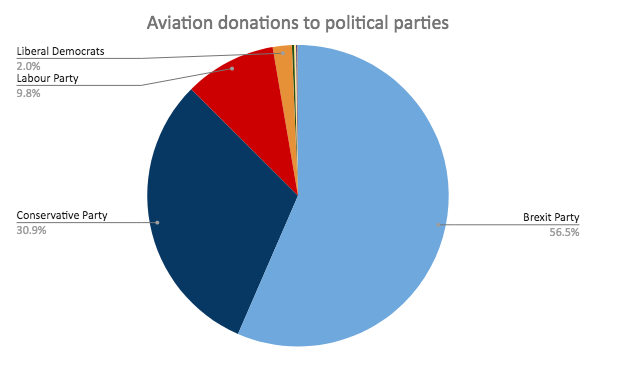
It is hard to make an absolute connection, but the underlying factor that raises most sense is a history of political donations totalling over £8m made by donors in the aviation businesses to UK parties, with further sums to MPs, as illustrated below.

Source: https://www.desmog.co.uk/2019/12/06/revealed-brexit-party-and-conservatives-have-received-8m-aviation-industry

The Conservative Party received £2.8m of the above. Sitting members of that party rreceived the lion’s share of donations from those same aviation businesses. These included: BAA (now Heathrow Airports Holdings), the previous owner of several other UK airports including Gatwick, Stansted, Edinburgh and Glasgow, which gave £1.2m. Significant amounts have been donated by well-known companies such as Airbus and Virgin Atlantic. More than half of the donations come from Christopher Harborne, CEO of AML Global, a major aviation fuel supplier. 

Source: https://www.desmog.co.uk/2019/12/06/revealed-brexit-party-and-conservatives-have-received-8m-aviation-industry

Official records show how airports, airlines and aircraft manufacturers have made hundreds of contributions, either in cash or to cover the cost of politicians’ travel. Liam Fox is not only the largest beneficiary, but the most hypocritical, having publicly stressed the need to “reduce the consumption of fossil fuels” but has backed fracking and told an oil and gas conference that “for the moment, we do require fossil fuels to deliver secure and affordable energy.” Even before the pandemic hit, Johnson’s then-new government was already being accused of doing favours for Richard Branson in a deal to rescue FlyBe a year ago.

There is, of course, no concrete link between donations to Conservatives by aviation businesses and a continued reluctance to fight Covid as othrs have—by closing down air links. This Augean stable door has been left open still —and it stinks.

Posted in Community, Politics | Leave a comment

Today’s Thirty Years War

The original Thirty Years War occupied the attention and wealth of Europe for much of the 17th ©. Like most wars, it was an exercise in greed and ego that settled little. Given the carnage possible with mass use of gunpowder, it served as an ugly template for various derivations for the next three hundred years, until Europe stopped periodically squandering its young men, wealth and talents after Hitlerwas humble in the ruins of the Third Reich.

In the seventy-five years since, Europe has largely beaten its swords into ploughshares and set an example for the developing world. Unfortunately, part of that developing world sits on the largest reserves of oil known to man and they have, as yet, not got religion along those lines.

Though there has been warfare in the Middle East since records began, it was a series of imbroglios among locals. Their Thirty Years War started on August 2nd thirty years ago when Hussein’s Iraq invaded Kuwait. The fact he then controlled some 40% of the world’s oil reserves had the West scrambling for a moral codpiece to conceal their paranoia about a dictator in control of their main fuel supplies.

Hussein gambled—much as the Japanese gambled in 1941—that if the objective was captured swiftly, then defended with massive forces that the West would see the cost in lives of re-taking the prize would make even the mighty USA balk. His timing was bad. Not only was a resurgent USA ready to reassert its role as global superpower after the humiliation of Vietnam but Russia, the only other superpower at the time was preoccupied with salvaging what it could from the collapse of the Soviet Union. Getting the Israelis to lay low and stay out of it allowed George Bush to cobble together an unlikely alliance of over 30 countries includingt Arab states. It was the broadest coalition seen since the Korean War, the last time that Russia stood aside and allowed the UN to take real action.

History relates that the Gulf War did not last long. After an intense air campaign of several weeks, the massive Iraqi forces were so damaged and demoralised that the ground war took just five days. Thousands of Iraqis died for the cost of under 300 coalition combatants. But that was not the end. It was not even the end of the beginning.

By liberating Kuwait, but leaving a weakened Saddam Hussein still there was like slapping on a plaster without first cleaning the wound. In 1951, when Truman stopped General Macarthur before he could take the Korean War over the border into China, he did the world a favour by avoiding World War 3. In 1991, George Bush Snr. stopping General Schwarzkopf for what he regarded as similar reasons was a mistake. The limited objective of deposing Hussein while his army was prostrate was a limited and quite feasible objective.

As it was, 13 years later, once the USA was angrily searching for the culprits of the 9/11 destruction of New York’s World Trade Center found George Bush’s son “Dubya” incensed enough by 2003 to try to complete that unfinished business with what Congress called “The Iraq War”, but which was, in fact, Gulf War 2, in much the same way that WW2 is sometimes seen as an unavoidable completing unfinished business of WW1. But, this time there was no broad Arab coalition in active support, nor a pliant Russia standing helpfully aside.

Once again, military “shock and awe” overwhelmed a numerically superior army in short order, with minimal casualties—except for the Iraqis. No evidence of support for terrorism, nor “weapons of mass destruction” were found. But they did find and dealt with Hussein. But in the press and public’s mind—especially in the USA—both conflicts had played out like a Hollywood script. Forget the stalemates of Korea or Vietnam. America was  back as top dog with the military muscle to prove it. And, as in that other clean-cut final result of WW2, like a second Marshal Plan would bring 38 million Iraqis and their shattered country/economy into the affluent folds of the western world, as they had with Germany and Japan.

That it didn’t work out that way lies largely in the American presumption that the rest of the world wants to be like them. The Madrid Conference of 2003 was to co-ordinate reconstruction among 25 countries involved. Unfortunately, as Wikipedia describes it:

“While reconstruction efforts have produced some successes, problems have arisen with the implementation of internationally funded Iraq reconstruction efforts. These include inadequate security, pervasive corruption, insufficient funding and poor coordination among international agencies and local communities. Many suggest that the efforts were hampered by a poor understanding of Iraq on the part of the international community assisting with the reconstruction.”

In the course of the original engagement, plus the 2003-11 extended occupation, plus the 2014 return, the USA alone spent over $1 trillion (a one with twelve noughts), or half again the entire UK budget, on military operations and investment in ‘rebuilding’ the country. Despite all this, there is still neither peace, nor prosperity. Mishandling of the Sunni vs Shia factions, mishandling of the Kurds, intrusion by ISIS all contributed to continuing unrest and occasional bloodshed, of which there is still no end in sight.

The underlying problem appears to me American ineptitude in its largesse and clumsiness in its military engagement. Combined with dogged support for Israel  and ill-judged and unsuccessful incursions in Lebanon, Somalia an Afghanistan, the Gulf version of the Thirty Years War has imprinted the USA as an intrusive and arrogant pack of unbelievers among muslims from Marrakesh to Malacca.

Quite apart from military intrusions, the aftermath of the fall of Hussein in 2003 saw a flood of American companies, opportunists and soldiers of fortune tapping into the bounty flooding Iraq. This led to opportunism and corruption among the Iraqis themselves—hardly surprising since the people had scant experience of either democracy or the rule of law since the British empire shrank to nothing half a century before. That a country with a tenth of the world’s oil should stagger on in chaps and poverty is a travesty of what the Marshal Plan did for Europe. And that cost the USA just $12 billion ($132 billion at today’s rates). Their Thirty Years War is not yet over.

But perhaps the worst outcome from the whole sorry story is that the US military think they have rediscovered their mojo, that nuclear carriers, Abrahams tanks, Apache helicopters, cruise missiles and laser-guided Paveway bombs make the world secure under their guidance. It is understandable that the rankers who man these things should be gung-ho and convinced in their invincibility. But that the top brass suffer the same delusion is dangerous. It is doubly dangerous if the Administration suffers the same delusion and believe the USA is the global policeman.

Instead of studying WW2 and the Gulf at West Point NY, Annapolis MD and Montgomery AL to study big toys to deliver shock and awe that costs over $710 billion each year, they should consider the realities of war in the 21st century. War against powers like China or Russia would be either unthinkable or cause nuclear annihilation. A recurrence of favourable circumstances for a short, ‘good’ war like 1991 or 2003 will be rare. Far more likely are repetitions of Korea, Vietnam or Afghanistan, for which US forces are singularly unsuited and staff studies inadequate:

  • Most wars are ‘brush wars’, involving guerrillas, combatants indistinguishable from civilians, with ill-defined battlefields and few clear objectives for victory.
  • Gulf Wars were flukes; large scale operations against a conventionally armed enemy, fought over open desert with clear fields of fire and few civilians.
  • Strategic air power is futile. Douhet, Harris et al got this badly wrong. No war has been won by air power alone. Intimidation by bombs does not work.
  • Tactical air support does work—but only in open terrain and is expensive. F/A18s cost $70m each and need a $3bn carrier or air base to fly from.
  • The logistical ‘tail’ of US forces is massive and clumsy. Not only is this also expensive, but it tends to restrict operations to roads and deserts.
  • The cultural awareness and language abilities of US forces is negligible, creating barriers with and resentment from locals in overseas deployments

It seems the Pentagon and the staff academies are either not conversant with 21st © military home truths like the above or suffer from the trap into which many unchallenged powers fall—believing their own propaganda. Examples: the Russians at Tsushima; Bomber Command in 1939; the Soviet Army in 1941; the French at Dien Bien Phu—all thought the knew the key to success and planned on that basis.

Someone in the US top brass must surely be aware of this. But the immense flywheel of inertia created by officer ambition, Congress pork barrel and massive corporate interests like Boeing ($29bn), Lockheed Martin ($47bn), Northrop Grumman ($26bn), Raytheon ($24bn_ General Dynamics ($22bn) make change unlikely. That’s just the top five, who accrue $148bn of lucrative business from the military every year.

It is hard to see how such a dripping roast could be turned off with hot spots erupting around the world on a regular basis. The pressure from all above (but not taxpayers) to fund the best defence systems for the world’s policeman is irresistible.

But this new Thirty Years War rolls on. Because what the world needs is a bobby on the beat who knows the patch, the local villains and how to put the squeeze on them. But what the US has created is the equivalent of donut-laden guys in a heavily armed squad car. They can patrol and intimidate the neighbourhood all they like. But they will not find the bad guys, let alone end the war.

Posted in Military, Politics | Leave a comment