Rock of Eejits

Rock of ages, cleft for me
Let me hide myself in Thee.”

The current intransigence infecting the Republican Party in clinging to the flotsam that remains of the Trump presidency has much deeper roots than Trump’s ego-driven tenure. Their demonising of Biden—and anyone who disagrees with them—as “socialist”, if not “communist” is hyperbole with a history. Its roots lie half a century ago, in the depths of the Cold War, the Vietnam War, and the Nixon presidency.

The Lewis F. Powell Jr. Memorandum

On August 23rd, 1971, prior to accepting Nixon’s nomination to the Supreme Court of the United States (SCOTUS), as a corporate lawyer, Powell was commissioned by his neighbour, Eugene B. Sydnor Jr., a close friend and education director of the US Chamber of Commerce, to write a confidential memorandum for the chamber entitled “Attack on the American Free Enterprise System,”

American global hegemony, as the only power not devastated by WW2, had brought them widespread prosperity and influence through the 1950’s. America had risen to the challenges of Sputnik (1957)  and the Cuban Missile Crisis (1962) and had hemmed in the Soviet Union with a ring of bases and allies. However, rising competition from Germany and Japan, domestic unrest in the shape of the Civil Rights movement, anti-war demonstrations and a rug-fuelled counter-culture among the youth had tarnished the clean-cut, crew-cut image of itself shared by what would be called “Middle America”. In 34 pages, Powell delivered what Sydnor and his contemporaries wanted to hear.

No thoughtful person can question that the American economics system is under broad attack.

—Lewis Powell

The memo was intended as an outline philosophy of conservatism in the USA. Because the Founding Fathers had created the perfect Constitution, right-wing observers believed America’s adherence to it had slipped.. A corporate lawyer from Virginia who specialised in defending the tobacco industry, his conservative presence on SCOTUS was pivotal in decisions made during his tenure 1971-1987.

Part of the plan was to dumb down America – especially those college students protesting the war.  Anti-science seems to be a part of that philosophy; science and reason vs. pro-business/pro-wealth. It was an anti-Communist and anti-New Deal blueprint for conservative business interests to retake America. It was based in part on Powell’s reaction to the work of activist Ralph Nader, whose 1965 exposé on General Motors, Unsafe at Any Speed, put a focus on the car industry and its putting profit ahead of safety. It was seen as the spearhead of an attack the American consumer movement, an undermining of the power of private business and a step towards socialism.  His experiences as a director on the board of tobacco manufacturer Phillip Morris from 1964 until his appointment to SCOTUS made Powell a champion of the tobacco industry as they railed against growing scientific evidence linking smoking to cancer deaths. He argued, unsuccessfully, that tobacco companies’ First Amendment rights were being infringed when media did not give credence to cancer denials of the industry.

The Foundation Fathers

The memo called for corporate America to become more aggressive in molding society’s thinking about business, government, politics and law in the US. It inspired wealthy heirs of earlier American industrialists to fund Powell’s vision of a pro-business, anti-socialist, minimally government-regulated America. This was based on what he thought America had been in the heyday of early American industrialism, before the Great Depression and the rise of Franklin Roosevelt’s New Deal. He realised that, unlike political parties, private charitable foundations did not have to report their political activities, offering unlimited what is now called “dark” money.

Those sympathetic foundations responding to his call to provide funds, mostly for research in conservative think-tanks included:

  • the Carthage Foundation (Richard Mellon Scaife—banking, metals)
  • the Earhart Foundation (oil)
  • the Smith Richardson Foundation (cough medicine)

The Powell Memorandum thus became the blueprint for the rise of the American conservative movement and the formation of a network of influential right-wing think tanks and lobbying organisations, such as The Heritage Foundation and the American Legislative Exchange Council (ALEC) as well as inspiring the US Chamber of Commerce to become far more politically active. The rise of neoliberalism in the US can be traced to Powell’s memo, where he argued:

“The most disquieting voices joining the chorus of criticism came from perfectly respectable elements of society: from the college campus, the pulpit, the media, the intellectual and literary journals, the arts and sciences, and from politicians.”

—Lewis Powell

First; Define Your Enemy

In the memorandum, Powell advocated “constant surveillance” of textbook and television content, as well as a purge of left-wing elements. He named consumer advocate Nader as the chief antagonist of American business. Powell urged conservatives to undertake a sustained media-outreach program; including funding neoliberal scholars, publishing books and papers from popular magazines to scholarly journals and influencing public opinion.

The Elephant Is the Symbol of the epublican Party

This memo foreshadowed a number of Powell’s court opinions, especially First National Bank of Boston v. Bellotti, which shifted the direction of First Amendment law by declaring that corporate financial influence of elections by independent expenditures should be protected with the same vigor as individual political speech. Much of the future Court opinion in Citizens United v. Federal Election Commission relied on the same arguments raised in Bellotti.

Though written confidentially for Sydnor at the Chamber of Commerce, it was discovered by the  Washington Post, which reported on its content a year later (after Powell had joined SCOTUS). Anderson alleged that Powell was trying to undermine the democratic system; however, in terms of business’s view of itself in relation to government and public interest groups, it was a major force in motivating the Chamber and other groups to modernise their efforts to lobby the federal government. Following the memo’s directives, conservative foundations greatly increased, pouring money into think-tanks. This rise of conservative philanthropy led to the conservative intellectual movement and its increasing influence over mainstream political discourse, starting in the 1970s and ’80s, and due chiefly to the works of the American Enterprise Institute and the Heritage Foundation.

Second; Disdain Your Enemy

The Heritage Foundation laid the groundwork for the later Contract with America, which was a legislative agenda advocated for by the Republicans during the 1994 congressional election campaign. Written by Newt Gingrich and Dick Armey, recycling text from Reagan’s 1985 State of the Union Address.

The Contract detailed the actions the Republicans promised to take if they controlled the House for the first time in 40 years. As it was signed by all but two Republican members of the House and all non-incumbent Republican candidates, it can be seen as a unifying force for the party, which had a reputation for weak party discipline.

The Contract was revolutionary in offering specific legislation for a vote, describing in detail the precise plan of the Congressional Representatives, and broadly nationalising the Congressional election. It represented the views of conservative Republicans on issues such as:

  • shrinking the size of government
  • promoting lower taxes
  • greater entrepreneurial activity
  • tort reform
  • welfare reform.

Gaining 54 House and 9 Senate seats, meant Republicans controlled both chambers. Sweeping changes, such as an amendment to the Constitution that would require a balanced budget unless sanctioned by a two-thirds vote in both houses put them on a collision course with Bill Clinton’s Democratic Presidency.

Third; Discount Your Enemy

It was at this point that the widening policy gulf between Democrats and conservative Republicans broke into the open. From this point on, moderate Republicans, such as Senator John Glen of Arizona, became more and more of a minority, as they were swept along by conservatives, led by Newt Gingrich. Unable to get most of the Contract enacted, they fell to obstructing Clinton, initiating a personal witch-hunt that threatened to impeach him over the Monica Lewinsky case.

Some harmony returned under George W. Bush, whose focus became international in the aftermath of 9/11. This involved the Second Gulf War, and occupation of Iraq and Afghanistan. This “War Against Terror” was such a motherhood-and-apple-pie issue that Democrats dare not oppose. It  was also a bonanza for arms and aerospace industries, enthusiastic supporters of conservatives.

Any cross-party consensus was broken with the election of Obama in 2008. His efforts to revolutionise health care to include the vast bulk of Americans, and not just those who could afford it, ran foul of a pharmaceutical and medical insurance lobby even more powerful than tobacco had been in stifling legislation. In this, they found allies not just in an increasingly right-wing Republican party, but the various conservative foundations described above, who provided both research and directed funding through their well financed backers.

Money had always played a role in American politics. But it was at this point that anyone wishing to run for Congress required a campaign fund in the millions. And those prepared to provide those millions attached conditions that were almost always the pursuit of conservative policies.

Seen from this perspective, the divisive, tribal nature of the Trump presidency has roots stretching back half a century. The Potemkin Village of obstruction that Republicans are now building denyies Trump lost the election in November 2020, and asserts Biden is a socialist, bent on destroying the American way of life.  The whole village is built on the 34-page rock of the Powell Memo.

See also: https://www.greenpeace.org/usa/democracy/the-lewis-powell-memo-a-corporate-blueprint-to-dominate-democracy/

Full text of the Powell Memo available at: https://scholarlycommons.law.wlu.edu/powellmemo/1/

#994  1,556 words

Posted in Commerce, Community, Politics | Leave a comment

Meet Pesky Blunders of 10 Clowning Street

Pesky Blunders on the Beat in Liverpool, 6.12.21

Unless you’ve been the victim of one of his many jolly japes that pass for policy, it’s hard to dislike Boris Johnson entirely. There is something about his gung-ho gusto, about his head-down bullishness that makes him an effective political campaigner which reaches not just across his party but out into the great majority of people who regard politicians much the same way as shepherds regard wolves. Many people allergic to policy discussions have confessed they would like to sink a pint or two in his company.

However, blokeishness is not normally listed as a key characteristic in a successful national leader. Boris was two years into his premiership before this home truth did, in fact, come home to him.

He had led a charmed life to this point. He survived an itinerant childhood to put his undoubted intelligence to good use as a ticket to Oxford, where he developed his trademark veneer of an affable everyman. This disarmed men and women he met, to the point of deflecting their censure of less likeable traits of egotism, ambition, moral flexibility and a penchant for cutting corners and asserting implausible reasons for his behaviour.

Had he become a rake, or a City trader, or even stuck to journalism, the path he originally followed, he might have been successful, even famous. His appearances on Have I Got News for You show wit and presence of mind that may well have made him a household name and “personality”, even had he not chosen politics.

But that he did chose politics has become his downfall. This was not apparent at first. With his Bullingdon Club background and faced with the unappealing likes of John Redwood, Theresa May or Jacob Rees-Mogg as competition, their adherence to principles and traditions made them easy to outmanoeuvre. Like Trump, and with only slightly less brash assertion, it was easy to climb aboard a passing bandwagon. His passage as Mayor of London was achieved by peppering the airwaves with sound bites, while relying on a team of competent subordinates to actually run the city. It was a page straight out of Ronald “The Gipper” Reagan’s successful playbook.

But the full orchestra bandwagon he climbed aboard to take him to the top was Brexit. And he rode it skilfully, playing on the xenophobia that ran through Conservatism and paying scant attention to accuracy when asserting EU costs and perfidy. Misjudgements by his predecessors and maladroitness in his opponents swept him to power.

That is not when things started to go wrong for him but it was when it started to matter. Had he surrounded himself with competent colleagues in his Cabinet, as Wilson did in the 1960s, he might have reprised the approachable competent leader of his days as mayor. But the political furnace of the Covid pandemic burned away any illusion that his team were of such high calibre. They could not divert from him a growing sense of erratic and untrustworthy leadership out in the public.

The vast majority of people who pay scant attention to daily political detail may think recent exposure of clandestine Christmas parties, questionable financing of flat refurbishment and so on are scandalous revelations coming out of the blue. But the man has form. Lots of it. The chickens now coming home to roost in Boris’ coop are darkening the sky over 10 Clowning Street. It’s a Fair Cop. Read on, if you dare…

…as a Journalist

  • As cub reporter on The Times, BJ was to write article on  discovery of Edward II’s castle. His research was shoddy, citing conflating characters from differing times. He quoted Prof Colin Lucas (his godfather) as saying “reign of dissolution with his catamite”. Lucas denied the quote; so Boris was fired.
  • Became Brussels correspondent for The Telegraph. While there he “made the assignment more interesting” by fabricating stories, like: “EU wants to ban prawn cocktail crisps”; “There are plans to blow up the EU Commission HQ”; “EU has plans to monitor smelly farmyards; ”EU has plans to standardise coffin sizes; pink sausages; condoms
  • He promised Telegraph Editor he would never become an MP. He was elected MP for Henley in 2001, while still at The Telegraph  

…as Mayor of London

  • On 27 Sep 2019, GLA referred him to the IOPC for Misconduct in Public Office for providing Jennifer Arcuri (his “bidie-in” at the time) with subsidies and access to trade missions. After two years of investigation, the necessary records could not be found and are believed to have been deleted.
  • During the 2008 mayoral campaign, Boris Johnson pledged to withdraw articulated buses on the grounds that they were unsuitable for London. They are still in use in most European capitals.
  • When he was mayor, Boris Johnson pledged help for my business to win my love” Jennifer Arcuri in The Observer, November 14th 2021.

…as Foreign Secretary

  • In a Michael Crick interview discussing Turkish immigration Boris asserted: “I didn’t say anything about Turkey”. In a June 2016 letter, he had written: “The only way to avoid common borders with Turkey is to vote Leave
  • Reflecting on his first three months in the job at the Tories’ 2016 conference Boris referred to Africa as “that country”, while painting the world a “less safe, more dangerous and more worrying” place than a decade prior.
  • Boris stated: “Membership of the EU costs UK an extra £1 bn each month” This is untrue.
  • During a 2017 select committee hearing Boris erroneously said Nazanin Zaghari-Ratcliffe was training journalists in the region. The 38-year-old Briton was hauled in front of an Iranian court and told her sentence could double.
  • He was berated at a Sikh temple in Bristol for talking about increasing whisky exports to India – despite alcohol being forbidden in the Sikh faith.
  • In August 2019 after Boris compared women wearing burqas and niqabs to letter boxes in a column for the Daily Telegraph that earned him £275,000 a year, he was publicly rebuked by Prime Minister May.
  • At the Tory conference in October 2017 Boris was condemned after claiming the Libyan city of Sirte would have a bright future as a luxury resort once investors “cleared the dead bodies away”.
  • At a November 2016 meeting with EU ministers, Boris described suggestions that free movement of people was among the EU’s founding principles as “bollocks”. He wanted only the free market, or they “would sell less wine”.
  • During a visit to India in 2017 Boris appeared to accuse the European Union of wanting to inflict Nazi-style “punishment beatings” on the UK because of Brexit.
  • Boris broke Commons rules by failing to declare a financial interest in a property within the mandated time limit. The Commons Standards Committee accused him of displaying “an over-casual attitude towards obeying the rules of the house”.
  • Britain’s ambassador to Myanmar had to stop Boris from reciting a Rudyard Kipling poem, written in the voice of a colonial soldier in the country’s most sacred temple. He also referred to a golden statue in the Shwedagon Padoga temple as a “very big guinea pig”
  • Boris once waved a kipper during a rant about “pointless, expensive, environmentally damaging” EU regulations, claiming that Brussels bureaucracy had “massively” increased costs for fish suppliers because of rules saying that their products must be transported in ice. It turned out the regulation had been introduced by the British, not the EU
  • In January 2017, Boris was forced to apologise for breaching Commons rules by failing to declare more than £52,000 of outside earnings.

…as Campaigner

  • Boris claimed “polls showed a no-deal Brexit was more popular by some margin” than Theresa May’s deal or staying in the EU. This was untrue.
  • n Tory social media campaign orchestrated by their Central Research Department, 88% of claims made were found to be misleading, such as:
  • “Corbyn plans to wreck the economy with a £1.2 tn spending plan”.
  • “Corbyn thinks home ownership is a bad idea.” Untrue
  • “Corbyn has called for the abolition of Britain’s Armed Forces.” Untrue
  • During the ITV leader debate, the Tory Twitter account’s name was changed to “@factcheckUK” and proceeded to support Boris’ statements and denigrate those of Corbyn.
  • Claimed “Corbyn would whack corporation tax to the highest in Europe. “ Labour wanted to set the rate to 26%; in France, it was 31%.
  • Claimed “Corbyn would give Scotland a referendum inn2020”. Labour had ruled that out the day before Boris made this statement.
  • At the General Election launch, Nov 2019 Boris said: “We can leave the EU as one UK, whole and entire and perfect, as promised”. “There will be no tariffs and no checks between Britain and NI” Andrew Mar Show. Goods travelling between Britain and NI now must complete import declarations and Entry Summary Declaration

…as Prime Minister

  • He promised he was building 40 new hospitals when the money for only 6 had been identified.
  • He promised 20,000 more police operating on our streets. In fact he only replace those lost since 2010 over 3 years
  • Reaction of his government to each wave of Covid was slow and ineffectual, especially as regards testing foreign arrivals and learning from other countries.
  • Claimed the biggest increase in NHS funding by £34bn. Adjusted for inflation the rise of 20.5 bn was less than Labour had provided.
  • Allocation of contracts for emergency PPE was poorly supervised, with insiders gaining lucrative contracts and the quality supplied inadequate.
  • The English Test & Trace system cost over £30 bn but was ineffectual, ignoring the local knowledge of environmental health teams and paying consultants £1,000 a day, even after the system was defunct.
  • He has deeply disappointed both Yorkshire and Northeast England by cancelling their leg of the HS2 project.
  • A Report on Russian Interference in Election by Ruwwiq. Submitted 17 Oct 2019. Normally 10 days to release. Boris said:. “I see no reason to interfere with the normal timetable for these things” But that’s exactly what he did.
  • At the 2021 G7 meeting in Cornwall, Boris said: “We will vaccinate the world by the end of 2022.” This seems highly unlikely
  • Many of the £30 bn in emergency Covid loans to small business went to defunct companies or ones set up days prior to applying, such that as much as 1/3rd of the money is likely to be irrecoverable.
  • Boris is currently picking a fight with France over Channel-crossing immigrants and fishing licences, and with the EU over rewriting the Northern Ireland protocol which he signed and declared as a victory a year ago.

To apply a euphemistic phrase like “economic with the veracity” may be one way of avoiding breaking Westminster edicts against calling a member a liar. But Boris Johnson lives in a world of his own creation, where facts are to be moulded to his purpose and brazen assertion is how others can be snowed into agreement. That may have worked in foxing editors and Londoners. But at time of writing, his assertive statements about knowledge of law-breaking parties in December 2020 and donation-breaking financing of his flat refurbishment may run foul of the following:—

The Commons may treat the making of a deliberately misleading statement as a contempt.”

—Erskine May Para 15-27

It is of paramount importance that  ministers give accurate and truthful information to Parliament Those ministers who knowingly misled Parliament will be expected to offer their resignation.

—Ministerial Code

Even if the unprecedented scale of his tribulations do no bing him down—not least because he has been careful not to harbour an obvious successor—he will go down, and heavily. His has broken with the traditional courtesies associated with British Prime Ministers, being more an iconoclast in the Trump mould. The incomplete and tawdry track record listed above makes it inevitable.

Far from being an echo of his hero Churchill, history will not be kind to him. The end will not have the orchestration of Blair’s going, nor the pathos of Thatcher’s. The closest model is likely to be that of Nixon; shoddy, mean-spirited and eminently forgettable.

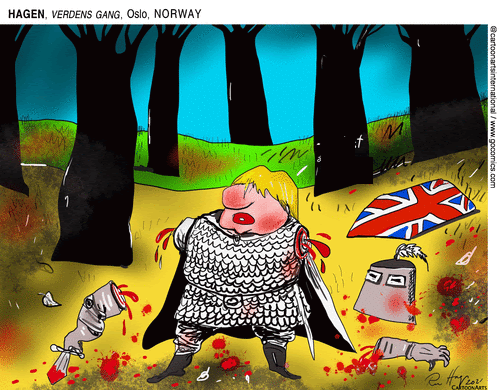
(from Norway’s Dagbladet—Pace the Black Knight from Monty Python & the Holy Grail

See also the New York Times: https://www.nytimes.com/2021/12/13/world/europe/boris-johnson-uk-coronavirus.html?referringSource=articleShare

#993 2,035 words

Posted in Politics | Leave a comment

The Road to Scindy III—Councils As Partners

On Thursday, December 9th, Finance Secretary Kate Forbes will present a budget to the Scottish Parliament. A couple of goodies have been trailed in Nicola Sturgeon’s speech to the SNP Conference in November, including a doubling of child benefit from £10 to £20 per week. Undoubtedly a boon to less-well-off families, like free prescriptions, personal care, tuition fees, etc. Nicola did not discuss where the additional funding to pay for this could be found.

It is unlikely that Kate will be any more specific, but the likelihood is that a squeeze on council budgets that has lasted a decade will continue. Despite John Swinney’s promise of “Parity of Esteem” made to CoSLA as Finance Secretary in 2007, devolution of powers to Holyrood did not been reflected in any devolution of powers to councils. This has been Devo-min.

The Background

The series of Ministers holding the Local Government brief included Derek Mackay and Kevin Stewart, both former Council Leaders—in Renfrewshire and Aberdeen City, respectively. But this made no discernable difference to the tight rein on which councils were kept.

This has been achieved through control of finance. All 32 councils in Scotland receive their revenue from two main sources: around 20% from council tax and around 80% from a Revenue Support Grant (RSG) direct from the Scottish Government (SG). Only a few per cent come from fees and charges. By offering to add or threatening to remove parts of the RSG, the SG persuades councils to implement their policies. For a decade, this was how Council Tax was frozen during austerity. Even when this stricture was relaxed, a 5% rise in Council Tax would still only raise 1% more in actual revenue. The SG still threatened a cap if much more was attempted.

Discussions about replacing Council Tax with another revenue source, such as local income tax, have gone nowhere. With all her other pressures, councils are not likely to see any relief from Kate’s budget. Indeed, North Lanarkshire has got its rebuttal in first, claiming they will be faced with a £70 million cut over three years from its annual budget of £854 million.  Whether realised or not, demands on major council services—like Education and Social Work, which together typically absorb three-quarters of council budgets will grow. Local options for raising funds to meet this are limited. The present Council Tax is regressive, with poor people paying proportionally more. The attempt to spread this fairly across eight ‘bands’ (A-H) has been skewed over 30 yeas as house prices have risen at rates well above inflation. It is now to the point that the “top” band at £212.000 is now over  £10,000 below the average house price.

If the present government want to win an independence referendum, they must show the vision and creativity needed to steer Scotland to prosperity beyond independence. Popular though such measures may be, £10 per week “bribes’ to voters do not fit the bill.

One Simple Solution

Without redrawing council boundaries or revaluing homes, there is a straightforward way to provide a significant funding boost to councils, empowering their ability to improve those services that directly affect people’s lives. It involves adjusting the existing banding system in use. The system allocates properties within value bands, with Band D used as the median. Bands above and below are rated in multiples of ninths. Taking East Lothian as an example, its eight bands, the number of homes in each band and the tax levied on them are shown in Table 1.

BandRatioCouncil TaxNo. of PropertiesTax Raised
A6/9£7451,231£917,505
B7/9£8709,271£8,061,650
C8/9£99415,036£14,942,443
D9/9£1.1186,294£7,036,692
E11/9£1,3666,325£8,642,761
F13/9£1,6155,219£8,428,105
G15/9£1,8634,657£8,677,543
H18/9£2,236862£1,927,432
Total48,895£58,634,131
Table 1—Council Tax by Band in East Lothian

This shows a total of  £31.0 million collected from the 65% of properties in Bands A-D and £36.5 million from the 35% in E-H, for a total tax income of  £57.6 million. There are no bands above ‘H’, although many properties have much higher values in picturesque villages, affluent coastal towns and commuter developments. What is needed is an adjustment that burdens those with money rather than those without.

The simple approach is to split each of the four existing upper valuation bands in two, dividing properties equally between each. This creates eight upper bands. By applying the “ninths multiplier” as before, we arrive at a modified table, as shown in Table 2.

BandRatioCouncil TaxNo. of PropertiesTax Raised
A6/9£7451,231£917,505
B7/9£8709,271£8,061,650
C8/9£99415,036£14,942,443
D9/9£1.1186,294£7,036,692
E111/9£1,3663,163£4,321,381
E213/9£1,6153,163£5,107,086
F115/9£1,8632,610£4,862,368
F218/9£2,2362,610£5,834,842
G121/9£2,6092,329£6,074,280
G224/9£2,9812,329£6,942,035
H128/9£3,478431£1,499,114
H232/9£3,975431£1,713,273
Totals48,895£67,312,668
Table 2—Modified Bands for East Lothian

Although this looks similar to Table 1, the four additional bands bring the top tax payment up from £2,236 to £3,975. Although this is a steep 78% jump, it applies to only 431 properties—less than 1% of the total and worth far more than their out-dated £212,000 valuation. The tax increase would diminish as we go down the bands, so that those in E1 would be paying the same and the 65% of properties in A-D would be unaltered.

The net effect would be to boost Council Tax income in the East Lothian example from £58.6 m to £67.3 million, while making a regressive tax more equitable. This £8.7 million increment is equivalent to an unthinkable 15% rise in Council Tax and delivers a financial flexibility councils have not had in years.

The 35% of residents paying more might feel aggrieved. But consider this: given annual increase in house prices across East Lothian exceeds 3%, even a £400,000 home paying the £1,739 increment for Band H2 would recoup that in property value within two months.

More Complex Solutions

The above should be regarded as a temporary solution until a property revaluation is done to make location within the bands more fair. But there would be no need to adjust the bands, other than the range of property values applied to each.

This raises the question of particularly valuable properties. It would be unfair to allocate properties above, say £500,000 to band H2 when properties exist valued in the millions. If Band H1 were to run from £400k to £500k with a tax levy around £4,000, the introduction of a “Mansion Tax” of 1% on the value of all properties above that. Rather than being onerous, this would still leave 2/3rds of the 3% annual growth in the hands of the property owner.

As additional income, East Lothian has many holiday homes. These are typically rented in season at high rates through Air B&B or local agencies. Anyone owning a second home and able to do this cannot be poor. The density of holiday homes, though not as endemic as in Cornwall or the Highlands, has a detrimental effect on community, especially in older properties, town centres and picturesque locations.  If such properties were rated at 150%, this would effectively tax holiday lets,  yet leave the locals payment unaffected. The definition of local would be registered voters resident, which would have the added bonus of catching the rich who maintain a home in Scotland yet claim reduced council tax as non-residents. Estimating the number of local second homes (mostly above band D) at 1,000, such a scheme should add another £1.5m. This is equivalent to a further 2.5% rise in Council Tax, the difference being that it affects mostly non-residents of the council area.

As a party of government, the SNP has remained resiliently popular. If all it wished to do is maintain the status quo of devolution, this might be a shrewd tactic. But, by not frightening the horses with a timid fiscal policy based on populist political “bribes” they have neglected showing inspirational leadership and, more importantly, how they would deal with the 22% of GDP in government spending that would be the case on the first day of any independence. That Kate Forbes will empower our 1,200 councillors as partners on Thursday, instead of continuing to treat then as chattels, is unlikely. But a scheme like that above is the kind of radical thinking and willingness to take risks necessary to attain the future prosperity to which we all aspire.

#992: 1.298 words

This idea is neither new, nor original: see also:

Ma Faither’s Howff Has Many Mansions (March 2012)

Ma Faither’s Howff (Revisited) (September 2012)

Posted in Uncategorized | 2 Comments

The Road to Scindy II—Cunning Plan, or Planning Con?

A high quality planning system is essential to create quality places with the homes, infrastructure and investment that people need. We are improving Scotland’s planning system, to strengthen the contribution planning can make to inclusive growth, to delivering housing and infrastructure and to empowering communities to influence future development of their areas.”

—Scottish Government Planning and Architecture

The Planning (Scotland) Act 2019 was passed by the Scottish Parliament in June of that year. The idea is that this will determine the future structure of a modernised planning system. The detail of how the new Act’s provisions will work in practice is to be contained later within secondary legislation. The end result is to be a comprehensive document called National Planning Framework Four (NPF4), which will replace the current NPF3, in force since June 2014, when the Minister was the now-disgraced Derek Mackay. His introduction then already included pious boilerplate about “sustainable economic growth” or “reduced spatial inequalities” or “promoted low-carbon growth and wellbeing”.

Behind the warm words is a developer’s charter. The prime motivator appears to be seen to address social inequalities, while providing more and better housing. Nothing wrong with that, but good planning requires much more. The net effect is that each council winds up with a simplistic tally of homes it must provide through a local plan.

It is, in fact, a de minimus framework, leaving councils drawing rings around fields and letting developers decant any shape or style of house they wish into them. These are usually detached 3-to-5 bedroom family homes squeezed together to generate maximum profit. Outside the provision of schools, safeguarding space for infrastructure—bypasses, surgeries, community hubs, etc., is ignored. Questions regarding human-scale integration of shops, leisure, nature or social diversity, let alone the aesthetics are not asked, let alone answered. The whole is administered by planners who cite rule books about acceptable materials and window distances in a mostly reactive way. The developer decides street layout, choosing house design A over B in homogeneous ghettoes of 50 to 500 houses grafted like growths onto town peripheries.

In England, a highly centralised system of planning over seventy years spread wartime rebuilding by a mix of Keynesian state and modernist architects favouring Corbusian towers and motorways. The role of finance in shaping urban landscapes is most obvious behold Docklands redevelopment, the corporate island of Canary Wharf, and steel and glass monoliths named for their shapes—“Gherkin,” “Shard”— jutting from London’s neoclassical skyline.

The modernist experiment was also imprinted on concrete public housing estates such as those found in London’s boroughs, still occupied by the poor. More recently, English planning has turned towards participation and reclaiming the street network for cyclists and pedestrians, following a European trend to address livability and climate change. As a retrofit, this has been only partly successful.

Scotland has followed this centrist model, initially creating (without intending to) centres of deprivation in Easterhouse, Wester Hailes, Mastrick, Raploch, etc. Right to Buy saw abandonment by councils of building social housing and provision by RSLs at much slower rates. The bulk of new builds have been detached family homes, as described above. Only Edinburgh has made good use of brownfield sites with low-rise flats integrated with existing communities and facilities.

Both countries have suffered from a planning regime that is bureaucratic, unimaginative and reactive. It is divorced from what people regard as town, let alone community, planning. The urban segmentation results in excessive vehicle flows. Both fragment society, increase “defensive” living, and petty crime. As commute distances soar, local social mixing in High Streets declines, children don’t dare run free any more and our affluence comes at increasing cost. Ask any bufti to relate all we have lost.

But it need not be this way. And at a time when Covid has scrambled social patterns and climate change is forcing us to re-think how we live, might this not be the time to radically re-think how we plan our towns, if not our civilisation?

The Scottish Government, rather than churning out another developer open season in NPF4 has a chance to show how to evade the urban sprawl and inner-city disintegration becoming the norm in England. Our cities are not so large; our towns less smothered in suburbs. It will take vision, resolution, team work and devolution.  The benefits will be immense, with the Scottish Government augmenting the credibility it needs to be plausible steering an independent Scotland the people believe will be the better place to bring up their children. This will demand:

  1. Vision. Quite apart from waking up sleepy council planning departments , the law needs to be changed to remove the presumption of permission to build unless “material planning considerations “ can be demonstrated to stop it. Overarching Regional Plans will set out how a city region is expected to develop and will include business, retail, and (especially) integrated transport plan, all to be secured and partly provided before residential elements are finalised.
  2. Resolution A completely restructured planning law that sets out mechanisms whereby real town planning is to be achieved. Statutory consultees will be tasked to comply with requirements, rather than have a veto. Government departments will be expected to supply support, finance and guidance to ensure the plans are viable. Local councils will employ more creative teams, led by a qualified town planner with vision to perform town planning on each settlement under their care, including settlement statements on their future role.
  3. Team Work  This will be required and expected from all those contributors listed above. Y these should be added seminars of consultation with community representatives, with the goal of each town plan becoming as close to consensual as possible. Only when that point has been reached would developers be included in the process, each bidding to fulfil a part of the town plan, with an incentive to address the vision contained therein.
  4. Devolution  It should be clear from the foregoing that the Scottish Government will no longer hold centralised authority over planning, other than in formulating and adapting laws, as required. Bu the same token, planning departments will have a duty to engage with and persuade partners and residents of the desirability of the plan, far more than the present holding of public meetings, then ignoring whatever was said.

The principle to be adhered to is that each area is different, has a sense of itself, and, has a good idea what it would like and gets behind working for the future if they believe it theirs. Kirkwall, Kirkcaldy and Kirkcudbright are all different places—and should feel different—even if they have much in common and things they might learn fro  one another. Like taking your cue from local accents, you should know where you are just by looking around. People are tired of everywhere looking like Watford.

So, what should they look like. That depends where it is. Edinburgh has a mixed record in getting this right. The Radisson Collection Hotel on the Royal Mile is barely an improvement on the Midlothian County Council it replaced on the Royal Mile, but the Scandic Crown further down makes a superb effort to blend in. The state of Princes Street is pitiful, but the new apartment blocks on Macdonald Road let you know you’re in Edinburgh and provide compact modern city living.

It is not necessary for Glasgow to build a pastiche of its red sandstone tenement heyday. But building another Gherkin or Shard there would be as inappropriate as in the centre of Paris—or a clutch of detached family homes to fill Pollokshields Park.

Planning must make our great cities more liveable, and therefore more attractive. As well as compact living, making for handy facilities, they need green space and pleasant walkability. That means fewer vehicles, which is not achieved (as Edinburgh is trying) but just making life hell for drivers. It means that glacial buses need help from a re-opened South Suburban rail line and some trams on the many abandoned tracks around the city.

If Glasgow were the hub of a city region plan that included all adjacent councils; if Edinburgh were a planning hub for the Borders and West Fife, as well as the Lothians and such areas were granted the context described above, this mishmash of obscure and unaccountable bodies like SEStrans would become simpler and, more importantly, transparent to those it is supposed to serve. Scottish Water, NHS and ScotRail should not be allowed to hide in there ivory towers either.

Is this radical? You bet. But it’s how the Dutch made their towns and cities pedestrian friendly and more liveable than ours. It’s how the city twinned with Edinburgh, Munich, is so highly praised, because they took the Deutschhe Bundesbahn (railways), city trams, local buses and banged their heads together to make a seamless, efficient public transport system that everyone uses. Whether you want to shop or go sailing or take off from the airport. it’s so easy, they leave their cars at home.

#991  1,502 words

Posted in Community, Politics | 1 Comment

Fake News Is Nothing New

Propaganda as a means to persuade people has a long history. But it really only came into its own with the spread of newspapers and radio in the 20th century. The first to exploit mass media’s ability to spread falsehood in the interests of the state was Dr Goebbels in Nazi Germany.

He should be credited (if that is the right term) with creating Fake News, although Stalin’s regime in Soviet Russia was not far behind. The scale of both their streams of falsehoods designed to sustain the state was brilliantly lampooned in Orwell’s 1984, where the Ministry of Truth’s sole task was to disseminate lies.

But the West—especially the USA— was not above using such black arts during four decades of the Cold War against the Soviet Union and communism in general. Radio Free Europe was not always scrupulous about what it broadcast to the people behind the Iron Curtain. The Cold War escalated into the Korean War in 1950. The USA fell into a conviction of its moral superiority as the clearly democratic “Leader of the Free World” against the dictatorship of communism, as evidences by Stalin’s iron rule in the Soviet Union.

In the early 1950’s, this led to the “Reds under the beds” era of McCarthyism when a paranoid USA saw Communists both at home and abroad. In what was not America’s finest hour, democratic principles were pushed aside in the hunt for real, or imagined, Communists. The greatest sensitivity was in America’s back yard: Latin America.

Early post-WW2 was also the era when large American corporations, swollen and undamaged by the war had free global reign. There was great demand for their aircraft, computers, armaments, household appliances, cola and hamburgers, as well as films, TV and music.

Ever since the Monroe Doctrine declared Latin America to be their economic fiefdom, American companies had exploited the area. This was particularly true of the supply of tropical fruit. The United Fruit Company (UFC) flourished in the early and mid-20th century. It came to control vast territories and transportation networks in Central America and the Caribbean, establishing virtual monopolies in Costa Rica, Honduras, and Guatemala.

Such “Banana Republics” were each under the control of a handful of families who owned and ran vast estates that grew the fruit. The esrarws were worked by the poorly paid majority of the population. In 1944, an uprising in Guatemala toppled a dictatorship under Jorge Ubico. Juan José Arévalo was elected president in Guatemala’s first-ever democratic election, turning it into a democracy. He created universal suffrage; establshed a minimum wage. In 1951, Arévalo was succeeded by Jacobo Árbenz, who granted property to landless peasants through land reform of the estates.

This displeased the estate owners, but more especially UFC, which was making handsome profits from the pitiful wages paid on the estates, as well as a light tax regime by paying off the right people. Due to the level of political influence UFC exercised at home, the Truman administration was soon under pressure from fake news that this land reform was just the thin end of a Communist wedge. Nobody in the US appears to have done any homework on the reality in Guatemala.

In early 1952, advised by staffers John Foster Dulles and Allen Dulles (who both had links to UFC),  Truman authorised the Central Intelligence Agency (CIA) to plan Operation PBFortune to topple Árbenz. This was never executed. Late that year, Eisenhower was elected President on a platform of being tough on Communism around the world. With McCarthyism “witch-hunts” at their height, the stalemate in Korea unresolved and defeat for the French in Indochina imminent, paranoia was in the air. As a result, the U.S. federal government conclusions about the extent of Communist influence among Árbenz’s advisers were exaggerated into what we would now recognise as fake news.

So, in August 1953, the CIA was authorised to carry out a reconfigured Operation PBfortune as Operation PBSuccess. The CIA armed, funded, and trained a force of around 500 men and the coup was preceded by a “softebing-up” operation. This was a media campaign of disinformation that criticised and and tried to isolate Guatemala internationally.

On 18 June, the scratch force invaded Guatemala A campaign of psychological warfare was led by a Radio Free Europe-style broadcasting, using anti-Árbenz propaganda and a heavily distorted version of events. The “news” denied: that a naval blockade of both coasts was in force; that the bombing of Guatemala City had anything to do with the USA; that the invasion force was making heavy weather of reaching the capital.

When it promulgated the threat of a U.S. Marines storming ashore, the beleaguered Guatemalan Army laid down arms and refused to fight on. Árbenz resigned on 27 June and Castillo Armas was installed as President ten days later. In becoming the first of a line of US-backed dictators, Armas was the coup de grace to democracy in Guatemala. The CIA tried to justify the Guatamalan incursion by searching records for evidence that the Soviet Union had been involved in the country. They found nothing.

Such blatant interference did not pass unremarked and so further eroded Latin regard for the USA as a force for good in the Americas. The rot had started when supposedly ant-colonial USA sparked the War of 1898 against colonial Spain. After a swift victory, it proceeded to annex Puerto Rico, Guam and the Philippines as virtual colonies and turned Cuba into an offshore Las Vegas. Soon after, in 1903, threats towards Colombia severed Panama to set it up as a puppet state so the Panama Canal could be built. The Castro-led 1959 Cuban Revolution should be seen through the prism of a century of self-justified IS arrogance in the region.

Variants on Guatemala;s story a scattered through Latin America, always with CIA justification for intervention of combating Communism. It brought Pinochet to Chile and Ortega to Nicaragua. UFC may have gone out of business in 1970, but its legacy of covert intervention to prop up business interests continues. Regard for the niceties of democracy and the will of the people are often cited, but seldom adhered to. Papers concerning such activities were witheld until Clinton and Obama called off the dogs of war.

But the legacy of peasant populations oppressed by rich estate owners, protected by strong-arm presidents, backed by American clout lives on. So when Trump grew belligerent about great numbers of desperate Central Americans who were appearing on the southern border and railed against Mexico for permitting more caravans of migrants to cross the 2,000 miles of its territory from the Guatemalan border, neither he, nor most Americans saw any responsibility for them. But it is utterly cynical that those refugees were treated so harshly, as if the US were blameless for their plight.

These people represent just some of the many chickens hatched under all those dishonest cover stories disseminated on behalf of McKinley. Teddy Roosevelt, Truman, Eisenhower and Regan now coming home to roost.

#990 1177 words

Posted in Commerce, Politics | Leave a comment

The Road to Scindy I—Hug a Sassenach

There is a case for Scotland being a normal, independent nation that is at least as strong as the argument for it remaining within the United Kingdom. Unfortunately, in the seven years since 2014, the SNP, whose job this should be,  has not been making that case. To be sure, it is a complex argument, fraught with unknowns, that the bulk of Scots are unlikely to delve into, nor come up with watertight arguments, should they do so.

Just as scientific analysus is a flawed method of choosing a partner in life, passion for the country that you regard as home is a matter of the heart. It is not hard to find people who are passionate about England and others equally passionate about Scotland. But most of those get no closer to hostility than the stands at Twickenham and Murrayfield. Scotland’s case for independence does not rest on hostility towards England.

However, there is a third class of people who regard themselves as British. They recognise the many differences between the two nations, but see them as cultural only. This is not confined to older people with memories of WW2 heroism and the greatness of empire. They believe the weld that made a political union over 300 years ago cannot be sundered, any more than Yorkshire could become a separate state. This is the element that causes problems. Were this Czechoslovakia, the problem would not arise, as neither Czechs nor Slovaks counted many who loved the artificial state glued together from ruins of the Austro-Hungarian Empire in 1919. The resulting “velvet divorce” shows how smoothly such splits can be made to mutual satisfaction.

Britain is different. Having been top dog with a massive empire covering a fifth of the globe just a century ago, the political baggage is massive. What is also massive is the preponderance of things English in 1707’s supposed union of equals, but which, in fact, carried on English policies, culture and institutions and bade the Scots to fit in as best they could. There is no doubt Scots benefitted immensely from the partnership for 250 years, explaining their quiescence over that period. But times have changed.

With England providing 50 of the 65 million inhabitants and a similar proportion of members in the UK Parliament, Britain is clearly now no union of equals, if it ever was. The 47 (of 59 = 80%) Scottish MPs wanting independence are hopelessly outvoted at Westminster. Hostility from the present Conservative government has been the focus of anger and resentment in Scotland, and not just from the SNP. But clearly, a consensus among the English that Scotland could go its own way would trump any unionist resistance among other parties. So what is the current picture among the English?

Early this summer, Savanta Comres performed a poll among 1,853 representative English people and received the following answers (excluding Don’t Knows) to their questions:

  1. Support (43%) or oppose (56%) Scottish Independence?
  2. More (43%) or no more (56%) financial support to Scotland to stay in UK?
  3. England would be weaker (63%) or stronger (37%) without Scotland in UK?
  4. Scotland should keep using (58%) should not keep using (42%) the £ sterling?
  5. Would an independent Scotland thrive (44%) or fail (56%)?
  6. Should there be vehicle checks at the border (47%) or not (53%)?
  7. English people should (42%) should not (58%) vote in a Scottish referendum?

The English are hostile to Scottish independence, but not excessively so. When you consider that up to 24% of respondents were “don’t know”, it would appear that a public relations campaign by those keen on Scottish independence directed, not at the Scots, but at the English might open a fruitful new front in their campaign and outflank their unionist opponent relying on English votes to stay in office.

London is unlikely to be fruitful territory, more because of its inability to see outside the Home Counties, let alone have awareness of Scotland beyond offering them rugged recreation. As far out as the Cotswolds and Norfolk, residents are unlikely to be understanding, let alone sympathetic.

But the former industrial Midlands and North, recently christened as the “Red Wall” should prove far more sympathetic. Not only do they suffer similar patronising neglect by the Imperial Capital, similar to Scotland, but a strong case could be made that the departure of Scotland would boost their profile and benefits.

A subtle campaign to woo the sympathies of Northern England would do the cause of Scottish Independence far more good than locking horns with the increasingly desperate, and therefore intransigent, Scottish Unionists. A suite of ideas that would best be applied together, rather than individually includes:

  1. Wheesht Yer Whining. Scots have never thrown off the stereotype among the English of the mean and moaning Scot (c.f. Private Fraser in Dad’s Army). This elicits neither sympathy, nor respect. Compare Ireland that half a century ago was similarly pilloried but recent success and a confidence to make their own way in the world has stemmed patronising jokes and ridicule.
  2. They are NOT ‘The Enemy’. Nothing is achieved by being resentful, much less hostile, to the English. Half the English (22m) live in the five regions of Northern England and feel as much irritation at the Southerners as Scots do. There are opportunities for common cause to be made in areas like:
    1. Wildlife tourism
    2. Industrial regeneration
    3. Carbon capture and storage
    4. Esturial regeneration (e.g. seagrass; oysters) in Solway Firth and Morecambe May. Suppambe Bay vs. upper Firths of Tay ad Forth
  3. Integrated public transport. Support Mayor Andy Burnham’s drive for a TfL-equivalent single-ticket, metropolis-wide scheme for Manchester by driving for one in Glasgow and supporting similar efforts in Birmingham, etc.
  4. Find Common Causes. While Scots attempt to distance themselves from the English as a whole, they failed to see how some investment in high-impact, low-cost projects might woo Northern English support, such as:
    1. Create a “Border Bond”: Berwick-Upon-Tweed residents could be treated as entitled to benefits available to their Scottish Borders hinterland and eliminate resentment on things like free prescriptions
    2. Solve the “Irish Sea Border”: Once the Lord Frost NI Protocol spat settles down, offer to create a custom clearance facility at Stranraer/Cairnryen that smoothes the passage of English goods headed to NI and calms Ulster Unionist ‘division’ from UK.
    3. Links with the Continent: In the absence of the Rosyth-Zeebrugge ferry, work with Newcastle to provide better ferry service there and easier links to bring foreign and tourists in there, avoiding Channel and M25 bottlenecks and superior access to Netherlands, North Germany and Scandinavia.
  5. Create an Inner City Institute. This would direct cross-border research and disseminate best practice in dealing with the post-industrial social problems found in Glasgow and Dundee, as well as cities in Northern England that differ greatly from those found in London
  6. ‘De-privatise’ Rail.  On the assumption that TfL-style transport nets were created in metropolitan areas, the fact that Transpennine trains already run to Edinburgh and ScotRail trains to Newcastle, a higher level of integration would be possible and more cost-effective than the present expensive franchising system. If Northern, Transpennine and Central Trains were brought back into public ownership, a “Northern Hub” airport at Manchester could be fed by an integrated network of rail services, much as Copenhagen provides an international hub for All Scandinavia. Being 200 miles closer to North America, Manchester would become a more viable and accessible competitor to Heathrow. Just look how Dublin has become a springboard for the USA. Newcastle, Glasgow and Edinburgh would remain as regional, non-international airports because of their restricted size and poo access.

There may be other opportunities, once some serious thought and research is put into these possibilities. But, by eschewing a stance as a nation of 5.5m tacked on to the end of England, if Scotland were to regard Northern England as a natural ally with a common cause against a neglectful and often arrogant Southern England. With a joint population of almost 30m and capitalising on its energy resources an industrial past, the disabling of London dominance through Brexit offers an opportunity to shift the economic centre of gravity further North in a way George Osborne’s still-vague and unrealised “Northern Powerhouse” never could.

And when Scotland does achieve independence, it will be well integrated with friends in the revitalised North of England.

Posted in Commerce, Politics | 1 Comment

Videotracks of Our Lives

Given the myriad of channels through which it is now delivered, the very dame “film” has become a misnomer, verging on the archaic. But for a century, it has been the prime means of mass communication around the globe, surviving through each successive development of sound, radio, TV, videotape, DVD, YouTude, streaming, etc. In a world where someone known outside their home town can get called a “star”, remain the unquestioned peak of the star pyramid are film stars, recognisable around the world. Their work has formed a tapestry of my awareness of life, as it may have done for our culture—at least, until recently.

I fell in love with film early. Growing up in the pre-TV 1950’s in a small town where the only entertainment was the cinema, I took advantage of indulgent grandparents with whom I lived to toddle the 100 metres with another 6d (2.5p) puece in my hot little hand to watch what was showing. As the Playhouse’s programme changed three times a week, that meant most of my pocket money wound up there.

It was magic—a window on the world my grandparents never saw and hooked me on the immersive experience of being transported from the dark into the sounds and sights and emotional colour of living in the film. I have come to appreciate theatre, concerts and other live performance. But nothing moves me like a well crafted film.

It was only later in life, once I was well past the stage of missing half the film by paying too much attention to the date beside me, that I came to not only critique, as well as be entertained by a given film, but slowly realised what a wonderfully memorable videotrack (as opposed to soundtrack) of my life, and that of society in general, they had become.

This came to me during my 15 years in Silicon Valley when David Packard (of Hewlett-Packard fame) chose to spend some of his zillions restoring the Stanford Cinema to its pre-war glory and show a series of pristine black-and-white prints from the UCLA Film Archive, complete with cartoons, popcorn and usherettes in pill-box hats.

As well as revealing to me forgotten geniuses of the silent era like Buster Keaton and Fritz Lang, you started to see the living history of the pre-war era laid out in socially observant series like The Thin Man, witty observations on American life that moved into colour with authentic later representations like Chinatown.

All this threw many of the films I had seen as a primary school kid in shorts into new perspective. While I had my boyish thrills at British pluck in The Dam Busters, Cruel Sea or Ice Cold in Alex, I had not connected with more mannered British fare like Blythe Spirit or Genevieve. What I did connect with—but fully only much later—were American films that made eloquent (for the time) social comment, films like Giant, The Wild Ones, The Misfits, Look Who’s Coming to Dnner, In the Heat of the Night or On the Waterfront. It was only later that British cinema dared to come out with equivalents like Look Back in Anger; Georgie Girl; A Taste of Honey, To Sir With Love or Loneliness of the Long Distance Runner. All products of the “Kitchen Sink” school of writers determined to show life as it is.

There is so much to take in, so much insight into what drove or restricted people’s lives in any of those. Unfortunately, they were few and far between as Hollywood got side-tracked into “sword and sandal” epics or John Wayne westerns to try to compete with TV. Britain’s equivalent was endless Carry On films and bubble-gum like Summer Holiday. Had Bond not come along, Elstree/Pinewod would have shut up shop in the mid-1960’s.

Thankfully, the wave of rebellious innovation from that decade reached film makers. Lush and powerful dramas reset the standards high: Romeo and Juliet; Lawrence of Arabia; A Man for All Seasons; Women in Love; Doctor Zhivago brought history to life and posed modern questions. 2001; A Space Odyssey exploded the imagination in preparation for the moon landing; A Clockwork Orange frightened the bejasus out of you as a different take on the future.

There followed a couple of decades of film innovation interspersing blatantly commercial releases. Star Wars was popular, but comic book, while Alien seemed so chillingly plausible. The American agony of Vietnam was not assuaged by gung-ho releases like Green Berets, but the relentlessly surreal Apocalypse Now immersed you in the craziness, equalled (but not bettered) by the later Platoon. American politics came into film’s crosshairs in All the President’s Men and the wonderful Being There. The serious stuff was balanced by a series of wonderfully crafted period pieces so good, they could almost have been documentaries of these times, including Tess, A Room with a View and The French Lieutenant’s Woman. But, while the Americans came to grips with contemporary social issues in films like One Flew Over the Cuckoo’s Nest, Fried Green Tomatoes, Working Girl and Wall Street, the British stuck to historical clashes like Rob Roy or lightweight contemporary observations like Four Weddings or Notting Hill.

From the 1990s onward, the increasing number of media on which films could appear and the difficulty of securing income from them forced a wider volume of production, with a concomitant reduction in general quality. Pure entertainment series, such as Indiana Jones, James Bond, John Maclean (Die Hard), Lara Croft, Jack Ryan, Jason Bourne, etc., as well as Marvel Comics derivative brought in the money and art house releases gained scant distribution. Honourable exceptions are films of the Coen brothers. From Miller’s Crossing to Three Billboards, they are shrewd, very human and funny to boot.

The introduction of CGI opened up a world of possibility that earlier special effects could only dream of. These were put to excellent use in Titanic and the utterly stunning, unutterably beautiful Avatar. But mostly they have been used to enhance thin shoot-’em-up stories from Pearl Harbor through Independence Day to White House Down. It’s entertainment, but it’s not art.

Maybe that’s me being crabby because I’m old. Maybe I’m too much of a purist, steeped in the old school. But films documenting real life now seem rarities and fantasy is all the rage. I hope there will be more films blending directors craft with brilliant actors using eloquent scripts that make shrewd comment on society that we can all learn from, even as we are being entertained. But the last decade has not thrown up a film able to hold a candle to kitchen sink films cited above. But I live in hope.

And my own favourites? It’s a toss-up between Local Hero and Cinema Paradiso: both shrewdly observed, full of humanity and humour—and not a frame of CGI in sight!

#988—1,176 words

Posted in Uncategorized | Leave a comment

Is It a Fair COP?

“Humanity has long since run down the clock on climate change, It is one minute to midnight to prevent catastrophe.”

—Boris Johnson at COP26, November 2021

Intensifying media blanket coverage means most of us were fed up with “last-chance-saloon” mood music before COP26 even graced “The Dear Green Place”. It is now going well, a suspiciously politically motivated strike by GMB waste workers notwithstanding. While much has been made of Chinese and Russian leaders being no-shows and India making promises for 2070, not 2050, the fact that virtually everyone is there (192 countries sent delegates) means it may be the best we can do.

Talk in the run-up focussed on the goals of slowing, rather than halting, global warming, with a 2 deg C rise as a ceiling and a 1.5 rise an aspiration. A UN study predicting 2.7 rise under current commitments may be discouraging news, but, equally, it could act as a spur.

A short blog like this is no place to rehearse all the arguments. But a discussion of the concrete consequences might focus minds better than temperature generalities. It is clear that the world is already suffering weather instabilities from climate change but more permanent damage is in the offing and from which full recovery is unlikely. This the juggernaut of sea level rise.

“The global mean water level in the ocean rose by 0.14 inches (3.6 millimetres) per year from 2006–2015, which was 2.5 times the average rate of 0.06 inches (1.4 millimetres) per year throughout most of the twentieth century.”

—NASA Sea Level Research Laboratory, Hawaii

By the end of the century, they predict a global mean sea level rise of one foot (0.3 meters) above 2000 levels, provided greenhouse gas emissions fall to a low level in coming decades. This would be required to follow the 1.5 degree model, together with a linear extrapolation of the present rate of rise. This appears optimistic, because:

  1. The 2.7 degree rise is the most probable future temperature
  2. The likely disappearance of Arctic sea ice in summer will make the albedo of the Northern Hemisphere darker, causing more heat to be retained
  3. Such warming will start to melt the Greenland and Antarctic ice sheets, which have trapped 70% of the world’s fresh water

Neither the melting of glaciers, nor of sea ice causes appreciable rise in sea level; the former is relatively small and the latter already displaces the same amount of water as it floats. But the ice sheets are entirely another matter. Lying on land to a thickness up to 3 km, their melting would raise sea levels by a catastrophic 58 metres.

Long before that, the melting that is taking place and the thermal expansion of the seas through warming can cause trouble enough. Taking the more brutal 2.7 degree scenario and another factor of 2.5 for increase in sea level rise gives an increase of 1m over this century. In itself this could turn areas of low-lying farmland near the sea into salt marsh. But increasingly violent weather adds storm surges, caused by high winds and a drop in air pressure in the eye of such storms. This can add over 1m to the height of a tide. In 2005, Hurricane Katrina created a storm surge over 4m, which inundated much of New Orleans. In 2012, Hurricane Sandy flooded coastal New Jersey and parts of New York City.

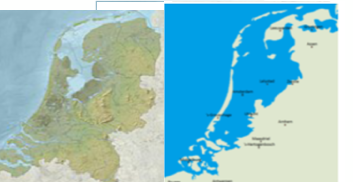
The UK defines HMWS (High Mean Water Springs) as the highest a tide reaches. But, in reality, this could be overtopped by another 2 metres if all factors coincide. Such a “great flood” overwhelmed the Essex coast in 1953 and 53 people died.  Prepared sea defences, such as most of the Netherlands or the Thames Barrier protecting London, would probably withstand such an event. Most of the world enjoys no such protection.

Netherlands—and Flooded at Current Sea Levels

In future, such events as the 1953 flood would rank minor among the world’s problems. Much of Bangladesh is already underwater for a time and inhabitants displaced. The American Gulf coast is vulnerable along much of its 1,600 mile length. Deltas, like Vietnam’s Mekong are vulnerable. Most Pacific atolls would soon become uninhabitable. Almost all coastal cities would suffer damage along their shores.

Were a combination of sea level rise, storm surge at high Spring tide add 3m to ‘normal’, entire cities would be lost. Though the waters might recede, damage and the likelihood of repetition would make re-occupying them to risky. Cities at risk of abandonment as a result of such occurrences include:

  • High Risk: Alexandria, Egypt; Algiers, Algeria; Brisbane, Australia; Darwin, Australia; New Orleans, LA USA; Quingdao, China; Beirut, Lebanon; Georgetown, Guyana; Venice, Italy, Wellington, New Zealand
  • Medium Risk: Adelaide, Australia; Bridgeport, CT USA; Colombo, Sri Lanka; Dohar, Qatar; Le Havre, Mobile, AL USA; France; Miami, FL USA; Perth, Australia; Rijeka, Croatia
  • Low Risk: Alicante, Spain; Atlantic City, NJ USA; Bangkok, Thailand; Belfast, Ireland; Benghazi, Libya; Hull, England; Galveston, TX USA; Hiroshima, Japan; Izmir, Turkey; Norfolk, VA USA; Panama City, Panama; St Petersburg, Russia; Trieste, Italy; Vancouver, Canada

These lists are neither exhaustive, nor definitive. But they do a sense of both the diversity and the importance of cities under immediate threat. Many others would suffer partial inundation and recover, as New Orleans did. Every metre rise in sea level would shift cities up one stage. Such lists could be extended to include hundreds of smaller cities, thousands of towns and, probably, millions of villages.

The key point is that, taken together with widespread loss of agricultural land and the millions of displaced people, few, if any, countries would have the resources to look after others so afflicted. Even advanced countries would be pre-occupied with  looking after their own damage and displaced citizens and to even maintain their economy.

This does not imply the collapse of civilisation, but it would mean severe drops in living standards and quality of life. Landlocked countries like Switzerland would be unable to compensate this scale of loss.

Bad though this may seem, even more catastrophic scenarios exist. Any serious melting of the Greenland and Antarctic ice sheets multiply the problem well before any 58 metre Armageddon. Well before that level, civilisation as we know it would disappear, along with entire countries. Londdon;s and Netherland’s sea defences may still be holding out but they would fall into one of the following lists of key cities likely to be abandoned with each metre rise in sea levels.

  • 4-Metre Rise: Bruges, Belgium; Cherbourg, France; Fort Lauderdale FL USA; Iskenderun, Turkey; Ravenna, Italy; Recife, Brasil; Shanghai, China; Southampton, England; Stockton, CA USA; Tunis, Tunisia
  • 5-Metre Rise: Basra, Iraq; Cagliari, Sardinia; Camden, NJ USA; Dunkirk, France; Kaliningrad, Russia; Tel Aviv, Israel, Sapporo, Japan
  • 6-Metre Rise: Bordeaux, France; Bremen, Germany; Charleston SC, USA; Channai, India; Luanda, Angola; Massawa, Eritrea; Riga, Latvia
  • 7-Metre Rise: Biloxi MS USA; Hamburg, Germany; Honolulu, HI USA; Tokyo, Japan; Ho Chi Minh City, Vietnam; Ostend, Belgium; San Sebastian, Spain
  • 8-Metre Rise: Exeter, England;Hue, Vietnam; Manila, Philippines; Monrovia, Liberia; Nice, France; Portsmouth, England; Vladivostok, Russia
  • 9-Metre Rise: Antwerp, Belgium; Corpus Christi, TX USA; Karachi, Pakistan; Reykjavik, Iceland; Salvador, Brasil, Tricomalee, Sri Lanka
  • 10-Metre Rise: Baltimore, MD USA; Bandar Abbas, Iran; Barcelona, Spain; Belem, Brasil; Calcutta, India; Cayenne, French Guyana; Hanoi, Vietnam, Kingston, Jamaica; Long Beach CA USA; Mogadishu, Somalia, Perth, Scotland; Philadelphia PA USA; Sacramento, CA USA; Taipei, Taiwan; Valparaiso, Chile

If global warming totally melted the ice sheets, even if the resulting weather permitted crops to grow and civilisation to hang on, the world would be literally unrecognisable. Half the capital cities of the world would be gone, including Washington and Beijing. Almost ALL European capitals would be gone—only Madrid, Zurich, Vienna, Prague, Sofia and Athens would remain. Budapest would be a coastal city. So would St Louis MO, Strasbourg, Chesterfield and Vitebsk, Russia. Wales would be an island and the Black Sea would flow across the Kalmyk steppe to fill the Caspian basin.

And the good news? Well, the Suez Canal would be superfluous and Antarctica would finally be available for colonisation.

Watch “Earth Under Water, a one-hour documentary on the Smithsonian Channel (Channel 56 on Freeview, UK)

An earlier post on the same topic, discussing impact on my local patch of East Lothian, was published here in August 2021. See: Can You Canute?

Antarctica—Covered with 2-3 km of Ice, Showing Sea Ice
Posted in Environment, Politics | Leave a comment

Those Who Walk on Water: III—Boris Johnson

“This Budget will deliver a stronger economy for the whole of the UK. We’re building back better from the pandemic with a more innovative, high skill and high wage economy that will level up across the country.”

—Tweet from Boris Johnson after Sunak’s Budget Speech, 27.10.21

And so we come to Boris Johnson, the latest in 21st century top dogs who see the rules are for mere mortals, but not for them. He does not have the vision and charisma of Blair or Obama; he does not have the planetary ego and unshakeable chutzpah of Trump. But he has earned his place in the Pantheon of Walkers on Water—of politicians whose personality comes to dominate the party that begat them, rather than the other way round.

Boris has long had form. Early on, he was fired as a journalist for making up a quote. As a reporter in Brussels, he cottoned on to English hostility to Europe and recognised a bandwagon to ride. A shrewd move was to be elected as Mayor of London brought him into the public eye. There his trademark tousled blonde mop, his boisterous manner and media baits like bendy buses and Boris bikes meant he received for more exposure than he could as an MP and his bloke-ish affability (c.f. Nigel Farage) took him into the consciousness of many outside his party and even outside politics. Throw in non-political appearances, such as on Have I Got News for You and the profile becomes that of famous actor or rock star, which few politicians ever achieve.

Once back in parliament, he was soon in the thick of the Leave campaign, once Cameron had released the jingoistic Tory genie out of tits bottle with the 2016 EU Referendum. It was here that Boris refined (though that may not be the correct term) as a political force in his own right. Gleefully attaching himself to slogans and assertions that owed more to posture than fact (£300m for the NHS if we leave), his rise stumbled when Michael Gove stabbed his leadership bid in the back.

It was, however, soon back on track when one of Theresa May’s many misjudgements was to appoint him Foreign Minister.. In his two years of tenure, he alienated more countries than any other in the post over that period of time. These were not gaffes, but tactics to keep him in the public eye. And when May’s faltering premiership ran out of road, Boris enjoyed the nearest thing to a coronation we’ve seem since 1953.

The next few months saw Boris at his presidential busiest, flitting from photo op to photo up, hair tousled, head down, as if about to butt someone, driving a fotk-lift though a polystyrene wall to “Get Brexit Done”. After May’s dither, Boris’ decisiveness carried not just the country, but many “Red Wall” seats ‘oop North’. By making Brexit the theme and leading the charge, he upstaged his own party. But, with a majority of 80 after a decade of weakness, nobody complained.

Boris was no Blair; he had no visionary agenda. But what he did have was Trump’s elastic and opportunistic relationship with facts, as well as much of his disdain for the niceties of tradition and procedure. As the shabby earnestness of Corbyn gave way to the dapper earnestness of Starmer, he came into his own, cheerfully ignoring substance at Prime Minster’s Question Time and taking gladiatorial joy in turning each into an attack on the Opposition. It was a home brew distillation of Trump’s “Fake News” handbook. Though few non-anoraks watch PMQs, the spirit of it leaked out and all his bumbling but can-do appearances have served to cut across party and even political barriers to give him a genuine, if undeserved, aura of “man of the people”, much as Trump achieved.

Especially given the bland and interchangeable facelessness of most of his Cabinet, it is his personal popularity that is carrying the Conservatives now. To date, the many gaffes (too slow to lock down; £40bn wasted on Test & Trace; no ‘over ready’ social care plan, even after two years), their accumulated effect has yet to cause damage, not least because Labour has been no more fleet of foot catching Boris than the Democrats were with Trump.

Whether the Conservatives can weather the fall when Boris goes is not clear. The First Republic did not survive Napoleon and the Labour party has yet to show it can survive Blair. But all three will live on in history books ling after the conventional Chamberlains and Coolidges are reduced to footnotes.

Final scene from Hal Ashby’s 1979 Film “Being There”

(End of 3-pert article, 2113 words)

Posted in Uncategorized | Leave a comment

Those Who Walk on Water: II—Donald J. Trump

“Well, if I ever ran for office, I’d do better as a Democrat than as a Republican – and that’s not because I’d be more liberal, because I’m conservative. But the working guy would elect me. He likes me. When I walk down the street, those cabbies start yelling out their windows.”

—Playboy, March 1990

Hot on the heels of the Obama personality phenomenon came one that redefined “cult of personality” on a scale  few could have anticipated. Whatever opinion you may hold of Trump, he played America and its political system like an old violin. Before the primaries, nobody would have bet on him gaining the nomination. But everyone was used to candidates playing by the rules. Delve into Trump’s business dealings over the previous three decades and you realise that, to him, there ARE no rules.

Trump has always been a law unto himself, moves through a world of his own creation that a stash of billions helped form and sustain. In business dealings, he found glitz and chutzpah opened many doors in New York and learned early that honesty and integrity were disadvantages that hindered progress and—more importantly—could be dispensed with by the application of money and good lawyers. His profitable exit from the Taj Mahal casino in New Jersey, leaving partners and contractors holding massive losses is the stuff of law school lectures.

The application of this approach to gaining the Presidency caught the stuffy patricians of the Republican party off-guard, and his appeal to normally Democrat blue-collar voters flat-footed the Clinton campaign with slogans like “Make America Great Again”.

Such ostentation of wealth and boastful hubris should have led to an ignominious prattall and humiliation. But the “Emperor’s Clothes” phenomenon seems to have kicked in. By sensing the need—always strong in middle ad working-class Americans—for their country, and by extension themselves, to stand tall, Trump was able to don the clothes of reviving American greatness that Reagan used to great effect to heal the scars and despair of Vietnam.

Though hardly credible to any objective observer, he presented himself as one of the people, a fellow campaigner against the remote bureaucrats of Washington, who were guilty of letting America slide in the world, be overrun by immigrants, have their pioneering technologies stolen by Asian upstarts. It came out of the playbook of right-wing demagogues from Attila to Zarathustra: create an internal enemy that threatens the way of life (Democrat = socialist) and create external enemies who threaten the country itself (Latino immigrants and upstart Asians). It was cheap and tawdry, but that had never bothered Trump and plugged right into the fears of the millions of Americans who had hardly left their state, let alone owned a passport to find out the truth.

By dismissing serious reporting as “fake news”, by seizing social media to bypass traditional media, by spreading rumours of electoral malfeasance well ahead of time and galvamising a tribe who stormed the Capital to overturn his defeat, Trump rode the tiger of his own creation. And, so overwhelmed were many Republicans by this, that they saw only the populism and its electoral power. Trump became a party in his own right, daring Republicans to ignore his wide support and flat-footing both Biden and the Democrats, who still think only in terms of legal procedure.

He may be out of the White House, but the final chapter of Trump’s political saga has yet to be written.

Posted in Politics | 1 Comment