Ivan to Go Home—I

A five-part article on Russian military misjudgements in Ukraine

  • I—Background and Russian Unit Organisation
  • II—Russian Equipment and Manpower
  • III—Russian Onslaught
  • IV—Russian Inertia
  • V—Russian Rout

“Our country is officially and directly declared the main threat to North Atlantic security. And Ukraine will serve as a forward springboard for the strike.”

—Vladimir Putin, February 24th 2022

The second week of September 2022 was certainly momentous. In the UK, the monarch died within two days of investing a new Prime Minister and in Ukraine, a front that has moved sluggishlyif at all— for half a year suddenly burst into life Though UK media have focused all attention on “historic” UK events, those unfolding in Ukraine may well have the deeper impact on the world at large.

What has suddenly changed? How could a massive Russian Army experts expected to overrun Ukraine in a week in February become so bogged down and now seems to have been caught napping?

The war is far from over.  Accurate and comprehensive data from the front is hard to find. But this appears a turning point in the conflict. What follows is informed speculation why that should happen after months of stalemate.

Russian Unit Organisation

In war, moral power is to the physical as three parts are to one.”—Napoleon Bonaparte

The Russian Army has always been large. As the Red Army stormed Berlin in 1945, it numbered around 12 million. Kept at a still-impressive size throughout the Cold War, until the collapse of the Soviet Union. At that point, both size and readiness eroded. At one point, only a few dozen armoured fighting vehicles (AFVs) were built in a year. Many junior officers left to find careers outside the  service and morale slumped.

Some forces were kept up to strength and in readiness. These were sent to Kosovo and Moldova in the 1990s, but in a peacekeeping role. As he secured his power in the 2000’s Vladimir Putin revived investment in the Army and devised training grounds that suited his flexing of muscles to restore his dream of the Russian “sphere of influence” (a.k.a. Empire).

This was achieved in Chechnya and Ossetia—two smallish territories in the Caucasus far from foreign interest so he could assume a free hand. Unlike the bottomless quagmire of Afghanistan where Russia had burned its fingers and lost 10,000 men through the 1980’s, these were small “brush fire” wars against poorly armed and  led local militia, where tactics could be tested and morale restored.

By the teens, the Russian Army had been built to around 80 brigades, formed by the splitting up of divisions that proved too unwieldy for effective deployment—a lesson learned from the early years of WW2.
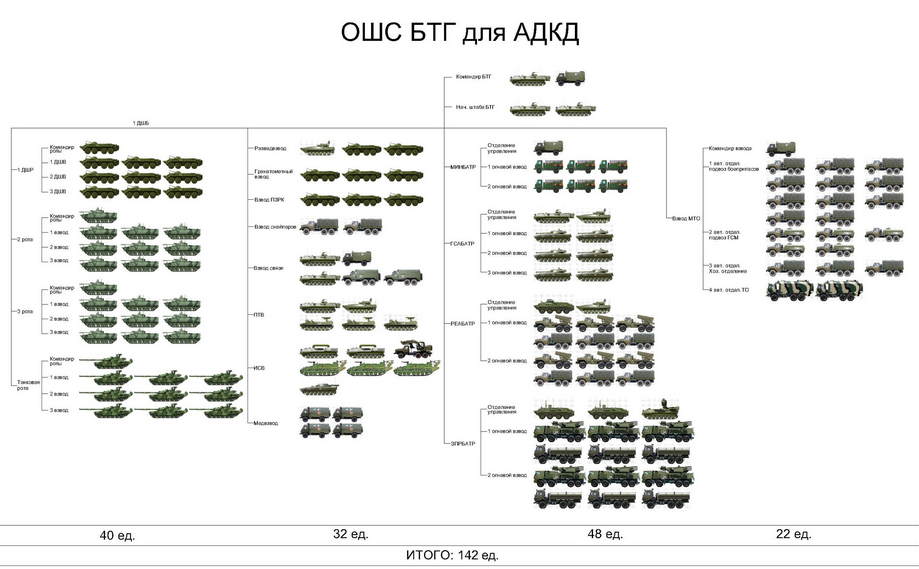
Typical Russian Battalion Tactical Group Organisation

When Russia first intruded into Ukraine, the fall of Crimea came relatively easy. But the Russian-backed insurrection in the Donbas ran into such resistance that the Russian Army had to intervene, but without insignia to protect the fiction that this was spontaneous local action. Those sent were battalion tactical groups (BTG) were a modular tactical organization created from a garrisoned Russian Army brigade to deploy combat power to conflict zones. BTGs were typically effective in combat operations in Ukraine from 2013-2015, but on several occasions, BTGs were tactically defeated by Ukrainian regular units despite Russian firepower, electronic warfare (EW) and air-defense artillery (ADA).

Further Reading: https://rusi.org/explore-our-research/publications/commentary/getting-know-russian-battalion-tactical-group

#1039—491 words
Posted in Military | Leave a comment

Leadership vs Tyranny

The remains of Mikhail Sergeyevich Gorbachev were taken from Moscow’s Hall of Columns, where all Soviet leaders had once lain in state after their death. But all were buried with a State Funeral. Gorbachev was not. This, and Putin’s diary being “too full to allow him to attend” was a major snub of the only leader of real stature, one who had ended the Cold War and built links through a crumbling Iron Curtain.

The origins of Gorbachev’s mould-breaking career is seldom discussed. Born under Stalin in Stavropol, South Russia, his early childhood would witness the brutal collectivisation of the Kulaks and, at age 11, witness occupation by the Wehrmacht’s Army Group ‘A’ making Hitler’s lunge for Caspian oilfields.

Little wonder that, when he had the influence to do so, he looked for de-escalation and peace.

His rise through the Party ranks to take the Soviet Union in a different direction to his  geriatric predecessors, risking all with his glasnost (“openness”) and  perestroika (“restructuring”) was world-changing. Considered in the West to be one of the most significant figures of the 20th century, Gorbachev remains the subject of controversy in his homeland. Hardliners like Putin clearly se him as an aberration, someone who threw away the empire he is mow desperate to restore.

So Gorbachev is the exception, Putin is a return to the norm of Russian leader: a tyrant; a heartless despot, borrowing from repressive Russian leaders down the ages, with Stalin his poster boy. The thuggery of Chechnya, Ossetia, Crimea, Donbas and now Ukraine are just Putin’s desperate attempts to fill Stalin’s shoes as the most successful dictator the world has seen.

But it is Putin’s background in paranoid ambition, honed while scaring the bejasus out of hapless Ossis (East Germans) during the earlier part of his career as a KGB thug. That poorly-led troops have committed innumerable war crimes, that civilians have been brutalised,  that nothing remotely resembling truth is ever announced. All are not new tactics, invented by Putin. They are straight out of Stalin’s playbook how to control a population by terrorising it.

“How many divisions does the Pope have?”

—Josef Stalin, when asked to consider Catholic good will.

Repulsive though brutality not just sanctioned but planned and initiated by Putin may appear, he is an amateur when compared with events during the three decades his role model Stalin held sway. For example:

  • Between 1929 and 1933, kulaks (prosperous peasants) were collectivised transforming traditional agriculture and centralising power. This process of “dekulakization” was pure political repressions, including arrests, deportations, or executions of millions of kulaks.
  • In the summer of 1941, the invading German Army Group Centre uncovered mass graves in the Katyn forest, near Smolensk. They were Poles, taken when Stalin quietly occupied half of Poland in 1939. 8,000 officers, 6,000 police and 8,000 “intellectuals” were executed on Stalin’s orders “as they represented a threat”. When accused, Stalin blamed it on the German occupiers. The Allies hushed the while thing up to assuage Stalin.
  • When the surrounded German 6th Army finally surrendered at Stalingrad in January 1943, over 90,000 half-starved, frost-bitten soldiers were marched off to Soviet gulags. Fewer than 10,000 ever saw the Fatherland again.
  • In May 1944, after the Red army re-occupied Crimea, 200,000 Tartars—even party members and Red Army veterans—were forcibly transported to Uzbekistan in cattle trucks because Stalin suspected some of collaboration. Russians were given the empty farms and houses. Nearly 8,000 died during the deportation.

Whether the harsh Russian climate created a hardy race of tough people who need strong leadership to control them, or a litany of harsh leaders has created the phlegmatic resilience of the Russian people is not clear. Ivan the Terrible and even Catherine the Great set the tome, but none matched Soviet leaders for pitiless brutality. Though he fancies himself as Stalin’s successor who will restore Russia to its rightful empire, he is a wuss; his actions born of desperation, not dominance.

Even casual students of Russian history know, a century from now, which of Gorbachev and Putin will be lauded for contributions made to Mother Russia and civilisation. It won’t be a minor KGB apparatchik whose brutality got lucky.

“Those who vote decide nothing. Those who count the vote decide everything.”

—Josef Stalin

#1038—695 words

Posted in Military, Politics | Leave a comment

Union Myth-Take 6

Few nations are better placed to navigate the challenges ahead,

—Boris Johnson

This typically bullish Boris Johnson assertion in the March 2021 Global Britain in a competitive age publication has yet to be realised 18 months later. The most cursory glance over UK economic history sreveals a short-sighted ineptitude in strategic thinking, highlighted by the announcement of another 80% hike in energy bills in a country that is self-sufficient in energy. We kept building steam engines and similar dying steel or shipbuilding. Worse, we treated our North Sea oil bonanza as a cash cow.

North Sea oil fields divide equally between UK and Norway. But each chose a different path to exploit them. Given the greater economic clout of UK we could have made the better of the bonanza. But the Thatcher government sold off the assets and used revenue from oil to keep taxes low. and pay off debt

By 2016, Brent Crude price had dipped below $40 and revenue had slumped to £60 million. That year, Norway produced a similar volume of oil, but raked in £9 billion to their treasury. The difference? . While the UK privatised BNOC through Britoil by 1988, Norway’s oil and gas industry remains state-owned.

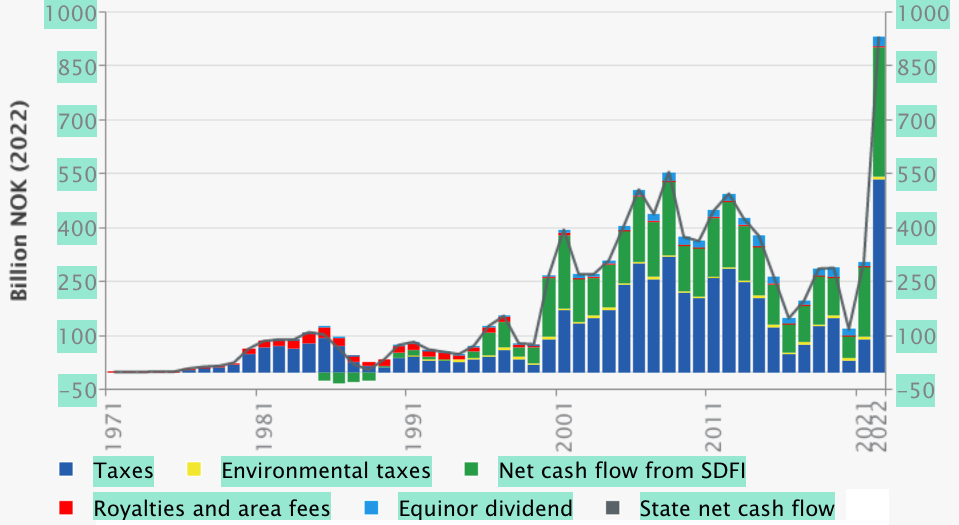
North Sea production was never permanent. While it was clear to all this wealth was finite (it peaked around 1990), the UK made no plan for the future.  Contrast Norway’s consistent higher oil revenue on this chart with the UK’s, given in Union Myth-Take 5.

History of Norwegian State Oil Revenues (£1 = NOK11. Sovurve Norwegian Govt[1]

[1] https://www.norskpetroleum.no/en/economy/governments-revenues/

In 1990, while the UK was spending its windfall, Norway began a sovereign wealth fund –the Oljefondet. It now stands at over £1 trillion and funds Norway’s investments and social programmes. Whereas the UK take from this year’s oil price surge will be £17 billion, Norway’s NOK926 billion translates as £80 billion—twice ALL profits eked out of the UK sector. Had the UK government not pillaged and squandered its inheritance, Scotland could have been another Norway. It still can.

And, in case you’re wondering, in July 2022, Norway’s inflation rate was 6.8%. Before the present price hike, the average home consumed 3MW a year, costing £445. The price in Britain was £764 but will soon rise to £1,560

“Dear God, give us another oil boom. Next time we won’t piss it up against the wall.”

—graffiti on a wall in Aberdeen

#1037—365 words

Posted in Commerce, Politics | Leave a comment

Democracy for Sale

This blogger subscribes to a number of sources regarded as reliable with the intention of presenting information and opinions here based on factual evidence. Occasionally, those sources present what Americans might call a “humdinger” of a scoop that demands wider distribution. One such is today’s blog from Heather Cox Richardson, containing the following verbatim quote.

Heather Cox Richardson, Aug 23

Today’s big news is an eye-popping $1.6 billion donation to a right-wing nonprofit organized in May 2020. This is the largest known single donation made to a political influence organization.

The money came from Barre Seid, a 90-year-old electronics company executive, and the new organization, Marble Freedom Trust, is controlled by Leonard A. Leo, the co-chair of the Federalist Society, who has been behind the right-wing takeover of the Supreme Court. Leo has also been prominent in challenges to abortion rights, voting rights, climate change action, and so on. He announced in early 2020 that he was stepping back from the Federalist Society to remake politics at every level, but information about the massive grant and the new organization was broken today by Kenneth P. Vogel and Shane Goldmacher of the New York Times.

Marble is organized as a nonprofit, so when Seid gave it 100% of the stock in Tripp Lite, a privately held company that makes surge protectors and other electronic equipment, it could sell the stock without paying taxes. The arrangement also likely enabled Seid to avoid paying as much as $400 million in capital gains taxes on the stock. Law professor Ray Madoff of Boston College Law School, who specializes in philanthropic policy, told the New York Times: “These actions by the super wealthy are actually costing the American taxpayers to support the political spending of the wealthiest Americans.”

This massive donation is an example of so-called “dark money”: funds donated for political advocacy to nonprofits that do not have to disclose their donors. In the 2010 Citizens United v. Federal Election Commission (FEC) decision, the Supreme Court said that limiting the ability of corporations and other entities to advertise their political preferences violates their First Amendment right to free speech. This was a new interpretation: until the 1970s, the Supreme Court did not agree that companies had free speech protections.

Now, nonprofit organizations can receive unlimited donations from people, corporations, or other entities for political speech. They cannot collaborate directly with candidates or campaigns, but they can promote a candidate’s policies and attack opponents, all without identifying their donors.

“I’ve never seen a group of this magnitude before,” Robert Maguire of Citizens for Responsibility and Ethics in Washington (CREW) told Casey Tolan, Curt Devine, and Drew Griffin of CNN. “This is the kind of money that can help these political operatives and their allies start to move the needle on issues like reshaping the federal judiciary, making it more difficult to vote, a state-by-state campaign to remake election laws and lay the groundwork for undermining future elections.” Our campaign finance system, he said, gives “wealthy donors, whether they be corporations or individuals, access and influence over the system far greater than any regular American can ever imagine.

Heather Cox Richardson, Aug 23

#1036—519 words

Posted in Politics | Leave a comment

Union Myth-Take 5

“The case for independence has been swallowed up by a £14bn North Sea black hole.”

This quote from unionists in 2016 was based on a fall of 97% in tax revenues from North Sea Oil from £1.8bn in 2015 to £60m in 201. This dismissive attitude toward what contribution the North Sea could ever make to the finances of an independent Scotland has been repeated and compounded by increased deficits due to measures to cope with Covid. Budget balances over the last five years is shown in the table.

Comparison of Historic Budget Deficits  (Source: GERS[1])


[1] https://www.gov.scot/publications/government-expenditure-revenue-scotland-2020-21/

Clearly, Scotland runs a larger budget deficit proportionally than does the the UK. The is unionist case that oil makes little difference to this holds true for the years up to 2019-20. And GERS figures for 2021-22, to be released in August will be similar.

Companies operating in the North Sea pay three profit-related taxes on oil and gas: ring fence corporation tax, supplementary charge, and petroleum revenue tax (PRT).

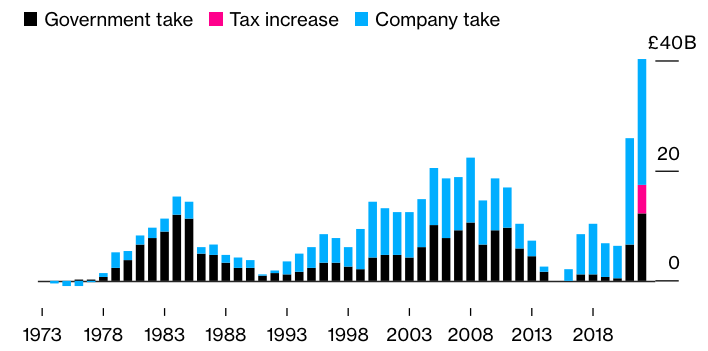
Russia’s war on Ukraine has hit Western economies in unanticipated ways. From a level around $40 a barrel in 2016, Brent crude has ben selling around $100 a barrel since April and boosting BP profits to $8bn for the quarter. Other than slapping a windfall tax on this in July, Westminster has been coy about its own windfall, not least because it would transform Scotland’s balance into healthy positive territory. This transformation is shown on the chart:

Company Profits and Treasury Take from North Sea Oil & Gas (Source: Bloomberg[1])


[1] https://www.bloomberg.com/news/articles/2022-05-27/uk-set-for-record-tax-revenue-from-north-sea-oil-and-gas – xj4y7vzkg

UK Treasury was set to collect £12bn this year before windfall tax added £5bn more. Only 90% of this £17bn lies in Scottish waters, But this still wipes out the deficit, leaving a £2-3bn surplus. Which explodes the myth North Sea is finished.

#1035—341 words

Posted in Commerce, Politics | 1 Comment

Tweedledumb vs. Twaddledee

“Your automobile can be any color you want, as long s it’s black.”

—Henry Ford, launching his Model T

The candidates for the vacant post of PM made the obligatory brief stop in the colonies when they attended hustings in Scotland and Northern Ireland on August 16th and 17th respectively. Given that there are barely 600 members (0.37% of their UK total) and no elected representatives in Northern Ireland, the latter looks like a fool’s errand or gesture politics. Or both. That the “unionist” part of the “Conservative and Unionist” parts refers to Ireland, and not Scotland, is all the more bizarre. It was demonstrably unsuccessful, as the Republic flew the coop exactly a century ago and shows zero inclination to return to the fold. As for the fragment that remains:

“Tories are becoming the England Nationalist Party…Choosing between Rishi and Liz is Hobson’s Choice”

—Conservative and Unionist party members in NI

The hustings held in Perth were less pointless, as there are 11,000 members (6.8% of the UK total) in Scotland. Tories provide the Opposition in the Scottish Parliament and still send six of Scotland’s 59 MP’s to Westminster—the same number as a century ago.

While they may clash on details of Tory policy, they are pretty much united when it comes to dealing with Scotland. Neither Sunak nor Truss has waivered on what is now a firmly entrenched Tory position—it is not the time for a new independence referendum. Truss has modified her earlier undiplomatic statement that she would “ignore Nicola Sturgeon”, so that both now want to deal firmly with her government to benefit the union as a whole. As for real issues affecting mainly Scotland, little was said beyond the ritual dirge condemning the SNP-led Scottish Government that has been the Scottish Tories leitmotif since Douglas Ross became leader.

“What people in Scotland want is… to see their governments, Scottish and UK governments working together”

—Rishi Sunak

It is a nice sentiment, but we reckon Scottish people probably know more about what people in Scotland want than Sunak. This disconnect is highlighted by his comment during the hustings that the idea of another referendum was “barmy” hardly acknowledges that this is a policy of the majority of the Scottish Parliament with a better democratic mandate than his own party at Westminster.

Sunak used his past to pitch himself to unsure Tories. He bragged about his various achievements in government, such as the furlough scheme and support for business during Covid. The sense was of someone losing the room during a job interview. But With Truss still soaring ahead in the polls, he came across slightly desperate.

“We’ve had several decades of low growth across the United Kingdom.”

—Liz Truss

We have indeed. But who has been steering the ship for the last 12 years? Why, her Tories, with her an MP for the entire time and am influential government minister for half of it

I was worried about disruption, disruption didn’t take place.”

—Liz Truss

Talking about why she didn’t initially back Brexit, Truss said she was worried that it might end up disruptive but has been reassured by its implementation. To that we can only wonder what version of the UK she has been living in, because it certainly hasn’t been the same one as we have.

Truss came across tired and complacent, as if bored of the sound of her own voice. In contrast to Sunak, her pitch was geared to the future—promising Scotland free ports and smoother whisky export opportunities.

“Tory front-runner Liz Truss playing the populist card getting into the gutter in Perth in front of the party faithful. Says she will legislate to allow the Rwanda one-way deportation scheme to be expanded to other countries. Nasty, toxic Toryism trafficking in vulnerable people.”

—Gerry Hassan

Neither contestant had more than warm words to address today’s burning issue: the cost of living crisis. Nor did they explain how their various promises were to be funded under the burden of over £2 trillion on debt, nor explanation/remedy why the UK was being hit harder by inflation and probable recession than any other G7 country.

Polling shows that Truss is out in front with Conservative voters in Scotland, in line with the UK as a whole. More interestingly, it also shows around one quarter of voters will be more likely to back independence, regardless of who wins the race to replace Boris.

In truth, it will make little difference to Scotland who becomes PM because the arrogant attitude towards Scotland’s differing opinions will continue. The truly frightening thought is that it may be worse than these three years under Brexit Boris, whose boisterous antics at least had some entertainment value.

#1034—758 words

Posted in Politics | 2 Comments

Union Myth-Take 4

“UK will be a high growth, high skills, high wage  economy.”

After briefly rising in the wake of the Covid-19 crisis, real weekly wages fell back below their 2008 level, as workers came off furlough. This fall in real wages reflects the highest inflation since the 1970’s (5.4% now; >9% by autimn).

The UK may claim to be the fifth-richest country in the world, but this is not reflected in the productivity, nor wealth per person. This trend is shown in this chart below.

Historical Productivity Comparison with Neighbours (Source: Financial Times

This results in the UK trailing most of its neighbours and those with whom it competes internationally, with Scotland’s productivity trailing even the UK average, as shown in the chart below.

Developed Countries, Ranked by Productivity

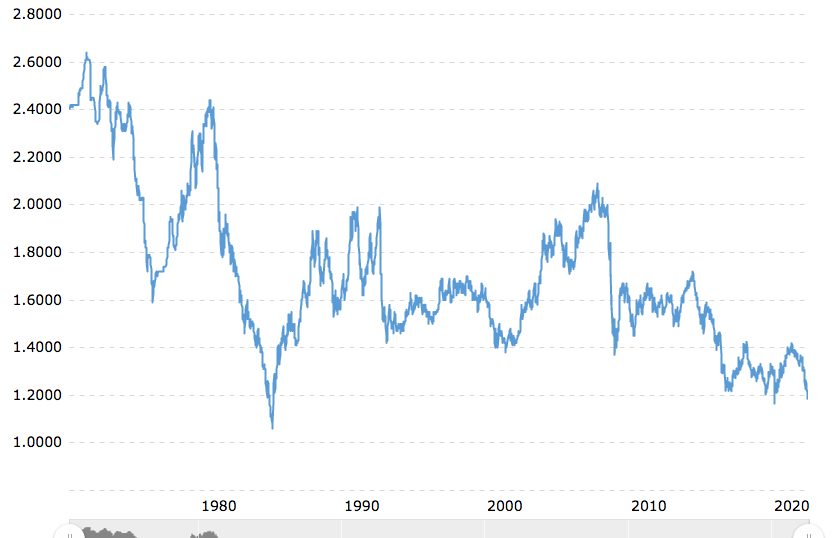
Declines in the UK balance of trade were once compensated for by “invisibles”, such as financial services,. But, by June 2022, goods exports were barely half the value of imports and barriers from Brexit had weakened the financial sector’s contribution. This has had the effect of devaluing the British pound against the US dollar majing imports increasingly expensive, as shown in the chart below.

Historical Value of the £UK against the $US

The lack of either new “high skill; high wage” jobs, or “levelling up” successes to deal with borrowing at a rate of £264 bn a year, (88% of which is interest on a £2.4 tn debt) makes any “high-wage” economic recovery increasingly difficult—if not impossible— any time soon.

#1033—209 words

Posted in Commerce, Politics | 2 Comments

Sturgeon’s Stavka Stays Shtum

Liz Truss appealing to darkest Tunbridge Wells by suggesting any government she led would ignore Nicola Sturgeon is political folly for any unionist.  Over a year ago in May 2021, this site featured a blog entitled “Sturgeons Stavka”, in which the talents of her new 10-member Cabinet was discussed. The conclusion was this would be a government with ideas to leave both Tory and Labour opponents floundering

We were wrong; the noise you hear is the munching of a big slice of humble pie.

Ms Sturgeon has lost the plot—not that she does not remain the best politician operating in Scotland. Back in May 2021, she was riding high, having given a master class in leading a nation through the Covid crisis and delivering on major projects like the Queensferry Crossing or EGIP electrification.

Since then, ossification has set in. Declaring an independence referendum to be held on October 19th has been the only news. The silence from her Cabinet has been deafening. What’s going on? Surely electoral success, her steady hand on the tiller against a backdrop of ineffectual opposition from Ross or Sarwar and bonkers Boris self-immolating in No 10 should mean things only getting better.

As regular readers will know, this site takes a pro-independence stance in matters political. That said, it also attempts to be a critical friend to that cause, pointing out overlooked ideas and promoting debate. But, with the last year of Sturgeon’s Stavka looking like a damp squib the referendum’s jaikit is on a shoogly nail.

The problem appears to be Ms Sturgeon herself. Whereas Alec Salmond’s robust ego handled opposing views from senior colleagues aas debate, and not a threat, Ms Sturgeon is behaving as if a palace coup were in train. Our FM does not like criticism and the Cabinet seems to have been muzzled and become a rubber stamp. Even Cabinet Secretaries now avoid challenging her, or showing much public presence.

As examples, in the previous Cabinet, Kevin Stewart and Joe Fitzpatrick had already into a passive “don’t-make-waves” roles. Their more experienced replacements have been equally silent. Shona Robison’s massive portfolio covers Social Justice and Housing (each needing undivided attention), as well as Local Government, currently in revolt because of ham-fisted control and budgeting. Angela Constance has the Drug Policy brief, but after a year in post, deaths remain four times that of other UK nationss.

Margaret Thatcher reportedly said she only needed two or three good men to help run the show. Nicola prefers women but doesn’t make use of either. Keith Brown was once willing to challenge, but was moved and has been singularly low-profile in the Justice brief—far more so than Kenny MacAskill, whose headlines over integration of Police Scotland, and culling of District Courts made him famous.

The urbane Angus Robertson took over the Constitution brief from the equally urbane Mike Russell, but is seldom in media as Mike was. Shirley-Anne Somerville took over the can of worms that is Education from John Swinney (as loyal a lieutenant as anyone could want), but her more abrasive style sits badly with unions and parents and is seldom seen defending PISA scores. Health combined with Social Care is a promising idea, but so far, little more than papering over the gulf between with Joint Boards has happened. Granted, creating a National Care Service in current times would tax Nye Bevan. Unfortunately, the affable, inexperienced Humza Yousef is no Nye Bevan.

Assigning Cabinet roles to the young and thrusting is no bad thing. But when ambition is cautious, Ms Sturgeon can dominate the Government more than is good for democracy. Her Cabinet lacks balance,d opinions, especially as it placess too little emphasis on the economy and its growth. Combining economy and finance under Kate Forbes is a very British construct. For all the talk of being European, the SNP remains a classic British party in many respects.  Even before independence, public finance depends on the strength of the Scottish economy, which receives scant attention.  The tax powers the SNP clamored for come with responsibility and unpopularity attached. But Ms Sturgeon’s avoids those to focus is to give voters what they want. The means to pay for it gets short shrift. Her manifesto is commitments simply don’t add up. 

While the voters still think the SNP is competent, much evidence is mounting that Sturgeon’s Government is far from that.  Danger flags include PISA scores, incomplete ferries, resentful councils (even SNP ones), drug death statistics and stalled poll levels supporting independence. She remains lucky, in that her opponents have been so weak and very lucky that Westminster Tories are such clots when dealing with what they treat as the Provinces.

But all that cuts little ice with Scottish business, nor the absence of any big ideas to sway Scotland’s ambitious middle class who see no economic benefit because the case has yet to be made. The claptrap coming out of Holyrood about “cleaner, greener, fairer, more prosperous society” needs real policy flesh to be put on such spindly bones.

#1032—848 words

Posted in Politics | Leave a comment

Union Myth-Take 3

“UK’s Size Creates Wealth by “Punching Above Our Weight”

A major claim by the UK has been it enjoys “the fastest growth in the G7. This statement is true for the last year but ignores the fact that the UK economy shrank more than other G7 members when Covid hit and therefore had the furthest to recover.  The World Bank forecast for the next year is that UK will grow the slowest among G7 members, if at all.

Looking back pre-pandemic, the argument that UK’s size brought prosperity does not hold water. Comparison with some rich countries  is shown in the table below.

Global Economy; GDP Purchasing Power Parity Comparisons, data from 2020

Source: https://www.theglobaleconomy.com/rankings/gdp_per_capita_ppp/G7/

Within the UK itself, economic disparity among regions and nations is worsening, despite three years of “leveling-up”. Of the dozen regions and nations of the UK some of the most glaring disparities are shown in the table below. Although comparisons between the tables cannot be made directly, rough comparisons show disadvantages regions and nations in the UK performing 30-50% below small European countries.

ONS GDP data for Sub-national regions of the UK, May 2021

Source: https://www.ons.gov.uk/economy/grossdomesticproductgdp/bulletins/regionaleconomicactivitybygrossdomesticproductuk/1998to2018

#1031—314 words

Posted in Commerce, Politics | Leave a comment

Union Myth-Take 2

UK Trade with the EU Is Higher Than pre-Brexit Levels”

Despite cross-channel hold-ups, lorry driver shortages and labour shortages as many EU nationals have gone home, UK trade with the EU has improved over the last five years. However, EU trade is increasing as a proportion of total trade and the trade deficit with the EU has grown twice as fast as with the rest of the world. According to ONS:

 “Total exports of goods increased by £2.3 billion (7.4%) in May 2022, Goods exports to the EU reached £16.9 billion in May 2022. Though this is the highest level since the series began in 1997; rising prices in 2022 mean removing the effect of inflation, exports to the EU actually rose to only £13.9 billion, the highest levels since December 2020.”

UK Office of National Statistics

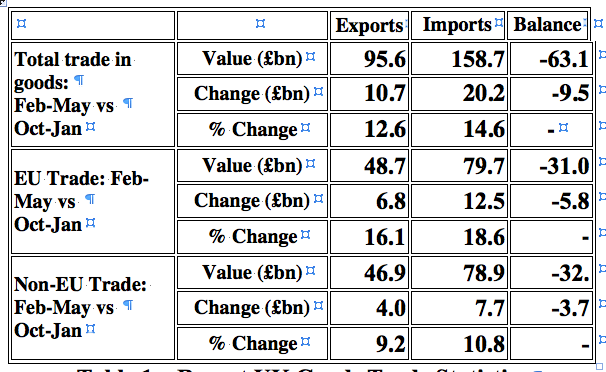
ONS statistics for UK trade comparing the last two quarters are shown in the Table below.

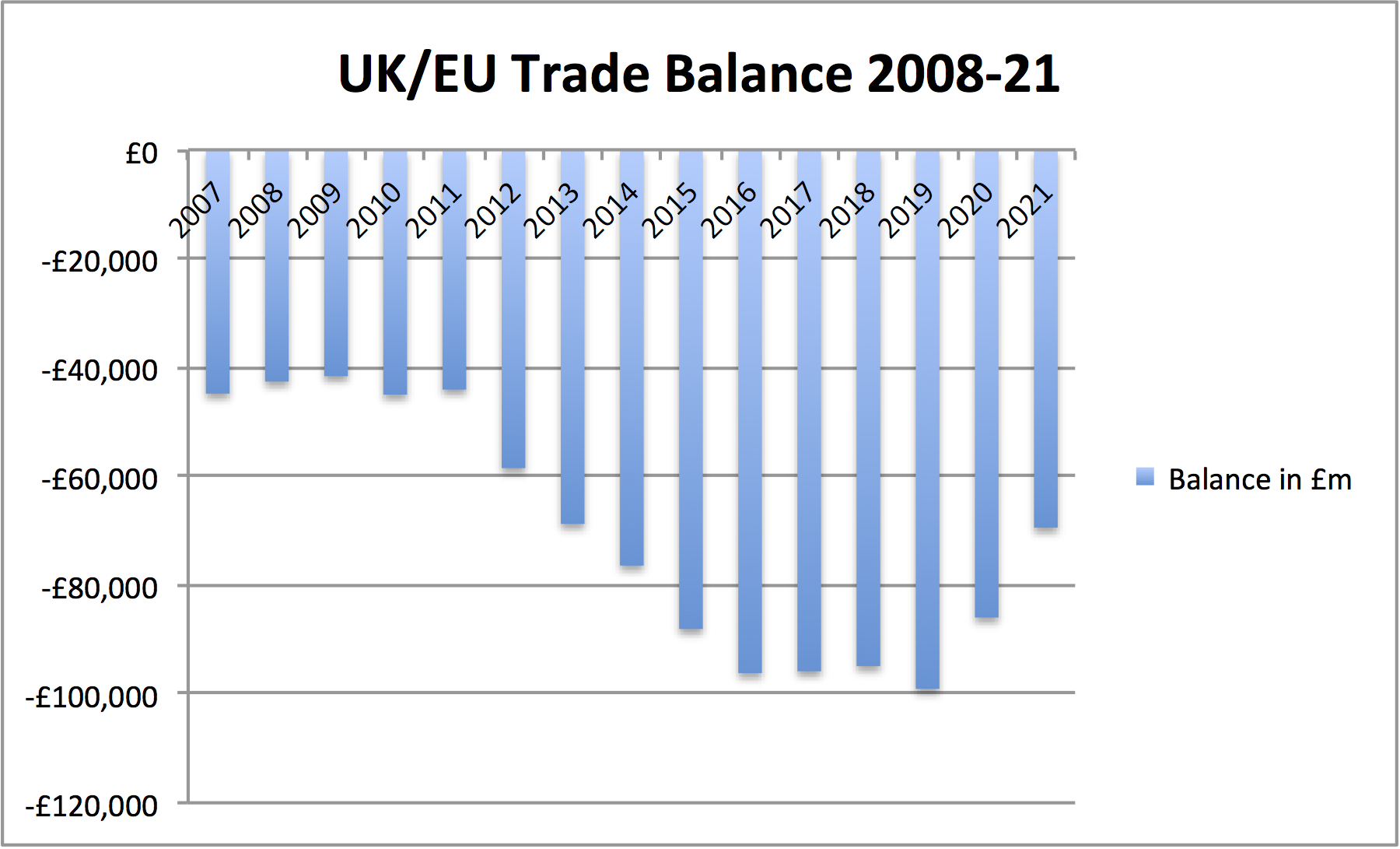
This shows the 16.1% growth in exports to the EU was overtaken by a n 18.6% growth in imports from the EU, with a 31.0% trade imbalance having swelled by 5.8%. Meanwhile, non-EU trade, where Brexit should be showing benefits, grew by barely half the increase in EU trade. Looking further back, the trade deficit with the EU has effectively doubled See the chart below.

At present, it is not clear whether the reduction over the last two years is structural or caused by current factors like Covid. However, recent figures given in Table 1 imply it is worsening again.

#1030—321 words

Posted in Commerce, Politics | Leave a comment