Data Aggro

Having been involved social media for a couple of years and approaching 300 blogs at this particular site, like most I had given little thought to any down side of social media. But an article from our American cousins—who have been typically faster than us Luddite Brits to take up whatever new technology offers—brought me up short.

Having once been a network protocol guru in a former life, I had always been aware of the mechanisms of the internet and the way that the more sophisticated software of the so-called “Upper Layers” could slice and dice all the data passing through. Without ensuring end-to-end industrial-grade encryption (128-bit key & better), the internet is an eavesdropper’s paradise; not only content but even your browsing habits reveal much about you—especially things credit and government agencies might want to know.

Before you start to dismiss me as a paranoid survivor of the sixties, I would suggest you read an interesting piece in yesterday’s New York Times Sunday Review. Facebook Is Using  You was written by  Lori Andrews, a professor at the Chicago-Kent College of Law and does not restrict its concerns to Facebook. It seems that last week’s filing with US Government of Facebook’s Initial Public Offering (IPO) on the stock market is likely to net its founders a cool $65bn and this event was the trigger for her article.

Her beef is not with the IPO itself but with the fact that 85% of Facebook’s $3.2bn income last year came from advertising to its close-to-1bn users. That in itself is hardly remarkable. But what seems less well understood is that: a) The IPO valuation is based more on its access to your personal data than its current revenue and; b) The degree of targeting of advertising to your data is astonishingly sophisticated. As Prof Andrews says:

” If you indicate that you like cupcakes, live in a certain area and have invited friends over, expect an ad from a nearby bakery to appear on your page.”

Unlike the US, residents of the EU are somewhat protected by Freedom of Information legislation which restricts what data companies can hold on you without your knowledge and/or permission. But few of us make any effort to find out what that might be and US citizens are largely defenceless in this regard anyway.

But, worse than an invasion of privacy and even distortion of records being held on you, this can have far-reaching effects on your life. Unlike fifty years ago when most operated in a cash society, paying as we went, almost everyone nowadays relies on credit to buy most things, right down to paying for groceries with a debit card. That credit is rated by agencies over whom you have little or no control—much as Moodies could downrate the mighty US Government from AAA to AA+ without the Marines storming their building.

Those credit agencies are relying more and more on the highly sophisticated data they buy from social media companies. As Prof Andrews describes it:

“Ads that pop up on your screen might seem useful, or at worst, a nuisance. But they are much more than that. The bits and bytes about your life can easily be used against you. Whether you can obtain a job, credit or insurance can be based on your digital doppelgänger—and you may never know why you’ve been turned down.”

These credit rating agencies have become or work closely with data aggregators, whose job it is to string as much information together about you as they can.  Your application for credit could be declined not on the basis of your own finances or credit history, but on the basis of aggregate data—what other people whose likes and dislikes are similar to yours have done.

Perhaps the worst thing is that they may hold any data they like and interpret is as they wish and it can have a massive effect on you and your family’s lives. Again as Andrews puts it:

“If I’ve Googled “diabetes” for a friend or “date rape drugs” for a mystery I’m writing, data aggregators assume those searches reflect my own health and proclivities.”

Online advertising companies habitually contract with ISPs (internet service providers—every online user uses one) for large sums to monitor internet users’ activities and stream the data back to their own servers for analysis.

Europe is not yet at the stage of sophistication where demographics are used to ‘redline’ people—those living in a particular area are stygmatised because they are regarded as having, say, typically low credit ratings. The state of your own may not be considered: it is assumed that, because you live in a poor neighbourhood, you cannot be credit-worthy.

We have seen the beginnings of this, with bank branches shutting down is less well-to-do parts and effectively disenfranchising locals from normal banking services, including loans. As data aggregation becomes ever more sophisticated, not only will the geography become less important but social pressures to channel ambition are likely to appear. To quote Andrews again:

“When women are shown articles about celebrities rather than stock market trends, will they be less likely to develop financial savvy?”

This is deep stuff and has huge social implications. While I would not argue that social networking is, on balance, negative, I would say that we have all moved into unfamiliar territory where $85bn corporations like Facebook, while minting the dosh, have yet to develop any conscience about how they use our personal information. As usual, the legislation to assist in protecting us is still years away.

Posted in Community | Leave a comment

Looking for a Few Good Molluscs

A twist on the US Marine Corps recruiting slogan is no bad way to start people thinking about the 75% (yes, that much) of Scotland that is underwater. Look at a map of the UK’s territorial waters and—even if you accept Blair’s 2000 land grab in the North Sea, it is astonishing to see that, in pure area, Scotland is actually larger than England.

Current State of Scotland's Seas

Currently, the UK government stewardship of this huge subsea area has been, to put it kindly, lax. Given that England has less seabed than dry land and lands only a fraction of fish that Scotland does, this—along with their selling Scotland short in the EU Common Fisheries Policy—might explain, even if it doesn’t forgive, such laxity.

As an example, fish stocks are ‘managed’ under the CFP but the Spanish in particular bend EU rules to suit themselves and have even got away with using EU subsidies intended to decommission fishing boats to actually build more boats for themselves. Then they have the cheek to use ports like Kinlochbervie to offload catch onto huge trailer lorries to get it back to Spain faster than the boat can.

Meanwhile the UK’s DEFRA comes down on Scottish boats for every infringement of some pretty crazy CFP rules and the ‘black fish’ market burgeons. It is no way to run a railway, let alone a conservation policy. If you haven’t seen it and want your sense of outrage stoked into high gear, watch Trawlermen.

Sad to say, that’s the story of the managed bit of our waters. The seabed itself is more like the Wild West—anything goes. There are no regulations on crab, lobster, prawns scallops, mussels—in fact, any crustaceans or molluscs.

In inshore and relatively shallow waters like the Firths of Forth or Clyde, a huge metal dredge goes over the side of a scallop boat to be dragged along, shredding all life on the seabed for miles. This is legal. The only thing stopping lobsters being fished out is that catching them is highly labour-intensive and the beasties are too thrawn to be farmed.

The Forth used to be so choked with native oysters that they were the poor man’s food in medieval Edinburgh. But, since they don’t move, once industrialisation came, they were fished out in Victorian times. What you get nowadays are farmed Pacific oysters from Loch Fyne—big and meaty but without the more flavoursome native Scottish oyster.

These could, in theory, be farmed but ‘rights’ on the seabed are asserted by the Crown Estates; we have an insensitive bureaucracy geared to charging for anything that touches ‘their’ seabed. They bill salmon farmers, anchorage buoys, even harbour improvements. They do nothing in return to earn the money. The other problem is that laws protecting such investments are scant—the chances of catching someone robbing an accessible place in flagrante delicto are only slightly greater than successfully prosecuting them.

Not all is doom and gloom, though. However belatedly, last year saw the first Marine Reserve in Scotland (and the second in the UK) established in Lamlash Bay, off Arran. This has been designated as a ‘no take’ area, which is, in theory, protected from having any creature down to a winkle removed from it. The theory is that, having this as a refuge, many species will thrive and pass spawn and life back into the adjacent waters. It appears to be working.

But, until now, most thought given to a National Marine Plan our seabed has been for defence purposes or for the exploitation of hyrdrocarbons. RSPB Scotland made what they consider a full response but they see things from a ‘twitcher’ perspective and, unless a marine creature is lunch for some seabird, they are likely to overlook it.

UK marine legislation (including the Marine & Coastal Access Act 2009?) is due to be reviewed under the ‘Water and Marine’ theme due to be in the spotlight on the UK Government’s ‘Red Tape Challenge’ website from Thursday 16th February 2012 for five weeks. But, as regards either reserving significant areas of Scotland’s seabed from ongoing unrestricted pillage or establishing anything like enough clones of Lamlash to make serious inroads into ongoing abuse that is unsustainable, we’re not out of the gate yet.

There is hardly much point for us to make all the efforts we are on land as regards the impact of our civilisation on land if we ignore the part three times as large that lies beneath the waves. Tourism brings in comparable earnings to fishing, with wildlife tourism growing faster than other elements, such as golf. We know very little about the Moray Firth dolphins, let alone cetaceans like the minke and pilot whales that visit and cause such thrills when sighted. We pillage their home at our peril.

At the same time, Scots have a reputation for quality produce, which applies as much to seafood as it does to salmon or fruit or even our top-notch tatties. Half the seafood consumed in Spain is actually Scottish. Articulated lorries leave Barra on the ferry to take lobster, prawns, scallops and crab to Spain within 36 hours. Why we don’t keep most of that to ourselves to retail through specialist restaurants and earn three times the money for the same beast has always been a mystery to me.

And, with 6,000km of coastline, there surely must be space for fish or shellfish farms interspersed with marine reserves so that business and conservation need not be in conflict. We have 2m of coast for every inhabitant: the massive USA has only 66mm and places like Belgium just 6mm for each of its 11m people.

We, of all people, need to take seriously the good work begun by the Scottish Environment Link’s Marine Taskforce whose Introduction to Marine Protected Areas is short but well worth a read, provided you don’t mind disentangling your eyebrows from your hairline every few lines. If we get this right, we will not just be a major tourist destination but also a flag-carrier for sustainable development of the 2/3rds of our planet that is covered in water.

Posted in Uncategorized | 3 Comments

The Guizer Jarl

The former LibDem Leader Tavish Scott MSP has an op ed piece in today’s Hootsmon in which he waxes lyrical on Shetland’s Norse heritage and another rousingly successful Up-Helly-Aa—as impressive and unique a local festival as you could sail a longship into.  We hear too little of this splendid ritual in the rest of Scotland, for we share more in common with the Shetlanders than many of us realise. And if Tavish is successful in his railing against the rather prohibitive transport costs involved in visiting there, perhaps more of us could discover that for themselves.

But, if I am entirely supportive of Tavish in his enthusiasm for the mid-winter festival that binds local people and their heritage together, I am less so of his rather clumsy attempt to beat the evil ‘Central Belt’ with it as a stick and use it as a lever to prise the North Isles away from the rest of Scotland. As with many other distinctive regions of the country, the North Isles are not to be confused with anywhere else. And I accept that the phrase “going to Scotland” that they use has more than geographic overtones. But to set hares running about UDI is both mischievous and simplistic.

Though not resident as Tavish and some 50,000+ people are, I have visited on a number of occasions and look forward to returning for the North Isles are a special place that breeds special people, some of whom I’m privileged to call my friends.

It is irrelevant that Up-Helly-Aa has been THE celebration of Norse heritage for 100 years when the islands’ allegiance Norway was severed 400 years before that. The link goes back over 1,000 years to when the first Norsemen overran much of what is now Scotland as part of their great expansion that reached Labrador, Dublin, Kiev, Normandy and Sicily. Those hardy (and, at the time, hated) navigator-warriors became settlers and, by burning their boats, showed their firm commitment to their new homes.

Although seldom celebrated, that Norse link applies across Scotland. The Earls of Orkney ruled not just the North Isles but Caithness and south, hence Norse names like Dingwall and Sutherland.  The medieval Lord of the Isles ruled a gaelic reincarnation of Norse Soder that once included all the Hebrides, Kintyre and Man. The Forth/Clyde valley was once formed the trade route linking Viking York with Viking Dublin.

Even my own East Lothian—about as far from Shetland as you can get in Scotland—is peppered with Norse names: Fidra; Humbie; Begbie. There is even an unsubstantiated legend of a 9th century Viking Kingdom of Dunbar before it was subsumed into Viking-York-powered Northumbria. Even further south, Lockerbie and Langholm trace their settlements all the way to the Solway and beyond.

So in mongrel Scotland, the next-biggest external influence on who we all are (after the English) may not be the Irish but the Norse. Do names like Gunn or Ericson or Chisholm sound Scottish? I find Christine de Luca’s Shetland poems barely more comprehensible but certainly more engaging to me than Sorley McLean’s in the original gaelic. Whether any more Viking blood than elsewhere flows in East Coast fisher folk like me has yet to be established by DNA testing. But it feels that way to me.

So, while I admire Tavish’s pride in local heritage, he loses me when he drifts into a ‘Little Shetlander’ mode that ill becomes him. And I disagree that we Scots take advantage of a fraction of our historic links with Scandinavia in general and Norway in particular we’re entitled to.

In the past we sent intrepid explorers to Malawi, unflappable administrators to Mumbai and phlegmatic ship’s engineers (and the ships they sailed in) to every corner of the globe. We should be exchanging students with Norwegian universities—the skiing and the scenery are both fabulous. We should be flooding Norway with tidal generation projects because their long deep fjords offer more options than even we do.

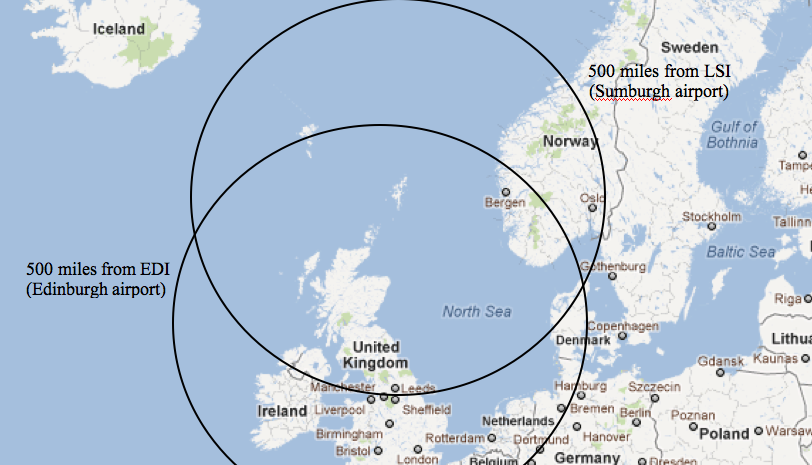
It’s obvious that the Shetland should be to the fore in relations with Norway—almost as many ships from the Norwegian fields use Lerwick and Sumburgh as ours do. But though Lerwick is closer to Oslo (420 miles) than to London (580 miles), that last is also the Edinburgh-Oslo distance. Central Belt Scotland is as close to Olso or Copenhagen as it is to Amsterdam, Brussels or Paris.

I’m sure Tavish’s loyalty to his North Isles is genuine and well intentioned. But what if he opened his mind to the bigger picture? What if Scotland became independent and joined the Nordic Council? Would Shetland not then, rather than being a forgotten outpost of imperial Britain, become a central hub of the Nordic Council, linking Greenland, Iceland and the Faroes with Scandinavia proper? And would Scotland’s Central Belt, far from being a remote master, not become their gateway access to England and southern Europe?

No-one in Liechtenstein, Monaco or even the Faroes wants someone distant telling them how to live. Like many of his deluded unionist colleagues, Tavish needs to learn that anywhere—Scotland or Shetland—is small and oppressed only if you think it is. Who can say whether, one day, Shetland might not become another Singapore to Scotland’s Malaysia? But first, we both need shot of the self-absorbed, uncomprehending influence of London and its environs.

Scotland and Shetland within the Nordic Council

Posted in Community | Leave a comment

Wanted: Unionist Lincoln

These first weeks of the New Year have been dominated in Scotland by an escalation of the debate over the possibility of Scotland declaring its union with England at an end. In general, I welcome this new intensity because, not only has it finally intruded into the Gormenghast cogitations of Westminster, but it has also raised international interest, culminating in the Burns Day gathering of fifty journalists from two dozen countries to hear Alex Salmond launch the referendum consultation in the Great Hall of Edinburgh Castle.

I see this as historic and stimulating stuff but recognise that others—especially unionists—are unhappy with it all. Ordinarily, I would have sympathy for an opposing view. But, knowing the history of the last forty years, I see the unionists as having played a rather loaded game to date, absconding with all the oil in the ’70’s, rigging the ’78 referendum, disemboweling Scottish heavy industry in the ’80s, foisting the Poll Tax on us, stalling the Claim of Right and, even in the shadow of the 1999 Scottish Parliament, filching 6,000 square miles of rich seabed East of the Forth into English control.

So, for me, this year’s debate does not start out on a level playing field. From Paxman to Osborne, there is a continuation of history, a similar readiness to use any means—fair or foul—to derail aspiration not to be part of this state called Britain.

I recognise that many people may consider UK troops in Helmand, two aircraft carriers with no aircraft or four Trident submarines at Faslane to be sensible deployment for the second-rate power Britain has become. I recognise that many English feel strongly that Brussels has taken too much power to itself, that too many foreigners have come to these shores and that John Bull glares out from the beetling cliffs of Albion, daring Johnny Foreigner to make his day.

But I share none of those views and, truth be told, find them all rather odious.

But, unfortunately, such attitudes are defining how this independence debate is shaping up. On the one hand, I witness a Scottish Government who explain their position, move steadily towards a goal that was part of their manifesto and receive a barrage of hysteria from unionists. They appear to have lost balance of judgement and moral compass in debate when it comes to the lengths, if not depths, they’ll go to in discrediting not just independence but those who believe in it.

Much has been said by unionists of the need to make a positive case for the union. That is something I would welcome but there is little sign. Anas Sarwar on BBC’s GMS made it plain that there is no reason to doubt Scotland’s viability as a country. My hopes rose that reason was prevailing. Almost immediately he then launches into dire predictions of how Scottish firms could not compete across a new border with England.

In a reversal of the ‘Braveheart’ romanticism so often flung at independistas, most unionist arguments—especially those coming from the rump Tory flank—reek of a frenzy to discredit that would shame the worst tabloid journalist. A romanticising of Britain by selective re-telling of its history combines with a venom towards those seen to threaten it. An example is ToryHoose, whose bias finds expression by lashing out at others.

“The SNP are not, as they may sometimes seem, just made up of social democrats; but are a mixed band of far left, socialists, left wingers, right wingers, and even some of those on the hard right. They are republicans, monarchists, free marketers, Europhiles, euro sceptics, moderates, extremists, some are anti-english, some are anti-British, some want indy-lite, others only want devo-max.”

Apparently, being such a rag-tag, representative cross-section of the Scottish public who have the audacity to agree with one another is reprehensible. ToryHoose offer no explanation why such a fragmented mob are not at each other’s throats, let alone could win an election. It’s not ToryHoose’s opposing view that bothers me—I actually respect their position and would welcome articulation. It’s their venom I decry. It clouds their understanding of (or any desire to understand) the perfectly normal non-baby-eating people to whom they are so venally opposed.

Contributions to the debate to articulate a non-SNP perspective are largely being made by people from civic Scotland, certainly those distant from the clueless and idea-free zones that currently encompass all three opposition parties. Canon Kenyon Wright recently pitched in with an eloquent plea for “devo-max”. Perhaps the most balanced take on the whole debate that I’ve seen so far came from Gerry Hassan’s recent blog.

“This moment requires a calmness and consideration to allow Scotland and the UK to have a reasoned debate and discussion. So far both the British political classes and media, and a large part of unionist opinion in Scotland has shown no indications that it has the capacity or qualities to do so.”

There is certainly a place for passion in this debate. But when either side allows their own bias to assert a moral ascendancy over the other, then reason becomes an early casualty, usually followed by truth. Salmond said from the start “we have no monopoly on wisdom”. We also have no crystal ball to answer the increasingly shrill insistence that the SNP define every step and defang every threat into the future. But it was not emotion that drew the conclusion that Scotland would be the sixth-richest country in the world.

To parry such powerful arguments, unionists cannot afford to rely on dirty tricks deployed since the seventies; they clearly haven’t worked. Nor can they believe just more hand-wringing negativity is an option—it has all but done for Labour. They need someone of stature, strength and ideas who’ll deliver Britain’s Gettysburg Address or they have no cause worthy of the name left.

Every athlete about to compete, every businessman about to launch a new venture, every swain about to pop the question sizes up the situation, draws on their every fibre of life experience, looks to their best capabilities and launches all of them into the moment. These focal points are life itself—the turning points that define the worthwhile. The life of a country is no different.

Posted in Politics | Leave a comment

You’re Gonna Lose That (G)oil

Despite being a fan since high school, I had never realised how prescient the Beatles were about things political, especially regarding Scottish Independence until I watched Jeremy Paxman slide into his sneering worst of Newsnight. A decade ago, I would have been outraged and insulted.

This time, despite having read Paxman’s various books and still enjoying University Challenge, I could not help smiling and singing the first track off the Revolver album:

“Let me tell you how it will be—Paxman!

There’s one for you, nineteen for me—Paxman!”

Because, as might have been predicted, Paxman’s deeply condescending attack on Wur Eck lit the phones up at SNP HQ like a Christmas tree. The last I heard, we had 200 more members and counting.

I say nothing about his country, other than it’s my favourite foreign one, and I say nothing personally about Paxman, other than he ranks among the most erudite of his countrymen. With one exception: he displays a trait that seems all too  common among said countrymen—that of having difficulty recognising the diversity and even the validity of other cultures.

But lang may his lum reek in this regard. He may, unwittingly and probably much to his own chagrin, be the best recruiter we’ve got.

Poll in the New Statesman

Posted in Politics | 1 Comment

Best to Be Best Friends

A lot of partisan and, frankly, wildly unsubstantiated, words have spouted forth since the indy/union debate took off at the turn of the year. Neither side has entirely covered itself in glory. Though I openly belong in the indy camp, I have done my best to engage with and understand the arguments deployed by opponents. Last May Alec Salmond launched the new Scottish Parliament with a clear statement that the SNP “has no monopoly on wisdom”. Who am I to gainsay His Eckness?

But, despite three parties to voice arguments and the UK Government lined up behind them, the case for the union has, so far been completely upstaged in positivism, in vision and in obvious belief that the Scottish people can make their minds up when they need to. I have heard warm words from all three opposition party leaders about the need to talk Scotland up. But I challenge readers to point me to where this has been done.

For me, the area that pro-union voices have done the greatest disservice is not to either the SNP or to Scotland but to the heart of the union itself: England. Laughable as it is, Paxman’s recent sneering dismissal of things Scottish neither represents his country nor its attitude towards Scotland. Scot though I am, I claim and am proud of my English connections—dad from Westminster; early beneficiary of the NHS born in Central Middlesex Hospital; worked three years in London, Hampshire & Cornwall, I spend at least a month a year south of the border. It remains my favourite foreign country.

So when I say the English attitude to Scotland is largely one of puzzlement, there is no judgement in that opinion. The English are broadly reasonable, comfortable in their culture and somewhat pushier than their polite demeanour might suggest. Scots could learn much from them. They are puzzled because, to the average English, we Scots are another region of Britain—slightly more diverse in culture than, say, Devon, but integral to the nation. And in describing that ‘nation’, they often use Britain or England pretty much interchangeably. This is especially true south of Peterborough. Why would anyone want to leave?

Despite a couple of decades of SNP rise being charted in Scotland, this had not registered  in England (any more than it had elsewhere). But this month has changed all that, even if it hasn’t given them any real understanding. Most English exhibit a combination of curiousness, mild resentment that Scotland seems to get more than its share (under Barnett) and a sense of “if they want to leave, let ’em”. Especially among unionists, there is also a hurt, as if all we went through together (building an empire, fighting Nazis, etc) is being discarded.

I tell my English friends not to worry. If Scotland does end the union, they are going to prove a better friends that they were partners. Firstly, the Scots “punch above their weight” even better than the UK does. Not only better known internationally than other countries their size, they are better liked than Britain/England because they exhibit little of the jingoism that, through the Tories, has tarnished England’s reputation.

Secondly, though Scots might be 8.5% of the UK population, they have 30% of the land, 50% of the seabed and gas reserves and 90% of the oil. Together with our engineering (Weir pumps; Clyde Blowers) finance, whisky and tourism industries, that makes for a prosperous country that’s already ahead of England in GDP. Thirdly, having to fend for ourselves will sharpen Scotland up, forcing us to regenerate jaded entrepreneurism and look for opportunities abroad.

Fourthly, that will stimulate our renewables industry even further as schemes like the massive Scottish & Southern offshore scheme east of Fife and the tidal potential of the Pentland Firth and Minch become tapped. Selling energy south to England at lower rates will benefit both countries. The industrial growth in Scotland will need support from and give work to the broader range of firms in England. An independent and more agile Scotland could exit recession faster than England and, by its bouyancy, help drag England back into growth.

You only have to look at Eire’s relationship with the UK. Separated in acrimonious circumstances in 1922, nonetheless, relations improved post WWII. UK trade with Eire grew by 5% in 2010 to over £41bn and, despite its financial difficulties, it still boasts more growth and a higher GDP than Ulster. In fact, Ulster was long an example of how poorly the Irish did by staying in the UK, as opposed to Eire which prospered, sharing few of the ‘troubles’ that so plagued Ulster.

How much better could the friendship between Scotland and England work in favour of both countries? With memories of any animosity hundreds of years further in the past than with Ireland, with centuries of willing and enthusiastic partnership that built the widest, most polyglot empire the world has yet seen, with contributions to science and progress to match any country, why would the close relations Scotland and England now enjoy not continue?

Imagine these British Isles as an amicable cohabitation of countries, with shared language, culture and history, but with independent diversity to enrich the mix. Would this not be a model for 21st century international co-operation? As Joyce and Becket enriched ‘English’ literature, so McMillan and Vettriano have done the same for music and art.

With English fast becoming the world’s lingua franca, the countries of Britain would be at the leading edge of Europe in the world. With Irish and Scottish enthusiasm detoxing English scepticism at ‘foreigners’ beginning at Calais, this bloc could be Europe’s gateway to the States and beyond. And, because of natural gifts the English exhibit for business, the Scots show for engineering and the Irish show for persuasive sales and good criac, what might not be achieved through liberty for each to pursue their gifts towards their own ambitions as friends together?

Posted in Politics | Leave a comment

You Can’t Get There from Here

Yesterday’s BBC Panorama programme, entitled Train Fares: Taken for a Ride, while not quite up to their usual incisive standard of surgical reporting, provided a wealth of information about commuter travails in England and the soaring costs to those captive customers around any of their major cities. Although they did not film north of the border, the story here is substantially the same—geography is irrelevant: this is one case where the Scots and English should make common cause.

The programme interviewed a refreshingly frank Network Rail Chief Executive and tried to portray the complexity of major upgrades to the system, such as modernising Reading station while still allowing the Great Western lines that pass through it to operate. The net conclusion seemed to be that Britain’s main transport problem is that Network Rail wastes 30% of the money it is given; this was based on railways on the continent run some 30% cheaper and provide a better service.

Railways currently cost £11.4bn to run across Britain, with the state paying a £5.2bn subsidy to support the other £6.2bn revenue from passenger fares. Blame is often laid at the awkward privatisation system that the Tories invented in the 1980s where Train Operating companies lease trains from holding companies and then pay Network Rail to use their tracks. Blame gets shifted from one to another when services are disrupted: Network Rail has 300 staff engaged in explaining why such things are not their fault.

But even this Heath-Robinsonesque is not, in my opinion, the reason why our trains—despite a wheen of money being spent over 20 years and some undoubted improvements—fall short in the public’s view. It is because we don’t have a real transport system, nor has either government or those running all our trains and buses grasped that key fact.

Because people don’t usually want to travel from station to station. They really want to travel from home to work or to the supermarket or to Aunt Maisie’s with the kids. Britain is simply not set up for that. Whereas some urban areas—notably London with its Oyster system—do half-understand this, most places have their transport co-ordinated by bureaucrats in council transport departments who are more concerned with complying with bus deregulation and monopoly laws than seizing people by the lapels and driving them to make an integrated system. Even in London, little thought goes into bus vs tube vs train—they all effectively compete.

Making a system that works is not rocket science. Getting around in Amsterdam or Munich or even Majorca is stunningly easy because they link up. Munich may have the most sensible public transport on the planet. Radiating suburban trains (S-bahn) all flow through the city centre E-W and are augmented by underground (U-bahn) flowing N-S. Where there is neither, for heavy traffic street cars/trams feed into S/U-bahn stations and for lighter traffic buses. Transfers between are fast and waiting times short because it’s all planned to work together. Best of all you use the same ticket for everything.

Munich's Transport Network

As a result, European cities tend not to be blighted by the car to the extent that UK ones are. So many people find the public transport so easy and cheap that the major investment made is a fraction of what it would have taken to transport a similar number of people in and around the city in cars and at a fraction of damage to the infrastructure and quality of life. Neither Amsterdam nor Munich have motorways inside the city and so are not blighted as Glasgow is from the cathedral to Charing Cross. But both have multi-lane ring roads that make Edinburgh’s A720 look like a farm track.

Even in relatively simple transport patterns, such as we have in East Lothian, inefficiency and waste are the order of the day. We already have a y-shaped rail backbone in that ScotRail trains from North Berwick and Dunbar merge at Drem and run through four more stations into Waverley on an all-electric mini-network of modern class 380 trains. None of them go through to useful places like Edinburgh Park. And, because long-distance trains also serve Dunbar, ScotRail service there is patchy—there is no half-hourly service to Drem then hourly to the two termini. That would be too logical.

And then there are the buses. Most of our rural buses are First’s. They operate as if the trains did not exist because (they claim) they are not allowed to link with (First) ScotRail for fear of bringing in the Monopolies Commission. So the Route 124 from North Berwick parallels the railway all the way in to Waverley. But there are no buses to Leith or ERI or even QMU and the transfer to one is made worse because you must pay for each journey separately. And whoever sets First’s fares not only knows how to gouge but has some evil streak because they never charge £2 or £3 but it’s always £3.65 or some obscure figure that has seventeen people waiting in the rain while change is found. Even the Edinburgh-wide fare of £1.30 has a similar effect made worse by Lothian insisting on single-manning huge double-deckers so they are held at a stop while everyone pays.

If we were back in nineteen canteen when all journeys were short and direct, then our fragmented system might be fit for purpose. But we’re paying 21st century prices for this Victorian throwback that most foreign visitors find puzzling and customer unfriendly. What each city in Scotland needs is:

  • a single transport authority co-ordinating all public transport services
  • an integrated timetable of buses feeding train backbones
  • an Oyster-type fare card system on all vehicles/station

It doesn’t look that difficult, does it? So, the sooner we get started unravelling this half-baked apology for a system that is costing us an arm and a leg and admit that our European neighbours are streets ahead of us, the better. That’s the only way we’ll get there from here.

Posted in Commerce, Transport | Leave a comment

Dancing the Paisley Pattern

I should not have been surprised when Douglas Alexander tweeted to promote his Independent on Sunday column today: “As a Scot I don’t want to retreat from vision of a multiethnic, multicultural, multinational, state My IoS piece http://bit.ly/yFSbLU. But I was saddened by it because I sympathise with his statement; I feel the same way.

And this contradiction may embody half the misunderstanding currently going on between proponents of both sides of the independence argument. I have no reason to suspect Douglas’ basic sincerity on the matter and, while I disagree with half that he says, I find him usually a more coherent, plausible proponent of the unionist side than those actually paid to do that job (for avoidance of doubt; Curran, Murphy and—sadly—Lamont all seem to fall into that category).

Unfortunately, unionists seem reluctant to examine in any depth what we nationalists are actually saying. They re-hash slogans from 1999 and accord us little of the consideration and integrity that would make for better debate. The implication from Douglas’ tweet is that any Scotland created by the SNP would not offer characteristics he considers vital. Let’s sidestep being insulted by that and consider each in turn:

  • Multiethnic. Yes, we are. Apart from clear statements that anyone who lives or was born here qualify as Scots, I keep falling over enthusiastic nationalists of Asian, English and even Ukrainian origin. “Scotland was and is a mongrel nation”.
  • Multicultural. Far from excluding people, the range of those attending Burns Suppers is a matter of pride. Yet, my local SNP branch thinks curry is the national dish. Unlike England, our cultures here are mixed in together, which may help explain why race relations seemed less of an issue in Scotland
  • Multinational. What attracted me to study at Edinburgh decades ago was the fact that it had the highest proportion of non-Scots students. Before it was dominated by ‘British’ foreign policy, Scotland had a strong international presence, now continued in its diaspora. But, as the late (and sorely missed) Bashir Ahmed put it: “It’s not where you’re from but where we are going together that matters”.

It does not take long reading London newspapers, listening to BBC ‘national’ news or watching Westminster in action to realise the extent to which England suffers from a parochial, inward vision. Quite apart from the conflating of “English” with “British” interests, the tendency is to regard Britain as a collection of English regions—all the same really, bar quirky accents, whose importance is inverse to the distance from Whitehall. Though this has fallen from its 1950’s peak when received pronunciation was the badge of civilisation and good careers (those not involving dirty fingernails) could not be found outside London, the sense of cultural identity and nationhood that has permeated Scotland in the two decades since the Claim of Right has yet to percolate Boodles or the Carlton. 

All this should make the likes of Douglas ca’ cannier. Born, like his equally bright sister, in Glasgow and representing Paisley since 1997, the pysche of West-Central Scotland should be no mystery to him. Its centre-left leanings and occasional socialist outbursts should be second nature. That Thatcher’s Little-Englanderism and New Labour’s pliant cronyism with Bush over Iraq/Afghanistan/nukes went down like a lead balloon there should be seared into his political soul. Yet, though he speaks better than his colleagues, he still speaks more like an outsider, a Mandelson baffled by Hartlepool mushy peas.

Because, though the Buddies were having had a hard time of it even before Brown’s much-vaunted prudence went oot the windae in 2008, they haven’t been blaming Asians or immigrants or the English for their dearth of jobs and future. They were looking for someone with a plan to give them jobs and hope. After decades of wall-to-wall Labour, these people who agree with Douglas’ laudable multi-ethic/racial/national beliefs voted to give the SNP their local council and both Holyrood seats.

The Buddies he currently represents are not stupid, any more than Douglas is himself. Their history and beliefs would not have let them vote for a party unless it demonstrated key principles that it shares with them. That includes the left-of-centre focus on community in which the Labour Party once led the world. Although Douglas’ tweet resolutely implies otherwise, the evidence for shared beliefs is all over his own constituency.

All this reminds me of the feisty mother of an early girlfriend. The family had relocated from Paisley to Haddington as part of the sixties’ slum clearance and she was visited by a local councillor who boasted familiarity with the area she was from. Not one to take him (or anyone) at face value and always impish when roused, she asked him to dance the Paisley Pattern with her. She proceeded to embarrass the bejasus out of the man, leading him in a complicated set of steps until he got flustered and left. Great entertainment and a lesson to all those who would try to take a len’ o’ a Buddy.

So, Douglas, since you’re already in a community that reflects your beliefs, why sacrifice all for that job in a country whose people think more like what you dislike? Ignore your London staff, re-think your tweet and, come 2015, avoid being led a merry dance.

Posted in Community, Politics | Leave a comment

Far Cry to Port Ellen

Apologies right off that this is another blog about things military. But this week saw quite a burst of activity that centred around the SNP releasing some ideas for an independent Scottish Defence Force (SDF) that were somewhat churlishly abridged to ‘a brigade and two bases’.

What is misleading about such peremptory dismissal is the implication that Scotland is about to abdicate from its exalted position as part of a world power and discard the 300 years of history that gave us the seamlessly integrated world-class institutions that are the British Army, the Royal Navy and the RAF. Led by Lord Robertson of Port Ellen and the ToryHoose blog, variants on that position were plentiful. But let’s consider why that might not be the balanced view. Most make the following flawed assumptions:

  1. That all British forces belong to England if the Scots leave. The 1707 treaty was between equals; when such a Union breaks up, each partner is entitled to its share.
  2. That three centuries of (agreed splendid) shared military history must determine our joint future. The present military posture disadvantages Scotland because:
  3. Forces with a global reach of the full gamut of conventional as well as nuclear weapons are required. Scotland has no need of Trident subs, aircraft carriers, strategic lift or Challenger MBTs, all of which cost £billions:
  4. That Scotland must pay £3bn to help sustain the 4th biggest military budget in the world at £28bn, yet get no maritime recce aircraft, no fast missile boats and nothing bigger than a minesweeper to defend £1tn+ of North Sea oil and infrastructure.
  5. That the men of the RRS, RSDG and Scots Guards would want to serve in the English Army. If the Ladies from Hell earned a formidable reputation at the business end, their martial traditions did not derive from the snugger Home Counties.
  6. That those same soldiers would see deployment in the English Army (Northern Ireland, Iraq, Falklands) as preferable to Arctic training with Norwegians, or deployment on UN blue helmet operations.
  7. That current MoD attachment/TOE has any relevance. Whether the 22 Scimitars recce vehicles come with the RSDG or AAC Lynxes come with 5Scots in their role is not the point. The Scots would be morally—if not legally—entitled to 8-9% of MoD assets, including elements of 40th Regt RA, 38th Regt RE, 32nd Signal Regt, logistics, catering, etc.
  8. That the present idiotic RN/RAF deployment provides a sensible defence of anything at all, let alone North Britain/Scotland: no STOL/LRMRA. A bunch of Somali pirates could strangle North Sea production as they almost sank USS Cole in Aden harbour.
  9. That both Clyde and Rosyth yards would close shop with no business. Even the MoD has some sense and if it’s cheaper to finish the two aircraft carriers there, that’s what they’ll do. We also need fast missile boats and they could have 4-5 years’ work building a flotilla of six.
  10. That we are obliged to retain Faslane and the nuclear submarine fleet. While we are keen to retain good relations with the English, the fact they have no appropriate base to which these could be transferred is their problem. And they can take all five nuclear subs mothballed at Rosyth with them when they go.

Both MoD and their ministers are still wedded to a Central Europe WWIII posture and a delusion of global strength. As described in earlier blogs, Scotland could develop an appropriate defence for half what it currently pays and evict Trident from the Clyde as a bonus. We need allies like the English and the Scandinavians and we need to contribute to common defence. But, realistically, who’s going to invade us without taking on England first?

I am all in favour of the SDF maintaining close links with the English. But the MoD has decimated the traditions of Scottish regiments. Reconstituting the five that were forced into the RRS would be a start in redressing that. And, because we would need proportionally more infantry, forming Territorial regiments that revived the heritage of the Cameronians or the five kilted regiments that merged to form 4Scots (Highlanders) would be sensible.

The SDF army component is likely to consist of 6-8 infantry battalions and, like the present RRS, exhibit several specialties from 5Scots Air Assault training to 4Scots mechanised deployment. These would probably form an active and a reserve brigade and would require the appropriate support units mentioned above.

Comparison with the Danish, Norwegian or Irish armed forces show this scale is proportionate. No country of 5m expects to fight a war by itself, nor to be deployed far overseas and engage in, in von Clausewitz’s ringing phrase, ‘diplomacy by other means’. Most of the unionists arguing against the above seem to be military types for whom ‘a whiff of grapeshot’ or ‘in the service of empire’ still belong in the lexicon. If the English wish to retain such tradition, they are welcome. But Scotland wants to live in the now.

It is sad that Lord George Robertson of Port Ellen should be so vocal and bitter about the prospect of an SDF. Port Ellen was once the heart of MacDonald power as Lords of the Isles. They once deployed such a highly efficient military, based on clan infantry and the Norse birlinn that they could thumb their nose at the King of Scotland. But they did not change with the times; carracks and carronades defeated them. From his stint in NATO, George apparently can only think in Cold War terms of tanks, nukes and aircraft carriers. Such big-ticket items may belong in the hands of superpowers, but those are not sensible weapons for small-to-medium countries in the 21st century.

Posted in Politics | 4 Comments

For Whom Do They Speak?

Perishing though the weather has been of late, it has been dry and (largely) calm so we’ve been taking a break from the rarified world of the Twitterati and blogosphere where debate has been especially intense on Scotland’s future. Being deeply interested in that, I tend to ‘get tore in’ and not worry about the rarified atmosphere of such debate.

But, out on the doorsteps of East Lothian having a chat with some ‘normal’ people puts things in more realistic perspective. People out there are far more preoccupied with real and immediate things. While I’m sure they are capable of dreaming and speculating, when you show up to ask what concerns them, you get it tight about the streetlight across the way, the abandoned skip, the rowdy pub, the safety of the walk to school or some such highly localised issue.

Truth be told, this is the meat-and-potatoes of representation. While you need to show vision, integrity and tenacity, people are pleased when you simply listen to their concerns and doubly so when you do something about them. And while mobile phones, e-mail, secretaries, offices, surgeries, newsletters and all the accoutrements of political life are helpful, if you’re not out on the street meeting people then your radar’s simply not plugged in.

Which makes me wonder who our opponents are talking to—if anyone at all. I have been astonished since New Year not so much that the debate on if/when/how/etc a referendum on Scotland’s independence is to be held has taken off such as to be on the London news media for the first time, but that all three opposition parties are singing a close harmony on it. They have not, to my recollection, been able to do this before, so you have to wonder what is actually going on.

Historically, all three parties have held a variety of views and, though I disagree with most of them, I respect that they reflected significant constituencies of views and looked on them as obstacles that would need to be overcome for victory in any independence vote. The Tories, to their credit, oppose more (any?) power to Scotland and have been consistent in this. Lib-Dems consistently argued for a federal state and Labour, after decades of welshing on Kier Hardie’s original promise, did come good with devolution under the late (and I say with all respect lamented) Donald Dewar.

These last two parties even went so far as to form the Constitutional Convention and the first MSPs of both parties signed the “Claim of Right” that asserted the principle to which the SNP also subscribes—that, unlike England neither the monarch nor the parliament but only the people of Scotland are sovereign.

Many in the Labour party had made positive contributions to the Calman proposals to extend powers for Scotland and some went so far as to agree with many Lib-Dems that the proper solution was ‘devo max’ under which Scotland would raise all its taxes and leave only defence, foreign policy and the like to the British state.

So it was with some surprise and disappointment that this year the debate got underway by all three parties ringing down a unified curtain to try to define the terms of any referendum the SNP might try to hold. Michael Moore, backed by ex-MSP (and Claim signatory) Jim (now Lord) Wallace both said Scotland had no right to hold any such thing but, if they did, it must be soon and with a straight yes/no question. In London, Cameron Clegg & Milliband and in Edinburgh, Davidson, Rennie and Lamont almost fell over themselves backing this position. The variety of positions once seen disappeared.

Every spokesperson on the subject from those quarters, be it Jim Murphy, Douglas Alexander or George Osborne, sang from identical song sheets—that an answer must be found soon because of uncertainty and that the choice could not be complicated. Just last week Jim Murphy said “people want clarity now”. Yet, as recently as October, he was demanding that Salmond define ‘devo max’. Douglas Alexander was reported as “heading in the same direction”. Yet both Calman and Devo Max have all but disappeared from any opposition statement.

Which is a puzzle that makes me wonder who—if anyone—the opposition parties can be talking to. Because what we are seeing is a spread across the five basic options:

  1. Revert to pre-devolution. (<5%) Easily the least popular option, there are enough people with rose-tinted memories of Britain’s glory days where the SP doesn’t belong
  2. Status Quo. (15%) Held onto with some principle by mainly Labour folk, there seems to be a feeling that Labour’s creation of the SP shouldn’t be tinkered with.
  3. Calman/Augmented Scotland Bill. (10%) The Commission took submissions across Scotland and the findings are the basis of a modified bill now before the UK parliament. Including many ‘tweaks’ to current responsibilities, this is a significant departure from the status quo simply because revenue would be raised
  4. Devo Max (16%) Mostly embraced (until recently) by Lib-Dems, this seems to have grown in popularity under its other moniker of “Indy Lite”. There is no definitive interpretation that I can find, but it would be similar to a federal state, where Scotland would raise all its own taxes and provide all its own services, except for things like defence and foreign policy, for which it would pay London a fee.
  5. Independence (34%) This would mean Scotland becoming like any other EU member state, including its own armed forces, foreign policy and membership of international bodies. In the option being promoted by the SNP, there would be as close a social union with England as both were comfortable with. Scotland would keep both the monarchy and the pound until we decided otherwise.

What concerns me is that our statistics on these options seem broadly reflected in national polls. Though the numbers vary, something less than a third like what we have at present and more than a third support. But all three opposition parties are suddenly insisting a black/white choice between those two must be the only option.  The Tories at least show consistency in stuffing unpalatable choices down Scots throats (as witnessed by Cameron’s clumsy intervention a week ago), But both other parties once enjoyed a better democratic record.

But when Murphy, supported by Lamont, ignores all the work on Calman and all Labour MPs/MSPs fall silent, for whom does he speak? The people of Scotland or some tactical plan to scupper the distressingly successful SNP? When Rennie, backed by  Wallace, says “devo max is a second class option” and swings his party into lock-step with Tories and Labour, what price their long tradition of seeking a federal Britain?

Most tellingly, the original Labour and Lib-Dem MSPs in the first parliament of 1999, along with many from ‘civic Scotland’, all signed the Claim of Right and therefore agree with us that “the people of Scotland are sovereign”. If they believe that, why dismiss the third of Scots who appear to want to give Scotland more power than it has now but want to stop short of full independence?

Posted in Politics | Leave a comment