Low Budget

I can’t be broke; I still have plenty of cheques.”

—Eric Sykes in BBC’s Sykes,1972

Citing events of a half-century go is not as irrelevant to Friday’s “mini” budget as you might think. In a three-hour session in parliament when Kwasi Kwarteng presented and defended his £45 billion tax relief. He pitched it as a radical scheme for growth, as if Truss’ new government were blaming years of 1% (i.e. sluggish) growth under the Tories on someone else. This surprised many Tory members behind him, as they had all loyally voted through measures he was now scrapping.

His proposals gladdened the hearts of  arch-Tories like Ian Duncan Smith and John Redwood by scrapping:

  • 1.25% rise in NIC contributions
  • proposed rise of corporation tax to 25%
  • 100% ceiling on bankers’ bonuses
  • 45% top income tax rate

Adding in the 1% drop in the lowest tax band to 19%, doubling of stamp duty threshold (in England) to £250k, plus other measures constitute a bold move to bump-start growth or innumeracy on a grand scale. A quick analysis, done by the IFS seems to point to the latter. It predicts:

  • Half of the £45 billion will benefit the top 5% of earners
  • Those earning more than £150,000 will pay less tax
  • Those earning less than £150,000 will pay more tax
  • Those earning £1 million will pay £55,000 less tax
  • Those earning £20,000 will pay £150 less, but this will be swamped by inflation

According to Kwarteng, this will boost UK growth from 1% to at least 2.5%, whereby all—and not just the rich— will prosper from sharing a bigger cake. Contrary to normal practice, none of this had been passed through the OBR (Office fir Budget Responsibility) as a sanity check. He claims it may be radical, but no gamble.

There is serious dissent with this view. For a start, it reeks of “trickle-down” economics, whereby, as the rich get richer, they spread it around and everyone benefits thereby. The problem? It’s been tried; each time, the rich and the right wing colluded to foist it on the public, inequality got sharply worse. History shows it doesn’t work.

Those who do not learn from history are condemned to repeat it.”

—George Santayana

Lesson 1: Anthony Barber

In March 1972, Heath’s Chancellor Anthony Barber presented his “Dash for Growth” tax-cutting budget. At the time, a pint of milk cost 6p and a gallon (4.5 litres) of petrol was 35p. Within months, he was forced to float the pound, leading to a sharp decrease in its value and huge inflationary pressure on the economy, which failed to grow in the way his tax-cutting measures had been intended to stimulate.

I do not believe that a stimulus to demand of the order I propose will be inimical to the fight against inflation. I see no reason why the present boom should either bust or have to be busted.”

—Anthony Barber on his 1972 Budget.

After industrial unrest,Ted Heath called a general election early in 1974 and Barber lost his job as chancellor as Harold Wilson was returned to office with a minority Labour government. This ran into massively unruly unions. Together with oil price shocks, this led to three-day weeks, inflation reached 24%. Britain became described as “The Sick Man of Europe”.

Anthony Barber’s appointment as Chancellor was the first time I realised Ted Heath had a sense of humour.”

—Harold Wilson, 1970

Lesson 2: Ronald Reagan

“The idea behind Reaganomics is that a rising tide raises all yachts.”

—Walter Mondale

When he became President in 1980, Ronald Reagan introduced a similar package he called “free market economics”, but which has since been called “Reaganomics”, “supply side” or “trickledown” economics. Like Barber and Kwarteng,, it involved reducing income tax and capital gains tax, reducing government regulation. But, unlike them, it included balancing the federal budget, slowing the growth of government spending and tightening money supply to reduce inflation.

This did create affluence, largely driven by booms in semiconductors, oil, software, arms and global corporations like Macdonald’s. But the affluence went mainly to the rich; inequality grew as “Joe Sixpack”, who had pulled down $25 an hour in Motown found themselves doing menial work to survive as US manufacturing slumped in the face of imports. Affluence in Sun Belt cities like Los Angeles and Phoenix contrasted with social decline in Rust Belt cities like Detroit, Cleveland and Pittsburgh.

Lesson 3: Donald Trump

Nothing daunted, Donald Trump played to his Republican backers in 2016 by trying the same gambit. His 2017 Tax Cuts and Jobs Act was the largest overhaul of the tax code since then. It created a single corporate tax rate of 21% and gave individuals an average tax cut of $1,200.

“At the time, economists did not think Tax Cuts and Jobs Ac would pay for itself, it only paid about one fifth..”

—Eric Ohrn, Asst. Prof of Economics, Grinnell College

For the wealthy, banks, and other corporations, the tax reform package was considered a lopsided victory given its significant and permanent tax cuts to corporate profits, investment income, estate tax, and more. By 2019, less wealthy found their tax bills higher and refunds smaller. The overhaul was forecast to raise the federal deficit by $1.9 trillion. The highest earners would benefit most from the law, while the lowest earners would pay more in taxes. Under Trump, the U.S. national debt increased by 39%, reaching $27.75 trillion by the end of his term,

Is Kwasi Kwarteng Lesson 4?

None of these lessons from history are identical to what is now proposed for Britain.  It is too early to tell whether Kwarteng’s radical plan is as much of a backward step as they indicate. But some elements of it suggest the result might even be worse:

  • Trump’s plan was the only one to propose borrowing to cover lost tax revenues
  • None of the above plans faced the level of public spending on benefits, health, education and defence already committed to by Truss’ government
  • None of the above plans faced a rejection by financial markets that happened to Kwarteng’s plans the day they were announced.

This reeks of a desperation similar to Putin’s. It’s economics, Jim—but not as we know it.

#1045—995 words

Posted in Commerce, Politics | Leave a comment

C’est Magnifique, mais Ce n’est pas la Gloire

With apologies to Le Maréchal Pierre Bosquet’s observation on the Charge of the Light Brigade, this seems an apt comment on today’s spectacle of the Queen’s funeral.

There is no question that it was spectacular, nor that the Queen had more than earned the best send-off her kingdom could muster. Nobody does pomp and ceremony like the British Establishment, and they did not disappoint. Even the weather played along, with sunshine breaking out as the coffin left Westminster Abbey.

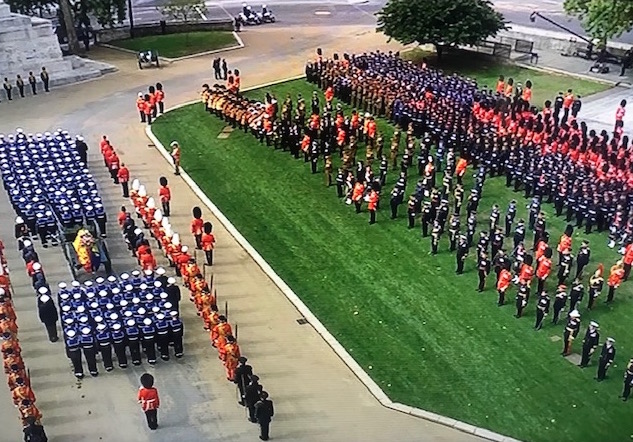
The Cortege on the Mall

The whole event went off with military precision. The planning had been impeccable; uniforms were vibrantly resplendent; Whitehall and the Mall provided ceremonial backdrops; nobody in the 3,000+ in the parade put a foot wrong; the crowds cheered and threw flowers. It was a global showcase of Britain at its best.

That said, other than wall-to-wall TV coverage from countless cameras, it could have been a re-run of Victoria’s funeral 120 years ago. It was the same gun carriage; they wore the same uniforms; the busbies, the ostrich feather, the plumed cavalry helmets had not changed since. Some—like those of the Tudor-era Beefeaters or the pre-Union Honourable Company of Archers are half a millennium old.

All of this makes for a spectacular show. And, though the day did not disappoint even the sceptics with its magnificence, the absence of anything indicating Britain was living in the 20th—let alone the 21st—century poses profound questions.

Such ceremonies were born of Empire, of the era when Britannia ruled the waves and the Great White Queen held dominion over a pink-painted fifth of all mankind. When you are the world leader in power and riches, it behoves you to demonstrate this with ceremonials befitting such status and which no-one else can match. It went with the cultural domination that justified fifty million people dominating a couple of billion.

That “white man’s burden” has been laid down and it is to the credit of the British state that it went more peaceably than the Roman or Russian empires. Reworking it into a Commonwealth of independent states was no mean achievement.

Though he has very big shoes to fill, Charles has shown, in his long apprenticeship, a shrewd humanity that will make a worthy king and may continue to be Head of State in 14 former colonies, as well as the UK. However,  this latter role will decline with time, as will Britain’s pretence to still be a global power “punching above its weight”. The scale of conflict in which it could be decisive ended with the Falklands war four decades ago.

It may not happen soon, or even quickly, but it will happen in my lifetime.”

—Jacinda Ardem, New Zealand PM on Laura Kuenssberg on New Zealand becoming a republic

So, if the ceremonial brilliance of today is to be maintained, it will only be as a nostalgic memento as the past that is also a big tourist draw. Because what counts today—as it did when Victoria died—is wealth, and the power derived from it. Now in the 21st century, because Britain doesn’t dominate semiconductors like America or oil like Saudi Arabia, or manufacturing like China, or engineering like Germany.

All 67.9 million of Charles’ subjects can’t eat ceremony. Nor can they live from London’s finance business and a couple of world-class successes like Rolls-Royce. We are too big to live from dairy, Lego and wind turbines like Denmark or flowers and ocean towing like Netherlands.

Glory comes from power and power derives from wealth. A century ago, Britain had both. But repeating magnificent ceremonies from then does not regenerate either wealth or power. Britain may still stage impeccable ceremony, such as today. But if it can’t rediscover the glory of world-beating exports like those ships, locomotives, etc. of a century ago, it is in danger of becoming a Ruritanian museum piece.

Transfer Point at Wellington’s Arch

#1044—639 words

Posted in Commerce, Community | Leave a comment

Ivan to Go Home—V

  • I—Background and Russian Unit Organisation
  • II—Russian Equipment and Personnel
  • III—Russian Onslaught
  • IV—Russian Inertia
  • V—Russian Rout

“The Russian Army is a boxer who has a great right hook and a glass jaw.”

—Phillips O’Brien, Prof. of Strategic Studies, St Andrews University

The Ukrainian offensive that began around Kherson in the South at the end of August was a cautious affair, involving first destroying bridges across the Dnepr by which Russia was supplying its troops there. It developed as an encircling movement and caused comment because the Ukrainians seemed to be revealing intentions to the public. But it appears that this was primarily a feint—and it worked.

The Russians had assembled the 3rd CAA as a strategic reserve east of Moscow, with the intention of deploying it offensively to regain the initiative. With news of the threat to their stepping stone to secure Odessa and the entire Black Sea coast, they switched it to the South. This allowed Ukraine to launch a completely unexpected offensive east of Kharkiv in the North, which caught the Russians napping.

The Ukrainian Army liberated first 1,000 in the first week of September. They then doubled that several times, each in a couple of days, so now 8,000 square km of the Kharkiv, Donetsk and Kherson Oblasts, once occupied by the Russians for months, are freed in not much more than a week.

Ukrainian Counteroffensive in Kharkiv Oblast Sep 6th – 14th (source: Al Jazeera)

Once the front was broken, the command and morals difficulties that had plagued the Russians initially were amplified by months of failure and stasis. A blitzkrieg by well co-ordinated Ukrainian forces gave bewildered Russian units no time to regroup. The absence of air superiority to allow reconnaissance simply added to chaos, which turned into a rout.

As the rout continues, the Russian army is losing at least a battalion’s worth of vehicles and men a day as twin Ukrainian counteroffensives roll back Russian territorial gains in eastern and southern Ukraine. That’s hundreds of casualties and scores of vehicle write-offs every day.

These losses are catastrophic for Russia. The Russian army barely was sustaining a little over 100 under-strength battalions in Ukraine before Kyiv’s forces counterattacked in the south on Aug. 30 and in the east eight days later.

Around 5,500 Russian troops have died in Ukraine since Aug. 29, according to Ukrainian officials. It’s possible the Ukrainians are overstating the death toll, but it’s worth noting that recent U.S. estimates of Russian losses have been only slightly lower than Ukrainian estimates.

Total Russian Military Losses by Sep 18 (source Ukrainian Military via Kviv Independent

The aircraft losses alone explain Russia clumsiness, having failed to gain air superiority and the intelligence that goes with it. But the sheer scale of losses puts the Russians in general ((and Putin in particular) between a rock and a hard place. To retain whatever hope of victory they might have to save face when the reality a quarter of their original force that included their best units and equipment seems delusional.

But if Putin calls for full mobilisation to bolster his flagging front, the gaffe is blown, and 145 million Russians will know his “special military operation going to plan” was just so much chin music.

#1043—504 words

Posted in Military, Uncategorized | 2 Comments

Ivan to Go Home—IV

  • I—Background and Russian Unit Organisation
  • II—Russian Equipment and Personnel
  • III—Russian Onslaught
  • IV—Russian Inertia
  • V—Russian Rout

“It suggests that the generals need to be at the front lines to ensure that their troops are conducting the battle plan in the way that they want. But that also suggests a lack of confidence in their troops if they need to be that far forward with so many senior ranks.”

Col. Steve Ganyard (rtd), adviser to the Ukrainian Army

By April, it was clear that, despite bumptious pronouncements on Russian TV that “The Ukraine Special Operation” against the fascists in Kiev was going to plan”, somebody in the Kremlin worked out they were getting nowhere. Casualties were far higher than anticipated and, after the prolonged and bloody battle for Mariupol, a major port on the Sea of Azov, there was little to show beyond a land bridge to Crimea and the city of Kherson, blocking the lower Dnepr river.

What had surprised Russians from the lowliest pyadavoy to the Kremlin was the widespread unity and fierce resistance of the Ukrainians—even those who spoke Russian as a mother tongue. The troops have been sent in with a variety of lies as motivation: that they were off on exercise; that the Ukrainians would treat them as liberators; that women would welcome them with flowers. But it seems even the Kremlin largely believed therir own propaganda—that Putin’s efforts to reconstruct the Russian Empire, if not the Soviet hegemony over Eastern Europe as well would come to pass as Ukrainians flocked to the cause.

The decision was made to redeploy forces that had failed to take either Kyiv or Kharkiv in the North and use them to complete conquest of the breakaway oblasts of Donetsk and Luhansk in the East. So plans were altered and an unsubtle, grinding advance behind massive artillery did eventually occupy both.

However, the withdrawal uncovered how Russian troops had behaved I occupied areas, displaying brutality to the residents and poor discipline and morale among Russian units.

Between May and July, a grinding advance focussed on clearing the Donbas by withering artillery barragescost Ukraine 150-200 soldiers killed and several hundred wounded each day. However, Russian casualties were just as heavy and the expenditure in ammunition was prodigious. Before being ejected, the Ukrainians scored successes, using longer-range weapons, partisans and  special forces to destroy several supply and ammunition dumps, slowing the Russian effort.

Ukraine Stalemate—May to August

By August, both sides appeared to have exhausted both themselves and their options. Most observers began talking about a long stalemate, with speculation how Putin could save face and claim spme sort of victory when the military situation was hard to spin as successful completion of the “Special Military Operation”.

#1042—436 words

Posted in Military | Leave a comment

Ivan to Go Home—III

A five-part article on Russian military misjudgements in Ukraine

  • I—Background and Russian Unit Organisation
  • II—Russian Equipment and Personnel
  • III—Russian Onslaught
  • IV—Russian Inertia
  • V—Russian Rout

“No plan survives contact with the enemy.” ­

Otto von Clausewitz

Although the Russians stoically denied it, there was a blatant amount of warning before the attack on Ukraine actually happened on February 24th. By then, they had deployed the 6th , 8th, 41st, 48th, 58th and 65th Combined Arms Armies (CAAs) along the border, with the  29th, 35th  and 36th CAAs deployed in Lukashenko’s puppet state of Belarus. That may sound like nine armies, but they total fewer than 200,000—the size of a single Western army. Despite this belligerent stance, the presumption seems to have been threefold:

  1. That Ukrainian forces would be as ill-prepared as in 2014.
  2. That there was considerable sympathy across Ukraine for returning to the Russian fold.
  3. That the reputation of Russia as a superpower with overwhelming force would cow and resistance by hostile Ukrainians.

All three turned out to be delusional. The Ukrainian Army had used the small-scale war against separatists in the Donbas as a training ground and had cycled many units through there for “live fire” training. The Army was also much better equipped—partly from the West—and, most importantly, were motivated by outrage at earlier Russian attempts to bring the country back under Kremlin control. The invasion was all that was needed for the few remaining skeptics to feel that motivation.

Though they overran another 10% of Ukraine almost immediately, progress slowed to a crawl within a month.  This was due to several Russian shortcomings, as well as stiff Ukrainian resistance. These were:

  • BTG  fragility, leading to decline in combat effectiveness after a few losses
  • Poor logistics and support providing POL, ammunition and supply
  • Lack of air support as the Russian Air Force failed to gain air superiority
  • Lack of initiative at low levels, allowing Ukraine to dictate tactics
  • Poor timing, as the seasonal rasputitsa mud made off-road travel difficult
  • Poor command and control among units due to little brigase-level, let alone CAA-level operational experience

Perhaps the worst example of all this was the massive column at a standstill NE of Kyiv for well over a week. Within a month, little progress was being made on any front and the Ukrainians were taking fresh heart from having stopped what had been billed as a juggernaut.

Taking nothing away from Ukrainian heroes, the bullets above imply that the Russians did not help themselves. There were reports of Russian soldiers amazed that they were not welcomed as liberators; others panicked when they met stiff resistance they had not expected. Despite there being many Russian-speaking inhabitants in the regions occupied, few seemed ready to collaborate and fewer still to welcome “libettors from the fascist regime in Kyiv”.

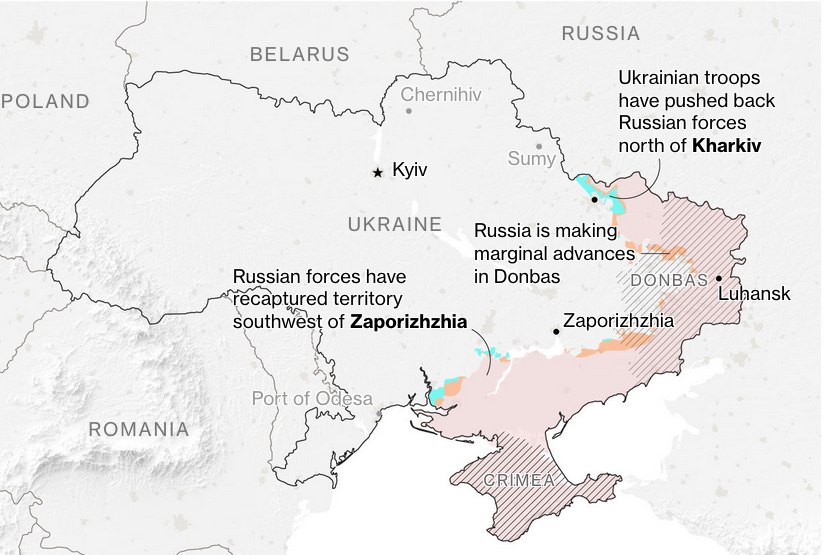
Russian-Occupied Areass by End March 2022 (source: Bloomberg)

Further reading: https://www.bloomberg.com/graphics/2022-ukraine-russia-us-nato-conflict/?leadSource=uverify%20wall

#1041—446 words

Posted in Military | Leave a comment

Ivan to Go Home—II

A five-part article on Russian military misjudgements in Ukraine

  • I—Background and Russian Unit Organisation
  • II—Russian Equipment and Personnel
  • III—Russian Onslaught
  • IV—Russian Inertia
  • V—Russian Rout

Confusion amongst Russian soldiers over their mission and poor morale due to inadequate training and uneven leadership explains their poor performance.”

— Curtis Scaparrotti, US four-star general (rtd)

Put simply, modern warfare consists of tanks capturing ground and infantry holding it. In theory, the entire Russian Army is mechanised with Main Battle Tanks (MBT) variants of differinf vintage. In order of age, the tanl park consists of:

  • 600 T-62 variants, mostly used as tactical artillery support.
  • 2,000 T-72 MBTs in front-line units, plus 7,000 in reserve storage
  • 300 T-80 MBT variants, with 3,00 in reserve storage
  • 350 T-90 MBT variants in elite front-line units
  • very few of the new T-14 MBT , which have serious teething troubles.
Russian T-90 Main Battle Tank

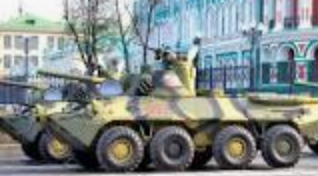
Infantry front-line formations, including those brigaded with tank units, are mostly equipped with 1,000 BTR-80s Infantry Fighting Vehicles (IFVs) and other mechanised infantry in 3,500 BMP-1/2/3, still in active service.

Russian BTR-80 Infantry Fighting Vehicle (IFV)

Older models have been augmented since the takeover of Crimea through greatly increased military spend has produced Iskander-M missile system, Tornado-G MLRS and Msta-SM self-propelled howitzers and Buk-M2/3 air defence missile complexes. Up to February’s full-scale invasion, the share of modern weapons and equipment increased 4 times, with more than 2,500 armored fighting vehicles (AFVs) of all types had been delivered to tank formations.

Formidable as this equipment park might appear, those deploying and using it are  mixed bunch. At the senior level, Putin does not seem to have studied the hard lessons learned during WW2. Stalin purged Red Army officers of all but loyal lackeys and paid the price of incompetence by the likes of Popov and Budyenny by losing over a million prisoners and most of Western Russia in the opening months o the German invasion. Only when Stalin stopped interfering and let professionals like Zhukov, Chuikov and Koniev run their operations did victories come.

Senior Russian commanders (i.e. colonel and above) have scant experience operating large formations and are chary of risk for their career’s sake. The junior officers and junior officers thinned out during the lean years of the 1990s. In contrast to the flexible competence of such officers that once made the Wehrmacht so formidable, Russians are neither trained to think flexibly, nor show much initiative. At least 12 Russian generals have been killed in Ukraine, which suggests a poor level of control and initiative at lower levels, requiring senior commanders to take change from the front. Many BTGs in the Donbas rely on local militia to cover flanks and rear.

Although there are almost a million ordinary soldiers, their skills and quality very greatly. Speznatz (special operations), Guards (elite), EW and missile units are mostly regulars with a good stiffening of regulars. But the bulk of the army relies on conscripts to fill out the ranks with. These are required to serve a year (down from two) in the military. The few professionals in their units are too few to train them “on the job”.

#1040—488 words

Posted in Military | Leave a comment

Ivan to Go Home—I

A five-part article on Russian military misjudgements in Ukraine

  • I—Background and Russian Unit Organisation
  • II—Russian Equipment and Manpower
  • III—Russian Onslaught
  • IV—Russian Inertia
  • V—Russian Rout

“Our country is officially and directly declared the main threat to North Atlantic security. And Ukraine will serve as a forward springboard for the strike.”

—Vladimir Putin, February 24th 2022

The second week of September 2022 was certainly momentous. In the UK, the monarch died within two days of investing a new Prime Minister and in Ukraine, a front that has moved sluggishlyif at all— for half a year suddenly burst into life Though UK media have focused all attention on “historic” UK events, those unfolding in Ukraine may well have the deeper impact on the world at large.

What has suddenly changed? How could a massive Russian Army experts expected to overrun Ukraine in a week in February become so bogged down and now seems to have been caught napping?

The war is far from over.  Accurate and comprehensive data from the front is hard to find. But this appears a turning point in the conflict. What follows is informed speculation why that should happen after months of stalemate.

Russian Unit Organisation

In war, moral power is to the physical as three parts are to one.”—Napoleon Bonaparte

The Russian Army has always been large. As the Red Army stormed Berlin in 1945, it numbered around 12 million. Kept at a still-impressive size throughout the Cold War, until the collapse of the Soviet Union. At that point, both size and readiness eroded. At one point, only a few dozen armoured fighting vehicles (AFVs) were built in a year. Many junior officers left to find careers outside the  service and morale slumped.

Some forces were kept up to strength and in readiness. These were sent to Kosovo and Moldova in the 1990s, but in a peacekeeping role. As he secured his power in the 2000’s Vladimir Putin revived investment in the Army and devised training grounds that suited his flexing of muscles to restore his dream of the Russian “sphere of influence” (a.k.a. Empire).

This was achieved in Chechnya and Ossetia—two smallish territories in the Caucasus far from foreign interest so he could assume a free hand. Unlike the bottomless quagmire of Afghanistan where Russia had burned its fingers and lost 10,000 men through the 1980’s, these were small “brush fire” wars against poorly armed and  led local militia, where tactics could be tested and morale restored.

By the teens, the Russian Army had been built to around 80 brigades, formed by the splitting up of divisions that proved too unwieldy for effective deployment—a lesson learned from the early years of WW2.

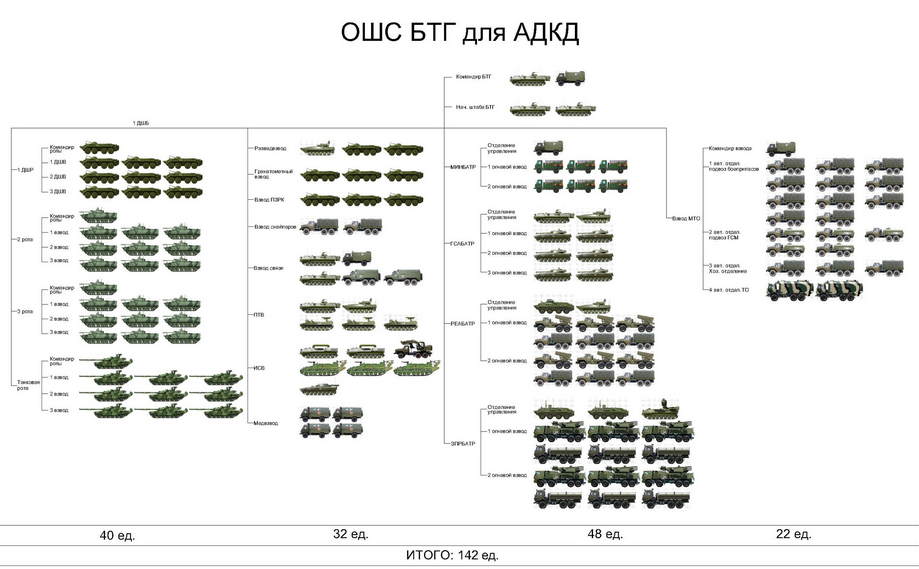
Typical Russian Battalion Tactical Group Organisation

When Russia first intruded into Ukraine, the fall of Crimea came relatively easy. But the Russian-backed insurrection in the Donbas ran into such resistance that the Russian Army had to intervene, but without insignia to protect the fiction that this was spontaneous local action. Those sent were battalion tactical groups (BTG) were a modular tactical organization created from a garrisoned Russian Army brigade to deploy combat power to conflict zones. BTGs were typically effective in combat operations in Ukraine from 2013-2015, but on several occasions, BTGs were tactically defeated by Ukrainian regular units despite Russian firepower, electronic warfare (EW) and air-defense artillery (ADA).

Further Reading: https://rusi.org/explore-our-research/publications/commentary/getting-know-russian-battalion-tactical-group

#1039—491 words

Posted in Military | Leave a comment

Leadership vs Tyranny

The remains of Mikhail Sergeyevich Gorbachev were taken from Moscow’s Hall of Columns, where all Soviet leaders had once lain in state after their death. But all were buried with a State Funeral. Gorbachev was not. This, and Putin’s diary being “too full to allow him to attend” was a major snub of the only leader of real stature, one who had ended the Cold War and built links through a crumbling Iron Curtain.

The origins of Gorbachev’s mould-breaking career is seldom discussed. Born under Stalin in Stavropol, South Russia, his early childhood would witness the brutal collectivisation of the Kulaks and, at age 11, witness occupation by the Wehrmacht’s Army Group ‘A’ making Hitler’s lunge for Caspian oilfields.

Little wonder that, when he had the influence to do so, he looked for de-escalation and peace.

His rise through the Party ranks to take the Soviet Union in a different direction to his  geriatric predecessors, risking all with his glasnost (“openness”) and  perestroika (“restructuring”) was world-changing. Considered in the West to be one of the most significant figures of the 20th century, Gorbachev remains the subject of controversy in his homeland. Hardliners like Putin clearly se him as an aberration, someone who threw away the empire he is mow desperate to restore.

So Gorbachev is the exception, Putin is a return to the norm of Russian leader: a tyrant; a heartless despot, borrowing from repressive Russian leaders down the ages, with Stalin his poster boy. The thuggery of Chechnya, Ossetia, Crimea, Donbas and now Ukraine are just Putin’s desperate attempts to fill Stalin’s shoes as the most successful dictator the world has seen.

But it is Putin’s background in paranoid ambition, honed while scaring the bejasus out of hapless Ossis (East Germans) during the earlier part of his career as a KGB thug. That poorly-led troops have committed innumerable war crimes, that civilians have been brutalised,  that nothing remotely resembling truth is ever announced. All are not new tactics, invented by Putin. They are straight out of Stalin’s playbook how to control a population by terrorising it.

“How many divisions does the Pope have?”

—Josef Stalin, when asked to consider Catholic good will.

Repulsive though brutality not just sanctioned but planned and initiated by Putin may appear, he is an amateur when compared with events during the three decades his role model Stalin held sway. For example:

  • Between 1929 and 1933, kulaks (prosperous peasants) were collectivised transforming traditional agriculture and centralising power. This process of “dekulakization” was pure political repressions, including arrests, deportations, or executions of millions of kulaks.
  • In the summer of 1941, the invading German Army Group Centre uncovered mass graves in the Katyn forest, near Smolensk. They were Poles, taken when Stalin quietly occupied half of Poland in 1939. 8,000 officers, 6,000 police and 8,000 “intellectuals” were executed on Stalin’s orders “as they represented a threat”. When accused, Stalin blamed it on the German occupiers. The Allies hushed the while thing up to assuage Stalin.
  • When the surrounded German 6th Army finally surrendered at Stalingrad in January 1943, over 90,000 half-starved, frost-bitten soldiers were marched off to Soviet gulags. Fewer than 10,000 ever saw the Fatherland again.
  • In May 1944, after the Red army re-occupied Crimea, 200,000 Tartars—even party members and Red Army veterans—were forcibly transported to Uzbekistan in cattle trucks because Stalin suspected some of collaboration. Russians were given the empty farms and houses. Nearly 8,000 died during the deportation.

Whether the harsh Russian climate created a hardy race of tough people who need strong leadership to control them, or a litany of harsh leaders has created the phlegmatic resilience of the Russian people is not clear. Ivan the Terrible and even Catherine the Great set the tome, but none matched Soviet leaders for pitiless brutality. Though he fancies himself as Stalin’s successor who will restore Russia to its rightful empire, he is a wuss; his actions born of desperation, not dominance.

Even casual students of Russian history know, a century from now, which of Gorbachev and Putin will be lauded for contributions made to Mother Russia and civilisation. It won’t be a minor KGB apparatchik whose brutality got lucky.

“Those who vote decide nothing. Those who count the vote decide everything.”

—Josef Stalin

#1038—695 words

Posted in Military, Politics | Leave a comment

Union Myth-Take 6

Few nations are better placed to navigate the challenges ahead,

—Boris Johnson

This typically bullish Boris Johnson assertion in the March 2021 Global Britain in a competitive age publication has yet to be realised 18 months later. The most cursory glance over UK economic history sreveals a short-sighted ineptitude in strategic thinking, highlighted by the announcement of another 80% hike in energy bills in a country that is self-sufficient in energy. We kept building steam engines and similar dying steel or shipbuilding. Worse, we treated our North Sea oil bonanza as a cash cow.

North Sea oil fields divide equally between UK and Norway. But each chose a different path to exploit them. Given the greater economic clout of UK we could have made the better of the bonanza. But the Thatcher government sold off the assets and used revenue from oil to keep taxes low. and pay off debt

By 2016, Brent Crude price had dipped below $40 and revenue had slumped to £60 million. That year, Norway produced a similar volume of oil, but raked in £9 billion to their treasury. The difference? . While the UK privatised BNOC through Britoil by 1988, Norway’s oil and gas industry remains state-owned.

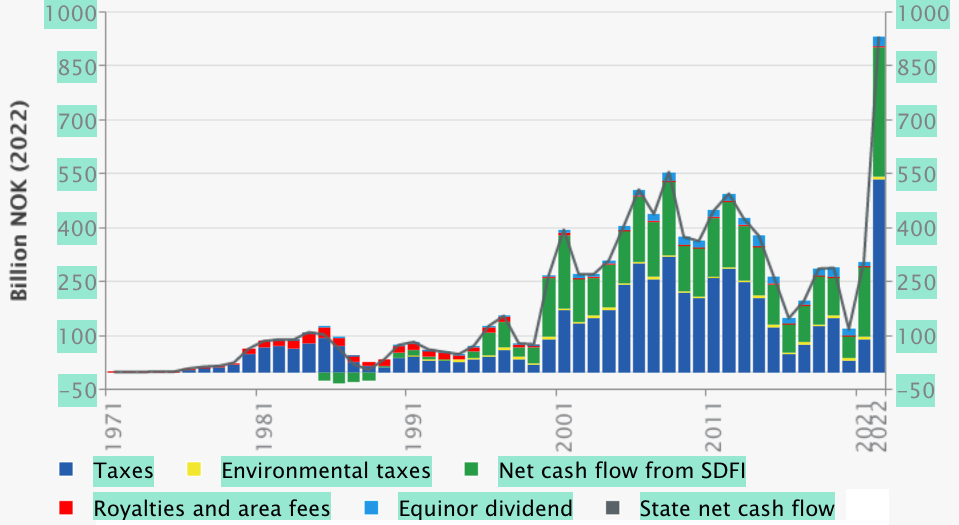
North Sea production was never permanent. While it was clear to all this wealth was finite (it peaked around 1990), the UK made no plan for the future.  Contrast Norway’s consistent higher oil revenue on this chart with the UK’s, given in Union Myth-Take 5.

History of Norwegian State Oil Revenues (£1 = NOK11. Sovurve Norwegian Govt[1]

[1] https://www.norskpetroleum.no/en/economy/governments-revenues/

In 1990, while the UK was spending its windfall, Norway began a sovereign wealth fund –the Oljefondet. It now stands at over £1 trillion and funds Norway’s investments and social programmes. Whereas the UK take from this year’s oil price surge will be £17 billion, Norway’s NOK926 billion translates as £80 billion—twice ALL profits eked out of the UK sector. Had the UK government not pillaged and squandered its inheritance, Scotland could have been another Norway. It still can.

And, in case you’re wondering, in July 2022, Norway’s inflation rate was 6.8%. Before the present price hike, the average home consumed 3MW a year, costing £445. The price in Britain was £764 but will soon rise to £1,560

“Dear God, give us another oil boom. Next time we won’t piss it up against the wall.”

—graffiti on a wall in Aberdeen

#1037—365 words

Posted in Commerce, Politics | Leave a comment

Democracy for Sale

This blogger subscribes to a number of sources regarded as reliable with the intention of presenting information and opinions here based on factual evidence. Occasionally, those sources present what Americans might call a “humdinger” of a scoop that demands wider distribution. One such is today’s blog from Heather Cox Richardson, containing the following verbatim quote.

Heather Cox Richardson, Aug 23

Today’s big news is an eye-popping $1.6 billion donation to a right-wing nonprofit organized in May 2020. This is the largest known single donation made to a political influence organization.

The money came from Barre Seid, a 90-year-old electronics company executive, and the new organization, Marble Freedom Trust, is controlled by Leonard A. Leo, the co-chair of the Federalist Society, who has been behind the right-wing takeover of the Supreme Court. Leo has also been prominent in challenges to abortion rights, voting rights, climate change action, and so on. He announced in early 2020 that he was stepping back from the Federalist Society to remake politics at every level, but information about the massive grant and the new organization was broken today by Kenneth P. Vogel and Shane Goldmacher of the New York Times.

Marble is organized as a nonprofit, so when Seid gave it 100% of the stock in Tripp Lite, a privately held company that makes surge protectors and other electronic equipment, it could sell the stock without paying taxes. The arrangement also likely enabled Seid to avoid paying as much as $400 million in capital gains taxes on the stock. Law professor Ray Madoff of Boston College Law School, who specializes in philanthropic policy, told the New York Times: “These actions by the super wealthy are actually costing the American taxpayers to support the political spending of the wealthiest Americans.”

This massive donation is an example of so-called “dark money”: funds donated for political advocacy to nonprofits that do not have to disclose their donors. In the 2010 Citizens United v. Federal Election Commission (FEC) decision, the Supreme Court said that limiting the ability of corporations and other entities to advertise their political preferences violates their First Amendment right to free speech. This was a new interpretation: until the 1970s, the Supreme Court did not agree that companies had free speech protections.

Now, nonprofit organizations can receive unlimited donations from people, corporations, or other entities for political speech. They cannot collaborate directly with candidates or campaigns, but they can promote a candidate’s policies and attack opponents, all without identifying their donors.

“I’ve never seen a group of this magnitude before,” Robert Maguire of Citizens for Responsibility and Ethics in Washington (CREW) told Casey Tolan, Curt Devine, and Drew Griffin of CNN. “This is the kind of money that can help these political operatives and their allies start to move the needle on issues like reshaping the federal judiciary, making it more difficult to vote, a state-by-state campaign to remake election laws and lay the groundwork for undermining future elections.” Our campaign finance system, he said, gives “wealthy donors, whether they be corporations or individuals, access and influence over the system far greater than any regular American can ever imagine.

Heather Cox Richardson, Aug 23

#1036—519 words

Posted in Politics | Leave a comment