Grrrr! Feck!

Of all the endeavours of government, the one that affects everyone and that for much of their lives—whether for themselves or for their children—is education. We may spend more money on health but a significant number of us never go near the health service, while many others use it as a breakdown service for bodily functions. But though health spending in the UK tops out at over £120bn each year and is beaten both by pensions and by welfare, education is not far behind in fourth place and around £118bn.

Education spending in Scotland this year will be just shy of £8bn or about £1,500 for every man, woman & child in Scotland. And, in case you think that’s not enough money, that sum has doubled since the Scottish Parliament was established. And, in that time, there have been a number of laudable initiatives, including inclusion, the McCrone settlement on teachers’ pay and GIRFEC—Getting It Right for Every Child.

The problem is, though, that despite getting all this attention and money, and despite slowly improving exam results, all is not well in Scottish Education. In fact, we have a number of mutually contradictory facts being slung about, partly by vested interests like government and opposition spokespeople and teaching unions and partly by business who staff up on the fruits of education’s labours. Teaching unions extol our quality; business complains of innumerate school leavers with atrocious communication skills. Most telling are the more neutral observers, such as PISA (Programme on International Student Assessment). They placed  UK pupils in 16th place in Science, 25th place in Reading and 28th place in Mathematics: soundly beaten by, among others, Hong Kong and Liechtenstein. And that’s before we even start on the UK’s miserable record of ability in foreign languages.

Now, had we ignored and underinvested in Education, we might thole such humiliation as our own neglectful fault. But in both Scotland and England, it has been the focus of fierce debate, not least because it is such a growing focus of public money in these times of economic stress. Not too much can be read into comparisons between Scotland and England as both have been fiercely proud of their independence and of the differing methods used north and south of the Border. But, putting it another way, they have both arrived at a the same miserable place by very different means.

Last Thursday, BBC Scotland’s Newnicht after a decade of schools development in England, latched onto the recently completed “London Challenge” as if this were some ‘magic bullet’ that Scots could fire to improve on their ongoing woes in school education. Flattered as I was to be asked on the programme, I was dismayed by the narrowness with which the twenty-minute debate was conducted. Much though I admire Gordon Brewer, it brought the sum of human knowledge little further and took me until now to calm down enough to write about it.

There seems no doubt that the London Challenge has been a success, especially in the more underperforming schools in the Imperial Capital. And , if there was a factor that made a difference in this ‘dahn saff’‘ it was teachers feeling empowerment and therefore engagement that made the difference. But what was unclear from the Newsnicht discussion was how this had been achieved. The difficulty, as I see it, is the old problem of blind men fondling an elephant and giving widely divergent reports.

So, smarty pants, what would YOU do to boost real achievement? My ‘Dozen of the Best’:

  1. Stop Treating Children Like Hothouse Flowers. While parents have every right to feel protective of their kids, they overdo it, freighting them to school by Chelsea Tractor any time it looks like rain. We should adopt Norwegian robust kindergartens where they are bundled up and out into the snow to play at age 3. They learn social skills, explore nature and develop robust immune systems.
  2. Start Treating Children Like People Early On. Many believe the most influentially formative years stop at age 7. Kindergarten and Infant classes should be small, stimulating and well supported for any child showing difficulty with learning & socialising. Infant teachers have a challenge to be so much more than just day care.
  3. Introduce a Foreign Language Early On. Doesn’t much matter which, as long as there is a sound basis on which to continue (e.g. town twinning; many Poles in town), although dauntingly difficult langauges like Mandarin make this more difficult. Real interactions with natives, news clips, media, etc essential to make it real/relevant.
  4. Get Back to Basics. One of the reasons British kids do poorly is their literacy and numeracy skills are shaky. Primary schools is where skills in spelling, punctuation, grammar and mental arithmetic should be grounded and built on. Like riding a bike, they are vital skills, useful the rest of your life, let alone in securing a job.
  5. Get Out of That Academic Rut. For decades, parents, teachers & governments have been colluding about exam results as if they were the only measure to value. While qualifications are important, take a leaf out of the German book where vocational, creative and sporting skills are all valued as much and a functional balance among all is regarded as the way to prepare young people for life.
  6. Everyone Isn’t a Winner. While care must be exercised dealing with fragile young egos, downplaying competitiveness (e.g. prizes) is delusional: not only does the world they will enter not work like that. But, if point 5 is properly addressed, there will be few who do not earn prizes in at least one area they are good at.
  7. Engage the Teachers as a Calling. There are plenty of good, dedicated teachers out there who engage with their charges, take on extra work, stay after hours. But you’d never know it from their unions. Of the ten reasons EIS gives to join, only one is about education; when you check their website for ‘policy’ most are political postures. We need the Finnish model where teachers are valued, autonomous, seen as royalty in society and consequently a hugely positive and productive factor in teaching Finnish kids (in PISA rankings: 2 in Sciences, 3 in Reading and 5 in Maths—see above).
  8. Cut the Cluster Some Slack. Rather than have local authorities steer details within each school, each cluster (secondary school, plus the primaries that feed it) should be managed both financially and academically as a single unit and given great latitude as to what they teach and how. Not just academic but vocational skills have differing use and importance all across the country.
  9. Get the Community Involved. We should have no delusions about the superiority of our education, having been overtaken by the English in terms of innovative thinking. Academies and Free schools may have been stealth measures for parent selection that don’t apply here but Scotland needs to learn from the London Challenge. By engaging the community, the extensive positive energy from parents and others can weave the school cluster into everyday life. Fundraising and interaction improves, support at home rises and even social problems minimise.
  10. Become a Part of the Real World. (and not just a Highers Factory). Take a lesson from the US where schools are involved in such pragmatic things as learning to drive or how to deal with their complicated voting system. There should be no need for local authorities to be running Adult Ed classes because schools should be doing this both as a part of being in the community and as a way of fundraising.
  11. Keep the Politicians At Bay. Not only are Education Committees rife with people with no qualifications but the bureaucracy at national level are forever foisting their latest fad in pedagogy on reluctant schools. As an example at the last Portfolio Questions at Holyrood (May 22nd) of the 22 questions almost all were local pork barrel issues or political grandstanding. Scrap any national curriculum: let schools have the initiative for once, which leads to the final and most crucial step:
  12. Shoot the Inspectors. With 12 years on an Education Committee and over 100 Inspection Reports under my belt, they were mini-monuments to conformity and clammy bloodsuckers on initiative. The Finns, among others, have done this. They maintain some rudimentary central awareness of what is going on across the country. But freed of the unconscionable volumes of time involved in inspection, imbued with a sense of self-worth and inspired to send their charges out towards the future as well equipped for life as they can, teachers there earn the respect and gratitude they once earned here—and could have again.

So, Mike Russell, are you growling/swearing or up for this? Are our front-line teachers, or for that matter the parents, ready to roll up their sleeves? Most importantly, are EIS, SSTA and the whole rest of the teaching unions who have been dictating an overly expensive education setup ready for something this radical? Or would they rather be remembered as an oatmeal-tie-and-baggy-cord-jacket reincarnation of the lost-in-last-century-thinking miners?

Posted in Education | Tagged | Leave a comment

Reassurance for the Feart

While about one third of  Scots are clear they want independence and a similar number are clear they want to stick to nurse for fear of something worse, the final third has an open mind; they are looking for some kind of reassurance which option would make their lives and those of their children better. It’s not just about money but that is an understandably important factor. If you feel you belong in that third, read on.

This week, the Scottish government produced a paper putting the economic case for independence. Titled Scotland’s Economy: the case for independence, it says: “By international standards Scotland is a wealthy and productive country. There is no doubt that Scotland has the potential to be a successful independent nation.” The paper concluded that Scotland had “more than enough resources” if it had the powers of independence.

Launching the paper, First Minister Alex Salmond said: “Despite our strong economic foundations and excellent global reputation Scotland, with Westminster in control of our economy, is not reaching our potential as a nation and this report clearly lays out the ways in which UK government economic policies have not worked in Scotland’s best interests.”

Here, are the key points of the Scottish government paper:

Scotland can afford to be an independent country

The Scottish economy performs strongly on key indicators but there is room for improvement, the Scottish government says. In 2011, Scotland was positioned as the third highest region in the UK – behind London and the south east of England. Adding a geographical share of Scotland’s North Sea output increases Scottish GDP per head from 99% to about 118% of the UK average.

Scotland’s share of the UK national debt is lower as a percentage of GDP than the UK’s. UK public sector net debt at the end of 2011-12 stood at £1.1 trillion (72% of GDP). Scotland’s per capita share would have been equivalent to £92bn (62% of GDP). Scottish exports (excluding oil and gas) to destinations outside the UK in 2011 totalled £23.9bn. In the same year, a further £45.5bn of goods and services were traded with the rest of the UK.

Key strengths include the food and drink sector (18%), reflecting high demand overseas for Scottish whisky.

Scotland has enormous potential

In oil and gas, Scotland is estimated to have the largest reserves of oil in the EU, accounting for 60% of the EU total. There are estimated to be up to 24 billion barrels of oil to be extracted from the North Sea. In 2011, oil and gas production contributed £26bn to Scottish GDP.

Analysis by Prof Alex Kemp of Aberdeen University estimates Scotland’s share of UK offshore oil production at 96% and offshore gas production at 52% in 2011. This resulted in Scotland accounting for an estimated 78% of total UK hydrocarbon production in 2011.

In renewables Scotland has 25% of Europe’s offshore wind and tidal resource and 10% of Europe’s wave resource. At this time, there are more wave and tidal power devices being tested in the waters off Scotland than in any other country in the world. It already generates more than one-third of our electricity needs from renewables, including hydro power.

Turnover in our food and drink reached £5.38bn in 2011. and Scotland is now the world’s third largest salmon producer. In fact, Scotland lands 60% of the UK’s fish and has more than one quarter of the UK’s beef herd. When it comes to whisky it is reported that 40 bottles of the spirit are shipped overseas each second.

Scotland is internationally recognised as the most important UK financial services centre outside London and the south east. The tourism industry in Scotland employs almost 200,000 people. Our creative industry sector has a turnover of £4.8bn. Scottish art, film, fashion, music and literature are well recognised, as are Scotland’s design, IT and computer gaming industries.

Scotland has a strong digital and ICT sector, employing 47,000 people. In 2012 the life sciences sector provided employment for about 32,500 people in 650 companies and organisations. The related area of medical technology and pharmaceutical services has also shown growth.

Status Quo not working

The Scottish government says: “The one-size fits all policies implemented by the Westminster-based UK government are not generating the growth or delivering the social cohesion that Scotland should be enjoying.” Work carried out by the Scottish government’s Fiscal Commission Working Group concluded: “It is widely accepted that, in terms of economic growth, Scotland has underperformed relative to both the UK and other small EU countries.”

The Scottish government says the current constitution arrangements do not allow economic policies to be tailored to the challenges faced in Scotland. This puts Scotland at a disadvantage and is also evident in the divergence in performance of the economies of other regions within the UK in relation to London and the south East.

It argues that the UK is the fourth most unequal country in the developed world. As well as limiting the potential and prosperity of individuals, such inequality is bad for our economic health. Inequality is estimated to be slightly lower in Scotland, but is still too high, the report says.

How independence will strengthen economy

The paper says: “Our ambition is for an economy that is diverse and grows sustainably, with high value jobs that pay decent wages, leading to greater equality of income and wealth and a higher degree of social cohesion.” It adds: “This paper is not intended to be a policy manifesto, but it does set out the evidence that small economies perform well and that independence, within a continuing currency union, would give future Scottish governments the powers to address the imbalances and inequalities that inhibit economic growth.”

The Scottish government believes that it is in the interests of Scotland, and the rest of the UK, for an independent Scotland to share the pound within a monetary union after independence. It admits a currency union would provide some constraints on deficit levels and debt levels.

But it does not believe a currency union would “seriously inhibit the policy freedom and flexibility of an independent Scottish government”. It says it would instead ensure and promote overall financial discipline.

The lack of policy levers has constrained the ability of Scotland to perform as well as it could have over the past few decades, says the Scottish government. The paper provides a list of fiscal levers that could be used to boost growth, address inequality and stabilise the economy. These include:

  • Oil and Gas Taxation
  • Excise Duty
  • Value Added Tax (VAT)
  • Air Passenger Duty
  • Capital Borrowing
  • Welfare and Social Security
  • Corporation Tax (base and rate)
  • Public Sector Pay/Pensions
  • Capital Gains Tax
  • Rural and Environmental Taxation

Anyone who watched the first programme of Nick Crane’s Town series on BBC2 on May 21st will have been struck how Oban—once a remote and rather second-rate transit point for ferries to the Hebrides—has reinvented itself as a quality food, watersports and outdoor vacation destination. Instead of following any Central Belt model, it has invented its own and it works. Anyone going there now who knew Oban in the eighties marvels at the transformation. Scale that up to a national level and you have Scotland with all its potential.

Posted in Commerce, Politics | Tagged | Leave a comment

The Diseconomies of Scale

It is no surprise to seasoned nationalists that the Hootsmon is gradually ratcheting up the intensity of its doom and gloom forecasts as to how Scotland will land in the poorhouse if it has the gall to actually try to be independent of England. This week alone, Malcolm Rifkind was banging on about Scotland having ‘only’ 5,000 front-line combat troops available, the in-house hacks were puffing up the prospect of both HBOS and RBS having to leave the country and even well respected commentator Peter Jones was sucking his teeth over the prospect of pensions in an indy Scotland.

Now, having been defence secretary, Big Malky knows a thing or two about armed forces. What he didn’t say is that ‘only’ 5,000 troops make up eight battalions, or four times what the UK currently has uncommitted in its present global overstretch. That’s also almost twice the active infantry currently in the Scottish Division of the British Army. The problem with the unionist view is they see us as a mini-UK, throwing our weight around à la Falklands, Kosovo, Iraq, Afghanistan, etc; Scotland, while wanting to do its bit for UN peacekeeping, would have no such ambitions—and would spend half on defence per capita than we do now in the UK (roughly a £2bn annual savings).

Less easy to dismiss are the doom-and-gloom arguments of fiscal catastrophe, especially when people believe it will affect them personally. The scare of major employers like RBS heading South is real, especially as Alastair Darling glued HBOS onto Lloyds in a panic in 2007, with little thought of long-term consequences. Lloyds will certainly remain headquartered in London. But, unless there are sound fiscal reasons, why would they shift their HBOS management elsewhere?

The answer—as with so much in banking—is money. Or, more specifically profitability. Banks have major operations in Jersey and Isle of Man; it saves them money. They have myriad subsidiaries in the Cayman Islands; it saves them even more money. On the Continent you can drive through Liechtenstein in minutes but it is a major banking centre. Need I go on? Scotland only has to pitch its corporation tax a notch below the City of London and all sorts of banking operations would show up in Edinburgh. That, plus the headquarters would stay put for similar reasons—especially if we stayed in the EU while a xenophobe UKIP-led England retreated to sulk in the wilderness.

But Mr Jones’ points about pensions are less easy to dismiss. Indeed, though they should be taken entirely seriously, the first key point is that your pension is under threat whether Scotland stays linked to England or not. Such was the transformation of pension fund fortunes over the last 6-7 years that few would have forecast anything but sunny future before the financial crisis hit. And—here beginneth the First Lesson—that crisis did hit…and scuppered pension values right across the UK. Not much protection being part of this larger UK union, was there?

Then there’s the issue of affluence. If Scotland alone had a lower GDP and its citizens heading for retirement were entitled to funds based on a higher GDP, then payouts would be less affordable pro rata and the Scots Treasury would be harder pressed to ensure all got paid what they were due to them. This is the point being made over the Pension Protection Fund—some 25,000 of its 360,000 members being Scots—how can a small country carry such guarantees spread over far fewer companies?

That’s the Second Lesson. Scots actually make stuff and have fewer unemployed and more exports per capita than the UK. Also its ratio of PPF members is 0.5% vs England’s 0.67%, which makes our burden one quarter less with more prosperity to pay for it. Much more alarming is the public sector pension commitment which has ballooned over the last couple of decades as successive governments and council have bowed to public sector workers’ demands.

In two decades, public spending on pensions has gone from zero (i.e. self-funding) to £118bn. That means that Scotland will have to find £10bn each year just to make up the shortfall in funding of its public sector workers. In or out of the Union, the problem will be just as big—except that Scots could choose to confront this elephant in the room once independent. Labour would never touch this with a bargepole (they largely created it under Irn Broon’s supposed ‘prudence’) and the Tories have simply shied away. But a determined Scottish government with a more robust economy to back it could do some renegotiation that at least prevented this from mushrooming further, such are the diseconomies of scale.

But the most thorny point raised about pensions is the EU law that requires any pension fund that crosses member boundaries to be fully funded. The Scottish Government argues that this cost can be spread over a transition period of several years. I tend to agree with it, that this and other cross-Border problems can be dealt with, and it would not be in the UK government’s interest to be petulant about it.

What no unionist seems to acknowledge is that ‘only’ 5m Scots would have a booming oil business that, relatively speaking would be ten times the present size, relative to the economy. That, the preponderance of export business, such as the £4bn in whisky, and the world-leading niche expertise in green energy and oilfield technology makes you wonder why shrewd investors are not betting on our advantage in diseconomy of scale already. With 2% of our population and 0.14% of our land area, how does Jersey survive?

There is no question a looming pension gap exists or that both England & Scotland must address it jointly or severally. But Scotland’s economy is better suited to finding its own solution than locked into the UK with its backward-looking governments and failed financial regulation systems.

An interesting prospect presents itself now that the Tories are running scared from their own backwoodsmen over Europe: what if Scottish independence and English withdrawal from the EU coincided? Then, not only would Scotland become the sterling bridgehead into the EU, but the pension funds crossing the border would no longer need to be self-funded as only one participant was an EU member.

Despite Farage’s obnoxiously small-minded politics, I’m sending him a tenner immediately; Scotland has bigger ambitions.

Posted in Commerce, Politics | Tagged | Leave a comment

Must Justice Always Be Blind?

“The virtue of justice consists in moderation, as regulated by wisdom.”     —Aristotle

Tuesday May 21st sees a meeting of Holyrood’s Justice Committee that has serious implications for how the Scottish Courts Service administers justice. As part of the Scottish Government’s exercise in belt-tightening in these troubled times, the SCS has proposed closing 10 of the 49 sheriff courts around the country, with a heavy preponderance in South-East Scotland that would close Haddington, with all court business transferred to Edinburgh.

Justice Secretary Kenny MacAskill said the reforms were “justified” and claimed a £3m initial saving, with further annual savings of £1.3m. Duns and Peebles, along with three others, would also close, with business going within 20 miles. These five are justified in the SCS proposals by a “low volume of business”. On the other hand, Haddington, along with four others, is chosen because of “a close proximity to another”.  These are:

  1. Haddington transferred to Edinburgh (19 miles)
  2. Arbroath transferred to Forfar (15 miles)
  3. Cupar transferred to Dundee (14 miles)
  4. Dingwall transferred to Inverness (14 miles)
  5. Stonehaven transferred to Aberdeen (15 miles)

Drawing on the largest population and being shifted the greatest distance, there is an argument that Haddington should not be included in that tally. But far more cogent an argument is that real justice—the kind that is more likely to work than the more primitive and draconian form forced on cities by their greater social problems—will be lost.

Not only does East Lothian exhibit a very difference profile of crimes and criminals than does Edinburgh, they have been putting creative efforts into developing a better justice system through supporting community police officers, specialised police teams and their own squads of community wardens and ASBO officers that help cover  ‘nuisance’ crimes that are often overlooked in cities. As a result, crime statistics have been dropping faster in East Lothian than in Edinburgh and resident surveys show much smaller fear of crime.

Closing Haddington Sheriff court and mixing the magistrates there in with those in Edinburgh will result in Edinburgh-style justice. That may be appropriate in city conditions. But banging the boys up in Saughton, as opposed to placing them under close surveillance in a community that knows them and lets them get away with little, is not way to steer anyone—especially youth—away from a life of crime.

As an elected representative in the area, I am appalled that we might be about to unravel a decade of good work tacking crime statistics and especially nuisance crime, for which the police seldom had the resources to take seriously. In Haddington, it doesn’t even make economic sense as the court building is in desperate need of renovation and the burden with fall on the local council and what the SPS claims to save will simply move to elsewhere on the public purse.

The last chance to reverse this idiocy is by the Justice Committee meeting on the 21st. I have therefore written to its chair, asking for a more sensible approach to be taken and for the Justice Minister not to be blind enough to throw a healthy baby out with his cost-saving bath-water.

“Christine Grahame MSP, Convener, Justice Committee.

“The Scottish Court Service put out a consultation about the provision of courts around the country. As an elected member of East Lothian Council with 14 years of service and chair of my Community and Police Partnership, I object to any decision to close Haddington Sheriff Court because it does not meet the requirements of local justice.

“Local justice, as provided at Haddington, cannot be replicated in Edinburgh any more than policing appropriate for Edinburgh can be applied here. Not only are crime and criminal profiles very different but our more flexible, hands-on approach to minor infractions, using community officers, community wardens and our ASBO team has, over the last decade, been developed with support from both sheriffs and JPs who understand our need for subtlety and understanding.

“When Leader of this council, I was at pains to ensure development of a strong and effective team to steer those committing misdemeanours—especially the youth element—into more reasonable behaviour. Knowing how much police time such activities takes, we funded additional local police teams, plus our own warden squad to work with them and argued for long appointments for our community constables.

“All this was underpinned by a sheriff court that, knowing what we were trying to achieve, acted sensitively in similar spirit. Our mode of working is yet, unknown in Edinburgh and their courts have no experience of the subtleties involved. Our sharply falling crime statistics in East Lothian will be jeopardised by the loss of the sheriff court element of our effective local justice and undermine much good work done.”

Yours

David Berry, Councillor, North Berwick Coastal

Posted in Community | Tagged | 2 Comments

A Funny Thing Happened…

…on my way to the internet. Having an eclectic wander, as I often do, in a (frequently fruitless) search for new ideas—especially from the many sides of the independence debate, I came across the following (no, not the Zen article but the ad in the lower right corner). And blinked, rubbed my eyes and still wondered if I was seeing things:

LabourAd


Disagree as I do with Labour over a number of things, I had held them to be a party of principle, from the dogmatic and partisan Jackie Baillie through the genuinely gifted Alexander siblings to the affably loyal, yet open-minded like Duncan Hothersall.

This ad may not be a first. But to anyone who has listened to Labour bang on about the preciousness of the NHS while dismissing anyone else’s claim to be as good a guardian for its future, this must rather reek of hypocrisy. It certainly sits ill with Gordon Brown’s speech to their part Conference in which he re-iterates their commitment:

“And now, as we celebrate the 60th anniversary of the NHS, let me—on behalf of all of us here and all the people of the country—thank all the NHS staff: the cooks and cleaners; the paramedics and porters; the doctors and midwives and nurses.
You have served our country and served a great ideal: the principle that, in a fair society, health-care should not be a commodity to be bought by some but a right to be enjoyed by all. 

“Labour is the party of the NHS—we created it, we saved it, we value it and we always will support it.”

What is someone struggling to believe in them to think? It just doesn’t sit right, does it?

Posted in Politics | Tagged | 1 Comment

Best-Laid Plans O’ Mice & Mair Mice

In the magnificently ornate Surgeon’s Hall in Edinburgh, MacKay Hannah convened 50-odd professionals (oh, all right, anoraks) to discuss wur gubbermint’s out-for discussion National Planning Policy 3. The theme was the a drive towards achieving “economic growth and recovery in a low-carbon, sustainable Scotland”. Laudable stuff but after presentations from no less a personage than Derek Mackay MSP, Minister for Local Government and Planning and a dozen other presenters, I was little the wiser.

The problem seemed to be a combination of the scale of the topic under discussion and the narrow fields of view adopted by most presenters in order to make some element of it digestible. Thus while Dorothy McDonald of Glasgow and Clyde Valley Strategic Development Planning Authority spoke for half an hour on “Effective Housing Land Supply”, she managed to avoid mentioning the single most restrictive factor on such land supply for the past four years: the relative scarcity of capital and the paranoid husbanding of what little there is for their own purposes by the banks.

With the glaring exception of myself, everyone there seemed very comfortable and secure with the level of debate, so there is a case to be made that I have attained that irritable old git stage and am never satisfied with anything. Yet I could not help an impression that everyone in the planning business connects with their own narrow element of the process and clings on to it for dear life—a combination of the tale of blind men touching various parts of an elephant and the one about the Emperor’s New Clothes.

The Minister set the tone by rattling through what should have been a half-hour speech in half of that. He covered £10bn planned investment in 33 programmes and 54 investments; he covered fee levels; he outlined planning reform; he looked forward to carbon capture; national marine plans would follow this summer; our generating grid would be enhanced and international interconnectors built; vehicles would be converted to run green with recharge points on every corner; HS rail would come to Scotland and link Glasgow with Edinburgh. He did not hang about: it was Superman on speed…but without the cape.

Far be it from me to belittle ambition—regular readers of this blog will have ploughed through much optimistic speculation here over the past two years—but this was no realistic synopsis of what good planning could achieve for Scotland over the next decade; it was wish list as political statement and, as such, badly out of place in a public forum for knowledgeable attendees. You could tell Derek hadn’t written it: he barely looked up during the whole speed reading exercise.

Yet this set the tone for the other dozen speakers. Dave Gorman from SEPA launched into an Al Gore-(t)-esque diatribe of facts demonstrating the certainty of global warming and the urgency of green measures. He was particularly critical of the 300-year old building in whose glory we sat, disparaging it as a ‘stupid’ building that could not detect its occupants and therefore regulate heating and save energy.

If we’re bringing up the subject of environmental stupidity, home heating in Scotland produced 3m tonnes of carbon last year while cars were responsible for 15m tonnes. Perhaps he was unaware that, of the 22 SEPA offices across Scotland, only Perth and Thurso are within 5 minutes walk of a station and so over 95% of their employees and visitors make just as unhelpful a contribution to global warming as anyone else.

Given that so much of development (and therefore planning) is driven by money, particularly house developer money, I had hopes for Professor Duncan McLennan of the University of St Andrews. An economist-turned-planner who had spent time in charge of infrastructure projects in New Zealand, Australia and Canada, I had hopes he would bring the fiscal dimension into play. Even if he didn’t blame Mammon for driving quite desperate attitudes from the government to provide housing and turbines en masse, I had hoped he would introduce the need for weaving market forces into the fabric of planning so that local plans and financier ambition were not at loggerheads.

But not a bit of it. Paying what seemed rather wry dues to ‘Stalinist’ planning in Scotland (he was Donny Dewar’s special advisor in Infrastructure & Planning), he is convinced that planning can no longer be a concrete and space extension of social programmes but he called for a ‘multiscalar system’ even as he derided the ability of heavy investment in infrastructure to necessarily have a positive on growth. By the end of his slot, I was getting baffled by any relevance of economics in planning (and vice versa), even though their close connection is, to me, axiomatic.

The rest of the speakers were a mixed lot, from Government Chief Planner John McNairney who recited ambiguous platitudes in a manner that gave Nytol a run for its money, through Orkney & CoSLA’s Cllr. Stephen Hagen who made a decent plea for the consideration of small and remote communities by allowing them to take their own decisions as they best understand their circumstances. His assertion that Postcode Lotteries are not necessarily bad certainly struck home with me.

Best of the rest for me was Sinead Lynch of TPS Planning on Town Centre Strategies who deftly outlined the continuing problem, despite good intentions since 1986 to protect town centre vitality: since 2000 we still lost 44,000 shops and High Streets dropped below 50% of all retail space while out-of-town increased 30% in the same period. While she presented Livingston’s Almondvale as the most successful town centre, ah hae ma doots that building what is indistinguishable from out-of-town actually qualifies.

Most depressing was not the catalogue of unsuccessful retail areas that were both new and old town centres: Cumbernauld vied with Paisley; Glenrothes with Dunfermline for the most hopelessly catatonic; but the myriad of bodies set up to study/dissect/analyse and otherwise climb on the economic pathology gravy train of picking over the corpse of Scotland’s High Street. And while she cited NPF3’s “emphasis on the cities as drivers; we need a different approach to town centre revitalisation”, nowhere in the paras 42, 54, 57 or 67 she referred to does it provide a scooby HOW this is to be achieved.

Pardon me if you’ve heard this before but: “It’s the economy, stupid!”

Scots Planning law is currently hostage to housing developers who array QCs to frighten your average council. Council planning/legal officials, in turn, seek a quiet life leading to a fat pension and roll over at the threat of QC-tipped appeals at refusals. And a Head of Service explained (in writing) to me that there was no point in allocating land for business purposes as developers would always make more money from houses.

The current Local Plan for my council has no economic backbone, no coherent business promotion, nothing on infrastructure strategy, no settlement statements as to why towns exist (or reasons to continue doing so) and nothing resembling a travel strategy that could merit green credentials. It is merely a carving up of land forms into parts house developers may pillage and those they may not. Our one-time county Planning Hero Frank Tyndall must be spinning in his grave at his timorous inheritors.

And this is the real betrayal of NPF3, continued into this SPP3 ‘consultation’. It is the ambition of developers filtered through the jobsworth sticky fingers of centralising Victoria Quay bureacrats and topped with headline-oriented catch phrases from government ministers. If we want a vibrant Scottish economy, this is not the recipe. Derek may have sense and ambition but it’s obvious from this document and his speech that his Sir Humphreys and their minions have neither. A REAL planning framework would provide:

  • A requirement for each City Region and council to have an economic plan driving any spatial plans
  • Learning, for once, from others. Put people in cars and you erode community (Dalgety Bay or Penicuik mimic America’s failed tract homes). Make it easy to bus/train/walk and you will build community. Look what the Dutch have done; study why Munich is so much more of a success than its supposed twin Edinburgh
  • The flexibility to allow councils to group investment as they see fit and not blindly segregate business from retail from housing because it’s easier that way
  • Commitment from government to change major infrastructure decisions from headline-grabbing pork barrel to complement City Region priorities (Who said the Forth Crossing or the A9 were higher priorities than connecting the economic engine of Aberdeen with the miserable economy of Glasgow?)
  • Realisation that out-of-town and High Street retail are NOT interchangeable. Sometimes (like Stirling) they can coexist but look to Peebles or Pitlochry for the kind of retail that thrives irrespective or what’s out of town
  • Ensure professional and other jobs are provided premises close to High Streets so that towns retain disposable income to be spent there, which will also require…
  • Reclassification of both business and retail so that fertile combinations are encouraged (printers near lawyers; art shops near design studios) and an almost willfully blind attitude among planners (commerce is commerce) ceases: metal bashers belong in out of town industrial estates; retail outlets don’t.
  • Transport where the ludicrous lack of co-ordination among train and bus operators ends asap. Ticket must be for end-to-end journeys and not care which vehicle you use to get there (Europe has had this for the last 40 years)

None of this is yet evident in either government or council thinking. And until it does, this we-need-house or we-need-jobs myopia will be the 21st century equivalent of stupid 1960s we-know-best investment decisions that gave us Linwood, Ravenscraig, Wester Hailes, Craigmillar, Castlemilk and the Red Road flats we just demolished.

Forgive us, Frank, for we know not what we do.

Posted in Community, Environment | Tagged | 2 Comments

From Underground to On Top of the World

While East Lothian can make fair claim to the best place to live in Scotland, the ‘Hill Country’ of Gullane is the most desirable address in the county. And while there are some very fine houses on Hummel, Nisbet or Whim Roads, the sine qua non is Hill Road itself. EH31 2BE is just a dead-end. But its steeply rising curve strings mansion after mansion along  spectacular views out over a sandy tangle of bents and beach, a choppy ‘Sea of Scotland’ and a magnificent sweep of Fife along the whole horizon.

Forth Lodge; Dilston; Coldstones; take your pick—they’re all impressive in their Victorian or Edwardian architecture, tastefully separated from one another by plenty of well manicured space. And while none are identical—indeed they provide a smorgasbord of designs that could busy an architecture student for months—they do provide aesthetic coherence, speaking of an age of tasteful elegance rather lost in the tract home of today.

Oh, I almost forgot—they’ll each set you back a serious seven-figure sum before you have to start worrying about how you’re going to furnish eight bedrooms and find a maid.

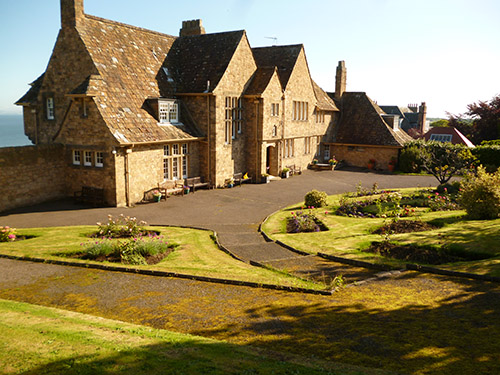
Nestled near the top on the view side is the wonderful Cotswolds-looking (actually local honey-coloured Rattlebags stone) pile in the Arts and Crafts style called Whatton Lodge. Designed in 1910 by J.B. Dunn as the earliest of three in this style (Lorimer’s Corner House and Coldstones followed in 1912), it was built for Sir Harold Jalland Styles as his main home. Succeeding Joseph Bell (Conan Doyle’s model for Sherlock Holmes) as surgeon at the Royal Hospital for Sick Children, he brought aseptic surgery to Scotland and made major contributions to the treatment of breast cancer and TB.

Whatton Lodge

Whatton Lodge

Of all the houses on this secluded street, this is perhaps the most unspoiled—no modern garages or extensions; absolutely nothing to spoil its century-old pristine style. But even better is the interior, in which dark wood panelling and extravagant flock wallpaper are still in place. The panelled doors are all original with their bulky brass door fittings. Decorative cast-iron grates are in place in the open fireplaces.  Unusual Vitruvian scroll and plaster cornices still decorate the ceilings. It is so authentic that three film crews have used it for Edwardian scenes with little beyond some furniture required to make it look authentic.

Main Stairway at Whatton Lodge

Main Stairway at Whatton Lodge

“So“, you are saying to yourself “what is all this leading up to? What captain of industry or robber banker has set himself up in this nice little earner to gaze down on the peasants from its lofty heights?” Actually, that’s the best bit of all.

Immediately after WW2, the house became vacant. Plans to nationalise Scotland’s health services faced a last minute threat from an unlikely source—workers in the newly-nationalised coal industry. The Miners’ Welfare Fund wanted a new convalescent home and had hit upon Whatton Lodge, with its salubrious beaches, golf courses and other recreation nearby, as ideal for their purpose. Also, such a move ran against Bevan’s health policy which was to bring everything into the new NHS.

Papers in Scotland’s National Archives reveal an additional snag: grand houses like this on Hill Road had feu conditions for use solely as family homes – and this was to be a convalescent home for up to 20 miners. Sir Harold’s nearest neighbour on Hill Road was his former assistant Sir John Fraser who died the year after Stiles. Fraser was the finest surgeon of his generation and had become principal of Edinburgh University in 1944.

Other neighbours asked their views on dropping the feu condition and were uniformly shocked. According to one Hill Road resident: “The precedent, to allow institutions of this kind to spring up in a locality famed throughout the world as a holiday resort primarily for golf, would to my mind be disastrous”. The chances of the nimby nobs fighting off these grubby miners from appearing in their neat back yard looked good.

But public pressure grew on Arthur Woodburn to act, although he had no powers to intervene as Secretary of State. Finally, a letter on behalf of Lady Fraser and her son Sir James broke the logjam. They said they had no objection “as they feel certain that had Sir John been alive, he would have been the last person to stand in the way of such a project”.

Dining Room at Whatton Lodge

Dining Room at Whatton Lodge

And so, since 1948, Whatton Lodge has been the Scottish Miners’ Convalescent Home, enjoyed by thousands of those stalwart men (and their wives and widows) who once made a hard living dragging what was once our main energy source from the bowels of the earth. And even though the last deep mine closed over a decade ago, there are still hundreds who come to enjoy the company of their old comrades and feel, for once in their lives, they are living like toffs.

Which they are, and long may they do so.

(To support or make enquiries about Whatton Lodge, contact Mrs E. Egan 01620 842278, whattonlodge@yahoo.com)

Posted in Community | Tagged | Leave a comment

Jock Tamson’s Kindergarten

I have a confession to make. Despite a lifetime of dedication to the cause of Scottish Independence, I like Douglas Alexander. Hell, I even like his sister and regret that she has gone from the mainstream of Scottish politics. Let me be clear that I have no idea whether I like Douglas personally (still less whether he could thole a chat with me) and he has proved to be such a loyal Labour bag-carrier that I despair of even the best in that party dragging themselves out of their partisan rut for the sake of a decent democracy. But, unlike the bulk of his Scottish colleagues, at least he has shown both initiative and courage to raise the debate about our future.

His ‘Scotland 2025’ speech, delivered at the University of Edinburgh two months ago was as close to a game-changer from Labour in the debate over Scotland’s future as I have yet seen. As Douglas put it:

“I want to suggest that the nationalists’ approach creates an opportunity for those of us who believe our Scottishness is best expressed within the United Kingdom to counter that nationalist negativity with a different, and a more hopeful, story about Scotland’s future.”

This may be like swigging hemlock and vinegar to an old nationalist like me. But the man goes on to make his case—and a positive one, damn him—for why Scotland would be better off staying part of the UK. And he does it without denigrating anybody and certainly not the Scots themselves along the traditional “too poor/wee/stupid” lines so often deployed as an argument. Good for him. If us nats can’t win in 2014 by making the better argument and countering such decent articulation, we don’t deserve to have our own country back.

I was reminded of the pivotal relevance of this sipping my usual pre-Saturday-surgery latte and scanning the Opinon pages of the Hootsmon to find they had eschewed their usual venal partisanship and featured two very different pieces—one from Gerry Hassan and the other from Alf Young—that pose similar questions and bemoan that such articulate contributions as Douglas remain very much the exception, rather than the rule. As Gerry puts it:

How many times have we been told that the independence debate is a “once-in-a-lifetime opportunity” or “a historic moment”? Funny that, because it doesn’t feel like that to many people outside the “bubble Scotland” that lives and breathes politics. There have been comedy wars, twitter spats, stupid interventions, and a politics shaped by “fans with typewriters” and worse. There hasn’t been much insight and light so far.

His article cites vicious little cyberwars that have gone on in overreaction to people like comedian Susan Calman or academic Gavin Bowd and highlights again what Douglas took pains to highlight: “Empathy is what keeps us together. It’s all really about people getting on with other people.”

And yet, trawl through media coverage of SNP commentary (there is precious little other than bumf emanating regularly from the Yes campaign so far) and it’s as if they are going out of their way to underscore Gerry’s point. Veteran eco-warrior Rob Gibson MSP trumpets a rebuff of the MoD acquiring more land around Cape Wrath; Kevin Stewart MSP bangs on in provincial narrow focus about the AWPR and the “notorious Haudagain roundabout traffic blackspot”; Eilidh Whiteford MP chirps that she has caught Harriet Harman out by revealing Labour’s plan to cut benefits to Scots; even the normally astute SNP Westminster leader Angus Robertson sees the English local elections in terms of UKIP “pulling the Tories to the right” when such 19th-century class war concepts are usually associated with stuck-in-the-past Old Labour.

Such stuff may be the talk of the Garden Lobby and have been standard fuel for street and doorstep campaigning for decades, it is hardly edifying and comes nowhere near building the empathy that Alexander makes a case for and, more importantly, that the Yes campaign needs to be building to move outside of the static 31% faithful they have had in their camp since the 2011 election. Much though they clearly love being top dogs running the Holyrood bubble, the SNP are in danger of seeing things entirely through that prism.

While the SNP have indeed demonstrated a competence, not to say an audacity, in running the country that put the small-scale timidity of the pre-2007 administrations to shame, there is something verging on hubris in present programmes that risks alienating those they would seek to convince. MacAskill has not just the judiciary but a wheen of ordinary folk up in arms about the way he has gutted the Procurator Fiscal offices and decimated the local responsiveness of Sheriff Courts. Brown has alienated Green allies by pushing ahead with road building (Forth Crossing; A9; AWPR) while cutting back on EGIP. Mackay has brought out pitchforks and burning torches across the countryside by refusing to consider private wind turbines next to settlements as any more evil than substantial wind farms hidden up on the moors.

All this has left the man in the street—the Scottish variant of the one the urbane and plausible Nigel Farage was so astute at wooing in the recent English local elections—disconnected, if not disinterested, not to say sullenly hostile to what should be Scotland’s biggest debate since 1707. In his article, Alf Young blames the SNP for “playing the long game” and allowing the discussion to start out dominated by naysayers. Professor James Mitchell, now occupying a chair in public policy at Edinburgh University, has called the debate so far “arid and acrimonious”.

Alf complains that opposing websites contain little more informative than people jumping up and down with ‘Yes’ placards in many languages or the details of a fundraising ceilidh in Banchory. Certainly, if you’re looking for information on your future pension, the apportioning of the national debt or how we stop Russian Yankee-class submarines parking themselves off the Broch in an independent Scotland, you’ll be as disappointed as if you wanted details how our English bros will look after us or HS2 is going to transform all our lives—once the Union is safe. Alf”s main thesis, with which it is hard to take exception, is:

“(The SNP) opted to play this very long game, counting on their accumulating record in running a devolved Scottish government responsibly and well as a sure foundation from which to win the trust of a majority of Scots, when it came to taking the next big step. They did not know, nor did the rest of us, that that long march would be overshadowed by lengthening years of austerity, as much of the western world struggled to extricate itself from arguably the most profound economic crisis since the 1930s.”

When you dominate the ministerial floor of offices in Holyrood, surrounded by flunkies whose career depends on keeping you happy, the natural response is to worry about your place in the pecking order and less about events outside of that bubble. The Unionists have enough Michael Forsyths and Alastair Darlings kicking about to make a fair fist of a campaign while their party parliamentarians fret about questions no-one counts and speeches no-one listens to.

But, since Mr & Mrs Punter or the Scottish equivalent of Farage’s Dog & Duck barside debate are entirely disengaged, it is hard to see how the Yes campaign can build its momentum even if juicy morsels of policy will have been grilled to perfection by this autumn when there is less than a year to go to September 2014’s vote. After the best part of a year when debate has seldom risen above a four-year-old’s “does not!”…”does too!” level of debate, the largest vote cast is likely to be by those fed up with the childishness of  it all: they will not deign to vote at all.

This could be a depressing echo of 1979 when even the dead were voting ‘No’. And, after any such ‘No victory’ we will have turned our back on change and all 60m  Britons will be stuck in the same political kindergarten.

Posted in Politics | Tagged | Leave a comment

Why Scots Should Be Fans of Farage

The results of this month’s English local elections were a shock to many and a surprise to even more. Normally barely registering on political seismographs, the discussion usually revolves around how many seats the party of UK government lost vs how many the main opposition gained. Pundits poke around the entrails, trying to divine what the relative shift means for the next UK general election. Actual issues like good vs bad councils with good or bad policies never even raise a comment.

This year was different because, 14 years after Scotland voted for a 4-party political system, England caught up. Sweeping up a quarter of the votes cast to tally a respectable 147 councillors (from 8) UKIP came of age and put some seriously feral cats among other parties/ policy pigeons, especially the Lib-Dems.

Labour, while making progress and chalking up some serious victories based on diligent local work in taking Nottingham- and Derby-shire, made disappointing progress for a 9-point poll lead. The Tories have been a-flutter with the renewed Euroskepticsm that they contract on a regular basis. But the Lib-Dems, losing most ground and all control are behaving a bit like the Poles in August 1939 just before receiving the world’s first visitation of the Blitzkrieg.

Now, gentle reader, before you put quill to parchment to accuse me of equating UKIP with NSDAP or Nigel with Adolf, allow me to explain why they are a similar force to be reckoned with and, demonstrating a mass backing of ordinary people as they do, why English parties ignore them at their peril—as they have done to date. Note that I omit Scottish parties and we shall return to examine why.

UKIP’s rise in England should come as no surprise. It has less to do with xenophobia and more with the progress of major parties towards what they regard as self-serving enlightenment. Just as no party is against motherhood or apple pie, so none that hope for national success allow policies that offend; all seek to be for education for all and human rights and compassionate welfare and universal health care and emancipation and inclusion and all other such laudable buzz words as have entered the language.

As a result of being ‘for’ everything, the average politician restricts criticism to his/her opponent or whoever backs their opponent’s party. Anyone who doesn’t risks a media roasting—Norman Tebbit is still being quoted as saying ‘on yer bike’ when what he actually said was his dad got on his bike and looked for work when he found none in the vicinity. Being interviewed, the typical politician answers any question but the one asked, takes no blame and does a passing impression of an eel caught by hand. Those of the old school still left (Prescott, Lawson et al) are out to pasture and regarded as dinosaurs.

But this left a serious vacuum at the heart of a society that sees soap operas as reflecting real life; arguments flare up; punches are thrown; vendettas fester. Nobody in the many bars of Westminster (ex-Army majors whose rent-a-quote career has ended excepted) talks or acts like they do in the Queen Vic or the Rovers. Enter bloke-ish Nigel Farage, fag in one hand and pint of bitter in the other, looking exactly like the local car dealer making his way in the world that you would pass the time with amiably setting the world to rights down the Stoat & Ferret.

The man’s a natural. Every self-made local builder or insurance broker or anyone else staying late at work putting together VAT returns for the insatiable gub’mint takes to his easy manner and forthright answers. Asked on the Andrew Marr Show if he was going to stand for Westminster, he actually answered the question and left Jeremy Vine stumbling to follow up. For the teens more moderate equivalent of the sixties’ Alf Garnet, he speaks with an authenticity that chimes with widespread frustration at endless H&S rules, political correctness, smug bureaucrats and Johnny Foreigner’s boundless cheek at telling John Bull what shape his bananas must be then coming here to have his op on the NHS.

So, this UKIP phenomenon is no flash-in-the-pan. Unlike the BNP or NF, their dislike of foreigners is measured and so English in its reasonableness and so appeals to the more admirable good nature of the average bloke. In fact, the arguments they deploy down the Stoat & Ferret are not so different from what has inspired Scots to move as far as they have towards disconnecting from an adjacent stronger neighbour whose power they see as overweening and whose sympathy for our culture and priorities misplaced or absent.

Which is one reason that UKIP does appallingly in Scotland—we already have our literate and passionate party of protest: it’s called the SNP. And, were UKIP to drop its rather futile insistence on Scotland staying part of the UK, the two parties could benefit much from co-operation, even as their respective philosophies sit badly with one another. For the second reason UKIP does appallingly in Scotland is that the overwhelming majority of Scots actually like foreigners: they add colour and bring gumption—the only people who threatened to invade Scotland in the last millennium were the English.

So UKIP xenophobia and Scottish xenophilia could actually work in harmony. While UKIP obliterates large chunks of the ephemeral Lib-Dems and pushes Tory schizophrenia into overdrive, the Scots can calmly assert both their independence and their strong interest in remaining part of the largest economic union on the planet. Along with Eire, Sweden, Denmark, Finland and other like-minded influential small members they can steer the EU away from this Brussels/Euro fixation that means ever-tighter union and towards what has been its economic glory: an affluent 300+ million trading bloc that can play ball with the US, China, the BRICs or any other economic development we may meet.

Rather than the last four years of economic stagnation, what is wrong with this scenario:

  • 2014—Scotland votes to become a normal country. It negotiates to keep EU membership and £ sterling
  • 2015—Cameron delivers a referendum on EU membership which is lost. The subsequent UK general election gives another hung parliament as 50 Labour MPs are lost with Scotland’s departure
  • 2016—Scotland takes its seat at the UN between Saudi Arabia and Senegal, joins NATO, EU, OPEC, the Nordic Union, adopts £80 bn of UK debt, contracts with England for certain services (embassies, DVLA, MCA, etc), agrees to a five-year run-down of Trident at Faslane and comes to an agreement with the Bank of England as regards permissible fiscal policy. EU abandons Euro for all members; Greece and Cyprus leave the Eurozone.
  • 2017—after two years of protracted negotiation with an ill-tempered UKIP snapping at its heels, the UK withdraws from the EU. England see sense, cancels any Trident replacement and begins to shut down Trident operations at Faslane. Scotland’s tidal and wave renewables investments begin to contribute to the 5GW of existing wind capacity. Cross-North-Sea interconnectors agreed with Norway and Holland
  • 2018—with oil above $120 a barrel and debt being paid down faster in Scotland than England, £ sterling rises in value above € (which continues to falter with the PIGS) and $ (which is burdened by over $15 trillion in US government debt now Obama is gone). This causes England’s already bad balance of payments deficit to worsen as exports suffer and more is imported. Scots oil, energy food & drink & tourism grow. The Black Watch (formerly 3Scots RRS) deployed, along with Finns and Canadians, in UN peacekeeping force to rebuild Syria after seven years of civil war. Scots prove to be most popular because they wear skirts and interact with people, sharing their Irn Bru and playing football with the kids.
  • 2019—China’s economy overtakes US; Brazil and India both overtake Germany. Strength of £ sterling and long-established Scottish trade connections with China & India combine to allow England to make major investments in consumer businesses: M&S, Next, Sainsbury & Stobard in the lead. While rediscovering overseas markets, English europhobia leaves Scotland as the  sterling zone foothold in Europe (and vice-versa) trade improves, with Scandinavia leading and providing most of population surge past 5.5m. Edinburgh & Glasgow both experience boom like 1990s Dublin.
  • 2020—Scottish trade with England and Northern Europe doubled in ten years; inherited national debt brought down to £60 bn. Renewable energy technology overtakes whisky as export earner. England has only just stopped borrowing and debt has begun to decline from £1 trillion, thanks to resurging economy on Asia/BRIC trade and £10bn saving on defence from axing Trident.
  • 2021—Scotland takes over the Presidency of the EU for the first time and convenes a World Trade summit on the back of its international success to lay the foundations of  Universal Free Trade; only North Korea and Zimbabwe decline. Faslane becomes a conventional Scottish Defence Force naval base. Edinburgh comes in second as most desirable city to live in the world, losing out to Prague only because of higher property prices. Nigel Farage, deputy PM of England, is voted Scotland’s Man of the Year.
Nigel on Home Turf

Nigel on Home Turf

Posted in Commerce, Politics | Tagged | Leave a comment

Tug for a Clapped-Out Gunboat

The ‘discussion’ on Scottish independence is theoretically well underway but the SNP’s Angus Robertson gets himself into hot water on Audioboo’s new Hear Hear and reported in today’s Hootsmon by asserting that all the Better Together campaign do is repeat scaremongering tactics that claim Scotland is too poor/stupid/wee to be a proper country.

Not a bit of it, retorts Better Together:

“The only people who peddle this line are the Nationalists. No-one from Better Together thinks that Scotland couldn’t go it alone – we think that it is better for our economy, our jobs and our future if we stay together with the rest of the UK.

“The Nationalists are only interested in dividing people. We think that we are stronger when we work together.”

Oh, aye? Let’s think about that for a bit. Yesterday Erikka Askeland and Tom Peterkin gave us both barrels in separate pieces that said:

“A study by the Institute of Chartered Accountants of Scotland (Icas) questioned the affordability of private pensions, suggesting businesses could be faced with a multi-billion-pound pension bill to finance private retirement schemes in an independent Scotland. It also highlighted the cost of paying for Scotland’s share of the United Kingdom’s £893 billion public-sector pension schemes and £82bn state pension.”

No mention that England would face the same problem as this  would work both ways, still less any prospect that the two countries might work positively to solve this problem—if it is indeed a problem. Then consider Mr Osborne, who came North earlier this week to deliver his Sermon on the Mint to us in Glasgow. The Grauniad‘s headline pretty much sums it up but more importantly, the entire speech revolved around dismissing the practicality of any future currency union out of hand:

“Would the rest of the UK family agree to take that risk? Could a situation where an independent Scotland and the rest of the UK share the pound and the Bank of Englandbe made to work? Frankly, it’s unlikely because there is real doubt about the answers to these questions”.

Let’s leave aside the Chancellor’s dubious track record on getting financials right, where is the willingness to consider options; where are the positive proposals how currency issues might be resolved among friends and equals in the event that the Yes campaign wins? His disdain is echoed by the Leader of the Better Together campaign himself, who ought to know as much about finance since he used to have Osbo’s job:

“Would the rest of the UK agree to creating Eurozone-style complexity given that they would already have the pound and the Bank of England? Would it be in their interests? We wouldn’t know the answer to this until we separated from the rest of the UK. But today the UK’s Chancellor said that he thought it was unlikely that the rest of the UK would agree to create a Sterlingzone if Scotland left the pound.

“If the rest of the UK won’t enter into a currency union, or if the terms of a currency union are unacceptable to Scotland then the likelihood is that we end up with a separate currency from the rest of the UK.”

Ach, weel, that’s us then—scunnered. Top names pooh-poohing the very concept. But Angus may have a point: if this is Better Together’s top team “thinks that Scotland could go it alone”, it’s a funny way of expressing it. And don’t you find it funny that those very proponents of how well Scotland does remaining in this Union won’t even give the time of day to any idea or request for it to assert its own priorities.

Starting with the very name “Bank of England” itself,  through CofE bishops (but no CofS ministers) sitting in the House of Lords down to the tawdry assertion of superiority by MPs such as Ian Davidson over the affairs of Scots, there is a tasteless bias here that rankles: it veers between the condescending and the insulting.

Forget the idea that a Scots king once took over the English throne—the last coronation in Scotland was for Charles II in 1651. Although the Parliament of Scotland proclaimed Charles II King of Great Britain and Ireland in Edinburgh on 6 February 1649, Cromwell’s English Parliament instead passed a statute that made any such proclamation unlawful. Such attitudes set the precedent of which country wore the trousers for the next 350 years.

The Union of the Parliaments itself was an attempt to disarm Jacobite dissent and—other than preserving Kirk and laws, that tawdry document was more concerned with filling the right pockets (on both sides of the Border) than the stature of any rump existence for the Scottish nation. English hostility to the Scots Darien venture set the tone. Both the Enlightement and the irrepressible innovation of Glasgow merchants were outwellings that benefitted both countries, Hielan laddies marched off to conquer in large numbers and it appeared that the North British were brought nicely to heel at last.

Except, no-one south of Carter Bar ever spoke of the ‘South British’. And when some district agent sat on his verandah with a pink gin after a long day, he thought of ‘England’ with its cool shires; how else could every other country on this planet talk of ‘England’ when they mean ‘Britain’? By the early 20th century, our march to cultural unity was on track so the prospect of Scotland being no different to Yorkshire was indeed plausible.

It is more than a symbolic point. Perhaps the BBC has stopped talking about ‘the regions’ in which it included Scotland. There is no question that the Scots were enthusiastic partners in empire-building—and saw great benefit from it. But, more importantly, our joint colonial cause that spilled so much blood while making so much money rather fell off a cliff in the last 50 years so that the question is less “what is Britain for” north of the border than “why am I still a part of this?”

Because that same colonial effort drove mighty industries that were even more at home in industrial Scotland than the Home Counties. This bred socialism and questioning of the forelock-tugging hierarchy at the heart of Merry Old England but was alien to the tight iconoclasm of Scottish clans and Glasgow humour. So, no more than it could with Ireland, England has failed to imprint its culture beyond its border.

To the Scots, this debate is not about what Better Together would make it—nostalgia for the the great days of Great Britain when we stood alone/together in the world against fascism and dictatorship. Only people well into retirement have any memory of that. The rest of us have learned that international trade with friends—not gunboat-enforced third world sweat shops—is what makes modern prosperity and that the Scots have little taste for those trappings of empire that seem to mean so much to our English cousins.

So, let them squabble about historical appendages like Gibraltar or Falklands or Akrotiri; a seat at the UN top table should be for monster countries and not declining has-beens struggling to stay relevant; nukes are for the delusional; global reach is now quite unaffordable to Britain together, let alone England alone.

Just as England has done for centuries, it’s time for Scots to define the priorities that suit them and pursue them. If that involves keeping the Queen, the Pound and our share of the British Army/RN/RAF—and ditching Trident and the global policeman ego that goes with it—we should negotiate that.

For now we need positive debates on how we could work together to mutual benefit and not this hand-wringing caterwauling about disasters on pound or pension if Scots had the temerity to decline to abandon the fiscal mess that UK governments have led us into. It is not helpful for them to make two-faced arguments, such as the SNP point out this week:

“Liberal Democrats remain in favour of joining the euro and Labour have never ruled it out—a fact that they seem to want the people of Scotland to forget. Meanwhile, the Tories have consistently ruled out joining the euro, meaning that there are three different positions on currency within the No campaign – something which they have described as an ‘incredible situation’ when applied to the Yes campaign.”

A little less hypocrisy and a lot more humility would allow a reasonable outcome for a currency union post-independence. The Scots would benefit from using a stable world currency and Scotland’s oil & gas would shore up both global status and its stability. And, if Edinburgh’s financial hub got back to playing the role it does best—demonstrating our famous Scots canniness to the world—they can let their Essex wide boys of Canary Wharf have their head if they want: Scots could have it own FSA with teeth that would avoid future repetition of 2007.

So, rather than the shock troops of naysaying unionists like Ms Askeland and Mr Petersen getting relentless press that gives everyone a headache and probably contributes to continued recession with their pitifully uncreative moaning, let’s get the jaikets off and see what the practicalities are of sharing the pound or the Queen or a positive joint attitude. Because if those congenital teeth-suckers succeed in bludgeoning Scots into keeping hold of nurse for fear of something worse, the remedy to dig the UK out of the Brown/Osborne fiscal shambles will be much longer and much harder than it need be.

A resurgent, independent Scotland cannot fix the present broke-but-doesn’t-know-it England by ourselves. But as we strike out in a more modest, affordable and less imperial direction, we’ll make better friends and common cause with Ireland and gain a more modern stature by joining the Nordic Union. All of this would be a pleasant surprise to other countries, especially European friends, who are used to seeing Britain as curmudgeonly, clumsy and globally still hankering for lost hegemony.

Scotland could provide a tow, could embarrass our English cousins out of their grumpy gunboat mentality, leaving their 19th century lost glories behind and, standing up with better purpose, join the 21st century.

Posted in Commerce, Community, Politics | Tagged | Leave a comment