Twelve Score and Seven Years Ago

After the best part of a century dominating world events and its economy and on top of its victory over “The Evil Empire” that ended the Cold War, America is having what can only be described as an “existential crisis”. To the consternation of millions of cosmopolitan Americans, their country appears locked in a debate deriving more from the 18th century than the 21st.

As with any power that comes to dominate all rivals, the risk that the only future is decline underlies any self-deluding hubris. America’s wobble started in the 1990s when Newt Gingrich steered the Republicans into the political long grass of reactionary politics. Funded by self-interested industry barons, the reality that “trickle-down” Reaganomics failed to enrich anyone but the rich did not dissuade them. The culmination was the election of Trump in 2016, with his arrogant disregard for procedure or democracy. Having burned their bridges and plunged the country into a $32 trillion debt, Republicans saw little option but to double down on tax cuts, States’ Rights, right-wing moralising and more Trumpanomics.

For the first time in the 160 years since their Civil War, America has segregated itself into two camps of mutual hostility. This threatens the foundations of a nation that once made the 20th century its own. It is time both sides in this standoff overcame their respective polemic, stop paying lip service to partisan readings of their Constitution and rediscover the spirit in which it was conceived in the first place.

Today, on their country’s 247th birthday, seems a propitious day to do just that.

On July 4th, 1776, the Second Continental Congress adopted the Declaration of Independence, which said: 

“We hold these truths to be self-evident, that all men are created equal, that they are endowed by their Creator with certain unalienable rights, that among these are Life, Liberty and the Pursuit of Happiness.”

—Declaration of Independence, 1776

Leave aside that blacks, women, Indians, etc. did not get a look-in until later, this document was astonishingly radical in a world dominated by a coterie of kings, nobles and rich merchants Everybody else accepted their lowlier status from birth or were punished for their effrontery. But these upstart legislators on the edge of a continent declared that no man was born better than any other. It was the foundation on which this Western civilisation of ours was built. 

America was founded on the radical principle that all men are created equal is self-evident came under pressure eighty-seven years later, when southern white men went to war to reshape America into a nation in which others were of lower status and equality was not “self-evident.” But “Honest Abe” had wisdom and courage enough to reassert that founding principle.

“Four score and seven years ago, our fathers brought forth on this continent, a new nation, conceived in Liberty, and dedicated to the proposition that all men are created equal, and this Civil War is testing whether that nation, or any nation so conceived and so dedicated, can long endure.”

The United States—and its founding principle—endured and expanded the idea that all men are created equal to include all skin colours and genders.

Although not (yet) a civil war, America is facing serious rebellion against that founding principle, as a few seek to reshape America so that such people consider themselves better than others.

Although not (yet) a civil war, America is facing serious rebellion against that founding principle, as a few seek to reshape America so that such people are better than others.

We pledge our lives, our fortunes and our sacred honor to defend the idea of human equality.”—

.”—signatories of the Declaration of Independence

Down the years, many other Americans have sacrificed their own fortunes, honor, and even their lives, following Lincoln’s admonition: 

“We here highly resolve that these dead shall not have died in vain—that this nation shall have a new birth of freedom—and that government of the people, by the people, for the people, shall not perish from the earth.”

—The Gettysburg Address, 1863

Trump and his devotees deserve to have such words stapled to their foreheads.

#1074—660 words

Posted in Politics, USA | 1 Comment

Away with the Ferries

Of all the various alligators snapping at Humza Yousaf’s bum, the most persistent and damaging has been one with a long, sad history, inherited from his predecessor and showing no sign of going away. Although the contract for two ships with Fergusson Marine of Port Glasgow has repeatedly been the media focus, the saga encompasses the entire ferry fleet run by CalMac, serving the Inner and Outer Hebrides. Their entire fleet is aging, many running well past their 25-year “sell-by” date, meaning repairs to patch them up now run to £8m each year.

Despite leasing a boat from Pentland Ferries for £1m, CalMac can’t cover service commitments. The main Isle of Mull crossing to Craignure is served by a boat too small for the job; the Corran ferry serving Morvern no longer takes vehicles and the Uists have had to thole no ferry at all to or from Lochmaddy throughout June.

No matter the rights and wrongs of the Fergusson fiasco, after several lost seasons through Covid, tourism across the Western Isles is being hobbled by inadequate and unpredictable ferry services upon which much of their business—not to mention day-to-day living— depends. Whether Fergusson delivers a ferry by the end of the year, or four others that have been ordered from Turkey, none will arrive in time to salvage the summer of 2023.

The prospect of CalMac, CMAL, Transport Scotland and the eighth Transport Minister in a row to reprise their ferrets-in-a-sack show is unlikely to make islanders feel more than recycled despair.

Why is it this Scottish government can’t think big? Why do they persist in this softly-softly “progressive” strategy of electoral bribes—whether it’s baby boxes or free travel for rich pensioners? When are they going to stop carping about Westminster intransigence, show some imagination and think big for the country they want to run? Have they even looked elsewhere for inspiration?

Take Norway as an example—similar size to Scotland, even if they have been far more canny with their share of the oil bonanza. If you think our Hebrides are rugged and pose serious transport headaches, then examine Norway’s fjord-fragmented coastline, Their E39 coastal highway runs 1,100km (658 miles), linking Kristiansund, facing the Skagerrak in the South, through Stavanger and Bergen to reach Trondheim, most of the way to the Arctic Circle in the North.

Given this highway crosses fjords over 3km across and 1km deep, this needs a ferry system as complex as CalMac’s. Seven ferry services link isolated stretches of road, meaning a trip along the entire E39 currently takes 21 hours. It would be enough to redden any Scottish Transport Minister’s face to relate how reliable those ferries are, compared to CalMac’s. The Norwegians are too modest to rub this in. But they are not content with the service this provides in linking four of their main coastal cities, even though they are already linked through the country’s interior.

They want to dispense with the ferries altogether.

In an example of how a “small” country can think big, Norway is now engaged in a $47bn infrastructure project to link up all the parts of the E39 with soe serious thinking out of the box. Most of the crossings involved defy conventional engineering. So, they are inventing unconventional ones, starting with a 27km tunnel near Stavanger that will be longer and deeper (390m) than any other, when completed in 2026.

Other crossings require even more radical engineering. Nothing daunted, the Norwegian Roads Authority are considering radical solutions like sunken tubes and floating bridges to link across some of the most spectacular scenery anywhere.

This is no pie-in-the-sky along the lines of Boris Johnson’s link to Northern Ireland across the North Channel, which ignored vast amounts of munitions dumped in the Beaufort Dyke after WW2. The Norwegians are a pragmatic people, not given to flights of irrational fantasy. You can catch a video of the project at: https://www.youtube.com/watch?v=HCT-FurFVLQ

It may be asking much of the present pedestrian Scottish Government to hatch such inspirational ideas for the country to match those in Norway. After all, both Bergen and Trondheim boast populations of a quarter million to justify such expenditure. But it was visionary infrastructure boosting such cities that created that size in the first place. Both have grown by half since 1990. Inverness may have doubled over the same time but, at 47,000, it is still a minnow by comparison. Stornaway (5,000), Portree (2,500) or Tobermory (1,500) don’t even get a look-in.

Also, Norway’s hefty per capita GDP of $77,500 embarrasses Scotland’s $44,100, and goes some way to explain how they can afford this project.

But we must ask whether shrewd investment is what gave Norwegians that edge. Mull’s 3,000 population may not justify a bridge from Appin, over Lismore and Morvern—yet. Now it has a bridge, Skye’s population has doubled to over 10,000. 

But unless Fiona Hyslop and Humza Yousaf put their heads together and come up with similarly inspirational concepts to show what an independent Scotland might do, their collective jaikets hang—along with the prospect of indy—by an increasingly shoogly nail.

#1073—804 words

Posted in Community, Politics, Transport | Leave a comment

Wanted: Unconventional Convention

This weekend saw the SNP faithful gather in Dundee’s Caird Hall for an “Independence Convention”. Humza Yousaf’s idea was to agree among themselves in private on a road map to independence that would break the logjam imposed by the Tory government at Westminster to block any attempt to seriously discuss independence at all. The conclusion appears to be that, if the looming 2024 General Election produces a majority of MPs in Scotland with independence in their manifesto, this justifies another referendum.

Much though this author agrees with the moral argument and would welcome such developments, more rational thinking senses some whistling in the wind here, dictated by the SNP’s current place on a parabola of political fortunes, the unavoidable fate of all political parties.

Some history to support this contention:

After two decades abroad, disconnected from UK politics but involved in both German and American, it was an education to find SNP activists a dynamic mixture of long-serving stalwarts, youthful idealists and virulent anti-Tories, with scant experience or understanding of politics or society outside their own. There was little beyond emotion by way of either pragmatic or visionary appeal to convince others. Tory voters were given no economic case and Labour voters no social case to change their minds.

As a result, the two more seats gained in the 1997 election were dwarfed by the Blair landslide and the substantial block of seats in the new Scottish Parliament negated by a Labour/LibDem coalition denied the SNP any taste of power.

But, after the loss of Donald Dewar, Labour offered only a succession of passive placeholders as First Minister, running the Scottish Parliament as they had run Scottish councils—with scant ambition and functioning as a system for rewarding loyalty. Blair may have won both the 2001 and 2005 UK General Elections s quite handily, but North of the Border, tectonic plates were shifting. In 2001, Labour won 56 seats in Scotland from 46% of the vote, while the SNP won only 5 from 20%. By 2005, that had shifted to 41 and 6, respectively, hardly presaging what came next.

A combination of assiduous local campaigning over a decade by the SNP and a dangerous presumption of entitlement by Labour produced shock results in both local and parliamentary elections in 2007. Suddenly the SNP had 47 seats to Labour’s 46 and formed a government (albeit a minority) for the first time. The advance in councils was similar. Having relied on elected representatives to fund and man their campaigns, Labour was suddenly compromised in its ability to reach people through civic activity and on doorsteps.

Casual observers could have been forgiven in thinking this had little consequence for the Union, as the SNP UK position of 6 MPs and 20% of the vote was repeated in the 2010 General Election. But the 2011 Scottish Parliament elections brought an SNP landslide, jumping the number of SNP seats by 22 to 69 on 45% of the vote, while once-dominant Labour slumped to 37 seats on 32% of the vote.

This so rattled Cameron’s unionist government in Westminster that he granted a Section 30 Order to permit an Independence Referendum to be held in September 2014 to call the SNP’s bluff, as the polls were putting support for independence in Scotland around 20%. Unfortunately for him, his political “nose” was no better than it was for the later “Brexit referendum.  Support for the cross-party “Yes” campaign ballooned until the final result of 45% Yes and 55% No scared unionists by being much closer than predicted.

Paradoxically, this defeat for the cause galvanised many switherers and sceptics to get involved, pushing SNP membership well over 100,000 and boosting other “Yes” parties lie the Scottish Greens. This momentum carried through the June 2016 Brexit referendum. Although won by the Leave campaign by a narrow 52% vs 48% margin, the figure for Scotland was a whopping 63% fir Remain. This further galvanised the SNP and the Yes campaign.

Growing momentum showed in the revolutionary result in the 2015 General Election when the map of Scotland turned yellow: 56 seats on a vote of 50% for the SNP, with the 50 gins all coming from Labour, which was reduced to a single MP on 24% of the vote. It was obvious that this was the apogee of the SNP’s political parabola: nowhere to go but down. If Humza’s contention that winning a majority of Scottish MPs next year would constitute a mandate for another referendum, then 2015 should have made the case irrefutable.

But nobody made that case. Which brings us from history, into the present day

Two years into her leadership, Nicola Sturgeon played her cards cautiously, promoting loyalty and gender balance among ministers, while pursuing laudably “progressive” social policies, such as protection of disabled children, trying to establish a National Care System and providing baby boxes to new mothers. This has eroded a once-broad appeal. Policies like the Gender Recognition Reform and their Deposit Return Scheme. Both have cost political capital as such initiatives were quashed by Westminster and made few new friends.

The difficulty arises because, ever since the Brexit vote, the SNP has been cultivating the already-converted, trying to rein in their frustration. Despite her unquestioned skills in leadership and debate, Nicola Sturgeon has neither hatched any broad-based “big ideas” to appeal to the 50% leaning towards unionism, nor created a positive platform of competence in the powers already held that would encourage the doubters to believe in the brighter, richer future Scotland might find with independence. Business for Scotland has framed such a vision in its Scotland the Brief booklet, but you’d hardly know it from the SNP. Similarly, Ireland or Denmark could be glowing examples of what Scotland-sized countries could achieve but the SNP is not making the case.

What is happening to the SNP parallels what happened to Labour as it became hollowed out in the 1990s, relying on rewards for loyalty to perpetuate the status quo.

Unfortunately for Humza, he has chosen to remain shackled to Nicola’s unambitious “progressive” agenda. This appeal to his own political backyard of Glasgow and its surroundings, where the SNP currently hold every constituency seat preaches to the choir—just as Labour did two decades ago. He has also sidelined Ash Rega’s plea for a non-party independence convention, based outside the SNP. He may galvanise the troops to get out and canvass this summer, but without more specific visionary inspiration, will they appeal to Scotland’s sceptical half?

The trouble with parabolas is: once you pass the apogee and make no radical change, the trajectory leads inevitably downward.

#1072—1,096 words

Posted in Politics | Leave a comment

Hoist by Their Own Canard—Boris Johnson

“My policy on cake is pro- having it and pro- eating it.”

—Boris Johnson

“By the time he graduated from Oxford at the age of 23, Johnson’s three key personality traits had been formed. After that age, he did not learn or mature an iota. (First) a skill unmatched since Tony Blair to communicate with the wider public; second, his inner emptiness made it imperative for him always to be the centre of attention, craving affirmation and breaking truth and convention to achieve it; finally, a total absence of moral compass, seriousness or ability to see anything or anyone as more than fodder to be expended for his own gratification, pleasure and career.”

—Anthony Seldon, Sunday Times, June 11th 2023

“We’ve got an oven-ready deal. We’ve just got to put it in at gas mark four, give it 20 minutes and Bob’s your uncle.” 

—BoJo, November 3rd, 2019

If we vote to Leave and take back control, all sorts of opportunities open up. Including doing new free trade deals around the world, restoring Britain’s seat on all sorts of international bodies, restoring health to our democracy and belief to our democracy.”

—Boris Johnson

I’m immensely proud of the achievements of this government: from getting Brexit done to settling our relations with the continent for over half a century, reclaiming the power for this country to make its own laws in parliament,” .

—Boris Johnson

“The signing of the Withdrawal Agreement is a fantastic moment, which finally delivers the result of the 2016 referendum and brings to an end far too many years of argument and division.” 

—BoJo, January 24th, 2020

“We will prosper mightily as an independent free-trading nation, controlling our own borders, our fisheries, and setting our own laws.”

 —BoJo, October, 16th, 2020

“I believe Scotland, along with the rest of the UK, will benefit from a very strong relationship with our friends and partners across the Channel whatever the circumstances, whatever the terms we reach tonight.” 

—BoJo, December 9th, 2020

 “As for a present for Nicola, there is all sorts of things that will arise naturally from the UK getting a new relationship with our friends in the European Union. But one thing that may be of particular interest to the people of Scotland is they will become the proud possessors of hundreds of thousands of tonnes of fish, shellfish, crustaceans. I don’t know whether Nicola is a keen fish-eater but she will have more than she can possibly consume herself for a very, very long time to come. How about that?” —

—BoJo, December 16th , 2020

Exchange at Prime Minister’s Questions on December 8th, 2021 (eight days after the first reports of Downing Street gatherings emerged):

“Would Mr Johnson tell the house whether there was a party in Downing Street on 13 November?”

—Labour MP Catherine West

“No; the guidance was followed, and the rules were followed at all times”.

—Prime Minister Boris Johnson

Referred to the police by the Cabinet Office last year over events in Chequers and Downing Street following a review of his official diary as part of the official COVID inquiry, Boris said: “I think it’s ridiculous that elements in my diary should be cherry-picked and handed over to the police, to the privileges committee. “This whole thing is a load of nonsense from beginning to end.”

“Members of the Privileges Committee, including Labour’s Harriet Harman, have already expressed deeply prejudicial remarks about my guilt before they had even seen the evidence. It was a kangaroo court. Its report is clearly partisan and biased.”

—Boris Johnson

“I promised to run the most open and transparent administration in Britain. That is why, with this brutally honest and unprecedented progress report.”

—Boris Johnson

“To you, the British public, I know that there will be many people who are relieved and perhaps quite a few who will also be disappointed. And I want you to know how sad I am to be giving up the best job in the world…Cutting taxes is the way to generate the growth and the income we need to pay for great public services. 

—BoJo, Resignation Speech, July 7th 2022

“The Privileges Committee should publish their report and let the world judge their nonsense. They have no excuse for delay. Their absurdly unfair rules do not even allow any criticism of their findings.”

—BoJo, June 13th 2023

“The Commons may have been misled multiple times.”

—House Privileges Committee

His 40 awards (cut from 100 by the Lords vetting process) included an Order of the Bath for his former principal private secretary Martin Reynolds, who oversaw a garden party during lockdown restrictions in 2020, as well a peerage to his chief of staff, Dan Rosenfield, and a CBE to Jack Doyle, his former director of communications, both of whom were in office during some of the Partygate era of controversy within No 10 and the investigations into the scandal.

Hasta la vista. Baby.” 

—Boo, House of Commons, 20th July 2022

#1071—907 words

Posted in Politics | 2 Comments

A Long Way to Tipperary

Don’t tell the jingoists, but the “great” in Great Britain is not some accolade of national superiority but a geographic term. As the island stretches over 80,000 square miles and the French peninsula of Britany only covers a bare 13,000, the word is a statement of the bleeding obvious, no matter what some Tory backwoodsmen might say.

Unfortunately, the effect, combined with national nostalgia over pink-painted globes results in a UK government, such as we now enjoy, who believes the country “punches above its weight”, merits a seat on the UN Security Council and deserves a ‘special relationship with the USA. For such reasons, the UK has severed ties with its neighbours and suffers an ignorance about them worse than anywhere else in Europe.

One explanation for this might be that the British have the lowest proportion of its people who can make any fist of a foreign language. Even after half a century in the EU, four out of five Brits who do visit Europe do so on a Mediterranean holiday, conducted entirely in English. They have such little contact with local culture that they find scant reason to dispute UK government claims that we dealt with Covid; saved people’s wallets; came out of recession better than anyone else. Were British media less parochial and tabloid-minded, the truth might have been revealed.

Even where no language barrier exists—with our closest neighbour, Ireland—the collective ignorance, led by Westminster silence on Irish success and prosperity studiously ignores the object lesson that modern statistics* teach. Many Brits still believe Ireland to be a Catholic-dominated Guinness-dark agricultural backwater where the young leave to find jobs.

Time we woke up and smelled the poteen.

Ireland’s population is blossoming. At 5.123 million, it is about to overtake Scotland. At $100,170, its GDP per capita is now DOUBLE the UK’s $46,510. Ireland exports goods worth $134,510 per capita—TEN times the UK figure of $13,360. And, while UK debt climbs toward $3 trillion on the back of $61.4 billion in borrowing each year ($910 per person), in contrast the Irish state enjoys an $8.45 billion SURPLUS—or $1,680 per person. The stats demolish Westminster post-Brexit bluster: average UK household income of £44,480, vs £76,110 in Ireland; national debt of 103% of UK GDP, while Ireland’s is 55%. The list just goes on.

No wonder the government stays shtum about this. A former colony, the first to break the bonds of empire doing better than the mother country? Unthinkable!

Britain may have Canary Wharf and Fintec, but very little else not associated with tourist tat these days. Meanwhile, Dublin boasts a dynamic tech sector filling disused warehouses along the lower Liffey. This was catalysed by the likes of Apple and Google being lured by incentives. The same tax breaks encouraged the likes of Starbucks and Amazon to site European HQs here. They’ve even pinched much of the financial business that escaped London after Brexit. 

Dublin is on a roll—a lively, liveable city, full of young enthusiasm, boasting an international airport that makes Heathrow look Heath-Robinson-esque and Edinburgh’s a down-market mall with a runway attached. One of its appeals is clearing US customs BEFORE boarding. And, being an hour closer, offer flights to ten US destinations, vs.  Edinburgh’s two.

While the SNP flails about trying to make a case for “indy”, it would do well to trumpet why our prospering neighbours are won’t reverse 1922 to don the shackles of this tired Union once again. Because Westminster certainly won’t.

*See Country Comparisons at: https://www.worlddata.info/country-comparison.php?country1=GBR&country2=IRL#economy

#1070—592 words

Posted in Commerce, Politics, Uncategorized | Leave a comment

High Street Robbery

In the past, this scribe has criticised East Lothian Council (ELC) for its economic innumeracy. As examples, it couldn’t make its pie-beans-and-chips staff canteen wash its face, so they leased it to two ladies who turned it into the money-spinner of The Loft; wholly owned Enjoy Leisure, a sink for public money, can’t see how Bannatyne’s turns a profit in the same business; they fail to license ice cream stands along their 30 miles of beaches, foregoing thousands in income to RLC. It’s classic clunky corporation cluelessness.

But…haud oan…what’s this? An initiative to raise an extra £1m to bolster empty council coffers without going cap-in-hand to the Scottish Government or whacking up Council Tax above their 10% hike this year? Has ELC finally found its fiscal mojo? After announcing it a year ago and going out to consultation at the end of last year, they have decided to impose parking charges in town centres. Much to the surprise of visitors, until now, parking has been free.

An enlightened approach to solve parking, congestion and encourage green travel? Well, that’s what it has been presented as. In truth, it is a further example of stodgy narrow-mindedness characterising the administration controlling one of the most pleasant and affluent areas of Scotland. So “Town Centre Parking Management: Introduction of Parking Management Proposals in North Berwick” was approved 17-4 at a virtual council meeting on April 25th, 2023. 

Sadly, for 23 of its 28 year-existence, ELC has been dominated by Labour, who have yet to show understanding of the jewel in their hands. Slow to exploit being on tourist-magnet Edinburgh’s doorstep, they instead revelled in Provost limo, special allowances for ‘senior’ colleagues and free access to the biggest private box at Musselburgh racetrack. That theirs was the fastest-growing area in the country was pure luck.

Readers who have never visited North Berwick won’t know its historic High Street, bustling with interest. Since the 1950’s, there have been a myriad of schemes to deal with growing congestion and limited parking, decades before ELC came along. They all came to naught, and this was for a reason. Despite Labour running ELC, North Berwick declines to vote Labour. 

This has led to many behind-the scenes tussles, such as an attempt to break the North Berwick Trust (failed); close the outdoor pool (succeeded) and short-change the town at every turn (succeeded). You only have to study planning consent for Kirk View to know that it blocked any hope of a viable E-W traffic alternative to relieve the High Street.

The town centre plan prior to this one is not yet five years old. A charette, involving virtually every interested party in town hammered out a traffic and parking solution acceptable to everyone. It sat gathering dust until, as with earlier plans, ELC threw it out and started again. Because the charette had specifically ruled out parking charges. ELC has form on seeking consultations until it gets the answer it wanted. And so, this umpteenth consultation blithely states:

“With East Lothian having a growing population and being a popular visitor destination, we need to achieve a balanced and sustainable approach which meets parking needs, whilst ensuring our town centres remain vibrant and attractive places in which to live, work and visit.”

—Councillor. N. Hampshire, ELC Leader

To be fair, the final parking plan does take comments on the proposals from last November on board:

  • Extending free parking from 30 minutes to 45 minutes  (Traders)
  • Increasing the long-stay maximum from 5 to 6 hours (golfers)
  • Professionals who require to park on streets will be able to apply for exemptions (Carers and Health workers)
  • Free parking on Sundays until 1pm (church-goers).
  • Reduce the original four zones to three zones
  • Residents living in them will no longer be restricted to spaces marked as resident only but will be able to park in charging spaces in their zones.

Welcome though such adjustments are, the fact remains that all town centre streets and car parks will levy £1 per hour, while residents will pay £40 for a resident permit to avoid this. The only long-stay car park will be at the rugby ground, which is a 1km walk to the main shops. There will be no extra parking, no town shuttle bus and all this will be enforced by the same “blue meanies” who plague drivers in Edinburgh.

Just how Cllr. Hamshire sees all this as a “balanced and sustainable approach which meets parking needs, whilst ensuring our town centres remain vibrant and attractive” is entirely unclear.

In fact, Traders, Area Partnership, Community Council and many residents consider this betrayal of community cohesion displayed by the charrette. Some see it as a cynical mugging of the most economically successful town in the county, likely to dissuade locals and visitors alike from using the town centre. It risks the demise of retail vitality—as happened when Berwick-Upon-Tweed introduced parking charges.

Indeed, ELC’s 2018 North Berwick Town Centre Strategy piously records, in Section 5.3:

  • “The town centre is well used and there are a wide range of uses represented in the town centre. Residents do the majority of their convenience food shopping here.”
  • “83% of people who live in North Berwick visit the town centre weekly; 26% visit daily, 60% use it in the evening.”
  • “North Berwick has the highest proportion of shops, cafes and restaurants out of all 6 settlements in East Lothian.”

North Berwick’s formula for success has evaded wastelands, as Kirkcaldy, Falkirk, etc. have not. It offers a template to follow for other towns in the county—none of which are getting parking charges. But then, they vote Labour; ELC regards North Berwick as a cash cow.

“Charging people to park in the town centre would not benefit local businesses and could, in fact, damage them.”

Councillor J. Findlay, Ward Member

#1069—970 words

Posted in Commerce, Community, Politics, Transport | Leave a comment

The Right to Arm Bears

This week saw another mass shooting in the USA when eight people were killed and seven injured in Texas by a right-wing supremacist wielding an assault rifle, bringing the number of mass shootings there to over 200 this year alone. Rather than pontificate from afar on “What’s wrong with America?”, the rest of this blog is a transcript from a journalist we have praised before for her analytical view of her country, going some way to explain how this carnage has come about.

The Story of Gun Ownershjp in America

Heather Cox Richardson, May 7th 2023.

The Second Amendment to the U.S. Constitution, on which modern-day arguments for widespread gun ownership rest, is one simple sentence: “A well regulated militia, being necessary for the security of a free state, the right of the people to keep and bear arms, shall not be infringed.” There’s not a lot to go on about what the Framers meant, although in their day, to “bear arms” meant to be part of an organized militia.

As the Tennessee Supreme Court wrote in 1840, “A man in the pursuit of deer, elk, and buffaloes might carry his rifle every day for forty years, and yet it would never be said of him that he had borne arms; much less could it be said that a private citizen bears arms because he has a dirk or pistol concealed under his clothes, or a spear in a cane.”

Today’s insistence that the Second Amendment gives individuals a broad right to own guns comes from two places.

One is the establishment of the National Rifle Association in New York in 1871, in part to improve the marksmanship skills of American citizens who might be called on to fight in another war, and in part to promote in America the British sport of elite shooting, complete with hefty cash prizes in newly organized tournaments. Just a decade after the Civil War, veterans jumped at the chance to hone their former skills. Rifle clubs sprang up across the nation.

By the 1920s, rifle shooting was a popular American sport. “Riflemen” competed in the Olympics, in colleges, and in local, state, and national tournaments organized by the NRA. Being a good marksman was a source of pride, mentioned in public biographies, like being a good golfer. In 1925, when the secretary of the NRA apparently took money from ammunition and arms manufacturers, the organization tossed him out and sued him.

NRA officers insisted on the right of citizens to own rifles and handguns but worked hard to distinguish between law-abiding citizens who should have access to guns for hunting and target shooting and protection, and criminals and mentally ill people, who should not. In 1931, amid fears of bootlegger gangs, the NRA backed federal legislation to limit concealed weapons; prevent possession by criminals, the mentally ill and children; to require all dealers to be licensed; and to require background checks before delivery. It backed the 1934 National Firearms Act, and parts of the 1968 Gun Control Act, designed to stop what seemed to be America’s hurtle toward violence in that turbulent decade.

But in the mid-1970s a faction in the NRA forced the organization away from sports and toward opposing “gun control.” It formed a political action committee (PAC) in 1975, and two years later it elected an organization president who abandoned sporting culture and focused instead on “gun rights.”
This was the second thing that led us to where we are today: leaders of the NRA embraced the politics of Movement Conservatism, the political movement that rose to combat the business regulations and social welfare programs that both Democrats and Republicans embraced after World War II. 

Movement Conservatives embraced the myth of the American cowboy as a white man standing against the “socialism” of the federal government as it sought to level the economic playing field between Black Americans and their white neighbors.

Leaders like Arizona Senator Barry Goldwater personified the American cowboy, with his cowboy hat and opposition to government regulation, while television Westerns showed good guys putting down bad guys without the interference of the government.

In 1972 the Republican platform had called for gun control to restrict the sale of “cheap handguns,” but in 1975, as he geared up to challenge President Gerald R. Ford for the 1976 presidential nomination, Movement Conservative hero Ronald Reagan took a stand against gun control. In 1980, the Republican platform opposed the federal registration of firearms, and the NRA endorsed a presidential candidate—Reagan—for the first time.

When President Reagan took office, a new American era, dominated by Movement Conservatives, began. And the power of the NRA over American politics grew.

In 1981 a gunman trying to kill Reagan shot and paralyzed his press secretary, James Brady, and wounded Secret Service agent Tim McCarthy and police officer Thomas Delahanty. After the shooting, then-representative Charles Schumer (D-NY) introduced legislation that became known as the Brady Handgun Violence Prevention Act, or the Brady Bill, to require background checks before gun purchases. Reagan, who was a member of the NRA, endorsed the bill, but the NRA spent millions of dollars to defeat it.

After the Brady Bill passed in 1993, the NRA paid for lawsuits in nine states to strike it down. Until 1959, every single legal article on the Second Amendment concluded that it was not intended to guarantee individuals the right to own a gun. But in the 1970s, legal scholars funded by the NRA had begun to argue that the Second Amendment did exactly that. In 1997, when the Brady Bill cases came before the Supreme Court as Printz v. United States, the

Supreme Court declared parts of the measure unconstitutional.
Now a player in national politics, the NRA was awash in money from gun and ammunition manufacturers. By 2000 it was one of the three most powerful lobbies in Washington. It spent more than $40 million on the 2008 election. In that year, the landmark Supreme Court decision of District of Columbia v. Heller struck down gun regulations and declared that the Second Amendment protects an individual’s right to keep and bear arms.

Increasingly, NRA money backed Republican candidates. In 2012 the NRA spent $9 million in the presidential election, and in 2014 it spent $13 million. Then, in 2016, it spent over $50 million on Republican candidates, including more than $30 million on Trump’s effort to win the White House. This money was vital to Trump, since many other Republican super PACs refused to back him. The NRA spent more money on Trump than any other outside group, including the leading Trump super PAC, which spent $20.3 million.

The unfettered right to own and carry weapons has come to symbolize the Republican Party’s ideology of individual liberty. Lawmakers and activists have not been able to overcome Republican insistence on gun rights despite the mass shootings that have risen since their new emphasis on guns.

#1068—1,077 words

Posted in Community, Politics, USA | Leave a comment

Rishi, Don’t Lose That Number

A week ago, Prime Minister Rishi Sunak traveled north to address the faithful with a sermon in the SEC.  He played the usual refrain of how the SNP are failing Scotland and how the Tories are “delivering for all parts of the Union”, citing £1bn in levelling-up, two freeports, etc. coming to Scotland, how survival of Covid was only possible due to the scale of support provided in furlough, etc. He even shaded into condescension when he referred to the Scottish Parliament as “a Devolved Assembly”.

Such gutsiness for the future of Scottish Conservativism was undermined by a scene outside the conference when Rishi Sunak’s minders attempted to block several newspapers, , from attending a media Q&A session.This is an example of “controlling the story” that the present breed of muscular media specialists favour. Such media handling has become systemic, driven by how Boris Johnson took pages out of Donald Trump’s playbook—that the Big Lie was more credible than the small one, and that gallus* bluster works better than factual reasoning.

Such tactics were again deployed in the week since, as sundry ministers appeared across the media parroting the same story that Rishi was following five prioroties that mattered to the people and that the English local elections would be difficult and might result in the loss of as many as 1,000 Conservative councillors. This latter is known in the trade as “expectation management; paint a dire picture, so that a bad result looks good by comparison and can be touted as some kind of victory.

Sadly, the Tories “builded better than they knew” (pace R. W. Emerson) , losing almost exactly the prediction in a result even more dire than Theresa May managed in the throes of Brexit inertia in 2019.

Rishi and his team must be grateful that wall-to-wall coverage of the Coronation blanked serious coverage and analysis of what this result portends. To hear other parties, Tory fate is sealed. Indeed, knives are out among rebellious Tory MPs who are either feeling politically precarious or are on the IDS/Redwood/Truss low-tax wing, who see Hunt’s present posture as an affront to their principles. Neither camp seems to have read the runes.

For, while the Tories need not look far to find reasons for voter discontent at their recent rule, Labour is reading rather too much into the local election results, the overview of which is in Figure 1

Figure 1—English Councillors by Party, Post-May 5th (source: BBC News)

Yes, the Tories took an unholy drubbing, losing a third of their councillors, control of 49 councils and slipping from their place as the largest party. But Labour picked up barely half of those seats, with the other half going to ebullient LibDems and Greens.

This suggests that, while Rishi may be achieving some popularity, his party isn’t. And, while Labour is recovering ground lost, their leader isn’t. The shift in voting signals discontent with Tories for more than inspiration by Starmer. If there is a lesson for next year’s General Election, it is that the probable outcome will be a hung parliament.

But, worse than that, in the run-up to the next election and after it (if Starmer stalls and the Tories stagger on), the low-tax rebels will seize the moment and trigger yet another blue-on-blue, ferrets-in-a-sack interlude. This is unfortunate for the country, because their mantra is flawed and there is a glaring example of why, if only they would care to do their homework. For example, take a look at what the American Republicans have failed to achieve by the idealistic policy that they have followed of slashing taxes.

The Brookings Institution (BI) in the U.S. has outlined a very different vision of the global economy and American economic leadership to the Republicans, which is to integrate domestic policy and foreign policy. 

The BI asserts many of the economic challenges facing the USA have been created by the economic ideology that has shaped U.S. policy for the past 40 years. The idea that markets would spread capital to where it was most needed to create an efficient and effective economy has been proved wrong.

Under Reagan and Bush, the U.S. did cut taxes, slashed business regulations, privatised public projects and advocated free trade on principle with the understanding that all growth was good growth. And if the U.S. lost infrastructure and manufacturing, it could make up those losses in finance. But, as countries lowered their economic barriers and became more closely integrated with each other, they would also become more open and peaceful. 

That did not happen. Today’s tax-cutting Republicans are reduced to gesture politics. House Speaker Kevin McCarthy persuaded Congress to pass a bill demanding major concessions from Biden before the Republicans would agree to raise the debt ceiling. He succeeded only because everyone knew it was dead on arrival at the Senate, and so would never become law.

This sorry pass is where prioritising tax cuts over fundamental economic growth has got them—a national debt of $32 trillion, rising at $30,000 each second. The U.S. lost supply chains and entire industries as jobs moved overseas, while countries like China discarded markets in favour of artificially subsidising their economies. Rather than ushering in world peace, the market-based system saw an aggressive China and Russia expand their international power. 

The American stance on tax cutting has not achieved the desired outcome. The Tories have always been the self-proclaimed party of low taxes—a popular stance among British voters. But the American experience should be a warning message to any UK Government—tax cutting does not expand an economy in a changing global economic climate. Savvy UK voters will demand economic policies that drive growth directly. Those who grasp this will win the next General Election.

The whole Brexit rationale in Britain was to follow this flawed American example. The tax-cutting wing of the Tories are as wedded to this ideology as Republicans. Unlike a century ago, Britain does not wield equivalent economic clout. In Britain‘s enthusiastic embrace of joining the Trans-Pacific Partnership (TPP). Since UK trade in the region is relatively small it is not clear that heavyweight dogs will not wind up wagging the British tail, as they see fit.

If Rishi is to regain the initiative, not to mention the numbers of councillors, he will need more than a five-point plan to ease the people’s current economic pain. Simply building HS2 or nuclear power stations will not re-establish Britain as a major economic force until they have thriving businesses to connect and industries to power. With imports growing and exports dropped by 30% since Brexit, we need to make something the world needs in quantity. The wealth created by the wide boys of Canary Wharf doesn’t spread much outside the M25.

Nd 85% of UK votes live outside the M25.

  • gallus (Scot.) = abrasively self-confident
  • #1067—1,132 words
Posted in Commerce, Politics | Leave a comment

The House that Jock Built

On Wednesday, April 19th, our new First Minister launched his flagship New Leadership; a Fresh Start for Scotland” into rather choppy seas. With the SNP’s former leader, CEO and Treasurer all under a cloud, whatever message he hoped to get across was lost in a blizzard of press speculation. He avoided banging on about independence, focussing instead on: Equality; Opportunity; Community. Unfortunately, he omitted to mention what pre-occupies many: housing.

Though Nicola Sturgeon failed to ease a decades-old housing crisis, she at least supplied a sticking-plaster remedies by imposing a rent freeze. That freeze has now thawed. Despite it, private rent in renewals rose by 5%, and new lets by 10%. 

Whether Patrick Harvey’s proposed Rent Control, and 3% “cap” will be effective is anyone’s guess. While this might ease inflation, it leaves landlords to cover rising costs while mortgage tax relief is phased out. This may reduce incentive to repair and invest in private rentals to meet overflow demand from insufficient social housing.

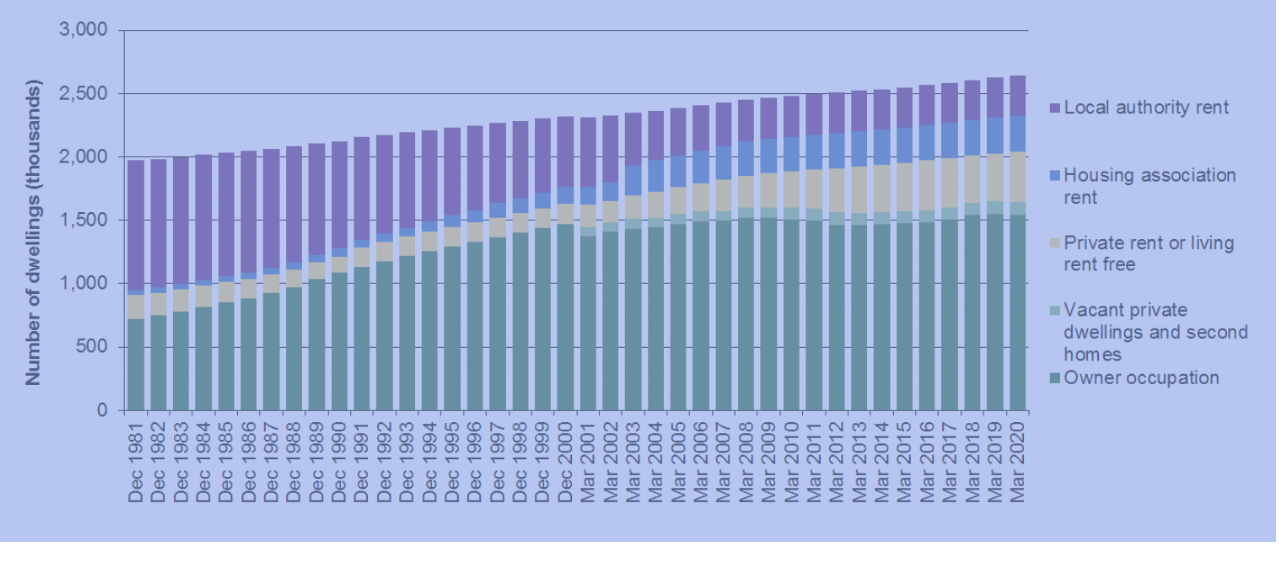
The cause of this crisis is not hard to find: there are simply not enough homes available, especially at the affordable end of the market. This originated 40 years ago in the right-to-buy policy. Though the principle itself is good, requiring councils to set ALL proceeds against debt made building replacements unaffordable. Over the next four decades, council tenancy fell steadily from 54% to 12%. Private ownership and rentals both doubled—to 1.42m and 334,000, respectively. See Figure 1 below (Source: Scottish Government).

Figure 1: Change in House Tenancy by Type in Scotland 1981-2019

The proliferation of housing associations to evade right-to-buy did provide a second source of social housing, but at higher rents, a loss of economies of scale, and confusion ti all. The private market kept expanding to meet the need, but at a cost to tenants. With shrinking numbers of social housing, waiting lists grew enormously. Ordinary punters havd scant hope of ever being offered a house.

As a result, rents in Scotland now average £970 per month. This is up 45% over the last 10 years. Edinburgh average is now £1,370—up 65% over the same period. This has taken “mid-market rent” in Edinburgh out of reach for many. 

There is a total of 2.67m homes in Scotland. This represents an increase of 34% on the 1.97m in 1981, as compared to the 6% increase in the population as a whole. Put another way, demand for housing grew over five times faster than the population. Of this total stock, 320,400 (12%) are local authority units, 318,369 (11%) Registered Social Landlords (RSL’s),342.199 (16%) private rental, leaving 1.55m (56%) owner-occupied. There are also 3% vacant and 24,487 (1%) second homes.

This represents a radical change in Scotland’s housing mix. Council and RSL housing together are regarded as “affordable”, but even were this term accurate, the relative halving of availability is itself an indicator of the housing crisis. Council house rents are genuinely low across the country. However, RSL rents, although well below private rents, vary between 10% and 25% higher than council rents in the same area. This effect is exacerbated by six councils, including Glasgow City. turning their entire housing stock over to RSLs.

The Scottish Government, while speaking of a housing crisis, have done little to meet it. They often resort to obfuscation. For example, their publication on affordable homes states:

“The total completions for the 12 months to end March 2022 rose to 6,557, an increase of 72% (2,744 homes) on the 3,813 social sector new build homes completed in the previous year.”

—Scottish Govt Housing Statistics, ISBN 9781804354209

Sounds great? Actually, the previous year’s build had been crippled by Covid-19. The figure for the year to March 2020 had been barely 14,000 of all types, a steep drop from over 21,000 the previous year—and making the 2022 figures look stellar. This also compares poorly with private completions of over two-and-a-half times that (17,225). This imbalance of affordability is not clear from official charts showing overall figures, such as Figure 2 below. (Source: Scottish Government)

Figure 2: New Homes Starts and Completions in Scotland, 2007-2020

“ScotGov affordable home target concerns as house approvals slump. Concerns have been raised that the number of affordable homes being approved for build has slumped to the lowest level for eight years.”

—The Herald, 28th March 2023

For comparison, the late 1960s and early 1970s saw 41,000 to 43,000 new houses completed each year. This was predominantly public sector housing with barely 7% being private sector. By the time the SNP formed a government in 2007, this had reversed drastically, as shown in Figure 1 above.

The Scottish Government seems coy about this and the massive social stresses it causes. Their housing statistics cheerfully cite the number of new builds, without emphasising the paucity of affordable social housing involved. The fact that the half of Scots who once enjoyed low-cost council housing are now chasing a narrow 12% segment of council homes, plus a more expensive 11% segment of RSL homes does not seem to have galvanised any of the three earlier Housing Ministers (Alex Neil, Keith Brown and Margaret Burgess) into decisive action.

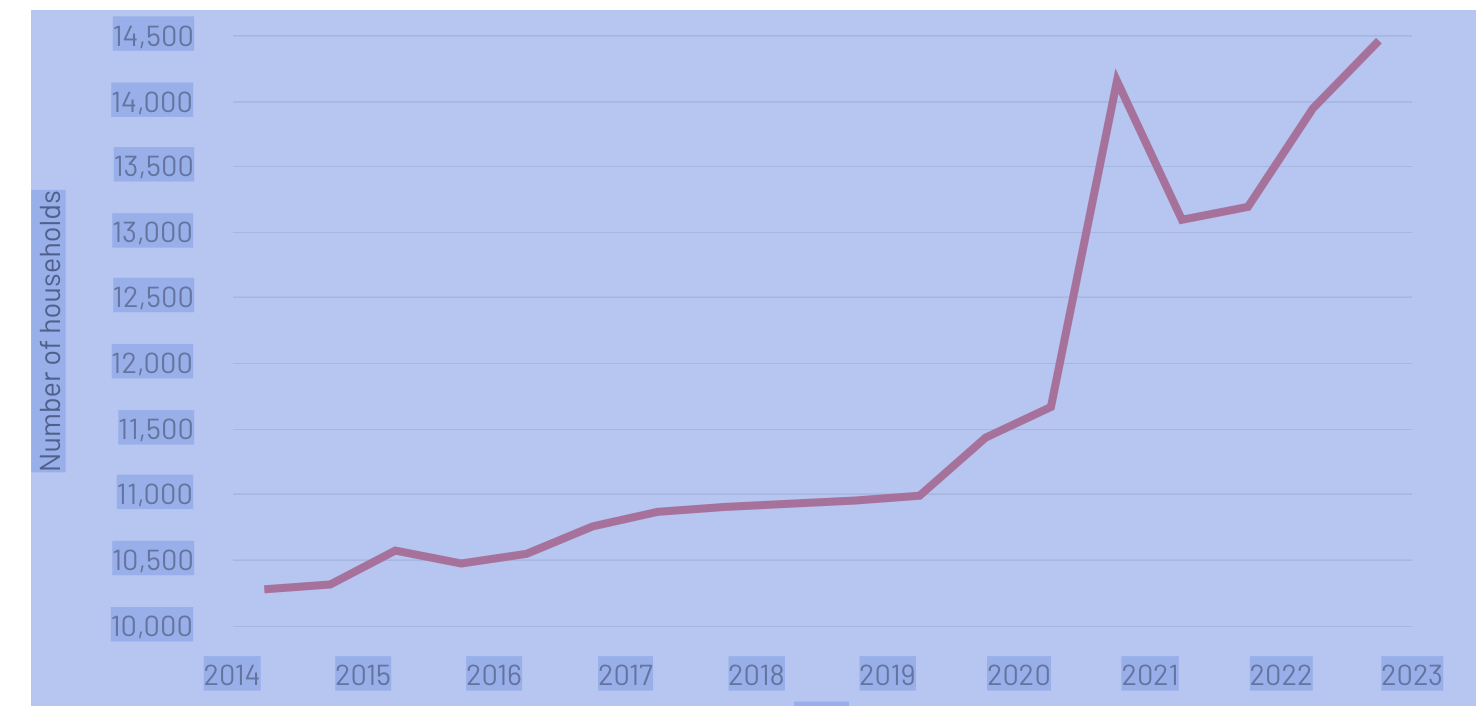
The crucial element in council housing they seem to have ignored is its offer of long-term security. Such security allows for continuity of education, health facilities and social structure. All these are being eroded by the current policies that provide a paucity of secure affordable rental stock. This creates huge social problems and a further drain on Government finances. The result is a steady increase in homelessness and an even more acute situation of people in temporary accommodation. These latter may not be sleeping rough, but have no basis for a stable, let alone a fulfilling life. Recent worsening of the crisis is highlighted in Figure 3 below. (Source: Scottish Government)

Figure 3: People in Temporary Accommodation in Scotland, 2014-2022

The surge shown in Figure 3 happened during the unfortunate seven-year hiatus when Nicola did not see the need for a dedicated Housing Minister to address this worsening crisis. Humza Yousaf resurrected the post by appointing Paul McLennan last month.

Though new as a minister, Paul has been steeped in this crisis, as his East Lothian constituency is in the van of growth in Scotland, so that affordable homes are like hen’s teeth. This results in an ELC waiting list if over 4,000 applicants. Pressures from being commuter-land for Edinburgh are compounded by serious numbers of second homes and Air B&B-style holiday lets, forcing scant private rentals towards Edinburgh prices.

Provision of affordable homes was compromised by East Lothian Council (ELC) building virtually no homes before 2008, relying on local RSLs EL Housing Assoc. and Homes for Life to provide. They failed, achieving only 4.7% of housing in the county—well under half the RSL national average of 11%. And ELC are not above fudging the figures. They are proud the number of people needing temporary accommodation has dropped by 20% from its 2011 peak of 1,137. However, since average days spent IN that accommodation has almost doubled (from 199 to 377), that’s actually a net 72% increase in demand.

At the same time, ELC’s original stock of over 16,000 homes in 1981 has halved to 8,740.. They were also slow in enforcing a planning requirement that developments of four or more homes must provide 25% of them as affordable. This has been undercut by elastic interpretation, with many going to RSLs, to rent-to-buy schemes and even to “affordable” purchase. This has left only 5-10 in each hundred being truly affordable council homes to rent, almost all of which go to “vulnerable” people and those stuck in temporary accommodation.

“When you’re up to your ass in alligators, it’s hard to remember the plan was to drain the swamp.”

Paul could make a name for himself in his home turf by incentivising ELC to get serious about rebuilding their stock and stop relying on crumbs from developers’ tables. Better yet, he could put his head together with Tom Arthur, Minister for Planning, and come up with a scheme for planning communities, rather than the 21st century bland equivalents of Castlemilk or Wester Hailes, now growing like boils on small towns. That would do much to heal social fragmentation blighting Scotland and thus render the “progressive” policies this government favours largely redundant.

Does Paul want to leave a legacy, or become just another revolving-door minister?

#1066—1,395 words

Posted in Community, Politics | 1 Comment

Wars Begin at Calais

“Fog in the Channel; Continent cut off!”

 The Times, 22 October, 1957

Despite a rehearsal of delays and confusion over last weekend when holidaymakers had to queue for up to 24 hours at Dover to get away to the Continent, more delays were still experienced om Easter weekend. This was due, in part, to unhelpful weather, a surge in demand and Eurotunnel declining to take many coaches. Least convincing were the furious denials by Sue Braberman and her Home Office this had anything to do with Brexit. 

The closest she came was implying French custom officials were sluggish in checking passports. But, since the UK is now as foreign as North Korea in EU eyes, passports must be date-stamped, and mug shots examined.

Much though the present UK government will huff and puff denials, this is yet another consequence of Brexit and the xenophobic paranoia that drives many Home-Counties-Heartland Tories. Their credo is embodied in European Research Group stalwarts like John Redwood, IDS, Mark François and the inimitable Jacob Rees-Mogg.

To some extent, this paranoia is understandable. Southeast England has been the target of continental miscreants, from Caesar, through William and Napoleon to Adolf himself. Such repeated threats leaves cultural scars. Add in the Southeast’s folk memory as the capital and a pink-painted fifth of the globe and the breeding ground of the elite who came to rule ít, then disdain for poorer unfortunates (‘Frogs’, ‘Wops’, ‘Krauts’, always said sotto voce) becomes effortless.

Since their “End of Empah” half a century ago, this nomenklatura has been casting about for a comparable dominant role in the world, for a chance to keep “punching above our weight”. Unfortunately, despite sucking up to new superpower America and building symbols of power like nuke subs and aircraft carriers,, those that matter—in Moscow, Beijing and Delhi—are unimpressed. From their perspective, Brexit smacks more of petulance than ambition.

The recent Easter snarl-ups are just one of many consequences of 2016’s marginal decision to go it alone. On the credit side of the ledger, Liz Truss (remember her?) secured trade deals with Iceland (pop. 376,000) and Liechtenstein (pop. 38,900) and a recent t rade deal with 12 Pacific nations, most of whom already had trade deals with us. We now feel free to deal with unwanted immigrants as if we were North Korea. Of the £385,000 a day for the NHS, promised on Boris’ Big Bus, there is no sign.

Unfortunately, the debit side of the ledger shows rather more (and more consequential) entries:

  1. The Office of Budget Responsibility (OBR) estimates that the UK’s GDP is 4% lower than had Brexit not occurred.
  2. UK is the only G7 country whose economy is yet to surpass its pre-Covid level.
  3. After two years of a half-baked Northern Ireland Protocol which damaged the NI economy, the Windsor agreement has removed many trade obstacles but the NI Assembly remains dysfunctional.
  4. Research at Aston University’s School of Business found UK exports fell by an average of 22.9% in the first 15 months following Brexit.
  5. They also found that the variety of UK products exported to EU was down by 42%. This matters for the future because variety comes from smaller growth businesses, least able to deal with new bureaucracy and overheads. An example is Scottish shellfish exports, typically partial-load and time-critical, where volume has halved.
  6. Relations with France. in particular. have declined because of the UK’s inability to dissuade migrants choosing small boats to cross the Channel over the UK’s glacial system for processing asylum seekers.

“We are seeing the effect of Brexit on exports; and that is persisting. It’s not diminishing, and exports have yet to show signs of recovering. It seems that the UK can buy, but it can’t sell.”

 Professor Jun Du, Aston University

Perhaps the most galling consequence for those gung-ho Brexiteers of the Home Counties who have (or have relatives with) gites/spiti/haciendas scattered across the sunny PIGS (Portugal; Italy; Greece; Spain) is EU residency law.

Whereas before, you could hop on Easyjet on a whim, you now get your passport date-stamped. The EU tracks when you are, whether in Tallinn or Torremolinos. You may stay 90 days in any 180 and may not return for another 90. Thjis has caught many of the 2 million Brits living in the EU who did not apply for residency pre-Brexit with their Bermudas down.

Despite this catalogue of disadvantages, the denizens of the ERG and their acolytes hate the taste of humble pie and are unlikely to be swayed into revisiting the 2016 decision.

This is unfortunate for the disadvantaged areas od the UK (basically anywhere outside Southeast England), whose main business is goods, and who benefit little from London’s massive trade surplus in services.

Shame Indy has become a distant hope for Scotland when the Tories have spent over a decade offering a blizzard of reasons (beside Brexit) why that chance would be worth taking.

#1065—846 words

Posted in Commerce, Politics | 1 Comment