GERS Swimming Lessons

No, this blog is not about the Ibrox side. Unlike the Herald and Reporting Scotland we often let a day go by without mention of the latest crisis rocking that once-great team. Despite the last blog implying I was crying off politics, the jousting at UK level and the bun fight at Holyrood over whether today’s finance figures released for Scotland implied sunlit uplands or doom to rival Atlantis for its future was simply cadence to the bun fight at Westminster over whether Osbo’s austerity or Balls’ brinkmanship constitutes the most direct and unerring road towards total disaster.

The debate is unedifying. As Andrew Wilson accurately observes in SoS:

“The annual Scottish numbers fest is never an edifying sight and serves only to underline what a juvenile political culture and discourse Scotland currently has, at least when it comes to understanding the sustainability of public finances. Even otherwise informed and intelligent commentators indulge in the doublethink involved in framing the Scottish budget debate. It is, and always has been, nonsensical.”

The trouble is that normally competent spokespeople making the case for Scotland’s economic robustness and ability to go it alone like John Swinney have been drawn into said bun fight, accusing those who would question robustness of “talking Scotland down“. Several people other than Andrew have made more helpful (and not necessarily positive) contributions, including Kevin Hague in his Chokka Blog and Brian Ashcroft’s Scottish Economy Watch.

Now, however emotional you are on the topic of independence, it is irrational to bring that emotion front and centre when making the fiscal case either way. But that’s just what leads to a number of arguments masquerading as objective when the authors have an agenda. That Prof Ashcroft is married to Wendy Alexander does not disqualify his contributions. Let’s quickly examine some charts. Scotland does run a deficit worse than the UK’; this is shown in Figure 1
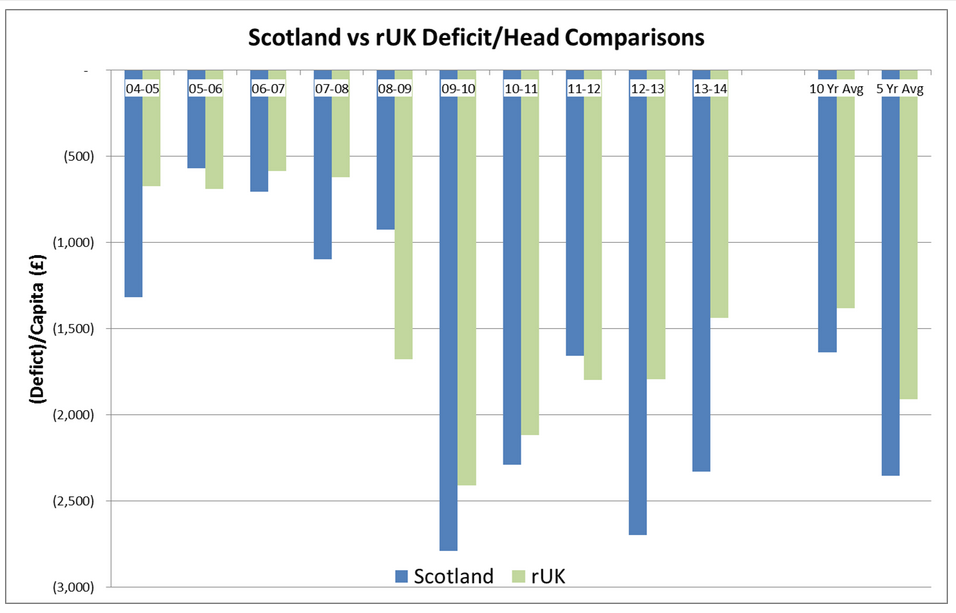
Comparison of UK vs Scotland Deficit per Capita (source Chokka Blog)

Figure 1: Comparison of UK(-Scotland) vs Scotland Deficit per Capita (source: Chokka Blog)

That’s pretty conclusive: Scotland consistently runs a fiscal deficit worse than the UK (with Scotland’s figures removed)—the 5- and 10-year averages underscore this. Looking at the absolute figures for revenues and spend for Scotland gives the charts shown in Figures 2 and 3 below.
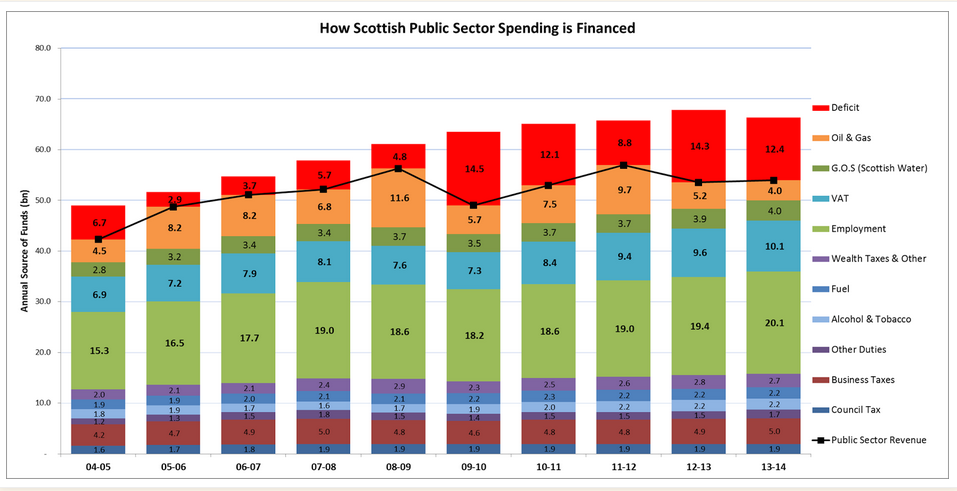
Figure 2: Source of Scottish Finance (all above the black line is deficit

Figure 2: Source of Scottish Finance (Source: Chokka Blog)

Figure 3: Total Public Spend in Scotland (aginn black line shows taxes raised: anything above is deficit)

Figure 3: Total Public Spend in Scotland by Sector (Source: Chokka Blog)

The black line in both figures is the total of taxes raised and so anything above that constitutes a deficit. With a £2bn hole expected in next year’s figures for Scotland due to oil price drop, this picture won’t change any time soon. Several items jump out from these last two charts:

  • increases in revenue raised through employment taxes and VAT have been offset by decline in oil & gas revenue
  • education spending has effectively stagnated since the fiscal crash
  • transport spend has been maintained after a more than doubling
  • health and social protection have increased steadily by 10%
  • everything else—including justice—has stagnated.

The Scottish Government Economic Strategy has the objectives of “achieving a productive, cohesive and fairer Scotland.” It will achieve this by boosting investment, innovation, internationalisation, and inclusive growth. Where Prof Achcroft diverges is, while accepting that the Computer General Equilibrium (CGE) Model used was a rigorous basis for analysis, assumptions made on the basis of implementing Smith Commission recommendations  (a.k.a. “Devo Max”) were not. He finds no substantiation for:

  • an increase in productivity by 0.1% per annum over 10 years
  • a narrowing investment gap between Scotland and its competitors
  • a boosting of Scottish export receipts by 50%

The Scottish Government’s response to GERS foresees greater GDP, jobs and tax revenues because of the  ‘Full Revenue Retention’ concept. In this, all the tax revenues generated by growth are re-spent in Scotland, in contrast to the Smith Commission powers. Prof Ashcroft’s difficulty with this is the Scottish version of having your cake and eating it:

“It is wholly unrealistic to imagine a policy in which, in addition to the Barnett formula, the Scottish government also received any increases in Scottish tax yield.”

These seem valid points that have yet to be properly countered. In the Autumn Statement the gap between UK spending and taxation income sat at £64 billion for this year. Osborne made good that difference by borrowing and adding to the ballooning national debt. In this week’s budget, we will learn the latest plan of eliminating this shortfall, which both Labour and the Tories are pledged to do, just at a slightly different pace.

But, rather than pick up the cudgels offered in the discussion above, Scottish Labour’s deputy leader, Kezia Dugdale, warned Scotland that, effectively, these Tory led cuts were preferable to home rule and the devolution of financial control to Holyrood. It is a retread of the old saw that Scots should “hold on to nurse for fear of something worse“. So even when cogent arguments that could be deployed against even fiscal autonomy present themselves, they are ignored.

As Gordon Wilson, former SNP Leader and Dundee MP, and never one to temporise with the goal of full independence once pithily observed: “Fiscal Autonomy? It sounds like an Irish folk singer!

So, while unionists are (again) doing themselves no favours by selecting increasingly strident cheap shots against a hated (but robust) SNP government, the SNP themselves are missing the chance to pitch more substantive arguments than their hapless unionist opponents seem able to manage, despite all the foregoing.

But, even leaving aside some of the more optimistic planks in their independence argument, fiscally responsible moves to address some of the detail are available to them. To date, they have made a virtue of sustaining a number of programs that need to be examined both in the light of present fiscal constraints and also regarding what needs to be done to change the relative position in Figure 1 above. These include:

  1. Revamping council tax. A blog three years ago made a proposal how to double council tax income by splitting upper bands and creating a ‘mansion’ element. That would gain around £2bn, entirely from people with houses worth £1/4m and more.
  2. Concession fares cost over £250m. While most are vital, there is neither distance restriction not means testing, both of which could save £100m
  3. Free personal care has tripled in cost to £350m since its introduction; free eye exams have doubled opthalmic costs to £100m. While both benefits may be desirable, but the question must be asked whether their free availability of either is affordable.
  4. While nobody argues against the NHS or its adequate funding, its performance in fiscal management falls woefully short of its medical prowess. An accountable management and clean-out of dead wood that allows heating to be controlled by opening windows or counts food plated as food consumed could save 10% of its £3.7bn increase over the decade cuts £350m off the deficit.
  5. But the biggest question is whether the Social Protection budget could be reduced or at least spent more effectively. The £7bn increase over the last decade also offers a chance for 10% savings through service re-provision and tighter control of private company mark-ups. This would shave a further £700m.

Given a fiscal deficit (see Figure 2) of some £10.5bn in Scottish public finances, even all these measures would only reduce the deficit by a third. But that is enough to reverse the relative position of Scotland and rUK. The question immediately becomes: if Scotland would not be viable then the argument must be that the UK is not viable as a country.

And were Scots to get more stroppily partisan, a chunk of the public expenditure burden currently allocated to Scotland could be quibbled with, as this synopsis does in Figure 4.
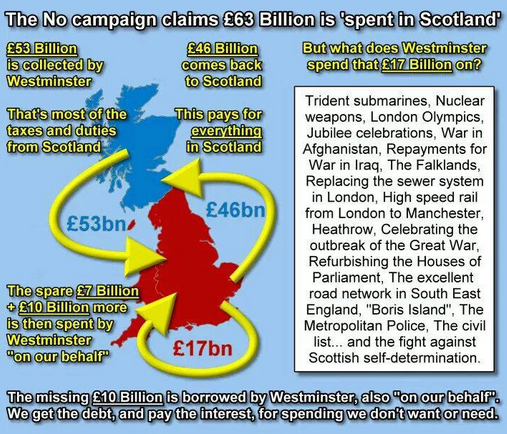
Figure 4: A More Partisan View of Scotland's Public Cash Flow (Source: Twitter)

Figure 4: A More Partisan View of Scotland’s Public Cash Flow (Source: Twitter)

Some items listed on the right of Figure 4 could be quibbled with as valid expenditures on Scotland’s behalf. But, if you believe, as many Scots do, that Britain’s pretensions at being a world power are already threadbare, then Scottish funding of wars abroad or a £40bn defence budget that includes Trident and super-carriers but no maritime patrol capability demand rethinking. Even allowing refurbishing parliament and High Speed Rail may be acceptable burdens to share, some significant element of the £17bn “spent on Scots’ behalf’ would disappear with Scotland’s more modest role, were it to follow the Ireland of a century ago and leave the UK. Ireland’s posture now is nothing like the UK’s.

It would be helpful if both sides of the argument would address the above and paint a realistic picture of Scotland’s financial health as a standalone country and not one simply sliced off the UK as if nothing else would happen. With oil under $60 a barrel, nobody should argue that it alone provides Scotland fiscal salvation. But, given adjustments above, any Scottish deficit would be close to half that of rUK’s. That further adjustments to achieve balance must be made are a given. But these need not be as draconian as both Osborne and Balls are offering in their 21st © equivalent of ‘blood sweat and tears’.

Kezia Dugdale argues swallowing the UK’s huge fiscal time bomb is the lesser of two evils. But, turning around an £80bn oil/whisky/tourism/engineering economy £120bn in debt running a £1k per head deficit is more plausible—and easier—than solving the present £900bn UK service economy that is a whopping £1,500bn in debt and still running a £1.8k deficit per head.

Why keep hold of nurse if she’s actually drowning?

Posted in Commerce, Politics | Tagged | Leave a comment

Cold Turkey

After 20 years at the coalface, I find I am fed up with politics. A veteran of fifteen campaigns, three successful personal elections, two decades of various party offices and sixteen years representing my home town all piles up and renders this grizzled grognard fatigued. But my energy is high as ever and is probably more potent than ever; long experiences better directs its focus, as opposed to spraying invective all over the place. And tilting at windmills of smug bureaucracy still engages me as much as it ever did.

But the ‘higher’ levels of politics (no, I don’t really see them that way either) have slowly declined into an example of squalid, self-serving opportunism. I once thought I had escaped that, left it behind in the volatile egos of Silicon Valley and the corporate lawyers, management consultants and $250/hr therapists who feed off them. We are, it appears, all living in a village more global than I had bargained for.

This realisation began last week as I witnessed yet another stylised Punch-and-Judy Show masquerading as Prime Minister’s Questions and—despite spending the next two days in the detached idyll that is St Andrews, with the poetic creativity of the StAnza festival, floods of energetic students and an Oktoberfest-in-March oompah band—I was brought low by Labour’s one-day conference. More specifically, by the speech made there by one Davie Hamilton soon-to-be-ex-MP.

Despite the furore he caused in social media, what he said wasn’t so terrible. But his tone, a knuckle-dragging tirade that was as evilly aggressive as it was passionately authentic, made my heart sink. And when more balanced members who should know better like my own MSP Iain Gray, Edinburgh South CLP Chair Duncan Hothersall and high-hied-yin Jim Murphy all praised him, I felt ashamed to be associated with the hale clamjamfrey.

All this is not new. Half a century ago, media in general and interviewers in particular were deferential to a fault. Some politicians took advantage of this but, generally, the calling was seen as public service for which standards must be kept high. But the last politician who got it wrong and fell on his sword in acknowledgement was Lord Carrington for underestimating Argentinian aggression. That was 33 years ago—ancient history now.

Examine the front benches either side at Westminster. Within the phalanx of lawyers and never-had-a-real-job politicians two motivations flow effortlessly without regard to policy or creed: 1) Survival and; 2) Power. Though there are doubtless principled MPs lurking in the backbench wilderness, the proliferation of ministers and their shadows to almost 200 has inbred a mentality that exhibits all the rentaquote characteristics of automatons.

I’ve lost count of the Politics Today or PMQs or Newsnights or Marr Shows or (sad to say) FMQs to which I have paid serious attention. But I now come to wonder why I bothered. Recently, none have added to the sum of my—let alone human—knowledge. And it almost doesn’t matter who’s in the firing line. This weekend, Philip Hammond batted as Foreign Secretary just as stolidly as he had previously as Defence Secretary; Angela Eagle, rolled out yet again as Shadow Energy Secretary, was again a safe pair of hands. Both were more than competent and—to the recently landed Martian—apparently informative and sincere.

But it is what the Germans call an “Affentheater” the illusion of theatre because primates are going though human motions that could be relating a story. From the remotest constituency office all the way to the dispatch box, Punch and Judy ply their trade using sound bites as clubs and societal shorthand for meaning. Were it all a symposium on quantum physics, it could be left to Scrödinger’s illuminati to pass judgement on performance and underlying ability in that esoteric field.

But this is about life. This is much too important to abandon to a self-serving priesthood of insiders who spend PMQs baying for blood while their gladiators on both front benches circle each other to give it to them than to enlighten the general public watching. Those with the partisan interest of a well thumbed membership card may rejoice when their lions rip unwary Christians to shreds. But, despite repeated admonishments from the Speaker, there seems alternative to testosterone-induced chest-butting and the baffled alienation of the 60-odd million Britons who are turned off by it all.

And so, at whichever party rally the next Davie Hamilton rabble-rouses with over-abrasive invective at unbelievers, real debate will continue to ossify, policy will derive from ever-shorter-term tactical advantage and politicians will be winnowed down to a sly few who know the right people, spout the right sound bite and never, ever expose themselves as a hostage to fortune by making any real, accountable commitments.

So, please forgive this squirming disillusionment with those who pull down $65k a year, finger our billions and deploy nuclear warheads, yet put nursery kids to shame on maturity. Should real debate break out or an idea benefitting society (as opposed to its administrators) before May 7th, I may find motivation to pay attention again. But meantime, I think I’ll abandon party politics and go highbrow by following darts or mud wrestling.

Posted in Politics | Leave a comment

Beware the polls of March

No Cassandra she: the Burd deploys a shrewd, spot-on analysis of subtle key factors surging beneath remarkably smooth polls.

burdzeyeview's avatarA Burdz Eye View

While there has always been tension with the Scottish Labour party about how and where to target resources during elections, never have we enjoyed such a ringside seat to the internal drama. Such is the panic in their breasties that it’s all being played out publicly for our delectation. It makes for a very bad farce. Or even a Greek tragedy.

This weekend, we’ve had unnamed sources calling for the West of Scotland and Glasgow, those previous citadels of Labour electoral dominance, to be abandoned in favour of seats that can still be saved in the East of Scotland. Then there’s been the criticism of the amount of support going into Margaret Curran’s Glasgow East constituency at the expense of others. Finally, some have questioned how it was worked out which seats would benefit from £1,000 of Blair’s filthy lucre, while some of the beneficiaries appear to have tried and…

View original post 971 more words

Posted in Uncategorized | Leave a comment

Biggest in the World

Living as I do in the wonderful seaside environment of North Berwick, you can get banal about its wonders—not least the Bass Rock. Empty as it is of its gannet residents just now, the sheer wonder of their teeming presence most of the year can be taken for granted.

But now comes a report that it has surpassed St Kilda as the world’s biggest colony of Northern gannets at some 75,000 nest sites on a rock barely 1 mile in circumference. Reproduced below are some details of the report published on our local Scottish Seabird Centre’s website. Of particular interest is the increase in the heart of the existing colony where you would have sworn there was no room for more nests.

The Scottish Seabird Centre, East Lothian, announces that a count of Northern gannets undertaken by Stuart Murray, in conjunction with the Centre for Ecology & Hydrology (CEH), has shown that the Bass Rock is now the world’s largest colony.

The Bass Rock is located 4km (2.5m) from North Berwick and the Northern gannet’s scientific name (Morus bassanus) is derived from the Bass itself.

In 2014, independent counts made by Stuart Murray and Mike Harris (CEH), with advice from Maggie Sheddan, the senior Bass Rock guide for the Scottish Seabird Centre, found 75,000 apparently occupied sites (AOS). This is an increase of 24% since a similar count made by Stuart Murray in 2009.

Stuart Murray said: “The colony was photographed from the air on 23 June 2014. Conditions were excellent, with no wind and a high cover of thick cloud which obscured the sun, reducing the glare from all these startlingly white birds. The images were later viewed on computer screens for counting and each occupied site was blocked-out as it was counted.

“Interestingly, the most dramatic increase is between the old lighthouse keepers’ garden and the summit of the Rock. We counted around 10,000 sites in this area compared with 6,500 five years ago.”

Sarah Wanless, from the Centre for Ecology & Hydrology, said: “Our long-term research on North Sea seabirds aims to understand how species such as the gannet will cope with the rapid pace of environmental change. This is our fifth census of the Bass Rock in the last 30 years.

“It is particularly heartening to see them doing so well when so many other seabirds in Scotland appear to be in trouble, however, the Bass Rock is a small island and the gannets have now filled most of the available nesting habitat. The colony now has only very limited capacity for further increase.”

Tom Brock OBE, Chief Executive of the Scottish Seabird Centre, said: “Scotland is of international importance for seabirds and is home to over 60% of the world’s population of Northern gannets. The figure of 75,000 sites is phenomenal especially when many apparently occupied sites will represent a breeding pair and their chick. I would expect that the total gannet population on the Bass in the breeding season will be well in excess of 150,000 birds. Every year the Bass Rock turns brilliant white with the sheer number of gannets crammed onto the Rock and not, as some people think, with their guano.

“While this is fantastic news we cannot ignore the fact that although gannet colonies are currently thriving other seabird species are not. This is a very complex issue however we know that gannets are able to travel further to forage for food – even as far as the coast of Norway.

“Many seabirds are now under threat and as a conservation and education charity we will continue to work in partnership with other organisations across Scotland to undertake further research and appropriate action, where we can, to conserve Scotland’s amazing wildlife for future generations.”

Posted in Community | Leave a comment

Past Joukin Gin the Heid’s Aff

After decades of political invulnerability come rain, shine or socialism, Jim Murphy has been scurrying about trying to prop up the Scottish Labour edifice. From a high point of the ‘feeble fifty’ in the 1980s, the shedding of support, Labour Clubs, activists and even members over the next two decades seemed to make little difference to solid Labour majorities across the Central Belt that were counted with shovels.

Then came the surprise result of 2007. Any stimulation from the shock of losing control of Scotland eased and faded when 2010’s General Election seemed to put Labour back in the driving seat with 41 out of 59 MPs and dismayed the SNP with only six of the rest. A sigh of relief bred a sense of comfort that carried them to last September when the ‘No’ win was bigger than predicted. A disinterred Gordon Brown and ‘The Vow’ was credited with turning the corner.

But since then, a succession of wheels have come off with alarming frequency. And, despite the choice of a heavyweight spinmeister as leader, even Hydra Jim has too few heads to plug all the holes in the dyke. Polls have consistently rung alarm bells but, until now, there was no way to predict where the shift was concentrated—if at all. Given that major Labour heartlands had voted ‘Yes’, answering this became the $64,000 question.

Now Lord Ashcroft’s Polling has made a start. And disconcerting reading it is too for Murphy et al who claim they’ll hold all 41. Willie Bain looks like the last man standing. Here is the introduction to Ashcroft’s startling analysis of just those heartland seats Labour was so shocked to lose in the last SP elections—yet has done precious little to recover. If this is accurate, it will make that earlier gubbing seem nirvana by comparison.

(excerpt begins)

Most of my constituency research is focused on marginal seats. But in post-referendum Scotland, the concept of a marginal seat is rather obsolete. Huge swings to the SNP in national polls suggest that even some MPs who must have thought they had a job for life are threatened.

My first round of Scottish constituency research therefore required a different approach. I decided to look primarily at Labour seats – including some with colossal majorities – in areas which voted yes to independence, or where the result was very close. This included all the Glasgow seats, plus Airdrie & Shotts; Coatbridge, Chryston & Bellshill; Cumbernauld, Kilsyth & Kirkintilloch East, Dundee West; Motherwell & Wishaw; Paisley & Renfrewshire South; and West Dunbartonshire. I also looked at two current Liberal Democrats seats of interest: Gordon, where Alex Salmond is standing in May, and Danny Alexander’s constituency of Inverness, Nairn, Badenoch & Strathspey. In total, the research covers more than a quarter of all the constituencies in Scotland.

I found the SNP ahead in fifteen of these sixteen seats. In the Labour-held constituencies the overall swing to the SNP was 25.4%. This ranged from 21% in Airdrie & Shotts to 27% in Dundee West and Motherwell & Wishaw. Among these seats only Glasgow North East would stay in Labour hands if these results were to be repeated at the election, with the party’s majority in the constituency down from 54 points to just seven.

Douglas Alexander, Labour’s campaign manager and the Shadow Foreign Secretary, would lose his Paisley & Renfrewshire South seat with a swing to the SNP of 25%. Elsewhere, Salmond would be back in Westminster with a comfortable majority over the Lib Dems, and Chief Secretary Danny Alexander would lose by 29 points.

In the Labour-held seats, only 60% of those who voted Labour in 2010 said they would do so again this year; more than one third (35%) said they would support the SNP. While the Conservative vote (such as it was) has held up in these seats well, the Lib Dems have collapsed: only 12% of the party’s 2010 supporters said they would vote Lib Dem again; nearly half (47%) said they would switch to the SNP.

Labour-SNP switchers were markedly less optimistic than most about the economy. Just 41% expected things to go well for the country as a whole over the next year, and 49% for themselves and their families, compared to 59% and 67% of those sticking with Labour.

In the Labour-held seats only just under four in ten (38%) said they were dissatisfied with David Cameron and would rather have Ed Miliband as Prime Minister. Meanwhile 44% said either that they were satisfied with Cameron (18%) or that they were dissatisfied but preferred him to Miliband (26%). Just over half (59%) of Labour voters said they would rather see Miliband as PM, as did just under half (49%) of Labour-SNP switchers.

Despite this, the single most popular general election outcome in these seats was a coalition involving Labour and the SNP – a result favoured by 39% of voters overall, including 62% of SNP supporters and 79% of Labour-SNP switchers. Around one in seven SNP voters (14%) hoped for the unlikely prospect of a coalition between the SNP and the Tories.

What are the implications for the wider general election battleground? If a swing to the SNP of 21%, the smallest in this range, were to be repeated across the board next May it would endanger 35 of Labour’s 41 seats in Scotland. But we cannot assume such a uniform swing. Most of the seats in this survey are in areas which returned a particularly strong yes vote in September, where the SNP attraction will naturally be greater; in future rounds of research we may find a different pattern where support for independence was lower. Even so, the prospect of losing heartland seats will be a blow to Labour’s hopes: every seat they lose in Scotland means another they have to win from the Conservatives in England, while the national polls could not be much narrower.

But as ever, it is vital to remember that these polls are a snapshot, not a prediction. The Labour majorities in some of these seats are such that even a swing of this magnitude has not put the SNP far ahead – for example, just three points in Glasgow South West and Coatbridge, Chryston & Bellshill, and six points in Glasgow North West.

With a vigorous Labour campaign there remains room for movement before May. For such a crucial battleground the campaign in these seats has yet to reach fever pitch – perhaps not surprisingly given the exhausting referendum campaign. Just 13% said they had heard locally from the SNP in the last few weeks, and only 9% from Labour.

More importantly, by no means all voters have made up their minds. Just over two thirds (68%) of switchers from Labour to the SNP say they definitely rule out voting Labour again in 2015 – which means nearly one third are at least open to the idea of returning.

(excerpt ends)

Posted in Politics | Leave a comment

Irn Guru

I am no great fan of the Gordon Gecko school of ambition; if everyone plays dog-eat-dog, there’s won’t be much hope for civilisation. That said, most Scots still have some way to go to get the hang of entrepreneurship. In this field, the US has blazed an uncompromising trail. While we need not follow blindly, there are nonetheless lessons for us to learn.

Despite many charlatans, some Stateside gurus are worth studying. Despite once stalling my career for daring to gift my boss In Search of Excellence, a short cut to learning still involves absorbing someone else’s experience/insight to dust off your own cobwebs. A more recent example of this is Peter Diamandis‘ new book Bold. Eleven key points he highlights seem worth consideration—even among those like me who branched off the road to billionairedom some way back.

  1. Agility will trump size: In the same year that Kodak went bankrupt (2012), another company in the digital imagery business (Instagram) was acquired by Facebook for $1 billion, but Instagram had only 13 employees. As the rate of change continues to increase, large, slow-moving linear companies will be unable to keep up with rapidly experimenting, exponential entrepreneurs.
  2. You either disrupt yourself, or someone else will: 40% of today’s Fortune 500 companies will be gone in ten years. Products and services are being dematerialization and demonetization. The entrepreneurs who win are those who can think exponentially, digitize a service (think Uber and Airbnb), then dematerialize and demonetize the marketplace.
  3. Reading an exponential roadmap is key to your success. How do you predict when technology is going from deceptive to disruptive? One key is looking for the creation of an ‘interface-moment’ (e.g. Andreessen’s creation of the Mosaic browser for the Internet) which allows entrepreneurs to build new businesses. Today’s 3D printing software is just one example of an interface-moment that will disrupt a trillion dollar industry.
  4. Tech to change the World: Robotics, infinite computing, synthetic biology, artificial intelligence, 3D printing, networks and sensors are the technologies that will produce the next group of billionaires. These technologies gives each of the the capabilities only available to governments and the largest corporations just 20 years ago. While you don’t need to be a technologist to play this game, you do need to have a Massively Transformative Purpose (MTP) that attracts a talented team.
  5. Bold Mindset & Moonshots: Both Lockheed Skunkworks and GoogleX show us how to go 10x bigger, rather than 10% bigger. Taking a Moonshot inside of your Massively Transformative Purpose is the fuel you need to go big and bold. Moonshot thinking is100 times more worth it. And it’s rarely 100 times harder.
  6. The Secrets of Going Big: Super-Credibility and Stone Soup are two terms you probably don’t know, but exponential entrepreneurs depend on both to punch above their weight class. This chapter offers a step-by-step roadmap for starting, building momentum, and attracting the right people to your big idea.
  7. Billionaire Wisdom: Elon Musk, Richard Branson, Larry Page and Jeff Bezos share eight key strategies that help them think at scale. Passion, experimentation and optimistic thinking are three of the eight. Your mindset matters. Here’s a glimpse of what it takes to play on a global scale.
  8. Crowdsourcing: With five billion people online by 2020, the most successful entrepreneurs and companies will use the power of the hyper-connected crowd to source their latest ideas, products and solutions.
  9. Crowdfunding: By 2020, $100 billion of capital is coming on-line from Crowdfunding. Bold offers a proven and detailed how-to guide to turn the crowd into your personal cash machine for funding your next product or service.
  10. Building Communities: Communities built Wikipedia and Linux (both valued at tens-of-billions). Communities can design your next products, spread your video to millions, or finance your next company.
  11. Incentive Competitions: Incentive Prizes let you tap into the world’s smartest people to help you solve your biggest problem. Best part you don’t pay until after it’s solved.
Posted in Commerce | Tagged | Leave a comment

Inside the Commons

Reblog of John Plunkett’s review in The Guardian, January 29th 2015, of Michael Cockerel’s documentary of the same name to be broadcast on BBC2 on February 3rd.

There is precious little in Michael Cockerell’s documentary about the House of Commons to encourage Russell Brand, should he watch it, to cast his vote after all.

Cockerell portrays a “mother of all parliaments” in which MPs vote against their instincts to avoid ending up in their whips’ black books, and where Tory MPs use a precious opportunity at Prime Minister’s Questions to ask a question emailed to them by Conservative high command.

Granted unprecedented access, the cameras on the floor of the Commons make the bear pit of PMQs feel louder and more raucous than it does from the bird’s-eye view we see on the news. Up close and personal, they look almost human.

The behaviour in there is just disgusting, really embarrassingly juvenile, screaming,” is the verdict of Labour MP Sarah Champion, who is still adjusting to her surroundings three years after taking office. “The fact it’s men in their 50s and 60s doing it – it’s just distasteful.

But while much of Cockerell’s film focuses on Champion and another of the newcomers, Tory MP Charlotte Leslie, as they attempt to get to grips with the “bewildering codes and customs” of Westminster (including, until recently, free snuff for all members), it’s the big beasts we want to hear from.

Neither David Cameron nor Ed Miliband display the sort of enthusiasm for PMQs that you might hope – or expect – to see.

Once you’re in it, you forget about the nerves and it’s ‘Try and do the best you can,’” says Miliband. “The anticipation, I find, is worse than the reality.”

There isn’t a Wednesday that you don’t feel total fear and trepidation about what is about to happen,” adds Cameron. No wonder he’s not keen on the TV debates.

George Osborne also appears, but he isn’t interviewed in this first episode. Maybe it’s just the music, but there’s something about the chancellor’s pre-budget prep talk – “We’ve got a good budget, we’re going to go out there and sell it” – that feels like a scene out of The Apprentice.

Cockerell, who has previously cast his all-seeing eye over Whitehall and Tony Blair’s 10 years in power, has more affection for the building than the people who work in it.

But the palace of Westminster is falling apart, including the famous tower that houses Big Ben, and requires repairs that could run into millions of pounds. It’s not just the facade that’s crumbling.

Posted in Politics | Leave a comment

Beware the Greeks When Baring Teeth

All results are not yet in but it’s pretty clear that the Greek people have thrown a wobbly after five years of austerity and voted en masse for Συριζα and its leader Tsipras who said:

“Today the Greek people has written history, Hope has written history … Greece is turning a page. Greece is leaving the austerity of catastrophe and fear … there are no losers and winners. Those who have been defeated are the elite and oligarchs … we are regaining our dignity, our sovereignty again.”

That the Greek people have chosen an alternative to austerity is hardly surprising. The economy has slumped by 25%. Rising unemployment (in a country where health insurance is linked to work status) has led to an estimated 800,000 people lacking either state welfare or access to health services. Nobody doubts that the Greeks are suffering. But is ever-tighter austerity the road to recovery and prosperity?

Greece was forced to make massive cutbacks to meet the terms of twin bailout packages, totaling €240 billion, largely from the EU. Unemployment is rife and youth unemployment may have improved in the last year—but only from 58% to 51%. You may think Osborne’s austerity has been tough in Scotland but it is nothing compared to what the Greeks have suffered.

On January 20th 35 economists and professors wrote a joint letter to the Guardian arguing for “cancellation of a large part of the debt and new terms of payment which support the rebuilding of a sustainable economy.” Their argument is that a more expansive fiscal policy setting, targeting immediate relief from poverty, would stimulate further domestic demand and lead to economic recovery.

Reports from across Greek society—including middle-class but especially the poor—are full of hardship and declining standards so humanity argues for another solution. Yet, the Greeks largely brought this upon themselves. Their relative profligacy earlier on was made possible by their joining the Euro for its launch in 2002.

Prior to that, the Greek drachma had been a minor and relatively volatile currency. Greek governments wishing to fund ambitious programmes were rather limited in the amount of debt that they could accrue without the drachma sliding on world markets and repayments becoming onerous. Although as wedded to popular (if expensive) policies as any other government, this kept their ambitions in check.

But 13 years ago, that changed. Being part of the bigger currency meant that Greek borrowing had little impact on interest rates for the Euro and, rates being low, it was a serious temptation for governments to borrow at low rates and settle above-inflation wage demands. Once parties get elected on such economic drugs, it was hard to wean themselves off it again.

So, ten years of such policies and Greek National Debt stood at a whopping 175% of GDP. For comparison, deep-in-debt Britain stands at 90% and prudent Germany at 78%. What is not coming out in this whole discussion—and certainly was not being admitted by any of the parties engaged in the Greek election—is that, for years, Greece has been living well beyond its means.

And—lest any of us get smug about it—so has the UK. From the Thatcher buyout of mines and steel mills to the present day, Britain has avoided paying the cost of many programmes through taxation by squandering the income from North Sea oil. Now that some £8bn has disappeared from that honey pot through oil dropping to $50, Osborne has yet to explain how he will compensate for such a glaring shortfall in straitened times.

But we digress.

The point is that the Greeks are putting Συριζα in charge because they’ve had a bellyful—their fault or not. And the first act of whatever administration Tsipras cobbles together will be to go to Brussels and tell those malakas where to get off. It will amost certainly result in a restructuring of Greek debt and (if they get lucky) forgiveness of some of it. Which is good news if you happen to be Greek and even better if you happen to be Greek and unemployed. If the professors are right, the Greek economy will recover.

Had Greece been the only profligate country who surfed the stability gift that was the Euro, all might be well. But now you’ve just handed the European Central Bank a ticking time bomb. Italy, Spain and Portugal were also not slow off the mark milking this nation-sized credit card and will soon be at their door demanding similar leniency.

Which leaves the EU with a pretty stark choice: throw Greece out of the Euro, making their repayments all the harder; or abandon the entire Euro project altogether. While there are more than a few stolid German businessmen who would resurrect the Deutschmark in the time it takes to say “Wirtschaftswunder”, that letter will not seem a plausible option.

So spend all your Euros while you’re on holiday on Mykonos this summer because, by 2016, they’ll be back to drachmas—and probably at a more favourable exchange rate.

Posted in Commerce, Politics | Tagged | 2 Comments

Canute’s Kingdom

Most people agree that whatever Gordon Brown’s virtues or failings, his memorable contribution to political debate since 2010 was his impassioned plea for the union just before September’s referendum. The Huffington Post described the result as “a personal triumph for the former Labour prime minister, whose thundering eve-of polling day rallying cry was praised as the speech of his life.

Lost in the hubbub was the fact that he had neither the authority nor the position to make some of the statements he did. Coupled with last-minute pledges for improved devolution from the union from the three big UK parties, the echoes of Alec Douglas Home’s similar promise from 1979 did not prevent significant numbers of switherers taking it at face value and decide to vote ‘no’.

But, unlike 1979, this Damascene conversion by both UK government and opposition did find expression in the Smith Commission which engaged the five Holyrood parties in debate as to what shape that devolution should take. The promise came from Westminster to convert the Commission’s findings (based on over 18,000 submissions from the public and more than 400 from civic groups) into concrete proposals before Burns Day. As Cameron said on September 19th:

“To those in Scotland sceptical of the constitutional promises made, let me say this we have delivered on devolution under this Government, and we will do so again in the next Parliament. The three pro-union parties have made commitments, clear commitments, on further powers for the Scottish Parliament.”

On Thursday 22nd, they delivered. Cameron made his first foray into Scotland for months to make the announcement on the heels of FMQs yesterday. (When Willie Rennie posed his stock opening question of when the First Minister would next meet the Prime Minister, Nicola stood up and, consulting her watch, shot back “In an hour”.)

So the Prime Minister comes to Edinburgh, and announces what he calls a “great day for Scotland, and a great day for the United Kingdom too.” and went on to promise “if I am your Prime Minister after 7 May, you will get in full these measures set out in this document, in a bill in the first Queen’s Speech of a government I lead.” There indeed many substantive measures and an incomplete list includes:

  • The Scottish Parliament will have all powers in relation to elections to the Scottish Parliament and local government elections in Scotland
  • Scottish budget to benefit in full from policy decisions by the Scottish Government that increase revenues or reduce expenditure, and bear the full costs of policy decisions that reduce revenues or increase expenditure.
  • Scottish income tax revenues will be retained by the Scottish Government to be spent in Scotland rather than these taxes being pooled and redistributed by the UK.
  • Scotland’s fiscal framework should receive additional borrowing powers to ensure budgetary stability and provide safeguards to smooth Scottish public spending.
  • The power to charge tax on air passengers leaving Scottish airports and on the commercial exploitation of aggregate in Scotland will be devolved.
  • Scottish Ministers will be given the power to make alternative payment arrangements in relation to Universal Credit.
  • Benefits for carers, disabled people and those who are ill: Attendance Allowance, Carer’s Allowance, Disability Living Allowance (DLA), Personal Independence Payment (PIP), Industrial Injuries Disablement Allowance and Severe Disablement Allowance will be devolved.
  • Discretionary Housing Payments and benefits which currently comprise the Regulated Social Fund: Cold Weather Payment, Funeral Payment, Sure Start Maternity Grant and Winter Fuel Payment will be devolved.

That may seem a pretty meaty chunk of responsibility and even the SNP agrees that this represents real progress, having been party to the Smith discussions. However, there has been no outbreak of harmony following the announcement. This revolves around a phrase used to which the SNP object and are regarding as a form of veto.

The phrase is “Whitehall ministers would have to be consulted and give his or her agreement” even though it goes on to say “…such agreement not to be reasonably withheld”. Danny Alexander the Treasury Chief Secretary maintains this means: “No ifs, no buts; there is no veto. If they can pay for it, a Scottish government can do what it wants with the new benefit powers it is getting.

So, is the Scottish Government girning unjustifiably? Certainly the practical effect of all this is for considerable powers to devolve to Holyrood and the SNP at least can be exoected to seize the opportunities this offers to beat a different path for Scotland—as they have done since 2007 but Labour was leery of doing 1999-2007.

But they do have a point. As a last resort, Westminsier could intervene if it chose. There is a “no detriment” rule – which implies no decision made by a devolved government should actually put Scotland at a financial advantage, or vice versa. The interpretation when “agreement may not be reasonably withheld” looks like a bonanza for QCs, should it ever come to that.

But the SNP is being partisan and more than a little disingenuous. The Constitutional Commission has argued that the present setup at Holyrood does not and cannot embody the sovereign rights of the Scottish people as it stands—independence or no. Were all power to be transferred from Westminster to Holyrood, there would be inadequate checks and balances—no second chamber; no presidential office; no separation of justice.

For all its flaws, the American constitution was originally crafted and frequently defended as the arbiter when executive and legislative elements are at loggerheads. In the absence of such checks, it seems sensible to retain such options at Westminster. But that begs the question of the supportiveness (or otherwise) of a given UK Government for whoever happened to be in power in Scotland.

Some seasoned and knowledgeable commentators, such as Joyce McMillan in Friday’s Hootsmon regard the proposals as something of a mess. Others like Tom Peterkin in the same issue see this as merely the first step to resolving the West Lothian Question and implementing Cameron’s quid-pro-quo of EVEL (English votes for English laws).

But what is NOT being talked about is the apparent failure of Westminster in general and Cameron’s government in particular to read the mood of the Scottish people and what it is likely to take to take the steam out of their present lively bolshyness. Conservative Central Office clearly doesn’t ‘get’ Scotland, having just issued this poster:

Alex Massie in the Statesman thinks the Tories are working for the SNP

Alex Massie in the New Statesman thinks the Tories are working for the SNP

As he sees it, “it frames the election as a battle between Scotland and England in which the latter is menaced by the former. It pits the two largest parts of the Union against one another.” And here, he puts his finger on the problem Westminster seems to have.

As Joyce McMillan puts it “the British establishment seems unable to get beyond the idea that the Scottish Yes campaign represented some kind of explosion of rash and unthinking patriotic sentiment.” The Queen’s admonishment to “think very carefully” and Jim Murphy’s frantic attempts to belatedly wrap Scottish Labour in a saltire also seem to derive from the same thinking.

After centuries of regarding “England” and “Britain” as interchangeable, the UK establishment sees Scotland as a kind of frostbitten surly Midlands whose occasional strops require some raw constitutional meat to be thrown to them to stay onside.

But here in Caledonia, sterrrn and wild, the whole thing is not about constitutional change. What Scots are fired up about—and this includes significant numbers of those who voted ‘no’—is to protect social justice, to support public services, to secure and develop a more cohesive society against an economic consensus at Westminster that appears alien to most.

So King Cameron can sit with his eyes fixed on the horizon of another term in government while minions scoop up shovelfuls of “An Enduring Settlement” to keep back the waves. But the floodgates are creaking in Scotland, the tide of dissatisfaction not yet at full flood.

Posted in Politics | Leave a comment

Ailment or Oil Mint?

Fate has not been kind to Scottish Labour over the last few years. Under first Iain Gray and then Johann Lamont, they seemed to get stuck in a dreich cycle of politics-as-moanfest. That led to a drubbing in 2011 that exceeded even their worst performace-to-date in 2007, losing seats by the boatload, including several ministers and (almost) their leader. Iain had not had a good time of it, getting confused at FMQ who created Norway’s massive oil fund and being publicly slapped down by Dundee’s Joe Fitzpatrick:

“The money for Norway’s oil fund doesn’t come from Statoil – it comes from tax revenues from all the oil companies that work in the Norwegian oil sector. Norway’s oil fund is now worth around £300 billion, and simply underlines why – in the face of savage London cuts – it is essential that Scotland similarly benefits from its own resources, with a Scottish oil fund to secure the nation’s wealth for future generations.

As former Finance Minister, he should have been up on such basics. His successor did little better, appearing to avoid the subject altogether. Johann managed to get through her last speech to a Labour Conference as Scottish Leader without mentioning oil once. She had managed it the previous year but only by saying “Let others speak of an oil boom“.

Perhaps this is because when she did once try at FMQs to decry the SNP proposal to set up an oil fund as ‘dishonest’ she had to back down. The Presiding Officer stepped in after Ms Lamont claimed the First Minister was “simply dishonest“. The Labour leader went on to state that “honesty is not something this government deals in“.

So far, Jim Murphy has steered clear of such banana skins but his troops at Holyrood have not learned their lesson. Jackie Baillie in particular has been lambasting the SNP Government for not cutting taxes on North Sea oil, now that the price has halved to below $50 a barrel. Her recent demand for a ‘Scottish OBR’ begs the question of whether she has been paying attention for the last two years. John Swinney’s riposte was withering:

“Ms Baillie seems completely unaware that Labour supported our establishment of the Scottish Fiscal Commission, and indeed, our Programme for Government makes clear our intention to put the commission on a statutory footing.

“But frankly, it takes some brass neck for a Labour politician to accuse others of making over-optimistic fiscal forecasts. In just six years, Gordon Brown managed to get his borrowing predictions wrong by over £400 billion. During Labour’s time in office, national debt almost trebled. In contrast the SNP Government has balanced the budget every year.”

Bottom line: recent Labour leaders have shown little interest and no leadership on the most important business in Scotland. Worse, when they have opened their mouths, it has be embarrassing. It;s the epitome of the old adage “Rather keep your mouth closed and be thought a fool than open it and remove all doubt.”

When Energy Minister Fergus Ewing argued in Parliament that the UK Government makes the changes in the Budget in March, saying “it is crystal clear that it is the fiscal regime that needs to change“, Ms Baillie was quick to denounce this, saying his statement had not included “one action that has changed or appeared since the dramatic fall in oil prices in the last few months“.

Lost among this ‘debate’ is the fact that oil tax revenue from North Sea oil has been jacked up by successive UK governments—mostly Labour. Petroleum revenue tax (PRT) was introduced under the Oil Taxation Act of 1975, soon after Wilson’s Labour government returned to power. It was intended to ensure “fairer share of profits for the nation” from the exploitation of UK  (mostly Scottish) waters.

In theory PRT was abolished in 1993…but only for all fields given development consent on or after then. It continues for (many large) fields established before then. And, although the rate was reduced from 75% to 50%, various reliefs were withdrawn. All this is separate from Corporation Tax (CT), normally paid at 30%. Gordon Brown tapped oil producers for an extra 10% in 2002, upped to 20% in 2006. And, as if that weren’t greed enough, Osborne made it 32% in 2011.

Net result: oil producers pay at least 62% tax and often as much (with PRT) as 82%.

So for anyone in Holyrood associated with UK governments of the last 40 years have a rare cheek to pillory the present Scottish Government for threatening jobs in the oil industry when: a) SG have no control of either PRT or CT and b) Labour under Irn Broon was especially adept at wheezes funded by squeezing easy targets most voters thought were rolling in it anyway, such as pension funds and oil producers.

SO, if I were on the Labour payroll and looking down the barrel of this election 15 weeks away, I would haud ma wheesht—and try not to look too sheepish in the process.

Posted in Commerce, Politics | Tagged | Leave a comment