They Also Serve

Unless there’s a scandal involved, like yesterday’s Hootsmon front page story of Edinburgh officials on the take, you don’t hear much about councils. There were council elections all over England on the same Thursday as the General Election  but they might have been in Patagonia for all the coverage in the media. As provider of most local services and the closest democracy gets to Mr & Mrs Punter, you’d think they deserved better.

But do they?

From once being mostly low-paid administrators and manual workers, council employees have come up in the world. Public service unions made sure their members didn’t lose out in rampant wage inflation that once characterised the 1970’s. But, after the handbagging of private sector unions that subsequently took place, those same unions survived to transform their members’ jobs from being low on wage to compensate for being high in job security into ones that were both.

Council chief executives now earn over half what the Prime Minister does; South Lanarkshire Council executive director Linda Hardie  came second on a UK-wide rich list. being paid £543,538. In adjacent N. Lanarkshire Council, 29 senior staff scooped approximately £184,000 in extra payments – chief executive Gavin Whitefield being the biggest winner with an extra £12,050 on top of his £136,848 salary. All of this has the approval of the local Labour administrations.

Meantime, council meetings echo to the management-school-speak of team building and mission statement and key performance indicators; council papers are now peppered with financial impact and code of conduct and equalities impact and human resources policies.

As they say in the States: “They can talk the talk—but can they walk the walk?”

After sixteen years as a councillor, I have developed a high regard for the professionalism, dedication and general hard work of most of the officials with whom I have come in contact. There are those who have had some acknowledgement for this but it is generally internal, such as ELC’s Star Awards which are presented at a gathering of employees. Generally, the public they serve are unaware.

This is all the more unjust because those who do go the extra mile stand out from the facelessness that is how most public view their council because almost none of them work local so you can chat in the post office queue. That means their phone number/e-mail gets passed about as ‘someone who gets things done’ and their work load is ever-increasing while their pay stays the same as their colleague whose phone never gets answered.

When dealing with this latter type, my advice to customers frustrated by their passivity has always been: “Never ascribe to malice what you can explain by incompetence“.

Poor service isn’t always a function of poor pay but it is a reasonable explanation why—30 years ago when their pay was poor—council employee dealings with the public were poor, if only in the familiar bureaucratic “but you should have filled out the seven-page Form 79B, not 79A” way.

They delighted in setting rules; their own perceived lowly status was compensated by being able to order others about; all seemed paid-up members of the Amalgamated Union of Pencil-necks. Fast-forward thirty years and the only thing to have changed significantly are pay grades and their compensation. Teachers—rightly outraged at having been left behind in professional salary—received the generous McCrone settlement in 2001. Since when they have worked to rule as if they hadn’t been professionals in the first place.

It’s unfair to pick on teachers. Pretty much across the spectrum, any increased rewards are linked to service not to quality and the original mind-set of keeping the public in check and at arm’s length has not been leached out of the system. Examples:

  • A new call centre is installed—but taking half a minute to answer an incoming call is regarded as acceptable; private companies want phones answered by the third ring.
  • Planning officials make definitive decisions following the letter of the law, ignoring aesthetics, context, architecture or community needs—but thereby avoid making any waves in the shape of appeals or even litigation by rich developers.
  • Supported bus services are dictated by what the council is required to do (e.g. school transport) with no initiative to research new travel patterns or develop integration
  • Major local events like the Open are planned behind closed doors with the police and then ‘consultation’ involves telling communities affected how things will be run
  • Licensing consists of ensuring fees are paid for everything under the sun allowed by law but no effort is put into promoting the businesses being licensed
  • Formal correspondence, be it Council Tax demands, Road Traffic Notices or Planning Notifications consist of minimal blocks of legalese and so wind up largely incomprehensible gibberish, with no effort explain or expand
  • A drive for community involvement became ‘Area Partnerships’ with a cast of thousands and little responsibility or budget beyond duplicating community councils

Some attempts at genuinely tying council services into local initiatives (like Landscape does so well with In Bloom or Culture does with Community Museums) or putting them on a professional customer-oriented setting (like Enjoy) have not broached the silos in which most council departments continue to operate.

While not as keen on empire building as brash new private companies, most directors are shrewd at empire-defending: each fiefdom is jealous of both its budget and its size of staff. And, while many are adept at ‘downsizing’ and using special funds for early retirements and the like, strange things happen. For example, the car park at ELC’s John Muir House HQ is now harder to get into at 8:30am that it used to be at 9am—and this after ‘loss’ of 400 posts and the closure of Haddington Sheriff Court. Strange.

The explanation is mostly to be found in agency staff—and in early retirees who are suddenly back at their desks as ‘consultants’ They earn more money And they collect pension. Sweet. The richest scam of all was when an ELC Chief Executive tried to have his post declared redundant (actually against the law) and collect a £149,000 extra pot on top of his normal retirement package.

But the greatest fallacy going the rounds is that of interchangeable management. Managers and directors usually start off as junior officers and work their way up. Until recently, that invariably meant within their own discipline. The latest fad is to define directors or heads of service as ‘generic’ managers, able to bring widely applicable skills to different disciplines.

In theory great, in practice it means directors with scant understanding of the intricacies of a broad range of services under their control. In private business that would be handled by a management team, many of whom had MBAs or at least experience with management consultants—which meant they were trained to be generalists. Such people are rare in public service and those who join seldom stay because the culture is so passive and therefore incompatible to what they were trained for.

Despite all the moaning from various council leaders about belts being tightened, that has only been true of lower level management and those that left were often the experienced ones who seized a chance at early retirement or a move to the private sector. What is left in Scotland is a hollowed-out set of 32 councils not fit for purpose. They small ones are too small to be efficient; the large ones too bureaucratic to be efficient. All are to large to enjoy much local connection and are not at the heart of most communities.

Continued austerity will bring them to the brink. That will mean serious amounts of shared services that all have body-swerved to date. And if the Scottish Government is worth its salt, it will replace the hale clamjamfrey with a half-dozen regional authorities based on cities (with all strategic and most operational responsibility) and revive the old burgh councils (or equivalent) at community level with small budgets, tiny staff and the clout to shape the communities they serve.

This is not new: see earlier blogs on the Christie Commission, overpaying council management, and possible council structures for the future.
Posted in Community | Leave a comment

“Not Enough Votes, Mainly”

Tom Harris, whose dry comment on Scottish Labour’s election debacle this is, is only one of a posse of capable and experienced politicians whose next stop is the burroo. Aside from those who jumped ship, Douglas Alexander, Anne Begg and even Jim Murphy elicited respect from their opponents as well as their constituents. That they should be swept away reversing 5-figure majorities on swings never before seen in modern politics deserves far more than customary simplistic explanation of left-right swings beloved by the media.

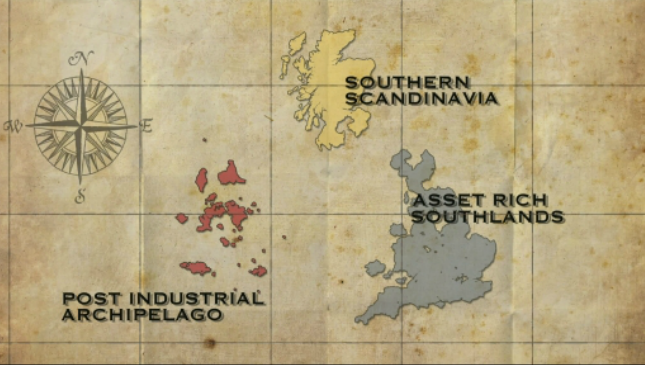
What was interesting about the BBC coverage in particular was not so much that they reported on the stunning changes in Scotland but that they did so from a traditional ‘British’ (i.e. London-centred English) perspective. The coverage of the stalled Labour revival across England (with London a notable exception) was astute in many cases. Paul Mason of Channel 4’s analysis of the UK’s new political geography was succinct:

The Fragmented Political Geography of Britain 2015

The Fragmented Political Geography of Britain 2015

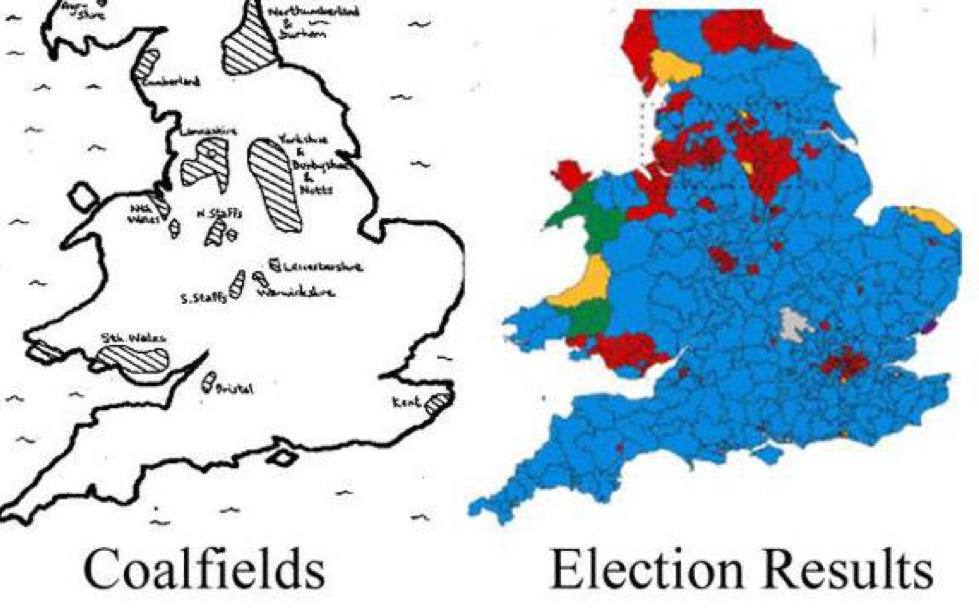
This underscores the degree to which Labour in England was unable to break out of what has been its traditional heartlands where heavy industry and mining once dominated. Pat Kane tweeted an even more graphic map of this phenomenon by comparing the areas of Labour support in England with the distribution of former coalfields, as shown.

Comparison of Coalfield Distribution with Labour MP

Comparison of Coalfield Distribution with Labour MP

There are exceptions to this uniform coincidence (London & Kent) but the point remains—Labour could not break out of its post-industrial ghetto into the more aspirational rural idylls. It was the failure to make progress here—more than any other factor—that scuppered any Labour government and caused Milliband to fall on his sword. Labour will now descend into internecine conflict whether the party was not left enough or not right enough; whether it was too Blairite or too much in the pockets of the unions. But that would be repeating the mistakes of the past and remaining blind to a new era, heralded as graphically as it could be by its obliteration in Scotland.

Labour are not alone in seeing tomorrows politics in terms of the past—the whole night’s coverage by the BBC was entirely by London-anchored reporting with outposts in the far-flung colonies like Manchester. But the hexagonal colour tile map taking shape outside BBC’s Broadcasting House showed a startling variety among the four countries of the UK.

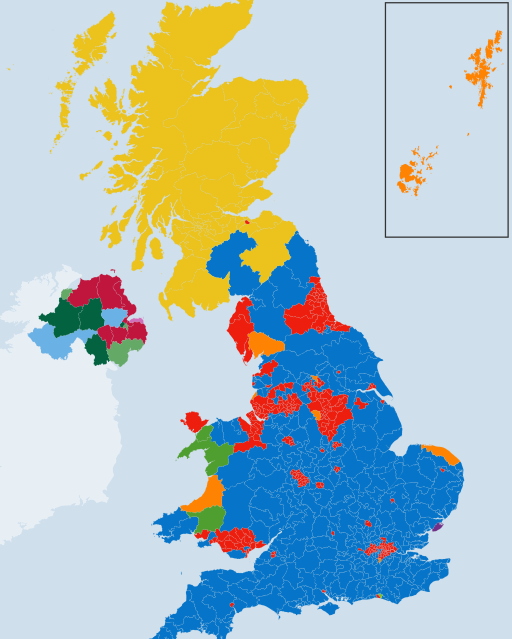
Reporters made much of the divergent colours between England and Scotland as virtually all the 59 tiles representing Scottish constituencies turned SNP yellow. But the 18 tiles for Northern Ireland were coloured a mix of ‘Other’ parties, as they have for a century—which was reported as normal. Wales was the only one of the four looking vaguely like England, made the more so by three more Tory seats—and 27% representation there.

Political Map of UK after the 2015 General Election

Political Map of UK after the 2015 General Election

Given that England covers 533 of the 650 seats being elected (82%), it is hardly surprising that the bulk of coverage focused on those. But while much was made of the voting revolution in Scotland, the attempts to explain it were couched very much in English terms and the underlying drivers barely understood.

Some factors were universal across most of the UK. That the Liberal-Democrats were going to suffer as a punishment for their coalition with the Tories was widely predicted. But its sheer scale was underestimated—a loss of 49 of their 57 seats not only decimated their experienced MP cohort but sent them back into a minority wilderness out of which they had inched over half a century. Why the punishment was so severe remains unclear, given their centrist policies and the general drift of parties in that direction.

“The Lib Dems are not just empty. They are a void within a vacuum surrounded by a vast inanition.” (Boris Johnson)

Understandably,  the main story of the night was the Tories’ ability to form a majority government, despite having been in power and administering swingeing austerity measures for the last five years. Virtually no pundit or poll had foreseen this.

The second story was Labour’s modest progress in England and Wales—14 more seats almost entirely at the expense of the L-Ds, with the exception of some impressive victories in London. Even had their normal Scottish contingent of 40 MPs been returned as before, this was far too weak a performance to get anywhere near government.

The third story was the Labour wipe-out in Scotland at the hands of the SNP. But this was reported entirely in terms of the English CON/LAB/LD ‘main parties’ when such a framework clearly no longer applies—even Paul Mason and Pat Kane’s keen observations seem to miss the probably permanent dislocation of Scotland from the British political mainstream, much as happened with Ireland in the run-up to WWI.

“The sweetest victory of all…we confounded the pollsters…We held on in Scotland.” (David Cameron)

Cameron’s quote is shorthand for the myopia that exists in the unionist parties even after the rise of the SNP and the political awakening of the referendum last September should have opened their eyes. For the Prime Minister to see the UK governing party holding a single seat in Scotland with a thin majority of 798 (1.5%) as anything other than tragic says much for their focus.

From once being as typical in party balance as England, since the seventies, Scotland has drifted in its own direction. At this election, it left the reservation altogether. A chart of its history of representation at Westminster illustrates this well.

Westminster Party Representation from Scotland since WW2

History of Westminster Party Representation from Scotland

For unionist parties to have countenanced this decline and seen it in terms of Westminster (and therefore English) terms seems foolhardy and counter-productive. First the Tories, who once held a voting majority, lost that edge through a series of thrawn decisions that decimated Scottish heavy industry, culminating in the disaster (for Scottish Tories) of Thatcherism.

“There is no such thing as Society” (Margaret Thatcher)

Labour gladly stepped into the vacuum without needing to actually do anything. They spent the next quarter-century sending mostly buggins-turn voting fodder down to Westminster where Scottish interests like oil funds or fishing rights or opposition to Trident were subsumed into their battle with the now-totally-English-focused Tories. Even capable Labour MPs like Smith, Cook, Darling, Brown, Alexander, etc ‘went native’, seeing themselves more as London’s men in Scotland, rather than the reverse. Only Dewar had the vision to join the Scottish Parliament but had died within the year.

Labour could have learned from the Tories whose ‘hollowing out’ in Scotland under Thatcher reduced them on a feeble footing from which they have never recovered. Despite the Goldies and Monteiths, they are still seen—however unfairly—as an English party of ‘Hooray Henries’ confined to comfy Borders or Perthshire estates or the rarified world of Edinburgh QCs and the Honourable Company of Archers.

Either unionist party could have smelled the coffee, absorbed the bolshy zeitgeist abroad since the nineties and developed Scottish policies in tune with the people they claimed to represent. But after two decades of ineffectual opposition (kept in local power mostly by not being Tories), Labour in Scotland caught its terminal disease—Blairism. This did not sit well down the Miners’ Welfare in Auchenshoogle but it offered success and power—whether in Edinburgh or London—both irresistible to candidate and branch organiser alike. It was tholed philosophically as a means to an end.

But it also meant a hollowing-out of the Scottish party. On top of the political nursery of council sinecures, Labour now had over a hundred MPs and MSPs, all of whom needed office managers, press officers, SPADs, etc. The payroll vote swelled to over a thousand. But self-motivated, principled activists, who once formed the backbone of the party and rooted it in the communities it served, shrank to a core of idealists. Worst of all, the ‘B’ team from whom the MSPs had been recruited sought promotion to the London gravy train, where they took up jobs with no notable impact back home—certainly not when it came to benefiting Scotland.

The bottom line: despite mouthing a mantra of ‘ordinary working class’ or ‘looking after the vulnerable’ or ‘traditional values’, it doubtful that John Maclean or Keir Hardie would have given the time of day to wasp-chewers like Curran or bar-room brawlers like Joyce, let alone Derry Irvine’s taste in wallpaper or Peter Mandelson’s penchant for guacamole over mushy peas. The Westminster elite became alien to the remaining social fabric that held Scottish Labour together as a civic force at grass roots level.

All of this could be seen as progress and a modern party would have adjusted and moved on. But the dogged loyalty and local rewards created a system that threw up too few able politicians at any level. For every Wendy Alexander there were a dozen Karen Whitefields and nobody had the ability or stature of Wilson’s Willie Ross to take advantage of the power they deployed as Scottish Secretary.

It is no coincidence that the earlier fall of the Scottish Tories or the rather more rapid disintegration of Scottish Labour can be discussed with barely a reference to the SNP. Because both parties brought their demise on themselves. Despite the euphoria of Blair’s sweeping victory in 1997 (enhanced by Scottish Tories shooting themselves in the foot opposing any Scottish Parliament) the strong contingent of SNP MSPs elected in 1999 was their first warning.

But it didn’t warn. Organisation continued to drift; policy was set by London; decent performers headed South. Then came the louder fire alarm of 2007. Proportional representation winnowed the ranks of numpty West Central councillors like machine gun fire while SNP councillors doubled and half Scotland’s council fell out of Labour control. More stunning was enough SNP MSPs to form a minority administration under Alex Salmond and its competent operation. Suddenly, even Labour’s payroll vote was shrinking.

Radical action might have saved things—but Scottish Labour seemed incapable of ‘action’, let alone anything ‘radical’. Their group psyche of being the only ones capable of representing working and downtrodden people became outraged that the SNP had muscled in on ‘their’ patch. Members developed a venal hatred of all things SNP, surpassing even their long-held venal hatred of Tories.

The result was not pretty. They chose leaders like Gray and Lamont who were grey and lamentable—light on leadership and idea-free zones. Their opposition was interminable girning and nothing else. Sympathetic media did Labour no favours by beaming FMQs into ordinary homes, showing Salmond running rings round their supposed champions.

The final straw was the 2010 general election when Brown was clearly a wounded animal and, after 13 years of Blairism, a Tory victory was likely. Labour voters trotted out for the last loyal time to be rewarded in a lesson in London Labour impotence. ‘Osterity’ should have been an open goal but they picked the wrong brother as Leader ant PMQs became not much better than FMQs. Worse—almost every Labour talking head on Marr or Newsnight was some button-down slick ‘soothmoother’ or excruciatingly earnest ‘Blair Babe’, many of them (e.g. Balls) with the oily facelessness of ex-SPADs. Not one Willie Ross or John Reid with whom the once-Labour-to-a-man denizens of Carntyne or Cardenden could identify.

At the 2011 Scottish elections ‘third warning’ another slew of mediocre Labour MSPs went down like ninepins across once-hallowed home turf of Lanarkshire. The SNP achieved the supposedly impossible outright majority in the Scottish Parliament. Outraged resentment oozed from every Labour statement. They resembled a small child refused an ice cream who hopes that by squatting down, closing their eyes and holding their breath their just entitlement would be restored. To the apolitical bulk of Scots, it was their undoing.

Perhaps a better metaphor than a spoiled child would be a rabbit in the headlights. For the last four years, little changed: policy was dire; spokespeople were dire; joint work with on Better Together was negative caterwauling of the ‘Scots are too poor, too wee…’ sort. Had they claimed that, with independence Irn Bru would become poisonous and our first-born would arrive with two left feet and thus be hopeless at football, they could hardly have insulted supporters more.

The ‘victory’ of the NO campaign last September was nothing of the sort. Given the fanfare of media arrayed against them, the canny Scots should never have got near voting YES in the first place. But hurried intervention of promises just prior the shuffling of feet at Westminster since outraged many by its cynical deviousness. From then on, a serious gubbing for Scottish Labour was inevitable.

But what made this election the perfect storm for Labour was the loneliness of Jim Murphy’s one-man band underscored by Kezia’s overpromotion. Once-traditional Labour heartlands were loyally fed a Milksop-Millibland message…and jumped ship. All the SNP had to do was avoid making any mistakes. Having come of age, they made none.

Up by 933%—Six Old MPs with 50 New Ones + NIcola

Up by 933%—Six Old MPs with 50 New Ones—with a Triumphant Nicola

Tom Harris’ wry explanation of “not enough votes, mainly” while true, provides no clue how Labour moves on from this. Fortunately, one glaring lesson of what NOT to do is clear—don’t be a branch office. The Tories have done that and have been mired in the wilderness for 18 years so far.

If the three unionist party rumps are too thrawn to learn from the SNP, they need to look at Ulster, where parties start from the premiss that they represent  locals in the imperial capital and not the other way round. Because recent 55% NO vote or not, Scotland is off the reservation and ain’t coming back.

If the unionists are serious about being our friends, they must stop saying ‘British’ when they mean ‘English’, they must stop throwing their 533 English votes around when it suits them and start handling Scotland AS IF it were a sovereign nation because that’s where it’s headed if they don’t.

Posted in Uncategorized | Leave a comment

The Other Borders Railway

Most people around Edinburgh know that there will be big fanfares this September when the long-awaited Borders Railway re-opens as far as Tweedbank, linking the Central Borders, Galasheils, Gorebridge and Dalkeith back into the ScotRail network at Waverley. It’s not quite the Waverley route that once went on through Hawick to Carlisle but it’s a start.

But there is a second such key link in the works that is likely to provide just as big a boost to Borders business and quality of life—but at far less cost than £294m the Institute of Economic Affairs called ‘insane’ because of its cost-benefit ratio of only 0.5 (50p return for every £ spent).

For ten years, the local Rail Action Group East of Scotland (RAGES), backed by East Lothian Council has been lobbying for a return of a local service from Edinburgh to Dunbar and beyond. Until recently, all such services were provided by long-distance trains from East Coast or Cross Country and had led to the ridiculous situation of Dunbar station being run by East Coast and their train service being driven by East Coast Main Line (ECML) planning based in London.

A Scottish Transport Appraisal Guidance 1 (STAG 1) was undertaken and released in October 2005. It identified various points as worthy of further examination. When the SNP administration took over ELC in 2007, they put the project into high gear, asked for the more detailed STAG 2 analysis (completed in 2013), lobbied Keith Brown MSP as Transport Minister and persuaded ScotRail to experiment with an interim local service to Dunbar (stopping only at Musselburgh for QMU) in 2010.

A full service with new train stations for East Linton and Reston came a step closer after services for the stops were written into the new ScotRail franchise. This involved a two-hourly service between Edinburgh and Berwick, with timing for stops at East Linton and Reston as part of the new planned timetable. Recently this local service to Berwick was priced by Abellio and accepted by Transport Scotland.

Although originally planned to be introduced as early as December 2016, operational requirements meant that even the newest  class 380 trains used on the North Berwick service did not have adequate acceleration to adhere to the proposed timetable stopping at all stations in the busy ECML schedule. This means that service introduction is delayed until the new Hitachi-built trains are available, which means December 2018.

By then, considerable progress will have been made in providing a new station at East Linton some 300m to the West of the old one with vehicle access from the North (Brown’s Place) and pedestrian from the South (Orchardfield). Such a station will provide an easier access for people in Spott/Stenton and relieve congestion at Drem. Work should also have begun on a station at Reston, accessible from Eyemouth, St Abbs, Ayton and much of Eastern Berwickshire.

And because it is included in the ECML timetable, we know when the trains will run. Apart from an 07:00 train to Waverley starting at Dunbar, the 2-hourly service is as follows:

  • Weekdays leave Edinburgh at 06:31, 08:36, 10:33, 12:33, 14:35, 16:34, 18:34, 20:22 and 22:33
  • Sundays leave Edinburgh at 08:36,11:36, 14:36, 17:36 and 20:36
  • leave Berwick at 07:41, 09:47, 11:50, 13:47, 15:47, 17:48, 19:47, 21:47 and 23:44
  • Sundays leave Berwick at at 09:47, 12:47, 15:47, 18:47 and 21:51

Journey times will be at least as fast to existing stops (Edinburgh-Drem in 23 minutes) with the following journey times on the extended service:

  • Edinburgh-Dunbar in 35 minutes
  • Edinburgh-Berwick in 58 minutes

While not quite as fast on either stretch as the Cross-country trains, this will beat any driving time to Central Edinburgh and may prove serious competition to Perryman’s excellent bus service on both ( currently 1hr from Dunbar and 2hrs 10 mins from Berwick), as well as linking Berwick with Dunbar by rail for the first time in decades.

Besides convenient access into Edinburgh, this also opens up a number of options for East Lothian and Berwickshire residents. Access to/from QMU will now be easy for students in Eastern Berwickshire and better for those around Dunbar, avoiding any need to go into Waverley then back out on a North Berwick train.

But this also opens up options for residents along the line to pick up both East Coast or Cross Country trains at whichever between Dunbar and Berwick they stop, again avoiding the need to travel all the way in to Waverley. Even North Berwick residents can change at Drem for a 15-minute wait to head South but coming North you’ll need to dash over the bridge because the two trains will arrive around the same time.

Including Dunbar and its hinterland, the population opened up by the other Borders service is as large and economically important as the main Borders Railway. And, at under 10% the cost (with most of that going to provide two brand new stations). With a BCR of over 2 already calculated for this service, positive lessons from electrification of the North Berwick service and huge unexpected ridership on new services like the Alloa line means this may be some of the money best spent on Transport anywhere in Scotland—with a bonus for our Northumbrian friends.

Posted in Commerce | Leave a comment

Labour is already in mourning.

MacWhirter has proved to be among the most astute political observers in Scotland. But in the blog below he has managed to cut through party spin to articulate the real currents driving Scottish politics in a way that unionist parties and the media have failed to grasp, let alone deal with.

@iainmacwhirter's avatarIain Macwhirter

Spare a thought this weekend for the Labour MP for Glasgow North East, Willie Bain. Opinion polls had suggested that he might be the only Labour MP left in Scotland. It could have made him a shoe-in for Scottish Secretary.

Then on Wednesday, disaster struck. A poll from Ipsos Mori suggested that the SNP would take every seat in Scotland. Poor Willie Bain’s brilliant career was cut tragically short.

Of course, no one believes these polls. I can’t see the SNP winning every seat in Scotland. Even after landslides on Everest some people are left standing and I fully expect that on Friday morning there will still be a number of Labour MPs boasting that they survived the Nat-quake.

But no one can be in any doubt that a fundamental change has taken place in the fabric of Scottish politics. It seems almost unbelievable that only five years ago, Labour…

View original post 2,054 more words

Posted in Uncategorized | Leave a comment

The Kids Aren’t All Right

What follows is my column to this week’s East Lothian Courier, which tries to address a pressing issue for our local school pupils and their education.

Last week East Lothian Education Committee met for the first time this academic year since September. After two recent efforts had failed as inquorate, it met last week. The reason given for this huge 7-month gap? “No business to consider”.

Errr..not true.

Last June Audit Scotland published its School Education report. Its Exhibit 10 shows East Lothian to be the 2nd-worst (of 32) councils in improvement over 2004-15; its Exhibit 9 highlights EL with the 2nd-worst (of 32) disparity between best- and worst-performing schools in its care.

Also last June, the Wood Commission published its Education Working for All report. It is laced with insight and ideas how education might better prepare our young people for the real world. Its Summary says: “(throughout secondary), young people should be exposed to a wide range of career options. This can only be achieved by schools and employers systematically working together in meaningful partnership”. East Lothian has achieved no such thing.

Fire alarms on this scale should demand reports and decisive action. A year on, the chair (Cllr Shamin Akhtar) has yet to do either. The two policy papers that were considered on April 21st didn’t mention—let alone address—either report, despite having had a year to do so. The decision taken? That members note “attainment in East Lothian has improved 2009-2014”.

Cobblers.

By SQA yardsticks, East Lothian has fallen (by 1.5%)—behind comparable authorities like East Dumbartonshire (up by 15%) Disparity within the county has actually grown but Labour shies from publishing data for individual schools and, by aggregating, can boast we’re around national average.

Comparing 2004 SQA statistics with 2014 is very revealing: NBHS results +15%; Knox +9%; Dunbar +3%. Good so far, but: PL -6%; Ross -7%; Musselburgh Grammar -9%. These latter are poor figures, suggesting our three largest high schools have lost ghround: they are WORSE than a decade ago.

And looking at where school leavers wind up shows similar disparities. So-called “positive destinations” averages 89% of EL’s 1,043 leavers, compared to 91% nationally. Our poor average conceals over half ‘non-positive’ results leave from just two schools (43 out of 82).

Yet Audit Scotland and Wood are ignored. This Labour administration declines to hear any alarm bell ringing, let alone the need to discuss solutions—so smugly comfortable with inaction are they that deaf must mean there IS no alarm.

Meanwhile, pupils in half EL’s high schools are offered raw deals instead of careers.

Posted in Education | Leave a comment

Tiptoe Through the TTIP

Hands up all those who know what TTIP stands for? You don’t? Well it was the topic of a major debate in the Scottish Parliament yesterday. However it received scant coverage. The only news about the SP seemed to be that we should expect a rammy there today because it’s the last FMQ before next week’s General Election.

It’s the same with most obscure acronyms referring to organisations not instantly recognisable as sports (FIFA), political hot potato (NATO), celebrity (BAFTA) or telly (BBC) oriented. Business—especially international business—is a wilderness of ignorance. ITU-T(CCITT)? CFCA? ERDF/ESF? The first regulates telecomms worldwide—the basis for both internet and mobile phones, the second runs EU fishing (in which Scotland gets no say) and the third distributes more EU sunsidies across Scotland (£600m) than CAP (£580m).

The Transatlantic Trade and Investment Partnership (TTIP)—along with the TPP sister operation for Asia—is Uncle Sam waking up and trying to smell the coffee after five decades of protectionism during which they missed several rounds of trade agreements with their best customers. While Europe was post-war devastated and fragmented and the Chinese dragon had not yet grown up to be capable of global flame-throwing, US firms from Ford to Boeing to Intel to McDonalds to Microsoft could rule the roost.

The global reach of Google, Starbucks et al shows they are still very much a player. But the way Japan challenged and won electronics and small car skirmishes, the way Airbus stole much of Boeing’s market, the way Union Carbide’s Bhopal disaster put a stop to most shoddy industrial practice exploitation of the Third World all knocked the US off its once-dominant perch.

The struggle to mitigate the impact of recession post-2007 has been hampered by the habitual civil war that goes on between President and Congress but minds have slowly turned from their usual autocratic Deus-ex-Mackinaw position to a genuine attempt to go out into the world and negotiate treaties different from one-sided United Fruit deals with small banana republics—largely responsible for the US being tarred with a colonial brush throughout Latin America.

And so to TTIP. TTIP is about reducing the regulatory barriers to trade for big business, things like food safety law, environmental legislation, banking regulations and the sovereign powers of individual nations. The good news is that the Americans are genuinely after a deal with Europe.

The bad news is that (as usual) they want the rules written their way AND the whole thing has been going on behind the closed doors of commercial confidentiality since February of last year. As a result, few people are informed about the likely consequences of this being approved. John Hilary, Executive Director of campaign group War on Want, calls it “An assault on European and US societies by transnational corporations.”

Is that not hyperbole or, at least, anti-American overstatement? Well consider some of the probable impacts:

  1. Public services, especially the NHS, are in the firing line. One of the main aims of TTIP is to open up Europe’s public health, education and water services to US companies. This could essentially mean the privatisation of the NHS. The European Commission has claimed that public services will be kept out of TTIP. However, Lord Livingston (Tory Trade Minister) has admitted that talks about the NHS were still on the table.
  2. On the touchy subject of Food Safety, TTIP’s ‘regulatory convergence’ tries to move EU standards on food safety towards the US. But US regulations are not as strict: 70% of US supermarket processed food has genetically modified ingredients while the EU allows none; US restrictions on the use of pesticides are more lax and growth hormones in its beef are banned by EU due to links to cancer.
  3. Similarly in environmental issues, the EU’s REACH regulations on potentially toxic substances are strict—a company has to prove a substance safe before use is permitted; in the US any substance can be used until it is proved to be unsafe.
  4. The all-powerful City of London wants America’s financial rules (much tougher than the UK’s). They were put into place post-2007 to curb the powers of bankers and avoid a repetition of that fiscal crisis. TTIP could remove those restrictions, effectively handing the City’s powers back to bankers on both sides of the pond.
  5. On privacy, an easing of data privacy laws and a restriction of public access to pharmaceutical companies’ clinical trials are both being discussed. There is also a concern that the Anti-Counterfeiting Trade Agreement (thrown out by the EU parliament) is being reintroduced undemocratically as part of TTIP discussions.
  6. Jobs are also at stake: The EU has aldready admitted TTIP will switch jobs to the US, where labour standards and trade union rights are lower. The 30-year-old North American Free Trade Agreement (NAFTA) between the US, Canada and Mexico actually cost 1m US jobs over 12 years, instead of hundreds of thousands promised.
  7. There is no evidence to support TTIP’s claim that it will benefit small businesses. Large corporations will benefit from opening up of local procurement but small businesses will be disadvantaged in competition with transnationals.”
  8. But TTIP’s biggest threat is its inherent assault on democracy. One of TTIP main aims is Investor-State Dispute Settlements (ISDS) These allow companies to sue governments if their policies cause a loss of profits. This means unelected global corporations could dictate policy to democratically elected governments.

Many of these points came out in Wednesday’s Holyrood debate S4M-13007—Implications of the TTIP for Scotland. While Jamie McGrigor  (Tory Spokesperson on the Environment, Fishing and External Affairs) was pretty gung-ho about the whole thing, a great deal of sense was spoken by the two Independent Highland MSPs, Jean Urquhart and John Finney who touched on most of the points listed above and made a strong case that, although Scotland was (again) not at the top table negotiating this, that we would be best to sup wi’ a lang spoon from this particular brew.

On a February visit to London to ‘promote’ TTIP, EU Trade Commissioner Cecilia Malmstrom got several fleas in her ear: MPs said more transparency was needed to address public concern; Business Secretary Vince Cable accepted there were benefits, but only if MPs were given access to the treaty to ask searching questions; StopTTIP UK claimed it could jeopardize governments’ legal freedom and lower trade standards. “What part of ‘NO’ does she not understand?” is how they put it.

International trade agreements are necessary for world economies to flourish. But a good start to defusing a raft of valid concerns about TTIP would be to drag its negotiations out of the closet and into democratic view.

Posted in Commerce | Leave a comment

Lions Led by Donkeys Revisited

This week the centenary of the launch of the ill-fated Gallipoli campaign of WWI reminded us all that butchery and senseless loss of life was not confined to the trenches of the Western Front and the massed Russian cannon-fodder of the Eastern. As with the opening of the ‘War to End All Wars”, it is right that the bravery and sacrifice of those who died there is acknowledged, if not celebrated.

But news pieces in the UK media of uniformed royalty making speeches and laying wreaths at Cape Hellas were rather long on glorification and short on reality. As with so many military operations, the expediency of the war effort, national morale and self-interest results in far more glorious victories being toasted when they were actually disasters. WWI seems to specialise in particularly pointless disasters.

The motive to launch Gallipoli was to break the deadlock of the new trench warfare on the Western Front with a strategic blow that would take one of the four Central Powers out of the war. Winston Churchill hatched the scheme during his first tenure at the Admiralty, his attention having been drawn there by the RN’s botched effort to prevent the German battlecruiser Goeben from escaping to Turkey when war broke out.

With frustration rising that the propaganda-touted Home Fleet was unable to bring the German High Seas fleet out to deal with it and unable to prevent embarrassing raids on North Sea ports, Churchill’s brilliant but Boys Own mind thought using the Allies’ superior navies to force “the Sick Man of Europe” (as the tottering Ottoman Empire was known) out of the war was the very dab to rekindle the sense of adventure he had relished against the Boers and at Omdurman.

They would force the Dardanelles against a much weaker Turkish Navy (Goeben notwithstanding), seize their capital Constantinople (not yet called Istanbul), thus forcing their surrender. This would open access to the Black Sea and to hard-pressed Russian and Rumanian allies.

As an example of inadequate intelligence, abysmal planning, inappropriate equipment, ad hoc muddling and tactical incompetence, Gallipoli has few equals in a war where Imperial jingoism seems to have trumped sensible evaluation and deployment every time. Having fought mostly spear-wielding natives and little else over a century of empire-building, the British mind set and training was geared to conflicts such as depicted in the film Zulu.

Turks were clearly not ‘British’ (cultural overtones of superiority intentional) and so could obviously be dismissed as similar to the Mahdi’s troops, slaughtered so comprehensively at Omdurman. The officers, many of whom had served in colonial roles, all of whom had grown up inculcated sons of the world’s first superpower, were particularly racist in  dismissing enemies.

The Turks—aware that an attack on the Dardanelles was a strong possibility greatly improved their defenses in the region. From February 1915, the Allies had bombarded and destroyed the Turkish forts right at the entrance to the 50-mile-long Dardanelles before making their attack proper. This revealed that the straits were heavily mined, forcing the Allied navy to sweep the area before its fleet could safely enter, but also alerting the Turks.

For an account of the various unedifying military missteps that characterise this best-forgotten pointless disaster, consider reading the original Lions Led by Donkeys blog. Suffice to say that it cost three dreadnoughts and 250,000 casualties on each side. By 1916, all troops and ships left were withdrawn with nothing positive to show for the utter waste.

However brave and resolute the troops were on both sides, it is hard to accept acknowledgement of that without parallel acknowledgement that the Admiralty planners, the Admirals and Generals in command, their considerable staffs of supposedly well trained, “top-notch” officers who dined well and passed the port in their comfortable messes on Lemnos or aboard ship of an evening were incompetent, verging on the criminal. Even now, they have not been brought to book. Consider:

  • On February 19th, Admiral Carden expected the breakthrough to capture Istanbul to take no more than two weeks. In one day his fleet of ten was halved.
  • Kitchener appointed Sir Ian Hamilton to land a Mediterranean Expeditionary Force of first the ANZACs (then training in Egypt) and the British 29th Division to silence the forts. But there were no landing craft, bombardment or support vessels provided and they were landed on scattered beachheads on the side of the peninsula away from the forts they were to capture.
  • The rapid, fierce Turkish response was countered by digging trenches and repeating the same unimaginative charging-barbed-wire-and-machine-guns tactics that had already made the Western Front such a bloodbath. So fierce was the fighting around Chunuk Bair that 711 of the 760 men of NZ’s Wellington Battalion were casualties.
  • Hamilton’s sensible attempt to outflank the Turks by landing IX Corps at Suvla Bay was botched by appointing the overage (if not senile) General Stopford to command it. His troops met no resistance and could have walked to the Dardanelles but were told to dig in and brew tea, which they happily did while Turks arrived to hem them in.
  • Because of poor logistics, summer heat and decomposing bodies, day-to-day life was intolerable, quite apart from Turkish snipers and artillery. Dysentery, disease, lice, flies and sores were endemic. Even water was scarce, tepid and reeking of chemicals.

Other than the courage and unbreakable spirit of those who survived this hell, there is little positive to be salvaged from the colossal folly. The former undoubtedly deserves to be remembered. But, even more tragic than their forlorn sacrifice is the depth of stubborn incompetence in the jingoistic imperial mindset of those who sent them into such futility in the first place.

It’s time that was remembered too.

Posted in Politics | Leave a comment

The Cost of Hubris

The troops have been brought home, Camp Bastion is again empty desert and everyone’s happy the news no longer features Hercules aircraft landing at Brize Norton with another load of coffins. Everyone—the government, the opposition, MoD, the Army, the veterans and the families most of all—wants to draw a line and move on.

But it should not be that simple. Despite the human cost, there are good and bad wars. Without Isandhlwana, Omdurman and other Boys Own adventures, Britain would have languished as a second-rate nation on the periphery of Europe. Whatever you think of Kipling’s ‘white man’s burden’, making a fifth of the world pink made Britain rich and powerful, predating America’s ‘manifest destiny’ by more than a century.

All that was possible only courtesy of an omnipotent Royal Navy and an army fielding some of the toughest infantry ever to wear a uniform. That omnipotence went by the board some time ago but the quality of British servicemen in terms of professionalism has remained a standard by which others are still measured.

And, as a result, the British Armed Forces have found themselves in some kind of shooting war in each and every decade since WWII, despite the Empire shrinking from a fifth of the world to odd corners too remote/poor/uninhabited to constitute viable countries. After India, our ‘Jewel on the Crown’ became independent in 1947 and an avalanche of colonies followed suit, the interventions that could once be seen as internal and therefore essential—Mau Mau in Kenya, Eoka in Cyprus, Communists in Malaya—evolved into intervention in sovereign countries.

Although no British Forces were involved in Vietnam, the litany of involvements from Sierra Leone to various Arabian flare-ups and culminating in Iraq and Afghanistan, have become a fixture in British policy.

But why?

Developed, mature Western democracies like Germany and Sweden play global roles; they both out-manufacture and out-export Britain these days. They therefore have more economic interest in what goes on around the world than most. Yet they decline to throw their weight around. Their armed forces are deployed outside of their borders only on UN peacekeeping missions. As a result, their standing around the globe—but especially in developing countries—is enviable. They are seen as a force for good, for progress, for co-operation.

Contrast that with Britain, that insists it is still a world power and still entitled to a seat on the UN Security Council, justifying this by retaining Trident. The result? Muslim and ex-Comecon countries regard Britain as an American pawn, ex-colonies use it mostly as a source of aid; British friendship is more cultivated to ease arms sales than anything else. The argument that British Foreign Policy is more driven by the US State Department and BAE than the long-term interests of its citizens is hard to refute.

Because, since Blair mortgaged real global independence to maintain the ‘special relationship’ with Bush and the ‘world’s policeman’, ever-diminishing British forces have been increasingly absorbed in wars of intervention that they are hard-pressed to sell as ‘good’ wars. The initial Taliban-ousting success in Afghanistan was squandered when the focus shifted to Iraq too early. And for the next decade, the British Army was enmired in an un-winnable civic squabble that made Ulster look like a cake-walk. At least everyone in Ulster spoke English.

Estimates vary but the US has spent something like $1.6tn on its involvements to date. That’s £1,000,000,000,000 or twice Britain’s entire budget. The war in Afghanistan alone has cost Britain ‘just’ 4% of that—£37bn. Since 2006, on a conservative estimate, it has cost £15m a day to maintain Britain’s military presence in Helmand province. The equivalent of £25,000 will have been spent for every one of Helmand’s 1.5 million inhabitants, more than most of them will earn in a lifetime.

Cost of US Involvement in Iraq and Afghan Wars

Cost of US Involvement in Iraq and Afghan Wars

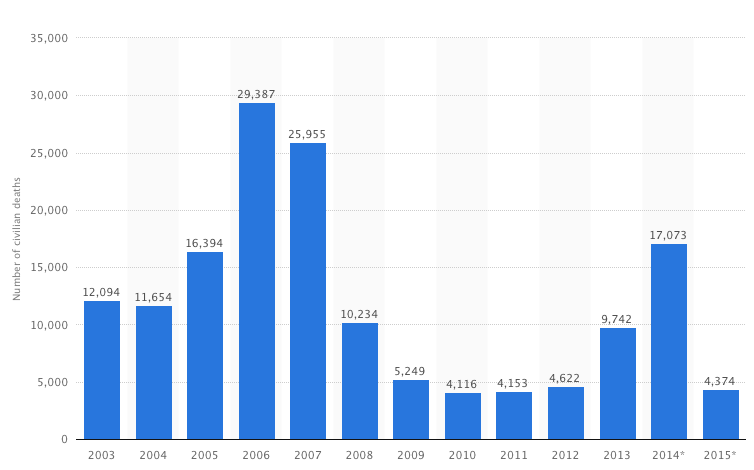
MoD officials claim “British troops were in Helmand to protect British national security by helping Afghans build up their own security forces”. But, after 2,400 wounded and 444 dead British soldiers (not to mention around 500 ‘civilian’ dead) and ten years, what has been achieved? Contrast with Iraq, a ‘bargain’ at only £8.4bn (MoD figure for 2003-09 only). Civilian deaths in Iraq have been a feature of the country since it was ‘liberated’ from Hussein’s tyranny, worsening recently as the ISIS offensive has destabilised the place yet again. There is every reason to believe that Afghanistan will mirror just as sorry a tale over the next decade.

Unfortunately, nobody in Britain seems to be asking what £45bn has bought civilisation, let alone Britain. Rather than killing umpteen foreign nationals for questionable aims, that sum translates into 115 hospitals or 2,250 schools or the entire government investment in the rail industry for the last decade.

Civilian Deaths in Iraq by Year

Civilian Deaths in Iraq by Year

Had the net result of either adventure (Iraq or Afghanistan) resulted in either becoming a model of democracy and stability now taking its place amidst the world community, an argument could be made that the money was well spent. But from the French at Dien Bien Phu to the British in Helmand lies a trail of hostility bred from cultural incomprehension and the mistaken belief that (in a repulsive phrase much in use during the hapless US incursion into Vietnam) “inside every gook, there’s an American trying to get out”.

Typical of the cultural mountain to climb was that in 2010, after five years of war, just three officials among the 160 UK Embassy staff in Kabul spoke Pashto. The proportion among serving officers in Helmand was even worse and among troops engaged in ‘pacification’ none at all. Here and in Iraq, Britain (like its US master) were using the wrong tool for the job. ‘Shock and Awe’ destruction of Hussein’s or the Taliban regular forces was a doddle. The cultural colonialism that followed was doomed to failure, just as a multiplicity of band-aids is no cure for brain hemorrhaging.

But, worse than leaving the country occupied with little or no net benefit, the resentment caused by the presumptive dismissal of local culture makes enemies where there were none. This, in turn, feeds the propaganda of those already hostile. There is an argument that 7/7 would not have happened had Britain not been hostile to such muslim countries. If Britain is to include, as it does, significant numbers of muslims who are to be regarded as citizens and equal as such, then following the US-led ‘global policeman’ foreign policy  is hard to reconcile with such principles.

Is it not time that Britain lost the delusion of being a World Power, propping up that claim with nuclear weapons? It can afford neither and would become a better global citizen more at peace with itself and its ethnic complexity. And when the outdated post-imperialists protest that we must be prepared to defend ourselves against the likes of Putin with his designs on Ukraine, ask them how they would feel if Russia  started dictating British policy in Ulster or its relationship with Eire.

Posted in Politics | Tagged | Leave a comment

Where the Rubber Meets the Road

Everyone knows there’s an election coming. The less political punters who think “they’re a’ the same” and seldom bother to vote may already be turned off by the whole affair with over a month still to go. But that would be a shame because—like the referendum in September which engaged just about everyone—there are things worth paying attention to this time around. It’s not just ‘business as usual’.

For the first time in nearly a century, it seems that no party holding an overall majority is easily the most likely outcome. The post-war era of monolithic Westminster-dominated behemoths who were once sharply distinct but have now (like the Republicans and Democrats in the USA) half-blended into Tweedledum vs Tweedledee apparatchiks who seem more fixated by power, the status quo and traditions than breaking moulds and forging new futures for the people.

Since Labour has backed off from the fractious statist mess they created in the 1970s and Tories have backed off from the equally fractious Thatcherite mess of the 1980s distinctions have blurred. Since Blair’s New Labour took power and the noughties by storm, the jibe about Red/Blue Tories has had an increasing whiff of truth.

But rather than fall over each other to woo the middle class, what post industrial Scotland needs is a dynamism that will take it into the 21st century with the kind of quiet resolve, social justice and effective economy that characterises Norway or Finland. What England does with its Westminster rituals, its delusion of world power, its cultural isolation, its distrust towards its neighbours is up to England. Scotland deserves better.

So, rather than getting too caught up in what is an English political debate about how best to afford Trident, aircraft carriers and a ‘seat at the top table’, Scots must be looking beyond May 7th and considering how best to prepare its people for the future. This is not, in the first instance, about re-fighting the referendum. But it is about driving the country forward, powered by the energy, interest and vision that the referendum unleashed.

I attended an SCDI (Scottish Council for the Development of Industry) Forum, held at RBS HQ at Gogarburn. Not only was the array of speakers impressive but what they said and the debates that ensued illustrated the resources upon which we can draw and the ideas that need to be exploited in forging a prosperous and distinct future for Scotland.

The RBS HQ Campus at Gogarburn

The RBS HQ Campus at Gogarburn

The welcome by Ken Barclay, RBS Chairman in Scotland, set the tone that a debate on our economic future was urgent. But Secretary of State for Scotland Alastair Carmichael echoed it by speaking of City Deals and decentralisation as essential steps to an efficiency and effectiveness that leads to prosperity.

This was reinforced immediately by Sir Richard Lees, Manchester City Council Leader who brought a tale of how Greater Manchester, enjoying a 19% population growth 2001-11 due mainly to an influx of younger people, was performing at 4.5% annual growth, better than London’s. But he emphasised that this was not as robust as Munich or Barcelona who had control over a greater geographic swathe and (more importantly) a range of services.

So he was on a crusade for a ‘Northern Powerhouse’—major political elements of the city region (ten councils, including the city) co-operating closely on services while major civic elements (NHS, transport, etc) came under their jurisdiction. He believed that, more than any other factor, cities drive growth and prosperity in their region. He also saw economic and social policy as inextricably linked, with particular emphasis placed on the early years of education. But key among such large overarching organisations was a need for close working and avoidance of silo mentality.

Clearly, despite Alastair Carmichael’s enthusiasm for city deals, we have a way to go. Unlike highly devolved Germany, until recently the UK operated a monolithic power base entirely focused in London. Unfortunately, despite receiving devolution themselves, Holyrood has been equally poor at passing those powers devolved any further and this will be a pivotal issue if Scotland’s cities are ever to benefit Manchester’s pioneering example.

The breakout (or ‘workstream’) sessions followed three themes. Of most interest to me revolved around ‘Better Skills’, led by ECC Chief Executive Sue Bruce. Scotland’s poor vocational system is holding it and the skills of a swathe of its people back. Social stigma associated with non-academic achievement is a curse common to England and Scotland.

Germany makes no such mistake and values craft and creative skills alongside academic ones (going a long way to explain their dominance in precision engineering and exports that capitalise on it). The Wood Commission highlighted a shortage of skilled young people and how poorly we dovetailed their training into education.

British Gas Field Operations Director John Craig provided and excellent example of the application of Modern Apprentices. They must replace their entire installed base of meters by 2020 with smart ones that can be read remotely. This involves 50 million installations in the space of five years. To achieve this, British Gas are hiring and training hundreds of young people as their own engineering staff have good mechanical but limited electronic skills and/or training.

John spoke of ‘fuelling the talent pipeline’, by which he meant they were engaging the young early on by ‘Inspire’ (at ages 5-11), ‘Inform’ (at ages 11-16) and ‘Experience’ (ages 16+). This involves entering schools for the first two stages to better support the last. However, the other presenter Marion Beattie of Skills Development Scotland betrayed the worst traits of a well intentioned but ineffectual bureaucracy. Fluent in the vocabulary “regional skills assessment”…”blended learning”…”triangle approach” it was, in Woody Allen’s phrase “tinged with nothingness”.

It was my distinct impression that, had she been confronted by an apprentice forester with a chainsaw she would have run a mile. Such bureaucrats dominate the civic structure of Scotland as part of the bloated 52% of Scots GDP dependent on the public sector. They are comfortable in cosy niches. As such, they are not part of the solution but part of the problem.

Interlude to Watch the Partial Eclipse during the SCDI Forum

Interlude to Watch the Partial Eclipse during the SCDI Forum

In contrast, the afternoon session brought a refreshingly frank ‘opening of the kimono’ by Darrell Steinberg, former President of the California State Senate. Among his legislative achievements, he created a $250m Career Pathways Trust to better prepare students for the workplace.

But the most important message he brought was the danger of over-reliance on academic results as a measure of either schools or the education they impart. California had based funding on a very narrow set of exam results, with the result that most education effort went into passing as many students as possible, all at the expense of a broader education and adequate preparations for the workplace, especially in vocational terms.

Although only a day long, the Forum was both though-provoking and useful for the opportunity it gave to meet and chat with the broad spectrum of 150-or-so senior business people who were there. Where the audience was weak was in policy decision-makers, whether MPs, MSPs, councillors or their staffs. Anyone concerned about the present academic fixation and consequent refrain from business that students are ill-prepared and sometimes even illiterate/innumerate would find that omission dispiriting.

For what Scotland needs is for our politicians of all stripes to stop fixating on their own career and tinkering with secondary legislation like smoking or air gun bans and meet this crisis in developing our young people to not just to have dreams but to have the skills to exploit them to the economic benefit of the country. That covers a broad spectrum of callings that need equal placing with academia—from the carpentry that drives the world-class Chippendale Furniture school in East Lothian to sports ambition to follow the trail blazed by Andy Murray to the international acclaim from music giants given to Nicola Benidetti for following her dream.

The SCDI Forum was only a signpost. The UK parliament is too fixated on dogmatic disputes based on politics to give a lead. It is the Scottish Government who must take a lead from Manchester and give our half-dozen city regions powers they are hoarding to plan, education and provide civic support for what is appropriate for them.

The present SNP government may show more gumption and initiative than what went before but Labour led a sorry cavalcade of mediocrity for the first eight years. If the polls are right, a decimated Scottish Labour will be in the wilderness for a decade and the Tories have yet to find their way back.

So, in forty days, the opportunity will be there for a rampant SNP to hold Westminster to account for devolution of what Scotland needs. They will have a clear run to go after and pass the Norways and Finlands of the world, a chance for a Second Enlightenment that boosts the lives of all our people. But that will happen only if they stop grabbing any reins of power for themselves and trust some to the hands of the people they claim to serve.

For all the barnstorming bravado shown in Glasgow this weekend, are they gallus enough to chance their future to achieve ours?

Posted in Politics | Leave a comment

Respect Unzipped

Yet another thoughtful blog from BurdzEyeView—in this case entitled “Nae man can tether time nor tide” demands consideration and, in this case, response. The piece welcomes the initiative of a motion in the name of the party NEC to the SNP Conference (planned for Glasgow next weekend) that will require the party to consider all-female short lists of candidates for next year’s Scottish election in those constituencies without a sitting SNP MSP.

This blog can make no better a case for this initiative than is laid out in BurdzEyeView and it is therefore recommended reading as preparation for the stushie that is about to break out in Glasgow when this is debated. For a branch in Clydesdale (already represented by a female in the shape of Minister for Children and Young People Aileen Campbell MSP) has lodged an amendment that effectively nullifies the original motion.

The SNP is to be commended for facing up to this controversy and providing what may prove to be a lively debate on the eve of a full-scale General Election campaign. While there is little doubt that the bulk of SNP leadership, starting with Nicola Sturgeou, stand full-square behind the idea of all-women shortlists to redress a gender imbalance in SNP (and other party) representation in the Parliament, in the soaring membership now passed 100,000 (many of them women) that may not be universal.

Rewind some 17 years to a similar conference in Aberdeen prior to the first Parliament election and there was a similar motion (in that case proposing ‘zipping’ candidates on regional lists—the idea that the list should alternate between genders as you went down) which triggered lively and impassioned debate on both sides but resulted in a rejection of the proposal. Many of those arguing against were women who felt such methods were artificial and demeaned women with the presumption that they were not able to achieve selection without help. As the Burd puts it:

“That debate for me was characterised by the number of bright, young women speaking against the idea, adamant that they would get there under their own steam, thanks very much. Only one of them ever did.”

Having met and worked with many colleagues of either genders while I was a member, I was impressed both by its egalitarian culture and, (having lost as many debates as I won against them) the abilities of the distaff side.

Because of said abilities, in this case I am not fearful that any such artificial construct might dredge up some dreadful candidates simply because they are women. But it must be said that earlier parallel efforts by Scottish Labour resulted in what has been slated as a ‘coven of Karens’ getting elected in the Parliament’s early days. They brought scant experience and even less ability to the chamber, having been elected entirely because they were a) loyal b) Labour and c) female. The argument could be made that the stature and achievements of the early Parliament were hindered by such members.But let me be clear that this must not be seen as applying to all female Labour MSPs. Wendy Alexander (whom I respect immensely) and Margaret Curran (whom I detest but accept has ability) to name but two were both formidable presences who could hold their own with the boys, not to mention Bella Goldie and Nicola herself.The issue is not whether women belong in Parliament or that they are in any way naturally inferior in ability, contribution or stamina, once they are there. And there is much to be said for Nicola’s position, which is:

“People say to me, ‘I don’t want quotas, I don’t want all women shortlists because I believe people should get on on merit’. I absolutely 100 per cent believe in that, I think people should get on on merit.

“The problem is that’s not what happens very often just now. If we had a system that was purely based on merit, we’d have gender balance because women are 52 per cent of the population, and unless you think that women are somehow less capable, then if we had a merit-based system we wouldn’t have these problems of under-representation of women.”

The trouble is we DO have a merit-based system and running a dogmatic coach and horses through it will not improve democracy.

Thirty years ago, because Latinos made up a significant portion of the population of California, the new equal-rights laws there were applied to boost promotion of Latinos and entire schools became Spanish-speaking to cater to the prevailing language in their catchment areas. Latinos were promoted and school grades improved. So a win?

Actually, no. So many people—especially Latino women—who benefited found themselves out of their depth because their background ill-prepared them to operate nearer the boardroom and their skills had not had adequate training to succeed. Many were failed by this missing element. Meanwhile high school achieved excellent grades that would have set them on careers had they been in Bogota or Buenos Aires. But their English wasn’t fluent or professional enough to earn them a job in Los Angeles.

Crow-barring culture through legislation is a crude and possibly even damaging approach. And if we don’t want to train Thatcher clones (females who operate in a male dominated environment by ignoring the fact they’re women and fail to offer enlightening character traits  in which men are singularly ill-equipped), then culture has to change first. That women are able and have equal contributions to make should be a given.

But simply shoving more women in by force who will have a doubly hard time until the social environment changes is gesture politics. If supported, I hope the motion does succeed in its long-term aims. I believe it to constitute a well intentioned approach at progress—but it is actually delusional.

Posted in Community, Politics | Leave a comment