And the Canute Cup for 2019 Goes to…

..the Scottish Conservative and Unionist Party, for the umpteenth year running. While this award is so richly deserved, it is hard not to feel sympathy for a number of sincere and honorable people who have dedicated much of their lives to this party’s lost cause. Current members from Jackson Carlaw down to the most marginal coffee morning attendee may  well rail at such trite dismissal. But it’s their own fault.

A party with a long and influential history in England, it reached a high level of influence with Disraeli’s government of 1874-1880, a time when British explorers led entrepreneurs, backed by the Royal Navy, to dominate and influence the world. Sadly, the Scottish Conservatives were a sickly scion of that robust tree, reputedly able to send all of its MPs to London in a single first class railway compartment. This is small wonder.

Whereas, in England, while the party’s grandees wee uniformly upper-class, the bulk of its members and support came from middle-class pillars of society—bank manager and shopkeepers who may not have been to Eton of Oxbridge, but were (in today’s phrase) “aspirational. The rise of the Labour and concomitant decline of the Liberal parties couched the political debate in class terms, which amplified this social stratification of party support.

A parallel stratification was at work in Scotland, but here it rather worked to their disadvantage.  Post-Culloden, the landed gentry mostly adopted London-centric English culture and accent, following the English practice of identifying the status of strangers by the way they spoke. Edinburgh had little to offer the ambitious that could compare with the  power, the finance and the gentleman’s club networking beyond the Faculty of Advocates and the Honorable Company of Archers. Support from landed gentry evolved naturally to include farmers. But what gave Scottish Conservatives a much-needed shot in the arm in the 20th century was their opposition to Irish independence. The ‘Unionist’ part of their title refers to unity with Ireland, not to Scotland. Their staunch support for the Protestant unionists of Ulster garnered them major support among the (larger) Protestant working class, specially in and around Glasgow. This was augmented post-WW2 by some shrewd intermingling of social events with politics; people attended their popular tea dances just to meet ‘nice’ people.
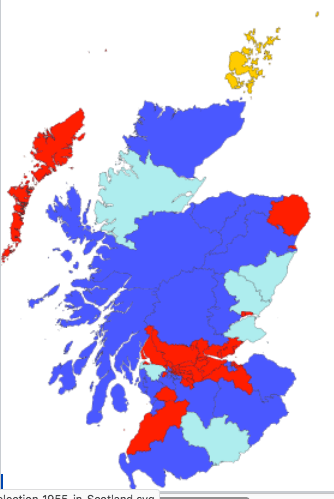
ToryHeyday

What a Difference a Lifetime Can Make—The 1955 Unionist Heyday

This helps explain the unique phenomenon of the 1955 General Election, when, for the first and only time, Conservatives gained over half the votes cast. But this was delusion. The rule of the landed gentry grandee MP was over. William John St Clair Anstruther-Gray lost rural Berwickshire & East Lothian to a dynamic Labour academic John Macintosh. The pragmatic and therefore popular Teddy Taylor held Glasgow Cathcart against a decimating tide of Tory unpopularity in Scottish cities, perhaps because he had no class pretentions.

Against a waning influence of landed gentry, no robust Home Counties and Shires base as exists in England, rampant Labour support in cities and a disappearing Protestant vote, Thatcher’s reign sounded their death knell. Despite her early reforms Britain so desperately needed, she never saw Scotland as more than a province (c.f. “The Sermon on the Mound“) and the patrician arrogance of Ian Lang and Michael Forsyth sealed the fate in advance of  the 1997 wipe-out.

The following decade in the wilderness did little to change their mood music. Having bitterly opposed the Scottish Parliament, their acceptance of (almost all list) seats in it did people’s perception of their integrity no good. The pedestrian leadership initially displayed did little to help

Then, along came Ruth Davidson, the breath of fresh air they so desperately needed. Suddenly, the SNP Government were being held to account by Ruth and her Tories than the denizens of Numptygrad who lined Labour’s opposition benches. Not only was she a breath of fresh air after the stilted mirthlessness of McLetchie, Fraser, Carlaw and Liz Smith but she appealed to thousands normally put off by Tory policies and history. From one solitary MP—the hapless David Mundell—she galvanised her party and the electorate to return 13 in 2017. In the 2017 Scottish elections, she led 31 MSPs into the chamber, becoming the official opposition and keeping Nicola Sturgeon and her troops on their mettle far more effectively than the carousel of Labour leaders had done.

But this renaissance was not to last. Cameron misjudged the mood of Britain regarding the EU, May misjudged Tory party loyalties and played her Brexit cards too close to her chest and Johnson has behaved like a political bull in our parliamentary china shop.

GE1955ti2015

Sixty Years  After the Unionist Heyday

Any party that has lost one third of its support, as Labour has, needs to look at its policies in the light of who it seeks to represent. But a party like the Conservatives, who have lost TWO thirds of their voters needs to ask why it exists.

If Scottish Tories are content to be a minor, marginal party, they may well exist for some time. Landowners, farmers, businessmen, professionals and public school alumni, many of them seeing themselves as British more than Scottish, do form a natural base. But that is barely 10-15% of the Scottish electorate. A century ago, their forebears stuck their unionist heads in the sand over Ireland. The result was partition, bad blood, The Troubles, thousands dead and—ironically—the divisive Backstop that torpedoed May’s Brexit deal.

To break out of that ghetto and gain widespread appeal to seriously contend for power in Scotland, they must (however distasteful this may be to the Old Guard) listen to the people they claim to represent and break with their English colleagues on three major issues. This means:

  1. Rejecting Brexit and adopt a Europhile approach
  2. Removing Trident from Faslane or anywhere else in Scotland
  3. Actively supporting Scottish Independence

I can already hear the Old Guard choking on their cornflakes at such outrageous proposals. But Scottish Tories cannot afford to be dragged j

kicking and screaming into independence (as they will be) the same way they were dragged to devolution. This would be political hari-kaei. And it would leave businessmen and professionals of a right-wing bent who are to generate and staff the economic renaissance that would follow ceasing to be the vassal of a stumbling England and joining the European community as a valued and active member

Or they can cling blindly to their rusting throne and let the tide of history engulf them, then sweep them away.

Posted in Uncategorized | Leave a comment

US Founding Fathers Had Trump’s Number Two Centuries Ago

So, on the last day of October, after weeks of preliminary investigation, the US House of Representatives voted by a convincing margin to proceed with the impeachment of a sitting President for only the third time in the country’s history. Every Republican voted against this. Those Republicans are following the line given out by the President and his staffers that this is “a witch hunt”; “unconstitutional”; “secretive”;; etc.

In this, they appear to be both partisan and misguided, not to say ignorant of the Constitution in which the profess to believe and which they are sworn to uphold. Because among America’s founding fathers were some very shrewd operators—particularly Alexander Hamilton, whose views count heavily because he was the foremost proponent of a robust presidency. But conscious of the powers that would reside with that one individual, he also harboured an abiding fear that a brazen demagogue could seize the office. That worry explains why he was the one who analysed the balancing factor of impeachment in  detail: It would be required as a crucial instrument to curb possible abuses arising from extensive Presidential powers that he envisaged.

For the first 200 years, the ‘nuclear option’ of impeachment was never invoked. President after President from both parties sustained the dignity of the highest office in the land. Then came Nixon and Watergate and, in the stunning aftermath of the Vietnam War, a serious crisis of faith in the American system. Nixon at least when cornered, owned up to abuse of his office and  resigned. The impeachment attempt on Clinton twenty years later, being more partisan and of less import, fizzled out.

Unlike Thomas Jefferson, with his belief in people’s common sense, Hamilton concerned himself with their “turbulent and changing” nature. He feared an unholy trinity of traits in a future president — ambition, avarice and vanity. He worried about a “restless” and “daring usurper” who would excite the “jealousies and apprehensions” of his followers. He wanted the country to be governed by “wise and illustrious figures” who would counter the fickle views of the electorate with reasoned judgments.

And so after 242 years of figures living up to the high expectations pf their office, we come to Donald J. Trump— the type of man Hamilton most dreaded: a populist demagogue who would profess friendship for the people and pander to their prejudices while secretly betraying them. Such a false prophet would foment political frenzy and try to feed off the confusion. This is immediately recognisable as Trump.

What Trump and his Republican apologists seem to forget is that the morals of business deals and reality TV do not translate well into the dignity of high office and the impartiality of representing all 330 million people under care, rather than narcissism  and nepotism. Hamilton predicted there would be a Trump when he waned against:

“a dangerous ambition more often lurks behind the specious mask of zeal for the rights of the people than under the forbidden appearance of zeal for the firmness and efficiency of government. History will teach us that . . . of those men who have overturned the liberties of republics, the greatest number have begun their career by paying an obsequious court to the people; commencing demagogues, and ending tyrants.

What Hamilton failed to predict was:

  1. a supine electoral college, stuffed with party appointees, instead of individual wise thinkers.
  2. a supine Senate, more concerned with protecting ‘their’ President than demanding the noble and selfless spirit Hamilton had in mind when he empowered the office.
  3. a supine Supreme Court who, even if impeachment happens and passes the Senate, will quash any such impeachment

But who knows? Impeachment is no terrible swift sword and may well drag beyond next year’s election. If Trump loses, it’s all academic as it will be swallowed in a wave of law suits, once Presidential immunity evaporates.

Buy if, as the smart money has it, Trump trounces whichever of the myriad Democrat contenders who wind up opposing him, the circus will continue, Trump will denounce all opposition in his voluble way and Republicans will cling to his shabby coat tails. And the sensible, noble provisions Hamilton made so conscientiously will be trampled in an undignified public bar brawl for another four years.

Posted in Uncategorized | Leave a comment

Turkeys Vote for an Early Christmas

So the Brexit centipede’s final shoe has dropped and we are to endure the first General Election at Christmas for a century. Broadcast media are already hoaching with rentqaquotes from every party, burbling over their keenness to come to grips with their opponents and thereby win punters’ heats and minds.

Leave aside that those punters’ hearts are likely to be focused on whether to buy a Disney Rapunzel Vanity or and iPhone for their niece and their minds have, over the last three years, been gradually fortified against the predations of MPs who appear on TV with unavoidable frequency to eloquently rubbish one another, yet who cannot assemble agreement on the most important question facing Britain this century, despite pulling down £6,334 for each of the 41 months they have failed to do so. When their campaign gets underway in the dreich depths of winter, they may be warmed by the roasting they can expect on many doorsteps.

For, while media still conspire with politicians for these three years to pretend that various spokespersons speak with the honesty and clarity of Winston Churchill or Clement Atlee. Too many transparently self-serving statements have been made by small men (less often women) with small ambitions for this election to be seen by many as little more than a bun fight among political pygmies. To be sure, a voter with strong leave/remain views has some clear choices and will exercise them. But the indifferent and the tired-of-all-of-it may body-swerve the polls altogether.

Add in likely weather on December 12th and the turnout is likely to be low. This may reward Boris for sticking his neck out by suppressing Labour votes and pushing marginals into the Tory camp. This effect will be compounded by two additional factors: 1) Labour has a bigger civil war raging between the leftie Corbynistas and the centrist Blairits; 2) Corbyn himself is seen as un-electable as PM by anyone outside Labour..

But this does not mean a romp for Boris and his Tories. They will do well in the Home Counties and various shires. Nigel’s Brexit party are a spent force and won’t win seats. But their 10-15% will be enough to upset the Tory apple cart in leafy suburbs and the West Country where the Lib-Dems have strength and can milk their Remain credentials.  The Independent Group will be casualties, as will some very capable Tories like Ken Clark, Philip Hammond, Justine Greening, Rory Stewart and Dominic Raab, through the spite of BoJo and his Chief of Staff, Dominic Cummings.

The net result in England and Wales is likely to be a moderate Tory majority and a surge in Lib-Dems back to their pre-2015 strength.

But in Scotland, expect the story to be rather different. As late as 2006, Scotland was a Labour fiefdom, with other parties consigned to holding the odd seat and the Tories in limbo since their 1997 wipe-out debacle. Then the SNP shattered Labour hegemony in 2007, 2012 and 2015. Since Scots voted 63% Remain and the SNP has led a vocal resistance against being bounced out of the EU by English Eurosceptics, there is every chance of the Tories losing some of their hard-won seats and be left with a handful, mainly in the Northeast—especially since their doughty and effective leader Ruth Davidson has stepped down..

Labour, despite a revival in 2017, is a shadow of its former self, now that its power base and patronage system has been shattered. Although left-leaning, Scottish Labour is mostly at odds with Corbyn and will suffer the worst of both worlds. They will hold on to some seats where the MP is popular and effective, such as Ian Murray in Edinburgh South. But they will drop to single digits.

The Lib-Dems, though bouyed North of the Border by being europhile and a kindlier alternative to Tories, will also be squeezed—Orkney & Shetland will remain safe but even their leader Jo Swinson will need to look to her laurels not to get he jotters in Dumbartonshire East.

Irrespective of hat happens down South, in Scotland, the SNP will win big—not as big as their 56-seat landslide in 2015, but certainly getting halfway there from their present 36.But they could do better. If their leadership abandons its present timorous approach to leading the Scots to something better than a chattel of English jingoism and lay down some visionary policies, backed by plausible research, such as Andrew Wilson’s Sustainable Growth Commission report from 2018, they might do better.

Were they to articulate how wealthy Norway is from the same amount of oil as Scotland’s, how Netherlands is influential in the EU beyond its size and (especially) how Ireland not only recovered faster and better from the 2008 crash than the UK nut now boast a per capita GDP 40% higher than the UK, they might really set the heather alight.

Then not only would Indyref2 be a given but its outcome more likely to differ fro the first. Only then might the 438 Tory and Labour Unionist MPs when finally played nice and voted for a Dec 12th election realise that they were turkeys voting for an early Christmas and for the demise of the United Kingdom.

Posted in Community, Politics | Tagged | 1 Comment

Andy’s Not Our Only Heroic Murray

“Do you know that there’s hardly anyone left of last year’s Caucasian governments? I’ve tried to stop it, but in vain. Yet they can’t all be Trotskyites and traitors.”

——Lavrentiy Beria

Even today, Scottish society carries the scars of decades of political domination by the Labour party. Founded by the great John Maclean, for most of the 20th century, it fought the cause of the industrial workers who built Scotland into one of the great engineering centres of the world.

By the 1970s. with heavy engineering in steep decline, Labour’s powerful political machine, built around Labour clubs, Miners’ Welfare halls and unions, saw their power base grow shaky and figuratively circled the wagons to ensure their power—so hard-won—would be retained.

From their rock-solid base in widespread council estates, they ensured a layer of councillors controlled the cities and most of the Central Belt. Though a gifted few were selected to provide leadership, most were selected on the basis of loyalty. This provided a training ground for a phalanx of MPs, noted mainly for their loyalty and lack of contributions o Westminster. A similar recruitment base, leavened by some hard-fought gender balance, provided the MSPs who ran an uninspired first two terms of the Scottish Parliament. Control by the Bath Street STAVKA and individual CLPs brooked little dissent. An activist who worked hard and stayed loyal could expect a council sinecure and those dutiful in that role could hope for a “Buggins’ Turn” quiet and rewarding life as a voting-fodder MP. Few rocked the boat as most had no ambition or wish to lose either prestige or income. While not as brutal (nor as fatal), it reeked of Beria’s control under Stalin.

Then came the heresy of an SNP government in 2007, compounded by the majority sweep in 2011 and the landslide in 2015 that saw 40 Labour MPs lose their Scottish seats, leaving Ian Murray as the last of their MPs standing.

To be fair to Ian, he earned his survival, not being of the standard numpty stock. As a councillor, he worked hard for his Liberton ward and so earned his 2010 MP win in Edinburgh South. He proved his credentials as his own man by speaking out against Corbyn’s leadership and lobbied hard for a second referendum when the official Labour policy line was waffle.

“The Labour Party will have to come off the fence on that (i.e. a referendum) at some point pretty soon because I think what they’re trying to do might be incompatible with what’s available.”

—Ian Murray MP. Good Morning Scotland, BBC Scotland 18.12.18

Murray accused the party leadership of breaking its “broad church” when seven Labour MPs broke away to join a group of independent MPs in February. While still the only Scottish Labour MP, he resigned the post of Shadow Scottish Secretary because he could not thole staying quiet under Corbyn’s leadership.

So, given this and the history recounted above, it was perhaps no surprise that an attempt was made to deselect their most successful MP in Scotland at their meeting on October 24th. But it was not the CLP, nor its branches, nor even its affiliated unions who moved de-selection.

The move to deselect Murray came from the Unite union—not from the local branch but from its national headquarters, possibly even from Lavrentiy McClusky himself, an avid Corbyn supporter. Even by Unite’s standards it’s a demented move: Murray was re-elected in his Edinburgh South seat with an increase in his vote of 6,976. Labour party rules state that a contest to replace a sitting MP is triggered if a third of local members or affiliated unions back it.

“Corbynistas are using the prospect of an election to tighten the far-Left’s grip on Labour”

—Tom Harris, Daily Telegraph, 22.10.19

Murray saw off the attempt by Unite to have him deselected in the Edinburgh South constituency with aplomb. The move was overwhelmingly rejected in a vote of local members. All four member branches in the constituency backed the 37-year-old’s reselection in the meeting. Trade union and affiliate branches also rejected a selection contest, with the sole exception of Unite itself. As Murray commented at the meeting:

“It is a huge honour to have been reselected for the forthcoming General Election,” Representing my home city is a great privilege, and I have always put this constituency first and foremost.”

However much they may disagree with Labour policies, objective voters in Edinburgh South are likely to prefer Murray’s principled backbone to just another numpty loyal to the strict orthodoxy of Lavrentiy and STAVKA.

(See also Diana Johnson MP’s similar battle in Hull North)

Posted in Politics | Tagged | Leave a comment

No Way to Run a Railroad

ScotRail (Scotland’s railway) has come into some stick from customers for habitual poor service, especially since the franchise was taken over by Abelio three years ago. But things have improved immeasurably since ScotRail was formed over 20 yeas ago, with new trains, refurbished stations and a revamp Waverley.

Contrast this with the CalTrain system, serving the most advanced conurbation in the world—Silicon Valley, California. The 50-mile line runs from a terminus in the SOMA district of San Francisco to the heart of San Jose. It connects with the BART subway system near San Francisco airport, San Jose’s VTA (Valley Transit Authority) trams at Mountain View, and with Amtrack’s long-distance trains at San Jose.

CalTrainMap

In contrast to East Lothian’s ScotRail service to seven stations, serving 0.1m people, the CalTrain corridor offers 24 stations, to 1.94m living in one of the priciest stretches of real estate in the world. Massive commuting patterns to tech giants like Google, Apple, Facebook and Intel, as well as a financial services hub has flooded the two freeways (101 and 280) that run parallel between the two terminal cities. The total annual ridership is only 554,000—the same as the station at North Berwick (pop. 7,250) sees in a year.

CalTrain is in a $2.5bn (£2bn) infrastructure upgrade funded by the State of California and not Southern Pacific Railroad, who owns the tracks. This is six times the £294m cost of 30 miles and seven stations of the Borders Railway from scratch. So farCalTrain has spent much on modernising stations and elevating track to eliminate level crossings.

But all this investment has resulted in little improvement to services. Outside of commuter times, all trains stop at all stations, meaning a 1 hour 35 minute journey end-to-end—no faster than 40 years ago. The trains themselves are still 40-year-old diesel-drawn sets of six double-decker carriages. Multiple places where parallel track would allow fast trains are not utilised.

Although the plan envisages electrification, this will be hindered by 15 level crossings that snarl up local traffic as trains pass and the lack of integrated ticketing with BART, San Francisco’s MUNI and San Jose’s VTA makes the same un-joined-up thinking that Scotland suffers from. Far smarter would have been to extend BART on the SP tracks, where it would connect with the East Bay BART line extension to San Jose.. It is a duplicate spend as foolish as Edinburgh trams taking three times as long as trains between Waverley and Edinburgh Gateway—except wasting three times as much publuc money.

Posted in Community, Transport | Tagged | Leave a comment

Why Does America Keep Shooting Itself in the Foot?

The United States of America: World’s Richest Country; Leader of he Free World; Land of the Free; etc. Who would dare meddle with it? Yet it does have enemies: Iran; Russia; North Korea; Venezuela. China is a rival, but more of a trade partner than an enemy. But the most persistent and baleful challenge to its hegemony and future prosperity is America itself.

This was not always so. In its first century as a new nation, it was brashly aggressive, acquiring vast territories from Spain, France, Britain, Mexico and Russia, as well as the natives, by stealth bribery and outright warfare. As those countries all had similar empire-building ambition, hostility was short-lived. The threat of Spain trying to reassert control of its former colonies led President Monroe to issue his Doctrine in 1823, that:

“The United States will not tolerate a European nation colonizing an independent nation in North or South America. The United States wull consider any such intervention in the Western Hemisphere to be a hostile act.”

This anti-colonial stance stemmed not only from their own experience, but also from an early sense of destiny that the USA was the natural leader of both the Americas and emerging democracies. In the 1895 Cuban rebellion against Spain’s harsh rule, the US sent the battleship USS Maine to Havana to protect American citizens threatened by rioters but the ship was sunk by a still-unexplained explosion while at anchor. Spain’s brutally repressive measures to halt the rebellion were graphically portrayed for the U.S. public by several sensational newspapers engaging in “yellow journalism”—the original “fake news”.

Spain announced an armistice and a new program to grant Cuba limited powers of self-government. But public outrage against Spain persuaded the U.S. Congress to issue resolutions that declared Cuba’s right to independence, and demanded the withdrawal of Spain’s armed forces from the island, In addition to Cuba, the US had a long interest in China—initially economic but then spiritual as churches sought converts among China’s millions. The Spanish colony of the Philippines were eyed as a potential base. This is when ambition and economic gain subsumed better intentions.

As well as an American fleet sinking the Spanish Caribbean squadron and Teddy Roosevelt storming San Juan Hill, a fleet to do the same to the Philippines first required a coaling station and the independent kingdom of Hawaii was first taken over by US commercial interests there. The Philippines were duly conquered. But, instead of handing over to the rebels, as public interest forced then to do in Cuba, the US seized the islands as a coliny, trigggrting a brutal continuation of the rebellion that cost many lives on both sides before it was repressed.

It also signaled an end to America’s idealism and coming of age as a colonial power, like the Europeans it had so long derided. Hawaii did become a state in 1957, but Puerto Rico and Guam continue as colonies to this day. The hiving-off of Panama from Colombia as a supine host so the Panama Canal could be built reinforced this new, assertive posture.

The next cycle of self-delusion came in WW1 when America, now grown into a major power, made a decisive entry into  the war and influenced the subsequent peace through Wilson’s pet project of the League of Nations. But the mindset that it was Europeans who were always at war and that America should not pull their chestnuts out of the fire led to an isolationist stance that the Great Depression and recovery though the New Deal only reinforced. But America remained expansionist, with companies like United Fruit making the Caribbean an economic colony. In 1935, top Marine, Major General Smedley Butler  wrote a book titled “War Is A Racket“, in which he described and criticized the workings of the US in its foreign actions

But, isolationist or no, the US objected when Japan invaded China, which it now felt fell into its own spheee of interest. Mounting economic pressure culminated in an oil embargo on oil-poor Japan, effectively giving them the stark choice of a humiliating withdrawal from China or seizing the oil assets of the Dutch East Indies for themselves.

The direct result was the surprise attack on Pearl Harbor, for which American indignation was barely justified, given the scale of provocation and Japanese fetish about ‘face’.

Brave and copious though America’s contribution to WW2 was, at the Yalta conference towards its end, Churchill was unable to convince Roosevelt of Stalin’s iron will and Machiavellian ambition post-war. The result was a sense of betrayal and hostility to Communism as a new enemy among Americans, fanned by Senator McCarthy and witch-hunts against “un-American activities”. The Chinese revolution, the Berlin Airlift, the Korean War and the French debacle in Indochina only served to underscore the urgency and rectitude of this stance.

This led to lost opportunities, such as a refusal to support the Viet Minh who had cleared the Japanese out of Indochina, were moderate in their Communism and looked to the US as an anti-colonial power. Instead, the French were given copious arms and support to defeat them, the toughest and most effective guerilla force the world has ever seen wa created and all the lessons learned by the French studiously ignored in subsequent debacle on an even gander scale called the Vietnam War.

But propping up the corrupt regime in South Vietnam was not the only way America squandered its moral capital. Covert CIA operations propping up similar regimes from Nicaragua to Chile to Iran all failed. Muscular support for NATO ensured friends across Western Europe. But an unbending support for Israel lost it a similar number across the muslim world. Though leading the First Gulf War did much to repair such hostility, the over-reaction to 9/11 that resulted in a costly and unsuccessful occupation of Iaq, followed by a costly and unsuccessful occupation of Afghanistan, has frittered much of the resulting status and good will away.

The net result is that—even before Trump and his erratically blowhard foreign policy came on the scene, America’s fiends wee largely limited to prosperous Western democracies, while the bulk of the Third World saw their influence somewhere between overweening and insensitive and prefers the less didactically intrusive approach taken for decades by an ever more influential China.

But why should this be so? Why should the greatest economic powerhouse the world has ever seen keep “punching under its weight” in the world? The answer is two-fold.

  1. Bidness. The US became an economic powerhouse through untrammeled free markets—and persuading others to do the same. Much American foreign policy is diven by business, whether it was Dole in seizing Hawaii, United Fruit in the Caribbean, Kaiser Steel in supporting the UK in early WW2 or Haliburton in rebuilding post-war Iraq. This is all made possible by:
  2. Congress. Although technically a representative democracy, there was typically more turnover in the Soviet Politburo than in Congress.  America elects no-one to the House (and certainly not the Senate) without serious funding. Much of this comes from Political Action Committees (PACs). These are largely driven by business interests—insurance companies promote private health; auto manufacturers oppose emission regulation; arms manufacturers oppose defence cuts. As if this were not enough, most Congressmen and Senators have little foreign experience and little incentive to acquire any as they must focus on their domestic support and the funding to cultivate it.

While these two factors are too simplistic to provide all the reasons why America is consistently less well thought of in the world than it deserves to be, addressing both would go a long way to rectify the shortfall.

The root cause of both is the American electoral system, which gives money too much influence, giving incumbents too much job security (see previous blog “Constitutional Constipation). It is these self-same people in Congress, who would have to approve any such change, that puts this firmly into the category of “turkeys voting for Christmas“.

So, don’t hold your breath.

Posted in Commerce, Politics | Tagged | Leave a comment

Constitutional Constipation

America—regarded by many (especially Americans) as the world’s greatest democracy—is rightly proud of its Constitution. Forged at a time, before either the French or the Russians did away with them, when monarchs ruled the world it was a clarion call to the rights of individuals and the restriction of the power of rulers.

We hold these truths to be self-evident, that all men are created equal, that they are endowed by their Creator with certain unalienable Rights, that among these are Life, Liberty and the pursuit of Happiness.” —The Declaration of Independence

Pretty heady stuff at a time when Louis XIV was scalping his people to sustain the opulence of Versailles and the British were busy building an empire policed by conscription and press-gangs on class and slavery.

Something to be proud of, then—especially when it took thirteen struggling colonies of barely two million, clinging to the edge of am unknown continent, and turned them the world’s richest country of 350 million people. The concept of “rights” continues to this day, with states fiercely defending theirs against federal authorities and cities fiercely defending theirs against state authorities. As a result, enthusiasm for and participation in especially local democracy has remained strong, as evidenced by state propositions and healthy public attendance at city council meetings.

As part of all this, the American system of government, hinging on a deliberate three-way balance among the Executive (President), Legislature (Congress) and Judiciary served the country well for a quarter of a millennium. Things were not always noble (as when McKinley was bounced into the Spanish=American War and colonialism, after having championed the cause of oppressed peoples) or above board (as when Johnson got the country entangled in a major war in Vietnam, without ever admitting it was). Until recently, despite the electoral system having been invented when candidates rode horses around a trackless countryside the country on horseback and handbills wee the only medium. Developments like the telephone, newspapers, radio, automobiles, aviation, television and now the internet have revolutionised campaigns in ways the Founding Fathers could never have envisaged. But the biggest influence has been money; lots of it.

Spending on political campaigns in America dwarfs anywhere else. The 2016 Presidential election cost $2bn. The 2018 Mid-term (i.e. Congressional ) election cost twice that. That’s $43.64 for each actual voter in an electoral cycle, and far more than any other country. Efforts to set limits on spend have been quashed by the Supreme Court as it would “curtail freedom of speech”. As a result, these days, only rich people get elected, with billionaire Donald Trump the latest exemplar.

It’s democracy, Jim—but not as we know it.

There are strong arguments against the institutionalised US two-party system that dominates American politics (see The Hill and OSU Origins), which discourages reason and co-operation (known as “bipartisanship”).

So, now that this electoral jalopy has creaked down the road for over 240 years, is it long overdue to trade her in for a modern model? At the risk of a verbal lynching by outraged Americans civic purists, here are proposals to provide a democracy fit for the 21st century, and which would cost them (as they might say) “a whole bunch of money.

  1. Take the President out of politics. France, Germany, Ireland, etc. have Presidents who are above politics and can represent the while country, much as the Monarch does in Britain. His/her election thereby becomes less partisan and the bizarre Electoral College consigned to history.
  2. Re-think Congressional Districts. In all but the six states entitled to only one representative (AK, DE, MT, ND, VT, WY), introduce STV proportional representation. All states entitled to single-digit representation would be a single Congressional District. The 13 states with double-digit representation would be split into a minimum number of districts. This would increase state awareness and minimise gerrymandering.
  3. Introduce severe caps on campaign spending, in part by outlawing use of broadcast media (TV, radio, internet) advertising. Possible free distribution of one election address and limited Party Political Broadcasts in proportion to poll standing.
  4. Revamp Senate to mirror representation: States with 1-9 representatives receive one senator (elected by FPTP); States with 10-19 representatives receive two senators (elected by STV);States with 20-29 representatives receive three, and so on. (75 senators in all).
  5. House Majority Leader forms a government and chooses a Cabinet; most Presidential powers transferred here. House Minority Leaders leads the Opposition ad selects a Shadow Cabinet.
  6. Elections for all seats would be held once every four years.
  7. Consideration should be given to pursuing the 100-year-old idea of dividing California into two states around the latitude of San Luis Obispo.

Outrageous as such proposals may seem, consider other examples of counties with executive presidents—Maduro in Venezuela, Mugabe in Zimbabwe, Putin in Russia—and consider if this is the kind of political company the USA wants to keep. Then consider that just about every other pillar of democracy—from Western Europe to Canada to South Korea, to India to Australia—practices some variant on the above. And, finally, consider the advantages that would accrue to the American people, whom the system is supposed to benefit:

  • No more interminable (and expensive) Primaries
  • Ability for a broadly popular candidate to win over narrow partisanship
  • Opportunity for smaller parties to break REP/DEM hegemony
  • Opportunity for minorities to break the ‘white hair in a suit’ older male cabal
  • Demise of PACs, millionaire funding and ‘Beltway Bandits’ influential cliques
  • Obligation on Congress to actually DO something ad not bicker & filibuster
  • Enhanced representation of State, as opposed to business interests
  • Increased focus on the candidate and undermining of incumbent strangleholds

This may be much too heady for traditionalists/purists. But, with Trump behaving like a bull in a china shop with the niceties of convention that once made the present system seem fit for purpose, popular anger among the huge non-political majority may require change. For, as the Declaration of Independence also says:

“…whenever any Form of Government becomes destructive of these ends, it is the Right of the People to alter or to abolish it, and to institute new Government, laying its foundation on such principles and organizing its powers in such form, as to them shall seem most likely to effect their Safety and Happiness.”


Posted in Politics | Tagged | Leave a comment

Rule Without Rules

Many political observers, and a large chunk of the public, are variously bemused, shocked and outraged by the leaders of the two main anglophone countries on either side of the Atlantic. Rather than being “Leader of the Free World” where “huddled masses yearning to be free” find welcome, America has upset more nations in the last three years than when LBJ ran a full-scale undeclared war in Vietnam. Likewise, the legendary stability of Britain—and of its “Mother of Parliaments” has displayed more indecisive neurosis in those same three years than in the decade prior to Thatcher’s iton rule.

In part, this is due to leaders holding office before those thee years. In America, the affable Clinton, the folksy Bush and the urbane Obama lulled Americans into thinking their institutionalised two-party system was perfrct and neede d no change. In Britain, the bookish Major, the ebullient Blair and the smooth Cameron played a similar role in soothing feathers ruffled by Poll Tax riots. The Commons resumed its arcane pleasantries to which no-one, besides anoraks in some late-night TV wasteland, paid much attention.

All that now seems long ago.

We should be grateful to the Trump & Boris shoow for waking us all up, for administering a dose of salts to constipated hallowed halls of democracy. Congress—and the Beltway Bandits vampiring a good living from it—were entirely too comfortable inside funded fortresses that made incumbents immovable. They got little donedone beyond ritual dissent. The Commons seldom raised its debate level to the level even of the Lords and pretended not to be under the thumb of government majorities and the baleful power of whips.

Under Trump and Boris, dust, cobwebs and reputations are scattering. A good section of their respective publics are welcome their iconoclasm among the fustier corners of the temple. Various Sir Humphreys jerk awake from slumber.

But, is all this doing any long-term good?

This muscular politics, taking many of its cues from Vladimir Putin, is one that even tin-pot tyrants like Assad, Allende and Mugabe, not to mention exemplars like Stalin and Hitler would recognise. It follows some simple rules that would be laughably simplistic, if the preceding regime and its politicians did not cling to decorum, politeness and convention as tools to confront it. The rules are:

  1. Nothing is sacrosanct, unless it keads to success
  2. Find a popular/patriotic cause—and trumpet it.
  3. Find a section of the population to demonise and blame
  4. Find an foreign enemy to demonise and blame.
  5. Create an aura of powerful determination: L’audace, toujours l’audace, in which the leitmotifs are: “Attack is the best means of defence” & “it’s always easier to receive forgiveness than to obtain permission”
  6. Eschew consistency: keep ‘em guessing with unpredictable behaviour
  7. Say whatever it takes to succeed; just make sure it’s plausible
  8. Never apologise; admit nothing; deny everything
  9. Mould principles and morals to the cause—you must believe them yourself

To say that either Trump or Boris is a tyrant is exaggeration. But don’t be surprised if memoirs from Dominic Cumming or Jared Kushner emerge some day, embedding this philosophy in their received wisdom. That does not, however, mean that they are not driving their constitutional go-karts well over the speed limit and without due care and attention. Neither Prime Minister nor President gives a fig for the niceties of either constitution nor political convention. Selfless appreciation of anything—most especially others—does not even come into it. It takes real chutzpah to be so brutally focussed. But both leaders have it in spades.

Trump started life already in a penthouse with a father worth $8bn and a lifestyle he regards as his due. In New York property and New Jersey casino dealings, he learned how to out-fox opponents by misinformation that would have evinced Sun Tsu’s admiration. He learned early the dictum that the appearance of wealth and powerbegets more wealth and power. Ostentatious display of both became his calling card. And neatly leaving other people in the lurch—as n his failed Atlantic City casino—was just part of doing business. With no-one but family and minions supplying advice, there was no pressure to deflate his ego. With his wealth, running for office was always a possibility. But the brazen certitude, honed in major business deals made him a natural as the forthright, self-made outsider to appeal to masses tired of watching silver-haired suits mumble away their time in Washington.

Boris had a different experience, with similar results. He did not start with a silver spoon. As eldest in a middle-class family, he was zigged and zagged across the Atlantic in pursuit of his father’s career and was lucky to secure a King’s scholarship to Eton on the strength of English and classics. There the swot became gregarious, mixing easily with the other pupils and moving on with several of them to Balliol College, Oxford. There he joined the upper-class Bullingdon Club, mixed with budding Conservatives like Cameron and Gove. But, keen to become President of the Union, he displayed early elasticity of principles by suppressing this from SDP and Liberal students, diving the impression he shared their views. He won. After a stint as a reporter in Brussels, over which he enthused, he lost his job at the Times by fabricating a quote from his own godfather. Moving to The Telegraph, he found a niche in Brussels writing virulent anti-EU columns which stirred up the Euroskeptics in the Tory party to action but which Chris Patten observed included fake news, which John Major spent much time disproving. Although his writing style was well regarded, he was frequently late with submissions and berated staff who published without waiting for his piece. By developing a bumbling upper-class persona, he gained national fame on various TV shows and then as Mayor of London. Holding down multiple jobs, he did none of them to the satisfaction of those who had to clean up after him. Rather, he honed his harmless bumbler image while shifting political stances with shrewd aplomb, culminating worth his being the clear leader of the Leave campaign, which he peppered with ‘creative’ sound bites that seldom stood scrutiny. His gaffes as Foreign Minster may have been deliberate and got him sacked. Other than a fracas with his girlfriend, he kept quirt until Theresa May self-destructed.

“The selection of Boris Johnson … confirms the Tory Party’s increasing weakness for celebrity personalities over the dreary exigencies of politics. Johnson, for all his gift, is not known for his excessive interest in serious policy matters, and it is hard to see him grubbing away at administrative detail. To maintain his funny man reputation he will no doubt find himself refining his Bertie Wooster interpretation to the point where the impersonation becomes the man.

Max Hastings, London Evening Standard

In the case of both Trump and Boris, the personalities are the antithesis of the demure, reliable, if not downright elected representative that most people expect (and usually get) in a democracy. But these two are foxes, each loose in their local polital chicken shed. Their opponents cluck and fuss about the rules, condemning them for cavalier, capricious and confrontational behaviour—as if sowing alarm and confusion among their opponents were not intentional, if not meat and drink to them.

Significant numbers of votes relish the panic these two cause because they believe their own agenda is being furthered. This plays right into the “Rules…what rules?—I make the rules” *formely “Le Roi, c’est Moi) approach both leaders espouse. The resulting success will continue to, as long as either emperor convinces the cheering crowds the clothes are indeed real. But those who choose to live by such political swords should watch for opponents realising that ritual clucking is no defence. Boris stands closest to his Armageddon. If he goads them enough, the opposition parties may just forget their traditional enmity and line up to supplant him with an interim government that either reverses Brexit or, at least, gets a deal first.

Posted in Politics | Tagged | Leave a comment

Greta vs The Red Center

Greta Thunberg,, the immensely sensible 16-year-old who triggered mass protests at the reluctance of nations to address looming climate catastrophe, sailed across the Atlantic in a non-polluting yacht to address the UN’s Climate Summit this summer. Her message was impassioned, articulate and clear: we have only a few years to mend our energy-profligate ways before climate change will lead to nature-driven destruction. Her incisive advocacy inspired many to take action. Large numbers of young people showed up for a demonstration outside the UN summit.

We need a concrete plan—not just words” (Greta Thunberg)

But, however articulate Greta’s plea or impassioned the young demonstrators were, the rest of New York, and indeed the US took little notice. This is a bad omen. From the EPA struggles with Big Business forty years ago to the recent Obama administration, the USA had made steady, if halting, progress towards seeing nature as more than a collection of resources to be plundered. A couple of oil crises and loss of total economic dominance in the world has helped focus America’s mind on co-operation on broader issues. But that all seems to have come to a shuddering halt with the election of Donald J. Trump to the Presidency thee years ago.

In a whole series of consensus-wrecking moves, withdrawal from the Paris Climate Accord may turn out to be the most ill-considered. Now the Presidential glare has focused on California and its ground-breaking legislation on the environment, most especially on car emission standards.

This s unfortunate. Because since Washington legislators are swamped by PACs and lobbyists well funded by Big Business keen to encourage a light touch in placing any restrictions on their activities, it falls to the state—especially California, easily the most prosperous and dynamic among all fifty—to lead such innovation. And, curiously enough, Big Business does not seem to mind this because where California leads, other states follow and a de facto national standards provides manufacturers with a level playing field.

So, for the last century, California, together with other progressive states like New York, Massachusetts and Illinois have set the pace and the rest of the country more or less happily followed suit. But that was when America’s institutionalised two-party political system was in balance. Since the increasingly venomous 1990s, that has ceased to be the case to the point that these progressive states mentioned have become Democrat fiefdoms. Now that the Republicans hold the White House, it’s payback time. And Donald J. Trump is just the man to do the partisan job.

You may wonder why such a cluster of leading states would not carry the day with their size and economic clout. But Trump has plugged directly in to that part of America little seen by and little interested in the outside world: the Red Center.

The Red Center is an eclectic amalgam of North-East manufacturing states, Mid-West farming states, Southern Bible-Belt states and Wild West sunbelt states. They vote Republican. They don’t like imports. They don’t like immigrants. They regard themselves as patriotic Americans, believing it the greatest country in the world and that everyone else wants to be like them. This justifies American interference in other countries it regards as hostile to this concept as the “World Policeman”. It is a messianic 21st century twist on Kipling’s “White Man’s Burden”.”. And, while there are millions of enlightened citizens who don’t share this simplistic outlook, they are thin on the ground in the Red Center, where environmentalism is equally thin on the ground.

Given the scale, beauty and riches of the country, it is easy to understand hoe Americans developed this sense of boundless potential waiting for the hand of man to release it. While the more crowded states on both coasts have evolved beyond that, it is still the credo of the Sunbelt, especially Texas and Arizona. You may think Los Angeles is the sine qua non in urban sprawl and freeway lifestyle. Buy it is constrained by ocean and mountains.

LA’s 4,800 sq. mile metropolitan area—eight times the area of London—is dwarfed by Phoenix’s  14,600 sq. miles. To put it in context, that’s 25% bigger than ALL of Belgium. It spreads its rectangular grid of streets across the flat, featureless and apparently limitless Sonora Desert. Downtown is a huddle of high-rises, with nobody on the street because of 40degC heat. Otherwise, nowhere is close to anywhere, so everyone drives. The grid of streets are full of vehicles, mostly new, many SUVs the size of minibuses and trucks the size of delivery vans. They are all single-occupant. Commutes of 40 miles are common—but petrol is $3.34 per US gallon (62p per litre).

As if this were not enough to turn Greta’s hair white, the average house size is 2,164 sq. ft. (201 sq. m.), as compared to the UK’s 818 sq. ft. (78 sq. m.). These cost around £300 per month to keep habitable with air conditioning. You’d think that hot desert air would provide ideal laundry drying conditions but there’s not a clothes line to be seen: every house has a tumble-dryer. But many have pools, which each lose about 20,000 gallons of water to evaporation each year. This is on top of millions sprayed on golf courses, sometimes in the heat of day, and all of this water pumped from aquifers and draining the Colorado River dry.

The point of all this being that the 5m inhabitants of Phoenix could hardly be called environmentalists. Even if they wanted to, the place is so spread out they have to drive and the rest of their lifestyle is environmentally unsustainable. Which may be one reason why, like their fellow citizens of the Red Center, they will vote for Trump again in 2020. Because Trump tells them what they want to hear: that jobs can be brought back; that immigrants can be kept out; that it is perfidious foreigners and leftie Democrats that seek to sap America’s vitality and threaten the conspicuous consumption that made America great in the 1950s  & 60s.

One thing is sure: they are not listening to Greta. Even if they wanted to, they could not adapt to anything approximating the curtailed consumption she advocates. With Trump at America’s wheel and an eye on his voters, he will steer policy in a direction opposite to that required by Greta, by science and by reason. With China burning coal and Brazil burning forests, without America’s participation, action on climate change would be ineffectual.


Posted in Environment, Politics | Tagged | Leave a comment

In the Hands of the Irish

Growing up with The Troubles was not easy. In the late Sixties, you didn’t have to live in the six counties to feel their anger and grief, their passion and frustration, that sense of walking a long, dark tunnel with no sign of exit. Despite meeting fine human beings among their diaspora, for decades, I avoided visiting the place and could not shake a Pavlovian connection between an Ulster accent and blind bigotry. The breakthrough of the Good Friday agreement let me hope all that was past. But the resurgence of tribal that brought down Stormont 2 1/2 years ago and the divisive poison of the Brexit Backstop has re-kindled fears and despair among many more than just me.

But while Boris Johnson burbles on about how rich we could all be if the Backstop wee simply discarded and Arlene Fraser channels Ian Paisley with chilling accuracy, few in Britain seem to be taking Eire’s position into consideration or reflecting the half of Ulster that seems Eire as a good friend from whom they do not wish to be detached in any way. In part, this is because Shin Fein continue to practice their own intransigence, including not taking seats at Westminster, to which they were elected.

It takes some gall for any non-Irish to propose any solution for any part of Ireland and I apologise in advance should any of this cause offence. But, sometimes, it takes someone owing fealty to neither side and with nothing to gain or lose to not only be objective, but, more importantly, to be seen as such.

At first glance, the opportunity for objectivity—let alone mediation—seems bleak. All the institutions set up by the Good Friday agreement are moribund and the 2017 general election pushed results to parties at the extreme either way. Both SDLP ad UUP were wiped out; 10 DUP MPs wet to Westminster to wield extraordinary power by holding the balance, while Sinn Fein held to its tradition of performing MP duties at home but refusing to take their seats at Westminster. So, entrenchment is dug beeper?

Not if you dig deeper yourselves.

This Nay’s local and European elections threw up some unexpected trends in Northern Ireland. With the Brexit Party not standing there, UKIP had high hopes.. But their performance was as dismal as elsewhere in Britain. The non-sectarian Alliance won an MEP who wound up with more votes than any of the other thee elected. Preference transfers from both ‘sides’ to this middle ground were huge. The Alliance won an unprecedented 53 council seats (to the DUP’s 122 and SF’s 105) to become a force to be reckoned with.

It may be premature to say that the people of Northern Ireland are tired of partisan extremes. But they are certainly moving that way. Given their history of desperate attempts to retain control of Ulster ever since Jamie the Saxth planted the Scots-Irish there, it would take a wheen of optimism to think the dour cohorts behind Arlene Foster might shift their position when their world has never looked so uncertain.

But what about Sinn Fein? Given their loyalty to all things Irish and that a No Deal Brexit is likely to damage a prosperous Eire as much as their own patch.  Was there ever a time when a re-think of their tactics to benefit the people of all Ireland (not to mention friends in the UK and EU) by using powers they hold to influence events. I put to the many patriotic and reasonable people in Sinn Fein to adopt one of the following, depending on which is the most palatable:

  1. Go to Westminster. By sending seven MPs, Boris Johnson’s tissue-thin majority of 1 evaporates: he’s be 6 votes under water. Even with the DUP, his government could be constrained and a No Deal avoided.
  2. Resign en masse. Now. In members are unable to thole the Imperial Capital, go talk to the Alliance, Greens, SDLP, independents, etc. and pick the strongest possible candidate to fight each seat, then cause seven by-elections. With support for the centre ground growing rapidly, weakening unionist influence would be unable to stop this. The seats could not be left vacant for 3 months, so seven new MPs, all with Ireland (both parts)s interests at heart could create an unstoppable opposition to a No Deal Brexit.

Whether there is a general election or a minority government, there should be the opportunity for opposition motions to re-run the referendum, guide the government out of its blind intransigence or ask for assistance from the EU to limit any damage.

But, with the relationship with Eire being both the sticking point and the solution to the present Brexit deadlock, would it not be justice for the Irish both sides of the (non) border to seize the initiative and drive the imperial Brits towards a rational solution for a change?

Posted in Politics | Tagged | Leave a comment