Not Learning from History

“”Those who do not learn from history are condemned to repeat it.”

—George Santayana

Boris Johnson, having won his “decisive victory” declares this has cleared the air of doubt so he can “get on with the job of delivering for the people”. Laudable stuff—but what is the job?

His acolytes claim he has delivered Brexit, led Britain through a pandemic and led support for Ukraine. But his policies for our future remain unclear. Levelling up inequalities, growing the economy through well paid, skilled jobs, sustaining the Union, forging new trade deals and making Britain “punch above its weight” have all been repeated as matra. But how will these be pursued, let alone achieved?

Boris Johnson paints himself as another Churchillian, a leader whose rhetoric will guide us back to greatness. Not to decry Churchill’s wartime achievements, but he lived in the past. His vision was imperial, rooted in the 19th century. It seems Boris inhabits the same political anachronism.

A hundred years ago, Britain ruled the world—or thought and acted as if they did. Indeed, there was much to sustain this view. She had led the Allies in defeating the Central Powers; her massive Royal Navy ruled the waves; her Empire stretched “wider still and wider” having added Tanganyika, Namibia, Palestine, Jordan and Iraq?

But those parading this global dominance showed scant awareness the world changed. Edwardian affluence had been drained into national debt. American industry already outstripped antiquated British factories and practices. Class war and the 1926 General Strike eroded the deference with which flat caps doffed to top hats. And any harmony at home was shattered by the bloody secession of the Irish Free State.

The edifice of empire continued to stand, propped up by upper-class cadre to which Churchill belonged, who saw no reason for rethinking empire. Tea planters continued to mint money in Kenya and India, rubber planters in Malaya. That global reach was underscored by a great naval base in Singapore, a heavy presence in Egypt to secure to the East via the Suez canal and exploiting Iraq to serve the growing market for oil.

Both governments and business were happy to “carry on and keep cam” when it cme to economic exploitation of the colonies. Raw materials gleaned by colonial labour were imported, processed, then exported back as finished goods at huge profits. As other countries developed and seized such opportunities, Britain became less and less a going concern, with the depression taking much of the remaining wind out of its sails.

Rearmament for WW2 revived the economy, as Hitler’s had Germany. But with few exceptions (notably aircraft and electronics), Britain became Colonel Blimp. An arrogant officer class practiced tactics derived from the playing fields of Eton leading soldiers and sailors into war with inadequate weapons and training. An air of “muddling through” permeated the country.

But shocks in Norway, Dunkirk, Greece and Libya exposed these shortcomings. When two aircraft carriers (Courageous and Glorious) were lost through flawed deployment and the “mighty” Hood was sunk by the Bismarck, even the “Senior Service” was shown wanting

These sharp lessons, all suffered in the first two years of war, did not shift the bankrupt military thinking. When the Japanese struck in December 1941, the nabobs of Empire refused to conceive of any non-white race having the audacity—let alone the competence—to take on an empire “where the sun never set”.

Losing the battleships Repulse and Prince of Wales, sunk in a single attack by the Japanese 22nd Air Squadron stripped the British of serious naval presence, but not their confidence in ther provision and deployment of military forces.

Then the Japanese 25th Army ran rings around Percival’s IIIrd Corps, seizing Malaya and storming Singapore from the landward—where no defences had been built. 140,000 troops went into captivity, defeated by half that number. As if that were not enough, the Japanese 15th Army infiltrated Burma, routed the 17th Indian division. Another 200,000, mostly Indian troops died, or were captured on the 750-mile retreat into India

Both disasters derived from hidebound arrogance and neglect of training and equipment for native troops. The innovative Japanese simply infiltrated through “impassable” jungle disorienting and encircling road-bound empire units.

Nonetheless, the story that the plucky Britain went on to “win the war” is the standard text still used. That America become the massive arsenal of democracy; that they overwhelmed Japan; that the Russians absorbed and defeated the worst 80% of what Germany could do; that, without them, we’d all be speaking German are stories seldon told among those of Churchillian bent. The post-war “big three” gave Britain an inflated sense of itself until the 195 humiliation of Suez shattered that iany pretence of being a global power.

The point of all this is not to denigrate those who served or died for the Empire but to ask if those establishment figures like Churchill, who ran an eroding Empire for the first half of the 20th century had their eyes on the future or just leading a nation down memory lane. Which is where many still appear to live.

Churchill and his contemporaries may all be gone, but there is a faction in the present government, led by Boris Johnson and including the likes of Jacob Rees-Mogg, Bill Cash, Michael Gove and their brand of Brexiteers who would have us believe that past glory can be re-attained—in global economic clout, if not in pink-painted maps hanging on classroom walls.

This is dangerous delusion. Thinking that cutting ourselves off from our nearest neighbours and their single market can lead to economic glory echoes the blinkered dismissal of the opposition and blind faith in your own superiority that sent 2,000 men to their fireball deaths in a antiquated battleship or a quarter million into years of slavish captivity in sweltering Japanese P.O.W. work camps.
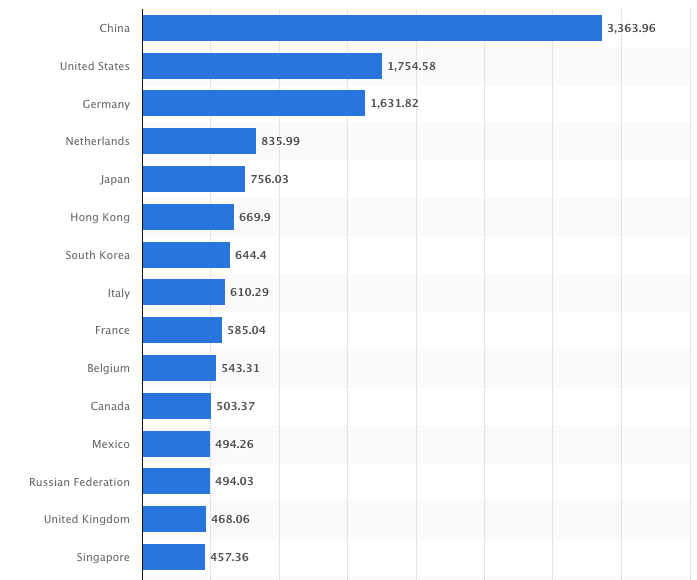
Nations Ranked Globally by Export Value, May 2022

The answer to Britain’s future does not lie in its past—a nostrum of Dunkirk spirit, Spitfire fly-pasts and warm beer in Walmington-on-Sea. Britain does is world-class in financial services. Together with creative industries, that does power a world economy in London and the Home Counties.

Unfortunately, the country is run largely by and for that one quarter of Britain. Despite noises about “levelling-up”, that affluence has yet to penetrate where the other 48 million British live. And, with a few exceptions, like Rolls-Royce in Derby or Weir Pumps in Glasgow, the rest of Britain offers the world little by way of USP.

The Danes can survive on dairy, Lego and wind turbines; the Swiss on finance and chocolate. But neither are struggling to keep their flgging economy in global fifth place and neither has 65 million mouths to feed. In fact, both the OECD and the World Bank agree in their forecasts that, the next year, Britain will grow least among G20 countries and risks stagflation. From dominating global exportss a century ago, it has fallen to 14th place (see chart), being overtaken by former colony Singapore, an island with 9% of our population who already boast a per capita GDP ($59.7k) that is 50% above Britain’s ($40.5k).

If Britain really wants to regain some of the economic clout it once weilded, it needs more than blusier about unfettered trade; it needs unique products TO trade. America and Russia can exploit massive resources; China and India can exploit docile millions who work hard for sweeties. Trooping the Colour souvenirs will not cut it.

Two years after having “freed” itself from the EU, this Brexit-loving government has yet to demonstrate that this was more than an exercise in re-introducing imperial measures, putting the crown back on pint glasses and relishing telling Johnny Foreigner where to get off.

#1026—1,275 words.
Posted in Commerce, Politics | 1 Comment

Sun, Sand and Sorted!

To all our English friends who have languished in queues and been bounced around Gatwick, East Midlands or Manchester airports by Cryin’-Air or Easy-Jilt in thwarted attempts at your first real holiday in three years, have you considered you might have been heading the wrong direction?

Despite rumblings from the independistas, neither passports not luggage checks are required to cross the border to Scotland.  We speak the same language (almost), have a lot more to do and see than among the endless tower-blocks of Benidorm. Since we have only 5 million people in one third of all Britain, while you cram 56 million into the rest, we are far from full-up.

Fine though such trails are to follow, while here you are not limited to just golf, castles or whisky. As well as culture to beat the band in our cities, there are outdoor activities a-plenty, from mountain bike trails in Glen Tress, white-water rafting on the Tay, hill-walking (but not necessarily Munro-bagging), sea-kayaking the Summer Isles or hard-core surfing Atlantic rollers on Tiree.

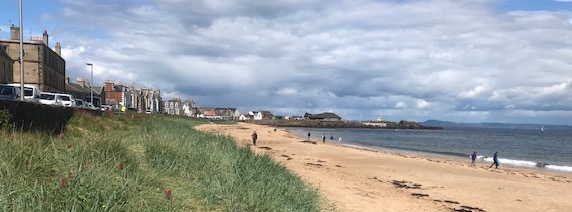
And, while I have your attention, during your visit may I recommend investigating North Berwick, delightful seaside town just 40 miles over the Border and a half-hour from the splendours of Edinburgh? (please avoid foul calumny and scurrilous innuendo that I might be plugging this because it’s my home). The town is rare in wrapping itself along two glorious beaches, split by a rocky harbour area, with several islands to make your snaps more scenic. Only 50m from the beach, the High Street offers a half-dozen cafes and pubs, a dozen restaurants and interesting shops and galleries to nose around in between.

East Beach with Paddling Pool, Seabird Centre and Craigleith
Skiffs Launching for an Evening Row, West Bay

Speaking of seafood, we land lobsters here so the juicy one on your plate was crawling about the local seabed a day or so before making your acquaintance. Which brings us to the harbour, the heart of the town in summer.

The Scottish Seabird Centre (SSC) will introduce you to the marine wildlife that shares this part of the coast with us. From the biggest gannet colony in the world on Bass Rock, through the flocks of puffins on Craigleith, the grey seals that keep them company and the occasional visit by dolphins, you come to realise how close we live to another world. Inside the SSC, you can control remote cameras to get panoramic views of that world. For those who’d like to see it for themselves, there are boat trips out to get up close and personal.

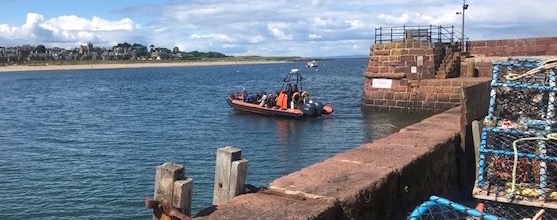
Seabird Centre Fast RIB Leaving Harbour for Isle of May Landing
Disembarking from SSC Catamaran at Galloway’s Pier, Craigleith in Background

The locals keep themselves busy in a myriad of ways. Aside from the fishermen and SSC crews, the local yacht club has more boats than the harbour can hold and organises regattas for “yachtties” from all over the country to compete on the fresh winds and open waters of the Firth of Forth.

Topper-Class Racing in the West Bay, 612-ft Berwick Law in the Background

If sailing is not your thing, there are plenty of other opportunities to get out on the water. Sea angling is good; local cod and mackerel can be caught by hiring Braveheart, which comes with rods, bait and a fisherman skipper Dougie.

Those up for some exercise can try local sea kayaking with Duneidean under George’s watchful instruction or join the crew of one of the Rowing Club’s four-oar skiffs for a social row out to see the wildlife and the town from a new angle. The really adventurous can get themselves caught up in the annual local raft race.

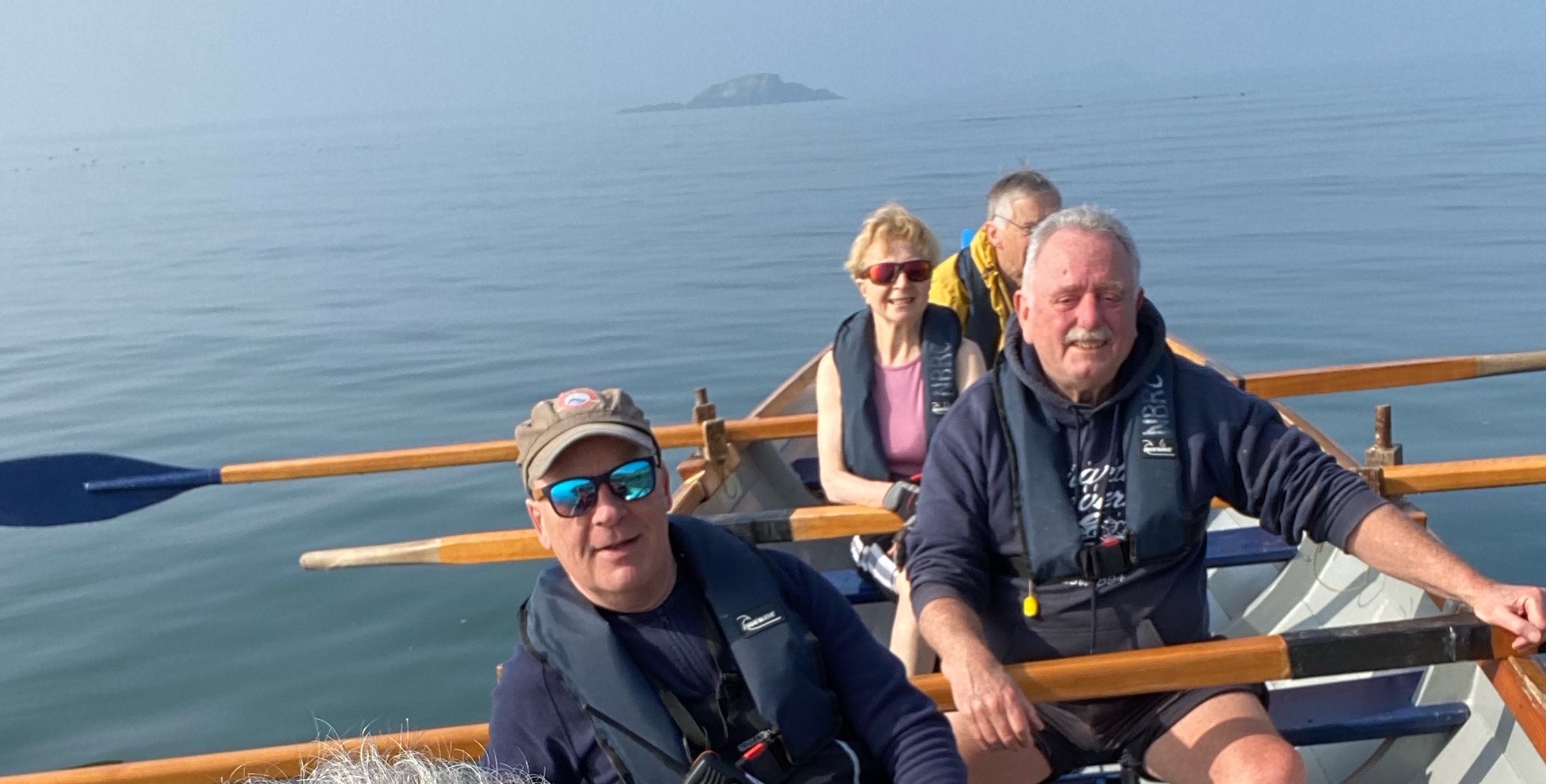
Skiff Rowing Crew Take a Break (Your Humble Scribe at No.3 Oar)
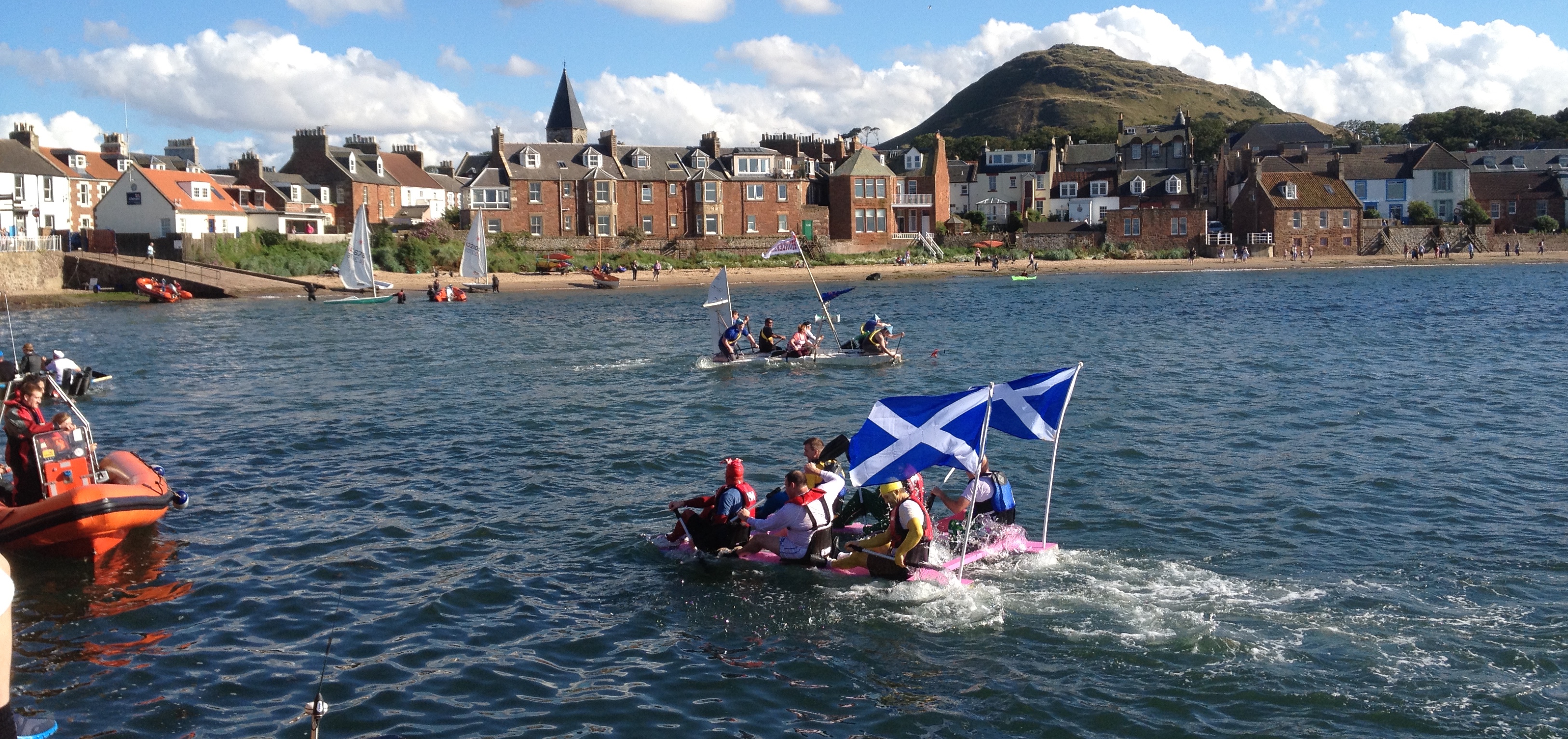
Raft Race in West Bay

And, if none of this appeals to your landlubber heart, there are many other events, such as the week-long Fringe by the Sea, the North Berwick Highland Games (dozens of bands from all over the world because it is used as a warm-up venue for the Worlds in Glasgow), a Lifeboat Day, the Air Show at the Museum of Flight.

It all sounds exhausting, but it is more relaxing and much more fun than 12 hours at an airport so that you can share the beach at Alicante with umpteen thousand others.

Forget airports—go green. That’s your sun and sand by the seaside sorted!

#1024 (known to us nerds as “two-to-the-tenth”)—685 words

Posted in Commerce, Community | 1 Comment

You Can Tell Republicans…but You Can’t Tell ‘Em Much

Gun violence in America reared its ugly head yet again in Uvalde TX. It can be scant comfort to those trying to comprehend this  in Britain, where guns are uncommon and not part of the culture, to know that Americans are equally baffled and appalled.

The most cogent analysis I have seen so far comes from US journalist Heather Cox Richardson, from whose recent blogs the following is a shameless steal-and-edit job.

“Ninety percent of Americans want to protect our children from gun violence, and yet those who are supposed to represent us in government are unable, or unwilling to do so.

— Heather Cox Richardson.

During the Cold War, American leaders came to treat democracy and capitalism as if they were interchangeable. So long as the United States embraced capitalism, liberal democracy would automatically follow.

That theory seemed justified by the fall of the Soviet Union in 1991. The crumbling of that communist system convinced democratic nations that they had “won”, that their system of government would dominate the future. In the 1990s, America’s leaders believed that the spread of capitalism would turn the world democratic, but they talked a lot less about democracy than they did about free markets.

In fact, the apparent success of capitalism actually undercut democracy in the U.S. The end of the Cold War was a gift to those determined to destroy the popular liberal state that had regulated business, provided a basic social safety net, and invested in infrastructure since the New Deal. They turned animosity toward the Soviet Union toward those they claimed were bringing communism to America instead.

“Now the Soviet Union is gone and conservatives can redeploy. And this time, the other team doesn’t have nuclear weapons.”

— Grover Norquist

Republicans cracked down on Democrats trying to preserve the active government that had been in place since the 1930s, increasingly demonising political opponents. In the 1990 midterm elections, Republican whip Newt Gingrich gave candidates a document called “Language: A Key Mechanism of Control.”

It urged candidates to label Democrats with words like “decay,” “failure,” and “corrupt,”, while defining Republicans with words like “opportunity,” “moral,” “courage,” and “freedom.” Gingrich later told the New York Times his goal was “reshaping the entire nation through the news media.” 

Their focus on capitalism undermined American democracy. They objected when the Democrats made it easier to register to vote. Losing Republican candidates argued that Democrats had won their elections with “voter fraud.” House and Senate Republicans launched investigations that turned up nothing, but sustained coverage in the media, by insinuating voter fraud was kept an issue that helped Democrats win elections. hee “Big Lie” was not a Trump invention.

In 2010, the Supreme Court green-lit a flood of corporate money into our political system with the Citizens’ United decision of 2013, which gutted provisions of the 1965 Voting Rights Act requiring the Department of Justice to sign off on changes to election laws, prompting a slew of discriminatory voter ID laws. In 2010, REDMAP (Redistricting Majority Project) enabled Republicans to take over state legislatures and gerrymander voting districts in their own favour. 

At the same time, the rise of a market-based economy in the former Soviet republics made it clear that capitalism and democracy were not inter-changeable. An oligarchy rose from the ashes, and U.S. leaders embraced the leaders of that new system as allies. The Conservative Political Action Conference met recently in Hungary, where Viktor Orbán was a keynote speaker. At the conference, he called for the right in the U.S. to join forces with those like him. 

In the US, where focus on free markets has stacked the political system in favour of Republicans, the vast majority of Americans want reproductive rights, action on climate change, equality before the law, infrastructure funding, and as well as reasonable gun laws. Sadly, their representatives seem unable to secure such things. 

Capitalism, it seems, is trumping democracy (pun intended).

A key driver of Republican policy is celebrating the ideal American, patterned on the American cowboy. if only the federal government would get off their backs. Those opposed to government regulation pushed the image of running cattle on the Great Plains, a white man who worked hard, fought hard against “imjuns”, and just wanted to be left alone. 

Actually, government intervention in the Great Plains was more extensive than anywhere else, with the Bureau of Land Management railroad barons and the US Cabvalry. Also, laws defending black rights in the post–Civil War South were seen as Federal overreach, leading to “socialism”, according to white racists there.

The idea of a hardworking man taking care of his family and beholden to no one became an attractive image to those who disliked government, whether  protection of civil rights or business regulation. Republicans played on this John Wayne mythology. Part of that mythology, of course, was the idea that men with guns could defend their families, religion, and freedom against a government trying to crush them. By the 1980s, the National Rifle Association (NRA) was no longer just promoting gun safety, but defended “gun rights”. “Shock jock” radio hosts like Rush Limbaugh fed the media with inflammatory warnings that government was set to destroy a man’s ability to protect his family by coming for his guns. 

That cowboy image has stoked an obsession with guns and war training in police departments. It feeds a conviction that true men dominate situations, both at home and abroad, with violence which, in turn, protects society’s vulnerable women and children. 

In 2008, the US Supreme Court said that individuals have a right to own firearms outside of a militia or hunting clubs. Justice Antonin Scalia, who wrote the majority decision, was eager to erase decisions of post-WWII courts that had upheld business regulation and civil rights. 

In 2004, a ten-year federal ban on assault weapons expired. Since then. mass shootings have tripled. The 400,000 AR-15 style assault rifles in private hands before the ban have increased fifty-fold to 20 million.

For years now, Republicans have stood firmly against any measure to restrict guns. After the Sandy Hook Elementary School massacre in 2012, Republicans in the Senate filibustered a bipartisan bill that would have expanded background checks, despite 55 votes in favour.

Since Sandy Hook, USA has suffered over 3,500 mass shootings. Republicans have excused them all by insisting on the need for MORE guns, so there will be “a good guy with a gun to take out the bad guy with a gun”., by arming teachers or having more police in schools. Fox News Channel personality Robb Elementary School had already been “hardened” with over 650,000 in security, including six armed security guards. The Uvalde (pop. 18,000) police cost 40% of the town budget even have their own SWAT team.

The story of what happened in Uvalde is undermining the Republican myth as it emerges. A fast response to Salvador Ramos firing outside the school for 12 minutes drove him inside where he barricaded himself inside two classrooms and shot his 21 victims while the 20 police outside stalled for almost an hour before Border Patrol (not local) officers unlocked the door and shot Ramoz.

Parents tried to get the police to go in found themselves accused of interfering with an investigation. US Marshals arrested Angeli Gomez, who driven 40 miles to get there. Gomez got local officers to release her, then jumped the fence, grabbed her two children and brought them to safety. 

“The law enforcement officers at the school were reluctant to engage the gunman as they could’ve been shot, they could’ve been killed“.”

— Steven McCraw, Texas Director of Public Safety

The heroes protecting Uvalde’s children were not the guys with guns.

In the aftermath of last week’s mass shootings in a supermarket in Buffalo, NY, Democrats had quickly passed a domestic terrorism bill and passed it to the Senate, where Republicans blocked it.

at a press conference, Texas governor Greg Abbott, who has signed seven new laws to make it easier to obtain guns said “tougher gun laws are not a real solution.” Standing against him for the governorship in November, Beto O’Rourke said:

“You said this is not predictable…. This is totally predictable. Until you choose to do something different, this will continue to happen. Somebody needs to stand up for the children of this state or they will continue to be killed.”

#1023—1,395 words

Posted in Community, Politics | Leave a comment

Have Anorak—Will Travel: Reston

The publicity over the opening of London’s £19 bn Elizabeth Line (formerly Crossrail) yesterday rather overshadowed ScotRail’s newest station opening at Reston at a millionth the cost. Largely the result of stalwart campaigning by the Rail Action Group East of Scotland (RAGES), this ends the anomaly of Berwickshire having one of the country’s premier rail lines (ECML), but no stations to access trains using it.

The intention is that it becomes a hub for the area and railhead for  scattering of towns and villages that includes Eyemouth, Ayton, Coldingham, Duns and Chirnside, as well as providing parking that is in short supply in Berwick.

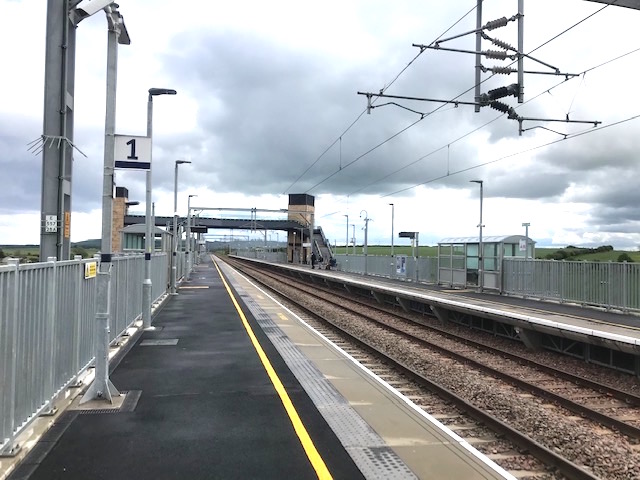
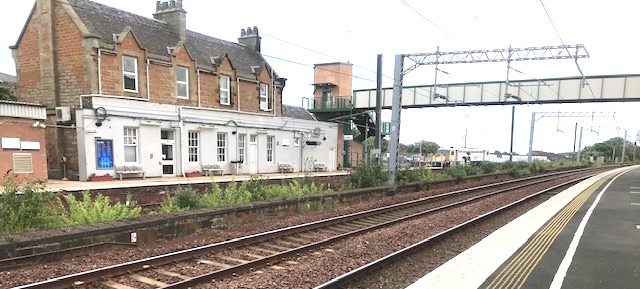
Platform 1 at Reston, Looking South

As a modern unmanned station, it provides lifts and bridge access from the 70-stall car park and bus stop where the single ticket machine is placed and basic waiting facilities of a couple of shelters and four-seat benches on each platform. The bridge has a nice touch of glass panels that allow views of the trains below without compromising safety.

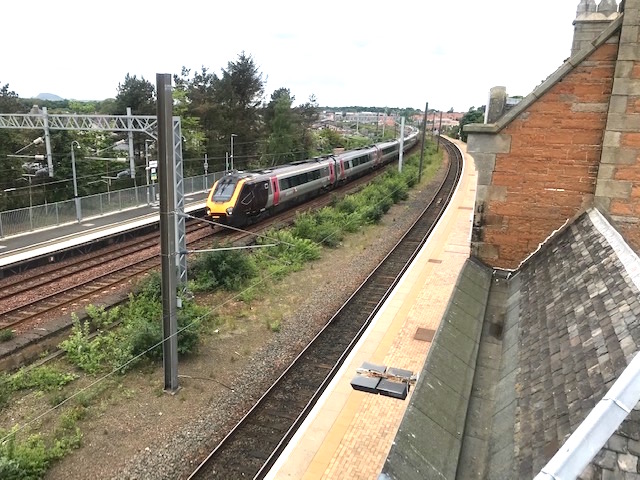
Northbound Transpennine Express Class 802 at Platform 2

Although the station itself shows little information and no timetables, the bus stop des show one for the Borders Bus services 34 Berwick-to-Duns (2-hourly) and 253 Berwick-to-Edinburgh (hourly). There is also a local Pingo dial-up bus. As with other unmanned stations, there are no toilet facilities, nor even waste bins. The nearest shop is 300m to the East in Reston village (pop: 450)

Bus Stop and Car Park frrom Top of Emergency Exit Stairs

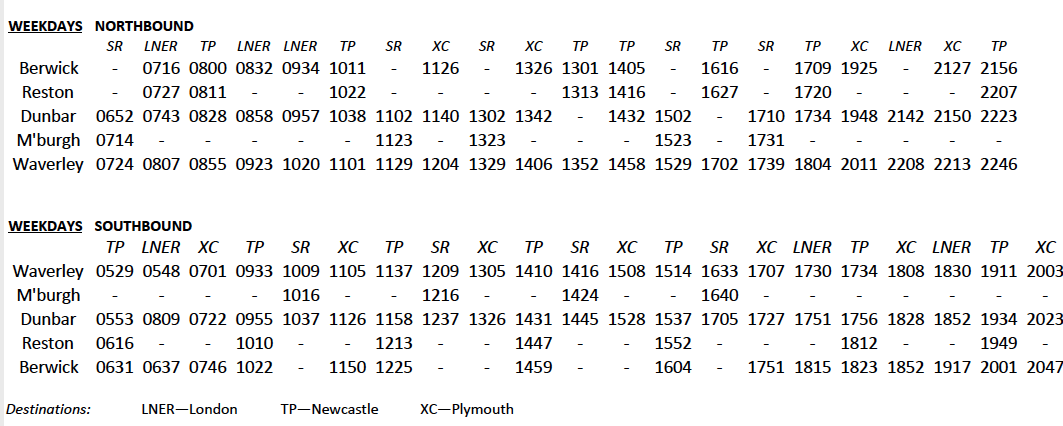
Reston is an un usual ScotRail station in that it has no ScotRail train service, the nearest being the five-trains-a-day service to Dunbar. Even those are currently suspended during the temporary timetable in place during the driver dispute. The reason for this is that the ECML here is almost entirely dedicated to long-distance trains between Edinburgh, Berwick and further South.

These are run by LNER (London & North-Eastern Railway), TP (Transpennine Express) and XC )Cross-country). Only TP stops at Reston, with the others providing a more frequent service to Dunbar.

Overview of ECML Local Service Dunbar – Berwick

On the first day of operation (May 23rd), two dozen cars in the car park and a smattering of passengers on each train shows there is already interest in the service. However, only a half-dozen trains each way at erratic times is unlikely to encourage heavy use outside of commute times. The North Berwick service used to suffer from this. But the introduction of a regular hourly electric service in 1991 grew traffic to over 5m passengers each year at North Berwick alone.

With only one stop at Dunbar, the service into Edinburgh Waverley is fast at under 40 minutes for the 45 miles. Despite being run by a famously cheese-paring First Group, TP’s 6-car 802-class trains are modern, quiet and provide a trolley catering service en route. As their Newcastle-Edinburgh route is relatively new, there are plenty of empty seats and reservations are not necessary.

Tickets cost £8 – £18 single to Edinburgh—but be careful to note and follow any restrictions; TP staff can be quite snotty if you board a train for which a ticket is not valid, starting with a £20 penalty fare, plus the cost of another ticket. However, contrary to that reported in earlier “Anorak” blogs, train companies will honour tickets issued by other companies for travel within Scotland.

Pedestrian Access at Reston; the Platforms are 8m ABove the Car Park

Nonetheless, this attempt to have airline-style booking with differing prices on particular trains is not common elsewhere in Scotland, nor on local services in general. This problem will compound when another station opens on this “no-mans-land part of the ECML at East Linton in two years’ time. Which TOC will provide a service there is not et clear.

What IS clear is the logical way to provide service to both stations is for ScotRail to get serious about serving this part of Scotland. If it can run trains through Carlisle to Newcastle, it can run a local service to Berwick. The logical answer is to grow the Waverley-North Berwick service to a “Y-shaped” route, running half-hourly to Drem and then alternate trains between North Berwick and Berwick, with the latter calling at East Linton, Dunbar and Reston on the way. This latter need not stop at all station into Edinburgh, but should at least serve Musselburgh for access to QMU.

#1022—701 words

Posted in Community, Transport | Leave a comment

Have Anorak—Will Travel: Dunbar

Few ScotRail customers notice that it changes timetables each May and December because the changes are typically minor. This May is different. The standard timetable shows losses to some services, reflecting reduction in passengers since Covid. Worse than that, an industrial dispute with train drivers about overtime that has festered since First ran the ScotRail franchise has shelved this new timetable already, and  replaced it with an emergency one from Monday 23rd. It will run until the dispute ends.

The most drastic cut is in evening services, with last trains running hours earlier than usual. The last train from Glasgow to Dundee is now 19:10 and to Edinburgh 22:00. Hardly an encouragement to use public transport for an evening out in Edinburgh, instead of 23:14, the last train to North Berwick is now 19:37. ScotRail trains to Dunbar disappear altogether.

This last is not as bad as it sounds. An afterthought, seldom included in Transport Scotland or ScotRail thinking, East Lothian and the Eastern Borders are an anomaly because they run on the East Coast Main Line (ECML), the planning for which is driven by the English Ministry of Transport and English Train Operating Companies (TOCs).

Dunbar Station—Original Platform 1 from the New Platform 2

The result is a guddle of competing services between Edinburgh and Berwick, at the heart of which lies Dunbar. A smattering of GNER trains stopping on their way to/from London in the 1990s meant they ran the only manned station in the area. As Dunbar grew with masses of new commuter homes, stopping services improved, largely due to persistent lobbying by the Rail Action Group East of Scotland (RAGES). Something like an hourly service to/from Edinburgh was achieved when ScotRail agreed to run trains in the existing gaps, turning them at Dunbar.

The variety of long-distance operators multiplied, with GNER eventually transforming into LNER, Cross Country (XC) expanding its services and being joined by a Transpennine service to Newcastle stopping at Dunbar. The result was a service of 20 trains each way providing access over the 28 miles to Scotland’s capital in just 20 minutes. Ridership grew, and the goal of shifting people from their cars was particularly successful.

Business was so good, it justified the first major rail investment in the area since the £57 million shifting of the ECML tracks at Prestonpans to avoid mining subsidence. Dunbar’s single platform on a loop off the southbound (Up) line was augmented by a £7 million platform on the northbound (Down) line itself, but did not provide a loop so trains could stop and still keep the line clear. This has increased ECML capacity as northbound trains stopping at Dunbar no longer need cross the Up line to reach the sole platform.

ScotRail Train at Dunbar About to Leave for Edinburgh from Platform 1

Losing its five daily ScotRail trains still leaves around 15 trains calling daily. But this is likely to result in a deterrent to rail travel discussed in Have Anorak—Will Travel: Morpeth a month ago.

Long distance train operating companies (LDTOCs) do not run their trains as ScotRail does, where tickets are generally valid on all services. Long distance operators run an airline-style system, where tickets are only valid for a certain train and not generally valid on other operators. Because they ran so few trains deeper into Scotland, LDTOCs have usually accepted ScotRail tickets between, say, Perth and Edinburgh. But this may change.

The three LDTOCs providing the 15 services stopping at Dunbar are in fierce competition further south. For the duration of the temporary timetable, they may accept ScotRail tickets from Dunbar because there are no ScotRail trains on which they could be used. But whether a TP ticket will be accepted on a XC train or vice-versa may become problematic. Ignorance of such things is unlikely to cut much ice in avoiding a £20 penalty ticket, plus full single fare, should this be enforced.

Cross Country Train Passing Dunbar on the Up Line without Stopping

So Dunbar may soon suffer Morpeth’s problem: a plethora of trains calling but, depending on your ticket, several hours between services by the same LDTOC that on which you can use that ticket.

For Dunbar locals reading this. Consult with the ticket counter at Dunbar. Not only is Dunbar that increasingly rare creature—a manned station—but, since being run by ScotRail, they are helpful, informative and an encouragement to keep using public transport, despite present travails.

#1021—715 words

Posted in Community, Transport | Leave a comment

Disentangling Holyrood Voting

The Scottish Parliament, adjourned on the 25th day of March in the year 1707, is hereby reconvened

—Winnie Ewing MSP, 12th May 1999

Whether you’re a unionist or a nationalist, those words from 23 years ago started Scotland down a road that refreshed its sense of itself. By allowing it to exercise discretion beyond the kirk, law and education to which its civic efforts had been  restricted for 292 years, new voices and new thinking emerged. Since then, despite major improvements to representation across the UK, no revision to how Members of the Scottish Parliament (MSPs) are elected has been considered.

Closely following the pattern used in Ireland, in accordance with the Good Friday Agreement, since 1999, the Northern Ireland Assembly has been elected by a proportional system, known as Single Transferrable Vote (STV). The 18 Westminster constituencies also each elect five MLAs (Members of the Legislative Assembly), for a total of 90. Each MLA therefore represents 21,000 people with broad representation of their political orientation.

The Welsh Senedd (formerly Assembly) was set up at the same time as the Scottish Parliament, using the same Additional Member System (AMS) as Scotland; 40 members are elected by the First Past The Post (FPTP) system, while 20 more by AMS, using lists of candidates, ordered by the parties themselves. The five regions each elect four members for a total of 60 in the Senedd. In Scotland, 72 are elected by FPTP from constituencies that now differ considerably from Westminster constituencies, which have been reduced to 59. The eight regions used for AMS were originally European constituencies, which makes them an anachronism. Each elect seven MSPs, for a total of 128 MSPs.

Even without the confusion among MSP and MP constituency responsibilities, the Welsh have found problems of representation overlap between region and constituency. This “two-tier” system of MSPs plagues the Scots too.

To address this, the Welsh are proposing to shift to STV to elect the Senedd. The Welsh Boundary Commission plans to reduce the number of Westminster constituencies in Wales from 40 to 32. The STV plan would be based on these, pairing these into 16, each of which would elect six members by STV, for a total of 96 Senedd, all elected the same way and each representing 32,900 people, rather than the present 52,600. This plan will require 2/3rds of the Senedd to approve. As it comes jointly from Labour and Plaid, it is likely to pass, despite Tory opposition.

Is this not a chance for the Scottish Parliament to improve its confusing democracy?

In Scotland, each MSP currently represents 42,600 people—considerably more than the present NI Assembly or what is proposed for the Welsh Senedd. Given this level of dissatisfaction and confusion with AMS should Scotland follow the lead elsewhere and improve democracy by clarifying representation by adopting uniform STV?

Scottish voters are already familiar with STV though its use to elect councillors—the last being earlier this month. This would not be a new system to learn, but actually one fewer to handle. That said, restriction of council wards to 3 or 4 being elected mitigates against STV’s ability to allow smaller parties fair representation. Both the Irish Dail and the NI Assembly elect five per constituency.

Scotland has 59 Westminster constituencies. There is an argument that, because of their special cases, the Northern and Western Isles, might be better represented by FPTP. Pairing the remaining 56 give 28 mainland STV constituencies sharing boundaries with Westminster. Having each elect five MSPs by STV would give a total of 143 MSPs. These would all be elected on an equal basis, with each MSP representing 38,200 people—closer to other nations.

These paired constituencies would eliminate the present confusion of boundary overlap and obsolete regions. They also simplify community representation. A cross-party group of five MSPs would represent cities like Dundee (East paired with West), Aberdeen (North paired with South), or Perth (Perth & North Perthshire paired with South Perthshire & Ochil).

Election of five MSPs ranked by the voters increases the likelihood of more diverse representation—which eliminates party ranking AMS lists and encourages candidates to become polular with voters, rather than party failthful. The cities exampled above would most likely elect an MSP from all five main parties. This increases local bonds and common interests could reduce the present adversarial nature of Holyrood by compelling the group of five to identify more with those they represent. A more collegiate approach would benefit all.

And we would no longer have 56 regional MSPs “interfering” in constituencies and trying to stretch from Stranraer to Dunbar or Campbeltown to Lerwick.

#1020—775 words

Posted in Community, Politics | Leave a comment

The Queen’s Speech

“This Government has lost its way.”

—Lord Finkelstein

With the ritual pomp and circumstance of Life Guards, Beefeaters, Rolls Royces, Black Rod and everyone who’s anyone among Westminster politicos, a new session of parliament was opened on May 10th. For the first time, Prince Charles did the honours and more media attention fussed over the Queen’s absence than the substance of the 38 bills to be shepherded through in this session.

The following debate on the matter centred on there being “little to address the current cost of living crisis” (Keir Starmer), but this seems unfair. This was always a programme of government which would have little effect before the bills were drafted, discussed, agreed and promulgated, a process that typically takes two years.

The stated aim of these bills was “to turbocharge the economy”, with the subtext that Britain would have to grow its way out of its present fiscal problems of soaring energy costs, looming double-digit inflation, rising interest rates and a national debt creeping toward £3 trillion (£46,150 per head of population). Some bills may contribute to growth, including HS2 Crewe-Manchester and a House Building Programme for England. One to “make a bonfire of EU red tape” is to realise £1 billion in savings. But many others, such as those to curb illegal immigration and increase police powers to control demonstrations, show costs, rather than economic boosts. Only a vague reference to rectifying flaws in the Northern Ireland Protocol that have derailed the Northern Ireland Assembly offers a hint that it will be simply scrapped, in defiance of the EU. Liz Truss is clearing the political ground by finally rejecting EU proposals she has been sitting on since October.

Yet, there is no clear strategy to disentangle customs hold-ups that exacerbate a 15% drop in exports—serious enough to soak up any economic growth to the point of threatening recession and stagflation.

In short, there were few clear signs how the much-touted “Brexit Bonus” “Levelling-Up” and “high-paying, high-skilled jobs” all touted as delivering the desired growth remain vague and unspecified. This all smacks of few ideas among growing desperation.

No-one disputes the ability of  high-value jobs in turbocharging the economy. But there are few examples of governments being the main driver. Conservatives tour privatisation as the magic wand. But they sold off UK control of North Sea oil and publicly owned power companies. This resulted in the our present impotence to control this energy price shock. In contrast, the French did not—in fact state-owned EDF is one of Britain’s |big six” energy companies that is using UK profits to keep French prices down. They sold off BA and UK airports, which are now the most Heath-Robinson and most underdeveloped in Europe. Rail privatisation has given us the most fragmented and most expensive rail system too.

What Conservatives seem to have forgotten was that, once the brutality and slavery that characterised the early British Empire had bootstrapped its riches, the Victorians developed more humanitarian principles while leading the world in technologies developed and exploited by entrepreneurs. Government had very little to do with it, beyond providing civic stability (through democracy) and protected trade (through the Royal Navy).

Hankering wistfully after that heyday, which the UK government and especially the Little Englander backwoodsmen from the shires is unlikely to recreate that in a world of economic giants like China and the USA. What they fail to recognise is Britain needs a USP or two, which will not be established by random scattering of money.

Such an example is the £2.6 billion Regional Growth Fund (RGF) for England supports eligible projects and raising private sector investment to create economic growth and lasting employment. When the BBC put FOI requests to 100 eligible local authorities, they found that 35 had not applied and a further 28 had their proposals rejected. In each case, an expensive and time-consuming proposal had to be submitted and there is no sense that the 37 in process offer any coherence likely to develop USPs.

Looking at other economies, Germany specialises in the high-precision engineering required for quality cars, white goods, machine tools, etc. Denmark has the lion’s share of wind turbine production. The Dutch have cornered the market in global marine towing. What Britain needs is to expand existing advantages, such as in jet engines, offshore engineering, aerospace and biotechnology. To this, it must add new fields, like tidal energy, artificial intelligence (AI) or fintech.

But only when Hartlepool has become the global hub of tidal energy, Manchester of AI and Edinburgh of fintech will any “levelling up” become reality, rather than the bureaucratic squandering of billions, such as the 1960’s ill-fated Linwood car plant and Ravenswood steel mill to counter Glasgow’s industrial decline.

And Scotland shows that it is not just Westminster that can displays scant understanding of the problem, let alone how a self-sustaining dynamic breakthrough could be achieved. At the same time as the Queen’s Speech, Scottish Enterprise was welcoming business attendees to the 2022 World Forum for FDI (Foreign Direct Investment) at Edinburgh’s ECC. This international event highlighting Scotland as a world-leading destination for investment and business location. Its purpose is given as:

“...to showcase Scotland’s on-going ability to attract cutting edge/innovative/world leading international projects, with the country continuing to be the most attractive location in the UK outside of London for Foreign Direct Investment.”

This is positive-sounding, but just as fuzzy as that embodied in the Queen’s Speech. SDI is unveiling a series of new ‘extended reality’ investment propositions to promote strategic investment sites in Scotland. The Forum features panel discussions on “sectors critical to Scotland’s economy, such as a Just Transition, Health Tech and Software/Digital Industries”.

All of which also sounds good, but is in danger of falling between two stools. The boom of FDI in the 1980s that produced “Silicon Glen” was soon recognised as largely a third-world operation—an opportunity to produce goods cheaply within the EU, but bringing few of the “high-paid, high-value” jobs discussed above. Despite Scotland’s claim to have a well educated work force and quality universities, the chances of FDI bringing in the R&D labs, the skunk works, the engineering infrastructure like wind tunnels or cutting-edge fab lines that are the seeds from which USP businesses grow are actually small. Certainly, Scottish Enterprise’s £600 million budget has failed to secure any to date. White elephants like the Chunghua Picture Tube (remember them) on the M8, or Hyundai plant in Dunfermline East sully their reputation for anticipating technical opportunity is heading.

North or South of the border, those charged with securing our future prosperity are not demonstrating they are worthy heirs to Brunel, Telford, Baird or Gresley. Because that’s what we need to survive, le alone prosper, in the 21st century.

Bureaucrats need not apply.

#1019—1,142 words

Posted in Commerce, Politics | Leave a comment

The End of the End of Empire?

Just over a century ago, at the end of the Great War, Britain bestrode the world. Its rivals in the colonial stakes were either humbled, like Germany, or war-torn, like France. Great chunks of the globe, like Namibia and Tanganyika, were new colonies and others, like Palestine and Iraq, were Protectorates that could be exploited much like colonies.

But it was a shell, a Potemkin Village of brave frontages with little substance behind. Britain was exhausted by four years of war and the financial edge that had led to Victorian and Edwardian prosperity lost to a more dynamic USA. Worse than that, the increasing level of education throughout the empire had triggered a sense of awareness among its citizens that they were not masters of their own fate. The colony displaying the most unrest was the one closest to home: Ireland.

Although Ireland was technically not a colony but an integral part of the United Kingdom since 1801, it stll operated very much like one, with an Anglo-Irish ruling class operating in a manner similar to the nabobs of India and the bulk of the Irish population resenting such treatment, with resentful memories stretching back through the handling of the Easter Rising, the Potato Famine and Elizabethan repression, back to a conquest by the Normans.

Still, it was unexpected when, after civil war, the nearest colony followed the USA in leaving the Empire exactly a century ago. The retention of the six counties that form Northern Ireland to assuage strongly unionist Protestants and their domination of all instruments of the state there lit the fuse on a social time bomb that exploded into the Troubles 45 years later, only being partly defused by the Good Friday Agreement in 1999.

The devolved Assembly at Stormont forged out of that has had a fractious history, not least because it presumed Unionists and Nationalists must sharre leadership. This made for ritual confrontation and frequent dislocation. But, more importantly, it left politicians who wanted to end tribal confrontation out in the cold as “Others”.

This May, things changed. Not because, as the media incessantly banged on about, Sinn Fein won an Assembly election for the first time, but because the non-sectarian Alliance party actually made the greatest advance by far. Even though Sinn Fein has renounced violence and mellowed with time, the DUP has continued as the awkward squad by demanding that the Northern Ireland Protocol;, cobbled together by Boris to “get Brexit done” be scrapped.

But insisting there be not as much as a nominal border between Northern Ireland and Britain means it cannot simultaneously remain in the EU, which means that the “invisible” border with the Republic, an essential element of the Good Friday Agreement cannot continue if the EU’s border integrity is to be retained.

With the most residents of all loyalties keen to have an Assembly address a plethora of concerns from health to inflation, intransigence by the DUP over paperwork is no longer likely to receive much sympathy, even among their supporters. This explains why the party has slid from pole position, losing a quarter of its 28% vote share. Their 25 remaining seats are overshadowed not just by Sinn Fein’s 27, but outflanked by the Alliance’s solid new block of 17, with a further 21 scattered across small parties, including the once dominant Ulster Unionists (UU) and the SDLP.

In other words, things have changed and a log-jammed Stormont is not likely to be tolerated as before. Westminster is perfectly capable of scrapping the NI Protocol unilaterally, but that would trigger a legal battle and even more bad blood with the EU. With “Unionist” being part of the Conservative’s party name, neither Brandon Lewis, nor the PM will be minded to do anything beyond sitting tight on the status quo, and hoping for the best. But that approach has brought them serious decline in Scotland, where they lost a quarter of all their councillors there this month against an SNP government in power for 15 years. They did almost as badly in Wales, where Labour has been running the show.

Boris Johnson and his party may call themselves “unionist”. But their understanding of other nations on these islands is proving to be no more profound than the Colonial Office of yore. Indeed, as any ability to address the “Red Wall”  issues of Northern England, the chances of them talking the more remote nations round seem slim. Burying their political heads in the sand in the face of seismic shifts in the “provinces” is no answer in the long term.

There is unlikely to be any “Border Poll” in Northern Ireland in the short term. But not revamping Stormont to discourage adversarial stances and encourage the less partisan approach of the Alliance will weaken the DUP—the only friends Westminster has left in Ireland—even further and raise the clamour for a poll.

It does not take a visionary to see that the 21st century has seen components of the “United” Kingdom outside England feel themselves more and more like colonies as Conservative governments, steeped in Home Counties culture , have increasingly treated them s if they were.

Clinging on to unwilling possessions long after they should have been released is a trait Westminster has habituated down the years, from the Angevin Empire to the USA to Mau-Mau in Kenya, Communists in Malaya, EOKA in Cyprus and the Troubles in Ulster. The fact that current movements are peaceable does not mean they are not permanent and must not be under-rated.

Digging in with their diminishing local unionist rearguard is likely to repeat the humiliation of losing Ireland a century ago and the diminution of England’s standing in the world comparable to another Suez 1956.

#1018—955 words

Posted in Community, Politics | Leave a comment

Have Anorak—Will Travel: Morpeth

A month after the Scottish Government took ScotRail back into public control, it would be unreasonable to expect the traveling public to notice major changes. A fares review to simplify (and perhaps lower) the welter of faes is promised, but will take most of the is year to complete.

One benefit passengers enjoy is the fact that almost all trains in scotland are ScotRal. They need not worry which train they board as long as it’s going where the ticket says. Unfortunately, there may soon be an Alice-in-Wonderland corner of Scotland where that doesn’t apply.

Currently, the East Coast Main Line from Edinburgh through Berwick and on to English destinations is the domain of long-distance trains, with the exception of an hourly ScotRail local service to North Berwick. Some trains stopping at Dunbar provid an erratic local service there.

Trains to Dinbar were once all GNER. But there has since been a proliferation of private companies running lomng-distance services, including Cross-Country, LNER, Transpennine and Lumo. The ad hoc arrangement needs to develop into a proper local service. The opening of a station at Reston this May and another at East Linton within a year wll not introduce that. Service is likely to be by long-distance operators and so be similar to Dunbar.

The long-term intention for ScotRail to run a joined-up local service connecting those stations with Dunbar and Berwick is not yet firm. Long-distance trains may not provide the frequency rail travellers need.

An example of such public transport mismatvh already exists at the English equivalent: Morpeth. After having an infrequent local service to Newcastle by Northern and the occasional GNER stop, persistent local lobbying secure more long-distance stops. This seemed like improvement, but local passengers have fallen foul of a major defect in privatisation: service fragmentation.

Long-distance train companies operate ticketing policies like airlines, while local public transport does not. A myriad of ticket types, schedules and fares is used to maximise revenue and wrong-foot competitors to steal their customers by varying “offers”. Just as nobody shows up at an airport without a booked ticket, nor try to hop on a competitor’s flight with that ticket.

Between London and Edinburgh, or even to half-way places like York. Such an “airline” system on long-distance trains permits planning ahead and creates barriers to customers moving to compettors. But passengers on local train services need it to operate like other public transport where tickets are bought on the day and no thought is given to which operator provides the transport: in London, Circle and District lines serve the same stations and Oyster is accepted on any bus.

This disprity is thrown into high relief at Morpeth. Because of a similar situation of a border section of the ECML, what applies there may soon apply to Reston.

The most common ticket sold at Morpeth is to Newcastle. But, as there are six different companies providing the service, not only is the advertised cheapest fare of £2.70 not available on most of them, whichever ticket you buy is not valid on the other five.

This means, for example, you buy a return on Transpennine , intending to return on their 12:06 from Newcastle. Should you miss it, the next five trains will not accept your ticket and charge you a £20 fixed penalty for travelling without a valid ticket. The next service you may use to avoid that is the 16:14—a wait of four hours for the next Transpennine service.

The local operator Northern will often accept you ticket. But it runs aged diesel 2-car Sprinters only every couple of hours because so many long-distance trains use up available “slots.” And, because of their “airline” style pre-booking, long distance companies typically penalise those who buy tickets on the day. As an example, several companies offer a £19.30 single Edinburgh-Newcastle. Buying it on the day will cost you £60 or more. Clearly, this discourages local travel, which typically does not book ahead.

The other disincentive is irregularity. Quite apart from long-distance trains often being delayed en route, timings at Morpeth are worse than Dunbar, being all over the shop. What makes local trains popular and become well-used is a frequent service at fixed minutes past each hour. None of that happens at Morpeth, nor is it likely to at Reston, until ScotRail provides a local service.

Posted in Community, Politics, Transport | 1 Comment

Seasonal Heresy

It is Easter Sunday—the main event in the Christian calendar, despite Christmas having overtaken it in the minds of many. The proportion of those people who regard themselves as Christian has, after decades of decline, stabilised this millennium. This hokds tue despite the drop in church attendance over two years caused by Covid.

Although the Church of England is the more deeply embedded in the establishment, than its Scottish equivalent, acceptance of other beliefs and their tolerance are very similar, such that hostility and enmity between faiths is now a rarity. Tolerance in general has increased. Whereas, fifty years ago, the church’s role in setting and enforcing moral standards was as powerful as it had been in the days of Victorian repression, the sixties and their aftermath rendered their role in civic morals much less evident.

The main media still seeks to acknowledges that it is Easter: a major service is broadcast; biblical sword-and-sandal epics are screened on lesser channels. But coverage of the weekend’s semi-finals, like Liverpool vs. Man City and the Edinburgh derby swamp all else. Far more people attended, watched and got excited by these than all Easter service attendees put together.

It is a basic truth that people do deel a need to believe in something. For centuries, the church was all there was. But, even those who regard themselves as Christians are rarely active and engaged. Even fewer make their church relevant outside their own congregational comfort zone.

This is not to deny there are many good people with civic consciences, who give of themselves outside their own family and friends. But a decreasing proportion of them do so via a church, or even for religious reasons. Although they may follow “Christian morals”, the Church no longer monopolises the moral high ground.

Why is this? Has the Church failed mankind? Has it betrayed itself? Has its activity/inactivity alienated people?

After centuries in an unassailable position at the centre of public life, the Chirch is struggling to retain relevance and resonance in the 21st century. A millennium ago, the Church was all-powerful—not only politically, but in the minds of the vast majority, especially the illiterate masses. The amazing soaring cathedrals; the ornate clothing; the mysterious incantations; its powers of fogiveness and guidance to avoid damnation overawed people into belief and obediance.

But, as civilisation evolved, its flaws became more glaring and counter-productive. Whether it was two popes contesting between Rome and Avignon; disruption of  the Reformation; brutality of the Spanish Inquisition; blinkered persecution of “heretics” like Galileo or “witches”—each showed it flawed and therefore fallible and therefore less wothy of belief. The very latest example is Patriarch Kirill, head of the Russian Orthodox Church providing unstinting support for Putin’s war on Ukraine.

But, more fundamental is the philosophical clash between the teachings of the Church and modern education, especially in science. This started before Hutton’s geologic unconformity blew Archbishop Usher’s calculation that the world was created in 4004 BC right out of the water. As an unashamedly heretical blog, this is not intended to disabuse fervent Christians of their beliefs. But, for those of us who do not share their convictions, to posit alternatives available to atheists.

The generally accepted “Big Bang” theory that created this universe does not answer what happened immediately before—and where all the matter came from. At first, the Christian “God created the Earth and all that is in it” seems to have the inside track… until you ask where God came from, and what was there beforehand.

The idea of blissful heaven up in the sky and a sulphurous hell below has not worn well in the face of astronomy. Details, such as St Peter controlling pearly gates while over 240 people arrive each second for processing, how you stay sane as an angel, faced with an eternity of bliss are awkward. And do you want to be in heaven when all the interesting people are roasting in hell?

It is more than having credulity stretched by transubstantiation—that a wafer becomes flesh and wine becomes blood. It is the idea that any God can hear, watch over and understand all eight billion of us. And that’s a minimum. What if there are many other planets like us? How is it the massive evil we do is “man’s free will” and not prroof of God’s heartlessness, or even helplessness.

Even among Christians, most don’t take the bible literally, which allows for creative papering over of garish implausibilities found in there. Tales of pillars of salt or Red Sea parting, or multiplying fishes & loaves sit awkwardly in an inquisitive and foensic 21st century mind. But, if the bible is the Word of God how can there be room for fiction, without the whole edifice collapsing?

Attempts to make the Church more “relevant” or “modern” have generally come to grief. Rregular attendees may have been comforted by BBC4 insertion of  verses from humns into their programmes. But, while “Alleluyah” may offer comforting familiarity to some, its relevamce is lost on most of the rest. On the other hand, those who attend infrequently are baffled by new hymns and mumble through them embarassed by their unfamiliarity. Having day centres, youth clubs, elderly outreach certainly adds to the community cohesion already contributed by the church. But they have little to do with the soul and its salvation.

Which begs the question of the soul’s existence and, therefore, any need for its salvation. What if Dawkins was right and we are simply the result of four billon years of random chemical and biological evolution? Why is that not enough for us?  We are past those dark ages when all human life was nasty, brutal and short, when religion was a necessary salve.

Until we find intelligent signals emanating from the Horse Head Nebula, what’s wrong with simply being joyful about being the product of a cosmic Petri dish that got lucky.

Why does a civilisation that put a man on our moon and explained Special Relativity and unravelled the himan genome need an elusive sentient being who offers no proof of existence that would stand up to the simplest scientific proof?

If we could just get the Russians to behave, we could throw away this philosophical crutch that still holds millions in simplistic thrall , as if we were still medieval serfs? Looking back over these 2,000 years, why perrsist in following a belief that has probably caused more war and death than any other single branch of human endeavour.?

#1016—1,091 words

Posted in Community | 1 Comment