Emancipating the Ladies from Hell

At last the forces of unionism are drawing together something approaching a campaign to save their union. The latest co-ordinated assault in the pages of the Hootsmon involved offsetting Swinney’s announcement of a new tax regime in Scotland by a two-page spread by Ed Milliband claiming we could not be both independent and British and a rather spurious piece from Defence Secretary Philip Hammond that any Scottish Army would be ‘unsustainable’. This was complemented by an op ed piece where a Tom Miers, citing his long family tradition of military service claimed independence would be the ‘death of military tradition‘ in Scottish units.

However orchestrated all these pieces critical of independence and its corrosive influence on the prospects of any purely Scottish military might be, it was certainly not substantiated by much in the way of argument and evidence. In fact, while excoriating the prospect for it in Scotland, Miers was sympathetic, if not openly supportive of Hammond’s plans to further reduce British military numbers from 108,000 to barely 82,000—and with them to face the merger or dissolution of more regiments.

What is evident is current UK military overstretch, despite an MoD budget of £40bn—the third largest in the world. This does represent an unsustainable disaster and is substantiated—by recent £4bn scrapping of Nimrod replacements; by bargain-basement sell-off of 72 Harriers to the USMC; by repeated shortfall of equipment for our forces overseas, especially in Afghanistan. And yet Hammond, not content with ‘rationalising’ 17 once-proud Scottish regiments into a single RRS, is hell-bent on discharging another 20,000 professionals?

This is sheer nonsense.

But consider this. A proportionate (8.5% by population) defence budget for Scotland of £3.4bn would be freed of many ludicrous UK distortions and drains on budget: Trident, nuclear bases, aircraft carriers, main battle tanks and similar kit is not only expensive but vulnerable and clumsy. How could a more balanced useful and deployable active army be created from existing units of the British Army? Rather easily.

Let’s assume that The Scots Guards stay with the British Army as a memento of our long military history together.  The five active battalions of the Royal Regiment of Scotland, restored to five component regiments would provide a core for any Scottish Army:

  • Royal Highland Fusiliers (Light Infantry)
  • Argylls & Sutherland Highlanders (Air Assault)
  • Black Watch (Light Infantry)
  • Highlanders (Mechanised with 45 x Warrior & 25 Boxer armoured vehicles)
  • Scottish Borderers (Light Infantry)

These provide an active brigade, say 51st Light Infantry, plus two battalions for a 52nd Mobile Brigade that would be augmented by existing active Scottish formations

  • Royal Scots Dragoon Guards, reconstituted as a reconnaissance regiment (15 x Warrior; 25 x Scimitar; 25 Boxer) and the third battalion of 52nd Mobile Brigade
  • 42 Commando, retrained for deployment as special forces small units focussed on defence of North Sea rigs but capable of air assault along the the Argylls
  • 40th Artillery Regiment, organised to deploy composite battalions (105mm/Javelin/Rapier) in support of 51st & 52nd brigades
  • 38th Engineer Regiment, organised to deploy composite battalions (pioneer/assault/REME) in support of 51st & 52nd brigades
  • 32nd Signal Regiment, organised to deploy in support of 51st & 52nd brigades

A proportion of logistics, medical, adjutant and training would also be expected, as would existing bases such as Glencorse, Redford and Fort George. The remaining two territorial battalions of the present RRS would provide the core for six reserve regiments that would constitute the 9th and 15th brigades in the event of mobilisation of the forces. These could revive the identities of formerly amalgamated Scottish regiments and, like them, be based and recruited geographically, for example:

  • Gordon Highlanders (Light Infantry—based in the North East)
  • Seaforth Highlanders (Light Infantry—based in the Highlands)
  • Cameron Highlanders (Light Infantry—based in Tayside/Stirling)
  • Highland Light Infantry (Light Infantry—based in Glasgow)
  • Scottish Yeomanry (Mechanised—based in Edinburgh)
  • Scots Greys (Mechanised—based in Southern Scotland)

And though they might restore the 339 battle honours to their colours, such a force is clearly no match for a major enemy. But why should it be? Scotland’s fortunate position means that it has no obvious enemy if relations with England remain as cordial as they are today. And though, light as this force is, it is comparable to the 35,000 the Danes can field and far more flexible and useful than the armour-heavy deployment of the present British Army. Clearly, close working with the British Army would be both desirable and sensible, along with adopting NATO standards in equipment and training.

But most ludicrous of any assertion in the Hootsmon is the idea that such forces would “languish in barracks”. Such assumption ignores the cocky pugilistic nature still alive and well in the young men of Scotland. Of all the world’s infantry, the “Ladies from Hell” boast 300-years of  global history and have no need for proof of their worth. There would be not just active training with their neighbours and allies but deployment on operations around the globe in NATO or UN actions. Keeping them home would be a bad idea.

While home, they would have a far more prominent ceremonial role in Scotland’s barracks and castles (c.f. Brigade of Guards in London) but Scottish soldiers’ reputation would keep them in high demand in the world’s hotspots. So, while a concern that they might languish is understandable and a professional soldier currently serving in the British Army might regard a ’smaller’ army with scepticism at first, the Scots will not lack for foreign adventures.

The difference is that they are more likely to be popular ones. Light infantry are tough, resilient soldiers. They make good, heavy-duty, on-the-street police for the Lebanons and Liberias of the world. They also won’t balk at helping pull survivors from earthquake rubble whether in Haiti or Japan. From Cassino to Korea, Scottish soldiers have made friends in the past and that gruff, no-nonsense good sense of the Jocks will make more friends in the future because they put on no airs and know how to handle themselves.

When the serving Scot discovers that pay will be better and his equipment more modern, that unit morale is sky-high and deployments interesting, that they are sent as friends and not as a hostile occupiers of the Iraqs and Afghanistans, then there will be fewer  recruitment problems than those with which the RRS, despite fine Samoan volunteers, is being bedevilled at present.

Indeed, we may have to consider weeding the English applicants out.
Posted in Community, Politics | Tagged | Leave a comment

But Don’t Mention the War

It seems that last weekend’s jubilee was a big hit across Germany. Several channels carried coverage and there appears to be a certain fascination with things ‘Englische’. Some touchy Scots find the endemic continental verbal sloppiness between ‘British’ and ‘English’ insufferable but it is a fact of life; get over it. The main thing is that we Scots appear to be riding a minor wave of popularity, along with our English cousins.

Coverage of UK national events has been underpinned by a ZDF (‘Second German TV’) channel focus on Scotland. They recently broadcast nothing short of a sales travelogue and followed Angus Robertson MP (chatting in his fluent German) around photogenic corners his Moray constituency from teenagers in lofty Tomintoul to craggy Macduff fishermen. The theme was independence and how current it has become as a topic. Certainly this year has seen a notable increase in German tourists coming to Edinburgh and down the Lothian coast.

All this was documented in David Leask’s piece in yesterday’s Herald. But there’s more than just whisky-tinted tourism or curiosity going on. Yesterday also saw the last David Hume lecture at Edinburgh’s Royal Society, given by the Prime Minister of Lower Saxony, in Scotland at the invitation of the German Consul, the indefatigable Wolfgang Moosberger, for three days of talks with Scottish business and our First Minister.

As might be expected from his name, David MacAllister was fluent in English, delivering a complex speech on current affairs in Europe with panache and humour of which even native speakers would have been justly proud. His grasp of things Scottish was explicable because his father, entering Germany in 1945 as a member of the 51st Highland Division, married and settled there and finally became, he said, fully European  one day in 1981 when he saw his son dressed ready for national service in German Army uniform.

Making many references to historic connections with Scotland, such as Walter Scott’s interest in the tales of the brothers Grimm, Prime Minister MacAllister knew his history, relating how Hanover had shared a monarch with Britain until 1837 when the prospect of a Queen had been more than the Germans could stomach. He was clearly aware of the chequered relations between the countries. He expressed particular gratitude that Keynes had warned against the reparations insisted on in 1919 and how the British had been insistent on giving Germans the chance to re-educate themselves and set up a fully functioning democratic republic within a few years of the collapse of the Nazi regime.

But, while appreciating and learning lessons from the past, he clearly saw the future as another country, chiding us with scarcely-veiled references to British tabloid headlines concerning Germans. Indeed, while being asked a question from the audience relating to that, it was clear that he feels time ought to have healed more than it apparently has.

But the main thrust of his talk was focussed on the present Euro crisis and the relative roles that Germany and Britain could play in resolving it. As a CDU politician, he is very much at odds with Britain’s strategy of borrowing its way out of recession. He was swift to admit that his own Land has run a budget deficit for every year since its inception in 1947 (although he ruefully acknowledged that the 1946 budget had been balanced by the last British Military Commander—another Scot called Macreadie).

There was, in his view, no long-term alternative to austerity. In 2008 when the present crisis first hit, Germany had tried borrowing. But the availability of the cash had made strict adherence to spending plans difficult and that experiment had, in his view, failed. He is clearly a disciple of Angela Merkel (and, indeed, has even been spoken of as a possible successor to her) and, perhaps because the German press corps was present in some numbers, never deviated from her present line of strict adherence to the Fiscal Compact and the European Stability Mechanism.

Discussion did not come round to whether both compact and mechanism were robust enough to deal with whatever outcome the Greek elections due on June 17th might bring and to deal with the run on Spanish banks undermined by their ongoing property bust. He simply reiterated that the sole path available out of the present crisis was a trimming of outlays to match income, no matter what pain that cost. Queried about German resentment for others’ profligacy, he accepted Germans, who now retire at 67, resent Greeks retiring much earlier but that was a matter the Greeks themselves had to solve. For him, the key was that Greece or Spain were still better off staying with the Euro.

Because of cultural and manufacturing similarities, he saw Britain as an ally, despite it remaining outside the Eurozone and pursuing a borrowing strategy of which he could not approve. But when asked whether the relative openness of the Scots to Europe and the international community might not be used as a bridgehead to circumvent English euroscepticism, he became non-committal. Clearly there was a diplomatic reluctance to take any sides in the independence debate and. despite reference to our historic links with Hanseatic ports, an underrated fiscal rectitude around the North Sea as well as the Baltic and a social conscience common across Northern Europe, he was not about to use his personal links to further any such ‘special’ relation with Scotland.

Reading between his statements, it was clear that he regards all of Germany as a single political state and the 16 Länder exist as vehicles to allow local differences of culture and character. He was clear that any fiscal disparities within Germany were simply tasks to be completed, rather than any reason to question the unity of Germany. The present structure whereby economic investment was prioritised towards the former East Germany would be reviewed in 2019. With a wry smile, he suggested that date might be Germany’s equivalent to the 2014 that was receiving much attention in Scotland.

Disappointed as I was that the prospect of a ‘special relation’ with Scotland was elegantly sidestepped, in contrast to the ‘light-touch’ ZDF treatment, this lecture was as thoughtful, pragmatic and fluent a presentation on the present Germany and its relations with us as you could hope to cram into 90 minutes. We’ve not heard the last of Herr MacAllister.

Posted in Commerce, Politics | Leave a comment

Do You Know Who I Used to Be?

Zero Mostel’s classic line from The Producers had special resonance this weekend. Despite the weather and Philip’s hospitalisation, the jubilee seems to have gone off well and those many enthusiasts well pleased with events. I tried to watch the concert but it became increasingly surreal, with the Welsh (in the shape of Tom Jones & Birly Chassis) blowing the rest of Britpop royalty off the stage.

Most touching was the Thames pageant of over 1,000 boats, for which Pageantmaster Adrian “Canute” Evans had managed to get the Thames Barrier closed for the day so that they didn’t have to contend with 5-knot runs and the 7m rise and fall that a spring tide visits on the Pool of London and all who sail on her.

It was touching because of the variety and enthusiasm with which the huge flotilla had been brought together. But it was also touching in a wistful way because of the glaring absence, for which this flotilla acted as a colourful distraction. Because this was the first jubilee in which a Spithead Review did not figure at all—let alone prominently. For the many pacifists among the readers, allow me to explain.

Since Trafalgar (over 200 years ago) Britain has been able to rely on its dominance of the seas to allow its global trade to pass unhindered. While gunboat diplomacy is now rightly a thing of the past, we still rely on ships to carry 93% of UK trade with the rest of the planet. As evidence of that power to control the seas, a feature of every jubilee has been a gathering of Royal Navy power in the Solent off Portsmouth for the celebrating monarch to review.

The most memorable was Victoria’s 1897 jubilee, equivalent to this one. Some 21 battleships, 44 cruisers and over 100 other ships gathered in serried grey ranks appearing to pave the entire Solent. That was even before HMS Dreadnought was launched and an Edwardian arms race of bigger, faster, greyer battleships culminated in WW1. The RN’s fleet had shrunk dramatically by the silver jubilee of 1977 but was still third-biggest (behind United States and Soviet Navies). Two aircraft carriers, including Ark Royal, two cruisers, one assault ship, 17 destroyers, 18 frigates, 14 submarines and dozens of minor vessels attended. The 18-or-so foreign ships present were dwarfed.

For this Queen’s golden jubilee a decade ago, a review (of sorts) was held but barely 20 RN ships of any size could be scraped together and the biggest warship there was French: the 35,000 ton aircraft carrier Charles de Gaulle dwarfed anything the RN could deploy, and still does.

It turns out that all senior naval staff have been asked to stay shtum about the lack of any review for this jubilee. It’s not that we don’t have any ships (couple of assault ships, 20-ish destroyers and frigates, a dozen subs and many small craft and auxiliaries—about 70, all told), it’s just that they’re all busy. As a demonstration of force overstretch, it could hardly be bettered. Whether the monarch misses the review or might even prefer to go boating on the Thames has not been recorded.

But, as the MoD & Royal Navy still see fit to deploy 28 serving Admirals of varying stripes, the real question that must be asked: how we can afford to pay so many when they now outnumber the ships they have left to command?

Posted in Politics | Leave a comment

Veni; Vidi; Vicar

Andrew Marr is usually good value, especially in the wilderness that is Sunday morning television. This week, despite the crush of Jubilee pressure, he did not disappoint, with a feisty performance against the Prime Minister over Hunt and leading Toynbee & Bremner into giving a livelier take on the papers than usual.

But what stopped me in my tracks was the interview with the eloquent the Right Honourable and Right Reverend Bishop of London, Richard Chartres. We’ll leave aside the fact that the cathedral of the same name may be the most brilliant edifice to man’s faith in the Western World and that his affable nature made the interview pleasurable in comparison to the rough-and-tumble Paxo-esque nature of most interviews on the show.

Chartres is also Dean of the Chapels Royal, which means, roughly speaking, he’s a vicar with parishioners at Buckingham Palace—hence his appearance to discuss, among other things, the continuing use of Fidei Defensor (defender of the faith) by the monarchy that still appears on all our coins, albeit reduced to “F.D.” these days. (It is rumoured that Charles does not wish to use this title, should he become monarch, which says much for his sense of propriety.) But, genial as he was, it was both the argument His Grace made and the assumed context within which he made it that got right up my nose.

First of all, the ‘F.D.’ bit. Granted by Pope Leo X in 1521 to a youthful Henry VIII for a treatise denouncing the protestant heresy being preached by Luther and his ilk, this was all made something of a travesty by Henry’s subsequent unilateral establishing in 1530 of the Church of England with himself conveniently as head so that he could use its vast wealth to pay off debts and fund his lifestyle. Although the title was revoked by Pope Paul III, Henry’s English parliament of lackies contrived to re-award it as “defender of the Anglican faith”, in direct contradiction of the original award.

When Unionists speak of the strength of tradition, I often wonder whether they mean to gloss over such dissolute effrontery to truth and principle or whether they operate the Orwellian model where we have always been at religious loggerheads with Eurasia. When Chartres tried to interpret the fuzziness of Latin translation (no definite articles) to mean ‘of faiths’, implying the importance of faith communities in holding society together, it just smacked of philosophical convenience.

What got my goat far more was the way His Grace regarded the Anglican Church ipse facto as the being establishment and that, despite declining numbers who attend Anglican services, could operate as a political wing of the monarchy and with their authority. There was, he averred, little mood for disestablishing the Church—i.e. removing the monarch as its head. Ministering to his own religious superior was not anomalous.

For a Scot—albeit a non-religious Scot like myself—all this makes me feel ignored. Leave aside that 16 Anglican bishops sit in the Lords while the Scots have none because they don’t believe in bishops. Leave aside that the 1707 Act of Union, for all its ugly flaws, did ensure that the Church of Scotland would not be part of the established Anglican church. We have a Scot like Marr, who should know better, chatting to a man who clearly thinks the Church of England is sole authority in such matters.

Far be it from me to dictate how the Anglican (or any other) Church operates within itself. It may well be a force for good and part of the complex weave that keeps society together. But even if the CofE no longer forbids Catholics being Head of State and accepts women as equal aspirants to the throne, we still inhabit Henry’s morally suspect 16th, rather than our enlightened 21st, century if someone accedes to be head of a church—much less head of state—simply by accident of birth. But the English, from His Grace on down, continue to fail to distinguish between England and its Union with us.

For us Scots, there is a simple solution to such arcane and morally suspect dilemmas: choose to be, not just in a country that once had no truck with such nonsense but in one reasserting its right as a sovereign state to again have no truck in future.

Posted in Community | Leave a comment

Dahn Sahff Inna Smoke, Innai?

And so, for my first time this year, I made a pilgrimage to the Imperial Capital—and resplendent the old girl looks too in her much-delayed Spring sunshine finery. Having lived there for a number of years on-and-off, it’s a place I feel as much at home in as I do in any major city. Add in friends even more at home than I am and the novelty of metropolitan socialising can be so much fun.

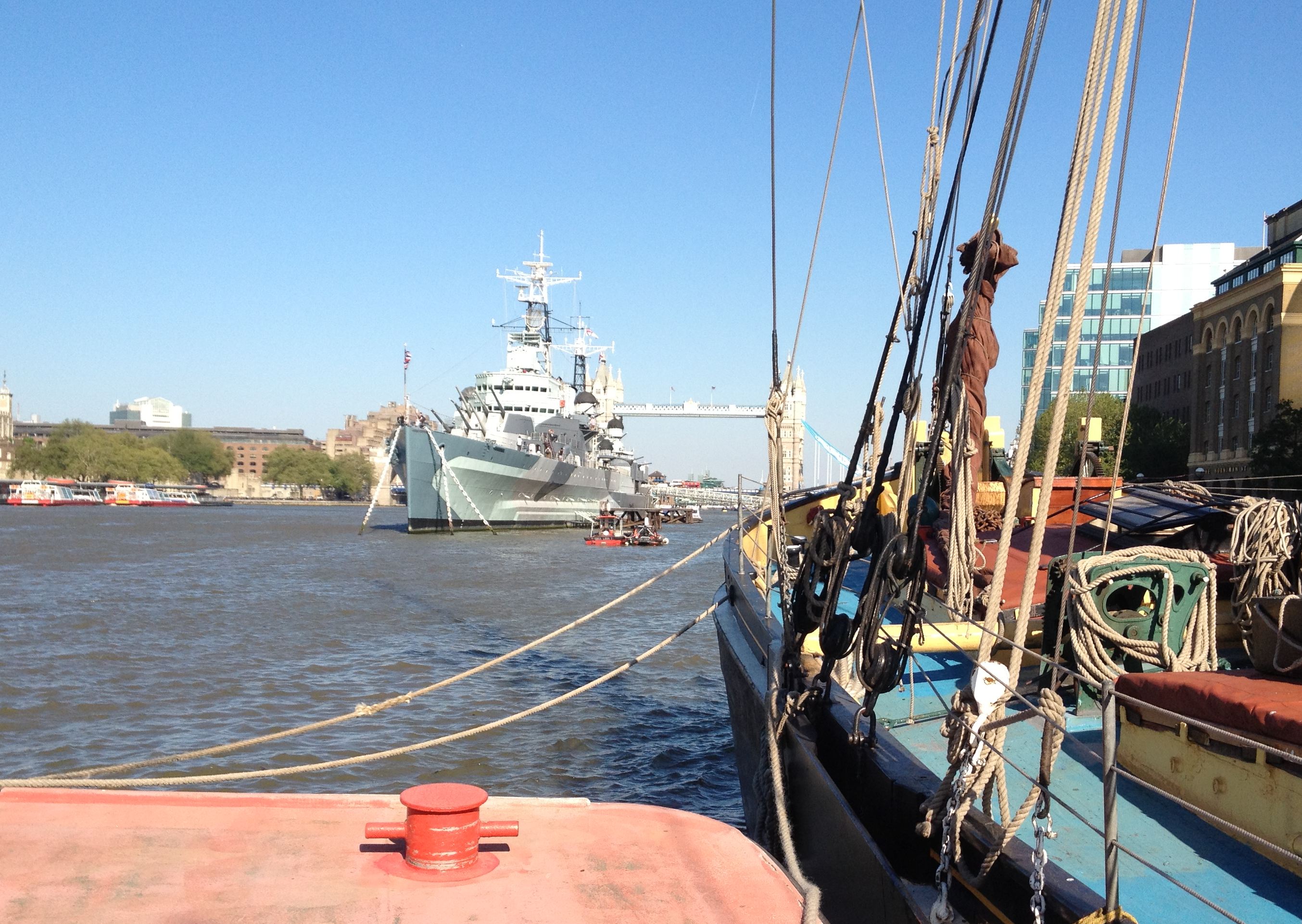
Redevelopment around the Pool of London has added much variety to the more familiar haunts of Soho, Islington or King’s Road. Where once HMS Belfast pointed her big guns almost in self-defence she was so isolated, now a warren of quayside walks, refurbished warehouses and sundry bars and cafes gives the whole Southwark shore a cosmopolitan feel in contrast to the tourist ruck surrounding the Tower across the river.

HMS Belfast with Tower Bridge beyond from London Bridge Pier

Tucked into corners are a variety of places to discover, such as the Design Museum at Shad which is showing the definitive shoe designer Christian Louboutin’s work. Full of macho skepticism at first, I trailed round after the others, making quite a discovery in the process. Brought up in the rural-Scotland-functional school of footware, it took me until university before I strayed from conventional brown-or-black-with-laces orthodoxy.

This man is a sculptor: not just any sculptor but a man who obviously mainlines women’s psyche and has a sense of humour thrown in for good measure. His success could be tracked by the gasps, sighs and giggles emanating women of all ages taking their time to examine each and every creation. Just as well there was only one of each or the security nightmare would have been unmanageable.

Many of shoes must be regarded (even by women) as un-walkable (but not necessarily unwearable)—especially in the fetish section. But the huge majority on display seemed to inspire attendees with ambition and fantasies a-plenty. For people-watching as a male, it was one of the best venues I’ve ever come across.

The craftsmanship was obviously superb and the subtle selection of materials that complemented it gave me my first understanding of this whole shoes-as-psychology thing that women of my acquaintance failed to explain to me. It seems a combination of physical poise and psychic projection that makes emphatic statements to those who would hear.

Two of the More Wearable of the 2009-10 Louboutin Collection

Though there was whimsy aplenty, the quiet competence of shapes and styles demonstrated infinite variations on what is basically a very simple shape. One evening pump had small wings of the vamp that must make the wearer look like Mercury’s mistress; and otherwise standard gleaming black thigh boot had small pockets skillfully attached for the schoolmistress’s pencils, chalks and—perhaps—things less innocent.

Coming back upriver, we hopped on to one of the new river catamarans which now ply Putney-to-Blackfriars and Embankment-to-Woolwich. These are huge, fast maneuverable and a splendid new way to see London. Along with a variety of river cruises, private party boats and fast RIBs, the options available are quite bewildering. But they are easy to access at the half-dozen piers between Westminster and Tower Bridge—and with a frequency that you start to treat them as you would the Tube.

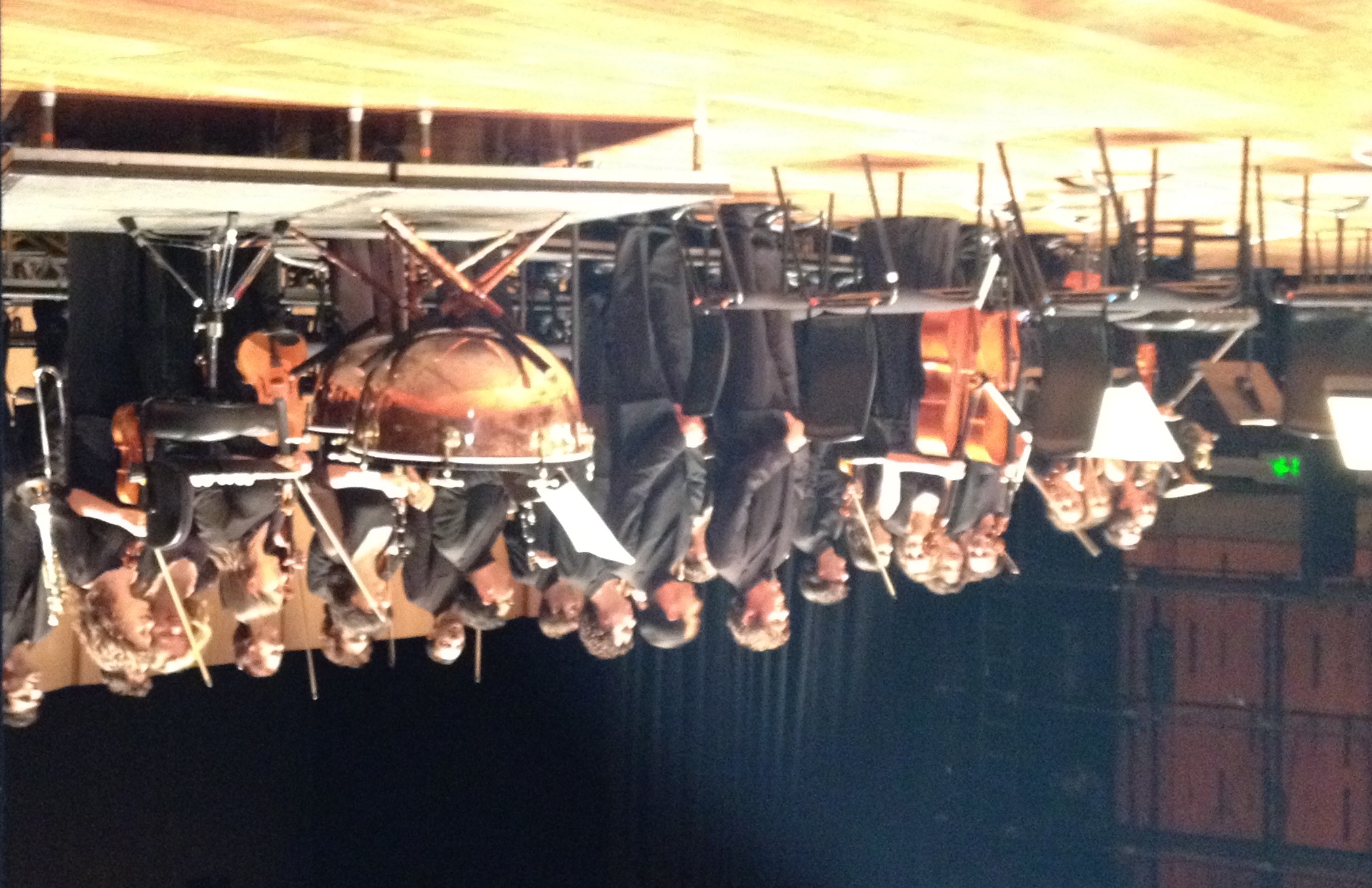
Catching Spiro Mirabilis at the Queen Elizabeth Hall was a concert like none I had attended before. Hardly a music buff, I’m nonetheless familiar with most of the classics and that includes Beethoven’s Pastoral. But it was laid out before me anew by the forty or so young Italians, Germans, Poles, etc who make up this conductorless orchestra. Much became clearer in a fascinating Q&A session after the performance.

Forty Young People Who Gave The Pastoral New Dimensions

Apparently, they rehearse together intensely, working out their approach to each phrase as a team. It takes much longer when there is not the single driving vision of a conductor leading the debate. But the net result is astonishing. It was the difference between canvas and lace. Whereas even a good orchestral performance drives at a steady pace through its phrasing, this was lyrical—groups of phrasings passed among members as they layered such ethereal tissues of music that billowed together only to float apart in a way Ludwig would surely have admired.

So, tucking in to duck and halibut al fresco just across from the Burlington Arcade wrapped the whole day up in a rather golden light (although the second bottle of Pinot Grigio may have had something to do with that). Despite some abrasive articles on its political dimensions over the last couple of years, it was uplifting to rediscover its world status as a destination after my varied travels. London did not disappoint—in fact it rose to exceed my jaded and hostile expectations to be a delight.

Shame it’s going to be a foreign country soon.

Dusk over the South Bank Centre from Charing Cross Footbridge

Posted in Uncategorized | Leave a comment

Irrtumliche Weltanschauung

A fascinating conversation flashed amongst the Twitterati yesterday on the unevenness of foreign  language teaching ability in Scottish primary schools, despite a recent move to introduce a second foreign language there. Let’s leave aside for a minute whether the Doric constitutes a foreign language and contemplate a few home truths: we’re shite at languages. And we’re not getting any better.

For over half a century, the brightest kids is Scottish schools have studied foreign languages (mostly French) S1-S4. And while our subsequent French graduates and scholars can hold their own, you don’t have to spend much time around tourist spots in France to hear their language being mangled by Brits from all parts of these islands—because it is not just the Scots who seem inept when it comes to using languages.

Scandinavian countries are famous for embarrassing us Scots in this department. To quote from the This Is Finland website (English-language, of course: my Finnish is non-existent):

“Finnish schools emphasize foreign language studies. The first foreign language is generally introduced in the third year of comprehensive school and the second domestic language (Swedish for Finnish-speaking pupils and Finnish for Swedish speakers) in the seventh year, if not sooner.

In addition, pupils may opt for up to six different languages by the completion of upper secondary level. The most common foreign languages are English, German, French, Russian and Spanish.”

For the avoidance of doubt their “comprehensive” means primary, not secondary, school which is entered after three years at nursery where much time spent exploring outdoors even in the -20degC Finnish winter—but that’s another blog.

You may not have encountered a Finn and had the chance to appreciate just how relaxed and articulate they are in speaking English. This is one of the subtleties we Scots seem poor at appreciating: the gulf between the ability to shop at a supermarket or order lunch and the fluency necessary to operate fully in that language. Once you can chat with a stranger on the phone (where there is no body language to help out), you’re getting close to being fluent.

Our schools have tried to improve the manner in which they teach languages by moving away from rote and ritual of declensions and cases a focussing more on how language is actually used. Our teaching graduates are no less capable than anyone else’s. We joined the EU 40 years ago. Why are we lagging so badly in the language race?

Our geographic position doesn’t help. Whereas foreign-speaking tourists pour into London in their millions, perhaps a tenth of those make it to Scotland and any Spanish-speaker found in Airdrie is almost certainly lost. So Scots lack much local opportunity to use any language skills they have gained. But, each year, we are finding more and more foreign tourists discovering Scotland and—when you think of it—Finland is even more disadvantaged by geography, so that can’t be a major reason.

A second reason may be that everyone seems to speak English anyway. There is much truth in this. Because of America’s cultural dominance of the planet from film to Coca-Cola, the bulk of the world’s technical manuals, films, TV programmes, games and much of its literature are all created in English. Spanish had its chance in the 18th century and Russian in the 20th but since the end of the Cold War, the lingua franca of the planet has been English and, unless the Chinese standardise one of their several languages and make it widespread beyond the Middle Kingdom, that will remain so.

It is galling to walk into a boulangerie, point to croissants and stutter “J’en veux deux, s’il vous plait” and be greeted with “with or without chocolate?” But this is deceptive. Though many can speak English, they are more at home in their own language and the ability to acknowledge this cuts considerable ice. Off the beaten track, especially with less common languages like Portuguese, even a few phrases do so much more for international relations than simply speaking louder in English.

Scots take too much comfort from the omnipotence of English, especially as a business language. Especially now that we are on the cusp of regaining some of our tarnished reputation for solid and creative engineering through top-notch oil services companies like Weir and Wood Group and the emerging renewables businesses, these will need to be sold around the world against competitors like the Danes whose English puts them on a par with us in that language and gives them the thick edge learning the customer’s.

But, perhaps most importantly, we Scots have lost the concept of a foreign policy that is our own. For three hundred years, we have been active participants in the British Foreign and Colonial offices as our windows on the world. As a colonial power, that brought much trade and more than a few glorious scuffles, culminating in WW2. Since then, from Korea to Afghanistan, UK foreign policy was still too influenced by the glory days of empire that has not moved with the times.

Though, thankfully, the phrase “wogs begin at Calais” gets little airing these days, that lies behind not just the BNP but the non-racial but nonetheless xenophobic positioning of UKIP, neither of which encourages the embrace of foreign culture, far less their language. Unfortunately, Scotland suffers from the same immigration restrictions, the same bossy border controls, the same faint disdain for things foreign among our officials that might have had basis when our gunboats dominated world trade—but has none now.

More than anything, this residue of greatness, this idea that once prevailed of “making the world England” still pervades much unionist thinking. There, at least, it has a logical basis. But in family homes across Scotland, few could handle non-English-speaking exchange students if they were to be billeted on them; few yet see the point of preparing for that or a similar eventuality. They would rather their children nailed another Higher and secured university entrance than that they had the fluency to live a gap year surfing in Biarritz and earn enough to save for uni while there.

Travel around Europe—Benelux especially—and you are struck not just be the open borders of Schengen but by the cultural flexibility with which business, products, services, transport, flow across borders, language barriers and old enmities. Cologne to Brussels or Lille to Utrecht, the only difference with Edinburgh to Glasgow is proper motorway with more lanes and less holdup. People there aren’t thinking in country boxes any more and languages are the keys to open up international possibilities.

This is what Scotland needs to learn: that languages aren’t just useful but essential for a 21st century nation with ambitions not just to sell to the world but to be seen as a willing and valued participant in it. At this point, the UK does not qualify. With a revival of attitude they once embraced in medieval times, an independent Scotland could.

But it will take business to demand language skills in their new hires, government to support that far-sighted initiative and parents to understand that their Micky Mechanic or Eloise Engineer will get twice the salary and see more of the world if they can talk Halbleitertechnik and not just semiconductors. Putting part-qualified teachers into primary schools will not be enough: it will remain an initiative without a context.

And we need to grasp this particular thistle as a country fast—before we’ll also have to consider Urdu or Mandarin as further essential languages to introduce at primary level.

Posted in Education | Leave a comment

Bams Oot the Windae

They say there’s a first time for everything. In today’s Torygraph, Alan Cochrane found common cause with SNP Defence spokesperson Angus Robertson MSP and—for the first time to my recollection—I find myself agreeing with both of them. Arch-unionist Alan is, for my money, one of the more thoughtful and articulate among them. Though he takes no prisoners and many independistas have come off worse in exchanges with him, his are exactly those arguments we must counter if the case for independence is to be conclusive.

His column regrets that the SNP has shied away from reconsidering its hostility to NATO membership by an independent Scotland at next month’s National Council and sympathises with Angus’ quite effective campaign on behalf of current and future armed forces in Scotland. Angus does talk military language almost as fluently as he does English & German and cuts a martial figure in trews and bumfreezer, as Alan observes.

Originally fueled by active member hostility to nuclear weapons and a long record of CND membership and demonstrations against Faslane, the refusal to consider NATO membership when Scotland became independent seemed a logical extension. This was underpinned by basing of the UK deterrent in Scottish water within 25 miles of Scotland’s densest conurbation around Glasgow, which put 2m Scots in the Cold War firing line.

The end of the Cold War put any urgency on the back burner but recent Westminster decisions to spend £350m investigating ‘Son of Trident’ has brought it all to the fore again. At this point, there is no practical alternative nuclear base in English waters, so the Faslane base becomes a key negotiating point in any independence discussions. But, at the same time, detailed plans for Scottish Armed Forces and their international posture—once academic, now possibly imminent—need to be laid.

Both sides of the independence argument see no need for hostility between Scotland and England, so the prime route of any hostile action towards Scotland is thereby neutralised.  Any invader would need to come through England or by sea. This latter should be taken to include terrorist acts against major items of infrastructure, like oil platforms, offshore wind farms, tidal turbines and the like. Even Torness or Hunterston nuclear power stations or the Forth/Tay Bridges could be plausible targets for seaborne attack.

If we add in the 10km length of Scotlands coast and scattered islands, the need for long-range maritime recce and rescue lies mostly within Scotland and so the net balance of appropriate armed forces for Scotland would look very different to the one the MoD is currently pursuing.

But smaller countries especially are all the stronger for having good friends among their neighbours. Quite apart from England, good relations with Eire, Iceland, Norway and Denmark would constitute an outer line past which any putative enemy would have very little chance of moving undetected, let alone undeterred. Such good relations would need to be earned by Scotland bearing its share of international duties, be it the odd infantry battalion deployed to world hotspots under UN blue berets or rescue squads flown in to help people recover and rebuild after major disasters like earthquakes.

Let’s leave aside the shape of any Scottish Defence Force. No reasonable Scottish budget could afford to build it on a scale such that it didn’t need good friends and military allies. And while some might argue that we could ‘do a Costa Rica’ and neglect to have any armed forces whatsoever, our history, our links with global communities—not to mention the exceedingly high regard in which Scottish soldiers are held throughout the world—all mitigate against anything but a small but balanced and capable military.

Looking at possible international links to develop, there is certainly a future in celebrating the Celtic connection with Eire and Cornwall, as well as Brittany and Galicia. In the opposite direction, the Nordic Council could be a booster rocket to strap on the Scottish economy. But neither have a military dimension. Indeed, with the demise of the Warsaw Pact and many of its members going over the their former ‘enemy’, the only game in town is NATO.

NATO has been called the most successful military alliance of all time and certainly none of it members has suffered non-terrorist attack in its 60+ years. It is certainly a nuclear alliance but 25 of its 28 members are non-nuclear and most have managed to negotiate a degree of non-nuclear involvement with which its people are comfortable. Given that Scotland holds a key position on NATO’s North flank and provide some of the best training facilities in Europe, the likelihood that a deal over favourable membership for an independent Scotland could be reached is high.

So why would the SNP not want it? Longstanding and principled anti-nuclear credentials need not be compromised. The drive to remove Trident from Faslane need not be sacrificed (not least because the US is far happier to run a nuclear deterrent under its own control, as France already does with its variant). NATO and UN deployments are among the few opportunities beyond joint exercises to encourage Scottish recruits with the incentive of seeing the world.

The principled pacifists in the SNP ranks who want the Cost Rica approach are few in number. The realist majority accepts that a  joint defence posture is the only one a full nation can realistically adopt. No-one in the SNP is arguing for a nuclear Scotland, nor for the horrendous moral dilemmas that it brings—quite apart from the costs.

Quite how SNP MSPs and other senior members think an independent Scotland could take its place as a normal nation and not join a defensive treaty with all its neighbours has not been explained. Idealism was something the SNP might allow itself while in the political wilderness. But on the brink of achieving its goal, the need to convince the still-doubting 2 in 3 Scots with a consistent, pragmatic suite of policies has become vital.

These policies must not only articulate the many advantages of a nation blessed with Scotland’s people and resources but also demonstrate how integrally linked it remains with neighbours and friends by accepting its obligations, even as it seizes opportunities.

Like it or not: Scotland is already a nuclear power and a NATO member—and a target for any who would challenge either. Faslane and the current union make that a fact. Independence is the way to escape such labels and set a course different from that forced on us by London. But to want independence, yet reject the vital key for close work with friends we need will be seen as retrograde, unrealistic, bampot thinking.

I’m all for independence. But we need these bams oot the windae before they hang oor collective bum oot the windae in the international isolation that would surely result.

Posted in Politics | 5 Comments

Taking the temperature: what the Eurobarometer tells us about attitudes to the economic crisis

Taking the temperature: what the Eurobarometer tells us about attitudes to the economic crisis.

Posted in Politics | 1 Comment

It’s the Education, Stupid

Politicians of all stripes seem ferally inclined to have a go at one another. But one area on which even they all agree is on the importance of education. And, having led the world in getting its broad citizenry into schools three hundred years ago and through the Scottish Enlightenment a hundred years after that, surely Scotland should be some kind of educational superpower, no?

Er, no. While politicos knock lumps off each other on class sizes, on pupil/teacher ratios, on the merits or otherwise of Curriculum for Excellence, while teachers squabble over less pension for more work and their unions fixate on pay structures and in-service hours, kids are still being dumped at the end of our education production line like so many horse buggies in an automotive world. When employment was plentiful, this went little-noticed. Today everyone agrees youth unemployment is a scandal. We are no basket case, But we do compare poorly with other countries like Finland, Denmark, etc.

Ah, but how to fix it? In the noughties, Labour created slick youth employment schemes that did little more than slip numbers off the unemployed statistics for a year or two. The present modern apprentice schemes are more laudable but broadly equivalent to treating a brain hemorrhage with elastoplasts. Everyone wants quick fixes and education officials see the issues as theirs to solve. But, even in 1680, the world was a complicated place and no parish dominie worth his salt would have seen teaching his kids as his job and his alone.

A good education has always been a complex and elusive thing. But in this hectic world of specialists we have made of the 21st century, our streamlined thinking jams complex matters into facile categories. Just as when our car gets sick and the mechanic cures it, we expect the same from the hospital: it’s a service; we’ve paid for it; I’m entitled. The concept of responsibility for our own health is only beginning to be dimly perceived. And, until it is, our NHS will go on taking £1 in every £3 our government spends.

The same applies to education. Parents can be seen in two main types: 1) ambitious ones who want their child to succeed, seeing education essential to get there and; 2) indifferent ones who see school as kind of day care and expect it to deal with any and all their kids’ problems for them. Both approaches deserve criticism.

The ambitious parents fixate rather too much on qualifications. Vital though those are, there is seldom the kind of pro-active involvement which engages the child in activities outside of school, especially those that complement what the teacher may be doing. With both parents out working—often the case in ambitious households—the connection between the school day and the rest of life can be tenuous to the point of schizophrenia.

The indifferent parents are often not that way through choice. Again, both parents may work or it’s just a single parent at their wit’s end. Often the neighbourhood is one where academic, or any other kind of success, is a rarity. Not only the child but the parents themselves are presented with no local role models, nor support/advice that makes sense to them. ELC runs a project in Musselburgh called First Step that seeks to address this but it is one of very few drops in a bucket of daunting scale.

Why is this all so negative? Why are we not celebrating the fact that last year, exam attainment across Scotland again set a record? Because we’re lying to ourselves. From kids, through parents, teachers, schools, all the way up to the Minister, it suits everyone to have exam inflation, where exams get slightly easier; everyone can boast improvement. But it is self-delusion. Firstly, much essential education cannot be measured by exams and secondly, youth unemployment and business feedback makes it clear the system is poor at turning out employable people.

Tomorrow, a major summit by Holyrood’s Finance Committee will examine this ongoing, deteriorating issue of youth unemployment. In preparation for that, Arnold Clark has released a depressing evaluation on the employability of Scottish youth, in which 80% (1,850 out of 2,280 applicants to them) were declared unfit to work as apprentices. Now, we are not talking about calculus, nor the correct use of the Past Anterior here. As the report puts it:

““We are increasingly concerned at the state-sponsored babysitting nature of some college programmes, rather than the specifically targeted vocational training for near-guaranteed employment we believe taxpayers’ money should be being spent on.”

Students are work-shy, regarding the 18-hour week they attended college as already too onerous. Other criticism included a poor attitude to others, no concept of citizenship, poor communication skills, a poor understanding of the standards expected and an “inability to make a decision based on anything other than ‘I want’.

Blaming educators is the obvious remedy. But what is almost always overlooked are the 150 hours each week when the students are not at college or the slightly less time pupils are not at school. Three hundred years ago, parents, neighbours, ministers, etc were part of the education process. Even in John McLean’s time on Clydeside, the principles of self-improvement were still ingrained in their thinking. Today’s easy TV diet of soap operas, fantasy contests and overpaid ‘celebrities’ are poor substitutes for such rugged support.

But where present-day socialists seem to have it wrong is that education isn’t the great leveller—it’s the great raiser-upper. But only if the child has some form of extracurricular support to round out the rote of learning in school itself, the chance to apply what they learn and see their options. There another article in today’s Hootsmon that describes how even recently, growing up on a council estate but listening to Simple Minds still opened that window out onto the world showing even a third-generation on the burroo that there were other options.

And here’s the multi-layered dilemma. If the world were less complex and hectic, there would be more peace and time to focus. If we had fewer growing up on deprived estates, there would be less distraction and more support. If parents were better able to comprehend their kids and not see them as extensions of themselves. If we had more old-school teachers who know their kids and intervene with them when required.

Modern kids are no more stupid than those in 1680. But certificates are only part of education—and not even the most important part. If we can help kids navigate the pitfalls of the paragraph above, they will achieve much—not least developing their skills, their interests, their ambition, whether as surgeon or stable-boy.

STV is currently running the 56-Up documentary that charts a dozen 7-year-olds at 7 year intervals from 1963 to the present. They were of all social backgrounds but where they wound up—from cheeky Cockney jockey to Hooray Henry—was both predictable and yet surprising. Most stumbled somewhere along the way; those that did while still in education had the hardest times and harboured most regrets; all recovered under their own steam and were the better for it.

If tomorrow’s committee is just another bunch of politicos grandstanding for the camera and trying to knock points off their opponents, we’re no further on. But if they take the Curriculum for Excellence as their starting point, encourage social work to stop acting like they operated on another planet, inspired parents to be just that and teachers to remember the dominie’s social heart under his crusty black-gown exterior, we might leave a country better populated by the personal success stories to which we all aspire.

Posted in Education | 1 Comment

Drachmatis Personae: Angela vs Bob

In my second Silicon Valley job 30 years ago, I launched the engineering department of a start-up PC company years before IBM rolled out the PC or Apple the Macintosh. ACS was run by the most plausible Southern good-ole-boy salesman you could ever want to meet. Bob could talk the hind legs off a donkey. He so inspired me, it took a year for me to realise that hardware, operating system and applications could all be invented by a staff of six—but they couldn’t also be developed into reliably bombproof products.

As red figures ate through the $1m in venture capital Bob had bamboozled out of Xerox, Bob and I had a heart-to-heart. “We have a problem, Bob” I confessed. “Our actual income can’t justify keeping this scale of development.” Bob disagreed and shared a little of his genius with me. “You’re off by a country mile, Dave,” he beamed. “If I owe $5k, yes I have a problem. But, since they’re into us for over $1m, it becomes Xerox’s problem.”

These thoughts came back after the non-event G8 summit in Washington was followed by a NATO summit in ‘da Windy City’. Both produced similarly vacuous statements over withdrawal from Afghanistan and taking the air out of the fiscal panic (a.k.a. ‘Eurocrisis’) over Greece. Both issues have headlined around the globe for years to the point of boredom with most folk. But while a simple solution exists for one (just bale out), resolution of the Eurocrisis lies much more in the ‘rock-and-a-hard-place’ category.

Much though I disagree with former Chancellor Alastair Darling on policy, his refreshing frankness on Sunday’s Andrew Marr show was an overdue lesson in clarity; Europe has had four years to learn from the banking crisis that struck in 2007; they appear not to have done so. As a consequence, continued dithering means the bigger the crash is likely to be once enough people agree that the Euremperor still has no clothes.

In the course of the noughties, our banks forgot their main role of financing business and devoted much time and money in speculation—either within themselves or in a variety of questionable ‘instruments’, among which were accidents-waiting-to-happen like junk bond packages and treasury bonds from places like Greece.

Unfortunately, few leaders are showing rigour equivalent to Mr Darling’s candour. But as one of them is Angela Merkel—this may be the only reason Europe’s entire fiscal structure is not disintegrating around our collective ears. Yet. Just as Darling & Brown baled out British banks with almost £1tn in loans, so the Germans have shored up overextended European banks’ imprudent willingness to buy up government debt—not just in from Greece but in other overheated economies across the Mediterranean.

Almost everyone is pressuring Angela to budge on a little more generosity towards Greece. She’s having none of it and she’s right. Though it is hard to find politicians anywhere who agree with her, that has more to do with the toxicity of the situation than with any flaw in her fiscal thinking. M. Hollande, the new French President talks austerity but walks a softer line than Sarkozy did. Spain’s Treasury Minister, Inigo Fernandez de Mesa is similar, arguing for Greece to be accommodated and denying that Spanish banks are in imminent need of any bail-out (although the Torygraph begs to differ and shares in Bankia, Santander, etc plunged 20% at the end of last week.)

The origins of all this lie in incompatible ambitions for the EU among its members. Skeptical as Britain always was, the EU’s French/German heart of 20 years ago beat faster as a huge boost in members from communism’s collapse and German re-unification  made anything seem possible. The dream of a single trading bloc of 350m using one single currency beckoned. For public (especially German public) consumption, criteria for euro membership were portrayed as strict. But Italy only qualified because no-one could imagine any euro without them. Greece didn’t qualify but was let in anyway. The boom of the noughties raised all boats, meaning shortcomings and stresses could be papered over.

In Britain, Irn Broon steadily sold off the UK silver by raiding the pension funds, selling off the gold reserves, syphoning burgeoning tax receipts off to pay for social programmes—in short, living beyond our means. On the Continent, the same: banks bought euro-denominated lucrative Greek (and Spanish, etc) debt, which the Greeks used to fund pay rises and pensions they couldn’t afford. In both places, politicians pretended their short-term vision would suffice, secretly aware that, some time later (hopefully, much later) someone else would reap the whirlwind they had sown.

Comeuppance came earlier than any predicted. The worthlessness of many bank-created ‘instruments’ brought down both creators and customers in 2007-8. The rot was only stopped by countries printing money that had no backing to lubricate the otherwise creaking global fiscal machine as banks and business ran for cover, calling in loans and snapping shut any cash outlay in sight. As a short-term expedient, it worked. But as a long-term solution, it has flaws, not least when faced with the ‘Bob’ philosophy.

Whereas most countries pulled on sackcloth and ashes and skidded into sullen austerity, such was the omnipotence of the ‘Masters of the Universe’ of Canary Wharf and their ilk who, ever since the 1988 ‘big bang’ in the City, have been feverishly inventing a slew of financial derivatives and hedge strategies, that their personal money machines kept them ‘earning’ six- and seven-figure bonuses, even as the financial institutions they served (and the punters who invested their life savings in them) took a serious hammering.

The defiance of fiscal gravity by bank directors and traders was not lost on a public now hit by collapsed jobs, pensions, house prices and salaries. But, worse, it convinced the public in places like Greece that defiance and chutzpah could sustain their bloated salaries and pensions, despite their country alone being palpably deficient in means to sustain them. Given that they were eurozone members, they could afford wages & benefits over the odds because their neighbours could not let the euro fail.

As a international version of Bob’s scenario, it is entirely plausible. And, as long as Greece lacks the political will to change as they are being asked to do, the problem is not really theirs: it is indeed the eurozone’s. Having failed to keep the nerve prior to their April elections, their inability to form any government means that the June 11th elections will be equally inconclusive, leading to a summer of uncertainty. While others sweat, they’ll just keep getting overpaid and hoping for the best.

And, rather than being supported to hold the line on Greek (and anyone else’s) austerity, Angela is under new pressure from Hollande in France (to show something from his new presidency) from Obama in the US (to avoid frightening American horses prior to his own election in November) and even her own unions, who have just secured an austerity-busting 4.8% wage rise.

Forget that Greece should never have been let into the Euro in the first place, ejecting it now would mean an instant default on all its loans and Treasury notes. This, in turn, would mean serious deficits at banks who had made (and perversely continue to make) those loans. In other words, the banks, far from learning from the ludicrous over-stretch of four years ago, have hardly changed their ways. Since virtually none of their boards were hung by their thumbs for their earlier behaviour, this is no surprise. It seems a couple more failures are needed for them to finally relearn their banking business.

But it means that the combined pressure on Merkel of eurozone solidity and further bank runs guarantees that Greece can brazen it out indefinitely—or at least until the entire euro economy falters from pouring all its cash into the likes of inefficient Greece when it should have been tooling up to meet insatiable demands of the new Chinese consumer.

At that point, when the bulk of European business has been crippled, the Greeks will simply revert to the drachma, suffer a couple of years of austerity not much worse than they are baulking at now—and then quietly prosper as their devalued drachma brings in tourists by the million. But not as many, nor as rich tourists as if their Bob-style bluff were to fail, Angela were to prevail and Greece were unceremoniously booted out of the euro right now. It would be short-term pain for long-term gain.

But who’d dare take centre stage to force such a tragedy?

Posted in Commerce, Politics | 1 Comment