A Promise the SNP Should Have Kept

Some 14 years ago, in the run-up to the 2007 Scottish Parliament elections, the SNP campaign made a number of promises which won them the election for the first time ever. One with appeal right across the country was this:

SNPsCTpledge

A real chance to help poorer people and empower communities was scuppered here.

I was among the 32 council leaders who gathered at CoSLA that June of 2007 to hear John Swinney, the new Finance Minister promised a new “parity of esteem” between councils and government. In exchange for the SNP Government scrapping Council Tax, councils had to agree to council tax rates being frozen for the next couple of years while a fairer alternative was worked out. Although the SNP held no majority, CoSLA agreed to this. Among those in the room were Kevin Stewart from Aberdeen, Joe Fitzpatrick from Dundee and Derek Mackay from Renfrewshire—all of whom became MSPs and Scottish Government Ministers.

To be fair to the SNP, there were efforts made to find an alternative, but these were quietly dropped after the 2011 election, when the SNP won a clear majority. Despite now having a free hand, while council tax remained frozen, the 80% of council income provided by the government was steadily pared in real terms. Actual increases were “ring-fenced” for specific purposes and could not be spent as general funds. Parity of Esteem it most certainly was not. Councils were effectively tools of government policies and Aunt Sallies for public resentment at less popular ones.

Exactly eight years ago, a blog on this site , recognised unforeseen difficulties in finding a short-term alternative to council tax. It proposed a way of simply modifying the existing system to make it less regressive and provide a roughly 15% increase in its revenues to councils. This was brought to the attention of Derek Mackay as Finance Minister, Kevin Stewart as Local Government Minister and Joe Fitzpatrick as Housing Minister.  Eight years later, there has been neither response, nor any action beyond lifting the tax freeze two years ago.

For those interested in the (still valid) original proposal, here is the link to the post of March 9th 2012

Ma Faither’s Howff Has Many Mansions


Posted in Community, Politics | Tagged | Leave a comment

No Country for Old Men

America prides itself in being “The Land of the Free”, celebrating the ability of anyone to prosper in a land of opportunity. Compared to other countries, this is largely true. But, with this attitude comes a dislike of rules and restrictions and a political system that leans to what people describe as the ‘right’. There is a general mistrust of ‘Big Government’ and a tendency to celebrate those who succeed within the law‚or at least the appearance thereof.

As a result, the only two parties that matter are on an unusual political spectrum. The Democrats are considered ‘liberal’ but would be regarded as ‘centre-right’ anywhere else, The Republicans are conservatives, but verging on the extremist by standards elsewhere. While the country developed its apparently limitless frontier, a no-nonsense, ‘de’il-tak-the-hindmost’ attitude was almost essential. But now limits have been reached around 1970, amiable consensus between the two parties has eroded.

By the contested election of 2000, the gloves were off as George W. Bush’s brother Jeb was suspected of swinging the election his way as Governor of Florida, which held the balance. This came on the back of Republicans derailing Clinton’s attempt at health care reform and attempted impeachment in the 1990s. The bitterness was compounded by Bush’s attempt to cut taxes on the rich and scale back Soicial Security for the poor and the eldery and his laissez-faire approach to regulating big banks lay at the root of the financial crash of 2008.

Into the resulting mess stepped Barack Obama, seen as a beacon of hope, ad not just by  Democrats who elected him. While the rich had been getting steadily richer since that 1970 shift (CEO income had soared from 4 to 40 times workers’ pay), the poor were still poor and  middle class affluence had stagnated. Where this hit hardest was in affording the private and expensive health care available. Social Security eased much of the burden for the elderly through Medicare. Health insurance was provided to workers by good employers. But some 16 million Americans had no health cover at all. People were refused treatment in A&Es, or were ejected from hospitals when they could not pay.

Led by Obama, Democrats wanted to introduce universal health care, along European lines. Republicans claimed this was governmental interference in the market. The real reason was that not only the expensive (and therefore lucrative) medical and pharmaceutical sectors but the $1 trillion medical insurance business—all big donors  to Republicans—saw this as a major threat. They were right.

The result was a compromise in the Affordable Care Act (ACA) , signed int law on March 23rd 2010. This provided extended coverage of Medicaid and Medicare to those less well off. Iy was supposed to extend this to those earning 33% more than the income specified but Republicans fought this through the courts and the compromise arrived at was to allow individual states to decide whether the 100% or the 133% level would apply there.

Because this was a federal program, funded by payments (called FICA) levied nationally, the federal government would have to provide the funds,, whichever was chosen. Most observers expected all 50 states to choose the higher threshold as their residents would benefit from federal money at no cost to themselves.

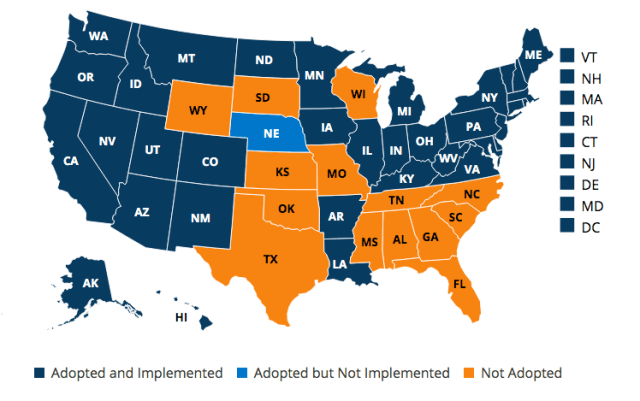
But a funny thing happened. Democrat-controlled states, without exception,  did take up the option. Most Republican controlled states declined the upper threshold—for reasons that defy logic. These states are a roll-call of the poorest in the nation. Even if you support small government, why would you deny your residents the benefit of free money? Other than dogma, no answer has presented itself in the intervening decade. And representatives from these states wee to the fore in 2018 supporting Trump’s failed attempt to repeal the ACA ( now known colloquially as ‘Obamacare’) in 2018. The map below shows the holdouts,

Ovamacare

This seems doubly bizarre, because Dixie Democrats used to rule the roost in America’s South. This because Abraham Lincoln, the president who freed the slaves and fought the Civil War to do so, was a Republican. The still-dominant white elite of the South did not forgive that party for the next century. Only Lyndon Johnson’s efforts on civil rights changed their loyalties.


Posted in Community, Politics | Tagged | Leave a comment

SPQR Begat SPAD

SPQR (Senatus Populusque Romani = the Senate & People of Rome) may be ancient history. But it was the first political system Britain ever knew. How those politics evolved to today is relatively simple.

Post Romans came chaos of internecine tribal warfare. This gave way to (mostly) strong kings who ruled by divine right. But when regal heads rolled, Parliament made the laws as a bulwark against chaos.

In all of this, the vast bulk of people had no say, but some vested interest, as it allowed them to get on with their lives in some sort of framework. They still had no say, as Parliament consisted entirely of aristocratic landowners. That they were divided into Whig (Liberal) and Tory (Conservative) parties had little meaning for the peasants who worked their estates, served in their houses or toiled in early factories and mines.

But, as the Industrial and Agricultural revolutions brought in rising wealth and a middle class, the idea that change was possible fomented the American and French revolutions, leading to growing worker agitation through the 19th ©.

After WW1, politics changed. Though most politicians still wore top hats and spoke with ‘received pronunciation’, the flat cap, the regional accent and the brazen iconoclasm that would culminate in Dennis Skinner\s ‘Beast of Bolsover’ presence became common (to turn a phrase) at Westminster.

But much of the gentlemanly deference and discretion continued, extending to the media and private lives.

The 1960’s started the change with the Profumo affair, when the media went for the jugular and the ‘News of the Screws’ invented the tabloid journalism of today. Forelock-tugging respect for politicians was damaged by their impotence in the face of de-industrialisation and devaluation in the 1970s ad -80s, compounded by Thatcher’s un-gentlemanly hand-bagging and the rise of Harry-Enfield-esque ‘Loadsamoney’ Masters of the Universe products of the City’s 1988 Big Bang. Deference and the rising gig economy were simply incompatible.

It was Blair who first realised that presentation was also needed in politics, who re-invented Labour as Proctor & Ganble might have re-launched a soap powder. Old Labour may have railed against Peter Mandelson not being able to distinguish guacamole from mushy peas but the new middle class with their shares, their semi and their sunshine getaways had no such problem.

But it was Alastair Campbell and his SWAT team of fresh-faced Special Advisers (SPADs) that made the 1997 landslide happen. Media training became the order of the day. Spokespeople became adept at avoiding the issue or answering a different question. As a result, media became more combative and looked deeper for the cracks the SPADs toiled constantly to paper over.

After Blair bestrode the noughties, other parties got wise, with the Tories and SNP adopting these methods and both being rewarded with electoral success. Strangely, Labour has regressed and fallen foul of factionalism in the dace f repeated electoral defeats.

But those in charge have not. The Johnson administration has taken the Blair model even farther, using Dominic Cummings as the quarterback in an American football team. While Tory Minister forwards block the public by appearing in the press, he snaps the policies back to the fast moving SPAD backs, who can throw policies about and touch them down with minimal public scrutiny.

What the public see is either endlessly boring or increasingly acrimonious sessions in parliament, substance-free interviews and debates n the media and news reporting that focuses on personalities and their mis-steps in true tabloid form.

Superficially, this has the trappings of democracy, but not, as Star Trek’s Dr McCoy might say, as we know it.

The general public, it looks evasive, abrasive and unedufying. Those most fluently devious are those who present to the public. As an exception, Lord Steel resigned for not having handled abuse by a colleague in the 1970s properly. Yet, the last politician with that sense of public propriety was Lord Carrington over the Falklands in 1982. Sajid Javid’s recent laudable stance was entirely over internal turf wars. Boris’s own resignation from the May Cabinet was grandstanding and calculated furtherance of career.

So it’s no wonder so many voters are scunnered wi’ the hale clamjamfrie. Were we considerng the board of the East India Company 200 years ago, nobody but the nobility would care. But in this modern democracy, these people run our lives while hosing £1 trillion of our money about the place. It’s even less wonder that young people who march with Greta Thunberg to save the planet are losing interest in being elected to anything.

Instead, many are thinking of becoming SPADs

Posted in Politics | Tagged | Leave a comment

Row Wir Ain Boat

Among the many obstacles thrown by Unionists in the path of Scottish Independence is the issue of currency. This is a fair question and one that deserves a plausible answer. Unfortunately, due to partisan heat generated in the run-up to the 2014 referendum, there was les of a debate and more of a bun fight, with the media asking pointed questions and the independistas offering an incoherent and therefore less than persuasive set of responses, the most persuasive and seamless of which was “to keep the Pound”. This, however, ran into a further series of obstacles, including;

  • This would be blocked by Westminster
  • This would scupper any chance of keeping/regaining EU membership, as they insist any new members join the Euro.
  • This would tie Scotland to UK fiscal policy and therefore undercut the whole point of independence

Let’s consider these reasonable objections to Scotland using the Pound one by one.

  1. Permission from Westminster. This would not be the first example of such practice. The Channel Islands and the Isle of Man already do. And there is better precedence in the number of countries pegged to or using the US dollar, including most of the Middle East and Latin American countries like Panama and Cuba, the latter being twice the size of Scotland. None of them ask permission from the US Treasury to do this.
  2. EU & the Euro. Membership of the EU may be desirable but membership of the Euro isn’t. It has helped major countries like France but even medium-sized ones like Spain have been trapped in an economic bind, unable to adjust their exchange rate. A single currency without a single government is unstable and counties like Denmark, Sweden, Poland and Hungary have been wise to avoid it indefinitely. Scotland could do the same.
  3. Locked into UK Fiscal Policy. Initially, this would be true.  But this would also be a time when both economies were still compatible and Westminster fiscal policy would still make sense. It would also provide stability for foreign investment and time to set up our own central bank and associated fiscal mechanism. But it need not be permanent.

Being fully fiscally aligned may suit Scotland initially. Indeed, this is the situation we are in now, with Scottish banks issuing notes that are technically for a Scottish currency, which is fully equivalent to an English pound sterling. Upon independence, this would continue and there is little that a UK government or the Bank of England could do to prevent it. Indeed, there is some advantage to them, as the Scottish economy would effectively be tied to and add some 10% more weight to the pound in the world.

At a pace set by Scotland, they would develop their own fiscal structures, including a central bank and a true Scottish pound that would be pegged to the UK pound, Though this would limit fiscal policy, especially exchange and interest rates, the stability gained would promote inward investment and ease borrowing. To invest in a renewed Scottish economy, this latter would permit the serious spending necessary on infrastructure but the existing debt would not weigh on the pound sterling as Scotland’s economy would remain small (<10%), as compared to the UK.

This situation could continue indefinitely, provided UK fiscal policy remained appropriate  for Scotland’s growth. Should, however, some serious economic downturn, such as happened to Spain, especially its property market over a decade ago, having all the trappings of a full currency, Scotland would have the option of decoupling its pound from the UK pound and either devaluing it or allowing it to float as a countermeasure not available to counties like Spain  tied to the Euro.


Posted in Commerce, Politics | Tagged | Leave a comment

The Antiquated States of America.

The USA is rightly regarded as the birthplace of many ideas that now underpin the modern world.  From mass production to  household white goods to air travel to semiconductors to genetics, to computers, mobile phones, space travel, not to mention fast food, fast cars and Facebook, Even if they didn’t invent it, they found a way to develop lucrativel markets from it. All this made them the richest country on the planet.

But there is one key area where thus bustling modern state seems stuck in the 18th century—civic geography and government. Their system, born in the crucible of their War of Independence from Britain worked well in forging a nation out of 13 highly individual colonies who jealously guarded their right to do things their way within the umbrella of a union.

As the country prospered, spilling over the Appalachians, absorbing the Louisiana Purchase and the spoils of the Mexican War, territories were carved out with simplistic, straight-line boundaries with little reference to actual geographical features. In a short time these grew into states, with little reference to whether a system born on the Delaware still made sense on the Columbia.

What is true of states is also true of the counties and cities into which states are sub-divided. Away from the East Coast, counties are almost always rectangular boxes on the map, paying little heed to geography,. In California, the Gold Country, where the states prosperity started is split into a half-dozen counties with populations of a few thousand. In contrast, San Bernadino County contains not just a city of a quarter-million of the same name but suburbs like San Dimas (home to Bill & Ted’s Excellent Adventure), plus half the Mojave Desert. Cities often occur in agglomerations with convoluted boundaries, often with lumps of unincorporated county land embedded within them. While prosperity boomed, the inefficiencies inherent in this for services like individual police and fire departments did not much matter. But there has been no redrawing or consolidation since these boundaries were set to adjust to modern population patterns, as there has in Europe.

Restructuring a prosperous and litigious country of 4,000,000 square miles and 328,000,000 people is a massive, if not impossible, task.  But there a few places crying out for reform where a stat could be made. California (pop. 39m) sends two senators to Washington. Several states, including Wyoming, Delaware, Alaska, Vermont and both Dakotas have populations under 1m. Yet all send two senators to Washington. If strongly Democrat California sent senators in proportion to its population, Trump would have been impeached by the Senate.

One obvious and simple answer (arrived at a century ago, but never implemented) is to split California into two states. The North and South elements are already culturally distinct so this might even prove popular.

If Americans were game for biting the bullet with urgent reform, they should consider their main metropolitan areas, currently split among states, as well as cities. Although these may cause conniption fits (as they might say) among Americans, here are some suggestions how things might be better organised:

  1. New England, Fold Rhode Island into Massachusetts and merge New Hampshire and Vermont with Maine, giving states with populations of 7m an 4m respectively.
  2. New York. Split the city and lower Hudson off from the state (which would retain ~9m population) and combine with Connecticut and Northern New Jersey to make a metropolitan ‘state’ of ~17m people.  Southern New Jersey would become part of…
  3. Philadelphia, which would split from Pennsylvania (leaving it with 10m people) and taking in Delaware to form another metropolitan ‘state’ of some 5m people.
  4. Washington would cease its amorphous ‘DC’ status expand to include Maryland and Northern Virginia, leaving 6m there and forming a metropolitan ‘state’ of ~9m
  5. Chicago would expand to include the adjacent urban counties of Illinois (leaving it ~7m people) and those around Gary in Northern Indiana to result in a metropolitan ‘state’ of some 5m.

America tends to regard Europe as archaic. Oncem Germany was indeed a myriad of statelets and Italy a jigsaw with larger pieces. But Bismarck and Garibaldu sorted that out 150 years ago And cities like Munich, Amsterdam or Barcelona boast transport, planning and services more coherent than Americans city-dwellers enjoy.

Some might rail at the demise of historic states but their identity could be retained, even if the civic power isn’t.  other might protest that it implies (assuming two Californias) a net loss of two states to equal  the earlier 48. This could be redressed by splitting the remaining two larges states:Texas (28m) and Florida (20m) in two. This would restore the total to 50 and make a better senatorial balance at the same time.

But civic incoherence is not solely the province of our American cousins. The City of London (pop. 8,000) is only a small part of, the city of London (pop. 8m). Neither Berwick-on-Tweed, nor North Berwick are within the county of Berwickshire.

As those Americans might say: “Go figure!”


Posted in Community, Politics | Tagged | Leave a comment

The Sincerest Form of Flattery

In the brouhaha surrounding Sajid Javid picking up his abacus and going home, the media has paid much less attention to what the Sorcerer of No 10 and his Apprentice were doing that triggered it. Post-December 12th, a reshuffle was always on the cards. Some pundits even predicted the idea that a whopping majority of 80 relaxed the need for orthodoxy in building a broader church within Cabinet.

That did not turn out to be the case. Even loyal leavers like Andrea Ledsome and Esther McVey both got their jotters—the former for having a mind of her own; the latter for not showing enough leadership, as in response to last weekend’s floods in Calder Valley. More significant than either was the removal of Julian Smith from Northern Ireland. This was both unexpected and undeserved. Not only had be brought a fractious Assembly back to life after three years of dissolution, but significant politicians from Arlene Foster to the Taoiseach had good words to say about his efficacy.

He was removed for agreeing that investigations into deaths caused during the Troubles could be made. This did not sit well with backwoods Tories, who object to former soldiers being put on trial after half a century. This may have deeper long-term effects than the loss of a Chancellor.

The media have also been conveying the plausible story that effectively merging No10 and No 11 makes sense. Chancellors and Prime Ministers must get along—Osborne did with Cameron and Brown did with Blair. Examples of poor teamwork are Hammond with May or Howe with Thatcher. These did cause friction (both public and private). But there is an equally cogent argument that a strong Chancellor is necessary to balance the spending tendencies of government.

Were this all, uneasiness at such centralisation might be unfounded. 21st © communications facilitates a web of unity, leading to clarity. This may seem desirable. But consider who sits at the centre of such a web: Boris Johnson and Dominic Cummings, (a.k.a. Boris & The Dominator). The former hides a robust ego and unswerving ambition under a cloak of affable buffoonery. The latter is on record as early as 2014 that the Treasury must be brought under control; more recently that all Cabinet special advisers (SPADs) become subservient to him as Chief of Staff, just as Ministers are to the PM. This will be much more than a smoothing out of workings between No11 and No 10. The reshuffle has set the tome.

You need look no farther than our ‘Special Relationship’ to find the model on which such an approach is being built. America has long been boastfully proud of its Constitution. Its democratic lock derives from a balance of power among three elements: Executive (= President), Legislature (= Congress); Judiciary (= Supreme Court). While everyone behaved themselves within the spirit, if not the letter, of the Constitution, all went well for over 200 years. Only in the 1990s when Newt Gingrich and frustrated Republicans tore up etiquette and went for Clinton’s jugular did flaws start to show..

Over the last three years. America’s President has taken his powerful jalopy out on the highway and put his foot down. Prior to Trump, partisanship was downplayed by predecessors. But Trump’s partisanship is of a new kind: it’s personal. His success in dropping taxes and boosting the economy has thirled the Republican party to his personal cause. By behaving like the big wheel mogul he sees himself as, he has flat-footed conventional political opposition. He has no scruples about using all levers under his control to further personal interests. The failed impeachment shows Legislature to be disabled as a check on his power. And, had that impeachment been approved, it would have been struck down by the Supreme Court, to which  Trump has appointed right-wing judges unlikely to censure him.

This behaviour is consistent and disturbing. The Miller report condemning Trump’s actions was ignored and Miller subjected to a Twitter lambasting by the President himself.  Various Trump appointees have fallen like flies by either daring to contradict him or resigning in frustration. The latest is the Attorney General William P. Barr (in post for a year) who has complained in public, along with the four judges involved, that Trump has demanded the 9-year sentence recommended for a friend of his be reduced.

More disturbing than Cabinet turnover is US spending. The voodoo economics of tax curs for the rich paying for themselves has not come to pass. US national debt has climbed to $22 trillion (over £50,000 for every American). The UK’s massive £2 trillion debt is half that per person. Unlike the deficits of the mid-20th century, the money is not being invested in infrastructure like highways and dams.

powers.

Boris and The Dominator may not have presidential powers, but they are taking the unwritten—and therefore more amenable—British constitution that way. And who’s to stop them? An inexperienced Chancellor? SPADs from all departments subject to the Chief of Staff ? Labour leader contenders more focussed on transgender than transport? The temptation to mimic an autocratic White House beckons. Centralisation reduces disputes and imposes speedy decision-making. And there lie serious dangers. It goes beyond a pliant Treasury allowing the government to spend like drunken sailors and Just ask the Germans or the Russians about their last-century experiences with centralisation.

Ironically, the one hope of salvation from Boris and The Dominator’s Trump adulation may be the backwoodsmen of the Tory party, referred to above. They may have kept quiet so as not to frighten the voters during the election. But now they have Brexit under their belt, they are gathering their pitchforks and re-lighting their torches to take on HS2 and figuratively re-deploy steam gunboats in the Channel to see off Johnny Foreigner. Cue Huawei’s impudent bid to provide 5G or CMCC cheek in undercutting rail-building barons. A dozen bolshie Tory backbenchers could be our best defence against rampant Tumpian triumphalism.


Posted in Politics | Tagged | 1 Comment

Britannia Waives the Rules

Here we are at the cliff edge: January 31st 2020, the day a long, tortuous time coming that is supposed to make over 17 million people joyous and under 17 million miserable. As of tomorrow, we ate all liberated or stuffed, depending on your stance on Brexit.

Actually, very little of the foregoing is true. Many of the 34 million who did vote and most of the 31 million who didn’t regret the embarrassment of this fankle we got into, irrespective how it pans out. Friends, forms and families have all been riven between Leavers and Reminers. This hour has not been Britain’s finest.

It is possible that, freed of restrictive EU regulations, Britain Redux may blaze a bright path across the economic firmament, dominating trade and enriching its citizens. But ah hae ma doots.

Why? Because most of the case made for Brexit is for a Land of Hope through Glorious Isolation. This reeks of rhetoric from a century ago, when it was deployed—along with gunboats—by nabobs of the Great Queen to exploit the rest of the planet.  While Lancashire mills, Rhondda mines, Clyde shipyards and City counting houses minted the resulting moolah, it all worked like a dream. It’s little wonder we harbour folk memories of  such heady history.

Those who endlessly cite the 2016 referendum result as “the will of the people” seem oblivious to those halcyon days being gone. Still less do they appreciate the degree to which two world wars, a profligacy with North Sea oil and regulatory “light touch” that led to the 2008 financial crisis have all left Britain in poor shape to sail the choppy economic seas of the 21st century alone. Cutting ties to the third-biggest economy bloc, we will be up against the BRICs and Asian tigers, not to mention China.

Dare we pin our hopes on a ‘special relationship’ with the USA to cut at least one good trade deal? That seems delusional.

Isolated larger countries can survive—Brasil, Australia and Russia all do well. But they exploit vast resources. Isolated smaller countries can also do well—Singapore, Gulf States, Switzerland do well. But they have small population to feed and profitable global USPs. The world may beat a path to Britain’s door to buy whisky and Rolls Royce engines. But what else? The country that invented railways now buys its trains from Hitachi and Siemens. Though there are hordes of good British SMEs, where are our answers to Apple, Facebook, Amazon or—dare we say it—Huawei. Small countries can survive without breeding such giants. But not 65 million who spent the last three decades living beyond their means.

Britain is handling a £2,000,000,000,000 public debt because interest rates are risible. Were rates to rise to ‘normal’ levels—say 2.5%—the £50bn to be paid in interest would exceed the entire UK defence budget. There are opportunities in global trade. But, as Britain runs a £48bn trade deficit, we don’t make enough of what the world wants. Singapore and Netherlands prosper as entrepots, trans-shipping goods bound for elsewhere. But neither has 65m mouths to feed.

The UK government has signalled that, from 2021 onward, it will not follow EU rules. That means our £291bn exports there will suffer bureaucratic or customs friction and decline. The EU’s £1,876bn with the RoW will not suffer that effect. UK trade flexibility could open markets elsewhere, primarily in the USA.  But examines our ‘special relationship’ down the years. From Woodrow Wilson to Donald Trump, Churchill at Tehran, Eden over Suez, Wilson over the IMF all got short shrift when British clashed with American interest. Anyone thinking they won’t play hard-ball with an isolated Britain shows a poor grasp of both Americans and their deal-making, and.

What the currently gleeful coteries around Downing Street, the ERG and the Brexit Party seem not to grasp is that Britain, far from being the heavyweight dispatching Edwardian gunboats to bring Johnny Foreigner to heel, has neither the influence, nor the heft to reassert it. The White Star Line, North British Locomotive and Leyland are all history…and we have no USP to replace them.

So, as we sever ties to friends across the water, and that 50% of trade with them that built our present prosperity, are we waving their rules for a tangible purpose? Or are we just waving shared prosperity goodbye?


Posted in Commerce, Politics | Tagged | Leave a comment

Abelio Runs Out of Track

ScotRail has come into some stick from customers for habitual poor service, especially since the franchise was taken over by Abelio four yeas ago. There have been a catalogue of criticisms, many of them recurring as frequently as Abelio promises of improvements.  These include:

  • October 2016: 19,000 people back a petition calling for Abellio to be stripped of its ScotRail contract over delays and cancellations.
  • May 2018: ScotRail misses performance targets in 22 out of 34 areas in the first months of that year. They were hammered with a £1.6m fine.
  • July 2018: The first of a new batch of electric trains start running four months after they were promised.
  • October 2018: Performance level hits the lowest since the franchise began in 2015.
  • December 2018: The rail operator is given eight weeks to improve performance in an official notice issued by the Scottish Government after a surge in cancellations.
  • January 2019: Passenger satisfaction falls to a 16-year low and ScotRail apologises for “unacceptable service”. The Sun excoriates them for this.
  • February 2019: ScotRail is given a second notice after failing to meeting passenger satisfaction targets. Figures show that staff shortages caused the cancellation of thousands of ScotRail services since April 2018.
  • August 2019: Major disruption and claims of dangerous overcrowding during the Edinburgh Fringe.
  • Transport Secretary Michael Matheson announces franchise will end in March 2022, three years earlier than expected.

The analysis of this slow car crash by Douglas Fraser, BBC Business and Economics Editor, Scotland does not make for pleasant reading.

It did not have to end this way. Abelio should have been the godsend to rescue Scottish rail services from the penny-pinching, profit-obsessed clutches of First Group. They had run it like there bus operations—as a “cash cow”. But also, Abelio is a subsidiary of Nederlands Spoorwagen (NS = Dutch Railways). Anyone visiting Holland can’t fail to be impressed by the smooth, fast, punctual operations of their superb and frequent trains.

As it turned out, little of that expetise made its way to ScotRail. Indeed, the mediocre management ingerited from First was largely left in place and the cash cow milked in the same old way to subsidise NS to the tune of several £million each year.

To be fair, improvements like free WiFi, new trains and auto station announcements did happen. But had the ever-higher fares been invested in the ScotRail system, rather than repatriated to Holland, they might have avoided losing the franchise and addressed the many operational shortcomings that pushed their customers patience into seeing red, such as:

  • Cancellation of trains with no notice, often because train crews were unavailable
  • Turning services before the outbound terminus to avoid the return being late.
  • Station announcement boards showing ate/cancelled trains as “on time”.
  • Overcrowded trains with too few carriages causing poor fare collection.
  • New contactless card readers are still not usable by most tickets.
  • Total lack of bus co-ordination or common ticketing (c.f. London’s Oyster).
  • Refusal to try new routes or even extra trains for events like the Festival.
  • Lack of interest in tourism, e.g. promotion tickets to attractions.

Generally, new trains are fast, clean and bright, train staff are capable and pleasant and new service (Borders, Alloa) are great successes. But operational management of the system has been shoddy, verging on the amateur. Business oportunities to boost profits are ignored. As an example, ridership on the line into booming East Lothian has doubled in a decade. But apart from newer trains, nothing has been done to encourage more because trains and station car parks are both full. The extra £1m profit they now make here forms part of what disappears to Holland.

It’s high time Abelio was stripped of a franchise they simply have not earned. There is a strong argument coming from both unions and the Greens that this should be taken back into public ownership. But, whatever happens, don‘t give it back to First!

Posted in Transport | Tagged | Leave a comment

For “One Nation”, read “England”

Everyone, including the First Minister, accepts that Boris Johnson won an historic victory on December 12th and is highly likely to achieve Brexit by January 31st and look forward to five years of rule but fat majority. There is a reasonable expectation that this same fat majority will allow him to face down the more rabid Brexiteers around the ERG and take the sensible tack he did as Mayor of London, where he built a fair reputation for gathering competent people around him and let them do the hard work while he built bridges to the myriad communities in that most cosmopolitan of cities.

And to prevent the many blue bricks bulldozed out of Labour’s northern “Red Wall” from turning red again at the first opportunity, he needs to  woo ‘Workington Man’ with some real infrastructure, employment and social investment that does not risk him being taken up an alley behind the Tunbridge Wells Bridge Club. That, plus the heavy task on coming good on the economic boost promised by trade deals with all comers should keep him very busy all the way to 2024, when his tenure will next be tested.

Which is a shame. Because the Union, about which he claims to feel so strongly, is likely to be falling apart by then. He has already picked a fight with a resurgent SNP by flatly denying that the mandate they won in Scotland is even more convincing than his own impressive one in England. Whatever the legal situation, it is hard to see democratic justification for asserting his 43% UK vote share entitles him to Thatcher-esque autocracy over the UK when the SNP’s 47% does not entitle them to a similar mandate in Scotland.

And it is not just intransigent Canute act with the Scots that will endanger his precious Union. With its habitual Anglo-centric bent, the London media was even more scant in its reading of implications of election results in Northern Ireland than in Scotland. Although not as clear cut as the SNP’s sweep of 80% of seats, for the first time, the dour voices of Ulster Unionists did not secure a majority of the 19 seats. The DUP won 8, losing their Westminster leader in the process; Sinn Fein won 7; SDLP 2 and the non-sectarian Alliance 1.

With Stormont out of action for three years, with the DUP no longer relevant as Westminster kingmakers and public services (especially the NHS) drifting with no political guidance, the sense of impotence and abandonment that drove Scots into the arms of the SNP may well do similar in Ulster. Boris’ “Deal” that effectively puts a border n the Irish Sea and the ever-stronger economic ties with Eire will have the people of the six counties wondering just who their friends really are.

Quite apart from his temperament, given that the ‘Unionist’ part of his party’s name actually refers to Ireland, Boris will be in no frame of mind to treat aspirations in Northern Ireland any less peremptorily than he already has done to the Scots. However much the ‘One Nation” epithet Boris may apply to himself and even his party, it will be a stretch for him to reach, address and satisfy his converts in Leigh, Sedgefield, Grimsby, Wakefield, etc., let alone Kensington and the Tory shires.

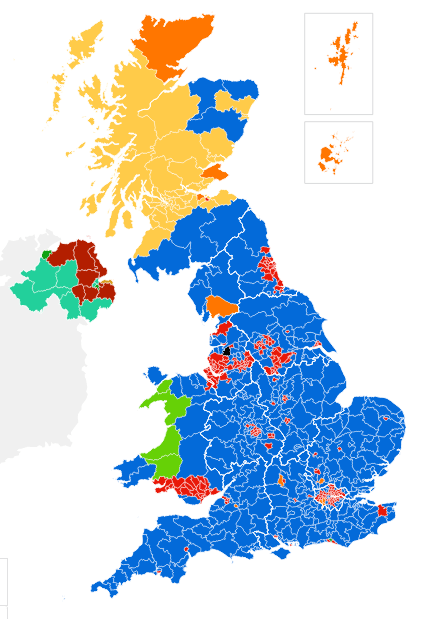
Take one look at the coloured media maps of the election result by constituency. England and Wales are covered with a patchwork of Tory blue surrounding red islands of Labour. Scotland is wall-to-wall yellow. Northern Ireland has neither red or blue but swathes of other colours. It looks more like three different countries—certainly not like a union.


Map2019election

UK 2019 Election Results Map by Party

As England’s population of 55 million represents 72% of the entire UK (77m), it is natural that it should dominate debate. But, as with the crucial Brexit debate, the degree to which Remain-voting components of the UK (Scotland and Northern Ireland) were drowned out by the disproportionate scale of England’s voice. The word ‘union’ implies that there are two or more elements involved. If, as happened with oil and now with Brexit, the larger partner in the union ignores the other to follow its own purposes, yet requires the smaller partner to comply with its every whim, then this verges on abuse, Similar behaviour between two people in a marriage would be considered unacceptable and justify divorce, irrespective of the wishes of the other partner.
It is possible that, having formed a stable government on the back of his large majority, Boris may soften his confrontational attitude towards junior members of the Union. He may see the tension into which Spain is thrown by aggressive repression of a clearly democratic effort by Catalans to secure themselves as a county. Or he may be swept up by the London-centric fixation of the Tory party and consider the HS2 project adequate recompense for the rest of the country to balance the £billions thrown at CrossRail.
Unfortunately, the Tory track record on perceiving that a union requires consideration of other partners is poor. From Highland estates, to oil, to Trident at Faslane, to Thatcher’s Sermon on the Mound and the Feeble Fifty, to opposition to a Scottish Parliament, to Brexit and now to a second referendum, the priority has been on one nation: England and its best interests. They tried to rule the American colonies in England’s interest and lost the greatest asset the Empire ever had. Even when forced by revolt and bloodshed to let Ireland leave the Union, they held on to six Irish counties. Look how well that turned out over the last century, when compared with a peaceful and now more prosperous Republic.
Remaining parts of the Union might as well be colonies, for all the say they have…or may ever have under “One Nation” Tories.

Posted in Politics | Tagged | Leave a comment

The Impotence of Being Earnest

Unless you have been snow-camping in the Mamores for the last month or are a fanatic for one party you will be cringing every time the word ‘election’ is mentioned. And the fervour with which the media—BBC especially—are banging on about it could tightly be accused of overkill. But they are not the main culprits.

Because, when you talk to the average voter and reassure them that you are not there to punt any particular point of view, they tend to lose that look of panic and calm down. For younger voters, brought up with mobile phones and Facebook, the scrappy, sound-bite nature of modern discourse on social media is second nature. If you can’t tweet or text it, the message isn’t worth digesting.

Older votes recall gentler days, when party political broadcasts might actually be watched and leaflets read. But that was before broadcasters discovered the jump cut, the gladiatorial lure of the leaders’ debate and the rottweiler interview.

To be fair to the politicians, such developments forced them into a media arms race. Whereas fifty years ago, any senior politician being interviewed would be treated with deference and respect. They had, after all, deigned to discuss things in public, for which the interviewer should be suitably grateful. Asking a question more than once was deemed rude. As interviewers became more forensic, interviewees became more evasive. This was compounded when party staffers discovered media management and armed their politician front men with media training, the basic rules of which are:

  • Appear authoritative; never stumble; keep talking
  • Always be positive—admit nothing
  • Answer a different question if the first one is awkward
  • Punt your policy sound bite whether its germane or not
  • Bad-mouth the opposition at any opportunity.

Once one party (actually the Tories) had hired the Young Turk SPADs who became the priesthood of this religion, major parties followed suit. This led to embracing techniques culled from other countries, like ‘air war’ vs ‘ground war’, focus groups, phone canvassing, targeted mailing, etc. To marshal and manage the complexities and subtleties of all this, the ‘Chief of Staff’ role became pivotal. By dint of experience, parties learned that this role required the properties of a sales whizz, a drill sergeant and a pit bull. The result wasn’t pretty. But it was effective. As the prototype, Alaastair Campbell showed what could be done by delivering Blair a series of election victories and spawning the highly entertaining “In the Thick of It“.

Since Blair stood down, Alaastair has had many imitators, with both the present two main exponents of the creed (Dominic Cumming for Boris Johnson and Seamus Milne for Jeremy Corbyn) being just as uncompromising in ranking effectiveness above all else. They may be titled “Executive Director of Strategy and Communications” or whatever, but make no mistake: they dominate how the party—and that includes all senior members—behave in the public eye.

Sadly, while this pubic stonewalling prevents too much discussion of real issues—let lone car crash disasters—it has bred a level of cynicism among all kinds of voters, whether they pay attention or not. The media frenzy that features this merely adds to the cynicism. Even seasoned forensic interviewers of the Jeremy Paxman/Andrew Neil/Andrew Marr Illuminati make scant headway towards the truth when faced with evasion of such elegance that thee should be Brtawards for those involved.

All of which leaves those parties foolish enough to still believe honesty and sincerity has a place in 21st century politics pretty much out in the cold. It leaves Caroline Lucas coming across like a wide-eyed new ecology lecturer and Jo Swinson as an earnest girl scout. You can fault what they say. But in the bear-pit-masquerading-as-debate into which British elections have fallen, political success, if not survival, appears to hinge on how effectively you can hoodwink the electorate—as well as the interviewers.


Posted in Politics | Tagged | Leave a comment