
On Sky’s Sunday with Trevor Philips, Business Secretary Kemi Badenoch dismissed speculation about her becoming Tory leader and professed loyalty to Rishi Sunak for having “halved inflation and grown the economy”. Really? In which fiscal fantasy world is the UK government now living?
Right-wing Conservatives are scathing about anyone who dares to “talk the country down”. But what if that is deserved? At what point does their positive post-Brexit cheerleading become the economic equivalent of putting fingers in ears and loudly singing “Rule Britannia”? Over the New Year, several articles in the Torygraphcrowed how much better UK expected to be over that “engine of EU growth” Germany. This is indeed true, but paints a slanted picture.
“I just don’t agree with the narrative that Brexit has ‘severely damaged’ our economy. Every major country, especially in Europe, has faced significant economic challenges over the last few years. We should stop taking ourselves down, and instead talk ourselves up.”
—Kemi Badenoch speech, November 7th 20323
Indeed, the OECD has said global growth had been stronger than expected in 2023, but that growth will remain modest in 2024 and 2025. In contrast to Kemi’s upbeat assertions, the OECD calculates UK GDP grew by 0.5% in 2023 and by 0.7% in 2024. Its overview figures for the G7 in 2023 are shown in Chart 1 below.
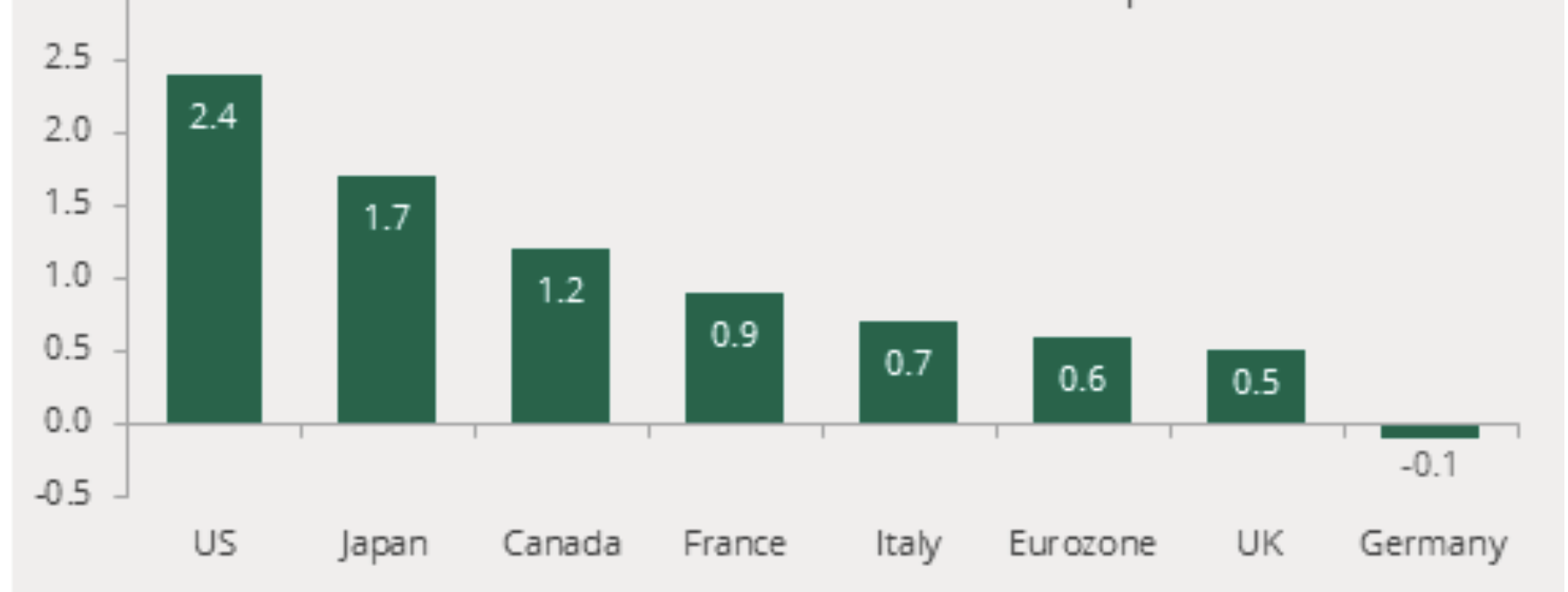
While this chart confirms the UK doing better than Germany, this contest for last place should be an embarrassment, rather than something to crow about. Far more revealing would be to admit sluggishness and see what we could learn from the leaders.
A recent report from the US Bureau of Economic Analysis showed strong economic growth of 3.3% in the U.S. in the fourth quarter of 2023, setting growth for the year at 3.1%. This is greater than that shown above. But even at five, rather than six times the UK’s growth, it rates the UK economy as “sickly” as opposed to “strong”. It also shows Biden’s leadership in a strong light; in the first three years of Trump’s term, before the pandemic, growth was 2.5%). A year ago, economists projected that the U.S. would have a recession in 2023 and forecast growth of 0.2%. US unemployment remains low, wages high, and inflation is receding (3.4% for the year, vs the UK’s 4.0%).
“The final three months of the year looked a lot like the soft landing Fed officials are seeking to achieve.”
—Gabriel T. Rubin, Wall Street Journal
There is a major political story behind this impressive economic one. Since 1981, US lawmakers have insisted that cutting taxes, regulation, and the social safety net would create much faster and more efficient growth than was possible under the system in place between 1933 and 1981. This is echoed by prominent Tories like Jacob Rees-Mogg and John Redwood, who still preach the discredited lesson sof “Reaganomics”.
In the earlier era, lawmakers regulated business, imposed progressive taxes, and supported workers to make sure that ordinary Americans had the resources to fuel the economy through their desire for homes, consumer goods, and so on. But with the election of Republican president Ronald Reagan, lawmakers claimed that concentrating wealth on the “supply side” of the economy would enable wealthy investors and businessmen to manage the economy more efficiently than was possible when the government meddled, and the resulting economic growth would make the entire country more prosperous.
The problem was that this system never produced the economic boom it promised. Instead, it moved money dramatically upward and hollowed out the American middle class while leaving poorer Americans significantly worse-off.
When he took office, Biden rejected “supply side” economics and vowed to restore buying power to the demand side of the economy. His policies invested in manufacturing, infrastructure, small businesses, and workers’ rights. After years in which pundits said these policies would never work, the U.S. economy appears very strong.
With December’s UK government borrowing at “only” £7.8 billion, Chancellor Hunt is being pressured by supply-side Tories to use this unexpected “headroom” to cut taxes. This would be foolish and counterproductive. Another £7.8bn added to the existing £2,685 billion of public debt may not seem much.
But it represents another £409 million in annual interest, on top of the £14,100 million already being paid. Put another way, £14 more of taxes paid by each UK household will be diverted to service our massive debt.
Had Kemi Badenoch been right in parroting the party line that UK GDP is growing like the US’s, then debt would diminish as a fraction of GDP—and perhaps justify even more borrowing.
As it stands it is wilful denial on a national scale.
#1092—732 words

 davidsberry